
Britain is suddenly alarmed about supposed “ethnic cleansing” in the West Bank.
The British government warns that Israeli policies could force Palestinian Arabs from parts of Judea and Samaria. It is sanctioning Israelis, condemning “settlements” and portraying demographic change in territory claimed by Palestinians as a grave moral offense.
Britain has seen ethnic cleansing in this territory before. Its reaction was very different.
In 1948, The Kingdom of Transjordan crossed the Jordan River and conquered Judea and Samaria and eastern Jerusalem. It then destroyed and expelled the Jewish communities that had lived across the territory. The ancient Jewish Quarter of Jerusalem’s Old City was emptied of its Jews. Jews were then barred from their holiest sites, as synagogues were destroyed or desecrated.
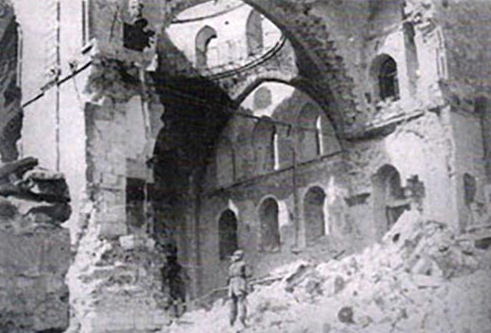
The result was remarkably complete: the territory Jordan occupied was ethnically cleansed of Jews. And less than two years later, Britain formally recognized Jordan’s union with the territory it had invaded and conquered, one of the only countries in the world to do so.
Jordan then made the demographic principle explicit. Its 1954 nationality law extended Jordanian nationality to former Palestinian citizens residing in the kingdom while expressly carving out “the Jews.”
Jordan expelled and excluded the Jews in its holy land, and Britain’s response was recognition.
In 2005, Britain would celebrate again, this time in Gaza.
Israel decided to dismantle every Jewish community in the Gaza Strip. Israeli soldiers physically removed roughly 8,000 Jews from their homes and twenty-one Jewish communities disappeared. A Jew-free Gaza emerged.
Britain did not describe this as ethnic cleansing. Prime Minister Tony Blair praised Israeli Prime Minister Ariel Sharon’s “courage” and offered Britain’s “full support” for the withdrawal. His foreign secretary called it a hugely significant step toward peace.
Now consider 2026.
Britain warns against the possible displacement of Palestinian Arabs from Area C of the West Bank, territory that has remained under Israeli civil and security control under the Oslo framework pending a final agreement. It speaks of forcible displacement, imposes sanctions and treats the prospect of Palestinian Arabs losing their communities as intolerable.
The moral principle sounds admirable. It would be more convincing if Britain had ever applied it equally to Jews in the region.
When some Palestinian Arabs might be displaced from territory it hopes to use in a future Palestinian state, Britain suddenly discovers that removing a particular ethnic population from its homes is beyond the pale. Instead, England demands that the region be ethnically cleansed – of Jews – citing the antisemitic UN Security Council Resolution 2334.
There is a British consistency here: ethnic cleansing is only appropriate when Jews are removed.
For generations, British policy has treated the removal of Jews from disputed territory as compatible with peace. A Palestinian Gaza without Jews was progress. A Jordanian West Bank without Jews was acceptable. A future Palestinian state is still routinely imagined as a place where Jewish communities cannot remain.
Only the possibility of some Arab relocation produces moral outrage.
That exposes the deeper problem with the diplomatic vocabulary surrounding the conflict. “Two states” has quietly come to mean one multicultural Jewish state containing a large Arab minority alongside one Palestinian state expected to contain no Jews. One and one-half states for Arabs; half a state for Jews.
England understands the ethnic cleansing of Jews – it did it itself in 1290 – the only minority group to ever be expelled from the country. It seems to continue to only have a taste for that kind of hatred and ethnic cleansing, including in the Jewish homeland.


