There was a time when respect was earned by learning. People who studied hard, accumulated degrees, mastered facts and logic were admired. They didn’t need followers; they had knowledge. They didn’t need virality; they had depth.
That world is gone.
Fame today is not built in libraries or laboratories but in the palm of a hand. A ring light replaces a classroom. A viral clip replaces a thesis. And the more lurid, outrageous, emotional, and dishonest the content is, the faster the fame spreads. The algorithms demand provocation, not proof. They reward outrage, not understanding.
And people are responding exactly as the system intends: they’re dropping degrees, skipping college, deciding that years of expensive education aren’t worth it in a world where clout is free and clicks are currency. AI will write the papers anyway. Tuition is a fortune. Morality is optional. Why struggle through years of learning when you can fabricate a persona, press “upload,” and watch the world react?
For the first time in history, the older generation will have far more education than the young. Degrees are becoming relics. Expertise is becoming an antique. And winning hearts and minds through argument — the old democratic ideal — is becoming a luxury.
Politics is drifting toward the young, the uninformed, the inflamed, the furious, the ones who know how to play the game of attention better than the game of truth.
Hasan Piker doesn’t win debates; he wins followers. Comedian David Smith isn’t famous for jokes; he’s famous for attacking fellow Jews, because tearing down your own people brings clicks in a sick digital economy.
And here is the crisis for the Jewish people: We are the People of the Book trying to survive in a world where books don’t matter. We are a civilization built on reason, argument, text, questioning — and we cannot comprehend why we’re losing the PR battle against influencers who deal only in emotion, rage, and spectacle.
We fight with facts. They fight with feelings.
The socialist-jihadi crowd celebrates Hasan Piker showing up at Zohran Mamdani’s victory party
We build logic. They build engagement.
We look for truth. They look for traction.
And so a terrifying question hangs in the air: Must Jews abandon their values to survive? Must we trade nuance for noise? Must we jump into the sewer of social-media fabrication because that is the only battlefield the world seems to care about? Must we out-viral our enemies just to protect ourselves from the lies, the hatred, and the persecution that spread faster than any truth we offer?
Or is there a third way — a way to fight fiercely without becoming the thing we oppose? A way to compete in the digital arena without destroying the intellectual soul that has kept us alive for 3,000 years?
This is the defining challenge of the modern Jewish experience. Not whether we can win a debate — we always could. But whether debate still matters.
And if it doesn’t, then the Jewish people must decide how to defend themselves in a world where vanities, not virtues, are the currency of influence.
The People of the Book didn’t choose this kind of world. But we must learn how to survive it — without losing who we are.
When I was a kid, before every supermarket aisle was filled with OU symbols, you had to read the ingredients yourself. That’s how you figured out whether something was kosher. No stamp, no shortcut. You made your own call with the information at hand.
It wasn’t perfect but that training carried over to how I learned to read the news. You didn’t wait for someone in authority to tell you what was moral. You read, you weighed, you judged.
After the October 7 Gazans’ slaughter in Israel, non-Orthodox denominations—the same ones least interested in kosher certification—raced to the presses with appeals for peace on both sides and declarations of shared mourning. The Orthodox world stayed largely quiet.
Then in August 2025, Open Orthodox rabbis decided they, too, needed to weigh in, well after Hamas and its allies had been trounced. Their letter condemned Hamas’s atrocities, but it quickly shifted its focus. Israel, they argued, bore moral responsibility for not providing enough food to Gazans and for Jewish violence in the West Bank.
The reaction was swift. The Coalition for Jewish Values (CJV), representing a more traditional Orthodox camp, branded the letter a distortion. They accused the signatories of ignoring critical facts, downplaying Hamas’s genocidal intent, and amplifying Jewish sins while minimizing Islamist terror. In other words, the Open Orthodox letter was stamped “Not Kosher.”
But step back for a moment and ask the obvious: who exactly are these letters for? Are the rabbis addressing their own congregants and communities, who look to them for guidance in halacha, prayer, and Jewish life? Are they trying to lecture the Israeli cabinet, which is fighting an existential war 6,000 miles away? Are they speaking to the American press and social media audience, where the concern is whether they will be judged as sufficiently “balanced” or critical? Or do they believe they are the modern equivalent of biblical prophets keeping Jewish kings in check?
The truth is that no single voice speaks for the Jews. And if you want serious political analysis, rabbis are not the address. They are trained to decide what happens when your meat knife slices into a piece of cheese—not how to conduct a multi-front war. When the OU stamps a product, it’s because real diligence has been done: site visits, lab tests, ingredient tracing. When rabbis stamp foreign policy with a moral hechsher, it’s about as kosher as Zabar’s selling ham on Chanukah.
Meanwhile, rabbis are getting urgent war-related questions. Not about ceasefires or humanitarian corridors—but about how to bury a soldier whose body isn’t recovered, or what obligations a spouse has when the other is on the front line, or how to mourn when half a community is shattered. Those questions are answered the traditional way: discreetly, privately, and halachically. That is moral clarity.
Open letters, by contrast, are performative. Nobody asked these rabbis to issue a ruling on how the IDF fights its battles. If anyone had, the question and answer would have been private, rooted in Torah and respect. To publish sweeping pronouncements in American media isn’t moral clarity—it’s moral vanity. It attempts to signal superiority over the very people fighting and dying, while feeding the antisemitic bonfire already raging online.
That may be the point. To profess innocence now that certain lines have been crossed, to posture publicly so that no one can accuse you of silence. But make no mistake: this is not Torah. It is branding.
Moral clarity means living the values you preach and answering the hard questions your people actually ask. It does not mean stamping your moral logo on a war you neither fight nor fully understand.
When liberals talk about “weaponizing racism,” the meaning is clear. Think of the infamous cases where white people call the police on Black people for doing something perfectly innocuous — selling water, birdwatching, sitting in a Starbucks. The very act of dialing 911 becomes a way to make Black people feel more vulnerable, more over-policed, more endangered. Racism is real in this framing, and its “weaponization” is a way of worsening the problem, inflicting still more harm on those already marginalized.
But when it comes to antisemitism, the logic gets flipped on its head. When Rep. Jerry Nadler (D-NY), Rep. Pramila Jayapal (D-WA) or campus activists talk about “weaponizing antisemitism,” they don’t mean that Jews are made more vulnerable. They mean the accusation of antisemitism is being used to silence critics of Israel or chill free speech. In this version, the harm is not what antisemitism does to Jews — but what claims of antisemitism do to non-Jews.
December 4, 2023 debate about “weaponizing antisemitism” on the House floor
That’s a disturbing asymmetry. With racism, the victim is always centered: racism exists, and its weaponization compounds the pain. With antisemitism, the victim disappears entirely: antisemitism itself is treated as unreal, and Jews are recast as the aggressors who manipulate charges of antisemitism for their own gain.
That’s not just dismissive. It’s antisemitism squared: denying the reality of antisemitism, while simultaneously vilifying Jews as powerful, conniving actors who exploit victimhood to harm others. It erases Jewish vulnerability, erases Jewish history, and turns the victims into villains.
The result is a discourse where every minority group is believed about its pain — except Jews. For everyone else, weaponization highlights their marginalization. For Jews, weaponization supposedly proves their power. That isn’t a progressive double standard. It’s an old antisemitic one, dressed up in new language.
For decades, the pro-Palestinian narrative labeled any Jew living east of the 1949 Jordanian Armistice Lines a “settler.” The term was never about accuracy but about framing. “Settler” implied that Jews were foreign interlopers, distinct from Arab residents who were cast as the indigenous population. So when Jewish and Arab families from Jaffa moved to Jerusalem’s Old City, only the Jews were called settlers. The transplanted Arab was considered at home, while the transplanted Jew was branded an intruder.
Even more strangely, the label of “settler” wasn’t tied to the founding of a new community. A Jew moving into an existing neighborhood—or even just a single apartment—could suddenly transform the entire edifice into a “settlement.” Words bent reality; the label carried the weight of illegitimacy.
But the terminology seems to be shifting. Wafa, the Palestinian Authority’s official media arm, now increasingly calls Jews in these areas not “settlers,” but “colonists.” The updated lingo seems to fit better with the intellectual currents flowing through Western universities, where post-colonial studies cast Jews as Europeans imposing themselves on native lands. Never mind that Jews are the indigenous people of Judea, Samaria, and Jerusalem, and that there are more Mizrachi Israeli Jews than Ashkenazi—the narrative works if repeated often enough.
Wafa website on August 19, 2025
If the key to eroding U.S. support for Israel lies in framing Jews as oppressors and colonizers, then the Palestinian Authority is adapting accordingly. By embracing this academic jargon, it aligns itself with progressive activists abroad.
Expect the United Nations, NGOs, and sympathetic media outlets to follow suit. Language is a weapon, and the word “colonist” sharpens the blade. The campaign is not just to vilify Jews east of an arbitrary line—it is to recast Jewish presence anywhere in the land as alien, invasive, and illegitimate.
Further, “settlers” is deeply embedded with an anti-Jewish narrative. A pivot to a generic smear appears less antisemitic as well as more universal in condemning the entire Western world’s imperialism and colonialism. Take on Jews everywhere in “Palestine.” Take on Americans throughout “Turtle Island.”
“Colonists” are the new cudgel in the effort to purge Jews from their homeland. It’s a deliberate term and effort, crafted so as to be easily next replicated against Americans by radicals as the new school year begins.
For Americans and Israelis, a summer vacation in Europe is almost instinctive. A relatively short flight offers a world away—new languages, different currencies, distinct cuisines. The joy is in the immersion: wandering museums, hearing street musicians in centuries-old plazas, staring up at Gothic spires, and feeling the weight of two millennia of history.
But the summer of 2025 was different. The walls of Europe’s cities told a darker story.
Alongside the usual student slogans and political tags were messages aimed squarely at one people and one country. Anti-Israel graffiti was everywhere—not just Palestinian flags but slogans in English declaring ” Smash Zionism” and “all Israeli soldiers are war criminals.” The words were not about policy disputes or borders. They were echoes of the Hamas charter, demanding the eradication of the Jewish state.
This was not the first time Europe’s streets had carried such messages. A century ago, it was pamphlets, posters, and shop signs. In the 1930s, “Kauft nicht bei Juden”—“Don’t buy from Jews”—was painted on storefronts. Nazi caricatures and blood libel imagery were plastered in public squares. These were not fringe ideas—they were mainstreamed into the civic landscape, normalizing antisemitism as part of public discourse.
Today’s slogans are more fluent in the language of modern activism, but the purpose is the same: to strip Jews of legitimacy and belonging. In the 1930s, the Jewish store owner was framed as a threat to society; in 2025, the Jewish state is framed as a threat to world peace. Then as now, the goal is erasure—economic, cultural, political, and, ultimately, physical.
What makes the present moment particularly jarring is its setting. The graffiti appears on the same walls that tourists pass on their way to see memorials to Europe’s murdered Jews. A plaque in the street may commemorate Jews deported to Auschwitz, but the wall above it proclaims “From the river to the sea,” a slogan advocating the removal of the Jewish State altogether. The contradiction is almost too much to process: “Never Again” in bronze, “Again Now” in spray paint.
Europe and the United States remain the last major powers to hold off on recognizing a Palestinian state somewhere in the Middle East. But that resistance is softening—not from a careful appreciation of the challenges of creating a peaceful, democratic state alongside Israel, but from the pressure of chants and hashtags lifted from jihadist manifestos. Politicians are not being persuaded by policy papers; they are being worn down by the relentlessness of street-level messaging and its seep into mainstream politics.
For Israeli and American Jewish tourists, the graffiti is not abstract. It’s aimed at them, personally. To walk through a city square and see your country branded as genocidal is not just uncomfortable—it’s alienating. It says: We know you’re here, and you’re not welcome IN HEBREW.
The tragedy is that many of the cities now hosting this wave of messaging were once vibrant centers of Jewish life, wiped out in living memory. The graffiti is a reminder that antisemitism, like the paint itself, seeps easily into old cracks, clings to old walls, and waits for the right political climate to dry in place.
There was scant commentary on the streets about the antisemitic genocidal group Hamas that launched the war. When it appeared, it was very small and seemingly in reaction to pro-Palestinian paint. It was a tank-versus-switchblade graffiti street brawl. The conflicts in Ukraine, Sudan, Myanmar and elsewhere were nowhere to be seen.
In the summer of 2025, Europe’s walls have become more than stone: they are mirrors that reflect not just the continent’s history, but its willingness to embrace its darkest periods. A reminder that the high brow culture frequently sinks in moral depravity.
When Moses addressed the Israelites in Parashat Vaetchanan, standing on the threshold of the Promised Land, his message was clear and urgent: Keep the commandments and you will live; abandon them and you will be driven from the land.
“You must observe His rules and His commandments that I am commanding you today, so that it may go well with you and your children after you, and so that you may endure in the land that God, your God, is giving to you forever.”
Deuteronomy 4:40
It wasn’t a political warning. It wasn’t about borders, treaties, or weapons. It was spiritual. Covenantal. National.
He reminded them: God didn’t choose you because you were many or mighty. He chose you because He loved you. And what does God ask in return? Not sacrifices, not empty rituals, but love expressed through loyalty. Loyalty shown in deeds—by keeping His commandments and walking in His ways.
That covenant stands today.
Amid a global spike in antisemitism, war in Israel, and growing divides between Jews in Israel and the Diaspora as well as secular and religious Jews in Israel, it’s time to return to the constitutional core of Jewish life: the Ten Commandments.
There are 613 commandments in the Torah, but these ten were spoken directly by God to the entire nation at Sinai. They were repeated again by Moses in Deuteronomy for a reason. They are not just laws—they are foundations.
If we want to stay in the Land we must invest in them.
Here are ten national action items for Israeli and Diaspora Jews alike to bring the Aseret HaDibrot back to life:
—
1. “I am the Lord your God” — Reclaim Faith
In Israel: Integrate emunah (faith) into national identity, not just religion. Teach the purpose of Jewish existence in the IDF, sherut leumi, and public schools.
In the Diaspora: Strengthen Jewish schools and programs that teach belief as something deeper than ethnicity or culture. Anchor identity in divine purpose.
The Shema prayer is in this parsha, a prayer to be read aloud with concentration. Let each session of the Knesset and Jewish day schools begin with that first sentence.
—
2. No Other Gods — Confront Idolatry
In Israel: Take on modern idols—power, tech, money. Demand spiritual accountability from the startup- scaleup nation.
In the Diaspora: Counter the worship of celebrity and culture with Jewish meaning and humility. Lead with Jewish ethics, not trendiness.
Focus on Humble Faith to moderate the human tendency to exaggerate our worth and blind us to God’s gifts.
—
3. Do Not Take God’s Name in Vain — Elevate Speech
In Israel: Clean up public discourse. Hold politicians, rabbis, and influencers accountable for words that desecrate God’s name.
In the Diaspora: Promote reverence and honesty in all Jewish communication—online, in media, and in leadership.
We all carry a global megaphone with us at all times of the day. Beware of proclamations and defamations made in the name of Judaism.
—
4. Keep the Sabbath — Build National Unity
In Israel: The Haredi community must not sit out the war. They must serve through sherut leumi by helping others keep Shabbat—cooking meals, opening homes, dancing in the streets. Make Shabbat the shared joy of the nation.
In the Diaspora: Host Shabbat for unaffiliated Jews. Create communal spaces that let people taste sacred time—no judgment, just joy.
Jews have the special opportunity to show each other and the world the special nature of Shabbat. Make it holy for you and your family. From there, let it spread outward to the community, country and civilization.
—
5. Honor Your Father and Mother — Care for the Elderly
In Israel: Train Israeli youth in elder care. It’s a disgrace that our Holocaust survivors and parents are mostly cared for by foreign workers.
In the Diaspora: Create teen-elder programs that pass down memory and dignity. Jewish continuity depends on honoring the past.
Modern psychology has taught many of us to center our being on ourselves and blame parents for our situations. Even – or especially – if that’s true, spend time showing honor to parents and in-laws. It is a pathway for a healthy society.
—
6. Do Not Murder — Value All Life
In Israel: Try to end domestic violence and youth crime. Reclaim the sanctity of life as a national value, not just a slogan.
In the Diaspora: Jews must lead on mental health and abortion, the leading causes of preventable death.
Every life is a world. Whether one is in favor or opposed to abortion, treat life with the utmost respect and engage in debates that are centered on life.
—
7. Do Not Commit Adultery — Strengthen Families
In Israel: Fund pre-marriage education and family counseling. Healthy families are the front line of Jewish survival.
In the Diaspora: Promote Jewish relationships and marriage through values-based education—not just dating apps.
Reorient Friday night dinners away from invited company for two Sabbaths every month to focus on personal relationships.
—
8. Do Not Steal — Demand Integrity
In Israel: Tackle corruption. Ethical leadership is not optional in a holy land.
In the Diaspora: Teach financial and business ethics as part of Torah. Kiddush Hashem starts in the workplace.
At an early age, allow children to reserve certain toys for personal use as opposed to sharing with friends; it allows them to incorporate the idea of ownership and space both for themselves and others.
—
9. Do Not Bear False Witness — Seek Truth
In Israel: End the plague of slander and fake news in politics and media. Truth is a national security issue.
In the Diaspora: Speak with compassion and accuracy. Lashon hara is poison. Truth builds communities.
—
10. Do Not Covet — Practice Gratitude
In Israel: Reduce economic resentment by promoting gratitude and generosity. Envy destroys unity.
In the Diaspora: Celebrate others’ success. Give, volunteer, and stop keeping score.
Being truly grateful involves the public declaration of appreciation: to God in prayer, and fellow person in thanks. It centers the interplay between ourselves and the world in a healthy dynamic.
—
Conclusion: Choose Life
Moses didn’t say this for nothing. The land doesn’t tolerate injustice, idolatry, or apathy. If we want to remain in Eretz Yisrael, we must remember what kept us from here: the first tablets were shattered on diaspora rocks and we wandered in the desert for failing to believe in God’s gift.
We must also remember what brought us to the land: God’s love—and a call to respond in kind.
The Ten Commandments are not old laws. They are today’s mission.
The Old City of Jerusalem including the Jewish Temple Mount/ Al Aqsa Compound
The government is coming down hard on Columbia University for failing to protect Jewish students. It has blocked grants from the school and has come after particular international students. Some civil rights organizations and Democratic politicians have argued that such maneuvers are trouncing protected free speech and are illegal actions against people who have different opinions than President Trump.
People are entitled to have opinions – even hateful ones, and share them aloud or in print. However, such rights are not absolute and have limitations at universities.
In general, people may not stop other people from enjoying their particular rights, say to enjoy the campus and study freely.
2. Students cannot engage in vandalism. Painting red triangles which are the signature of the Hamas terrorist group to target people and breaking glass is destructive. Anti-Israel Columbia students have done this repeatedly.
Red triangles painted on Columbia University COO’s apartment
The vandalism and takeover of schools is against both of these first two principles and certainly not part of free speech. The abduction of a school custodian during the building takeover also warranted severe disciplinary action.
3. People cannot disseminate propaganda and wave flags of US-designated terrorist groups. The United States has labeled several Palestinian Arab groups as foreign terrorist organizations (FTOs). Sharing propaganda from such groups can be viewed as providing material support, a serious crime.
Columbia students who are part of Students for Justice in Palestine shared statements from Hamas leader Ismail Haniyeh that “contextualizes” the slaughter of 1,200 people, kidnapping of babies and Holocaust survivors, and raping of women. They lionized the architect of the October 7 massacre, Yahya Sinwar, Hezbollah leader Hassan Nasrallah and many other mass murderers.
Some of the students at the Columbia encampments have been at rallies with Hamas flags and headbands, and people calling to repeat the October 7 massacre in other parts of the world to achieve “liberation.”
Being associated with designated foreign terrorist groups jumps from “free speech” considerations to the blurry definition of “domestic terrorism” to the very real and illegal area of “international terrorism” which the federal government will prosecute immediately.
4. People may not intentionally provoke someone “face-to-face” in an action likely to be met with violence. Screaming “I am Hamas” to a Jew in the aftermath of Hamas’s butchery of Jews and the genocidal group’s promise to repeat the heinous slaughter would not be protected under free speech.
5. Beyond provoking a violent response, free speech may not intimidate or harass someone or a group of people, especially if they are part of a “protected group.” For example, a mob yelling for all Zionists to get off a subway is not protected under free speech.
More generally, free speech only relates to government involvement. A private business or university may have restrictions on offensive speech that are more restrictive than federal laws. The government may then investigate the select application of free speech at private institutions when only protecting certain groups’ permitted speech while not for others.
Further, free speech does not shield someone from the ramifications of such speech. Someone may something that is protected under the government’s definition of free speech and still lose a job or opportunity because it is viewed as offensive.
The list above may overlap. For example, drawing a picture of the Islamic prophet Mohammed is protected speech but drawing it on a mosque is vandalism and harassment. Talking about an “Intifada” generally which might mean to “shake off” is okay, yet shouting to “globalize the intifada” while holding “zionism is racism” and “there is only one solution” banners before a Jewish institution is the equivalent of a bomb threat.
Free speech is a cornerstone of America—but so is liberty. The targeted harassment and intimidation of Jews across campuses and cities has crossed the line. Chanting genocidal slogans and glorifying the slaughter of Jews – at Jews – is not protected speech; it’s an assault on civil rights.
Defending the First Amendment must never come at the cost of abandoning the safety and liberty of American Jews.
In May 2024, Time Magazine ran a story decrying “How Weaponizing Antisemitism Puts Jews at Risk.” This idea has become fashionable among progressives, Islamists, and campus radicals. According to this twisted narrative, the real threat isn’t antisemitism—it’s the accusation of antisemitism, supposedly being used to “silence” criticism of Israel. They cite the House Education Committee’s task force on antisemitism as proof, calling it a vehicle to crack down on “pro-Palestinian” protests rather than protect Jewish students. They lobby to prevent the IHRA definition of antisemitism to be accepted in government cases, because Jews shouldn’t be allowed to decide for themselves what defines antisemitism.
Who gave them such privilege?
The charge against Jews is explicit and comes from Jews and non-Jews. UC Berkeley associate professor of history and Jewish studies Ethan Katz was part of the Nexus Project which put words like “Intifada” into various buckets and grades of antisemitism, in an attempt to jettison IHRA’s widely adopted definition. Katz took aim at the House Education Task Force and said “the overarching motivation for many of these people [Republicans on the committee] is to use this as a way of attacking higher education. This means that they are using Jews as a kind of pawn to play a political game.” It’s as though antisemitism doesn’t exist or politicians (read THOSE politicians) couldn’t possibly care about Jews.
We are being reeducated: Jews aren’t victims; they’re tools. Republicans don’t care; their racists using Jews to attack minorities and liberal institutions.
Worse, Jews are no longer victims in this reading but complicit in attacks on progressive causes. The expectation (read demand) from the socialist-jihadi alliance is therefore for Jews to accept the indignities, harassment, intimidation and discrimination lest they speak up, and victims of preference possibly be held responsible or pay a price.
This inversion of reality is extreme – and deadly.
The true weaponization of antisemitism is not rhetorical; it is literal. It is found in the chants of mobs in Western capitals calling to “Globalize the Intifada“—code for bringing the murder of Jews from Israel to the streets of New York, London, and Toronto. It is etched in graffiti that reads “Gas the Jews” in Paris and Melbourne. It is breathed into masked agitators who storm Jewish neighborhoods, businesses, and houses of worship.
Car in Australia with antisemitic graffiti
It is not new. For over a century, Arab leaders have worked to deny the Jewish people their rights. The Grand Mufti of Jerusalem, Haj Amin al-Husseini, incited riots in the 1920s and 1930s to prevent Jews from praying at their holiest site, the Temple Mount. In 1929, that incitement culminated in the massacre of 67 Jews in Hebron. His riots from 1936 to 1939 kept hundreds of thousands of Jews in Europe to die in the Holocaust.
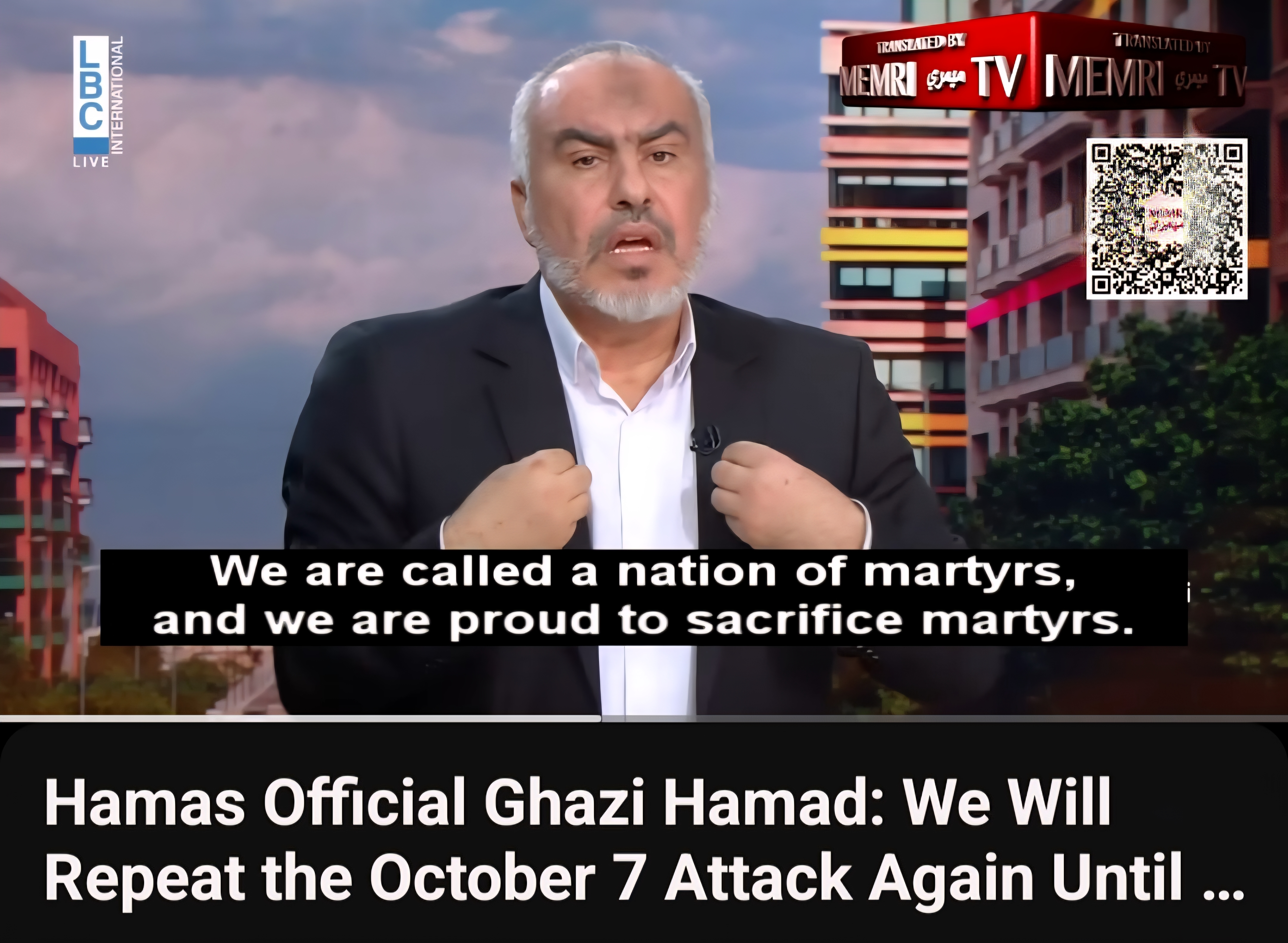
Fast forward to 2023 to Hamas’s October 7 pogrom—an antisemitic massacre that was a direct descendant of that same ideology. Jews, in the Hamas worldview, are not simply an occupying force—they are an infestation. Hamas’s 1988 charter calls for Muslims to fight and kill Jews wherever they may be. The 2006 Palestinian elections, in which Hamas won a majority, validated and empowered that genocidal ethos.
A majority of Gazans have always supported killing Jewish civilians in Israel, according to every Palestinian poll taken since 2000
This hatred has never been about borders or policy. It is about Jewish existence. Jewish presence.
Palestinian Arabs are almost uniformly antisemitic according to Antidefamation League (ADL) polls. They have weaponized their antisemitism and come to ethnically cleanse the land of Jews.
For calling out Muslim antisemitism, the three million-member powerful National Education Association (NEA) teacher union voted on July 6 to cut ties with the ADL. In rejecting using any materials from the ADL, the NEA stated that “despite its reputation as a civil rights organization, the ADL is not the social justice educational partner it claims to be.” NEA delegate Stephen Siegel said “allowing the ADL to determine what constitutes antisemitism would be like allowing the fossil fuel industry to determine what constitutes climate change.”
Only comrades of the socialist-jihadi alliance should be allowed to define antisemitism.
So when House Republicans call a hearing to investigate antisemitism on college campuses after mobs trap Jewish students in libraries and bar entry to Hillel buildings, outlets like Time spin it as a crackdown on speech. When Jewish students file Title VI complaints because professors and deans dismiss their fears and excuse calls for a new Holocaust as “political expression,” activists call it censorship.
Jewish students hide from mob at Cooper Union in New York City
The charge that “antisemitism is being weaponized” is not a defense of speech—it’s a shield for Jew hatred. It inverts the aggressor and victim and gaslights the world into thinking that Jews are too powerful, too organized, and too vocal in defending themselves.
It is not only in the Jewish Diaspora. The Islamic Republic of Iran – sworn to the destruction of the Jewish State which it calls a “cancer” – has literally weaponized its nuclear program. Not willing to be exterminated, Israel preemptively took out the infrastructure of the weapons of mass destruction. And the world came after Israel as if it were the aggressor.
Because there is a corrupt belief that Jews must accept their fate silently.
UN claims that Israel cannot defend itself from the political-terrorist group Hamas which rules Gaza and has 58% of the seats in parliament
The world has been trained that Jews have too much – whether power, money, land, rights – even pride. People believe that Jews should be stripped of those items and absorb the abuse. To demand basic human rights, dignity or protection is not considered defense but an assault on the attackers.
Are Jews hunting Palestinians on Western campuses or are Palestinian flag-wavers cornering Jewish students? Did Israel issue a fatwa against Arabs and Muslims, or was it Osama bin Laden who said that Jews will never be safe, Hamas that declared in its charter that it is an obligation for every Muslim to kill Jews, and Palestinian Authority President Mahmoud Abbas who demanded a land ethnically cleansed of every Jew?
The world knows that antisemitism has been weaponized but not by Jewish students or congressional investigators. It has been weaponized by Hamas with bullets, knives, and fire. By “anti-Zionists” who shout genocidal slogans and assault Jews in the the streets of the Global North. By media figures who gaslight Jews to stay silent to protect the indefensible in the name of free expression.
Antisemitism has been weaponized and Jews are dying. Hamas’s willing executioners are telling you to move along.
Before Adolf Hitler ever raised his voice in Munich, he walked the streets of Vienna. The year was 1908. He was a failed artist, a nobody—but he was watching. And what he saw was a master class in antisemitism, taught by none other than the city’s powerful mayor, Karl Lueger.
Karl Lueger (1844-1910), mayor of Vienna, Austria 1897-1910
Lueger didn’t scream; he smiled. He didn’t wear jackboots; he wore a mayor’s sash. But his message was clear: Jews don’t belong. He didn’t have to say it outright—he just needed to point at “Jewish capital,” “Jewish influence,” “Jewish power.” Always with a wink, always in the name of the people.
Hitler later said Lueger was one of the greatest German politicians of all time. Not because he was a fascist but because he knew how to mainstream hate. He made antisemitism a component of civic reform.
Sound familiar?
Over a century later, in Queens, New York, Assemblymember Zohran Mamdani is walking the old path in new shoes. Like Lueger, he’s building a political brand on a foundation that isolates Jews—especially those who support the Jewish State—as outside the moral community.
Criticize the Israeli government? Fine. Hold them accountable? Of course. But Mamdani goes further. He doesn’t criticize Israeli policies. He calls for Israel’s erasure. He doesn’t debate Zionism. He demonizes it. And anyone who affirms the Jewish right to self-determination is labeled part of the problem. AMCHA Initiative has long shown how Students for Justice in Palestine (SJP) on campuses – a group which Mamdani is proud to help found at his college – correlates to a steep rise in attacks against Jews.
We all see the impact on Jews today.
It’s Lueger’s method, just in post-colonial language.
Just like Lueger – and others like disgraced politician Jamaal Bowman – Mamdani claims he’s not against Jews; he’s just against the wrong kind of Jews—those who won’t denounce their homeland, who won’t apologize for their peoplehood. Like Lueger, Mamdani gets to decide who counts as a “good Jew.”
Zohran Mamdani (right) being endorsed by disgraced former Congressman Jamaal Bowman
And here’s the haunting echo: who’s watching today?
In 1908, Hitler was a quiet observer of Lueger. Who’s listening to Mamdani now?
Who’s the radical activist or ideologue soaking up the message that Jews are oppressors, that Zionists are the enemy, that the Jewish state is a crime? Who’s internalizing this polite, polished, progressive bile and dreaming of taking it further?
No, Mamdani isn’t directly inciting genocide. But Lueger didn’t either. History tells us you don’t need to pull the trigger to light the fuse. Lueger mentored Hitler without even knowing him.
We remember how it started last time. We worry who might be watching this time.