Eight Muslim countries issued a joint statement Sunday condemning Israel’s rejection of the latest roadmap for implementing President Donald Trump’s Gaza peace plan. They are: Saudi Arabia, Egypt, Jordan, Qatar, the United Arab Emirates, Turkey, Pakistan and Indonesia.
They have no formal collective name. So call them the Muslim Eight — the M8.
Together, the M8 countries have roughly 817 million people and contain forty percent of the world’s Muslims. Indonesia and Pakistan alone are two of the world’s largest Muslim-majority countries.
The M8 was assembled by U.S. President Donald Trump with a specific purpose.
On September 23, 2025, on the sidelines of the United Nations General Assembly, Trump convened the leaders and senior officials of these eight Arab and Muslim countries. The goal was to end the Gaza War and build a day-after framework. Trump needed Muslim and Arab countries with street-cred in Gaza to make that happen, as well as a history of operating functioning governments.
Egypt controlled the critical border with Gaza and, together with Qatar, was central to negotiations with Hamas. Jordan brought its relationship with Israel, the Palestinian Authority and sensitive holy sites in Jerusalem. Saudi Arabia brought money, Arab leadership and the enormous prize of possible normalization with Israel. The UAE brought capital, administrative expertise and an existing relationship with Israel. Turkey brought regional power and channels to Hamas. Pakistan and Indonesia brought two enormous Muslim populations and legitimacy extending well beyond the Arab world.
Trump assembled M8 to be directed at the problem in Gaza. Help end the war. Get the hostages released. Stabilize the ceasefire. Keep Hamas from returning to power. Reconstruct Gaza. Support a new Palestinian administration. Reform the Palestinian Authority. Create a workable security structure.
Six days after Trump’s meeting, the M8 jointly welcomed his Gaza peace proposal and committed themselves to working with the United States and the parties to implement it.
When Hamas responded to Trump’s proposal in October, the M8 responded together. When disputes developed over Rafah, the M8 responded together. When Trump established his Board of Peace to oversee Gaza’s transition, all eight announced together that they would join.
Trump had created a Muslim steering committee for Gaza. But soon, the M8 discovered it could steer other things.
By December, it was collectively defending UNRWA, even as Trump’s postwar architecture was establishing new institutions to govern, finance and rebuild Gaza.
In March 2026, the M8 jointly condemned Israeli restrictions at Al-Aqsa Mosque/ the Jewish Temple Mount. Later that month, it issued another statement about Muslim and Christian access to Jerusalem’s holy sites.
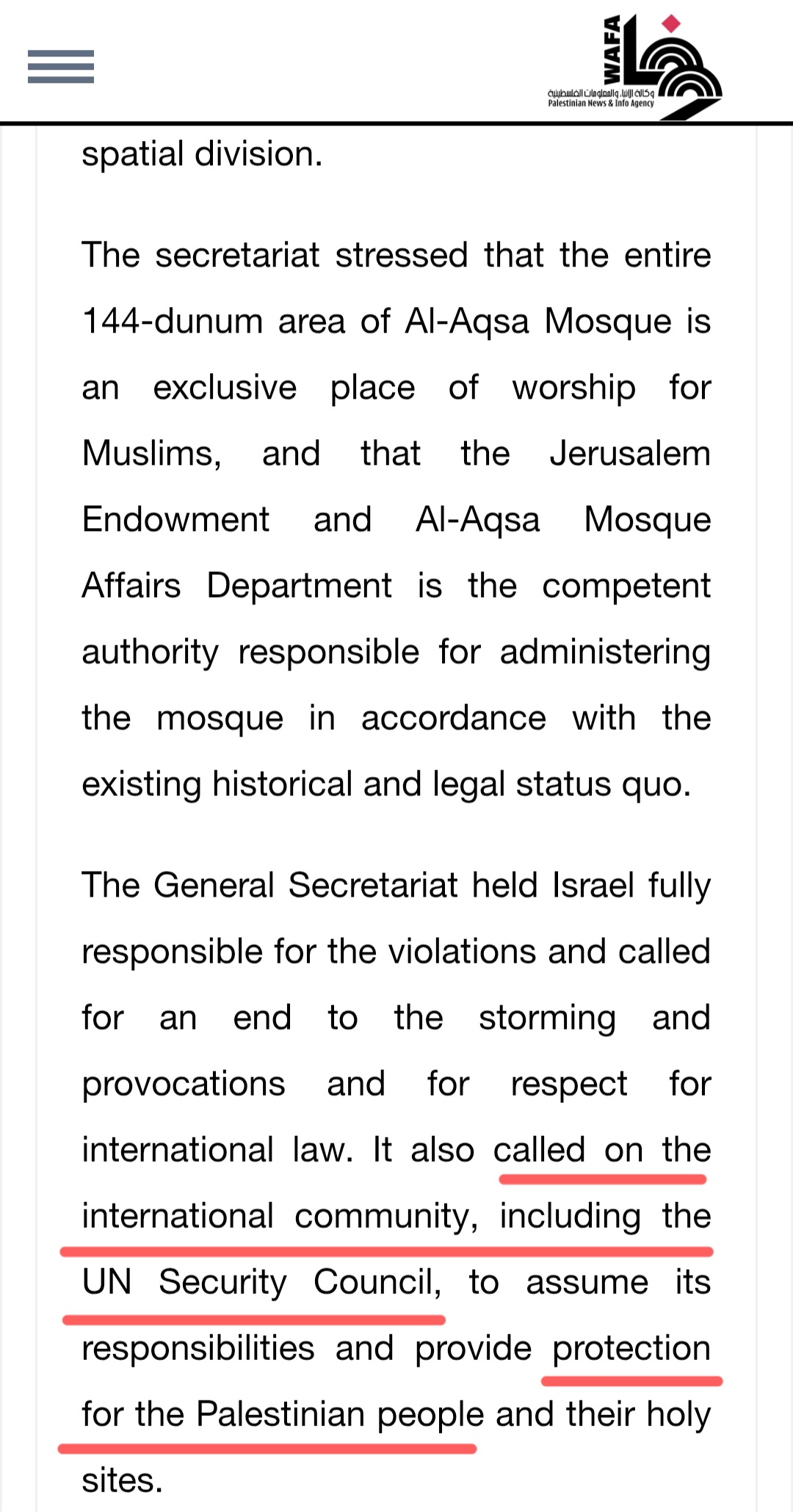
In April, it jointly declared that the entire 144-dunam Temple Mount/Haram al-Sharif compound was exclusively a Muslim place of worship and backed the Jordanian Waqf’s authority there.
The M8 began issuing collective positions on Israeli settlements, Israeli sovereignty measures, “settler violence” in Judea and Samaria.
None of that was why Trump assembled the M8.
The Board of Peace was created around a specific Gaza program: maintain the ceasefire, demilitarize Gaza, establish transitional Palestinian governance, rebuild the territory, reform Palestinian institutions and create conditions for a different future.
Yet the M8 now speaks on subjects well outside of Gaza with the institutional weight it acquired by becoming Trump’s chosen Arab-Muslim partner. A coalition created to solve Gaza has become a platform to pressure Israel over Jerusalem, Judea and Samaria, UNRWA and Palestinian statehood.
Trump gave the M8 a mandate to help fix Gaza. The M8 is turning it into a mandate to lecture Israel.
Charts regularly circulate showing the countries with the most “unicorns” — private companies that achieve valuations of at least $1 billion. Divide the totals by population and tiny Israel suddenly jumps toward the top of the world.
But the headline number obscures a three more interesting stories.
Israel did not spend 75 years steadily accumulating unicorns. Most of its unicorn phenomenon is remarkably recent. And many of the companies created by Israelis aren’t headquartered in Israel at all.
Then there is what these companies actually do.
Put those three pieces together — when they emerged, where they are headquartered and what they sell — and Israel’s unicorn story looks like a specialized company-production machine for today’s world.
The Unicorn Explosion
In 2011, only 16 new unicorns were created in the entire world. Israel was hardly overflowing with them either. TechAviv data show Israel produced just four new unicorns in 2015 and nine in 2019.
Then the curve turned sharply upward.
Israel produced 19 new unicorns in 2020 and 42 in 2021. By December 2021, TechAviv counted 79 Israeli-founded unicorns. By December 2022, there were 98.
That means the Israeli unicorn story people now take for granted is largely a phenomenon of the last several years.
“Israel ranked first globally in terms of its number of technology unicorns per capita. As of 2025, the country’s startup scene contained 90 active tech unicorns, and raised billions of dollars in investments annually. These are indicators of an exceptionally well performing startup ecosystem, which forms the basis of the country’s robust technology industry.” – Statista.com
The cheap-money technology boom certainly helped. Valuations soared everywhere in 2020 and 2021. But Israel’s performance was exceptional even within that global frenzy.
Israeli Unicorn Doesn’t Necessarily Mean in Israel
Of the 79 Israeli-founded unicorns counted at the end of 2021, only 33 — 42% — were headquartered in Israel.
The rest were spread around the world:
19 in New York.
15 in Silicon Valley.
5 in Boston.
3 in London.
2 in Los Angeles.
1 in Singapore.
1 in Chicago.
A year later, the ratio was almost identical. Of 98 Israeli-founded unicorns in December 2022, 40 were headquartered in Israel and 58 abroad. Silicon Valley had 24 and New York had 19.
So roughly three out of every five Israeli-founded unicorns were headquartered outside Israel.
That matters when looking at those viral country rankings. A ranking based strictly on corporate headquarters can count an Israeli-founded company as American. A ranking based upon where the entrepreneurs came from can count the same company as Israeli.
Israel is creating companies for a market vastly larger than Israel.
What Israel Is Creating
Israeli unicorns aren’t distributed evenly across the economy. The country’s technology ecosystem has become increasingly concentrated around enterprise software, fintech and cybersecurity.
The Israel Innovation Authority found that these three categories represented 29.4% of companies founded in 2013 but 42% by 2021. By 2022 they were attracting 53.4% of all investment in Israeli startups.
Cybersecurity is particularly extraordinary.
Dealroom currently counts 26 cybersecurity unicorns headquartered in Israel. It calculates that Israel is 9.15 times more represented in cybersecurity unicorns than its overall share of the world’s unicorn population would predict. Tel Aviv alone ranks behind only the Bay Area in Dealroom’s global cyber-unicorn count.
And that is based on headquarters. It therefore doesn’t fully capture Israeli-founded cyber companies headquartered in places such as New York and Boston.
Israel also over-indexes in semiconductors, health technology and medtech, although nowhere close to its extraordinary concentration in cyber.
Meanwhile, the composition of Israeli technology has been changing.
Communications — historically one of Israel’s great technology strengths, including hardware infrastructure and chips — represented about 8% of newly established Israeli technology companies in 2013. By 2022 it was just 1.7%.
” In H1 2025, High-Tech accounted for 57% of all Israeli exports, the highest share ever recorded. The export mix points to a clear trend: 72% software services versus 28% High-Tech industry. This means Israel is increasingly reliant on software services exports, while the High-Tech industry, including the defense industry, has been relatively stagnant. Israel increasingly went from building the pipes to building the software running through them.” – Israel Innovation Authority
Israel Invents. America Scales.
That industry mix helps explain the geography.
A cybersecurity company potential customers are banks, governments and Fortune 500 corporations around the planet. An enterprise-software company can develop its technology in Tel Aviv while putting executives and salespeople close to customers in New York. A fintech company can maintain Israeli engineering operations while establishing its corporate headquarters in the world’s largest financial market.
And those American headquarters aren’t simply mailing addresses.
In 2023, the United States–Israel Business Alliance identified 88 Israeli-founded unicorns with global or regional headquarters in the United States. Together, those companies employed nearly 62,000 people worldwide.
The available data do not establish how many of those employees were specifically in America, so the 62,000 should not be described as American jobs. But broader state studies show that Israeli-founded companies have become meaningful American employers. In California alone, Israeli-founded companies directly employed more than 14,000 people, with their broader economic activity supporting more than 22,000 jobs.
That economic relationship runs in both directions.
American venture-capital and private-equity firms finance Israeli entrepreneurs. Israeli founders establish U.S. headquarters and hire American salespeople, executives and other employees. American corporations then acquire some of the most successful companies, bringing Israeli-developed technology inside American businesses.
Google’s acquisition of Israeli-founded Wiz for $32 billion provides an extraordinary recent example. Cisco agreed to buy Israeli-founded CyberArk for approximately $25 billion in 2025. Intel’s earlier $15.3 billion acquisition of Mobileye demonstrated the same model on a massive scale. Three Israeli technology companies. More than $70 billion of announced acquisition value. Three American buyers.
The relationship is particularly important because Israel’s strongest sectors overlap with technologies the United States increasingly considers strategic: cybersecurity, artificial intelligence, semiconductors and advanced computing.
The Israeli and American ecosystems therefore aren’t competing with one another for unicorns. They are often parts of the same machine.
Israel supplies entrepreneurs, engineers, military-trained cyber expertise and dense technical networks. The United States supplies enormous customers, deep pools of capital, experienced executives and the world’s largest technology exit market.
The result is a peculiar multinational organism: Israeli-created, frequently American-headquartered, American-financed and globally sold.
A Very Young Herd
Israel’s unicorn phenomenon is not simply impressive because a country of roughly ten million people has produced so many billion-dollar technology companies. It is impressive because the herd appeared so quickly.
It is unusual because most of the herd established headquarters outside the country that produced its founders.
And it is revealing because the herd increasingly congregated in a few industries where Israel developed extraordinary comparative advantages — particularly cybersecurity, enterprise software and fintech.
For Americans, there is another reason to care.
Israel’s technology success isn’t occurring on the other side of the world in isolation from the American economy. Some of the value Israel creates lands in New York, California, Massachusetts and elsewhere in the United States — as headquarters, jobs, investment opportunities, technology and acquisitions.
The familiar unicorn-per-capita chart therefore captures only the surface. The deeper story isn’t that Israel has a lot of unicorns.
Over the last decade, Israel became very good at manufacturing global technology companies — together with American capital and talent.
WAFA, the Palestinian Authority’s official media, has spent years describing Jews who enter the Temple Mount as “storming Al-Aqsa.” I have written about that linguistic sleight of hand before.
Now WAFA is promoting something more dangerous: that Jews have no right to enter Judaism’s holiest site without Muslim permission, and that Jewish worship there is an assault on Islamic sanctity.
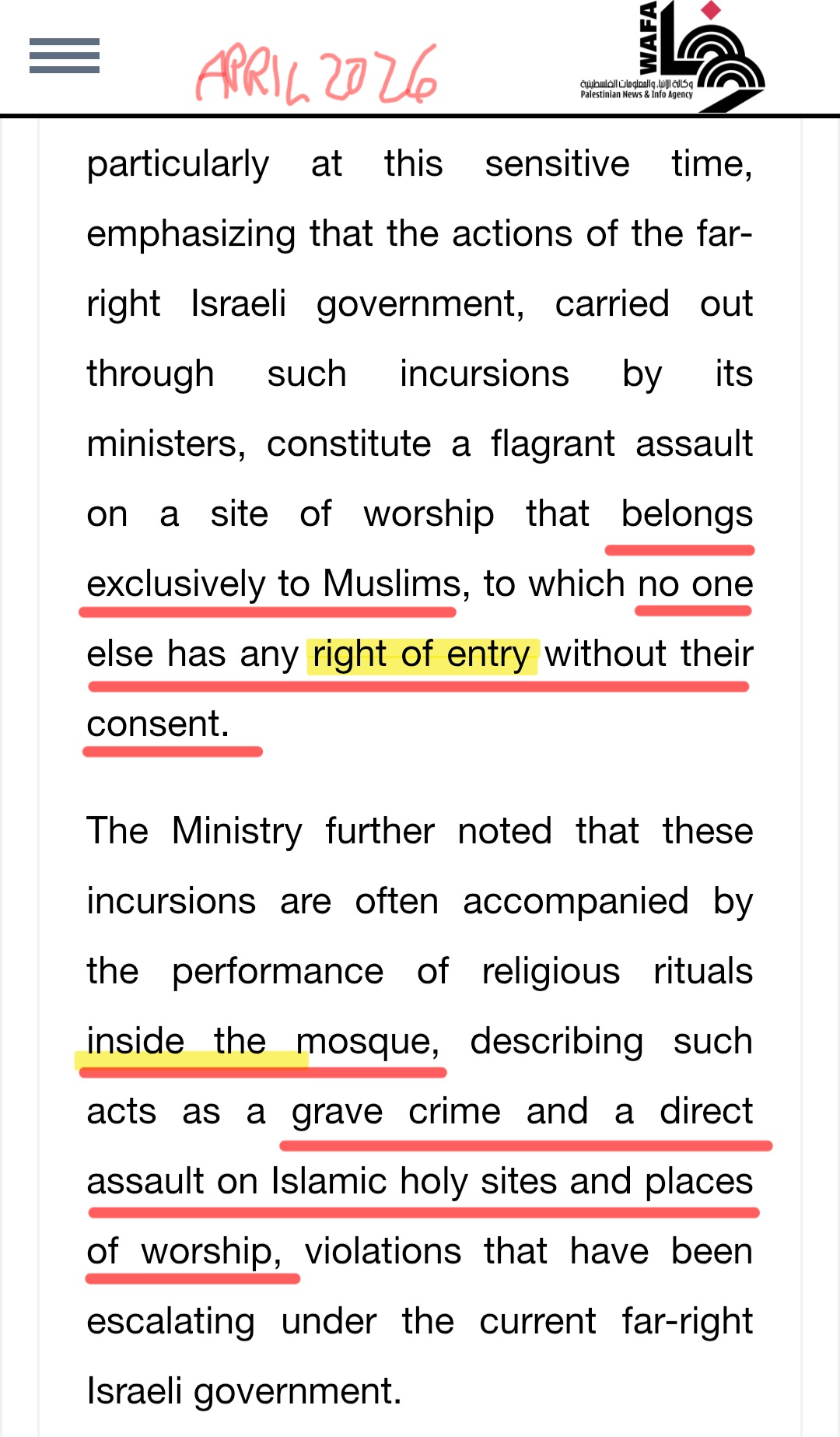
In April 2026, WAFA reported a Palestinian statement declaring the site one that “belongs exclusively to Muslims, to which no one else has any right of entry without their consent.”
On August 13, WAFA carried an Arab League statement condemning Jews entering the site and performing religious rituals as a “blatant violation of the sanctity of the mosque.”
WAFA promoted several lies:
Muslims do not control entry. Israel controls security and access to the Temple Mount. The Jordanian-backed Waqf administers Muslim religious affairs there. Presenting Muslim consent as a prerequisite for Jewish entry is totally false.
The compound does not “belong exclusively to Muslims.” That is a religious and political claim masquerading as settled fact about the Temple Mount—the holiest site in Judaism.
Jewish presence does not inherently violate Islamic sanctity. Islam does not have a general rule that a Jew entering Muslim sacred space desecrates it. Restrictions on Jewish prayer under the status quo are one issue; declaring Jewish worship itself an assault on Islam is another.
Then comes another sleight of hand.
Having defined Jewish presence as an offense against Islam, these organizations pivot to demanding action by the international community on behalf of Palestinians.
But those categories – Muslims and Palestinian Arabs – are not interchangeable.
Some 1.85 million Muslims live in Israel, nearly one-fifth of the country’s population. And the Muslim religious administration of the Temple Mount is handled by the Jordanian-backed Waqf. Palestinian Arabs do not exercise control over entry to the site, nor do they represent all Muslims in the region.
So why transform an asserted Muslim religious grievance into a Palestinian national claim demanding international intervention?
Because the lies are the tell.
The argument is no longer about protecting Muslim worship. It takes an assertion of Muslim religious exclusivity, converts it into a Palestinian territorial right, and then asks the world to enforce that right against Israel and Jews.
The implications become darker when the same logic is applied beyond the Temple Mount. Hamas’s 1988 charter declared all of Palestine an Islamic waqf. Combine that doctrine with the claim being promoted around Al-Aqsa—that Jewish physical presence and worship offend Islamic sanctity—and expelling Jews can be transformed into protecting Muslim holy land.
“the land of Palestine is an Islamic Waqf consecrated for future Moslem generations until Judgement Day. It, or any part of it, should not be squandered: it, or any part of it, should not be given up.” – Hamas Foundational Charter, Article 11
That is why the Arab League and WAFA’s language matters. By repeatedly publishing these false assertions, it helps turn a Palestinian territorial claim into a purported Islamic prohibition against Jewish presence.
And it begins at the most perverse possible location: Judaism’s holiest site.
The progression is stark:
Declare the Jewish holy site exclusively Muslim.
Deny Jews the right to enter without Muslim permission.
Call Jewish presence and worship a desecration of Islam.
Turn that religious claim into a Palestinian territorial right.
Ask the world to enforce it.
The Arab League and Palestinian Authority are building a religious and political case for removing Jews from their own holy land.
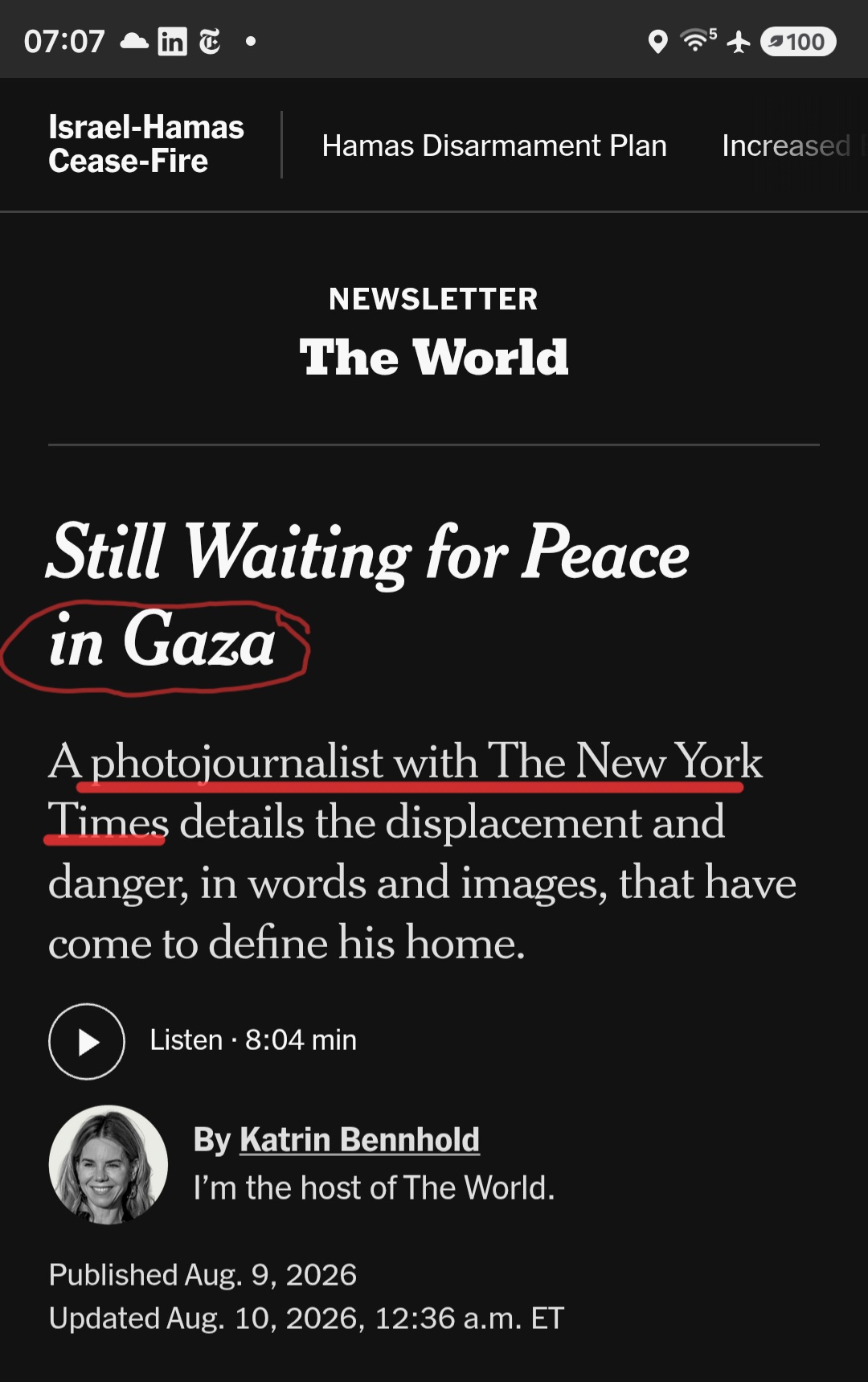
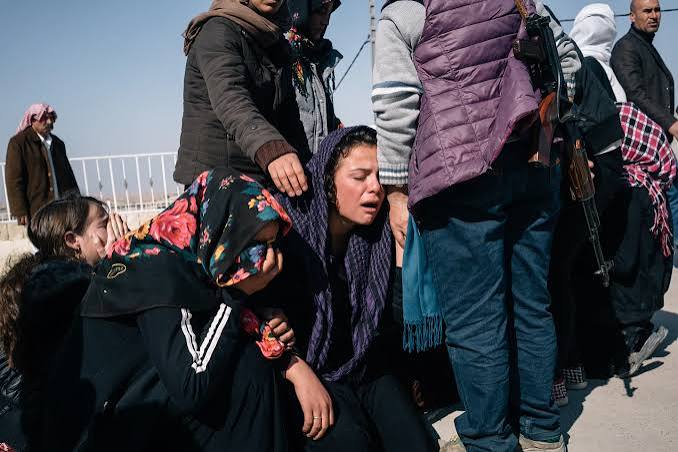
The New York Times published a photo essay under the headline “Still Waiting for Peace in Gaza.” Its Palestinian Arab photojournalist documents the world around him: shattered buildings, displaced families, rubble and danger. The photographs powerfully show what war looks like from inside Gaza.
But what does peace look like?
For Israelis living a few miles away, peace means sleeping without rockets overhead. It means children not watching their parents gunned down before them. It means young adults attending a music festival without being hunted, families living on kibbutzim without gunmen entering their homes, and civilians never again being murdered or dragged across the border as hostages.
Those images are outside the Times’ frame. And their absence raises the central question: Are Gazans waiting for peace with Israel, or peace from Israel?
Palestinian Arab polling makes the distinction important. After October 7, the Palestinian Center for Policy and Survey Research repeatedly asked whether Hamas had been correct to launch its attack. In March 2024, 71 percent of Gazans said yes. Three months later, after enormous destruction inside Gaza, 57 percent still considered the decision correct. Support showed a desire to live with violence inside Gaza if it led to the destruction of Israel.
The pattern predates October 7. Palestinian polling over decades has repeatedly recorded substantial support for attacks against Israelis, including civilians. The question of peace therefore cannot be answered simply by photographing people who desperately want the war around them to end.
Peace is reciprocal. It requires imagining security for the people across the border as well as for oneself.
A revealing photo essay would turn its lens outward. Ask Gazans whether Jewish families should live safely in Sderot and Kfar Aza. Whether Israelis should be able to dance near Gaza without fear of armed Palestinian Arabs crossing the border. Whether rockets should stop permanently. Whether Hamas should disarm. Whether the future they envision includes Jews living securely beside them.
Those answers would tell us whether Gazans are waiting for an end to war or waiting for peace.
And this is where the New York Times itself enters the frame. This is the newspaper’s own photojournalist, presented under the Times’ own headline and editorial framing. By calling the desire for calm inside Gaza “waiting for peace,” the newspaper takes one side’s desire for relief from war and gives it the language of reconciliation between two parties. It portrays the Palestinian Arabs as desirous of coexistence when it is plainly not so.
That framing is particularly consequential when the war began with Hamas crossing into Israel on October 7 to murder and abduct civilians. When thousands of Arab civilians invaded Israel to rape women and abduct children and spit on their corpses as they arrived in Gaza. Removing Israel from a story about “peace” reduces peace to what happens to Gaza after the attack, rather than what Gazans want to happen to Israelis in the future.
The Times reinforces a distorted understanding of the conflict: Palestinian peace becomes the absence of Israeli violence against Palestinians, while the Palestinian attitude toward violence against Israelis disappears beyond the edge of the photograph.
A camera pointed only into Gaza can show us what Gazans want to stop seeing. Peace begins with asking what they want Israelis to stop seeing too.
Congress did not arrive at legislation protecting Hamas overnight. It arrived there one bill at a time.
For decades, debates over Israel revolved around diplomacy. Republicans and Democrats argued over settlements, negotiations, Jerusalem, and the contours of a future Palestinian state. Even lawmakers sharply critical of Israel generally framed their proposals around advancing a negotiated two-state solution. The disagreement was over how peace should be achieved, not whether Israel had the right to defend itself against terrorist organizations.
In 2020, as the Trump Administration unveiled its peace plan and Israel considered extending sovereignty to portions of the West Bank, progressive lawmakers introduced legislation preventing American assistance from supporting annexation. Whether one believed annexation was prudent or unwise, the objective remained fundamentally political. These bills sought to influence the outcome of negotiations and preserve the possibility of a future Palestinian state. The debate was about borders, diplomacy, and competing visions for peace.
That bill did not stand in isolation.
In 2019, Representative Betty McCollum (D-MN) also introduced legislation prohibiting U.S. assistance from supporting the military detention of Palestinian minors. On its face, the proposal carried moral appeal. No civilized society wants children caught in war, and few slogans resonate more powerfully than protecting minors.
Yet the legislation missed the point. Israel’s military justice system does not prosecute minors because they are children. It prosecutes minors accused of security offenses, including violent rioting, firebomb attacks, shootings, stabbings, and participation in terrorist organizations. Hamas, Palestinian Islamic Jihad, and the Popular Front for the Liberation of Palestine have all recruited teenagers into violent activity for decades.
Arab minors caught on camera right before they stab Israelis
The debate was no longer centered on where Israel’s borders should ultimately lie. It was becoming a debate over whether Congress should restrict Israel’s ability to prosecute those participating in terrorism.
That evolution became unmistakable after October 7.
The largest massacre of Jews since the Holocaust might reasonably have been expected to produce overwhelming congressional support for dismantling Hamas. Instead, it accelerated an entirely different legislative movement.
Arabs in Gaza take the body of Israeli woman they had just killed into Gaza where the crowds pelted her body and spat on her
One proposal after another sought to block the military tools Israel argued were necessary to fight the war. Senator Bernie Sanders (D-VT) repeatedly forced votes to halt major arms sales. Representative Rashida Tlaib (D-MI), Representative Pramila Jayapal (D-WA), Representative Delia Ramirez (D-IL), and others introduced the Block the Bombs Act. Senator Chris Van Hollen (D-MD) sought to impose additional legal restrictions before military assistance could proceed.
US Senator Chris Van Hollen attends a Senate subcommittee on the Justice Departments proposed 2027 budget, on Capitol Hill in Washington, May 19, 2026.
Supporters presented these bills as humanitarian safeguards designed to protect civilians and uphold international law. Their practical effect, however, would have been to deny or delay weapons while Israel was engaged in combat against a U.S.-designated terrorist organization that had murdered, raped, tortured, kidnapped, and burned civilians alive.
Congress was no longer principally debating the contours of a future peace agreement. It was debating how much of Israel’s wartime capability should be withheld while the war itself was still being fought.
And it continued.
In July 2026, Representative Thomas Massie (R-KY) introduced an amendment eliminating the entire $3.3 billion annual Foreign Military Financing package for Israel. Previous proposals had sought to condition aid or block particular weapons systems. Massie’s proposal went much further. It would have ended America’s regular military assistance altogether.
The amendment failed by a wide margin. But 104 members of Congress voted for it, including 103 Democrats alongside the bill’s Republican author.
That vote tells a larger story than the amendment itself.
Over the course of a few years, the legislative progression moved from opposing territorial annexation, to restricting Israeli counterterrorism practices, to limiting the weapons available to fight Hamas, and finally to questioning whether the United States should continue military assistance at all. Each bill built upon the political space created by the one before it. What once occupied the outer edge of congressional debate gradually became part of mainstream legislative discussion.
The coalition itself is unusual. Rashida Tlaib approaches the issue through Palestinian nationalism. Bernie Sanders emphasizes humanitarian law and civilian casualties. Chris Van Hollen argues for greater legal oversight of military assistance. Thomas Massie opposes foreign aid as a matter of constitutional principle. They arrive from very different ideological traditions, yet increasingly find themselves casting the same vote.
For generations, support for Israel was one of Washington’s few enduring bipartisan constants. That consensus has not disappeared; overwhelming majorities in Congress still support the alliance. But the terms of the debate have unmistakably changed.
Six years ago, Congress debated how American policy might influence a two-state solution. Today, members openly introduce legislation that would limit—or eliminate altogether—the military support Israel says it needs to defeat jihadist organizations committed not to coexistence, but to its destruction.
That is the real story of the Jihadi Protection Bills. Not that any single measure became law. But that, one bill at a time, the center of the American political conversation migrated from shaping the peace process to constraining Israel’s ability to wage war against jihadist movements to its basic ability to protect itself in a deeply hostile region.
Words matter. They do more than describe reality. They shape it.
This week, the Palestinian Authority’s WAFA news agency reported that Israel had advanced a housing plan that would “further isolate Jerusalem from Bethlehem.”
The proposal involves building homes, roads, and infrastructure between Jerusalem and Bethlehem. In almost any other place on earth, connecting two urban areas with transportation and housing would be described as integration, development, or greater connectivity.
But not for West Bank Arabs. They object to more Jews living in the corridor connecting them.
In this narrative, Jewish presence itself is an obstacle, an impediment. Jewish life is redefined as separation.
The inversion is striking.
The 1947 UN Partition Plan once envisioned Jerusalem and Bethlehem as a single Corpus Separatum—an internationally administered area shared by Jews, Christians, and Muslims. Whatever one thinks of that proposal, its premise was coexistence, not exclusion. Yet today, not only have the local Arabs refused coexistence, but so has the United Nations.
Contours from the 1947 Partition Plan which included Greater Bethlehem and Greater Jerusalem under a “Corpus Separatum”
Instead of asking how Jews and Arabs can both live, work, worship, and travel throughout the Jerusalem-Bethlehem region, many arguments begin with the assumption that Jewish communities are inherently illegitimate. Under that framework, the more Jews who live or travel there, the more “isolated” the majority-Arab areas are said to become.
When the Partition Plan was being conceived on February 18, 1947, Secretary of State for Foreign Affairs, Ernest Bevin (1881-1951) said “for the Arabs, the essential point of principle is to resist to the last the establishment of Jewish sovereignty in any part of Palestine.” Today, we are not only witnessing the continued entrenchment of that tenet, but the profound hostility to the basic presence of Jews.
Don’t let the word isolation fool you. It is not describing geography. It is describing Jews as obstacles, not neighbors.
We know that every death is a tragedy. We all wish there wasn’t war. Yet wars happen.
There have been several attempts to portray the current Gazans war against Israel in various lights. Some people have used the civilian-to-death ratio in this war of roughly 2-to-1 as historically low compared to any urban combat in modern times, especially one in which the army hides underneath the homes and hospitals of the civilian population.
Here, we lay out the civilian death figures relative to other modern wars which had many civilian deaths.
Assuming:
73,356 reported total deaths in Gaza from October 7, 2023 to August 2, 2026
25,000 of those were Hamas or other militants (a rough figure supplied by the Israeli army in January 2026)
Average civilian mortality per month: 2.19% ÷ 34 = 0.055% per month.
That yields the following comparison:
Case
Estimated monthly percentage killed
Multiple of Gaza civilian rate (0.055%/month)
Gaza [2023-present]
0.055%
1×
Guatemala (Ixil) [1981-3]
0.10%
1.8×
Darfur [2003-5]
0.11%–0.17%
2.0-3.1x
Roma genocide [1939-45]
0.20%–0.69%
3.6–12.5×
Anfal (Kurds) [1987-8]
0.22%–0.44%
4–8×
Ustaše genocide [1941-5]
0.36%
6.5×
Cambodia [1975-9]
0.44%–0.59%
8–10.7×
Rohingya [2017-8]
at least 0.67%
12.1×
Holodomor [1932-3]
0.73%–1.04%
13.2–18.9×
Holocaust [1941-5]
1.32%
24×
Yazidi genocide [2014-7]
0.65%–2.5%
11.8–45.4×
Rwanda [1994]
13.8%–22%
250.9–400×
Srebrenica (monthly equivalent) [1995]
~80%
~1,454×
Monthly toll of civilian deaths in wars over last 100 years, as a percentage of the total population, in comparison to current Gazan war against Israel
Yazidis are a non-Muslim ethnic group in and around Iraq targeted for persecution and annihilation by ISIS. They continue to suffer persecution from Muslims in Turkey and Iraq.
“IS fighters invaded Yazidi villages and towns in Northern Iraq and Iraqi Kurdistan, rounding up men, women, and children. Yazidi men were ordered to convert to Islam; those who did not, and even some who did, were executed in mass graves. Yazidi women and girls were abducted and sold into sexual slavery, being forcibly “married” to jihadists and other individuals in Iraq, Syria, and other countries. Yazidi boys were also kidnapped by the Islamic State and sent to training camps, where they were indoctrinated into the group’s severe interpretation of Islam and trained to become soldiers. IS glorified its atrocities online in gruesome videos, propaganda magazines, and religious publications, emphasizing its commitment to eradicating Yazidi identity.” – Vicken Cheterian, “ISIS Genocide against the Yazidis and Mass Violence in the Middle East,” British Journal of Middle Eastern Studies 48, no. 4 (2019): 1-7, doi:10.1080/13530194.2019.1683718.
Measured against the last century’s ethnic group civilian deaths, the war in Gaza has produced a far smaller death toll than the wars that shaped recent history. Yet few conflicts of comparable scale have generated such an extraordinary level of international media attention, UN action, street protests, and campus activism.
The conflict has spilled far beyond the battlefield. Around the world, Israelis and Jewish communities have increasingly become targets of hostility, harassment, and violence tied to the war. Whatever one’s views of the prosecution of the war, the global reaction has extended well beyond criticism of a government and the borders of Israel unlike every other conflict, raising profound questions about why this war has become so singular in international political and cultural life.
The numbers remind us that history matters. A world that loses its sense of proportion does not become more moral but selective, narrow and biased.
For generations, antisemitism sought to remove Jews from the future. Today, it increasingly seeks to remove them from the past.
That is the deeper significance of the growing campaign to recast Jewish history as Palestinian history. It is not simply a dispute over archaeology or competing national narratives. It is an effort to strip the Jewish people of their origins, their memory, and ultimately their legitimacy and basic human rights.
The examples are becoming impossible to ignore.
The Holocaust—the systematic murder of six million Jews—is routinely appropriated as a metaphor for Palestinian suffering. Jewish victims become a rhetorical device rather than a people with a unique history. The descendants of Holocaust survivors are cast as the new Nazis, while the actual genocide of European Jewry is emptied of its historical meaning.
Some Europeans have taken the Jewish girl, Anne Frank, and dressed her in an Arab kefiyeh as if she were a Palestinian Arab or would have supported the murder of Jews. During World War II, Anne hid in an attic while Nazis hunted her and other Jews for years, before the Nazis took her and murdered her in a concentration camp.
Now even Jesus is being rewritten.
Rather than acknowledging the historical reality that Jesus was a Jew who lived, taught, and died among the Jewish people in Judea, activists increasingly describe him as “Palestinian.” The purpose is to transplant one of history’s most influential Jews from the Jewish story into a Palestinian national narrative that not only didn’t exist in his lifetime, but Arabs didn’t invade the Jewish holy land until the seventh and eighth century CE, hundreds of years after Jesus lived.
The same pattern extends across nearly every cornerstone of Jewish civilization.
The First and Second Temples become myths or located in far-way lands. The Western Wall is detached from Jewish history. Jerusalem is reframed as an exclusively Muslim city. The Jewish patriarchs and matriarchs are recast. Ancient Israel is dismissed as colonial fiction. Hebrew becomes a borrowed language rather than the indigenous language of the Jewish people. Even Jewish holy sites are repeatedly described as exclusively Islamic or Christian.
United Nations 1949 map of of holy sites in Jerusalem lists the Jewish Temple Mount as only holy to Muslims
Each claim may appear isolated. Together they reveal a coherent project.
The goal is not simply to elevate a Palestinian Arab identity or an Islamic one. Every people is entitled to tell its own story. But no national movement has the right to build its identity by erasing another people’s history, heritage and human rights.
If a Palestinian Arab national identity is legitimate, it should be able to stand on its own. It shouldn’t require denying that Jews are indigenous to the Land of Israel. It does not require pretending the Temples never stood in Jerusalem. It does not require transforming Jesus into an Arab. It wouldn’t require appropriating appropriating words and people from their national tragedies.
Anti-Israel author Susan Abulhawa repeatedly uses terms like “Holocaust” to turn Jews into Nazis, in an attempt at misdirection from the popular Palestinian Arab political-terrorist group Hamas, which are actual modern-day Nazis
Yet this pattern of historical theft has increasingly been accompanied by something darker: the revival of some of Europe’s oldest antisemitic ideas.
The Hamas Charter drew explicitly from antisemitic conspiracy theories and echoed themes long propagated by Nazi ideology. Since October 7, the world has again witnessed chants, slogans, and propaganda that do not merely oppose Israeli government policies but deny the legitimacy of Jewish peoplehood itself. Public figures, writers, and activists have too often trafficked in narratives that portray Jews not as an indigenous people with a continuous history, but as impostors who fabricated their past.
If Jews can be separated from Jerusalem, from the Temple, from Abraham and Sarah, from David, from Hebrew, from the Holocaust, and even from Jesus, then they become a people without roots. A nation without ancestors is easier to portray as foreign. A foreign people is easier to cast as colonizers. And colonizers, in the moral framework of today’s activists, can be removed. Should be removed.
Historical negation is not an academic exercise. It prepares the ground for political exclusion, eviction, and violence.
The attempt to steal Jewish history is not ultimately about the past. It is about deciding whether the Jewish people have any legitimate place in the future.
For nearly three years, Spain positioned itself as one of Israel’s sharpest critics in Europe.
Prime Minister Pedro Sánchez repeatedly condemned Israel’s conduct in Gaza, recognized a Palestinian state, pressed for European measures against Israel, and framed the conflict primarily through the language of humanitarian obligation. Israeli officials responded that Spain had become increasingly detached from the security realities Israel faces and was rewarding Hamas diplomatically after October 7.
Then Spain found itself confronting a border crisis of its own.
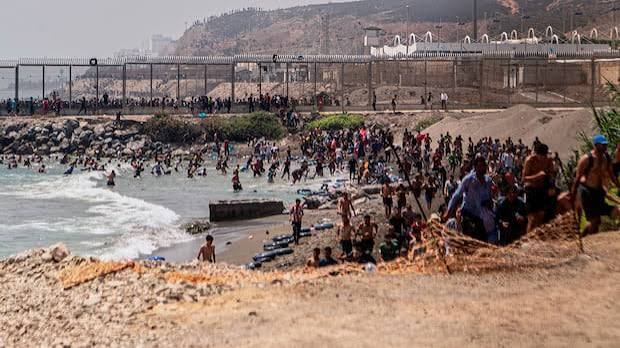
An estimated 49,000 migrants surged into Spain’s North African enclave of Ceuta in a single day, overwhelming local authorities and forcing Spain to deploy troops to restore order. Overnight, the country’s political conversation shifted from humanitarian ideals to border control, sovereignty, and national security.
Israel noticed immediately.
Israeli officials pointed to Ceuta as evidence of something they had argued for years: it is easy to lecture another democracy about borders until your own border collapses.
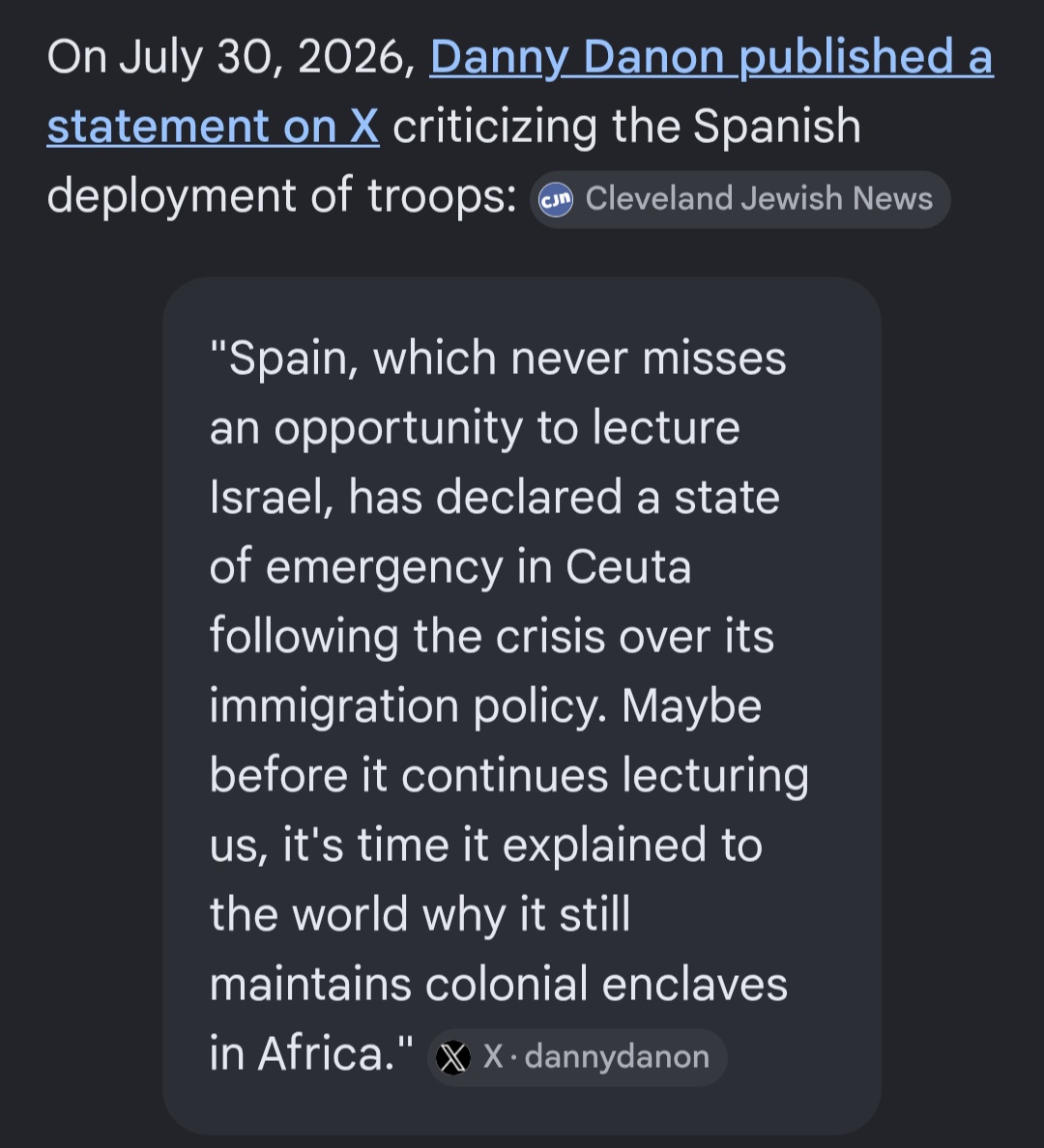
Israeli ambassador to the United Nations Danny Danon took aim at Spain for why it maintains a colony in Africa
There was an unmistakable sense of schadenfreude in parts of the Israeli reaction. The same government that had spent months criticizing Israel for emphasizing security suddenly found itself insisting that no sovereign nation can simply allow tens of thousands of people to cross its frontier without control.
Every democracy must balance compassion with sovereignty. Every democracy must decide whether humanitarian obligations can coexist with meaningful border enforcement. Israel has argued for years that they must. Spain is now discovering how difficult that balance becomes when events unfold on its own frontier.
There is another irony.
Spain’s immediate security now depends heavily on Morocco’s cooperation. Rabat’s willingness to police its side of the border has become essential to Spain’s stability. Yet Morocco chose a dramatically different path from Spain in its relationship with Israel. It joined the Abraham Accords, expanded security, intelligence, and economic cooperation with Israel, and demonstrated that pragmatic regional partnerships can coexist with support for Palestinian aspirations.
Spain and Morocco have moved in opposite diplomatic directions with Israel. Yet today Spain needs Morocco more than ever.
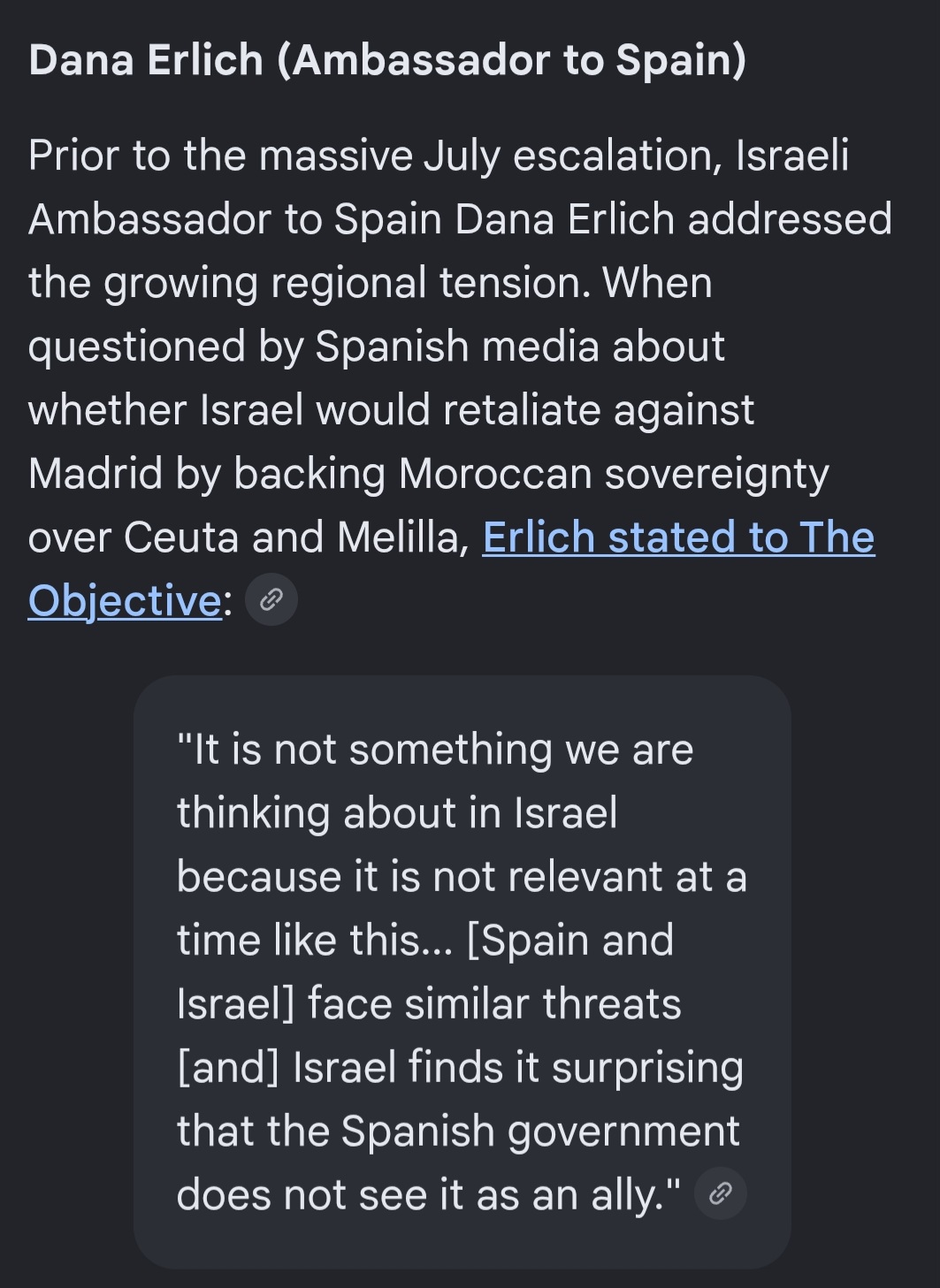
Israel’s ambassador to Spain declined to say whether its government supports Morroco taking over the Spanish enclaves in Africa.
Israel, however, should resist celebrating too loudly.
If Ceuta marks the beginning of sustained migration pressure into Europe, the political consequences are unlikely to stop with Spain. Across the continent, immigration has already fueled the growth of nationalist parties and intensified debates over identity, sovereignty, and integration. Another large migration wave could accelerate those trends even further.
History offers a warning for Jews.
Periods of political instability and polarization have rarely benefited Jewish communities. When societies become more fractured, antisemitism often finds new expression—from parts of the far right, from extremist Islamist movements, and from other ideological currents. Europe has already experienced a sharp rise in antisemitic incidents since October 7, 2023. Additional social upheaval could place Jewish communities under even greater pressure.
Israel can fairly point out the irony of Spain’s predicament. It can argue that Ceuta demonstrates the complexity of governing borders that are easier to criticize than to defend.
If Europe enters another prolonged period of political instability, no one should assume European Jews will remain untouched by the consequences. Those victims will not be amused by Israel nor protected by smug Israeli diplomats saying I told you so.
The Israeli-Palestinian conflict is often described as frozen. It isn’t.
Both Israelis and Palestinians appear to believe that now is NOT the moment for a final peace agreement. Instead of negotiating, each side is using this period to improve its position for whatever comes next.
They have adopted two very different strategies.
Israel’s strategy is physical.
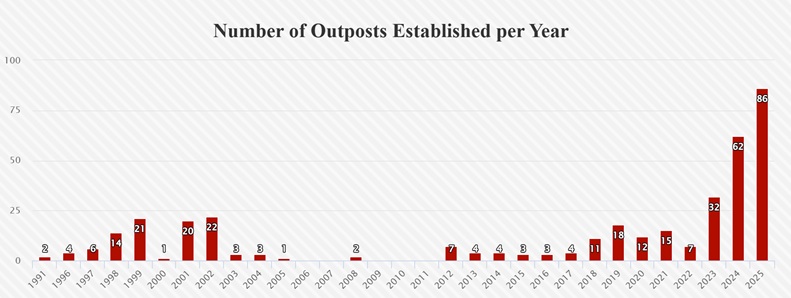
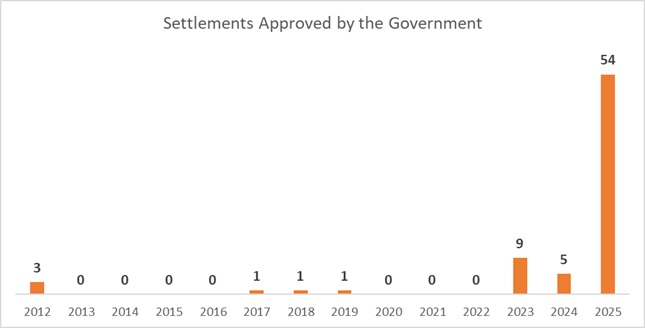
The settlement movement is racing to create new facts on the ground – approving settlements, establishing outposts, extending infrastructure, and expanding the Israeli presence in disputed territory of Judea and Samaria. The calculation is straightforward: when negotiations eventually resume, the map itself will have changed.
The pace has been striking.
ACTION
2025
2026 (through April)
What it Measures
Official settlements approved
54
34 additional approvals (bringing the current government’s total to 102 since January 2023)
Government approval of new settlements or legalization of existing communities.
Rather than altering the geography, Palestinian leaders have concentrated on shifting international opinion. They have sought additional recognition from foreign governments, expanded support within international organizations, pursued legal and diplomatic campaigns against Israel, and strengthened ties with constituencies – particularly within the U.S. Democratic Party – that may wield greater influence under a future American administration. Their calculation is equally straightforward: when negotiations eventually resume, the political environment will have changed.
Expanded formal recognition beyond the Global South.
Major Western powers (2025)
France, United Kingdom, Canada, Australia
First major Western/G7 countries to recognize Palestine, signaling a shift among traditional allies of Israel.
International legal initiatives
Expanded
Increased reliance on the UN, the International Court of Justice, and the International Criminal Court to advance Palestinian objectives.
Political support
Increased
Growing support in parts of Europe and among segments of the U.S. Democratic Party.
Measured by their own objectives, both sides can point to progress. Israel has expanded its physical footprint while the Palestinians have expanded their diplomatic footprint. One strategy seeks to change the map while the other seeks to change the politics surrounding the map.
What is striking is what neither side is emphasizing.
Neither is devoting comparable energy to the difficult work of strengthening governance at home: confronting corruption, reforming institutions, addressing political dysfunction, or building the domestic political consensus that any lasting agreement would ultimately require.
Instead, each is attempting to improve its negotiating position by changing the external environment. It is a race between geography and diplomacy.
The next round of negotiations will not begin where the last one ended. It will begin with a new map and a new political landscape.