
Antisemitism is driving French Jews to consider leaving. France’s political and economic future may determine how many actually go.
France has roughly 436,000 Jews. Nearly two-thirds have considered leaving.
That is the startling finding of a new American Jewish Committee study released in November 2026. Among 500 Jewish adults surveyed by IFOP, 64% reported having considered leaving France, up from 52% in 2024. Eighty-two percent reported experiencing antisemitism during their lifetimes. Nearly half have stopped wearing visible Jewish symbols, while 29% have removed the mezuzahs from their doors.
If Jean-Luc Mélenchon becomes president in 2027, 69% say they would consider leaving, including 40% who would certainly consider it. A Marine Le Pen presidency would prompt 31% to consider departure.

For centuries, France has been home to one of the world’s great Jewish communities. Today, many of its Jews are questioning whether their children should remain.
How many will leave by 2040? And will antisemitism alone determine the answer?
The Jews Who Have Already Left
French Jews have been leaving for decades, with Israel receiving the largest documented share.
Departures accelerated after the murder of Jewish schoolchildren in Toulouse in 2012 and the attacks culminating in the Hyper Cacher supermarket massacre in Paris in 2015.
Between 2014 and 2016, approximately 18,800 French Jews moved to Israel. The movement has accelerated again. By October 2026, Israeli authorities reported approximately 3,950 arrivals from France, already exceeding the roughly 3,400 recorded in all of 2025.

France is losing families raising the next generation and adults who might otherwise have spent their working lives in France.
Yet many who want to leave cannot. A doctor may need new qualifications to practice abroad. A business owner may be unable to sell a business. A family may depend on elderly parents. Some Jews who moved to Israel have returned because they could not rebuild their careers or afford the life they left behind.
Fear may start the conversation. Jobs, housing, family and finances often determine the decision.
What South Africa and Argentina Teach Us
South Africa once had a Jewish community exceeding 100,000. Today it numbers approximately 49,000.
Its Jews did not leave principally because of antisemitism. Political uncertainty, violence, crime and declining confidence in the country’s future persuaded many families that their children would have better opportunities elsewhere.
Argentina followed another path. Its Jewish community endured military dictatorship, hyperinflation and repeated economic crises. The financial collapse of 2001–2002 produced another wave of Jewish emigration.
Argentina’s Jews did not suddenly discover antisemitism in 2001. Their country was collapsing economically, and many who could leave did so.
France has already demonstrated how antisemitic violence can accelerate Jewish emigration. South Africa shows how political insecurity can sustain departures. Argentina shows how economic collapse can accelerate them.
France is neither South Africa nor Argentina. But their histories expose a danger that an exclusive focus on antisemitism misses.
The French Problem
The AJC survey offers a clue that its headlines have largely overlooked.
Twenty-six percent of French Jewish respondents cite concern about the future of Jews in France as their principal reason for considering departure. Another 22% cite concern about France’s future generally, while 8% cite economic reasons. Taken together, 30% of respondents identify France’s broader future or economic prospects as their principal concern, compared with 26% who specifically identify the future of Jews.
The survey also finds that 74% of French people are pessimistic about their country’s future, compared with 61% of French Jews. French Jews are not alone in questioning France’s direction. They are confronting those larger doubts while also facing antisemitism.
And France has reasons to worry.
The European Commission’s November 2026 forecast projects economic growth of just 0.4% this year and 0.6% in 2027. Unemployment is expected to climb from 8.4% in 2026 to 9.8% in 2028.
Government debt, already 115.7% of GDP in 2025, is projected to reach 123.2% by 2028. The budget deficit is forecast to remain above 5% of GDP through 2028. France is borrowing heavily while its economy barely grows. Its political divisions make serious fiscal reform increasingly difficult. Eventually, somebody must pay.
Higher taxes, reduced services and weaker economic opportunities could follow. For French Jews already questioning their future, these pressures would compound the antisemitism they face.
Antisemitism makes Jews question their safety. Political instability makes them question their rights. Economic deterioration makes them question their children’s future. Together, these pressures can turn the desire to leave into the decision to go.
Demographer Sergio DellaPergola has identified relative employment conditions as an important influence on aliyah. Economic opportunity can encourage migration alongside the desire to escape insecurity, provided opportunities abroad are attractive enough to make relocation practical.
How Many Will Leave?
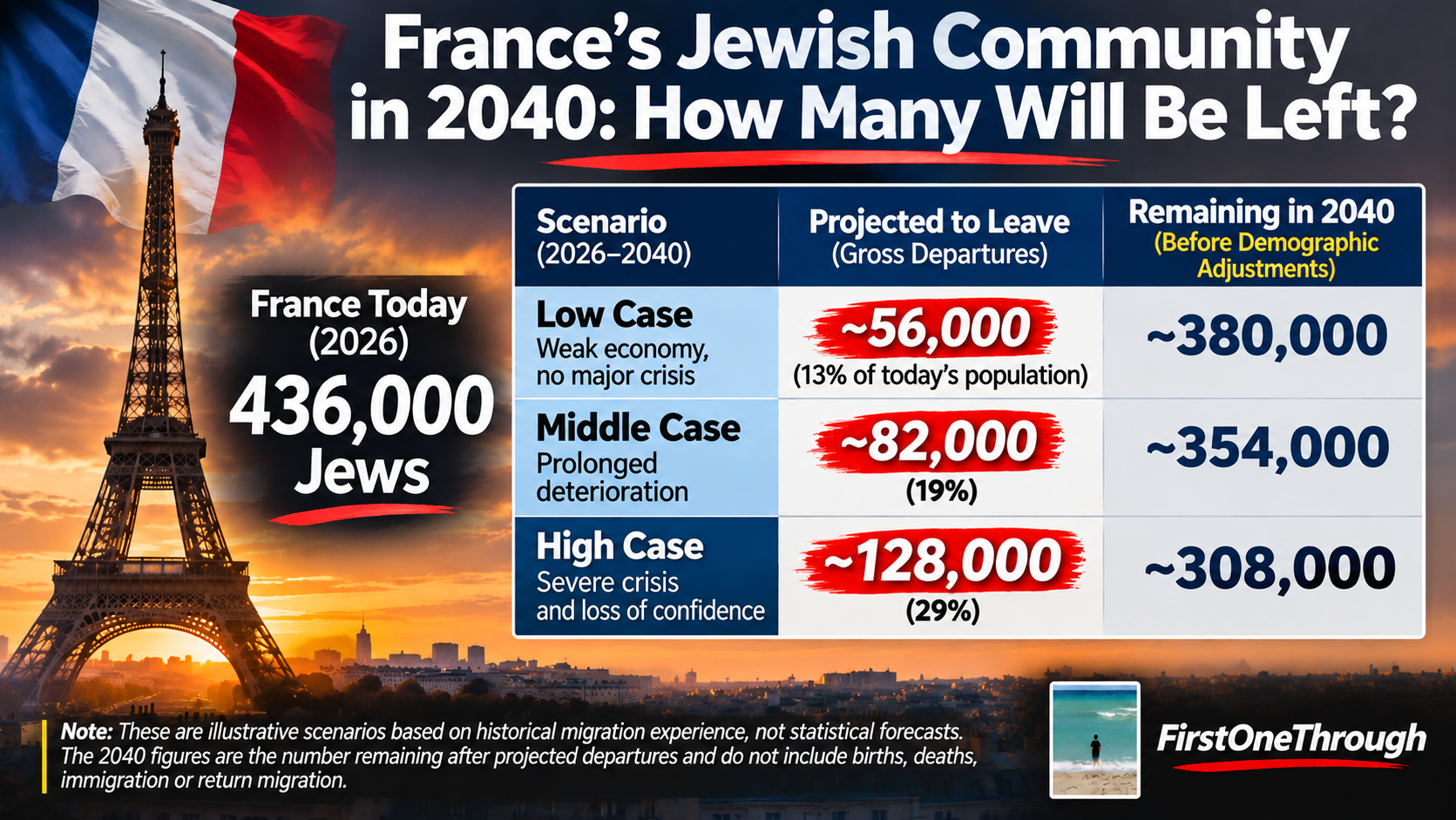
Starting with France’s 436,000 Jews, I examined how emigration might unfold under three conditions: continued economic weakness, prolonged deterioration and a severe national crisis.
France need not experience an Argentine-style collapse to lose a substantial portion of its Jewish community.
| France, 2026–2040 | Low | Middle | High |
|---|---|---|---|
| Antisemitism | Persistent | Worsening | Worsening |
| Economy | Weak but stable | Prolonged deterioration | Severe crisis |
| Politics | Institutions hold | Repeated instability | Major loss of confidence |
| Illustrative gross departures | ~56,000 | ~82,000 | ~128,000 |
| Equivalent share of today’s Jewish population | 13% | 19% | 29% |
The low case assumes that elevated migration gradually subsides toward 0.9% annually. The middle case includes several years approaching 1.8%. The high case requires a much more serious crisis, with rates approaching 3.8% for a limited period.
These are illustrative scenarios based on historical migration experience, not statistical forecasts or predictions of a French economic collapse. They represent gross departures, not permanent population losses. Some emigrants will return, while births, deaths and immigration into France will also affect the population.
Under the middle case, cumulative departures would equal roughly one-fifth of today’s French Jewish population. Under the high case, nearly three in ten.
When Jewish families leave France, the loss extends beyond those boarding the plane. Their children may grow up elsewhere, establish families elsewhere and build the Jewish communities of other countries rather than France.
The future of French Jewry will be shaped not only by those who leave, but by the generations who will never be born or raised in France because their parents chose to build their lives elsewhere.
France’s Choice
The AJC report calls on France to confront antisemitism and restore the confidence of its Jewish citizens. But protecting Jews from antisemitism may not be enough to keep them in France.
France could strengthen security around synagogues, prosecute antisemites and protect Jewish rights, yet still lose tens of thousands of Jews to countries whose futures they trust more.
The AJC report asks France to protect its Jews. This analysis suggests that France must also protect itself.
Sources and Methodology
Antisemitism, emigration intentions and political attitudes
- American Jewish Committee France — Radiographie de l’antisémitisme en France
- IFOP — Detailed 2026 survey results
Jewish population and migration
- Institute for Jewish Policy Research — Jewish population of France
- Israeli Ministry of Aliyah and Integration — October 2026 aliyah update
- Jewish Agency and Jewish People Policy Institute, historical French aliyah statistics.
- Sergio DellaPergola, demographic research on Jewish migration and economic determinants of aliyah.
- Institute for Jewish Policy Research, demographic estimates of South African Jewry.
French economic outlook
Forecast methodology
The analysis begins with approximately 436,000 Jews in France and applies three illustrative annual emigration-rate paths from 2026 through 2040.
| Year | Low | Middle | High |
|---|---|---|---|
| 2026 | 1.2% | 1.2% | 1.2% |
| 2027 | 0.9% | 1.2% | 1.5% |
| 2028 | 0.9% | 1.3% | 2.0% |
| 2029 | 0.9% | 1.5% | 2.7% |
| 2030 | 0.9% | 1.7% | 3.5% |
| 2031 | 0.9% | 1.8% | 3.8% |
| 2032 | 0.9% | 1.8% | 3.6% |
| 2033 | 0.9% | 1.6% | 3.0% |
| 2034 | 0.9% | 1.5% | 2.6% |
| 2035 | 0.9% | 1.4% | 2.3% |
| 2036 | 0.9% | 1.3% | 2.0% |
| 2037 | 0.9% | 1.2% | 1.8% |
| 2038 | 0.9% | 1.1% | 1.6% |
| 2039 | 0.9% | 1.1% | 1.4% |
| 2040 | 0.9% | 1.0% | 1.2% |


