
Coexistence, Until the Wrong Jews Show Up

A group of religious Jewish youths recently appeared on a Galilean hillside near the Israeli Arab town of Majd al-Krum. Protesters quickly described them as West Bank settlers establishing an illegal outpost as part of Finance Minister Bezalel Smotrich’s campaign to “do in the Galilee what we are doing in Judea and Samaria.”

The facts are considerably different.

Part of the property lies within Majd al-Krum’s municipal boundaries but belongs to the Jewish National Fund. It is surrounded by privately owned Arab agricultural land. In January 2026, JNF granted seasonal grazing rights over approximately 1,050 dunams to Gabi Damari, a livestock farmer from Tal-El, a Jewish community in the Galilee. The purpose was to reduce vegetation and the risk of fires. That authorization came roughly seven months before Smotrich announced his Galilee initiative, and no evidence has emerged that Smotrich sent Damari or the young men.

Damari said he brought youths from Judea and Samaria to guard equipment following thefts while his goats were delayed from arriving on the land by veterinary restrictions. Nothing reported thus far establishes that the young men were moving permanently to the Galilee or creating a residential community. They were living at a grazing site operated by a local farmer under a preexisting JNF authorization. (Ynet)

That did not make everything at the site proper. The camp included large tents, beds, utilities and equipment, some of which reportedly extended onto private land. Those were legitimate grounds for investigation and enforcement. JNF ultimately ordered excess structures removed, restricted the size and location of any shelter and limited how many people could remain. It did not cancel Damari’s grazing rights.

The protest, however, was not confined to property lines or permit conditions. Majd al-Krum’s council warned that the encampment was intended to change the area’s “demographic reality.” Hadash figures called it “land seizure” and “creeping transfer.” Sujood Badran, a local political activist arrested during the demonstrations, later recounted protesters chanting: “Arab land belongs to Arabs. Zionist, get up and leave.” She also described the area as “occupied Palestine.” (Times of Israel, Israel Hayom)

Haviva Ner-David offered the liberal Jewish version of the same exclusion. She praised the Galilee as a shared society “balanced 50-50” between Hebrew and Arabic speakers, including Muslims, Jews, Druze and Christians. Yet she said these particular Jews had come from outside to “ruin that,” pledged to protest “until they are truly gone” and promised that if they tried another Galilean hilltop, “we will go there, too.” (Ner-David’s post)

She proudly carried a protest flag bearing a dove and olive branch, presenting it as a symbol of Arab-Jewish partnership. Yet the flag identifies Majd al-Krum only in Arabic. There is no Hebrew and nothing representing the supposedly Jewish half of that partnership.
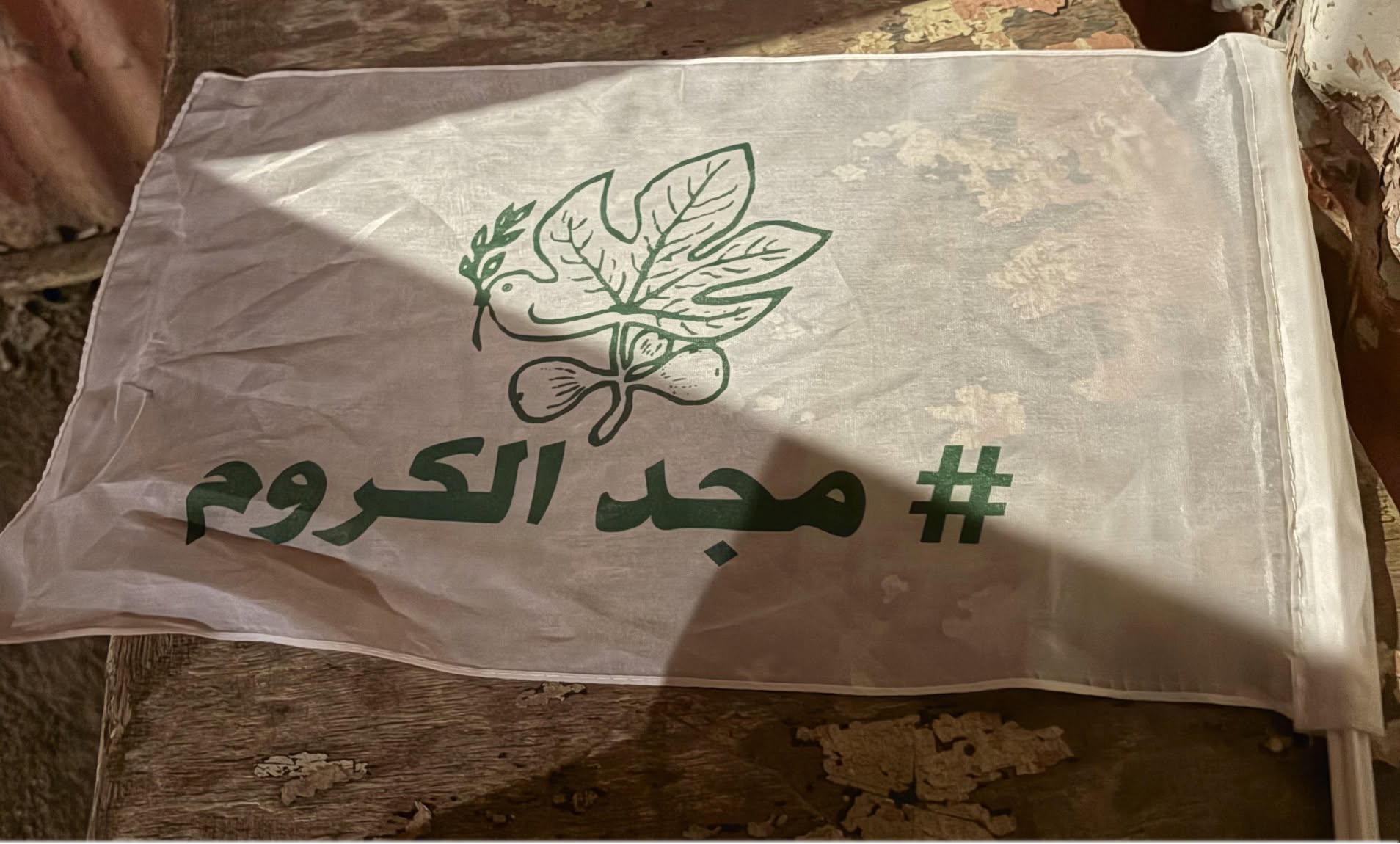
The protestors seemingly were taking a page from the Arab League that also protests new Jewish homes inside Israel. And the JNF has taken note, ordering the Jews to leave the area.

The legal standard should be straightforward. Private property must be respected. Grazing permits do not authorize unlimited construction. Theft, intimidation and racism should be punished whether committed by Jews, Muslims, Christians or Druze. None of those principles makes a person’s birthplace, religious appearance or previous residence grounds for expulsion.

Jews living in the West Bank are routinely denounced as obstacles to peace and told to move inside Israel. Now, when Jews associated with those communities appear inside Israel, they remain “settlers,” their presence becomes a demographic threat and self-described coexistence activists organize to make them disappear.

Coexistence that ends when the perceived wrong kind of Jews arrive is not coexistence. It is demographic exclusion in dove’s clothing.

ACTION ITEM

Contact the JNF at jewishnationalfund@jnf.org to make sure that they are not expelling Jews from Israel, but simply keeping grazing land for its intended purposes.

Enduring Peace versus Peace Now

There have been many failed attempts at forging a peace deal in the Israel-Arab Conflict. In 2017, the Trump Administration stepped into the situation with a very different approach than the Obama Administration. While there are many facets to the new methods, a clear distinction is Trump’s goal of an “Enduring Peace” versus Obama’s goal of “Peace Now.”

Team Trump’s “Enduring Peace”

Trump placed two people with seemingly little diplomatic experience – but significant deal experience – to try their hands at crafting a peace agreement between the Israelis and the Palestinians: Jared Kushner and Jason Greenblatt. While unfamiliar with diplomatic protocol, both Kushner and Greenblatt visited the region many times over their lives. They were joined in their effort by Dina Powell, an Egyptian-American who is the US deputy national security adviser for strategy.

A White House spokesperson made its goal clear for the talks on August 11, 2017 when it stated:

“Trump has previously noted that achieving an enduring Israeli-Palestinian peace agreement will be difficult but he remains optimistic that peace is possible.”

Jason Greenblatt echoed those words in November after visiting the region several times stating:

“We have spent a lot of time listening to and engaging with the Israelis, Palestinians and key regional leaders over the past few months to help reach an enduring peace deal. We are not going to put an artificial timeline on the development or presentation of any specific ideas and will also never impose a deal. Our goal is to facilitate, not dictate a lasting peace agreement.”


Jason Greenblatt and Israeli Prime Minister Benjamin Netanyahu
(photo: Kobi Gideon, GPO)

Team Trump’s stated mission is to forge a lasting peace that would endure for the future. The negotiators will take the time to work with the parties to structure an agreement that would provide lasting peace and security. This is a break from the Obama Administration.

Obama’s Progressive “Peace Now”

Obama had less international experience than Donald Trump when he assumed the office of the presidency in January 2009, and relied on his “progressive” liberal colleagues to educate him on the Israel-Arab conflict. Those left-wing parties included J Street and Americans for Peace Now. These groups advocated that the administration put “daylight” between America and Israel, as negotiations under President George W. Bush (which was viewed as very close to Israel), came up short of a deal. Obama made clear – to the delight of the far-left wing groups – that he was going to push the Israelis hard to stop building homes for Jews east of the Green Line (EGL).

The far-left groups believed that strong pressure on Israel was key to getting to a peace deal. They were ecstatic when Obama won a 10-month settlement freeze a few months after they met with Obama in July 2009 at the beginning of his term. They celebrated at the end of the Obama administration in December 2016, when Obama let United Nations Resolution 2334 pass declaring it was illegal under international law for Jews to live in EGL.

Jeremy Ben Ami, head of J Street said after the July 2009 meeting with Obama: “I left the room feeling we are at a truly historic moment of opportunity.  There may never be another American President who so clearly gets the issues strategically and has the political capital to try to pull off an agreement.”

The differences between Obama and Trump are both stark and clear.

The left-wing radicals believed that they had a moment in time, and that their anointed Messiah had a unique chance to forge peace in the Middle East. They felt both emboldened by Obama’s presidency and felt the urgency of time. They pushed the Obama Administration to get to a deal as quickly as possible by pushing a solution onto Israel.

Conversely, Team Trump has not shown such hubris. Their focus is not to get to a deal in the fastest time possible, but to establish an enduring peace. They recognize the fact that when Israel uprooted all of its settlements in Gaza and gave the land to the Palestinians it did not result in peace, but in three wars. Greenblatt and Kushner are content to take time to get to a lasting resolution, not the gratification of an immediate deal. They have stated that they are not going to let the UN impose a solution, like the Obama Administration advanced in December 2016.

Barack Obama, Hillary Clinton and John Kerry failed to advance peace between Israel and the Palestinians and watched the region descend into chaos. Their creation of “daylight” between Israel and the US; the use of international fora to attack Israel; and their rush to embrace the approach of “Peace Now” neither got to a deal nor set the parties on the path to enduring peace.

Hopefully the new approach of seasoned negotiators Greenblatt and Kushner to take their time to get to an “enduring peace” will yield much better results.


Related First.One.Through articles:

Jared Kushner’s Parents Donate $20 million to the First Hospital Likely to Win the Nobel Peace Prize

Mutual Disagreement of Mediators and Judges in the Arab-Israeli Conflict

John Kerry: The Declaration and Observations of a Failure

The Evil Architects at J Street Take a Bow

J Street is a Partisan Left-Wing Group, NOT an Alternative to AIPAC

J Street: Going Bigger and Bolder than BDS

Subscribe YouTube channel: FirstOneThrough

Join Facebook group: FirstOne Through  Israel Analysis