The name made sense at Israel’s founding. Israel fought wars against the armies of Egypt, Jordan, Syria, Iraq and other Arab states. The conflict was understood principally as one between the Jewish State and the surrounding Arab world.
Then the map changed.
Egypt made peace with Israel in 1979. Jordan followed in 1994. During the horrific Second Intifada, the suicide bombings, shootings and other attacks were overwhelmingly part of a localized war involving Palestinian Arabs. The terminology narrowed accordingly. The Arab-Israeli Conflict increasingly became the Palestinian-Israeli Conflict.
That description is now inadequate too as the map evolved again over the past several years.
The Abraham Accords fundamentally changed the regional picture. The United Arab Emirates, Bahrain and Morocco normalized relations with Israel. Trade, tourism, investment and security cooperation followed. Other Muslim-majority countries have also maintained or developed relations with the Jewish State.
Yet at the same time, Israel has faced repeated war from Hamas in Gaza, Hezbollah in Lebanon, the Houthis in Yemen and, increasingly directly, the Islamic Republic of Iran. These forces are separated by borders, ethnicity and even the Sunni-Shiite divide. What connects them is not Arab identity. It is a radical Islamist rejectionism that refuses to accept a sovereign Jewish state in the Middle East.
It is therefore time for the terminology to catch up. This is increasingly the Jihadi-Israel Conflict.
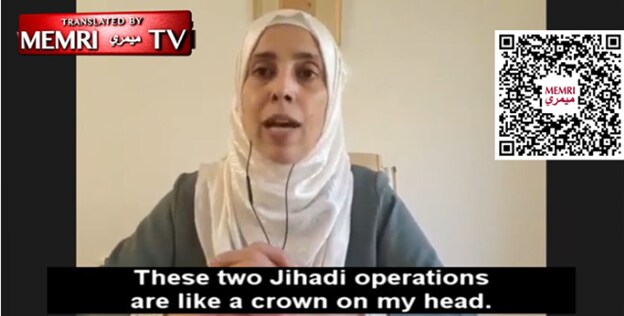
Ahlam Tamimi, who helped plan and transported the suicide bomber to the 2001 Sbarro restaurant bombing in Jerusalem and now lives in Jordan.
The term captures the venom, vitriol and violence of Hamas and the armed Islamist movements aligned against Israel. It encompasses Hezbollah and the Houthis and, most importantly, the Islamic Republic of Iran that has armed, financed and supported much of the network surrounding Israel.
It also leaves room to describe the roles of Qatar and Turkey, whose close relationships with Hamas and fierce political hostility toward Israel place them in a very different category from Muslim and Arab governments pursuing normalization.
Most importantly, the new terminology does something the old terminology cannot: it separates Muslims and Arabs who seek peace with Israel from radical Islamists committed to its destruction and the slaughter of Jews.
Hamas leader calling for slaughtering Jews as a religious Islamic principle
The dividing line has moved.
And that makes the choices facing Lebanon, Syria and Saudi Arabia especially important. They can move toward a Middle East built around trade and coexistence, or remain trapped in a conflict driven by radical Islamist movements that reject Jewish sovereignty, basic human rights and self-determination.
The conflict has become crystallized for what it likely always was: the Jihadi-Israel Conflict.
Two events separated by three months in 2021 delivered the same message to Islamist movements confronting more powerful enemies:
Keep fighting. Keep waiting. Eventually the infidels leave.
The first came in Israel.
In May 2021, Hamas launched rockets toward Jerusalem and Israeli cities, casting itself as the defender of Al-Aqsa and Palestinian Arab families facing possible eviction in Sheikh Jarrah.
Eleven days later came a ceasefire and the Israelis never moved forward with the evictions.
Immediately after the fight, the Palestinian Center for Policy and Survey Research’s June 2021 poll described a “paradigm shift” toward Hamas and armed struggle. 77% of Palestinian Arabs believed Hamas had won, versus 1% who thought Israel had won. And 65% believed Hamas had achieved its declared objectives regarding Sheikh Jarrah and Al-Aqsa.
The perceived lesson was simple: Violence worked.
Then came Afghanistan a few months later.
On August 15, 2021, the Taliban returned to Kabul, twenty years after the United States had removed it from power. The lesson for jihadist movements was not that they needed to defeat a stronger enemy. They needed to outlast it.
As described at the time in Gaza, The Terrorist Enclave, Hamas met with the Taliban and congratulated it for expelling Western forces from Afghanistan.
By June 2023, Palestinian confidence had moved beyond believing Hamas could win a confrontation. PCPSR asked Palestinian Arabs whether Israel, then celebrating its 75th anniversary, would survive to celebrate its 100th. 66% said no. Only 27% believed Israel would still exist. Another 51% believed Palestinian Arabs would eventually recover historic Palestine and return refugees to their former villages and cities.
Just four months later came October 7.
Nearly three years of war have weakened that opinion – in the near-term. As FirstOneThrough detailed in Palestinian Arabs Turn Inward, But Not Away From Hamas, support for armed struggle has fallen sharply and only 20% of Palestinian Arabs now believe Hamas won the Gaza war but 89% believe Hamas will continue to exist in some capacity.
Weakened but waiting. “Resistance” with resolve.
Which brings the argument from the Taliban and Hamas to the Islamic Republic of Iran.
Iran is making the same wager on time. That it can outlast the United States and send it packing much as the Taliban did in Afghanistan.
But for the United States, Iran is not Afghanistan.
Iran has called America the “Great Satan” since 1979 and built a regional military network directed against American forces and allies. Iran has developed increasingly long-range ballistic missiles and pursued nuclear weapons capabilities that could threaten far beyond its borders.
Afghanistan did neither.
Iran also sits on the Strait of Hormuz, through which roughly one-fifth of the world’s petroleum consumption passes. Disruption there reaches energy markets and economies around the world.
Afghanistan had no comparable leverage over the global economy.
America had no long-term goals of staying in Afghanistan. It was not going to keep thousands of troops and pour billions of dollars in a region thousands of miles from its shores to make sure girls went to school and women had equal rights.
But Iran is a real concern for the entire western world, both militarily and economically.
The current U.S. war has already achieved important aims by severely degrading Iran’s nuclear, missile and proxy capabilities. But degraded is not finished.
Iran does not need to reverse its losses today. It only needs to survive long enough for politics to change.
And two elections are approaching. Israelis vote on October 27 and Americans vote in November 3.
For Iran, Hamas and the broader jihadist world, those are more than elections. They are milestones testing the strategy of patience.
While the strategic logic for Israel and U.S. to continue the fight may be sound, their citizens may vote differently. And that is what the jihadists are waiting to observe.
Israel cannot leave Israel. America cannot simply walk away from an Iran threatening its forces and allies, pursuing nuclear and long-range missile capabilities, and holding a critical artery of the global economy at risk.
But jihadist strategy places a different bet: Can they wait until Israelis and Americans vote to stop fighting?
The summer of 2021 taught Islamists that they don’t have to win the wars against more powerful foes. Iran has ten more weeks to stall negotiations and wait for democracies to decide whether to pursue long-term strategic benefits or move on to more immediate matters.
Democracies have elections. Their enemies know it.
Will Israelis and Americans turn their elections into the jihadists’ exit strategy.
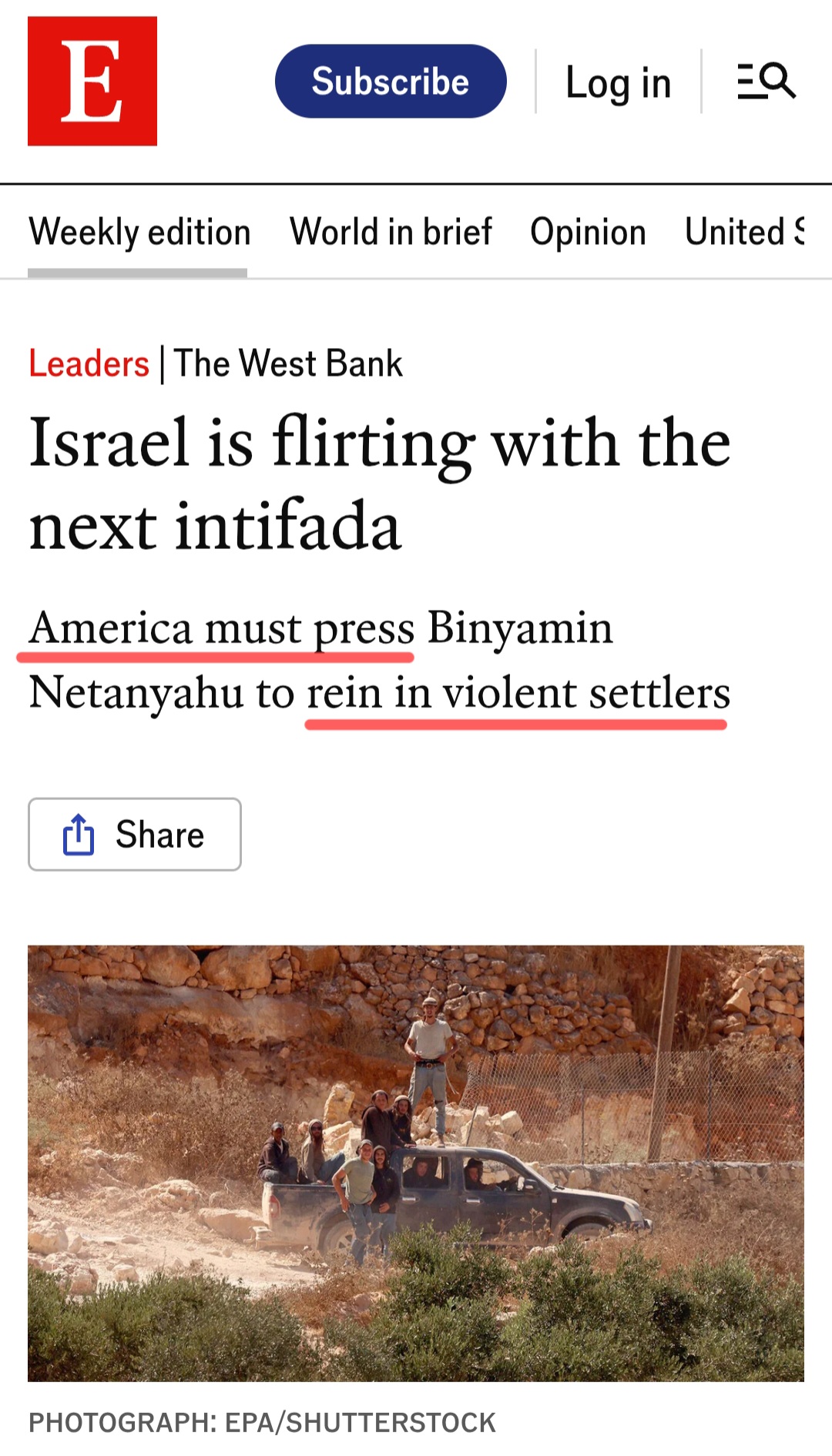
The Economist warned this week that “Israel is flirting with the next intifada,” arguing that violent Jewish settlers may push West Bank Arabs into another uprising.
It has the intifada backwards.
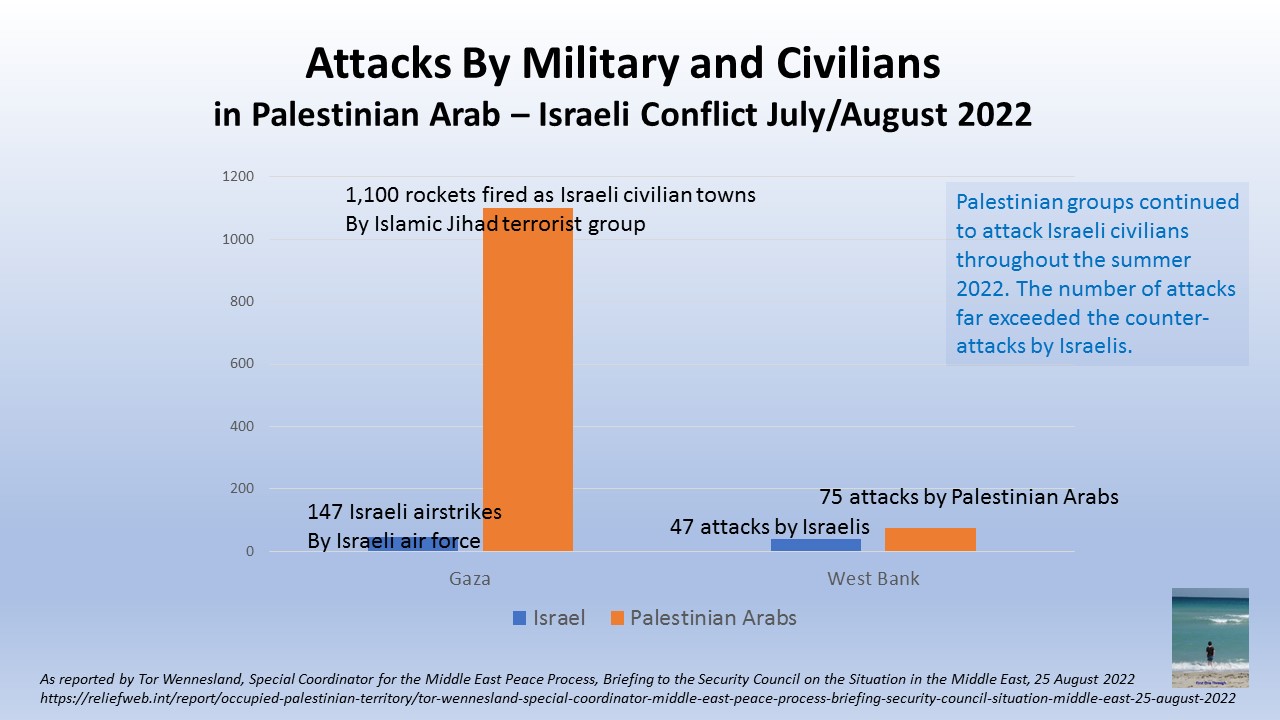
West Bank Arabs do not need West Bank Jews to introduce them to political violence. Palestinian Arab attacks against Jews in Judea and Samaria have been a persistent feature of the conflict for years, even when nobody attached the formal label “intifada” to them.
By 2021 and 2022, new armed groups were emerging in Jenin and Nablus, including the Jenin Brigades, Nablus Brigades and Lions’ Den. Their attacks spread beyond Judea and Samaria into Israeli cities, while the Lions’ Den became popular among Palestinian Arabs and the Palestinian Authority resisted demands to suppress it.
That was the environment in which I wrote “The Settler Intifada” on July 2, 2023, three months before the October 7 massacre.
The argument was that something new was happening among Jews in Judea and Samaria.
For years, Palestinian Arabs had murdered Jews while Jewish residents generally relied upon the Israeli government and military for protection. That slowly began to change. “Price tag” attacks appeared, followed by much larger retaliatory attacks after Jews were murdered.
In February 2023, after two Jewish brothers were shot and killed while driving, hundreds of Jews descended on Huwara and burned cars and buildings. In June, after four Jews were murdered at a restaurant and gas station, hundreds went into Turmus Ayya and again burned property.
I wrote then that Jews in Judea and Samaria had become “exasperated and are starting to engage in massive revenge attacks.” I warned that as Palestinian Arab attacks continued, Jewish violence could “morph from retaliatory in nature to constant.”
That was the idea of a settler intifada.
The word intifada has become so closely associated with Palestinian Arabs that journalists instinctively use it only for Arab violence against Jews. The Arabic word means an uprising. Palestinian Arabs do not own it only when they perpetrate it.
If a population believes its government cannot protect it, loses faith in existing institutions and begins taking matters into its own hands through recurring political violence, that can fairly be described as an intifada whether the people carrying it out are Arabs or Jews.
And the October 7 massacre made the situation even more toxic.
Jews in Judea and Samaria saw their government’s incompetence in allowing the massacre to take place. From 2021 to 2023 they had seen how West Bank Arabs attacked them with impunity, and now they saw Israeli Jews get hunted in their homes by thousands of Gazans.
Close to home, Arabs celebrated the slaughter of Jews. In the Palestinian Center for Policy and Survey Research’s December 2023 poll, 82% of West Bank respondents said Hamas was correct to launch the October 7 offensive. Support for Hamas surged after the attack, even more amongst West Bank Arabs than the Gazans who committed the crimes against humanity.
Jews in Judea and Samaria increasingly concluded that waiting for the Israeli government to stop Palestinian attacks was insufficient. Some began retaliating directly. Those attacks grew larger, more organized and less isolated.
But The Economist begins the movie in the middle. It sees Jewish violence today and warns that it may provoke a future Palestinian intifada. The more interesting story is that the Judea and Samara intifada is already underway.
Israel is discussed with hyperbole and adjectives: massive settlements, enormous American aid, rampant settler violence, Jewish encroachment, disproportionate war.
Between 700,000 and 750,000 Palestinian Arabs became refugees when they fled the battlefield as they awaited fellow Muslim Arab armies to destroy the nascent Jewish State during the 1948-9 war. In the same era, roughly 850,000 Jews left or were expelled from Arab countries with many more leaving non-Arab Muslim countries like Iran and Afghanistan.
Even though the Jewish refugee population was larger, we never speak of it today.
Today, UNRWA registers 5.9 million Palestinian Arab refugees, predominantly consisting of descendants of the original refugees, and those who married or were adopted by refugees. The comparable number of registered Jewish refugees from Arab and Muslim countries and their descendants is zero.
The Jews were absorbed as citizens of Israel and other countries. Their children, grandchildren and great-grandchildren were not perpetuated as refugees, they way Palestinian Arabs have been forced by those same “brotherly” Arab countries which went to war with Israel in 1948-9, in order to perpetuate the war they initiated and lost.
650 Times — Arab League Territory to Israel
Israel covers roughly 22,000 square kilometers and the 22 members of the Arab League collectively cover roughly 13–14 million square kilometers.
The territory of the Arab League is approximately 650 times the size of Israel.
127 Times — Muslims to Jews
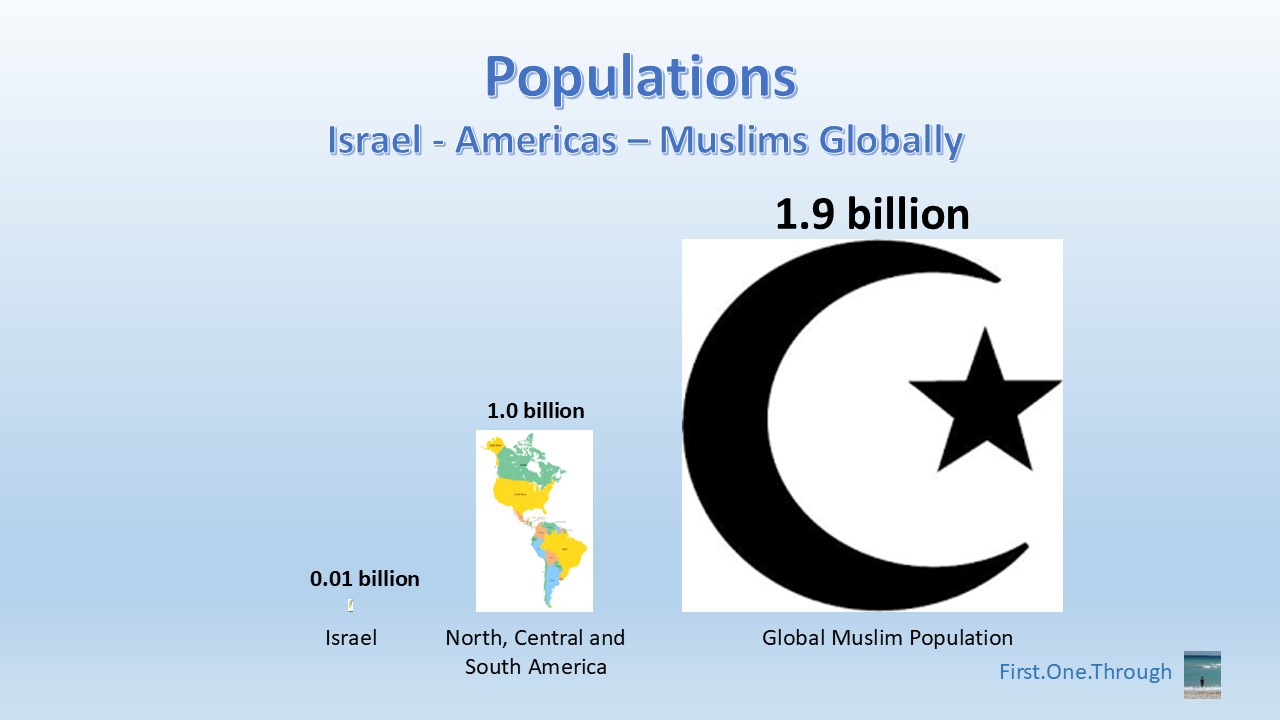
There are roughly 2 billion Muslims in the world, twice the size of the entire populations of North, Central and South America.
There are roughly 15.8 million Jews.
That is approximately 127 Muslims for every Jew.
Muslims account for roughly one-quarter of humanity. Jews account for about 0.2%.
Yet people in the West refer to Muslims as a “minority.”
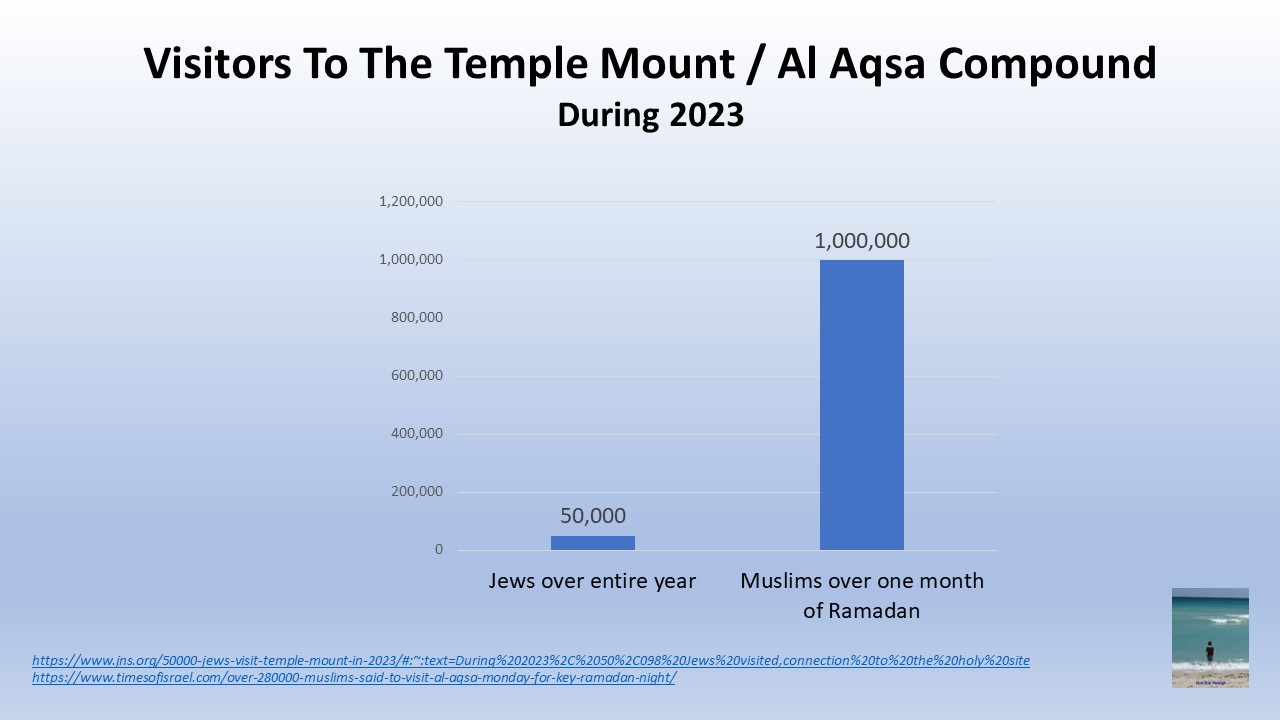
60 to 1 — Muslims to Jews Ascending the Temple Mount
Before COVID, roughly 1.8 million to 2 million Muslims visited the Temple Mount annually, compared with approximately 30,000 Jewish visits in 2019. That is roughly 60 Muslim visits for every Jewish visit.
The more recent figures of 2025 after the October 7 massacre launched by Gazans has roughly halved the visits by Muslims and doubled those by Jews, lowering the figure to about 15 times at Judaism’s holiest site.
57 to 1 — OIC States to the Jewish State
There are 57 countries in the Organisation of Islamic Cooperation that perpetually lambasts Israel. There is one Jewish state.
The Jewish state exists alongside a Muslim world dozens of times larger in countries, population and territory.
25 to 1 — American Defense Spending Outside Israel
Israel receives about $3.8 billion annually under the U.S.-Israel security assistance agreement. For every dollar America spends annually on Israel’s defense, roughly $25 is spent on defense elsewhere—defending the United States, maintaining forces abroad, supporting allies and providing security assistance around the world.
Even more striking, there are over 220,000 military personnel stationed around the world, of which slightly over 100 are in Israel. The baseline ratio is over 1,500-to-1, rising to 2,200-to-1 when reserve personnel are included.
The anti-Israel discussion focuses solely on Israel while ignoring the enormous American monies and personnel in Japan, Qatar, Germany and elsewhere.
14 Times — The Growth of Israel’s Arab Population
Approximately 156,000 Arabs lived in Israel in 1948 when the modern Jewish State was reestablished. Today, approximately 2.16 million Arabs live in Israel.
Israel’s Arab population has grown almost 14-fold since the establishment of the Jewish state. Meanwhile, the number of Jews inside Israel hasn’t even grown 12-times in that same time.
And people accuse Israel of “ethnic-cleansing.”
12 Times — Israeli Arabs Killed by Israeli Arabs Versus West Bank Arabs Killed by West Bank Jews
Thus far in 2026, Arab Israelis are murdered by other Arab Israelis at roughly 12 times the number of Palestinian Arabs killed by West Bank Jewish civilians in Judea and Samaria.
Hundreds of Arab Israelis have been murdered amid the organized-crime epidemic inside Israel over the last few years. Yet the international narrative solely focuses on settler violence.
10 to 1 — Muslim Gates to the Jewish Entrance
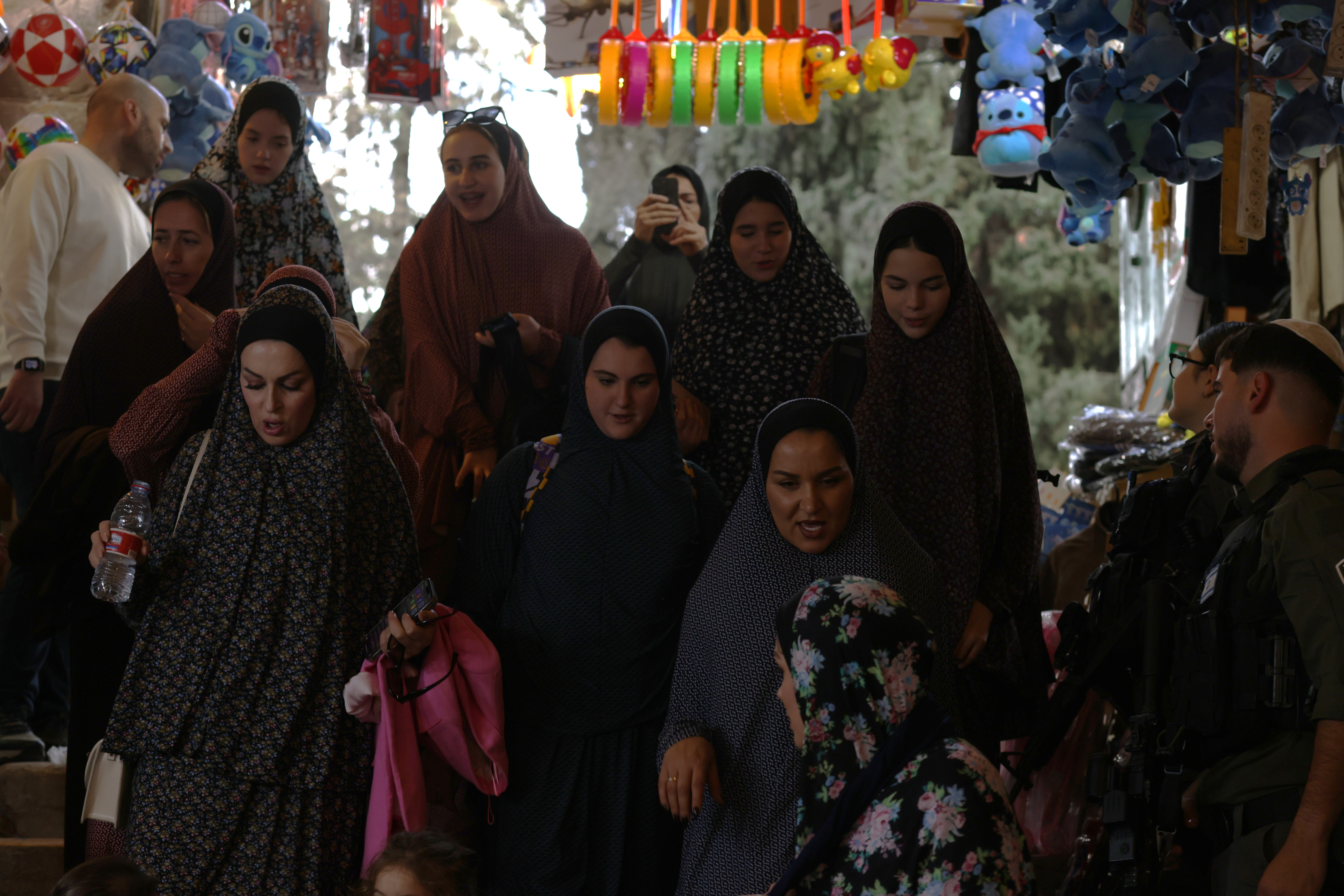
Muslims have access to the Jewish Temple Mount in the Old City of Jerusalem through ten gates. Jews and other non-Muslims enter through one: the Mughrabi Gate. There, Jews must pass through metal detectors and security clearance at only specified times of the day, even as Muslims ascend and descend at will through every other portal.
Muslim women descending from the Temple Mount through one of the many gates exclusively available for Muslims (photo: First One Through)
9 — Number of Times Hamas Charter Refers to Jews and Judaism
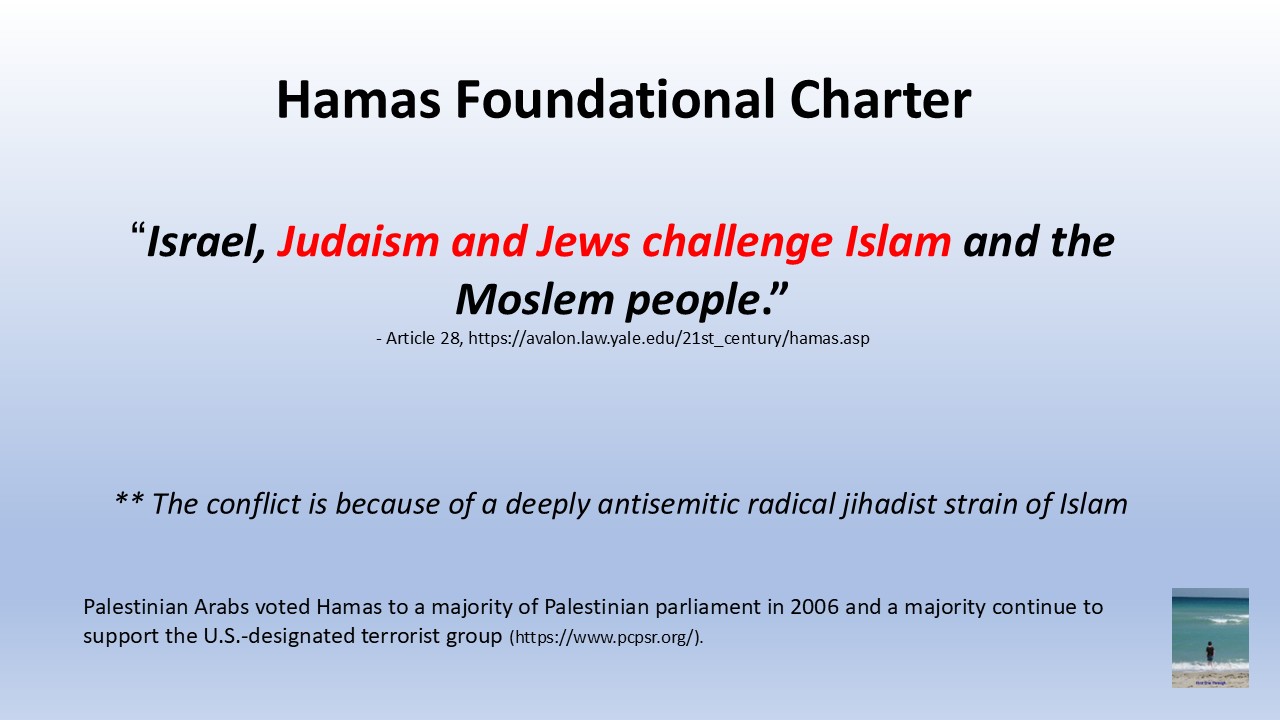
Hamas’s 1988 foundational charter is replete with antisemitic rhetoric. The opening lines begin with “Our struggle against the Jews…” and continues throughout its genocidal jihadist call to wipe out the Jewish people and Jewish State.
While the anti-Israel crowd pretends that the conflict is merely over land which can easily be compromised and carved up, they ignore the deep antisemitic ideology embedded in the Palestinian Arab culture.
8 Times — U.S.’s Ukraine War Spending Versus Gaza War Spending
The United States has spent roughly eight times more in connection with the Ukraine war with Russia than the Gaza war against Israel.
America has made roughly $195 billion available for Ukraine since Russia’s 2022 invasion. American expenditures associated with Israel and the Gaza war are a fraction of that amount.
Yet it is spending associated with Israel that is routinely presented as uniquely extraordinary.
6 to 0 — UN Bodies for Palestinians Versus Israelis
The United Nations maintains six standing bodies, offices or mechanisms focused specifically on Palestinian Arabs and Israel’s treatment of said Arabs: UNRWA; the Committee on the Exercise of the Inalienable Rights of the Palestinian People; the Division for Palestinian Rights; the Special Committee to Investigate Israeli Practices; the Special Rapporteur on the Palestinian territories; and the Human Rights Council’s permanent Agenda Item 7.
There is no comparable UN agency, committee or permanent agenda item devoted to protecting Israelis from the conflict, nor is there any group in the entire world (think the Kurds) so over-represented at the global organization.
5 — Gaza Wars Since Hamas Took Control
Israel withdrew every Jewish civilian and military asset from Gaza in 2005. Hamas subsequently took control of Gaza in 2007. Since then, it has launched five major rounds of war with Israel: in2008–09, 2012, 2014, 2021, 2023-.
Five wars in sixteen years.
2.5 to 1 — Israel Versus the Rest of the World at the UN
In 2024, the UN General Assembly adopted 18 resolutions focused on Israel. It adopted seven country-specific resolutions concerning the rest of the world combined.
That is roughly 2.5 to 1. One country received more than twice as many resolutions as every other country combined.
1 to 1 — An Equivalency of 15 Kilometers Which Matters for One But Not the Other
At its narrowest along the pre-1967 lines, Israel is roughly 15 kilometers wide. It is a stretch that continues along its major population centers.
After Ma’ale Adumim to Jerusalem’s east, the remaining West Bank corridor is also roughly 15 kilometers wide at a single narrow point where virtually no West Bank Arabs live.
15 kilometers versus 15 kilometers. Over a million Jews in the narrow stretch versus a few thousand Arabs.
Israel’s narrow waist is never described as dangerously vulnerable, while the West Bank neck is cast as making a two-state solution “impossible.”
1 — The Jewish State Whose Capital the World Challenges
There is only one country in the world whose national anthem is all about its capital.
Israel’s national anthem, Hatikvah, expresses the Jewish people’s ancient longing for Zion and Jerusalem.
The Knesset is there. The president is there. The prime minister is there. The Supreme Court is there. The government ministries are there.
Yet most countries still refuse to locate their embassies in Jerusalem or fully accept Israel’s designation of Jerusalem as its capital.
The numbers are there. Before accepting the narrative which is infused with anti-Israel bias, look at them.
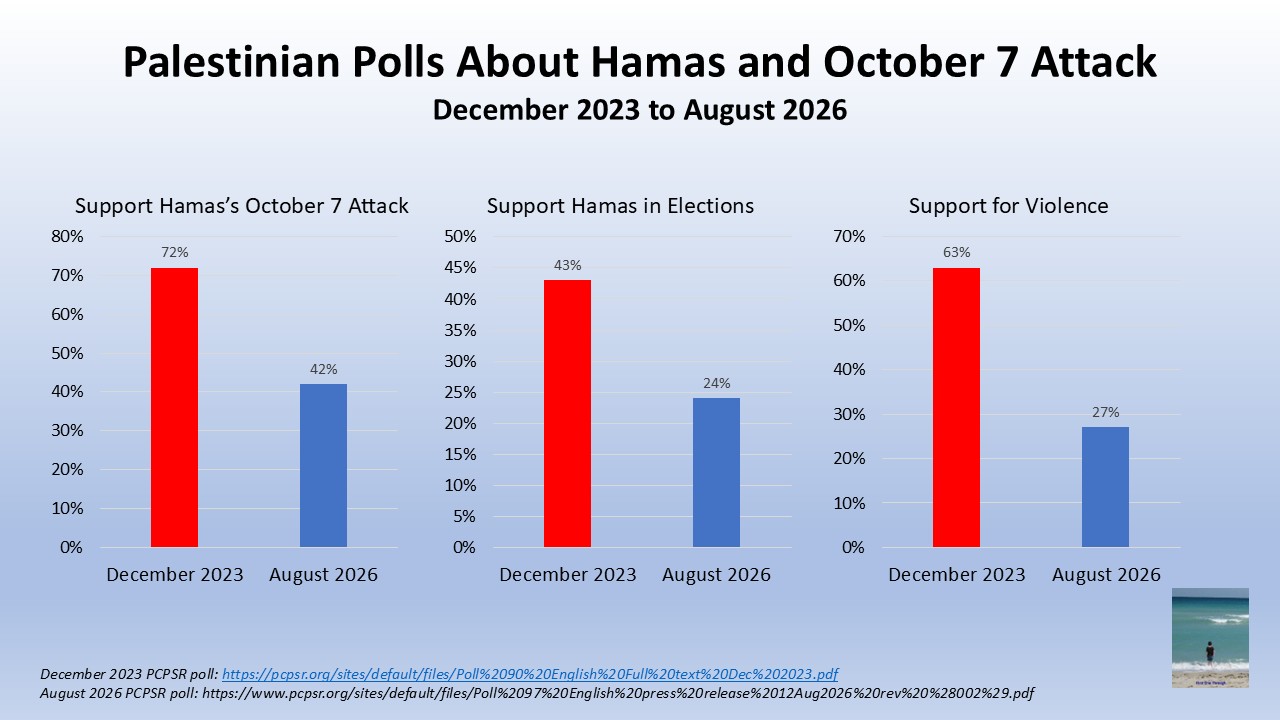
Three years ago, Palestinian Arabs thought October 7 might change their future by changing Israel. Polls show how much that ambition has changed.
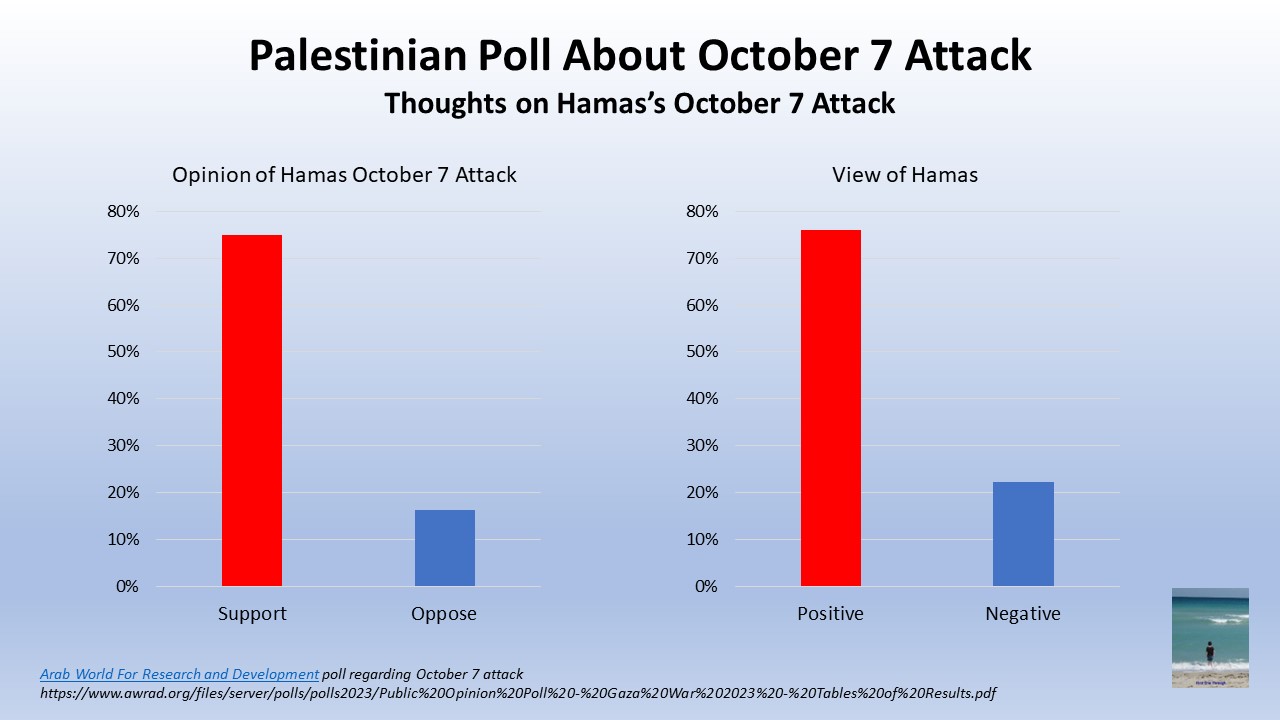
In December 2023, 72% of Palestinian Arabs said Hamas was correct to launch the October 7 attack.70% believed Hamas would emerge victorious.63% preferred armed struggle as the best way to achieve Palestinian goals.
Nearly three years of war produced something very different.
According to PCPSR’s August 2026 poll, only 20% now believe Hamas won the Gaza war. Hamas political support has fallen to 24%. Half of Palestinian Arabs say “armed resistance” (aka massacring Jewish civilians) failed to protect them or end the “Israeli occupation” and instead brought destruction. Among Gazans, 65% say so.
Support for armed struggle has fallen from 63% to 27%. 44% now choose negotiations as the most effective strategy.
Their priorities have shifted with it.
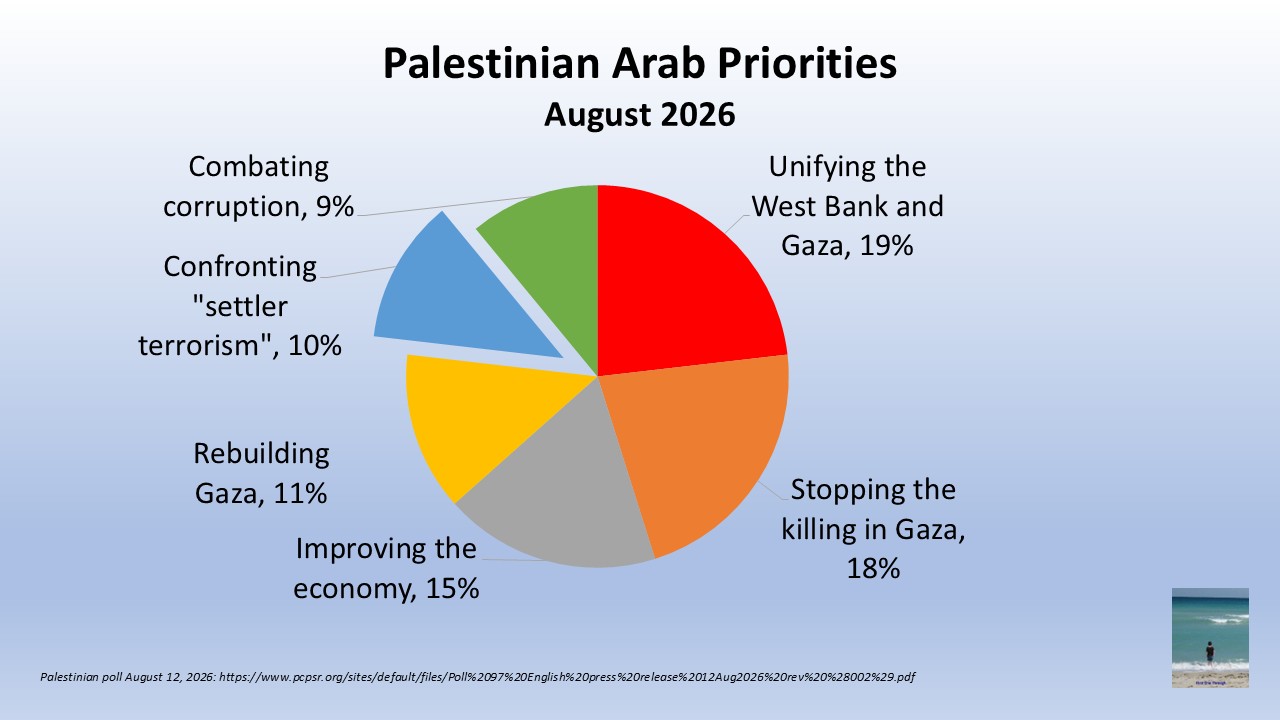
Asked in the August 2026 poll what the next Palestinian legislature should address, Palestinian Arabs answered:
19% — Unifying the West Bank and Gaza
18% — Stopping the killing in Gaza
15% — Improving the economy
11% — Rebuilding Gaza
10% — Confronting “settler terrorism”
9% — Combating corruption
Settler violence ranks fifth.
That is a very different Palestinian Arab story from the one dominating international headlines. Palestinian Arabs put reunification, ending the Gaza fighting, economic recovery and rebuilding Gaza ahead of attacks from West Bank Jews.
While the ambitions of October 2023 were directed outward, towards ending the Jewish State, the priorities of August 2026 are directed inward, to unification, rebuilding and recovering.
And Hamas remains part of that project.
The Palestinian Authority wants candidates in the coming elections to accept the commitments of the Palestine Liberation Organization, including its agreements with Israel. 66% of Palestinian Arabs oppose that requirement. Only 27% support it.
Because Palestinian Arabs envision Hamas remaining part of their future.
Asked what Hamas would become if it gave up its weapons, 53% said it would remain both an armed resistance and political movement. Another 36% said it would become solely a political movement. That means 89% see Hamas continuing as a political movement in some form.
There is a historical lesson in what happens after a genocidal society launches a disastrous war and loses.
Postwar Germany did not rebuild by simply disarming the Nazi Party and inviting it to contest elections. The Nazi Party was abolished and banned. Its political structures were dismantled. Germany’s reconstruction required a break with the movement that had led it into catastrophe.
Palestinian Arabs are not making that equivalent break. While they increasingly recognize that Hamas’s war failed, they want Hamas to be part of the Palestinian future.
As the western media and United Nations narrows a focus on violence committed by Israeli Jews against Palestinian Arabs, those same Arabs are no longer focused on those Jews. Instead, the Arabs prioritize rebuilding after the disaster while maintaining the eliminationist ideology in their society for a future war.
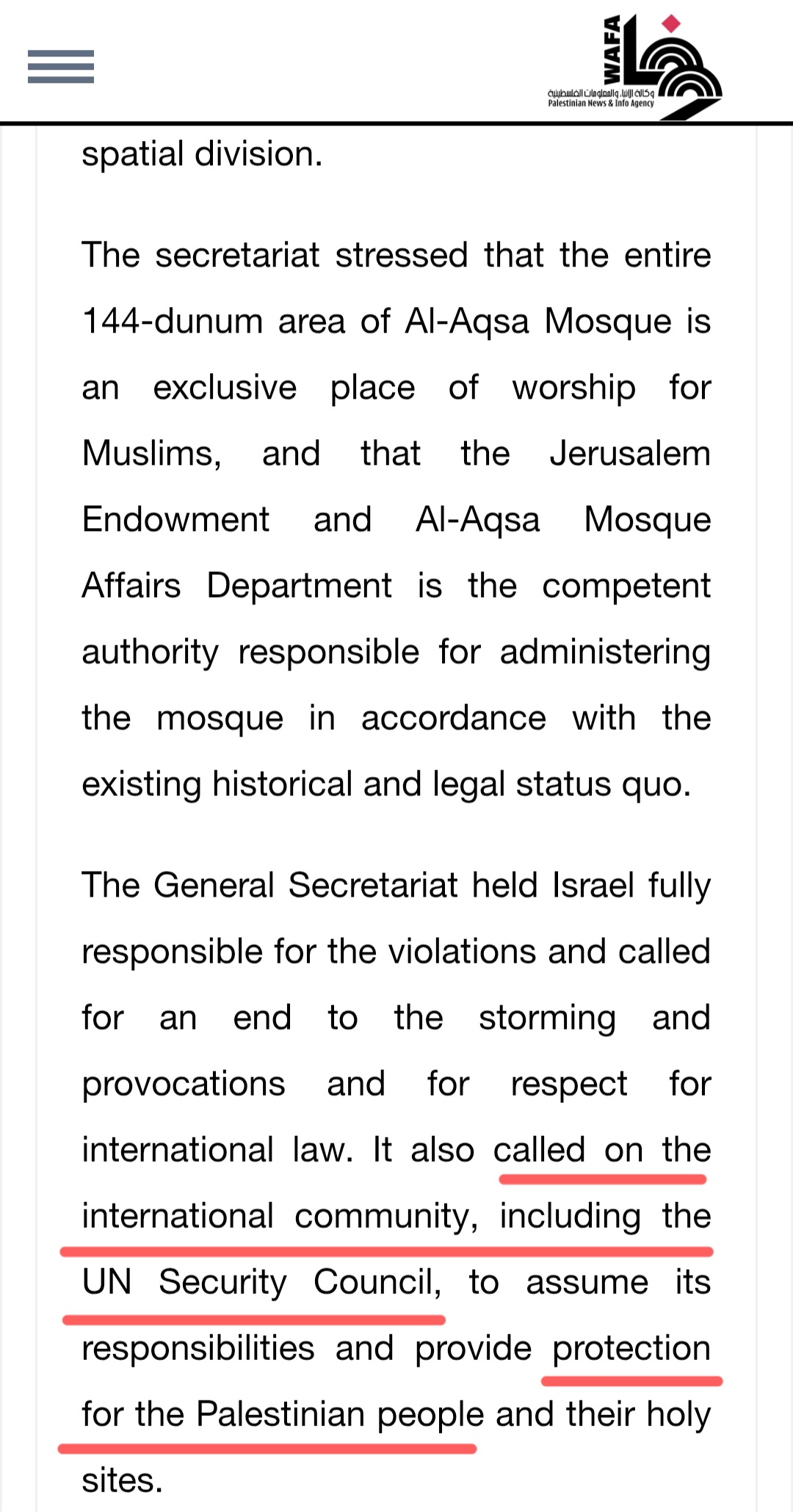
WAFA, the Palestinian Authority’s official media, has spent years describing Jews who enter the Temple Mount as “storming Al-Aqsa.” I have written about that linguistic sleight of hand before.
Now WAFA is promoting something more dangerous: that Jews have no right to enter Judaism’s holiest site without Muslim permission, and that Jewish worship there is an assault on Islamic sanctity.
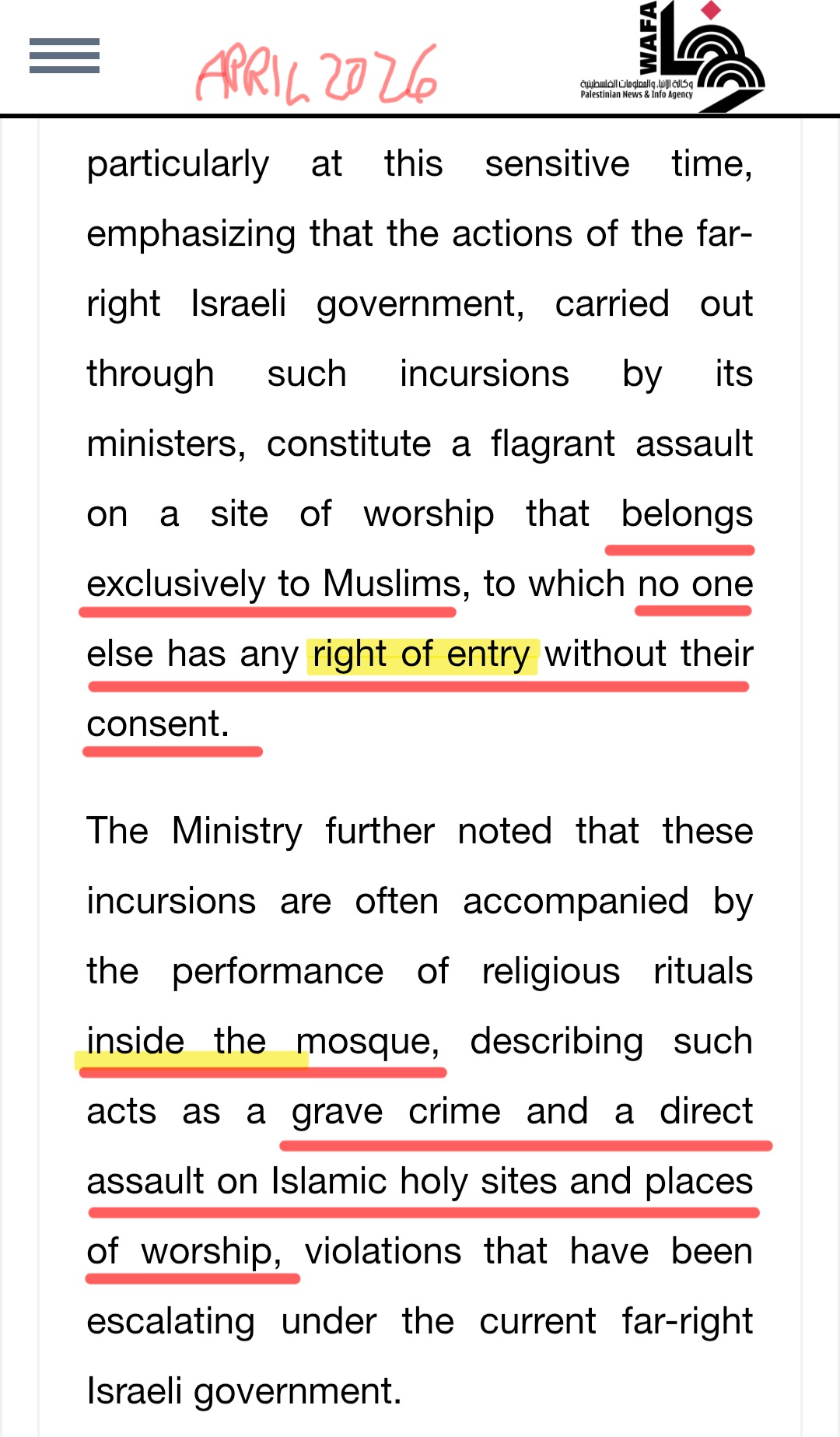
In April 2026, WAFA reported a Palestinian statement declaring the site one that “belongs exclusively to Muslims, to which no one else has any right of entry without their consent.”
On August 13, WAFA carried an Arab League statement condemning Jews entering the site and performing religious rituals as a “blatant violation of the sanctity of the mosque.”
WAFA promoted several lies:
Muslims do not control entry. Israel controls security and access to the Temple Mount. The Jordanian-backed Waqf administers Muslim religious affairs there. Presenting Muslim consent as a prerequisite for Jewish entry is totally false.
The compound does not “belong exclusively to Muslims.” That is a religious and political claim masquerading as settled fact about the Temple Mount—the holiest site in Judaism.
Jewish presence does not inherently violate Islamic sanctity. Islam does not have a general rule that a Jew entering Muslim sacred space desecrates it. Restrictions on Jewish prayer under the status quo are one issue; declaring Jewish worship itself an assault on Islam is another.
Then comes another sleight of hand.
Having defined Jewish presence as an offense against Islam, these organizations pivot to demanding action by the international community on behalf of Palestinians.
But those categories – Muslims and Palestinian Arabs – are not interchangeable.
Some 1.85 million Muslims live in Israel, nearly one-fifth of the country’s population. And the Muslim religious administration of the Temple Mount is handled by the Jordanian-backed Waqf. Palestinian Arabs do not exercise control over entry to the site, nor do they represent all Muslims in the region.
So why transform an asserted Muslim religious grievance into a Palestinian national claim demanding international intervention?
Because the lies are the tell.
The argument is no longer about protecting Muslim worship. It takes an assertion of Muslim religious exclusivity, converts it into a Palestinian territorial right, and then asks the world to enforce that right against Israel and Jews.
The implications become darker when the same logic is applied beyond the Temple Mount. Hamas’s 1988 charter declared all of Palestine an Islamic waqf. Combine that doctrine with the claim being promoted around Al-Aqsa—that Jewish physical presence and worship offend Islamic sanctity—and expelling Jews can be transformed into protecting Muslim holy land.
“the land of Palestine is an Islamic Waqf consecrated for future Moslem generations until Judgement Day. It, or any part of it, should not be squandered: it, or any part of it, should not be given up.” – Hamas Foundational Charter, Article 11
That is why the Arab League and WAFA’s language matters. By repeatedly publishing these false assertions, it helps turn a Palestinian territorial claim into a purported Islamic prohibition against Jewish presence.
And it begins at the most perverse possible location: Judaism’s holiest site.
The progression is stark:
Declare the Jewish holy site exclusively Muslim.
Deny Jews the right to enter without Muslim permission.
Call Jewish presence and worship a desecration of Islam.
Turn that religious claim into a Palestinian territorial right.
Ask the world to enforce it.
The Arab League and Palestinian Authority are building a religious and political case for removing Jews from their own holy land.
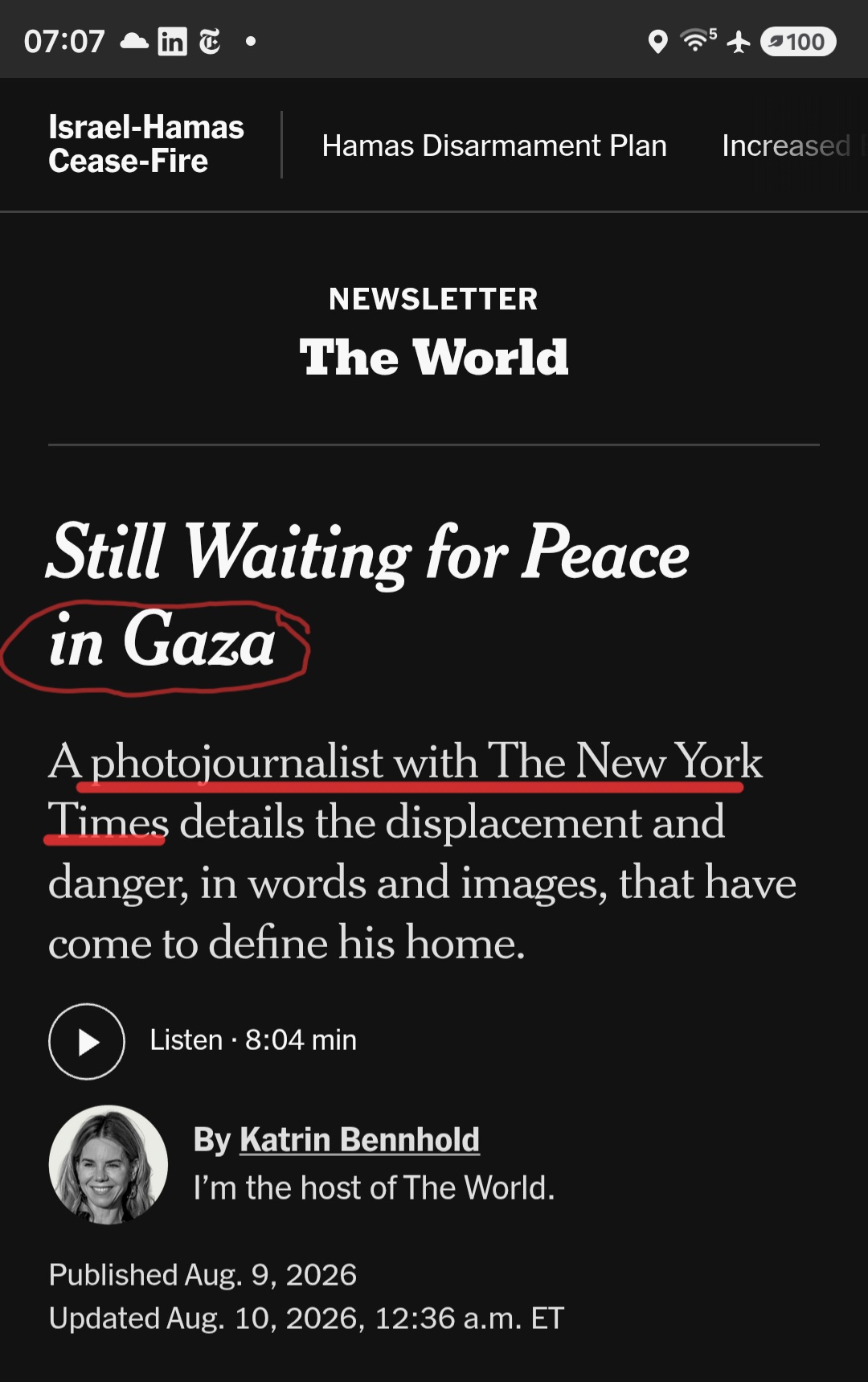
The New York Times published a photo essay under the headline “Still Waiting for Peace in Gaza.” Its Palestinian Arab photojournalist documents the world around him: shattered buildings, displaced families, rubble and danger. The photographs powerfully show what war looks like from inside Gaza.
But what does peace look like?
For Israelis living a few miles away, peace means sleeping without rockets overhead. It means children not watching their parents gunned down before them. It means young adults attending a music festival without being hunted, families living on kibbutzim without gunmen entering their homes, and civilians never again being murdered or dragged across the border as hostages.
Those images are outside the Times’ frame. And their absence raises the central question: Are Gazans waiting for peace with Israel, or peace from Israel?
Palestinian Arab polling makes the distinction important. After October 7, the Palestinian Center for Policy and Survey Research repeatedly asked whether Hamas had been correct to launch its attack. In March 2024, 71 percent of Gazans said yes. Three months later, after enormous destruction inside Gaza, 57 percent still considered the decision correct. Support showed a desire to live with violence inside Gaza if it led to the destruction of Israel.
The pattern predates October 7. Palestinian polling over decades has repeatedly recorded substantial support for attacks against Israelis, including civilians. The question of peace therefore cannot be answered simply by photographing people who desperately want the war around them to end.
Peace is reciprocal. It requires imagining security for the people across the border as well as for oneself.
A revealing photo essay would turn its lens outward. Ask Gazans whether Jewish families should live safely in Sderot and Kfar Aza. Whether Israelis should be able to dance near Gaza without fear of armed Palestinian Arabs crossing the border. Whether rockets should stop permanently. Whether Hamas should disarm. Whether the future they envision includes Jews living securely beside them.
Those answers would tell us whether Gazans are waiting for an end to war or waiting for peace.
And this is where the New York Times itself enters the frame. This is the newspaper’s own photojournalist, presented under the Times’ own headline and editorial framing. By calling the desire for calm inside Gaza “waiting for peace,” the newspaper takes one side’s desire for relief from war and gives it the language of reconciliation between two parties. It portrays the Palestinian Arabs as desirous of coexistence when it is plainly not so.
That framing is particularly consequential when the war began with Hamas crossing into Israel on October 7 to murder and abduct civilians. When thousands of Arab civilians invaded Israel to rape women and abduct children and spit on their corpses as they arrived in Gaza. Removing Israel from a story about “peace” reduces peace to what happens to Gaza after the attack, rather than what Gazans want to happen to Israelis in the future.
The Times reinforces a distorted understanding of the conflict: Palestinian peace becomes the absence of Israeli violence against Palestinians, while the Palestinian attitude toward violence against Israelis disappears beyond the edge of the photograph.
A camera pointed only into Gaza can show us what Gazans want to stop seeing. Peace begins with asking what they want Israelis to stop seeing too.
Congress did not arrive at legislation protecting Hamas overnight. It arrived there one bill at a time.
For decades, debates over Israel revolved around diplomacy. Republicans and Democrats argued over settlements, negotiations, Jerusalem, and the contours of a future Palestinian state. Even lawmakers sharply critical of Israel generally framed their proposals around advancing a negotiated two-state solution. The disagreement was over how peace should be achieved, not whether Israel had the right to defend itself against terrorist organizations.
In 2020, as the Trump Administration unveiled its peace plan and Israel considered extending sovereignty to portions of the West Bank, progressive lawmakers introduced legislation preventing American assistance from supporting annexation. Whether one believed annexation was prudent or unwise, the objective remained fundamentally political. These bills sought to influence the outcome of negotiations and preserve the possibility of a future Palestinian state. The debate was about borders, diplomacy, and competing visions for peace.
That bill did not stand in isolation.
In 2019, Representative Betty McCollum (D-MN) also introduced legislation prohibiting U.S. assistance from supporting the military detention of Palestinian minors. On its face, the proposal carried moral appeal. No civilized society wants children caught in war, and few slogans resonate more powerfully than protecting minors.
Yet the legislation missed the point. Israel’s military justice system does not prosecute minors because they are children. It prosecutes minors accused of security offenses, including violent rioting, firebomb attacks, shootings, stabbings, and participation in terrorist organizations. Hamas, Palestinian Islamic Jihad, and the Popular Front for the Liberation of Palestine have all recruited teenagers into violent activity for decades.
Arab minors caught on camera right before they stab Israelis
The debate was no longer centered on where Israel’s borders should ultimately lie. It was becoming a debate over whether Congress should restrict Israel’s ability to prosecute those participating in terrorism.
That evolution became unmistakable after October 7.
The largest massacre of Jews since the Holocaust might reasonably have been expected to produce overwhelming congressional support for dismantling Hamas. Instead, it accelerated an entirely different legislative movement.
Arabs in Gaza take the body of Israeli woman they had just killed into Gaza where the crowds pelted her body and spat on her
One proposal after another sought to block the military tools Israel argued were necessary to fight the war. Senator Bernie Sanders (D-VT) repeatedly forced votes to halt major arms sales. Representative Rashida Tlaib (D-MI), Representative Pramila Jayapal (D-WA), Representative Delia Ramirez (D-IL), and others introduced the Block the Bombs Act. Senator Chris Van Hollen (D-MD) sought to impose additional legal restrictions before military assistance could proceed.
US Senator Chris Van Hollen attends a Senate subcommittee on the Justice Departments proposed 2027 budget, on Capitol Hill in Washington, May 19, 2026.
Supporters presented these bills as humanitarian safeguards designed to protect civilians and uphold international law. Their practical effect, however, would have been to deny or delay weapons while Israel was engaged in combat against a U.S.-designated terrorist organization that had murdered, raped, tortured, kidnapped, and burned civilians alive.
Congress was no longer principally debating the contours of a future peace agreement. It was debating how much of Israel’s wartime capability should be withheld while the war itself was still being fought.
And it continued.
In July 2026, Representative Thomas Massie (R-KY) introduced an amendment eliminating the entire $3.3 billion annual Foreign Military Financing package for Israel. Previous proposals had sought to condition aid or block particular weapons systems. Massie’s proposal went much further. It would have ended America’s regular military assistance altogether.
The amendment failed by a wide margin. But 104 members of Congress voted for it, including 103 Democrats alongside the bill’s Republican author.
That vote tells a larger story than the amendment itself.
Over the course of a few years, the legislative progression moved from opposing territorial annexation, to restricting Israeli counterterrorism practices, to limiting the weapons available to fight Hamas, and finally to questioning whether the United States should continue military assistance at all. Each bill built upon the political space created by the one before it. What once occupied the outer edge of congressional debate gradually became part of mainstream legislative discussion.
The coalition itself is unusual. Rashida Tlaib approaches the issue through Palestinian nationalism. Bernie Sanders emphasizes humanitarian law and civilian casualties. Chris Van Hollen argues for greater legal oversight of military assistance. Thomas Massie opposes foreign aid as a matter of constitutional principle. They arrive from very different ideological traditions, yet increasingly find themselves casting the same vote.
For generations, support for Israel was one of Washington’s few enduring bipartisan constants. That consensus has not disappeared; overwhelming majorities in Congress still support the alliance. But the terms of the debate have unmistakably changed.
Six years ago, Congress debated how American policy might influence a two-state solution. Today, members openly introduce legislation that would limit—or eliminate altogether—the military support Israel says it needs to defeat jihadist organizations committed not to coexistence, but to its destruction.
That is the real story of the Jihadi Protection Bills. Not that any single measure became law. But that, one bill at a time, the center of the American political conversation migrated from shaping the peace process to constraining Israel’s ability to wage war against jihadist movements to its basic ability to protect itself in a deeply hostile region.
Words matter. They do more than describe reality. They shape it.
This week, the Palestinian Authority’s WAFA news agency reported that Israel had advanced a housing plan that would “further isolate Jerusalem from Bethlehem.”
The proposal involves building homes, roads, and infrastructure between Jerusalem and Bethlehem. In almost any other place on earth, connecting two urban areas with transportation and housing would be described as integration, development, or greater connectivity.
But not for West Bank Arabs. They object to more Jews living in the corridor connecting them.
In this narrative, Jewish presence itself is an obstacle, an impediment. Jewish life is redefined as separation.
The inversion is striking.
The 1947 UN Partition Plan once envisioned Jerusalem and Bethlehem as a single Corpus Separatum—an internationally administered area shared by Jews, Christians, and Muslims. Whatever one thinks of that proposal, its premise was coexistence, not exclusion. Yet today, not only have the local Arabs refused coexistence, but so has the United Nations.
Contours from the 1947 Partition Plan which included Greater Bethlehem and Greater Jerusalem under a “Corpus Separatum”
Instead of asking how Jews and Arabs can both live, work, worship, and travel throughout the Jerusalem-Bethlehem region, many arguments begin with the assumption that Jewish communities are inherently illegitimate. Under that framework, the more Jews who live or travel there, the more “isolated” the majority-Arab areas are said to become.
When the Partition Plan was being conceived on February 18, 1947, Secretary of State for Foreign Affairs, Ernest Bevin (1881-1951) said “for the Arabs, the essential point of principle is to resist to the last the establishment of Jewish sovereignty in any part of Palestine.” Today, we are not only witnessing the continued entrenchment of that tenet, but the profound hostility to the basic presence of Jews.
Don’t let the word isolation fool you. It is not describing geography. It is describing Jews as obstacles, not neighbors.
We know that every death is a tragedy. We all wish there wasn’t war. Yet wars happen.
There have been several attempts to portray the current Gazans war against Israel in various lights. Some people have used the civilian-to-death ratio in this war of roughly 2-to-1 as historically low compared to any urban combat in modern times, especially one in which the army hides underneath the homes and hospitals of the civilian population.
Here, we lay out the civilian death figures relative to other modern wars which had many civilian deaths.
Assuming:
73,356 reported total deaths in Gaza from October 7, 2023 to August 2, 2026
25,000 of those were Hamas or other militants (a rough figure supplied by the Israeli army in January 2026)
Average civilian mortality per month: 2.19% ÷ 34 = 0.055% per month.
That yields the following comparison:
Case
Estimated monthly percentage killed
Multiple of Gaza civilian rate (0.055%/month)
Gaza [2023-present]
0.055%
1×
Guatemala (Ixil) [1981-3]
0.10%
1.8×
Darfur [2003-5]
0.11%–0.17%
2.0-3.1x
Roma genocide [1939-45]
0.20%–0.69%
3.6–12.5×
Anfal (Kurds) [1987-8]
0.22%–0.44%
4–8×
Ustaše genocide [1941-5]
0.36%
6.5×
Cambodia [1975-9]
0.44%–0.59%
8–10.7×
Rohingya [2017-8]
at least 0.67%
12.1×
Holodomor [1932-3]
0.73%–1.04%
13.2–18.9×
Holocaust [1941-5]
1.32%
24×
Yazidi genocide [2014-7]
0.65%–2.5%
11.8–45.4×
Rwanda [1994]
13.8%–22%
250.9–400×
Srebrenica (monthly equivalent) [1995]
~80%
~1,454×
Monthly toll of civilian deaths in wars over last 100 years, as a percentage of the total population, in comparison to current Gazan war against Israel
Yazidis are a non-Muslim ethnic group in and around Iraq targeted for persecution and annihilation by ISIS. They continue to suffer persecution from Muslims in Turkey and Iraq.
“IS fighters invaded Yazidi villages and towns in Northern Iraq and Iraqi Kurdistan, rounding up men, women, and children. Yazidi men were ordered to convert to Islam; those who did not, and even some who did, were executed in mass graves. Yazidi women and girls were abducted and sold into sexual slavery, being forcibly “married” to jihadists and other individuals in Iraq, Syria, and other countries. Yazidi boys were also kidnapped by the Islamic State and sent to training camps, where they were indoctrinated into the group’s severe interpretation of Islam and trained to become soldiers. IS glorified its atrocities online in gruesome videos, propaganda magazines, and religious publications, emphasizing its commitment to eradicating Yazidi identity.” – Vicken Cheterian, “ISIS Genocide against the Yazidis and Mass Violence in the Middle East,” British Journal of Middle Eastern Studies 48, no. 4 (2019): 1-7, doi:10.1080/13530194.2019.1683718.
Measured against the last century’s ethnic group civilian deaths, the war in Gaza has produced a far smaller death toll than the wars that shaped recent history. Yet few conflicts of comparable scale have generated such an extraordinary level of international media attention, UN action, street protests, and campus activism.
The conflict has spilled far beyond the battlefield. Around the world, Israelis and Jewish communities have increasingly become targets of hostility, harassment, and violence tied to the war. Whatever one’s views of the prosecution of the war, the global reaction has extended well beyond criticism of a government and the borders of Israel unlike every other conflict, raising profound questions about why this war has become so singular in international political and cultural life.
The numbers remind us that history matters. A world that loses its sense of proportion does not become more moral but selective, narrow and biased.