A lecture on the archaeology of ancient Israel and Judah was supposed to take place at the British Museum this month. Instead, it was postponed after organizers learned that protesters intended to disrupt the event.
The subject was not the Gaza war nor settlements nor Israeli Prime Minister Benjamin Netanyahu.
It was archaeology.
It has happened before. In 2014, UNESCO canceled an exhibition on the Jewish people’s 3,500-year history in the Land of Israel after objections from Arab states. More recently, Palestinian Authority President Mahmoud Abbas repeatedly denied that the Jewish Temples stood in Jerusalem, at one point claiming they were actually located in Yemen.
These episodes share a common thread. The dispute is no longer simply about the modern State of Israel nor its policies or actions. It is increasingly about the history of the Jewish people themselves.
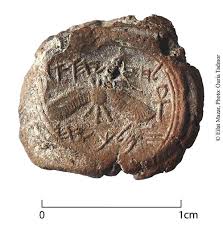
Yet the evidence is overwhelming. The kingdoms of Israel and Judah are among the best-documented societies of the ancient Near East. Their existence is attested through inscriptions, seals, coins, manuscripts, monuments, and the records of neighboring civilizations. The British Museum itself houses artifacts that tell this story.
Seal of King Hezekiah found in Jerusalem, around 700 BCE
That is why archaeology poses such a problem for those who seek to portray Jews as foreign interlopers – colonizers – with no ancient connection to the land. Artifacts cannot be pressured into changing their testimony. Every discovery points in the same direction: the Jewish story in the Land of Israel stretches back thousands of years, before the births of Jesus and Mohammed.
Few people would tolerate a museum debating whether ancient Egypt existed or whether Rome stood in Italy. Yet Jewish history is increasingly treated as uniquely negotiable.
Curiously and alarmingly, the protest at the British Museum had a much more immediate backdrop than the current war. This talk was to take place during Jewish Culture Month and the protestors were assembled by an anti-Israel group called “Jewish Artists for Palestine.” The museum’s efforts to highlight Jewish history in the land of Israel during a period of focus on Jewish culture brought out Jewish anti-Israel protestors.
Institutions are backing away from Jewish history and culture with the backing of fringe extremist Jews and anti-Israel Arabs. So basic history becomes debate, and the debate has moved from the policies of the Israeli government to Jews themselves.
The Nazis physically annihilated the Jews of Europe as it sought to place their culture as historical artifacts in museums. Now, museums and institutions seek to erase Jewish history and culture as a prelude to eradicating Jews in the Middle East.
Some of Israel’s strongest supporters today are found nearly 10,000 miles from Jerusalem.
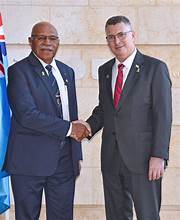
On June 2, 2026, as Israeli Foreign Minister Gideon Sa’ar opened Israel’s new embassy in Fiji, he was marking more than a diplomatic milestone. In recent years, Fiji and several Pacific nations have emerged as some of Israel’s most reliable supporters at the United Nations, often standing with the Jewish state when much of the world has turned against it.
Israeli embassy opening in Fiji, June 2, 2026
There is a certain irony in those votes. Israel was reborn in 1948, before the independence of most countries represented at the United Nations today, including many that now question its legitimacy.
At the center of this story stands Fiji’s Prime Minister, Sitiveni Rabuka.
Rabuka was born in 1948, the same year the modern State of Israel emerged from war and declared independence. Fiji itself would not become independent until 1970. Few leaders are better positioned to appreciate the journey of a small nation seeking to preserve its identity, security, and place in the world.
A former military commander and peacekeeper who served in Lebanon, Rabuka has become one of Israel’s strongest friends in the Pacific. The path that led him there reveals much about the bond between Israel and many Pacific nations.
Prime Minister of Fiji, SitiveniRabuka with Israeli Foreign Minister Gideon Sa’ar
Like generations of indigenous Fijians, Rabuka grew up in a deeply Christian society where the stories of the Bible shaped daily life. Jerusalem, Bethlehem, the Jordan River, and the Sea of Galilee were familiar long before they appeared in headlines. The history of the Jewish people, the kings of Israel, the prophets, and the life of Jesus formed part of a shared spiritual inheritance passed from one generation to the next.
For many Pacific Christians, the Holy Land is more than a place where sacred events occurred. It is the landscape where their faith began. Jerusalem is the city of David, the site of the ancient Temples, and the place where Jesus taught, died, and was resurrected.
Rabuka later encountered the region through military service. Fiji has contributed peacekeepers to the Middle East for decades, with soldiers serving in Lebanon, the Sinai, and the Golan Heights. Those missions transformed biblical geography into lived experience, creating connections between Pacific Islanders and a region they had long known through scripture.
Those experiences help explain why Rabuka has spoken so forcefully about Israel’s right to defend itself and why his government opened an embassy in Jerusalem in 2025, at the time, the seventh country to do so. His support reflects a worldview shaped by faith, military service, and an understanding that small nations must often fight to preserve their security, identity, and future.
“The people of Fiji share a very close religious and cultural connection to the Holy Land. We deeply value your great nation, which is the birthplace of Christianity. Our similarities, faith and common values continue to strengthen us together in unity and solidarity, as witnessed here this afternoon.” – Fiji PM Sitiveni Rabuka September 18, 2025
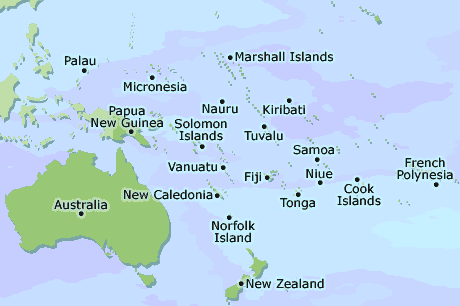
That perspective resonates across the Pacific. Countries such as Papua New Guinea, Tonga, Palau, Nauru, and the Federated States of Micronesia understand the challenge of preserving sovereignty and culture in a world dominated by larger powers. Israel’s story speaks to concerns that many of these nations know well: preserving identity, protecting sovereignty, and carrying an ancient heritage into the future.
Their support for Israel in international forums reflects more than diplomacy. They see a people who returned to their ancestral homeland, revived an ancient language, rebuilt national institutions, and defended their independence against repeated challenges. Those themes resonate deeply among nations that have worked to preserve their own cultures and sovereignty across generations.
It is a remarkable journey: a Pacific leader born in 1948, shaped by the Bible and military service in the Middle East, helping forge a friendship with the country whose modern story began the year his own life did. Across oceans and continents, the connection endures because both nations understand that a people secures its future by remaining rooted in its past.
Two years ago at New York City’s Celebrate Israel Parade, Holocaust survivors climbed down from their float and danced with the children marching beside them. This year the children climbed up onto the float and sat beside the survivors.
The change captured something unmistakable: distance in years sometimes requires an inverse relationship in physical space.
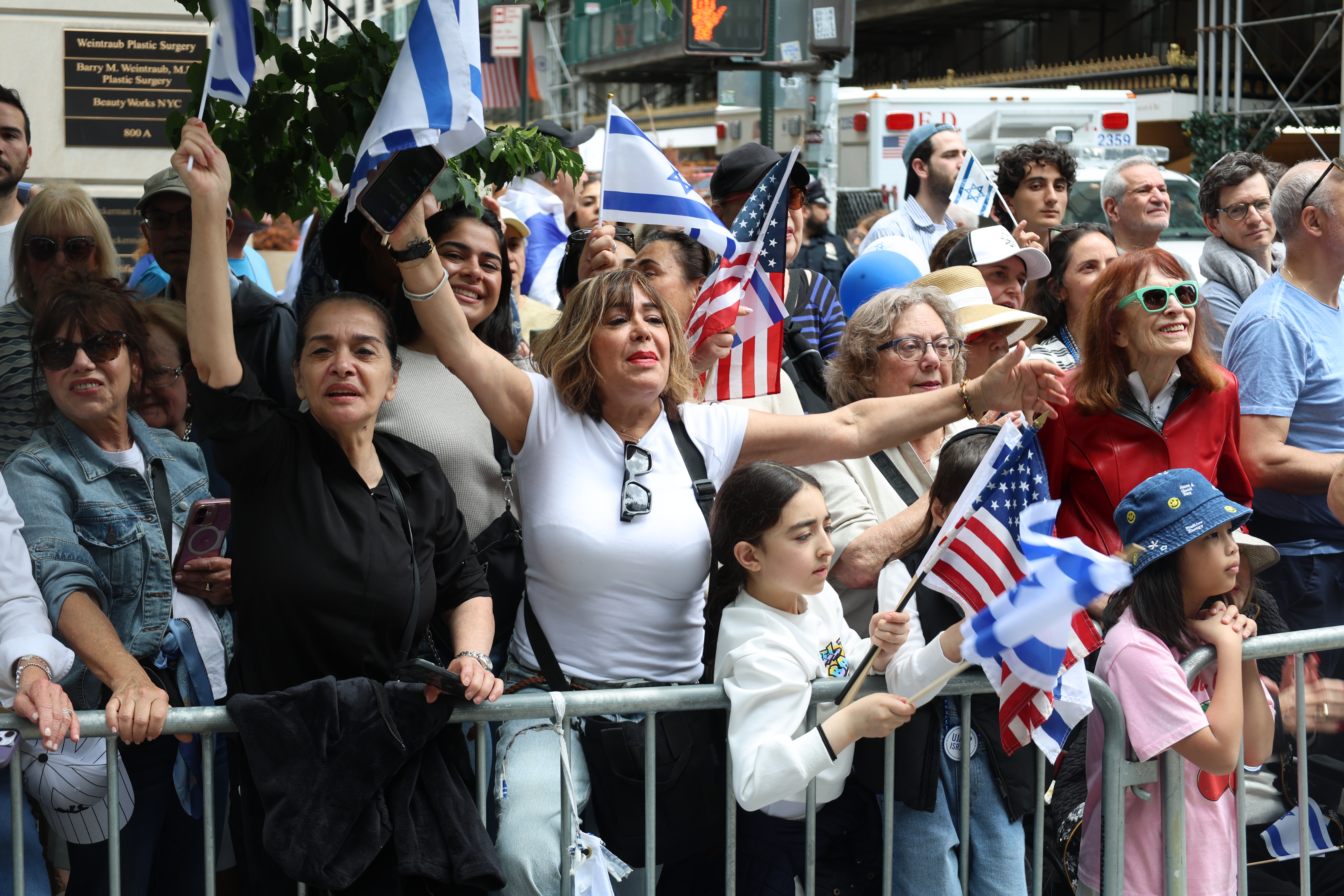
As the float moved down Fifth Avenue, Holocaust survivors waved Israeli flags toward the crowd. Around them stood students, children, grandchildren, and thousands of New Yorkers carrying American and Israeli flags. Some of those cheering were the children and grandchildren of Survivors who are no longer here.
Children of Holocaust Survivors march alongside float carrying Survivors (photo: First One Through)
They felt what we saw: how much smaller the group of survivors had become.
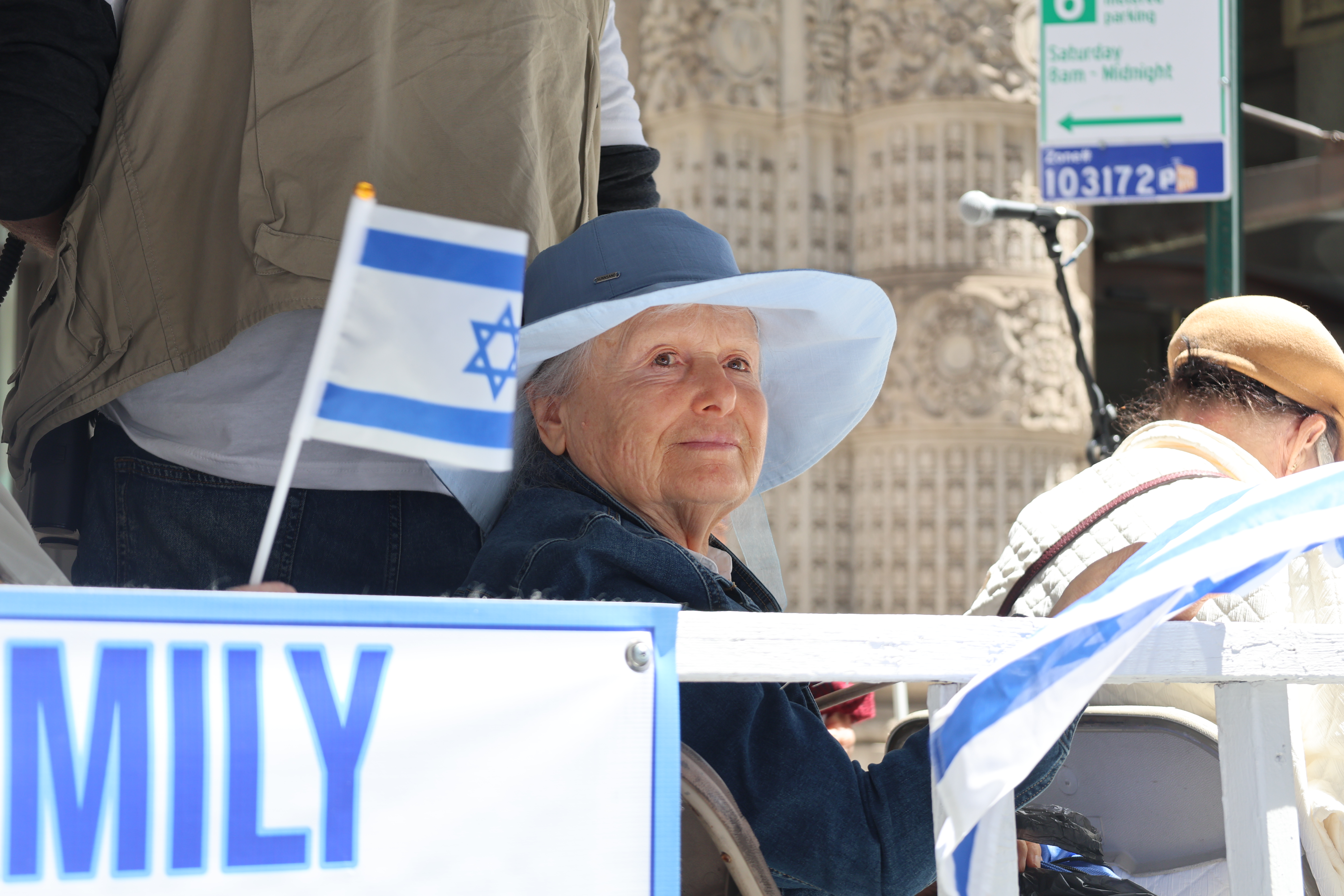
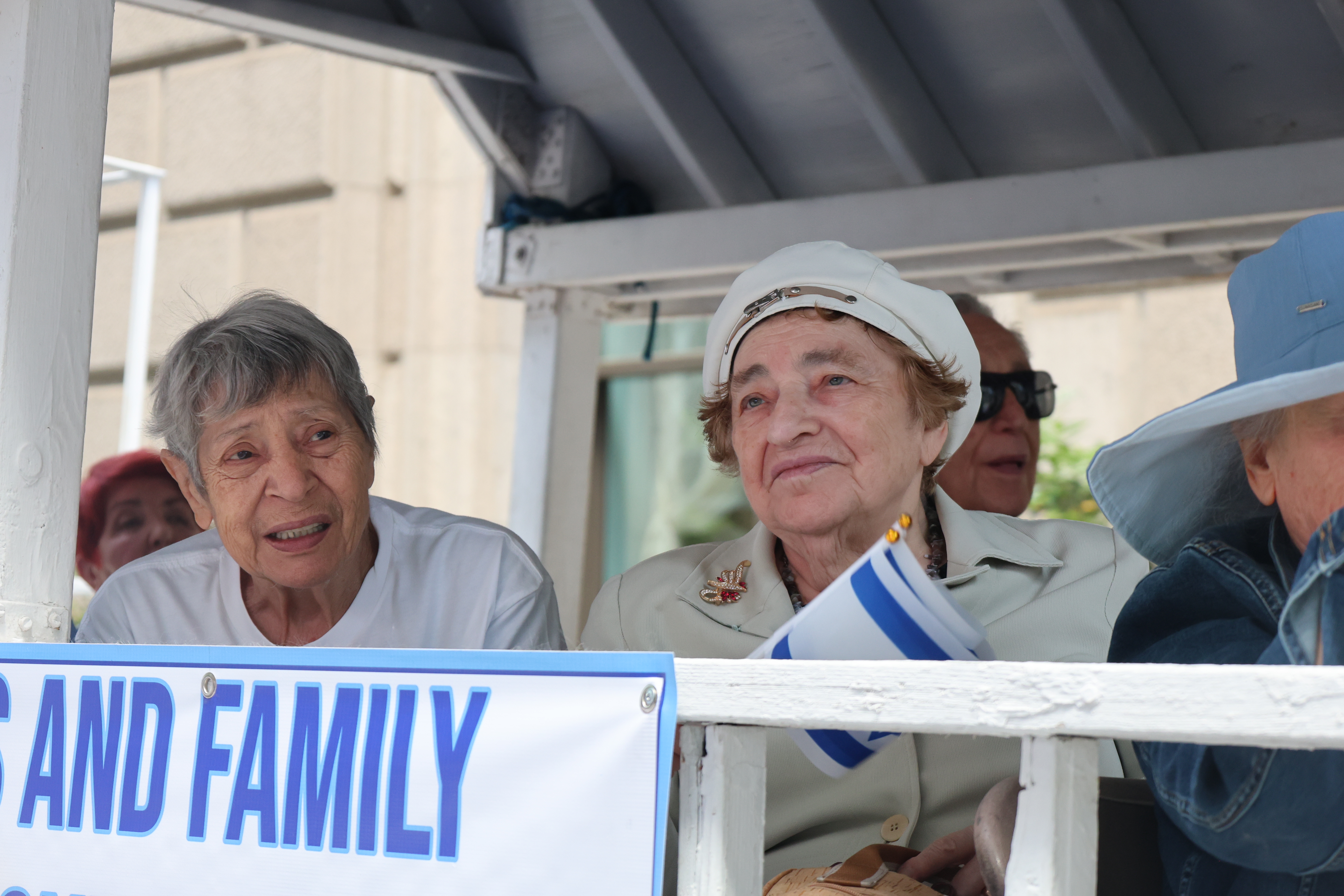
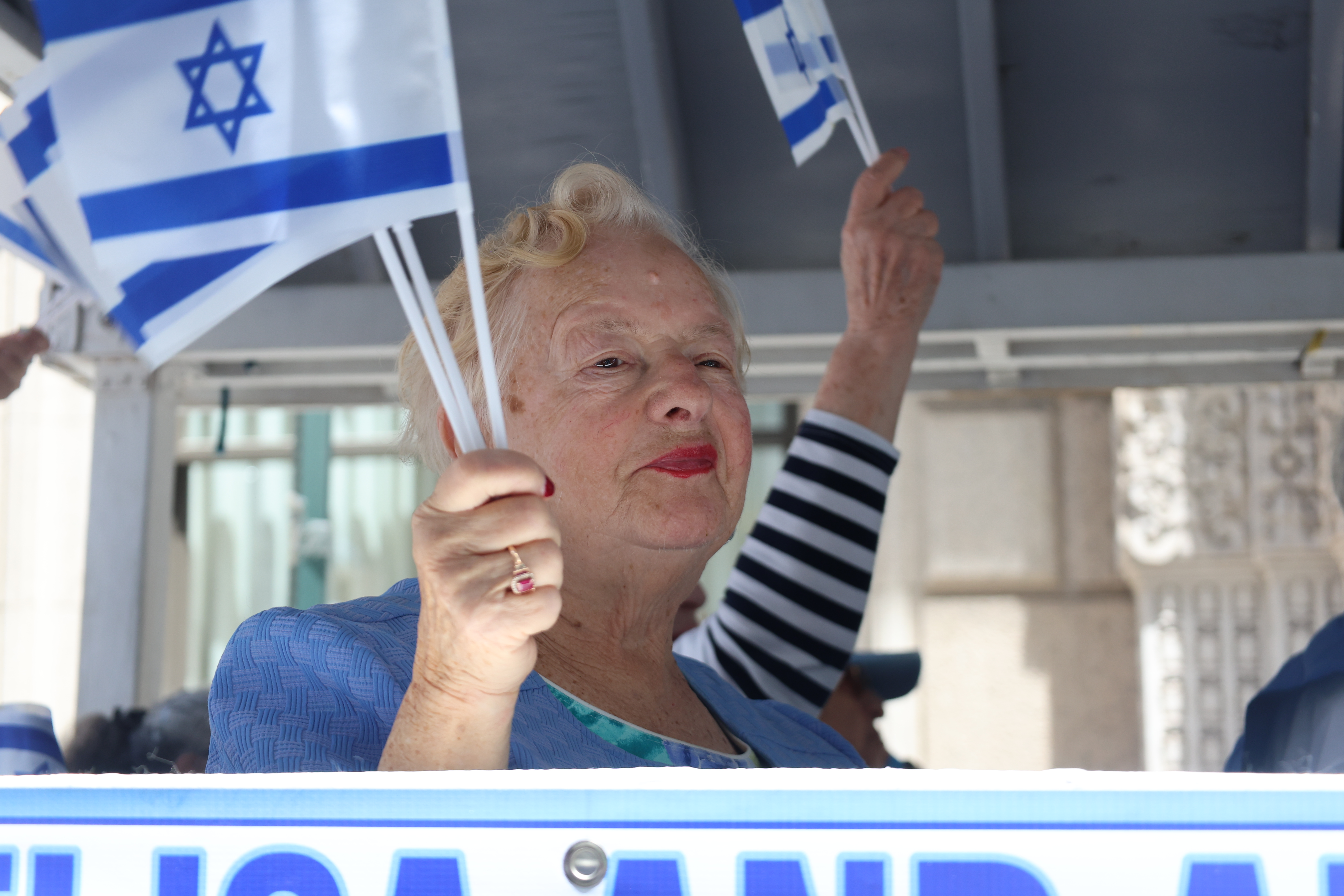
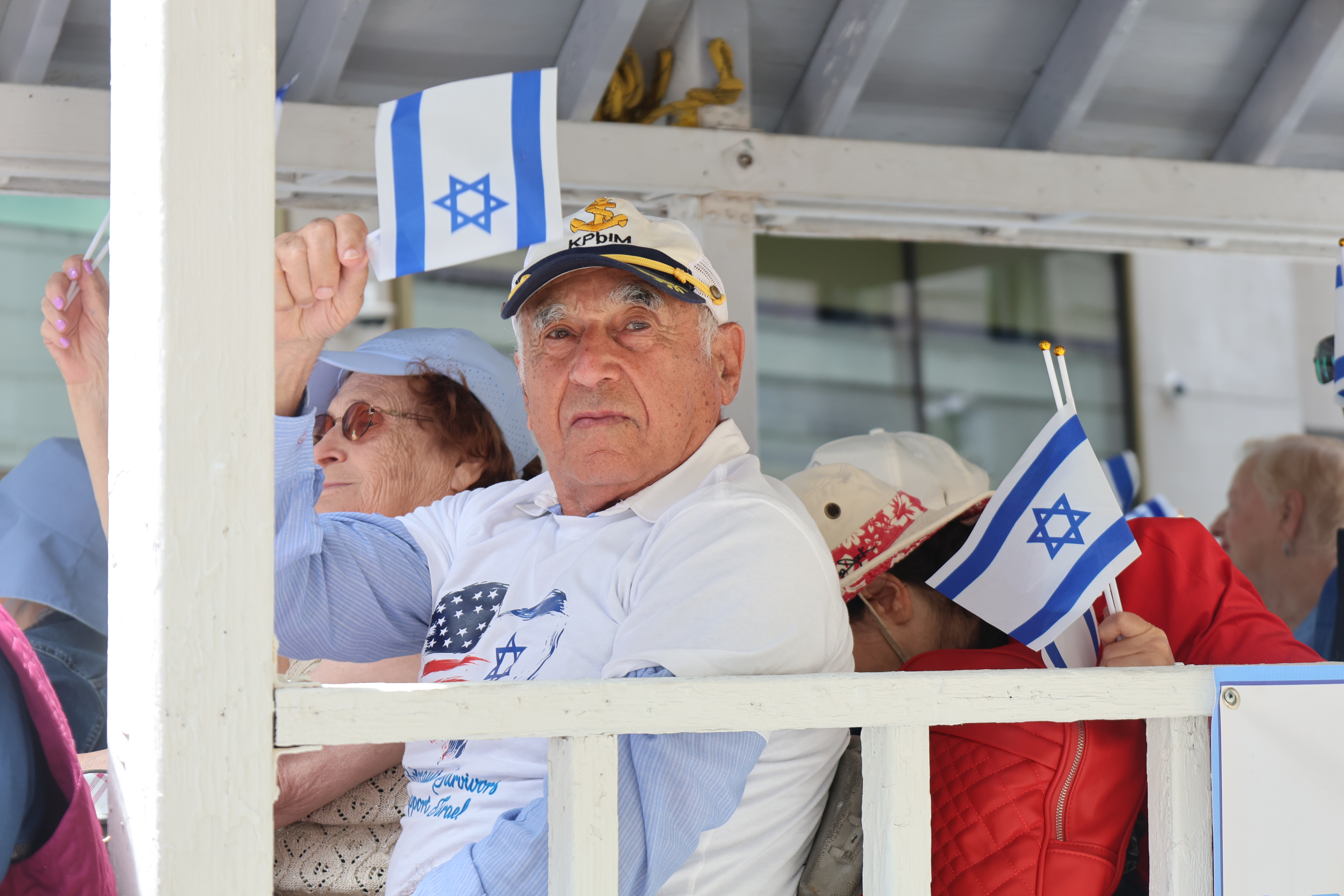
An elderly woman sat quietly beneath a blue hat, an Israeli flag resting beside her. Nearby, several other survivors smiled and waved to the crowd. Looking across the float, one could not help noticing who was missing.
Holocaust Survivor at Celebrate Israel Parade 2026 (photo: First One Through)
The men are disappearing.
Every year there are fewer survivors able to spend a day riding through Manhattan. Husbands, brothers, and friends who once shared these memories are no longer there. Increasingly, the survivors are women carrying stories that were once held by entire families and communities.
The Holocaust is passing from lived experience into history.
Holocaust Survivors at Celebrate Israel Parade 2026 (photo: First One Through)
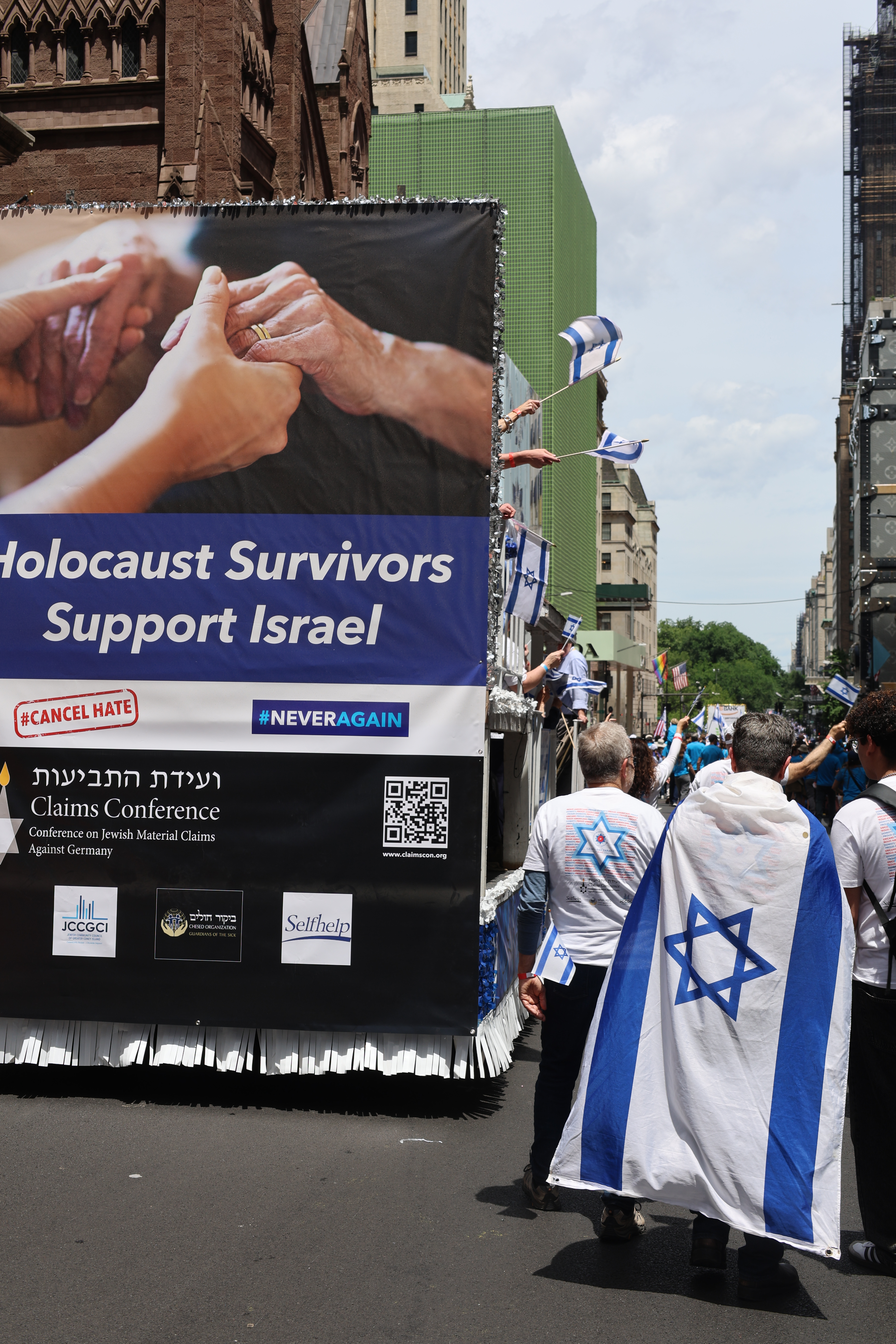
The banner on the float read simply: “Holocaust Survivors Support Israel.”
For many aboard, Israel is not a political issue. They remember something most Jews today know only from books: a world in which there was no Jewish state. A world in which the doors of country after country remained closed while European Jewry was destroyed.
That reality gave the float a weight extending far beyond the parade itself.
Claims Conference float at Celebrate Israel Parade 2026 (photo: First One Through)
Yet the most moving scenes took place between the survivors and the young people gathered around them.
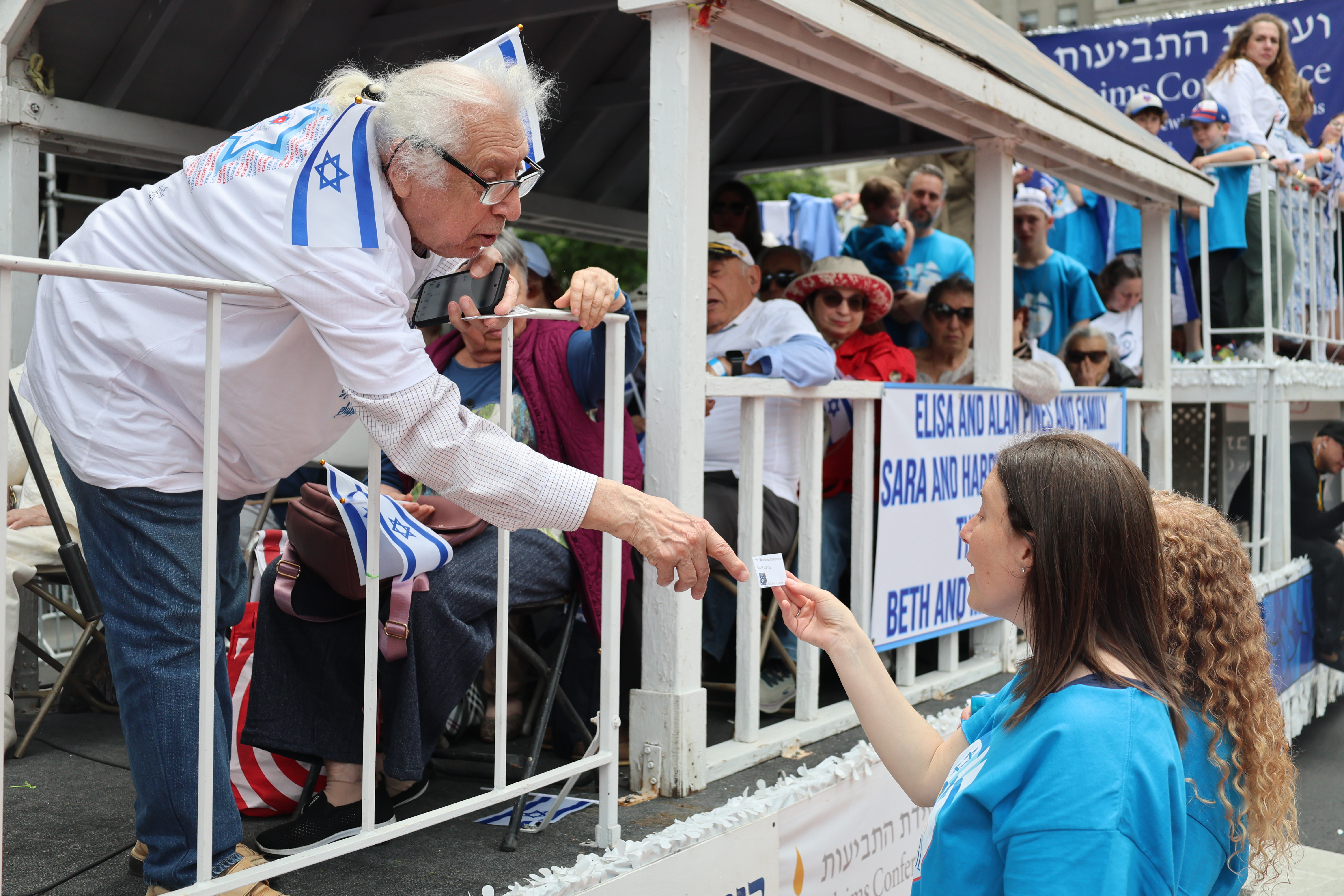
Some students and families from the Heschel School spent part of the afternoon alongside the survivors. Conversations unfolded between people separated by seventy or eighty years, yet connected by a common story. One survivor leaned over the railing to hand a parent a reference to a book he had written. Others stopped to speak with children standing beside the float.
The survivors can no longer carry these memories alone.
Holocaust Survivor at Celebrate Israel Parade 2026 talking to people from the Heschel School (photo: First One Through)
Others must carry them forward.
Perhaps that is why they continue to come.
Waving for hours on a hot day is not easy at ninety years old. Yet year after year they return because memory survives only when it enters public life and passes from one generation to the next.
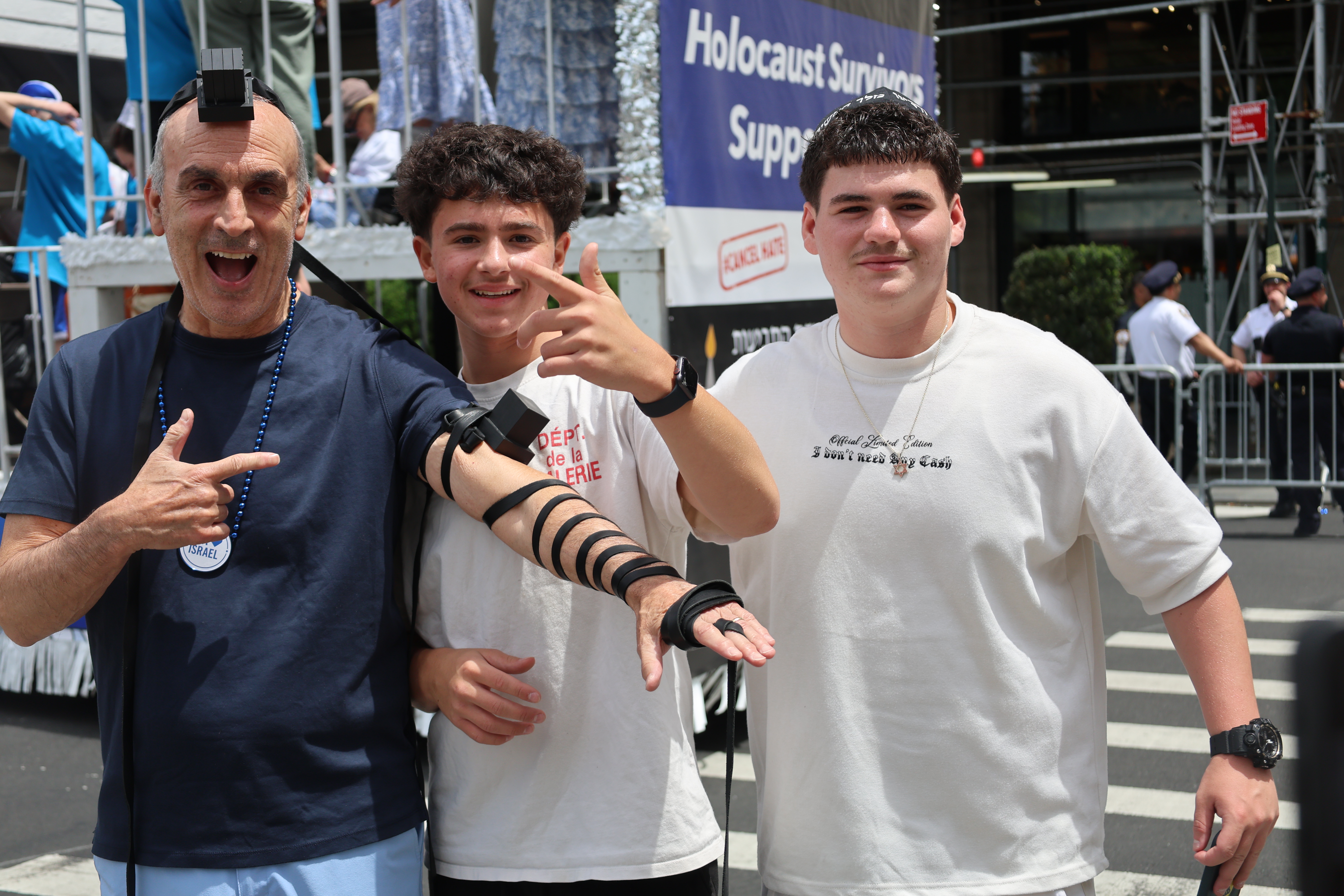
Around them, the parade moved forward. Families lined the route waving American and Israeli flags. Children danced in the streets. Chabad volunteers helped Jewish men put on tefillin along the sidewalks. The crowd cheered as marchers passed.
Young men put tefillin on Jewish men at Celebrate Israel Parade 2026 (photo: First One Through)
The city itself felt different than it had a few years ago.
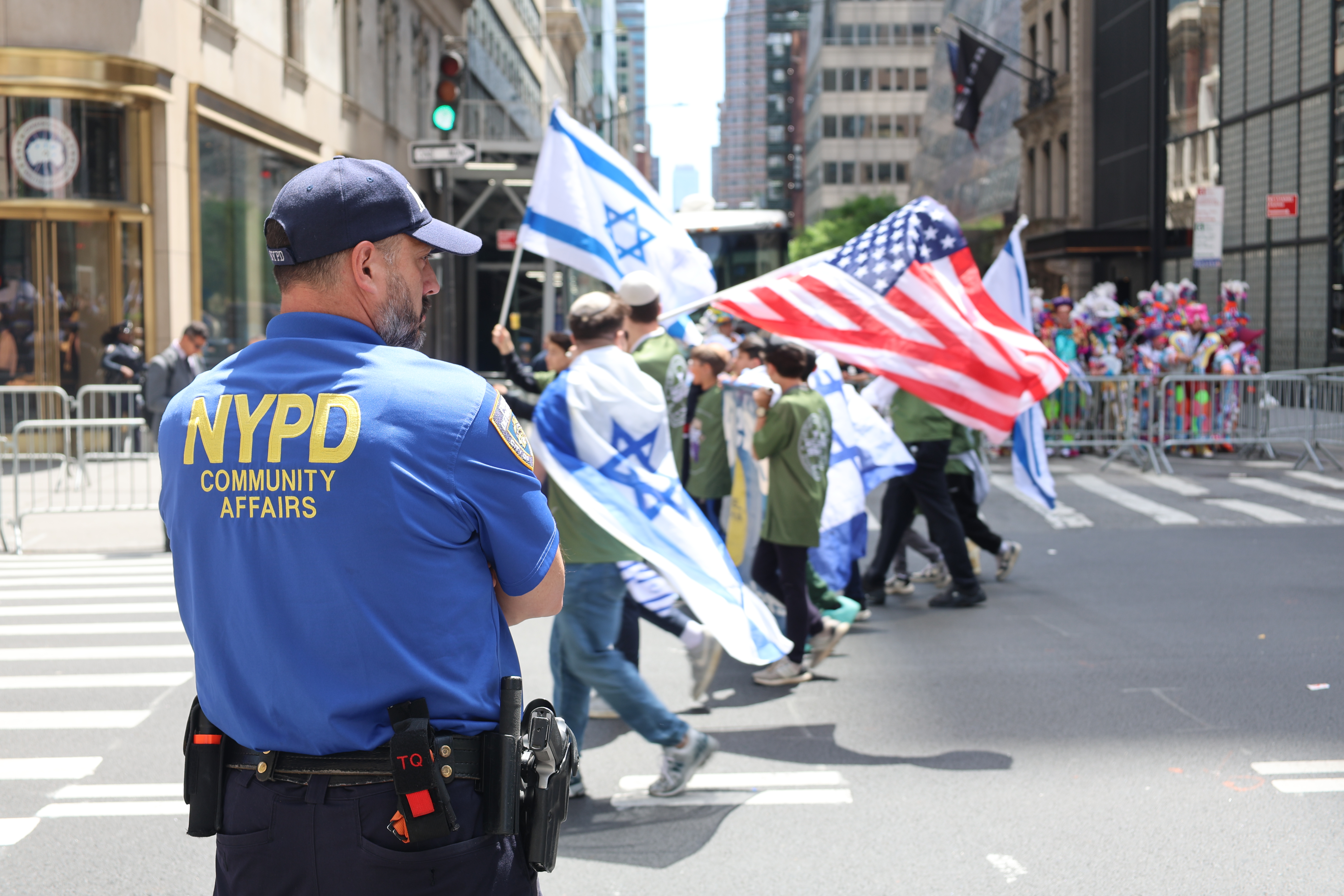
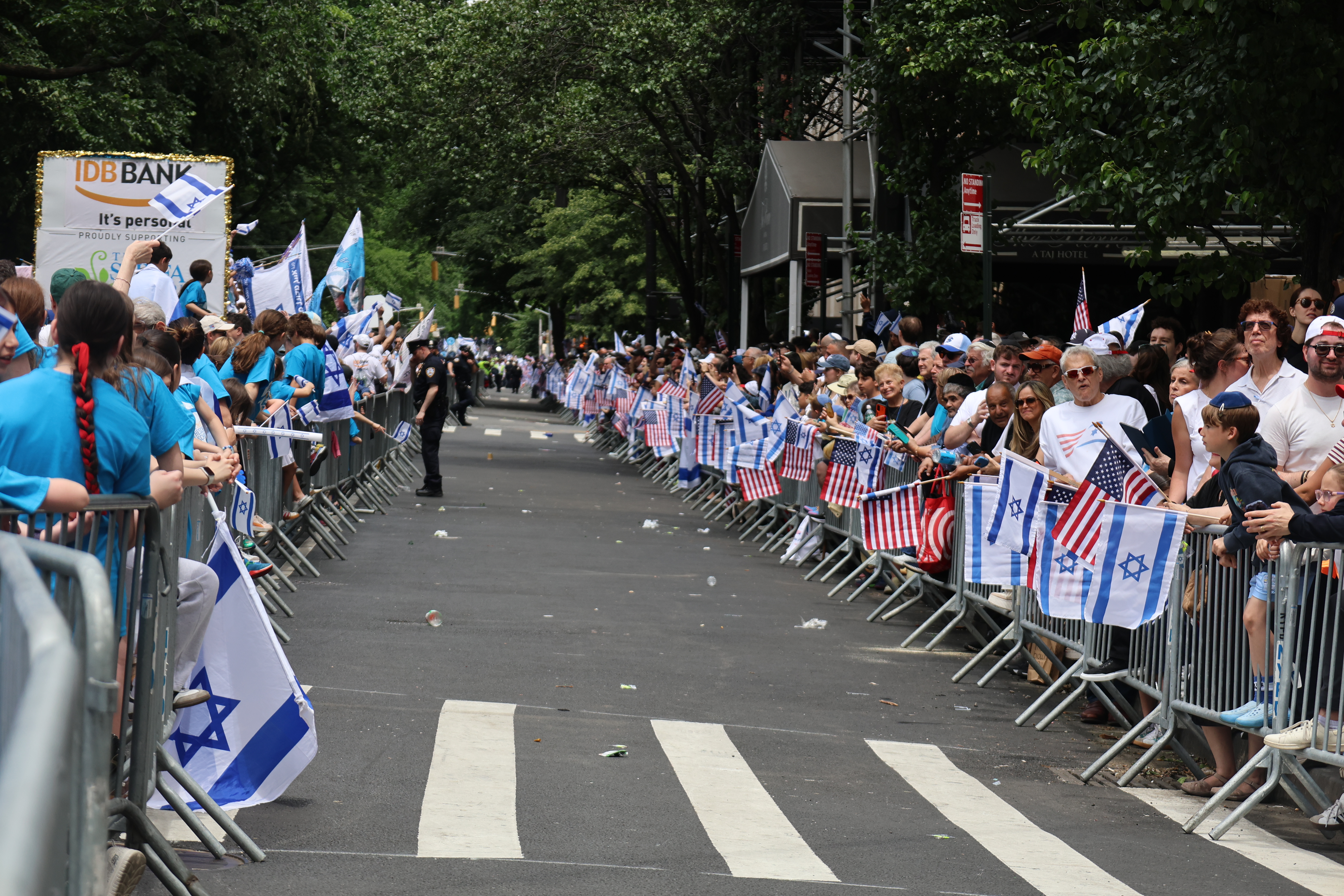
The parade was peaceful, but the precautions were impossible to miss. Police officers lined the route. Barricades stood farther from the crowd than in years past – perhaps twelve feet this year up from eight in years past.
NY Police watching over the Celebrate Israel Parade 2026 (photo: First One Through)Enormous twelve foot-plus separation along the Celebrate Israel Parade route on Fifth Avenue (photo: First One Through)
There was another difference as well.
Two years ago New York City’s mayor proudly marched in the parade. This year the mayor made a big show of not showing up because of his anti-Israel opinions. Support for Israel, once treated as an easy civic consensus, now feels more contested amid the ongoing Iranian proxy war on Israel.
The survivors understood such realities better than anyone. They have seen societies become less welcoming before.
Yet as the float rolled down Fifth Avenue, those tensions faded into the background. What remained was something older and more enduring.
Young people sat beside Holocaust survivors. They waved Israeli flags.
The scene compressed centuries of Jewish history. Survivors who remembered Europe before the Holocaust sat beside children growing up in America after the creation of Israel. The last witnesses shared space with those who will soon become witnesses for them.
Soon there will be no Holocaust survivors left to ride down Fifth Avenue.
The children waving beside them will inherit stories they never experienced themselves. They will become the custodians of memories that once belonged to the people sitting beside them.
Holocaust Survivor at Celebrate Israel Parade 2026 (photo: First One Through)
Two years ago the survivors climbed down from the float and danced with the children. This year the children climbed onto the float and sat beside the survivors.
The time distance between those moments is only two years. The physical distance between those generations has shrunk by necessity.
Holocaust Survivor at Celebrate Israel Parade 2026 (photo: First One Through)
For nearly two thousand years, Jews have ended prayers with the hope of returning to Jerusalem and rebuilding what once stood there. It is the location of the First and Second Temples. Jewish longing for Jerusalem is woven into daily prayers, holidays, weddings, and mourning rituals.
Yet major international bodies have passed resolutions referring to the site primarily through its Muslim names while minimizing or omitting its central place in Jewish history. Imagine a resolution discussing the Vatican without mentioning Christianity, or Mecca without mentioning Islam. The absurdity would be obvious.
The issue extends beyond language.
Official United Nations map labeling the Temple Mount as holy only to Muslims
The international community supports a protocol under which Muslims may pray freely on the Temple Mount while Jews are restricted from praying at Judaism’s holiest site. The result is extraordinary: the world’s only Jewish state is expected to enforce a policy under which Jews do not support a basic human right at their holiest location in favor of members of another faith.
The Temple Mount is not merely a religious site. It sits at the heart of a larger question: whether the Jewish people are entitled to the same rights afforded to every other people.
Around the world, international institutions celebrate indigenous peoples reconnecting with ancestral lands, reviving ancient languages, protecting sacred sites, and preserving cultural traditions. Yet only in the case of the Jewish people does a return to the place where their civilization, language, religion, and national identity were born become a form of “colonialism.“
International institutions routinely describe the Temple Mount and the Jewish Quarter as part of “occupied Palestinian territory.” Yet these are the very places where Jewish civilization was born, where the ancient Temples stood, and where Jewish communities lived for centuries.
Jordan’s capture of eastern Jerusalem in 1948 resulted in the expulsion of its Jewish population and the denial of Jewish access to the Western Wall, the Temple Mount, and the Jewish Quarter for nineteen years. It granted citizenship to residents as long as they weren’t Jewish. The UN seemingly liked this. International discussion of the Old City of Jerusalem begins after the expulsion of Jews, as though their absence were the natural condition and their return the disruption.
The same pattern appears in discussions of territory.
The Green Line was never intended to be a permanent border. The 1949 Armistice Agreements explicitly stated that the line was not a political boundary and would not prejudice future negotiations. It was a military ceasefire line drawn after a war.
Yet decades later, much of international law treats that armistice line as though it were a sacred border whose crossing transforms ordinary Jews into international criminals.
A Jew who moves across that line becomes a “settler.” An Arab who moves into the same building does not. The geography is identical. The identity of the resident is what changes.
International institutions frequently oppose changes to the “demographic character” of eastern Jerusalem. But demographic character relative to what date?
The answer is effectively 1949, the year after Jordan captured eastern Jerusalem and expelled every Jew from the Jewish Quarter and surrounding areas. Why should the demographic baseline for justice be the moment immediately following the ethnic cleansing of Jews?
Why not 1980? Why not 2000? Why not today?
Human beings move. Cities evolve. Neighborhoods change.
The only way to preserve a specific demographic snapshot forever is to decide that one particular population must be prevented from returning.
In Jerusalem, that population happens to be Jews.
Then there is the question of refugees.
The same international system that opposes Jews moving into neighborhoods beyond the Green Line frequently endorses claims that millions of Palestinian refugees and descendants should be allowed to settle inside Israel.
Movement in one direction is described as a right. Movement in the other direction is described as a violation of international law.
The asymmetry is impossible to miss.
Every era develops its own vocabulary for antisemitism. In medieval Europe it often spoke the language of theology. In the nineteenth century it spoke the language of race. Today it increasingly speaks the language of international law.
Around the world, international institutions celebrate indigenous peoples reclaiming ancestral lands, reviving ancient languages, protecting sacred sites, and restoring cultural traditions.
Jews have done all of those things.
They returned to the land where their civilization was born. They revived Hebrew from a language of prayer into a language of everyday life. They restored Jewish sovereignty to the city that has stood at the center of Jewish life for three millennia. They reestablished communities at many of their most ancient holy sites.
Yet only in the case of the Jewish people does this story become one of colonialism rather than return.
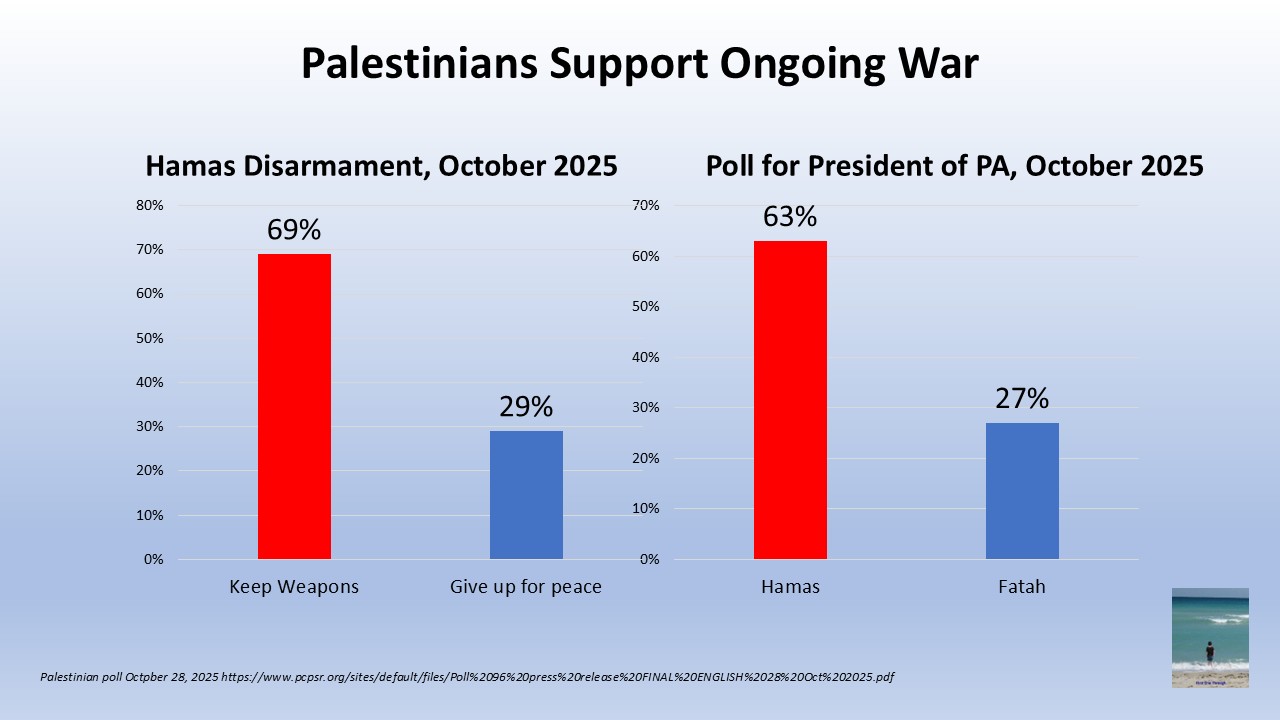
In October 2025, after two years of war and the devastation of Gaza, the Palestinian Center for Policy and Survey Research published findings that should have dominated headlines around the world:
Hamas remained the most popular Palestinian political movement.
More than half of Palestinians continued to view October 7 as the correct decision.
Nearly seven in ten opposed Hamas disarmament even if disarmament would prevent another war.
After two years of destruction, support for Hamas remained strong. Support for October 7 remained widespread. Opposition to disarmament remained overwhelming.
These findings did not come from Israeli politicians or government spokesmen. They came from Palestinians speaking to Palestinian pollsters.
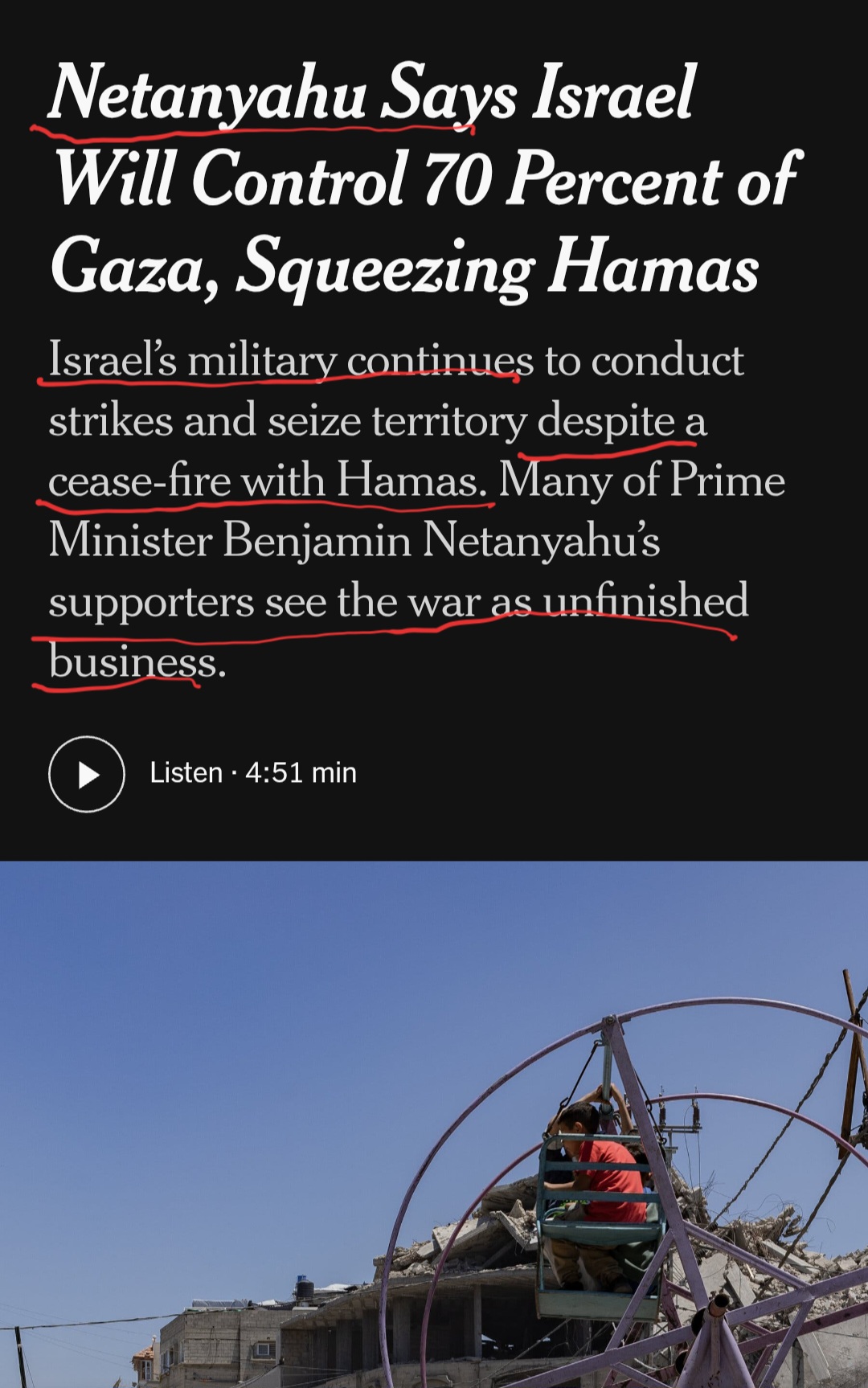
Yet still, the New York Times publishes lengthy articles that the Gaza war continues because of Israel.
Readers were taken inside Benjamin Netanyahu’s political calculations. They learned about coalition pressures, right-wing ministers, territorial ambitions, and supporters who view the war as unfinished business.
By the end, a clear narrative emerged: the war continues because Israelis want it to continue. Because of greed for land, for power.
There was no mention that Gazans want Hamas to remain armed and for the war to continue. That is the political reality that keeps a ceasefire from taking hold.
The omission matters because it changes the reader’s understanding of the conflict. It places blame solely on Israel when a majority of Palestinians continue to seek the destruction of Israel despite the devastation in Gaza.
Until journalists devote the same attention to Palestinian motivations that they devote to Israeli motivations, Americans will continue receiving a false explanation for why this war endures.
Europe spent twenty years explaining that Hamas had a “political wing.” Hezbollah too. The bomb throwers were one thing, the parliamentarians another. The rocket launchers belonged in one legal bucket, the social service offices reserved for a different one. Western diplomats performed intellectual yoga worthy of Cirque du Soleil to preserve the distinction. The “military wing” was terrorist while the “political wing” was complicated. Nuanced. An unavoidable interlocutor for peace.
Britain finally gave up the act in 2019 with Hezbollah. The distinction, it concluded, was largely fictional. Same leadership, same financing, same ideology, same organization. Europe still technically preserves some of these distinctions in various legal frameworks, but fewer people pretend anymore that the “armed wing” and “political branch” emerge from separate planets.
Which makes the growing sanctions campaign against Jewish housing rights groups so fascinating.
Because now the question flips. Suddenly Europe is no longer carefully distinguishing between ideology and violence. Advocacy for controversial positions – not for violence – can suddenly become complicity in terrorism. Entire categories of speech are treated as unlawful conduct even absent anything remotely resembling the classic terrorism that justified Hamas and Hezbollah designations in the first place.
Take Nachala. It is not Hamas. It does not have brigades. It does not launch rockets. It does not run suicide bombing cells. It is an ideological movement advocating Jewish settlement in disputed territory. One may agree with it or despise it. One may view Jews living in land the Stateless Arabs from Palestine (SAPs) want as a future Palestinian state as historic justice or catastrophic policy. But that is precisely the point. The dispute is fundamentally political and ideological.
For decades Europe insisted ideology alone was not terrorism. Supporting Palestinian “resistance” rhetorically was not enough. Calling for the destruction of Israel was grotesque but still politics. The line was violence. Actual violence. Material support for violence. Operational involvement in violence.
That was the principle.
Until suddenly the principle became inconvenient.
Now the standard appears to be evolving into something far murkier: movements may be sanctioned not necessarily for carrying out terrorism, but for contributing to environments viewed as extremist or against government foreign policy. Perhaps that standard is morally justified. Perhaps some Israeli activists have crossed legal and moral lines. But if this is the new doctrine, then the West should at least admit the doctrine changed.
Nachala’s Daniella Weiss
If ideology itself is now sanctionable, Western governments cannot apply the principle selectively.
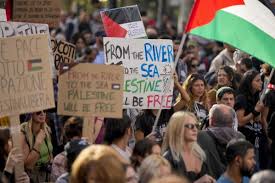
For years crowds across London, Paris, Barcelona and university campuses have openly chanted for the elimination of the Jewish state “from the river to the sea.” Activists routinely declare that Israeli Jews should “go back to Poland,” despite the fact that millions of Israeli Jews descend from families expelled from Arab countries, Ethiopia, Iran and elsewhere. Imagine any other minority in Europe being told to leave the country and “go back” to lands where many never lived, or to where their families were annihilated. Authorities would instantly recognize the ethnic character of the demand.
If Israelis arguing that Jews should again live in Gaza constitutes sanctionable extremism, then what exactly should Britain call organizations openly advocating a “right of return” designed to flood Israel demographically out of existence? If the standard is advocacy for the removal or replacement of another national group, then the principle cannot stop with some Jewish activists in the West Bank.
London protest against Israel in 2021, including rap song
If the line is now ideological support for demographic elimination, then governments must police the radicalism inside their own societies with equal vigor.
That means groups explicitly advocating the destruction of Israel should face the same scrutiny directed at Jewish expansionist movements. Organizations and individuals promoting the forced removal of Jews from the Middle East “from the river to the sea” should not receive a special exemption dressed up as mere “anti-Zionism,” as if Israel is a concept and not a reality. Calls for the end of the Jewish State are not sophisticated geopolitical critiques. They are ethnic slogans calling for violence. And if governments now believe rhetoric itself creates dangerous ecosystems, they cannot pretend those ecosystems exist only on one side of the conflict.
Anti-Israel protesters in Rome, Oct. 28, 2023, shortly after the October 7 massacre and abduction of Israelis by thousands of Gazans. (AP Photo/Andrew Medichini)
The irony is extraordinary. Europe once bent over backwards to separate terrorism from politics when the movements in question were Palestinian or Islamist. Now governments increasingly collapse politics into extremism to be sanctioned only when the movements are Jewish nationalist.
Europe spent decades insisting that ideas were not terrorism. If it now believes otherwise, it should say so openly and explain where the line will be drawn for everyone else.
Pip: There is something clarifying about discovering that a political vocabulary you assumed was spontaneous had a drafting committee — and a host country.
Mara: Today we are following First.One.Through into the history of how anti-Israel rhetoric was systematically constructed, tracing the ideological architecture back to a 2001 conference in Tehran. Let's start with where that script came from.
The Genocide Script Was Written by Iran in 2001
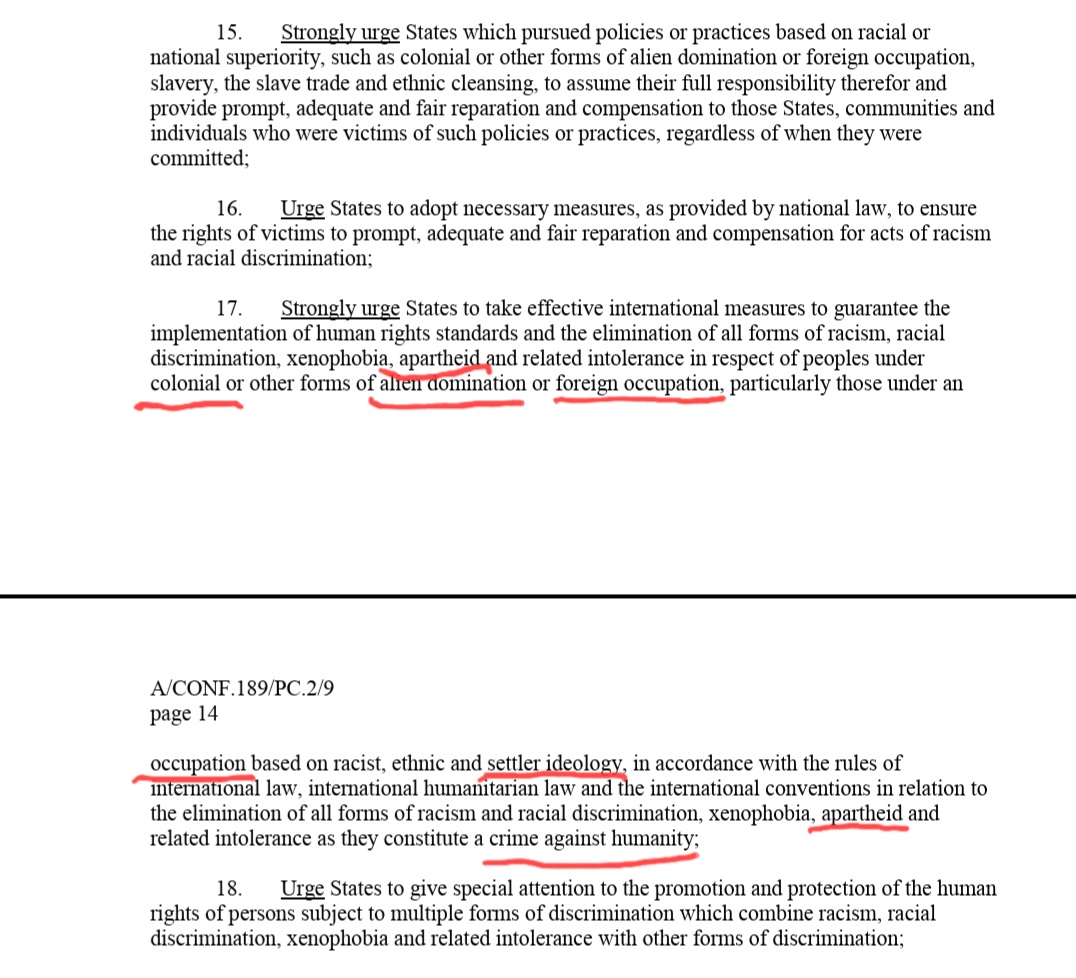
Mara: The central question here is whether the language of "apartheid," "settler colonialism," and "genocide" applied to Israel emerged organically from events on the ground — or whether it was a pre-built ideological framework deployed strategically.
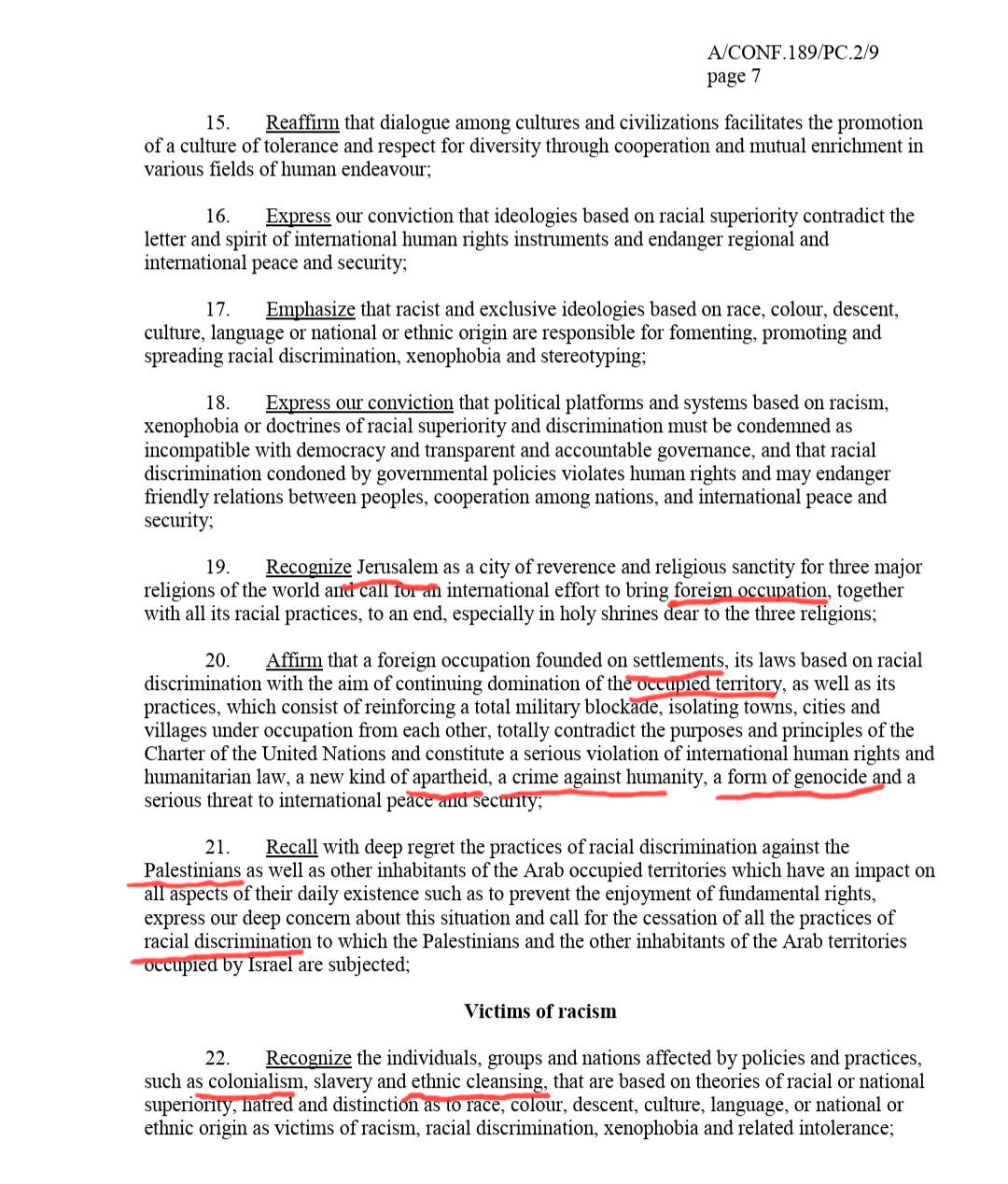
Pip: The post answers that directly. Here is the setup: this was February 2001 — Hamas had not yet seized Gaza, Israel had not disengaged, October 7 was over two decades away — and yet the declaration from Iran's UN preparatory conference already described Israeli policy as "a new kind of apartheid," "a crime against humanity," and "a form of genocide."
Mara: The upshot is that the vocabulary was not a reaction to events. The moral categories were assigned before the events now routinely cited to justify them existed.
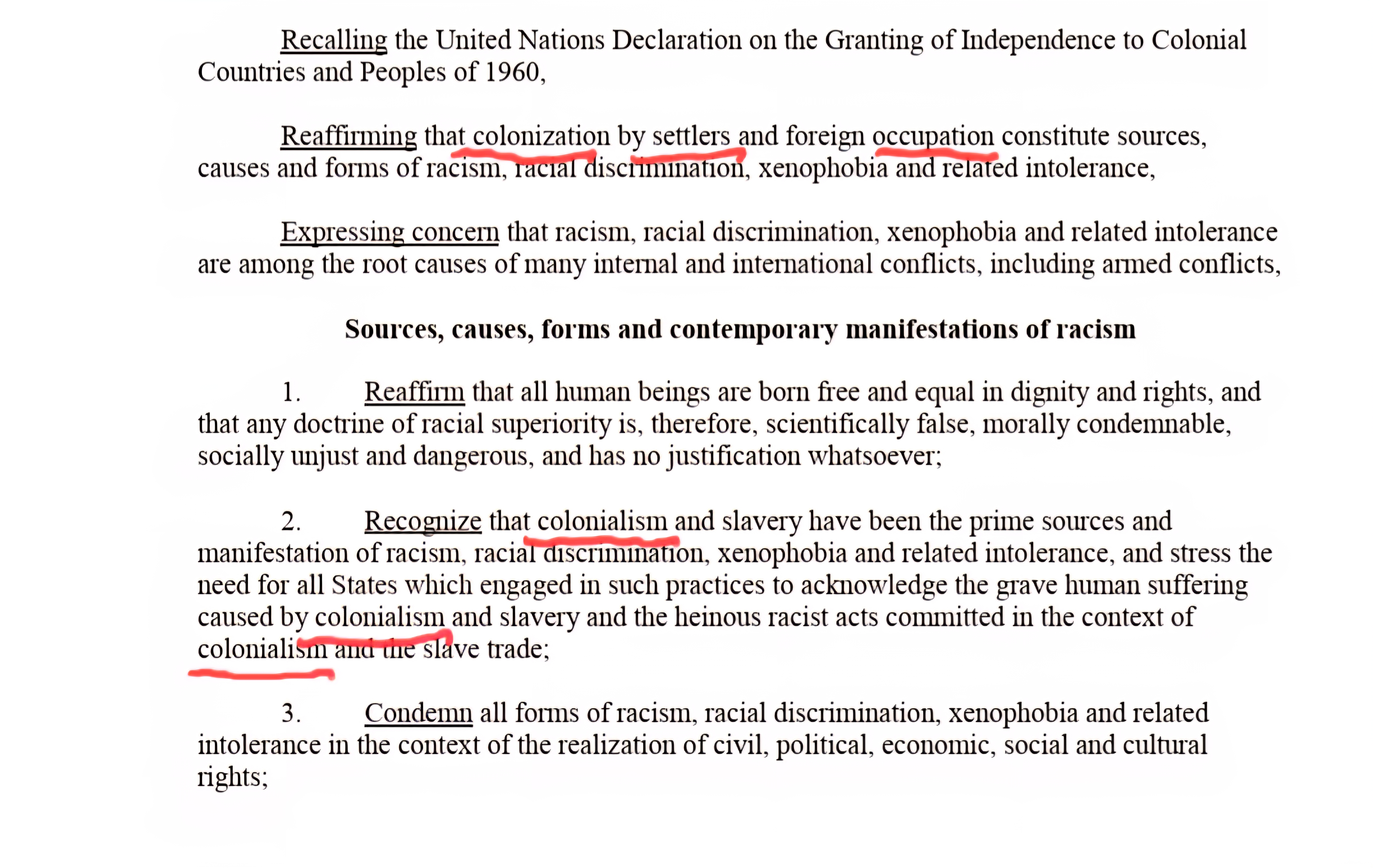
Pip: And the post walks through exactly what that vocabulary contained: apartheid, settler colonialism, genocide, racial supremacy, alien domination, decolonization. The full lexicon, complete, in 2001.
Mara: What the post argues is that Iran understood something many Western governments did not — that narratives outlast battlefields. The framing is precise: "Terror attacks shock people temporarily. Moral frameworks reshape generations."
Pip: The mechanism described is a kind of moral laundering. Traditional antisemitism had been discredited after the Holocaust, so hostility toward the Jewish state was repackaged in the language of anti-racism and liberation. The old demand that Jews disappear became "decolonization."
Mara: The post traces how that vocabulary migrated — from the Tehran declaration into NGO reports, university syllabi, newsroom style guides, and eventually street protests. Students repeating those phrases today are, as the post puts it, echoing a script written by regimes that openly sought Israel's destruction.
Pip: The inversion the post identifies is the sharpest part: a regime animated by eliminationist antisemitism repositioned itself as an anti-racist moral authority, while recasting the Jewish state as the great racist evil of the modern era.
Mara: And the asymmetry in the Tehran document itself is telling — exhaustive attention to portraying Israel as racist, and nothing on antisemitism in the Arab world, terrorism against Israeli civilians, or the expulsion of Jews from Arab countries. That imbalance was not accidental.
Pip: The post's conclusion is blunt: October 7 did not write the script. It activated one that had been waiting since 2001.
Mara: Which raises the harder question — what it means to engage with that vocabulary now, knowing where it was built.
Pip: When the moral framework precedes the facts it claims to describe, the facts stop doing the work.
Mara: That is the thread worth pulling — how political language gets built, distributed, and eventually treated as self-evident. More on that next time.
For years, the world was told the “Great March of Return” was peaceful theater. Demonstration. Symbolism. Political performance staged at Israel’s border fence. The real outrage, activists insisted, was not thousands of Gazans converging on a sovereign frontier controlled by a terrorist regime openly committed to Israel’s destruction. The outrage was that Israel refused to let them through.
Every breach attempt became a morality play. The fence itself was cast as villainous. Hamas was downgraded from genocidal jihadist organization to stage manager for a humanitarian spectacle. Foreign correspondents photographed smoke, flags, and crowds surging toward the barrier while carefully avoiding the central question: what exactly did “return” mean in practice?
A picture taken on March 30, 2018 from the southern Israeli kibbutz of Nahal Oz across the border from the Gaza strip shows tear gas grenades falling during a Palestinian tent city protest commemorating Land Day, with Israeli soldiers seen below in the foreground. (Photo credit JACK GUEZ/AFP/Getty Images)
October 7 answered it.
The world spent years romanticizing the idea of border penetration into Israel. Then Hamas finally achieved it. The infiltrators entered and what followed was not symbolic “resistance,” not coexistence, not liberation theology with subtitles for Western consumption. It was slaughter. Torture. Kidnapping. Burning families alive. Mass rape. Entire communities transformed into killing fields within hours.
The “Great March of Return” was not a protest but a rehearsal for an invasion.
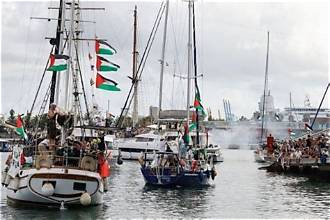
The flotilla theatrics now replay the same script at sea.
Once again, activists sail toward a Hamas-controlled enclave insisting their mission is humanitarian symbolism. Once again, cameras arrive before facts. Once again, Israel is expected to participate in a choreographed morality play where interception itself becomes the crime. The activists want confrontation because confrontation produces images, and images produce headlines, and headlines produce another cycle in which Israel defending its borders is treated as inherently suspicious.
But after October 7, Israel no longer has the luxury of indulging symbolic breaches.
A blockade around a terrorist enclave is not abstract political philosophy. It is a security perimeter. Every intercepted vessel is being measured against the memory of what happened when infiltrators were not stopped. The Israeli Navy does not have the privilege enjoyed by European activists thousands of miles away who can romanticize “breaking barriers” while knowing they will never personally absorb the consequences if those barriers collapse.
That is why the flotilla activists are ultimately engaged in theater. They know they will be intercepted. Israel knows it must intercept them. The performance depends on the interception itself. Their goal is not to deliver aid more efficiently than established channels. Their goal is to create imagery in which Israeli enforcement appears oppressive by definition.
Sumud flotilla
The irony is impossible to miss. For years, activists treated Israel’s insistence on secure borders as paranoia. Then October 7 became the bloodiest validation imaginable of exactly why those borders existed.
And so the boats are seized and returned to port. The activists call it repression. Israel calls it survival.
Perhaps the flotillas deserve a more honest name: the Great Return to Sender.
Every modern humanitarian organization insists the same thing: suffering is not a business. The starving child is not a marketing asset. The bombed hospital is not a fundraising funnel. The crying mother under rubble is not a revenue generator.
Then the annual reports arrive.
Médecins Sans Frontières (MSF) / Doctors Without Borders crossed roughly €2.3 billion in annual revenue in 2022. Then roughly €2.35 billion in 2023 and €2.36 billion in 2024. Three consecutive years above €2 billion. Ninety-eight percent of funding came from private donors. More than seven million donors worldwide.
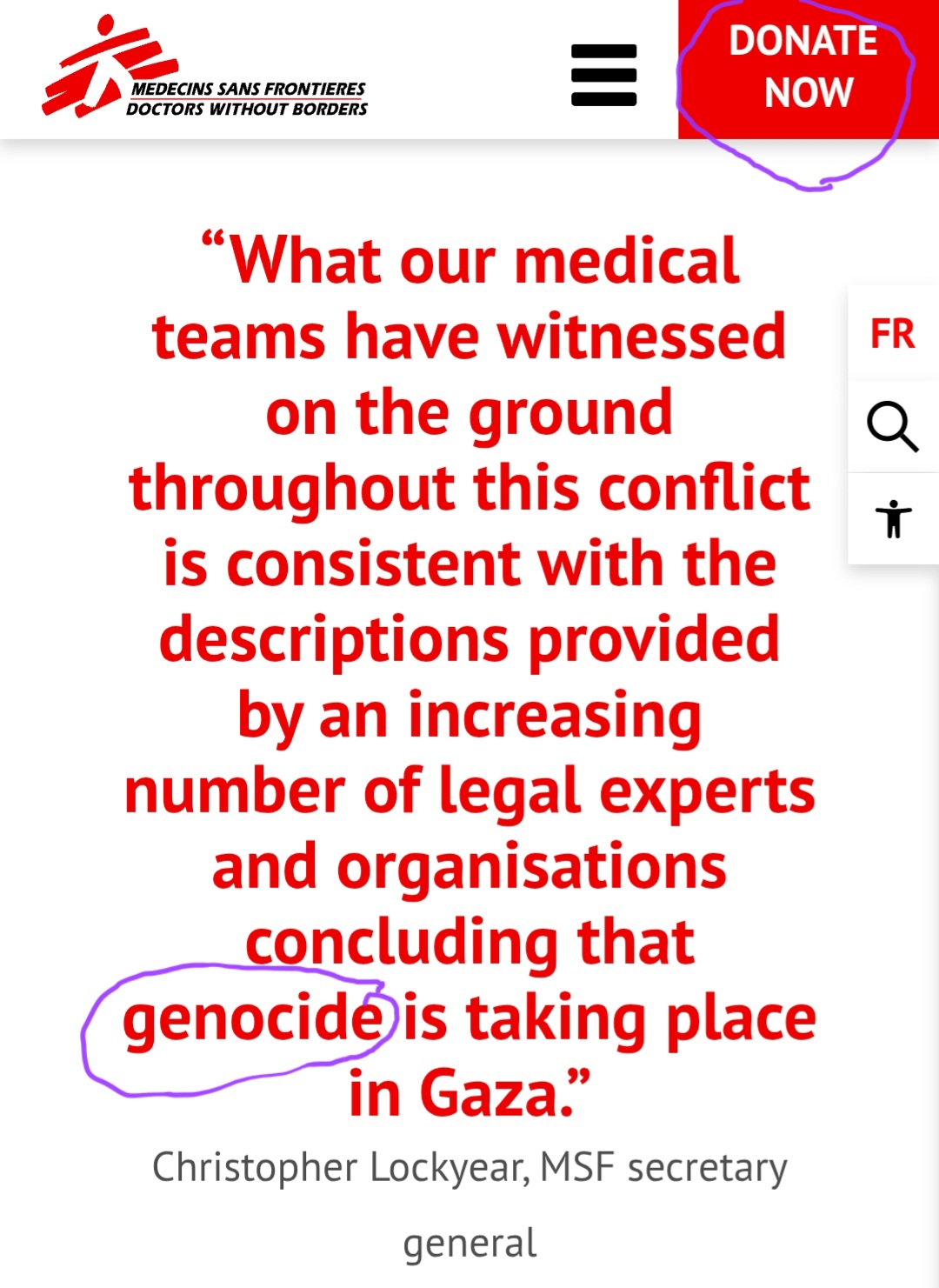
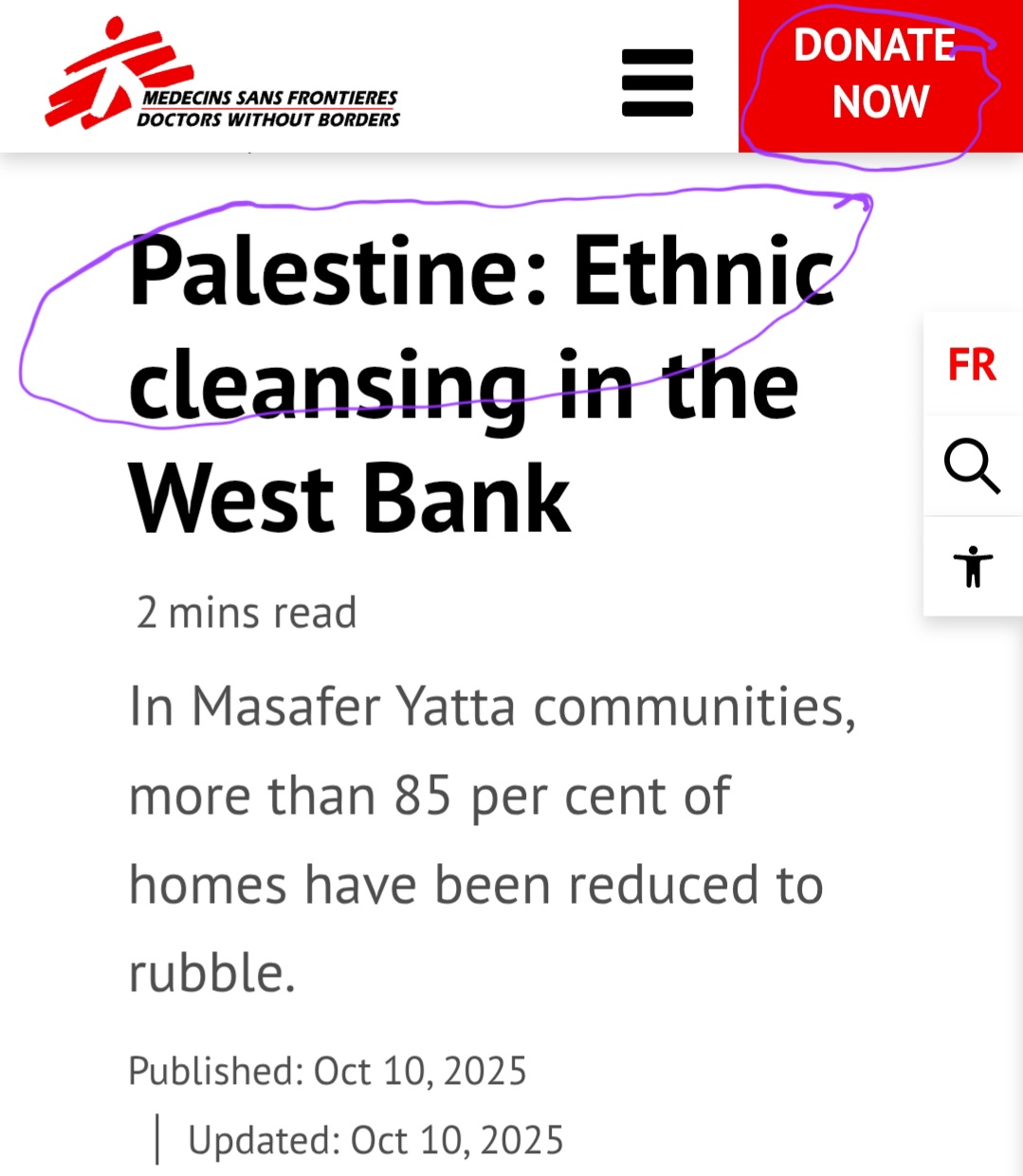
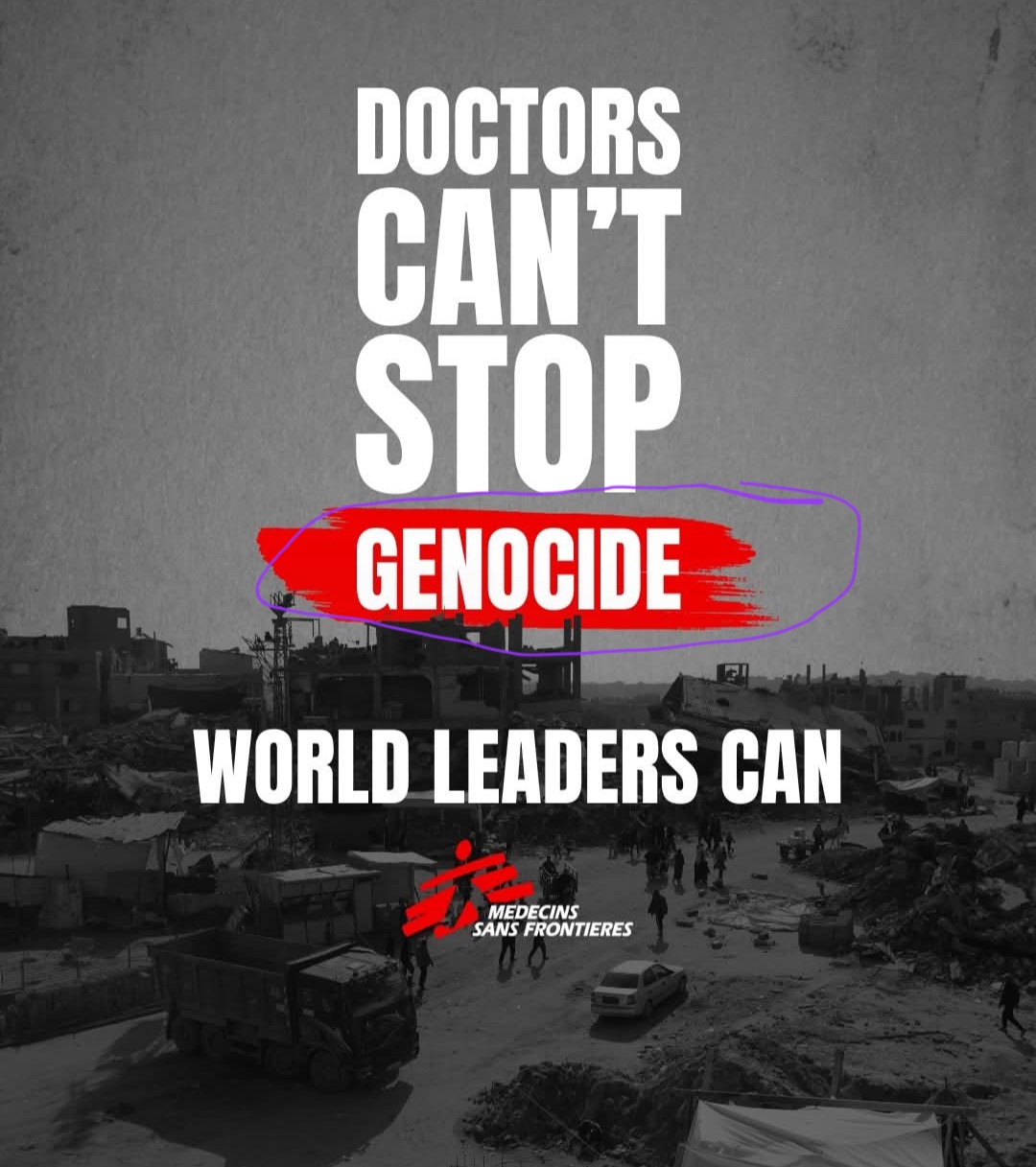
The organization presents this as proof of global compassion. It is also evidence of something else: misery has become one of the most effective fundraising products on earth. Especially if loaded with charges: “Genocide.” “Starvation.” “Ethnic cleansing.”
The humanitarian industry now operates inside the same emotional attention economy that drives political campaigns, cable news, and social media outrage. The more horrifying the imagery, the more morally charged the narrative, the more emotionally shattered the audience becomes, the faster the money moves.
And nobody understands this dynamic better than MSF.
MSF’s public communications increasingly fused emotionally maximalist language with direct fundraising infrastructure. A visitor no longer encountered merely medical updates. They encountered emotional conversion architecture.
The modern humanitarian sector has discovered what every digital platform already knows: emotionally devastating content converts. A dusty child under rubble produces more engagement than a policy paper. A charge of genocide and starvation moves directly into emotional reflex.
The uglier the images and explosive the charges, the healthier the fundraising pipeline becomes.
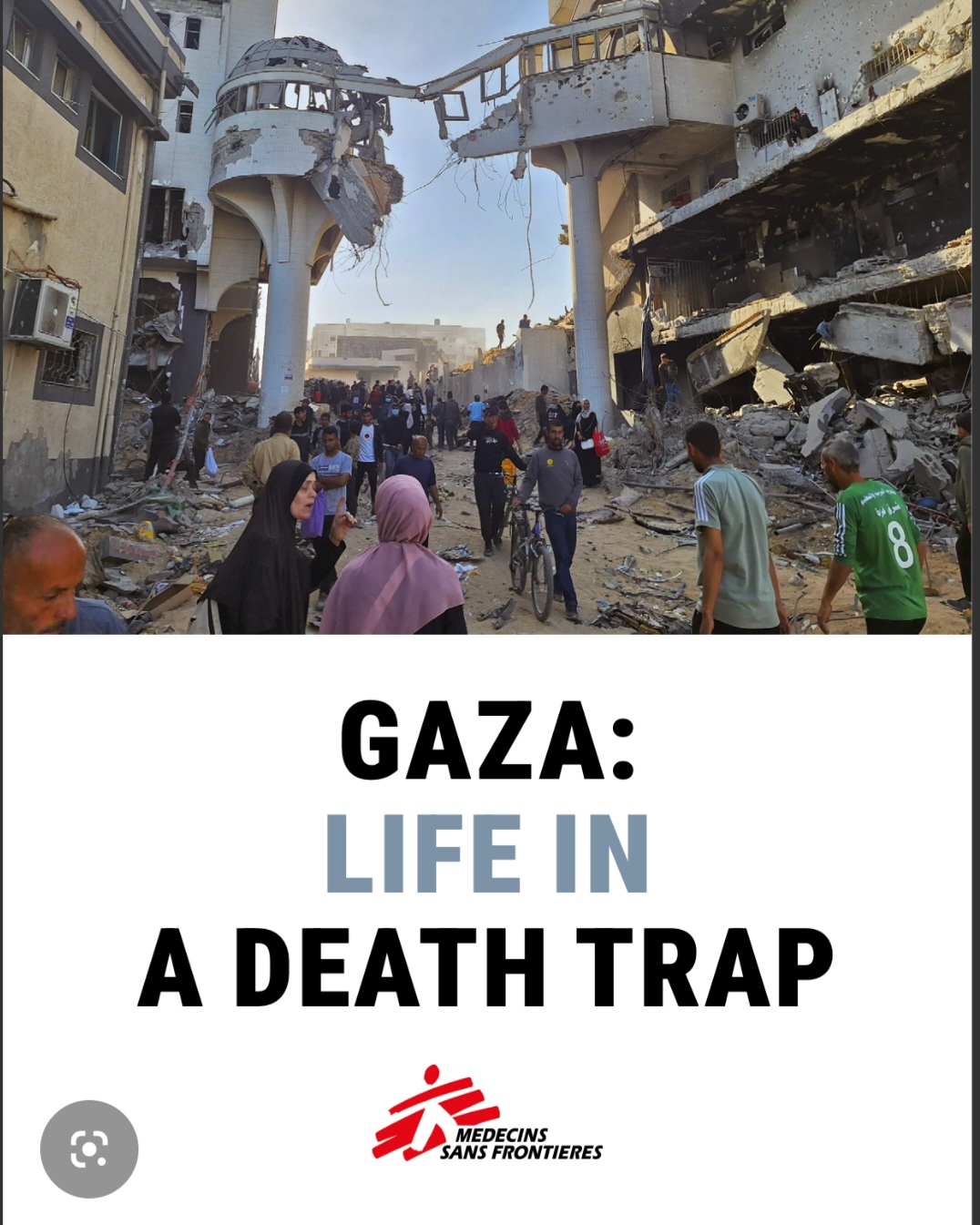
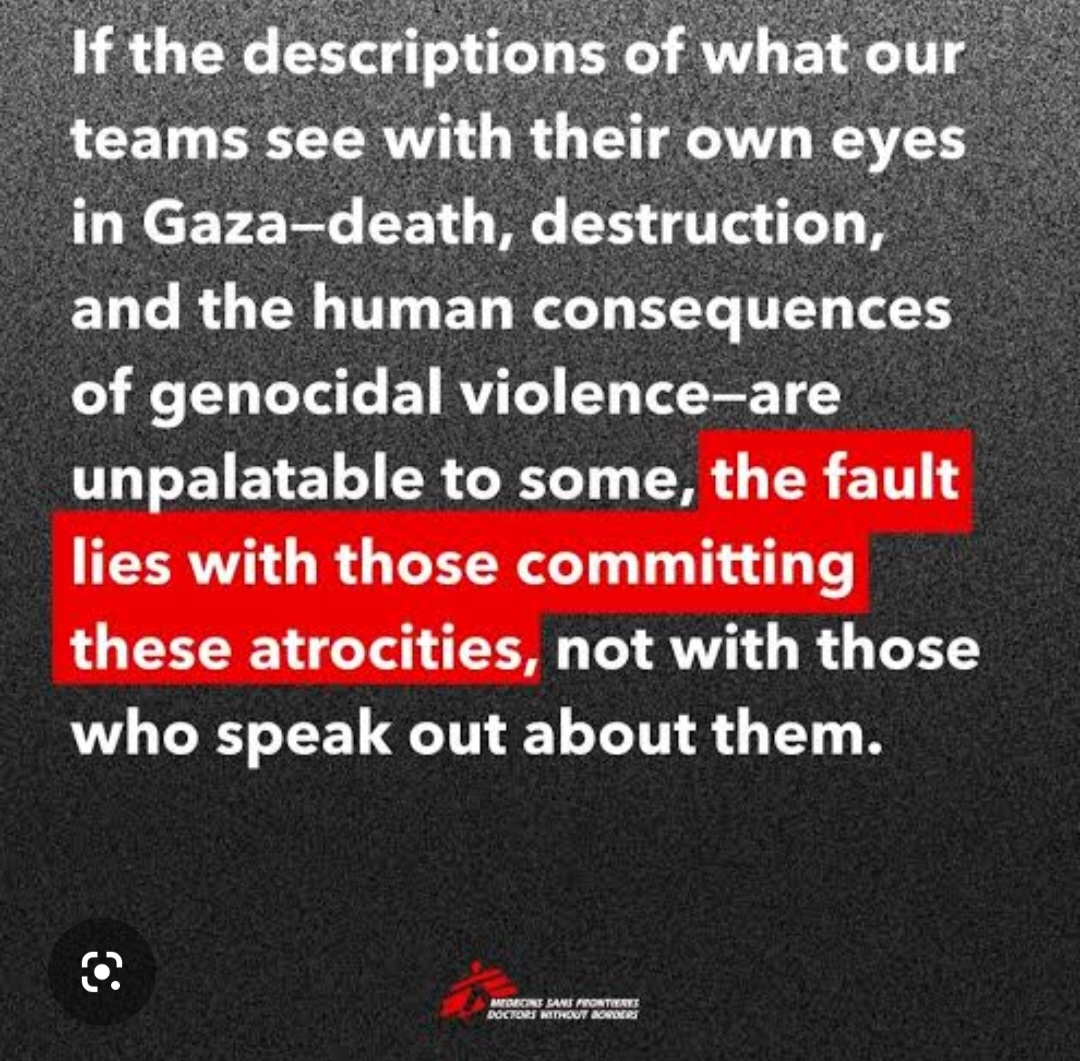
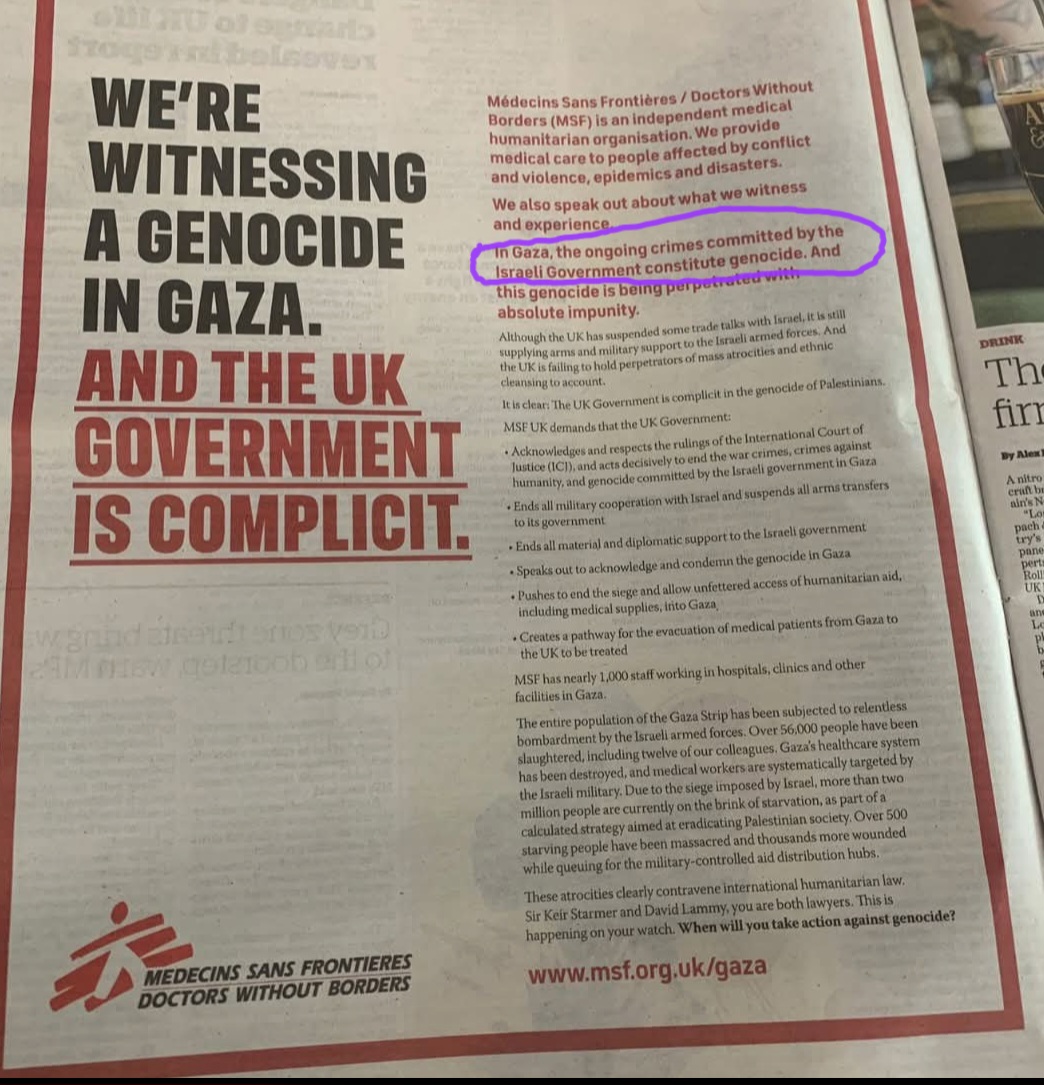
Doctors Without Borders is very selective in its explosive terminology regarding Israel. For MSF, Israel is the cause of all the ills in Gaza, not Hamas. Israel is directly called out, not the genocidal terrorist group that launched the war and hides in tunnels without letting civilians use them for protection. No excuse proffered by Israel will satisfy.
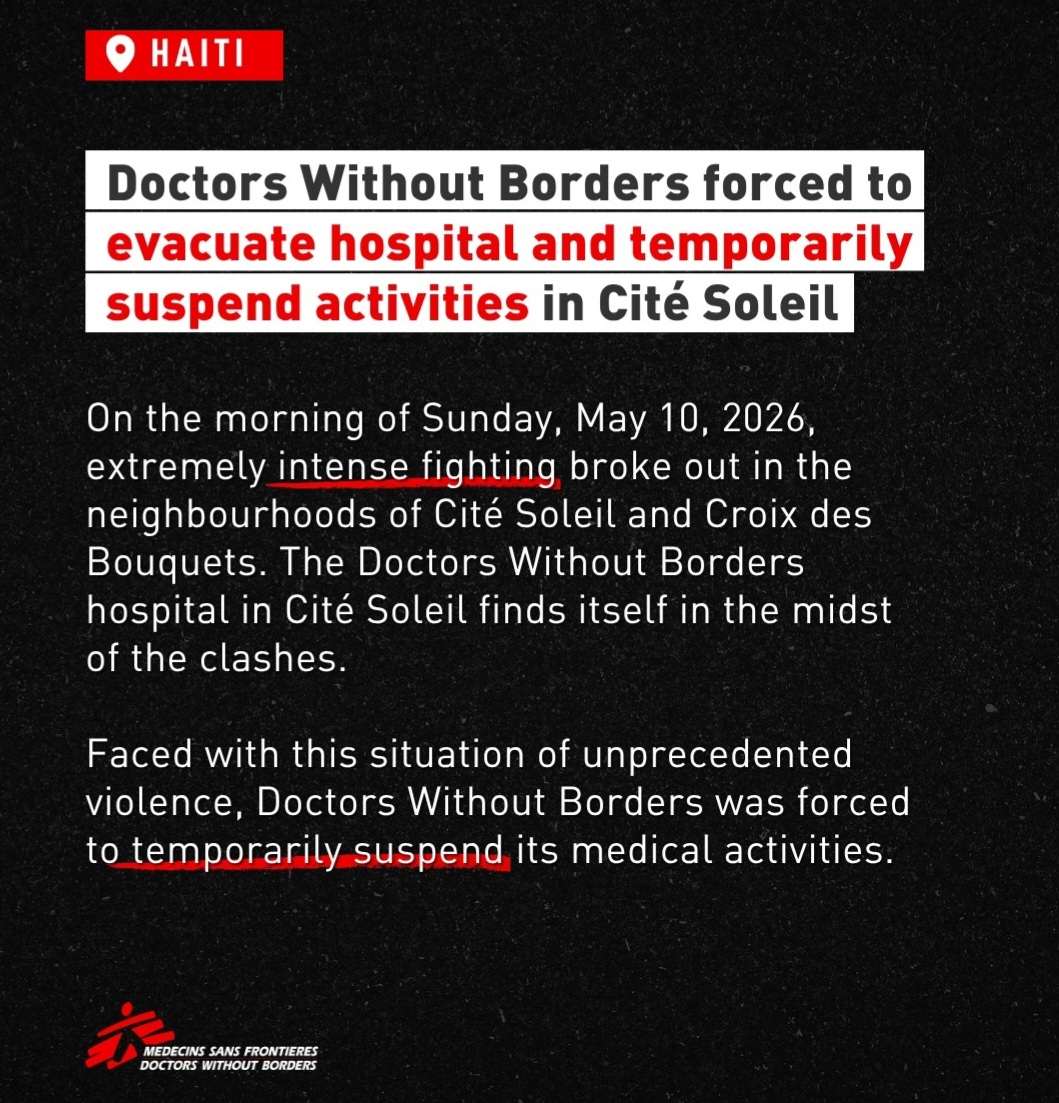
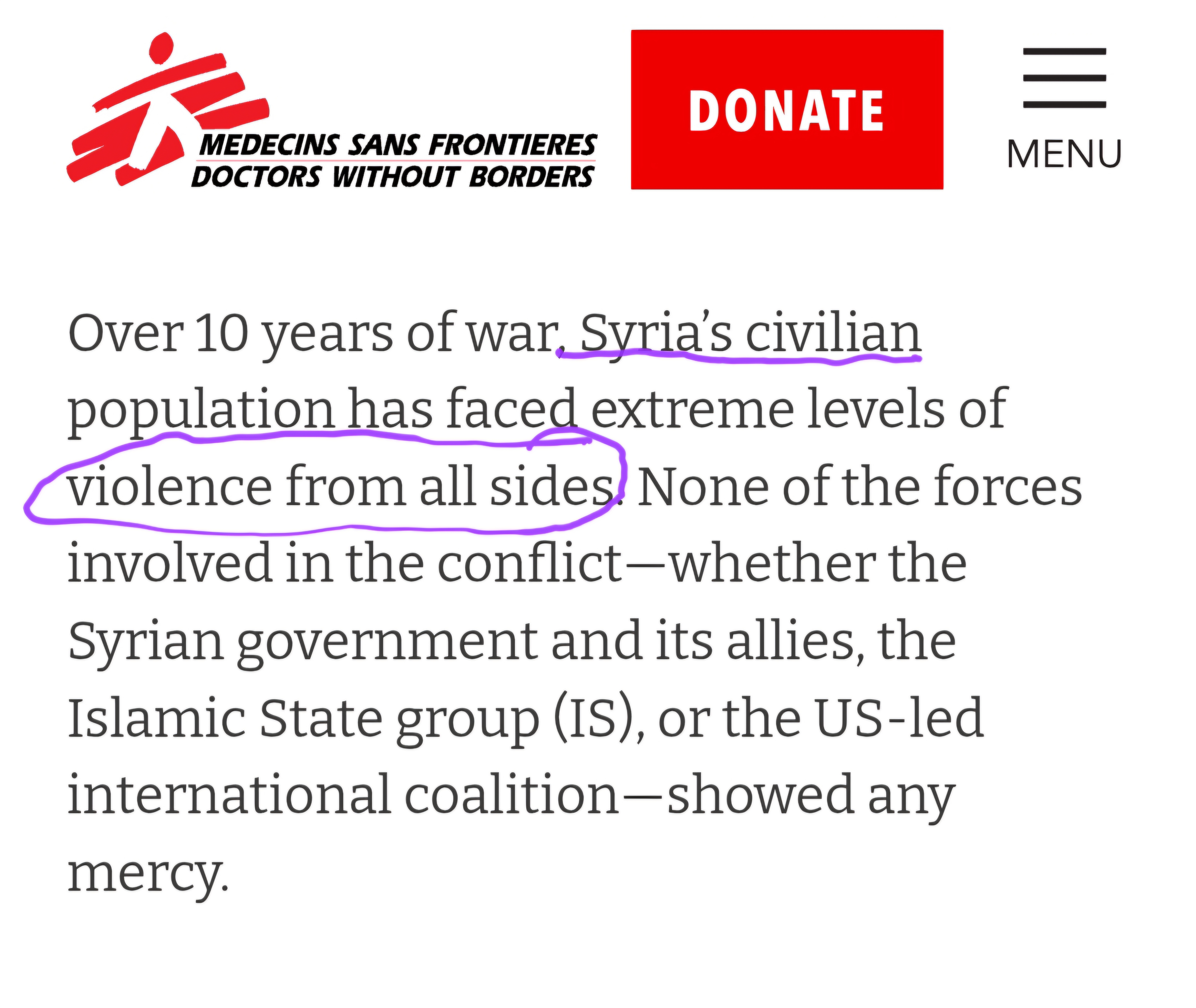
Doctors Without Borders doesn’t do this in other conflicts. Not in Sudan nor Somalia. Not in Syria nor Haiti. In those wars, either no one is called out or “all sides” are vilified.
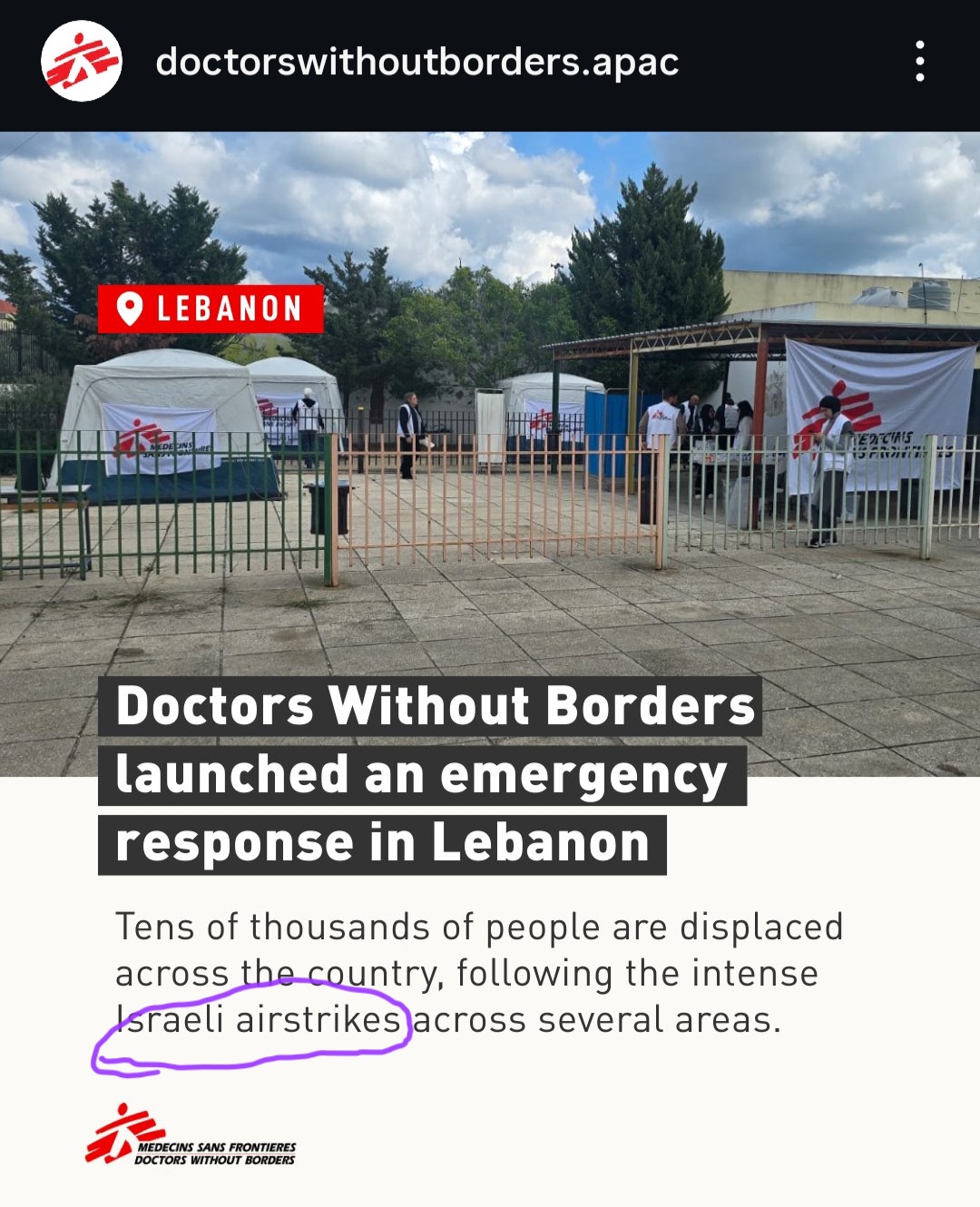
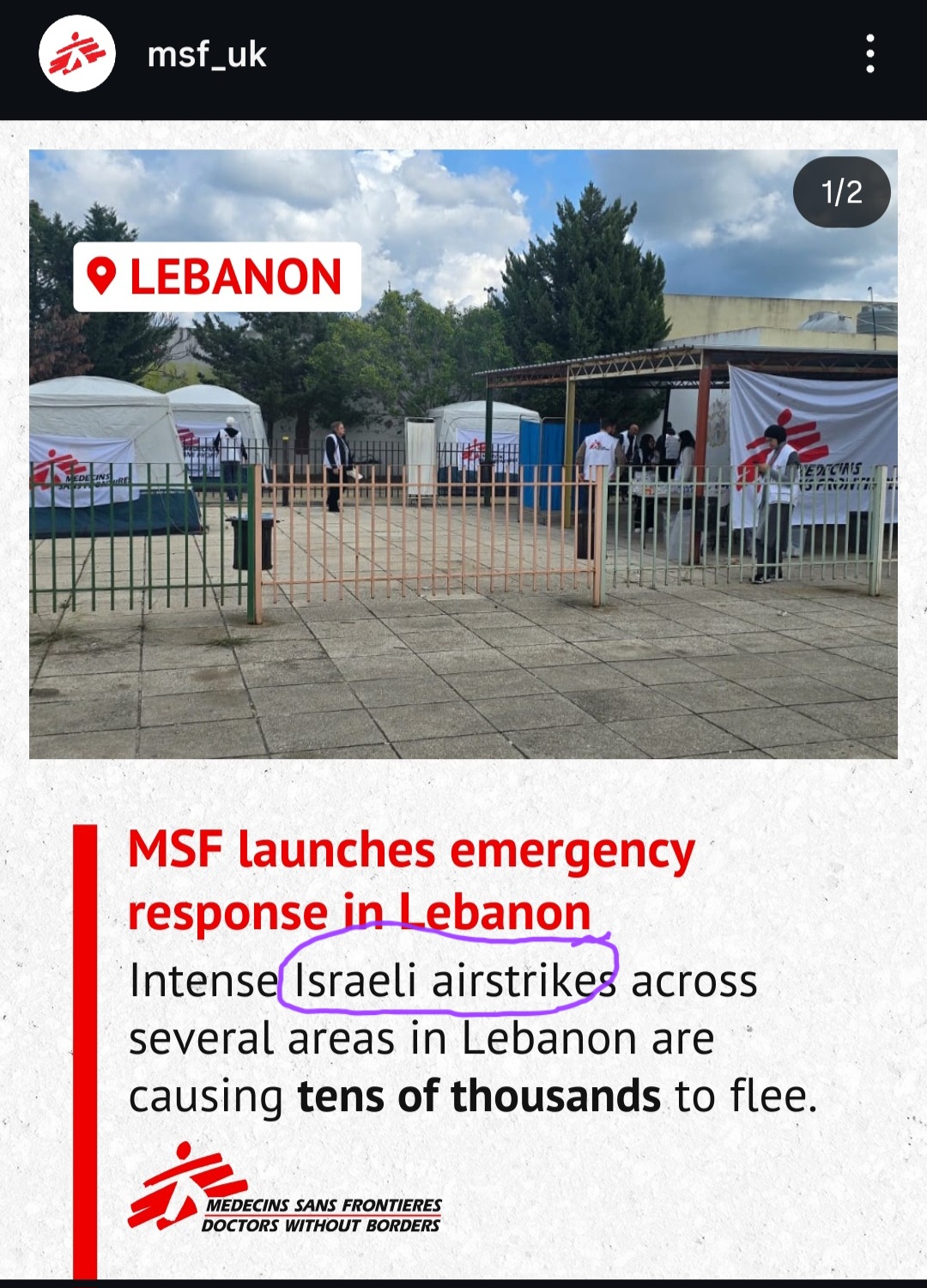
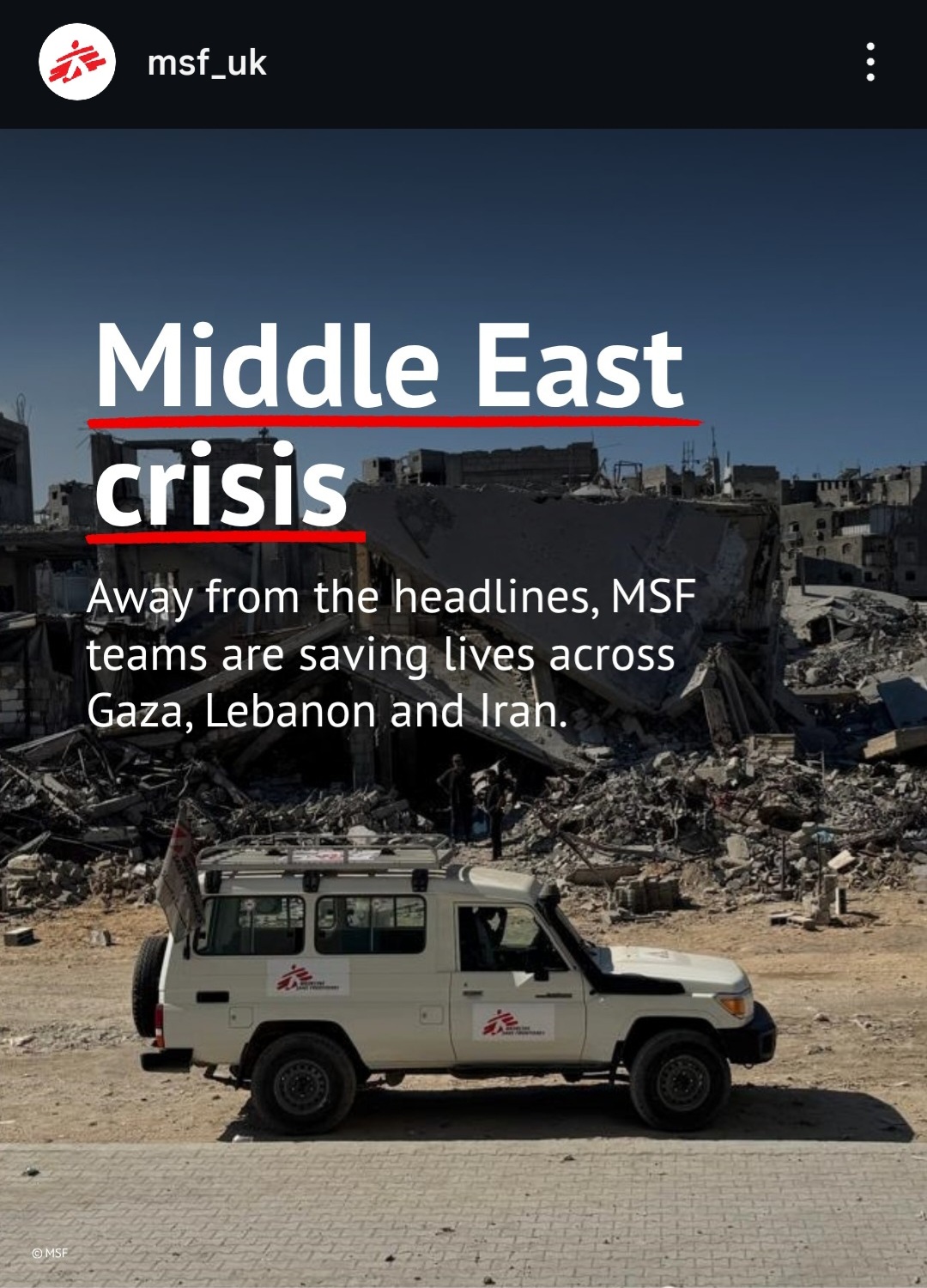
And MSF takes its anti-Israel campaign on the road. Wherever Israel is dragged into a defensive war against those determined to annihilate it, like Lebanon and Iran, MSF is standing guard and pointing fingers.
MSF does not limit itself to smear campaigns against Israel. It is a full lobbying shop, taking out full page ads in newspapers to rally the public against Israel. It pushes governments to stop supporting Israel in its defensive war.
So it is no surprise that MSF has officially backed the entire Iranian proxy war against Israel, telling the world that it rushes to protect “Gaza, Lebanon and Iran” from Israel.
Doctors Without Borders: 1) runs to assist jihadists in their active war against Israel; 2) raises money claiming the belligerent parties are the victims; 3) lobbies to have governments stop supporting Israel and 4) calls for the masses to protest the Jewish State. It does all of this, uniquely in Israel’s war.
Doctors Without Borders is not a humanitarian organization but an active instrument in the war to destroy Israel.
In February 2001, long before Hamas ruled Gaza, long before Israel withdrew from Gaza, long before the security barrier, and long before the phrase “genocide in Gaza” became a campus chant, a United Nations “anti-racism” conference in Tehran was already accusing Israel of being a racist apartheid state guilty of crimes against humanity and “a form of genocide.”
The language was not improvised after October 7. It was drafted decades earlier.
Buried in the archives of the UN World Conference Against Racism sits a document that now reads like the prototype for today’s anti-Israel activism. Hosted by the Islamic Republic of Iran as the Asian preparatory meeting for the infamous Durban Conference, the 2001 declaration accused Israel of “racial discrimination,” “settler ideology,” “apartheid,” and genocide years before the events now routinely cited to justify those accusations.
The Tehran declaration described Israeli policy as “a new kind of apartheid,” “a crime against humanity,” and “a form of genocide.” It condemned “foreign occupation founded on settlements” and portrayed Israel as a uniquely racist state. It attacked Israel’s Law of Return as “racially based” while endorsing a Palestinian “right of return,” and framed the conflict almost exclusively through the language of colonialism and racial supremacy.
This was February 2001. Hamas would not seize Gaza for another six years. Israel had not yet disengaged from Gaza. The major Gaza wars had not occurred. There was no October 7 massacre. There were no TikTok videos, no encampments, no “Globalize the Intifada” marches winding through Western capitals.
Yet the ideological framework already existed in complete form.
The core vocabulary was already there:
apartheid
settler colonialism
genocide
racial supremacy
alien domination
decolonization
The slogans were set. The distribution system under the framework of “anti-racism” needed time to become global.
Iran understood this battlefield earlier than much of the West did.
The Islamic Republic did not wage war against Israel on only one front. It developed a multi-front strategy: terror proxies, missile programs, regional encirclement, propaganda networks, diplomatic campaigns, university activism, NGO penetration and information warfare. The battlefield extended from southern Lebanon to UN conference halls.
Iran understood something many Western governments failed to grasp: narratives can outlive battlefields. Terror attacks shock people temporarily. Moral frameworks reshape generations.
The achievement of the campaign was not inventing new hatred. It was laundering their own very old anti-Jew hatred through the moral vocabulary of human rights.
The regime in Tehran openly sought the destruction of the Jewish state while simultaneously helping construct an international framework portraying the Jewish state itself as the great racist evil of the modern world. The inversion was deliberate. A regime animated by antisemitism and eliminationist rhetoric repositioned itself as an anti-racist moral authority while recasting Israel as a global pariah.
Reality itself had to be inverted for the framework to function:
The Jewish people had to be stripped of indigenous identity despite Judaism being born in the Land of Israel and the core of the Hebrew Bible.
Jerusalem had to be detached from Jewish history despite being the holiest city in Judaism for three thousand years, and the direction of daily Jewish prayer.
Hebrew had to become the language of “colonizers” despite originating in the same soil activists insist Jews have no connection to.
The objective was to transform the Jewish state from a country that could be criticized into a moral obscenity that could not legitimately exist.
The Tehran document placed Israel into the moral category occupied by apartheid South Africa, colonial domination and crimes against humanity. Once a country is assigned that status, compromise becomes collaboration and coexistence becomes moral surrender.
Iran supplied the ideological fuel. Large parts of the Western activist ecosystem supplied the distribution network. The result was one of the most successful political rebranding campaigns of the modern era.
NGOs, academics, journalists, activist groups and eventually corporate and educational institutions absorbed the vocabulary and repackaged it as the language of progressive morality. Traditional antisemitism had become morally discredited after the Holocaust, so hostility toward the Jewish state was translated into the vocabulary of anti-racism, anti-colonialism and social justice.
The old image of the malevolent Jew became the malevolent Zionist.
Ancient hatreds were repackaged as the language of anti-racism and liberation.
The old demand that Jews disappear became “decolonization.”
And because the rhetoric arrived wrapped in the language of human rights, millions of educated Westerners could participate while imagining themselves enlightened rather than radicalized.
The asymmetry inside the Tehran declaration is particularly revealing. The document devoted extraordinary attention to portraying Israel as the embodiment of racism while saying nothing about antisemitism in the Arab world, terrorism against Israeli civilians, the expulsion of Jews from Arab countries, or the openly eliminationist ideologies as the bedrock of Hamas and Hezbollah.
The imbalance was not accidental.
The conference was not constructing a universal anti-racism framework. It was constructing a hierarchy of permissible outrage in which Jewish sovereignty itself could increasingly be reframed as a moral offense.
The Durban process that followed later became notorious for antisemitic incidents, anti-Israel propaganda and efforts to revive the old “Zionism is racism” framework using newer terminology. Western democracies eventually began boycotting later Durban conferences because they viewed them as platforms for anti-Israel demonization masquerading as anti-racism initiatives.
But by then the political grammar had already escaped containment.
Over time, phrases first drafted in Iran migrated into university syllabi, NGO reports, newsroom style guides, faculty petitions, diversity trainings and street protests. Students who have never heard of the Tehran conference now repeat its vocabulary almost word for word, unaware they are echoing a political script written decades earlier by regimes that openly sought Israel’s destruction.
Long before October 7, the architecture had been built, the slogans drafted, and the moral categories assigned. More powerful than even the 1975 UN resolution equating Zionism with racism, the new format for the 21st century is anti-Zionism is anti-racism.
For twenty years the distribution system slowly penetrated the world, and reframed Jew-hatred as morally acceptable under willing and unwilling eyes.
October 7 did not write the script. It activated one that had been waiting since 2001.