For years, the world was told the “Great March of Return” was peaceful theater. Demonstration. Symbolism. Political performance staged at Israel’s border fence. The real outrage, activists insisted, was not thousands of Gazans converging on a sovereign frontier controlled by a terrorist regime openly committed to Israel’s destruction. The outrage was that Israel refused to let them through.
Every breach attempt became a morality play. The fence itself was cast as villainous. Hamas was downgraded from genocidal jihadist organization to stage manager for a humanitarian spectacle. Foreign correspondents photographed smoke, flags, and crowds surging toward the barrier while carefully avoiding the central question: what exactly did “return” mean in practice?

(Photo credit JACK GUEZ/AFP/Getty Images)
October 7 answered it.
The world spent years romanticizing the idea of border penetration into Israel. Then Hamas finally achieved it. The infiltrators entered and what followed was not symbolic “resistance,” not coexistence, not liberation theology with subtitles for Western consumption. It was slaughter. Torture. Kidnapping. Burning families alive. Mass rape. Entire communities transformed into killing fields within hours.
The “Great March of Return” was not a protest but a rehearsal for an invasion.
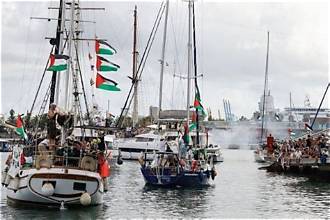
The flotilla theatrics now replay the same script at sea.
Once again, activists sail toward a Hamas-controlled enclave insisting their mission is humanitarian symbolism. Once again, cameras arrive before facts. Once again, Israel is expected to participate in a choreographed morality play where interception itself becomes the crime. The activists want confrontation because confrontation produces images, and images produce headlines, and headlines produce another cycle in which Israel defending its borders is treated as inherently suspicious.
But after October 7, Israel no longer has the luxury of indulging symbolic breaches.
A blockade around a terrorist enclave is not abstract political philosophy. It is a security perimeter. Every intercepted vessel is being measured against the memory of what happened when infiltrators were not stopped. The Israeli Navy does not have the privilege enjoyed by European activists thousands of miles away who can romanticize “breaking barriers” while knowing they will never personally absorb the consequences if those barriers collapse.
That is why the flotilla activists are ultimately engaged in theater. They know they will be intercepted. Israel knows it must intercept them. The performance depends on the interception itself. Their goal is not to deliver aid more efficiently than established channels. Their goal is to create imagery in which Israeli enforcement appears oppressive by definition.
The irony is impossible to miss. For years, activists treated Israel’s insistence on secure borders as paranoia. Then October 7 became the bloodiest validation imaginable of exactly why those borders existed.
And so the boats are seized and returned to port. The activists call it repression. Israel calls it survival.
Perhaps the flotillas deserve a more honest name: the Great Return to Sender.


