
Europe spent twenty years explaining that Hamas had a “political wing.” Hezbollah too. The bomb throwers were one thing, the parliamentarians another. The rocket launchers belonged in one legal bucket, the social service offices reserved for a different one. Western diplomats performed intellectual yoga worthy of Cirque du Soleil to preserve the distinction. The “military wing” was terrorist while the “political wing” was complicated. Nuanced. An unavoidable interlocutor for peace.
Britain finally gave up the act in 2019 with Hezbollah. The distinction, it concluded, was largely fictional. Same leadership, same financing, same ideology, same organization. Europe still technically preserves some of these distinctions in various legal frameworks, but fewer people pretend anymore that the “armed wing” and “political branch” emerge from separate planets.
Which makes the growing sanctions campaign against Jewish housing rights groups so fascinating.
Because now the question flips. Suddenly Europe is no longer carefully distinguishing between ideology and violence. Advocacy for controversial positions – not for violence – can suddenly become complicity in terrorism. Entire categories of speech are treated as unlawful conduct even absent anything remotely resembling the classic terrorism that justified Hamas and Hezbollah designations in the first place.
Take Nachala. It is not Hamas. It does not have brigades. It does not launch rockets. It does not run suicide bombing cells. It is an ideological movement advocating Jewish settlement in disputed territory. One may agree with it or despise it. One may view Jews living in land the Stateless Arabs from Palestine (SAPs) want as a future Palestinian state as historic justice or catastrophic policy. But that is precisely the point. The dispute is fundamentally political and ideological.
For decades Europe insisted ideology alone was not terrorism. Supporting Palestinian “resistance” rhetorically was not enough. Calling for the destruction of Israel was grotesque but still politics. The line was violence. Actual violence. Material support for violence. Operational involvement in violence.
That was the principle.
Until suddenly the principle became inconvenient.
Now the standard appears to be evolving into something far murkier: movements may be sanctioned not necessarily for carrying out terrorism, but for contributing to environments viewed as extremist or against government foreign policy. Perhaps that standard is morally justified. Perhaps some Israeli activists have crossed legal and moral lines. But if this is the new doctrine, then the West should at least admit the doctrine changed.

If ideology itself is now sanctionable, Western governments cannot apply the principle selectively.
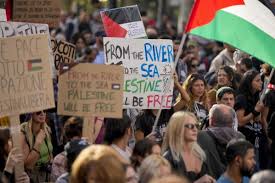
For years crowds across London, Paris, Barcelona and university campuses have openly chanted for the elimination of the Jewish state “from the river to the sea.” Activists routinely declare that Israeli Jews should “go back to Poland,” despite the fact that millions of Israeli Jews descend from families expelled from Arab countries, Ethiopia, Iran and elsewhere. Imagine any other minority in Europe being told to leave the country and “go back” to lands where many never lived, or to where their families were annihilated. Authorities would instantly recognize the ethnic character of the demand.
If Israelis arguing that Jews should again live in Gaza constitutes sanctionable extremism, then what exactly should Britain call organizations openly advocating a “right of return” designed to flood Israel demographically out of existence? If the standard is advocacy for the removal or replacement of another national group, then the principle cannot stop with some Jewish activists in the West Bank.
If the line is now ideological support for demographic elimination, then governments must police the radicalism inside their own societies with equal vigor.
That means groups explicitly advocating the destruction of Israel should face the same scrutiny directed at Jewish expansionist movements. Organizations and individuals promoting the forced removal of Jews from the Middle East “from the river to the sea” should not receive a special exemption dressed up as mere “anti-Zionism,” as if Israel is a concept and not a reality. Calls for the end of the Jewish State are not sophisticated geopolitical critiques. They are ethnic slogans calling for violence. And if governments now believe rhetoric itself creates dangerous ecosystems, they cannot pretend those ecosystems exist only on one side of the conflict.
The irony is extraordinary. Europe once bent over backwards to separate terrorism from politics when the movements in question were Palestinian or Islamist. Now governments increasingly collapse politics into extremism to be sanctioned only when the movements are Jewish nationalist.
Europe spent decades insisting that ideas were not terrorism. If it now believes otherwise, it should say so openly and explain where the line will be drawn for everyone else.


