The Antisemitic Status Quo Must End

The United Nations speaks constantly of justice, equality and freedom of worship in Jerusalem. Yet when confronted with the denial of the most basic religious freedom at Judaism’s holiest site, it demands that the discrimination continue.

This is not the position of one committee or one conference. It is the official position of the United Nations.

Following a recent visit by Israel’s National Security Minister to the Temple Mount, Secretary-General António Guterres declared that “the status quo at the Holy Sites must be upheld.” His spokesman, Stéphane Dujarric, went further on July 23, insisting that “there is a status quo regarding the holy sites of Judaism, Christianity and, of course, Islam in Jerusalem” and that “the faithful of all religions are able to interact with those sites… in a free manner.”
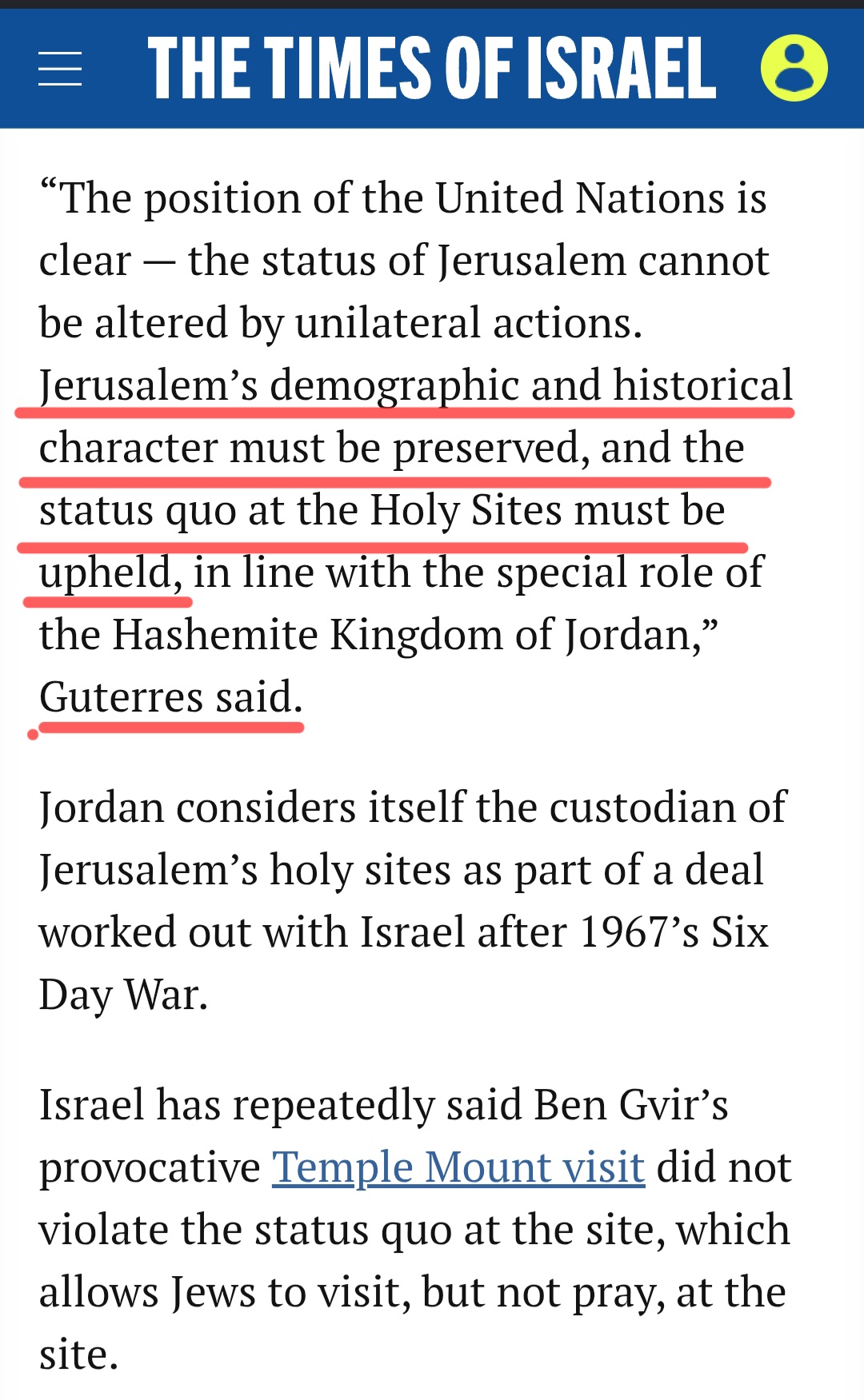
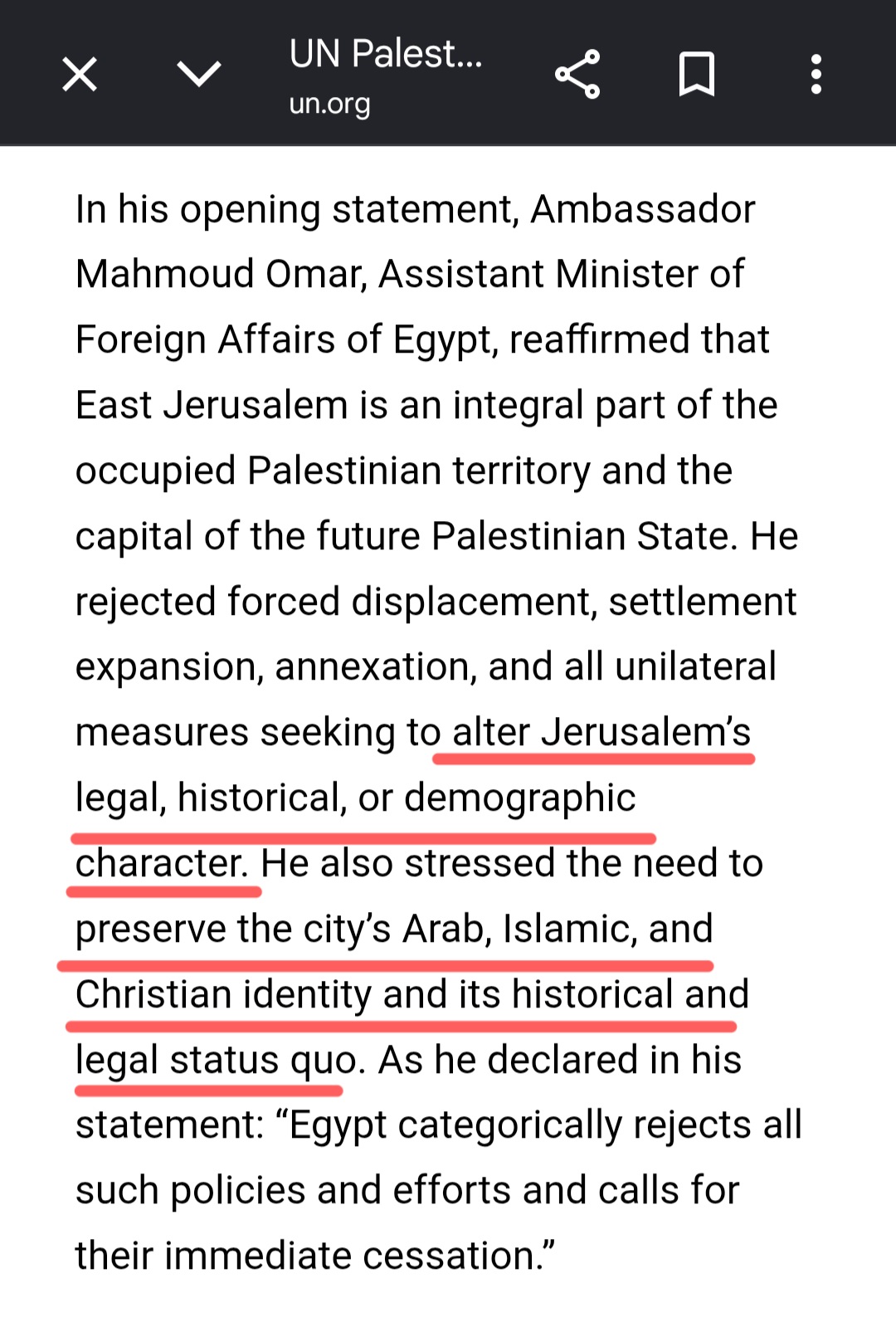
Those statements cannot both be true.

On the Temple Mount—the holiest site in Judaism—the “status quo” bars Jews from praying openly. Jews may visit during limited hours, but they are prohibited from conducting public prayer under the religious administration of the Islamic Waqf.

The United Nations therefore advocates preserving a system that denies Jews the freedom to pray at their holiest site while simultaneously claiming that people of all faiths are able to worship freely.

That is not religious equality. It is institutionalized religious discrimination.

Imagine the United Nations calling for the preservation of a system that prohibited Christians from praying at the Church of the Holy Sepulchre or Muslims from praying at the Al-Aqsa Mosque. Such a position would rightly be condemned around the world. Yet when the restriction applies to Jews, it is described as preserving the “status quo.”

The phrase has become a euphemism for unequal rights. For sanctioned antisemitism.
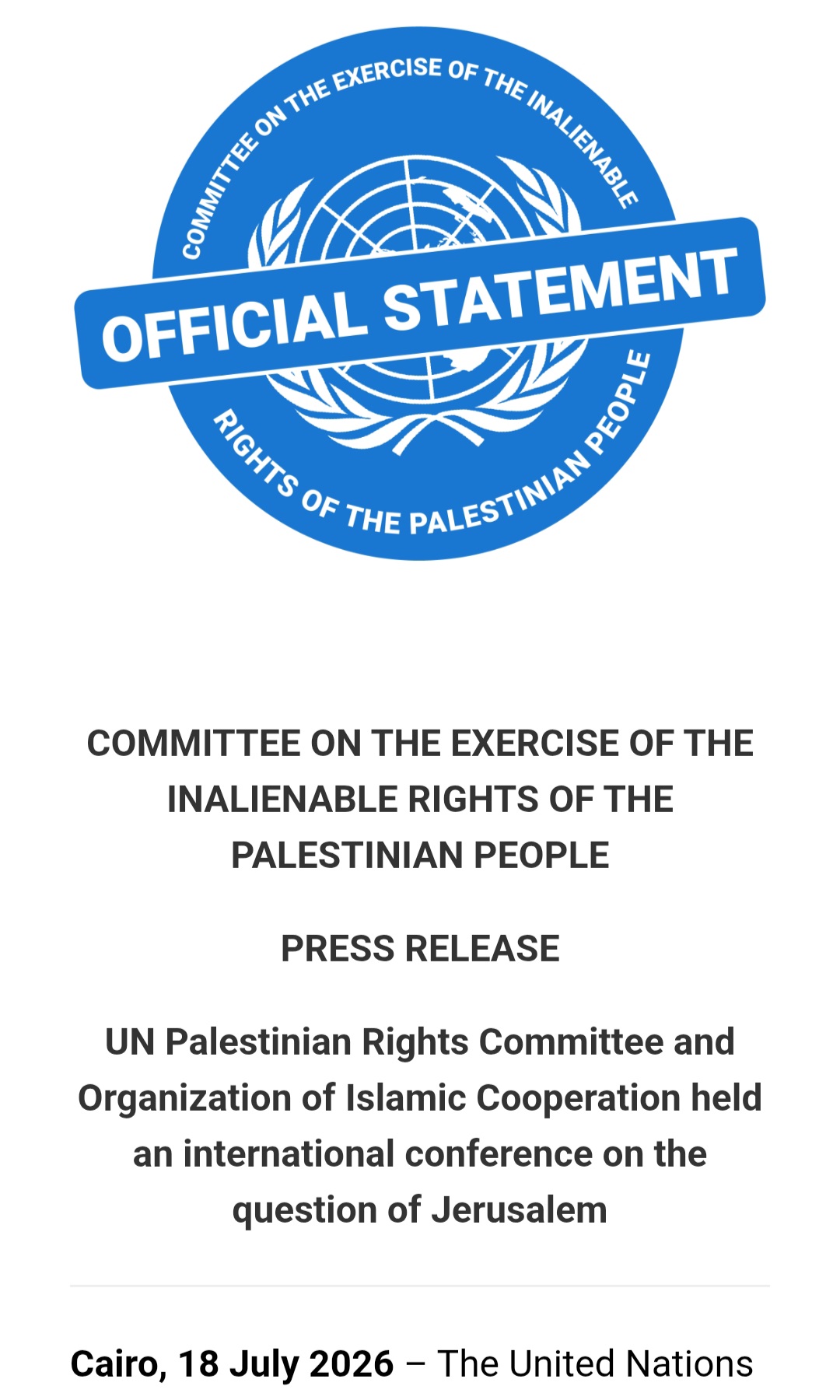
The UN states that the “Palestinian people” have “inalienable rights” in Jerusalem, while insisting that Jews have none

Peace is not built by requiring one religion alone to surrender the right to pray at its holiest place.

The United Nations should stop demanding preservation of the Temple Mount status quo and instead demand its reform.

  • The UN Human Rights Council should establish a permanent agenda item asking a single question: Why are Jews still barred from praying openly at Judaism’s holiest site?
  • Every report by the Secretary-General on Jerusalem should state whether that prohibition remains in force.
  • Every General Assembly debate on Jerusalem should require Jordan and the Islamic Waqf to explain why the ban continues and what concrete steps are being taken to end it.
  • Every UNESCO discussion of the Temple Mount should address not only Jewish history at the site, but whether Jewish freedom of worship is being respected there today.
  • Every UN conference on Jerusalem should repeat the same demand until the answer changes:

End the prohibition on peaceful Jewish prayer on the Temple Mount.

The United Nations cannot credibly champion freedom of worship while defending a religious order that denies Jews that very freedom at Judaism’s holiest site.

The antisemitic status quo must end.

Will This Be the Last Fast of Tisha B’Av?

For nearly 2,000 years, Jews have fasted on Tisha B’Av to mourn the destruction of the First and Second Temples, the loss of Jewish sovereignty, exile from Jerusalem, and a long chain of national tragedies.

Jewish tradition also teaches that the fast will not last forever. The prophet Zechariah envisioned a day when the fasts commemorating Jerusalem’s destruction would become days of “joy and gladness and cheerful festivals.” Many rabbis have understood that era to arrive with the rebuilding of the Temple.

No one knows when that day will come.

Yet the last century has witnessed changes that generations of Jews scarcely dared imagine.

The Jewish people returned to their ancestral homeland. The State of Israel was reborn (1948). Jerusalem was reunited under Jewish sovereignty (1967). For the first time in nearly two thousand years, Israel is home to the world’s largest Jewish population (2012).

Israel has also become increasingly accepted by its Arab and Muslim neighbors, establishing diplomatic relations with Egypt (1979), Jordan (1994), the United Arab Emirates (2020), Bahrain (2020), Morocco (2020), Sudan (2020, pending implementation), and Kosovo (2021). Meanwhile, the United States (2018), Guatemala (2018), Honduras (2021), Kosovo (2021), Papua New Guinea (2023), Paraguay (2024), and Fiji (2024) have moved their embassies to Jerusalem, while other countries (Slovenia and Nauru) are considering doing the same.

Last year (2025), more than 75,000 Jews ascended the Temple Mount – a modern record that would have been unimaginable only a generation ago.

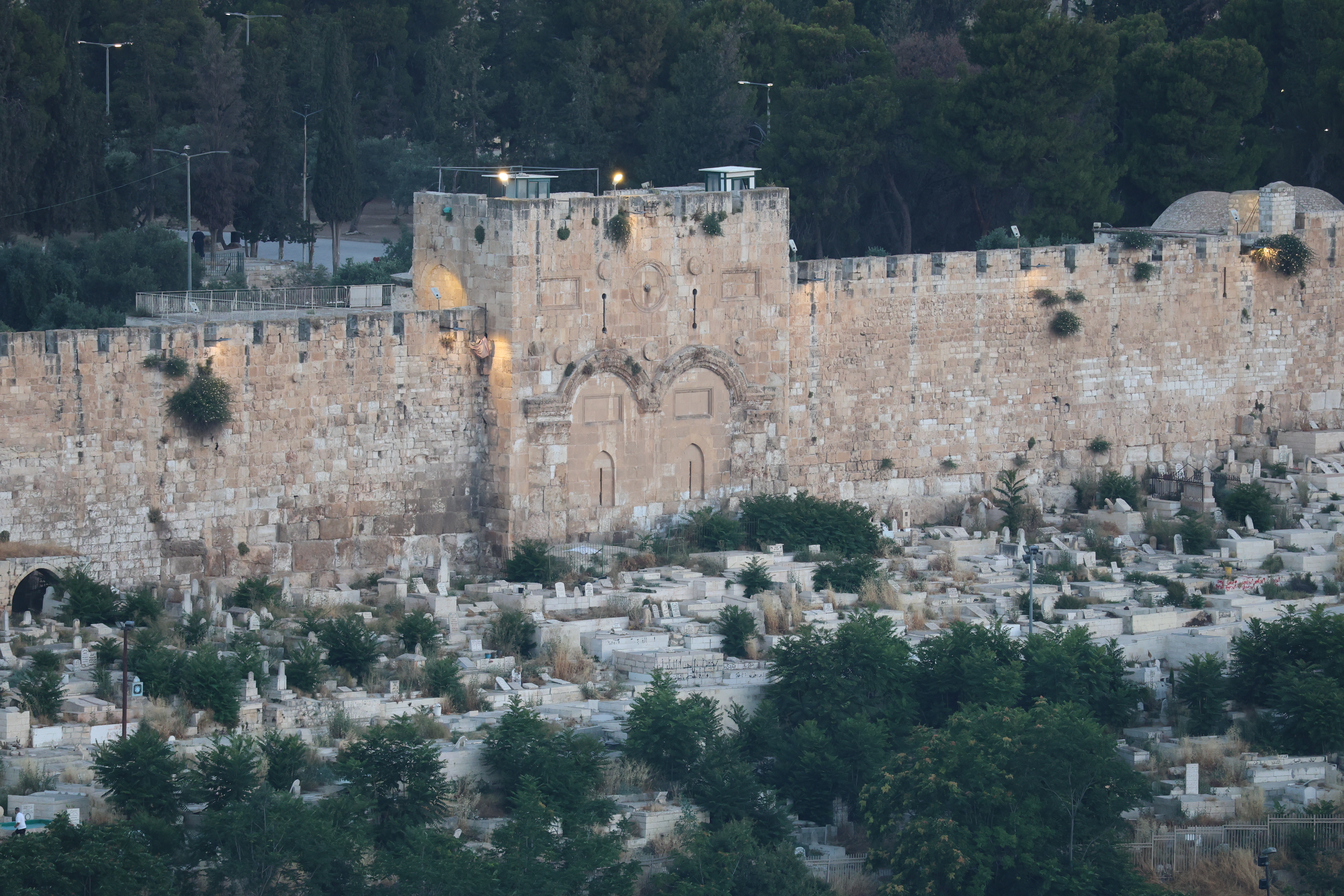
The Golden Gate in Jerusalem’s Old City exterior wall (photo: First One through)

The Temple remains unbuilt and Tisha B’Av remains a day of mourning.

But it does raise a question that previous generations could scarcely have imagined asking: Will this be the last Tisha B’Av fast?

Perhaps Jews a century from now will still be asking the same question. Or perhaps they will look back and realize that ours was among the last generations to mourn the destruction rather than celebrate the restoration.

For almost two thousand years, that possibility seemed unimaginable. Today, it no longer does.

The Vessels We Carry

There is something profoundly human about gathering related things into a single vessel.

We do it with photo albums, where a lifetime of moments is gathered into one book. We do it with museums, where centuries of artifacts are brought together under one roof.

The Jewish calendar does the same with time.

Tisha B’Av is not merely the anniversary of the destruction of the First and Second Temples. Over centuries it became the vessel into which Jewish history poured its sorrows – from the destruction of the Temples to the expulsions from England and Spain, to catastrophes that culminated in the Holocaust. Generations found in Tisha B’Av a place large enough to hold them all.

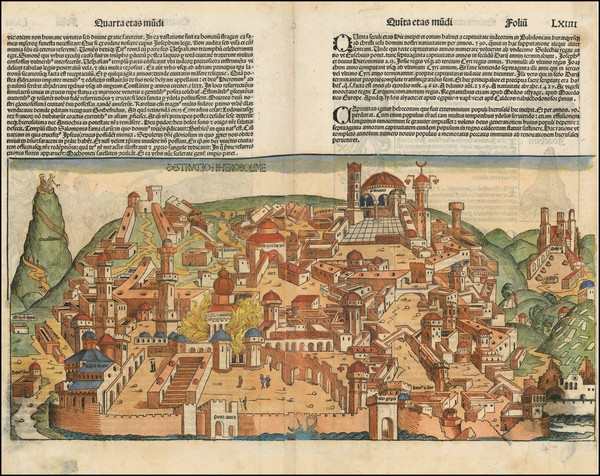
The Nuremberg Chronicle showing the destruction of Jerusalem

The Temple Mount in Jerusalem became another vessel. Of place.

For much of history, Jerusalem was known as the city of the Jewish Temple. But over time it gathered far more meaning. It became the location of the near sacrifice of Isaac, the destination of pilgrimage, the focus of exile, and the direction toward which Jews have prayed for thousands of years.

Other faiths also poured meaning into Jerusalem. Christians revere it as the place of Jesus’ crucifixion and resurrection. Muslims honor it as the destination of Muhammad’s Night Journey. Layer upon layer, century upon century, Jerusalem became more than a city. It became a vessel carrying humanity’s deepest convictions, hopes, and conflicts.

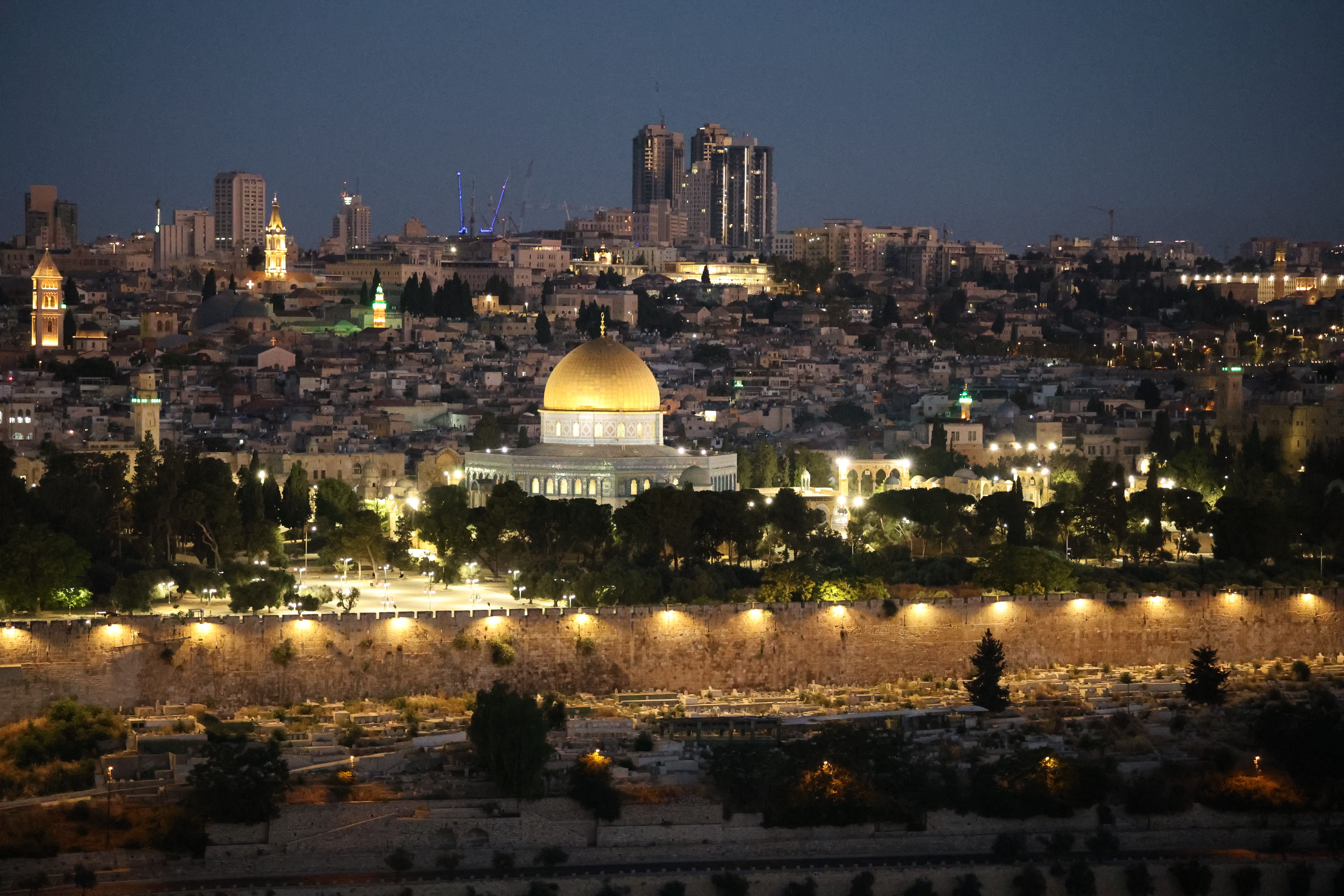
Temple Mount at dawn (photo: First One Through)

And then there is a unique people.

The Jewish people became a vessel unlike any other. Across thousands of years they carried covenant, exile, learning, persecution, survival, and hope. They preserved ancient language, sacred texts, melodies, customs, and memory across continents and generations. They became the vessel through which memory survived when kingdoms fell, empires vanished, and even the Temple itself lay in ruins.

Every vessel carries something. Some carry water. Some carry treasure. Some carry ashes. The greatest vessels carry what cannot be touched: memory, identity, covenant, and hope.

And that is what the Jewish people, Jerusalem, and Tisha B’Av have become. Three vessels in one elaborate story.

Every generation poured something more into those vessels: not only grief, but hope.

Within them rests the hope captured in the Israeli national anthem, Hatikvah: that the Jewish people will live as a free people in their own land, with Jerusalem at its heart.

And on Tisha B’Av in particular, the vessel holds one additional hope above all others: the rebuilding of the Beit HaMikdash. Not because Jews long merely for stones and walls, but because it represents the restoration of wholeness – between God and humanity, a people and their land, memory and redemption.

Every Tisha B’Av, Jews gather into one day the grief of centuries, turn toward one city, and renew one hope. As they do, they recognize that this is more than a story of three fused vessels. It is that together they carry one enduring promise.

The OIC’s Hamas Exception

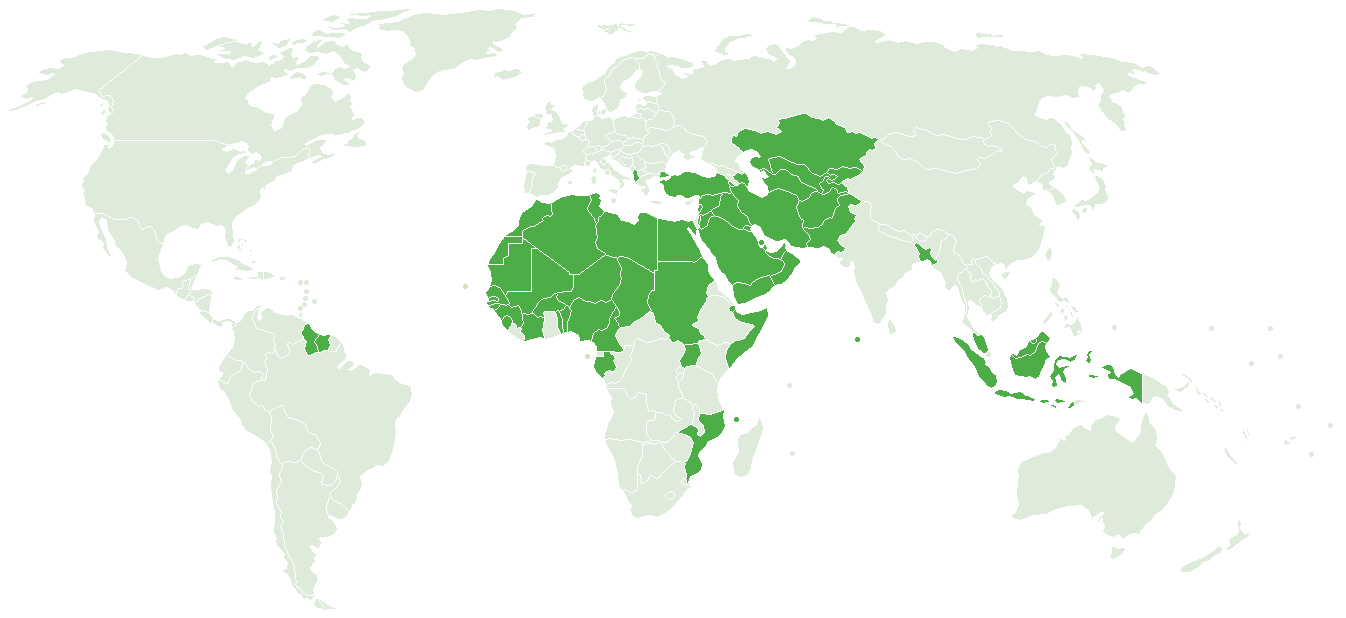
Founded in 1969, the Organization of Islamic Cooperation (OIC) is a coalition of 57 Muslim-majority nations, making it the second-largest intergovernmental organization in the world after the United Nations. Stretching from Morocco to Indonesia, and from Kazakhstan to Nigeria, it represents roughly a quarter of the world’s countries and speaks collectively on issues affecting the Muslim world.

OIC Member states

One of the organization’s longstanding positions is that extremist groups claiming to act in the name of Islam do not represent Islam. Over the years, the OIC has repeatedly condemned organizations such as:

  • ISIS (Daesh) — for attacks across Iraq, Syria, Libya, Afghanistan, and Nigeria, all OIC member states.
  • Al-Qaeda — for attacks in Saudi Arabia, Yemen, Pakistan, Afghanistan, Somalia, Iraq, and other Muslim-majority countries.
  • Boko Haram — for its insurgency in Nigeria, Niger, Chad, and Cameroon.
  • Al-Shabaab — for attacks centered in Somalia and extending into neighboring countries.
  • ISIS-K (Islamic State Khorasan Province) — for terrorism in Afghanistan and Pakistan.
  • Tehreek-e-Taliban Pakistan (TTP) — for its campaign against the government and civilians of Pakistan.

The common thread is unmistakable. Every one of these organizations has waged war against governments, civilians, or institutions in Muslim-majority countries, mostly members of the OIC itself.

The OIC has consistently argued that Muslims have been among the principal victims of jihadist terrorism. These groups bomb mosques, seek to overthrow Muslim governments, and destabilize OIC member states are denounced as terrorists and rejected as contrary to Islam.

Yet one jihadi terrorist groups is not called out. It is embraced.

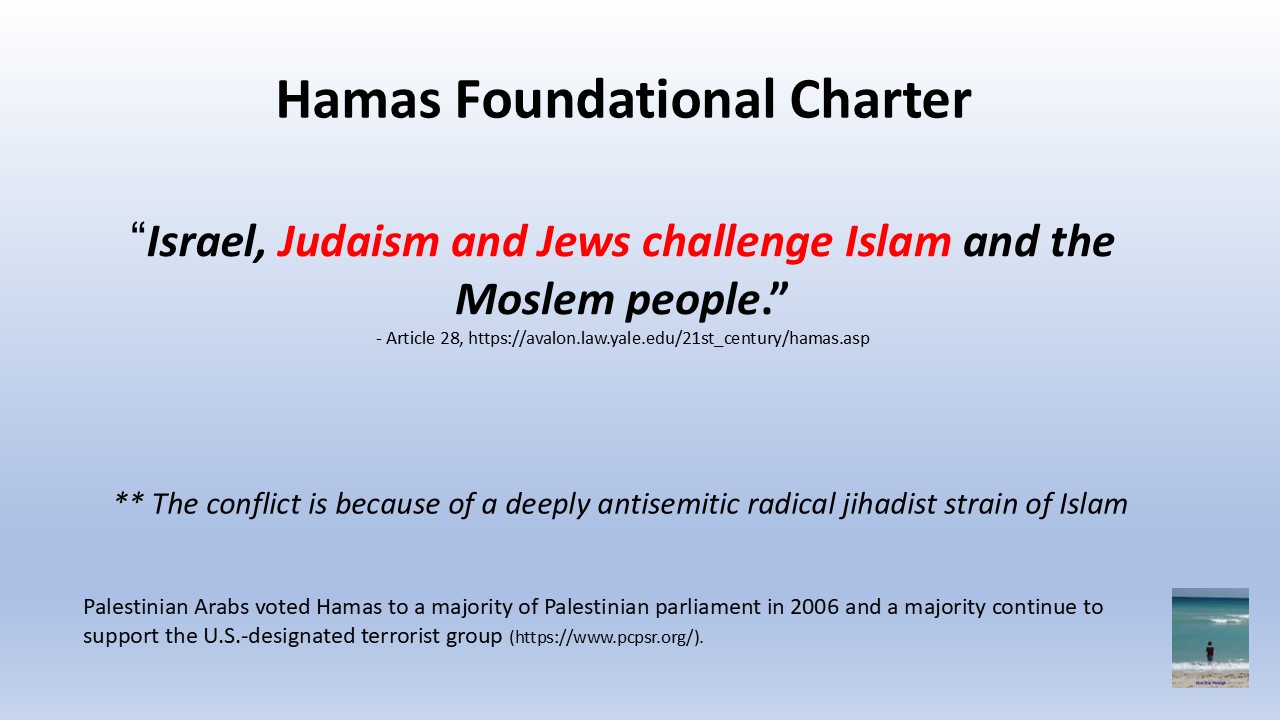
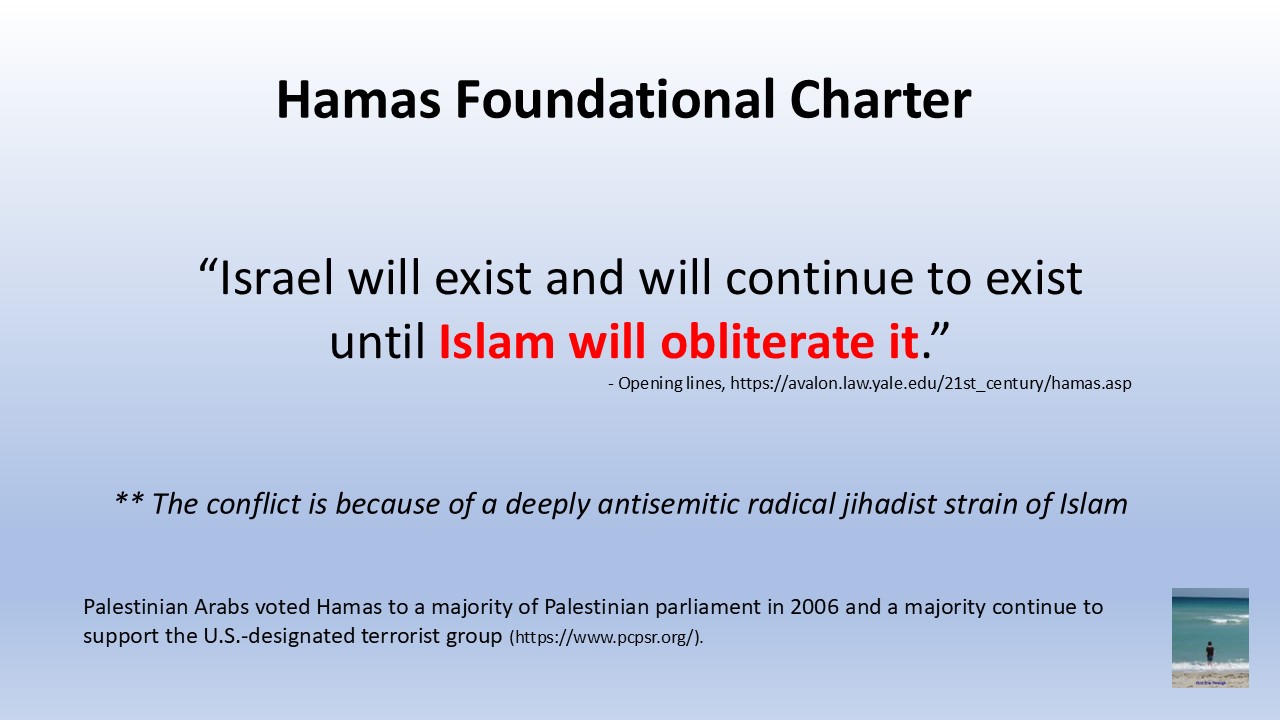
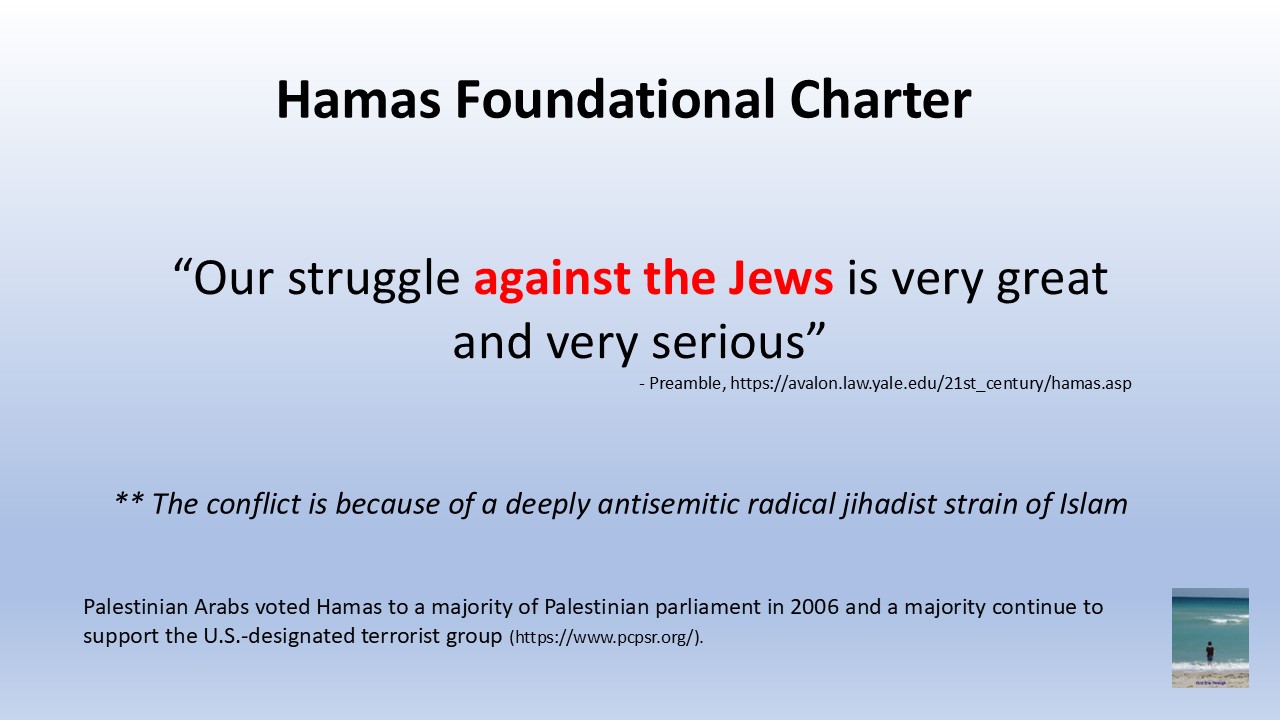
Hamas is an Islamist movement whose founding charter and rhetoric have long drawn on jihadist themes and whose October 7, 2023, attack deliberately targeted civilians. Nevertheless, the OIC has not designated Hamas as a terrorist organization or issued the kind of sweeping institutional condemnations that it has directed at ISIS, al-Qaeda, Boko Haram, Al-Shabaab, ISIS-K, or TTP.

The most obvious distinction is not the use of Islamist ideology or armed violence. It is the target: Israel, the Jewish State.

For an organization that frequently states that terrorism has no religion and that Muslims are among terrorism’s greatest victims, its record reveals a clear pattern. When jihadist groups attack the Muslim world, the OIC is unequivocal in its condemnation. When an Islamist movement wages jihad against the Jewish state, the organization’s response is support.

Is It Finally Time To Evict J Street?

J Street has long described itself as “pro-Israel.”

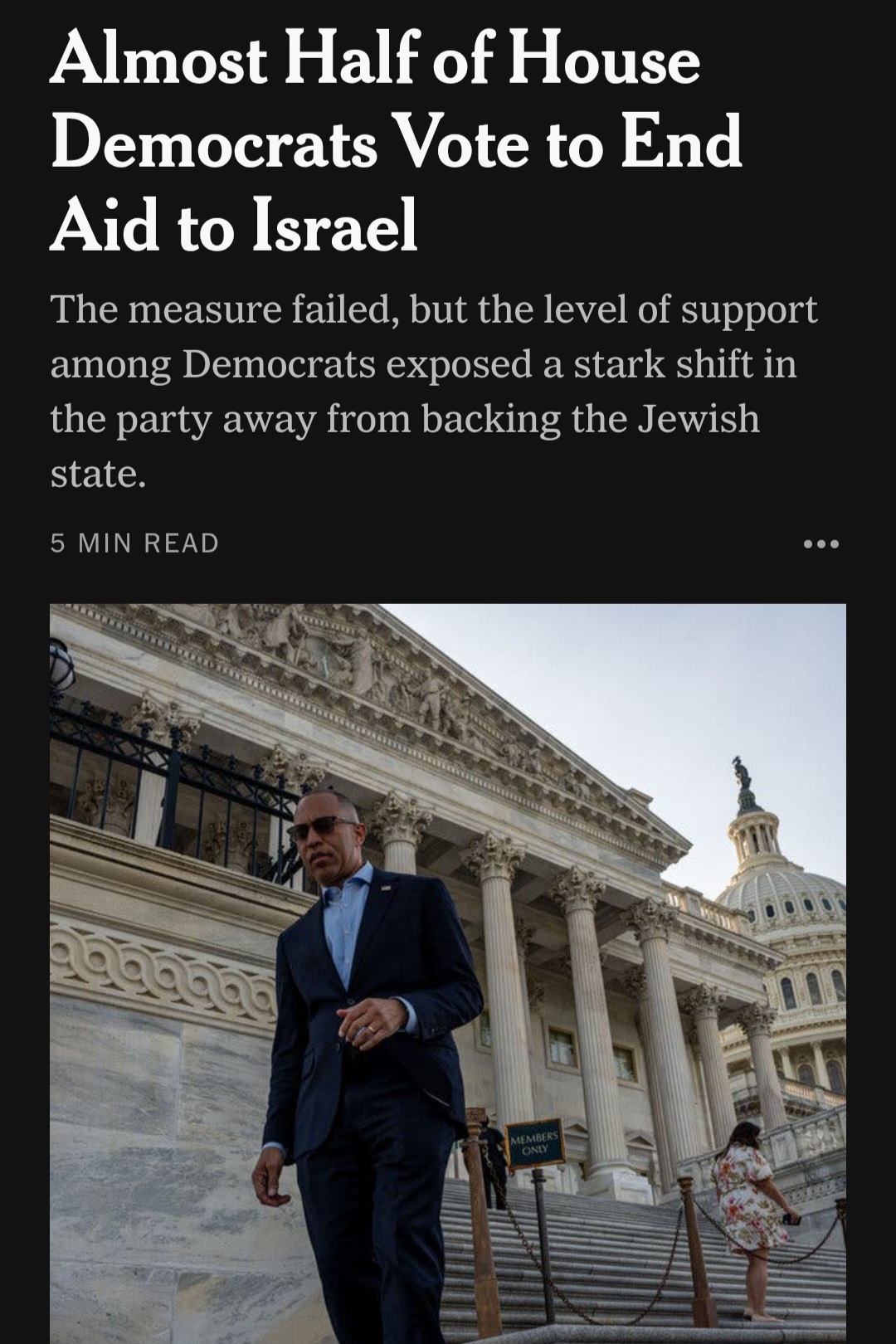
This week, after the House vote on military aid to Israel, it celebrated what it called the end of the old Washington consensus.

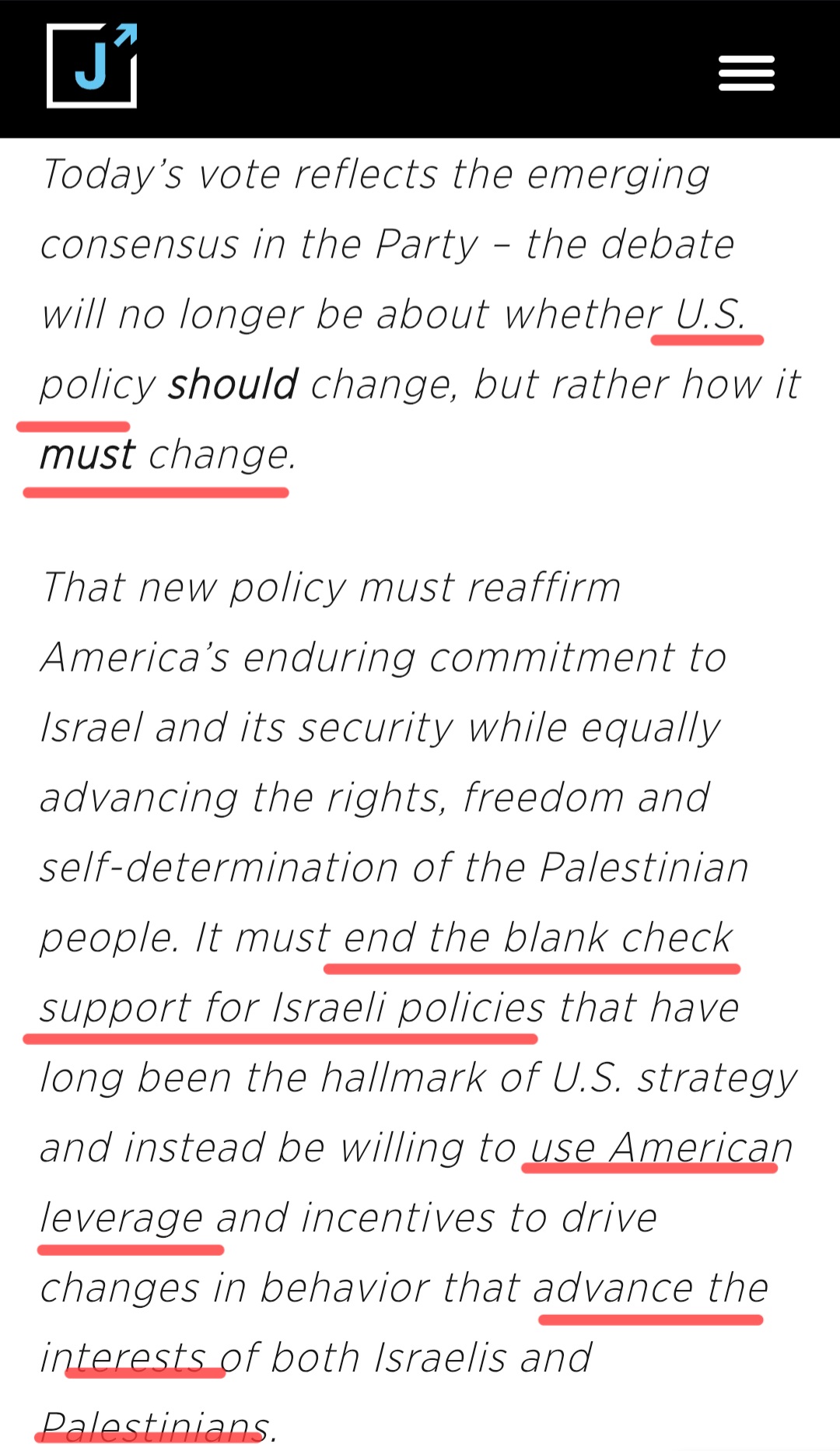
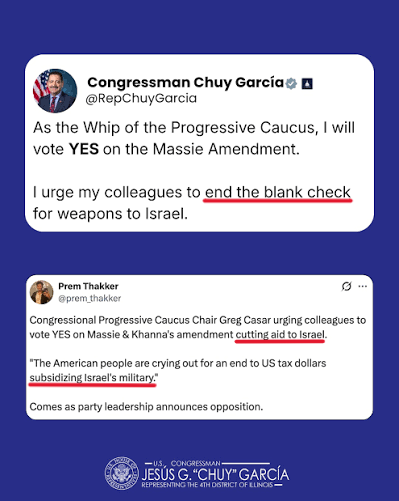
It welcomed House Democratic leaders for taking “a stronger stance” by using American leverage to pressure Israel’s government. It called for ending the “blank check” of military support. It declared that the debate was no longer whether U.S. policy toward Israel should change, but “how it must change.” [bold in original]

Those are remarkable statements.

They are not expressions of disagreement with a particular Israeli policy. They are a lobbying agenda urging the United States to use its military and financial support to compel Israel’s democratically elected government to change course while Israel is fighting the most complex, multi-front war in its history.

That is no longer simply criticism. It is an organized effort to change Israeli policy through pressure from a foreign government.

Every organization has the right to advocate for the policies it believes are best. But organizations should also be honestly described by what they do.

If an organization’s central mission is persuading Washington to pressure Israel, reduce military support, and override the strategic decisions of Israel’s elected government during wartime as its enemies desire, it is fair to ask whether “pro-Israel” remains the most accurate description.

And that question should extend to the institutions that continue to grant it the legitimacy of the broader organized Jewish community, such as those which represent the pro-Israel consensus within umbrella organizations.

The Conference of Presidents of Major American Jewish Organizations excluded J Street. As has the American Zionist Movement. But what of local Jewish community relations councils that also house organizations like Israel Bonds?

Westchester Jewish Council member organizations

These umbrella organizations exist to build Jewish consensus and strengthen support for Israel.

If one member organization is actively lobbying the United States to use military aid as leverage against Israel during wartime, then the question is no longer merely one of ideological diversity. It is whether the organization’s mission remains compatible with the mission of the coalition itself.

Pluralism is an important Jewish value but so is intellectual honesty.

The organized Jewish community has a right—and perhaps an obligation—to decide whether an organization dedicated to lobbying against the policies of Israel’s elected government during war should continue to be presented as part of the mainstream pro-Israel tent.

As these pages wrote back in 2017, “the Jewish State and pro-Israel groups will never have uniformity of opinions, but it should have unity of purpose,” especially within umbrella organizations. J Street has affirmed that its mission is more akin to Jewish Voice for Peace and the New Israel Fund, who occupy a very different tent.

And it knows this, which is why it created its own umbrella group, Progressive Israel Network. It is why they banded together to boycott a major pro-Israel event in Washington, D.C. in 2024, sponsored by the other mainstream groups.

It was one thing for the Conference of Presidents and AZM to not admit J Street. Will Jewish groups which have J Street as a member organization, now finally ask it to leave?

The Leadership Democrats Didn’t Provide

This week’s House debate over Israel’s $3.3 billion in annual military assistance was more than a vote. It was a test of leadership.

Many Democratic members of Congress allowed the debate to become one of competing sympathies: Israel versus American families, Israel versus veterans, Israel versus schools and health care. Some even embraced that framing themselves.

But leadership is not about amplifying the loudest voices in your coalition. It is about explaining difficult truths.

Over the past months, I wrote two essays that made straightforward strategic arguments.

In “Nobody Protests the Military Bases in Germany,” I argued that Americans have long understood military commitments abroad not as charity, but as investments in American security. We maintain troops, aircraft, and bases around the world because we believe confronting threats abroad is less costly than confronting them at home. It runs around $75 billion annually.

In “America’s Greatest and Quietest Military Victory in Nearly a Century,“ I argued that the wars in Israel and Ukraine should be viewed together, not separately. Two American allies have spent the last several years severely weakening two of America’s principal adversaries—Iran and Russia—while requiring virtually no American combat casualties and only a fraction of the cost of wars like Iraq and Afghanistan.

One can disagree with either argument. What is remarkable is how rarely Democratic leaders even attempted to make it.

  • Instead of explaining that military aid is part of a broader American strategy, they allowed it to be portrayed as a gift to a foreign country. And to only one country – Israel.
  • Instead of explaining that weakening Russia and Iran advances American interests, they permitted the conversation to revolve almost entirely around domestic tradeoffs. Only relative to Israel.
  • Instead of educating their constituents about seventy-five years of American global defense strategy, they surrendered the debate to slogans about “blank checks.” Specifically to the Jewish State.

Leadership requires more than counting votes. It requires helping citizens understand why America stations forces overseas, why it supports allies under attack, why it spends money beyond its borders, and why deterrence is almost always less expensive than war.

That conversation becomes even more important when the facts are uncomfortable.

  • The United States has committed far more aid to Ukraine than to Israel. Over eight times as much.
  • The wars involving Ukraine and Russia have produced far greater casualties than the war in Gaza. As much as eight times as much.
  • It spends vastly more each year defending allies through bases and military deployments across Europe and Asia. About 18 times as much.

Yet Israel alone has become the symbol of America’s supposedly misplaced priorities.

Statesmanship is not measured by how well elected officials echo the passions of the moment. It is measured by whether they are willing to explain complex realities even when doing so is politically difficult.

This week’s vote exposed more than a divide over Israel.

It exposed a failure to teach. A failure to lead. And a willingness to lean into vile antisemitic tropes.

We Are Now Post Fact-Check

Politics has entered a new era.

The old model was simple: make a claim, defend it with evidence, and persuade people.

The new model is different: create an unforgettable image. Whether it survives careful scrutiny is almost beside the point.

Attention and truth now operate on different clocks. Attention is immediate and verification is slow. By the time the facts arrive, the emotional conclusion has often hardened.

Rep. Ro Khanna’s recent visit to the West Bank illustrates the phenomenon. He described armed settlers and Israeli soldiers detaining his delegation and suggested U.S. Embassy involvement was needed to secure their release. Israeli and American officials have disputed key elements of that account. The details remain contested.

Politically, however, the outcome may already be settled.

Millions will remember one thing: an American congressman confronting violent Israelis.

This is why fact-checks so often fail. They assume the original purpose was to establish the truth. Increasingly, the purpose is to create a narrative that people remember. Every indignant rebuttal, every television debate and every social media thread extends the life of that narrative. Even proving the story exaggerated may simply give it another news cycle.

This is not unique to Ro Khanna. It is how much of modern politics now works. Viral videos replace investigations. Emotion outruns evidence. Politicians compete less to be correct than to become impossible to ignore.

Qatar-funded Hamas propaganda outlet Al Jazeera knows it. They’re good at it, mocking Israel even when they pretend to make the country look good.

Facts still matter. Every false or misleading claim deserves a documented response. Public officials should be held accountable for accuracy. But the correction should be concise, supported by evidence and then left to stand.

The real battle is over what people picture when they think about an issue.

If opponents reduce Judea and Samaria to images of violence, the answer is NOT weeks of arguing over a single disputed incident. It is to show a different reality: positive, possibly confrontational, and above all, memorable. Perhaps ancient Jewish history, thriving communities, vineyards, archaeology, entrepreneurship, shared workplaces, families and landscapes that tell a far richer story than Khanna’s video.

The same principle applies elsewhere. When anti-Israel extremists celebrate terrorism, intimidate Jewish students or glorify those who murder civilians, expose it. Not as a legal brief but show the human story. Show the victims. Show the consequences. Show the moral contrast.

Israeli Arab Nuseir Yassin known as Nas, has a big social media following

For too long, those who value accuracy have assumed that the best response to a misleading story is a better fact-check. Increasingly, the better response is a better story—one that is equally compelling because it is true.

The choice is not between truth and attention. It is to make the attention focused on the stories you want.

Checkpoint in California and Checkpoint in the West Bank. Only One Sparked Outrage.

There are many ways to measure whether politicians are guided by principle or politics. One is to compare what provokes their outrage and what does not.

In April 2024, a Jewish student at UCLA tried to walk across his own campus.

Pro-Palestinian protesters physically blocked his path and decided, on their own authority, who could and could not pass. UCLA security officers stood by and did nothing. A federal judge later ruled that UCLA could not permit Jewish students to be excluded from parts of campus because of their identity or beliefs, calling such exclusion “unimaginable” and “abhorrent.”

Where were California’s Democratic members of Congress about the incident? Other “progressive” members of Congress? Where were the press conferences, the demands for investigations and the flood of social media condemnations?

Their silence was striking.

Then came Rep. Ro Khanna’s recent 7,500-mile trip to the West Bank in July 2026.

Khanna claimed that armed settlers and Israeli soldiers prevented his delegation from proceeding and that U.S. Embassy involvement helped resolve the situation. Israeli officials, the U.S. embassy, and various parties dispute key parts of that account, saying the delegation entered a restricted security area without proper coordination and denying Khanna’s characterization of the encounter.

Yet progressive members of Congress like Ilhan Omar quickly rallied behind Khanna, condemning Israel and amplifying his account around the world.

The comparison is not between two people who were blocked. It is between two very different reasons for being blocked and the reactions that followed.

At UCLA, private protesters established their own checkpoint and allegedly decided which Americans could pass based on who they were or what they believed. A federal court concluded that a public university could not allow that to happen.

In the West Bank, the issue was about security. The area was subject to access restrictions because it was an active conflict zone. The dispute is over whether those security measures were properly applied not whether Ro Khanna had a right to unrestricted entry.

One concerns equal treatment under American law, the other concerns the exercise of security authority in a foreign conflict zone. Yet the louder political outrage came in response to the latter.

If elected officials cannot summon the same moral urgency when a Jewish American student is excluded from his own campus as they do when a colleague encounters a disputed security checkpoint overseas, the question is no longer whether they oppose injustice. It is what kinds of injustice – and for whom – they choose to notice.

We are witnessing more and more of the elected progressive wing marking American and Israeli Jews as “absolutely vile” people unworthy of basic protections and rights who “must be stopped.”

Fiction vs. Fact: Palestine 1948 and PLO 1964

There is a popular belief that Palestine was a country stolen and occupied by invading Jews in 1948. This has no basis in fact.

When the British Mandate ended in May 1948, there was no sovereign Palestinian Arab government waiting to assume power. There was no functioning Arab parliament, cabinet, constitution, or national administration prepared to govern an independent state.

The Jewish community took a different path. Over decades it had built the institutions of self-government: representative political bodies, courts, schools, hospitals, financial institutions, and a defense force. When Britain withdrew, those institutions became the foundation of the State of Israel.

The local Arab leadership did not establish comparable institutions of national government. Not before 1948 nor after.

Instead, neighboring Arab armies invaded the newly declared Jewish state. Transjordan assumed control of the West Bank. Egypt administered Gaza. A short-lived All-Palestine Government was announced later that year, but it exercised little authority and never became an effective sovereign government.

For the next sixteen years, there was no effort to start a Palestinian State.

Only in 1964 did the Arab League create the Palestine Liberation Organization.

Even its name is revealing.

It was not called the State of Palestine. It was not called the Government of Palestine. It was called the Palestine “Liberation” Organization.

Governments are created to govern. Liberation movements are created to liberate territory from an existing sovereign.

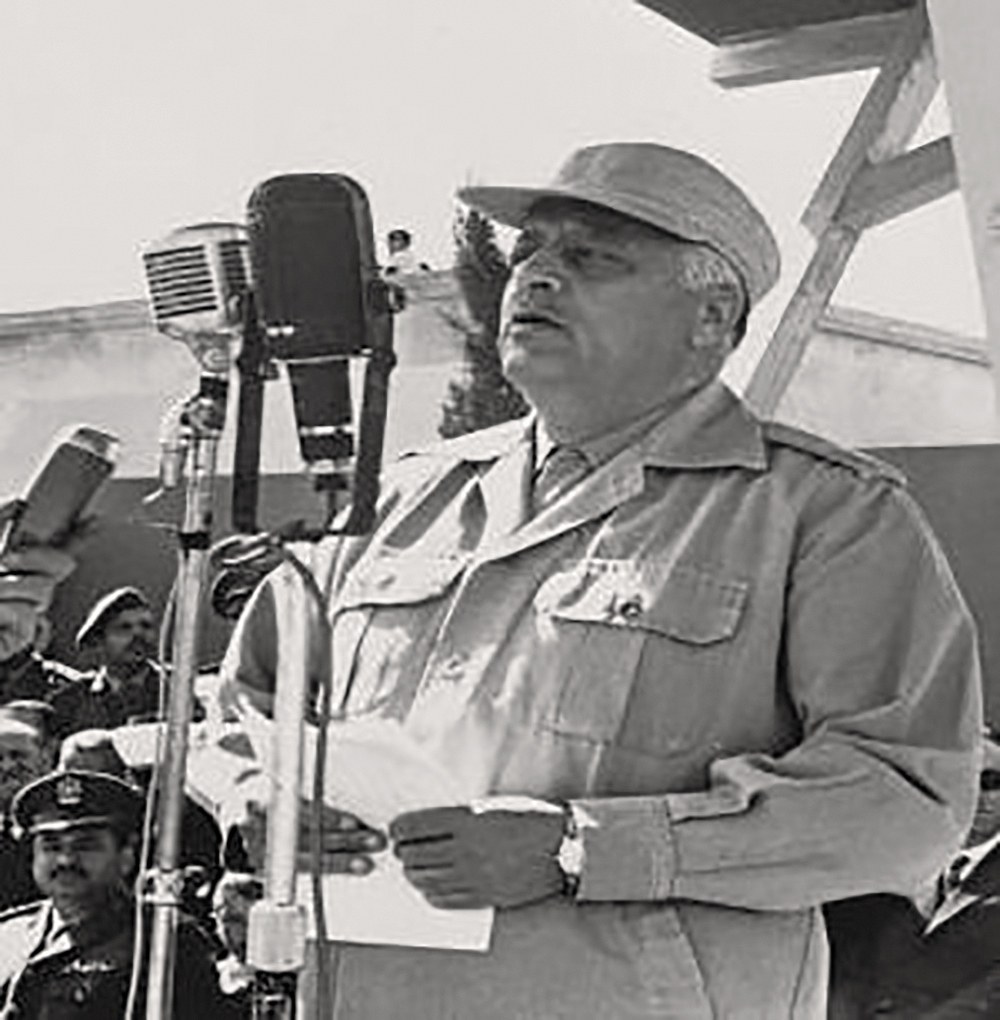
First Chairman of the PLO, Ahmad al-Shukeiri, was born in Lebanon and served as both Syrian and Saudi Arabian delegate to the United Nations at different times. He had to resign in shame after failing to destroy Israel in 1967.

The PLO’s founding charter reinforces that distinction. Rather than outlining the institutions of a future Palestinian state, Article 24 declared:

“This Organization does not exercise any regional sovereignty over the West Bank in the Hashemite Kingdom of Jordan, on the Gaza Strip, or in the Himmah Area [where Israel, Jordan and Syria meet].”

The PLO’s founding charter expressly declined to claim sovereignty over the parts of historic Palestine then under Arab administration. Yet throughout the document, its central mission was the “liberation of Palestine” – a struggle directed at Israel, the Jewish State. At its core, local Arabs wanted Arab rule, wherever it may come from. They opposed the so-called “Zionist invasion” and Jewish sovereignty “in any part of Palestine.“

When the first lasting Palestinian national organization finally appeared in 1964, it was constituted not as a government-in-waiting or a reclamation government but as a liberation movement, and its own charter expressly disclaimed sovereignty over the West Bank and Gaza while solely focusing its mission on Israel.

Within three years of its founding, the PLO and surrounding Arabs countries initiated their plan to wipe Israel off the face of the earth. They failed then as they failed in 1948.

The Palestinian “liberation” movement is a pan-Arab effort to remove the Jewish state first and foremost. Current efforts to portray it as a people seeking to reclaim their historic country is without any basis in fact.

Basic National Rights… For Some

The Palestinian Authority had no trouble explaining what every nation deserves.

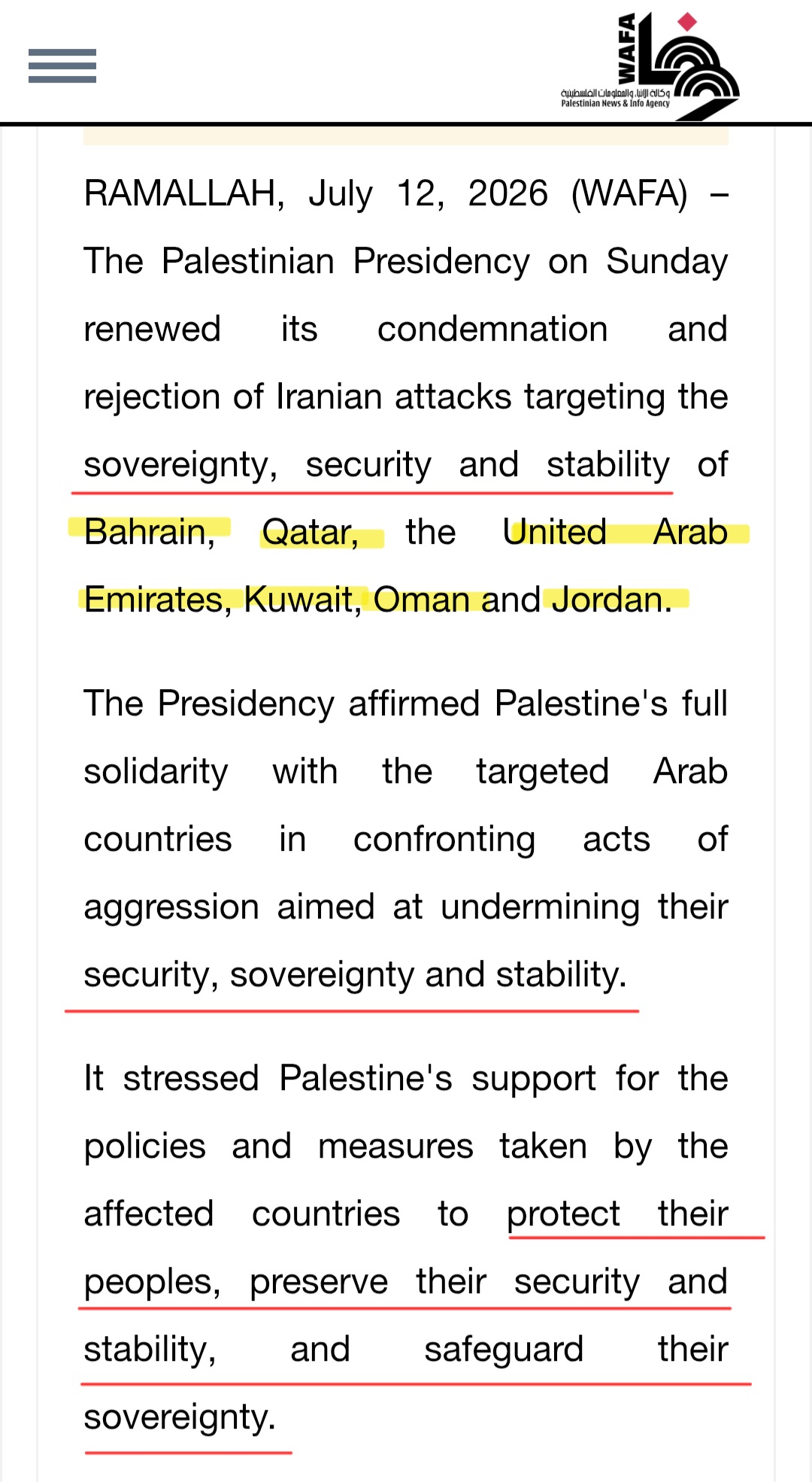
In a statement condemning Iran’s attacks on Bahrain, Qatar, the United Arab Emirates, Kuwait, Oman, and Jordan, the PA repeatedly invokes the same principles: sovereignty, security, stability, and protection of civilians.

PA President condemns Iranian attacks on July 12, 2026

Iran is condemned for violating each of them. The Arab governments are praised for taking measures to defend them.

“The Organization is based on the principle of the sovereign equality of all its Members.” United Nations Charter (Article 2(1))

Where were these principles when Israel was attacked?

When Iran launched missiles at Israel, did the Palestinian Authority defend Israel’s sovereignty?

When Hezbollah rained rockets on Israeli cities for months, did it affirm Israel’s right to security and stability?

states “refrain… from the threat or use of force against the territorial integrity or political independence of any state.” UN Charter (Article 2(4))

When the Houthis fired missiles toward Israel, did it support Israel’s right to protect its people?

And most pointedly, when Hamas – fellow local Arabs of the Palestinian parliament – crossed an international border on October 7, murdered civilians, kidnapped hostages, and occupied Israeli communities, did the PA condemn it as an assault on Israel’s sovereignty?

“the inherent right of individual or collective self-defence if an armed attack occurs against a Member of the United Nations.” UN Charter (Article 51)

A principle that applies only to friends is not a principle. It is a preference.

The Palestinian Authority’s own statement demonstrates that it understands exactly what every nation deserves. Its silence when those same principles are violated openly and repeatedly against Israel says just as much as its words.