Names and Narrative: Antisemitism And Islamophobia

We have a strange vocabulary for hatred.

Fear of Muslims is called Islamophobia. Hatred of Jews is called antisemitism.

One word announces fear (phobia) while the other focuses on hatred (anti).

Graffiti in London, England blames Jews on the September 11 terrorist attack that was committed by jihadi terrorists, in December 2019 during Hanukkah, or perhaps that terrorism was coming for Jews

Yet much of antisemitism has always been built on fear: fear of Jewish money, Jewish influence, Jewish intelligence, Jewish loyalty, Jewish networks, Jewish control. The classic antisemite does not merely dislike Jews. He believes Jews possess too much power and have things that do not rightfully belong to them.

That makes antisemitism, in a very literal sense, a phobia.

And comparing it with Islamophobia reveals something important about how the two prejudices work.

In Whole or Part

There are roughly 2 billion Muslims in the world and radical jihadists constitute a tiny fraction of them. Yet that fringe has caused extraordinary damage. Nineteen radical Islamic hijackers carried out September 11. ISIS murdered thousands and terrorized millions while representing a small share of the world’s Muslims.

That creates a fear rooted in uncertainty. The danger from jihadists is real; Islamophobia spreads that danger to innocent non-jihadi Muslims.

Antisemitism runs in the opposite direction.

There are only about 15 million Jews in the world. Their tiny numbers become part of the conspiracy. Jews constitute a fraction of one percent of humanity, yet Jews have achieved prominence in business, finance, academia, science, politics, media and culture.

The antisemite sees those accomplishments and converts disproportionate success into disproportionate power. Individual Jews disappear. There is only the Jews, a coordinated power.

Zero Sum Grievance Versus Sporadic Safety

There is a crucial difference between the fears.

Islamophobia begins with the violent actions of some Muslims and enlarges the circle of suspicion. Even the person consumed by fear of jihadism understands that every Muslim cannot be a jihadist. But the Muslim stranger becomes frightening because he might belong to the dangerous subset. There could be an attack at discrete moments in time.

Fear of Jews is about undeserved and evil coordinated power. It has an economic component which makes the fear especially combustible: Jews have something at the expense of others. The view of a zero sum game is that the Jewish power comes at the expense of your power; their wealth is taken from your wealth. If someone believes Jews control banks, corporations, universities, governments or the media, almost any personal grievance can acquire a Jewish culprit.

Movement

That difference in the fears makes its spread very distinct. Those disillusioned with their status in life can find a scapegoat in Jews. Poor or lost a job? Probably the fault of the Jews. Your favorite politician lost? Probably Jewish money and influence. Your culture going in a direction you don’t like? Jews control the media and Hollywood. Don’t have a functioning country? Must be the fault of the Jews.

Antisemitism takes fear and a zero-sum philosophy and allows it to travel to the corners of the world which don’t even have Jews. It is inherently portable.

But Islamophobia is a localized fear. It is not within your mind about everything that makes you upset; it is a tangible fear of your physical safety. It has an address.

Consequent Actions of Antisemitism and Islamophobia

With such orientation, the vectors to attack Jews become multiple. Remove them from positions of power: vote them out of office, get them off boards of directors, expunge them from teaching positions. Make it impossible for them to live nearby through banning kosher meat, circumcision, an eruv. Cast their lobbying group as uniquely nefarious compared to vastly larger and more powerful non-Jewish lobbying groups.

The Islamophobes’ battle against Muslims is not removal of a handful of people but placing a barrier from admitting billions of people. Limit immigration from Muslim-majority countries. Block mosques or Islamic centers from being built in the community. Keep the tsunami at bay before they overwhelm.

Between Fear and Hate

We readily describe fear surrounding Muslims with a word ending in phobia. It inherently carries the meaning “irrational.” There really is no reason to fear Muslims is the embedded argument – despite the global terrorism committed by jihadi terrorists. The language tells us that one’s fear is really a bias.

Antisemitism runs in a different direction.

There have been centuries obsessed with Jewish power, Jewish influence, Jewish wealth, Jewish loyalty and Jewish control without putting fear anywhere in its name. Doing so gives the hatred the comfort of being rational. There are data points – there’s a wealthy Jewish man! – and the cascade of evil thoughts that he must be responsible for anything wrong in your life is not a crazy leap but an endorsed component of a corroding society. The cure for this toxin is being promoted by teachers’ unions and radical politicians: that Jews must be stripped of any wealth, possessions, title, honor or business and their inherently illegal items given to victims of preference.

“Islamophobia” tells us to stop the irrational fear which leads us to hateful actions; “Antisemitism” is wired as an accelerant in a society whose foundation is grievance and victimhood.


We are arriving at the 25th anniversary of the September 11 jihadi attacks on the United States and subsequent War on Terror. It was a battle against the radical Islamic terrorist group al Qaeda, and the various sister organizations such as the Taliban, ISIS and Boko Haram to different extents.

We are also coming to the third anniversary of the October 7 jihadi massacre in Israel and its subsequent multi-front war with the Islamic Republic of Iran and its various proxies of Hezbollah, the Houthis and Hamas.

Lost in these anniversaries and large military battles against global jihadism is the softer war of words. Of civilian fear and hatred taking place on city streets and school campuses. Of the vastly disproportionate attacks on Jews than on Muslims in the English-speaking world.
There is no quick fix to stopping the torrent of attacks on Jews. But perhaps it is time to change the English term for Jew hatred to something like “Jewphobia” which forces people to confront their hatred as both irrational and anchored in fear. And then maybe the United Nations would finally recognize it the way it has elevated the less common “Islamophobia,” encourage governments and institutions to fight the scourge, as well as confront its own deep hostility for Jews around the world.

Gross Antisemitism in the English-Speaking World

Western governments have developed a familiar vocabulary.

  • “Hate is rising.”
  • “Religious intolerance is increasing.”
  • “Antisemitism and Islamophobia must be confronted.”

Every minority deserves protection. But treating victims equally does not require pretending they are being targeted equally.

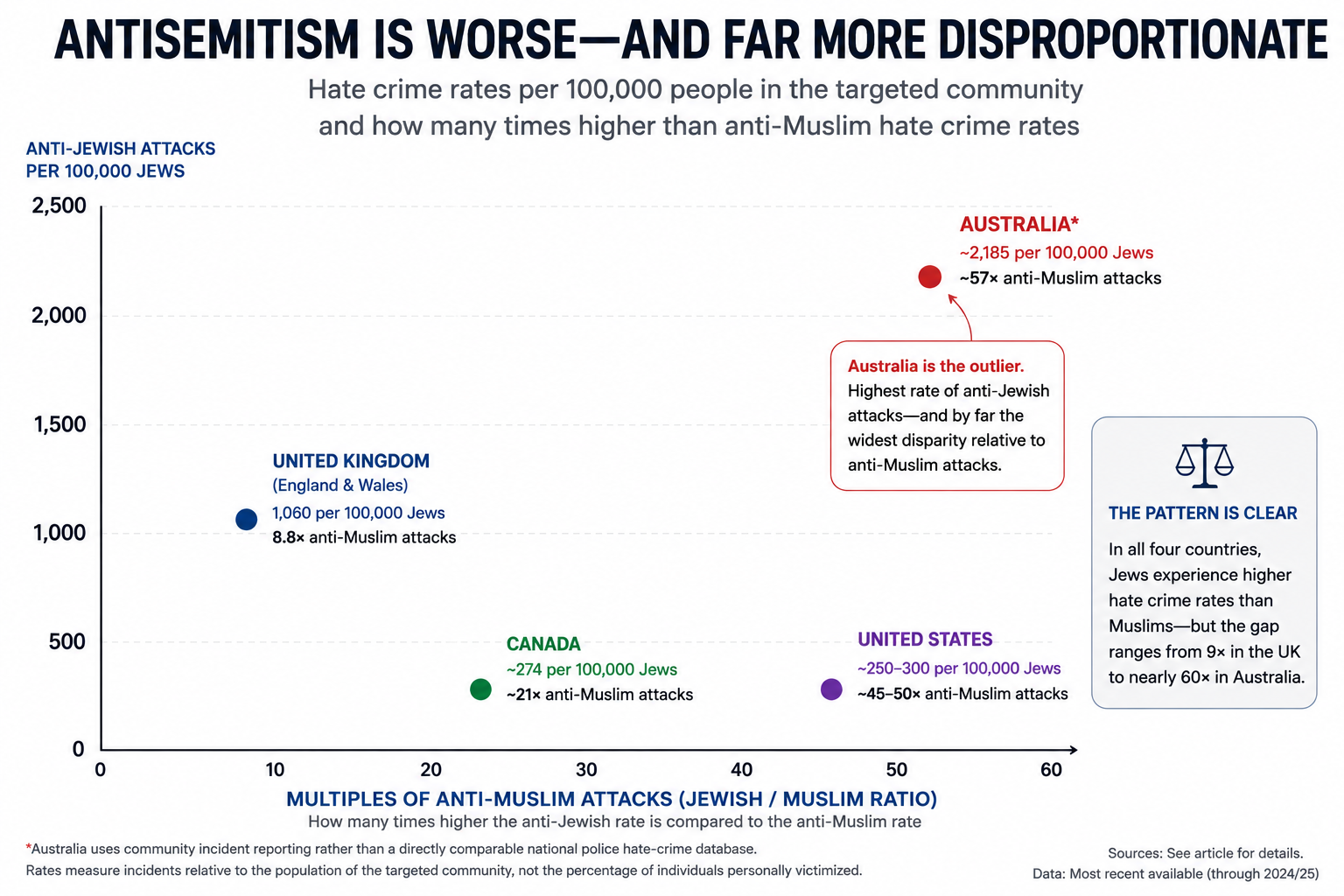
CountryAnti-JewishAnti-MuslimJewish / Muslim Ratio
UK (England & Wales)1,060 per 100,000120 per 100,0008.8×
Canada~274 per 100,000~13 per 100,000~21×
United States~250–300 per 100,000~5–6 per 100,000~45–50×
Australia*~2,185 per 100,000~38 per 100,000~57×

*Australia uses community incident reporting rather than a directly comparable national police hate-crime database.

Britain clearly has a religious-hatred problem. Muslims and Jews suffer substantial levels of hate crime, well above that of other English-speaking countries, while Jews are targeted at almost nine times the rate of Muslims. Canada and USA show fewer hate crimes per population, and a wider disparity between Jews and Muslims being attacked.

Then there is Australia.

For the decade before October 7, 2023, Australia averaged 342 reported anti-Jewish incidents annually. That exploded to 2,062 in 2023/24 and remained at 1,654 in 2024/25. In New South Wales, police-recorded hate incidents against Jews rose from 40 in 2020 to 841 in 2025.

Then statistics became bodies.

On December 14, 2025, gunmen attacked Chanukah by the Sea at Bondi Beach. Fifteen people were murdered while celebrating the Jewish holiday.

Australia subsequently established a Royal Commission on Antisemitism and Social Cohesion, which is examining the circumstances surrounding the attack and whether authorities adequately recognized the threat to Jewish events.

Australia had been warned.

It had also begun responding. The government appointed Jewish communal leader Jillian Segal as Special Envoy to Combat Antisemitism. Her national plan followed extensive consultation with Australian Jews, and the government adopted all 13 recommendations.

Yet Australia continues to struggle with whether antisemitism is a distinct threat or another part of generalized “hate.”

Its Combatting Antisemitism, Hate and Extremism Act puts antisemitism in the title – along with more generic terms of “hate” and “extremism.” There is nothing wrong with fighting all forms of hatred. The question is whether symmetry in government policy reflects the reality on the ground.

Australia’s available community data indicate roughly 38 anti-Muslim incidents per 100,000 Muslims and 2,185 anti-Jewish incidents per 100,000 Jews.

That is roughly 57-to-1.

Indeed, Australia’s Islamophobia envoy (in a federal post strictly devoted to “Islamophobia” and no other forms of hate) has urged the Royal Commission on Antisemitism to approach antisemitism through the broader causes of identity-based hatred and the common roots of antisemitism, Islamophobia and other prejudice.

“antisemitism, Islamophobia and other forms of prejudice share common causes, such as polarisation, online environments and declining trust in institutions. Tackling these underlying factors can strengthen outcomes for all communities.” – Australia’s Special Envoy to Combat Islamophobia, Aftab Malik, June 2026

What? If they were all the same, why are Jews attacked at a 57-to-1 ratio?

Australia does not have a generic hate problem that happens to include Jews. It has an extraordinary antisemitism problem that generic language about hate must not be allowed to hide.

Related:

Bondi Attack: Can Jews Be Victims in the Media? (December 2025)

Global Jewry Is Losing Australia, Canada, France, Germany and UK (December 2024)

It Is Time to Call It the Jihadi-Israel Conflict

It was once called the Arab-Israeli Conflict.

The name made sense at Israel’s founding. Israel fought wars against the armies of Egypt, Jordan, Syria, Iraq and other Arab states. The conflict was understood principally as one between the Jewish State and the surrounding Arab world.

Then the map changed.

Egypt made peace with Israel in 1979. Jordan followed in 1994. During the horrific Second Intifada, the suicide bombings, shootings and other attacks were overwhelmingly part of a localized war involving Palestinian Arabs. The terminology narrowed accordingly. The Arab-Israeli Conflict increasingly became the Palestinian-Israeli Conflict.

That description is now inadequate too as the map evolved again over the past several years.

The Abraham Accords fundamentally changed the regional picture. The United Arab Emirates, Bahrain and Morocco normalized relations with Israel. Trade, tourism, investment and security cooperation followed. Other Muslim-majority countries have also maintained or developed relations with the Jewish State.

Yet at the same time, Israel has faced repeated war from Hamas in Gaza, Hezbollah in Lebanon, the Houthis in Yemen and, increasingly directly, the Islamic Republic of Iran. These forces are separated by borders, ethnicity and even the Sunni-Shiite divide. What connects them is not Arab identity. It is a radical Islamist rejectionism that refuses to accept a sovereign Jewish state in the Middle East.

It is therefore time for the terminology to catch up. This is increasingly the Jihadi-Israel Conflict.

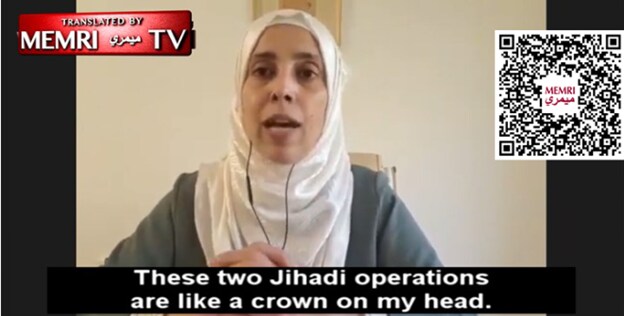
Ahlam Tamimi, who helped plan and transported the suicide bomber to the 2001 Sbarro restaurant bombing in Jerusalem and now lives in Jordan.

The term captures the venom, vitriol and violence of Hamas and the armed Islamist movements aligned against Israel. It encompasses Hezbollah and the Houthis and, most importantly, the Islamic Republic of Iran that has armed, financed and supported much of the network surrounding Israel.

It also leaves room to describe the roles of Qatar and Turkey, whose close relationships with Hamas and fierce political hostility toward Israel place them in a very different category from Muslim and Arab governments pursuing normalization.

Most importantly, the new terminology does something the old terminology cannot: it separates Muslims and Arabs who seek peace with Israel from radical Islamists committed to its destruction and the slaughter of Jews.

Hamas leader calling for slaughtering Jews as a religious Islamic principle

The dividing line has moved.

And that makes the choices facing Lebanon, Syria and Saudi Arabia especially important. They can move toward a Middle East built around trade and coexistence, or remain trapped in a conflict driven by radical Islamist movements that reject Jewish sovereignty, basic human rights and self-determination.

The conflict has become crystallized for what it likely always was: the Jihadi-Israel Conflict.

The Eclipse of Jihad

Staring at the sun is dangerous. It can permanently damage your eyes.

That is true today, during a solar eclipse. It was true yesterday. And it will be true tomorrow.

Yet almost no one spends an ordinary sunny day warning people not to stare at the sun. There are no news alerts. No public-service campaigns. No rush to buy protective glasses.

Then an eclipse arrives, and suddenly everyone is talking about retinal damage.

The eclipse does not make the sun more dangerous. It makes us more likely to look.

On an ordinary day, the sun is painfully bright. We instinctively turn away. During an eclipse, the moon covers much of that brightness. The sun becomes darker, stranger and irresistible. Curiosity tells us to keep looking precisely when the covering makes the danger easier to underestimate. We look at the danger precisely when the danger hides behind a mask.

The danger was always there. What changed was our behavior.

Violent jihad presents a darker version of the same phenomenon.

An ideology that glorifies murdering civilians, suicide bombings and religious war does not become less dangerous because something is placed in front of it. Yet organizations, activists and politicians can provide a kind of ideological eclipse—describing jihadist violence primarily through the language of “resistance,” “liberation” or Palestinian Arab self-determination.

October 7 should have been impossible to romanticize. Thousands of Hamas terrorists murdered families in their homes, slaughtered young people at a music festival and dragged hostages into Gaza. Yet almost immediately, people began searching for language that could place a covering over the horror.

“Palestinian self-determination” became one such covering. It transformed a discussion about what Hamas actually did and what it openly sought into a more familiar political argument about nationalism, borders and statehood. The words did not change the violence. They changed how people were invited to look at it.

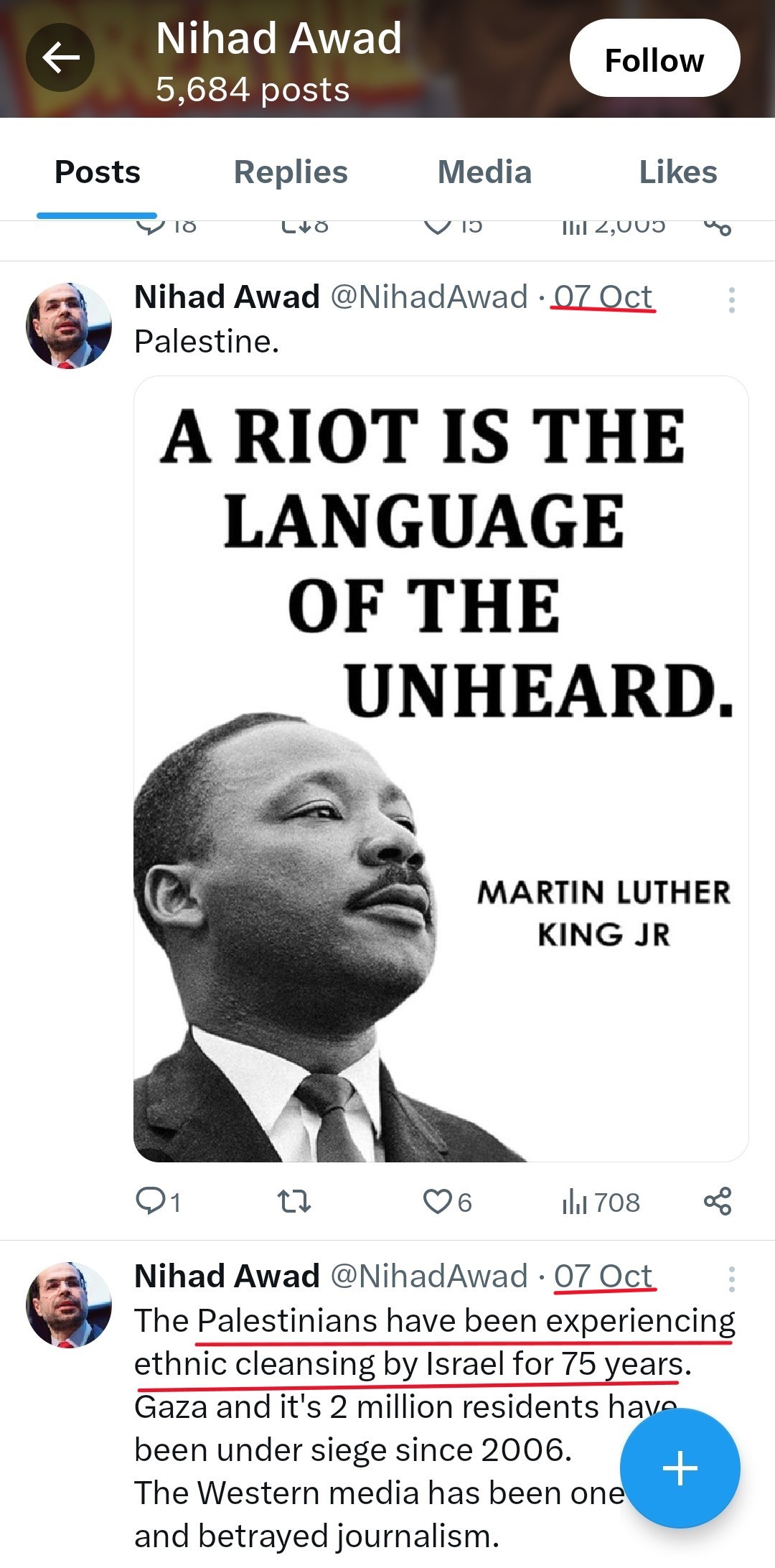
The head of the CAIR posted that October 7 was a Martin Luther King moment for Palestinian Arabs while the massacre in Israel was ongoing

And once the horror is covered, something disturbing happens. What should repel people can become a passing fascination. Violence acquires slogans, symbols and intellectual rationalizations. Terrorists are recast as revolutionaries; psychopaths and cowards as heroes. People who would instinctively recoil from the naked ideology are encouraged to stare at a filtered version of it.

That is the danger of an eclipse. It does not destroy the source of the danger. It obscures enough of it to change human behavior.

The sun was dangerous before the moon passed in front of it. It will remain dangerous when the moon moves away.

Violent jihad was dangerous before October 7. It remained dangerous while people explained its atrocities through socialist-jihadi language. And it will remain dangerous after today’s political fascination moves somewhere else.

The eclipse does not change the sun nor does political covering change violent jihad. It only changes whether people recognize the danger when they look at it.

Jihadi Protection Bills

Congress did not arrive at legislation protecting Hamas overnight. It arrived there one bill at a time.

For decades, debates over Israel revolved around diplomacy. Republicans and Democrats argued over settlements, negotiations, Jerusalem, and the contours of a future Palestinian state. Even lawmakers sharply critical of Israel generally framed their proposals around advancing a negotiated two-state solution. The disagreement was over how peace should be achieved, not whether Israel had the right to defend itself against terrorist organizations.

In 2020, as the Trump Administration unveiled its peace plan and Israel considered extending sovereignty to portions of the West Bank, progressive lawmakers introduced legislation preventing American assistance from supporting annexation. Whether one believed annexation was prudent or unwise, the objective remained fundamentally political. These bills sought to influence the outcome of negotiations and preserve the possibility of a future Palestinian state. The debate was about borders, diplomacy, and competing visions for peace.

That bill did not stand in isolation.

In 2019, Representative Betty McCollum (D-MN) also introduced legislation prohibiting U.S. assistance from supporting the military detention of Palestinian minors. On its face, the proposal carried moral appeal. No civilized society wants children caught in war, and few slogans resonate more powerfully than protecting minors.

Yet the legislation missed the point. Israel’s military justice system does not prosecute minors because they are children. It prosecutes minors accused of security offenses, including violent rioting, firebomb attacks, shootings, stabbings, and participation in terrorist organizations. Hamas, Palestinian Islamic Jihad, and the Popular Front for the Liberation of Palestine have all recruited teenagers into violent activity for decades.

Arab minors caught on camera right before they stab Israelis

The debate was no longer centered on where Israel’s borders should ultimately lie. It was becoming a debate over whether Congress should restrict Israel’s ability to prosecute those participating in terrorism.

That evolution became unmistakable after October 7.

The largest massacre of Jews since the Holocaust might reasonably have been expected to produce overwhelming congressional support for dismantling Hamas. Instead, it accelerated an entirely different legislative movement.

Arabs in Gaza take the body of Israeli woman they had just killed into Gaza where the crowds pelted her body and spat on her

One proposal after another sought to block the military tools Israel argued were necessary to fight the war. Senator Bernie Sanders (D-VT) repeatedly forced votes to halt major arms sales. Representative Rashida Tlaib (D-MI), Representative Pramila Jayapal (D-WA), Representative Delia Ramirez (D-IL), and others introduced the Block the Bombs Act. Senator Chris Van Hollen (D-MD) sought to impose additional legal restrictions before military assistance could proceed.

US Senator Chris Van Hollen attends a Senate subcommittee on the Justice Departments proposed 2027 budget, on Capitol Hill in Washington, May 19, 2026.

Supporters presented these bills as humanitarian safeguards designed to protect civilians and uphold international law. Their practical effect, however, would have been to deny or delay weapons while Israel was engaged in combat against a U.S.-designated terrorist organization that had murdered, raped, tortured, kidnapped, and burned civilians alive.

Congress was no longer principally debating the contours of a future peace agreement. It was debating how much of Israel’s wartime capability should be withheld while the war itself was still being fought.

And it continued.

In July 2026, Representative Thomas Massie (R-KY) introduced an amendment eliminating the entire $3.3 billion annual Foreign Military Financing package for Israel. Previous proposals had sought to condition aid or block particular weapons systems. Massie’s proposal went much further. It would have ended America’s regular military assistance altogether.

The amendment failed by a wide margin. But 104 members of Congress voted for it, including 103 Democrats alongside the bill’s Republican author.

That vote tells a larger story than the amendment itself.

Over the course of a few years, the legislative progression moved from opposing territorial annexation, to restricting Israeli counterterrorism practices, to limiting the weapons available to fight Hamas, and finally to questioning whether the United States should continue military assistance at all. Each bill built upon the political space created by the one before it. What once occupied the outer edge of congressional debate gradually became part of mainstream legislative discussion.

The coalition itself is unusual. Rashida Tlaib approaches the issue through Palestinian nationalism. Bernie Sanders emphasizes humanitarian law and civilian casualties. Chris Van Hollen argues for greater legal oversight of military assistance. Thomas Massie opposes foreign aid as a matter of constitutional principle. They arrive from very different ideological traditions, yet increasingly find themselves casting the same vote.

For generations, support for Israel was one of Washington’s few enduring bipartisan constants. That consensus has not disappeared; overwhelming majorities in Congress still support the alliance. But the terms of the debate have unmistakably changed.

Six years ago, Congress debated how American policy might influence a two-state solution. Today, members openly introduce legislation that would limit—or eliminate altogether—the military support Israel says it needs to defeat jihadist organizations committed not to coexistence, but to its destruction.

That is the real story of the Jihadi Protection Bills. Not that any single measure became law. But that, one bill at a time, the center of the American political conversation migrated from shaping the peace process to constraining Israel’s ability to wage war against jihadist movements to its basic ability to protect itself in a deeply hostile region.

Related

Nobody Protests the Military Bases in Germany (May 2026)

You No Longer Have to Listen Closely

When I wrote I’m Offended, You’re Dead in 2015, I argued that the West fundamentally misunderstood violent jihadism. It was routinely described as the work of a tiny fringe because Western observers were looking almost exclusively at Europe and North America. But that was never where most Muslims lived or where most of the violence occured.

The view that a few “extremists” have hijacked Islam and are attacking the freedom of press is both myopic in terms of history and geography, and hazy in terms of numbers and scope. 

In the Global North, Muslims make up only about 2.6% of the population. Across the Global South, they account for roughly 28%. Excluding Latin America and China, that figure rises to about 42%. The attitudes that gave rise to violent jihadism were therefore never confined to a handful of isolated extremists. Across large parts of the Muslim world, Islamist movements and deeply illiberal religious doctrines already exercised enormous influence and persecute people attempting to live with basic human rights. The West mistook a geographic illusion for an ideological one.

Terrorist movements do not emerge in an ideological vacuum. An ideology does not need majority support to convince a determined minority that violence is both righteous and necessary.

And you no longer have to listen carefully to hear that message.

Over the past decade, migration, social media, and global communications have brought that ideological current into the daily background of Western life. Many will be alarmed and others will feel called. Either way, it has become ever-present and one no longer needs to search to find it.

The attacks increasingly follow a familiar pattern because they spring from the same worldview.

The gay patrons of the Pulse nightclub in Orlando were condemned as morally corrupt and massacred by a man with ties to al Qaeda and Hezbollah. This week, a Berlin Pride parade became the target of a man who had reportedly sought to join ISIS. Christmas markets in Germany have repeatedly been attacked by men invoking Islamist causes. Trucks and cars have been used as weapons against civilians in France, Germany, and Israel. In Manhattan, a deranged man allegedly shouted “Allahu Akbar” while carrying out a stabbing spree.

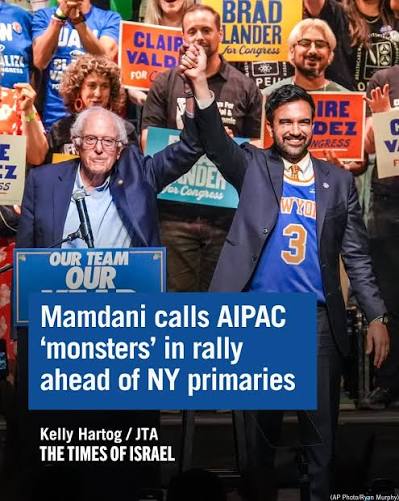
Moses Grunhaus after he was stabbed by a man yelling “Allahu Akbar.” He was in New York City to clear out his apartment to move to Florida because of the election of Mayor Zohran Mamdani

Different countries. Different perpetrators. Different personal histories.

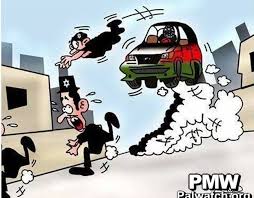
Official Palestinian media produced cartoons calling for Arabs to run over Jews

Yet the underlying message is strikingly similar: for the jihadists, those who offend do not merely deserve criticism – they deserve elimination.

That is the lesson many in the West still refuse to absorb. We continue to interpret these attacks through the lens of isolated extremism, mental illness, or individual grievance. Those factors may help explain why one person acts and another does not. They do not explain why the same religious slogans, the same enemies – the West, and the same methods appear again and again across continents.

The lesson of I’m Offended, You’re Dead is even more relevant today than it was a decade ago. The argument was never that every Muslim is a jihadist. It was that an ideology can become pervasive enough to inspire violence far beyond the ranks of organized terrorist groups. Even beyond “lone wolves.” It becomes the default language of the street.

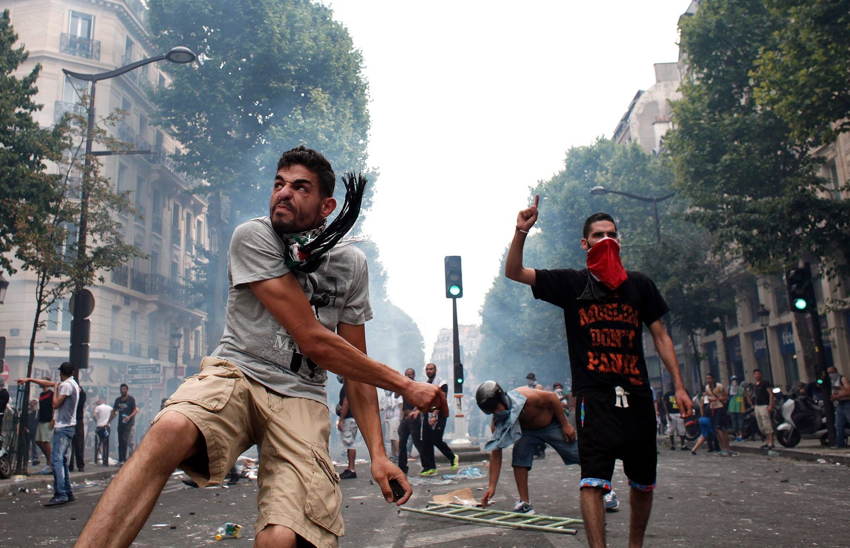
Islamic radicals riot in Paris, France

The West believes it is engaged in an argument over speech and tolerance. About the quantitative size of immigration and the culture of new arrivals. Because that is the culture of the West – to debate, to find compromise, to coexist.

But violent jihadism is engaged in something else entirely. It is not trying to persuade those it finds offensive. It seeks to destroy them.

A decade ago, you had to look for that message, to parse that difference. Today, you don’t.

The call of “Allahu Akbar” is no longer confined to jihadi groups or even “lone wolf” radicals as they commit attacks. Because the anti-West lexicon has become normalized on the angry streets, hunting people perceived of as “monsters.”

Trading Antisemitism in US For Help in Foreign Wars?

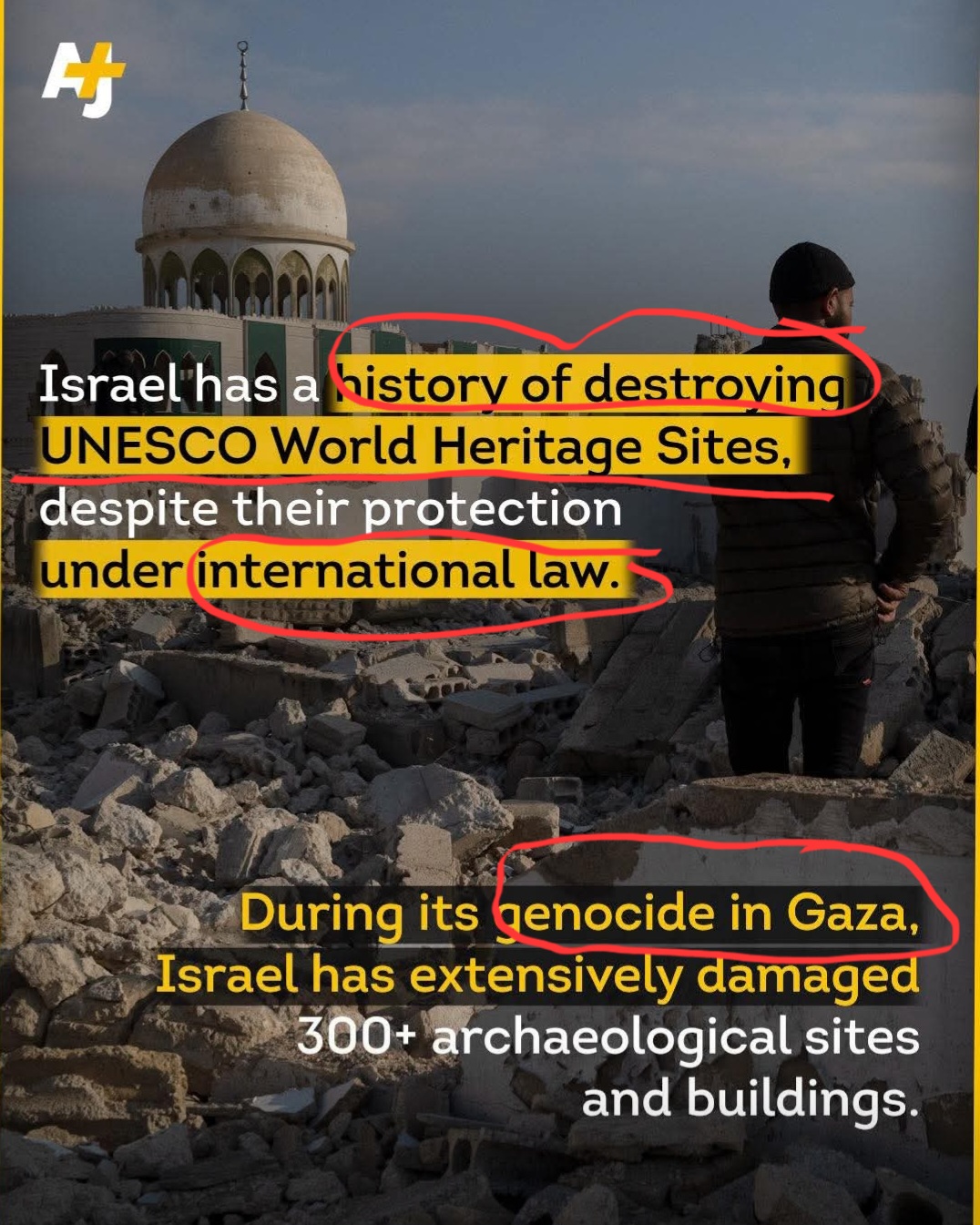
Al Jazeera is the global media company funded by Qatar, governed through a board appointed by the Qatari state and used to project Qatari influence around the world. Its digital arm, AJ+, was built in 2013 specifically for younger Americans who consume news through social media rather than television. By the late 2010s, it had become one of Facebook’s largest news-video publishers, generating billions of views and millions of followers while focusing heavily on race, social justice and the Israeli-Palestinian conflict, a peculiar cocktail of a socialist-jihadi alliance at that time, which is now mainstreamed.

AJ+ has a long history of peddling Hamas propaganda

In September 2020, the Trump Justice Department concluded that AJ+ was acting on behalf of a foreign principal and ordered it to register under the Foreign Agents Registration Act (FARA). Registration would not have restricted its journalism, but simply would have required public disclosure of its relationship with Qatar and periodic reporting similar to that required of other foreign state-backed media organizations like those from Turkey (TRT), China (CGTN) and Russia (RT).

AJ+ refused to register. Republican lawmakers including Chuck Grassley, Marco Rubio, Tom Cotton, Ted Cruz and Todd Young pressed DOJ to enforce its own determination.

Then, in May 2022, the Biden Justice Department withdrew the order after reviewing additional information submitted by AJ+. What changed has never been publicly explained. DOJ has not identified the decisive new facts, released its legal analysis or explained why AJ+ was treated differently from other foreign state-funded broadcasters.

“AJ+’s reporting ‘supports an inference’ that its broadcasts are ‘designed to influence the opinions and perspectives of its U.S. audience as directed by the foreign principals and for their principal benefit.’…

Given Al Jazeera’s and TikTok’s public prominence in the U.S., mounting evidence of their use to advance foreign agendas, and the Biden Administration’s own national security concerns with the two companies, the Committee is puzzled that the Department appears to have either ceased or paused enforcement of FARA registration requirements for the companies without explanation.” – February 8, 2024 letter from the Committee on Oversight and Accountability

The timing naturally raises questions.

Only months earlier, the United States had completed its withdrawal from Afghanistan. Qatar had become indispensable to Washington—hosting negotiations with the Taliban, assisting the evacuation from Kabul and serving as one of America’s principal diplomatic intermediaries in the region.

There is no public evidence that the FARA reversal was connected to Qatar’s diplomatic role but it is reasonable to ask whether a government relying heavily on Doha’s cooperation became less interested in forcing Qatar’s flagship media network to register as a foreign agent.

The same question now confronts the second Trump administration. Although Trump’s first Justice Department initiated the FARA action, his current administration has not publicly reopened the case. That may simply reflect DOJ’s legal judgment or competing priorities. It may also reflect Qatar’s continuing importance as a partner in addressing Iran, Gaza and other regional crises.

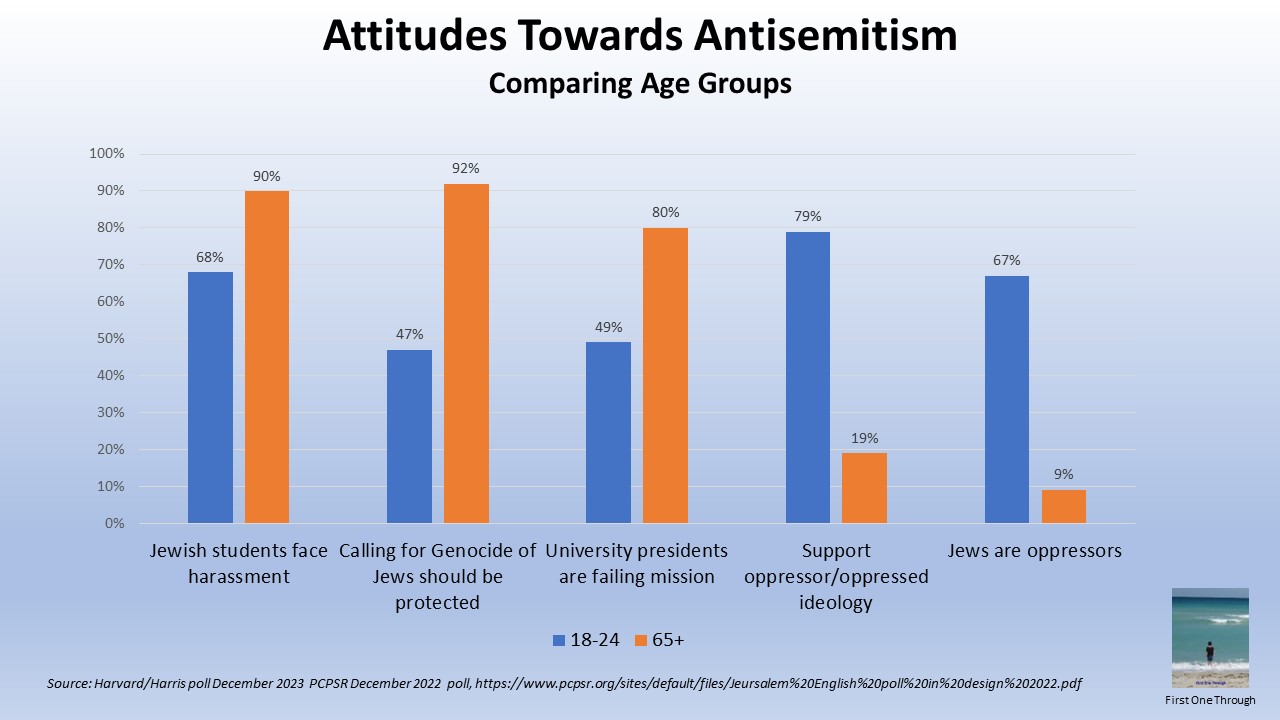
A final question – closer to home – may be the most consequential. During this same period, antisemitism reached levels not seen in decades while anti-Israel activism surged across American campuses and social media, principally from young people. And AJ+ was one of the most influential foreign state-funded digital news brands reaching young Americans, peddling such hatred over this time.

The unanswered question is whether Washington accepted greater Qatari influence inside the United States – including directly and indirectly promoting antisemitism – in exchange for Qatar’s assistance abroad.

Whether making Al Jazeera and AJ+ register under FARA would suddenly change these trends is unknown. But it is also unknown and curious why the government stopped asking the Qatari media powerhouse to do so.

The OIC’s Hamas Exception

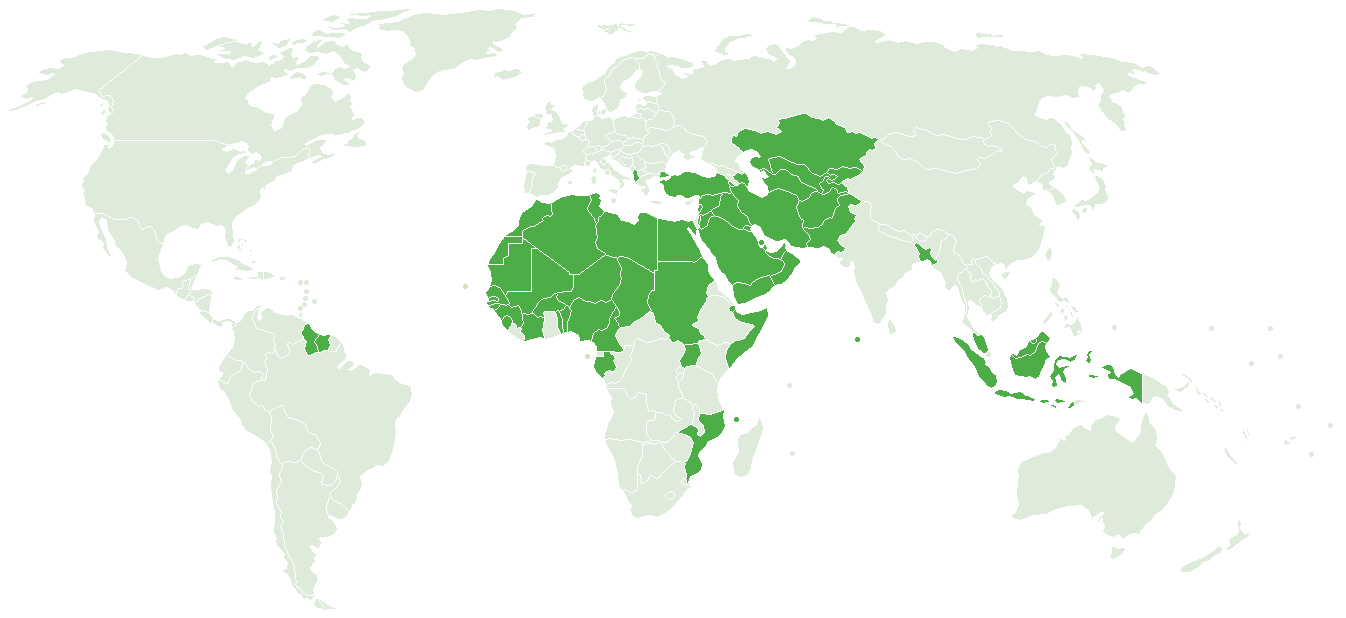
Founded in 1969, the Organization of Islamic Cooperation (OIC) is a coalition of 57 Muslim-majority nations, making it the second-largest intergovernmental organization in the world after the United Nations. Stretching from Morocco to Indonesia, and from Kazakhstan to Nigeria, it represents roughly a quarter of the world’s countries and speaks collectively on issues affecting the Muslim world.

OIC Member states

One of the organization’s longstanding positions is that extremist groups claiming to act in the name of Islam do not represent Islam. Over the years, the OIC has repeatedly condemned organizations such as:

  • ISIS (Daesh) — for attacks across Iraq, Syria, Libya, Afghanistan, and Nigeria, all OIC member states.
  • Al-Qaeda — for attacks in Saudi Arabia, Yemen, Pakistan, Afghanistan, Somalia, Iraq, and other Muslim-majority countries.
  • Boko Haram — for its insurgency in Nigeria, Niger, Chad, and Cameroon.
  • Al-Shabaab — for attacks centered in Somalia and extending into neighboring countries.
  • ISIS-K (Islamic State Khorasan Province) — for terrorism in Afghanistan and Pakistan.
  • Tehreek-e-Taliban Pakistan (TTP) — for its campaign against the government and civilians of Pakistan.

The common thread is unmistakable. Every one of these organizations has waged war against governments, civilians, or institutions in Muslim-majority countries, mostly members of the OIC itself.

The OIC has consistently argued that Muslims have been among the principal victims of jihadist terrorism. These groups bomb mosques, seek to overthrow Muslim governments, and destabilize OIC member states are denounced as terrorists and rejected as contrary to Islam.

Yet one jihadi terrorist groups is not called out. It is embraced.

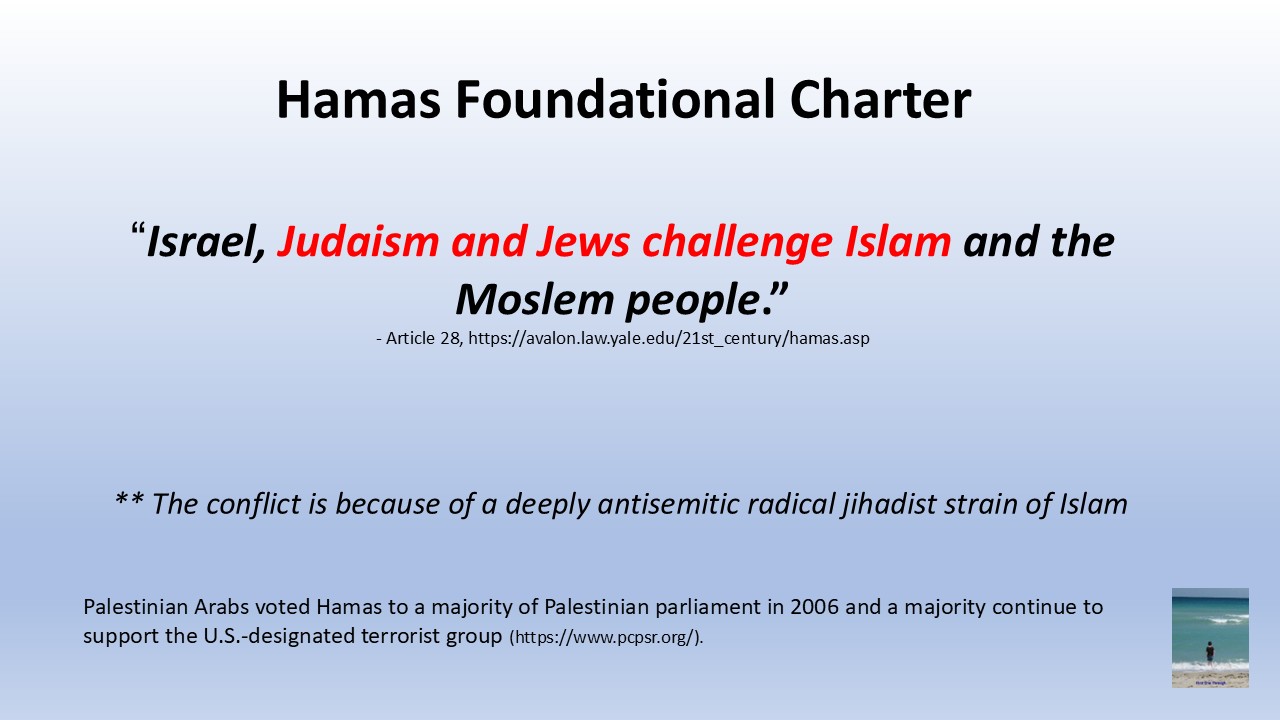
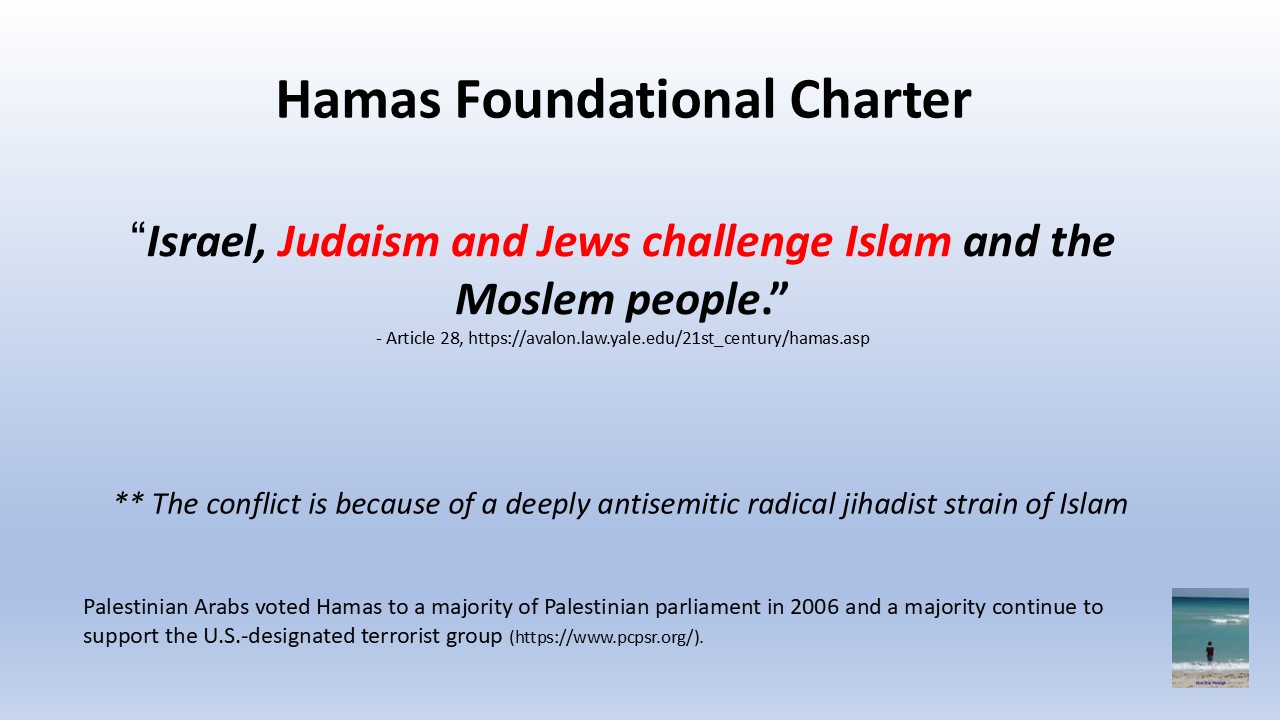
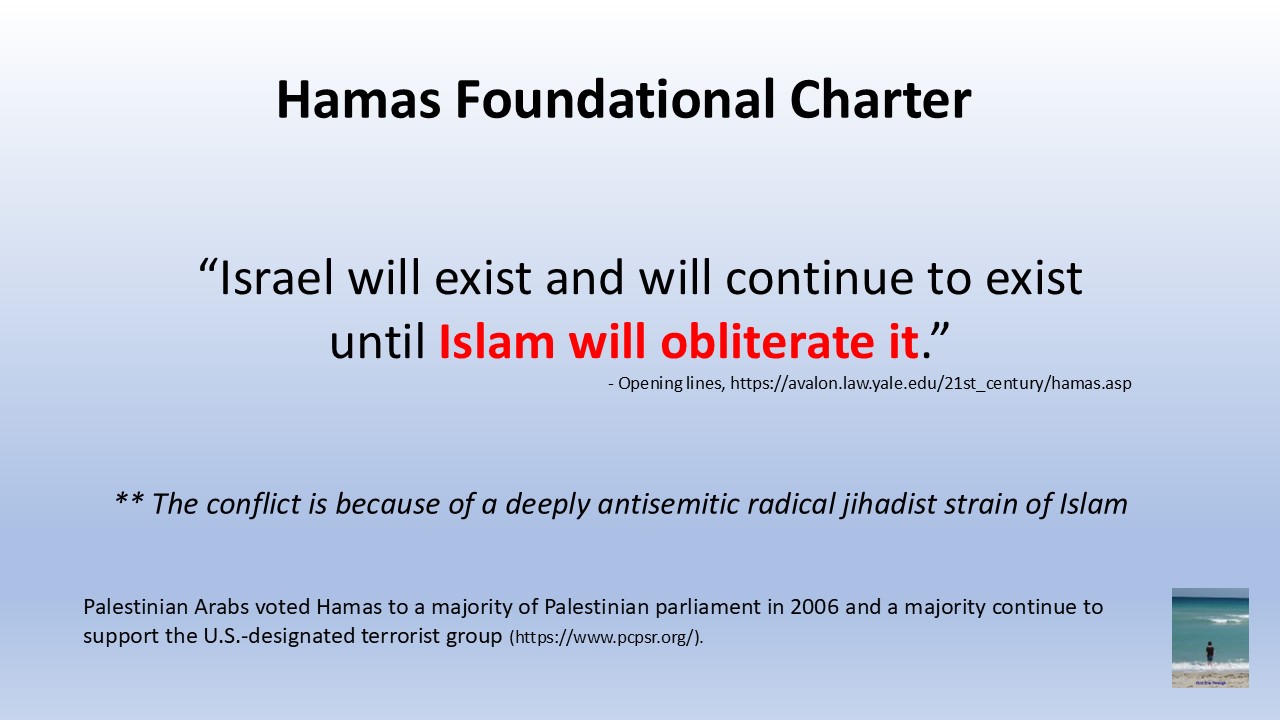
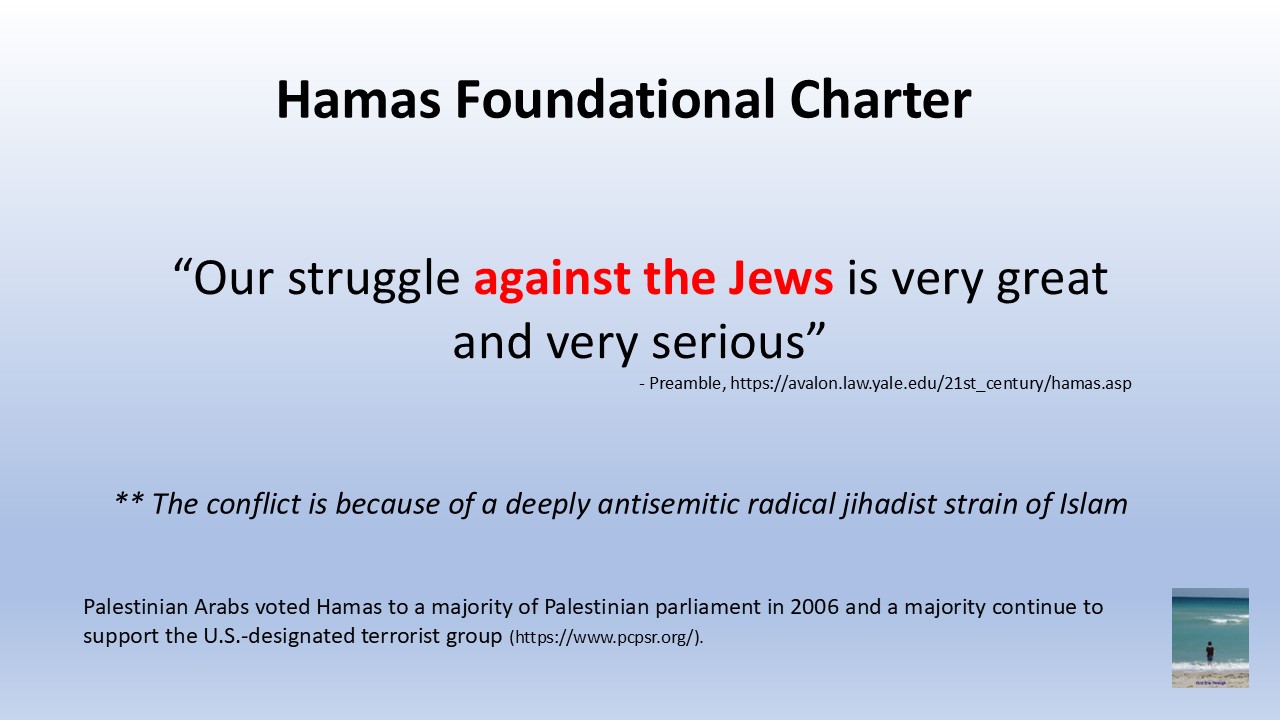
Hamas is an Islamist movement whose founding charter and rhetoric have long drawn on jihadist themes and whose October 7, 2023, attack deliberately targeted civilians. Nevertheless, the OIC has not designated Hamas as a terrorist organization or issued the kind of sweeping institutional condemnations that it has directed at ISIS, al-Qaeda, Boko Haram, Al-Shabaab, ISIS-K, or TTP.

The most obvious distinction is not the use of Islamist ideology or armed violence. It is the target: Israel, the Jewish State.

For an organization that frequently states that terrorism has no religion and that Muslims are among terrorism’s greatest victims, its record reveals a clear pattern. When jihadist groups attack the Muslim world, the OIC is unequivocal in its condemnation. When an Islamist movement wages jihad against the Jewish state, the organization’s response is support.

Choosing Love After the Pain

On December 6 and 7, 2015, U2 finally took the stage in Paris.

The concerts had originally been scheduled for November 14 and 15, just one day after Islamist terrorists murdered 130 people across the city in coordinated attacks, including the massacre at the Bataclan concert hall. Less than a year earlier, Paris had already endured the Charlie Hebdo and kosher supermarket attack. Fear had become the city’s soundtrack.

Standing before a grieving audience, Bono argued that the terrorists wanted more than bodies. They wanted souls. They wanted free people to surrender their openness, joy, and humanity. His message was simple: we cannot become monsters to defeat the monsters.

But that never meant the monsters should be left undefeated.

A decade later, Bono’s words resonate with renewed force. Islamist terrorists butchered hundreds at the Nova Music Festival in Israel on October 7, 2023, turning a celebration of life into a killing field. Yet Nova has refused to surrender. The festival has returned, even as Hamas and its supporters continue to mock the victims and celebrate the massacre.

That is the challenge every free society faces.

Love is not an alternative to defeating evil. Without security, there can be no concerts, no festivals, no freedom to gather. Evil must be confronted and defeated, or it will make love, music, and joy impossible.

The West must therefore pursue twin imperatives: defeat those who seek to destroy civilization, while steadfastly embracing the values of love, creativity, and human dignity that make civilization worth defending. Terror must never be allowed to decide either who lives or how we live.

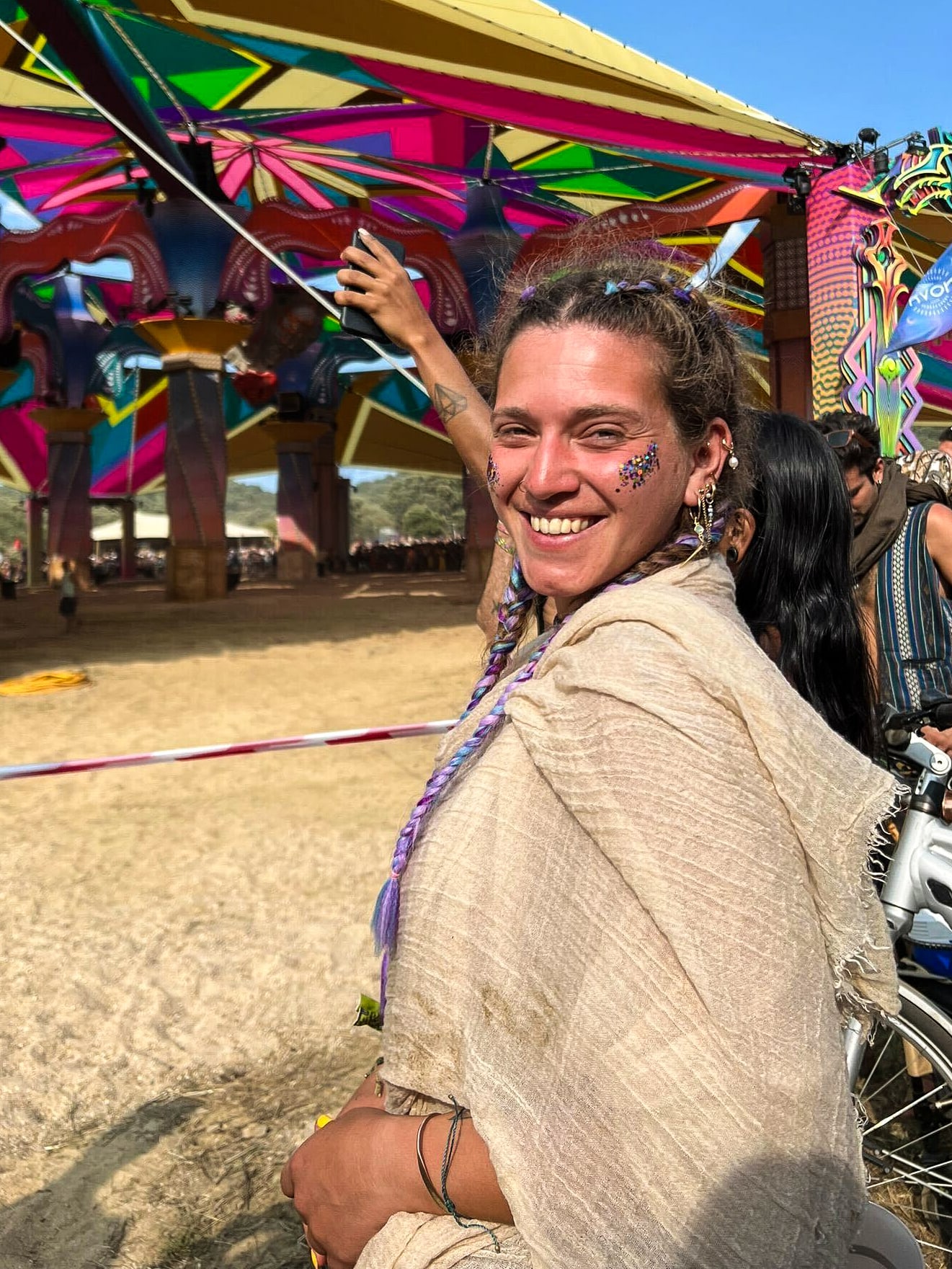
Noa Beer, one of the SuperNova X music and arts festival organizers.

Coming Soon: Certified Jihadist-Free™

A satire.

Shopping used to be simple. You bought food because it tasted good.

Today, every purchase arrives with a moral résumé.

  • The coffee is Fair Trade.
  • The chocolate is Rainforest Alliance Certified.
  • The eggs are Cage-Free.
  • The tuna is Dolphin Safe.

Soon the carton will tell you whether the chicken enjoyed equitable access to leadership opportunities.

With such established groundwork, the assertive red-green alliance / socialist-jihadi umbrella will undoubtedly develop a new standard for consumers to evaluate purchases:

Ethical Jihad Certification™

I imagine the following questionnaire for companies and organizations to complete, developed by the International Ethical Jihad Standards Council (IEJSC).

Supplier Ethics and Sustainability Review

If your organization employs child soldiers, is recruitment gender-balanced?

☐ Boys and girls equally represented
☐ Nonbinary recruitment targets adopted
☐ Diversity metrics forthcoming


If child brides are supplied, are they ethically sourced?

☐ Local
☐ Organic
☐ Family-owned supply chain


If weapons are stored among civilians, are they distributed equitably across community institutions?

☐ Hospitals
☐ Schools
☐ Mosques
☐ Balanced portfolio across all three


If hostages are held underground, are the tunnels built with recycled concrete?

☐ Yes
☐ Carbon offsets purchased
☐ Sustainability consultant retained


If civilians are used as human shields, has the organization achieved demographic representation?

☐ Women included
☐ Children included
☐ Elderly included
☐ Fully inclusive shielding policy


When invading another country, were low-emission vehicles prioritized?

☐ Bicycles
☐ Electric scooters
☐ Hang gliders
☐ Carbon-neutral pickup trucks


If rockets are launched from residential neighborhoods, has the launcher committed to Net Zero by 2040?

☐ Yes
☐ 2050
☐ Targets pending Qatari-donor approval


If propaganda calls for genocide, is the language gender-neutral?

☐ Yes
☐ Pronouns included
☐ Available in multiple languages


If a terrorist organization takes hostages, are accommodations culturally sensitive?

☐ Dietary needs considered
☐ Prayer space available
☐ Captivity experience survey administered


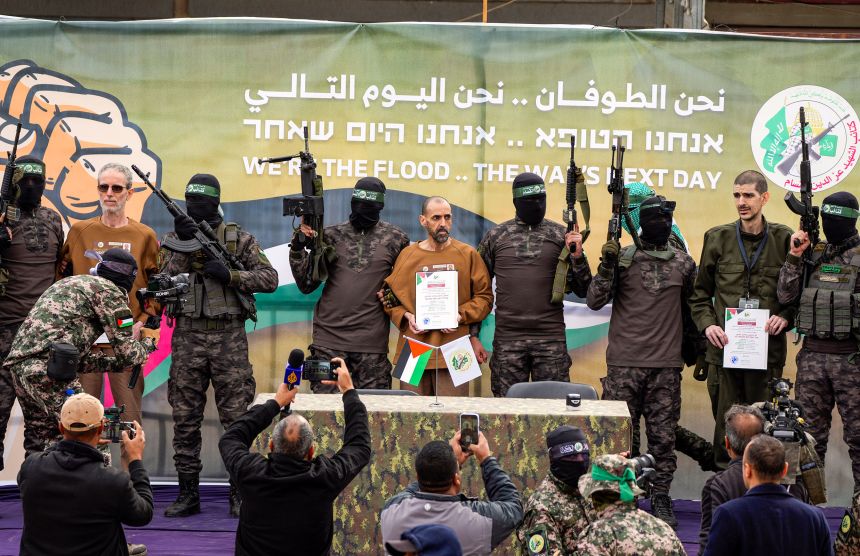
When returning hostages, was a positive community engagement experience provided?

☐ Parade route optimized
☐ Cheering crowds strategically positioned
☐ Children included for authentic community participation
☐ Environmentally-friendly branded backdrop prominently displayed


If civilians are murdered, was the operation at least locally sourced?

☐ Indigenous weapons
☐ Community-based perpetrators
☐ Minimal imported inputs


If rape is used as a mode of mass “resistance,” are the targets well represented?

☐ Young women
☐ Elderly women
☐ Trans-women
☐ Boys
☐ Sheep and goats


If burning a family alive in their home, what methods were used to assess environmental impact?

☐ Carbon emissions measured
☐ Certified sustainable ignition sources
☐ Recycled accelerants
☐ Ashes recycled in accordance with circular economy principles


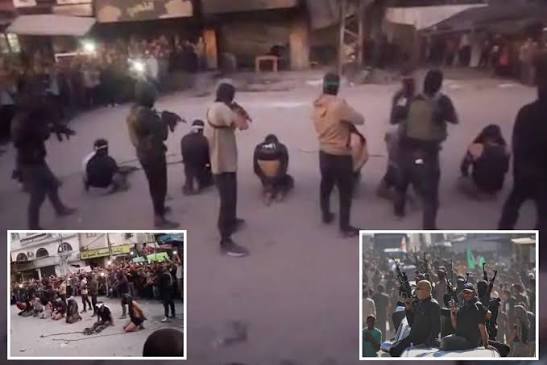
If political opponents require corrective kneecapping, please confirm that your organization follows an equitable enforcement policy.

☐ Applied without regard to race, religion, gender, or political affiliation
☐ Accessibility accommodations provided during the disciplinary process
☐ Impact assessment completed
☐ Stakeholder feedback incorporated into future kneecappings


If political opponents are subjected to “involuntary rooftop relocation,” (tossed off of rooftops) please indicate which governance standards were followed.

☐ Community stakeholders notified
☐ Staff received annual safety training
☐ Proper signage installed
☐ Liability waivers completed


How does your organization incorporate the LGBTQ+ community?

☐ Rainbow headbands replace green ones during Pride month
☐ Local imams considering ordaining transwomen
☐ Gay men’s decapitated heads disposed of in another jurisdiction

Palestinian man, Ahmad Abu Marhia, beheaded because he was gay

Have you established regular communication with:

☐ International NGOs
☐ Foreign correspondents
☐ Western university researchers
☐ Social media advocacy networks


Has your organization retained celebrity spokespersons to improve international brand perception?

☐ Actor
☐ Musician
☐ Influencer
☐ Climate activist


Has your organization demonstrated continuous improvement in expanding the number of international agencies, committees, or special offices devoted exclusively to your cause?

☐ Year-over-year growth achieved
☐ Additional mandate secured
☐ Dedicated rapporteur established
☐ Additional entities under consideration


Before issuing historical claims, has your organization completed a Heritage Simplification Assessment?

☐ Archaeological evidence destroyed
☐ Conflicting evidence omitted
☐ Timeline reduced to a convenient starting date
☐ Approved historical narrative distributed
☐ Site renamed in Arabic with only Islamic grounding


Has your organization’s founding charter undergone an independent review for language that may be inconsistent with modern human rights standards?

☐ Terminology modernized without changing intent
☐ Currently undergoing reputation management with select NGOs
☐ Using reputational management software to block viewers from finding foundational charter
☐ We prefer not to revisit founding documents


Has your organization successfully persuaded international stakeholders that your adversaries have no legitimate historical connection, cultural heritage, or rights associated with the land?

☐ Global awareness campaign exceeded expectations
☐ Educational materials updated accordingly
☐ Approved terminology adopted
☐ Further stakeholder engagement required


Has your organization successfully repositioned itself from perpetrator to primary victim in international discourse?

☐ Independent observers persuaded
☐ Media narrative successfully reframed
☐ Stakeholder sympathy increased
☐ Further communications investment required


Successful applicants receive one of four ratings:

Bronze: Mass violence, in recyclable packaging.
Silver: Child soldiers recruited inclusively.
Gold: Hostage facilities powered by solar panels.
Platinum: Calls for genocide delivered with a complete ESG report.

For foods, there is an addition to the consumer label. For example:

Nutrition Facts

Calories: 140
Protein: 4g
Sodium: 120mg
Carbon footprint: Low
Gender equity: Certified
Child soldiers: Inclusive
Child brides: Ethically sourced
Weapons near civilians: Institutionally diversified
Support for genocidal jihadists: Values-aligned

May contain traces of sesame.

May also contain an entire moral civilization that has forgotten the difference between auditing evil and opposing it.