The End of Old Politics: Attention Has Replaced Trust

Jeffrey Epstein’s crimes revealed something important about American society that had nothing to do with criminal law.

Many people who knew Epstein committed no crime. Association alone was not illegal. Flying on his plane, attending dinners or appearing in his address book did not make someone criminally liable.

Yet many still paid an extraordinary price.

Apollo co-founder Leon Black resigned as CEO after scrutiny over his financial relationship with Epstein, despite an independent review finding no evidence that he participated in Epstein’s crimes. MIT Media Lab director Joichi Ito resigned after revelations that he accepted Epstein donations. Others quietly stepped away from hospital boards, museum trusteeships, and prominent civic roles.

None of these penalties came from a courtroom. They came from boards, donors, shareholders, alumni, customers, and communities that reached the same conclusion: institutions entrusted with the public’s confidence should be led by people whose judgment inspires trust. The standard was higher than legality.

America’s moral code was not confined by the criminal code. It asked something more.

Can this person still represent us?

So consider terrorist groups like Hamas. Federal law makes providing material support to Hamas a serious crime. But simply expressing support for Hamas, absent conduct that crosses legal lines, is generally protected by the First Amendment. Americans remain free to express offensive or deeply disturbing political views.

But how can such a person represent us? Why is expressing support for terrorists or protecting them not grounds for cancelation? In a society where just an association with a pedophile can cost so much, how can active expressions of support for murderers and rapists cost anything less?

On October 26, 2023, just weeks after the massacre of nearly 1,200 people and abduction of 251 as hostages in Israel, sixteen members of the House of Representatives refused to condemn the barbarity. Those voting against condemnation were Ilhan Omar (D-MN), Rashida Tlaib (D-MI), Jamaal Bowman (D-NY), Summer Lee (D-PA), Cori Bush ( D-MO), Alexandria Ocasio-Cortez (D-NY), André Carson (D-IN), Al Green (D-TX), Delia Ramirez (D-IL) and Thomas Massie (R-KY). Those voting “present” were Greg Casar (D-TX), Ayanna Pressley (D-MA), Joaquin Castro (D-TX), Nydia Velázquez (D-NY), Jesús “Chuy” Garcia (D-IL) and Pramila Jayapal (D-WA). [Those whose names have been crossed out have since lost their seats or retired since the vote, as of this writing.]

The legal question is straightforward. Politicans can say horrible things. But why aren’t more people paying the price of promoting hatred and violence?

The answer comes from a second dynamic beyond trust: attention.

Over the last decade, as Americans have allowed influencers to dictate their worldview, a new question has emerged: will you entertain us?

The attention culture operates on an entirely different calculus than trust.

Consider Hasan Piker. He has repeatedly drawn criticism for rhetoric about Israel and Hamas that minimize or excuse terrorism. He has faced advertiser pressure, platform suspensions, and other controversies. Yet his overall influence has grown. Millions follow him across platforms. He has interviewed major political figures. He attended the Democratic National Convention as credentialed media. He has mobilized thousands to vote.

Controversy did not marginalize him. It expanded his audience. That is because social media does not ask the same question that institutions ask.

Institutions ask: Can this person still represent us? Algorithms ask: Will people keep watching?

Those are fundamentally different moral systems. And America’s youth is addicted to the latter.

More pointedly, politics increasingly resembles social media more than institutional leadership.

Young Americans are less likely to learn politics from newspapers or civic organizations than from livestreams, podcasts, TikTok clips, and YouTube personalities. The people shaping civic values increasingly answer to subscriber counts and recommendation engines, not to trustees or the establishment.

The old model of leadership rewarded persuasion, restraint, and credibility. The new model often rewards performance.

The Roman poet Juvenal warned that a republic could decline into a politics of spectacle. In Gladiator, the same questions are shouted at the crowd: “Are you not entertained?” The crowd is caught in the frenzy, unaware of how the barbarity has advanced another level, a new hero crowned, and a potential new political leader anointed.

Algorithms have perfected that logic. Every outrage becomes content. Every controversy becomes engagement. Every conflict becomes a step towards power.

Whether the personality is Donald Trump, Alexandria Ocasio-Cortez, Hasan Piker, or someone not yet famous, the incentive structure is remarkably similar. Constant visibility. Constant reaction. Constant performance.

And incremental steps towards political power.

RankPersonFollowers
1Barack Obama~200+ million followers. ~ 131 million followers on X and 42+ million on Instagram
2Donald Trump~100+ million followers. 90+ million followers on X, and ~13 million on Truth Social
3Kamala Harris~35 million followers. Mostly Instagram, supported by millions on X and TikTok
4Bernie Sanders~20+ million followers. Primarily on X, Instagram, and Facebook
5Joe Biden~16 million followers. Largely across X and Instagram
6Alexandria Ocasio-Cortez15+ million followers. On X, Instagram, and Twitch
The politicians with enormous following on social media are almost exclusively Democrats

The real question is not whether social media has changed politics. It is whether politics has become social media.

If the next generation chooses its leaders using the same instincts it uses to choose influencers, then America’s civic culture will inevitably begin to resemble the platforms that shaped it.

Perhaps that explains why lawful association with Jeffrey Epstein could end a corporate career while despicable rhetoric can become fuel for greater online influence. The outrage of social media enlists the youth who turn out the votes for the revoluntionaries.
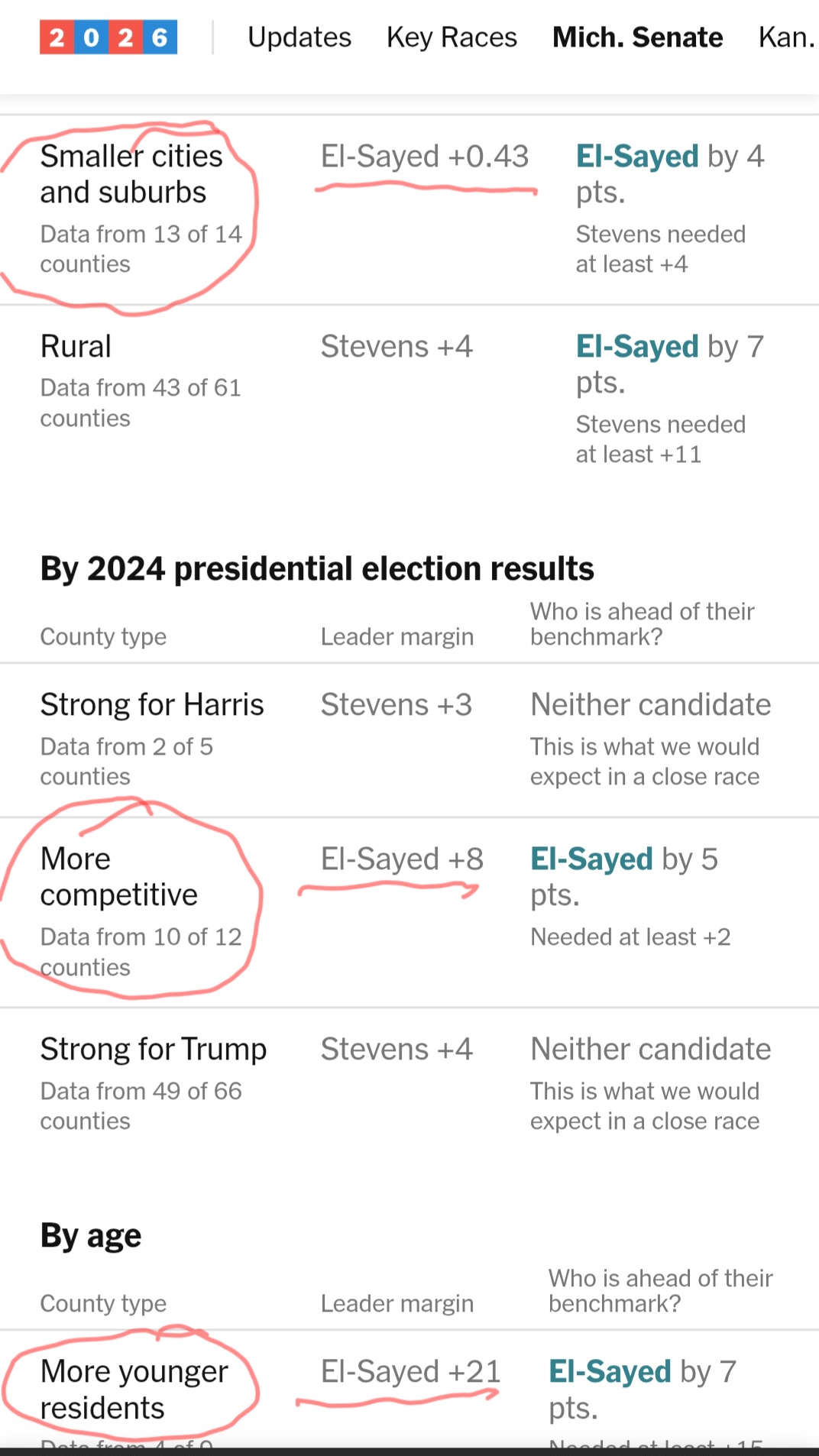
The youth vote propelled Abdul El-Sayed to victory in the Michigan Democratic Senate primary

The greatest danger may not be that one controversial figure gains another million followers. It is that the engine of engagement and vitriol has overtaken our politics, and weakened the country in this fast-changing and volatile world.

The idealism and sincerity of Mr. Smith Goes to Washington belong to a bygone era. Today, we elect Gladiators who entertain us.

Related

We Listen To Idiots (November 2022)

The Beginning of the End for the Establishment-led Democratic National Committee

For a decade, Democratic leaders have sought to preserve control of their party. Each decision made sense in the moment. Together, they have steadily eroded the confidence of both the activist base and, increasingly, the donor class.

The first crack appeared in 2016.

Bernie Sanders inspired millions of Democrats with a vision that challenged the party’s Clinton-era consensus. Yet the Democratic establishment rallied behind Hillary Clinton. Leaked DNC emails and the resignation of Chair Debbie Wasserman Schultz convinced many progressives that party insiders—not Democratic voters—were choosing the nominee.

And maybe the DNC’s action could have been excused had Hillary won. But she lost to Donald Trump.

Rather than disappear, the Sanders movement organized.

In 2017, former Sanders organizers founded Justice Democrats with a simple mission: elect a new generation of progressive Democrats and replace incumbents they believed had become too close to corporate donors. The movement was no longer asking for influence. It was organizing for control.

A year later, Alexandria Ocasio-Cortez defeated Joe Crowley, one of the most powerful Democrats in Congress and a presumed future Speaker of the House. At the same time, the Democratic Socialists of America expanded from a fringe organization into a national political force.

For years, party leaders dismissed these victories as isolated upsets. They can win in Brooklyn. They can win in Berkeley. But they cannot win statewide.

So the Democratic establishment continue to abuse its base. It lied to the country that President Joe Biden was fit for office long after it was clear he was not. The party leaders then coronated Vice President Kamala Harris to be the party nominee for president without a vote, in what many viewed as an act of treachery.

And now, Michigan has proven that the local alt-left phenomenon is much larger than the DNC pretended.

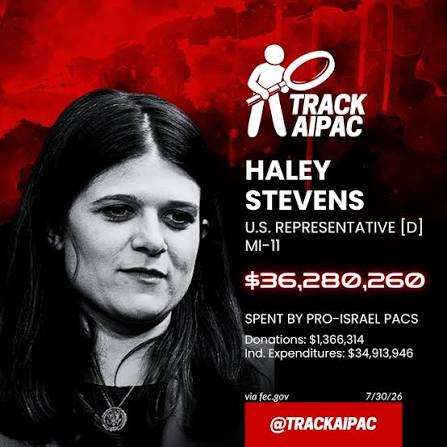
Representative Haley Stevens was exactly the kind of pragmatic, mainstream Democrat the party once expected to lead its next generation. Her defeat by Abdul El-Sayed, backed by the Democratic Socialists of America, suggests the insurgency has moved beyond city councils and safe House districts. It is now capturing statewide nominations in one of America’s most important swing states, predominantly with the support of young people who are turning out to vote in record figures.

Now even the donors are beginning to revolt.

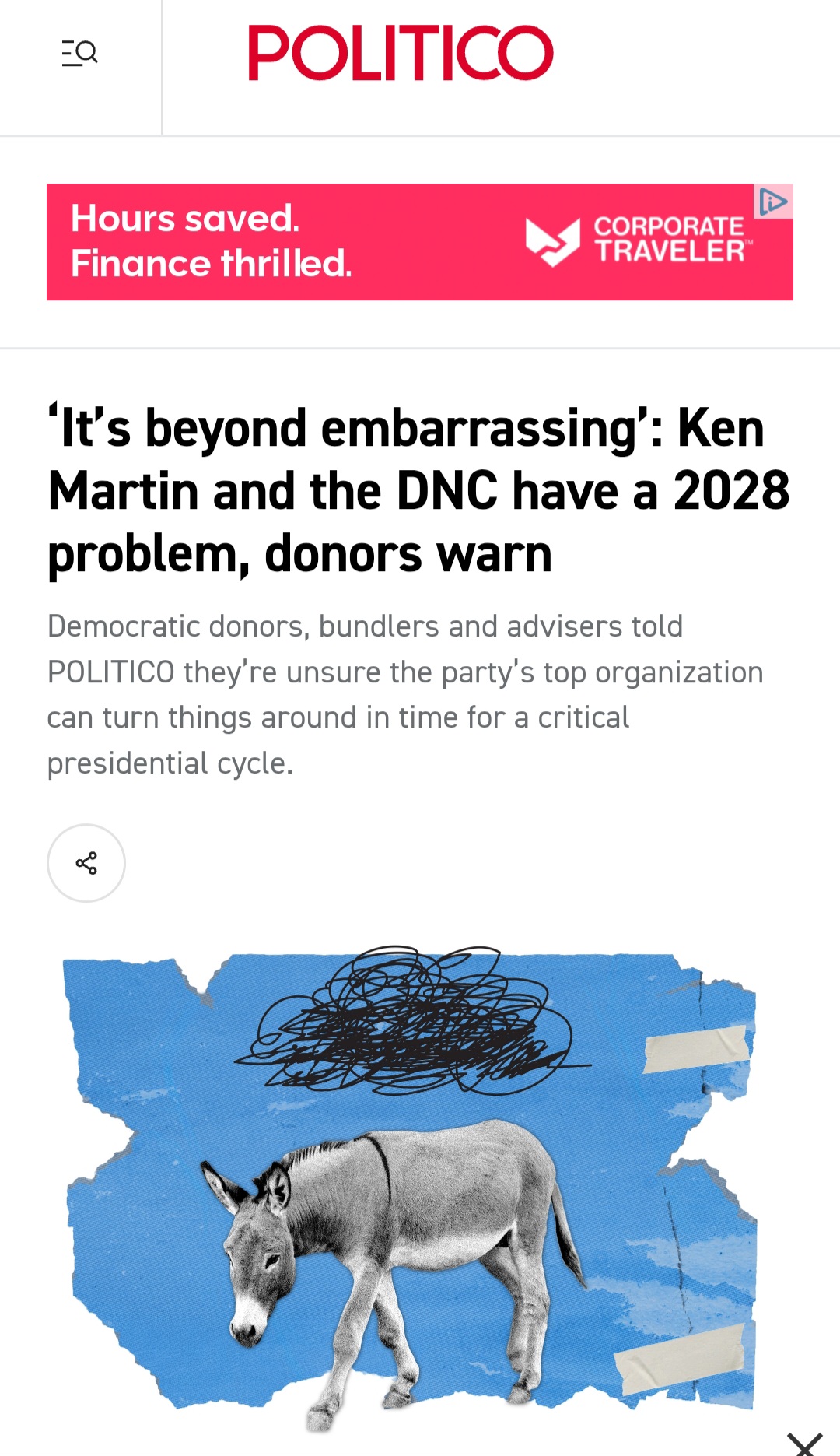
According to a recent Politico report, major Democratic donors are openly questioning the direction and competence of the Democratic National Committee. Fundraising has weakened. Confidence has faded. One longtime donor summarized the mood in four words: “It’s beyond embarrassing.”

At the same time, the party’s ideological center has moved toward jihadists.

For generations, military support for Israel during wartime against those seeking its destruction was a bipartisan assumption. During Israel’s current multi-front war against Hamas, Hezbollah, the Houthis, and Iran itself, most congressional Democrats voted to block or condition additional military assistance. A position that would have been unimaginable when Barack Obama entered office has become increasingly mainstream within today’s Democratic coalition.

Trashing Israel has even become a primary tool to get out young voters on social media.


The struggle inside the Democratic Party is no longer about one primary, one chairman, or one election cycle.

The DNC establishment that repeatedly tried to manage its succession is undergoing a hostile takeover by the far-left. The donor class got the message and is leaving. Only older lifelong Democrats seem blind to the transformation of the party, or unable or unwilling to vote Republican to turn the tide.

Related:

Hamas and the DSA: Ideology + Grassroots Mobilization to Power + Destruction (January 2026)

Racism In The Old and Antisemitism In The Youth (February 2024)

Names and Narrative: “Isolation”

Words matter. They do more than describe reality. They shape it.

This week, the Palestinian Authority’s WAFA news agency reported that Israel had advanced a housing plan that would “further isolate Jerusalem from Bethlehem.”

The proposal involves building homes, roads, and infrastructure between Jerusalem and Bethlehem. In almost any other place on earth, connecting two urban areas with transportation and housing would be described as integration, development, or greater connectivity.

But not for West Bank Arabs. They object to more Jews living in the corridor connecting them.

In this narrative, Jewish presence itself is an obstacle, an impediment. Jewish life is redefined as separation.

The inversion is striking.

The 1947 UN Partition Plan once envisioned Jerusalem and Bethlehem as a single Corpus Separatum—an internationally administered area shared by Jews, Christians, and Muslims. Whatever one thinks of that proposal, its premise was coexistence, not exclusion. Yet today, not only have the local Arabs refused coexistence, but so has the United Nations.

Contours from the 1947 Partition Plan which included Greater Bethlehem and Greater Jerusalem under a “Corpus Separatum”

Instead of asking how Jews and Arabs can both live, work, worship, and travel throughout the Jerusalem-Bethlehem region, many arguments begin with the assumption that Jewish communities are inherently illegitimate. Under that framework, the more Jews who live or travel there, the more “isolated” the majority-Arab areas are said to become.

“settlement expansion around the city is deepening its isolation” – United Nations January 20, 2026

That is a remarkable redefinition of language.

Connection becomes isolation. Coexistence becomes fragmentation.

When the Partition Plan was being conceived on February 18, 1947, Secretary of State for Foreign Affairs, Ernest Bevin (1881-1951) said “for the Arabs, the essential point of principle is to resist to the last the establishment of Jewish sovereignty in any part of Palestine.” Today, we are not only witnessing the continued entrenchment of that tenet, but the profound hostility to the basic presence of Jews.

Don’t let the word isolation fool you. It is not describing geography. It is describing Jews as obstacles, not neighbors.

Related:

Names and Narrative: “Right to Exist” (July 2026)

Genocide Math

We know that every death is a tragedy. We all wish there wasn’t war. Yet wars happen.

There have been several attempts to portray the current Gazans war against Israel in various lights. Some people have used the civilian-to-death ratio in this war of roughly 2-to-1 as historically low compared to any urban combat in modern times, especially one in which the army hides underneath the homes and hospitals of the civilian population.

Here, we lay out the civilian death figures relative to other modern wars which had many civilian deaths.

Assuming:

  • 73,356 reported total deaths in Gaza from October 7, 2023 to August 2, 2026
  • 25,000 of those were Hamas or other militants (a rough figure supplied by the Israeli army in January 2026)
  • Civilian deaths = 48,356
  • Prewar population = 2.2 million
  • Duration = 34 months

The calculation is:

  • Overall civilian mortality: 48,356 ÷ 2,200,000 = 2.19% of Gaza’s population.
  • Average civilian mortality per month: 2.19% ÷ 34 = 0.055% per month.

That yields the following comparison:

CaseEstimated monthly percentage killedMultiple of Gaza civilian rate (0.055%/month)
Gaza [2023-present]0.055%1×
Guatemala (Ixil) [1981-3]0.10%1.8×
Darfur [2003-5]0.11%–0.17%2.0-3.1x
Roma genocide [1939-45]0.20%–0.69%3.6–12.5×
Anfal (Kurds) [1987-8]0.22%–0.44%4–8×
Ustaše genocide [1941-5]0.36%6.5×
Cambodia [1975-9]0.44%–0.59%8–10.7×
Rohingya [2017-8]at least 0.67%12.1×
Holodomor [1932-3]0.73%–1.04%13.2–18.9×
Holocaust [1941-5]1.32%24×
Yazidi genocide [2014-7]0.65%–2.5%11.8–45.4×
Rwanda [1994]13.8%–22%250.9–400×
Srebrenica (monthly equivalent) [1995]~80%~1,454×
Monthly toll of civilian deaths in wars over last 100 years, as a percentage of the total population, in comparison to current Gazan war against Israel
Yazidis are a non-Muslim ethnic group in and around Iraq targeted for persecution and annihilation by ISIS. They continue to suffer persecution from Muslims in Turkey and Iraq.

“IS fighters invaded Yazidi villages and towns in Northern Iraq and Iraqi Kurdistan, rounding up men, women, and children. Yazidi men were ordered to convert to Islam; those who did not, and even some who did, were executed in mass graves. Yazidi women and girls were abducted and sold into sexual slavery, being forcibly “married” to jihadists and other individuals in Iraq, Syria, and other countries. Yazidi boys were also kidnapped by the Islamic State and sent to training camps, where they were indoctrinated into the group’s severe interpretation of Islam and trained to become soldiers. IS glorified its atrocities online in gruesome videos, propaganda magazines, and religious publications, emphasizing its commitment to eradicating Yazidi identity.” – Vicken Cheterian, “ISIS Genocide against the Yazidis and Mass Violence in the Middle East,” British Journal of Middle Eastern Studies 48, no. 4 (2019): 1-7, doi:10.1080/13530194.2019.1683718.

Measured against the last century’s ethnic group civilian deaths, the war in Gaza has produced a far smaller death toll than the wars that shaped recent history. Yet few conflicts of comparable scale have generated such an extraordinary level of international media attention, UN action, street protests, and campus activism.

The conflict has spilled far beyond the battlefield. Around the world, Israelis and Jewish communities have increasingly become targets of hostility, harassment, and violence tied to the war. Whatever one’s views of the prosecution of the war, the global reaction has extended well beyond criticism of a government and the borders of Israel unlike every other conflict, raising profound questions about why this war has become so singular in international political and cultural life.

The numbers remind us that history matters. A world that loses its sense of proportion does not become more moral but selective, narrow and biased.

Related:

We Let Minorities Die In The Middle East (July 2025)

Stealing a People’s Past

For generations, antisemitism sought to remove Jews from the future. Today, it increasingly seeks to remove them from the past.

That is the deeper significance of the growing campaign to recast Jewish history as Palestinian history. It is not simply a dispute over archaeology or competing national narratives. It is an effort to strip the Jewish people of their origins, their memory, and ultimately their legitimacy and basic human rights.

The examples are becoming impossible to ignore.

The Holocaust—the systematic murder of six million Jews—is routinely appropriated as a metaphor for Palestinian suffering. Jewish victims become a rhetorical device rather than a people with a unique history. The descendants of Holocaust survivors are cast as the new Nazis, while the actual genocide of European Jewry is emptied of its historical meaning.

Some Europeans have taken the Jewish girl, Anne Frank, and dressed her in an Arab kefiyeh as if she were a Palestinian Arab or would have supported the murder of Jews. During World War II, Anne hid in an attic while Nazis hunted her and other Jews for years, before the Nazis took her and murdered her in a concentration camp.

Now even Jesus is being rewritten.

Rather than acknowledging the historical reality that Jesus was a Jew who lived, taught, and died among the Jewish people in Judea, activists increasingly describe him as “Palestinian.” The purpose is to transplant one of history’s most influential Jews from the Jewish story into a Palestinian national narrative that not only didn’t exist in his lifetime, but Arabs didn’t invade the Jewish holy land until the seventh and eighth century CE, hundreds of years after Jesus lived.

The same pattern extends across nearly every cornerstone of Jewish civilization.

The First and Second Temples become myths or located in far-way lands. The Western Wall is detached from Jewish history. Jerusalem is reframed as an exclusively Muslim city. The Jewish patriarchs and matriarchs are recast. Ancient Israel is dismissed as colonial fiction. Hebrew becomes a borrowed language rather than the indigenous language of the Jewish people. Even Jewish holy sites are repeatedly described as exclusively Islamic or Christian.

United Nations 1949 map of of holy sites in Jerusalem lists the Jewish Temple Mount as only holy to Muslims

Each claim may appear isolated. Together they reveal a coherent project.

The goal is not simply to elevate a Palestinian Arab identity or an Islamic one. Every people is entitled to tell its own story. But no national movement has the right to build its identity by erasing another people’s history, heritage and human rights.

If a Palestinian Arab national identity is legitimate, it should be able to stand on its own. It shouldn’t require denying that Jews are indigenous to the Land of Israel. It does not require pretending the Temples never stood in Jerusalem. It does not require transforming Jesus into an Arab. It wouldn’t require appropriating appropriating words and people from their national tragedies.

Anti-Israel author Susan Abulhawa repeatedly uses terms like “Holocaust” to turn Jews into Nazis, in an attempt at misdirection from the popular Palestinian Arab political-terrorist group Hamas, which are actual modern-day Nazis

Yet this pattern of historical theft has increasingly been accompanied by something darker: the revival of some of Europe’s oldest antisemitic ideas.

The Hamas Charter drew explicitly from antisemitic conspiracy theories and echoed themes long propagated by Nazi ideology. Since October 7, the world has again witnessed chants, slogans, and propaganda that do not merely oppose Israeli government policies but deny the legitimacy of Jewish peoplehood itself. Public figures, writers, and activists have too often trafficked in narratives that portray Jews not as an indigenous people with a continuous history, but as impostors who fabricated their past.

If Jews can be separated from Jerusalem, from the Temple, from Abraham and Sarah, from David, from Hebrew, from the Holocaust, and even from Jesus, then they become a people without roots. A nation without ancestors is easier to portray as foreign. A foreign people is easier to cast as colonizers. And colonizers, in the moral framework of today’s activists, can be removed. Should be removed.

Historical negation is not an academic exercise. It prepares the ground for political exclusion, eviction, and violence.

The attempt to steal Jewish history is not ultimately about the past. It is about deciding whether the Jewish people have any legitimate place in the future.

Related:

Artificial Intelligence and The Civic Bargain

For most of human history, people did not belong to countries. They belonged to tribes.

Family came first. Then clan. Then religion. Then ethnicity. Your protection did not come from an impartial government but from the people who shared your blood and your history.

The modern nation-state asked humanity to do something profoundly unnatural. It asked millions of strangers to trust one another more than they trusted their tribe.

That may be civilization’s greatest political achievement.

Political scientist Francis Fukuyama has argued that human beings are naturally wired for tribalism. The genius of the modern state was not that it erased those instincts, but that it redirected them. Loyalty shifted from clan to constitution, from ancestry to citizenship, from family name to the rule of law.

No nation embodied that experiment more successfully than the United States.

America was never united by blood. It became a nation because generation after generation chose to believe that citizenship mattered more than ancestry. Irish immigrants, Jewish refugees, engineers from India, scientists from Taiwan, and millions of others came from different histories but increasingly shared one future.

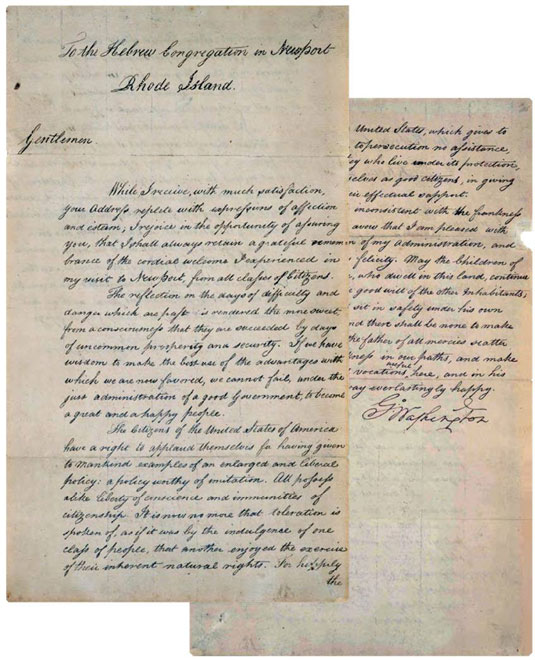
“The Citizens of the United States of America have a right to applaud themselves for having given to mankind examples of an enlarged and liberal policy: a policy worthy of imitation. All possess alike liberty of conscience and immunities of citizenship. It is now no more that toleration is spoken of, as if it was by the indulgence of one class of people, that another enjoyed the exercise of their inherent natural rights. For happily the Government of the United States, which gives to bigotry no sanction, to persecution no assistance requires only that they who live under its protection should demean themselves as good citizens, in giving it on all occasions their effectual support.” – George Washington’s letter to the synagogue in Newport, RI in 1790

George Washington’s letter to the synagogue in Newport, RI in 1790

America never eliminated tribes. It simply made being American more important than belonging to one.

But that civic bargain rested on something deeper than patriotism. It rested on hope.

America has never been a perfect nation. It never claimed to be.

Slavery contradicted its founding ideals. Women were denied the vote. Segregation mocked the promise of equal protection. Entire groups were excluded from opportunities others took for granted.

Yet what distinguished America was not the absence of injustice. It was the belief that injustice could be corrected.

The nation repeatedly expanded the circle of citizenship. Slavery was abolished. Constitutional amendments extended the franchise. The civil rights movement dismantled legalized segregation. Immigration laws evolved. Opportunity broadened. Each generation inherited an imperfect republic and, however incompletely, tried to leave it more just than it found it.

People can tolerate inequality longer than they can tolerate hopelessness. They can accept that today’s America is imperfect if they believe tomorrow’s America will offer greater opportunity for themselves and for their children.

For much of our history, that belief proved remarkably resilient. Yet today it is under strain.

The reason is not simply that inequality has grown. It is that many Americans increasingly question whether the civic bargain still works.

Over the past two decades, extraordinary wealth has accumulated among roughly the wealthiest one-tenth of one percent of American households—families whose wealth is roughly $50 million and more. Together they now control a remarkable share of the nation’s wealth, much of it held not in homes or factories but in ownership stakes in software companies, semiconductor firms, and cloud infrastructure.

The question for ordinary Americans is whether they believe they have a realistic chance of becoming tomorrow’s winners.

Yet much of the political debate on the left uses the moral vocabulary of the twentieth century to explain the economics of the twenty-first. Progressives point to slavery, segregation, redlining, and inherited privilege. They therefore demand reparations. But that’s the lexicon and proposals of a period past.

Today’s economy is not dominated by inherited railroad empires or industrial monopolies. It is dominated by technological innovation.

According to Forbes, roughly two-thirds of America’s 400 richest people built their fortunes themselves rather than inheriting them. Many of the largest fortunes were created within a single generation through software, semiconductors, venture capital, and artificial intelligence. America continues to produce extraordinary upward mobility. Immigrants account for roughly one in seven American billionaires, and more than nine in ten of those immigrant billionaires are self-made, many arriving from India, Israel, Taiwan, and China before building companies at the forefront of the technology revolution.

America is still the land of remarkable opportunity for all but it is predominantly happening inside an innovation economy that relatively few people understand—and even fewer know how to enter.

That distinction changes the political conversation. And it is magnified by the fear of artificial intelligence.

As the AI economy concentrates wealth, the identities of many of its most visible participants also become politically salient. Many of America’s leading technology founders, investors, and executives are white, Asian, or Jewish—groups often associated with educational and entrepreneurial success. That should be irrelevant in a civic republic. But in a society increasingly tempted by tribal politics, economic frustration is often translated into identity politics. The result is a dangerous feedback loop: the far left explains disparities through privilege and oppression, while the far right responds with conspiracy theories about ethnic or religious elites. Both abandon the American principle that citizens should be judged primarily as individuals rather than as members of competing tribes.

Alexandr Wang, 29, Chief AI Officer at Meta, worth an estimated $3.3 billion

And the concern is no longer merely that the rich will become richer. It is that AI will automate millions of middle-class jobs. Lawyers, accountants, software developers, analysts, designers, customer service representatives, and countless others increasingly wonder whether they are watching the economic ladder disappear beneath them. That is not just the rich getting richer and the poor getting poorer. It is everyone below the 0.1% – the entire lower, middle and upper middle class – becoming significantly poorer.

That anxiety helps explain proposals such as far-left Senator Bernie Sanders’ American AI Sovereign Wealth Fund Act. Sanders argues that because artificial intelligence is trained on humanity’s collective knowledge, the extraordinary wealth it creates should not belong solely to a handful of technology companies and investors. Whether one agrees with that proposal or not, it marks a profound shift. The political debate is moving beyond redistributing wealth after it is created, toward seizing and controlling the technologies that create the wealth in the first place.

Never has the U.S. government considered inserting itself so forcefully into the leading drivers of innovation, jobs and wealth, and pitted itself against those “elites” spearheading the effort.


On one side, the far-left is organizing around tribalism focused on race, gender, and “privilege,” which produces a counter-movement on the far-right around White nationalism. Both movements are inherently anti-American and undermine the founders’ ideals of a grand civic bargain. Each tells its followers that the other tribe is responsible for the country’s decline. Both play a part.

America fractures as both right and left move towards tribalism, and no longer trust the “establishment” political class, mainstream media and failing schools. Meanwhile, the real enormous promise and fear of the future for both groups is playing out in real-time before everyone: that AI will exacerbate the inability to trust people, information and institutions, while simultaneously creating a cohort of individuals – seemingly of only a few tribes – with remarkable wealth as the middle class loses its wealth.

If AI becomes a dominant technology that only a tiny club understands, owns, and profits from, the civic bargain weakens. Citizens begin searching for smaller communities that promise protection and belonging. Race becomes more important than citizenship. Class becomes more important than opportunity. Tribe becomes more important than country.

That is a future we can, should and must avoid.

America has solved this problem before. Every great technological revolution—from the steam engine to electricity to the internet—created extraordinary fortunes for its pioneers. Yet each ultimately generated industries, professions, suppliers, entrepreneurs, investors, educators, and workers whose prosperity far exceeded that of the original inventors. The wealth did not remain confined to those who built the breakthrough. It spread through the countless derivative businesses, careers, and opportunities that followed.

Artificial intelligence should be no different. America should not punish the innovators building the future or discourage the investment and risk-taking that made these breakthroughs possible. The challenge is to ensure that the AI economy develops the same broad ecosystem that previous technological revolutions produced—new companies, new professions, new skills, new services, new capital formation, and new pathways into prosperity for millions of Americans.

Just as importantly, we must prevent the far left and the far right from hijacking this technological revolution for their own political ends. The left should resist reducing innovation to a story of privilege and oppression, while the right should resist turning successful innovators into symbols of ethnic or cultural conspiracy. Both narratives encourage Americans to see AI through the lens of tribe rather than citizenship, resentment rather than opportunity.

For 250 years, Americans repeatedly chose the civic bargain over tribalism because they believed each generation would inherit greater opportunity than the last. Artificial intelligence now puts that bargain to the test. The defining question of the AI age is not whether America can continue producing extraordinary innovators. It is whether the prosperity they create becomes the foundation for millions of new success stories.

The American experiment has never depended on preventing greatness. It has depended on ensuring that greatness inspires opportunity rather than resentment, and that every generation believes it still has a place in the nation’s future. If AI expands opportunity as dramatically as previous technological revolutions ultimately did, it will strengthen the civic bargain that has made America history’s most successful multiethnic republic.

America’s next century can be truly remarkable, if we avoid the partisan pitfalls that plague us.

The Burden of Proof

An Israeli strike destroys a warehouse beside Al-Aqsa Martyrs Hospital in Gaza. A crater remains. Medical supplies are scattered across the site.

Those facts are visible.

What the warehouse actually was is not.

Palestinian officials say it was a medical supplies warehouse. Israel says Hamas had turned the site into a weapons cache hidden beside the hospital.

Reuters reported both claims. But after Israel’s explanation came an important sentence:

“The Israeli military… did not provide any evidence.“

Fair enough. But where is the equivalent sentence for the Palestinian claim?

What evidence was presented that the warehouse contained only medical supplies? Who independently verified it was not also being used by Hamas? The reporting does not say.

Reuters and CNN took the Palestinian Authority version of events as plain facts but left a question outstanding about the Israeli account. The reader is left with one side making a factual assertion, while the other appears to be offering an unsupported excuse.

Journalists should demand evidence from Israel. They should also demand it from Palestinian authorities. If neither side has independently substantiated its account, then neither claim should receive a presumption of truth.

In war, the burden of proof should not belong to only one side. Journalism earns trust when it applies the same evidentiary standard to everyone.

The Manna Was Never About Bread

One of the most quoted verses in this week’s parashah, Eikev, is also one of its most misunderstood.

“He humbled you, made you hungry, and fed you with the manna… to teach you that man does not live by bread alone, but by everything that proceeds from the mouth of God.” (Deuteronomy 8:3)

Of course we live by bread. Without food, we die. So what was Moses teaching?

Perhaps the answer begins with a forgotten detail. When the Israelites left Egypt, they did not leave destitute. The Torah says they departed with gold, silver—and large flocks and herds.

Flock in the area known as “E1” just east of Jerusalem (photo: First One Through

If they already possessed wealth, why were they hungry? They had plenty of cattle to satisfy their needs.

Perhaps God was interrupting a dangerous transition.

In Egypt, Israel depended on Pharaoh. After the Exodus, they could have concluded, Now we provide for ourselves. We have the means, we are self-sufficient. But alas, God “made you hungry.”

For what purpose?

Had Israel been sated with eating meat for their entire sojourn in the desert, they might have entered the Promised Land having consumed much of its productive wealth. Instead, God preserved those assets by first making them less appealing, and then supplying a substitute for their daily needs.

Read this way, the manna was both sustenance and strategy.

That sheds new light on Moses’ warning just a few verses later:

“Beware lest you say, ‘My power and the might of my hand have made me this wealth.'” (Deuteronomy 8:7)

That wealth would had been long decimated without the daily manna.

The point of the manna was both the immediate sustenance and the vehicle with which to preserve future sustenance (the cattle). And it was God who gave the manna to not just keep people alive, but to position the nation to succeed in the future in the Promised Land.

The same is true today.

We need jobs, businesses, investments, and income. Eikev asks us to appreciate the means of our immediate livelihood, future savings and the source for both.

God was not preparing Israel for perpetual dependence. He was preparing them for covenantal partnership. Today and tomorrow.

Consider the lesser known phrase of “He made you hungry” rather than “man does not live by bread alone,” to appreciate the gifts of today and what it enables tomorrow.

Israel’s Response to the Ceuta Invasion

For nearly three years, Spain positioned itself as one of Israel’s sharpest critics in Europe.

Prime Minister Pedro Sánchez repeatedly condemned Israel’s conduct in Gaza, recognized a Palestinian state, pressed for European measures against Israel, and framed the conflict primarily through the language of humanitarian obligation. Israeli officials responded that Spain had become increasingly detached from the security realities Israel faces and was rewarding Hamas diplomatically after October 7.

Then Spain found itself confronting a border crisis of its own.

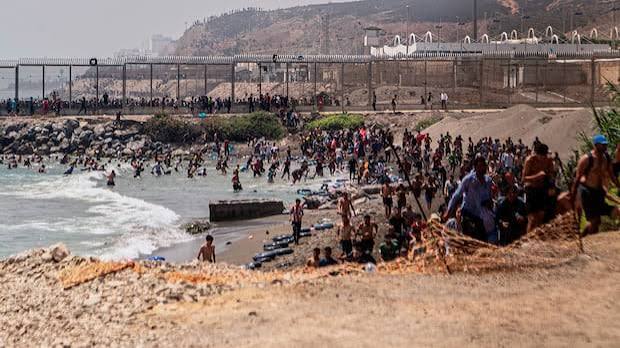
An estimated 49,000 migrants surged into Spain’s North African enclave of Ceuta in a single day, overwhelming local authorities and forcing Spain to deploy troops to restore order. Overnight, the country’s political conversation shifted from humanitarian ideals to border control, sovereignty, and national security.

Israel noticed immediately.

Israeli officials pointed to Ceuta as evidence of something they had argued for years: it is easy to lecture another democracy about borders until your own border collapses.

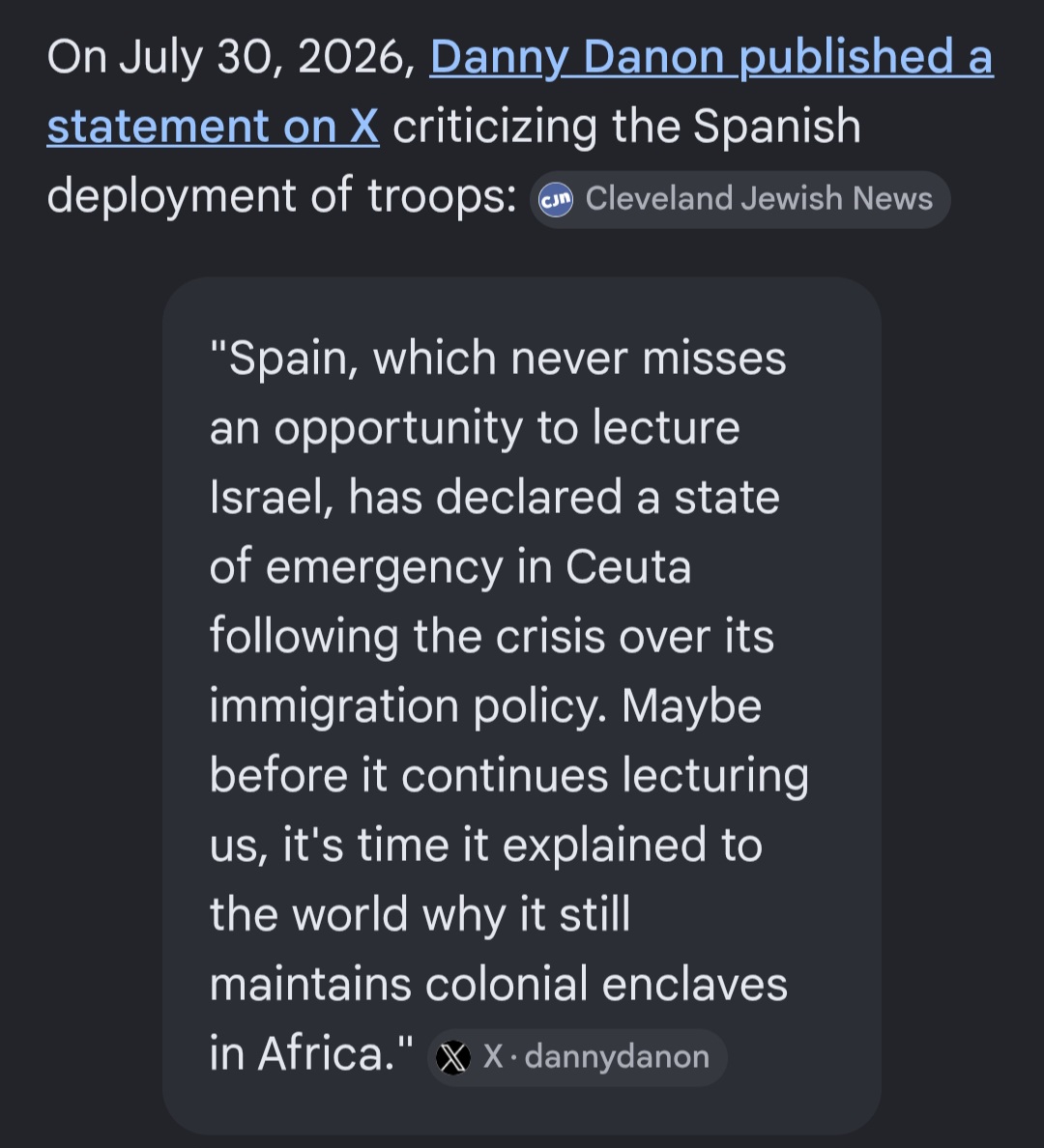
Israeli ambassador to the United Nations Danny Danon took aim at Spain for why it maintains a colony in Africa

There was an unmistakable sense of schadenfreude in parts of the Israeli reaction. The same government that had spent months criticizing Israel for emphasizing security suddenly found itself insisting that no sovereign nation can simply allow tens of thousands of people to cross its frontier without control.

Every democracy must balance compassion with sovereignty. Every democracy must decide whether humanitarian obligations can coexist with meaningful border enforcement. Israel has argued for years that they must. Spain is now discovering how difficult that balance becomes when events unfold on its own frontier.

There is another irony.

Spain’s immediate security now depends heavily on Morocco’s cooperation. Rabat’s willingness to police its side of the border has become essential to Spain’s stability. Yet Morocco chose a dramatically different path from Spain in its relationship with Israel. It joined the Abraham Accords, expanded security, intelligence, and economic cooperation with Israel, and demonstrated that pragmatic regional partnerships can coexist with support for Palestinian aspirations.

Spain and Morocco have moved in opposite diplomatic directions with Israel. Yet today Spain needs Morocco more than ever.

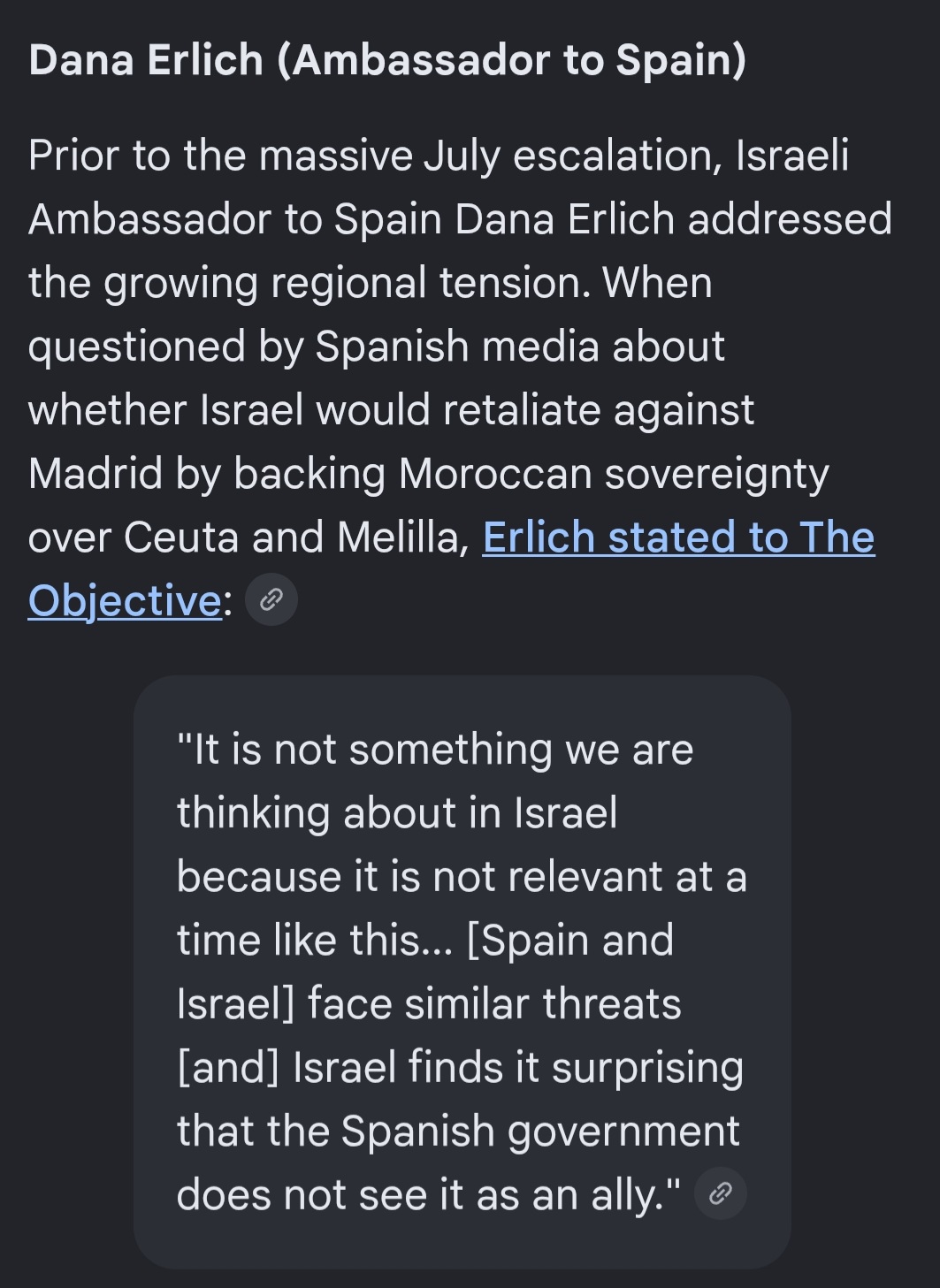
Israel’s ambassador to Spain declined to say whether its government supports Morroco taking over the Spanish enclaves in Africa.

Israel, however, should resist celebrating too loudly.

If Ceuta marks the beginning of sustained migration pressure into Europe, the political consequences are unlikely to stop with Spain. Across the continent, immigration has already fueled the growth of nationalist parties and intensified debates over identity, sovereignty, and integration. Another large migration wave could accelerate those trends even further.

History offers a warning for Jews.

Periods of political instability and polarization have rarely benefited Jewish communities. When societies become more fractured, antisemitism often finds new expression—from parts of the far right, from extremist Islamist movements, and from other ideological currents. Europe has already experienced a sharp rise in antisemitic incidents since October 7, 2023. Additional social upheaval could place Jewish communities under even greater pressure.

Israel can fairly point out the irony of Spain’s predicament. It can argue that Ceuta demonstrates the complexity of governing borders that are easier to criticize than to defend.

If Europe enters another prolonged period of political instability, no one should assume European Jews will remain untouched by the consequences. Those victims will not be amused by Israel nor protected by smug Israeli diplomats saying I told you so.

Spexit And Andalusia, or Borders

Until this week, Europe’s migration crisis was largely a story about the Mediterranean Sea.

For more than a decade, desperate migrants boarded overcrowded boats in North Africa, hoping to survive the crossing into Europe. Thousands never made it. The sea itself was the barrier.

Then came Ceuta.

Ceuta and Melilla are tiny Spanish outposts in Africa

In one of the largest mass border breaches Europe has seen in modern times, Spain’s tiny enclave on the North African coast was overwhelmed as an estimated 49,000 migrants crossed from Morocco by land and sea in just 24 hours. Spain deployed its military, Morocco reinforced the frontier, at least 18 people died during the rush, and the crossing was largely halted the following day.

The numbers are staggering. Ceuta is home to only about 85,000 residents. In a single day, arrivals equaled well over half the city’s population. This was a demonstration that, if the border gives way, hundreds of thousands of people can enter European territory almost immediately.

For migrants, the calculation is understandable. Europe offers safety, opportunity, and hope for a better life.

For governments, the calculation is entirely different. No country can meaningfully screen tens of thousands of arrivals in real time. Authorities cannot determine identities, criminal histories, security concerns, or asylum claims after a border has already been overwhelmed.

And this is not merely Spain’s problem.

Spain guards one of the European Union’s external frontiers. The Schengen system depends on every member securing that frontier because what enters one country can ultimately affect them all. Spain’s border policy is therefore not just Spain’s policy—it affects Paris, Rome, Berlin, Amsterdam, and every other country that has entrusted its own internal borders to the Schengen system.

That is why Italy’s Giorgia Meloni and other European leaders reacted so sharply. Their concern is larger than Ceuta itself. It is whether Europe can preserve free movement inside the Union if member states adopt fundamentally different approaches to controlling who enters from outside.

“We are in the process of bringing together the competent bodies and, once these meetings are over, we are ready to act, including through exceptional measures… such as suspending the Schengen agreement with Spain.” – Italian Prime Minister Giorgia Meloni

Since the Arab Spring, Europe has absorbed millions of refugees and migrants fleeing civil wars in Syria, Libya, Afghanistan, and elsewhere. Those movements reshaped European politics, accelerated the rise of nationalist parties, and transformed debates over sovereignty, identity, and integration.

Ceuta is different. It revealed a land route from Africa into the European Union capable of moving extraordinary numbers of people in an astonishingly short period. If this becomes an established migration corridor, Europe could face pressures unlike any it has experienced since the Arab Spring, and it will likely far surpass it in terms of numbers.

From here, several futures are possible.

  1. Spain could conclude that maintaining Ceuta and Melilla is no longer worth the political and financial cost and eventually negotiate their return to Morocco.
  2. Spain could dramatically strengthen its external border, making clear that humanitarian obligations do not require surrendering control over who enters the country.
  3. Or Spain could continue on its current course, betting that Europe will absorb the consequences. If so, pressure from its European partners will intensify. Calls to suspend Spain from Schengen or restore permanent internal border controls will become louder. While a “Spexit” (Spain’s exit from the European Union) remains a remote possibility, the political strains that produce such conversations would only deepen.
Nearly 50,000 migrants from Africa are estimated to have crossed into Ceuta, Spain on July 30, 2026

There is another outcome that deserves more attention beyond the immediate decisions of the government of Spain.

If governments are seen as unable or unwilling to control migration, voters rarely abandon the issue. They abandon the governments. Nationalist and right-wing parties would likely continue to gain strength across Spain and Europe. The political backlash would not stop at the wave of immigration. It would spill over into wider suspicion of immigrant communities and minorities who had no role in creating the crisis, further polarizing European society.

History offers reminders.

More than thirteen centuries ago, Muslim armies crossed from North Africa into Iberia and established Al-Andalus, reshaping the peninsula for centuries. Eventually, Spain pushed out all of its Muslims in a forced expulsion which also included the Jews. The roughly 200,000 Jews of Spain were expelled on July 31, 1492, and Spain has been basically Jew-free since then.

More recently, in the 1930s and 1940s, the National Socialists of Germany marked for extermination millions of unwanted people, including Jews, Roma and those with disabilities. Fierce tribalism marked foreigners as enemies, regardless of the actions of the residents.

Today, the choice is not between compassion and security. A democratic society requires both.

The Strait of Gibraltar remains one of the shortest distances between Africa and Europe. Ceuta has reminded Europe that borders are not abstract lines on a map: they are political decisions. If Europe chooses not to control its external frontier, events like this will not remain exceptional. They will become the new normal. As will the ramifications.

Will Europe decide who enters its borders, or will it let events on the ground make that decision for it. Each is a deliberate political decision.