
Data Centers, Golf Courses and America’s Environmental Double Standard

Data centers have become one of America’s favorite environmental villains. Critics argue that they use too much land, consume too much water and strain the electric grid. Communities increasingly fight proposed facilities on environmental grounds.

The concerns over electricity are real. But put data centers alongside another ubiquitous American land use — golf courses — and the environmental picture looks very different.

Golf uses dramatically more land and direct water and requires harmful pesticides to maintain its turf. Data centers consume dramatically more electricity. And data centers produce roughly four times the overall economic impact already – before the upcoming artificial intelligence boom kicks in.

MetricU.S. Data CentersU.S. Golf Courses
Facilities / courses~3,600 operational16,034 courses at 13,975 facilities
LandNo authoritative national total; far below golf~2.3 million acres
Direct water use~17 billion gallons/year (2023)~531 billion gallons/year (2024)
Electricity176 TWh/year (2023)~2.4 TWh/year*
Pesticides / herbicidesNot materialRegularly used on maintained turf
Total economic contribution / impact$926.9 billion (2024)$226.5 billion
Jobs supported5.5 million~1.65 million

*The national golf electricity estimate is older and should be treated as an order-of-magnitude comparison rather than a current industry census.

Start with volume. There is no universally accepted definition of a data center, so counts vary depending on whether campuses, buildings and individual facilities are counted separately. An August 2026 tracker identifies about 3,579 operational U.S. data centers and roughly 4,700 when facilities under construction and planned are included. Pew Research Center similarly reported in April that the country had more than 3,000 operational data centers. (DC Map) Golf is considerably more widespread. The latest National Golf Foundation figures count 16,034 courses at 13,975 facilities in the United States. (American Golf Industry Coalition)

Then there is land.

The USGA has estimated that American golf courses occupy nearly 2.3 million acres. (USGA) There is no similarly authoritative national accounting of the acreage occupied by data centers. Rather than manufacture precision from commercial databases, the relevant comparison is scale: America’s golf footprint runs into millions of acres, while several thousand data centers occupy a small fraction of that amount.

Water produces an even more startling comparison.

American golf facilities applied 1.63 million acre-feet of water in 2024, according to the latest Golf Course Environmental Profile survey. That equals approximately 531 billion gallons. To golf’s credit, that represents a 31% decline since 2005 as courses have closed and surviving facilities have become more efficient. (GCSAA)

Lawrence Berkeley National Laboratory estimated that U.S. data centers directly consumed approximately 66 billion liters of water in 2023, or roughly 17 billion gallons. (Lawrence Berkeley National Laboratory) So American golf courses use roughly 31 times as much water as data centers directly consume onsite.

Data centers also have an indirect water footprint because generating electricity can consume substantial amounts of water. Golf similarly has indirect resource requirements associated with electricity, fertilizer, chemicals, equipment and maintenance. The 31-to-1 comparison is specifically between water applied at golf facilities and direct water consumed at data centers — not their respective total lifecycle water footprints.

Chemicals produce another imbalance, although one that cannot responsibly be reduced to a current national poundage figure.

Golf courses maintain enormous areas of highly managed turf using fungicides, herbicides, insecticides and other treatments. GCSAA’s national pest-management research confirms continued use of those conventional chemicals while also finding greater use of non-pesticide practices and reductions or little change in reliance on conventional chemistries between its major surveys. (GCSAA)

Data centers, by contrast, do not require herbicides, fungicides and insecticides as a significant part of their core operation. They may have ordinary landscaping needs, but chemicals are not to computing what turf treatment is to golf.

There is one environmental measure where the comparison flips completely: electricity.

Lawrence Berkeley National Laboratory estimated that U.S. data centers consumed 176 terawatt-hours of electricity in 2023, approximately 4.4% of total U.S. electricity consumption. Its June 2026 update projects that data centers could reach 11.8% of U.S. electricity consumption by 2030, with scenarios ranging from 9.5% to 15.3%. (Lawrence Berkeley National Laboratory)

Golf isn’t remotely comparable. A U.S. Department of Energy analysis estimated golf-course electricity consumption at approximately 2.4 TWh annually, with a typical course consuming about 250,000 to 500,000 kWh and irrigation pumping accounting for 25% to 50% of course electricity use. The estimate is old, so it should not be mistaken for a current measurement. But even substantial growth would leave golf far below the electricity requirements of data centers. (U.S. Department of Energy)

Data centers are power infrastructure in a way golf courses simply are not. But power is being converted into something: economic output.

A 2026 PwC study commissioned by the Data Center Coalition calculated that the U.S. data-center industry contributed $926.9 billion to GDP in 2024, supported 5.5 million jobs and generated $204.4 billion in federal, state and local taxes. (Data Center Coalition)

Golf is also a significant American industry. Its national economic-impact study calculated $101.7 billion in direct economic activity and $226.5 billion when direct, indirect and induced effects are included, supporting nearly 1.65 million jobs and $80.1 billion of wage income. (GCSAA)
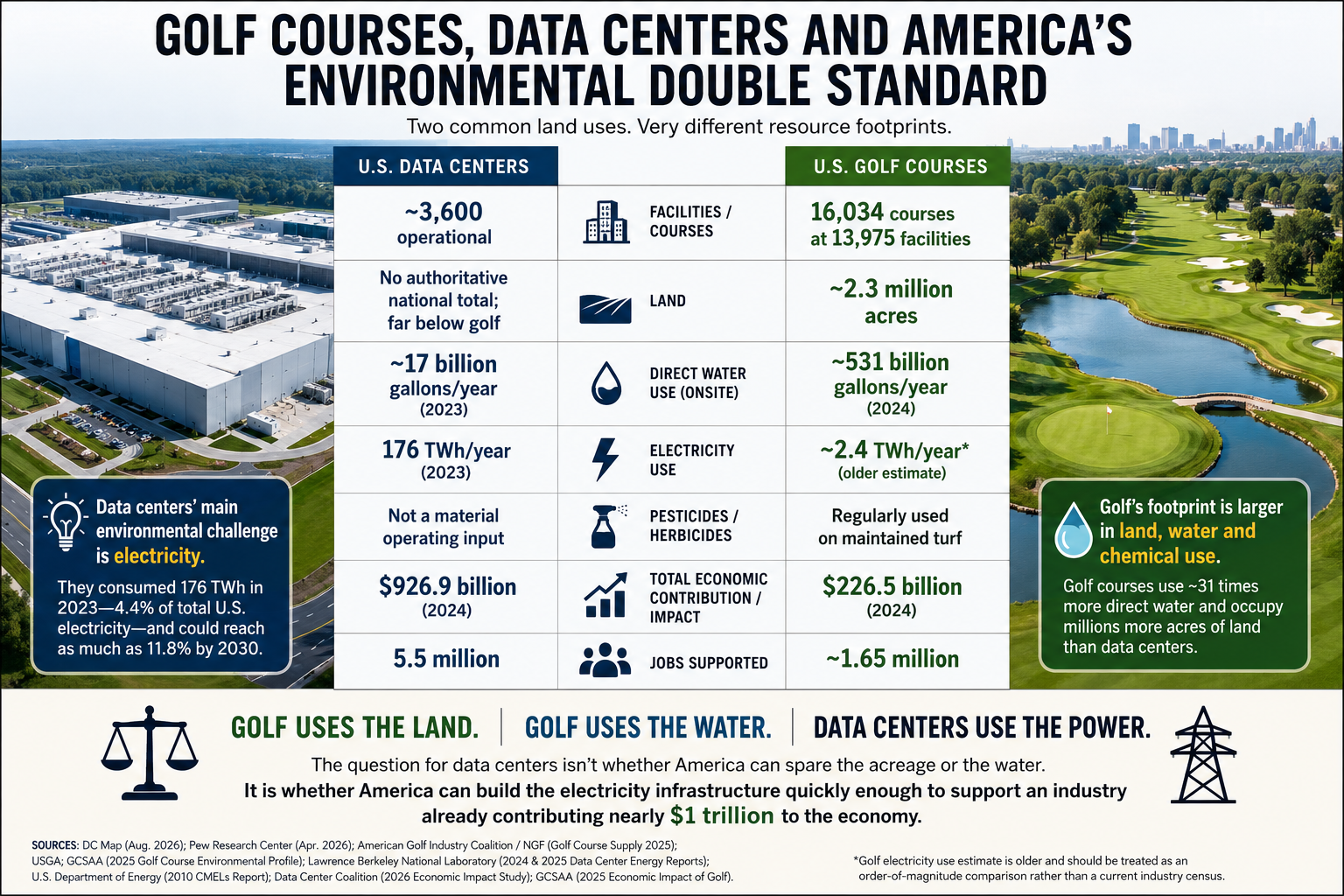
America has decided that using millions of acres and hundreds of billions of gallons of water for recreation is ordinary, while communities increasingly treat far smaller amounts of land and direct water used for digital infrastructure as an environmental crisis.

That doesn’t make data centers environmentally harmless. It identifies the environmental challenge they actually present: Power.

Data centers consumed 176 TWh in 2023 and could approach 12% of America’s electricity consumption by 2030. That growth demands generation, transmission and grid investment on an extraordinary scale.

The country should scrutinize where that electricity will come from, who pays for the infrastructure required to deliver it and whether utilities can add generation quickly enough without shifting costs onto existing customers.

Golf uses the land. Golf uses the water. Data centers use the power.

The question for data centers isn’t whether America can spare the acreage or the water. It is whether America can build the electricity infrastructure quickly enough to support an industry already contributing nearly $1 trillion to the economy and will drive the innovation and jobs of the future.

Artificial Intelligence and The Civic Bargain

For most of human history, people did not belong to countries. They belonged to tribes.

Family came first. Then clan. Then religion. Then ethnicity. Your protection did not come from an impartial government but from the people who shared your blood and your history.

The modern nation-state asked humanity to do something profoundly unnatural. It asked millions of strangers to trust one another more than they trusted their tribe.

That may be civilization’s greatest political achievement.

Political scientist Francis Fukuyama has argued that human beings are naturally wired for tribalism. The genius of the modern state was not that it erased those instincts, but that it redirected them. Loyalty shifted from clan to constitution, from ancestry to citizenship, from family name to the rule of law.

No nation embodied that experiment more successfully than the United States.

America was never united by blood. It became a nation because generation after generation chose to believe that citizenship mattered more than ancestry. Irish immigrants, Jewish refugees, engineers from India, scientists from Taiwan, and millions of others came from different histories but increasingly shared one future.

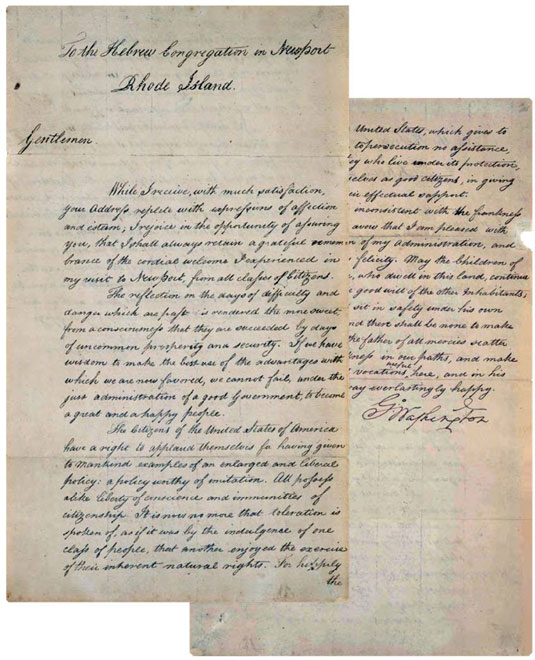
“The Citizens of the United States of America have a right to applaud themselves for having given to mankind examples of an enlarged and liberal policy: a policy worthy of imitation. All possess alike liberty of conscience and immunities of citizenship. It is now no more that toleration is spoken of, as if it was by the indulgence of one class of people, that another enjoyed the exercise of their inherent natural rights. For happily the Government of the United States, which gives to bigotry no sanction, to persecution no assistance requires only that they who live under its protection should demean themselves as good citizens, in giving it on all occasions their effectual support.” – George Washington’s letter to the synagogue in Newport, RI in 1790

George Washington’s letter to the synagogue in Newport, RI in 1790

America never eliminated tribes. It simply made being American more important than belonging to one.

But that civic bargain rested on something deeper than patriotism. It rested on hope.

America has never been a perfect nation. It never claimed to be.

Slavery contradicted its founding ideals. Women were denied the vote. Segregation mocked the promise of equal protection. Entire groups were excluded from opportunities others took for granted.

Yet what distinguished America was not the absence of injustice. It was the belief that injustice could be corrected.

The nation repeatedly expanded the circle of citizenship. Slavery was abolished. Constitutional amendments extended the franchise. The civil rights movement dismantled legalized segregation. Immigration laws evolved. Opportunity broadened. Each generation inherited an imperfect republic and, however incompletely, tried to leave it more just than it found it.

People can tolerate inequality longer than they can tolerate hopelessness. They can accept that today’s America is imperfect if they believe tomorrow’s America will offer greater opportunity for themselves and for their children.

For much of our history, that belief proved remarkably resilient. Yet today it is under strain.

The reason is not simply that inequality has grown. It is that many Americans increasingly question whether the civic bargain still works.

Over the past two decades, extraordinary wealth has accumulated among roughly the wealthiest one-tenth of one percent of American households—families whose wealth is roughly $50 million and more. Together they now control a remarkable share of the nation’s wealth, much of it held not in homes or factories but in ownership stakes in software companies, semiconductor firms, and cloud infrastructure.

The question for ordinary Americans is whether they believe they have a realistic chance of becoming tomorrow’s winners.

Yet much of the political debate on the left uses the moral vocabulary of the twentieth century to explain the economics of the twenty-first. Progressives point to slavery, segregation, redlining, and inherited privilege. They therefore demand reparations. But that’s the lexicon and proposals of a period past.

Today’s economy is not dominated by inherited railroad empires or industrial monopolies. It is dominated by technological innovation.

According to Forbes, roughly two-thirds of America’s 400 richest people built their fortunes themselves rather than inheriting them. Many of the largest fortunes were created within a single generation through software, semiconductors, venture capital, and artificial intelligence. America continues to produce extraordinary upward mobility. Immigrants account for roughly one in seven American billionaires, and more than nine in ten of those immigrant billionaires are self-made, many arriving from India, Israel, Taiwan, and China before building companies at the forefront of the technology revolution.

America is still the land of remarkable opportunity for all but it is predominantly happening inside an innovation economy that relatively few people understand—and even fewer know how to enter.

That distinction changes the political conversation. And it is magnified by the fear of artificial intelligence.

As the AI economy concentrates wealth, the identities of many of its most visible participants also become politically salient. Many of America’s leading technology founders, investors, and executives are white, Asian, or Jewish—groups often associated with educational and entrepreneurial success. That should be irrelevant in a civic republic. But in a society increasingly tempted by tribal politics, economic frustration is often translated into identity politics. The result is a dangerous feedback loop: the far left explains disparities through privilege and oppression, while the far right responds with conspiracy theories about ethnic or religious elites. Both abandon the American principle that citizens should be judged primarily as individuals rather than as members of competing tribes.

Alexandr Wang, 29, Chief AI Officer at Meta, worth an estimated $3.3 billion

And the concern is no longer merely that the rich will become richer. It is that AI will automate millions of middle-class jobs. Lawyers, accountants, software developers, analysts, designers, customer service representatives, and countless others increasingly wonder whether they are watching the economic ladder disappear beneath them. That is not just the rich getting richer and the poor getting poorer. It is everyone below the 0.1% – the entire lower, middle and upper middle class – becoming significantly poorer.

That anxiety helps explain proposals such as far-left Senator Bernie Sanders’ American AI Sovereign Wealth Fund Act. Sanders argues that because artificial intelligence is trained on humanity’s collective knowledge, the extraordinary wealth it creates should not belong solely to a handful of technology companies and investors. Whether one agrees with that proposal or not, it marks a profound shift. The political debate is moving beyond redistributing wealth after it is created, toward seizing and controlling the technologies that create the wealth in the first place.

Never has the U.S. government considered inserting itself so forcefully into the leading drivers of innovation, jobs and wealth, and pitted itself against those “elites” spearheading the effort.


On one side, the far-left is organizing around tribalism focused on race, gender, and “privilege,” which produces a counter-movement on the far-right around White nationalism. Both movements are inherently anti-American and undermine the founders’ ideals of a grand civic bargain. Each tells its followers that the other tribe is responsible for the country’s decline. Both play a part.

America fractures as both right and left move towards tribalism, and no longer trust the “establishment” political class, mainstream media and failing schools. Meanwhile, the real enormous promise and fear of the future for both groups is playing out in real-time before everyone: that AI will exacerbate the inability to trust people, information and institutions, while simultaneously creating a cohort of individuals – seemingly of only a few tribes – with remarkable wealth as the middle class loses its wealth.

If AI becomes a dominant technology that only a tiny club understands, owns, and profits from, the civic bargain weakens. Citizens begin searching for smaller communities that promise protection and belonging. Race becomes more important than citizenship. Class becomes more important than opportunity. Tribe becomes more important than country.

That is a future we can, should and must avoid.

America has solved this problem before. Every great technological revolution—from the steam engine to electricity to the internet—created extraordinary fortunes for its pioneers. Yet each ultimately generated industries, professions, suppliers, entrepreneurs, investors, educators, and workers whose prosperity far exceeded that of the original inventors. The wealth did not remain confined to those who built the breakthrough. It spread through the countless derivative businesses, careers, and opportunities that followed.

Artificial intelligence should be no different. America should not punish the innovators building the future or discourage the investment and risk-taking that made these breakthroughs possible. The challenge is to ensure that the AI economy develops the same broad ecosystem that previous technological revolutions produced—new companies, new professions, new skills, new services, new capital formation, and new pathways into prosperity for millions of Americans.

Just as importantly, we must prevent the far left and the far right from hijacking this technological revolution for their own political ends. The left should resist reducing innovation to a story of privilege and oppression, while the right should resist turning successful innovators into symbols of ethnic or cultural conspiracy. Both narratives encourage Americans to see AI through the lens of tribe rather than citizenship, resentment rather than opportunity.

For 250 years, Americans repeatedly chose the civic bargain over tribalism because they believed each generation would inherit greater opportunity than the last. Artificial intelligence now puts that bargain to the test. The defining question of the AI age is not whether America can continue producing extraordinary innovators. It is whether the prosperity they create becomes the foundation for millions of new success stories.

The American experiment has never depended on preventing greatness. It has depended on ensuring that greatness inspires opportunity rather than resentment, and that every generation believes it still has a place in the nation’s future. If AI expands opportunity as dramatically as previous technological revolutions ultimately did, it will strengthen the civic bargain that has made America history’s most successful multiethnic republic.

America’s next century can be truly remarkable, if we avoid the partisan pitfalls that plague us.

A Story At The Jaffa Gate

An AI Amalgam Story.

Outside the Jaffa Gate in Jerusalem, the day unfolds with layers of complexity. The stone walls, ancient and storied, bear witness to the lives that pass through.

On this morning, an Arab man stands near the portal entrance, his posture slumped, eyes lowered. His expression speaks of a quiet sorrow—perhaps personal, perhaps born of circumstances beyond his control.

Picture amalgam of four different scenes, presenting a view of the entry portal of the Jaffa Gate in Jerusalem, Israel (by First One Through)

Meanwhile, just feet away, an Orthodox Jewish man, dressed in traditional black attire, moves with purpose. He hurries toward his daily prayers at the Kotel, following a routine as old as the stones beneath his feet. The rhythm of Jerusalem’s life, with its sacred moments, continues without pause.

Standing between them is a medic from Magen David Adom. His presence is a testament to the tension that often simmers beneath the surface of the city. He watches both men—attentive, calm, ready to act if needed. His role is not in the realm of politics or faith but in the safeguarding of human life.

This moment encapsulates the juxtaposition of daily routines—spiritual devotion, personal struggle, and the ever-present readiness to heal. In Jerusalem, where layers of history meet contemporary reality, even the quietest scene can tell a deeper story.