Data centers have become one of America’s favorite environmental villains. Critics argue that they use too much land, consume too much water and strain the electric grid. Communities increasingly fight proposed facilities on environmental grounds.
The concerns over electricity are real. But put data centers alongside another ubiquitous American land use — golf courses — and the environmental picture looks very different.
Golf uses dramatically more land and direct water and requires harmful pesticides to maintain its turf. Data centers consume dramatically more electricity. And data centers produce roughly four times the overall economic impact already – before the upcoming artificial intelligence boom kicks in.
| Metric | U.S. Data Centers | U.S. Golf Courses |
|---|---|---|
| Facilities / courses | ~3,600 operational | 16,034 courses at 13,975 facilities |
| Land | No authoritative national total; far below golf | ~2.3 million acres |
| Direct water use | ~17 billion gallons/year (2023) | ~531 billion gallons/year (2024) |
| Electricity | 176 TWh/year (2023) | ~2.4 TWh/year* |
| Pesticides / herbicides | Not material | Regularly used on maintained turf |
| Total economic contribution / impact | $926.9 billion (2024) | $226.5 billion |
| Jobs supported | 5.5 million | ~1.65 million |
*The national golf electricity estimate is older and should be treated as an order-of-magnitude comparison rather than a current industry census.
Start with volume. There is no universally accepted definition of a data center, so counts vary depending on whether campuses, buildings and individual facilities are counted separately. An August 2026 tracker identifies about 3,579 operational U.S. data centers and roughly 4,700 when facilities under construction and planned are included. Pew Research Center similarly reported in April that the country had more than 3,000 operational data centers. (DC Map) Golf is considerably more widespread. The latest National Golf Foundation figures count 16,034 courses at 13,975 facilities in the United States. (American Golf Industry Coalition)
Then there is land.
The USGA has estimated that American golf courses occupy nearly 2.3 million acres. (USGA) There is no similarly authoritative national accounting of the acreage occupied by data centers. Rather than manufacture precision from commercial databases, the relevant comparison is scale: America’s golf footprint runs into millions of acres, while several thousand data centers occupy a small fraction of that amount.
Water produces an even more startling comparison.
American golf facilities applied 1.63 million acre-feet of water in 2024, according to the latest Golf Course Environmental Profile survey. That equals approximately 531 billion gallons. To golf’s credit, that represents a 31% decline since 2005 as courses have closed and surviving facilities have become more efficient. (GCSAA)
Lawrence Berkeley National Laboratory estimated that U.S. data centers directly consumed approximately 66 billion liters of water in 2023, or roughly 17 billion gallons. (Lawrence Berkeley National Laboratory) So American golf courses use roughly 31 times as much water as data centers directly consume onsite.
Data centers also have an indirect water footprint because generating electricity can consume substantial amounts of water. Golf similarly has indirect resource requirements associated with electricity, fertilizer, chemicals, equipment and maintenance. The 31-to-1 comparison is specifically between water applied at golf facilities and direct water consumed at data centers — not their respective total lifecycle water footprints.
Chemicals produce another imbalance, although one that cannot responsibly be reduced to a current national poundage figure.
Golf courses maintain enormous areas of highly managed turf using fungicides, herbicides, insecticides and other treatments. GCSAA’s national pest-management research confirms continued use of those conventional chemicals while also finding greater use of non-pesticide practices and reductions or little change in reliance on conventional chemistries between its major surveys. (GCSAA)
Data centers, by contrast, do not require herbicides, fungicides and insecticides as a significant part of their core operation. They may have ordinary landscaping needs, but chemicals are not to computing what turf treatment is to golf.
There is one environmental measure where the comparison flips completely: electricity.
Lawrence Berkeley National Laboratory estimated that U.S. data centers consumed 176 terawatt-hours of electricity in 2023, approximately 4.4% of total U.S. electricity consumption. Its June 2026 update projects that data centers could reach 11.8% of U.S. electricity consumption by 2030, with scenarios ranging from 9.5% to 15.3%. (Lawrence Berkeley National Laboratory)
Golf isn’t remotely comparable. A U.S. Department of Energy analysis estimated golf-course electricity consumption at approximately 2.4 TWh annually, with a typical course consuming about 250,000 to 500,000 kWh and irrigation pumping accounting for 25% to 50% of course electricity use. The estimate is old, so it should not be mistaken for a current measurement. But even substantial growth would leave golf far below the electricity requirements of data centers. (U.S. Department of Energy)
Data centers are power infrastructure in a way golf courses simply are not. But power is being converted into something: economic output.
A 2026 PwC study commissioned by the Data Center Coalition calculated that the U.S. data-center industry contributed $926.9 billion to GDP in 2024, supported 5.5 million jobs and generated $204.4 billion in federal, state and local taxes. (Data Center Coalition)
Golf is also a significant American industry. Its national economic-impact study calculated $101.7 billion in direct economic activity and $226.5 billion when direct, indirect and induced effects are included, supporting nearly 1.65 million jobs and $80.1 billion of wage income. (GCSAA)
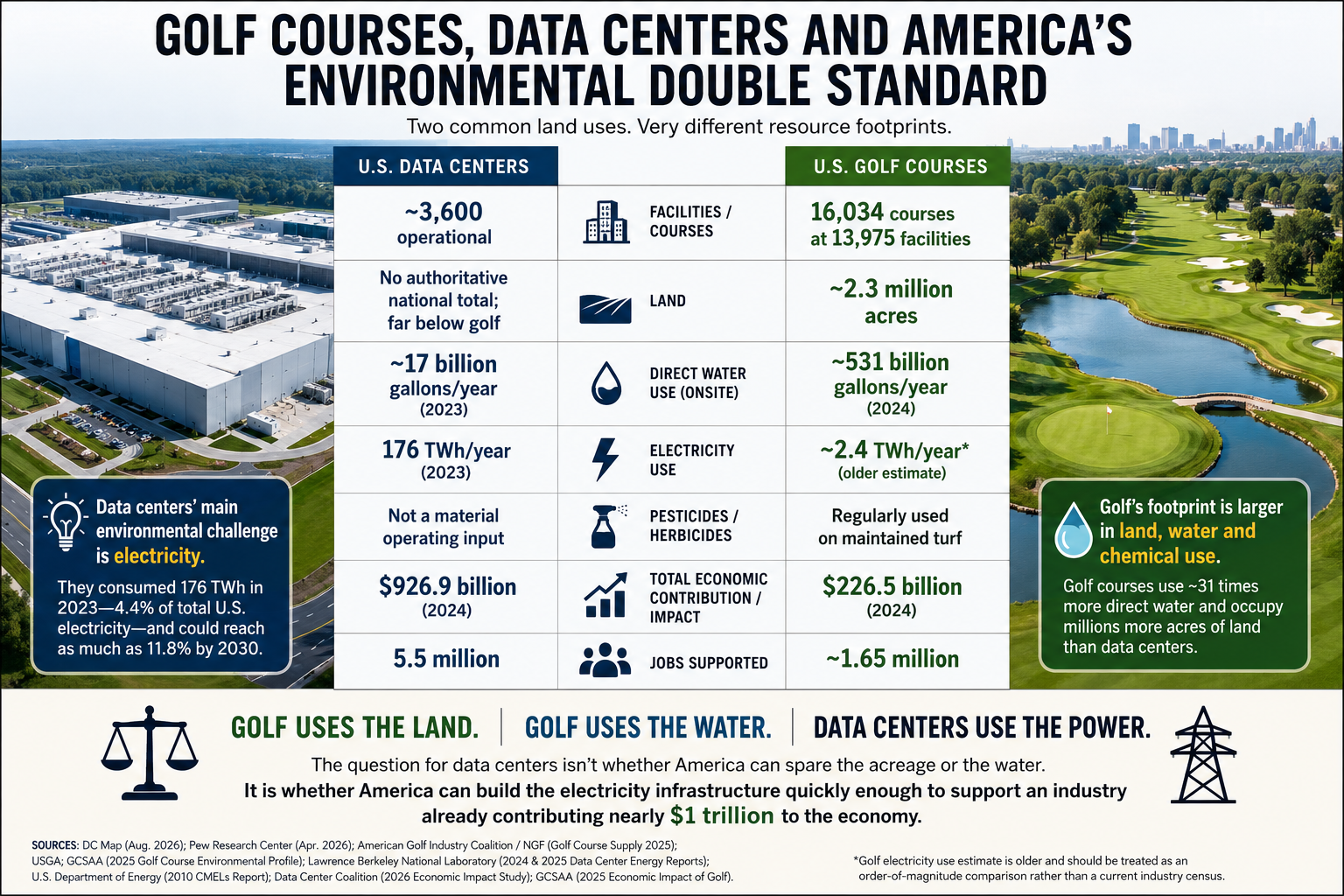
America has decided that using millions of acres and hundreds of billions of gallons of water for recreation is ordinary, while communities increasingly treat far smaller amounts of land and direct water used for digital infrastructure as an environmental crisis.
That doesn’t make data centers environmentally harmless. It identifies the environmental challenge they actually present: Power.
Data centers consumed 176 TWh in 2023 and could approach 12% of America’s electricity consumption by 2030. That growth demands generation, transmission and grid investment on an extraordinary scale.
The country should scrutinize where that electricity will come from, who pays for the infrastructure required to deliver it and whether utilities can add generation quickly enough without shifting costs onto existing customers.
Golf uses the land. Golf uses the water. Data centers use the power.
The question for data centers isn’t whether America can spare the acreage or the water. It is whether America can build the electricity infrastructure quickly enough to support an industry already contributing nearly $1 trillion to the economy and will drive the innovation and jobs of the future.


