Data Centers, Golf Courses and America’s Environmental Double Standard

Data centers have become one of America’s favorite environmental villains. Critics argue that they use too much land, consume too much water and strain the electric grid. Communities increasingly fight proposed facilities on environmental grounds.

The concerns over electricity are real. But put data centers alongside another ubiquitous American land use — golf courses — and the environmental picture looks very different.

Golf uses dramatically more land and direct water and requires harmful pesticides to maintain its turf. Data centers consume dramatically more electricity. And data centers produce roughly four times the overall economic impact already – before the upcoming artificial intelligence boom kicks in.

MetricU.S. Data CentersU.S. Golf Courses
Facilities / courses~3,600 operational16,034 courses at 13,975 facilities
LandNo authoritative national total; far below golf~2.3 million acres
Direct water use~17 billion gallons/year (2023)~531 billion gallons/year (2024)
Electricity176 TWh/year (2023)~2.4 TWh/year*
Pesticides / herbicidesNot materialRegularly used on maintained turf
Total economic contribution / impact$926.9 billion (2024)$226.5 billion
Jobs supported5.5 million~1.65 million

*The national golf electricity estimate is older and should be treated as an order-of-magnitude comparison rather than a current industry census.

Start with volume. There is no universally accepted definition of a data center, so counts vary depending on whether campuses, buildings and individual facilities are counted separately. An August 2026 tracker identifies about 3,579 operational U.S. data centers and roughly 4,700 when facilities under construction and planned are included. Pew Research Center similarly reported in April that the country had more than 3,000 operational data centers. (DC Map) Golf is considerably more widespread. The latest National Golf Foundation figures count 16,034 courses at 13,975 facilities in the United States. (American Golf Industry Coalition)

Then there is land.

The USGA has estimated that American golf courses occupy nearly 2.3 million acres. (USGA) There is no similarly authoritative national accounting of the acreage occupied by data centers. Rather than manufacture precision from commercial databases, the relevant comparison is scale: America’s golf footprint runs into millions of acres, while several thousand data centers occupy a small fraction of that amount.

Water produces an even more startling comparison.

American golf facilities applied 1.63 million acre-feet of water in 2024, according to the latest Golf Course Environmental Profile survey. That equals approximately 531 billion gallons. To golf’s credit, that represents a 31% decline since 2005 as courses have closed and surviving facilities have become more efficient. (GCSAA)

Lawrence Berkeley National Laboratory estimated that U.S. data centers directly consumed approximately 66 billion liters of water in 2023, or roughly 17 billion gallons. (Lawrence Berkeley National Laboratory) So American golf courses use roughly 31 times as much water as data centers directly consume onsite.

Data centers also have an indirect water footprint because generating electricity can consume substantial amounts of water. Golf similarly has indirect resource requirements associated with electricity, fertilizer, chemicals, equipment and maintenance. The 31-to-1 comparison is specifically between water applied at golf facilities and direct water consumed at data centers — not their respective total lifecycle water footprints.

Chemicals produce another imbalance, although one that cannot responsibly be reduced to a current national poundage figure.

Golf courses maintain enormous areas of highly managed turf using fungicides, herbicides, insecticides and other treatments. GCSAA’s national pest-management research confirms continued use of those conventional chemicals while also finding greater use of non-pesticide practices and reductions or little change in reliance on conventional chemistries between its major surveys. (GCSAA)

Data centers, by contrast, do not require herbicides, fungicides and insecticides as a significant part of their core operation. They may have ordinary landscaping needs, but chemicals are not to computing what turf treatment is to golf.

There is one environmental measure where the comparison flips completely: electricity.

Lawrence Berkeley National Laboratory estimated that U.S. data centers consumed 176 terawatt-hours of electricity in 2023, approximately 4.4% of total U.S. electricity consumption. Its June 2026 update projects that data centers could reach 11.8% of U.S. electricity consumption by 2030, with scenarios ranging from 9.5% to 15.3%. (Lawrence Berkeley National Laboratory)

Golf isn’t remotely comparable. A U.S. Department of Energy analysis estimated golf-course electricity consumption at approximately 2.4 TWh annually, with a typical course consuming about 250,000 to 500,000 kWh and irrigation pumping accounting for 25% to 50% of course electricity use. The estimate is old, so it should not be mistaken for a current measurement. But even substantial growth would leave golf far below the electricity requirements of data centers. (U.S. Department of Energy)

Data centers are power infrastructure in a way golf courses simply are not. But power is being converted into something: economic output.

A 2026 PwC study commissioned by the Data Center Coalition calculated that the U.S. data-center industry contributed $926.9 billion to GDP in 2024, supported 5.5 million jobs and generated $204.4 billion in federal, state and local taxes. (Data Center Coalition)

Golf is also a significant American industry. Its national economic-impact study calculated $101.7 billion in direct economic activity and $226.5 billion when direct, indirect and induced effects are included, supporting nearly 1.65 million jobs and $80.1 billion of wage income. (GCSAA)
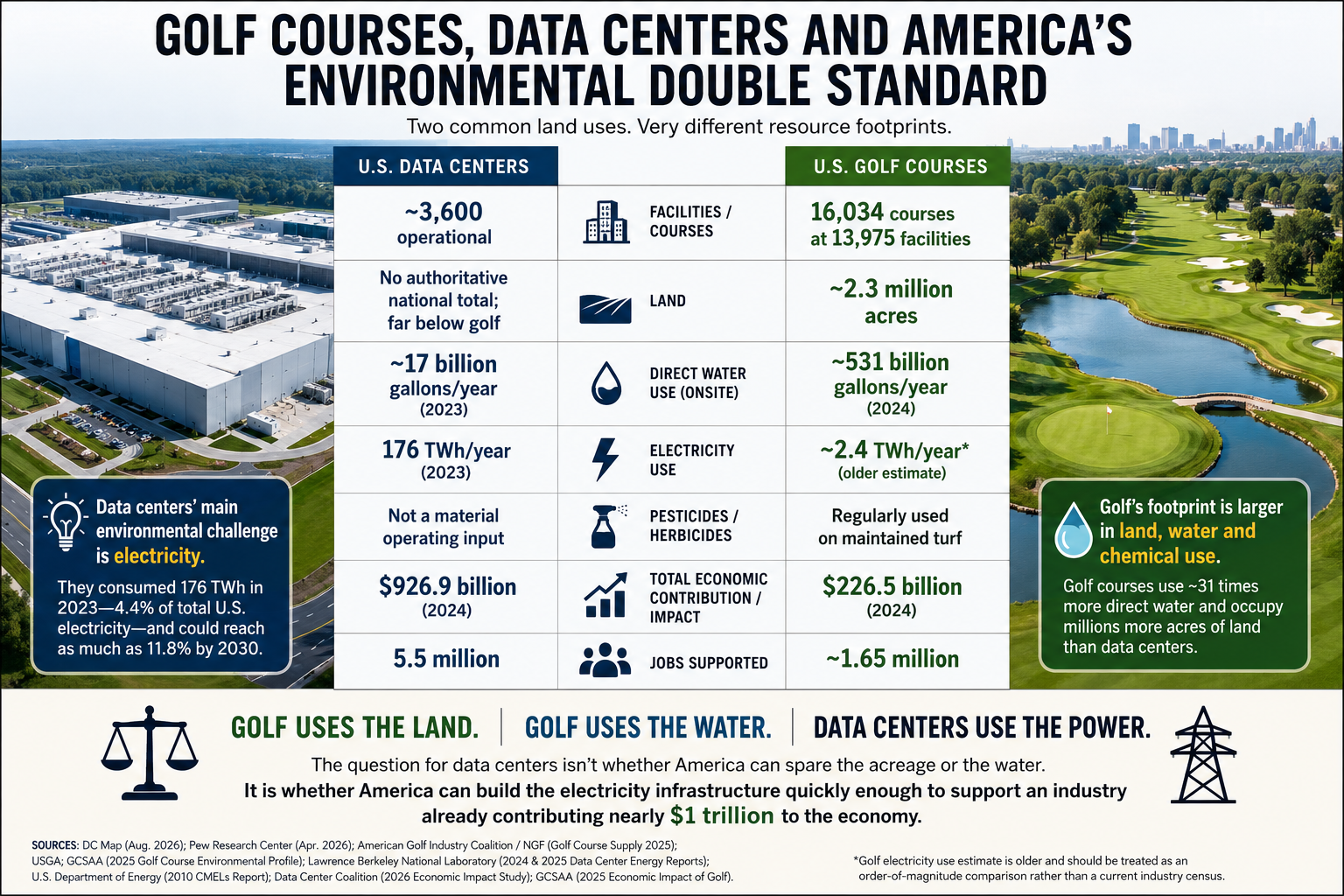
America has decided that using millions of acres and hundreds of billions of gallons of water for recreation is ordinary, while communities increasingly treat far smaller amounts of land and direct water used for digital infrastructure as an environmental crisis.

That doesn’t make data centers environmentally harmless. It identifies the environmental challenge they actually present: Power.

Data centers consumed 176 TWh in 2023 and could approach 12% of America’s electricity consumption by 2030. That growth demands generation, transmission and grid investment on an extraordinary scale.

The country should scrutinize where that electricity will come from, who pays for the infrastructure required to deliver it and whether utilities can add generation quickly enough without shifting costs onto existing customers.

Golf uses the land. Golf uses the water. Data centers use the power.

The question for data centers isn’t whether America can spare the acreage or the water. It is whether America can build the electricity infrastructure quickly enough to support an industry already contributing nearly $1 trillion to the economy and will drive the innovation and jobs of the future.

Israel’s Unicorn Boom Is Much Newer — and More American — Than You Think

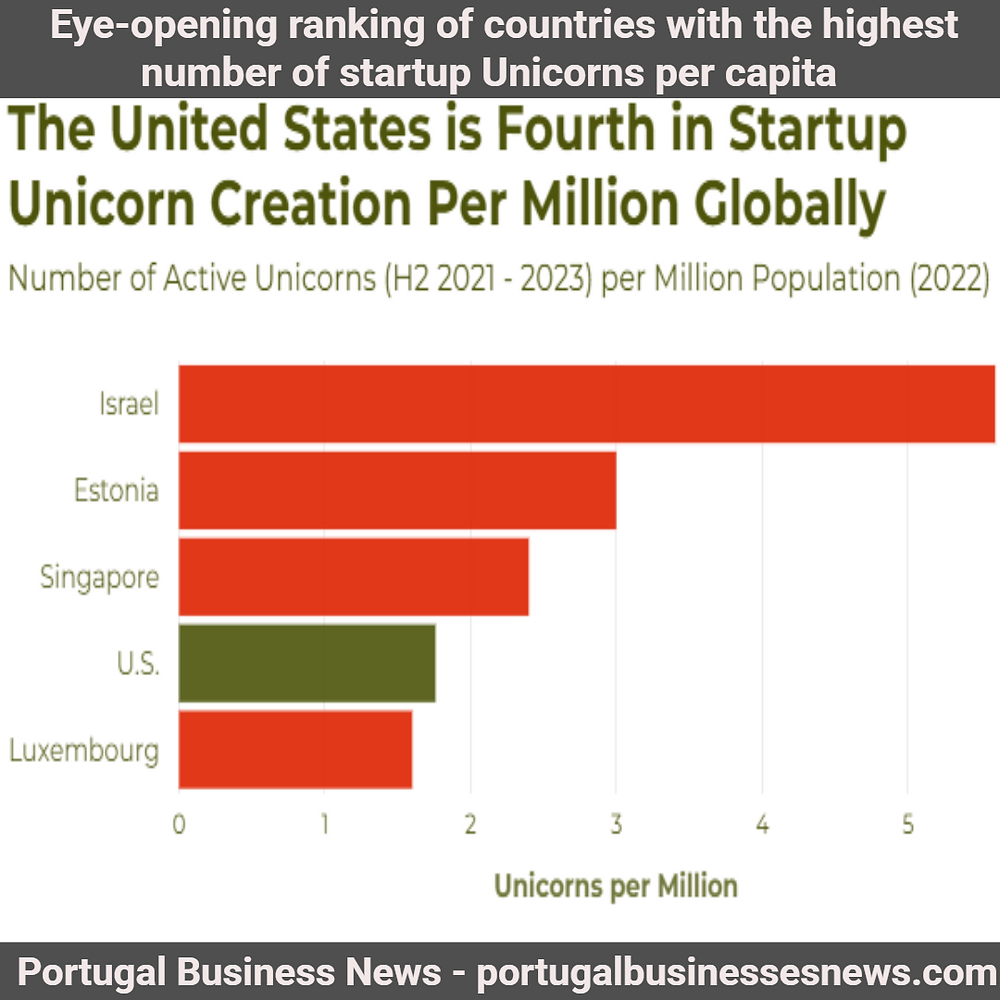
Charts regularly circulate showing the countries with the most “unicorns” — private companies that achieve valuations of at least $1 billion. Divide the totals by population and tiny Israel suddenly jumps toward the top of the world.

But the headline number obscures a three more interesting stories.

Israel did not spend 75 years steadily accumulating unicorns. Most of its unicorn phenomenon is remarkably recent. And many of the companies created by Israelis aren’t headquartered in Israel at all.

Then there is what these companies actually do.

Put those three pieces together — when they emerged, where they are headquartered and what they sell — and Israel’s unicorn story looks like a specialized company-production machine for today’s world.

The Unicorn Explosion

In 2011, only 16 new unicorns were created in the entire world. Israel was hardly overflowing with them either. TechAviv data show Israel produced just four new unicorns in 2015 and nine in 2019.

Then the curve turned sharply upward.

Israel produced 19 new unicorns in 2020 and 42 in 2021. By December 2021, TechAviv counted 79 Israeli-founded unicorns. By December 2022, there were 98.

That means the Israeli unicorn story people now take for granted is largely a phenomenon of the last several years.

“Israel ranked first globally in terms of its number of technology unicorns per capita. As of 2025, the country’s startup scene contained 90 active tech unicorns, and raised billions of dollars in investments annually. These are indicators of an exceptionally well performing startup ecosystem, which forms the basis of the country’s robust technology industry.” – Statista.com

The cheap-money technology boom certainly helped. Valuations soared everywhere in 2020 and 2021. But Israel’s performance was exceptional even within that global frenzy.

Israeli Unicorn Doesn’t Necessarily Mean in Israel

Of the 79 Israeli-founded unicorns counted at the end of 2021, only 33 — 42% — were headquartered in Israel.

The rest were spread around the world:

  • 19 in New York.
  • 15 in Silicon Valley.
  • 5 in Boston.
  • 3 in London.
  • 2 in Los Angeles.
  • 1 in Singapore.
  • 1 in Chicago.

A year later, the ratio was almost identical. Of 98 Israeli-founded unicorns in December 2022, 40 were headquartered in Israel and 58 abroad. Silicon Valley had 24 and New York had 19.

So roughly three out of every five Israeli-founded unicorns were headquartered outside Israel.

That matters when looking at those viral country rankings. A ranking based strictly on corporate headquarters can count an Israeli-founded company as American. A ranking based upon where the entrepreneurs came from can count the same company as Israeli.

Israel is creating companies for a market vastly larger than Israel.

What Israel Is Creating

Israeli unicorns aren’t distributed evenly across the economy. The country’s technology ecosystem has become increasingly concentrated around enterprise software, fintech and cybersecurity.

The Israel Innovation Authority found that these three categories represented 29.4% of companies founded in 2013 but 42% by 2021. By 2022 they were attracting 53.4% of all investment in Israeli startups.

Cybersecurity is particularly extraordinary.

Dealroom currently counts 26 cybersecurity unicorns headquartered in Israel. It calculates that Israel is 9.15 times more represented in cybersecurity unicorns than its overall share of the world’s unicorn population would predict. Tel Aviv alone ranks behind only the Bay Area in Dealroom’s global cyber-unicorn count.

And that is based on headquarters. It therefore doesn’t fully capture Israeli-founded cyber companies headquartered in places such as New York and Boston.

Israel also over-indexes in semiconductors, health technology and medtech, although nowhere close to its extraordinary concentration in cyber.

Meanwhile, the composition of Israeli technology has been changing.

Communications — historically one of Israel’s great technology strengths, including hardware infrastructure and chips — represented about 8% of newly established Israeli technology companies in 2013. By 2022 it was just 1.7%.

” In H1 2025, High-Tech accounted for 57% of all Israeli exports, the highest share ever recorded. The export mix points to a clear trend: 72% software services versus 28% High-Tech industry. This means Israel is increasingly reliant on software services exports, while the High-Tech industry, including the defense industry, has been relatively stagnant.  Israel increasingly went from building the pipes to building the software running through them.” – Israel Innovation Authority

Israel Invents. America Scales.

That industry mix helps explain the geography.

A cybersecurity company potential customers are banks, governments and Fortune 500 corporations around the planet. An enterprise-software company can develop its technology in Tel Aviv while putting executives and salespeople close to customers in New York. A fintech company can maintain Israeli engineering operations while establishing its corporate headquarters in the world’s largest financial market.

And those American headquarters aren’t simply mailing addresses.

In 2023, the United States–Israel Business Alliance identified 88 Israeli-founded unicorns with global or regional headquarters in the United States. Together, those companies employed nearly 62,000 people worldwide.

The available data do not establish how many of those employees were specifically in America, so the 62,000 should not be described as American jobs. But broader state studies show that Israeli-founded companies have become meaningful American employers. In California alone, Israeli-founded companies directly employed more than 14,000 people, with their broader economic activity supporting more than 22,000 jobs.

That economic relationship runs in both directions.

American venture-capital and private-equity firms finance Israeli entrepreneurs. Israeli founders establish U.S. headquarters and hire American salespeople, executives and other employees. American corporations then acquire some of the most successful companies, bringing Israeli-developed technology inside American businesses.

Google’s acquisition of Israeli-founded Wiz for $32 billion provides an extraordinary recent example. Cisco agreed to buy Israeli-founded CyberArk for approximately $25 billion in 2025. Intel’s earlier $15.3 billion acquisition of Mobileye demonstrated the same model on a massive scale. Three Israeli technology companies. More than $70 billion of announced acquisition value. Three American buyers.

The relationship is particularly important because Israel’s strongest sectors overlap with technologies the United States increasingly considers strategic: cybersecurity, artificial intelligence, semiconductors and advanced computing.

The Israeli and American ecosystems therefore aren’t competing with one another for unicorns. They are often parts of the same machine.

Israel supplies entrepreneurs, engineers, military-trained cyber expertise and dense technical networks. The United States supplies enormous customers, deep pools of capital, experienced executives and the world’s largest technology exit market.

The result is a peculiar multinational organism: Israeli-created, frequently American-headquartered, American-financed and globally sold.

A Very Young Herd

Israel’s unicorn phenomenon is not simply impressive because a country of roughly ten million people has produced so many billion-dollar technology companies. It is impressive because the herd appeared so quickly.

It is unusual because most of the herd established headquarters outside the country that produced its founders.

And it is revealing because the herd increasingly congregated in a few industries where Israel developed extraordinary comparative advantages — particularly cybersecurity, enterprise software and fintech.

For Americans, there is another reason to care.

Israel’s technology success isn’t occurring on the other side of the world in isolation from the American economy. Some of the value Israel creates lands in New York, California, Massachusetts and elsewhere in the United States — as headquarters, jobs, investment opportunities, technology and acquisitions.

The familiar unicorn-per-capita chart therefore captures only the surface. The deeper story isn’t that Israel has a lot of unicorns.

Over the last decade, Israel became very good at manufacturing global technology companies — together with American capital and talent.

Jamaal Bowman Wants A Radical Redistribution Of Wealth And Power

Rep. Jamaal Bowman has no idea how to build an economy or how to address the needs of all of the members of his district. He believes that the role of government is to take wealth and power from those he feels have too much, and redistribute it to those he believes deserve it more.

In his address to a crowd for Martin Luther King Day in January he said (1:01) “We need a radical redistribution of political and economic power.” His messaging continues to be to achieve that goal.

Bowman wants to cancel all student debt to Black people, hand $14 trillion in “reparations” to Black descendants of slaves, tax wealth (not only income), defund the police, abolish immigration controls, halt funding wars in foreign countries which he perceives as “white” or wealthy, and push DEI (diversity, equity and inclusion) into every facet of the American economy and power structures to strip non-minorities of their wealth and jobs.

Rather than focus on programs and policies which can CREATE wealth for everyone, Bowman calls for seizing it from non-minorities and handing it to the only constituents he wants to serve.

Black people in his district do not believe in Bowman’s antics. Darius Jones, co-founder of the National Black Empowerment Action Fund, mocked Bowman for not doing his job as a legislator to create jobs and enable the economy, voting against Biden’s Infrastructure Bill. Jones chided Bowman for holding back Black people by nixing charter schools and standing with the broken public schools system of which he is an integral part.

Not coincidentally, Bowman is one of the powerful teachers’ unions biggest donor recipients.

Bowman’s crusade is to enact former New York City Mayor Bill De Blasio’s words: “Brothers and sisters, there’s plenty of money in the world. There’s plenty of money in this city. It’s just in the wrong hands,” with a radical redistribution of wealth and power from White people to Black and Brown people in the U.S. and to the Global South.

While the media ponders whether Bowman is deeply anti-Zionists or anti-Jews, they miss the bigger picture: Bowman is anti-White and anti-capitalism, and views Israel and Jews as the nexus of White power and wealth he is targeting. A good deal of them are his own constituents in Westchester County.

Related articles:

Jamaal Bowman Is Not Progressive, He’s Divisive (June 2024)

Why Did Jamaal Bowman Fly To Virginia To Fundraise With Hamas’ Backers? (May 2024)

The Ongoing Embarrassment Of Jamaal Bowman Has Rallied The Local Democratic Establishment To George Latimer (April 2024)

Bowman’s Main Speaker Threatens Jews At Jewish Day School (March 2024)

Jamaal Bowman Parrots Iran That American Exceptionalism Is A Lie Based In Racism (January 2024)

Jamaal Bowman Is Unfit To Serve In Congress (November 2023)

Progressives are Stripping the Equity of Our Lives

The annual showing at the Davos, Switzerland World Economic Forum is always a spectacle. It is usually due to the who’s-who list of billionaires, celebrities and world leaders in a beautiful location. In 2019, it also featured stupid ideas led by the “progressive” views of worker protection and entitlement.

A Progressive View of Automation

One of the important themes discussed at the WEF was the consideration of the “Future of Work.” The Forum put forward three alternative views of how a world of digitization and automation could develop in the future. The considerations revolved around efficiencies, how to improve the value to customers, and how technology will require a new set of skills as it transforms the job market. The discussion sought to consider the future dynamics of competing aims of shareholders, workers and customers.

While progressives tout the concept of “fairness,” their actual concern is about a particular type of “equality,” which is the equal distribution of money. The status of “wealth inequality” and “income inequality” drives the proposed progressive agenda and thereby hijacks the definition of “fairness” to be one that reaches the conclusion of wealth and income equality.

In such an orientation, the holders of mass wealth – typically owning large stakes in companies – are afforded no leniency. If the future of automation brings an accelerated and inflamed debate of competing interests between shareholders, employees and consumers, the discussion is concluded as soon as it was introduced.

The progressive rag, The New York Times had an article written about the WEF called “The Hidden Automation Agenda of the Davos Elite.” As the title suggests, the article reviewed how the “elite” – those evil one-percenters – were hatching nefarious plans to destroy the workers of the world. The corporate titans at Davos were marketing how automation was going to bring all sorts of new inventions to the world with lower prices for consumers, however, the real goal was to replace people with robots, and hoard all of the economic gains for themselves.

“Automating work is a choice, of course, one made harder by the demands of shareholders, but it is still a choice. And even if some degree of unemployment caused by automation is inevitable, these executives can choose how the gains from automation and A.I. are distributed, and whether to give the excess profits they reap as a result to workers, or hoard it for themselves and their shareholders.

“The choices made by the Davos elite — and the pressure applied on them to act in workers’ interests rather than their own — will determine whether A.I. is used as a tool for increasing productivity or for inflicting pain.”

The progressive argument is plain: the elite / executives / shareholders will hoard the gains from digitization and automation, unless pressure (or new progressive tax and corporate laws) force the benefits to be distributed to workers.

A Progressive View of Employee/ Shareholder Protections

The progressive view of wealth is that it is essentially “immoral” as the recent progressive political star Alexandria Ocasio-Cortez said in an interview. It is a view shared by many progressives who view capitalism as evil at its core.

The notion that someone could build and own a business and become ridiculously wealthy – say Howard Schultz who created Starbucks – is inherently wrong according to the far left-wing. The hard work and risks which Schultz took along the way to create a company that employed tens of thousands of people and produced a product that millions of people enjoy is somehow negated by the tremendous wealth he personally amassed. According to progressives, his earnings and wealth should have been stripped along the way and passed on to the people who made and served the coffee. The salary of the workers was clearly inappropriate compensation if the company became so profitable. For progressives, the redundant task of making venti lattes all day which requires limited skills, no education and no risk – a task that will soon be automated – is not the essence of the discussion. The objection is that the person who owned the company made thousands of times more than the average worker, a conclusion, they believe that is immoral.

This progressive logic takes a bizarre turn when employees don’t help create value but destroy it.

Consider the electric utility PG&E which is being sued for causing the forest fires that killed people and destroyed billions of dollars in property value. Employees at the company are accused of committing a series of terrible errors, including not cutting the power in dry areas suffering from high winds (when the power lines came down from the wind, the electric sparks ignited the dry brush).

Who “paid” for the worker errors? Were thousands of employees fired? Was the employee pension fund stripped? Were line workers lined up before commissions and denounced in the media? No.

The executives and shareholders took the heat. Shareholders – many “women and orphans” who own utility stocks for the “safe” dividends – paid the price. On November 8, 2018, PGE stock closed at $47.80. One week later, on November 15 it stood at $17.74.

Did progressives cry fowl that the economic “windfall” wasn’t being shared equitably? Did they suggest that the workers who caused all of the death and destruction should bear the costs? No. They passed legislation meant to protect customers from rate hikes. Democrat State Senator Bill Dodd said his bill was needed because “without it, ratepayers will be left holding the bag and communities will needlessly suffer.

The Democratic Senator from California, Kamala Harris, who just announced her intention to run for president hasn’t said a word about the large corporate bankruptcy in her state. Any ideas why she would remain mum on such an enormous story? (Please don’t suggest it’s her ties to Democrats aligned with PG&E).


As the Democratic party lurches leftward, it is swaying deeper and deeper into an economic policy based on wealth redistribution over capitalism. The progressives have determined – and are demanding – that a worker whose job can be automated should not only not be fired, but be entitled to profit-sharing.

Progressives are seeking to dramatically revamp the notion of private ownership. They are advancing an economic system where we will collect fixed payouts as determined by federal officials. Workers, one and all. Equal and protected.

Private ownership will only be at the nod of the government. Strict limits will be imposed on compensation, capping salaries and demanding a set number of worker representatives sit on the board of directors. “Private” enterprise will be managed aggressively by politicians through heavy regulation and taxes, not by market forces.

The progressive aim is to strip people of the equity of their efforts and replace the return on their passions with interest payments as bondholders of the state. An “equitable” economy liberated and succored by a large government.

Such a system stymies equity investment and risk taking. It shrinks the economy and hurts innovation. No matter.

US President Ronald Reagan once said “this country is too great for small dreams.” For progressives, the great dream is a small country.


Related First.One.Through articles:

Please Don’t Vote for a Democratic Socialist

This July 4, I am Leaving the Democratic Party that Left Me Long Ago

Political Pinatas: Populist Greed Meets Populist Anger

A Country Divided

If You Want to Take Money out of Politics, Liberal Leaders Suggest Voting for Trump

I Love 5-to-4

Subscribe YouTube channel: FirstOneThrough

Join Facebook group: FirstOne Through Israel Analysis and FirstOneThrough

Palestinian Job Fair for Peace

A sad satire

The United Nations took a special interest in the high unemployment rate of Palestinians, which has led to feelings of despair and hopelessness, leaving many to resort to violence against Israelis.  As such, the UN held a meeting in October 2015 in Vienna to listen to various leaders of the Palestinian community describe their occupations to see if the global community could help advance their livelihoods.

Here are some of the presenters:

Gaza exterminator
Pest Control

Pest Control: The UN was impressed with the first presenter, the owner of a pest control company.  According to the businessman, there was a large infestation in the region that guaranteed a significant amount of work for many unemployed people.

Gaza quarry owner
Stone Masons

Stone Masons: A cleric from the West Bank described the incredible blessings of the holy land to be filled with stones of many sizes. He described the various types of rocks in the region and how they could be used in different situations.  Qatar pledged $100 million for a new quarry on the spot.

Gaza gambling
Gambling

Casinos: The casino in Jericho was reported to be doing very well.  The owner described “making a killing” in various games of chance.  He was happy to report that the gaming industry was actively hiring more people.

Gaza butcher
Butcher

Butchers:  While the amount of available meat for food consumption declined since Hamas took over Gaza, butchers continued to hone their skills.  A cleric showed off tools of the trade and urged others to get involved.

Gaza cattle ranchers
Cattle Ranchers

Ranchers:  As described above, the meat business has not been great, but Palestinian leadership was confident in their ability to corral enough when the market improved.

Gaza outdoor backpacker
Outdoor Hiking

Outdoor Activities:  Gaza developed a range of sporting centers with special backpacks, belts and other gadgetry for time outside.  While repelling has been around for a few years, preachers were just starting to advocate the activity.

Gaza behead
Bowling and entertainment

Indoor Activities:  The owner of one of the few Middle Eastern bowling alleys discussed “spares and strikes” and hoped to educate the community about fun “date-night” activities.

Gaza hide and seek
Teachers

Teachers: The Palestinian schools always need new teachers with new methods to teach the young.  A teacher presented an innovative method of teaching religion and history via a game of hide-and-seek with the children.

Gaza cheerlreader
Cheerleaders

Cheerleaders and Sports:  The UN was impressed with the progressive nature of the Palestinian schools that had a very large percentage of male cheerleaders.

Gaza surgeon
Surgeons

Doctors: The healthcare industry was still in shambles, particularly in Gaza.  However, the United Nations was heartened to listen to Palestinian doctors promoting their profession to the young.

Gaza zookeeper
Veterinary Medicine

Vets and Zoo:  The UN heard Palestinian requests to refurbish their zoos and teach veterinary medicine.  Apes and pigs were the primary attractions.

Gaza arms dealer
Arms Dealer

Arms Dealer:  Well, it is the Middle East.  The UN blessed Iran’s nuclear weapons program, so Palestinians thought they would have an easy time advancing an arms dealership in the region.  Turkey pledged to send a boat right away.

gaza journalist
Journalist

Journalism: Palestinians have taken to social media like African bees to a sweaty field worker. The United Nations promised to not only promote their posts, but to pay Palestinians for the news stories as well.

Gaza charm school
Charm School

Vocational Schools:  This was a hot topic in Vienna.  By teaching older adults new skills, more people would be able to earn livelihoods.  The graduates of Palestinian Charm Schools have a reputation of being so endearing, that they get speaking engagements paying handsome sums, even when they have little to say. The University of California school system has speakers booked through May.

Gaza ghost costume
Retail: Kids clothing

Retail: Clothing was historically a tough business in the territories, as large family sizes ensured a good supply of hand-me-downs.  This year, the UN promoted celebrating Halloween and paid for advertisements selling ghost and other costumes to stimulate the economy.

Gaza shapeshifters
Shape-shifters

Shape-shifters:  This occupation stumped the members of the UN commission.  They had heard of Jews controlling animals and sharks with their minds, but they were unsure about the nature of changing physical form.  The panel agreed to meet again later to learn more about the phenomenon and how it could be used to help the Palestinian cause.

Gaza shoe shine
Shoe Repair

Shoe Repair: The acting-President of the Palestinian Authority spoke about the basic needs of shoe repair and foot hygiene. His display of humility left the committee speechless.  One member of the committee from Ecuador commented that Abbas reminded him of the new pope.

The United Nations concluded the day-long session with a statement of support from Fodé Seck (Senegal), the Committee Chairperson.  The US Ambassador to the UN, Samantha Power remarked that the session showed a way forward for the Palestinian economy.  “As Obama says,” remarked Power, “once economic and political despair is overcome, peace will prevail.

In Middle East parlance, it is called putting the cart before the rocket launcher, a tried-and-true method of controlling the population.


Related First.One.Through articles:

Snack-Pack Inspections

Silwan Circulars, Christmas 2014

Subscribe YouTube channel: FirstOneThrough

Join Facebook group: FirstOne Through  Israel Analysis

The Explosion of Immigrants in the United States

Immigration has become a significant topic in the United States and Europe due to comments made by US presidential hopefuls about illegal immigrants and the flight of people from the Middle East due to turmoil in that region. Here is a review of some statistics from past decades and the recent unusual dramatic increase in immigrants while the general population has slowed down.

United States 1880-1930s

The population of the United States grew dramatically over a 50 year-period from 1880 to about 1924 (a period of mass migration, “MM”), at which time the US passed the Immigration Act capping the number of people from any country. From 1880 until 1930, the population of the country grew from 50 million to over 123 million. In each decade over that time, the population grew between 15% and 26%.

Immigrants accounted for a large percentage of the growth. Over that MM time period, foreign born-residents accounted for anywhere from 12% to 15% of the US population. Almost all of these immigrants came from Europe (over 83% in each decade) and a smaller portion from Latin America (from 1 to 6%) and Asia (1 to 2%). While the 1880s had immigrants principally from Germany, United Kingdom, Scandinavia and Ireland, the following decades had immigrants principally from Italy, Russia and the Austria-Hungarian Empire.

Security: The 1880s and the 1900-1909 decade witnessed particularly large number of immigrants. In those decades, immigrants accounted for 20% of the growth in the country’s population (with natural growth accounting for 80%). However, with the outbreak of World War I and enactment of the Immigration Act, the number of immigrants was curtailed, with only 3% and 2% of the population growth stemming from immigrants in the 1910s and 1920s, respectively. Interestingly, while the war raged in Europe, the percentage of immigrants from Europe declined over this period by 4% while the percentage from Latin America grew by 4%.

One would imagine that the number of people trying to emigrate from Europe to the US would have increased during WWI, and the percentage of immigrants would have spiked above the historic 87% European figure. Instead, there was a drop-off. Were Americans concerned about the safety and security of the US? Was it fearful of importing a conflict to its shores? The severe drop-off in immigration and coinciding change of place of origin suggest that may be a factor. Another was the economy.

Economy: The decades of the 1910s and 1920s saw relatively weak average GDP per capita growth rates compared to prior decades: 1.28% and 1.27% for 1910s and 1920s, respectively. These anemic figures compared to prior decades of 1.65%, 2.04% and 2.13% in the 1880s, 1890s and 1900s, respectively. The subsequent stock market crash of 1929 and depression of the 1930s severely hurt the economy. This was probably the principle factor in the US population only growing at 7% compared to prior decades of 15% to 26% growth. Fewer jobs and a weaker economy led to fewer births and a stricter immigration policy set in place in 1924.

Decade Total Population Growth Immigrants % of Growth % Foreign-Born Americans
1880s 26% 20% 15%
1890s 21 8 14
1900s 21 20 15
1910s 15 3 13
1920s 16 2 12
1930s 7%


 United States 1960 – 2010

The 50 years from 1960 to 2010 saw an inversion of some of the immigration and population trends from the 1880-1930 period.

With the exception of the 1950s, every decade had a population growth that was less than from the MM period (10%-14% growth versus 15-26% in MM). Foreign-born people in the US became a rarity from the 1950s through the 1970s when they accounted for only 5-6% of the population (compared to 12-15% during the MM period).

The Immigration and Naturalization Act of 1965 removed the former quota system that capped immigration from each country.  As such the 1970s and 1980s started to see a dramatic change in the make-up of the US population. While very few immigrants came to the US in the 1960s, the 1970s and 1980s had 17% and 26% of the total population growth come from immigrants, respectively.  The 1965 Act also resulted in a dramatic change in the ethnic origins of new immigrants: they were no longer coming from Europe, but from Latin America and Asia.

Source of US Immigrants (from US Census Bureau)

Decade Europe Asia Latin America
1950s 75% 5% 9%
1960s 62 9 19
1970s 39 19 33
1980s 23 26 44

Economy: The economy in the 1960s and 1980s were the best in US history. The average per capita GDP grew 2.88% and 2.26% each year, on average, during the 1960s and 1980s, respectively. As such, the growth in the immigrant population and the changing origin of those people did not generate considerable debate or concern from Americans or politicians.

That situation changed dramatically in the 2000-2009 decade.

Security and Economy: The US population growth in the 2000-2009 decade was the slowest in American history, growing by only 6% (even lower than the 1930s). That decade witnessed the attacks of September 11, 2001, stock market internet bubble collapse of 2000, and a large scale economic meltdown and financial crisis in 2008.

Decade Total Population Growth Immigrants % of Growth % Foreign-Born Americans
1950s 19% 5%
1960s 13 5
1970s 11 17% 6
1980s 10 26 8
1990s 13 37 11
2000s 6 41 13


Yet, against this backdrop, the foreign-born population in the United States in 2010 grew to 13% – the same percentage as existed during the peaceful growth mode of the mass migration.  This percentage is over twice the level that existed in the country just 30 years earlier, in 1980. Astonishingly, almost half of the growth in the US is now from immigrants – a rate not realized since the founding of the country hundreds of years ago.

Consider further, that most of the new immigrants are coming from Latin America that principally speaks a single language (Spanish) in comparison to immigration from Europe or Asia that brought a diverse number of languages. Such an enormous influx of a single language could create a bilingual country.

Conclusion

In the 50 years of the mass migration 1880-1930, the country took steps to curtail immigration as the economy slowed and from World War I. Today, the US has an aggressive immigration policy during a weak economy and has significant security concerns.

It is natural for a country that focuses on its quality-of-life and feels insecure about its safety and economy to see the population have fewer children and urge for curtailing immigration.

While the US economy improved from the 2008 financial meltdown to 2015, consumer sentiment remained weak, as many Americans remained unemployed and under-employed. In addition to the weak economy, Americans watched the collapse of the Middle East through videos of the horror on their smartphones. The fear of terror coming back to the US is real.

One could argue that America had the “benefit” of slowing GDP growth in the 1910s and 1920s which pushed the country to accept many fewer immigrants. By the time the depression of the 1930s hit, there was already a 1924 immigration law in place and the reality of a slowdown in accepting new “foreigners” for a couple of decades. However, in the US today, the number of foreigners are growing at an accelerated rate for the last few decades, just as the country experienced incredible turmoil.


When a person sees the plight of refugees in the Middle East, the human and moral reaction is to extend a hand. Indeed, President Obama decided to increase the quota of Syrian immigrants from that region to 10,000 in 2016. On top of humanitarian concerns, the Democratic president scored big with Hispanics (71% to 27% in the 2012 presidential election). These facts make Obama look very in favor of accelerating immigration.

However, it is unfair to paint all people who argue for a limit on refugees and immigrants at this time as xenophobic and racist. There is a natural ebb-and-flow to immigration, which often follows the status of the economy and perceived safety concerns. Considering the current double-impact of the economy and security, and the dramatic increase in immigration over the past three decades, a review of immigration policy would appear warranted.