
Until this week, Europe’s migration crisis was largely a story about the Mediterranean Sea.
For more than a decade, desperate migrants boarded overcrowded boats in North Africa, hoping to survive the crossing into Europe. Thousands never made it. The sea itself was the barrier.
Then came Ceuta.

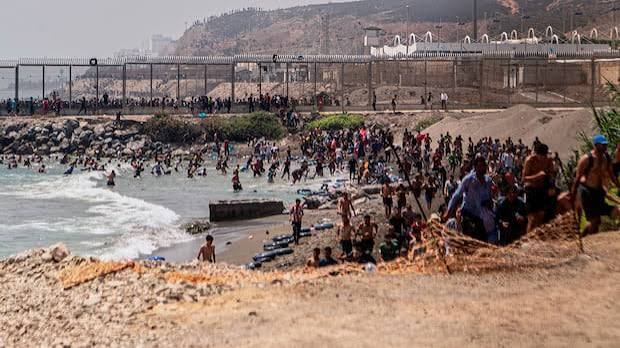
In one of the largest mass border breaches Europe has seen in modern times, Spain’s tiny enclave on the North African coast was overwhelmed as an estimated 49,000 migrants crossed from Morocco by land and sea in just 24 hours. Spain deployed its military, Morocco reinforced the frontier, at least 18 people died during the rush, and the crossing was largely halted the following day.
The numbers are staggering. Ceuta is home to only about 85,000 residents. In a single day, arrivals equaled well over half the city’s population. This was a demonstration that, if the border gives way, hundreds of thousands of people can enter European territory almost immediately.
For migrants, the calculation is understandable. Europe offers safety, opportunity, and hope for a better life.
For governments, the calculation is entirely different. No country can meaningfully screen tens of thousands of arrivals in real time. Authorities cannot determine identities, criminal histories, security concerns, or asylum claims after a border has already been overwhelmed.
And this is not merely Spain’s problem.
Spain guards one of the European Union’s external frontiers. The Schengen system depends on every member securing that frontier because what enters one country can ultimately affect them all. Spain’s border policy is therefore not just Spain’s policy—it affects Paris, Rome, Berlin, Amsterdam, and every other country that has entrusted its own internal borders to the Schengen system.
That is why Italy’s Giorgia Meloni and other European leaders reacted so sharply. Their concern is larger than Ceuta itself. It is whether Europe can preserve free movement inside the Union if member states adopt fundamentally different approaches to controlling who enters from outside.
“We are in the process of bringing together the competent bodies and, once these meetings are over, we are ready to act, including through exceptional measures… such as suspending the Schengen agreement with Spain.” – Italian Prime Minister Giorgia Meloni
Since the Arab Spring, Europe has absorbed millions of refugees and migrants fleeing civil wars in Syria, Libya, Afghanistan, and elsewhere. Those movements reshaped European politics, accelerated the rise of nationalist parties, and transformed debates over sovereignty, identity, and integration.
Ceuta is different. It revealed a land route from Africa into the European Union capable of moving extraordinary numbers of people in an astonishingly short period. If this becomes an established migration corridor, Europe could face pressures unlike any it has experienced since the Arab Spring, and it will likely far surpass it in terms of numbers.
From here, several futures are possible.
- Spain could conclude that maintaining Ceuta and Melilla is no longer worth the political and financial cost and eventually negotiate their return to Morocco.
- Spain could dramatically strengthen its external border, making clear that humanitarian obligations do not require surrendering control over who enters the country.
- Or Spain could continue on its current course, betting that Europe will absorb the consequences. If so, pressure from its European partners will intensify. Calls to suspend Spain from Schengen or restore permanent internal border controls will become louder. While a “Spexit” (Spain’s exit from the European Union) remains a remote possibility, the political strains that produce such conversations would only deepen.
There is another outcome that deserves more attention beyond the immediate decisions of the government of Spain.
If governments are seen as unable or unwilling to control migration, voters rarely abandon the issue. They abandon the governments. Nationalist and right-wing parties would likely continue to gain strength across Spain and Europe. The political backlash would not stop at the wave of immigration. It would spill over into wider suspicion of immigrant communities and minorities who had no role in creating the crisis, further polarizing European society.
History offers reminders.
More than thirteen centuries ago, Muslim armies crossed from North Africa into Iberia and established Al-Andalus, reshaping the peninsula for centuries. Eventually, Spain pushed out all of its Muslims in a forced expulsion which also included the Jews. The roughly 200,000 Jews of Spain were expelled on July 31, 1492, and Spain has been basically Jew-free since then.
More recently, in the 1930s and 1940s, the National Socialists of Germany marked for extermination millions of unwanted people, including Jews, Roma and those with disabilities. Fierce tribalism marked foreigners as enemies, regardless of the actions of the residents.
Today, the choice is not between compassion and security. A democratic society requires both.
The Strait of Gibraltar remains one of the shortest distances between Africa and Europe. Ceuta has reminded Europe that borders are not abstract lines on a map: they are political decisions. If Europe chooses not to control its external frontier, events like this will not remain exceptional. They will become the new normal. As will the ramifications.
Will Europe decide who enters its borders, or will it let events on the ground make that decision for it. Each is a deliberate political decision.


