
Four Latin American countries have moved their embassies to Jerusalem, all headed by conservative presidents. Argentina’s Javier Milei wants to be next, and Brazil’s conservative opposition has promised to follow. A new political map of Latin America is emerging, and Jerusalem sits at its center.
Colombia became the latest country to join this movement in October 2026, following Guatemala, Honduras and Paraguay. The pattern is unmistakable: conservative governments are embracing Israel and recognizing Jerusalem as its capital, while much of the Latin American left increasingly identifies with the Palestinian cause and opposition to the Jewish state.
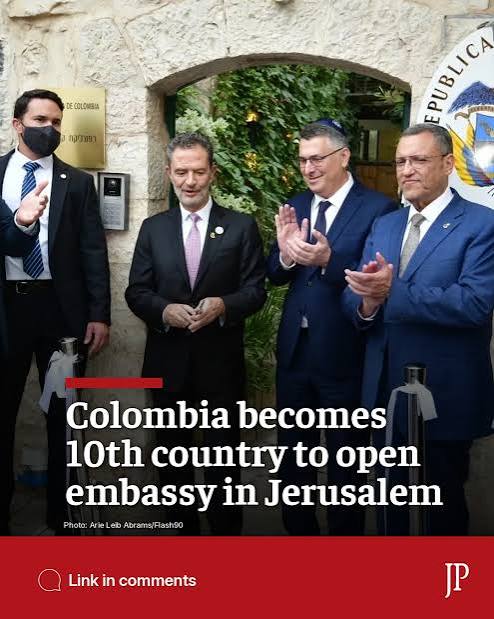
Colombia offers the clearest illustration of this ideological divide. Left-wing President Gustavo Petro severed diplomatic relations with Israel in 2024, halted coal exports and embraced international efforts to isolate the Jewish state. His conservative successor, Abelardo de la Espriella, reversed course, restored relations and opened an embassy in Jerusalem.
The same country, the same Israel, the same Jerusalem. A different president and an entirely different worldview.
For Latin America’s conservatives, Israel represents national sovereignty, religious heritage, technological achievement, military strength and partnership with the United States. For much of the Latin American left, Israel is viewed through the language of colonialism, Palestinian dispossession and opposition to American influence.
Religion reinforces this divide. Guatemala and Honduras have substantial evangelical Christian populations whose attachment to Israel is rooted in biblical belief. Conservative movements throughout Latin America increasingly draw support from these communities, for whom Jerusalem is central to Jewish history and Christian faith.
Argentina’s Javier Milei has become its most enthusiastic champion. In April 2026, Milei and Israeli Prime Minister Benjamin Netanyahu launched the Isaac Accords, a framework intended to strengthen Israel’s political, economic and security relationships across Latin America.
The name carries deliberate biblical symbolism. The Abraham Accords brought Israel together with Arab nations through the shared heritage of Abraham. Isaac, Abraham’s son, represents the continuation of God’s covenant through Jacob, whose name became Israel. Where the Abraham Accords emphasize common ancestry between Jews and Arabs, the Isaac Accords invoke the particular biblical heritage of Israel and its connection to nations identifying with Judeo-Christian civilization.
Milei has committed more than speeches to this vision, directing his $1 million Genesis Prize award toward establishing an organization to advance the initiative. Legislators from across Latin America have already gathered to promote stronger relations with Israel, combat antisemitism and encourage additional embassy relocations.
The movement also has a powerful strategic adversary: Iran.
Iranian-backed terrorism has already devastated Jewish communities in Latin America. Argentina suffered the 1992 bombing of the Israeli Embassy in Buenos Aires and the 1994 bombing of the AMIA Jewish community center, which killed 85 people. Argentine authorities have attributed both attacks to Hezbollah and Iran.
The Isaac Accords seek cooperation against Iranian terrorist networks, antisemitism, drug trafficking and transnational criminal organizations. Israel offers intelligence capabilities, cybersecurity expertise, military technology and experience confronting Iranian proxies. Latin American governments offer regional partnerships capable of disrupting hostile networks operating across the Western Hemisphere.
Jerusalem thus becomes both a declaration of political identity and the gateway to a broader security alliance.
The next major test comes in Brazil, Latin America’s largest country. President Luiz Inácio Lula da Silva has been among Israel’s harshest regional critics, while his conservative challenger, Flávio Bolsonaro, has promised to relocate Brazil’s embassy to Jerusalem. Their October 25 presidential runoff could determine whether the region’s largest economy joins this emerging alignment.

There are vulnerabilities. Paraguay moved its embassy to Jerusalem in 2018, reversed the decision months later under a new president, and restored it in 2024. Diplomatic commitments can change with elections. The Isaac Accords seek to build deeper economic, security and institutional relationships capable of surviving those political shifts.
The Abraham Accords brought Israel closer to the Arab world. The Isaac Accords seek to bring Latin America closer to Israel. Conservative presidents are leading that transformation, turning recognition of Jerusalem into a declaration of political identity, shared heritage and strategic allegiance.
Jerusalem has become a dividing line in Latin America’s ideological struggle, and its conservatives are choosing sides.


