Mark Medoff titled his play Children of a Lesser God to expose the way society infantilized the deaf, treating them as incomplete people. The phrase still burns because it names the humiliation: being allowed to exist but denied equal dignity.
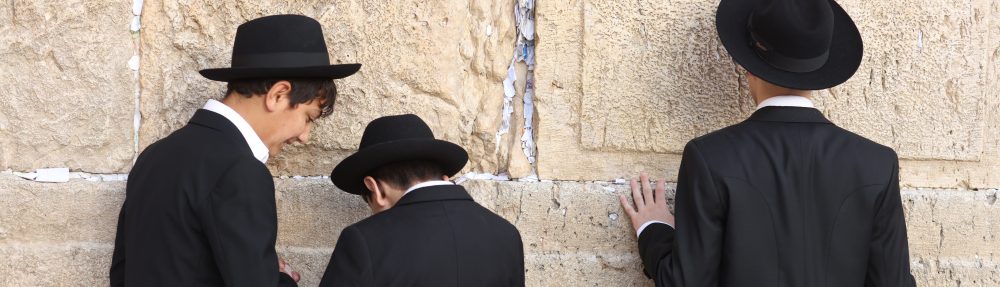
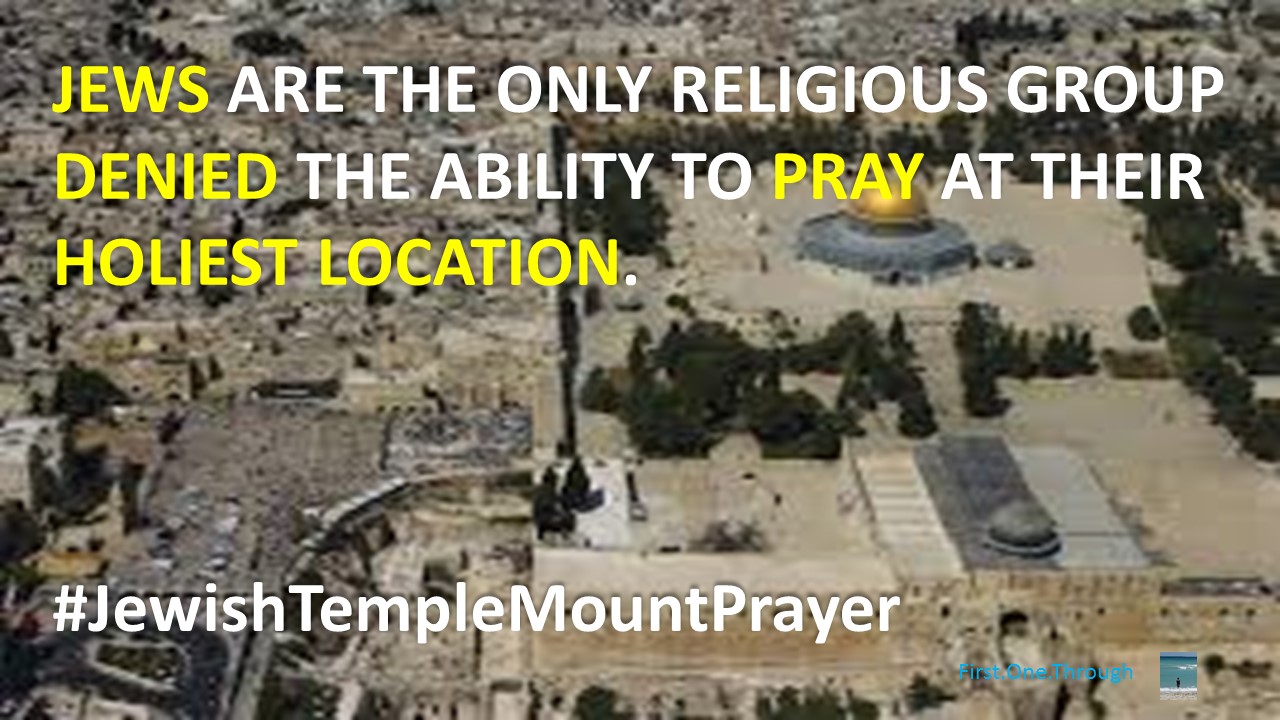
That is precisely the status of Jews on the Temple Mount. The holiest place in Judaism, the very ground of the First and Second Temples, the site of the binding of Isaac. Yet Jews are barred from uttering a prayer there. Visitors, reluctantly and barely; worshipers, never. The “status quo” enforced by the Jordanian Waqf with United Nations’ support dictates that Jews must keep their mouths shut.
It is a civic cruelty disguised as compromise. Jews are told they may stand in the place of their ancestors, but only as tourists in a museum, not as children before God. Muslims pray freely on the Mount by the millions, but Jews are gagged at their own holiest site. That is not neutrality — it is Islamic Imperialism.
The excuses are familiar: security, stability, avoiding unrest. But those words simply sanctify discrimination as pragmatism. As every Jew is expelled for moving lips in silent prayer, the world is reminded: some children are still treated as children of a “lesser” god.
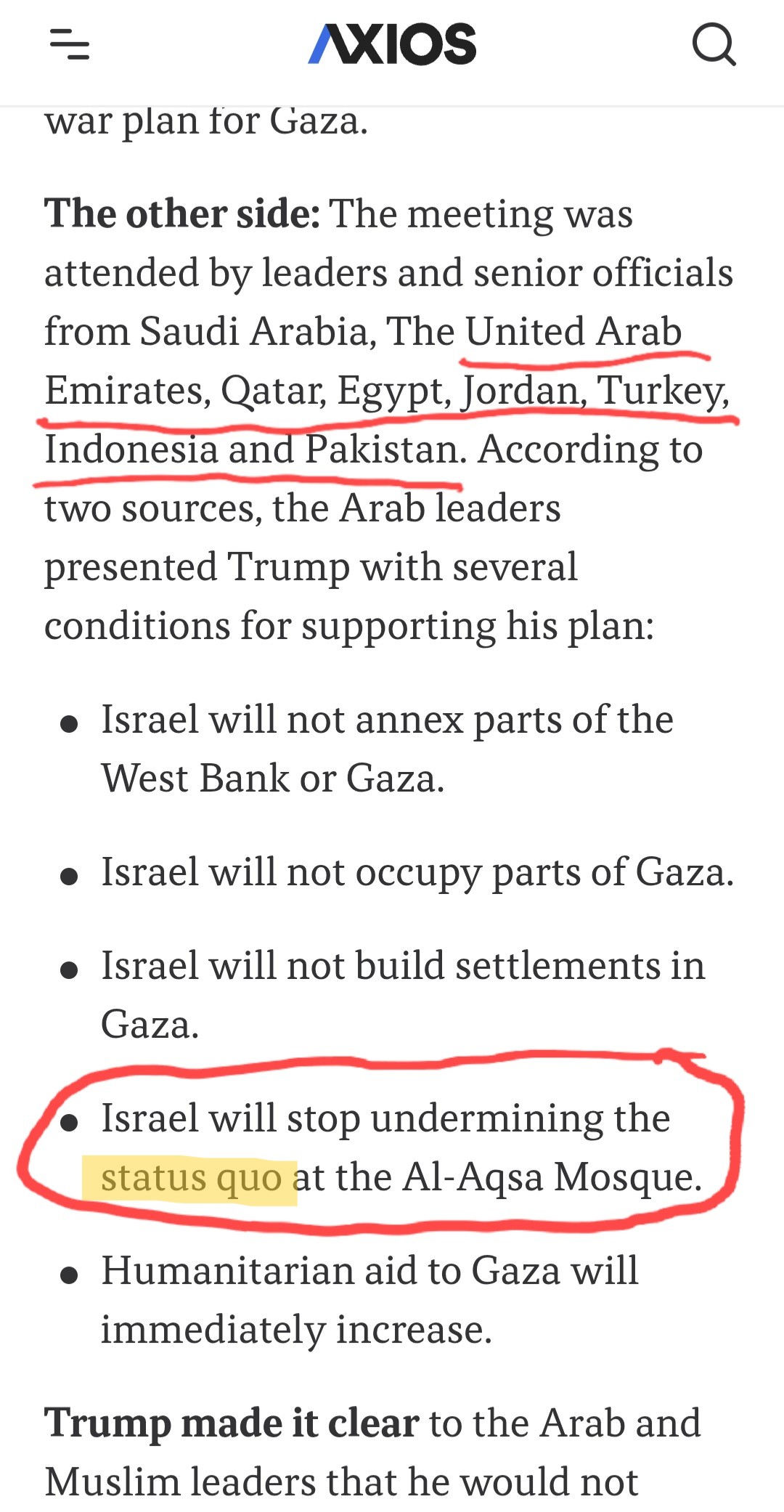
At the very moment Jews prayed in synagogues over Rosh Hashanah 5786 in September 2025, reading the story of Abraham binding Isaac on the Temple Mount and repeatedly praying for a complete Jerusalem, the Islamic world – from as far away as Pakistan and Indonesia – made demands of the United States that it would ensure that Israel maintains the “status quo” on the Mount. The despicable continued humiliation of Jews was essential for them even under the guise of stopping the Hamas war. Even above “humanitarian aid to Gaza.”
Islamic world makes demands on the United States to stop the war – and Jews attempting to pray at their holiest location
International diplomacy has institutionalized the humiliation of Jews. The so-called status quo is nothing but a permanent statement of inequality.
Medoff’s play forced audiences to confront a society that silenced the deaf. The Temple Mount forces us to confront a world that silences Jews. While both are intolerable, the latter is demanded at the anti-Jewish United Nations.
Words earn their meaning in how they are used. When a slogan is repeatedly screamed as an incitement to burn, stab, gun down, and terrorize people because of who they are or whom they support, it ceases to be mere rhetoric. It becomes a battle cry — and its meaning is what the battle cry does.
We have painful, recent proof of the sickness. In several separate, well-documented attacks in the United States, suspects shouted “Free Palestine” while carrying out murderous attacks. Investigations and prosecutions have treated these shouts not as abstract political slogans but as part of a violent intent to harm people identified as Jewish, Zionist, or supporters of Israel.
Man shoots people, killing one in New Hampshire yelling “Free Palestine”
When the slogan is used repeatedly for arson, firebombs, knives and bullets, its practical meaning is indisputable: it is a call for violence against Jews and Israel supporters. Institutions that track antisemitic violence warn that normalizing chants tied to violence contributes directly to more attacks. We see that “Free Palestine” is a call to murder.
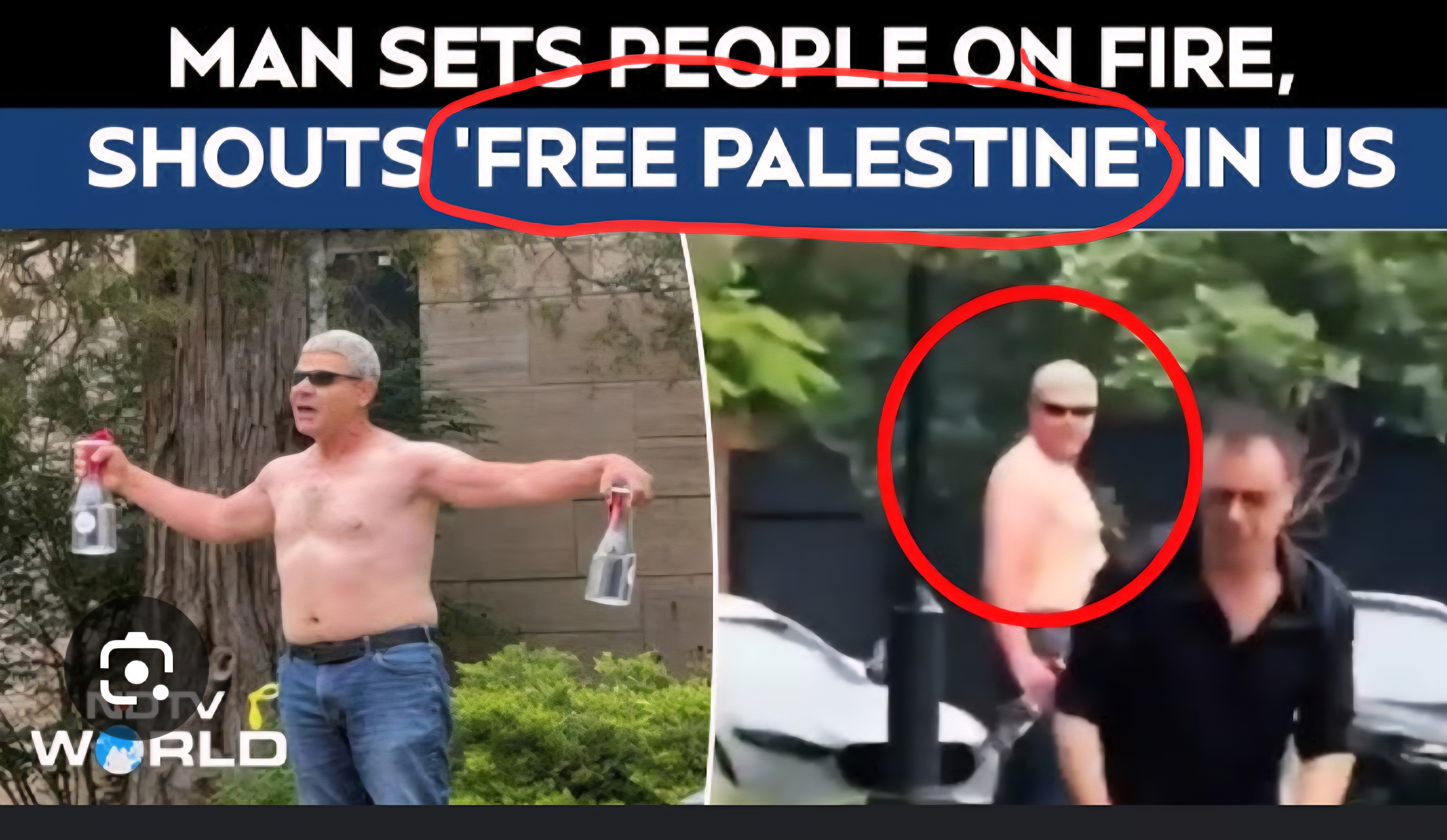
Man burns people alive, killing one in Boulder, CO, shouting “Free Palestine”
That ugly truth cannot be dressed up in euphemisms or by pleading free-speech. “Free Palestine” is the current moment’s “Allahu Akbar,” the chant of radical jihadists intent on killing “infidels.” For the assailants, today’s infidels are Jews and Israel supporters.
Couple killed in Washington, DC by man yelling “Free Palestine”
It begs the question of what a “Free Palestine” means when used so frequently in murderous rampages. Are there zealots killing because they want a peaceful Palestine, or is it more likely that they seek a Palestine that is free to kill Jews the way thousands of Gazans did on October 7, 2023?
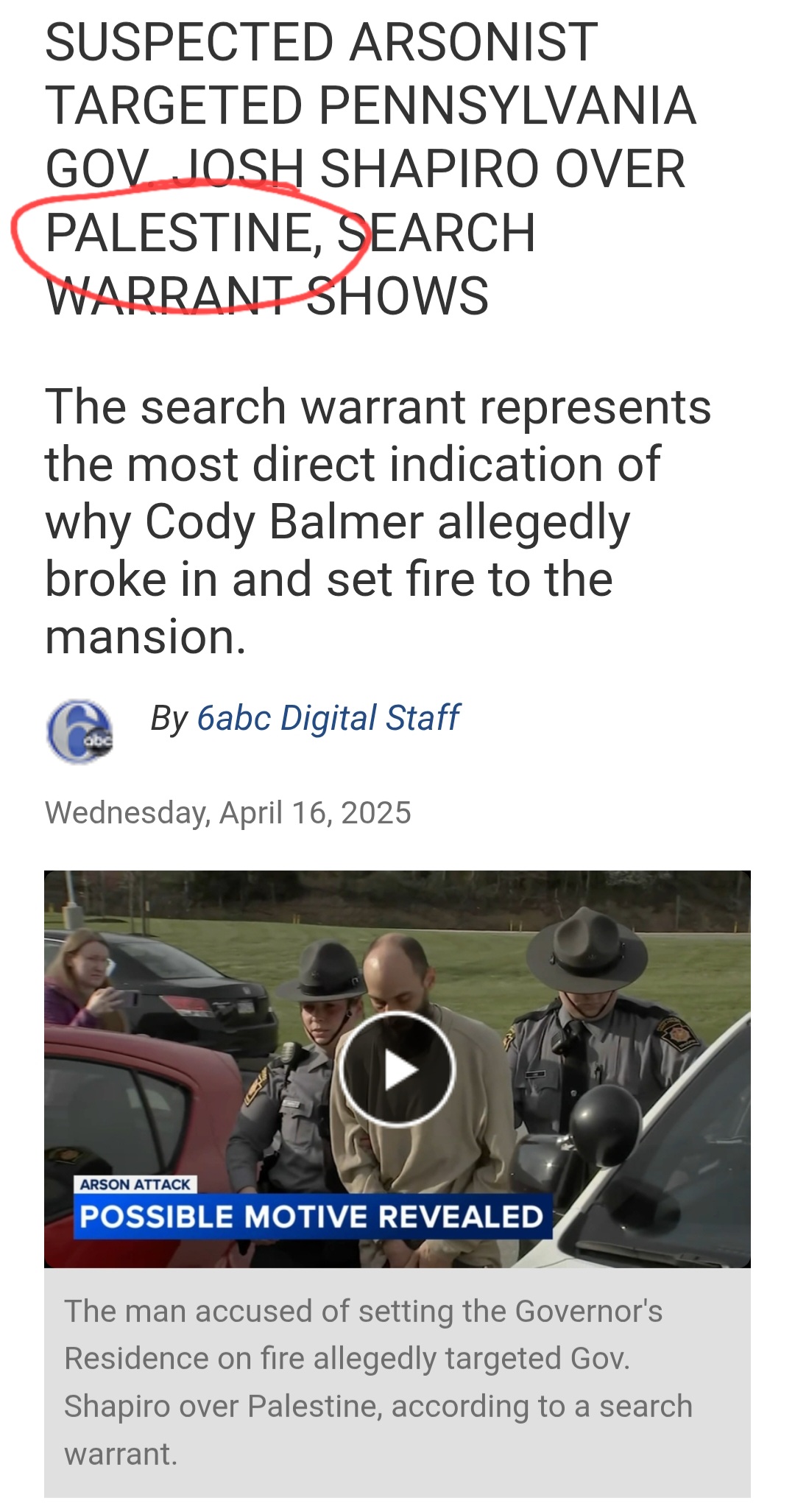
Man tries to kill Pennsylvania Governor Josh Shapiro and his family on Passover over “Palestine”
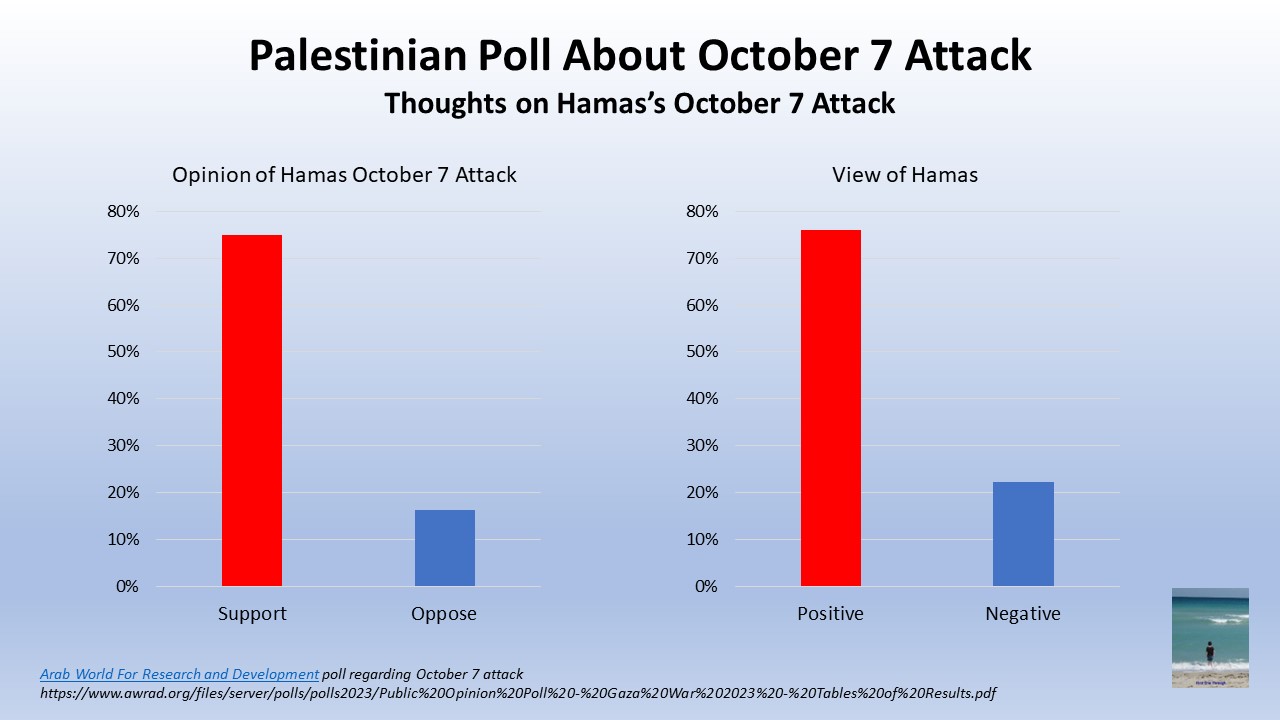
The one area that became a “Free Palestine” was Gaza when Israel left the region in 2005. Within a year, the political-terrorist group Hamas won 58% of the Palestinian parliament election and a year later took over Gaza. In the aftermath of the October 7 massacre in Israel, 72% of Palestinian Arabs supported the attack and the majority still want Hamas to rule according to Palestinian polls.
“Free Palestine” means death to Israel supporters outside of Israel, and death to Jews inside of Israel. Knowing this, are western countries recognizing a Palestinian State to both get a more proportionate death toll in the war and to kill more Jews in their own countries?
Palestinian terrorism has gone global. The question is whether the Palestinian Authority’s “Martyr’s Fund” start to pay killers of Israel supporters globally (as predicted on these pages in August 2023).
“Decolonization” has become one of the most fashionable buzzwords of the modern age. It is taught in schools, shouted in protests, and deployed at the United Nations as a moral bludgeon against the West. European imperialists, we are told, robbed indigenous peoples of their land, stripped them of their culture, and erected foreign regimes on stolen soil. The work of decolonization — dismantling those legacies and restoring dignity — has been cast as the great ethical project of our time.
But what of the other colonial power that swept across continents, subjugating peoples and erasing their sacred spaces? What of Islamic imperialism, which invaded the Jewish promised land centuries ago, laying claim to sites that predated Muhammad’s birth by millennia?
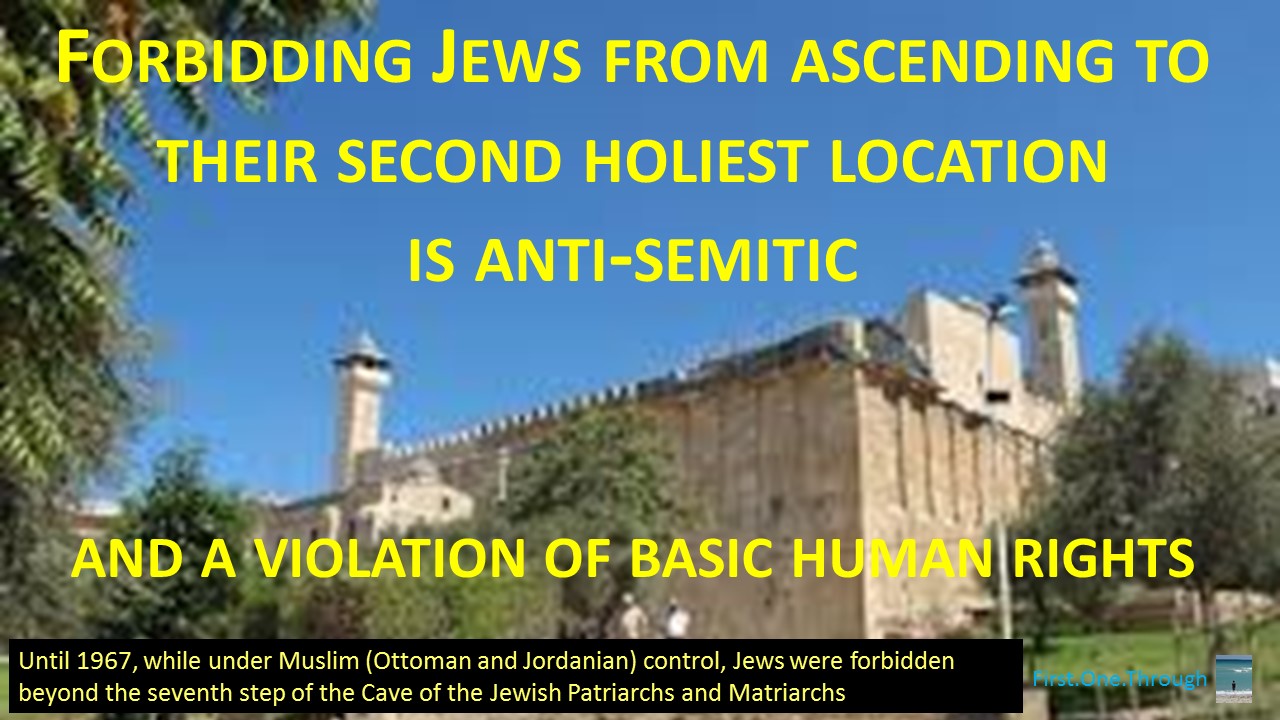
Consider Hebron, the resting place of Abraham, Isaac, Jacob, Sarah, Rebecca, and Leah. For Jews, it is the Ma’arat HaMachpelah, the Cave of the Jewish Matriarchs and Patriarchs — a holy site woven into the very text of Genesis. When Muslim conquerors took over, they renamed it the “Ibrahimi Mosque,” transformed it into a shrine for their own creed, and barred Jews from entering. For seven hundred years, Jews were not even allowed to set foot past the seventh step of the building.
This was not preservation; it was expropriation. A classic colonial tactic: erase the indigenous name, overwrite the meaning, and forbid the natives from practicing their own faith.
But unlike the narratives drilled into young students about European settlers in Africa or Asia, the Jewish story is not told.
In 1967, Israel liberated Hebron, and Jews once again could pray at the burial site of their patriarchs and matriarchs. Slowly, painstakingly, the work of de-Islamification has begun — not by erasing the Muslim presence, but by restoring Jewish rights. Jews may now pray, Jews may now enter, Jews may now sanctify their ancestral home.
And in June 2025, a historic step was taken: the Israeli government transferred administration of the second holiest site in Judaism to Jewish leaders in Kiryat Arba, removing it from the sole control of the Islamic waqf. This was neither vengeance nor displacement. It was simple justice — the recognition that all of those buried at the site are the founders of Judaism (while only one is revered by Muslims), and Jews are the indigenous people in the land as proven by that fact.
Decolonization movements have received global endorsement. Universities run entire programs on “postcolonial studies.” Yet when Jews engage in the parallel project of reclaiming their holy spaces from centuries of Islamic imperial rule, the world looks away — or worse, condemns.
Why should “decolonization” be celebrated while “de-Islamification” is scorned? Both are projects of justice. Both undo centuries of cultural theft. Both restore indigenous peoples to their rightful heritage.
If the United Nations were consistent, it would champion de-Islamification alongside decolonization. It would recognize Jewish efforts as authentic acts of restoration, not “provocations.” Schools should teach children that just as Africans reclaimed their lands from European empires, Jews are reclaiming their sacred spaces from Islamic erasure.
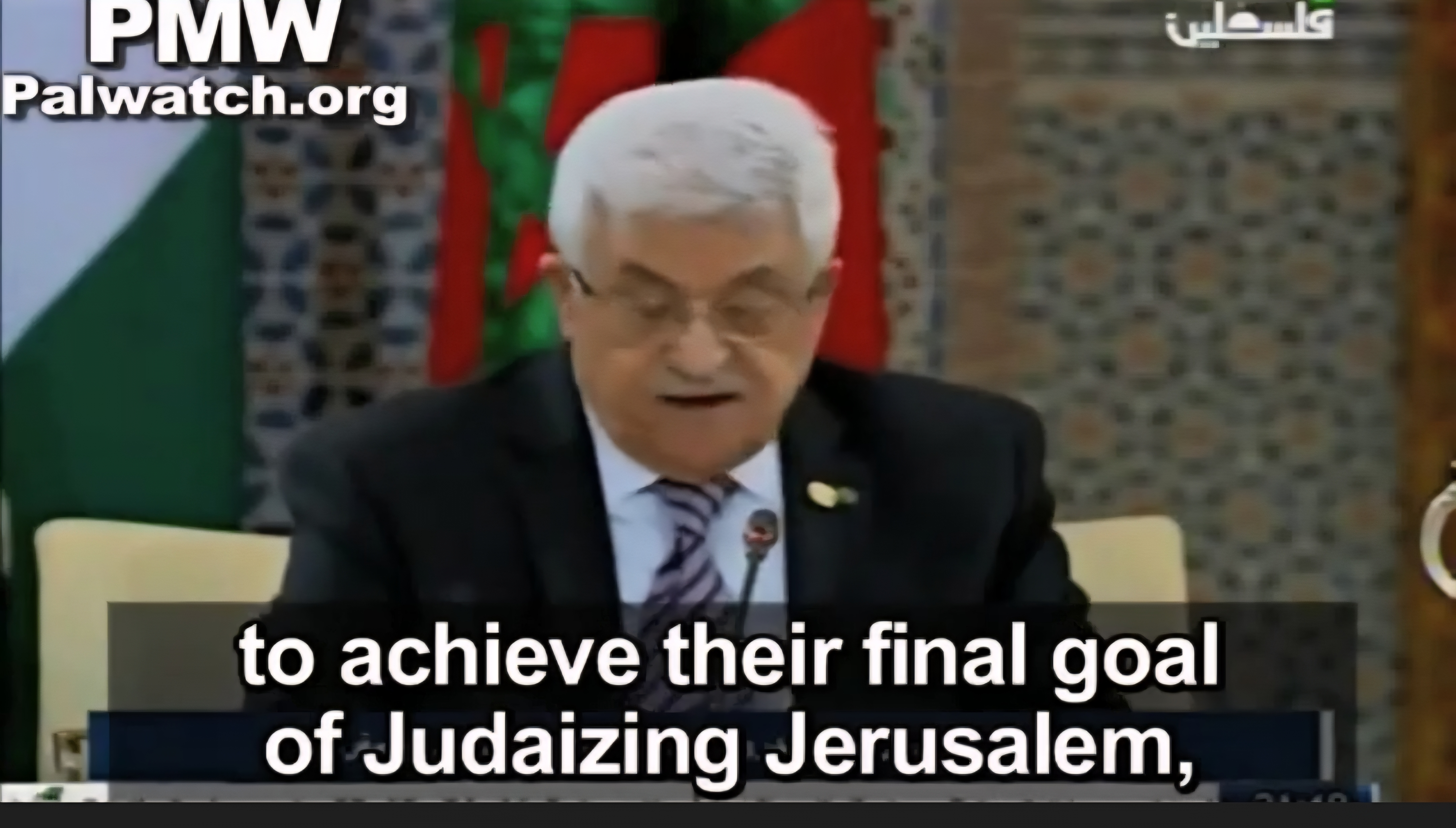
Instead, the UN gives its platform to radical jihadists who claim that Israel is trying to “Judaize” the Jewish holy sites in Jerusalem and Hebron. It’s an offensive smear deliberately made to try to erase the reality of their Islamic imperialism, colonization, ethic cleansing and cultural appropriation.
Palestinian Authority President Mahmoud Abbas talking about the “Judaization” of Jerusalem to conceal that Islamic cultural appropriation.
The jihadists fear that after Hebron, the Jews will come for the site they know is really Jewish – Jerusalem. They are calling the transfer of the Cave of the Jewish Matriarchs and Patriarchs from the Hebron Waqf to Jewish authorities a “rehearsal for al Aqsa” in Jerusalem. They know the Jewish Temple Mount is the holiest site for Jews and Muslims invaded and took the site. They are proud of the feat and fear a reversal would legitimize a people they consider “sons of apes and pigs.“
There is no “Judaization” of Jerusalem and Hebron. There is de-Islamification.
Decolonization may be decades old, but de-Islamification is still in its early chapters. It deserves not only legitimacy, but applause.
For the last several parshas, Moses has been addressing the children of Israel with a constant refrain: follow the commandments in the land, and you will be blessed; stray from them, and you will lose your inheritance. To us today, these verses are about mitzvot — the commandments that define Jewish life. But to the Israelites standing on the banks of the Jordan, the charge must have sounded different.
They had just watched an entire generation die in the desert. The memory of the spies still lingered — those men who declared that the land was too difficult to conquer, that the people within were too mighty to destroy. Could such whispers have been forgotten? Surely the children had heard rumors of what their parents had repeated around campfires for forty years. And now, standing on the edge of the land, they might have expected Moses to lay out the strategy, the order of battle, the plan of conquest.
Instead, Moses did something else entirely. He skipped the war. He jumped straight to what life would look like after. The rules of worship, the rhythms of daily life, the blessings and curses of obedience. It was as if the battles ahead — Jericho’s walls, Ai’s ambush, the wars against mighty kings — would be non-events.
Imagine a coach gathering his team before kickoff and skipping the playbook. Instead, he passes out dinner menus for the victory banquet to follow. No Xs and Os. No defensive schemes. Only a vision of celebration after the game.
Why? Perhaps it was Joshua’s role to direct the war, the next chapter of the Tanach already waiting to be written. Perhaps Moses, who knew he would not enter the land, wanted to leave the people with principles for the future. Or perhaps Moses was teaching something deeper: that the wars were only one part of securing a peaceful future. That the real challenge was not in winning the land, but in living faithfully within it.
The truth is, the dream of the land was already realized — even if the Israelites didn’t know it. Hundreds of years of diaspora were ending. The promise was being fulfilled before their eyes, not through a war plan but through divine decree. The land would be theirs. The victory was guaranteed. What remained in doubt was whether they would keep it.
Moses understood: the conquest would be won by God’s hand, but the inheritance would be maintained only through God’s law. The spies had feared giants and fortified cities, but the true danger was disobedience and forgetfulness once the land was secured. That is why Moses spoke not of how to conquer, but of how to live.
The people knew that Joshua would lead them to battle, just as he had over Amalek. And they had seen that Moses was their intermediary with God, who prayed for their success (Exodus 17:10-13). Now Moses was telling the people: you no longer need me as your agent; you are they keys to victory. Prayers during battle to secure victory; obedience thereafter to keep the peace.
Aaron and Hur hold up the hands of Moses in prayer as he grew tired, asking God’s help for Joshua to lead the people to victory in battle
And so it is today. The battles of our time are real, but they are only part of the threat. We must not be complacent. We must not assume that everything is on the battlefield. Beyond the battle plans lies our own responsibilities in living a meaningful life and knowing the source of our strength.
ACTION PLAN
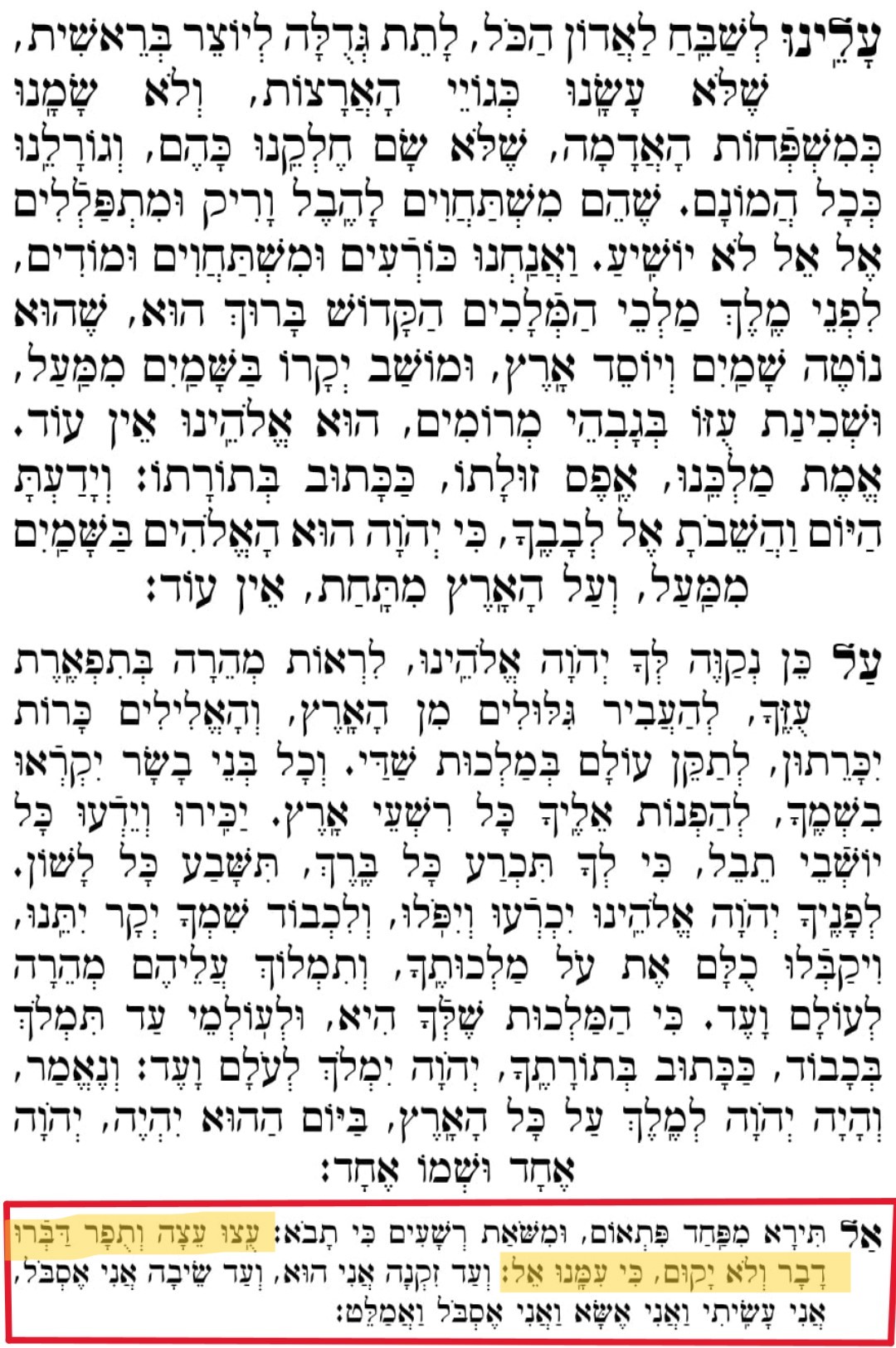
Go to the United Nations and sing outside the line from Al Tira, “Utzu Etza”: “Take counsel together, and it shall come to nought; speak the word, and it shall not stand: for God is with us.”
A Muslim who visits Mecca is called a Hajji. It is one of the highest honors in Islam, the completion of the Hajj pilgrimage, celebrated by family and community as a sacred accomplishment.
A Catholic who travels to the Vatican is a pilgrim. For centuries, the faithful have journeyed to Rome, walking into St. Peter’s Square with reverence, greeted with blessing and legitimacy.
And a Jew who goes to the Temple Mount in Jerusalem — the very place where the First and Second Temples once stood, the holiest site in Judaism? That Jew is branded a provocateur. Not a pilgrim, not a worshiper, not a faithful soul ascending to pray — but an instigator, an agitator, an accused trespasser, a “settler” on their own sacred ground.
The disparity could not be starker. What is celebrated as devotion for others is condemned as incitement for Jews. For Muslims, the Hajj is a right; for Catholics, Vatican pilgrimage is honored; but for Jews, even quiet prayer on the Temple Mount is labeled an offense — by the United Nations, NGOs, and international bodies.
It is not only hypocrisy; it is erasure. To deny Jews the name of pilgrim is to deny Jewish history, Jewish identity, and Jewish legitimacy. It casts the holiest place in Judaism as alien to Jews themselves, a desecration of memory turned into policy.
And why? Because the world has normalized the jihad. It has allowed Islamic Supremacy to dictate permissible behavior, even in the Jewish holy land.
The truth is simple: a Jew ascending the Temple Mount is not incitement. It is the most ancient pilgrimage of them all — the echo of three millennia of devotion, commanded in Torah, rooted in covenant, and carried in every prayer whispered toward Jerusalem, before Islam was even created.
The real provocation is not the Jew who prays on the Temple Mount but a world that dares to tell Jews they don’t belong at the center of their faith.
ACTION ITEM
Come to the United Nations in New York City and demand Jewish rights and freedom of religious assembly in Jerusalem.
When the Torah commands the farmer to bring his first fruits, it does not let him talk about his soil or his labor. Instead, the ritual begins: “My father was a wandering Aramean…” (Deuteronomy 26:5) The commentators note that gratitude is not complete without memory. To thank God for the harvest, one must first recall that the Jewish story began in exile and slavery. Only against that backdrop does the basket of figs become miraculous.
Later in the same parsha (Deuteronomy 28:4), the Torah turns to blessings and curses. If Israel listens to God, “Blessed shall be the fruit of your womb, the fruit of your soil, and the fruit of your livestock.” If not, those very fruits will wither. Here too, fruit is not agricultural output — it is covenantal currency.
Put together, the two passages form a cycle. The first fruits ceremony roots gratitude in memory: remember that you were once landless and fruitless. The blessings and curses tie the future of fertility to obedience: remember that your continued abundance is not guaranteed.
And notice where this all happens: Jerusalem. The farmer did not simply thank God in his vineyard or whisper gratitude in his kitchen. He carried his produce up to the city, presented it at the Temple, and declared his history publicly. Jerusalem was not just a capital; it was the beating heart of Jewish memory and faith. The fruits gained meaning when they were placed before God in the city chosen for His name.
The Old City of Jerusalem including the Jewish Temple Mount
This is why the prophets, the rabbis, and Jewish history itself encircle Jerusalem. The city is not peripheral to Judaism — it is central. It is where private labor becomes national testimony, where agriculture becomes covenant, where the wandering Jew becomes rooted in a people’s eternal home.
To this very day, Jews sing at their wedding the verses of Psalms 137:5-6: “If I forget you, O Jerusalem, let my right hand wither; let my tongue stick to my palate if I cease to think of you, if I do not keep Jerusalem in memory even at my happiest hour.” Jerusalem is bound in memory, that same memory that reminds us of our history, our promise, our obligations.
Today, too, the Jewish people encircle Jerusalem. Jews bring their “first fruits” to the city not only in the form of produce, but through aliyah, prayer, innovation, and sovereignty. Just as in ancient days, the city transforms personal blessings into collective covenant.
And yet, the world still questions that rootedness. Governments refuse to recognize Jerusalem as Israel’s capital. Diplomats condemn the building of homes in areas like E1 — the very corridor that links Jerusalem to the rest of the land, enabling Jews from north, south, east, and west to come to their eternal city.
Ki Tavo reminds us that Jerusalem cannot be negotiable. To encircle it, to build in it and around it, is not a matter of politics but of foundational principle. Without Jerusalem at the center, our fruits risk becoming mere produce, and the people risk becoming wanderers once more.
On October 28, 2011, Lord Jonathan Sacks, the Chief Rabbi of England, came to New York City and sat with Rabbi Meir Soloviechik at Yeshiva University. Their hour long talk touched on Lord Sacks’ book The Home We Build Together, and the role of religion in society, focusing on the United States and the United Kingdom, in particular.
Chief Rabbi Lord Jonathan Sacks Speaks at Yeshiva University with Rabbi Meir Soloveichik, October 2011
In the opening remarks (3:10), Rabbi Soloveichik shared a story about Senator Joseph Lieberman, who once observed that on Simchat Torah, Jews dance with the Torah in the streets with joy, yet often fail to carry that Torah into the world during the rest of the year. It was a reminder that religion cannot remain confined to ritual but must be brought into society.
Lord Sacks followed with a story of his own. Prime Minister Tony Blair once teased him that he had reached the “boring part” of the Hebrew Bible—the lengthy passages about the building of the Mishkan (Tabernacle). Why, Blair asked, does the Torah devote hundreds of verses to it, compared to just 34 for the creation of the universe?
Lord Sacks replied:
Prime Minister, it is not difficult for an omniscient, omnipotent, infinite God to create a home for human beings. But for finite, fallible human beings to create a home for the infinite God, that is difficult.
The Mishkan, Sacks explained, was not just architecture—it was a project that united the people. More than what God does for us, it is what we do for God that transforms and binds us together. “If you want to take this diverse, fractured culture of Britain and turn it into a united nation,” Sacks said, “you have to get them to build something together.”
Rabbi Soloveichik and Lord Sacks went on to describe that the decline of religious life and secularization of Europe was tied to fewer children being born. A self-centered focus weakens families, weakens faith, and weakens society. In contrast, raising children—caring for someone more than oneself—provides both the foundation of belief and the roots of charity: “having somebody whose life you care about more than yourself, that could actually be the foundation of faith for many of us.”
Washington (D.C.) and Rembrandt
Nearly fourteen years later, on September 8, 2025, U.S. President Donald Trump held an event at the Museum of the Bible in Washington, D.C. He invited members of the newly established (May 1, 2025) Religious Liberty Commission to hear how he was advancing the centrality of religion in American public life. He said “When faith gets weaker, our country seems to get weaker. When faith gets stronger… good things happen for our country…. To have a great nation, you have to have religion.”
One of the members of the Presidential Committee on Religious Liberty is Rabbi Meir Soloveichik. He was unable to attend the speech by the president in Washington because he was giving a day long-lecture in New York City at the home of Mem and Zalman Bernstein and the Metropolitan Museum of Art for the Tikvah Fund about art, religion and western society.
Rabbi Solveichik focused on Rembrandt’s two versions of the Sacrifice of Isaac. He contrasted Abraham’s devotion to God’s command to offer his son Isaac, to the investment of love and devotion he had made in his son. The angel broke the conflict, and with it, the end of human sacrifice which was prevalent in the world at that time. From this point onward, belief in a higher power could be accompanied by protecting and investing in our children.
Religion, Children and Western Democracy
It made for an interesting sermon triptych connecting religion, children and western values: Lord Sachs, Rabbi Soloveichik and President Trump all emphasized that religion has the power to strengthen ourselves, our families, our communities and our nation.
In Lord Sacks book, The Great Partnership, published in June 2011, right before his talk at YU, he wrote:
My argument has been that contrary to the received narrative, freedom has been better served in the modern world by a religious vision rather than a secular one. The Abrahamic vision, with its insistence on the non-negotiable dignity of the human person and the importance of protected space – the families and communities that make up civil society – where relationships are not based on power, saved England and America from the worst excesses of the revolutionary politics that cost tens of thousands of lives in France and tens of millions in Russia….
Abrahamic politics, by contrast, is politics with a human face, the politics that knows the limits of power, as well as the transformative effect of free persons freely joining together to make social institutions worthy of being a home for the divine presence. Abraham politics never forgets that there are things more important than politics, and that is what makes it the best defense of liberty.”
That is the motion before Western democracies: can humble faith as embodied in “Abraham politics” lead our different faiths to help build a cohesive society of respect and growth.
Concluding Circle
The discussion of religion and democracy is being advanced passionately today because it feels abandoned.
According to Lord Sacks, democracy under secularism preached intersectionality which yielded segregation and isolationism. Rabbi Solveichik responded that “a Mayflower of persecuted religions might leave England and Europe to come to safer shores [like America].” For his part, President Trump established the Religious Liberty Commission to deal with such matters, with the first group’s term ending on July 4, 2026, on the nation’s 250th anniversary.
So it was fitting that Rabbi Soloveichik should end his talk to the Tikvah Fund, a group whose motto is “Advancing Jewish Excellence and Western Civilization through Education & Ideas,” before Emanuel Leutze’s Washington Crossing the Delaware, while President Trump was concluding his remarks in Washington, D.C.
Rabbi Soloveichik at the Metropolitan Museum of Art, September 2025
In the 1851 painting, the future president of the United States stood aboard a boat filled with a diverse crew, readying to end the rule of England and break with the British monarchy and Church of England, to establish a new democratic state in 1776. Nearly 250 years later, the Chief Rabbi of England, the president of the United States, and the rabbi leading the oldest synagogue in the United States were championing the importance of religion in strengthening democracies everywhere. A quiet revolution to return to the foundations of faith to help build a more perfect union.
Six Jewish civilians were killed simply for being Jews. Surely, a world leader would stand firm, demand justice, and declare solidarity with the victims. Yet UN Secretary-General António Guterres offered only a perfunctory “strong condemnation” via his spokesperson—no mention of justice, no demand for the murderers to be brought to account, no affirmation of solidarity.
Because these murdered Jews were in Israel.
That’s the moral vacuum of the UN.
In Mali, after a terror attack on 17 September 2024, Guterres said he “strongly condemns the terrorist attack,” extended his “sincere condolences” to victims and the government, and—crucially—urged the Malian transitional government “to ensure that those responsible for this despicable attack are held to account.”
In Pakistan, following a deadly blast, he “strongly condemned the ‘abhorrent’ attack” and offering “solidarity” with the “Government and people of Pakistan in their efforts to address terrorism and violent extremism.“
Why does Guterres morph into a fierce defender of victims—and demand justice—when the targets are not Israelis, but merely issue a dry statement when Jews are murdered? Perhaps he is waiting to find out if this Palestinian Arab terrorist was also a UN employee?
This is not nuance. It’s deliberate abandonment. A moral inversion because the villains have long ago been beatified, and Guterres has internalized that 2 billion Muslims are his real clients.
The UN has become a place where Jewish lives are treated as collateral, while other victims are granted full moral and political recognition. Guterres’s pattern isn’t subtle—it’s a glaring indictment of the UN’s moral bankruptcy.
Imagine someone telling the Jews of Europe in 1935: accept the butchering and burning of six million of your people, and in exchange, you will once more gain sovereignty in your promised land. Would world Jewry have accepted such a bargain? Unlikely. In Judaism, the value of life as supreme trumps all—perhaps even over the divine inheritance of the Land of Israel itself.
That is why Jews do not take pride in the defenseless millions murdered in the Holocaust. They mourn them, honor their memory, and vow “never again.” The lesson is not that Jewish blood must be spilled for redemption, but that Jewish life is sacred and must be protected at all costs.
This moral foundation has been a hallmark of Jewish thought for millennia. The Talmud (Sanhedrin 4:5) teaches that “whoever saves a life saves the world.” Zionism, too, was never about blood sacrifice but about safeguarding Jewish existence and ensuring dignity, freedom, and self-determination. The rebirth of Israel is framed as a triumph of survival, not of slaughter.
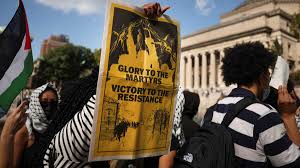
Yet for Palestinian Arabs, the moral calculus is inverted. Martyrdom is not mourned but celebrated. “Glory to the martyrs,” they shout, glorifying not only the dead but the genocidal jihadists of Hamas who carried out the October 7 massacre of unarmed Jews. Streets, schools, and summer camps are named for suicide bombers and killers. Death in the service of destroying Jews is not a tragedy but an achievement.
Columbia University placard of “Glory to the Martyrs”
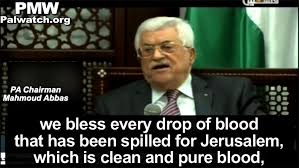
This glorification of death is not limited to fringe radicals. The majority of Gazans have always supported slaughtering Jewish civilians in Israel. Yasser Arafat, the father of the Palestinian national movement, repeatedly praised the “martyrs” who died attacking Israelis, insisting that “our blood is cheap compared to the goal [Jerusalem].” His successor, Mahmoud Abbas, continues the same practice. He honors terrorists killed while attacking Israelis, declaring that “we bless every drop of blood that has been spilled for Jerusalem.” The Palestinian Authority, under Abbas, even pays stipends to the families of those who die murdering Jews—the so-called “martyrs’ fund.”
Palestinian Authority President Mahmoud Abbas blesses blood “spilled for Jerusalem”
The same ethos echoed recently in the United States. At the People’s Conference for Palestine in Detroit, Michigan in August 2025, the crowd erupted in cheers for Gaza. Lameess Mahanna, sporting a shirt of the Palestine Youth Movement—employed at Columbia University—declared that the end of Israel would be “justice.” (1:35:00) She closed her remarks by leading the audience in a chant: “Say it clear and say it loud: Gaza, you make us proud!”
If Gaza, in her telling, is suffering a “genocide,” how can its dead make her and the thousands who echoed her cry, “proud?” The answer is chilling: because human life is secondary. For her, for Hamas, for the Palestinian leadership stretching from Arafat to Abbas, and from Gaza to Detroit, “justice” is not measured in lives saved, but in Israel’s disappearance. Every dead body is not a tragedy but a step toward their perverted form of “justice:” erasing the Jewish state and replacing it with Arab Muslim rule.
This is the precise inverse of the Jewish ideal. Jews mourn their murdered; Palestinians exalt theirs. Jews sanctify life; Hamas sanctifies death. Jews seek peace with dignity; Palestinian leaders glorify death as the path to victory. The Jewish lesson of the Holocaust is the necessity of Jewish strength to prevent further massacres. The Palestinian lesson of their own history is that more massacres are required for them to have “dignity.”
Which brings us to the central question: can two peoples animated by such irreconcilable values ever truly coexist? One side views life as sacred above all else. The other views life as expendable, even desirable, when spent in the service of destroying its cohabitants.
Coexistence demands a shared commitment to life. Without that, “peace” is a dangerous mirage—a prelude to slaughter, the ultimate source of perverted pride.
Hamas is genocidal. Evil. Its barbarous attacks on women and children are burned into the minds of anyone with a conscience. Its antisemitic charter leaves no doubt about its goal: kill the Jews, erase Israel, and replace it with a Sharia-run terror state.
As sick and twisted as that sounds, at least Hamas has a selfish motivation — they want the land, the power, the glory.
But what about the people waving Hamas flags on Western streets? The “activists” blocking bridges, intimidating students, and screaming for “resistance” while sipping lattes in safe democracies? They gain nothing material from Hamas’s success.
Their prize is watching Jews suffer.
Every synagogue with a new police guard. Every Jewish family installing security cameras. Every Jewish kid who removes a Star of David necklace before walking into school. People holding events at “undisclosed locations.” These moments are their theater. The sight of Jews — once confident, prosperous, “privileged” — now nervously glancing over their shoulders is the payoff.
Can you imagine people defacing the 9/11 memorial? For what purpose would they do such a thing? The carved names were innocent people murdered at work by fanatical jihadists. Yet hundreds of New Yorkers rip down posters of hostages held in Gaza. People in Boulder, CO, burn and shout at people who want innocent people reunited with their families. The attacks on hostage supporters is not for Gaza, but to torment Jews.
Memorial for victims of September 11, 2001 jihadi attack onthe Twin Towers in New York City (photo: First One Through)
Hamas is an antisemitic death cult, and its western supporters are sadists. They want Jews to run, to hide, to shrink. To stop asserting their place in society. To become ghettoized again. Marked as “enemies,” unwelcomed.
The “resistance” has been revealed to be against Jewish safety – anywhere.