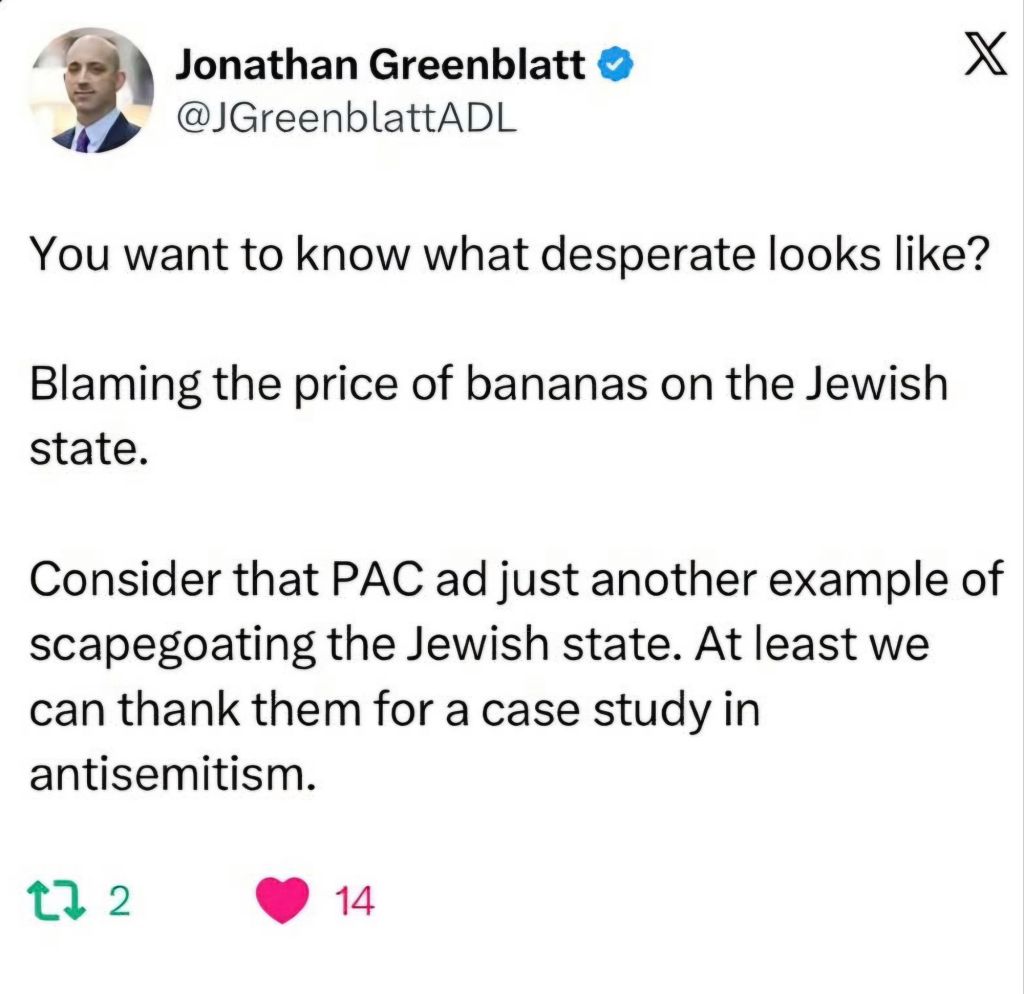
A political ad backing Abdul El-Sayed tells Michigan families that America’s support for Israel is part of the reason they cannot afford groceries. It turns Israel into the culprit for economic pain and casts Americans who support Israel as politicians bought by a foreign power, choosing Israel over their own neighbors. That is the old dual-loyalty smear dressed up as a grocery-price argument.
“Even though the rage of the people sometimes flares high against the eternal blood-sucker [Jew], it does not in the least prevent him from reappearing in a few years in the place he had hardly left and beginning the old life all over again. No persecution can deter him from his type of human exploitation, none can drive him away; after every persecution he is back again in a short time, and just the same as before.” – Adolf Hitler, Mein Kampf
The ad comes from Rebellion PAC, founded by Cenk Uygur. It links U.S. aid to Israel and the war in Gaza to the cost of food, while accusing Republican Mike Rogers of putting Israeli interests ahead of Michigan families. The Anti-Defamation League’s Jonathan Greenblatt condemned the ad as scapegoating Israel.
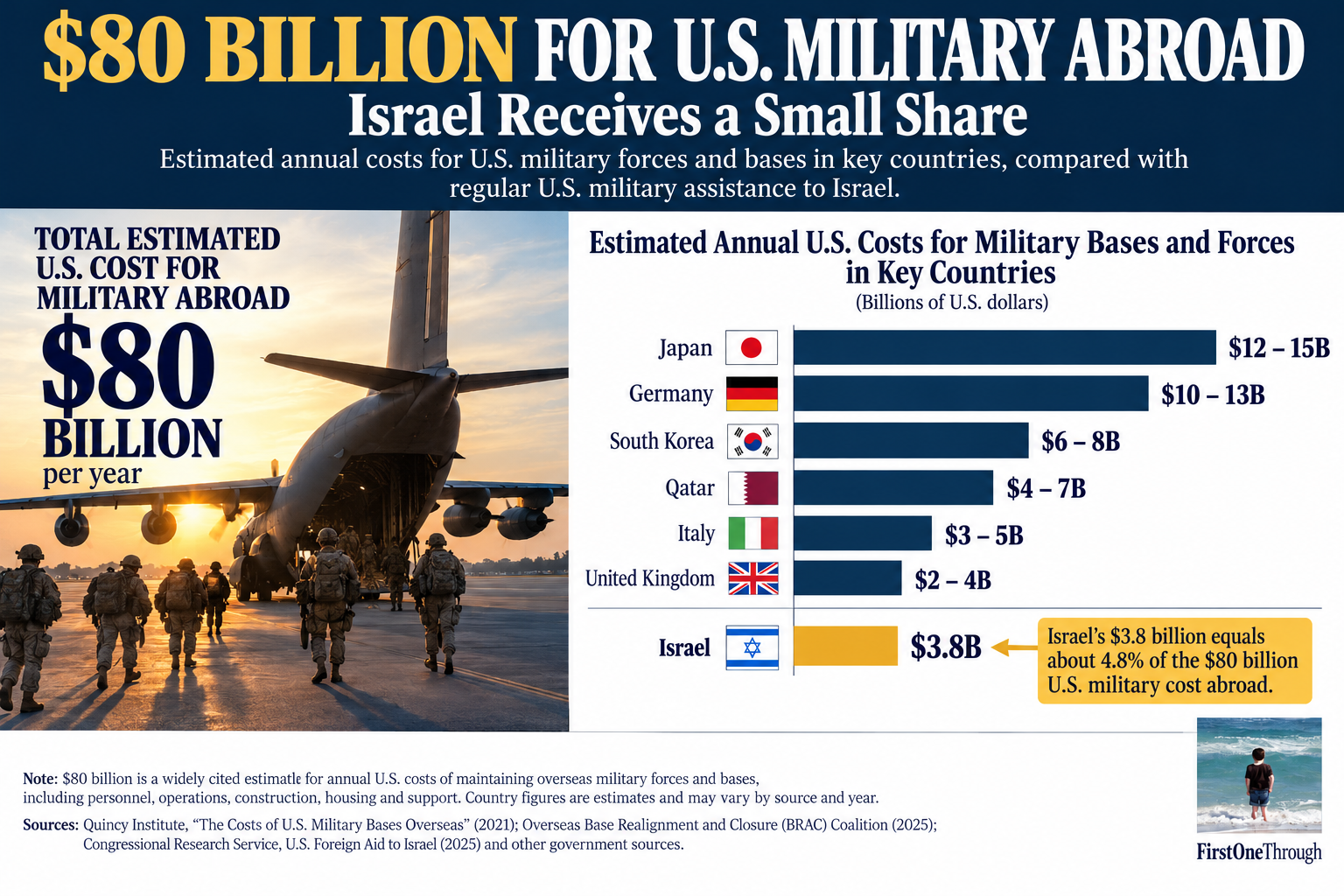
The figures expose the absurdity of the accusation. The United States spends an estimated $80 billion annually to maintain its military presence abroad. Japan, Germany, South Korea, Qatar, Italy and the United Kingdom together account for tens of billions of that cost. Israel receives $3.8 billion in regular annual military assistance – less than five percent of the $80 billion estimate. The ad singles out Israel while ignoring the vastly larger cost of America’s global military posture.
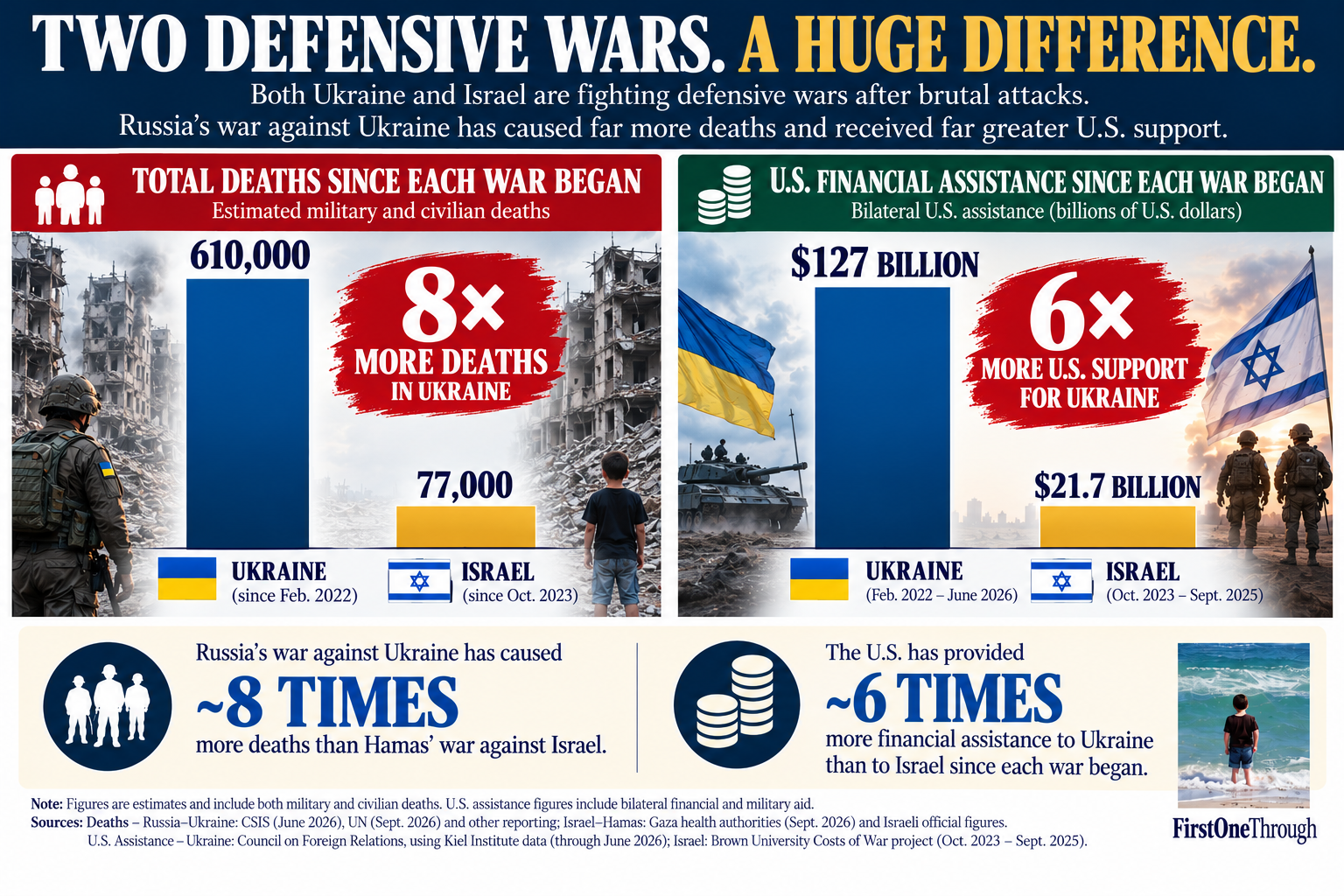
The Ukraine comparison is just as revealing. Since the wars began, the United States has provided roughly $127 billion in assistance to Ukraine, compared with $21.7 billion in military aid to Israel—about six times as much for Ukraine. The Russia-Ukraine war has caused an estimated 610,000 deaths, compared with roughly 77,000 in the Israel-Hamas war. That is about eight times as many deaths in Ukraine.
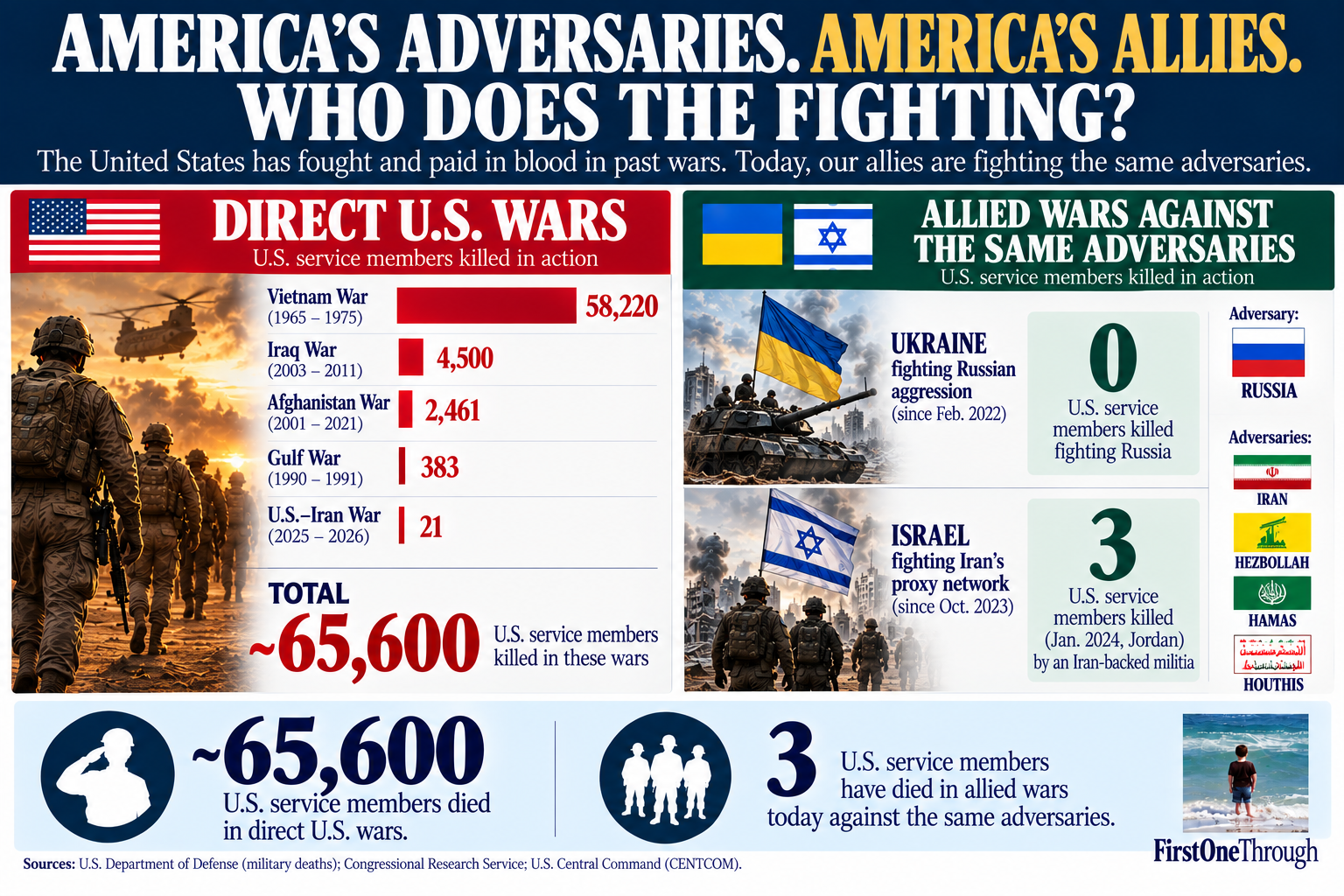
America’s own casualty record sharpens the contrast. More than 65,000 U.S. service members died in the recent direct wars: Vietnam, Iraq, Afghanistan, the Gulf War and the U.S.-Iran war. In the wars Ukraine and Israel are fighting against America’s adversaries, three American soldiers were killed in Jordan by an Iran-backed militia.
The ad offers no evidence that aid to Israel drives grocery prices. Instead, it directs public anger at Israel and at Americans who support its right to defend itself. It turns pro-Israel sentiment into an accusation of disloyalty: if you support Israel, you are supposedly taking food from American families.
Dana Nessel, a fellow Michigan Democrat – who has endorsed El-Sayed – has already warned her party to stop making Israel and AIPAC the villains in every political story.
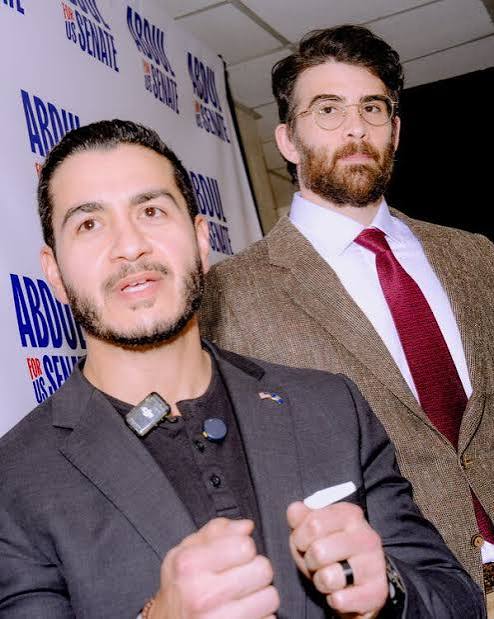
Cenk Uygur’s PAC turns grocery prices into an indictment of Israel. His nephew, Hasan Piker, supplies the online megaphone. Zohran Mamdani and El-Sayed give this politics electoral respectability. The message running through it is profound Jew hatred: Jews who support Israel are foreign agents, their loyalty is suspect, and their political participation is a threat to ordinary Americans.
Hasan Piker (right) campaigning with Abdul El-Sayed
“Trade and all money business he considers his very own privilege, which he exploits ruthlessly. Financial business and trade have become altogether his monopoly.” – Adolf Hitler, Mein Kampf
If this was all about money to foreign countries, if it was all about military spending, if it was all about people being killed, the ad would have mentioned Japan and Germany and Qatar and Ukraine. But it only mentioned one conflict, one country, and featured one government: Israel, and targeted its supporters.
Nessel has told them to stop. Jewish groups have told them to stop. Instead, they are doubling-down as elections approach.
Every Democrat who stays silent while Zionists are cast as the cause of Americans’ financial hardship helps make antisemitism acceptable. Voting for these candidates and promoting their backers accelerates the demonization of Jews.
An agency created to provide temporary relief now needs $70 million to cover its employees’ salaries over just two months. How did UNRWA become so large, expensive and financially dependent?
The United Nations Relief and Works Agency for Palestine Refugees in the Near East (UNRWA) is appealing for another $70 million to cover a financial shortfall, with employee salaries for the final months of 2026 at risk.
It is a remarkable moment for an institution established in 1949 to address the immediate humanitarian needs of refugees from the 1948 Arab-Israeli war.
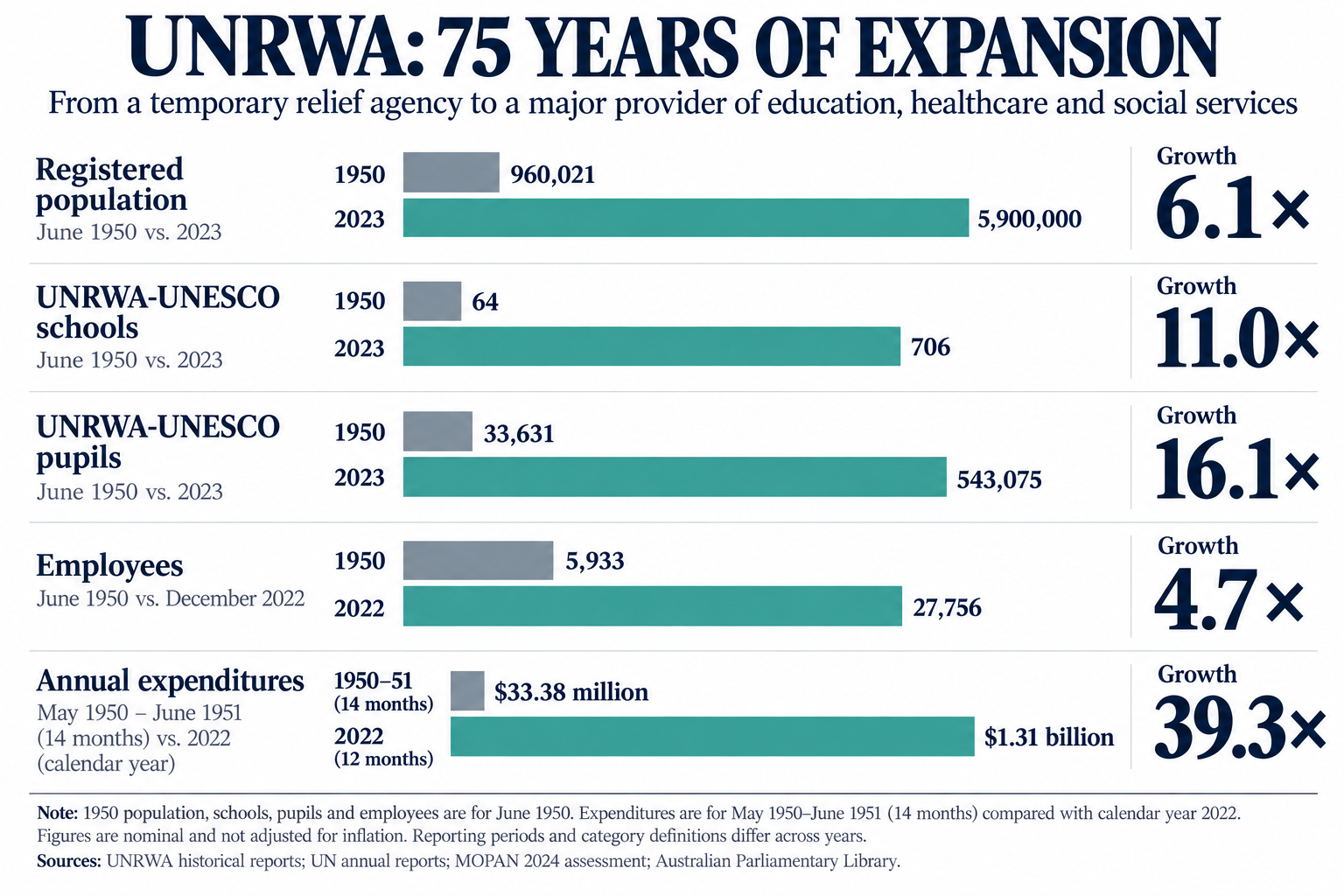
UNRWA began operations in 1950 with approximately 960,000 people on its registration rolls, distributing food, providing shelter and delivering basic medical assistance. Seventy-five years later, its register approaches six million people, its workforce numbers roughly 27,000, and its annual expenditure has exceeded $1 billion.
Along the way, it became an education system, a healthcare provider, a social-services agency and a major employer with retirement benefits serving people beyond its original refugee population.
The scale of this transformation deserves examination, particularly as UNRWA once again asks donors to finance obligations accumulated over decades.
What Changed in 75 Years?
Measure
Beginning
Later
Change
Registered population
960,021 (1950)
~5.9 million (2023)
6.1×
Employees
5,933 (1950)
27,756 (2022)
4.7×
Annual expenditure
$33.38 million (1950–51)
$1.31 billion (2022)
39.3× nominal
Schools
64 (1950)
706 (2023)
11.0×
Students
33,631 (1950)
543,075 (2023)
16.1×
Education share of regular spending
~1% (1950)
~60% (2002)
60-fold share
Relief share of regular spending
~97% (1950)
9.5% (2002)
Down 87.5 percentage points
Teachers
~800 (1950)
16,965 (2002)
~21×
Students per teacher
~51 (1950)
~29 (2002)
44% lower
Employer retirement contributions
—
$63.5 million (2024)
Recurring annual cost
Personnel expenditure
—
$735 million (2024)
57.7% of total spending
The comparisons use historical years for which measures are available. Expenditure growth is nominal; the initial expenditure figure covers 14 months, compared with 12 months for 2022.
UNRWA’s registered population grew approximately sixfold, while student enrollment expanded sixteenfold and its teaching workforce roughly 21-fold. The agency’s educational responsibilities grew far faster than its registered population, illustrating how profoundly its mission changed.
From Refugees to Generations of “Refugees”
UNRWA’s original registration population consisted primarily of people displaced by the 1948 war. Over subsequent decades, qualifying descendants became eligible for registration, creating a multigenerational population.
By 2023, nearly six million people were registered, including children, grandchildren and great-grandchildren of the original refugees and internally-displaced people. This increase reflects births, successive generations, migration and registration practices, rather than six million people personally displaced in 1948.
UNRWA also expanded eligibility beyond that original population. Following the 1967 war, the United Nations authorized the agency to assist additional displaced people, including individuals outside its registered refugee population.
By 1970, UNRWA was distributing approximately 217,000 monthly food rations to displaced people outside its refugee register, financed by the Jordanian government.
Registration also differs from actual service utilization. In 2023, approximately 2.02 million individuals used UNRWA healthcare services, compared with nearly six million registered “refugees.” Others used education, social services or emergency assistance, while some relied on alternative providers.
So even with the large budget, it doesn’t even cover all of the UNRWA registrants.
From Food Rations to Schools and Clinics
The greatest transformation occurred in what UNRWA actually did.
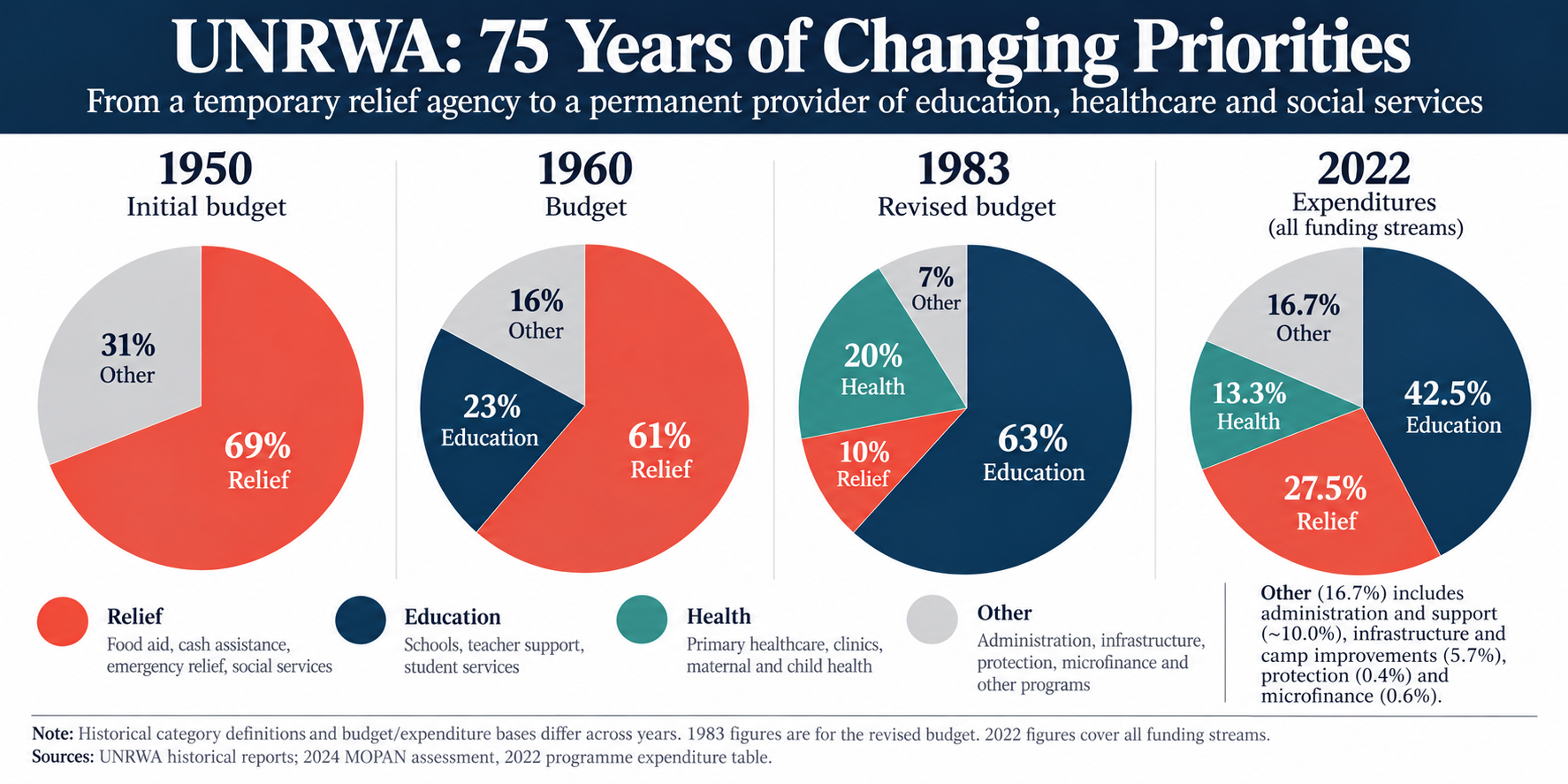
In 1950, approximately 97% of its regular programme spending went toward relief. Education accounted for roughly 1%.
By 1970, education had overtaken relief as the largest expenditure category. By 2002, education represented approximately 60% of regular programme expenditure, while relief had fallen to 9.5%.
UNRWA had become a substantial education system, with teachers, administrators, buildings, maintenance requirements and recurring operating expenses. Healthcare similarly evolved from emergency treatment into ongoing clinics, preventive medicine, maternal care and treatment of chronic illnesses.
Meanwhile, refugee camps themselves changed. The approximately 30,580 tents recorded in 1950 had largely disappeared by 1961, replaced by established residential communities and permanent structures.
UNRWA’s services increasingly resembled those normally provided by public institutions.
In 1983, UNRWA discontinued its general food-ration programme, shifting toward education, healthcare and targeted assistance. By its revised 1983 budget, education accounted for approximately 63% and relief for 10%. Emergency food distribution would return during subsequent conflicts, but the regular mission had fundamentally changed.
By 2022, however, relief and social services represented approximately 27.5% of total expenditures. This increase reflected a new generation of humanitarian crises, most having NOTHING to do with Israel.
The Syrian civil war beginning in 2011, Lebanon’s economic collapse beginning in 2019, and the COVID-19 pandemic beginning in 2020 created enormous additional demands for food assistance, emergency cash payments and support for displaced families. These crises, alongside continuing emergency assistance in Gaza and the West Bank, substantially expanded UNRWA’s relief operations.
The 2022 figures also include regular operations, emergency appeals and special projects, whereas the earlier historical budgets used different accounting categories. UNRWA spent approximately $387 million through emergency appeals in 2022. The larger relief share therefore reflects both newer crises and a broader accounting of expenditures, while education and healthcare remained its principal permanent services.
Graphic note: The 2022 “Other” category includes approximately 10% for administration and support, 5.7% for infrastructure and camp improvements, and roughly 1% for protection and microfinance. Earlier budget categories and reporting scopes differ from the 2022 total-expenditure presentation.
Emergency Spending That Became Permanent
The 1967 war illustrates how emergency responsibilities could become recurring expenses. For 1968, UNRWA proposed an ordinary budget of $40.2 million and an additional $5.7 million for expanded operations, representing 12.4% of the combined budget. Some emergency activities were incorporated into the ordinary program within a short period.
Subsequent conflicts, including the Gulf War, Second Intifada, Syrian civil war and successive Gaza wars, added further responsibilities. Temporary emergency responses developed into continuing facilities, services and employment obligations.
This institutional evolution creates a financial consequence: permanent services require permanent funding, even as UNRWA continues to operate under a refugee-relief 1949 mandate and depends heavily on voluntary donor contributions.
A Relief Agency Becomes a Major Employer
Education became UNRWA’s largest employer. By 2002, roughly three-quarters of its workforce worked in education.
Salaries and employee benefits consequently became central to its finances. In 2024, UNRWA reported approximately $735 million in personnel expenditure, representing 57.7% of its $1.27 billion total expenditure.
The agency also developed substantial retirement and employment obligations, financed through the contributions of governments and other international donors.
Most local employees participate in a Provident Fund, supported by employee and employer contributions. UNRWA’s employer contributions totaled approximately $63.5 million in 2024, money ultimately financed through its operating resources, principally donor contributions. Employees also contribute from their salaries. International employees generally participate in the United Nations Joint Staff Pension Fund, supported by employee and employer contributions.
Beyond retirement savings, UNRWA owes qualifying employees end-of-service and termination benefits. These obligations can require substantial payments when employees retire, leave or are laid off. Its audited accounts have recorded hundreds of millions of dollars in accrued employee-benefit liabilities, some of which lack dedicated funding reserves.
The United Nations’ 2025 strategic assessment estimated that mass termination of staff could generate approximately $278 million in indemnity payments, without available reserves to meet them. That figure is distinct from the broader accrued employee-benefit liabilities reported in UNRWA’s financial statements.
An organization created to provide emergency assistance has become a long-term employer whose workforce carries financial obligations extending well beyond any immediate humanitarian crisis.
What Should Happen After Another $70 Million?
UNRWA’s history raises questions that extend beyond the latest appeal.
How many of its nearly six million registered “refugees” actually depend on each service? What proportion of expenditure supports education, healthcare, emergency relief and administration? How much of its operating budget benefits people outside the original refugee registration system?
Could some established services be transferred to existing public institutions, and what would such a transition cost? How should employee retirement and termination obligations be financed? What would constitute a sustainable funding model for the services that remain?
These questions require answers grounded in audited expenditure, service usage, educational outcomes and the practical consequences of institutional change.
The United Nations itself has examined options ranging from predictable multiyear financing to changes in service delivery and transfers of responsibilities.
The $70 million appeal is a symptom of a much larger institutional problem. UNRWA has spent 75 years evolving from temporary relief into a billion-dollar-plus permanent education, healthcare and employment system, financed through international contributions. Another emergency payment may cover the next round of salaries. The harder question is whether the world intends to finance this structure indefinitely—or finally decide who should provide these services, under what mandate, and at what cost.
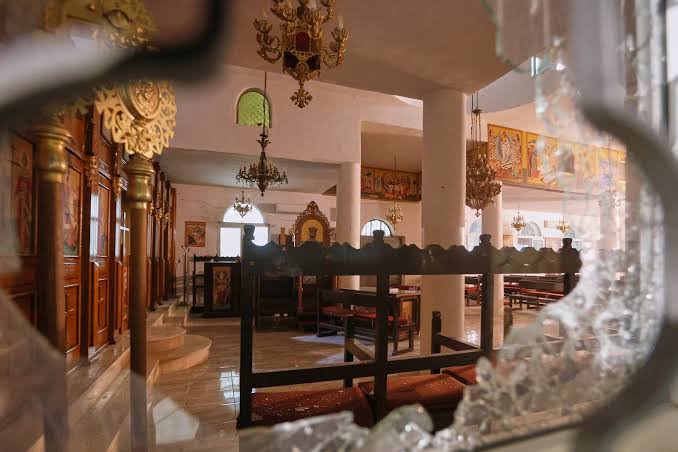
On October 23, 2026, gunmen opened fire on Christian mourners attending a funeral at St. George’s Greek Orthodox Church in Karak, Jordan. Nine people were killed and 40 wounded.
The interior of a Greek Orthodox church is seen through a shattered window hours after gunmen opened fire during a funeral, in Hamoud village, in Jordan’s Karak governorate, October 23, 2026. (AP Photo)
Jordanian authorities described the massacre as terrorism. Government spokesman Mohammad Momani attributed it to extremist takfiri ideology, associated with jihadist terrorist groups such as ISIS. The attackers’ identities and organizational affiliations remained unconfirmed.
Al Jazeera published three articles about the attack on October 23–24. It acknowledged that Jordanian authorities called the massacre terrorism, but did not explicitly describe the attackers as jihadists. Instead, its coverage repeatedly emphasized Jordan’s tradition of Muslim-Christian “coexistence,” including the possibility that the community would emerge even stronger.
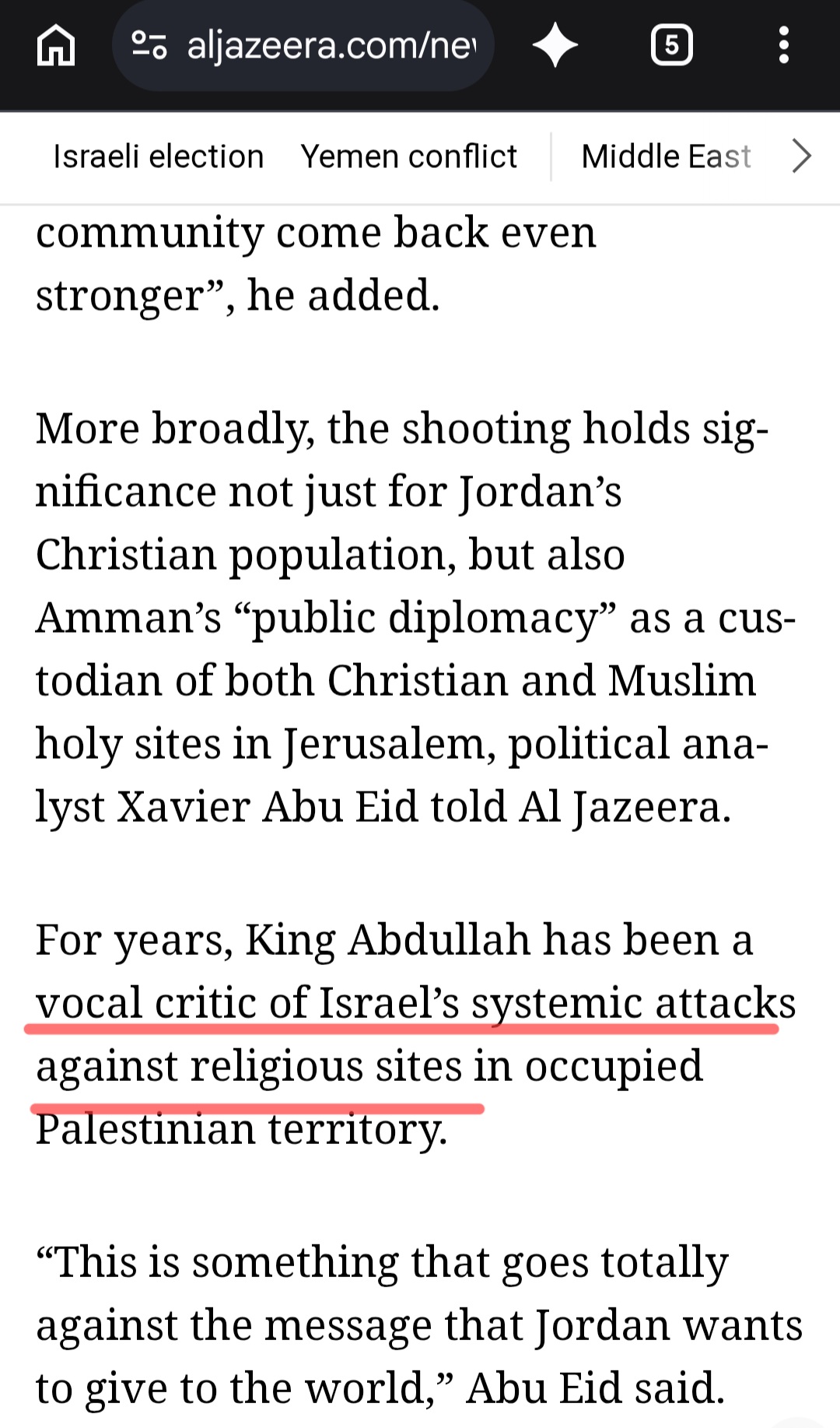
And then Al Jazeera turned its attention to Israel. In its October 23 report, Al Jazeera introduced this claim:
“For years, King Abdullah has been a vocal critic of Israel’s systemic attacks against religious sites in occupied Palestinian territory.”
Israel had no reported connection to the massacre. Yet Al Jazeera found a way to bring Israel into the story.
Al Jazeera is funded by Qatar, which has hosted US-designated terrorist group Hamas leaders for years and provided billions of dollars in assistance to Hamas-governed Gaza. Qatar is also the largest reported foreign source of gifts and contracts to American universities, accounting for approximately $8.8 billion cumulatively, including more than $1.1 billion in 2025 alone.
Qatar pours billions into American universities, finances Al Jazeera and hosts Hamas leaders. Al Jazeera’s coverage whitewashes jihadi terrorism and redirects attention from Islamist extremism toward Israel. Another example of the insidious jihad killing Christians and Jews, being exported from the Middle East.
While Americans argue over Gaza, Beijing is watching Taiwan.
China wants to dominate Asia, control waterways carrying trillions of dollars in commerce, and bring Taiwan under its rule. Standing in its way is potentially the United States.
So as America commits military resources to Middle Eastern conflicts and Americans increasingly question their country’s overseas role, China is pursuing two opportunities: expanding its power abroad and exploiting political divisions inside America.
The Trillion-Dollar Prize
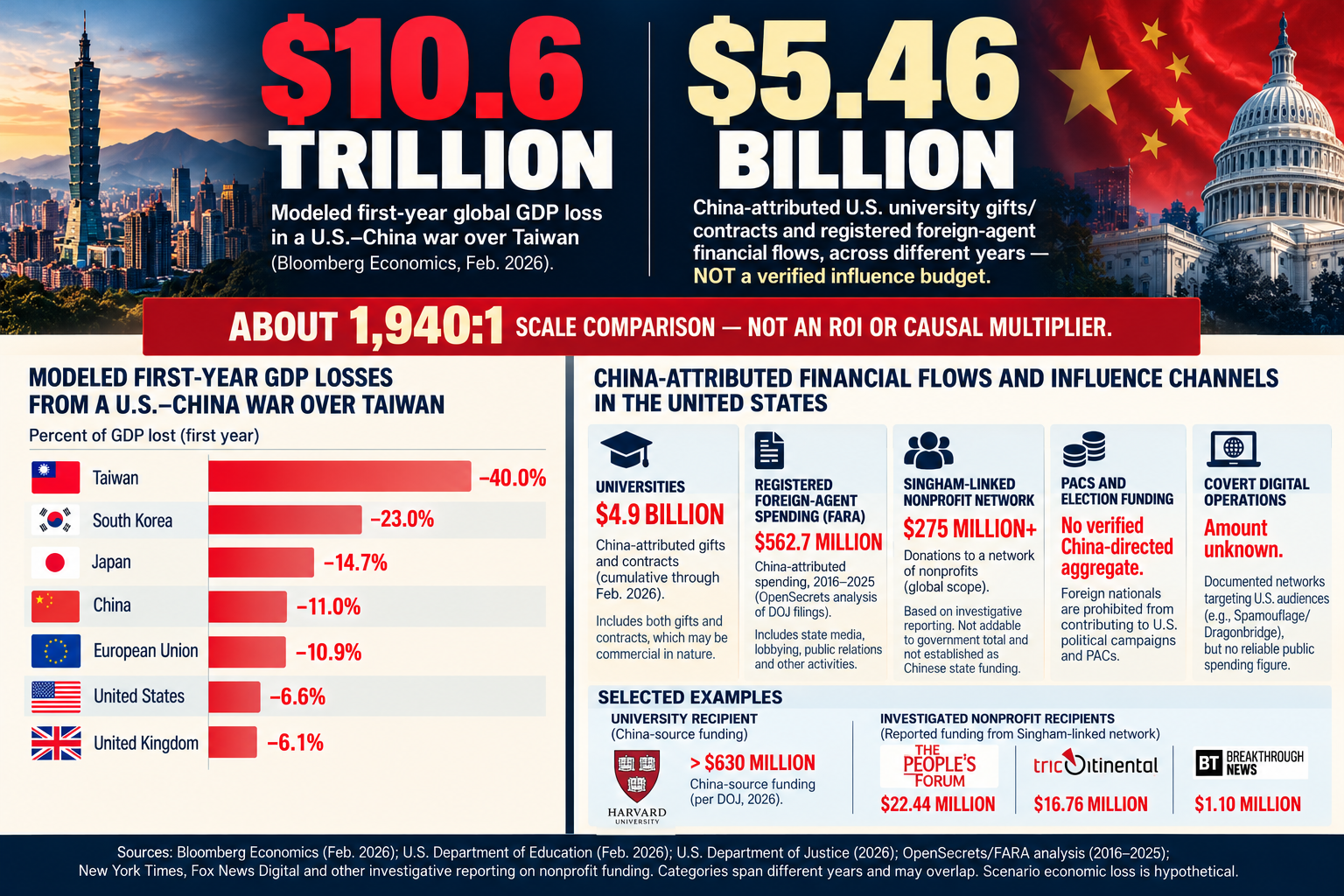
Taiwan produces much of the world’s most advanced semiconductors. According to the Center for Strategic and International Studies, approximately $2.45 trillion in goods passed through the Taiwan Strait in 2022, representing more than one-fifth of global maritime trade.
Bloomberg Economics estimated that a major war involving China and the United States could cost the global economy approximately $10.6 trillion in its first year, equivalent to 9.6% of global GDP. The modeled losses include 6.6% of American GDP and 11% of China’s. A Chinese blockade could reduce global GDP by approximately 5%. The consequences would reach American retirement accounts, employment, manufacturing, automobiles and everyday consumer prices.
Beijing has steadily increased military exercises, maritime patrols and operations around Taiwan and the South China Sea. China seeks the ability to impose its will on Taiwan while limiting American intervention.
China Sees an Opening
On October 7, 2023, Hamas invaded Israel, murdering approximately 1,200 people and taking 251 hostages. The ensuing war drew American aircraft carriers, missile-defense systems, intelligence resources and diplomatic attention into successive confrontations involving Gaza, Lebanon, Iran and the Houthis.
Within weeks, foreign-policy researchers identified the opportunity that Beijing will exploit.
On November 9, 2023, Emil Avdaliani of the Stimson Center published For China and Russia, the Gaza War May Be a Blessing in Disguise. He explained that the wars in Gaza and Ukraine interfered with America’s strategic focus on the Indo-Pacific, giving China greater freedom to maneuver and time to prepare for competition over Taiwan.
He compared the opportunity to the years following September 11, when American attention was consumed by the wars on terrorism. The Gaza conflict also threatened the proposed India–Middle East–Europe Economic Corridor, a potential competitor to China’s Belt and Road Initiative.
Two weeks after the Hamas attack, Ahmed Aboudouh of Chatham House published China’s Approach to the War in Gaza Is Not Anti-Israel. It’s Designed to Contain the US.
Aboudouh described Beijing’s posture as anti-Western neutrality. China avoided condemning Hamas’s atrocities while criticizing Israel and portraying America as a destabilizing force. Beijing was using sympathy for Palestinians to undermine American credibility, cultivate support among developing countries and strengthen its diplomatic position on Taiwan and Xinjiang.
Beijing also maintains an enormous economic relationship with Iran.
In April 2026, the U.S. Treasury Department reported that China purchased approximately 90% of Iran’s oil exports. The U.S.–China Economic and Security Review Commission estimated that Chinese purchases generated approximately $31.2 billion in Iranian oil revenue in 2025.
Those revenues support the Iranian government, whose military establishment finances and arms Hamas, Hezbollah and the Houthis. Iran’s regional activities repeatedly demand American military resources and diplomatic attention.
China receives Iranian oil while Tehran’s confrontations with America complicate Washington’s ability to concentrate on Asia.
China’s American Information Campaign
China’s efforts to exploit the conflict have also reached American audiences.
In June 2024, Google’s Threat Analysis Group documented DRAGONBRIDGE, also known as Spamouflage, a vast online influence operation linked to the People’s Republic of China.
The network distributed videos, fabricated news-style broadcasts and social-media comments attacking American democracy and exploiting domestic controversies.
One of its targets was the American campus protests over Gaza.
Beginning in May 2024, Chinese-linked accounts circulated English-language material portraying American police actions against pro-Palestinian demonstrators as evidence of Western hypocrisy. The messaging contrasted the treatment of campus protesters with American support for demonstrations in Hong Kong.
The same network criticized American involvement in Ukraine and depicted American democracy as dysfunctional.
Google disrupted more than 10,000 instances of DRAGONBRIDGE activity across its platforms in the first quarter of 2024. During the first nine months of 2024, Google also terminated more than 22,000 YouTube channels linked to Chinese coordinated influence operations.
Although investigators found limited genuine audience engagement, the volume of fabricated content demonstrated Beijing’s capacity to manufacture political messaging and distribute it across thousands of accounts.
Follow the Money
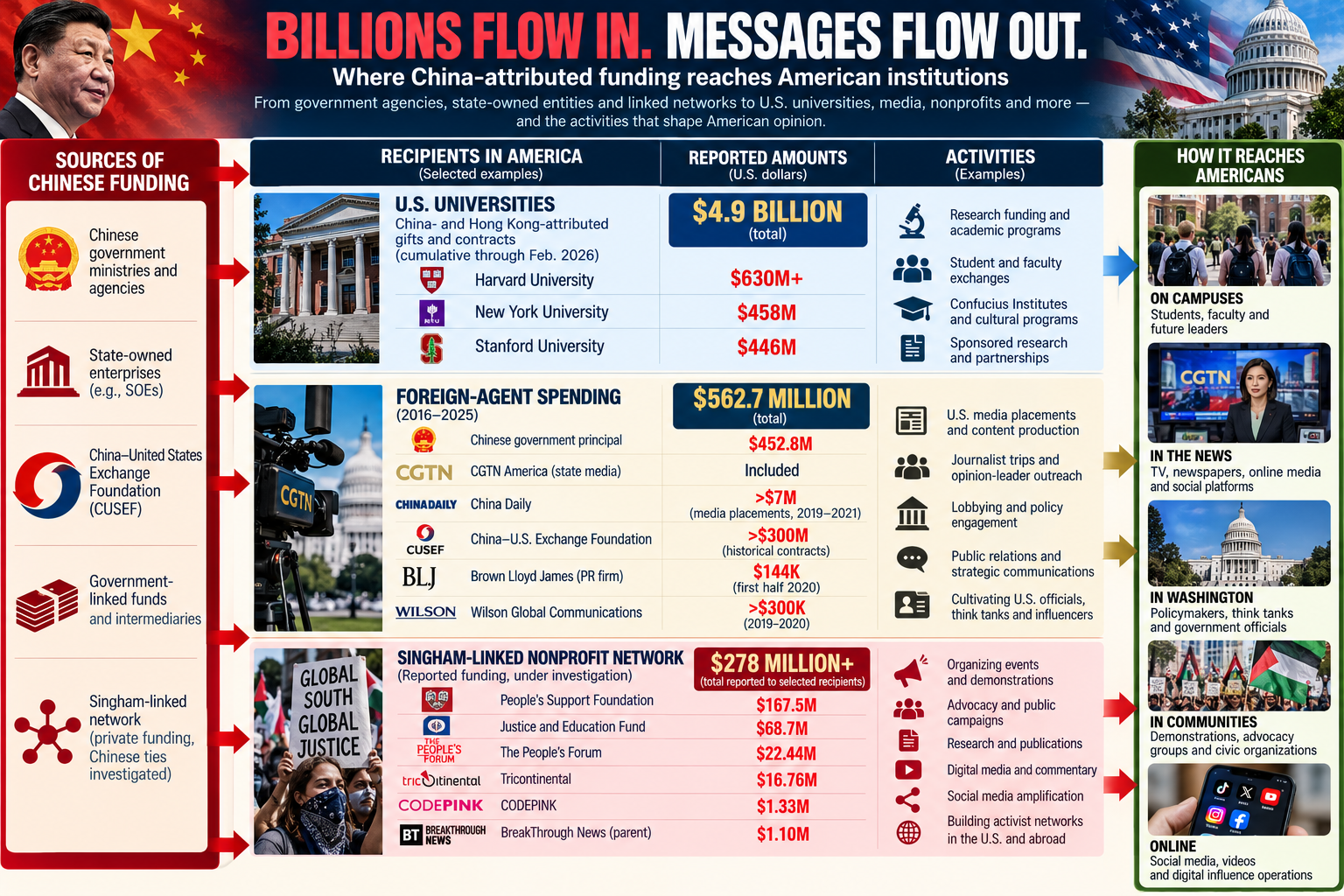
An August 2023 New York Times investigation uncovered a sprawling financial network associated with Neville Roy Singham, an American technology entrepreneur living in Shanghai, with approximately $278 million in reported financial flows attributed to his broader network. Major organizations associated with the network include the People’s Forum, ANSWER Coalition, International People’s Assembly, CODEPINK and affiliated activist and media operations. These organizations have helped organize anti-Israel demonstrations, promote political campaigns and advance positions frequently aligned with Chinese Communist Party interests. The Times also documented Singham’s financial and operational connections to Chinese propaganda organizations. A July 2025 George Washington University study examined overlapping financial relationships, organizational cooperation and ideological alignment involving Singham-linked organizations and groups associated with Shut It Down for Palestine. The $278 million represents broader network financial flows rather than verified direct funding of each organization.
The People’s Forum’s organizing activities became visible immediately after October 7. It co-organized a Times Square demonstration the following day, helped mobilize the November 4 march in Washington, and joined the nationwide Shut It Down for Palestine campaign. On April 29, 2024, more than 100 activists, including Columbia protesters, reportedly gathered at its Manhattan headquarters, where executive director Manolo De Los Santos urged them to “give Joe Biden a hot summer.” These events demonstrate the organization’s participation in street demonstrations and campus-related organizing, alongside a much broader student-led protest movement.
Beyond activist organizations, Chinese government agencies, companies and associated entities have developed financial relationships with American universities, policy institutions, media organizations and Washington lobbying firms.
U.S. Department of Education disclosures identify approximately $4.9 billion in Chinese-source gifts and contracts across roughly 8,000 transactions, making China the second-largest reported foreign funding source. These relationships reach institutions responsible for educating future American leaders and developing advanced technologies. The funding includes research, education and commercial arrangements, while its scale raises questions about academic independence, research security and foreign influence.
Chinese financial relationships have also reached American think tanks and policy institutes, where donor disclosures are less comprehensive and researchers help shape congressional testimony, national security debates and foreign-policy recommendations.
China’s presence in Washington is more directly measurable. According to OpenSecrets, Chinese government and other China-related foreign principals accounted for approximately $563 million in registered foreign-agent spending from 2016 through 2025, including approximately $453 million attributed to the Chinese government. Much of this money supported Chinese state-media operations, while other expenditures financed lobbying and public relations. U.S. Justice Department records, for example, document the Chinese Embassy’s engagement of Squire Patton Boggs to advise on congressional legislation, defense appropriations and other matters before Congress. Chinese-owned companies have separately spent millions lobbying over trade, technology restrictions and federal regulation.
From Gaza to Taiwan: The Same Organizations
CODEPINK‘s activism extends far beyond opposition to Israel. Its China Is Not Our Enemy campaign opposes American military preparations in Asia and criticizes U.S. support for Taiwan. Following Nancy Pelosi’s 2022 visit, CODEPINK characterized the trip as a dangerous escalation. Its Reject the US Militarism in the Pacific campaign challenges American military infrastructure and partnerships involving Japan, South Korea, the Philippines, Guam and Australia.
The ANSWER Coalition similarly opposes American military expansion in the Pacific, including military bases and exercises involving Okinawa and South Korea. Both organizations describe their positions as opposition to militarization and overseas intervention.
The overlap is striking. Organizations mobilizing against American support for Israel also oppose military commitments and partnerships central to American deterrence in Asia. Beijing has its own reasons for welcoming those positions: weakening America’s regional alliances would make coercion of Taiwan easier. The alignment of these policy positions is documented; whether Chinese funding or direction caused them is a separate question.
The Real Strategic Contest
American deterrence around Taiwan depends on naval forces, regional bases, military cooperation with Japan and the Philippines, defense spending and the political willingness to confront Chinese coercion.
China’s military buildup raises the cost of American intervention around Taiwan. Its influence operations exploit the political divisions that could make such intervention harder to sustain. Meanwhile, conflicts involving Iran and its proxies continue to consume American resources and attention.
A Taiwan war could destroy $10.6 trillion in global economic output in its first year. China’s disclosed financial relationships with American institutions and media operations amount to billions of dollars across multiple years, much of it spent on activities unrelated to political influence. Even a relatively small, effective influence campaign could matter enormously if it altered America’s willingness to defend Taiwan.
For a few billion dollars spent influencing Americans to be anti-Israel and pro-Iran, China is targeting several TRILLIONS of dollars in Asia.
Sources
Stimson Center — For China and Russia, the Gaza War May Be a Blessing in Disguise, November 2023.
Chatham House — China’s Approach to the War in Gaza Is Not Anti-Israel. It’s Designed to Contain the US, October 2023.
U.S. Treasury Department, April 2026, reporting on China’s purchases of Iranian oil.
U.S.–China Economic and Security Review Commission, March 2026, research on Iranian oil revenues.
Google Threat Analysis Group, June 2024, research on DRAGONBRIDGE.
Google congressional testimony, 2024, coordinated Chinese influence operations.
George Washington University Program on Extremism — CCP Influence in U.S. Pro-Palestinian Activism, July 2025.
The New York Times — A Global Web of Chinese Propaganda Leads to a U.S. Tech Mogul, August 2023.
CODEPINK — China Is Not Our Enemy.
CODEPINK — Reject the US Militarism in the Pacific.
ANSWER Coalition — Islanders Unite to Resist a New Pacific War.
Center for Strategic and International Studies — Taiwan Strait maritime trade research.
Bloomberg Economics — The $10 Trillion Fight: Modeling a US-China War Over Taiwan, February 2026.
Congressional Research Service — Section 117 of the Higher Education Act: Reporting of Foreign Gifts and Contracts, March 2026.
OpenSecrets — Foreign Lobby Watch, 2016–2025.
U.S. Department of Justice — FARA semiannual reports, including Squire Patton Boggs’ representation of the Chinese Embassy.
Harvard/University of Connecticut Crowd Counting Consortium — U.S. protest and campus encampment data, 2023–2024.
The People’s Forum — October 2023 statements and protest mobilization announcements.
Reporting on the People’s Forum’s April 29, 2024 organizing meeting in Manhattan.
A child unwraps a chocolate bar, takes a bite, and discovers something delicious made in Israel. Show them “Product of Israel” on the wrapper. If it has Hebrew lettering, point that out too. It’s a happy way to make Israel familiar: a place where people make things we enjoy.
Put a small sign by the bowl: “Israeli-made treats – shared with pride.” Kids can take home a new favorite.
The Democratic Socialists of America (DSA) asks candidates it endorses to support the boycott, divestment, and sanctions (BDS) campaign against Israel. Anti-Israel positions are also gaining ground among some Democratic candidates and officials.
We are not interested and will have none of it.
Order an Israeli-made treat for your candy bowl, then share this post with friends, family, and neighborhood groups. Every order adds demand for Israeli producers; many bowls make that support visible across the neighborhood.
Let Israel be the place behind the treat they remember.
Two Israeli soldiers were killed by Palestinian terrorists near Hebron on Friday. Staff Sergeant Ron Yonatan Roytman, 23, and Sergeant Yuval Shai Svilem, 20, were killed, and three other soldiers wounded.
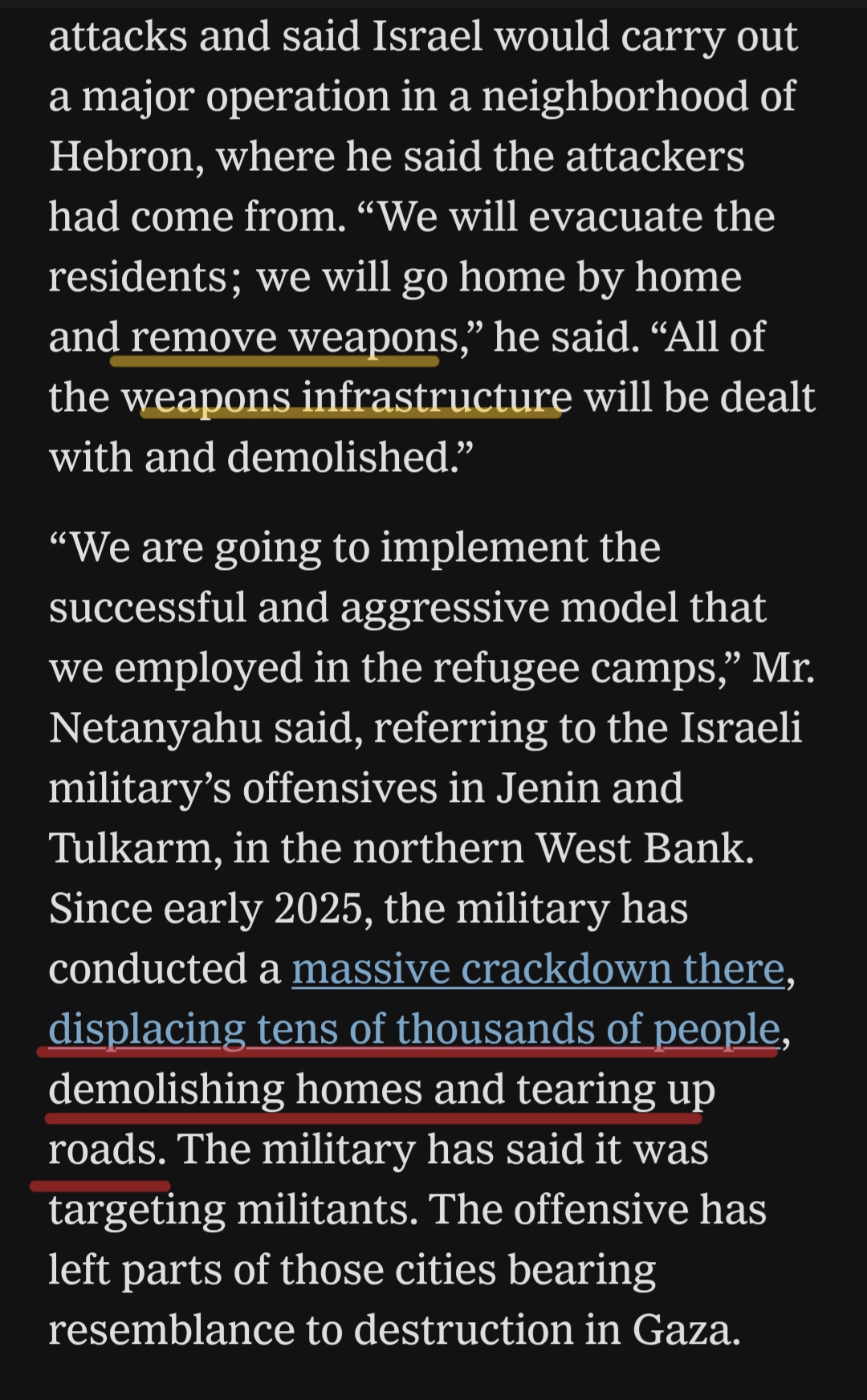
Prime Minister Benjamin Netanyahu announced a major operation in the Hebron neighborhood from which the attackers came. Soldiers would search homes, confiscate weapons and demolish terrorist infrastructure, repeating the model employed in Jenin and Tulkarm.
What exactly had Israel uncovered in those Palestinian cities?
In Jenin, Israeli soldiers reported discovering more than 100 explosive devices in just two days, along with a weapons-manufacturing workshop and a command center containing materials for making bombs. Explosives were even found hidden inside a washing machine.
In Tulkarm, soldiers found a weapons storage facility containing approximately 100 pipe bombs, eight additional explosive devices and equipment for detonating explosives. They discovered a drone-production laboratory and another bomb-making facility. Some 45 explosive devices had been planted beneath roads to attack Israeli soldiers and vehicles.
Across the broader northern West Bank operation, the Israeli military reported seizing more than 1,300 weapons and destroying over 50 terrorist infrastructure sites.
And how did the New York Times describe these discoveries?
Following Netanyahu’s announcement, the newspaper characterized Israel’s earlier operations in Jenin and Tulkarm as a massive crackdown, emphasizing that tens of thousands of Palestinians had been displaced, homes demolished and roads torn apart. It compared the destruction to Gaza, adding that the Israeli military said it was targeting militants.
The weapons factories, drone laboratories and explosives caches disappeared from its account when it was providing context to that specific account.
New York Times claims that Israeli military simply displaced people and ripped up roads without discussing the enormous weapons the IDF cleared out WHEN SPECIFICALLY GIVING CONTEXT TO THAT OPERATION
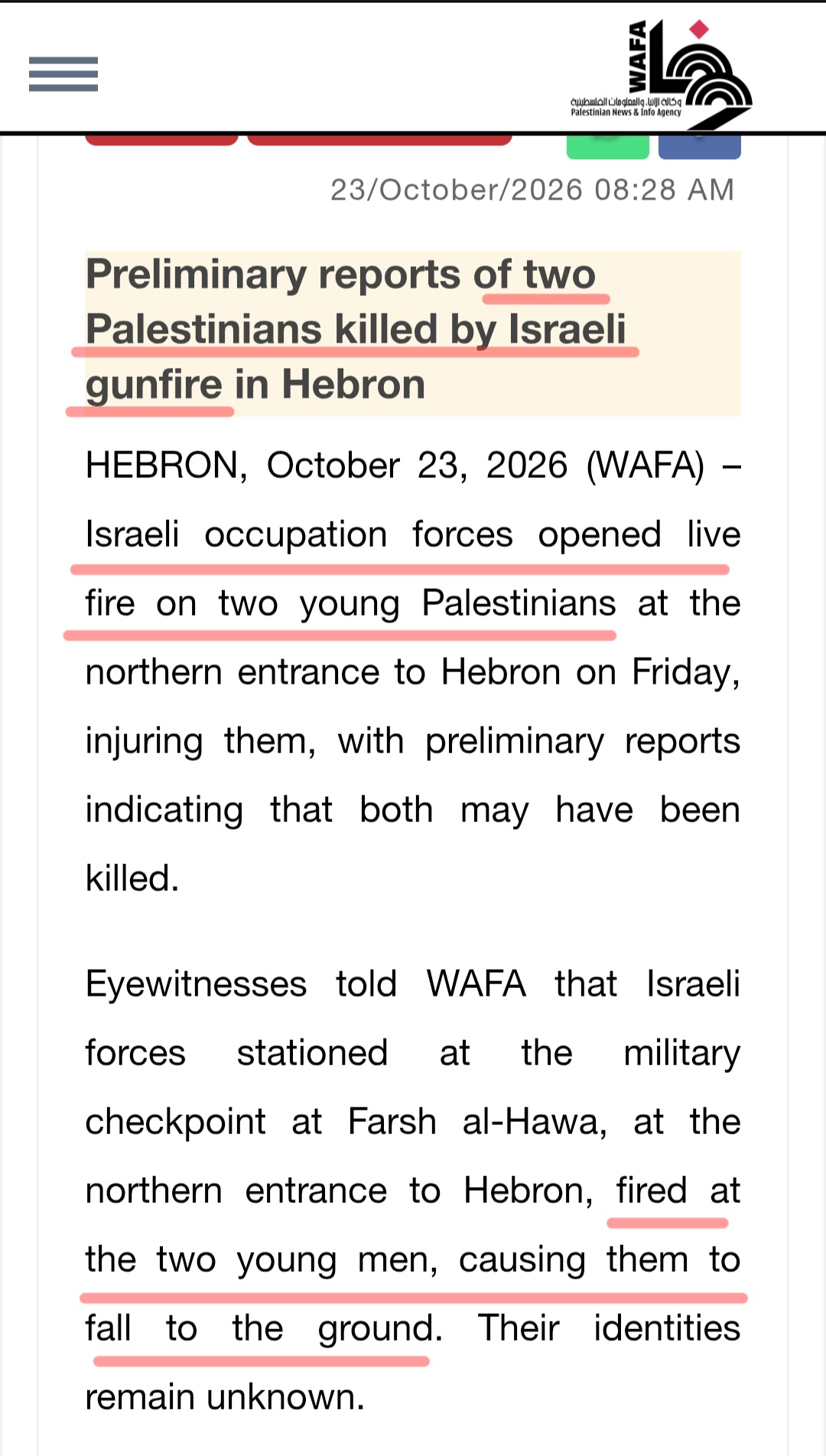
The Palestinian Authority’s official news agency, WAFA, offered an even more extraordinary account of Friday’s shooting. Its headline declared, “Preliminary reports of two Palestinians killed by Israeli gunfire in Hebron.”
The article described Israeli forces opening fire on “two young Palestinians,” causing them to fall to the ground. It omitted the two Israeli soldiers killed in the attack and the gunfire reportedly initiated by the Palestinians.
Two Palestinian gunmen who killed Israeli soldiers became two young Palestinians shot by Israeli forces.
According to Palestinian Authority media, Israelis shot and killed “two young Palestinians” without stating that they were armed and killed Israelis first
WAFA turned Palestinian gunmen who killed Israeli soldiers into victims of Israeli gunfire. The New York Times turned the dismantling of terrorist weapons factories into seemingly senseless destruction of Palestinian neighborhoods.
Different newspapers. The same distortion: remove the Palestinian terrorism, and Israel becomes the aggressor.
The Torah moves from humanity’s failed attempt to make a name for itself at Babel to God’s promise to make Abraham’s name great. Between these two visions of greatness lies the foundation of Jewish peoplehood.
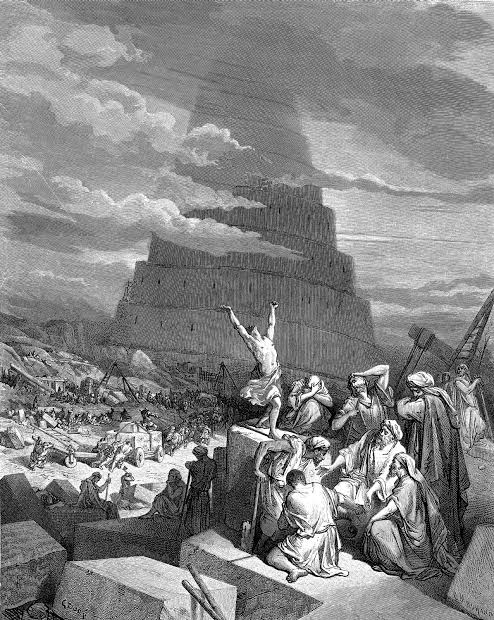
In last week’s portion, the people of Babel gather to build a great city and tower, united by a common language and ambition. They declare, “Let us make a name for ourselves” (Genesis 11:4). God disperses them across the earth, dividing humanity into different peoples and languages.
Gustave Dore’s Tower of Babel
Immediately afterward, in this week’s portion, Lech Lecha (Genesis 12:1–17:27), God calls upon Abraham and promises, “I will make your name great” (Genesis 12:2). The same Hebrew word, shem, meaning “name,” connects the two stories. At Babel, humanity seeks greatness for itself. Abraham is promised greatness through a mission that will benefit others:
“And all the families of the earth shall be blessed through you” (Genesis 12:3).
That mission begins with a journey to a particular land. God commands Abraham to leave his birthplace and his father’s house and travel to the land that He will show him. Abraham journeys through Shechem, Bethel and Hebron, places that remain central to Jewish history nearly 4,000 years later. God promises the land to his descendants, establishing the foundations of Jewish peoplehood through geography, ancestry and covenant.
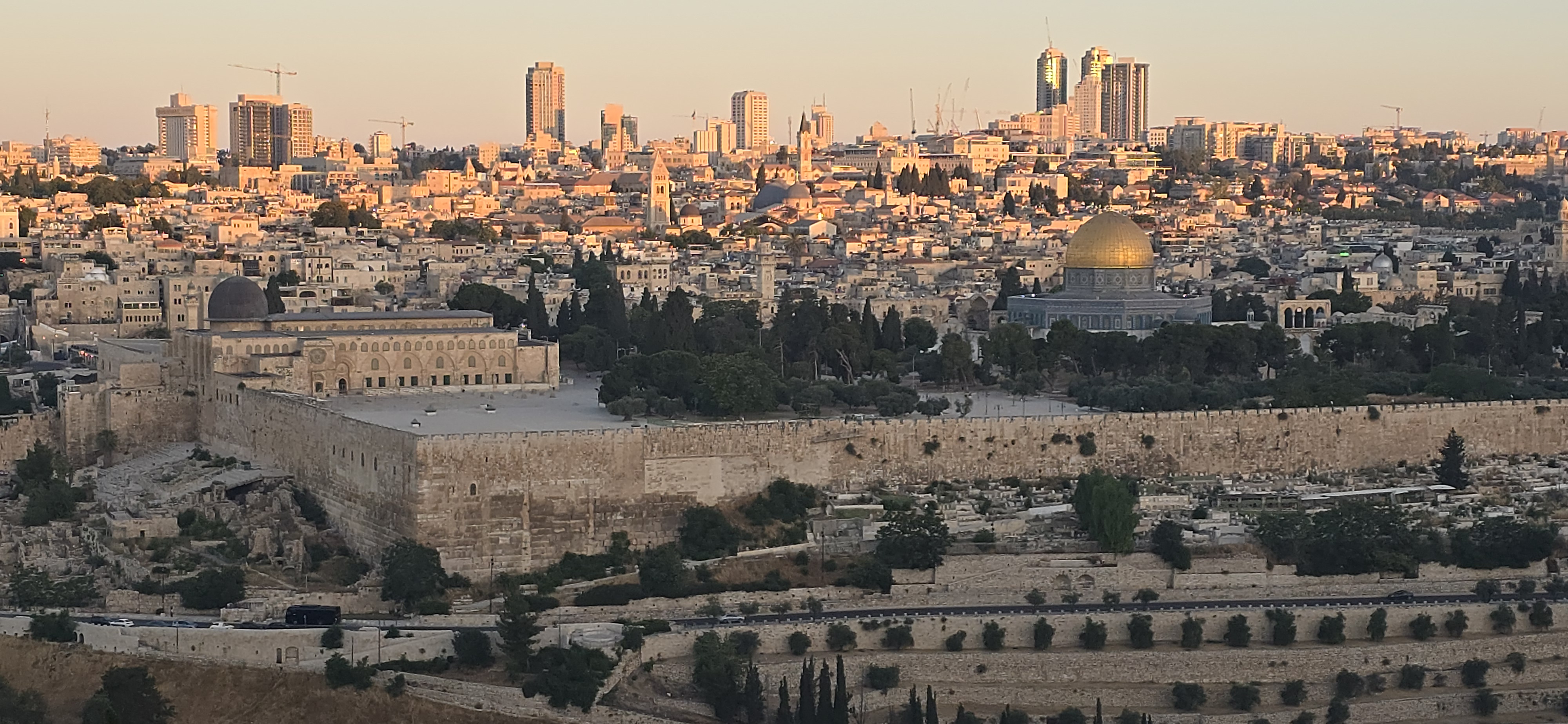
These foundations shape Jewish life across the centuries. The Jewish calendar follows the agricultural seasons of Israel, prayers turn toward Jerusalem, and the pilgrimage festivals call Jews to appear before God at the place of His choosing, ultimately Jerusalem. The land remains central to Jewish identity even during centuries of exile, preserved through ritual, language, memory and the longing to return.
Jerusalem at dawn (photo: First One Through)
The Torah presents a vision of humanity in which a particular people, rooted in a particular land and bound by a covenant, carries a mission extending to the entire world. Jewish distinctiveness becomes a source of universal blessing.
For thousands of years, Jews have carried this dual obligation: preserving their own peoplehood while contributing to the wider world. Yet today, Jews are increasingly told that acceptance into movements proclaiming universal justice requires abandoning their attachment to Israel. Jewish peoplehood is reduced to a religious preference, while the essential character of Judaism as a land-based religion is dismissed as a political invention. Even some Jews adopt this framework, treating the abandonment of Jewish national identity as evidence of moral enlightenment.
Lech Lecha teaches that Jewish identity and universal responsibility are intertwined. The covenant connects Jews to their ancestors, their land and one another, providing the foundation from which their obligations to humanity extend.
The Torah’s promise of blessing to all humanity begins with a particular people, a particular land and an enduring covenant. Those demanding that Jews surrender these foundations in the name of universal justice are asking them to abandon the very mission through which Abraham was called to bless the world. Their vision leads back to Babel: an impressive structure, a polished veneer of unity, and a common project built in defiance of God.
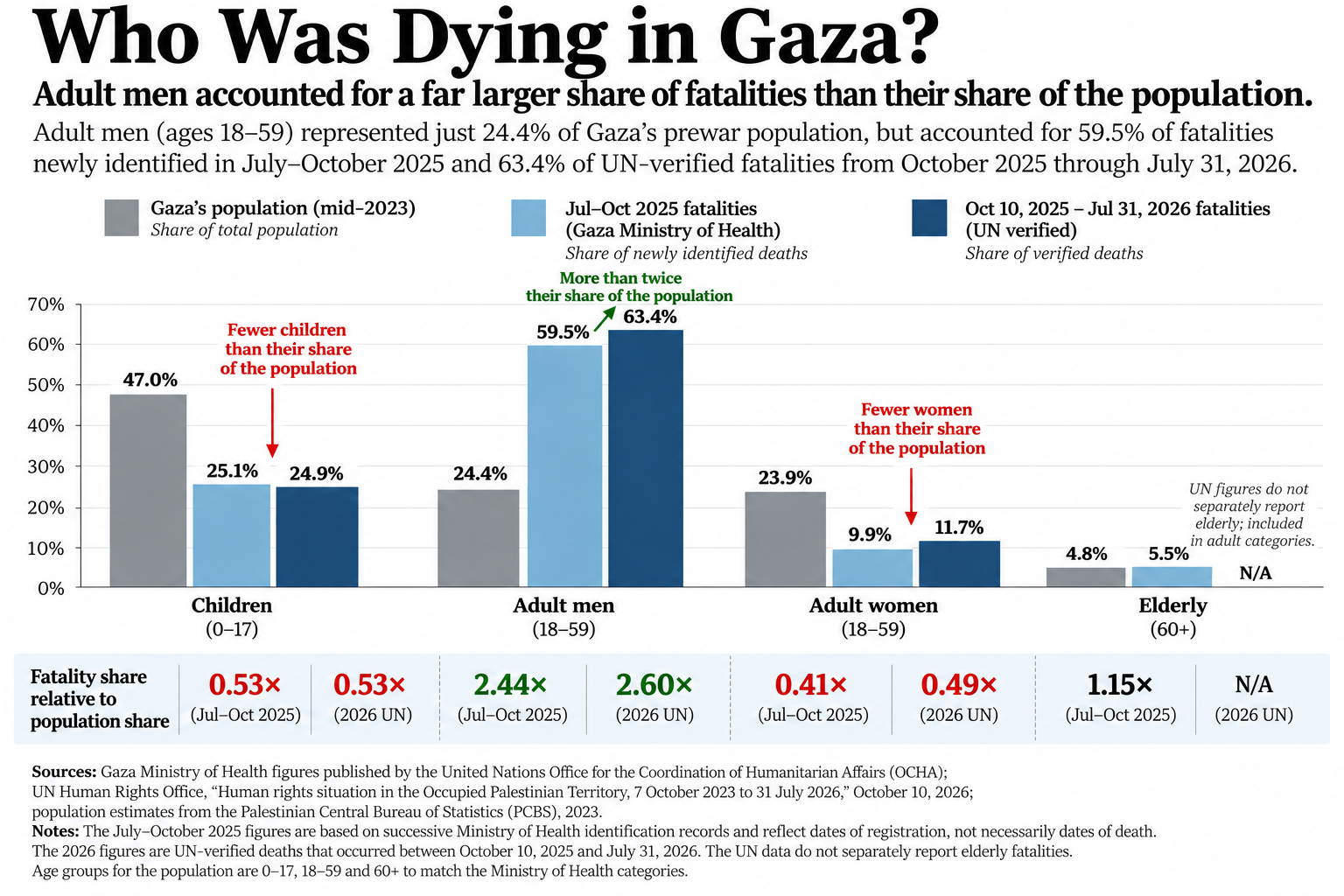
Gaza’s daily reported fatalities plunged by more than 90% following the October 2025 ceasefire, falling from over 90 per day during intense fighting in July to roughly four during much of 2026. Meanwhile, adult men’s share of newly identified fatalities climbed from 42% to over 63%, although they represented just 24.4% of Gaza’s population. Hamas combatants likely accounted for a substantial portion of those deaths. These extraordinary shifts tell a story buried beneath three years of cumulative death toll headlines.
For three years, Gaza’s death toll has dominated headlines. The number rises, newspapers report the latest milestone, politicians condemn Israel, and the world is reminded of the mounting casualties.
Yet the underlying data tell a story that has received remarkably little attention.
Gaza’s Ministry of Health under the direction of Hamas publishes detailed fatality figures, reproduced by the United Nations Office for the Coordination of Humanitarian Affairs (OCHA). Those figures reveal dramatic changes in who was dying, how frequently deaths were being reported, and how the cumulative death toll was being assembled.
Together, they offer a very different perspective on the progression of Israel’s military campaign.
The Remarkable Shift Toward Adult Men
Before the war, children represented approximately 47% of Gaza’s population. Adult men ages 18–59 accounted for just 24.4%, adult women 23.9%, and the elderly 4.8%.
The composition of reported fatalities changed substantially as the war progressed.
Among deaths newly identified between April and October 2024, adult men accounted for 42%, children 34.4%, and adult women 14.1%. By July–October 2025, adult men’s share had risen to 59.5%, while children’s share had fallen to 25.1% and adult women’s share to just 9.9%.
Adult men were therefore accounting for nearly two and a half times their proportion of Gaza’s population, while women and children represented substantially smaller shares of fatalities than their respective population shares.
The pattern continued after the October 2025 ceasefire. Among 1,076 fatalities verified by the UN Human Rights Office through July 2026, 63.4% were men, 24.9% children and 11.7% women. The UN’s categories differ from the earlier Ministry of Health breakdown, but the disproportionate representation of men remains striking.
Hamas combatants are overwhelmingly adult men. The growing concentration of fatalities among this demographic is consistent with Israeli forces increasingly engaging combatants as they gained control of the battlefield and improved their ability to identify and target Hamas and other terrorist group’s positions.
From More Than 90 Deaths a Day to Fewer Than Five
The changes in the daily death toll are equally dramatic.
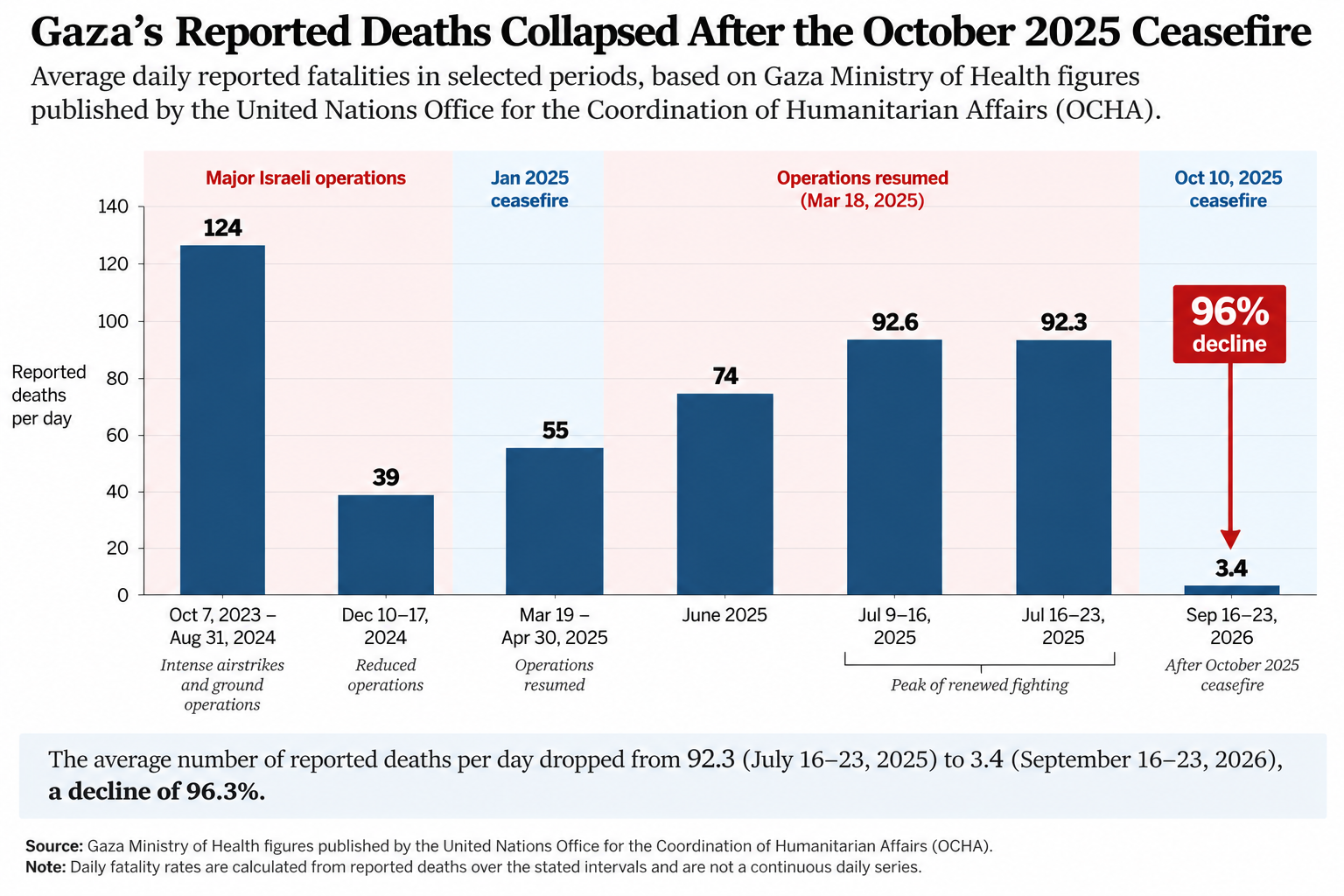
During the first eleven months of the war, Gaza reported an average of approximately 124 fatalities per day. Following the January 2025 ceasefire, the rate declined sharply before rising again when major military operations resumed in March.
During intense fighting in July 2025, the Ministry of Health reported more than 90 deaths per day. Following the October 2025 ceasefire, that figure collapsed. By September 16–23, 2026, just 24 fatalities were reported over seven days, an average of 3.4 per day. That represents a decline of more than 96% compared with the July 2025 reporting interval.
The numbers demonstrate how dramatically the intensity of military operations affected fatalities. They also reveal how misleading it can be to treat Gaza’s cumulative death toll as though it describes an unchanging level of violence.
The Death Toll Includes Deaths From Earlier Years
Another remarkable feature of Gaza’s reported death toll is how many fatalities are being added retrospectively.
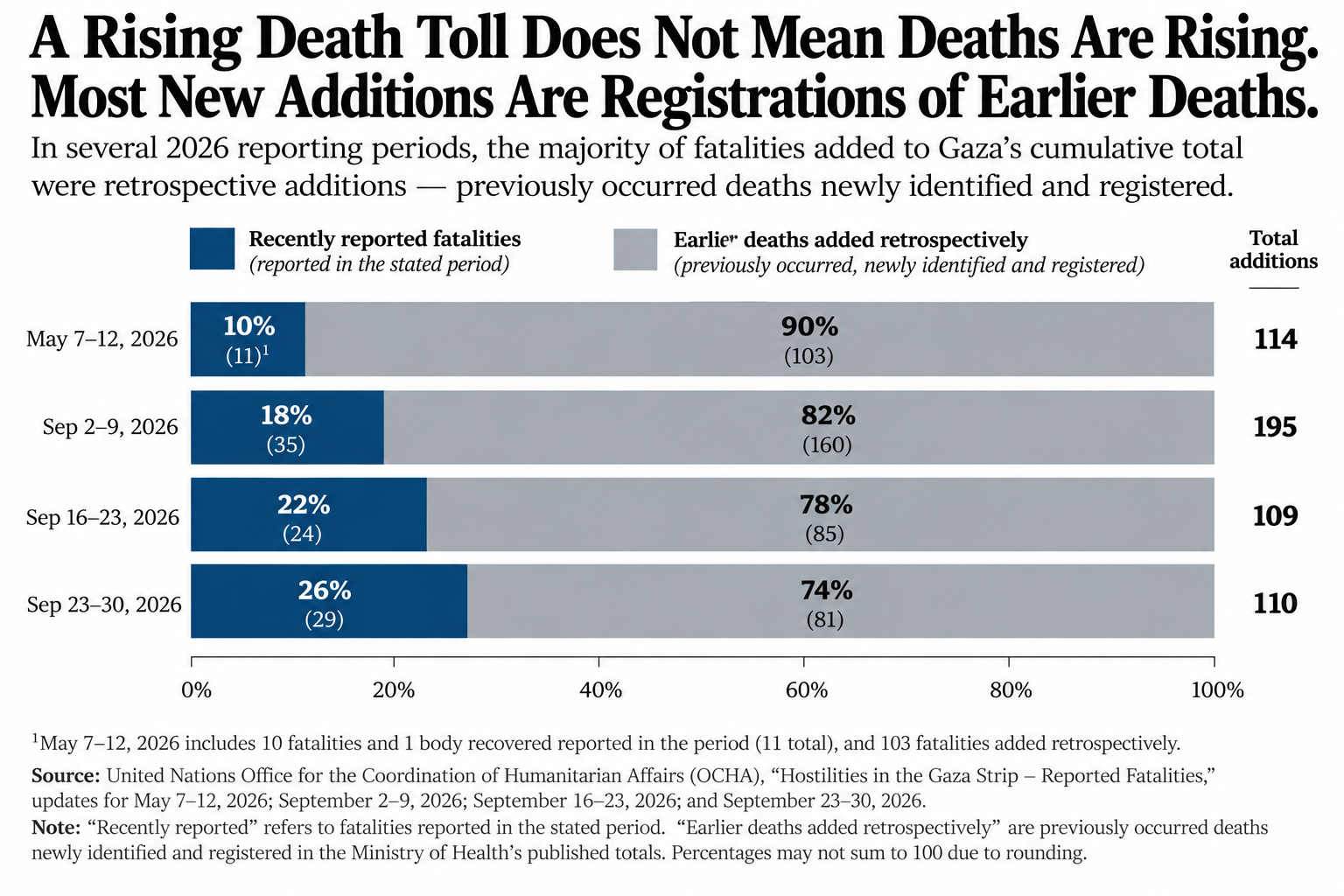
Hamas’s Ministry of Health continues identifying bodies, reconciling records and approving deaths that occurred in earlier periods. Those deaths enter the cumulative total when they are registered, regardless of when or how they occurred. In several 2026 reporting periods, retrospective registrations accounted for the majority of additions to the published total.
Between September 16 and 23, for example, 24 fatalities were reported for the period while another 85 earlier deaths were added after their identification details were approved. Retrospective registrations therefore represented 78% of the combined increase.
That distinction is almost entirely lost when the media simply announces another increase in Gaza’s cumulative death toll.
What the Numbers Say About Israel’s Campaign
The world has spent three years judging Israel’s military campaign largely through a steadily increasing cumulative death toll. Yet the underlying statistics reveal a campaign whose reported fatality patterns changed dramatically.
As Israeli forces gained control of the battlefield, adult men accounted for an increasingly disproportionate share of identified fatalities. Women and children represented progressively smaller shares, well below their proportions of Gaza’s population.
These patterns are consistent with a military increasingly able to distinguish and target Hamas combatants. They challenge the portrayal of a campaign conducted without regard for the distinction between fighters and civilians.
Meanwhile, the reported daily death rate has collapsed, and much of the recent growth in the cumulative total during selected periods has come from deaths registered long after they occurred.
The accusation of indiscriminate slaughter collapses when looking into the data. The numbers have been available. The story they tell has largely gone unread.
Sources: Gaza Ministry of Health fatality figures published by UN OCHA; Palestinian Central Bureau of Statistics, 2023 population estimates; UN Human Rights Office verified-fatality reporting. Demographic identification cohorts and UN-verified post-ceasefire deaths use different methodologies and should not be interpreted as directly comparable measures of battlefield fatalities.
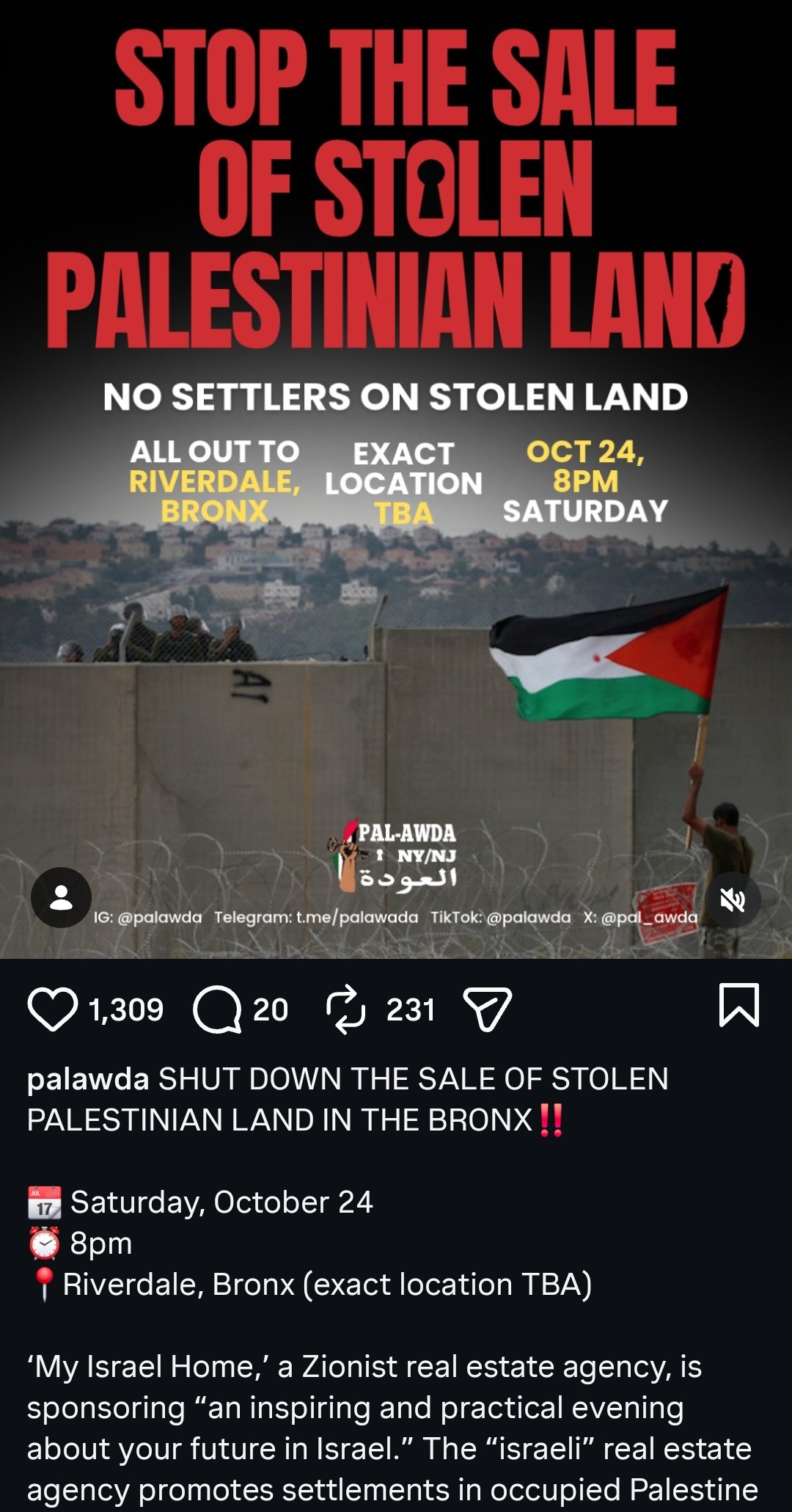
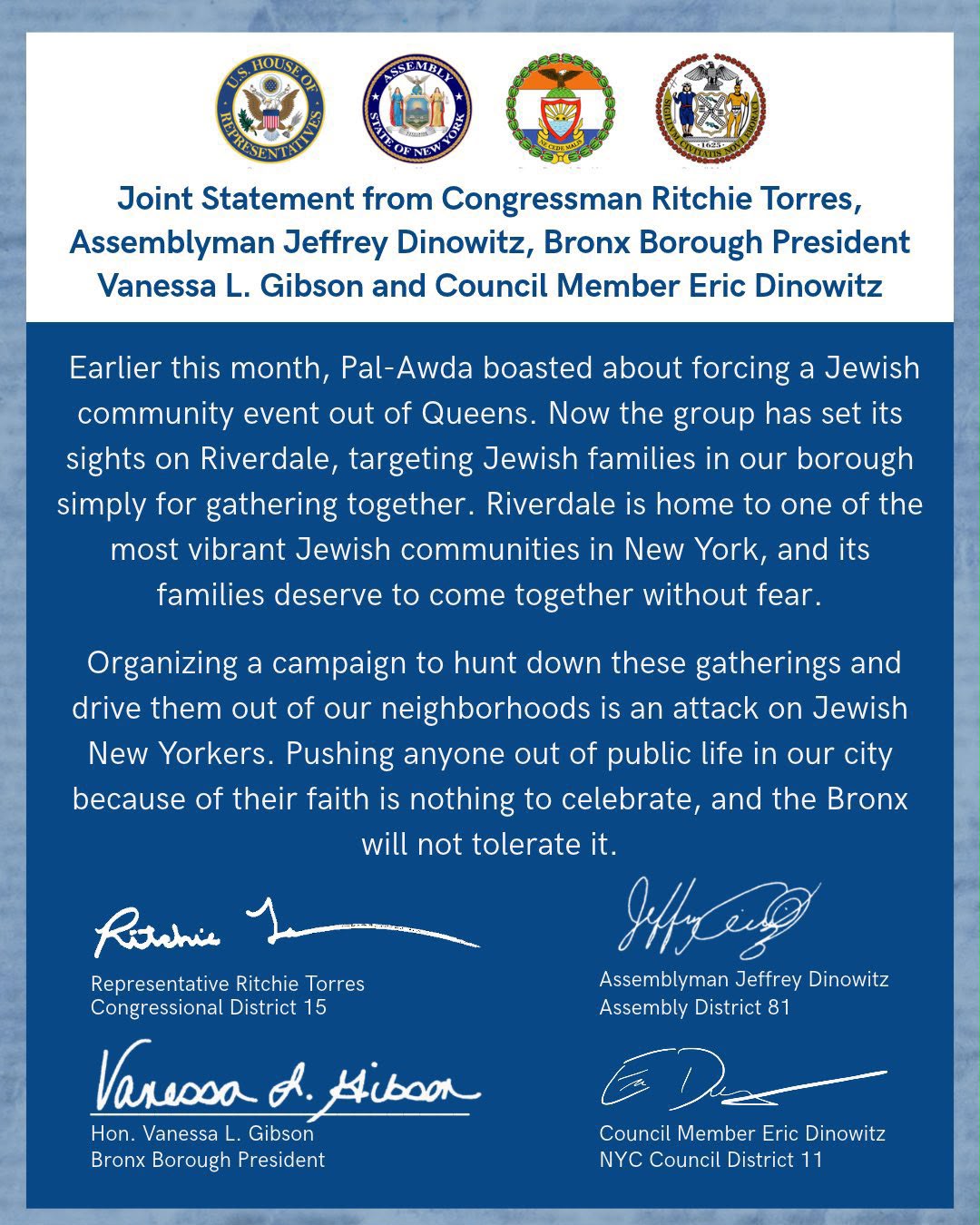
Pal-Awda is organizing a protest in Riverdale, Bronx, on October 24 to stop what it calls the sale of “stolen Palestinian land.” Its target is a Jewish real estate event organized by My Israel Home.
The accusation is enormous. The evidence is missing.
The protesters identify no stolen property, no dispossessed owner, no fraudulent deed and no evidence that anyone offering a home for sale acquired it unlawfully. They simply declare the land stolen and demand that the sale be stopped.
And what exactly makes a privately owned home “Palestinian land”?
There has never been an independent sovereign country called Palestine. Even if there had been, that would establish nothing about ownership of a particular house.
Imagine a homeowner in Dallas selling a house to someone from Los Angeles. Protesters descend on the transaction, shouting, “Stop the sale of stolen Dallas land!”
Stolen from whom? The homeowner? The city? Everyone who ever lived in Dallas?
Dallas describes an actual place. It does not own every home within its boundaries. A homeowner can sell to another person, regardless of where the buyer was born or lives.
The same is true in Judea and Samaria. Land owned by an Arab is the property of that owner, just as land owned by a Jew is the property of that owner. Lawful ownership can change hands. A property’s location or the ethnicity of its former owner establishes neither permanent ownership nor theft.
Pal-Awda previously celebrated forcing a Jewish gathering out of Queens. It targeted an event at a synagogue in Manhattan. Now it is targeting Riverdale, seeking to stop Jewish families from gathering to consider buying homes in Israel.
“It is our duty to make them think twice before holding these events. We need to make them scared! We need to make them scared! We need to make them scared.” – people at PAL-Awda protest in front of a synagogue event helping Jews move to Israel in November 2025
Congressman Ritchie Torres, Assemblyman Jeffrey Dinowitz, Bronx Borough President Vanessa Gibson and Council Member Eric Dinowitz condemned the campaign in a joint statement, calling it “an attack on Jewish New Yorkers” and declaring that “the Bronx will not tolerate it.”
The campaign has a documented pattern: targeting Jewish real estate gatherings, pressuring venues and celebrating when Jewish events are driven out of New York City. And this is in regards to ALL of Israel, as Pal-Awda has condemned all Jews making aliyah regardless of where they intend to live.
“Settler, settler, go back home, Palestine is ours alone!” – PAL-Awda’s Instagram
The protesters have identified no stolen home. But they have identified their target: Jews.
Simply allowing the event to take place is an inadequate response. The entire Riverdale community – Jewish and non-Jewish alike – should stand together in visible opposition to those who gather to harass and intimidate Jewish homebuyers. Elected officials who condemn antisemitism in statements should stand alongside the people being targeted.
Antisemites should never be allowed to decide where Jews can gather, where they can buy homes or whether they can live openly as Jews. Riverdale should make that unmistakably clear.
More than 100 Jews gathered in Brooklyn this month to plan a network of anti-Zionist synagogues, schools and summer camps. The emerging Jewish Diaspora Movement brought together people associated with Jewish Currents, Rabbis for Ceasefire, Jews for Racial & Economic Justice (JFREJ) and the American Council for Judaism. Rabbi Alissa Wise, formerly of Jewish Voice for Peace, is among its founders. Discussions included plans for a Jewish day school in Boston in 2029.
The gathering is part of a broader effort to reshape what future generations of American Jews learn about their religion, history and relationship to Israel.
The “intellectual” groundwork is expanding. Temple University professor emerita Carolyn Karcher’s Reclaiming Judaism from Zionism, featuring 47 Jewish contributors, includes a guide encouraging readers to bring anti-Zionist arguments into synagogues and families. Pulitzer Prize-winning author Benjamin Moser’s Anti-Zionism: A Jewish History profiles twelve Jewish opponents of Zionism, placing their dissent within a longer Jewish intellectual tradition.
Jewish opposition to modern Zionism has a history. Jewish attachment to the Land of Israel has a far longer one.
Judaism is an ancient, land-based religion. Abraham traveled to Canaan. The Israelites returned from Egypt. Jerusalem became the center of Jewish worship. The Torah commanded pilgrimage to Jerusalem three times annually, during Passover, Shavuot and Sukkot. For millennia, Jews have prayed toward Jerusalem, mourned the destruction of its Temple and concluded the Passover Seder with the aspiration of returning there.
Opposing modern Jewish statehood is a political or theological position. Denying the Jewish people’s ancient connection to the Land of Israel is a historical falsehood. The distinction matters because Judaism’s scriptures, laws, holidays and prayers are rooted in a particular people and their ancestral homeland.
A Jew may reject God, violate Shabbat, oppose circumcision or denounce Israel and remain Jewish. Jewish belonging encompasses believers and atheists, the observant and secular, Zionists and anti-Zionists.
A Jew can reject a teaching of Judaism and remain Jewish. But that does not transform the rejection into a teaching of Judaism.
A Jew who eats ham makes a personal choice. A rabbi who certifies ham as kosher betrays the trust of Jews who rely on that certification to observe their religion. Similarly, a Jewish school that teaches children to deny their ancestral connection to Israel betrays the trust of parents who expect it to transmit Jewish history and tradition faithfully.
Jews who disagree with established organizations are free to create alternatives reflecting their beliefs. Existing institutions have the same right to preserve their missions. The Jewish identity of an institution’s founders establishes its origins. Its teachings and conduct determine whether it deserves the community’s trust.
Rabbi Brant Rosen, founder of the anti-Zionist congregation Tzedek Chicago, described his community as “consciously not an inclusive community.” His congregation establishes boundaries around its beliefs. Yet Open Hillel challenges Hillel’s restrictions on sponsoring organizations that advocate boycotts of Israel or reject its legitimacy as a Jewish state.
Hillel welcomes Jews across denominations, levels of observance and political beliefs while maintaining a mission that includes strengthening Jewish connections to Israel. Anti-Zionist congregations defend their own ideological boundaries while demanding that Hillel loosen its own. BDS supporters advocate withholding institutional support from organizations whose values they oppose, yet object when Jewish institutions apply similar standards to BDS.
At Emory Hillel, Rabbi Nikki Golomb was dismissed in August, weeks after beginning her position. She attributes the decision to her fiancé’s fierce criticism of Israel; Hillels of Georgia disputes that account, citing concerns about transparency and alignment with its mission. Golomb was affiliated with Rabbis for Ceasefire, founded by Alissa Wise. Whatever the disputed circumstances, Hillel has the right to expect its religious educators to uphold its mission.
Jewish disagreement has produced competing religious movements and institutions for centuries. But religious harm occurs when an institution entrusted with Jewish education misrepresents foundational elements of Jewish history or tradition. A school that teaches children to deny the Jewish people’s connection to Israel can legitimately have its claim to teach authentic Judaism challenged by the broader Jewish community. Opposition to modern Jewish sovereignty alone does not establish that denial.
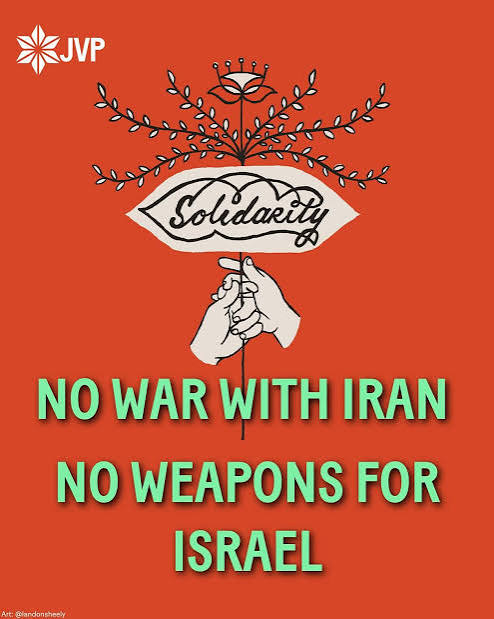
Physical harm presents a separate and more urgent threshold. Organization that campaign to deprive threatened Jewish schools or synagogues of reasonable security protections, or to deny Israeli civilians protection against attack – like JVP, JFERJ, IfNotNow NYC and the American Council for Judaism – know that they expose Jewish lives to danger. The Jewish community has the right to challenge such conduct, withdraw communal recognition and support, and defend institutions that faithfully serve their missions.
Jewish Voice for Peace is against defensive weapons for Israel
Every Jew belongs to the Jewish people. Every institution founded by Jews does not automatically speak for Judaism. And when an institution uses the Jewish name to falsify Jewish history, betray Jewish trust or endanger Jewish lives, the Jewish community has a responsibility to confront it.