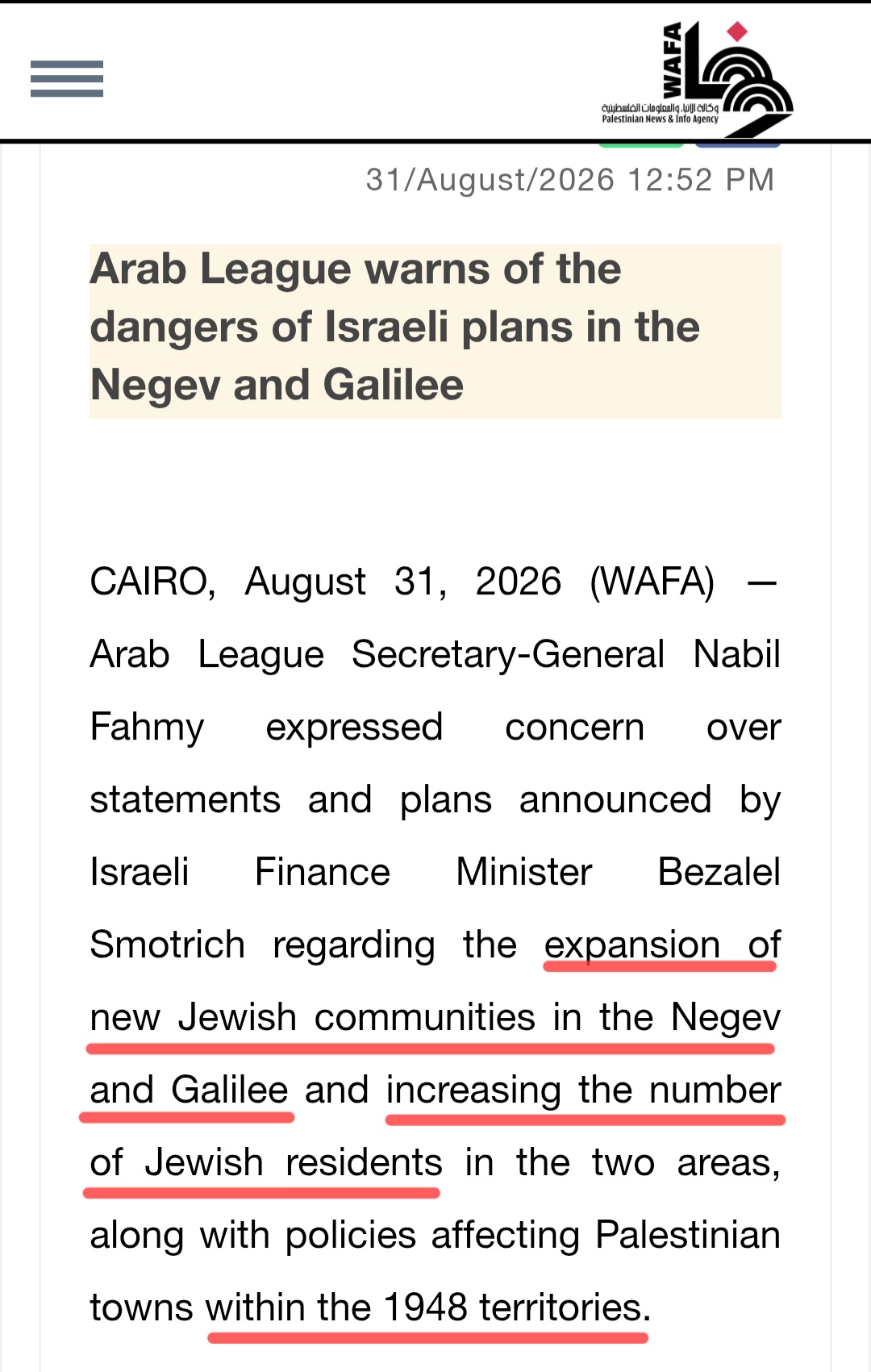
The Arab League issued a remarkable condemnation of Israel: it objects to the “expansion of new Jewish communities in the Negev and Galilee and increasing their Jewish populations.”
These are not settlements in the West Bank. They are areas inside Israel’s pre-1967 borders.
Further, Israel is described as “1948 territories.”
That makes the statement difficult to reconcile with the Arab League’s simultaneous support for a Palestinian state based on the June 4, 1967 lines. Under that formula, the Negev and Galilee remain part of Israel. And why suggest that Israel is just part of Palestine, calling the entire state “1948 territories?”
The question is particularly relevant to Egypt.
Egypt was the first Arab country to recognize Israel and signed a peace treaty with Israel in 1979, ending the two countries’ state of war. Nearly fifty years later, Cairo continues to endorse a two-state solution: a Palestinian state based on the 1967 lines alongside a secure Israel.
That position should carry a simple implication: Israel’s right to develop its own communities within its own territory.
Egyptian officials should therefore answer a straightforward question: Does Egypt believe Israel has the same right to develop Jewish communities within its territory that a future Palestinian state would have to develop its own communities?
If the answer is yes, Cairo should say so.
If the answer is no, then the issue is not simply the borders of a future Palestinian state. It is whether Jewish demographic and community development inside Israel is itself considered illegitimate. It reeks of antisemitism.
But is their another way to think of these hateful remarks?
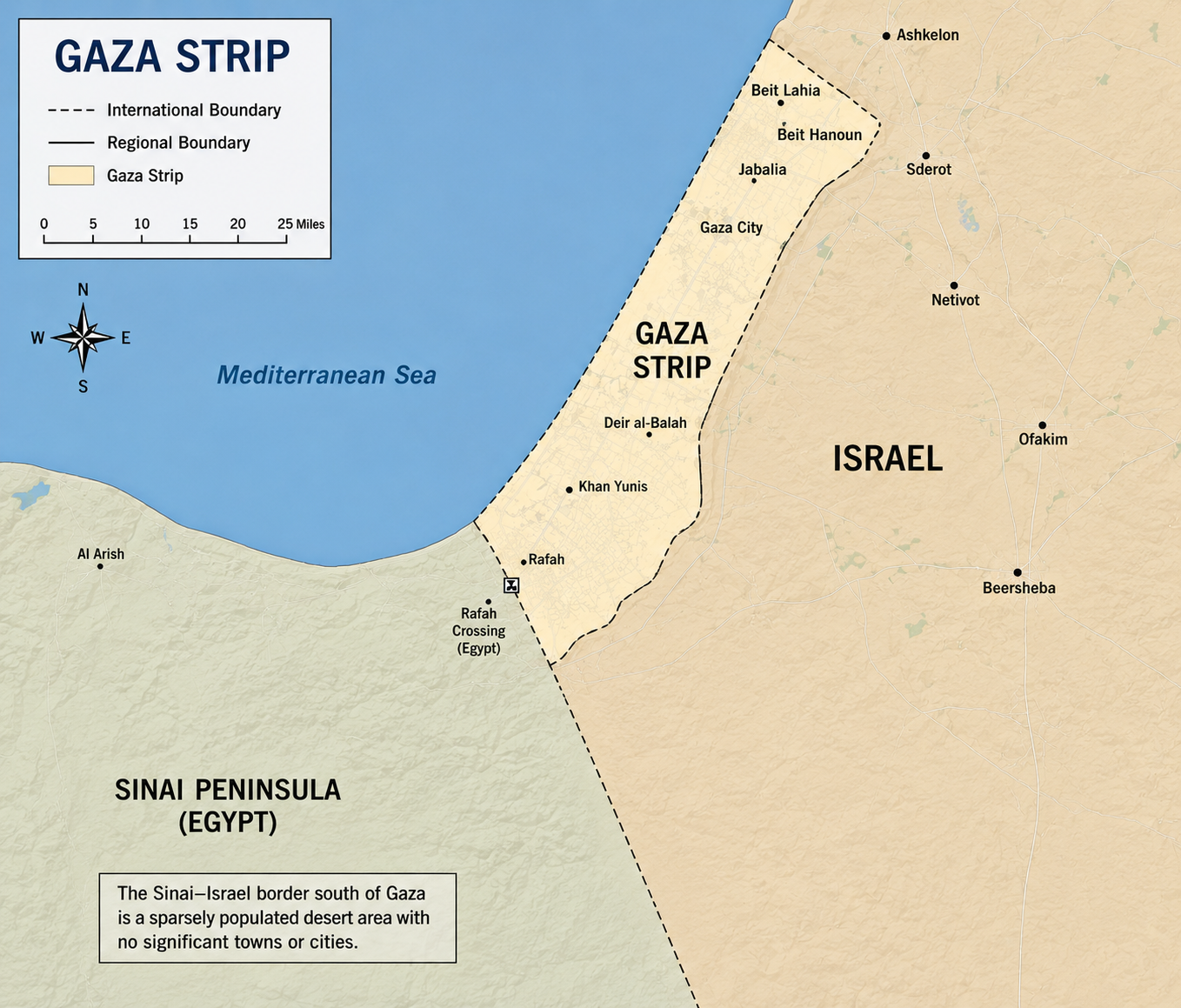
Egypt made peace with Israel nearly half a century ago to get back the Sinai Peninsula it lost in the 1967 Six Day War. Is Egypt deliberately opening cracks in that treaty? Is it preparing to push Israel to hand some of the Negev to Gazans now – alongside its own contribution of part of the Sinai – as Gazans hope to rebuild the strip after its failed war on Israel?
Is the Arab League simply being antisemitic or is it deliberately setting the course for a new map for Gaza?
Everyone knows why October 7, 2023 changed Israel. But an obscure Ottoman law makes another date worth watching: October 7, 2026.
In 1858, the Ottoman Empire enacted a land code under which three consecutive years without cultivationcould have consequences for rights to certain agricultural land.
Now, three years after October 7, that old rule may suddenly matter.
The Three-Year Rule
Much of the agricultural land of the Ottoman Empire was classified as miri. The sovereign retained ultimate title (“state land”) while individuals could acquire valuable rights of possession and use, known as tasarruf.
Active use of the land mattered.
Article 68 of the Ottoman Land Code addressed agricultural land left uncultivated for three consecutive years without a valid excuse. The original Ottoman mechanism was more complicated than “three years and the government automatically owns your land,” involving tapu, the status of the holder and opportunities to recover the right.
But the underlying principle was clear: continued cultivation could matter to continued land rights.
Ottoman term
Meaning
Relevance
Miri
State land carrying individual possession/use rights
Much agricultural land
Tasarruf
Right of possession and use
The individual’s valuable land right
Mahlul
Lapsed/reverted possessory right
Potential consequence of qualifying non-cultivation
Tapu
Land registration/title system
Documentary evidence of rights
This is not merely an Ottoman historical curiosity. It passed on to the British, Jordanians and then Israel with few modifications.
In 2020, Israel’s Supreme Court addressed the rule directly in HCJ 5426/17, Barakat v. Head of the Civil Administration in the West Bank (Nov. 29, 2020). The Court held that under the Jordanian land law still applicable in the territory, an unregisteredtasarruf right acquired through cultivation could be extinguished if the land was left uncultivated for three consecutive years, causing the land to revert to the government under Article 68’s mahlul doctrine. By contrast, a tasarruf right that had been formally registered generally was not lost merely because the land subsequently lay fallow.
So the three-year rule remains relevant to unregistered land in Judea and Samaria today.
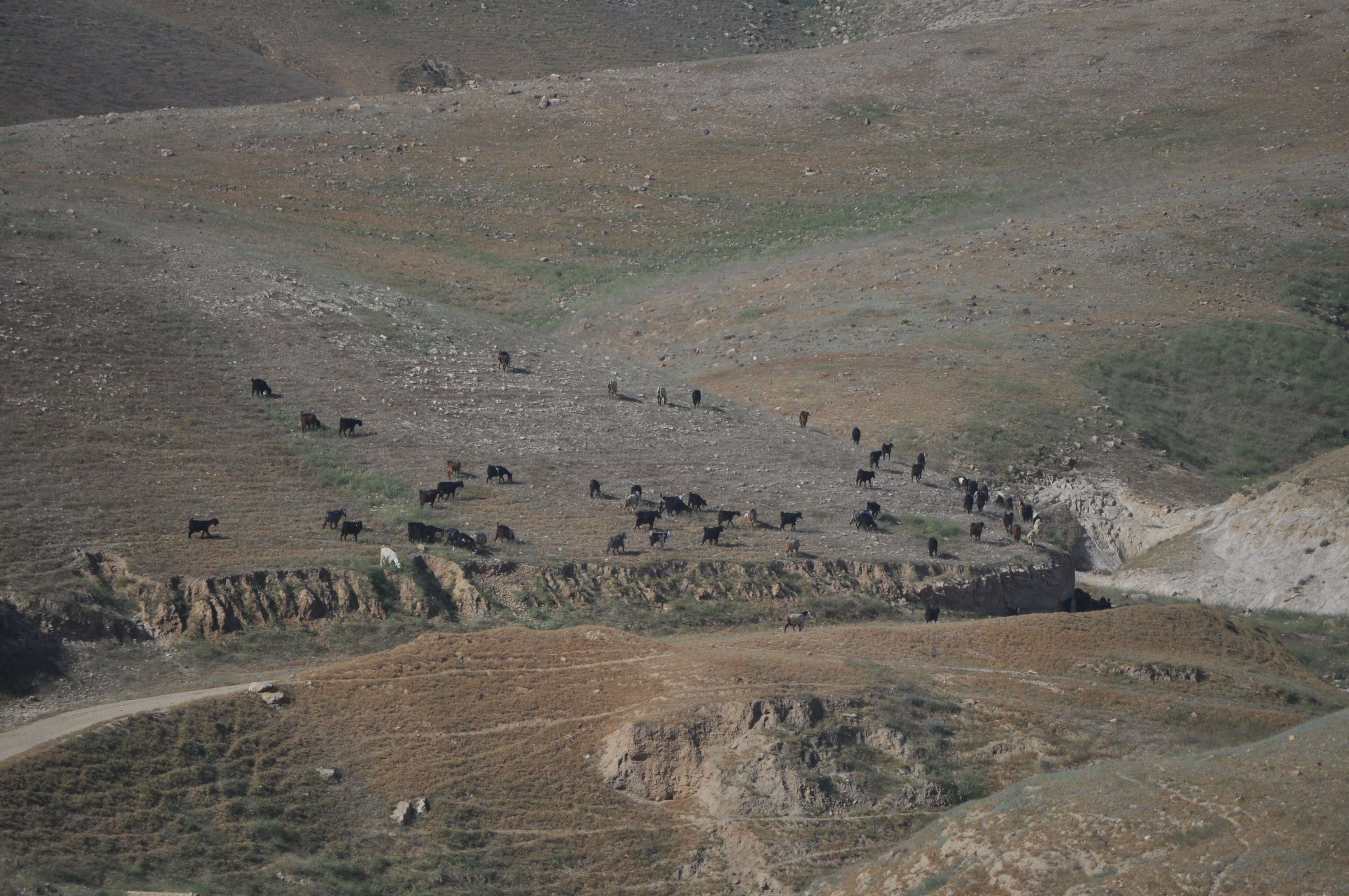
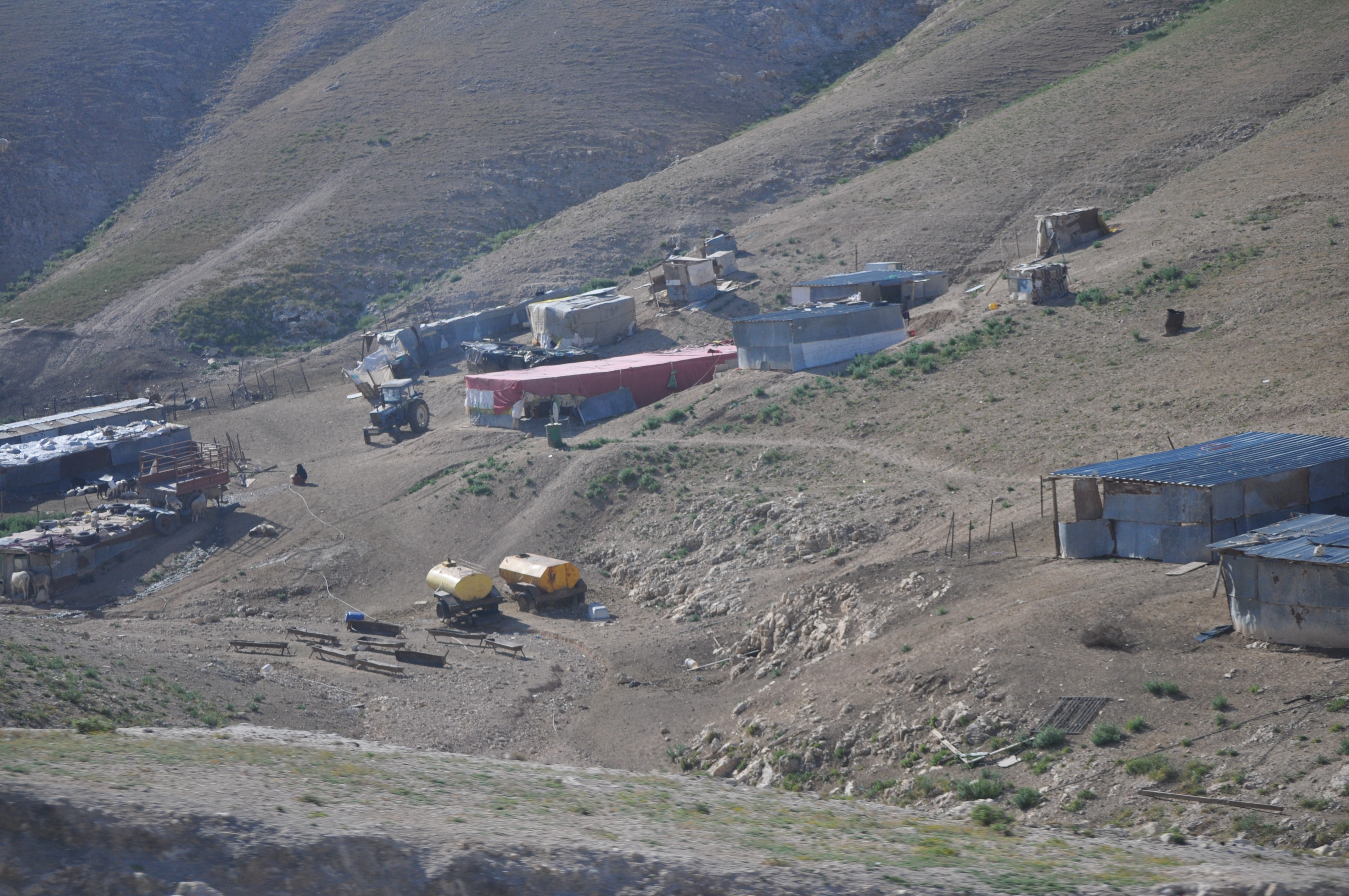
Goats owned by Bedouins graze in Judea and Samaria (photo: FirstOneThrough)
Then Came October 7
After the October 7 massacre by Gazans, security conditions dramatically changed access to agricultural land across the region. OCHA reported that more than 96,000 dunams of olive-cultivated land went unharvested during the 2023 season following access restrictions and violence. By the 2025 olive harvest, OCHA was reporting that farmers from multiple villages had been completely denied access for the third consecutive year to certain olive groves.
That creates the question: How much unregistered agricultural land has actually gone uncultivated since October 7, 2023?
The Eye in the Sky
There is something unusual about these particular three years.
Israel has had extraordinary security reasons since October 7 to maintain extensive aerial surveillance of Judea and Samaria.
At the same time, the Civil Administration already uses sophisticated geographical information in determining land status. Its Surveying Unit maintains cadastral and mapping information, while its Supervision Unit operates a team whose stated function is examining land through survey procedures “aimed at locating state land in the area, for declaration as such.”
The Civil Administration therefore potentially possesses an extraordinarily detailed record of whether cultivation occurred.
Request For Access
Consider two claimants whose land appears uncultivated in aerial photographs for three years. One produces repeated applications showing: I wanted to cultivate my land. Israel prevented me from reaching it. The other has no comparable record.
Those are materially different factual cases based on the background discussed above.
OCHA reports that Palestinian liaison authorities submit farmers’ access requests to Israeli authorities and tracks approvals, denials and pending requests in particular areas. Those applications coupled with the aerial documentation, may move the land into a different legal category.
Meanwhile, Israel Is Looking for State Land
This is where the 1858 law meets 2026.
The Civil Administration openly maintains a Survey Lands team charged with examining whether land can be declared government property. Its newly published procedures show that potential survey areas are placed on a priority list requiring approval by the head of the Civil Administration and the Defense Minister or an authorized representative.
The State Comptroller describes the same team’s purpose as locating and marking land in Judea and Samaria that can be declared government property.
And Israel has dramatically accelerated state-land declarations.
In February 2026, the Israeli government approved the resumption of systematic land-registration proceedings in Area C, allocating approximately NIS 244 million to the effort—the first such broad registration initiative since Israel suspended the previous settlement-of-title process after 1967.
Peace Now calculates that approximately 27,119 dunams had been declared state land under the current government by June 2026, nearly as much as it says had been declared during the entire period since the Oslo Accords. A Palestinian Authority commission consequently calculates that approximately 29,335 dunams have been included in state-land declarations since October 7, 2023.
And we haven’t yet reached the anniversary when many West Bank Arabs encountered more restrictions on movement due to the war their Gazan brothers waged on Israel.
October 7, 2026
That is what makes the third anniversary different.
Consider the ramifications of Ottoman law to this point in time:
1858: Ottoman law makes three years of non-cultivation legally significant for certain land rights.
2020: Israel’s Supreme Court confirms that the Article 68 mahlul doctrine remains relevant to unregistered tasarruf rights in Judea and Samaria.
2023: October 7 is followed by enormous disruption of access to agricultural land.
2023–2026: Israel accumulates an extraordinary photographic record of what is happening on the ground.
2024–2026: state-land declarations accelerate.
2026: Israel funds a major new land-registration initiative.
October 7, 2026: three years have elapsed for when many West Bank Arabs accessed land they had used previously.
Nothing automatically changes ownership at midnight of 10/7. Many questions remain.
How much affected land is actually unregistered miri land? Was it legally “uncultivated”? What constitutes a sufficient excuse? What happens when Israeli security restrictions themselves prevented cultivation? And what evidence exists showing that individual claimants continued asserting their rights?
Those questions will have to be answered parcel by parcel.
But after October 7, something will exist that did not exist before: three complete post-massacre years of evidence.
October 7, 2023 changed the security map of the Middle East. October 7, 2026 may begin changing the actual map of Judea and Samaria as well.
Palestinian Arabs are scheduled to vote on November 28 in their first legislative election in twenty years. International observers will naturally ask whether the election is free and fair. But there is a more fundamental question:
Will Palestinians actually be electing a government capable of governing?
The problem begins with the Palestine Liberation Organization.
The PLO was established in 1964, decades before there was a Palestinian Authority. In 1993, it was the PLO—not the Palestinian Authority—that entered the Oslo process with Israel. Those agreements established the framework for Palestinian self-government in the West Bank and Gaza and contemplated an elected Palestinian Council. The Palestinian Authority and the executive institutions emerged from that process as the interim governing apparatus.
The PLO is the institutional skeleton on which the Palestinian political system was built.
And that makes the coming election peculiar.
Electing People Who Reject the System
The August modification to the election law requires candidates to commit to recognition of the PLO as the sole legitimate representative of the Palestinian people, as well as its political and national program and relevant international resolutions.
Yet Palestinians overwhelmingly reject that requirement.
According to the Palestinian Center for Policy and Survey Research, two-thirds oppose requiring candidates to accept the PLO’s commitments, including its agreements with Israel. Only 27% support the requirement.
That is not an opinion related to dissatisfaction with Mahmoud Abbas, Fatah or the incumbent government. That is an outright rejection of the entire government structure and institutions. Palestinians want to elect the government while leaving unsettled whether the people elected to run it accept the foundations of the system they are entering.
It is a election whose foundation is anarchy.
PA President Mahmoud Abbas
If insufficient, the Arabs want to vote for terrorism.
Ballots Without Giving Up the Guns
Democratic government requires more than elections. Ultimately, the elected government must possess political authority and a monopoly on legitimate force. Yet Palestinian politics continues to blur the distinction between a political party and an armed organization.
Hamas is the clearest example.
The devastation of the Gaza war appears to have changed Palestinian calculations. Only 20% now say Hamas won the war, compared with 39% ten months earlier. Support for “armed struggle” (terrorism) as the most effective means of achieving Palestinian statehood has fallen from 41% to 27%, which was around two-thirds immediately after October 7, 2023. Meanwhile, support for negotiations has risen from 36% to 44%, its highest level in four years.
That all sounds encouraging. But look more closely at what changed.
Palestinians only moved toward negotiations as violence has proven devastating and unsuccessful. Yet even after that experience, 72% oppose Hamas disarming before Israel completely withdraws from Gaza. And 53% believe that even if Hamas gives up its weapons, it will remain both an armed resistance movement and a political movement. Only 36% expect it to become solely political. So 89% (basically everyone) thinks the group that most of the Global North has labeled a terrorist organization, will be part of the Palestinian government.
That holds true for the various Palestinian terrorist groups. A society established in which various militias will be free to operate their own foreign affairs and military engagements.
An Elected Government That May Not Govern
If not appalling enough, there is another revealing number.
If elections are held and a new Palestinian government is formed, only 28% of Palestinians say they would prefer that elected government to administer Gaza. Thirty-two percent prefer the separate National Committee, while 34% prefer neither.
Consider these three facts:
Palestinians are preparing to elect a legislature for a political system whose foundational commitments most do not want imposed on candidates.
They may elect factions that retain independent armed power outside the government’s control.
They do not want the resulting elected government to govern Gaza.
Combined, this is not merely an imperfect election in the shadow of war of a fledgling state.
It is a vote for anarchy with a veneer of cohesion.
The Liberated Ethnic Studies Model Curriculum Consortium (LESMC) has an ambitious mission. It calls for “anti-racist and decolonial pedagogy” in which students study imperialism and oppression, resistance movements and the struggles of peoples to reclaim their identity and agency.
By those standards, one extraordinary case study should sit near the center of the curriculum: The Jews.
Israel may be one of history’s greatest examples of successful decolonization.
Indigenous
Jewish civilization did not originate in Europe. It arose in the Land of Israel.
Israel, Judah, Judea, Jerusalem and Zion are not modern colonial names. They are ancient names embedded in Jewish history. Judaism developed there. The Hebrew Bible is centered there. Jewish holidays follow its seasons and agricultural cycles. Jerusalem became the religious and national center of the Jewish people.
1630 Map of the Israelite tribes in the holy land, together with images on the border from the life of the Jewish prophet Moses, and the Children of Israel’s exodus from Egypt
Even the people’s name—Israel—is ancient.
Colonized
Then came conquest. Jewish kingdoms were conquered by successive imperial powers, including the Assyrians, Babylonians, Greeks and Romans.
The Babylonians destroyed the First Temple and carried many Jews into exile. Rome later destroyed the Second Temple, crushed Jewish revolts and accelerated the dispersion that would define Jewish existence for centuries.
The Jewish people lost sovereignty in its own homeland but never its connection.
Dispossessed—but Not Disconnected
Dispersion scattered the Jews without eliminating Jewish peoplehood. Jews in Poland did not simply become Poles. Jews in Morocco did not simply become Moroccans. Jews in Iraq did not simply become Iraqis.
Across continents, they retained a common religion, history, calendar and connection to the same ancestral land. They prayed toward Jerusalem. They ended Passover with “Next year in Jerusalem.” Hebrew survived as the language of scripture, prayer and scholarship.
And Jews never disappeared from the land itself. Jewish communities remained through centuries of foreign rule.
Resistance
Jewish history is also a story of resistance. The Maccabees resisted Seleucid repression and restored Jewish sovereignty. Jews later rebelled against Rome.
Judah the Maccabee, Wood engraving by Julius Schnorr von Carolsfeld (German painter, 1794 – 1872), published in 1860.
After military resistance became impossible, survival itself became resistance. A small, scattered minority endured expulsions, forced conversions, discriminatory laws and massacres without surrendering its identity.
Eventually came Zionism: the modern movement to restore Jewish national self-determination where Jewish national history began.
A stateless people sought to cease being stateless.
Decolonization
And then something extraordinary happened. The dispersed people returned in large numbers.
There was no Jewish Britain or France directing an overseas colony. Jews came from Europe, North Africa, the Middle East and elsewhere to the land at the center of their collective history.
They restored sovereignty.
And they accomplished perhaps their most astonishing act of cultural decolonization: they revived Hebrew.
Not Polish, Russian, German or Arabic. Their ancestral language became the everyday language of children, schools, newspapers, commerce and government.
They made Jerusalem their capital. They called their national movement Zionism, after Zion.
So apply LESMC’s vocabulary consistently: Indigenous. Conquered. Dispossessed. Resistance. Return. Cultural restoration. Self-determination.
The Jewish story fits remarkably well.
So What Happened?
Why does this seemingly perfect LESMC case study become almost its opposite when the curriculum reaches Israel?
Some of the people shaping the curriculum help explain the disconnect.
Samia Shoman, a Palestinian-American member of LESMC’s leadership, co-coordinates the Teach Palestine Project, which develops curricula for American schools. Her materials describe Israel as an “institutionalized system of oppression and apartheid.” After California rewrote its original ethnic-studies curriculum, Shoman blamed “Zionist and other rightwing lobbyists” for what she said was the destruction of its “anti-racist, decolonial and liberatory” approach.
Jody Sokolower, who is Jewish, co-coordinates Teach Palestine. Her student history says Britain promised Palestine to Zionists and describes Zionists as subsequently carrying out plans to push Palestinian Arabs and Britain out. The larger Teach Palestine curriculum explicitly seeks to put these perspectives into American classrooms.
Guadalupe Carrasco Cardona, a founding member of Liberated Ethnic Studies, has spent her career developing what LESMC itself describes as “critical curriculum” and helped build the Liberated alternative after the original California curriculum was substantially changed.
This isn’t a peripheral connection. LESMC lists Shoman, Cardona and Theresa Montaño among its leadership, while Teach Palestine produces lessons connecting the conflict to forced relocation, criminalization and a “culture of resistance.”
“Zionism is a nationalist, colonial ideology that, from the late 19th century on, has called for the creation and expansion of Israel as a Jewish state in historic Palestine by any means necessary. As support for Palestine and criticism of Israel’s apartheid policies have grown in the US and internationally, Zionist organizations have stepped up their efforts to silence discussion of Palestine/Israel in movement circles, on college campuses, and now in K–12 education.” – Teach Palestine’s Understanding Zionist Backlash
Now the inversion makes more sense.
A framework supposedly built to recognize indigeneity, dispossession, resistance and decolonization encounters a people whose history contains all four—but influential architects approach Jewish national restoration through an anti-Zionist and settler-colonial lens.
So:
The indigenous become settlers. The dispossessed become colonizers. Return becomes colonialism. National liberation becomes oppression.
The Jews should be a textbook LESMC case study: an ancient people conquered and dispersed, preserving its identity and ancestral language for centuries, returning home, reviving that language and restoring sovereignty.
Instead, one of history’s most remarkable decolonization stories is recast as colonization.
The history didn’t change. The ideological lens did.
ACTION ITEM
Be involved in your local school board and investigate the materials used in the classroom.
Israel’s decision to move forward with construction in E1 produced the familiar headlines: settlers, seized Palestinian land, displacement and the death of a Palestinian state.
WAFA reported that Israel issued a tender for 1,234 “settlement units” in E1, presenting it as “one of the most controversial settlement schemes” in a colonial project designed to fragment Palestinian territory.
Before debating E1, start with what is actually being built, where, on whose property and for whom.
An Extension of Ma’ale Adumim
E1 is an approximately 12,000-dunam, or 12-square-kilometer, planning area between Jerusalem and the existing community of Ma’ale Adumim.
It lies in Area C, where the Palestinian Authority and Israel agreed under the Oslo framework would be under Israeli security control and civil administration. Israel is building within the municipal planning jurisdiction of Ma’ale Adumim, not a new area. E1 has not been annexed to Israel.
The current project is E1 South, one part of that larger area. The 1,234 units are in apartment blocks adjacent to the existing city, not isolated houses spread across 12 square kilometers of West Bank hills. The plans contemplate the infrastructure of a normal urban community: elementary schools, kindergartens and daycare, synagogues and a mikveh, community buildings, parks and gardens, commercial facilities, roads and infrastructure.
E1 is not a new project of the current Israeli government. Its planning dates back roughly three decades to the Rabin era. Roads and the Judea and Samaria District police headquarters were built there years ago, even as residential construction remained frozen under international pressure.
Building Does Not Draw the Border
Area C was created under Oslo as an interim administrative arrangement, not a permanent international border. Borders, settlements and Jerusalem were reserved for permanent-status negotiations, and Israel subsequently transferred authority over the major Palestinian population centers to the Palestinian Authority as part of Area A.
E1 South could therefore ultimately remain with Israel, become part of a Palestinian state, or be addressed through a negotiated territorial exchange. Construction changes the facts future negotiators confront; it does not establish sovereignty.
E1 does not make a Palestinian state geographically impossible simply because it creates a narrow connection between northern and southern Palestinian population centers. Israel itself has long existed with a narrow neck across its principal population center, historically only about nine miles wide at its narrowest point. If a narrow neck makes statehood impossible, Israel itself should have been geographically impossible for decades.
Palestinian north-south travel east of the 1949 Armistice Lines (E49)/ Judea and Samaria already happens and is being made easier. A route already exists east of Ma’ale Adumim, and Israel is constructing additional roads intended to connect current Palestinian Arab communities around E1.
A Land System Older Than Israel
Much of E1 is classified by Israel as state or government land, but Israel did not invent that category in 1967.
The underlying system begins with the Ottoman Land Code of 1858, which established categories of land and rules involving government ownership, registration, possession and cultivation. The Ottomans created the system, the British Mandate retained and amended it, and Jordan continued administering and registering West Bank land under it. Israel inherited that legal structure after 1967 and subsequently administered and modified it through military orders.
Private Palestinian Property Was Excluded
Approximately 775 dunams — about 6.5% of E1 — consist of recognized private Palestinian parcels interspersed through the area.
Israel did not classify those parcels as state land, and they were excluded from the official E1 plans. Bimkom, an Israeli planning organization opposed to E1, notes the importance of continued agricultural cultivation to the status of some private parcels.
Critics argue that surrounding development could make access to some excluded private parcels more difficult. That is a legitimate issue, but does not suddenly turn building these apartments into theft of privately owned Palestinian land.
1.55% of E1
The scale of the current project is considerably smaller than the overall E1 map suggests.
On August 18, 2026, Israel issued Tender 186/2026 for E1 South, Plan 420/4/7: 1,234 apartments divided among seven construction complexes. Bids are due October 19, 2026.
The current development parcels therefore occupy about 22.7% of E1 South and only 1.55% of the entire E1 planning area.
A companion residential plan, 420/4/10, contemplates another 2,173 apartments. The current tender, however, is specifically for the 1,234 units in E1 South.
The Bedouin Question
There is a separate Bedouin issue. Jahalin Bedouin communities live and graze animals throughout the broader Ma’ale Adumim/E1 area, and B’Tselem and OCHA argue that development, roads, demolition orders and restrictions threaten their residence, grazing and movement. Israel has previously considered relocating Jahalin families, including a 2005 plan involving approximately 200 families that was never implemented.
Bedouins in E1 (photo: FirstOneThrough)
Who Owns It — and Who Can Live There?
The seven parcels are being marketed in the tender as government/state land. Developers receive development rights over government property. The precise ultimate leasehold or ownership structure for apartment purchasers depends on the final land agreements.
Tender 186/2026 is a regular public tender, not a direct allocation to a religious or ideological organization. Foreign-controlled developers may face additional governmental approval requirements, but there is no requirement that bidders be Jewish-owned.
Nor do the E1 planning and tender provisions identify a religious or ethnic restriction reserving the apartments for Jews. Israeli Arabs could purchase or develop these apartments.
A Palestinian Arab resident presents a more complicated property-law question because the West Bank retains layers of Jordanian law, including a 1953 Jordanian law restricting certain sales and long-term leases to foreigners. The ability of a Palestinian from Abu Dis or a Jahalin Bedouin to acquire and register the same long-term property interest as an Israeli citizen therefore depends on the applicable land and registration rules. That complication is because of old Jordanian law, not Israeli.
Three Questions, Not One
The E1 controversy really involves three different legal questions: whether privately owned Palestinian property is being taken; whether Israel properly classified government land under the inherited Ottoman-British-Jordanian system; and whether international law permits Israel to use even legitimately public land in Area C for Israeli civilian development.
The first concerns ownership. The second concerns land law. The third concerns the law of occupation and sovereignty.
They are not the same question.
What Does “Palestinian Land” Mean?
That brings the argument back to WAFA’s description of E1 as Israeli construction on “Palestinian land” via “land seizure.”
The phrase can mean property privately owned by a Palestinian, public land geographically located in the West Bank, or territory Palestinians want incorporated into a future Palestinian state.
Those are three very different things.
E1 can be challenged because of its impact on future negotiations, Israel’s interpretation of inherited land law, international law or nearby Bedouin communities. But none of those arguments turns government property into privately owned Palestinian land, an urban extension of Ma’ale Adumim into the destruction of a Palestinian village, or housing without a religious purchaser restriction into “Jewish-only” apartments.
And construction today does not determine where tomorrow’s negotiated border must run.
E1 is controversial enough on the facts. There is no reason to blur them.
In Greek mythology, the Hydra was almost impossible to kill.
It had many heads. Cut one off and more grew in its place. Heracles eventually understood that killing the monster required more than endlessly chopping at whichever head was attacking him. Each severed neck had to be cauterized so it could not regenerate.
Heracles battling the Lernean Hydra
For nearly three years, Israel has been told that Hamas is a Hydra. Kill its leaders. Destroy its tunnels. Eliminate its fighters. It won’t matter. Hamas—or something worse—will simply grow back.
Queen Rania of Jordan articulated the underlying argument shortly after the October 7 massacre, that Israel’s actions against Hamas:
“create a new generation of resistance that is fiercer and more violent” – Queen Rania of Jordan
Retired U.S. Army Colonel Peter Mansoor was more explicit, predicting that “Hamas 2.0 will rise” from the destruction.
They identified a real danger. But regeneration is not immortality.
Hamas is more than leaders, tunnels, rockets and gunmen. It is a political and military organization built around an ideology. Destroy the organization while preserving everything capable of regenerating it and another head may indeed grow.
The question is whether everything capable of regenerating it must also be allowed to survive.
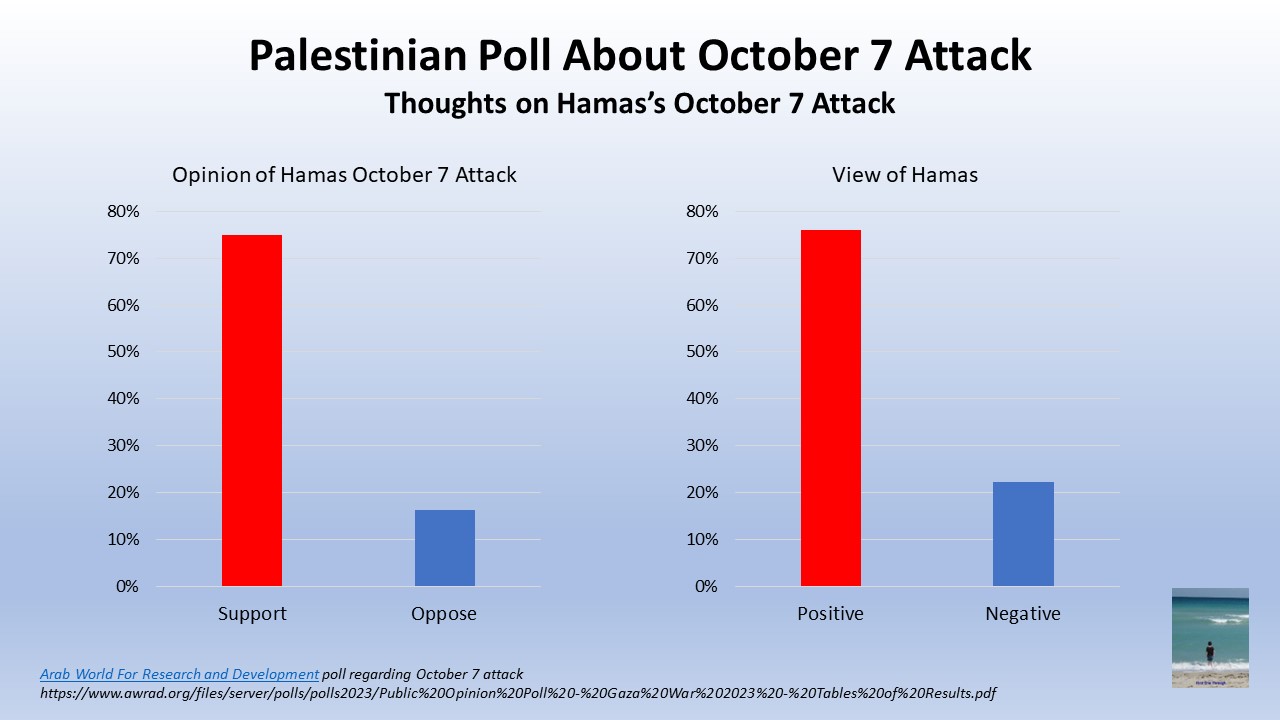
Nearly three years of Palestinian polling shows the problem.
As detailed recently in Palestinian Arabs Turn Inward, But Not Away From Hamas, Palestinian Arabs have dramatically lowered their expectations after three years of war. Support for Hamas and armed struggle has fallen sharply from the extraordinary levels recorded after October 7. But losing faith in Hamas’s ability to win is not the same thing as rejecting Hamas.
In the August 2026 PCPSR poll, 72% opposed Hamas disarming before a complete Israeli withdrawal from Gaza. Asked what Hamas would become if it gave up its weapons, 53% envisioned it remaining both armed and political and another 36% solely political. In all, 89% envisioned Hamas surviving in some form.
That is the Hydra problem.
And Hamas is only one head.
Hezbollah sits to Israel’s north. The Houthis attack from Yemen. Palestinian Islamic Jihad fights alongside Hamas. Above them, the Islamic Republic of Iran spent decades financing, arming and connecting organizations surrounding Israel.
October 7 exposed not simply a Hamas problem, but an ecosystem.
That is why eliminating Hamas militarily cannot be the entire definition of victory. As FirstOneThrough argued in From a Hamas Double Standard to the Hamas Dangerous Standard, an organization cannot maintain an independent army committed to destroying another state while simultaneously being normalized as an ordinary participant in democratic politics.
And military defeat addresses only part of what allows another head to grow.
FirstOneThrough addressed another part in The Only Way The Conflict Can End: the Palestinian claim to a so-called “right of return” into Israel itself.
A Palestinian state alongside Israel cannot simultaneously mean millions of Palestinians receive a state of their own while millions more retain a claim to move into Israel. That is 1.5 states for Arabs and 0.5 of a state for Jews.
American policy once said this plainly.
The 2004 Democratic Party platform called for Palestinian refugees to settle in a Palestinian state “rather than in Israel.” The 2008 platform repeated the position before the language was omitted in 2012.
President George W. Bush made the same commitment directly to Israeli Prime Minister Ariel Sharon in April 2004 as Sharon prepared the Gaza disengagement. A realistic solution, Bush wrote, would involve establishing a Palestinian state and “the settling of Palestinian refugees there, rather than in Israel.”
The principle was straightforward: Palestinian statehood was supposed to resolve Palestinian statelessness, not provide another mechanism for eliminating the Jewish State.
Defeating the Hydra therefore requires ending not only Hamas’s ability to wage war, but the expectation that Israel is temporary.
History offers another model.
Nazi Germany did not fight alone, and victory did not consist of killing Hitler while leaving the Axis intact. Germany and its allies were defeated or surrendered.
Then came political defeat. The Nazi military and political apparatus was dismantled. The Nazi Party was outlawed. Its leaders were prosecuted. Germany was not invited to preserve a rebranded Nazi Party so its supporters could recover through elections what they had lost through war.
The Axis was defeated as a system.
The same principle should define the defeat of Hamas.
Hamas cannot be permitted to lose its army, change clothes and emerge as an internationally accepted political party. Global institutions and governments should treat Hamas as one organization, dismantle its financing and international infrastructure, and isolate organizations that materially finance or facilitate its terrorism.
Prohibition is only half the answer.
Muslim governments, religious leaders and international institutions should strengthen Muslim movements committed to peaceful coexistence, religious equality and acceptance of Jewish sovereignty. Muslim-majority countries that have made peace with Israel already demonstrate that Islam and permanent war against Jewish sovereignty are not synonymous. Isolate the jihadis in the Jihadi-Israel Conflict and empower the moderate Arab and Muslim countries.
Make the institutions of coexistence stronger while making the institutions of violent supremacy militarily, financially and politically untenable.
The Hydra has many heads.
Hamas is a head. Hezbollah is a head. The Houthis are a head. The Islamic Republic supplies the Hydra with blood. The ideology gives it reason to regenerate.
The Hamas 2.0 warning should therefore be taken seriously—but not accepted as prophecy.
The Hydra is difficult to kill. It is not immortal.
A school in Jerusalem’s Shuafat refugee camp is reopening. The building is the same but UNRWA is no longer running it.
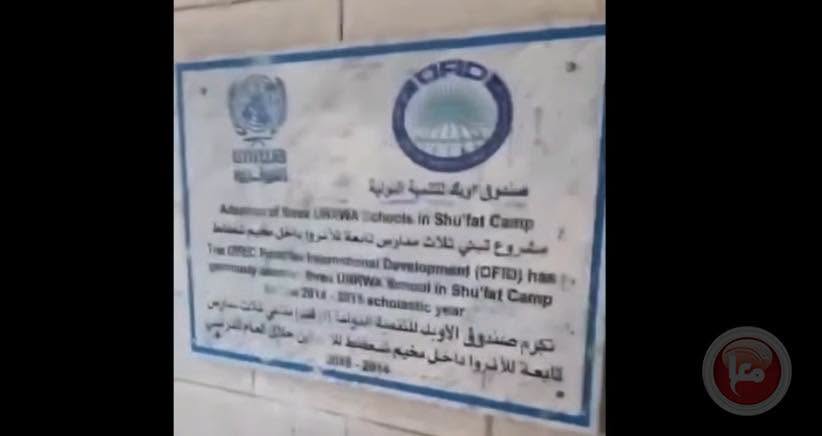
The school is now affiliated with Israel’s Ministry of Education and the Jerusalem Municipality. Jerusalem Deputy Mayor Aryeh King posted video of UNRWA signs being removed as the school prepared to open.
Sign of UNRWA run school in Shu’afat, Jerusalem
The change ends an educational arrangement dating back more than sixty years.
UNRWA established the Shuafat refugee camp in 1965, when Jordan controlled “East Jerusalem.” UNRWA’s educational policy, dating to 1952, has been to use the curriculum of the “host countries,” allowing refugee children to take local examinations and continue into local schools and universities.
So UNRWA worked with Jordan at that time.
There was nothing internationally settled about Jordan’s sovereignty over Jerusalem. Jordan seized eastern Jerusalem in 1948 and annexed the West Bank – including East Jerusalem in 1950. Even Britain, one of only two countries (along with Pakistan) which recognized Jordan’s illegal annexation of the West Bank, specifically withheld recognition of Jordanian sovereignty over Jerusalem. It only recognized Jordan’s de facto authority there.
Yet Jordan administered East Jerusalem, so UNRWA worked with Jordan there.
Then came 1967.
Israel captured East Jerusalem and became the government actually administering Shuafat, much like Jordan had previously. But UNRWA did not treat Israel the same way as the de facto administrating authority.
The Jordanian curriculum continued for years. After the Palestinian Authority was established, UNRWA increasingly coordinated its West Bank education program with it and ultimately used the Palestinian Authority curriculum.
That is difficult to square with the simple explanation that UNRWA follows the curriculum of its host country. The Palestinian Authority did not govern Jerusalem; Israel did. Yet UNRWA chose the PA curriculum for schools there.
The contrast is particularly striking today. Israel has nine foreign embassies located in Jerusalem, with Nauru announced as the tenth. Jordan never enjoyed anything approaching that level of international recognition of its rule over Jerusalem. Yet UNRWA had been willing to work with the authority actually administering the city when that authority was Jordan.
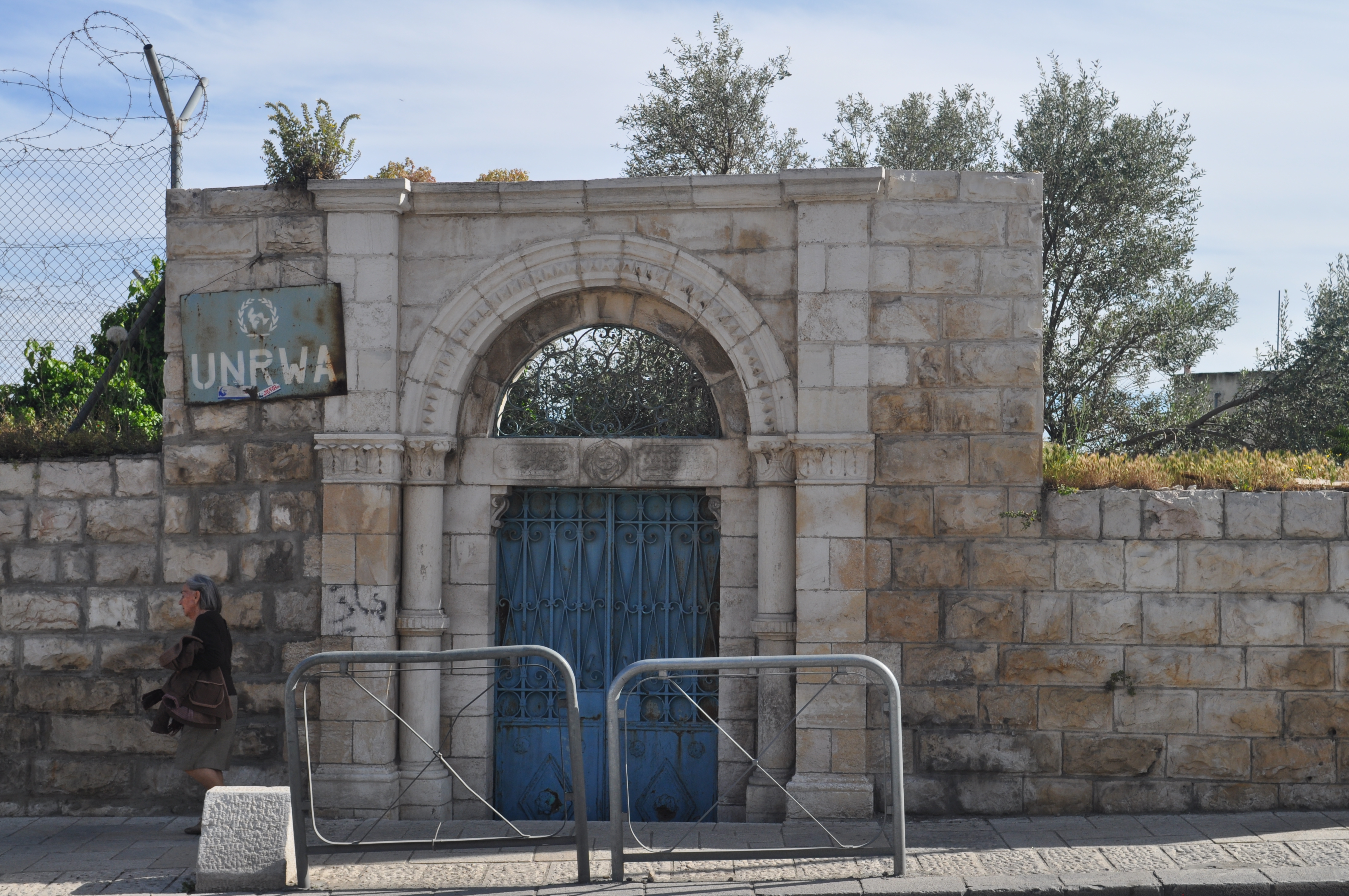
UNRWA offices in Jerusalem (photo: First One Through)
But the problem at Shuafat went beyond which government UNRWA chose to recognize educationally. It was what children at this particular school were saying they learned.
UNRWA says its curriculum framework must reflect UN principles of neutrality, human rights, tolerance, equality and non-discrimination.
Footage recorded at an UNRWA school in Shuafat in 2022 and published by Ynet in 2024 showed something very different.
Students said that stabbing and running over Jews brought Palestinians honor. One said he was prepared to carry out a suicide attack. Another said they were taught that Jews were terrorists. Another said they were taught that Jews were deceitful and evil and that he would stab and run them over.
The videos offer a horrifying vision of what is taught at UN schools.
Israel eventually acted.
In May 2025, Israeli authorities closed six UNRWA schools in eastern Jerusalem, including three in Shuafat. UNRWA protested that hundreds of Palestinian children were being deprived of education. Israel said alternative schooling would be provided through the Jerusalem education system.
Now that alternative is becoming tangible.
A former UNRWA school in Shuafat is reopening under the Israeli Ministry of Education and Jerusalem Municipality.
The choice was never between UNRWA and no education. What can change is the system educating them and the content of that education.
The UNRWA sign coming down in the Shuafat school is symbolic. What the children learn when they walk back through those doors will determine whether the real change happened inside.
Three years ago, Palestinian Arabs thought October 7 might change their future by changing Israel. Polls show how much that ambition has changed.
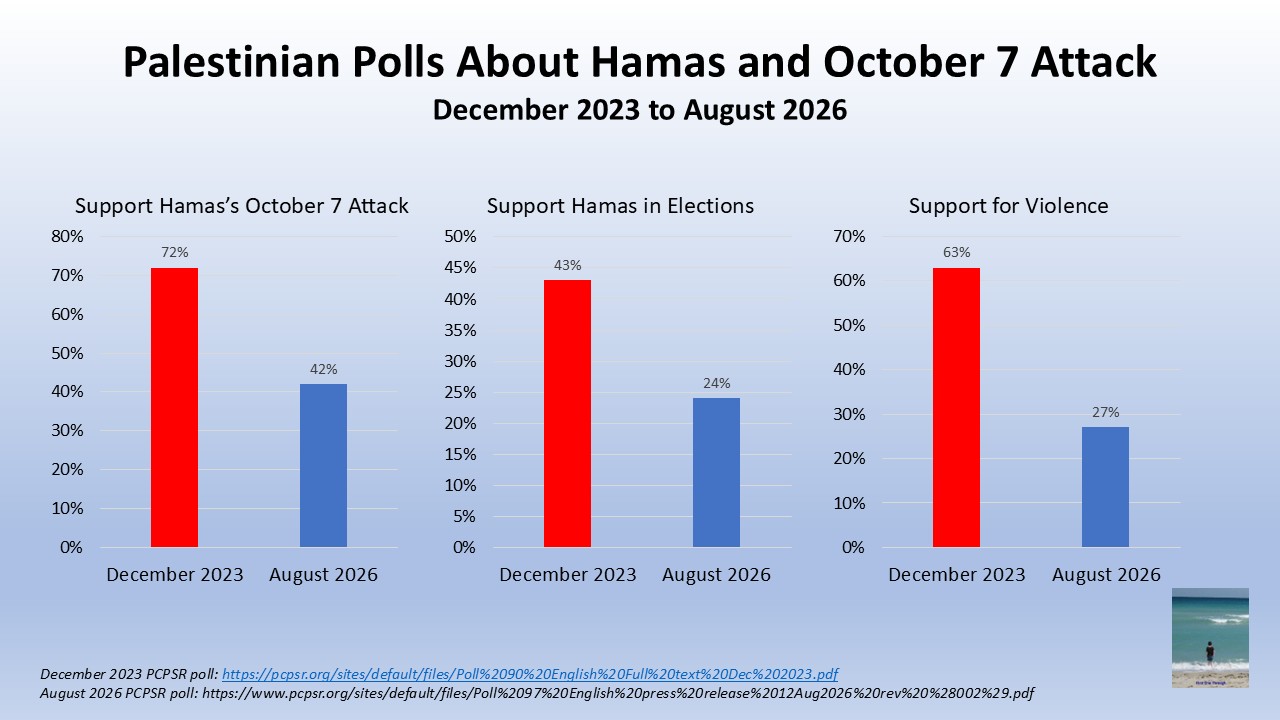
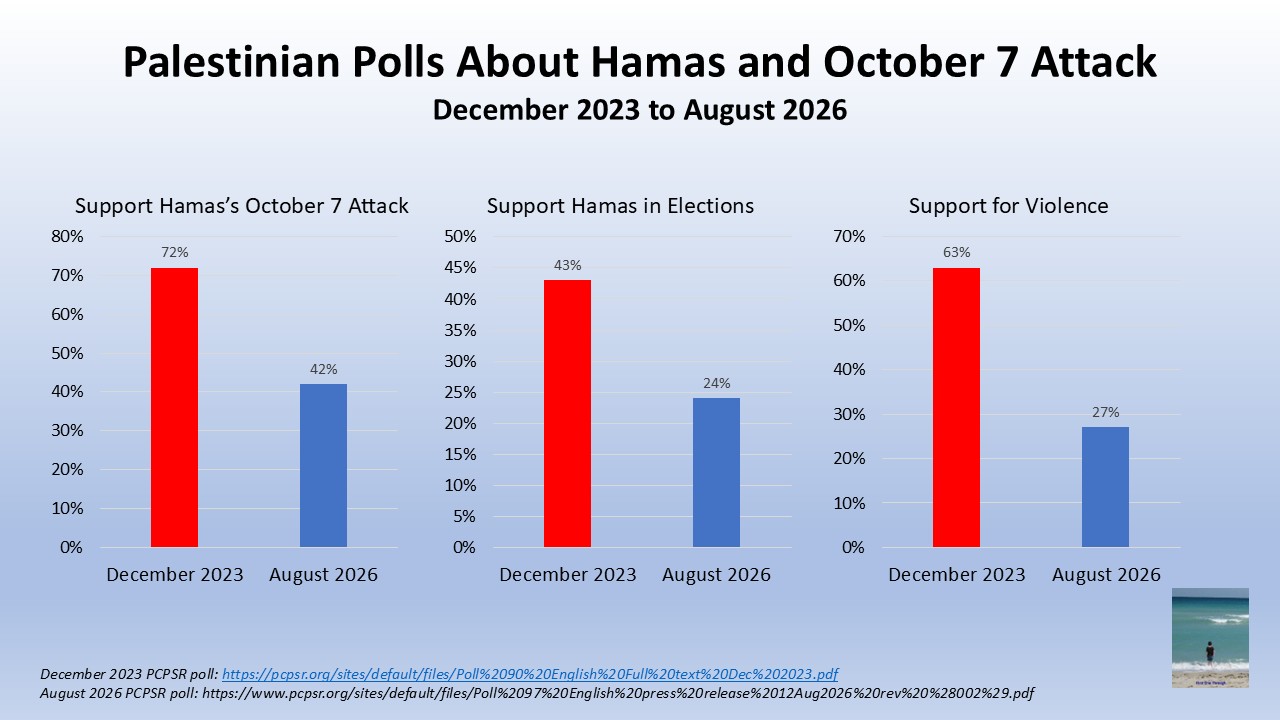
In December 2023, 72% of Palestinian Arabs said Hamas was correct to launch the October 7 attack.70% believed Hamas would emerge victorious.63% preferred armed struggle as the best way to achieve Palestinian goals.
Nearly three years of war produced something very different.
According to PCPSR’s August 2026 poll, only 20% now believe Hamas won the Gaza war. Hamas political support has fallen to 24%. Half of Palestinian Arabs say “armed resistance” (aka massacring Jewish civilians) failed to protect them or end the “Israeli occupation” and instead brought destruction. Among Gazans, 65% say so.
Support for armed struggle has fallen from 63% to 27%. 44% now choose negotiations as the most effective strategy.
Their priorities have shifted with it.
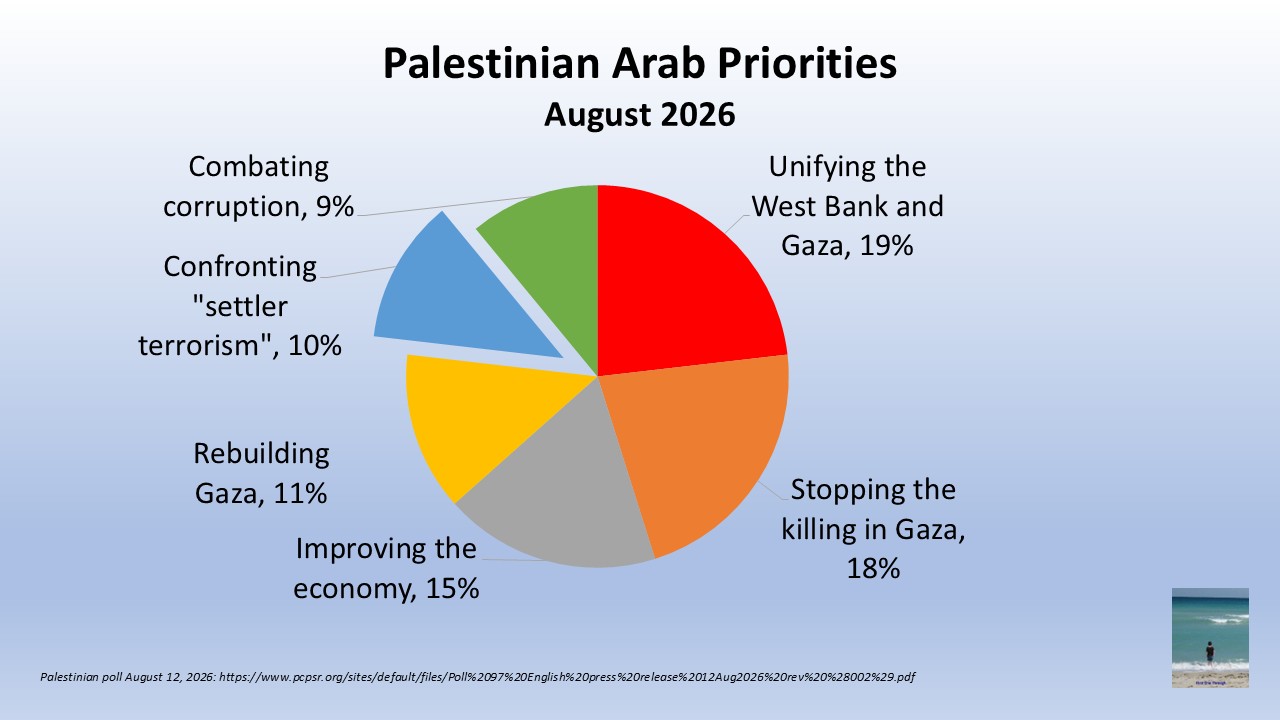
Asked in the August 2026 poll what the next Palestinian legislature should address, Palestinian Arabs answered:
19% — Unifying the West Bank and Gaza
18% — Stopping the killing in Gaza
15% — Improving the economy
11% — Rebuilding Gaza
10% — Confronting “settler terrorism”
9% — Combating corruption
Settler violence ranks fifth.
That is a very different Palestinian Arab story from the one dominating international headlines. Palestinian Arabs put reunification, ending the Gaza fighting, economic recovery and rebuilding Gaza ahead of attacks from West Bank Jews.
While the ambitions of October 2023 were directed outward, towards ending the Jewish State, the priorities of August 2026 are directed inward, to unification, rebuilding and recovering.
And Hamas remains part of that project.
The Palestinian Authority wants candidates in the coming elections to accept the commitments of the Palestine Liberation Organization, including its agreements with Israel. 66% of Palestinian Arabs oppose that requirement. Only 27% support it.
Because Palestinian Arabs envision Hamas remaining part of their future.
Asked what Hamas would become if it gave up its weapons, 53% said it would remain both an armed resistance and political movement. Another 36% said it would become solely a political movement. That means 89% see Hamas continuing as a political movement in some form.
There is a historical lesson in what happens after a genocidal society launches a disastrous war and loses.
Postwar Germany did not rebuild by simply disarming the Nazi Party and inviting it to contest elections. The Nazi Party was abolished and banned. Its political structures were dismantled. Germany’s reconstruction required a break with the movement that had led it into catastrophe.
Palestinian Arabs are not making that equivalent break. While they increasingly recognize that Hamas’s war failed, they want Hamas to be part of the Palestinian future.
As the western media and United Nations narrows a focus on violence committed by Israeli Jews against Palestinian Arabs, those same Arabs are no longer focused on those Jews. Instead, the Arabs prioritize rebuilding after the disaster while maintaining the eliminationist ideology in their society for a future war.
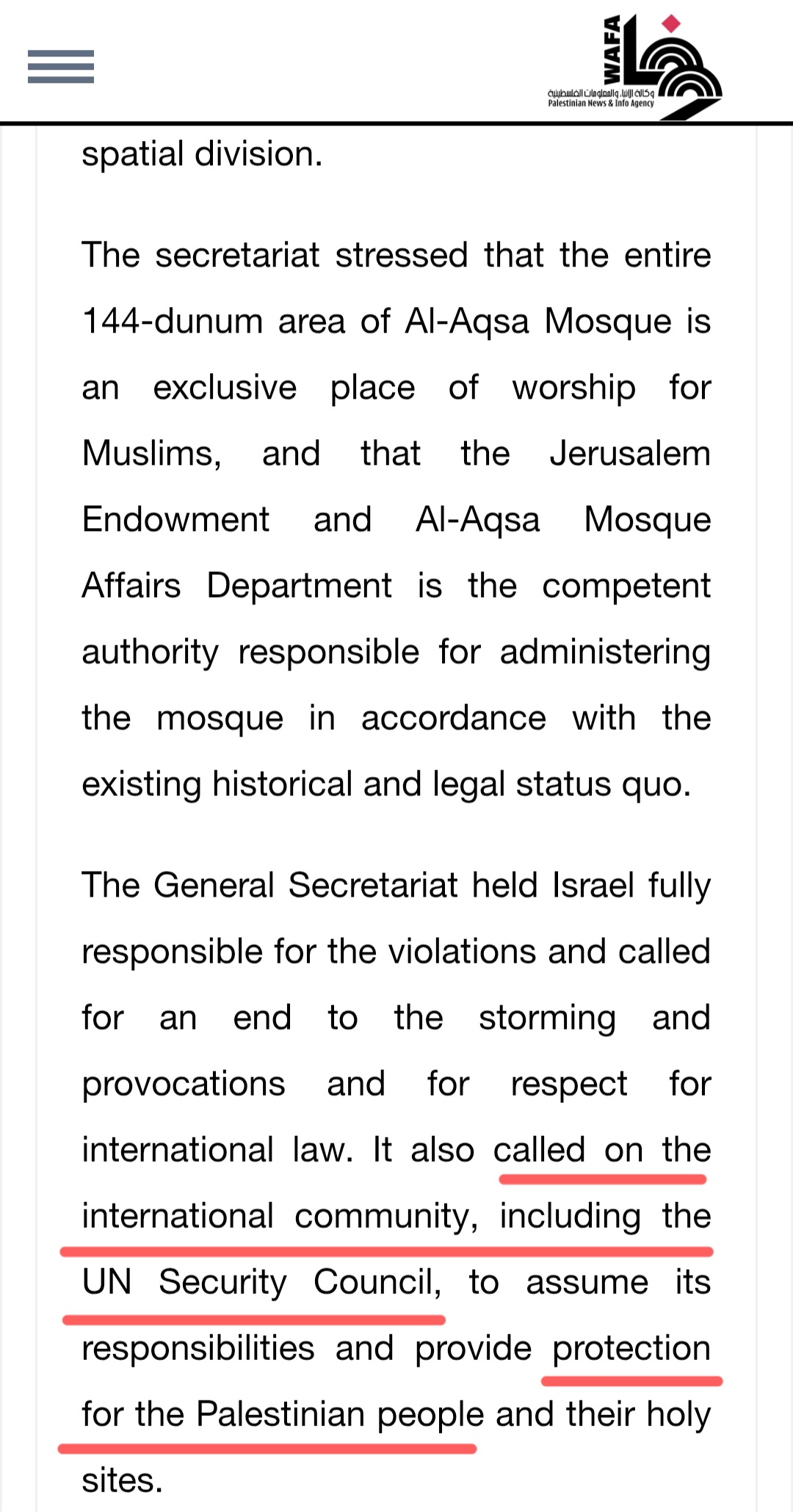
WAFA, the Palestinian Authority’s official media, has spent years describing Jews who enter the Temple Mount as “storming Al-Aqsa.” I have written about that linguistic sleight of hand before.
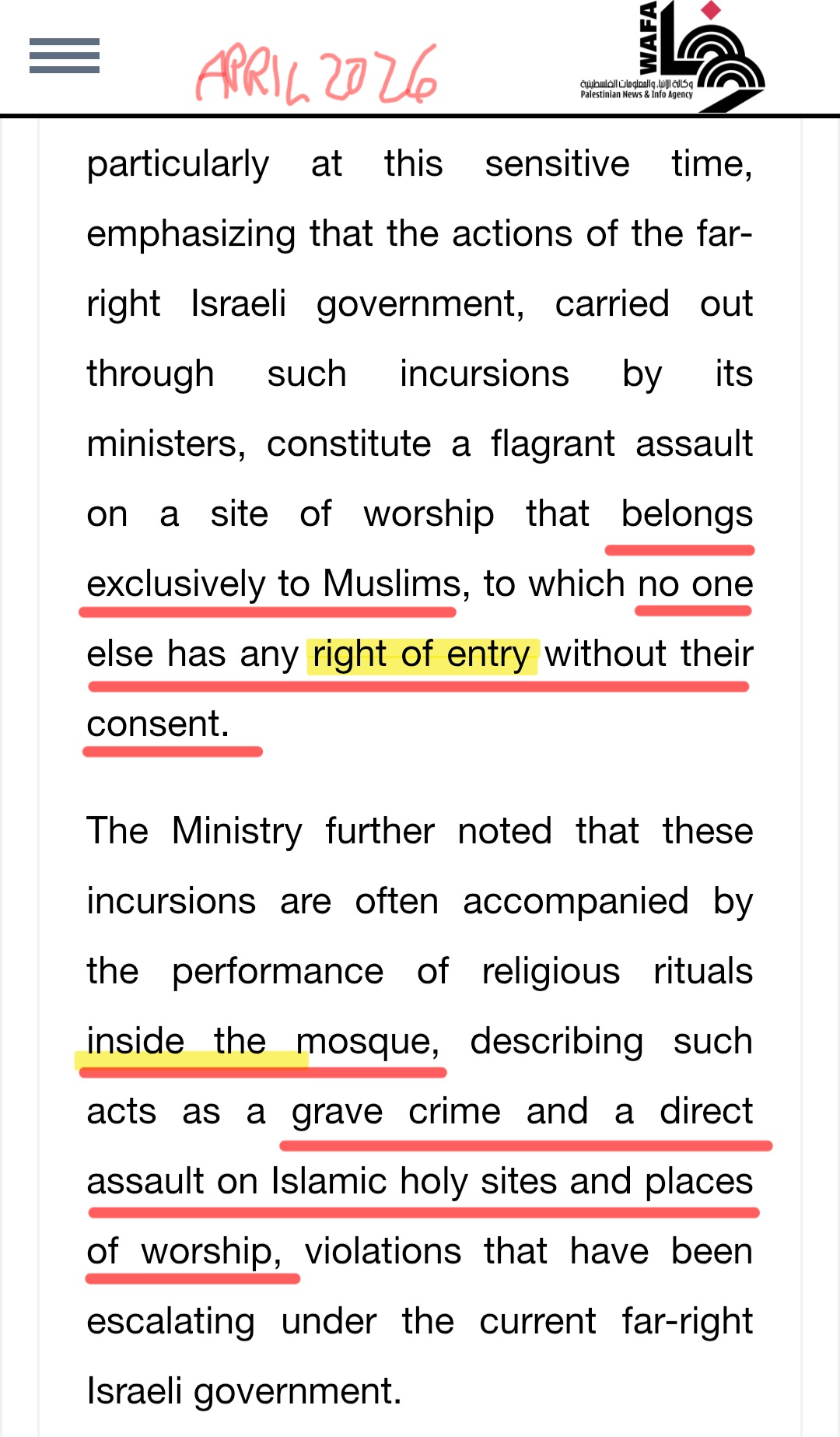
Now WAFA is promoting something more dangerous: that Jews have no right to enter Judaism’s holiest site without Muslim permission, and that Jewish worship there is an assault on Islamic sanctity.
In April 2026, WAFA reported a Palestinian statement declaring the site one that “belongs exclusively to Muslims, to which no one else has any right of entry without their consent.”
On August 13, WAFA carried an Arab League statement condemning Jews entering the site and performing religious rituals as a “blatant violation of the sanctity of the mosque.”
WAFA promoted several lies:
Muslims do not control entry. Israel controls security and access to the Temple Mount. The Jordanian-backed Waqf administers Muslim religious affairs there. Presenting Muslim consent as a prerequisite for Jewish entry is totally false.
The compound does not “belong exclusively to Muslims.” That is a religious and political claim masquerading as settled fact about the Temple Mount—the holiest site in Judaism.
Jewish presence does not inherently violate Islamic sanctity. Islam does not have a general rule that a Jew entering Muslim sacred space desecrates it. Restrictions on Jewish prayer under the status quo are one issue; declaring Jewish worship itself an assault on Islam is another.
Then comes another sleight of hand.
Having defined Jewish presence as an offense against Islam, these organizations pivot to demanding action by the international community on behalf of Palestinians.
But those categories – Muslims and Palestinian Arabs – are not interchangeable.
Some 1.85 million Muslims live in Israel, nearly one-fifth of the country’s population. And the Muslim religious administration of the Temple Mount is handled by the Jordanian-backed Waqf. Palestinian Arabs do not exercise control over entry to the site, nor do they represent all Muslims in the region.
So why transform an asserted Muslim religious grievance into a Palestinian national claim demanding international intervention?
Because the lies are the tell.
The argument is no longer about protecting Muslim worship. It takes an assertion of Muslim religious exclusivity, converts it into a Palestinian territorial right, and then asks the world to enforce that right against Israel and Jews.
The implications become darker when the same logic is applied beyond the Temple Mount. Hamas’s 1988 charter declared all of Palestine an Islamic waqf. Combine that doctrine with the claim being promoted around Al-Aqsa—that Jewish physical presence and worship offend Islamic sanctity—and expelling Jews can be transformed into protecting Muslim holy land.
“the land of Palestine is an Islamic Waqf consecrated for future Moslem generations until Judgement Day. It, or any part of it, should not be squandered: it, or any part of it, should not be given up.” – Hamas Foundational Charter, Article 11
That is why the Arab League and WAFA’s language matters. By repeatedly publishing these false assertions, it helps turn a Palestinian territorial claim into a purported Islamic prohibition against Jewish presence.
And it begins at the most perverse possible location: Judaism’s holiest site.
The progression is stark:
Declare the Jewish holy site exclusively Muslim.
Deny Jews the right to enter without Muslim permission.
Call Jewish presence and worship a desecration of Islam.
Turn that religious claim into a Palestinian territorial right.
Ask the world to enforce it.
The Arab League and Palestinian Authority are building a religious and political case for removing Jews from their own holy land.
Congress did not arrive at legislation protecting Hamas overnight. It arrived there one bill at a time.
For decades, debates over Israel revolved around diplomacy. Republicans and Democrats argued over settlements, negotiations, Jerusalem, and the contours of a future Palestinian state. Even lawmakers sharply critical of Israel generally framed their proposals around advancing a negotiated two-state solution. The disagreement was over how peace should be achieved, not whether Israel had the right to defend itself against terrorist organizations.
In 2020, as the Trump Administration unveiled its peace plan and Israel considered extending sovereignty to portions of the West Bank, progressive lawmakers introduced legislation preventing American assistance from supporting annexation. Whether one believed annexation was prudent or unwise, the objective remained fundamentally political. These bills sought to influence the outcome of negotiations and preserve the possibility of a future Palestinian state. The debate was about borders, diplomacy, and competing visions for peace.
That bill did not stand in isolation.
In 2019, Representative Betty McCollum (D-MN) also introduced legislation prohibiting U.S. assistance from supporting the military detention of Palestinian minors. On its face, the proposal carried moral appeal. No civilized society wants children caught in war, and few slogans resonate more powerfully than protecting minors.
Yet the legislation missed the point. Israel’s military justice system does not prosecute minors because they are children. It prosecutes minors accused of security offenses, including violent rioting, firebomb attacks, shootings, stabbings, and participation in terrorist organizations. Hamas, Palestinian Islamic Jihad, and the Popular Front for the Liberation of Palestine have all recruited teenagers into violent activity for decades.
Arab minors caught on camera right before they stab Israelis
The debate was no longer centered on where Israel’s borders should ultimately lie. It was becoming a debate over whether Congress should restrict Israel’s ability to prosecute those participating in terrorism.
That evolution became unmistakable after October 7.
The largest massacre of Jews since the Holocaust might reasonably have been expected to produce overwhelming congressional support for dismantling Hamas. Instead, it accelerated an entirely different legislative movement.
Arabs in Gaza take the body of Israeli woman they had just killed into Gaza where the crowds pelted her body and spat on her
One proposal after another sought to block the military tools Israel argued were necessary to fight the war. Senator Bernie Sanders (D-VT) repeatedly forced votes to halt major arms sales. Representative Rashida Tlaib (D-MI), Representative Pramila Jayapal (D-WA), Representative Delia Ramirez (D-IL), and others introduced the Block the Bombs Act. Senator Chris Van Hollen (D-MD) sought to impose additional legal restrictions before military assistance could proceed.
US Senator Chris Van Hollen attends a Senate subcommittee on the Justice Departments proposed 2027 budget, on Capitol Hill in Washington, May 19, 2026.
Supporters presented these bills as humanitarian safeguards designed to protect civilians and uphold international law. Their practical effect, however, would have been to deny or delay weapons while Israel was engaged in combat against a U.S.-designated terrorist organization that had murdered, raped, tortured, kidnapped, and burned civilians alive.
Congress was no longer principally debating the contours of a future peace agreement. It was debating how much of Israel’s wartime capability should be withheld while the war itself was still being fought.
And it continued.
In July 2026, Representative Thomas Massie (R-KY) introduced an amendment eliminating the entire $3.3 billion annual Foreign Military Financing package for Israel. Previous proposals had sought to condition aid or block particular weapons systems. Massie’s proposal went much further. It would have ended America’s regular military assistance altogether.
The amendment failed by a wide margin. But 104 members of Congress voted for it, including 103 Democrats alongside the bill’s Republican author.
That vote tells a larger story than the amendment itself.
Over the course of a few years, the legislative progression moved from opposing territorial annexation, to restricting Israeli counterterrorism practices, to limiting the weapons available to fight Hamas, and finally to questioning whether the United States should continue military assistance at all. Each bill built upon the political space created by the one before it. What once occupied the outer edge of congressional debate gradually became part of mainstream legislative discussion.
The coalition itself is unusual. Rashida Tlaib approaches the issue through Palestinian nationalism. Bernie Sanders emphasizes humanitarian law and civilian casualties. Chris Van Hollen argues for greater legal oversight of military assistance. Thomas Massie opposes foreign aid as a matter of constitutional principle. They arrive from very different ideological traditions, yet increasingly find themselves casting the same vote.
For generations, support for Israel was one of Washington’s few enduring bipartisan constants. That consensus has not disappeared; overwhelming majorities in Congress still support the alliance. But the terms of the debate have unmistakably changed.
Six years ago, Congress debated how American policy might influence a two-state solution. Today, members openly introduce legislation that would limit—or eliminate altogether—the military support Israel says it needs to defeat jihadist organizations committed not to coexistence, but to its destruction.
That is the real story of the Jihadi Protection Bills. Not that any single measure became law. But that, one bill at a time, the center of the American political conversation migrated from shaping the peace process to constraining Israel’s ability to wage war against jihadist movements to its basic ability to protect itself in a deeply hostile region.