
On May 28, 1964, the Palestinian National Charter was adopted in Jordanian-controlled Jerusalem. At that time, the West Bank was under Jordanian rule and Gaza was under Egyptian rule.
The Charter explicitly excluded both territories from its claims. It focused on Israel.
Article 24 stated:
“This Organization does not exercise any regional sovereignty over the West Bank in the Hashemite Kingdom of Jordan, on the Gaza Strip or in the Himmah Area.”
The Charter did not challenge Arab sovereignty. It only challenged Jewish sovereignty.
Palestinian leaders supplied the national cause; Arab governments supplied the armies.
The Charter left little doubt about its objective. It declared:
“The partition of Palestine in 1947 and the establishment of the State of Israel are entirely illegal.” – Article 17
And that “liberation” of the land is the common cause of all Arabs:
“Arab unity leads to the liberation of Palestine, and the liberation of Palestine leads to Arab unity.” – Article 12
The Palestinian movement was therefore born not as a campaign against an Israeli occupation of the West Bank and Gaza, but as a movement that denied the legitimacy of Israel itself, and one in which the entire Arab world must unite.
The Charter’s author, Ahmad Shukeiri, was born in Lebanon and was Saudi Arabia’s ambassador to the United Nations from 1957 to 1962. His pan-Arab worldview called for Arab armies to destroy Israel:
“Those who survive will remain in Palestine, but I estimate that none of them will survive.” – Ahmad Shukeiri June 1, 1967
Another widely reported statement attributed to him declared:
“The Jews of Palestine will have to leave…We shall destroy Israel and its inhabitants and as for the survivors – if there are any – the boats are ready to deport them.“
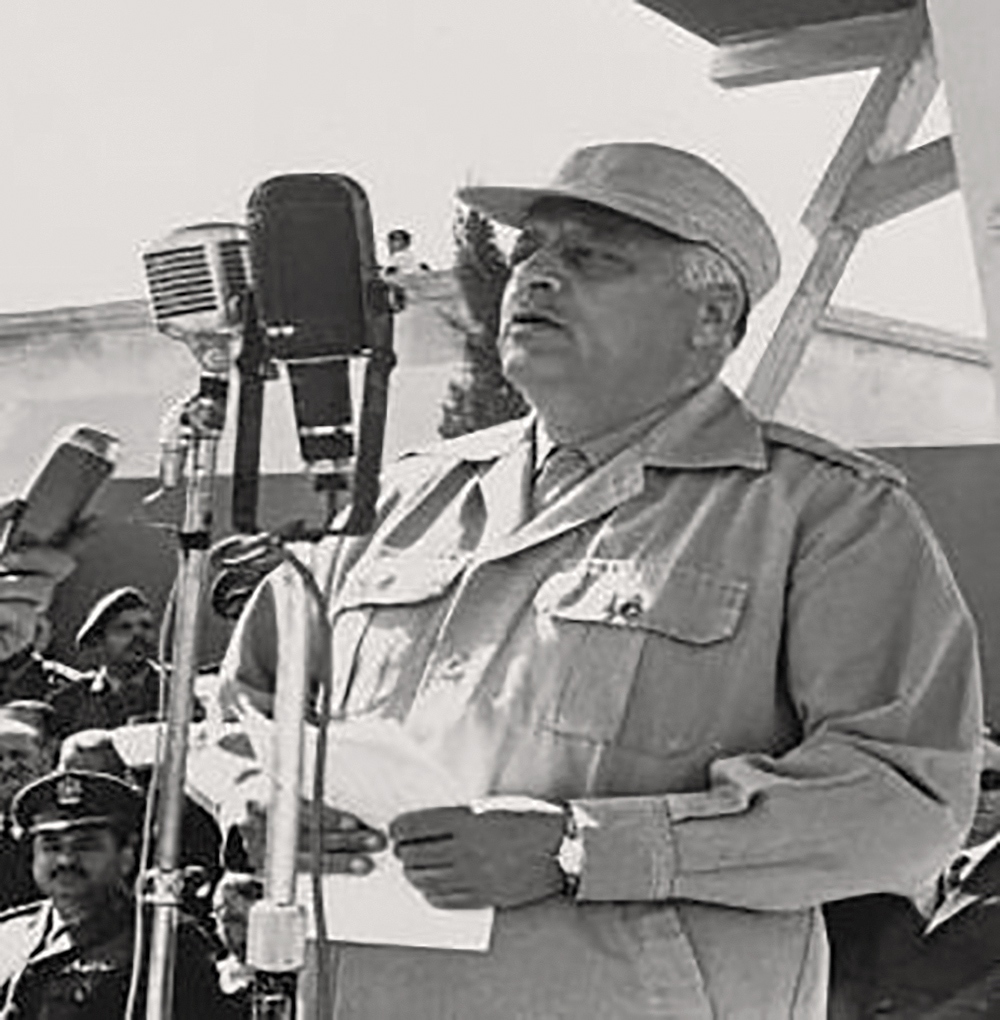
Shukeiri’s brothers-in-arms said much the same.
In October 1964, Syrian leader Salah Jadid declared:
“Our army will be satisfied with nothing less than the disappearance of Israel.”
In May 1965, Egypt and Iraq jointly announced:
“The Arab national aim is the elimination of Israel.”
That same year, Egyptian President Gamal Abdel Nasser proclaimed:
“We shall not enter Palestine with its soil covered in sand; we shall enter it with its soil saturated in blood.”
Iraqi President Abdul Rahman Arif described Israel as:
“an error which must be rectified.”
In June 1967, the Palestinian movement and the surrounding Arab states were speaking a common language. The PLO and Arab leaders denied Israel’s legitimacy and spoke openly of its disappearance, elimination, and destruction.
The rhetoric was matched by action. Egypt expelled the United Nations Emergency Force from Sinai, followed by Egyptian troops pouring into the peninsula. The Straits of Tiran were closed to Israeli shipping. Military alliances linked Egypt, Syria, Jordan, and Iraq. Arab armies massed on Israel’s borders.
Against that backdrop, Nasser announced on May 26, 1967:
“The battle will be a general one and our basic objective will be to destroy Israel.“
Nine days later, war began.
Today, one of the most recognizable slogans associated with the Palestinian movement is “From the River to the Sea.” People often pretend that it is a call to free the West Bank and Gaza from “occupation” but the Arabic phrase speaks to the deeper truth as outlined by history.
“Min al-nahr ila al-bahr, Filastin ‘arabiyyah” meaning “from the river to the sea, Palestine will be Arab.”
Whether controlled by Jordan or Egypt or a hoped for Palestine, the Palestinian movement at its core has always been an anti-Israel movement to destroy the presence of Jews in “any part of Palestine.”
The June 1967 Six-Day War did not create the current dynamic in the Israel-Arab conflict. It was the conclusion of the first chapter of the Palestinian-led pan-Arab rejection of Jews living in and having sovereignty in land they view as purely Arab.


