
For years, pro-Palestinian activists have promoted the false claim that Jesus was a Palestinian.
Jesus was a Jew, born to a Jewish family, living in the Jewish homeland, speaking to Jewish audiences, teaching from the Hebrew Bible, and making pilgrimages to the Jewish Temple in Jerusalem. The word “Palestine” was not even the name of the province during His lifetime. The Roman renaming of Judea to Syria Palaestina occurred about a century after His death.
Yet the claim persists because it serves an ahistorical but political purpose: If Jesus can be transformed from a Jew into a Arab, then the central figure of Christianity can be detached from Jewish history and reinserted into a modern political narrative. Suddenly, Jews are no longer obvious indigenous people in the Holy Land, but Arabs – who did not arrive en masse to region for another six centuries – are the real Jews.
The recent Vatican News article about Gaza takes that process one step further.
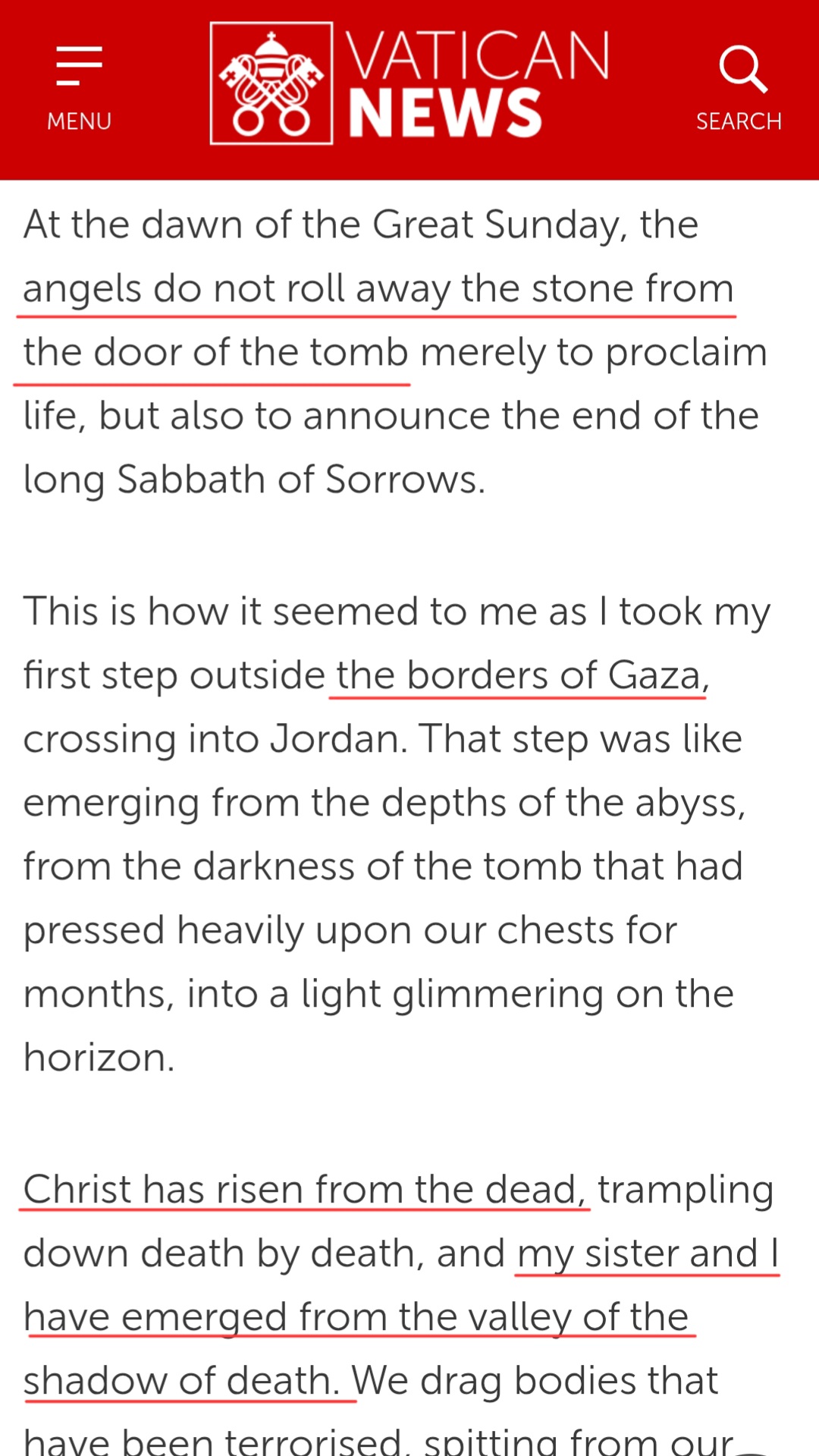
The article does not explicitly call Jesus a Palestinian. Instead, it wraps a Gazan narrative in the language of Christ’s passion, death, and resurrection. Gaza becomes the tomb. The refugee becomes the suffering servant. The journey out becomes resurrection.
The symbolism is unmistakable.
For centuries, Christians looked to the suffering of Jesus as a uniquely sacred story. Increasingly, anti-Israel agitators are attempting to woo parts of the Christian world by recasting that story through the lens of the Israeli-Palestinian conflict, with Palestinian Arabs occupying the role once reserved for Christ Himself.
The war in Gaza did not begin with suffering descending from heaven. It began with decisions made by thousands of Gazans. Hamas invaded Israel, murdered civilians and took hostages. Hamas launched a war that it knew would bring devastating consequences to Gaza as it hid it tunnels and refused to let women and children enter the shelters.
Does that resemble Jesus?
Genocidal psychopaths are being transformed into the innocent sufferer. The political and military context disappears from view. Agency gives way to symbolism.

What makes this especially troubling for many Jews is that the institution promoting this narrative is no longer just fringe anti-Israel groups or university protest movements.
It is the Vatican itself.
For two thousand years, the Church has wrestled with the consequences of separating Christianity from its Jewish roots. In recent decades, Catholic-Jewish relations made enormous progress by reaffirming the Jewishness of Jesus and Christianity’s historical connection to the Jewish people.
That progress is undermined when contemporary narratives replace Jesus the Jew with a new symbolic figure: the Palestinian sufferer who cheered Jews being burned alive.


