After Iran fired over 180 missiles at Israel, Israel considered how to handle synagogue attendance during the Rosh Hashanah holiday. Synagogue attendance typically swells on the holy days, with even more secular Jews attending services. But most synagogues only have small mamads (safe rooms) to protect people during a shelling attack, so hundreds could be left unprotected during an attack.
The situation is even more dire at one of the largest synagogues in the world – the Western Wall Plaza at the Kotel – where thousands of Jews gather in the Old City of Jerusalem. The large outdoor location has few easily accessible places to hide from missiles.
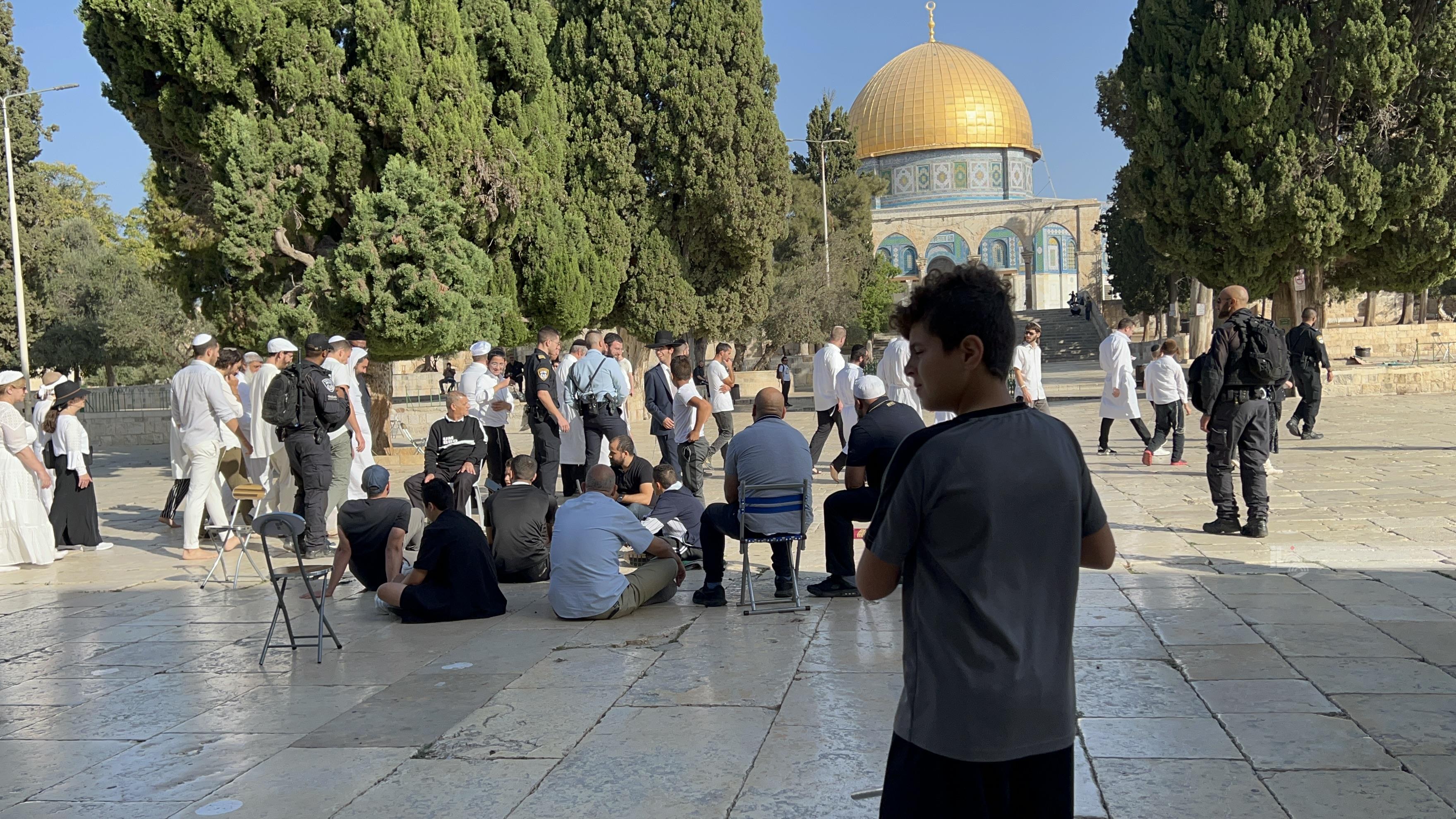
Perhaps the grey-domed al Aqsa Mosque can be used by thousands of Jews as a safe room from jihadi missiles. The jihadists would presumably try to spare their religious building, making the mosque a potential haven for Jews.
Al Aqsa Mosque from outside Jerusalem’s Old City walls (photo: First One Through)
Hamas termed their barbaric slaughter of Israelis the “al Aqsa Flood.” Perhaps it didn’t imagine that the term would become a prophecy inverted, drawing masses of Jews onto the Temple Mount.
The Jerusalem Great Synagogue is one of the grandest synagogues in the world. On holidays and sabbaths, it typically has a magnificent choir which enhances prayer services. In July 2024, when Rosh Hodesh, the new month of Tamuz fell on Shabbat, the synagogue decided to have a special choir with prayers full of songs by a 50-person choir consisting of many young boys.
The Jerusalem Great Synagogue, July 2024
Shabbat Rosh Hodesh involves reading from two torah scrolls, rather than a single torah on a regular Sabbath. On this special sabbath, two men raised the torahs at the conclusion of the particular readings and sat holding the holy scrolls as Moshe Lion, the mayor of Jerusalem read the haftorah before a packed synagogue.
Before the torahs were returned to their places in the ark, the large choir came down from their podium and encircled the bima, the center of prayers in the heart of the synagogue. The two men holding the torahs rose, and the entire congregation with them, as the cantor and choir sang two special blessings, one for the government of Israel and one for the Israeli Defense Forces.
With the backdrop of the ongoing war, the choir used a variety of melodies in singing the two blessings, including Hatikvah, the Israeli national anthem, and Lu Yehi, a contemporary song of longing to arrive at the end of all wars.
For twenty minutes the choir sang the songs with the congregation’s participation. Many cried as both old and young thought about many family members who were serving in the armed forces to combat enemies in Gaza and Lebanon. Hundreds of people gathered in the centers of Israel, of Jerusalem, and of the Great Synagogue but hearts and minds were elsewhere.
A Wedding In The Jerusalem Forest
The next day a wedding was held in the Jerusalem forest. The sun was setting as the bride and groom took their places under the chuppah, the wedding canopy. Family and close friends gathered before them, watching the young couple sanctify their union.
The Jewish ritual of presenting a ring, reading the ketubah and reciting seven blessings were complete, but the happy couple was not ready to celebrate. First a friend took the microphone to recite a chapter of Psalms for the soldiers and families impacted in the current war. Everyone recited the lines responsively, and then all sang Im Eshkachech Yerushalyim, If I forget thee, Jerusalem.
The groom then crushed a glass beneath his feet, symbolizing the still unbuilt holy city of Jerusalem, before turning to hug his bride.
Groom ready to crush glass symbolizing the ongoing incompleteness of Jerusalem
Two men in a synagogue and a bride and groom under a canopy, stood at the center of attention, yet their focus was elsewhere. Thinking of young soldiers at the battlefront, hostages held in captivity and the unbuilt Temple, Jews turn their consciousness outward to the larger community beyond those present.
The focus of the Jewish gaze ultimately extends beyond line of sight.
The United States was alarmed and appalled at the “Unite the Right” mob march in Charlottesville, VA in August 2017. As right-wing marchers descended on a university holding torches, wearing Nazi symbols and yelling “Jews will not replace us,” the country watched a scene of racism and antisemitism unfold into a crime scene. PBS called it a “watershed moment for the white supremacist movement.”
The real life play is being revealed once again in real time, with a new set of actors and fashion brandished by radical jihadists and the alt-left, once again yelling “Jews will not replace us.”
Radical Jihadists
Radical jihadists are typically located in Muslim-majority countries in the Middle and Far East including Iran, Qatar, Pakistan, Indonesia and Somalia. They believe that Islam should dominate the world, especially in any location which was once dominated by Islamists such as the land of Israel.
The jihadi extremists began to slowly migrate into Europe and the United States starting in the 1960s but accelerated their movement in 2015/16 as the “Arab Spring” and Syrian Civil War decimated their homelands. They came to Europe (2015) and the United States (in 2016) and brought much of their instilled antisemitism.
The United States also encouraged foreign students to attend American universities. In 2003, as the American War on Terror raged in mostly Muslim countries, the Kennedy-Lugar Youth Exchange and Study Program was launched. The goal was to bring “High school students from countries with significant Muslim populations [to] live and study in the United States for an academic year through the U.S.” In the 2015/6 academic year, 61,000 students from Saudi Arabia were at U.S. universities. That high figure represents 0.2% of the entire population of Saudi Arabia to a single country. By way of comparison, the ENTIRE American students abroad cohort all over the world is around 162,000, or 0.05% of the U.S. population.
The U.S. continues to push for foreign Muslim students at American schools. On September 12, 2023, the U.S. embassy in Israel posted an advertisement that the U.S. State Department “is seeking a group of Arab citizens of Israel secondary school students to participate in a Study- in-the-USA initiative for high school students during the 2024-2025 school year.” (bold in original). No Jewish students from Israel were invited to be part of the program.
And what do radical jihadists, faces covered in kaffiyehs, preach abroad and in the United States?
They consider the entire State of Israel to be an illegal project that must be terminated
Palestinian Arabs demand a “right of return” to towns where grandparents used to live along with an expulsion of Jews who refuse to live as second class “dhimmis.”
In short, radical jihadists are chanting that “Jews will not replace us!” in Palestine, as they seek to “Free Palestine” from the clutches of the Jews.
Alt-Left
The far-left cohort in America is seeking to end capitalism and pursue a broad redistribution of wealth and power. They have advanced the Diversity, Equity and Inclusion (DEI) into schools and corporations that demand the minorities of preference (Blacks, Hispanics, LGBT) be given priority in admission, compensation, title and power before Whites or somehow “privileged” minorities such as Asians and Jews.
The alt-left considers Jews to be part of the uber elite class, occupying too many CEO, Supreme Court and political positions. They attribute Jewish success as a matter of Jews only looking out for themselves, and cheating or stealing from the labor of the working class, in classic antisemitic tropes.
When Black Israelites shot up a kosher supermarket in Jersey City, NJ in December 2019, several leaders of the Black community were clear that they felt the killers were only REacting as a form of self defense: “Black homeowners were threatened, intimidated, and harassed by I WANT TO BUY YOUR HOUSE brutes of the jewish community.”
Jews do not belong. In the housing or their jobs.
“Jews will not replace us!” rained down in a hail of bullets in Jersey City and in federal and state mandated DEI programs.
Alt-Right
The alt-right coined the phrase “Jews will not replace us!” but far from monopolized the theme.
The alt-right version of the phrase in many ways is the most preposterous. White supremacists believe that Jews are so powerful that they are advancing a program of importing millions of non-White and non-Christian foreigners to dilute the White Christian backbone of the country. How and why that would have any remote advantages for Jews is never explained.
Muslim extremists, woke progressives and White nationalists have very different philosophies but congregate around a belief that Jews are cheats and thieves who are robbing the rightful owners of land, money, jobs and prestige. And they are coming for this beleaguered minority-minority “by any means they deem necessary,” much as antisemites have done for centuries.
We are at a “watershed moment for the jihadi and alt-left movements” in the United States to destroy Judeo-Christian values, capitalism and the West. How the government’s leaders and population respond will set the tone for our future.
Kosher food is eaten by Jews and non-Jews. Some Jews don’t eat kosher food and prefer non-kosher items. But “kosher” is definitely Jewish, as defined in the Bible outlining which foods are permissible and not permissible for Jews.
Many Jewish men get circumcised at eight days old in a “bris.” A small percentage of Jewish boys are not circumcised because the parents do not like the custom. But a “bris” is definitely Jewish, a commandment laid out in the Bible.
Many Jewish homes have a menorah as do many synagogues. They are lit on the holiday of Chanukah per rabbinic tradition. Some Jews do not own or light a menorah, but it is definitely a Jewish religious article.
Religious married Jewish women go to a ritual bath, a “mikvah,” once a month. Most Jewish women are not Orthodox or do not have regular menstrual cycles and do not visit the mikvah. But a mikvah is definitely a Jewish bath and has been for thousands of years.
Roughly 45% of world Jewry lives in the land of Israel, while the majority do not live there. But the land of Israel is central to Judaism, the “promised land” to the Jewish forefathers of Abraham, Isaac, Jacob and their descendants. It is central to the Jewish Bible and for Jews for 3,700 years.
Jews visiting the Jewish Temple Mount in the Old City of Jerusalem
Whether a person keeps kosher, had a bris, visits a mikvah, lights a menorah, or lives in the land of Israel, has nothing to do with those items being integral parts of Judaism. Similarly, a person may never read the Talmud, but such action is irrelevant to the tractates inherently being a fabric of Jewish tradition.
So when a Jewish person says Jews shouldn’t live in Israel, it doesn’t negate that the land of Israel is central to Judaism; it just means that that particular person doesn’t believe it.
The next time you see members of Neturei Karta yelling that Zionism is terrible and the Jewish State should be destroyed, whisper in their ears that you are working to ban kosher meat and circumcision in America, as a gentle reminder that just because they may not appreciate how some people express their Judaism, they shouldn’t fight to ban it for others.
Members of ultra-Orthodox Neturei Karta protesting a march combating antisemitism, January 2020 (photo: First One Through)
The land of Israel, the city of Jerusalem and the Temple Mount are deeply Jewish locations and have been for thousands of years. It makes absolutely no difference what any Jew or non-Jew says, and whether they are one side or the other of the Israeli-Hamas war. Parading “AsAJews” who fight against Zionism before cameras does nothing to negate the reality that Israel is an essential component of Judaism, much like keeping kosher and a bris.
The magnification of fringe anti-Jewish views held by Jews is a noxious tool used by Jew-haters to splinter the beleaguered minority-minority to become easier fodder for extinction. Shame on the media for making a deliberate point of doing so in these days of toxic antisemitism.
For the last few hundred years, Jews inserted three lines after their penultimate prayer in their daily services. Right after Aleinu and before the final mourner’s Kaddish, a sentence from Proverbs and two from Isaiah are found:
Be not afraid of sudden fear, neither of the desolation of the wicked, when it cometh. Take counsel together, and it shall come to nought; speak the word, and it shall not stand: for God is with us. And even to your old age I am he; and even to hoar hairs will I carry you: I have made, and I will bear; even I will carry, and will deliver you.
Al-Tirah
Roots Of Al Tira Prayer
Leaving synagogue was often a traumatic affair when Jews were scattered around the world. Inside of the synagogue, Jews were both together and felt connected to God; outside was a starkly different reality. Sometimes the local non-Jews would attack the Jews with pogroms and edicts, and at other times, Jews would be fortunate to find salvation.
Today, very few congregations actually recite the prayer despite its inclusion in prayer books.
I suggest that perhaps it is now time for all congregations to begin saying it.
Israel has responded to the Palestinian barbarity. It has killed and injured roughly one-third of the political-terrorist group Hamas in Gaza and has leveled much of the terrorist enclave. Hamas has claimed that nearly 30,000 Gazans have been killed at this point, with children accounting for over one-third.
On top of the frozen state of terror of Jews from the ongoing antisemitic attacks since October 7 is the sadness of watching the destruction of Gaza. Why did Hamas do this and why does the evil group insist that Israeli forces continue to pound Gaza rather than release the hostages and surrender the terrorists?
Hamas has an evil and twisted ideology rooted in a radical interpretation of Islam that demands the destruction of the Jewish state, believing its presence is an embarrassment for Muslims. As it states in its foundational charter “Israel will exist and will continue to exist until Islam will obliterate it…. Our struggle against the Jews is very great and very serious… There is no solution for the Palestinian question except through Jihad. Initiatives, proposals and international conferences are all a waste of time… In face of the Jews’ usurpation of Palestine, it is compulsory that the banner of Jihad be raised…. the Palestinian problem is a religious problem, and should be dealt with on this basis.”
For its part, Judaism has a different set of beliefs that stretches back thousands of years before the Islamic prophet Mohammed was born. It urges calm in the face of fear.
Be not afraid of sudden fear, neither of the desolation of the wicked, when it cometh. (Proverbs 3:25)
Jews are carrying both the shock of October 7 in Israel and the sickening reaction of Hamas’s fans around the world. They are simultaneously witnessing the destruction of that enemy. It’s a lot to process – the “sudden fear” and the “desolation of the wicked” – and has led many Jews and Zionists to huddle together in synagogue, and hide symbols of being Jewish when they go outside.
Jewish Calendar And Numbers
The Jewish year 5784 is a Jewish leap year which adds another month, and the year 2024 in the secular calendar is also a leap year which adds a single day. Both the Jewish calendar and the secular calendars add the time in the winter to “correct” the calendar for the upcoming spring.
We are now in the first of two months of Adar. Jewish tradition holds that Adar is a month of happiness and when Jews defeated their mortal enemies who attacked the weakest Jews. The double month of Adar is meant as a moment of double celebration.
This year of 5784 is the eighth year of the 19-year Metonic cycle which marks leap years on the third, sixth, eighth, eleventh, fourteenth, seventeenth and nineteenth year. Just as 2024 is the eighth year in the cycle, so was 1967, when Israel reunified Jerusalem, as was 1948, the year that the Jewish State was reborn. From 1948 to 1967 was one Metonic cycle and from 1967 to 2024 were three full cycles.
Numbers have significance in Judaism. One is connected to the singularity of God in the Jewish monotheistic faith. Three symbolizes Judaism’s founding fathers, the sections of the Shema prayer, three holidays of pilgrimage to Jerusalem and the three groups of Jews.
Eight is also meaningful. Beyond the day that Jewish males are circumcised to join the Jewish nation, tradition is that eight connects man in the natural to the supernatural world. While God made the world in seven days and had seven branches on the menorah in the holy Temple, eight is the step beyond. The seven branch menorah was for the Temple, while Jews light an eight branch menorah in their homes and synagogues today to connect to the miracle.
Take counsel together, and it shall come to nought; speak the word, and it shall not stand: for God is with us. (Isaiah 8:10)
These months of Adar seem like important months to recite the oft-skipped prayer. A time to mark the third complete leap year cycle of Jewish control Jerusalem and the Temple Mount. It is a time to remember that God is with us and he is the sole source of fear.
Amalek And Arms Aloft Together
When the Jewish people left slavery in Egypt they were attacked by the nation of Amalek. During the battle, Jews looked up to Moses who held his arms pointing to the sky with the assistance of Aaron and Hur who held the elderly prophet’s arms. The Jews were empowered when they saw Moses praying to God to vanquish the enemy, and prevailed as God enabled their success.
And even to your old age I am he; and even to hoar hairs will I carry you: I have made, and I will bear; even I will carry, and will deliver you. (Isaiah 46:4)
Today, there is no Jewish leader like Moses to pray on behalf of the jews, and every Jew takes their own prayer book to talk to God. They gather in minyanim around the world to pray for Jewish soldiers fighting with weapons, and Jewish lay leaders who fight against Hamas’s supporters in governments, college campuses and everywhere.
Let us all recite Al Tirah together, holding the hands of the people to our right and left, and pray for God to deliver success in defeating all of our foes.
The weekly parshas read from the Torah normally begin at the start of a chapter and conclude at the end of another chapter. It is extremely rare for any parsha to both start and end in the middle of chapters, which happens for the weekly reading of Vayetze (Genesis 28:10 – 32:3).
The reason for doing so has very much to do with the story told in Vayetze, as well as the stories which the rabbis wanted to separate at the start of Genesis chapter 28:1-9 in Parshat Toldot, and the story told afterward in Parshat Vayishlach, chapter 32:4-33.
Vayetze relays the story of Jacob leaving the land of Canaan to find a wife at Lavan, his mother’s brother’s house. When embarking, Jacob dreamt of a ladder going to the heavens with angels going up and coming down. God informed Jacob that he will be blessed with many children and that God would protect Jacob on his journey and bring him safely back to his land. At the end of the parsha, Jacob headed back to the land of Canaan with wives and eleven children, and met angels once again (Genesis 32:2-3). Angels are bookends of Vayetze, telling the story of Jacob marrying, and having many children and accumulating much cattle in his uncle’s house.
If one were to read Genesis straight through the chapters instead of with the breaks of the weekly portions, that story is less clear.
At the beginning of Genesis chapter 28 (1-5), Isaac instructed Jacob to not marry a local woman from Canaan and to visit his uncle’s house, seemingly consistent with the overall theme of Vayetze. However, 28:6-9 describes Esav’s overhearing Isaac’s command who subsequently embarked to marry his father’s brother’s daughter. Esav’s actions interrupted the focus on Jacob.
At the end of the parsha, the narrative also breaks around Esav. While Vayetze’s Genesis 32:2-3 has Jacob encountering angels and naming the location due to the holiness of the event as he did after his ladder dream, Vayishlach’s Genesis 32:4-7 has Jacob sending the angels off as mere messengers to scout out Esav’s intentions as he journeyed to return to Canaan. In one sentence, from 32:3 to 32:4, Jacob treated the malachim as holy people and then errand boys, which does not happen with the weekly parsha pause separating the sentences.
The neat angel bookends of Vayetze act as separators from Esav. While Jacob got married and returned with eleven children and a large flock, the difficult years were none-the-less realized as blessings. However, the stress of the world he left and to which he returned made the blessings harder to recognize, and maybe even finite.
Esav married Ishmael’s daughter and came to meet Jacob with an army of 400 men (32:7). While Jacob had been promised by God that his progeny would be numerous as he left Canaan, his brother Esav seemed to become even greater over that same time.
Upon learning of the large gap in power with his brother, Jacob became very frightened and prayed to God (32:8-13) seemingly thinking that his heavenly protection had ended. When Jacob next sends out messengers to meet Esav, they are no longer described as malachim, angels, but avadim, servants (32:17).
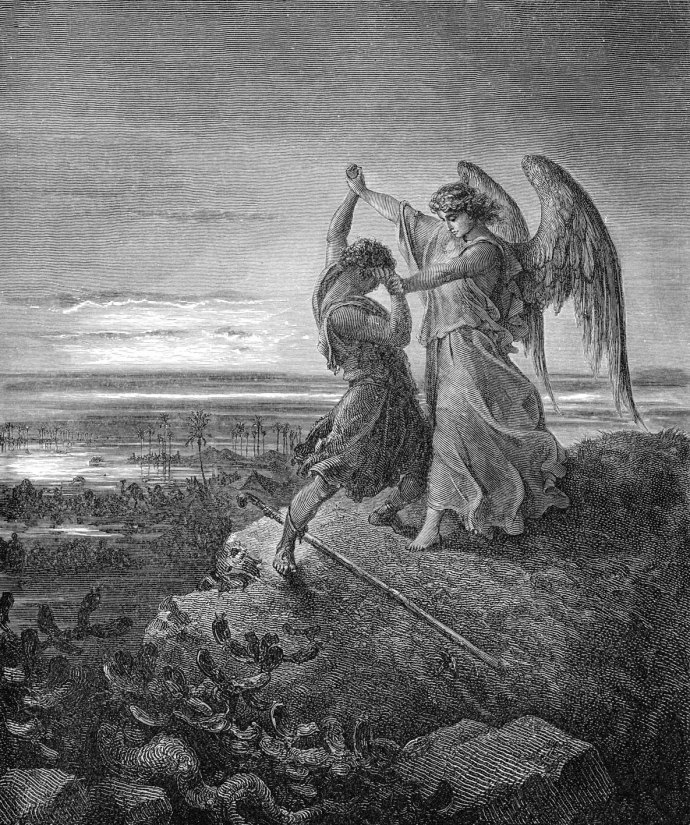
Jacob lost the ability to recognize angels as he approached his brother. When Jacob was next alone at night, he didn’t dream of angels on a ladder but wrestled with an ish, a man who is described by biblical commentators as an angel who renamed Jacob ‘Israel’ for prevailing in his fight with man and God. While Jacob should not have been scared of Esav as he had angels with him, he could no longer recognize them and fought them.
Jews today see their homes like Jacob as Vayetze Jews. Even in the face of family difficulties, a home is nevertheless a sanctuary in which we count our blessings and feel protected. It is when we compare ourselves to others and see their wealth and fear what they might do to us that we forget those blessings. We no longer see the angels and blessings they provide. So we demand that they serve our needs, and fight them thinking that they are strangers meant to do us harm.
And then we question the blessings we once enjoyed. Esav had no angels and yet prospered even more than Jacob. An unblessed life seemingly yielded greater rewards if one focuses purely on numbers.
Jacob produced a family which became a holy nation while Esav’s actions netted a massive army. During peace, it is easy to understand why Jacob’s descendants reach heights of thought and purity but in times of conflict, Esav’s army appears ready to conquer those achievements.
In a pre-October 7 world, Vayetze Jews imagined themselves blessed and protected in their home of homes, in their houses in Israel. The neat angel bookends of the parsha were the protective layer of building a home and family, and Vayetze Jews felt God’s blessings.
In the aftermath of the October 7 slaughter in which Arabs killed Jews in their homes in Israel, the Vayetze Jews were vanquished. We became Vayishlach Jews ready to fight man and God for the inhumanity inflicted on us.
Gustave Doré, Jacob Wrestling with the Angel (1855)
Is that our fate? Can the Jewish community become more?
Jews must internalize the text in the chapters and not just the parshas.
Esav DOES interfere with the story-telling of Jacob finding a wife. Esav does continue to build a family and army outside of Jacob’s Vayetze bubble. Jacob and the Vayetze Jew fail to internalize the outside world as they were self-absorbed which led to complacency. Jacob only saw angels’ blessings as partners for his activities in his home but did not use the gift for the fight to come outside.
We are both the Children of Jacob (Vayetze Jews) and the Children of Israel (Vayishlach Jews), and need to live lives focused internally and externally. Partnering with angels must extend beyond the bounds of angelic bookends and touch activities in everything we do. That is the pathway to true blessing and success inside and outside of our home and communities.
Each month, as I turn a new page of the calendar, I consider what needs to be done over the coming weeks. I plan my meetings, insert calls into my Outlook calendar and worry about my schedule.
When it comes to New Years Day, I have a different approach. I map what I want to accomplish in the coming year. I jot a big wish list and hope that my macro goals will be achieved over the course of the coming months.
Conversely, on my birthday I look backwards rather than forward. While I mark a new year of life I reflect upon my past year and where I am. I incorporate decisions that I made and whether those need to be reaffirmed or corrected in the year ahead.
Of course, I try to celebrate each milestone. The birthday, the new year, and yes, even the new month. Each is a cause for celebration in its own way.
The Hebrew month of Elul brings these thoughts together like no other. While it’s not yet the Jewish New Year, the countdown clock commences with its arrival. These days affords us the time to plan for the holidays and to reflect upon our actions as we ready ourselves to celebrate the upcoming month of holy days in Tishrei.
Elul binds the personal and spiritual. It is a month when we truly internalize that the success of our man-made plans and goals will be decided by Gd. We prepare for a month of intense prayers and celebration with mindful contemplation.
Jews normally wish people a “meaningful fast” during solemn fast days but it seems appropriate to wish people “a meaningful month” as we forge our past, present and future together – the very meaning of prayer to Gd.
In the 1986 film “Highlander”, immortal demi-gods roam Earth, interacting with people but caring mostly about other immortals. They live knowing that they must confront others like themselves and battle to the death, because in the end, only a single one can exist.
Monotheistic faiths often behave similarly.
Adherents of Christianity, Islam and Judaism have fought each other for supremacy. Many wars demanded death or conversion. As it related to places, the victor often took over holy sites and either demolished them or changed them to the winner’s religion, demonstrating superiority of their God.
Consider the Hagia Sophia in today’s Istanbul, Turkey. The building was originally built as a church around 537CE. When Ottoman Muslims conquered the city in 1453, they converted the church into a mosque. It remained so until the defeat of the Ottoman Empire in World War I, when shortly thereafter, the secular Turkish leader Mustafa Kemal Ataturk turned it into a museum. In the summer of 2020, Islamist Turkish leader Recep Tayyip Erdogan converted it back to a mosque, angering much of the western world.
Christianity and Islam battled for superiority in Europe and in the holy land for centuries. From 1095 to 1291 the church waged several crusades. The demand for armed pilgrimage to Jerusalem set the region on fire, with the paltry number of Jews in Europe and holy land left as victims on both sides.
When Christians ultimately failed to take Jerusalem, they turned to purge the Jews and Muslims of Europe. Various edicts preceded and followed the expulsion of the Jews of Spain in 1492 and in Portugal in 1497. Thereafter, Muslims were effectively routed from the peninsula, virtually completely by early in the 17th century.
Polytheists fought with monotheists as well. When Alexander the Great came to the Jewish holy land, he Hellenized the region. When the Romans came a few hundred years later, they destroyed the Second Jewish Temple and installed pagan gods. They renamed Jerusalem and the region in an attempt to vanquish the monotheist Jews.
Jews however, have uniquely not waged religious wars. While Christians and Muslims have long histories of invading lands and forcing people of different faiths to convert, Jews have no such imperative.
The reason is quite simple and completely misunderstood by non-Jews. While most religions contend that their belief system is supreme and that adherents to other faiths are either an affront to their god(s) and/or are doomed to damnation, Judaism is a particular faith, not a universalistic one. It does not demand that people of other faiths convert or that they are damned. It was always designed to be a local religion in the land of Israel for a specific tribe – the descendants of Abraham, Isaac and Jacob. Other faiths are free to worship as they desire.
The notion seems conceited to many and has sometimes led to anti-Semitism.
How can a supreme God produce a bible just for one community? If that were true and others want such relationship with God, they need to become the new Jews. This replacement theology placed Christians as the successors to Jews through Jesus. Islam held much the same, replacing Christians via their prophet Mohammed.
The Jews contend that they didn’t supplant any faith nor have they been supplanted. However, they do object to their religious places of worship being destroyed.
While Christians and Muslims may seek to place the Dome of the Rock and al Aqsa Mosque on top of the Jewish Temple Mount to show that their faith is supreme and replaced the old, Jews have no such dogma. There is no desire to “supplant”; just to have their own place of worship once again.
The Old City of Jerusalem including the Jewish Temple Mount/ Al Aqsa Compound. The Dome of the Rock has the gold dome in center right. Slightly below it is the al Aqsa Mosque with a gray dome.
Today, Islamic fanatics shout that “al Aqsa is in danger” to foment a jihad against the Jews. It is based on tenets not found in Judaism but in their monotheistic faith. Jews simply want to pray on the Temple Mount and rebuild their temple, but not to confront or show superiority to Islam.
The sentiment is captured in the Jewish Bible in a section read on the eighth day of Passover, in the book of Isaiah. While Isaiah 11:6 is famous, reading through to ninth sentence captures the fuller message:
6 The wolf will live with the lamb, the leopard will lie down with the goat, the calf and the lion and the yearling together; and a little child will lead them.
7 The cow will feed with the bear, their young will lie down together, and the lion will eat straw like the ox.
8 The infant will play near the cobra’s den, and the young child will put its hand into the viper’s nest.
9 They will neither harm nor destroy on all my holy mountain, for the earth will be filled with the knowledge of the LORD as the waters cover the sea.
That “holy mountain” is the Jewish Temple Mount. It can house the monotheistic faiths that believe in peace and coexistence. “The wolf will live with the lamb” will occur when the world’s great religions internalize their common bonds and stop fighting each other for dominance. Together, “they will neither harm nor destroy on all my holy mountain,” enabling the Third Jewish Temple to exist beside the al Aqsa Mosque.
The Islamic false perception that al Aqsa is in danger is rooted in its own conception of religious superiority and how it is manifest. When Muslim leaders internalize that Judaism has no such ethos, hopefully it will welcome the building of the Third Jewish Temple and help realize the vision of the prophet Isaiah.
The second book of the Pentateuch is called “Exodus” in English but called “Names” in Hebrew due to the opening lines. In reviewing the first ten sentences of the book, there is seemingly a deeper message about the names themselves.
Let us deal shrewdly with them, so that they may not increase; otherwise in the event of war they may join our enemies in fighting against us and rise from the ground.”
Genesis 1:1-10
The first sentence opens with calling Jacob by his changed name “Israel” before switching to his birth name “Jacob.” The text then lists all of the names of Jacob’s sons and subsequently pivots back to “Israel” after Joseph and his brothers died. At the end of the section, not only does the text pivot to using “sons of Israel” to include women and later generations but the new king in Egypt goes further in calling them a “nation of the sons of Israel.”
There is clearly more to appreciate in the names employed.
Birth Names of Human-Tension
The names given to the Jewish forefathers are explained inside the text in Genesis with some rationale given of how the parents felt at the time of the baby’s birth. Often, the names portend events in the future.
Consider how Sarah laughed when she heard she was going to have a child (Genesis 18:12) and then later Abraham named him Isaac (Genesis 21:3) after the Hebrew name for laughter. Sarah seemingly approved of the name (Genesis 21:6) only to soon witness Isaac’s half-brother Ishmael making fun of him (Genesis 21:8). Isaac’s name was an omen of things to come or perhaps served as the catalyst for how people perceived him. Maybe both.
One can see the impact of names when reading about Jacob’s eldest son, Reuben. Born to an unloved wife, Leah, Genesis 29:32 describes one of the saddest baby-namings in the Bible: “Leah conceived and bore a son, and named him Reuben; for she declared, “It means: ‘The LORD has seen my affliction’; it also means: ‘Now my husband will love me.’” How that name must have weighed on Reuben! To carry a name that shows his mother was unloved! With Leah’s sister as another wife and two handmaids also producing half-brothers, the family dynamic was extremely difficult. When his mother’s sister Rachel died years later and Jacob opted to still not enter Leah’s tent but that of Bilhah, Rachel’s handmaid, Reuben was apoplectic and raped Bilhah (Genesis 35:22).
The bible is deliberately silent on Jacob’s reaction to the event, stopping the story mid-sentence and starting a new paragraph with “Now the sons of Jacob were twelve in number.” Seemingly, Reuben is not punished by his horrific act and remained part of the collective twelve sons. Perhaps Jacob acknowledged that it was Reuben’s obligation to fight for the honor of his spurned mother, maybe even uniquely among Leah’s six sons, as he bore the name of desperate love.
Jacob himself was named by his mother Rebecca for the contentious relationship he would have with his brother Esau. In Genesis 25:23, God told Rebecca that two nations were struggling inside her womb and she named Jacob in Genesis 25:26 because he was clutching the heel (ekev in Hebrew) of Esau. This highly fraught relationship continued for years until an angel renamed Jacob in a night struggle, seemingly redoing the struggle in Rebecca’s womb. This time, Jacob came out on top but instead of clutching the heel of the winner, he incurred a permanent limp. As the victor, he was renamed Israel (Genesis 32:29) “for you have striven with beings divine and human, and have prevailed.” It was only at this point, stripped of a name that carried the significance of brotherly-confrontation, that Jacob met with Esau who had come to meet him with a 400-person army. Peace prevailed.
Karma of the Nation of Israel
After reviewing the nature of how parent-given names influenced the lives of the biblical forefathers, we can take a fresh look at the opening sentences of Exodus in a different manner.
From the middle of the first sentence through the sixth, the Bible names Jacob and his sons by their parent-given names with Joseph separated from everyone – twice. First, he is described as already living in Egypt and then specifying his death while not listing any other deaths in the family. Seemingly this fits the narrative to come, that a new Egyptian king did not know Joseph. A casual reader would infer that the new king did not know how Joseph saved the entire region from starvation and made Egypt into a rich and powerful nation.
But such a linear reading could have been accomplished without starting and closing the section with the name “bnai Yisrael,” at first being the sons of Jacob, then the extended family and ultimately entire nation of Israel.
The birth-named middle section is a family set upon itself. As sons of Jacob, they were dysfunctional to an extreme: Joseph’s brothers sold him into slavery after throwing him into a pit; the sons lied to their father that Joseph was dead; Reuben raped his half-brothers’ mother. The list goes on. This family of Jacob was a quarrelsome bunch, quite distinct from Joseph whose position was established in Egypt. The Egyptians tolerated the sons of Jacob only because of – and under the control of – Joseph.
Joseph Lowered Into The Well By His Brothers, by Peeter Sion (1620-1695)
When Joseph died and a new king arose, it was not so much that the new king no longer appreciated what Joseph did for Egypt as much as he no longer saw a small fragmented family under the control of an Egyptian prince. Instead, the “sons of Israel” had become generations and ultimately a “nation of the sons of Israel,” large and no longer under the control of a reliable Egyptian. As alarming, this rag tag group had a blessed name, meaning that it will prevail in dealing with “beings divine and human.” This unnerved the new king.
She’mot, the Book of Names, is not only a story of how a family became a nation, but how such family matured beyond individual names of personal conflict to realize the full-potential of its divine name.