A Muslim who visits Mecca is called a Hajji. It is one of the highest honors in Islam, the completion of the Hajj pilgrimage, celebrated by family and community as a sacred accomplishment.
A Catholic who travels to the Vatican is a pilgrim. For centuries, the faithful have journeyed to Rome, walking into St. Peter’s Square with reverence, greeted with blessing and legitimacy.
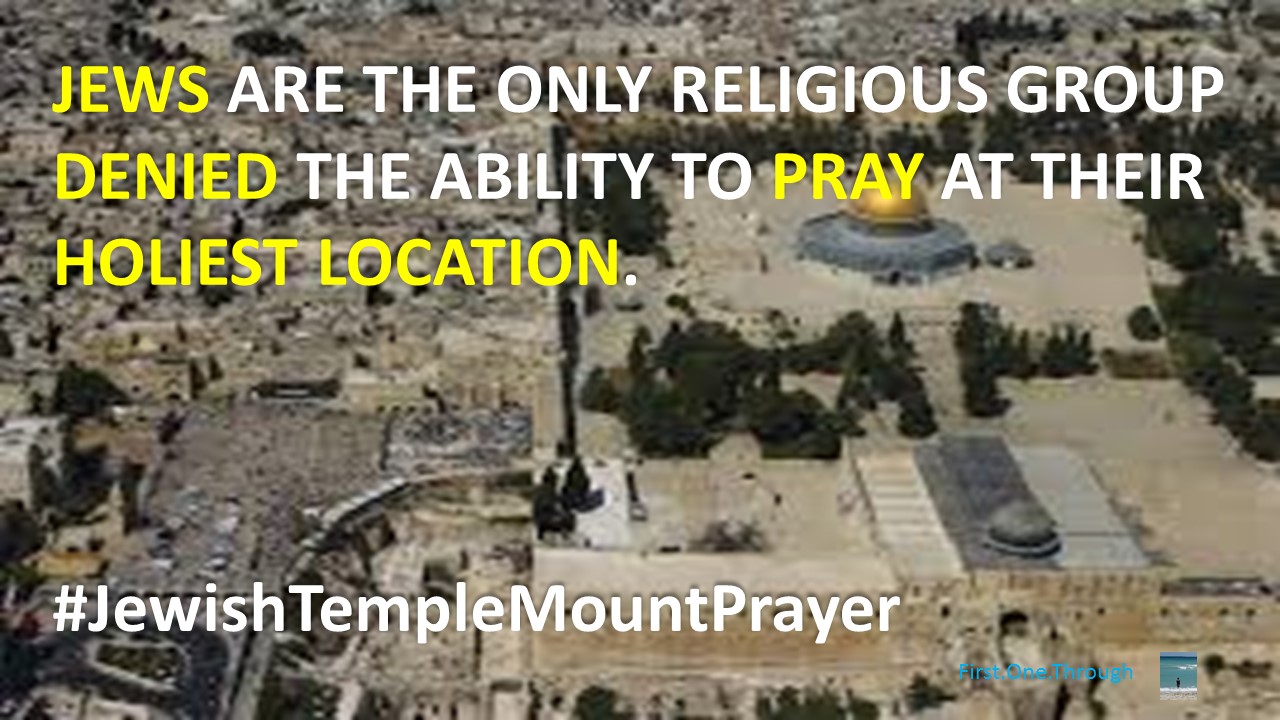
And a Jew who goes to the Temple Mount in Jerusalem — the very place where the First and Second Temples once stood, the holiest site in Judaism? That Jew is branded a provocateur. Not a pilgrim, not a worshiper, not a faithful soul ascending to pray — but an instigator, an agitator, an accused trespasser, a “settler” on their own sacred ground.
The disparity could not be starker. What is celebrated as devotion for others is condemned as incitement for Jews. For Muslims, the Hajj is a right; for Catholics, Vatican pilgrimage is honored; but for Jews, even quiet prayer on the Temple Mount is labeled an offense — by the United Nations, NGOs, and international bodies.
It is not only hypocrisy; it is erasure. To deny Jews the name of pilgrim is to deny Jewish history, Jewish identity, and Jewish legitimacy. It casts the holiest place in Judaism as alien to Jews themselves, a desecration of memory turned into policy.
And why? Because the world has normalized the jihad. It has allowed Islamic Supremacy to dictate permissible behavior, even in the Jewish holy land.
The truth is simple: a Jew ascending the Temple Mount is not incitement. It is the most ancient pilgrimage of them all — the echo of three millennia of devotion, commanded in Torah, rooted in covenant, and carried in every prayer whispered toward Jerusalem, before Islam was even created.
The real provocation is not the Jew who prays on the Temple Mount but a world that dares to tell Jews they don’t belong at the center of their faith.
ACTION ITEM
Come to the United Nations in New York City and demand Jewish rights and freedom of religious assembly in Jerusalem.
Ki Teitzei’s Call for Dignity vs. Hamas’ Celebration of Desecration
Parshat Ki Teitzei commands something extraordinary:
“If any party is guilty of a capital offense and is put to death, and you impale the body on a stake, you must not let the corpse remain on the stake overnight, but must bury it the same day. For an impaled body is an affront to G-d: you shall not defile the land that your G-d is giving you to possess.” – Deuteronomy 21:22-23
Even the guilty must not be left hanging overnight. The Torah demands swiftness in burial, even for one who deserved execution.
The biblical commentator Rashi (1040-1105) spells out the reason: “a degradation of the Divine King, for man is made in His image.” Since man is made in the image of G-d, it would be an insult to G-d to continue to embarrass the dead, even one who deserved capital punishment. The focus should be about restoring public order and nothing more.
Hamas: Desecration as Policy
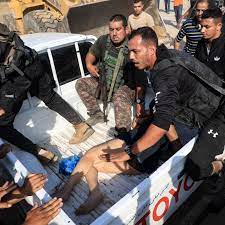
Contrast that to Palestinian political-terrorist group Hamas. On October 7, terrorists not only murdered, but dragged Jewish bodies through the streets of Gaza, spat on them, and beat them before crowdscheering “Allahu Akhbar” – G-d is Great. Their deaths became props for Hamas’ theatre of hate.
Hamas took the dead and mutilated body of German-Israeli Shani Louk to Gaza, where the crowds spat on her body and beat her. Her head was later chopped off.
To this day, Hamas holds the bodies of Israeli hostages, denying their families the ability to bury them, to say Kaddish, to mourn. It is deliberate, drawn-out torture.
The Law of Nations Agrees
This is not only a biblical imperative — it is a universal one. Article 17 of the Geneva Convention states plainly “Parties to the conflict shall ensure that the dead are honorably interred… and that their graves respected and properly maintained.”
Even in war, even between enemies, the dead are to be treated with dignity.
Hamas has made clear it recognizes no such obligation. It does not simply kill — it advertises cruelty, turning murder into propaganda and humiliation into spectacle.
The Moral Divide
Ki Teitzei calls us to a higher standard. To quickly bury even the criminal, to shield the image of G-d from public shame. The radical Islamist group calls its people to something else entirely: to spit, to drag, to desecrate. To turn death into a carnival. Jews believe sanctifying G-d means sanctifying the human body, even a murderer. Fanatical jihadists believe that Gd wants the community to mock the dead, even a female dancer.
This is not just a fight over land. It is a war between those who sanctify life — even those they must punish — and those who have turned death into a brand identity.
The choice before the world could not be clearer: stand with those who respect the divine image, even in death — or with those who trample it.
“Three times a year all your males shall appear before Hashem your God in the place He will choose—on the Festival of Matzot [Pesach], on the Festival of Weeks [Shavuot], and on the Festival of Booths. [Sukkot]” (Deuteronomy 16:16).
At a time when the tribes of Israel were destined to live across a wide and varied land—from the Galilee to the Negev, from the Mediterranean to the Jordan Valley and beyond—this commandment ensured that all Jews, regardless of tribe or geography, would remain bound to a single center: the place “He will choose:” Jerusalem.
Then: One City for One People
The pilgrimage festivals were not simply religious obligations; they were national glue.
Unity in Diversity: Each tribe had its own territory, customs, and leadership. But Jerusalem reminded them that they were not twelve separate entities—they were one nation.
Physical Connection: The journey itself—families traveling for days from north, south, east, and west, THREE TIMES A YEAR—kept every Jew intimately connected to the city at the nation’s core.
Spiritual Focus: No matter how far they lived, Jews oriented their lives toward Jerusalem.
Without this ritual of convergence, the tribes might have drifted apart, their shared purpose diluted by distance and difference.
Now: Re-Centering Around Jerusalem
Fast forward over three millennia. Jerusalem is once again the capital of a sovereign Jewish state. But the modern challenge is becoming increasingly less about tribal dispersion, with Jews in the holy land making up a plurality of Jews – it is geopolitical pressure and strategic vulnerability.
Recent government plans to develop the area known as E1, just east of Jerusalem, have sparked international controversy. Critics claim the project is “obstructive to peace.” It’s an absurd claim. Supporters see it differently: as an essential step to connect Jewish communities around the capital, ensuring that Jerusalem remains safe and accessible and central to Jews from north, south, east, and west.
The parallels to Re’eh are striking:
Geographic Cohesion: Just as ancient pilgrimage routes tied the tribes together, modern infrastructure links surrounding communities to Jerusalem.
National Identity: Building around Jerusalem reinforces its role not just as a city, but as the beating heart of Jewish life.
Defying Fragmentation: Where outside forces seek to carve up and isolate Jerusalem, development ensures continuity and connection.
Jerusalem: The Eternal Center
Parshat Re’eh’s vision was never merely about geography—it was about survival through unity. When Jews journeyed to Jerusalem three times a year, they reaffirmed their covenant and their peoplehood. One God, one people.
Today, as Israel strengthens the areas around Jerusalem, it is engaged in the same mission: to keep the Jewish people close to their capital, secure in their homeland, and united across generations.
Then as now, Jerusalem is not just a place—it is the center of a people.
The Old City of Jerusalem including the Jewish Temple Mount on the holiday of Sukkot
Parshat Eikev is about consequences. Love God and cherish the land, and there will be abundance. Turn away from them, and the blessings will vanish. It’s not just poetic scripture—it’s a binding principle embedded in Jewish destiny.
In 2005, Israel withdrew from Gaza, handing the Strip to the Palestinian Authority. The move was framed as a step toward peace, but Palestinians internalized a different lesson from the Second Intifada: violence works. Within two years, Hamas was elected to a majority of the Palestinian parliament, seized power in Gaza, and rockets became Gaza’s chief export.
The same pattern played out decades earlier. In 1967, Israel reclaimed eastern Jerusalem from Jordan in a defensive war and reunified the city. Yet, instead of asserting Jewish sovereignty on the Temple Mount—the holiest site in Judaism—Israel handed day-to-day control to the Islamic Waqf which banned Jewish prayer there. The Muslim world absorbed the message: Jews do not value their holy places as deeply as Muslims do.
These choices raise the uncomfortable question: do Jews truly love the land and God in the way Eikev commands? The Bible is not just a Jewish text. Billions of non-Jews around the globe read it. They know its covenantal clauses and its warnings. They understand—at least in their own terms—the consequences that befall Jews when we turn from God’s love and from the eternal heritage of the land. Some may even see themselves as agents in delivering divine justice.
God knows. The world knows.
It is time for Jews to internalize this truth. The Shema’s first line is often recited aloud with pride. But the second section (starting at Deuteronomy 11:13), with its stark outline of blessings for faithfulness and curses for betrayal, is whispered—if said at all. Perhaps it’s time to say it aloud, not just with our lips, but with our lives: affirming an unbreakable commitment to God and to the holiness of the land.
In Israel, that would be building homes in the area known as “E1,” cementing all of Jerusalem including the Temple Mount as integral to Israel. In the diaspora, it means putting mezuzahs on doorposts and wearing tefillin (11:18-20).
The Old City of Jerusalem including the Jewish Temple Mount/ Al Aqsa Compound
Consequences are not an abstraction in the Torah—they are the lived reality of Jewish history. Eikev’s message is as urgent now as it was on the plains of Moab.
As the Israelites were about to enter their Promised Land, the Bible relays stories of a series of conflicts.
After the spies delivered a bad report on the land in Parshat Shlach, we read the story of Korach who tried to launch a mutiny against Moses and Aaron. Then Chukat describes a war with Amorites, and Balak shares the story of a prophet trying to curse the Jewish people. At the end of Balak (Numbers 25:1-9), we read about Moabite women engaged in profanities with Jewish men. Pinchas, son of Elazar son of Aaron, took a spear and impaled the couple having sex in front of the Ohel Mo’ed, the tent Moses used to communicate with God.
Illuminated manuscript miniature from the 15th-century Alba Bible
And that is where Parshat Balak and the story seemingly end. With the murder of the couple and 24,000 others engaged in similar acts.
But it doesn’t really.
Parshat Pinchas continues the story with a pivot. Rather than highlighting the sins and the deaths, Numbers 25:10 begins with God appreciating the defense of holiness and His blessing Pinchas and his descendants. While the story may appear as a single episode, the Torah divides the parshas – and the narrative – between the violent and the holy, even when the violence was in the name of the holy.
The theme of separation can similarly be seen immediately after this in chapter 26, where God calls for another census of the tribes. Here, God counts the tribes and their families to allocate land for their inheritance. This is in contrast to the census of Numbers chapter 1 in which God wanted to account for how people would assemble in their journey and combat enemy forces. In the case of the journey and battle-readiness, there was a single head of each tribe; when they entered the land, each tribe’s family was specified.
It is a metaphor for how Jews assemble and coordinate today: there are wars that are fought in Israel and the diaspora against those who want to harm Jews and the Jewish State. Global Jewry understands the us-versus-them dynamic and the role for every Jew in the battle. It is related yet distinct from the interaction amongst Jews regarding our common heritage. We each have a part to play living together as a community.
Individuals fight with a common purpose. Families live under a societal umbrella.
We have tribes and borders and homes. We coexist with each other while understanding our peaceful lines. The separations today may be between synagogues or religious denominations. Between schools and political affiliations. Each aspiring for peace and holiness.
Those lines are very different than the battle lines between us and “them,” those who mean to harm us physically, morally and spiritually.
Upon entry into the Jewish holy land, Jews migrated from an army with legions to a people with property. While there were still wars to be fought inside the Jewish Promised Land, the muscle memory of understanding who is within the holy communal tent and those outside forces, was taught over the trials in the desert.
It is a lesson for our time as well: to clearly identify our allies and foes, and wage war and peace accordingly.
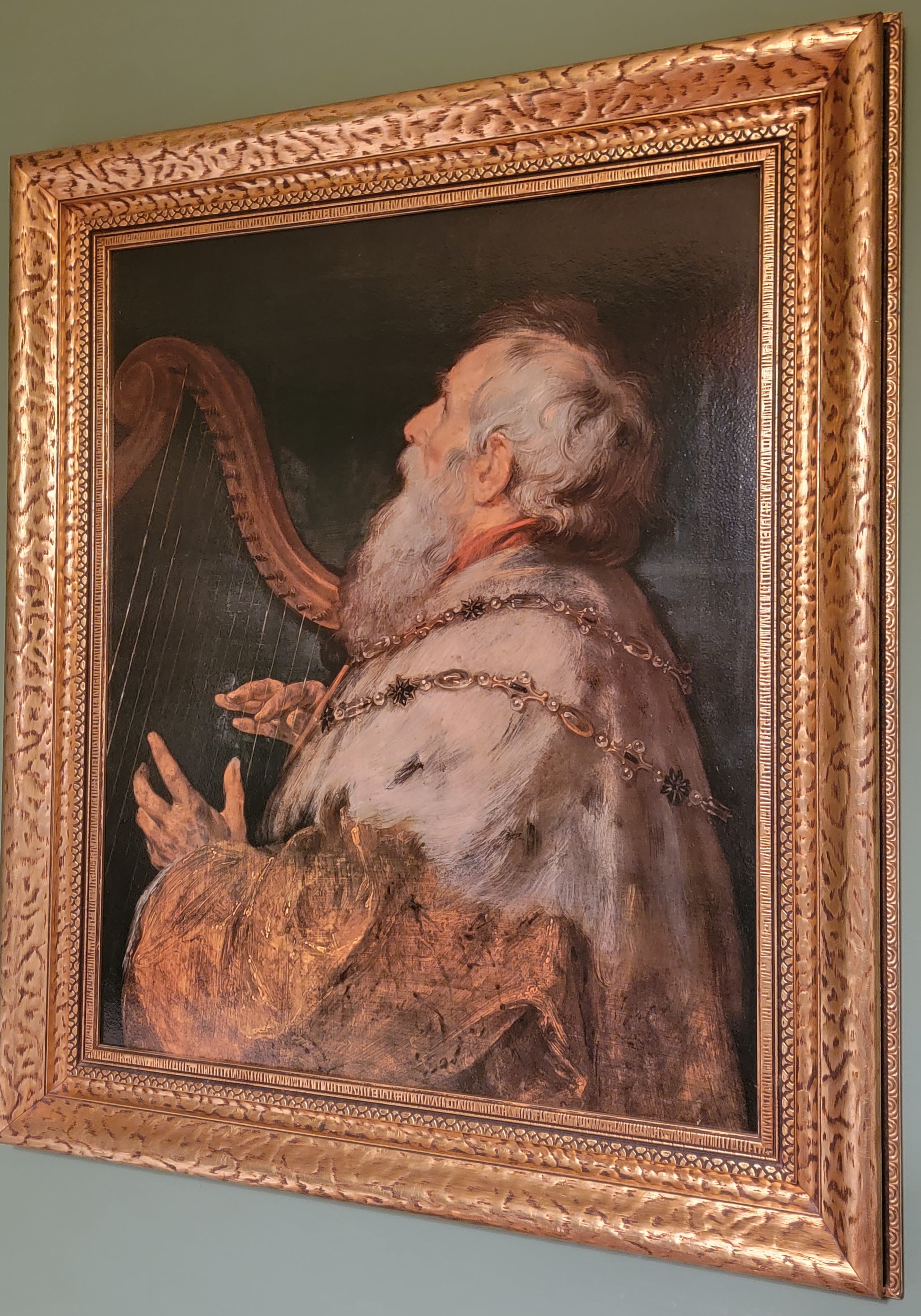
Since the horrific attacks on Israel on October 7, 2023, Jews around the world have recited Tehillim, Psalms. These were composed by King David as prayers to God which continue to be read by people around the world. People have recited them in WhatsApp groups on behalf of injured soldiers and civilians. They have said them in synagogues on behalf of the hostages.
King David Playing the Harp, ca. 1616 by Peter Paul Rubens
The WhatsApp groups tend to say all of the 150 psalms, with people volunteering to say one or a couple of chapters before another person steps in to read the next ones.
In synagogues, the congregations typically recite Psalm 121 and Psalm 130 which pray for salvation and redemption.
With the recent victories over Hezbollah in Lebanon, in Iran and soon over Hamas in Gaza, it is time for synagogues to recite songs of celebration during or at the end of services. Consider:
no exchange with passersby: “The blessing of the LORD be upon you.” “We bless you by the name of the LORD.”
And then recite sections of Psalm 118: 5-21, which are well known as they feature prominently during Jewish festivals in Hallel and the Passover Haggadah:
I praise You, for You have answered me, and have become my deliverance.
The Jewish people are securing great victories over genocidal antisemitic foes. The world should include Psalms of thanks alongside prayers for the hostages and injured.
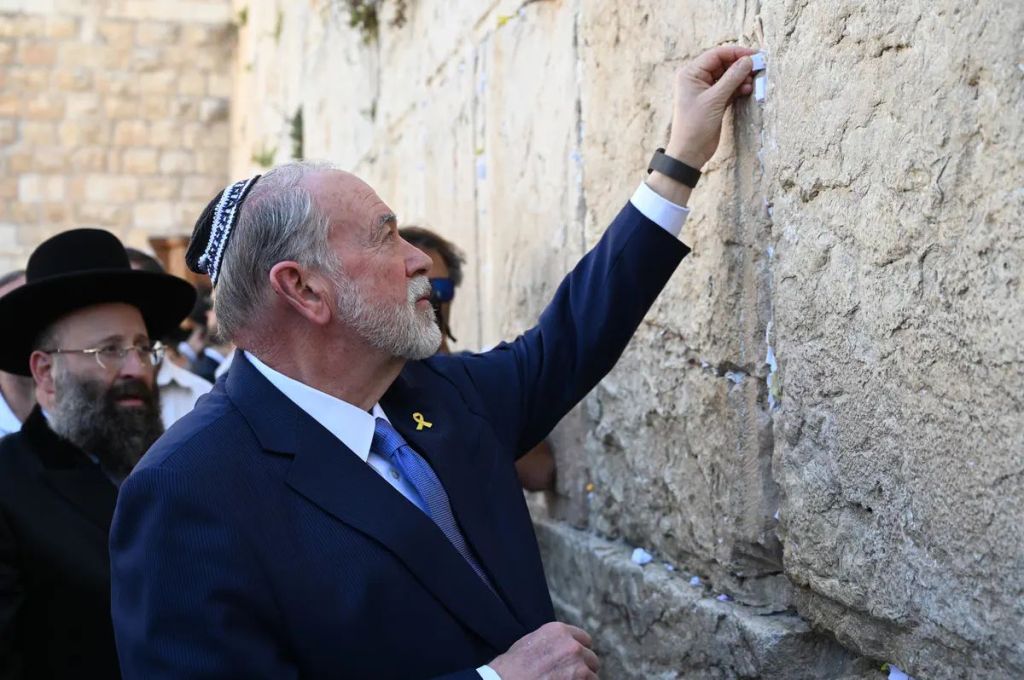
Mike Huckabee, the new U.S. Ambassador to Israel, landed in the holy land to assume his new role and immediately went to the Western Wall of the Jewish Temple Mount. It is the holiest site where Jews can pray today, so he used the opportunity to address Jews in a call for peace.
Huckabee carried a small paper note from U.S. President Donald Trump praying for peace, which Huckabee inserted into a small crack in the ancient wall. He told those gathered that he and the president prayed that all the hostages violently taken by Gazans would be released to their families soon.
Mike Huckabee speaking at Western Wall about the “Judeo-Christian understanding that every life has worth and value.”
The Council on American-Islamic Relations (CAIR) said that Huckabee’s appointment as ambassador to Israel will “undermine the rights and safety of Muslim and Christian Palestinians, including American citizens living in or traveling to the region.” Somehow, a man devoted to peace for everyone – including Jews – and freedom for everyone – including hostages – is a threat to radical Muslim groups like CAIR and the Islamic Waqf.
US Ambassador to Israel Mike Huckabee, wearing a hostage support yellow ribbon pin, places a note into the Western Wall of the Jewish Temple Mount, during Passover 2025
On the same day, Israel increased the number of Jewish visitors onto the Temple Mount to 180 at a time to accommodate demand. These were the largest sized groups according to the Islamic Waqf coming to “al Aqsa Mosque.” Aouni Bazbaz, head of international affairs for the waqf told Middle East Eye that the scene was “frightening” and portended Jews seeking to divide the holy compound into Jewish and Muslim sections like the Cave of the Jewish Matriarchs and Patriarchs in Hebron.
To put the 180-person Jewish group in context, during Ramadan last month, Israel banned Jews visiting the site while 90,000 Muslims visited for prayers without putting anyone into a “group” for security. No one in Israel called the massive number of Muslim visitors “frightening.”
To add insult to the waqf’s smear, Bazbaz said Israel’s allowing both Jews and Muslims to pray in Hebron was “apartheid” and likely to happen in Jerusalem.
Islamic extremists want a purely Muslim holy land in the Jewish homeland, without basic human rights like prayer for non-Muslims. Dignity for other faiths is labeled “apartheid” in slurs likely to be adopted by the United Nations and “human rights” groups.
The story of Chanukah happened in 164 BCE. The Seleucid king Antiochus IV Epiphanes had defiled the Second Jewish Temple in Jerusalem and enacted several laws against Judaism, including banning circumcision, celebrating Shabbat and Jewish holidays, forcing Jews to eat pork, and making it a capital offense to have a torah scroll. The Jews of the holy land revolted against the Syrian-Greek king and got rid of all the anti-Judaism decrees and rededicated the Temple.
This was a war of pagans against the Jewish religion, before Herod built the expanded Temple Mount plaza and before Christianity.
Over the following centuries, King Herod (72 BCE – 4 BCE) built the expanded Temple Mount and Jesus was crucified in Jerusalem by the Romans. Jewish revolts against the Romans in 66CE-70CE and 132-135CE led to the destruction of Jerusalem and expulsion of Jews from the area, renaming the city to “Aelia Capitolina” and the region to “Palestina.”
This was a war of pagans against Jews and Christians, before the birth of Mohammed and creation of Islam.
Mohammed’s quest to bring Islam from the Arabian Peninsula to the world brought a Muslim invasion into the Jewish holy land in the 7th and 8th centuries. Muslims built their third holiest site on top of Herod’s Temple Mount, the Al Aqsa Mosque. Christians and Muslims waged several wars over the holy land between 1095 and 1291.
Those battles between Christian crusaders and Muslims, were over the Jewish holy land and Judaism’s holiest location.
In 1948, Muslim Arab armies invaded and tried to destroy the newly declared State of Israel. The Jordanian army ethnically cleansed all of the Jews on the western bank of the Jordan River all the way through the Old City of Jerusalem. In 1954, it granted citizenship to all Arabs, as long as they were not Jewish.
This was a war of Arab Muslims countries against the physical presence of Jews in the Jewish holy land.
From the Chanukah story to the creation of Israel in 1948, many groups laid siege to Jerusalem, often attacking Jews through anti-religious actions, or lumped in with other religious groups. Since 1948, the war has been about the physical presence of Jews in Jerusalem, a place where Jews have been the majority since the 1860s.
At the story of Chanukah, there was no Temple Mount, no Christianity and no Islam. It was a battle of pagans against a small local tribe’s religion, who lived at the intersection of Africa, Asia, and Europe.
Chanukah marks the beginning of Jews in the holy land being attacked for their religion. The successful battles proved to be short-lived, as most Jews were forced into the diaspora over the following centuries, until the recent past. Celebrating the holiday today amidst a multi-front defensive war and global antisemitic chants that Jews are “European settler colonialists” is a chance to reassert Eight Attestations On Jerusalem:
Jews have an Inalienable right to pray on the Jewish Temple Mount
Banning Jews from living and praying in their holiest city is blatant anti-Semitism, as is denying Jewish history
There is no “Judaizing” Jerusalem, as Jews have been the majority in Jerusalem since the 1860s, and have devoted themselves to the city since 1000BCE
The security of Israel demands that its capital sit well within its borders
Divided capitals are a function of war, not peace. The place known as “East Jerusalem” only existed for a few years, 1949-1967
No part of Jerusalem was ever contemplated to be part of Palestine. Not only is “East Jerusalem” not an actual city, but there is no basis to call it “Occupied Palestinian Territory”
Jerusalem Arabs have been and are continued to be offered Israeli citizenship
There is no ethnic cleansing of Arabs. The Arab population in Jerusalem has grown faster than Jews since Israel reunited city
On Chanukah, diaspora Jews should pay particular attention to the direction of their prayer, the Jewish Temple Mount in Jerusalem, Israel, as Jews have done for thousands of years.
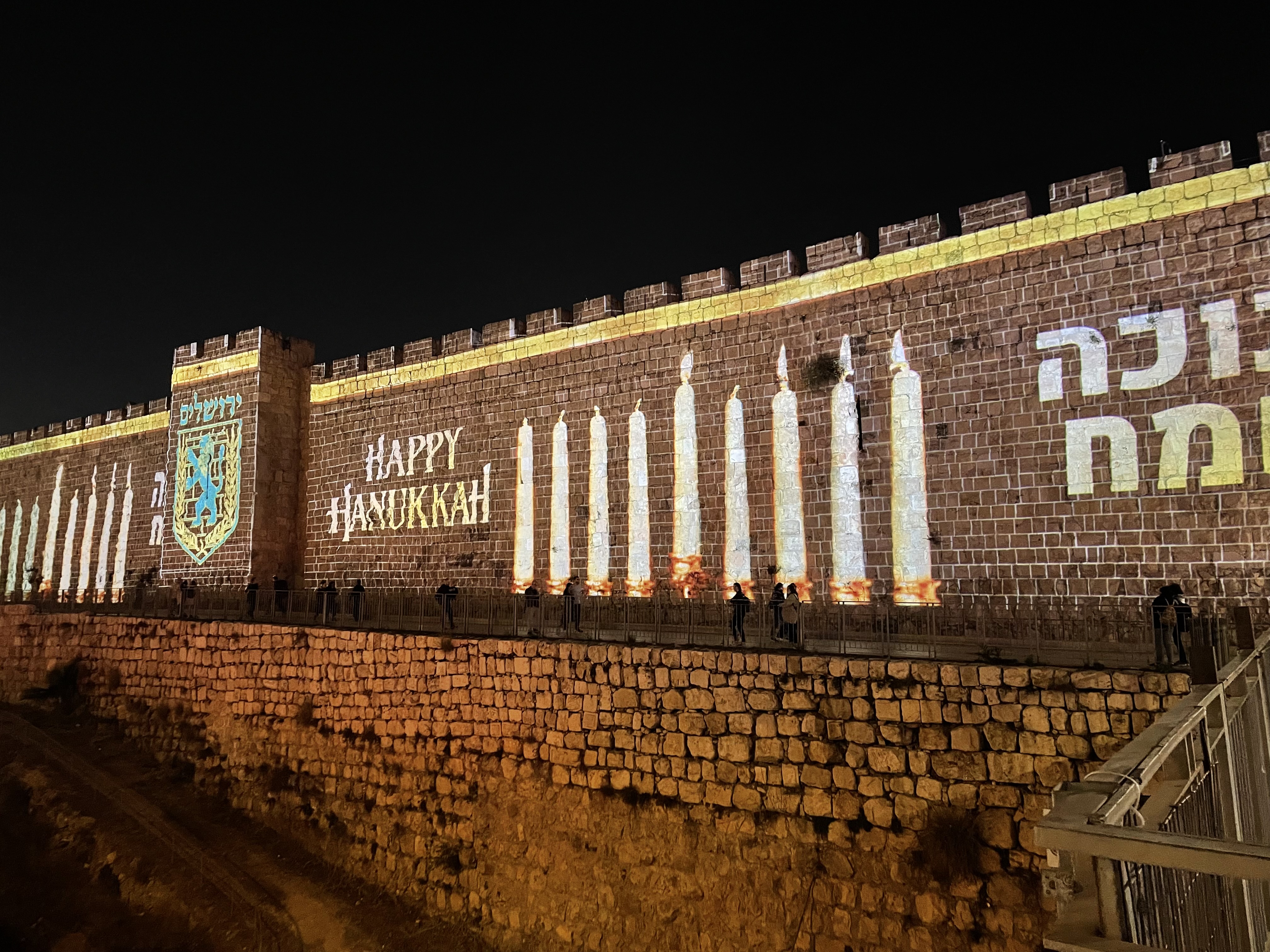
Happy Chanukah signs on the walls of Jerusalem, 2021
One of the most famous stories in the Book of Genesis is about Jacob’s ladder with angels ascending and descending. The famous biblical commentator Rashi (1040-1105) said that the angels going up were tied to the holy land and had to leave Jacob as he journeyed to live with his uncle Laban outside of the land. The angels coming down were new angels who would accompany Jacob while he lived outside of the holy land.
Jacob’s Ladder by Frans Francken II the Younger (1581-1642)
I would like to share an alternative interpretation: the angels on the ladder represent Jacob’s relationship with Esau.
There is no tool that connects hands and feet like a ladder. Both are required to go up as well as to come down. If several people are on a ladder at one time, hands and feet would likely be touching.
That is a reference to Jacob. His name literally came from his act of holding onto the heel of his brother Esau at their births. “Jacob” stems from the Hebrew word for heel, “akeb” (Genesis 25:26):
The clutching of the heel in the world’s first recorded twins set the primogeniture battle for the ages.
Birthright
There are two stories of Jacob angling to take the birthright from Esau. First, Jacob operates on his own and trades food with a hungry Esau for the birthright (Genesis 25:29-34). Years later, as their father Isaac wasn’t likely to abide by the earlier exchange between the brothers, Jacob acts at the urging of his mother Rebekah to trick Isaac into giving the special blessing intended for Esau to himself. Esau was so distraught by this action, that he swore he would kill Jacob, forcing Jacob to flee to live with Laban. (Genesis 27:1-21).
Jacob had the dream of angels on the ladder while he was fleeing from Esau. Jacob was not sure whether he had the advantage of the blessing or was a hunted man. On the ladder, the person higher up is only ahead while ascending; the elevated person actually trails the person below him when they are all descending.
The story of Jacob clutching Esau’s leg finally comes to a close when Jacob returns to the holy land. In Genesis 32:25-33, Jacob wrestles a man/angel who dislocates Jacob’s hip. As the angel breaks free he blesses Jacob by changing his name to Yisrael:
“Said he, ‘Your name shall no longer be Jacob, but Israel, for you have striven with beings divine and human, and have prevailed.'”
Jacob/Israel, together with his wives and children, are then able to meet with Esau with his 400-person army, no longer carrying the weight of the contest. After they meet, Jacob gets affirmation from Gd about moving beyond the Jacob-Esau heel connection in Genesis 35:9-13.
And God said to him, “I am El Shaddai. Be fertile and increase; A nation, yea an assembly of nations, Shall descend from you. Kings shall issue from your loins.
The land that I assigned to Abraham and Isaac I assign to you; And to your offspring to come Will I assign the land.”
Jacob’s view of himself was tied to his name which conveyed a pursuit of his brother and his blessing. Once he broke free of that pursuit – together with a limp and a new name – Israel was able to accept that he was the heir to the blessings Gd bestowed upon his forefathers.
The angels on the ladder in Jacob’s dream were not geofenced protectors of Jacob but a reflection of his link with Esau, together with confusion of his actions. Esau would always be older and above him on the ladder, but descending and on the ground in the holy land, Jacob/Israel was entitled to the blessings and inheritance.
For the sin of believing in Kamala Harris the moment she became the presidential nominee when I had believed her utterly incompetent for three and one-half years;
For the sin of not believing that Donald Trump is a megalomaniac;
For the sin of wasting time debating Trump-Harris for hours, when I live in a deeply blue or red state;