Every Jewish Holiday Leads Back to Jerusalem

For many people, Jewish holidays are family traditions: apples and honey on Rosh Hashanah, a Passover Seder, Hanukkah candles, or a sukkah in the backyard. Yet beneath these customs lies the deeper reality that every major Jewish holiday is connected in some way to the Temple in Jerusalem.

The Temple was not simply a house of worship. It was the spiritual, national, and legal center of Jewish life. Pilgrimages, sacrifices, priestly service, national assemblies, and the calendar itself revolved around Jerusalem. Even after the Temple’s destruction in 70CE, the holidays preserved its memory and continue to point toward it.

Rosh Hashanah marks the Jewish New Year and the sounding of the shofar. In Temple times, witnesses testified before the Sanhedrin in Jerusalem to establish the new month, and the shofar echoed through the Temple courts. Today, Jews still pray that God’s kingship will once again be recognized from Zion.

Yom Kippur is inseparable from the Temple. The High Priest entered the Holy of Holies only once a year to seek atonement for the nation. Modern synagogue services painstakingly recount the Temple ritual, preserving the memory of the day’s most sacred service.

Sukkot was one of the three pilgrimage festivals when Jews ascended to Jerusalem. The Temple hosted the joyous water-drawing ceremony (Simchat Beit HaShoeva), accompanied by music, dancing, and water libations on the altar. Rabbinic tradition describes it as one of the greatest celebrations ever witnessed.

Shemini Atzeret and Simchat Torah conclude the festival cycle begun at the Temple with Sukkot. While Simchat Torah developed later, it celebrates the Torah that was publicly taught and read in Jerusalem.

“Ki mitzion tetze torah” (כִּי מִצִּיּוֹן תֵּצֵא תוֹרָה). “For instruction shall come forth from Zion, The word of God from Jerusalem.” – Isaiah (Chapter 2, Verse 3)

Hanukkah commemorates the rededication of the Second Temple after it was reclaimed from the Seleucid Greeks. Every candle recalls the restoration of Jewish worship in Jerusalem.

Tu BiShvat, the New Year for Trees, determined agricultural laws whose tithes and first fruits were ultimately brought to the Temple.

Purim is the only holiday without a direct Temple ritual, yet its story ensured the survival of the Jewish people who would rebuild and worship in the Second Temple. Jerusalem itself celebrates Purim a day later, preserving its ancient status as a walled city.

Passover was the greatest pilgrimage festival. Hundreds of thousands ascended to Jerusalem to offer the Passover sacrifice before gathering in homes throughout the city for the Seder. Even today Jews conclude the Seder with the words, “Next year in Jerusalem.”

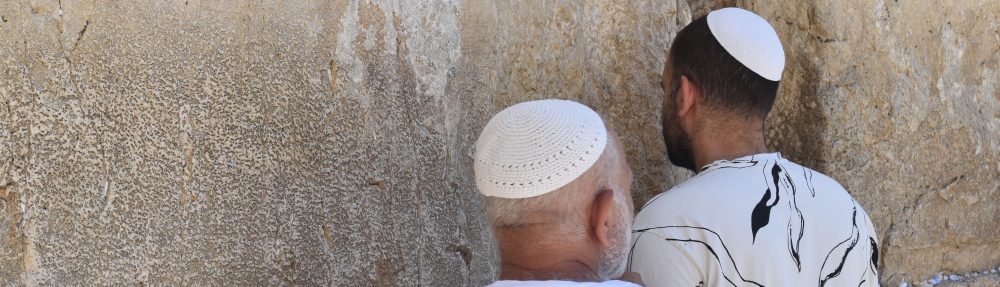
Tens of thousands of Jews at the Kotel Plaza in the Old City of Jerusalem during Passover, as they cannot ascend to the Temple Mount today

Shavuot celebrated the first fruits brought to the Temple in elaborate processions from across the Land of Israel. Farmers entered Jerusalem carrying decorated baskets while choirs sang Psalms of thanksgiving.

Tisha B’Av mourns above all the destruction of both the First and Second Temples. It is the day on which Jews sit on the floor, recite Lamentations, and remember the loss of Jerusalem’s spiritual heart.

Even holidays with no formal Temple ceremony ultimately orbit Jerusalem. They celebrate the survival of the Jewish people, the covenant, the Land of Israel, and the hope of restoration.

Jerusalem is not merely Judaism’s holiest city; it is the organizing principle of the Jewish calendar itself. The cycle of holidays begins and ends with memories of Temple worship, pilgrimages, offerings, repentance, thanksgiving, and national gathering in one place.

For centuries Jews prayed facing Jerusalem, broke a glass at weddings to remember its destruction, left part of a home unfinished in mourning, and ended the Passover Seder and Yom Kippur with the same aspiration: “Next year in Jerusalem.”

The Jewish calendar is more than a record of sacred time. It is a map whose destination is Jerusalem, carrying the memory of the Temple from one generation to the next.

Related articles:

The Prayer That Never Left Jerusalem (May 2026)

Stop With the Hanukkah Miracle and Declare the Hanukkah MESSAGE (December 2025)

Eight Attestations On Jerusalem (December 2021)

Purim 2024: Fighting

This Purim in Gaza
Jews seek a calm plaza
To recite the lengthy Megilat Esther.

An evil plot spun
By the antisemite Haman
Who would eventually become Jews’ jester.

The IDF’s mishloach manot
Would break from historic rote
And include foods each had on hand.

Each soldier had the same
And laugh at the passe game;
Exchanging foods which for months had become bland.

Tuna MREs,*
A bunch of chickpeas,
And a ripe, military-green avocado,

American Kind bars,
Often delivered with greeting cards
Would cement each gever’s bravado.

Classic sunflower seeds
Top off the good deed
Of gifts among Jewish friends.

In the Jewish Promised Land
And beyond, hand-to-hand
This holiday is seen through a new lens.

Many Jews are now scared
As our neighbors declared
That we are enemies for supporting Israel.

They are ready to pounce
Unless we renounce
The Jewish State and declare it vestigial.

This Purim 2024
We cautiously open the door
Now monitored by a Ring alarm.

Cautious of antisemites
Who deny Jewish rights
And mean to do us physical harm.

Recalling Mordecai did not bend
And Esther did ascend
To flip that historic situation.

Persian Jews defeated
An evil ideology, deep-seated
And avoided a mass annihilation.

We will also stand proud –
Zionists unbowed,
Sporting American and Israeli flags.

We yell “Happy Purim!”
As we munch our gar’inim
Handing IDF foods in olive green bags.

We will celebrate victory
Current and from history
And salute everyone involved in the fight.

That includes G-d
As well as the Mossad
And do it all over a bite.

Make sure IDF soldiers have a bit more to eat for Purim and throughout the war: https://my.israelgives.org/en/fundme/Hoffman_PURIM24

*MRE: military term for “meals ready to eat”

Mishloach Manot 2024, tribute to the IDF

Related articles:

Purim 2023: Non-Conformity Before The Drunken Purity Crusade

Passport Purim 2022

Purim 2020, Jewish Haikus

Purim 2019, The Progressive Megillah

Purim 5776/ 2016 Poem

First One Through music video:

Queen Esther Saves A Life (music by The Fray)

US Embassy to Israel Ignores Jewish Holidays

September 16 and 17, 2023 were celebrated by Jews around the world as the start of the new year. Together with Yom Kippur next week, they mark the holiest days in Judaism.

The United States embassy to Israel did not mark the occasion with any wishes to the Jews in Israel or around the world. This stood in sharp contrast to commemorating holidays for other religions.

In April 2023, the US embassy posted articles about the US Ambassador to Israel hosting Muslims to celebrate an Iftar meal. It also posted about National Arab American Heritage Month. In March, the site posted a message from the Secretary of State and his wish to “the 1.8 billion Muslims around the world Ramadan Kareem.”

Yet the embassy did not post about Jewish Heritage Month in May. It did not post Passover wishes which coincided with Ramadan in 2023. It has not wished any Jews greetings over their high holy days in September.

The embassy is well aware of the holidays. It chose to warn Jews to not travel to Uman, Ukraine over Rosh Hashana. President Biden wished Jews a happy holiday but the embassy staff in Israel did think it important to share, even as it does so for Muslim holidays.

The current staff of the U.S. embassy to Israel is seemingly going out of its way to belittle Jews and Judaism, and court Arabs and Muslims.

Related articles:

The Arabists of the US Embassy in Israel

Western Jerusalem’s U.S. Consulate and Embassy

Having the Boss in the Sukkah

Have you thought about having your non-Jewish boss over to your sukkah?  What could go wrong?  Enjoy the FirstOneThrough comedy sketch:


Other FirstOneThrough comedy shorts on Sukkot:

Sukkot in the Office: https://firstonethrough.wordpress.com/2014/10/02/anyone-working-in-october/

Occupy Sukkahs- end the 2nd day of Yom Tov: https://firstonethrough.wordpress.com/2014/10/05/occupy-sukkahs-end-the-2nd-day-of-yom-tov/

Sukkot package deliveries: https://www.youtube.com/watch?v=rDCkTqiWMfQ

Sukkot Package Deliveries

Does anyone miss the old horsehair for wrapping etrogim? Someone is bringing back a few tons of the stuff from Israel. Enjoy the FirstOneThrough comedy sketch.

https://www.youtube.com/watch?v=rDCkTqiWMfQ


Other FirstOneThrough comedy shorts on Sukkot:

Sukkot in the Office: https://firstonethrough.wordpress.com/2014/10/02/anyone-working-in-october/

Occupy Sukkahs- end the 2nd day of Yom Tov: https://firstonethrough.wordpress.com/2014/10/05/occupy-sukkahs-end-the-2nd-day-of-yom-tov/

Occupy Sukkahs- End the 2nd Day of Yom Tov

Diaspora Jews have been forced to celebrate a second day of yontif for thousands of years. The frustration has been magnified as society moves to an “always-on” environment. Try to explain to your boss how you hate taking off for extra holidays.

Enjoy the comedy sketch by FirstOneThrough below:


Other FirstOneThrough comedy shorts on Sukkot:

Sukkot in the Office: https://firstonethrough.wordpress.com/2014/10/02/anyone-working-in-october/

Sukkot package deliveries: https://firstonethrough.wordpress.com/2014/10/06/sukkot-package-deliveries/

Anyone Working in October?

The Jewish holiday season is here. Jews who celebrate the holidays outside of Israel will have two days of synagogue in a row – for back-to-back weeks! The stress over missed work days will undoubtedly result in one’s mind wandering about work while fasting on Yom Kippur. They really should add another al chet just for that.

Enjoy the FirstOneThrough animated comedy short “Sukkot in the Office” on explaining to one’s boss about missing a month of work – for holidays no one has ever heard of!


Other FirstOneThrough comedy shorts on Sukkot:

Occupy Sukkahs- End the 2nd day of Yom Tov:

Sukkot package deliveries