President Joe Biden addressed the nation on March 7, 2024 to discuss the state of the union. He discussed many points about situations abroad including Ukraine, Israel and China, and items on the domestic front such as immigration, abortion, education, the economy and crime.
President Joe Biden delivery State of the Union address on March 7, 2024
Biden put a very positive spin on the crime rate in the U.S. “All Americans deserve the freedom to be safe, and America is safer today than when I took office…. Last year, the murder rate saw the sharpest decrease in history, and violent crime fell to one of the lowest levels in more than 50 years.”
Sounds great.
But not for Jews.
Jews are being attacked and vilified on public streets and in schools. They watch university presidents smile when asked about calling for the genocide of Jews, and professors shout that they were exhilarated by the mass slaughter and rape of Jews in Israel.
In November 2023, Jewish Federations published a report that “70% of Jewish respondents said they feel less safe than they did a few months before [the Hamas war]…. Jews were twice as likely to say they worry very much about their personal safety compared to the general public.”
In February 2024, the American Jewish Committee released its own poll which found “63% of American Jews say the status of Jews in the U.S. is less secure compared to one year ago. In 2022, this number was 41%. In 2021, it was 31%.” The spike is found among the general public too in which “74% of U.S. adults say antisemitism is a problem in the United States today, compared to 68% who said so in 2022, and 60% in 2021.”
Biden knows about the tsunami of Jew hatred. In May 2023, five months before Palestinian jihadists butchered 1,200 people in Israel, Biden announced The U.S. Strategy To Counter Antisemitism. That document narrowly focused on the alt-right, with “Nazis” mentioned twelve times and “white supremacy” five. The more prevalent forms of Jew hatred from Islamic extremists, Blacks and the alt-left went completely unmentioned in the report.
The Biden administration was so blind to radical Islamic antisemitism that it put CAIR, the Council of American Islamic Relations, on the antisemitism committee at that time. The administration only removed CAIR after the head of the group said how pleased he was with the October 7 jihadi massacre.
The unwillingness of the Biden administration to clearly call out every manifestation of Jew hatred – not just from the alt-right – has upset many Jews. According to a February 2024 Siena College poll, the majority of Jews, who normally vote Democratic, are switching to Donald Trump for president in November 2024, buy a margin of 53% to 44%.
Joe Biden seems to be banking on math, that Jews are a minority-minority who are unlikely to tip the scales in any state. Or perhaps he just decided to “love the one your with” and cuddle up to the insidious jihad taking over America, protecting vile antisemites if the are Muslims or Blacks, who make up a much larger swatch of “minorities.”
Now in the 2024 election, Biden has informed Americans that the country is extremely safe, and is unwilling to acknowledge the tsunami of Jew hatred by his supporters in the Muslim, Black and progressive communities. Should Trump win the presidency, those left-wing and jihadi groups will surely come for the Jews in even greater numbers and ferocity than they are currently.
On January 29, 2021, the United Nations General Assembly published document A/75/729 which provided an update about Al Qaeda and ISIS, seemingly the only groups which the world agrees are terrorist groups. It contained a section called “Increasing support for the victims of terrorism,” which noted the importance of “healing” for victims and the need to be sensitive to events which might be “triggering or adding to their trauma.“
It was an interesting document for the UN, as two weeks earlier on January 16, 2021, UN Secretary General Antonio Guterres welcomed the news that the Palestinians would be holding elections, which he said would give “renewed legitimacy to national institutions, including a democratically elected Parliament and Government in Palestine.” It is baffling and alarming that the head of the United Nations would want to give “legitimacy” to an election which included the deeply anti-Semitic terrorist group, Hamas.
Guterres added that the election would “contribute to restarting a process towards a negotiated two-State solution based on the pre-1967 lines, and in accordance with relevant UN resolutions, bilateral agreements and international law.” Perhaps he never read Hamas’ foundational charter which is vociferously opposed to the basic existence of Israel and a peace process, “There is no solution for the Palestinian question except through Jihad. Initiatives, proposals and international conferences are all a waste of time.” (Article 13)
Now, three years after the leader of the United Nations called for Hamas to be part of the Palestinian political process while also calling for support for terrorist victims’ trauma, we are witnessing countries calls for Palestinian unity in the aftermath of the Palestinian armies of Hamas and PIJ butchering 1,200 innocent Israelis.
Last week, Palestinian Prime Minister Mohammad Shtayyeh resigned from office in light of the current war saying “I see that the next stage and its challenges require new governmental and political arrangements that take into account the new reality in Gaza and the need for a Palestinian-Palestinian consensus based on Palestinian unity and the extension of unity of authority over the land of Palestine.“
Russian Foreign Minister Sergei Lavrov welcomed the move towards Palestinian unity offering “Jesus Christ was born in Palestine. One of his sayings is: ‘A house divided against itself will not stand.’ Christ is honoured by both Muslims and Christians. I think that quote reflects the challenge of restoring Palestinian unity.” Leave aside that Jesus was a Jew and born in the land of Israel, the gist of Lavrov’s desires are understood.
United States Secretary of State Antony Blinken echoed a call for Palestinian rule over both the West Bank and Gaza while being unclear whether he supported a unified Palestinian government as he has denounced Hamas’s rule in Gaza. He shared in November 2023, “we need to see and get to, in effect, unity of governance when it comes to Gaza and the West Bank, and ultimately to a Palestinian state.”
Senior Hamas official Ghazi Hamad speaks in an interview with Lebanese channel LBC on October 24, 2023 calling for more butchering of Israelis. (Screenshot: X; used in accordance with Clause 27a of the Copyright Law)
A Palestinian government that is peaceful and demilitarized which governs all Palestinian territory can theoretically make peace with Israel, however, the majority of Palestinian Arabs approve of Hamas and its aims of destroying Israel and ethnically cleansing the land of Jews. Therefore, one can either have a “legitimate” Palestinian government which speaks for local Arabs which is at war with Israel, or an illegitimate Palestinian government which does not truly represent Palestinian Arabs making a peace agreement with Israel.
The United States seems to be pushing for the latter – a peace agreement over enduring peace – hoping that Israelis will ignore the leadership farce and that the Palestinian street will grow to accept the Jewish State over time.
Coupled with such approach, the United States will be demanding that the Israeli victims of terror and the entire country, ignore their profound trauma.
The sadistic massacre committed by Palestinian Arabs from Gaza on October 7 will impact the emotional and mental health of Israelis for a generation. That thousands of Palestinians could enter Israel and rape, mutilate and burn alive 1,200 people, brought back closeted inherited memories of the atrocities of the Holocaust and pogroms for Israelis and global Jewry. That Palestinians cheered the event and a majority support the heinous attacks, has scorched the sensibilities of Israelis, a trauma of the past that they will carry every day.
Palestinian leaders remain in control of Gaza and broadcast that they are committed to repeating the massacre, that “there will be a second, a third, a fourth because we have the determination, the resolve and the capabilities to fight…. We are not ashamed to say this, with full force. We must teach Israel a lesson and we will do this again and again.” The deep-seated evil ideology makes Israelis fear for their future.
Outside of Israel, hearing college professors say that they were “exhilarated” by the mass rape and butchering of Jews and felt “jubilation and awe” at the attacks has infused terror into the hearts of diaspora Jews, the 55% of global Jewry who live outside of their homeland in the land of Israel. Jews see that the attackers are not just Gazans but their global supporters.
For Jews, October 7 was a continuum of thousands of years of antisemitism brought forward to today and tomorrow. After centuries of instilled knowledge that nothing has ever appeased anti-Jewish zealots, Jews around the world look at the Israeli Defense Forces – a new army which was absent for 2,000 years – to reshape their future.
Israeli Defense Forces sing Israeli national anthem of “Hatikvah”, “The Hope”
For Palestinian Arabs, the IDF is their sworn enemy. Raised to believe that Israeli Jews are an illegal occupying force who stole Arab land, the IDF represents the boot on their necks enabling that crime to continue. As they watch tens of thousands of Gazans die and their infrastructure get obliterated by that army, they seethe in the present.
So despite the clear military trouncing of the Palestinian army of Hamas and Palestinian Islamic Jihad, the local Arabs are optimistic for their future. They are playing the long game and believe that Israel will soon cease to exist. In a June 2023 poll, “two-thirds say Israel will not celebrate the centenary of its establishment, and the majority believes that the Palestinian people will be able in the future to recover Palestine and return its refugees to their homes.”
The Islamic jihadists in the region believe that the IDF and Israeli Jews are evil but temporary. They see the tidal wave of global support crushing the “occupation army” and sweeping Jews from the region. The United States is Israel’s last column of support, and Islamic extremists see it buckling in the polls. With the help of Iran, Qatar and Turkey, they see a “liberation” of their land before Israel celebrates its 100th birthday.
Palestinians take dead Israeli bodies as trophies as part of October 7 atrocities
The IDF is the perceived game-changer for global Jewry, a chance to fight the toxic and violent antisemitism that has been killing Jews for thousands of years. It is the instrument to terminate their collective trauma and protect the ability to coexist in peace.
That same IDF is viewed by Palestinian Arabs and their supporters as deeply evil, causing a “genocide” of Gazans who, in their view, just want to live in peace in their land: everything from the River to the Sea, devoid of Jews.
Cornell University professor Russell Rickford celebrating the October 7 raping and slaughter of Israeli Jews
October 7th is fading in the world’s memory and is losing influence on opinions and policies. There is declining empathy for the ongoing Jewish trauma, as people focus on the latest body count of Palestinians. As part of that transition, the IDF is becoming the story as intended by the jihadists. The anti-Zionist extremists believe that neutering the Israeli army is the pathway to alleviating Palestinian trauma and perpetuating Jewish suffering.
Hamas might soon fade from public discourse. The political-terrorist force will blend into a new organization, having met its primary goals: the end of American support of the IDF as the pathway for the destruction of Israel. The political-terrorist group always knew that it could never defeat Israel militarily; its war mission was to weaken American support for the Jewish State, for its jihadi allies in Iran, Syria and Lebanon to strike the fatal blow.
ACTION ITEM
Write your politicians to maintain military aid to Israel to not only confront the Palestinian army but Hezbollah, Syria and the Islamic Republic of Iran.
Some far-left extremists have taken up the cause of Palestinian Arabs under the framework of being anti-colonialist, falsely believing that Jews have no history or connection to the land of Israel.
The bold lie is just the opening problem. They also protest blanketed in hypocrisy.
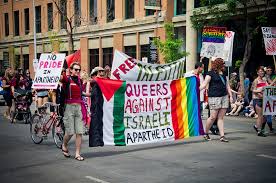
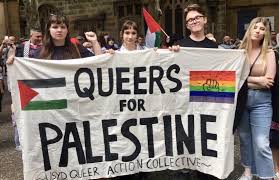
While standing firmly with Hispanic immigrants coming to the United States, the alt-left radicals demand that Jews “go back” to the concentration camps in Poland. As they demand full rights for gay people, they side with Gazans who execute homosexuals.
One such gay Palestinian was Ahmad Abu Murkhiyeh. He was granted asylum in Israel – along with roughly 90 other Palestinian homosexuals – because he correctly feared for his life among Palestinian Arabs. One year before Gazans raped and massacred over 1,000 people in Israel, Palestinian Arabs decapitated Ahmad and dumped his torso on the streets of Hebron. The killers took a video of the murder and shared it on social media, much as they did with the butchering of Israelis one year later.
Ahmad Abu Murkhiyeh, 25, decapitated by Palestinian Arabs because he was gay
There is a sick evil ideology amongst Gazans who want to kill Jews, murder those who sell land to Jews, behead gay people, and stone people who convert from Islam. Yet the alt-left looks away from the Palestinians’ jihadi manifesto and shouts their support for those who despise everything in which they believe.
Well not everything. Palestinians and the alt-left both agree on death to Israel and death to America.
Many commentators about the 2023-4 Hamas-Israeli War quote body counts to not simply frame and update the situation but to drive emotions and policy. While it is true that every civilian death is a tragedy, using statistics distracts from the core problem.
And it’s intentional.
Mainstream media and pro-Palestinian voices use Hamas-fed figures of Gaza’s dead and injured to make the claim that Israel is committing “genocide” and “ethnic cleansing” of the enclave. Pro-Palestinian lawmakers compare the roughly 1,200 people in Israel killed to the much larger number of Gazans. They append the figures of the hundred-plus Israelis held in Gaza with finger-pointing to thousands of prisoners held in Israeli jails.
Yet there is no mention of the qualitative chasm between the perpetrators.
Gazans invaded Israeli homes in the early morning and pulled women in their pajamas outside to be raped and mutilated. Members of Hamas and Palestinian Islamic Jihad burned families alive. They spent hours going house-to-house to butcher and slaughter children and the elderly. Fellow Palestinians celebrate and applaud those actions, and their leaders have promised to commit the atrocities again-and-again.
Meanwhile the Israelis simply want to bring their hostages home and the perpetrators to justice. The Jewish State wants the fighting to end quickly with as few casualties as possible to achieve their aims, while the goal of Palestinian terrorists is the death or expulsion of over 7 million Jews.
And people are deliberately silent about these critical facts when they discuss the war, all in an effort to shield Hamas and its aims to destroy the Jewish State.
Palestinians take back the dead body of an Israeli woman to parade through the cheering streets of Gaza
Rep. Ritchie Torres (D-NY) just spoke about the evil ideology of Hamas at a UN Watch panel and opened (0:53) with a quote from the prosecutor at the Nuremberg Trials saying “‘The wrongs which we seek to condemn and punish are so calculated, so malignant, so devastating, that we cannot tolerate them being ignored, because we cannot survive them being repeated.‘ Those same words should be said about October 7th.”
The number of dead on each side of the conflict has nothing to do with the disproportionate intentions of each side. Knowing this full well, pro-Palestinian activists ignore or deny the barbarism of Gazans and only repeat figures as a way to shield Hamas.
All decent people want the violence to stop but it can only end when Palestinians are freed of their toxic ideology seeking the death of Jews and destruction of the Jewish State.
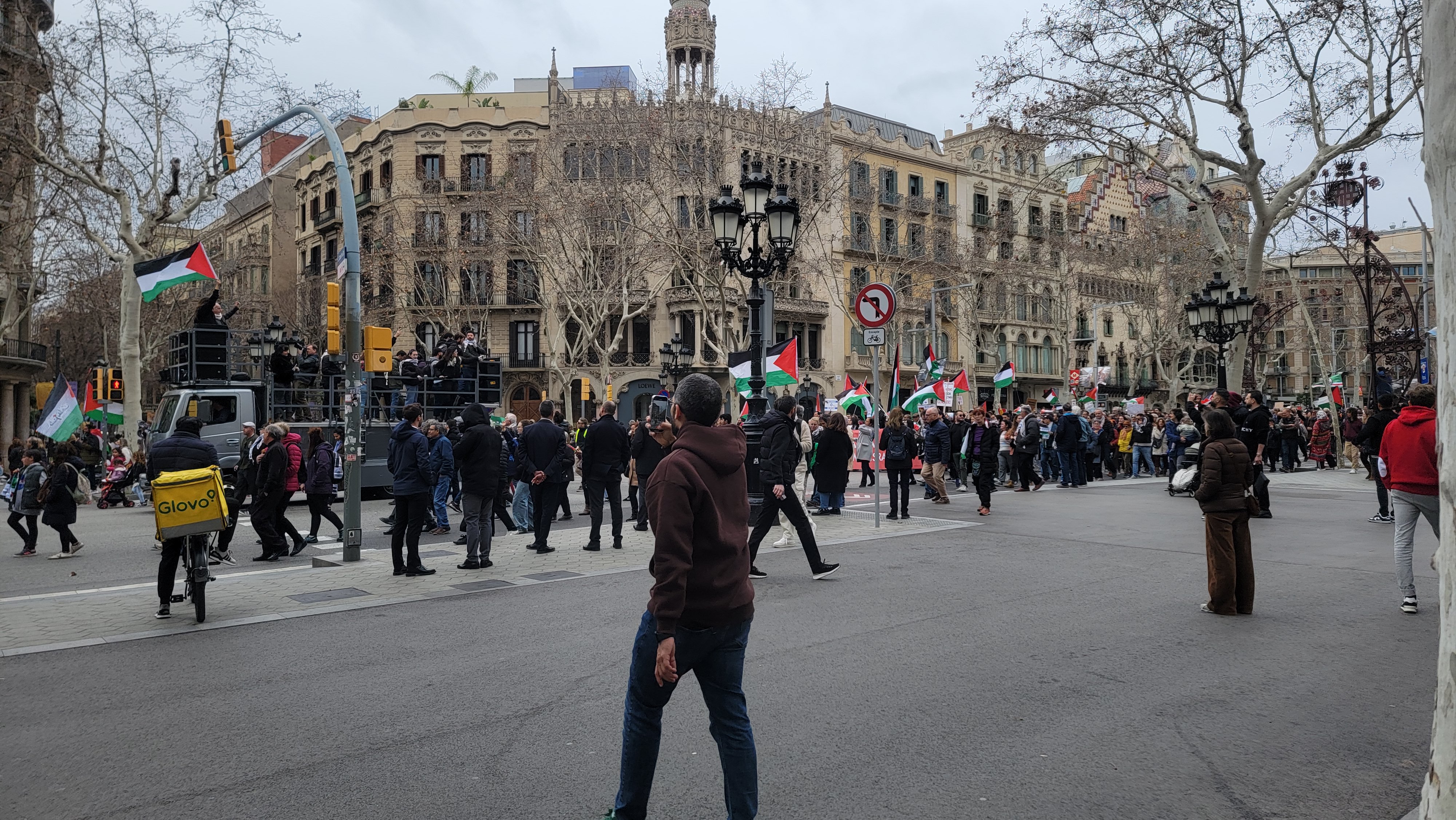
Sunday morning is a time for protests in Barcelona, Spain. Advocates for Peru took their customary spot on top of La Rambla. About ten people listened to a woman yelling into a megaphone.
Just ahead of the small gathering were thirty people protesting Russia’s war on Ukraine. They held placards and then marched together through Catalunya square of people feeding pigeons.
Further ahead were 2,000 people marching with Palestinian flags down the main street of Pg. de Gracia. Led by a ten people wearing kaffiyehs on a truck, they marched with signs calling to “Free Palestine” and “Boycott Israel.”
Thousands marched for Palestinians in Barcelona, Spain on February 25, 2024 (photo: First One Through)
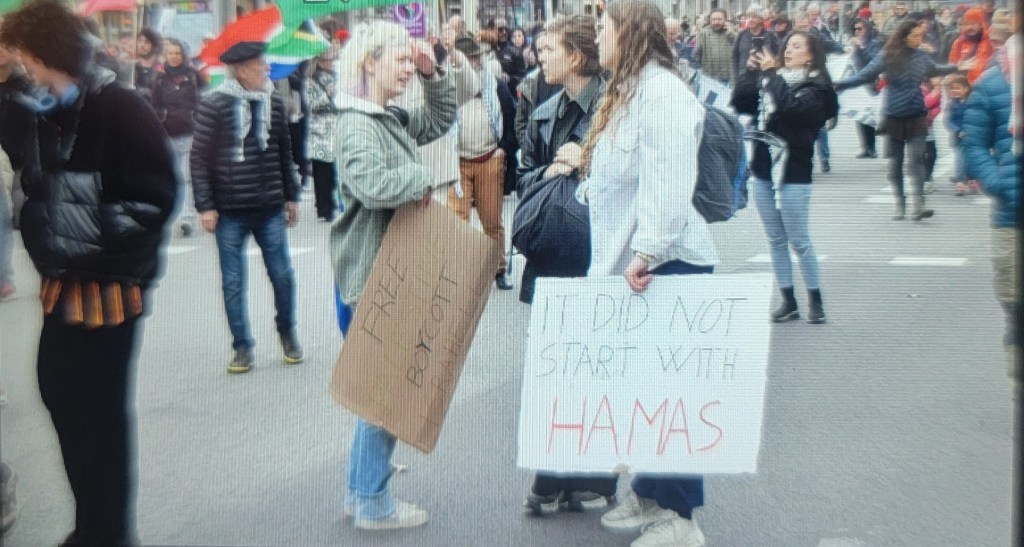
Many of the marchers wore kaffiyehs and held signs “it did not start with Hamas.” They chanted in Spanish about Israeli Prime Minister Benjamin Netanyahu and blamed the United States for “Genocide.”
There were no counter-protestors.
The Jews of Spain have long since been vanquished. Once the greatest center of Jewry in the 1400s, Spain is amongst the dozens of countries which now have fewer than 25,000 Jews. By way of comparison, there are 27 cities in the United States with over 25,000 Jews.
But Muslims have returned to Spain. After the Arab Spring and Syrian Civil War brought thousands of Muslim refugees and immigrants to Europe, many have once again settled in the Iberian peninsula.
Consequently, the street narrative – populated by many local Catholics – was neither nuanced nor balanced. There was no mention of the Israeli hostages or Hamas burning families alive. No demand for the Hamas rapists to face justice. Just for Israel to be replaced “from the River to the Sea.”
Pro Palestinian protestors in Barcelona
Catholic religious fanaticism routed Jews from Europe 500 years ago. Today, Muslim jihadi extremism is attempting to do the same in both Europe and the land of Israel.
There used to be jokes about how to handle one’s racist uncle during the holidays. Now the question is how to deal with a person’s antisemitic niece.
While many older cisgender White men continue to be challenged by the changing nature of America, a large percentage of women aged 18-34 (and under 24 in particular) have a hatred for Jews that would make Nazis blush.
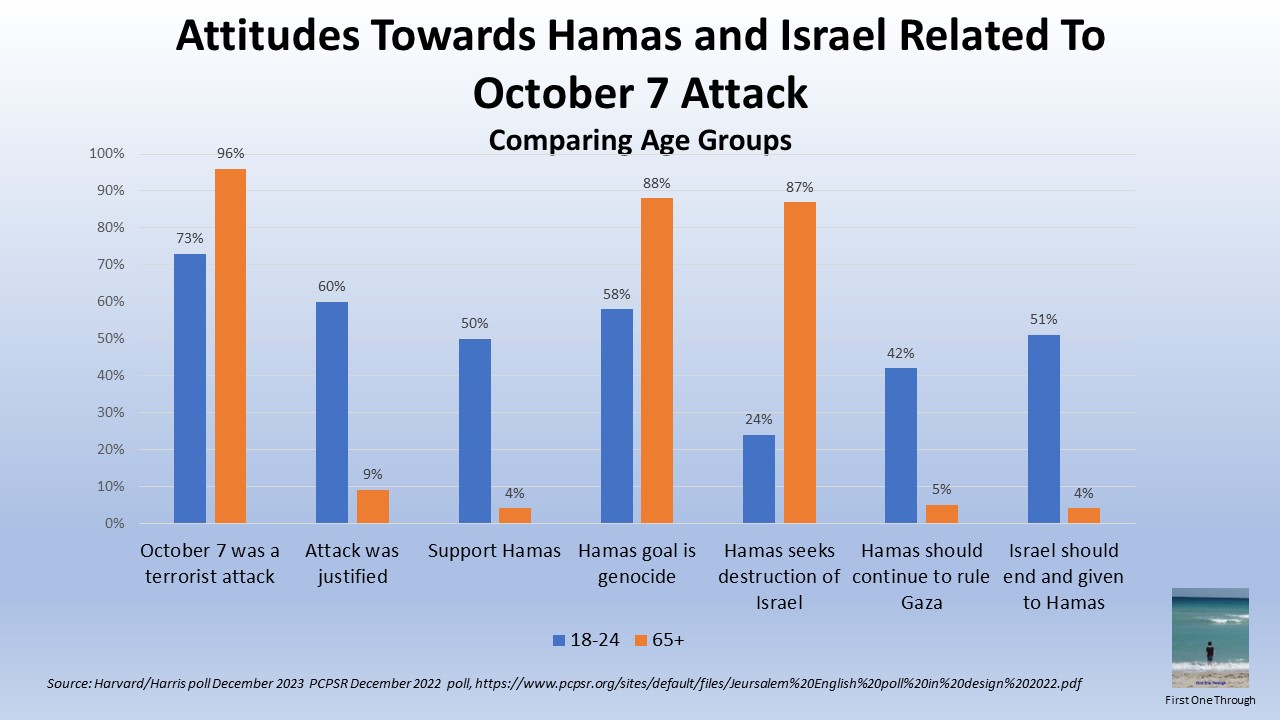
The results from the December Harvard/Harris poll about views of Israel and Hamas segmented by age were shocking. While well over 90% of people over 55 viewed the October 7, 2023 Hamas invasion and slaughter in Israel as an act of terrorism, only slightly more than 70% of the 18-34 cohort believed the killing of 1,200 people to be terrorism. An estimated 90% of people over 55 thought there was no justification for the Hamas attack, but 60% of people 18-24 thought the massacre was justified.
Young people are evenly split on supporting Hamas and Israel, while almost every older person supports Israel. After the October 7 attack, 76% of 18-24 year-olds thought Hamas is a rational actor with whom Israel can negotiate while 87% of those over 65 believe Hamas is dedicated to the destruction of Israel. Consequently, 84% of seniors oppose a ceasefire now that would leave Hamas in place while 67% of the youth think a ceasefire should happen immediately and leave Hamas intact.
In the aftermath of the worst murder of Jews since the Holocaust, a majority of 51% of 18-24 year-olds think Israel should be dissolved and handed to Hamas and the Palestinians. Only 4% of those over 65 hold such views, with 71% preferring two states and 25% supporting Palestinians moving into neighboring Arab countries.
Lastly, the poll touched on gender-related violence. Two-thirds of seniors believe that human rights groups did not adequately condemn the rape of Israeli women, while 80% of those 18-24 thought that women’s rights organizations condemned Hamas sufficiently.
These findings confirm a January 2023 ADL poll which found “Young adults have more anti-Israel sentiment than older generations.”
The age divide is much the same regarding antisemitism in the United States.
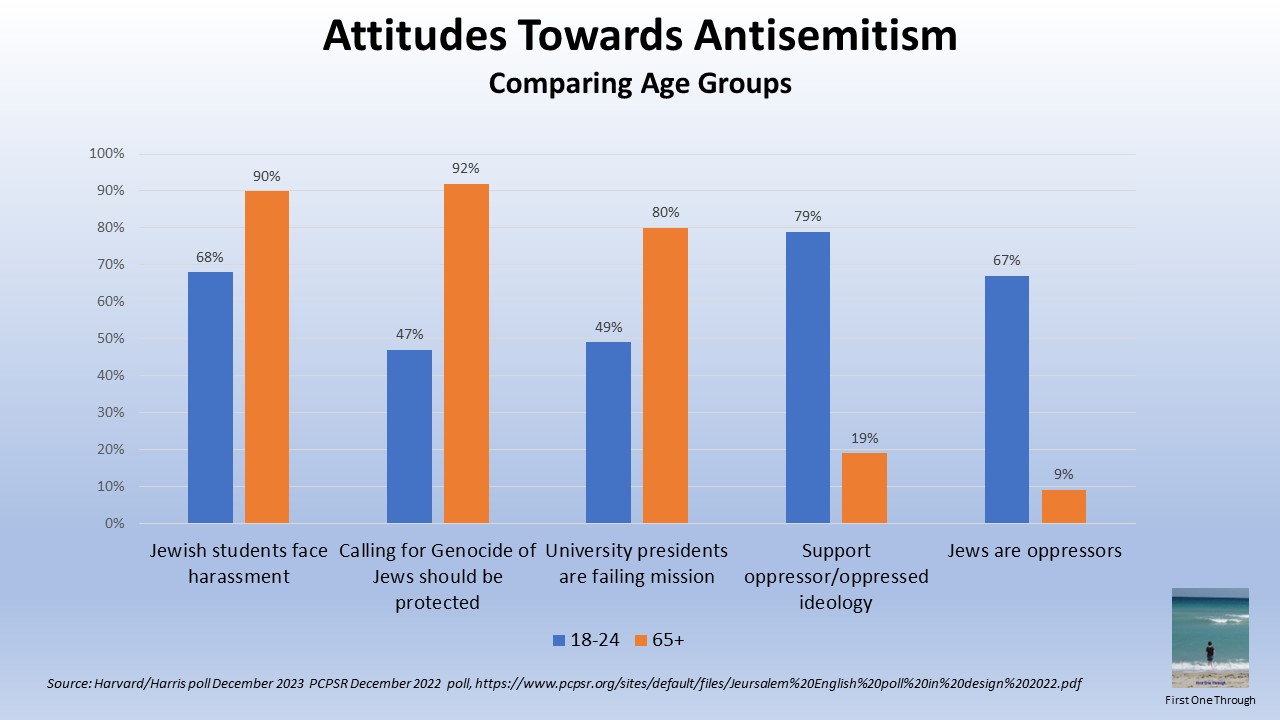
An estimated 90% of people over 65 years old think that Jews face harassment on college campuses which drops to about two-thirds for 18-34 year-olds. Much of that disparity seems to do with whether words constitute harassment, as 92% of people over 65 think that calling for the genocide of Jews should be against university rules, while 53% of people 18-24 think students should be free to call for the genocide of Jews.
In addition to penalizing particular speech, one of the drivers seems to be driven by ideology. Roughly 81% of people over 65 oppose the notion that people should be viewed through the lens of White oppressors and non-White oppressed classes of people, while 79% of 18-24 year-olds support the ideology. Among those over 65, 91% believe that Jews should not fall into the White oppressor class while 67% of 18-24 year-olds believe Jews should be in the oppressor class.
What has driven the enormous disparity of opinions in which young people side with terrorists who slaughter Jews? What drives so many 18 to 24 year-olds to be so anti-Semitic and anti-Zionist?
A few ideas to review including a post-9/11 world, indoctrination in schools, race, social media and human rights groups.
Post-9/11 World
Americans who were adults in 2000 and 2001 can easily remember the terrorist attacks of 9/11 and the continued heinous killing of Israeli Jews by Palestinian Arabs from 2000 to 2004. The clarity about the jihadi extremists perpetrating the disgusting murders was apparent to all, so the support for the United States and Israel responding to the attacks was wide and deep.
For young people who do not remember the attacks but only the consequences – America’s 20-year long war in Afghanistan and Iraq, and the Israeli Security Barrier which was put up to stop the flow of Palestinian Arab terrorists – the cause-and-effect is now inverted. Rather than see the Security Barrier as the effective reaction to jihadi terrorism, it is viewed as an obstacle to coexistence. Rather than appreciate the lack of mass casualty attacks in the U.S. over the past two decades, young people question why America fought wars abroad for so long.
Young people have come to believe that western powers are “imperialist” and wage wars to subjugate others. They have internalize the Iranian narrative of the US and Israel being “big Satan” and “Little Satan”, respectively, aggressively fighting Muslims and people of color for no reason.
When the 2014 Gaza War concluded around the same time as the killing of Michael Brown in Ferguson, MO, the SJP chapters started to align themselves with the Black community in an effort of allyship. It created narratives of “Gaza to Detroit” and “Ferguson to Palestine” as if the two have anything remotely in common.
Muslims claimed it did – and latched onto the oppressor/oppressed narrative which has now become university doctrine over the past decade. Teacher union bosses pushed the notion into lower schools as well, that Jews should be seen as part of the elite “ownership class” who try to keep others down.
Coupled with this incorrect portrayal of American Jews as powerful is the mischaracterization of Israel as a European colonial project. In university departments focused on decolonization, Israel is being cast as a racist state which must be dismantled. There is no subtle debate about Israel/Palestine for young people; they have been taught that Jews are not indigenous to Israel and “stole” Palestinian land.
As toxic ideologies like this inevitably metastasize, the calls to actively be “anti-racist” compelled students to become vocal anti-Zionists. Elective courses on “anti-racism” in California universities soon became mandatory in high schools, infecting the minds of tens of thousands.
While older Americans were spared this indoctrination, many Americans under 30 have been schooled in antisemitism and anti-Zionism.
UN and Human Rights Groups Slander
Universities celebrated when Amnesty International published a report in February 2022 calling Israel an “apartheid” state. It gave credibility to anti-Zionists who had long defamed Israel at will – like The New York Times – using a third party’s definition rather than state personal bias.
The Obama Administration’s last middle finger to Israel as it departed was allowing United Nations Security Council Resolution 2334 to pass which made it illegal for Jews to live east of the 1949 Armistice Lines with Jordan, including in Judaism’s holiest location of the Old City of Jerusalem. While older people may recall that Jews have been a majority of Jerusalem since the 1860s, younger people have grown up where Jews living in Jerusalem is an act of evil colonization.
Racial Overview of Youth
Today’s youth is much more multi-ethnic than older generations.
America’s youth has many more non-White people while older Americans are mostly White. According to Pew Research, the most common age for Whites was 58 in 2019, and a much younger 29 for Asians, 27 for Blacks and 11 for Hispanics.
Among 70 year-olds, there are about 2.5 million White people but not even 1 million non-White people. However, among 20 year-olds, there are roughly 2.3 million White people and only slightly fewer, 2.1 million non-Whites, roughly an even split.
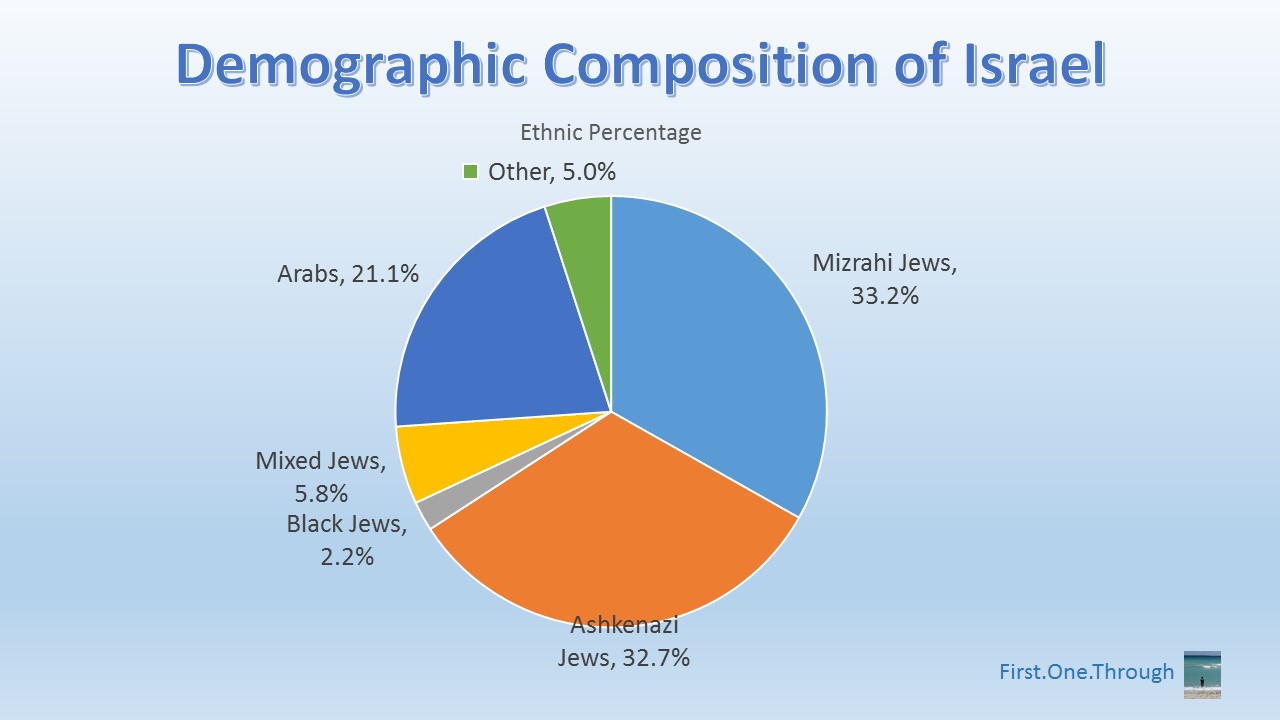
The multi-ethnic youth have come to see their White Jewish peers as part of the “White oppressor” class. They incorrectly assume that Israeli Jews are mostly White, like Israeli Prime Minister Benjamin Netanyahu. In fact, White Ashkenazi Jews make up only one-third of the Israeli population.
Race In Colleges
The race of college students varies by the type of school. Overall, 42.3% of students are White, 17.4% Hispanic, 10.6% Black, 5.8% Asian according to the National Student Clearinghouse Research Center. The figures change dramatically when considering the type of school and degree.
At private, nonprofit four-year universities, 47% of students were white and 33% of students were Black, Indigenous, or People of Color (BIPOC). A similar mix was found at public four-year schools where 46% of students were white, 38% were BIPOC. Shorter associate degrees attracted more minorities, with private two-year schools, 38% of students were white, 44% were BIPOC and public two-year schools, 29% of students were white, 42% were BIPOC.
More people are opting to not attend colleges, viewing them as expensive and not worth the time or investment. White enrollment declined the most from 2018 to 2022, dropping by 17.4%, while Black and Hispanic enrollment declined by 13.6% and 3.6%, respectively. Men are skipping universities in greater numbers than women, with women now accounting for 8.3 million students compared to 6.1 million men.
Despite women and minorities making up a greater share of college students, the professors are still mostly white, with White men making up 39% of all faculty and White women, 35%.
While White people make up a plurality of four-year degree programs, the schools have made very direct actions to change their faculty and curricula. They have implemented DEI (Diversity, Equity and Inclusion) programs, which are getting a lot of attention after the resignation of Harvard’s Black female president who failed to clearly condemn antisemitism at a congressional hearing.
Universities are not simply deploying indoctrinating students in a new socialist ideology compared to past generations; they are preaching to a more muti-ethnic population who are embracing the theology.
Social Media
The socialist antisemitic educational system deserves part of the blame but social media has fostered the toxicity as well.
While smartphones came to the world in 2008, the social media phenomenon on phones really took off from 2010 to 2015. Young people began to rely on news from influencers they followed (think sports stars, models, entertainers) rather than on professional news outlets. Young people fled to these idiots who offered opinions rather than facts, on platforms that pushed engagement via extremism rather than nuanced debate.
People like Kanye West, Kyrie Irving and Bella Hadid have many more people reading their drivel than CNN or the Wall Street Journal, especially young people. The youth get to enjoy the thrill of interacting with their stars rather than sit passively taking in boring news. Instagram became the simplest (fewest words) and most popular social media platform for young people while older Americans barely touched it.
And here also, race plays a part.
According to a May 2020 PRRI report, “young adults (ages 18-29) are notably more likely to use social media frequently than other age groups. Nearly half of young Americans (47%) report using social media sources frequently, compared to one in four (25%) Americans ages 30-49, about one in ten (11%) Americans ages 50-64, and only 3% of senior Americans (ages 65 and older).” It added that “Hispanic Americans (30%) are substantially more likely than white Americans (19%) and black Americans (19%) to be frequent social media user.”
According to Statista, Blacks are as likely as Hispanics to be active on social media, both much more than Whites. Daily use of social media is 46% for Blacks, 44% for Hispanics and only 34% for Whites. The gap in never-users shows the same contrast with only 18% of both Blacks and Hispanics never using social media and 30% of Whites never using it. So while 2.5 times as many Blacks and Hispanics use social media daily compared to never users, the numbers are almost the same for Whites.
So while over 70% of older Americans are White and not active on social media (and more inclined to use Facebook), the younger generation is almost 50/50 White/non-White and active on Instagram.
The Chinese company Tik Tok has a similar pattern. Roughly half of viewers are under 29 years old and 57% of all viewers are female. Almost no one over 55 uses the platform. Further, 80% of the content is made by people under 24 years old.
While the United States has the most viewers, it is followed immediately by Indonesia, Brazil and Russia. Almost all of the countries where the platform has the highest penetration are Muslim countries, including Saudi Arabia, UAE and Kuwait, followed by Thailand, Qatar and Malaysia.
Antisemitism in Young People / Non-Whites
Aggregating this information leads to a real divide among older and younger Americans. Those 65 and over tend to be White, remember 9/11 and the Second Intifada, get their news from newspapers made in western countries and went to work believing in meritocracy. That’s in sharp contrast to Americans 18-24 who are are as likely to be non-White as White; have no recollection of 9/11, just the War on Terror; get their news from social media stars and very young people alongside the Muslim world and Russia; and receive an education that meritocracy is a myth and that they live under the thumb of a White patriarchy which imposes its imperialist whims on the Global South from where many of the youths’ ancestors originated.
Young people don’t comprehend that Jews were active in the 1960s Civil Rights movement and view Jews as part of the White elite. They don’t believe the FBI Hate Crime reports that Jews are the most targeted group of hate crimes, and they hold antisemitic views that Jews and Zionists are deeply racist who only care about money, power and themselves.
Older Americans are relatively homogenous and see a disappointing new generation which hates America and its ally Israel. They watch young people loudly cheering the mass slaughter of Jews in Israel, and call the young socialists and jihadists out as antisemites. For their part, the young see the older generation as impossibly out-of-touch White racists, unwilling to let the multi-ethnic future take the reigns of power.
Jews know math and their impossibly small numbers, and turn to the government and cling to law enforcement to protect them from the percolating tidal wave of hate.
After the heinous butchering, raping and slaughtering of 1,200 people in Israel, the UN Secretary General Antonio Guterres did not call for Hamas to be brought to justice nor did he lambast Muslim extremism. Instead, he called for Israel to use “maximum restraint” against the killers. It seemed bizarre to excuse mass terrorism but the rationale soon became clear.
Just last week, UN Under-Secretary-General for Humanitarian Affairs and Emergency Relief Coordinator Martin Griffiths was more explicit about excusing Hamas’s atrocities and said “Hamas is not a terrorist group for us, of course, as you know. It’s a political movement.”
The UN is correct at some level: Hamas is a popular Palestinian political party which was elected to 58% of the Palestinian parliament in 2006. It has had complete rule over Gaza since 2007. So it is indeed a political group. It is also a terrorist group and a deeply antisemitic group, but the UN refuses to acknowledge those two plain facts.
That is because the United Nations has long tried to distance the idea of “terrorism” and “Islamic extremism,” which are both at the heart of Hamas’s evil ideology.
On March 17, 2016, the then-United Nations Secretary General Ban Ki Moon addressed the UN Human Rights Council about a “Plan of Action to Prevent Violent Extremism.” At the event, the then-UN Deputy High Commissioner for Human Rights Kate Gilmore said that “selective application of the term “violent extremism” only to Muslim believers reinforces intolerance and discrimination.”
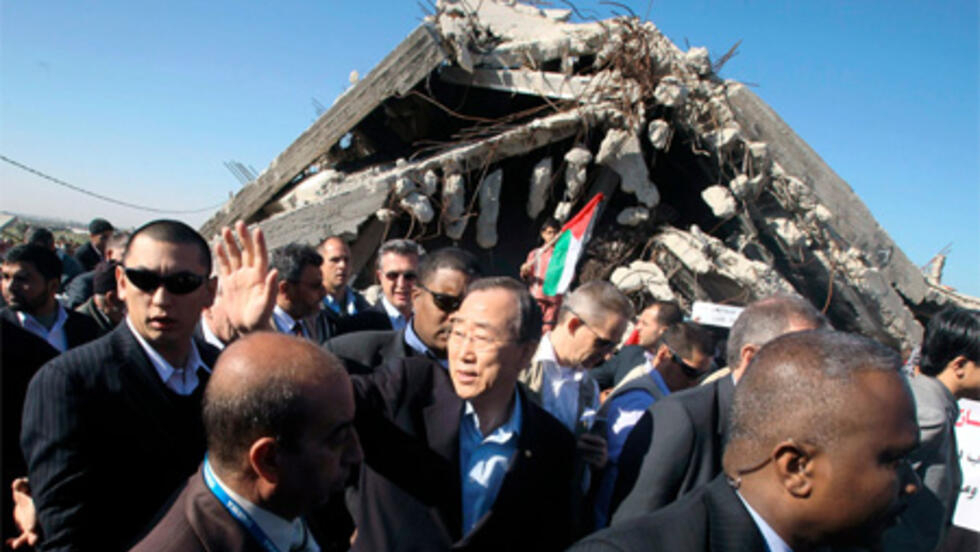
UN Secretary General visits Gaza in 2010, even though the region was not a UN member state, and it was ruled by Hamas, a terrorist Group (Photo: Reuters)
At least in regards to Islamic extremists. The media and United Nations talk about “Israeli settler extremism” and “right-wing Israeli government,” all of the time but whitewash the brutal attacks committed by Islamic fanatics.
US Politicians And NGOs
Aggravating this horrible situation, people attempt to smear people discussing terrorism and vicious antisemitism of jihadi radicals, as “Islamophobes.” Rep. Ilhan Omar made several comments which were widely viewed as antisemitic in her first weeks in office and then inverted the perpetrator-and-victim saying, “what I am fearful of is that because [Rep.] Rashida [Tlaib] and I are Muslim, that a lot of Jewish colleagues, a lot of our Jewish constituents, a lot of our allies, go to thinking that everything we say about Israel, to be anti-Semitic, because we are Muslim.”
Years later in 2024, when Congress passed a resolution condemning Hamas’s mass raping and mutilation of Jewish women, Rep. Tlaib refused to join civilized society and simply voted ‘present.’ The sadism of the emasculated Palestinian men was absolved by a sitting elected American official.
Tlaib’s sponsors like the DSA say much the same. The Democratic Socialists of America said that every Israeli Jew is fair game for annihilation by “resistance groups” in the months before the October 7 massacre. CAIR’s Zahara Billoo clearly called all Jews are the “enemy.” The “Mapping Project” in Massachusetts created by proponents of boycotting Israel, tried to make the targeting of Jews easy by providing names and addresses of Jewish organizations.
Notorious antisemite Rep. Rashida Tlaib being embraced by censured Rep. Jamaal Bowman (photo: AP)
The Arts and Media
The art world found its muse in Palestinian jihadists.
John Adams composed an opera called “The Death of Klinghoffer,” with arias about Palestinian terrorists who killed an elderly wheelchair-bound American Jew and threw him off a ship. The New York Times said the Metropolitan Opera’s general manager, Peter Gelb, said that the composer “John Adams said that in composing ‘The Death of Klinghoffer’ he tried to understand the hijackers and their motivations, and to look for humanity in the terrorists.” The Times went on to call the opera a “masterpiece.”
The media world’s empathy and shield for non-Palestinian jihadists extends to those who murder Jews around the world.
In 2008, ten Pakistani men from the Lashkar-e-Tayyiba terrorist group entered Mumbai, India and started slaughtering people. After killing dozens of people at a train station and luxury hotel, the terrorists descended on a small Jewish community center run by a Chabad rabbi. The terrorists killed the rabbi and his pregnant wife along with others at the facility. At no point in the storyline did CNN convey that the Pakistani men were Muslim and that they belonged to a radical jihadi group.
In 2015, four radical Muslim men killed people at the publishing offices of the magazine Charlie Hebdo in Paris, France, and then entered a kosher supermarket to kill more Jews. While CNN mentioned that the terrorists were upset at Charlie Hebdo for printing a picture of the Islamic prophet Mohammed, it never wrote that the killers were jihadi extremists.
The problem is not limited to The New York Times and CNN. Reuters avoids calling Hamas a terrorist group in its articles while comfortably doing so for other terrorist organizations.
The jihadists and socialists have already entered the final phase of their war against the Jews. The Four Step Battle Plan started with 1) Denying the Enemy Rights and Legitimacy; 2) Gathering Masses to the Cause; 3) Removing the Enemy’s Defenses; and 4) Assembling the Armies for the Battle. They are now bringing the world into phase 2 at the International Court of Justice, to advance quickly to phase 3, to abandon the Jewish State and global Jewry.
When the United Nations says aloud what radical socialists and jihadists have argued for years, that Hamas is not an antisemitic jihadi terrorist group but a legitimate political actor, it is time to ring the alarm bells. Global “legitimate” actors are now backing Hamas and its supporters who attack Jews around the world, smearing Jews as supporters of an apartheid, colonizing Zionist regime, consequently not victims but fair targets for assault.
People are trying to figure out what to do with UNRWA, the troubled United Nations Relief and Works Agency for Palestine Refugees. The organization has long perpetuated the Arab-Israeli conflict, fomenting hatred for Jews in its schools, and promising millions of Arabs that their future is in Israeli towns and villages where grandparents who had wished for the destruction of the Jewish State once lived.
The temporary agency is funded by voluntary contributions from UN member states, so can be dissolved very quickly, as was always intended. The issue at the moment is that the hospitals and schools still need to operate, with or without the existence of UNRWA. The five regions where UNRWA operates – Gaza, the West Bank, Jordan, Syria and Lebanon – all have different dynamics, politics and infrastructure, and the future will be different for each.
The best solution is for UNRWA to be dissolved and its personnel and infrastructure to be handed to proper authorities: operations in Lebanon and Syria would shift to the UNHCR, the UN Refugee agency; Jordanian operations to the government of Jordan; and operations in the West Bank and Gaza to the Palestinian Authority, in a staged process.
Syria and Lebanon to UNHCR
There are approximately 581,000 descendants of 1948 Palestinian Arabs in Syria being cared for by UNRWA in 2022, and another 93,000 people for whom the agency also gives free services. The numbers are 487,000 and 70,000 in Lebanon for refugee descendants and other wards, respectively. All of them have been denied citizenship by their host countries.
These people and the associated infrastructure should be handed over immediately to UNHCR which cares for over 89 million people as of 2022. UNHCR would try to settle the 1.23 million people either in those host countries or find them citizenship elsewhere, just as it does with millions of other stateless people.
Jordan
Jordan was part of the original Palestine Mandate of 1922, and England separated the land east of the Jordan River to become a new country known as Transjordan in 1923. After Transjordan attacked Israel at its founding and illegally seized the eastern part of what remained of Palestine, it illegally annexed that land and renamed itself “Jordan.” It ethnically cleansed all Jews from the region, including eastern Jerusalem, and granted citizenship to everyone in 1954, as they long as they weren’t Jewish (Nationality Law Article 3).
Not surprisingly with such deep history with the land “between the River and the Sea,” roughly half of Jordan is “Palestinian”, approximately 2.6 million people including Queen Rania. These “UNRWA refugees” in Jordan have Jordanian citizenship and have zero need to collect global charity under the false notion that they are stateless and lack self-determination.
The schools and hospitals should be transferred to the government of Jordan’s control immediately. Some countries may want to continue to voluntarily contribute to the Jordanian king for some time to help absorb the hit to the country’s budget, and then slowly wean the king from the global money teat.
West Bank to the Palestinian Authority
Palestinians declared a state in 1988, and most non-western countries have recognized its independence. It is ruled by the Palestinian Authority, which elected a president from the Fatah Party in 2005 and a parliament in 2006 with a majority from Hamas.
The PA operates from the West Bank city of Ramallah and has responsibility for the vast majority of Palestinian Arabs living in the West Bank. The Authority is viewed as weak and corrupt by Palestinians and others. It supplies money to terrorists and their families in a program alternatively called a Martyrs’ Fund / Pay-to-Slay program, which is popular amongst Palestinians and detested by civil societies for directly supporting terror. The PA has failed on all fronts, not being able to show the ability to govern internally nor to advance a future of coexistence with the Jewish State.
Alas, it’s much better than the alternative Hamas which has ruled in Gaza since 2007 when it seized control of the region from the PA. Perhaps with greater focus on good governance with western oversight, the PA can be reformed.
Handing the 96 schools and 43 health facilities operating in the West Bank to the PA should happen immediately. Funding for the operations should cover only six to nine months and a cohort of countries led by the United States, which is UNRWA’s principle benefactor, should use the time to stabilize the transition. That includes ensuring that no hatred for Jews or teaching about the destruction of Israel is found anywhere in the facilities or educational materials.
Continued funding for the schools and hospitals after the initial transition period should be captured under the United States Taylor Force Act. Just as the PA is denied getting any US monies as long as it pays terrorist salaries in the Pay-to-Slay program, it would also lose funding that used to come through UNRWA for the schools and hospitals. The historic backdoor circumventing American laws would be sealed closed, and the US and PA would need to work together to ensure that supporting terrorism comes to a definitive end for any monetary support to come to the PA.
Gaza, At Some Point, to the Palestinian Authority
While UNRWA’s West Bank operations should move to the PA immediately, UNRWA in Gaza is a different story. Not only must the PA prove it can absorb the many facilities and cleanse them of their toxic hatred, the PA will be tested as to whether it can take control of Gaza after 17 years of Hamas rule.
Hamas’s complete rule of Gaza since 2007 brought the region complete destruction. It focused all of its energies on building a war infrastructure to destroy the Jewish State next door, rather than build a functioning economy and society. It left the schools and hospitals for the world to fund and run, so cared little about letting them get destroyed while its leaders hid like cowards underground.
Neither Hamas nor the PA can take over the rebuilding of the schools and health care facilities. Over the next several years, another global cohort, perhaps similar to the one easing the UNRWA transition in the West Bank, should be tasked with building institutions anew. Basic humanitarian values and rights must be incorporated into the very foundations to chart a path for a future when the PA may be able to take over Gaza as well as the new former-UNRWA infrastructure.
UNRWA camp with a keyhole and key on top symbolizing the false promise that through UNRWA, Palestinian Arabs will get to move into homes in Israel
These actions, if properly executed, should empower and moderate a new Palestinian Authority which can take over Gaza at some point, and ultimately negotiate peace with Israel.
There is a fantastic idea that has been floated around the Middle East for many decades: two states for two peoples, one Jewish and the other Arab. Even though the notion continues to be bantered in political circles, few details are understood about what that plan means.
The pro-Palestinian camp talks about “THE” two state solution, meaning the Arab Peace Initiative proposed in 2002. The United States and other governments talk about “A” two state solution, which could mean a wide variety of negotiated outcomes. The United Nations has a third alternative, which is the most toxic and has directly led to permanent hostilities between Israel and its neighbors.
“THE” 2 State Solution: Arab Peace Initiative
There are three primary matters which stand between Israel and the Palestinian Authority: land/borders; capital city; and the future of Palestinian refugees.
Land: The API calls for Israel to withdraw from ALL territories taken in its defensive war of June 1967. This would include Gaza, the West Bank, the Sinai, Golan Heights, and areas of southern Lebanon still under dispute. Israel has already withdrawn from some of those lands including Sinai, Gaza and many areas of the West Bank. The API seeks the remainder.
Capital: The API calls for East Jerusalem to be the capital of a new Palestine. An early draft of the API called for “al-Quds al-Sharif as its capital,” seemingly softening the stance to something Israel could accept.
Refugees: The API states that Palestinian Arabs outside of Israel will seemingly not move to the Jewish State. The final language of “Assures the rejection of all forms of Palestinian patriation which conflict with the special circumstances of the Arab host countries,” may only be in reference to UNRWA Palestinians in Lebanon, Syria and Jordan whom the API thinks should not have to settle them. The API language was in sharp contrast to an earlier version which stated “To accept to find an agreed, just solution to the problem of Palestinian refugees in conformity with Resolution 194,” which would have given Palestinians wishing to live in peace with Israel the option of either moving there or getting compensation.
“A” Two State Solution
The United States and Israel see the end of the conflict differently. Through the Madrid Conference and Oslo Accords, as well as other efforts made by the Obama Administration in 2014 and the Trump Administration’s “Deal of the Century,” the three major matters had different contours.
Land: Israel believes that it has already given back some of the territory it took in June 1967. It returned the Sinai Peninsula to Egypt and handed Gaza and major population centers in the West Bank to the Palestinian Authority. UN Resolution 242 (1967) called for “withdrawal of Israel armed forces from territories occupied in the recent conflict” which does not call for ALL territory to be abandoned.
The United States agrees. The Obama Administration tried to broker a series of land swaps which would have essentially given Palestinians a state on the same amount of land but in different locations than came about from the 1949 Armistice Lines (49AL). The Trump Administration started with the same concept that the 49AL were arbitrary and not conducive to long-term peace and that Israel has already complied with the land provision of Res. 242. Team Trump did not try to match a certain number of square kilometers with history, and instead sought to create borders which accounted for current reality on the ground and a dynamic to forge an enduring peace.
Capital: Israel annexed the section of Jerusalem that was divided for nineteen years between 1949 and 1967, and further extended the municipal boundaries. It considers the city its eternal capital, but has offered sections of the city to be part of a Palestinian State as part of the peace efforts, with American prodding.
Refugees: Israel has offered some limited number of Palestinian Arabs to move to Israel. The figures have ranged from 10,000 to 100,000 over time under different plans. The US position has long been that Palestinian Arabs should move to the new Arab State, as the basic principle of two states for two people.
The United Nations’ Two State Solution
The UN’s plan is the most aggressively pro-Palestinian of the three.
The UN agrees with the API regarding a new Palestinian State on all of the land in Gaza and the West Bank being part of Palestine, as well as East Jerusalem being the capital of the country. However, it continues to insist on the full “right of return” for six million “Palestine Refugees” who are registered with UNRWA in Gaza, the West Bank, Jordan, Syria and Lebanon.
The UN’s promise to Palestine Refugees has caused them to be frustrated by the failure to move to neighborhoods where grandparents used to live. It has led them to build terrorist tunnels to penetrate the land which the UN promises to them, rather than build an economy. It has kept them in a restive state for generations, not accepting the existence of the “Zionist entity” which they believe will soon cease to exist according to recent polls.
The United Nations’ adoption of Palestinians as their perennial wards has harmed peace in the region. It has a position on refugees which it knows Israel cannot accept, deliberately putting the Jewish State as the obstacle to peace rather than a counterparty with whom to find a solution. Permanently putting Israel on the defensive with one-sided resolutions makes Israel unwilling to seriously consider the UN on any matter.
It is destructive to any peace process for the United Nations to call for a “two-state solution” without clearly articulating that there is no “right of return” to Israel. The death toll in the region will certainly rise while Palestinian Arabs believe their future is in Israeli homes.