Names and Narrative: “Palestinians” versus Palestinian Arabs / Israeli Arabs

History and politics can sometimes be analyzed on the usage of language as much as policy. The Names and Narrative series reviews how language oftentimes changes the nature of the narrative in the Israel-Arab conflict.

Nouns and the Range of Adjectives

An important component in considering language is the distinction between nouns and adjectives.  A noun is the key element of English sentences.  The noun is the focus of language; the item that commits actions.  In comparison, an adjective is the modifier of the noun, that helps describe the noun more explicitly.

But not all adjectives are the same. In some cases, adjectives can become nouns themselves.

Consider a simple noun like “table.” Describing a “wooden table” would give more context to the table, differentiating it from other tables like a glass table.  As such, “wooden” would be an adjective.  However, it is an adjective that is factual and embedded in the noun “wooden table.”  The two words cannot be separated – the table is, and always will be, made of wood.  I call this an “embedded adjective.”

Compare this to other adjectives for the table.  The table may be a “painted wooden table,” or “a rectangular wooden table.”  In these examples, “painted” and “rectangular” are also adjectives that describe the wooden table.  But these adjectives are not forever tied to the table.  The table could be stripped, and become unpainted.  It could be cut and become a square.  These adjectives are therefore not embedded in the noun, but a semi-permanent description of the noun.

There are also adjectives that are based on a relative position. Consider a “long table” or a “high table.”  A table could be viewed as long or high only relative to something else.  Describing a table in such fashion brings a person’s vantage point into the description.  These are “relative adjectives.”

Lastly there are adjectives that relay a person’s preferences. A “pretty table” conveys the author’s own sense of beauty.  The table itself is not inherently pretty- it is simply an opinion of a single person.  This “subjective adjective” is the polar opposite of an embedded adjective.

Consider the use of adjectives – embedded, relative and subjective – as they relate to the Israeli-Arab conflict in a single expression: Palestinian Arabs.

From Many Palestinians to Exclusively Palestinian (Arabs)

The Holy Land was renamed “Palestine” roughly 2000 years ago by the Romans who defeated the Jewish kingdom. The name stuck even when the Romans departed hundreds of years later.  Arabs from the Arabian Peninsula took over the region when they came as part of the Muslim invasion in the 7th century.  The Ottomans (Muslims, but not Arabs) also kept the name Palestine when they controlled the region as part of their empire for 400 years which ended at World War I.

There were many people that lived in the region during this time. They referred to themselves as Palestinian Arabs or Palestinian Jews or Palestinian Christians.  There was no consideration that “Palestinian” meant only one particular type of person, and “Palestinian” was a subjective adjective (people used it for themselves) and relative adjective (they lived in Palestine and not somewhere else).

That changed during the 20th century.

As world powers that defeated the Ottoman Empire considered breaking the empire into distinct countries (which were to become countries known today as Iraq, Syria and others), they looked to facilitate the reestablishment of the Jewish homeland in Palestine. They developed international laws in 1920 and 1922 known as the San Remo Agreement and the Mandate of Palestine, respectively, which sought to facilitate additional Jewish emigration to Palestine, an area which today covers Israel, Gaza, the “West Bank” and Jordan.

That did not make the local Arabs happy.

The British quickly divided Palestine into two parts, giving the area east of the Jordan River to the Hashemite family in what became the state of Transjordan. Arabs in remaining part of Palestine rioted against the Jews throughout the 1920s and 1930s.  By the end of the 1930s, the Arabs had effectively convinced the British who administered the Mandate of Palestine to stem the tide of Jewish emigration, and make entire sections of Palestine Jew-free (in edicts known as the White Papers).

When the British ended their administration of the Palestine Mandate in 1948, Jews declared an independent state of Israel. Five Arab countries invaded the nascent state, with a war that ended in 1949.  By war’s end, the area known as Palestine was split yet again, with the western half becoming Israel and the eastern half becoming the illegally annexed “West Bank” of TransJordan.  Gaza was taken over by Egypt.  Palestine was no more.

The Jordanians expelled all the Jews from their newly conquered territory.  They granted Jordanian citizenship to all Arabs living east of the 1949 Armistice Lines.  Their citizenship laws clearly and explicitly EXCLUDED Jews from obtaining Jordanian citizenship.

Some of the Arabs in the West Bank who were granted Jordanian citizenship were not happy with the Jordanian arrangement. They preferred their own autonomy and country and not to be part of Jordan.  As such, in 1964, the Palestinian Liberation Organization (PLO) was created.  Its goal was a new Arab country in all land west of the Jordan River – in Gaza, the West Bank and Israel.  They sought to destroy Israel and replace it with a new state of Palestine.  As they did so, they created new definitions for Palestine and a Palestinian in the PLO Charter:

At first, the charter continued to use the historic formula of noun and adjective of “Palestinian Arab.” Each of the charters preambles began with “We, the Palestinian Arab people.”  However, the charter then went on to describe the land as inherently “Arab” with ties to the rest of the Arab world:

Palestine is an Arab homeland bound by strong national ties to the rest of the Arab Countries and which together form the large Arab homeland.” (Article 1)

That statement stripped the land from non-Arabs that lived and ruled in the territory for thousands of years. It turned the physical ground into “Arab land,” a subjective adjective. The Arabs think of the land as Arab.  However, that terminology became incorporated into the left-wing media’s dictionary as an embedded adjective, as if the land were really inherently Arab (further described in “Nicholas Kristof’s ‘Arab Land’.)

The PLO Charter continued to extend the argument that only Palestinian Arabs have rights to “Arab land”:

“The Palestinian Arab people has the legitimate right to its homeland and is an inseparable part of the Arab Nation. It shares the sufferings and aspirations of the Arab Nation and its struggle for freedom, sovereignty, progress and unity.” (Article 3)

After declaring that the land was inherently Arab and the Palestinian Arabs were the logical possessors of the Arab land, the charter took the next step of defining a “Palestinian” in a new manner:

The Palestinians are those Arab citizens who were living normally in Palestine up to 1947, whether they remained or were expelled. Every child who was born to a Palestinian parent after this date whether in Palestine or outside is a Palestinian.” (Article 6)

From this date, a new term of “Palestinian” was created to refer exclusively to Arabs.

The PLO did make a provision that some Jews could be “considered” Palestinian (as opposed to actually being Palestinian) in a further affront as stated in their modified 1968 PLO Charter:

“The Jews who had normally resided in Palestine until the beginning of the Zionist invasion will be considered Palestinians.” (Article 6)

Did the Palestinian Arabs claim that the “Zionist invasion” (of “Arab Land”!) began in the 1880s with the first aliyah? In 1917 with the Balfour Declaration? In 1948 with the declaration of Israeli independence? The Palestinian Arabs certainly didn’t think it was 3700 years ago when Jews moved into the region and formed several kingdoms. Of course they wouldn’t allow their descendants (the Jewish people) to be considered Palestinian too.

When the Jordanians (as well as Palestinian Arabs who were granted Jordanian citizenship) attacked Israel again in 1967 and lost the “West Bank” which they had illegally annexed, the Palestinian Arabs witnessed yet more of their “Arab land” fall under non-Arab control, and the war of land and language intensified.

Names and Narrative:
Palestinians versus Palestinian Arabs and Israeli Arabs

In the politics of language, the debate of using “Palestinians,” “Palestinian Arabs,” and “Israeli Arabs” has become a debate over narratives.

Adalah, an organization established in 1996 that seeks to dismantle the Jewish State, feels strongly about using the PLO’s definition of “Palestinian” and objects to calling them “Palestinian Arabs” or “Israeli Arabs” if they are citizens of Israel.

Consider Adalah’s opening in ther “Inequality Report” of what it considers the racist state of Israel:

Palestinian citizens of the state [of Israel] comprise 20% of the total population, numbering almost 1.2 million people. They remained in their homeland following the establishment of the State of Israel in 1948, becoming an involuntary minority.”

This formula of “Palestinian citizens of Israel,” rejects the notion of “Israeli Arab.” As such, Adalah seeks to deny the standard adjective-noun term, as much as they reject the historic usage of “Palestinian Arab” and “Palestinian Jew.”

This anti-Jewish State organization does this as a matter of principle.

Subjective adjectives can be parsed and separated. A “Palestinian Arab” both means that there are non-Arab Palestinians, and Arabs that are not Palestinians.

Land = People: As noted above, the PLO sought to declare that all Palestinians are Arabs.  “Palestinian” and “Arab” are inseparable terms, now morphed into the exclusively Arab “Palestinians.”  Stating that the land’s people are only Arab, denies both the history and rights of Jews in the land.

People = Land: Just as important to many anti-Zionists, if the two terms of “Palestinian” and “Arab” are used, they can be separated.  That suggests that the people can be separated from the land.  Does a Jordanian Arab that moves to Egypt stay a Jordanian Arab for generations, or do those descendants eventually become Egyptian?  The Palestinian Arabs produced a bizarre definition that demands that “Palestinians” – regardless of where they have lived for generations – be permanently referred to as Palestinians.

(This absurdity is compounded by the fact that more Arabs than Jews moved to the holy land under the British administration of 1922 to 1948. How do Iraqi Arabs that moved to Haifa in 1930 – and all of their descendants, regardless of their citizenship – become “Palestinians” forever, while a Jew who came from Russia at the same time becomes only a semi-permanent Israeli Jew, only while he lives there.)

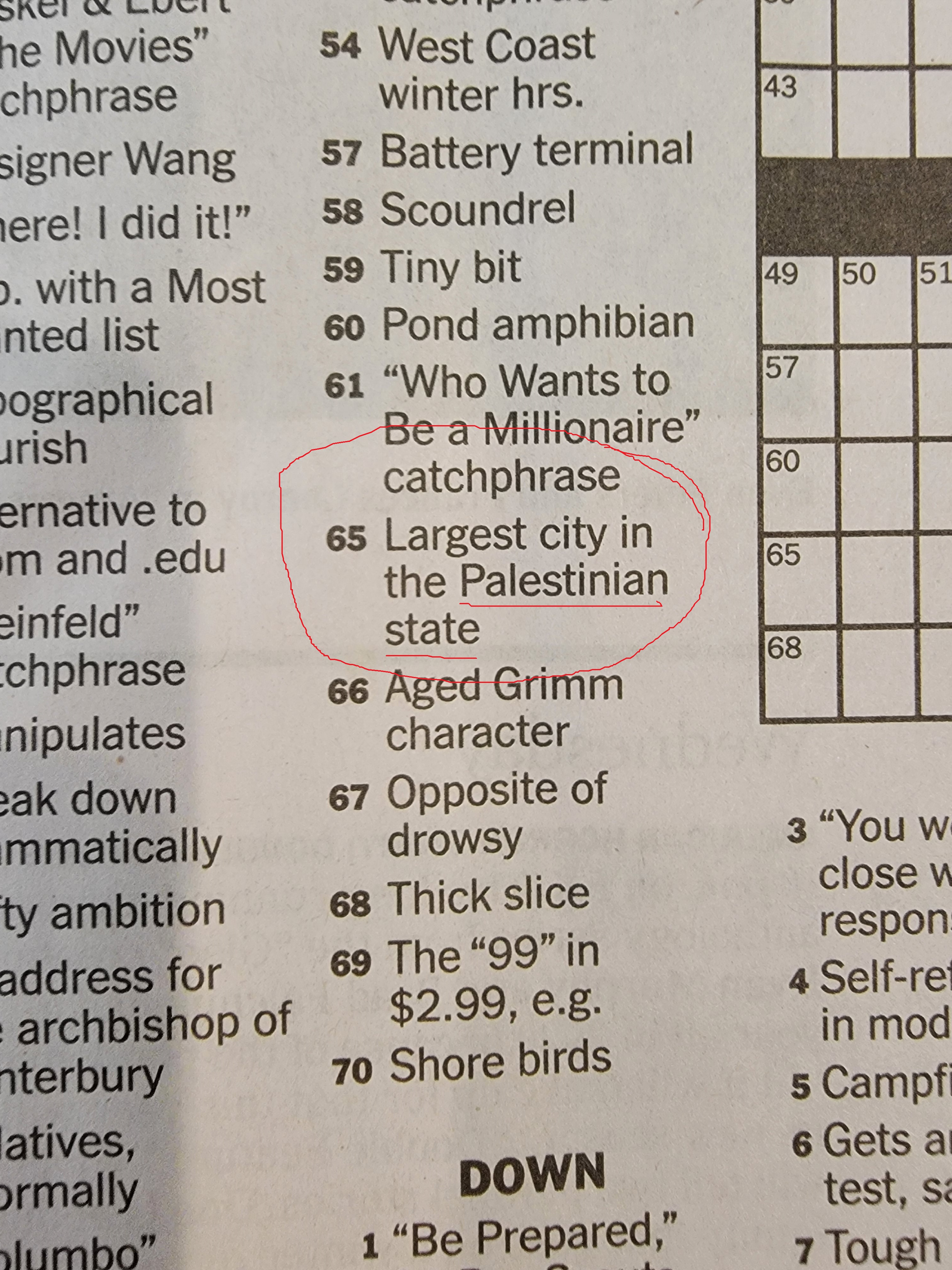
Further, as there is no country called Palestine at this time, what does a “Palestinian citizen of Israel” mean? That Israel is simply in a de facto state of existence and the Arabs have citizenship of that entity, but that Israel is occupying the underlying true state of Palestine?  Or that only Palestinians are truly part of the fabric of the land itself?

dsc_0881
Israeli Arab farmers in the Galilee
(photo: First.One.Through)

Pro-Zionists should never use the term “Palestinians”

As detailed above, the pro-Israel community should always use the terms “Palestinian Arab” (or stateless Arabs until if/when a new state of Palestine is created), or “Israeli Arabs” and reject using “Palestinians” as it furthers a flawed and anti-Zionist narrative.

Using “Palestine” and “Palestinians”:

  • Rejects the 3700-year history of Jews in the holy land
  • Declares that the land is inherently “Arab”
  • Argues that the Jewish State is simply in a de facto existence, while the underlying Arab nature of the land is permanent
  • It facilitates removing the Jewish , Zionist “invaders” from EGL (east of the Green Line)/ West Bank in the near-term, and from Israel in the longer-term.

“Israeli Arab” and “Israeli Jew” are relative and subjective terms, similar to “Palestinian Arab.” Do not get caught in the trap of pretending that a “Palestinian” is an embedded term, in which the holy land is Arab, nor those Arabs are permanently Palestinian.


Related First.One.Through articles:

Names and Narrative: Palestinian Territories/ Israeli Territories

Names and Narrative: The West Bank / Judea and Samaria

Names and Narrative: Genocide / Intifada

Names and Narrative: CNN’s Temple Mount/ Al Aqsa Complex Inversion

New York Times Lies about the Gentleness of Zionism

Elie Wiesel on Words

Subscribe YouTube channel: FirstOneThrough

Join Facebook group: FirstOne Through  Israel Analysis


The Illogic of Land Swaps

The argument that using the “1967 lines” as the basis for the borders of Israel and Palestine in a two-state solution is flawed at the outset.  “Land swaps” simply underscore that absurdity of the argument.

Obama on Israel-Palestine Borders

In May 2011, US President Barack Obama shared his thoughts on the contours of the ultimate borders of Israel and Palestine in a two-state solution: “We believe the borders of Israel and Palestine should be based on the 1967 lines with mutually agreed swaps, so that secure and recognized borders are established for both states.

The comment infuriated Israeli Prime Minister Benjamin Netanyahu and pro-Israel advocates. Obama clarified his comments before a pro-Israel group a few days later: “By definition, it means that the parties themselves, Israelis and Palestinians will negotiate a border that is different than the one that existed on June 4, 1967… it allows the parties themselves to account for the changes that have taken place over the last 44 years…. Including the new demographic realities on the ground, and the needs of both sides.”

Obama’s second statement moved away from his comments about “1967 lines.” By stating that the border would be arrived at through mutual negotiations and look “different than the one that existed on June 4, 1967,” Obama made the comment about the 1967 lines moot.  If the parties agree to an entirely new construct for borders, than that would be acceptable too.  There is no reason to even mention the “1967 lines” or land swaps.

obama aipac
President Barack Obama at AIPAC May 2011

But the left-wing group J Street was much more aggressive than Obama on the contours of Israel, and lobbied the US government about the 1967 lines and land swaps.

J Street on Israel-Palestine Borders

J Street clearly calls for a two-state solution to be based on the 1967 lines with land swaps as detailed on its site: “This border will be based on the pre-1967 Green Line, with equivalent swaps of land…  land of equivalent quantity and quality will be swapped from within the pre-1967 Green Line.

The group also urged the US government and Jewish groups to strongly condemn any Jews living east of the Green Line (EGL/West Bank).  More specificaly, J Street stated:

J Street is deeply concerned that the pre-1967 Green Line separating Israel and the occupied territory is being effectively erased both on the ground and in the consciousness of Israelis, Jews and others around the world.

The resolution of the Israeli-Palestinian conflict will require establishing a border through negotiations between Israel and the new state of Palestine – based, as noted previously, on the pre-1967 Green Line with adjustments. Until that border is negotiated, the Green Line remains the internationally-recognized separation between the state of Israel and the territory won in the Six Day War in 1967.

A disturbing and growing lack of awareness of the Green Line is partially responsible for the 47-year occupation fading from the consciousness of the Israeli and international Jewish publics. Efforts to erase the Green Line from maps and from public awareness serve the interests only of those who seek to establish control over all the territory to the Jordan River.

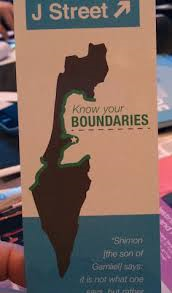
One step American community groups, businesses, schools and governments could take to foster memory of the distinction between pre-1967 Israel and the subsequently occupied territory would be to use only maps that include the pre-1967 Green Line – a visual reminder of the Green Line and its significance.”

j street bookmark

All of J Street’s arguments: negotiations based on 1967 lines; equivalent swaps of land; and using equivalent “quality” are all illogical.  The desire to push the US government to punish Israel was demonic.

The Illogic of “Land Swaps”

There are a number of issues regarding using the 1967 lines and subsequent land swaps as envisioned by J Street.

The 1967 Lines Rewards Aggression.  Using the 1967 lines as a starting point for negotiations rewards aggression.  When Israel declared itself as an independent state in 1948, it was immediately attacked by five Arab armies from Egypt; Jordan; Syria; Lebanon; and Iraq.  The 1967 lines were the Armistice Lines where the warring parties stopped fighting in 1949.

Imagine that in 1948-9, Egypt conquered the entire southern part of Israel, all of the way up until Bethlehem, and Jordan conquered the entire eastern part of the country, leaving Israel as a narrow sliver of coastline from Tel Aviv to Rosh Hanikra. Consequently, imagine that it is this small state that becomes recognized by the United Nations in 1949, within Armistice Lines with Egypt and Jordan.

Further consider that history played out precisely as it did: in 1967 the Arab armies once again threatened to destroy Israel, so Israel pre-emptively attacked Egypt and Syria and then Jordan attacked Israel. Egypt and Jordan lost all of the territory that it took from the 1922 Palestine Mandate for a Jewish homeland in the war.

How would the world react?  Would the world demand that Israel needs to return to a stub of a state and give Egypt and Jordan all of the land past the 1949 Armistice Lines? Even if Egypt and Jordan ultimately relinquished their claims to the lands they seized in favor of Palestinian Arabs, would those borders somehow be considered the appropriate borders for Israel and Palestine?

Of course not.

Pushing Israel to accept the borders that the UN endorsed in 1949 would be rewarding the five Arab armies assault on Israel. The areas within the Jewish homeland mandate that are some refer to as “Arab land,” are simply lands that were seized by Arab aggression.  Using such 1967 lines/ the 1949 Armistice Lines, is a direct reward to an aggressive war to destroy the Jewish State.

Land Swaps Acknowledges that 1967 Lines are not Borders.  Those parties that suggest that land swaps between Israel and a future Palestinian state, inherently admit that the 1967 lines have no merit.  How could anyone suggest that a sovereign nation (Israel) give up some of its own land?  How could a country annex land of another country (Palestine)?  It can do so, if the two parties both acknowledge that the lines are not borders.

This was clearly spelled out in the Armistice Agreement with Egypt that stated “[t]he Armistice Demarcation Line is not to be construed in any sense as a political or territorial boundary.” Similarly, the Armistice Agreement between Israel and Jordan which stated “The Armistice Demarcation Lines defined in articles V and VI of this Agreement are agreed upon by the Parties without prejudice to future territorial settlements or boundary lines or to claims of either Party relating thereto.

While J Street urges Israel and Jewish groups to “know its boundaries,” the actual suggestion to engage in land swaps undermines the J Street argument that the 1967 lines have any real significance.  If there is any doubt, the Armistice Agreements that created those specific Armistice Lines stated those lines were not borders.

Land Swaps Undermine a call to limit Jewish “Settlements.” J Street and other groups that suggest that no Jewish Israelis should be allowed to live east of the Green Line (EGL/ West Bank), undermine their own argument when they suggest that there should be land swaps.  If Israel should give over some of its land west of the Green Line to a future Palestinian State, that would mean that Jews should also be prohibited from living in those border areas in Israel too.  Swapping land means that those Jewish communities in Israel would be considered a similar threat towards peace as the “settlements” in EGL/West Bank.

If people really believe that Jewish communities threaten the viability of a Palestinian State, the same parties that argue for banning Israelis in EGL/West Bank should argue similarly argue against Jewish communities in Israel that threaten the ability to effectively conclude land swaps.

That suggestion is clearly absurd.

Therefore if it is not a problem for Jews to move into communities that are west of the Green Line, than it is not an issue for Jews to move east of the Green Line.

Phantom Size.  The suggestion that the exact number of square kilometers of the “West Bank” and Gaza that were created by the 1949 Armistice Lines is somehow a sacred amount is ridiculuous.  As described above, the “West Bank” was an artifice created by a war of Arab aggression against Israel in 1948.  There is/was nothing inherently special about where the warring parties stopped fighting.

It is therefore non-sensical to suggest that the “equivalent quantity”of land be exchanged between the parties.  The Armistice Lines were arbitrary, non-permanent lines, and therefore the amount of land on either side of those lines are also arbitrary.

Further Absurdity of “Equivalent Quality.” J Street outdid itself in promoting a concept that went beyond the illogical suggestions of the 1967 lines land swaps.  It proposed that the land swaps between Israel and the Palestinian Authority should be based on land of “equivalent quality.”  In other words, J Street did not only propose that there be a swap of 50 square km on one side of the Green Line for 50km on the other side.  J Street introduced the concept of “quality.”  The far left-wing group argued that desert land would not be equivalent to an aquifer.  Holy land would not be equivalent to non-Holy land.

What is the conversion factor between the different types of land? Who knows!  Just add some subjective requirements to simplify negotiations that are already going nowhere for decades and are illogical at the start.  That should speed things up!

 benami-J Street
J Street leader Jeremy Ben Ami

When people pick on Obama for being anti-Israel, they should consider his rather moderate stance compared to the advice he receives from J Street.


Related First.One.Through articles:

J Street: Going Bigger and Bolder than BDS

The Legal Israeli Settlements

The Left-Wing’s Two State Solution: 1.5 States for Arabs, 0.5 for Jews

The Long History of Dictating Where Jews Can Live Continues

Subscribe YouTube channel: FirstOneThrough

Join Facebook group: FirstOne Through  Israel Analysis


Considering a Failed Palestinian State

Failed Countries
On July 9, 2011, the world welcomed a new country, South Sudan, which separated from Sudan. South Sudan rapidly became a failed state, one in which the central government lost the ability to control the security and economy of the country.
Failed states suffer from many terrible and unstable features: lack of governmental control; factional militias and armies; lack of border integrity and gross poverty. These societies often see rampant human rights abuses as various parties assert control over parts of the country and seek vengeance and control over minorities and local populations.
Consider some reports from South Sudan over the past year:
Ten thousand people have been killed and more than 1.6 million have been internally displaced since civil war broke out in South Sudan in December 2013.
June 2015: South Sudanese army may have caused widespread human rights abuses according to the UN
May 2015: At least 129 children killed, boys castrated and girls raped
July 2014: Food crisis declared worst in the world by UN Security Council
According to Business Insider, the worst failed states include: South Sudan; Sudan; Somalia; Congo; Chad and Yemen. The populations of these countries are forced to flee, suffer or die.

South Sudanese refugees wait to be registered at a crossing into Ethiopia earlier in 2015. (Photo: UNHCR/R. Riek)
Considering a Palestinian State
Many countries in the United Nations would like to see the Palestinian Arabs gain self-determination and have their own country. However, many of the ingredients for a failed state currently reside in the political structure of the Palestinian Authority:
The Palestinian territories have various stand-alone armies and militias including Hamas and Islamic Jihad
No central government, as the west bank of the Jordan River and Gaza strip are administered independently
Internal fighting as witnessed in the 2007 rout of Fatah by Hamas forces in Gaza, and various extrajudicial killings between those parties that continued since then
No border integrity as bedlam prevails in Gaza, Sinai and Israeli towns near the border of Gaza
Lack of functioning economy and widespread unemployment due: to the extremely high percentage of people under 25 years old; and constant war to destroy Israel
No presidential or legislative elections, as they were suspended due to the splits mentioned above. The presidential election was last held in 2005 and the president’s term expired a long time ago.
A country built on this framework would likely deteriorate. Factional fighting to dictate the future of the country would exacerbate. Unemployment would further skyrocket. Cross-border battles with Israel would escalate and also include the area east of the Green Line, EGL/ west bank of the Jordan River. This region, which already leads the world in the “honor killings” of women, would likely continue to see such murders increase.
It would be a country built in chaos, with people’s dreams dying alongside their lives.
Concrete Steps to Avoid a Failed Palestinian State
Should the Palestinian Arabs hope to achieve a functioning state after self-determination, important steps need to be instituted before the state is formed:
Remove all weaponry from Hamas and other groups. A functioning government must only have a single army. There cannot be a society in which various entities wage internal and external wars.
Ban Hamas. No entity which advocates for murder of minorities should be allowed to sit in any elected office, and no country should have any dealings with any country that seeks destruction of another country. As Hamas advocates for the killing of Jews and calls for the complete destruction of Israel, the party should be banned in its entirety until it renounces both positions completely.
Form new Political Parties and Hold Elections. The Palestinian Arabs have not held presidential elections since 2005 and legislative elections since 2006. As Hamas won legislative elections in 2006 and have polled to win future elections, new parties should be organized that can compete in new elections.
These are the basic steps that must occur for the Palestinian Authority to have a functioning government. Once the central authority rests in a representative body, that entity can negotiate a final status agreement with Israel to create a new state. To minimize the chances that it slip into a failed state, the Palestinian government should further consider the following:
Peace Agreement with Israel. A viable government should have a strong economy, including a flow of people and goods. Due to the separation of the Palestinian territories, it would be most efficient for the government to have a good working relationship with Israel to facilitate commerce.
Minimize Incoming Youth. A Palestinian state would likely want to welcome Arabs whose families once lived in the region. As a large population below age 25 often leads to rampant unemployment and instability, the emphasis on incoming people should be on professionally-trained adults.
Transitional control from UNRWA. UNRWA has kept infant mortality, immunizations, life expectancy and literacy of Palestinian Arabs at among the best rates in the world. Over a period of years, the UN should cede control of the schools and hospitals to Palestinian control.
While the world celebrated the founding of a new country four years ago in South Sudan, the declaration proved a hollow victory for the people. It would be a mistake to push forward another declaration for Palestinian Arabs at this time which would ultimately lead to further suffering. Mayhem with a flag benefits no one.

Related First.One.Through article:
A “Viable” Palestinian State

The Narrative that Prevents Peace in the Arab-Israeli Conflict

Everyone has a perspective.

Marcus Aurelius, the Roman emperor, was credited with saying “Everything we hear is an opinion, not a fact. Everything we see is a perspective, not the truth.

Our opinions and perspectives are shaped by many things including our backgrounds and biases. When two people look at the same incident at the same time, it is quite possible that they take away very different stories. When two people do not see things first-hand, but hear histories second and third-hand, the narratives of each could appear to describe two different events and worlds.

Yet, those strange worlds can coexist and the parties with alternative truths can get along. The reason is not solely because some events in question are not in direct conflict, but because those events do not define each party.

Many histories remain in the past and do not touch the present. Other narratives reach out from history and impact decisions and views of people in the present. The deepest – and potentially most dangerous – narratives are those that are embedded in a person’s psyche, which can distort history, make people act against their own interests and mar the future.

Arab-Israeli “Neutral” Narratives

There are many narratives that contradict each other in the Middle East. Some are conflicting perspectives and some have alternative facts. Here is just a small sample of events from pivotal moments in 1948, 1967 and 2000 from an Arab perspective, followed by an Israeli view:

  • The creation of Israel in 1948 was a “Nakba” (catastrophe) // the founding of the state was a celebration
  • During the “Nakba”, 711,000 Palestinian Arabs were expelled by Israeli forces from their homes // Palestinian Arabs were encouraged to leave where they lived by their leaders, as the armies of five neighboring Arab states invaded Israel
  • Five Arab armies came into Palestine to defend the Palestinians from Israeli attacks // five Arab armies invaded Israel in an effort to destroy the nascent state
  • In 1967, Israel attacked Egypt, Syria and Jordan // Israel preemptively attacked Egypt and Syria after the parties made clear their intentions to attack and destroy Israel; Jordan then attacked Israel and Israel responded in self-defense
  • The West Bank has always been Palestinian land and cannot be settled by Israelis // Judea and Samaria (the “West Bank”) were always home to Jews and mandated under international law to be a homeland for Jews in 1922; only under the Jordanian expulsion were Jews barred from the land. International laws related to taking land in a defensive war is not the same as taking land in an offensive war
  • In 2000, Israeli Prime Minister Ariel Sharon went to the Al Aqsa Mosque in an attempt to claim control over Islam’s third holiest site, which brought about the Second Intifada // Sharon visited the Temple Mount, Judaism’s holiest site during regular visiting hours; the Palestinian leader Yasser Arafat launched the Second Intifada because he was unhappy with the “near-final” peace agreement with Israel

Consider the opposing narratives. Some can reside comfortably in history books, while others actively influence each party’s actions today.

abbas reuters
Acting-President of the Palestinian Authority Mahmoud Abbas
(photo: Reuters)

PAST: Some of these points may be found in either an Arab or Israeli history book. Palestinian textbooks may write about forced expulsions from Palestine during the “Nakba”, while Israeli textbooks may write about Palestinian Arabs being encouraged to leave their homes by their leadership while the armies from five supportive Arab countries attacked Israel in an effort to destroy the country and drive the Jews into the Mediterranean Sea. The arguments are not subtle differences of opinions, and each side holds onto their account of history with examples of stories of a family here, a village there, or quotes from Israeli and Palestinian leadership at that time to underscore their version of history.

Arguably, this is something for historians to debate and a thoughtful person would probably conclude that there are elements of truth to both sides. Whether it is 80/20% or 20/80% for the parties is beyond the point of this discussion. The thrust is that their narratives are stories of the past. While Arabs and Israelis will invariably bring up their point of view in a debate, it need not dictate the debates nor compromise the conversations of the future of the region. A “starting point” of the here-and-now can be established to find a solution for the future.

A second example is the conflict between Egypt and Israel. Each side’s view of who was the belligerent party in 1967 did not impede a path forward to a different future leading to a peace treaty.

PAST AND PRESENT: Some splits in narratives run throughout time. The past can consume the present and the versions of history touch daily dialogue.

Many Arabs argue that a state of Palestine has always existed, but has been occupied by various parties including Israelis, Jordanians, Egyptians and British. They carry placards to “Free Palestine” from current Israeli occupation. For their part, Israelis note that Palestine never existed as an independent country. It was never ruled by a local Palestinian Arab government. The parties are in negotiations to potentially “Create Palestine,” while dismissing the Arab narrative as factually incorrect. The competing narratives are in conflict, but needn’t prevent the parties from moving towards a future that is in alignment.

PRESENT: A last example of a “neutral” clash of each side’s take on history is current history. Israelis and Palestinian Arabs argue forcefully about who started the Gaza war in 2014 and which party is responsible for many civilian deaths. Politicians and people will argue their points forcefully and recommend actions to punish the other side and improve their own position. Ultimately, the war and responses will become part of the past. The parties could opt to move forward with plans for a future OR they could use the war as an excuse to undermine a future peace.

 Bibi -Ariel Jerozolimski)
Israeli Prime Minister Benjamin Netanyahu
(photo credit: Ariel Jerozolimski)

Arab-Israeli “Toxic” Narratives

The term “Toxic Narrative” is meant to describe the inability of the two sides to ever establish a true peace; it is not intended to suggest that a narrative is inherently evil.

PAST, PRESENT and FUTURE: The best example of competing viewpoints of the past that stretch into the future, is the Balfour Declaration (1917) and its incorporation into the San Remo conference (1920) and then the international law established by the League of Nations in the British Mandate of Palestine (1922). The two sides’ competing opinions impact the ability of the parties to establish peace for the future.

International Law: The Palestinian Arabs argue that the League of Nations had no right to declare a homeland for the Jews in Palestine. They contend such international decision was made without the approval of the local Arab population in Palestine, and as such, the law itself should be null and void. They further argue that the imposition of such mandate was an effort to colonialize Palestine. The Palestinian Arabs took many steps to halt the implementation of that mandate for “the establishment in Palestine of a national home for the Jewish people…and facilitate Jewish immigration…and close settlement by Jews on the land.” The most significant actions were the riots of 1936-9 which enabled the Arabs to get the British to issue the 1939 “White Paper” which would limit the Jewish population in Palestine to one-third of the country, leaving an Arab majority population and facilitate Arab rule.

The Israeli perspective is that the League of Nations (precursor to the United Nations) made a law specifically recognizing the Jewish right to a national homeland in Palestine. They do not believe that such international law was illegal in 1922, and when the United Nations voted in 1947 to only grant a small portion of the Mandated land as a Jewish State, the Jews were disappointed but voted in favor of the proposal anyway.  The Arabs rejected the 1947 proposal, just as they rejected the 1922 Mandate.

Historical Connection: As part of the League of Nations Mandate for Palestine, the international community recognized the “historical connection of the Jewish people with Palestine.” The history of the Jews in the land goes back 3700 years and the Jews were the only people to ever be self-governing in the land. They were also the only people to make Jerusalem its capital, which they did for the third time in 1950.

The history of the Jews has also been challenged by the Palestinian Arabs who continually deny Jewish history in the region and insist that Israelis are attempting to “Judaize” the country, and that Jewish presence in the region is a recent phenomenon. (They have even advanced that Jesus was a Palestinian, not a Jew, even though Arabs did not come to the holy land en masse until the Muslim invasions hundreds of years later).

In short, the two conflicting narratives relate to the RIGHTS of Jews to REestablish a Jewish majority in the land and be self-governing again.

The Palestinian contention is that the entire Zionist enterprise was illegal from the start: The call for Israel’s creation in 1922 was illegal; the declaration of the state in 1948 was illegal; and the assumption of additional land in 1967 was illegal. They view the entire region as “Arab land” and Jewish presence and rule is illegitimate and directly undermines the Arab rights in the land.

The Roadblock to Peace

The Future:  Some argue that despite such widely held opinion by Palestinian Arabs, acting-President of the Palestinian Authority Mahmoud Abbas has stated that he would recognize a state of Israel as part of a peace agreement. As such, the debate of narratives and facts is not truly “toxic” as the Arabs are willing to look past their past.

Israeli Prime Minister Benjamin Netanyahu maintains that is not so.

Netanyahu claims that a de facto recognition of Israel as a country that exists today will not prevent a war tomorrow.  A de facto peace treaty that does not recognize Israel’s RIGHT to exist is a flimsy veneer.  Over time the veneer will come off, and the underlying Palestinian Arab contention that Jews have no rights to live and rule on Arab land will lead to further war and bloodshed.  Without a break from the storyline that Jews have no history, no legal authority, nor basic rights to live and pray and be self-governing in Israel, there will never be peace.  No amount of land-for-peace swap could resolve an illegal Jewish claim until the entire state of Israel is under Arab rule.

The Palestinians have not been able to accept such a break with their narrative of the rights of Jews in Palestine.  They could not accept such vision of Jewish rights in 1922 and have been unable to accept it today, as Abbas has repeatedly stated he will never recognize Israel as a “Jewish State”.

As such, the seemingly innocuous request for Palestinians to recognize Israel as the Jewish State has potentially become a roadblock to final settlement talks. A statement that would have no practical impact (compared to tangible matters such as borders or “right of return”), has touched a key nerve in the Palestinian psyche.  They would rather forgo a brighter future than negate their narrative as the sole rightful owners of the land.


People typically speak of the Arab-Israeli conflict and refer to events at important time periods like 1948, 1967 and 2000.  While those events helped shape the present, they need not dictate the future.  Each side can maintain many narratives without destroying the prospects for peace.

The toxic narrative that prevents peace revolves around the rights of Jews to their historic homeland established in international law in 1922.  It is that narrative that must be addressed for the parties to arrive at a long-term peaceful future together.  It has been almost a century, and well past time for Arabs to recognize the legal and legitimate rights of Jews to live in the holy land and to be self-governing.


Related First One Through articles:

Names and Narrative: Palestinian Territories/ Israeli Territories

Names and Narrative: The West Bank / Judea and Samaria


The Green Line

Much of the ongoing debate about the Israeli-Arab conflict surrounds Israel’s borders. The Arabs seek the creation of  a new state of Palestine, up to the “1967 borders.”  That term has also been used by US President Obama as a basis for a peace formula.  However, the term and plan are flawed at its core, as the “1967 borders” were deliberately and specifically never declared borders by the warring parties in 1948-9, for different reasons.

In 1922, the predecessor to the United Nations declared in the British Mandate the “establishment in Palestine of a national home for the Jewish people“.  Because of the 1936-9 Arab riots, the British back-tracked from the original international plan and began to devise a solution that created only small enclaves for Jews within an Arab state.  By 1947, their actions set in motion a compromise plan by the United Nations that would have created distinct Jewish and Arab states.  That plan was rejected by the Arabs. When the British withdrew from Palestine in May 1948, the Jews declared an independent state and five Arab countries went to war against Israel to destroy the nascent Jewish state.

The end of the war in 1949 did not fix borders, but established armistice lines where the fighting concluded. No peace deals were signed between the warring parties as each sought ultimately different borders: the Arabs still sought the complete destruction of the Jewish state; the Israelis wanted borders that were more defensible.

The 1949 Egyptian Armistice Agreement stated clearly that: “The Armistice Demarcation Line is not to be construed in any sense as a political or territorial boundary,…The basic purpose of the Armistice Demarcation Line is to delineate the line beyond which the armed forces of the respective Parties shall not move.”  The Jordanian Agreement had similar language.

From Israel’s perspective, as it was subject to constant attacks, riots, wars and blockades to destroy the country, it viewed the 1949 Armistice lines as insufficient to provide it effective security.  The sentiment was best summarized by Israeli Foreign Minister Abba Eben to the UN Security Council in 1967, after the Arab armies once again set out to destroy Israel.

Why does accuracy matter?  How would a Palestinian call for the establishment of a new state of Palestine along the “1949 Armistice Lines” or the “Green Line” be any different than calling for such action along fictitious “1967 Borders”? Because the 1949 Armistice Lines underscores fundamental truths:

  • that Palestine never existed as a distinct country
  • that Palestine was not ruled by Arabs, but by the British and Ottomans before 1948
  • that five Arab armies from Egypt, Jordan, Syria, Lebanon and Iraq attacked Israel in 1948 in an attempt to destroy it
  • the “West Bank” is a newly defined term on newly conquered territory
  • highlights that the “Palestine Question” has always been a civil war- about the allocation of land between Jews and Arabs in an area that was once part of the Ottoman Empire
  • the “armistice lines” were never a border and never intended to be a border

The deliberate use of the term “1967 borders” gives a false impression that those lines were at any time approved and permanent. Further, using the term “West Bank” for the area east of the Green Line, makes that area appear to have been an actual Palestinian Arab entity, and as such, implies that the “occupied territory” is occupied Palestinian Arab land. Those conclusions are all false, and all fall away by using the proper Green Line/Armistice Lines terminology.


Sources:

Palestinian call for 1967 borders: http://palestinianmissionuk.com/news/president-abbas-calls-on-quartet-to-recognize-1967-borders/

Obama call for 1967 borders: http://www.nytimes.com/2011/05/20/world/middleeast/20speech.html?pagewanted=all&_r=0

1922 UN British Mandate: http://unispal.un.org/UNISPAL.NSF/0/2FCA2C68106F11AB05256BCF007BF3CB

1939 British White Paper: http://avalon.law.yale.edu/20th_century/brwh1939.asp

1947 UN partition plan: http://unispal.un.org/unispal.nsf/0/7F0AF2BD897689B785256C330061D253

1949 Egypt-Israel Armistice agreement: http://avalon.law.yale.edu/20th_century/arm01.asp

1949 Jordan-Israel Armistice Agreement: http://avalon.law.yale.edu/20th_century/arm03.asp

1967 Abba Eben to UN Security Council on constant threat of Arab states: http://www.mfa.gov.il/mfa/foreignpolicy/mfadocuments/yearbook1/pages/19%20statement%20to%20the%20security%20council%20by%20foreign%20mi.aspx

1969 Abba Eben Auschwitz borders: http://www.mefacts.com/outgoing.asp?x_id=10191

2002 Arab peace initiative does not use the term “1967 borders”: http://www.al-bab.com/arab/docs/league/peace02.htm

FirstOneThrough article on “West Bank” and “Judea and Samaria”: https://firstonethrough.wordpress.com/2014/12/08/names-and-narrative-the-green-line-west-bank-judea-and-samaria/

Names and Narrative: The West Bank / Judea and Samaria

The New York Times has taken more concerted efforts to balance the narrative between Muslims and Jews regarding the holy city and sites in Jerusalem. It has not taken such efforts elsewhere where it only uses an Arab narrative.

JERUSALEM

The holiest site in Judaism is “The Temple Mount” in Jerusalem, due to the fact that it was the location of Judaism’s two temples which existed from roughly 954BCE to 70CE. The Jewish King Herod built the Temple Mount platform specifically for Jewish use to ease access and flow to the Second Temple. To this day, it continues to be the direction of all Jewish prayer.

In Islam, that holy site is called the “Noble Sanctuary”, or “Bayt al-Maqdes” or “Al-Haram al-Sharif”. It is Islam’s third holiest site after Mecca and Medina, both located in Saudi Arabia. The Noble Sanctuary holds the Al Aqsa Mosque and the shrine known as the Dome of the Rock.

Historically, the New York Times would reference the names that both religions ascribed to the holy site, typically with the Jewish name first (the Temple Mount), and later in the article, it would use the Islamic name (Noble Sanctuary). More recently, the Times would use both names in the same sentence, and occasionally use the Islamic name first, followed by the Jewish name.

JUDEA AND SAMARIA

However, when it comes to other sites in the region with different names from the two peoples, the Times excludes the Israeli terminology: specifically, “Judea and Samaria”. For such region, the Times will only use the term “West Bank”, except if an Israeli is quoted using the name Judea and Samaria.

Interestingly, the West Bank never existed as an entity until 1949, and was never even referred to by the United Nations Security Council until 1953. In comparison, Judea and Samaria, which cover more area than just the West Bank, have existed for thousands of years.

The “West Bank” came into existence after five Arab armies attacked Israel in 1948. The armistice lines established in 1949 at the end of the war with Jordan became known as the “Green Line” as the line was drawn in green on the maps. The haphazard demarcation did not follow any historic, political or geographic contours, but was simply where the warring parties stopped fighting. The area east of the green line eventually became known as the West Bank.

In the years following the 1948 Arab attack on Israel, every United Nations Security Council (UNSC) Resolution regarding the “Palestine Question”, never mentioned Palestinians as a discrete people or the “West Bank” and Gaza as entities. Each resolution referred to the various parties in the conflict being Israel, Syria, Jordan and Egypt. The term “west bank (in lower case) of the Jordan” only showed up for the first time in 1953.

The term “West Bank” is an Arab artifice and highlights the short, violent and illegal Arab rule of the area:

  • It was achieved in an offensive war to destroy Israel
  • The duration of Arab rule only lasted for 18 years 1949-1967
  • Arab rule of the West Bank was never internationally approved (the UNSC never voted on the April 1950 Jordanian annexation of the area)
  • Was administered counter to the Fourth Geneva Convention (the Jordanians and Palestinians deported all of the Jews out of the territory)

The exclusive use of the term “West Bank” gives a false impression that the territory has a long history of Palestinian Arab rule. Further, in never using the term “Judea and Samaria” for the region, the UN, the New York Times and others, distance Jews and Israelis from lands that they lived in for thousands of years.

As the New York Times and other publications now give equal weight to “the Temple Mount” and “Noble Sanctuary”, they should do the same for “West Bank” and “Judea and Samaria”. Alternatively, it could use neutral nomenclature such as EGL- East of the Green Line.

judeasamaria


Source:

2014 NYTimes Noble Sanctuary first, then Temple Mount (11/19/14): http://www.nytimes.com/2014/11/19/opinion/horror-in-israel.html

2014 NY Times mentioning Temple Mount and Noble Sanctuary at the same time (10/31/14): http://www.nytimes.com/2014/10/31/world/middleeast/israel-palestinians-jerusalem-temple-mount-al-aksa.html

(11/7/14): http://www.nytimes.com/2014/11/07/world/middleeast/israel-jordan-jerusalem-al-aqsa-temple-mount.html

(11/23/14): http://www.nytimes.com/2014/11/23/world/middleeast/mistrust-threatens-delicate-balance-at-a-sacred-site-in-jerusalem-.html

Only calling it the “Al Aqsa compound” and not the “Temple Mount” (9/17/14): http://www.nytimes.com/2014/09/18/world/middleeast/unrest-by-palestinians-surges-in-a-jerusalem-neighborhood.html?_r=0

2013 NYTimes mentions Temple Mount and only later Noble Sanctuary (10/15/13): http://www.nytimes.com/2013/10/15/world/middleeast/ten-jewish-men-arrested-at-temple-mount.html

(9/22/13): http://www.nytimes.com/2013/09/22/world/middleeast/jews-challenge-rules-to-claim-heart-of-jerusalem.html?pagewanted=all

2009 NY Times only mentions Temple Mount (10/26/09): http://www.nytimes.com/2009/10/26/world/middleeast/26mideast.html

UN mentioning “west bank of Jordan” for the first time in 1953: http://www.un.org/en/ga/search/view_doc.asp?symbol=S/RES/101%281953%29


Related FirstOneThrough articles:

The Green Line

The EU’s Choice of Labels: “Made in West Bank” and “Anti-Semite”

Nicholas Kristof’s “Arab Land”

The United Nations Audit of Israel

The obsession of the United Nations with Israel is well documented.prosor

Israeli Ambassador to the UN, Ron Prosor

Various UN bodies sanction Israel in every session over any real or perceived issue. Meanwhile, the organization ignores mass slaughters and human rights abuses that occur daily throughout the world. When well-meaning people point out the singular focus on Israel, the Israel-bashers contend that such complaint is not a defense- it is just “whataboutary”.

Really?

If black people in Missouri were pulled over by police at 70 times the rate of white people, the police department would come under attack for abusive and discriminatory behavior.

If a particular person with financials similar to other people, was audited by the IRS every year, the agency and government would be investigated.

Just a few examples of UN uniquely targeting Israel:

A First One Through video about the many actions and sanctions against Israel, “I hate Israel – the UN told me so”

https://www.youtube.com/watch?v=jMb4oofyVgo


Source:

UN Human Rights Council: 56 out of 103 resolutions against Israel. http://time.com/3060203/united-nations-human-rights-council-israel/

http://www.unwatch.org/site/c.bdKKISNqEmG/b.3820041/

UN interpreter surprised by number of anti-Israel resolutions: http://www.haaretz.com/blogs/diplomania/.premium-1.558302

An Inconvenient Truth: Population Statistics in Israel/Palestine

The questions of word choice and chosen narrative dominates much of the discourse around the Israeli-Arab conflict. However, simple statistics do not suffer and sit in the same simmering pot as poisoned positions.

Below is a music video with music by Seal with a basic question: “Why do people get complacent with the things they’re told?”

  1. Under the Ottomans, the Muslim population in Palestine barely grew from 1800 to 1922. The rate of growth was effectively births minus deaths (meaning no Muslims moved to Palestine).
  2. Jewish population growth in Palestine BEFORE THE BRITISH MANDATE took effect was twice the Muslim population growth (meaning Jews were the only people who moved to Palestine, well before the mandate).
  3. The expanding Jewish aliyahs to Israel after the mandate came from countries OTHER THAN ENGLAND (meaning that the “creation of a Jewish homeland” as dictated under the San Remo agreement, was NOT a colonization effort, as the Jews did NOT come from England).
  4. Jews did not come to Israel as a reaction to the Holocaust- they already constituted 31% of the country in 1945.
  5. By the time World War II was over, the growth of Jews in Israel was equally from NATURAL population growth, as from aliyah (further undermining the claim that the Holocaust had anything to do with the creation of Israel).
  6. The population growth of Muslims in the region, ONLY started under Israeli rule in 1967 (the claims of ethnic cleansing are not only insulting but completely opposite the actual population statistics).
  7. Jerusalem has had a majority of Jews since 1866 (the claim that Israel is “Judaizing” the city is not simply insulting about their holiest city, it has no merit on the basis of simple numbers).
  8. The only time the Christian population in Jerusalem declined over the past century, was during the period of Jordanian/Palestinian rule 1949-1967.
  9. The Muslim population in Jerusalem exploded since Israel reunified the city in 1967. Their growth far surpasses the growth of Jews or Christians (not only has there been no “ethnic cleansing” in Israel, there has been none in Jerusalem).
  10. Compared to all of the surrounding countries which house Palestinians, the Palestinian population is not only growing faster in Israel/WB/Gaza than in any other region, it is the only place where they are growing faster than the host country.

The music video with music by Seal:

https://www.youtube.com/watch?v=eI5l9V0uLEc


Sources:

FirstOneThrough article on “Who’s New?”: https://firstonethrough.wordpress.com/2014/07/03/whos-new-everybody/

aliyah1918

The Palestinians aren’t “Resorting to Violence”; They are Murdering and Waging War

The 78-year Civil War

While pro-Palestinians and Palestinian PR personnel describe Arabs killing Jews as a “natural” or “spontaneous” reaction to Israeli policies, the facts are clear that the Arabs are actively looking to murder Jews. Any person or media outlet that uses language that the Arabs are “resorting to violence” is simply lying.

“Resorting to violence” is something that someone does begrudgingly and spontaneously. The deliberate and celebrated killing of innocents has a different, specific name: “murder”.

  • Premeditated murder…The various attacks in the fall of 2014 by Palestinian Muslims against Israeli civilians were premeditated.
  • …as called for by Palestinian leadership… The Hamas and PLO charters and repeated incitement by the Palestinian leadership encouraged the murders.
  • …endorsed and celebrated by the Palestinian people: The murderous agenda received overwhelming support from the Palestinian people and the murders were celebrated events.

In short, the Palestinians were not “resorting” to violence; they were fighting a war that they started in earnest in 1936 when they fought to stop Jewish immigration to Palestine and to halt the Jewish state from becoming a reality.

“Resorting to violence”

The media must stop using “resorting” language on its own, and cease quoting Palestinians who use the deceitful language to both cover the intentional murder of Jews, and to reverse the fault for the murder onto the victims themselves.

Not only is the “resorting” phrase disgraceful in putting the blame onto the victim, it ignores the incessant calls from Palestinian leadership for war, the murder of Jews and destruction of Israel.

Palestinian Leadership Calls for the Murder of Jews

Yasser Arafat (fungus be upon him):

Mahmoud Abbas:

  • Described the shooter of Rabbi Yehuda Glick as a “martyr
  • Abbas’s advisor on the murderer who ran over civilians “saturating the land of the homeland with their pure blood and igniting the flames of rage
  • On the Temple Mount: “We have to prevent them, in any way whatsoever, from entering the Sanctuary. This is our Sanctuary, our Al-Aqsa and our Church [of the Holy Sepulchre]. They have no right to enter it. They have no right to defile it. We must prevent them. Let us stand before them with chests bared to protect our holy places.

Sheik Ahmed Yassin (founder of Hamas):

Other Hamas & Fatah leadership:

  • Calls for “Day of Rage”
  • “move to save the Aksa Mosque and defend Jerusalem against the Israeli siege imposed on the city.”
  • Fatah Ahmed Assaf said that “the Jerusalem operation was a natural response to the Israeli violations.
  • Fatah official Amal Hamad on TV:It was only natural that the outcome of all that has happened would be the operation that we witnessed yesterday [murders of rabbis in the synagogue]…the natural outcome is the targeting of some settlers”
  • Mushir al-Masri, a Hamas spokesman, wrote in a Facebook post: “We have the full right to revenge for the blood of our martyrs in all possible means.

PLO Charter:

  • Palestine, with the boundaries it had during the British Mandate, is an indivisible territorial unit. ” (meaning all Gaza, Israel, West Bank and Jordan)
  • “It is a national duty to bring up individual Palestinians in an Arab revolutionary manner…He must be prepared for the armed struggle and ready to sacrifice his wealth and his life in order to win back his homeland and bring about its liberation”
  • “one national front working for the retrieval of Palestine and its liberation through armed struggle”
  • “Armed struggle is the only way to liberate Palestine. Thus it is the overall strategy, not merely a tactical phase. The Palestinian Arab people assert their absolute determination and firm resolution to continue their armed struggle and to work for an armed popular revolution for the liberation of their country and their return to it”
  • “Commando action constitutes the nucleus of the Palestinian popular liberation war….in the armed Palestinian revolution
  • “aims at the elimination of Zionism in Palestine…the Arab nation must mobilize all its military, human, moral, and spiritual capabilities to participate actively with the Palestinian people in the liberation of Palestine. It must, particularly in the phase of the armed Palestinian revolution, offer and furnish the Palestinian people with all possible help, and material and human support, and make available to them the means and opportunities that will enable them to continue to carry out their leading role in the armed revolution, until they liberate their homeland.”
  • “The Arab Palestinian people, expressing themselves by the armed Palestinian revolution, reject all solutions which are substitutes for the total liberation of Palestine”
  • “the liberation of Palestine will destroy the Zionist and imperialist presence and will contribute to the establishment of peace in the Middle East”
  • Fighters and carriers of arms in the war of liberation are the nucleus of the popular army which will be the protective force for the gains of the Palestinian Arab people.”

Hamas Charter:

  • They [Jews] are smitten with vileness wheresoever they are found; unless they obtain security by entering into a treaty with Allah…
  • Our struggle against the Jews is very great and very serious….
  • until the enemy is vanquished and Allah’s victory is realized…
  • raise the banner of Jihad in the face of the oppressors, so that they would rid the land and the people of their uncleanliness, vileness and evils…
  • raise the banner of Allah over every inch of Palestine…
  • The Day of Judgement will not come about until Moslems fight the Jews (killing the Jews)… O Abdulla, there is a Jew behind me, come and kill him
  • Jihad is its path and death for the sake of Allah is the loftiest of its wishes…
  • the land of Palestine is an Islamic Waqf…
  • Nothing in nationalism is more significant or deeper than in the case when an enemy should tread Moslem land. Resisting and quelling the enemy become the individual duty of every Moslem…
  • so-called peaceful solutions and international conferences, are in contradiction to the principles of the Islamic Resistance Movement
  • There is no solution for the Palestinian question except through Jihad. Initiatives, proposals and international conferences are all a waste of time and vain endeavors…
  • The day that enemies usurp part of Moslem land, Jihad becomes the individual duty of every Moslem. In face of the Jews’ usurpation of Palestine, it is compulsory that the banner of Jihad be raised
  • the Palestinian problem is a religious problem, and should be dealt with on this basis…
  • Moslem woman has a role no less important than that of the moslem man in the battle of liberation
  • The Islamic nature of Palestine is part of our religion and whoever takes his religion lightly is a loser….
  • Arab countries surrounding Israel are asked to open their borders before the fighters from among the Arab and Islamic nations so that they could consolidate their efforts with those of their Moslem brethren in Palestine…
  • Israel, Judaism and Jews challenge Islam and the Moslem people…
  • Under the wing of Islam, it is possible for the followers of the three religions – Islam, Christianity and Judaism – to coexist in peace and quiet with each other…
  • It is the duty of the followers of other religions to stop disputing the sovereignty of Islam in this region…
  • Hail to Jihad…
  • as the Moslems faced those raids and planned fighting and defeating them, they should be able to confront the Zionist invasion and defeat it”

Various comments from Palestinian leadership calling for the murder of Jews: http://www.palwatch.org/main.aspx?fi=427

How has the incitement been received by the Palestinian masses? Quite well.

Majority of Palestinians Advocating and Celebrating Violence

  • Palestinian Center for Policy and Survey Research on October 10, 2014:“the public still favors Hamas’ “way” over negotiations, and Hamas and Haniyeh are still more popular than Fatah and Mahmud Abbas”
  • September 25, 2014 poll: “[if] presidential elections if held today: Ismail Haniyeh [of Hamas] would win a majority of 55% and Abbas 38%
  • Palestinians have demonstrated their majority support for the rabidly anti-Semitic Hamas party (elected to 58% of parliament in 2006).
  • Over 25% of Palestinian Arabs believe the goal of the Palestinian Authority is a complete destruction of Israel (every Palestinian poll in 2014).
  • Palestinians hand out sweets to celebrate the murder of four rabbis praying in synagogue.
  • Palestinian leadership calls murderers of Jews “martyrs” and names squares and tournaments after them.

The Palestinian people have willingly embraced a culture of war and terrorism and there is nothing begrudging in their violent actions or attitudes.  A global community that supports such actions and blames the victims is complicit in the terrorism itself.

jlem attack


Sources:

Ashrawi November 18, 2014: http://www.cnn.com/2014/11/18/world/meast/jerusalem-violence/

Palestinians celebrating murder of four rabbis praying: http://www.israelnationalnews.com/News/News.aspx/187615#.VGvObd4L8mg.facebook

New York Times Hamas “resorting” editorial: http://www.nytimes.com/2012/11/20/opinion/hamass-illegitimacy.html?_r=0

UN Ban Ki-Moon on “resorting”: http://www.theguardian.com/world/2014/jul/23/john-kerry-flies-israel-flight-ban-gaza-ceasefire-talks

Palestinian poll September 2014: http://www.pcpsr.org/

PLO Charter: http://www.iris.org.il/plochart.htm

Hamas Charter: http://avalon.law.yale.edu/20th_century/hamas.asp

Arafat quotes: http://www.brainyquote.com/quotes/authors/y/yasser_arafat.html

Abbas on shooter of Yehuda Glick: http://www.palwatch.org/main.aspx?fi=157&doc_id=12946

Day of Rage (November): http://www.jpost.com/Arab-Israeli-Conflict/Palestinians-again-call-for-Day-of-Rage-against-Israel-on-Friday-381091

Day of Rage (July): http://www.nydailynews.com/news/world/israel-hamas-agree-12-hour-cease-fire-article-1.1879824

Amal Hamad “natural”: https://www.youtube.com/watch?v=2bn5a0o4Qbk

Other comments on murder of rabbis praying: http://www.frontpagemag.com/2014/joseph-klein/palestinian-bloodlust-unleashed/


Related FirstOneThrough articles:

Mainstream and Abbas’ Jihad

Abbas’ Racism

The New Blood Libel

UN Comments on the Murder of Innocents: Itamar and Duma

Extreme and Mainstream. Germany 1933; West Bank & Gaza Today

Many books and studies have been written analyzing Nazi Germany during the 1930s and 1940s, including the famous “Hitler’s Willing Executioners” by Daniel Goldhagen. The premise of the book revolved around the question of how Hitler – a single madman – could possibly kill millions of people. The book advanced a theory that, putting it simplistically, a single extreme individual or idea could stop being viewed as extreme if many others harbored similar thoughts. Millions of people could be actively annihilated if an entire society believed in the extreme notion that Jews, gays, gypsies and other “undesirables” should be killed. Such a society was capable – and did – murder millions. It was not a lone extremist with a gun, but a country with an army.

The dynamics of the Palestinians in 2014 runs parallel to the Germans in the 1930s in many respects.

mufi Jlem Nazi
Mufti of Jerusalem visiting Nazi troops

Position

Popularity

  • Majority support: The Nazi party won 44% of the votes in 1933. Hamas won 58% of the seats in Parliament in 2006 with their radical platform.
  • Last election. The Nazis suspended elections after the 1933 vote. The Palestinians have held neither presidential elections nor parliamentary elections since their 2006 election.
  • Popularity of Nazis: There are no polls to show how the Nazis would have fared if additional elections were held. Perhaps the Nazis feared that they could have lost an election and therefore did not allow one.
    Popularity of Hamas: There are dozens of polls that show Hamas would win the presidential elections and the parliament with over 50% of the vote, no matter what year the poll was taken. The current acting PA President Mahmoud Abbas (of the Fatah party) and the world knows this, so has suspended any new elections which would clearly show the desires of the Palestinian Arabs for war.

Pal nazi
Palestinians in Nazi Salute

As seen above, the Hamas positions are more extreme than the Nazis at the time of the respective elections. The Palestinians voted much more overwhelmingly for Hamas than the Germans did for the Nazis. Palestinian anti-Semitism in 2014 is more extreme and mainstream than the Germans in the 1930s.

As further evidence, in May 2014, the Anti Defamation League conducted a global poll of anti-Semitism. By a substantial margin, the Palestinians held the most anti-Semitic views in the world, with almost every single Palestinian Arab (93%) in the West Bank and Gaza holding anti-Semitic views. In comparison, 26% of countries outside of the Middle East and North Africa (MENA) region held anti-Semitic views.


Germany rose to power in the 1930s and the world did not hold the Nazi aspirations in check. As such, Nazi Germany went on to execute its plans killing millions of civilians until the world reacted.  Perhaps the world only stepped in, because Germany crossed into their backyards.

Fatah nazi
Fatah leader in Nazi Salute

Today, the Palestinians do not have significant fire power and have therefore only been able to kill hundreds, not millions of Jews.

  • Will the world encourage and embrace such a nation and leadership on the world stage?
  • Will the world enable Iran or other allies of the Palestinians to obtain nuclear weapons?
  • Does the world believe that “Never Again” only means in Europe?

Related First.One.Through articles:

Abbas’ Jihad is a move to the mainstream Palestinian opinion: https://firstonethrough.wordpress.com/2014/11/12/mainstream-and-abbas-jihad/

Why the media ignores Jihad in Israel: https://firstonethrough.wordpress.com/2015/01/26/radical-jihadists-in-europe-and-dislocated-and-alienated-palestinians-in-Israel/

Abbas’ racism: https://firstonethrough.wordpress.com/2014/10/27/abbas-knows-racism/

Antisemitism, Holocaust denial and terrorism in Palestinian society and leadership: https://firstonethrough.wordpress.com/2015/01/29/what-do-you-recognize-in-the-palestinians/

 Pal nazi2

Sources:

Nazi 1933 election: http://www.historylearningsite.co.uk/march_1933_election.htm

Nazi platform: http://www.jewishvirtuallibrary.org/jsource/Holocaust/naziprog.html

Hamas terrorist label: http://en.wikipedia.org/wiki/Hamas

Hamas charter: http://avalon.law.yale.edu/20th_century/hamas.asp

Palestinian courts handing death sentence for land sale to Jews: http://www.aljazeera.com/news/middleeast/2009/04/2009429105147715724.html

Birzeit University banning Jews: http://www.timesofisrael.com/haaretz-writer-booted-from-palestinian-school-because-shes-israeli/

Abbas no Israelis in Palestine: http://www.reuters.com/article/2013/07/30/us-palestinians-israel-abbas-idUSBRE96T00920130730

Palestinian poll: http://www.pcpsr.org/

Anti-Semitism poll 2014: http://www.algemeiner.com/2014/05/13/adl-global-survey-finds-anti-semitic-attitudes-are-persistent-pervasive-around-the-world-west-bank-gaza-highest-scores/