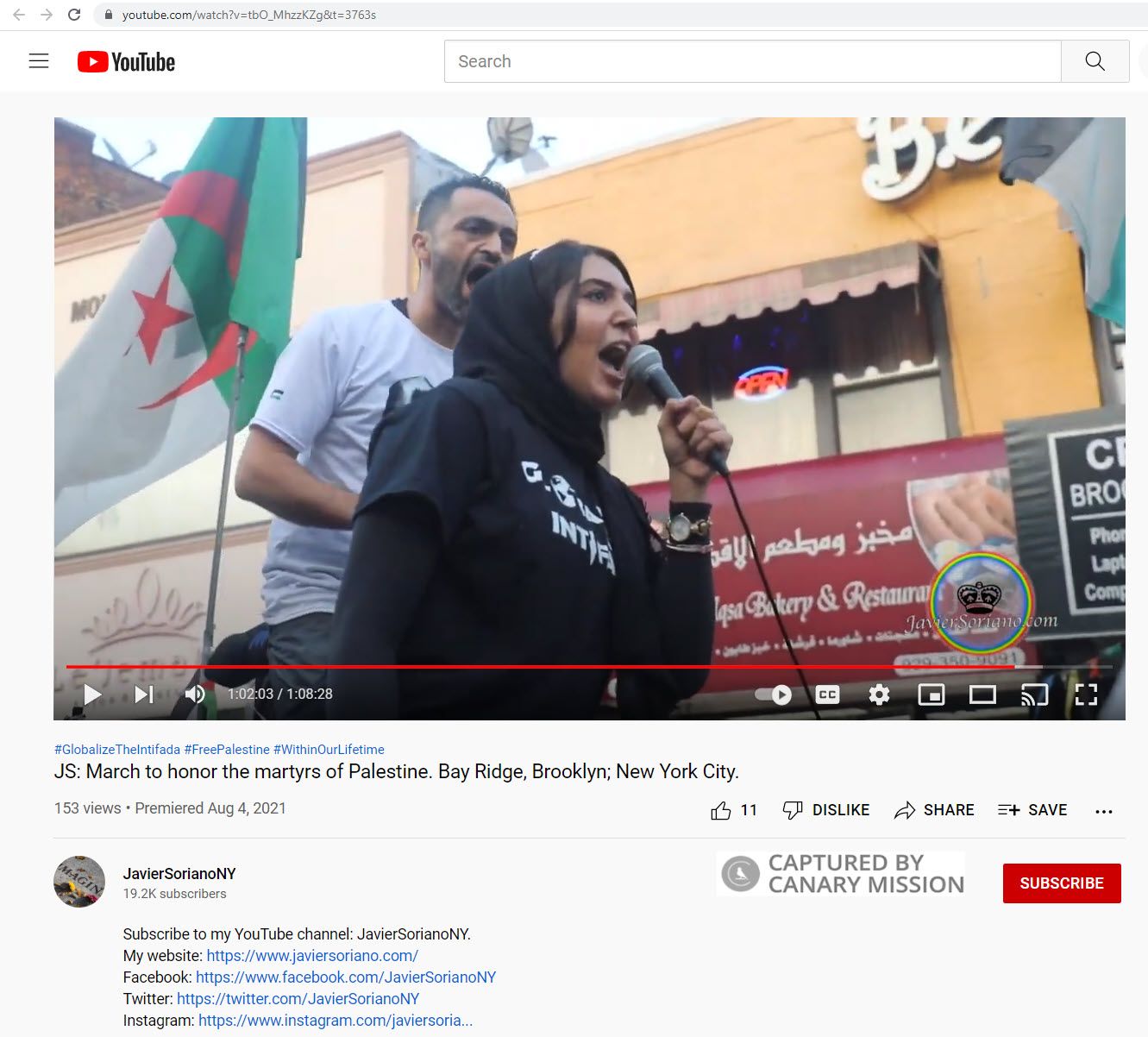
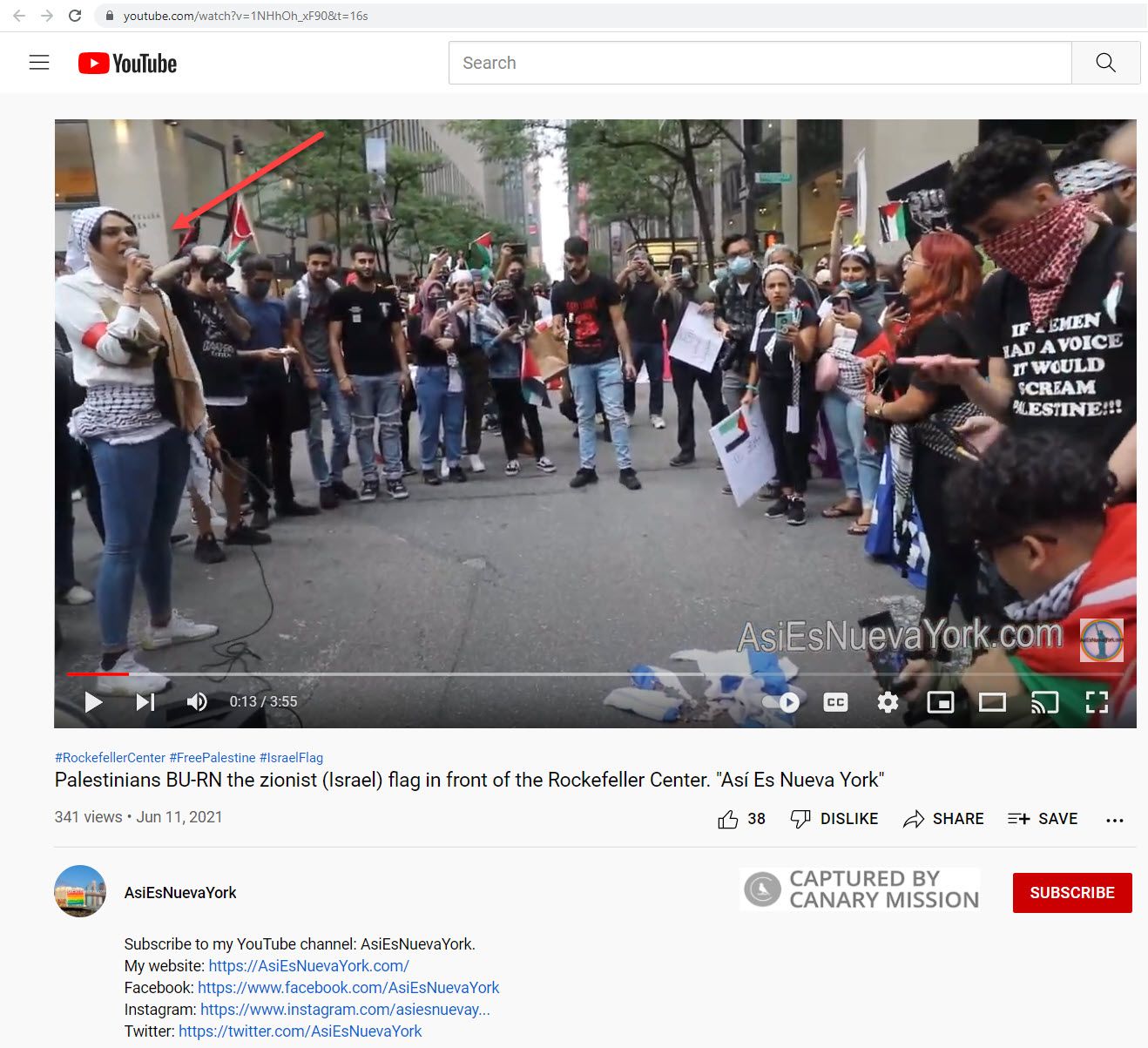
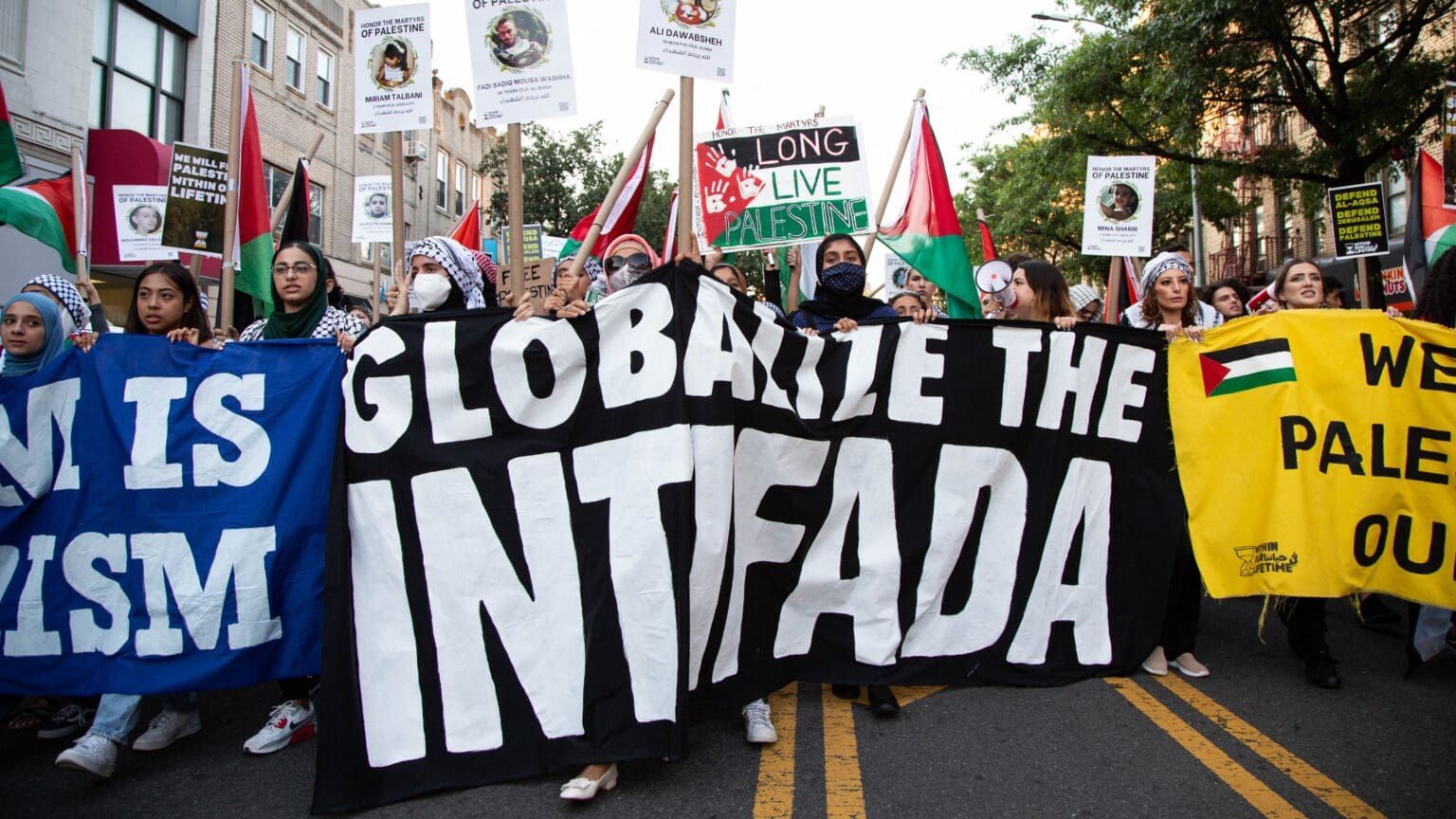
Nerdeen Kiswani is not quiet about her views. She wants the Jewish State obliterated and Zionists killed. She says it openly and proudly in front of loud cheering crowds.
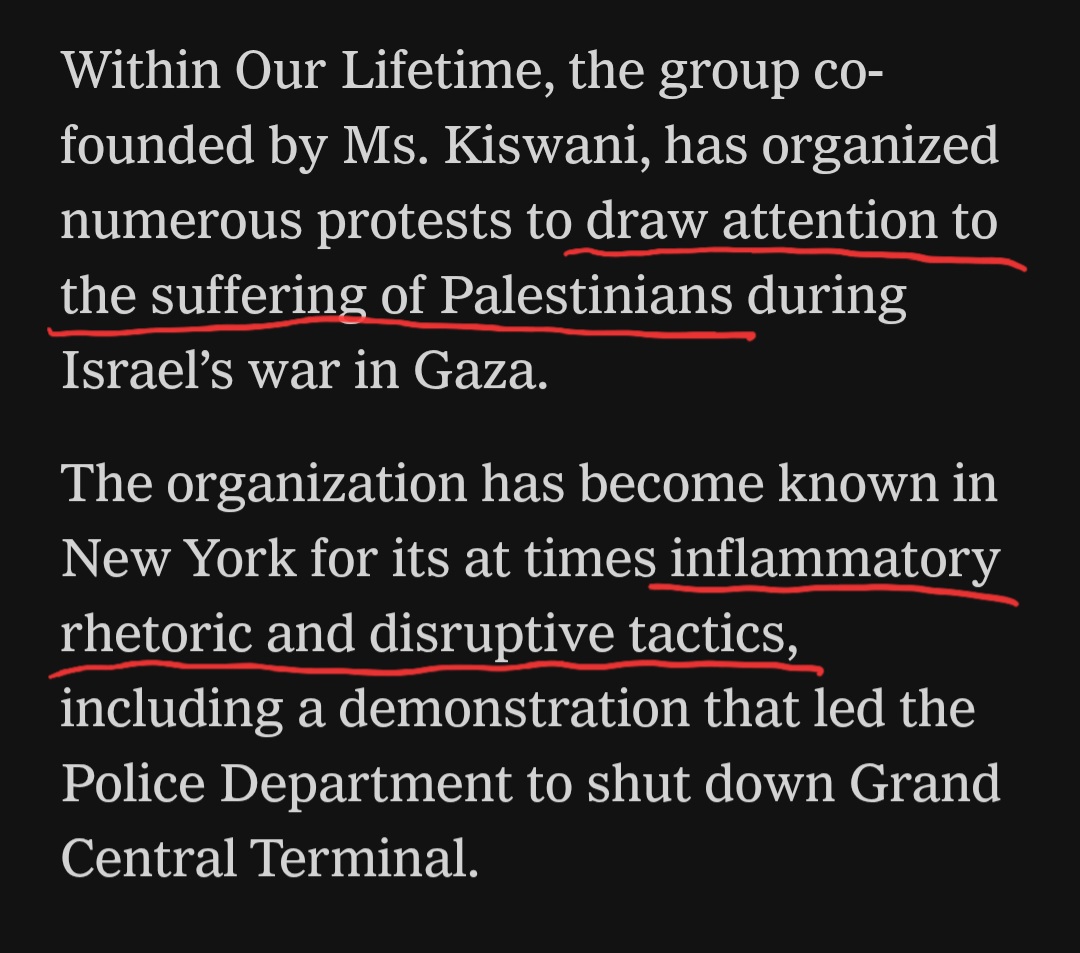
So why did The New York Times soften her stance? Why did it say that she was simply assembling “protests to draw attention to the suffering of Palestinians,” when her entire movement is about the destruction of Israel?
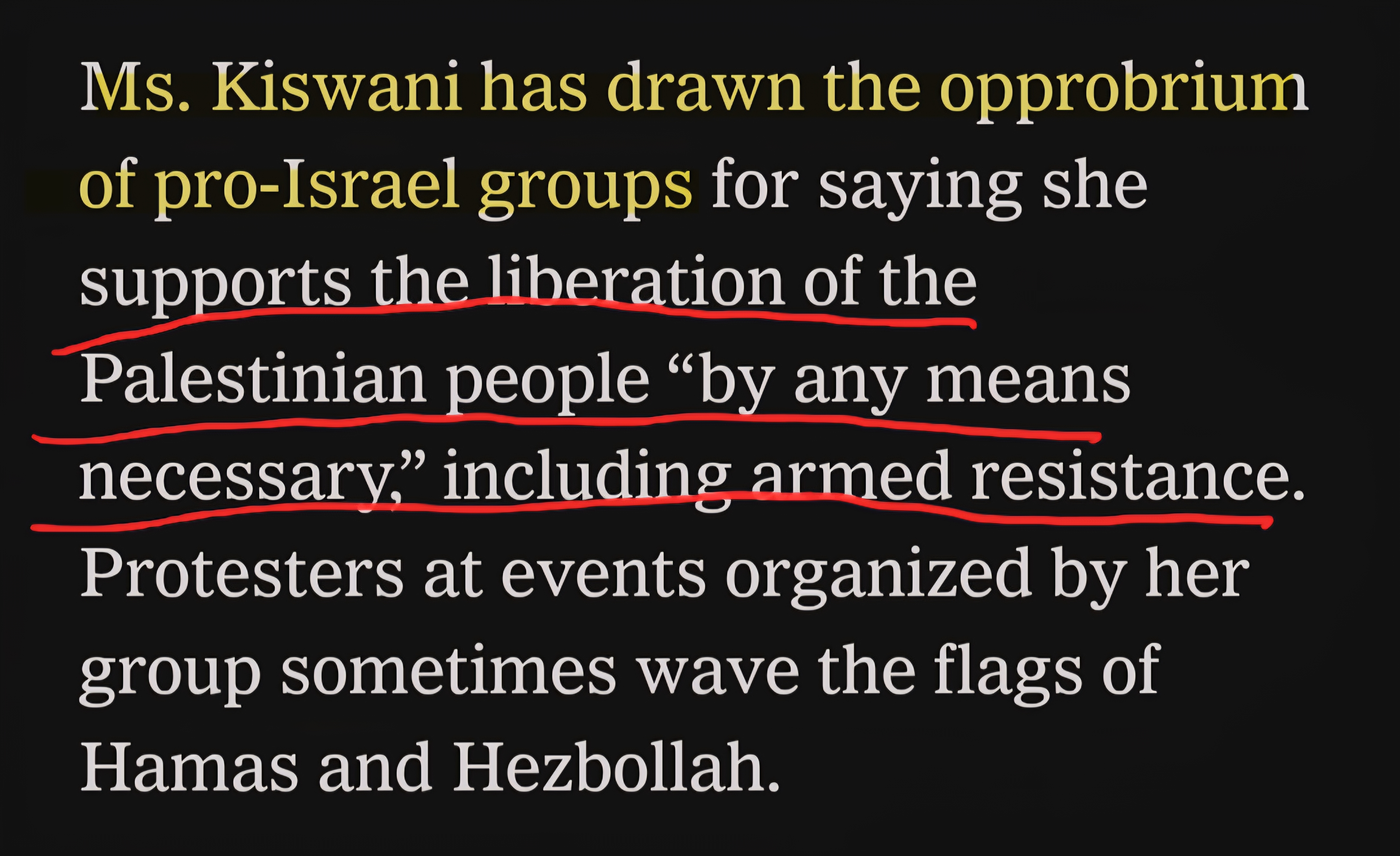
Why did the Times make it sound like pro-Israel groups were uniquely offended that “she supports the liberation of the Palestinian people “by any means necessary,” including armed resistance.”?
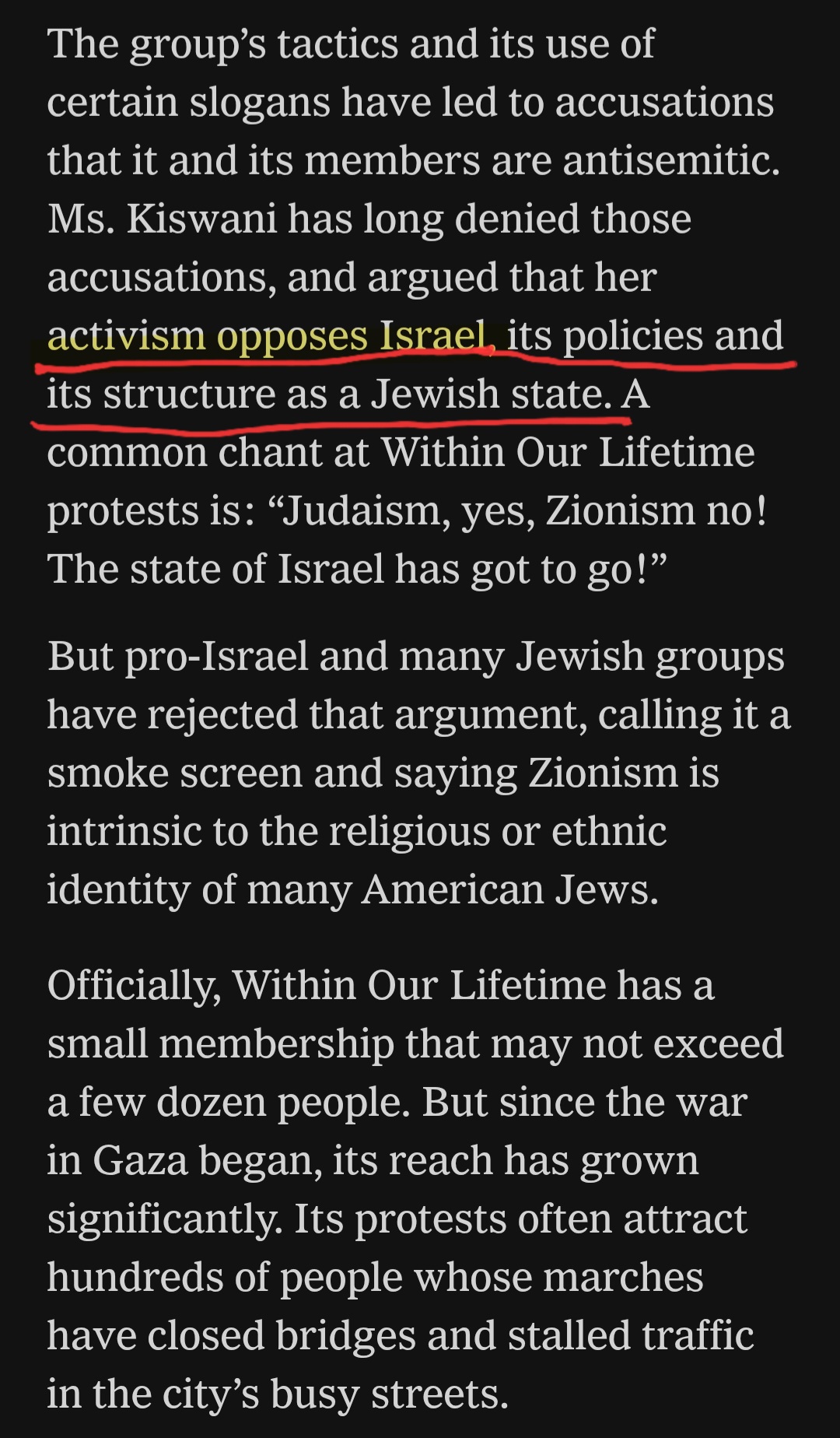
Why did the Times use so much energy and so many words to say “that her activism opposes Israel, its policies and its structure as a Jewish State,” without saying that she supports targeting Jewish organizations and the annihilation of the only Jewish State?
“We marched today, we took over the streets and we visited multiple Zionist settler foundations. Multiple. We let them know we know where they’re at. We know where they work. We’re gonna find out more about where they’re at too. And we’re gonna go after them.” – Nerdeen Kiswani, YouTube, Jun 11 2021
Why didn’t the Times explicitly state that Kiswani endorses US designated terrorist groups and individuals?
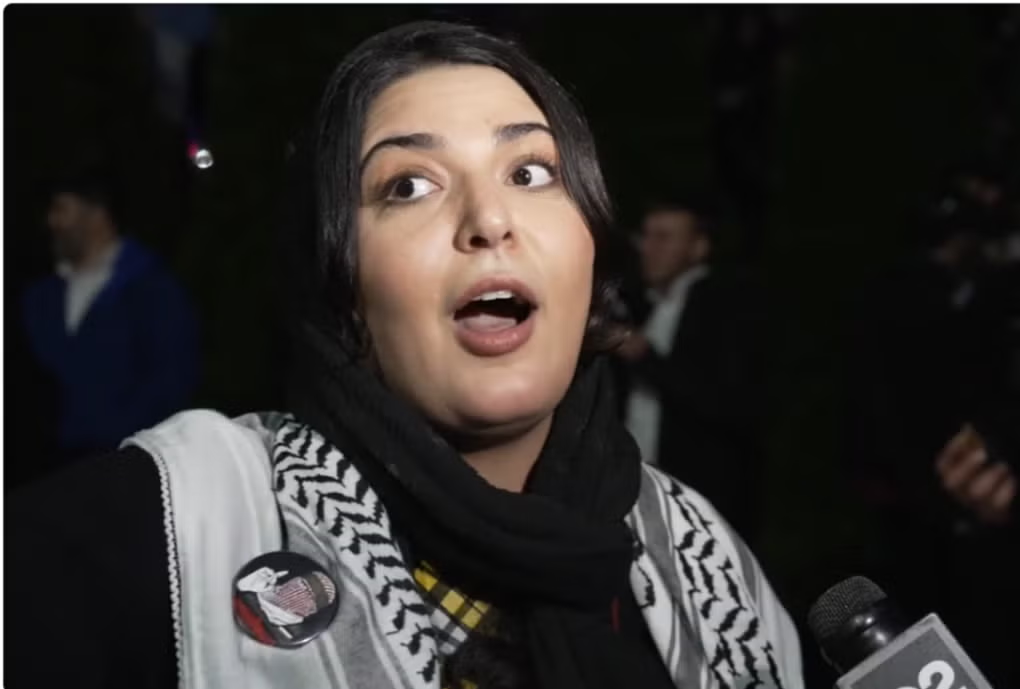
Picture on left is Kiswani with pin of Abu Obaida, a spokesman for Hamas, while protesting in front of a synagogue in Teaneck, NJ on April 1, 2024 (from ADL website)
On June 10, 2024, Kiswani led a protest outside a memorial exhibit in downtown New York City about the Nova Music Festival where she said that young partygoers enjoying music was “like having a rave right next to the gas chambers during the Holocaust,” mocking not only the hundreds of murdered youth but millions of Jews slaughtered in the Holocaust.
Kiswani post of a child kissing an armed Hamas terrorist, like those that burned Jewish families alive
In short, Kiswani is a proud supporter of terrorism against Jews and American allies. Yet The New York Times made it appear that her stances were simply pro-Palestinian, which some members of the pro-Israel community found offensive.
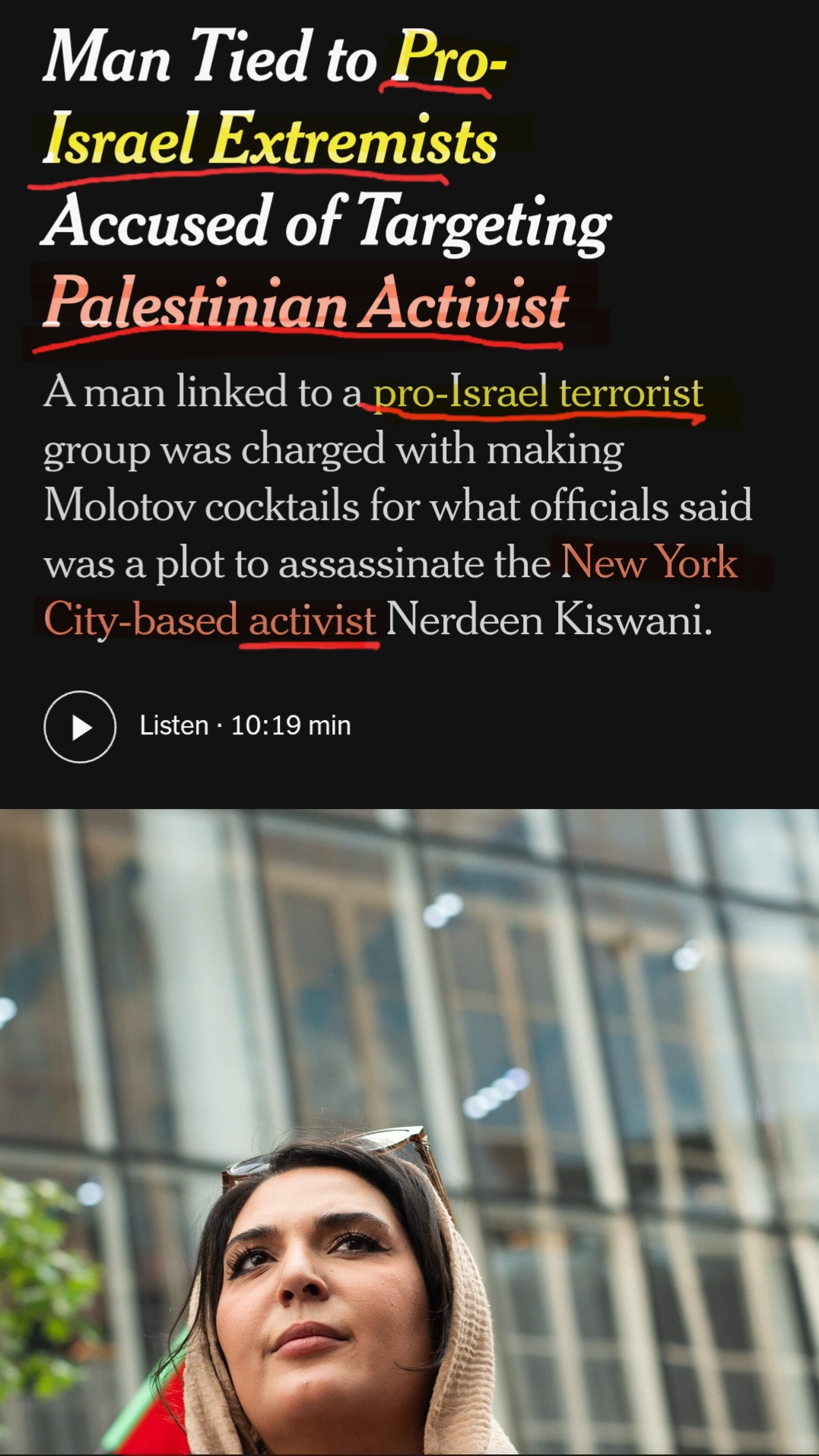
The reality is that a pro-Israel “extremist” allegedly planned an attack on a pro-Palestinian “extremist.” But the Times editorialized by showing the smiling face of an “activist” worried about the “suffering” of her people. Such is the alt-left embrace of the toxic “deformity in Palestinian culture.”
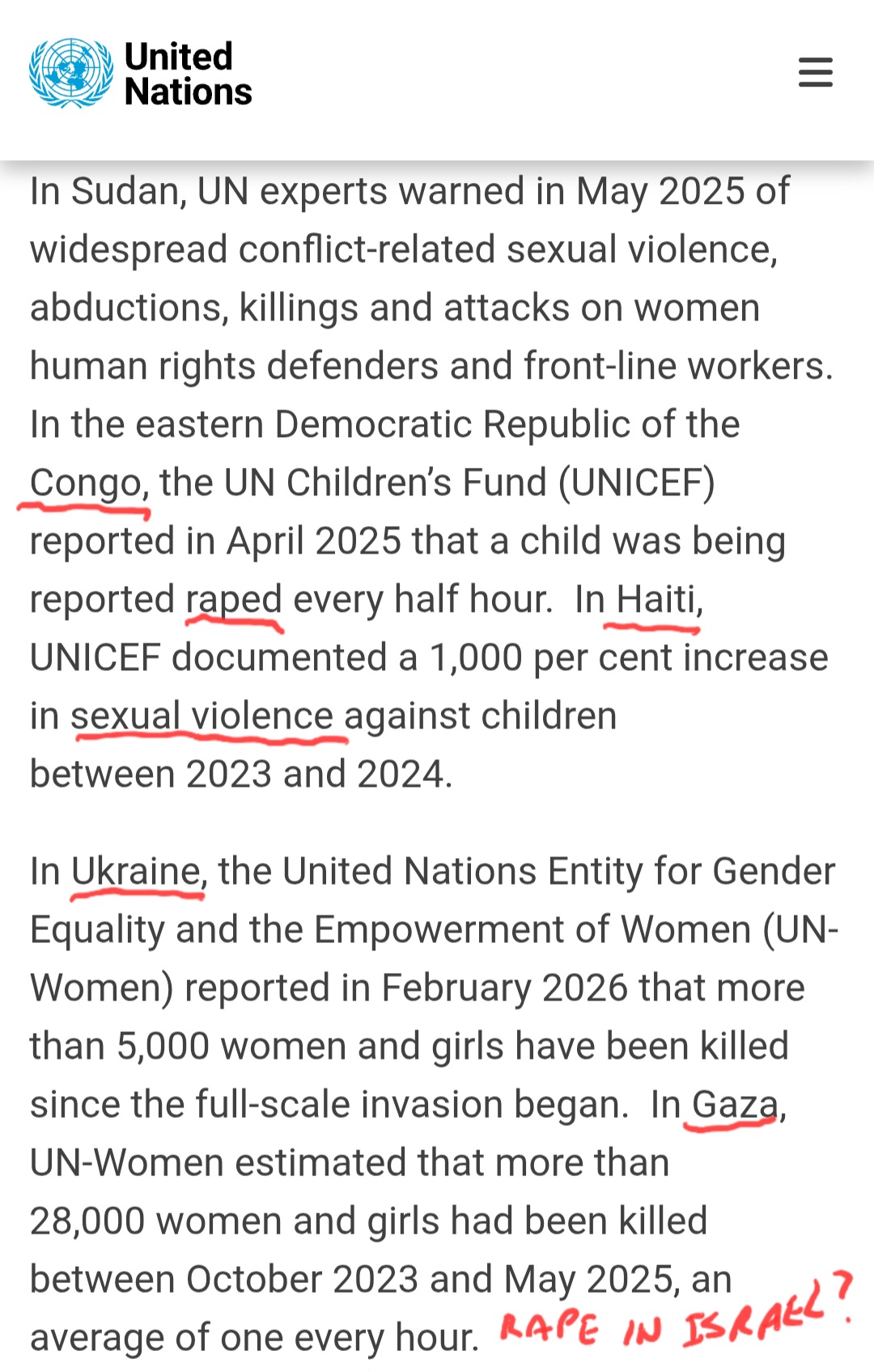
The United Nations has released yet another report on violence against women. It reads like a catalogue of human depravity – Sudan, Congo, Haiti, Ukraine, Gaza – each documented, each calibrated to shock the conscience.
And it does but not for the reason the authors intend.
Because one of the most documented episodes of mass sexual violence in recent history is missing. Not debated. Not contextualized.
Absent.
On October 7, an estimated 6,000 Gazans invaded Israel and carried out atrocities that included the systematic rape and mutilation of women. This is not a matter of competing narratives. It has been documented by eyewitnesses, first responders, forensic teams, and subsequent investigations.
And yet, in a sweeping global report about violence against women, these victims disappear.
The report finds space for a child raped every half hour in the Democratic Republic of the Congo, for the explosion of abuse in Haiti, for war deaths in Ukraine, and for casualty figures in Gaza. Horrific and worthy of attention.
But the omission is not accidental. It is instructive.
Because what the United Nations is quietly establishing is a hierarchy of victims. Some suffering is elevated. Some is ignored. And some – when it disrupts a preferred political narrative – is erased altogether.
Jewish women fall into that last category.
That is not human rights reporting. It is narrative management.
And that distortion does not stay confined to UN documents. It bleeds outward. When the international system refuses to clearly name and center atrocities committed against Jews, it creates a form of moral cover. The record itself becomes a kind of absolution.
So when figures in the West – like the wife of New York City Mayor Zohran Mamdani, Rama Duwaji – publicly express approval for the October 7 massacre, the reaction is muted, rationalized, or ignored. The most grotesque elements of that day, including the sexual violence, have already been softened, blurred, or omitted by institutions that claim to stand for universal rights.
If the crime is not fully acknowledged, then the celebration of it can be more easily excused.
That is the downstream consequence of selective memory and outrage.
The United Nations is not failing to see. It is choosing not to look and remind the world about violent antisemitism. And in doing so, it transforms a report about protecting women into something far more revealing: a document that tells us which victims matter and which ones are inconvenient.
In that calculus, the rape and murder of Jewish women is not denied. It is deemed unworthy of inclusion. Perhaps even harmful, lest it paint its forever wards, the Stateless Arabs from Palestine (SAPs) in an unfavorable light.
When Iran attacks neighboring countries, many observers react with confusion.
How could the Islamic Republic of Iran strike Muslim countries, they ask?
The question reflects a misunderstanding. Throughout modern Middle Eastern history, many of the region’s bloodiest conflicts have been Muslims fighting other Muslims. The idea of a unified “Muslim world” standing together against outsiders is largely a Western illusion.
Reality has always been far messier.
Muslims Fighting Muslims
One of the deadliest wars in the modern Middle East was the Iran–Iraq War. From 1980 to 1988, two Muslim-majority states fought a brutal conflict that killed hundreds of thousands and wounded millions. Both sides invoked Islam. It did nothing to prevent the slaughter.
More recently, the Syrian civil war has killed roughly 500,000 people, most of them Muslims, as factions divided along sectarian and political lines tore the country apart.
But these are far from isolated examples. Modern history is filled with wars in which Muslims killed other Muslims on a massive scale.
Major Muslim-vs-Muslim Conflicts
Iran–Iraq War (1980–1988) ~500,000–1,000,000 killed Shia Iran vs Sunni-led Iraq in one of the deadliest wars in modern Middle Eastern history.
Syrian Civil War (2011–present) ~500,000+ killed Assad regime, Sunni rebel groups, ISIS, and other militias fighting largely Muslim populations.
Yemen Civil War (2014–present) ~350,000+ killed (including famine and disease tied to the war) Iranian-backed Houthis vs Saudi-backed Yemeni government.
Sudan / Darfur conflicts (2003–present phases) ~300,000+ killed Fighting largely between Muslim militias and factions within Sudan.
ISIS war in Iraq and Syria (2013–2019) ~200,000+ killed ISIS fighting governments and populations that were overwhelmingly Muslim.
Algerian Civil War (1991–2002) ~150,000–200,000 killed Islamist insurgents vs Algerian government.
Iraq sectarian civil war (2006–2008 peak) ~100,000–200,000 killed Sunni and Shia militias fighting for control after the fall of Saddam Hussein.
Black September in Jordan (1970–1971) ~3,000–10,000 killed Jordanian army crushing Palestinian militant groups operating inside Jordan.
Hamas–Fatah conflict (2006–2007) ~600–1,000 killed Palestinian factions fighting for control of Gaza.
Together, these conflicts account for millions of deaths, overwhelmingly among Muslims themselves.
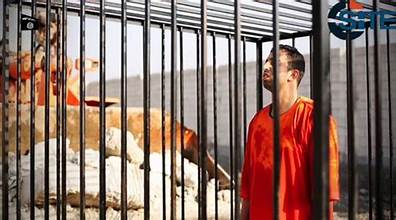
Members of ISIS about to burn Jordanian to death in a cage
Palestinians Killing Palestinians; Israel Arabs Killing Israeli Arabs
Even movements that claim to represent a single people often turn their guns inward.
In 2007, Hamas violently seized Gaza from Fatah, executing rivals and throwing some from rooftops in a bloody Palestinian power struggle.
The same pattern appears inside Israel.
Most Israeli Arabs who die from violence are killed by other Israeli Arabs, usually in criminal or clan disputes rather than in conflict with Jews.
Internal violence, not confrontation with Israel, accounts for the majority of these deaths.
Power Over Solidarity
Western observers often assume shared religion should produce political unity.
But the Middle East repeatedly shows otherwise.
Persians compete with Arabs. Arabs compete with Turks. Sunni compete with Shia.
Power, rivalry, and survival drive politics far more than religious solidarity.
A Familiar Pattern
Seen in this context, Iran attacking Muslim countries is not surprising.
It follows a long-standing regional pattern: Muslim states and factions frequently fight one another.
The Middle East’s wars are not unique. They follow the same rule that has governed politics everywhere:
Nations and movements fight for power and dominance—even when they share the same faith.
Words matter. Especially when a newspaper chooses them carefully.
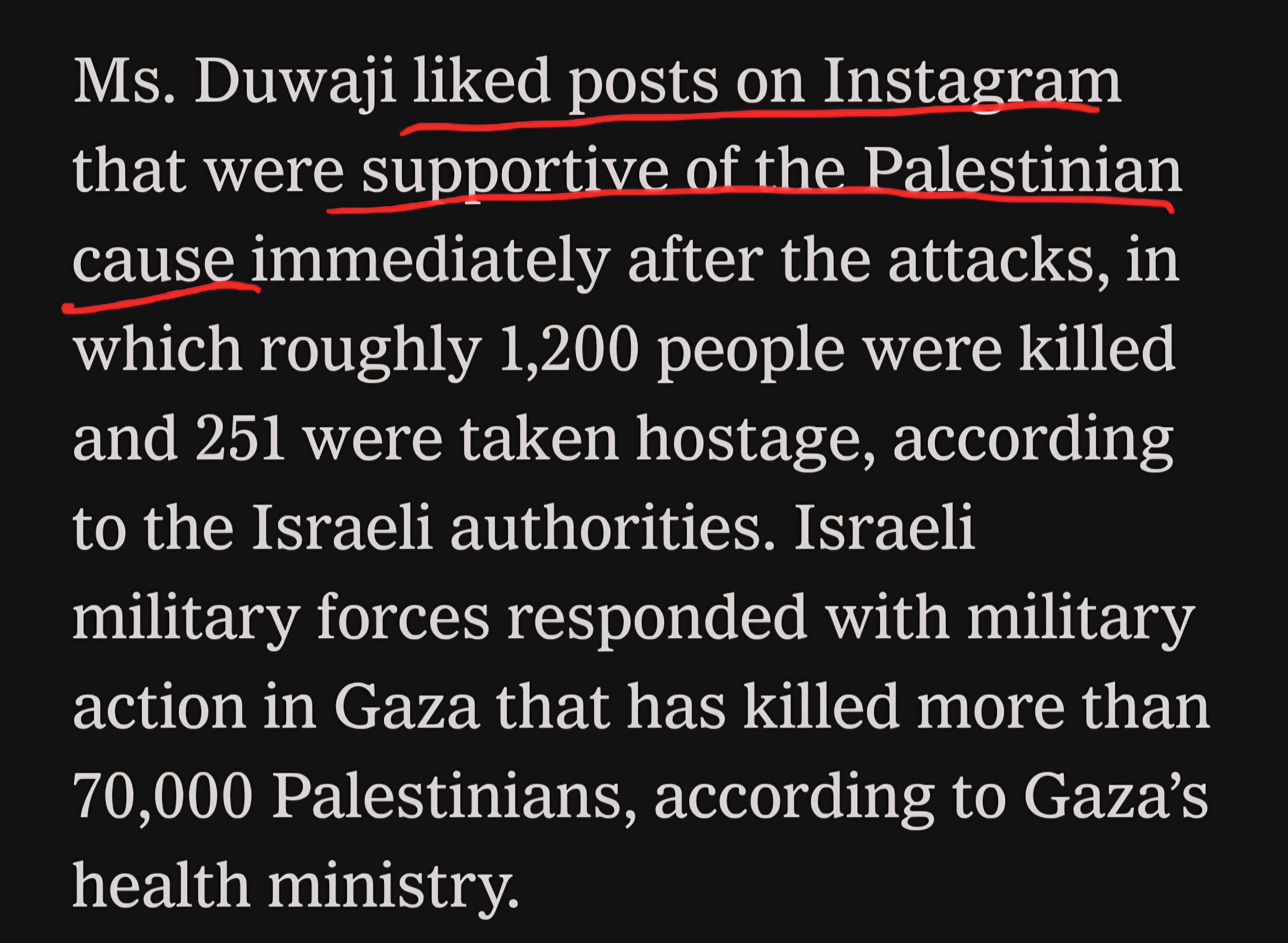
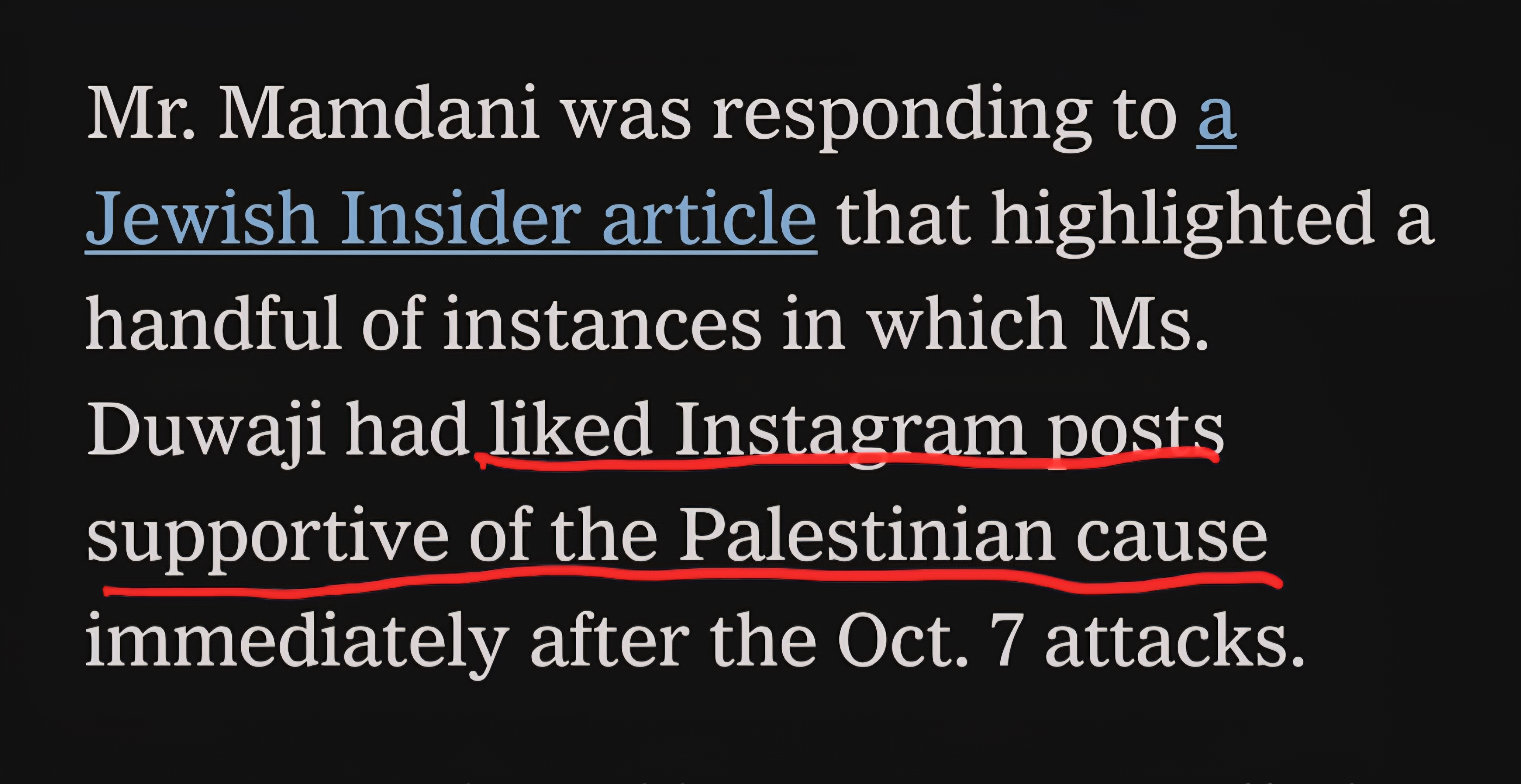
In a recent article, The New York Times wrote that New York City Mayor Zohran Mamdani’s wife, Ms. Duwaji had “liked Instagram posts supportive of the Palestinian cause immediately after the attacks,” referring to October 7.
Read that sentence again.
October 7 was the largest massacre of Jews since the Holocaust. Hamas terrorists murdered about 1,200 people, raped women, burned families alive, and kidnapped 251 civilians.
Yet approval of posts celebrating that moment is described by the Times as support for a cause.
A cause sounds political. Principled. Even noble.
But immediately after October 7 the images circulating online were not debates about borders or statehood. They were videos of murdered Israelis, kidnapped civilians, and triumphant Hamas fighters.
Calling appreciation of those posts “support for the Palestinian cause” launders the meaning of the act. The language turns approval of atrocities into activism. And it did the spin repeatedly.
Then the article pivots.
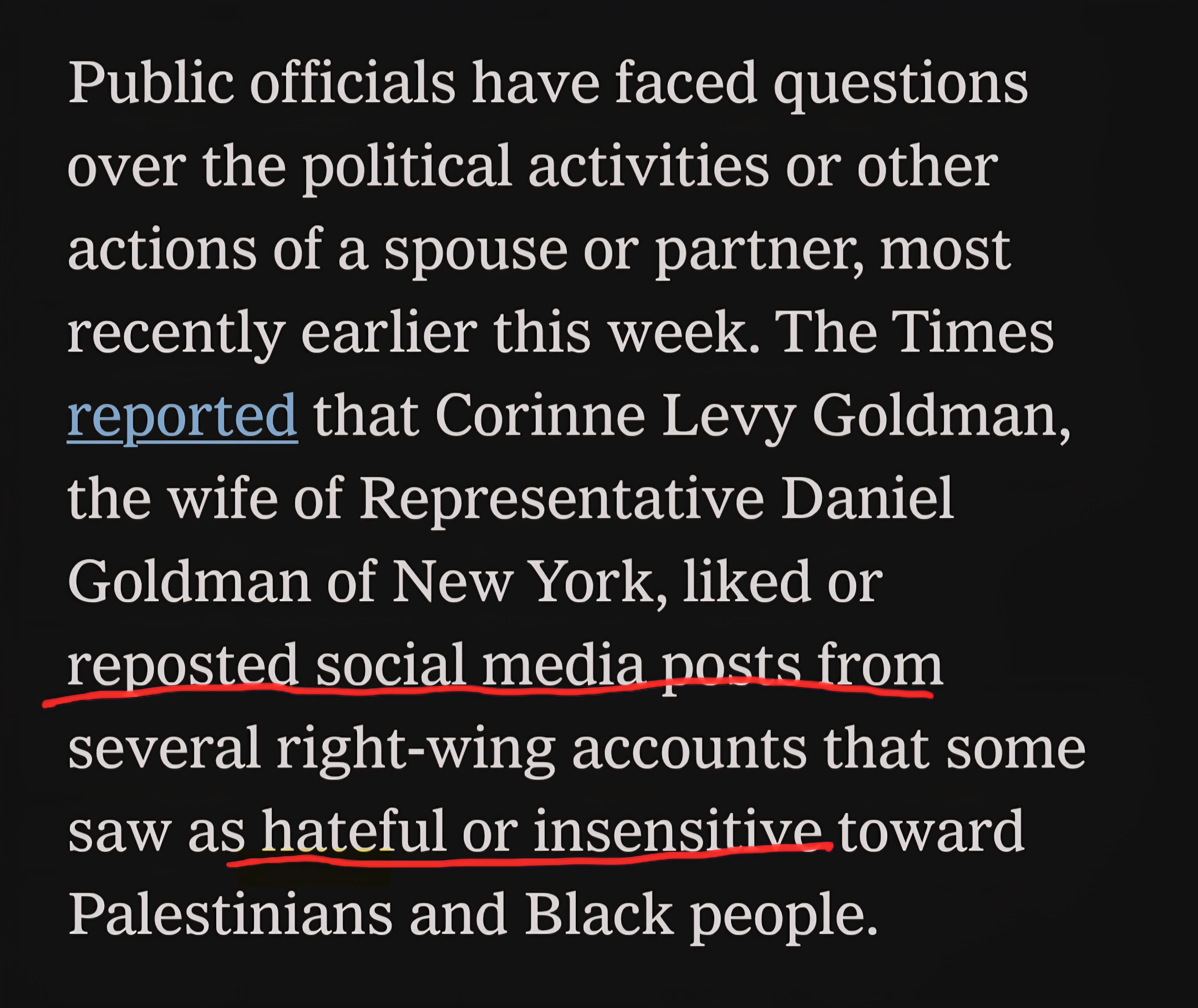
The Times raises concerns about a Jewish congressman from New York because his wife had “liked or reposted” posts from right wing accounts that some people considered hateful or insensitive.
So approval of posts DIRECTLY ABOUT a terrorist massacre is softened, while a Jewish public official becomes controversial through a chain of ASSOCIATIONS.
One situation involves praise for the moment Jews were slaughtered. The other involves subjective offense. Yet the newspaper treats them as comparable.
And this pattern did not begin here.
For years the Times has regularly described Israel’s elected government as “the most right wing in its history,” a political judgment embedded in news reporting. At the same time, the paper often avoids stating a simple fact: Hamas is a U.S.-designated terrorist organization.
So the judgmental language is applied freely to Israel and the factual label is avoided for Hamas.
Frighteningly, the framing has sunk even lower. The New York Times has moved from absolving terrorists to sanctifying the antisemitic genocidal terror itself as a “cause.”
It is a moral inversion that reflects a deeper rot in how the story is being told.
And it arrives at a moment when hostility toward Jews is rising once again across the world, seemingly with the endorsement of The New York Times.
António Guterres wants the world to believe that peace can be engineered with a spreadsheet — that inequality is the disease, redistribution the cure, and justice a matter of financial rearrangement. In his January 15 address, he warned that concentrated wealth corrupts institutions and that most low-development countries are in conflict. The implication is unmistakable: balance the books and peace will follow.
“The top 1 per cent holds 43 per cent of global financial assets. And last year alone, the richest 500 individuals added $2.2 trillion to their fortunes.
Increasingly, we see a world where the ultra-wealthiest and the companies they control are calling the shots like never before — wielding outsized influence over economies, information, and even the rules that govern us all.
When a handful of individuals can bend global narratives, sway elections, or dictate the terms of public debate, we are not just facing inequality — we are facing the corruption of institutions and our shared values.” – UNSG Antonio Guterres
But choosing the wrong enemy guarantees the wrong war.
Because evil is not an accounting problem.
The UN’s failure begins in its diagnosis. It treats terrorism as a social pathology when it is, in fact, an ideological one.
Terrorism is not born in empty wallets. It is born in minds captured by belief.
Two decades of research have demolished the claim that poverty causes terror. Terrorists are rarely the poorest of the poor. They are often educated, middle-class, and technically trained — the engineers of jihad, the lawyers of holy war. The suicide bomber is seldom starving. He is convinced.
If poverty produced terrorism, the poorest societies would be its factories. They are not. Many desperately poor states remain largely untouched by global jihad, while terror movements arise from politically radicalized societies with functioning middle classes and ideological incubators.
What correlates with terrorism is not poverty, but ideas combined with power: religious absolutism, revolutionary nationalism, grievance cultures, and failed identity — not failed GDP.
This is not an academic distinction. It is the fault line between clarity and catastrophe.
If money could defeat jihad, Gaza would be the proof. It is not — it is the refutation.
Gaza has received billions in international aid. What emerged was not prosperity, but the most elaborate terrorist war machine ever embedded in a civilian population: tunnels beneath hospitals, command bunkers under schools, rockets from playgrounds, children trained for martyrdom.
This was not a failure of funding. It was the success of ideology. And the UN instigates that very ideology claiming that Israel should have no sovereign control of who enters its country, and specifically that almost every Arab living in Gaza will move into Israel with UN support.
“We are totally committed in the cause of peace in Gaza, Ukraine, Sudan and far beyond.” – UNSG Antonio Guterres
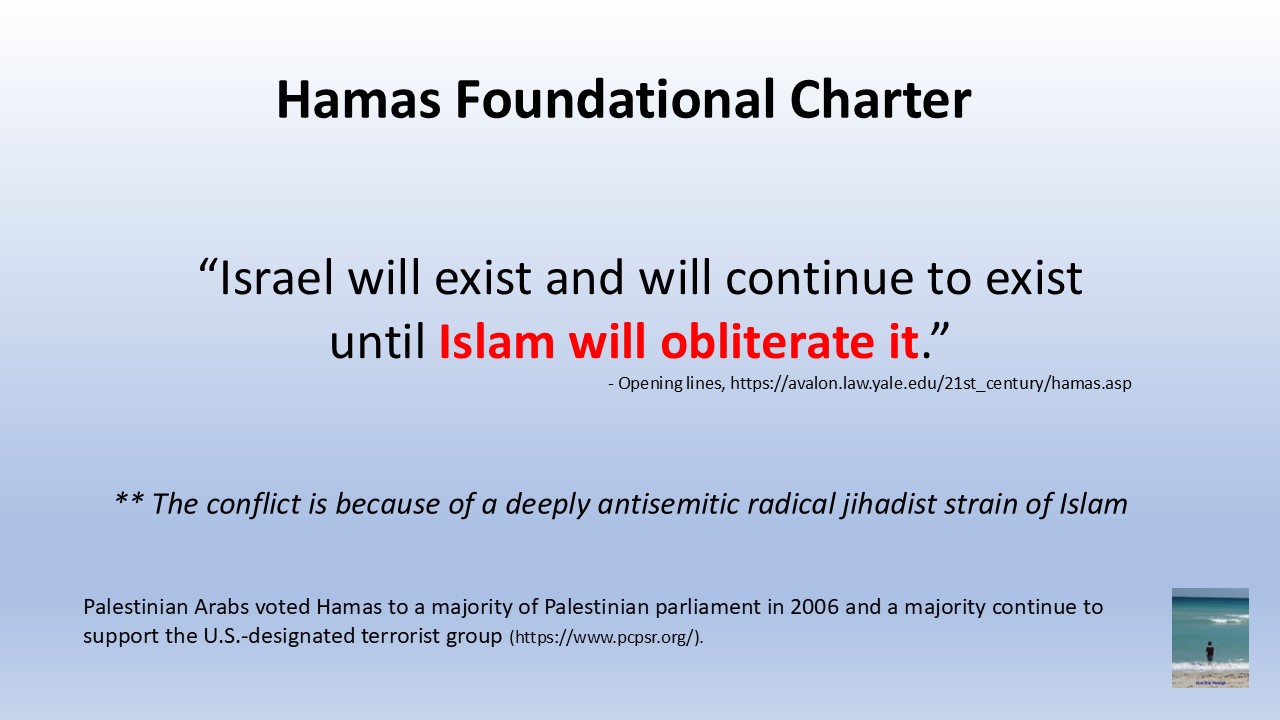
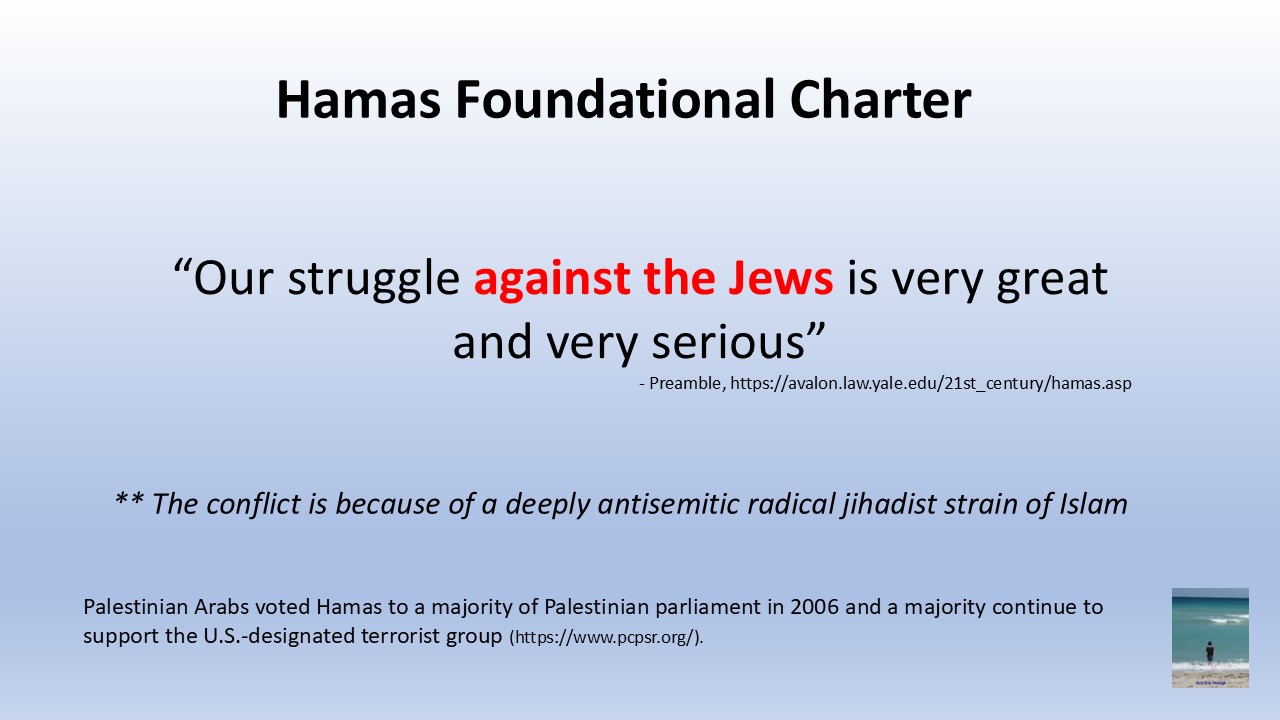
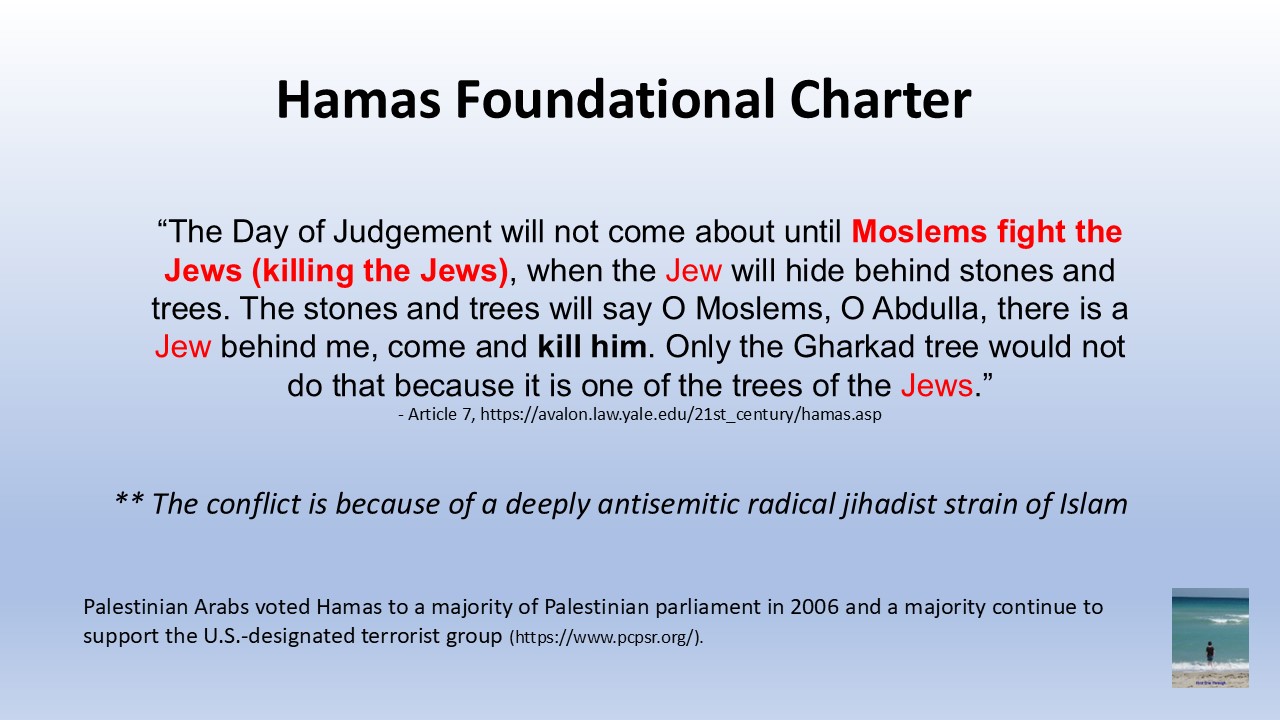
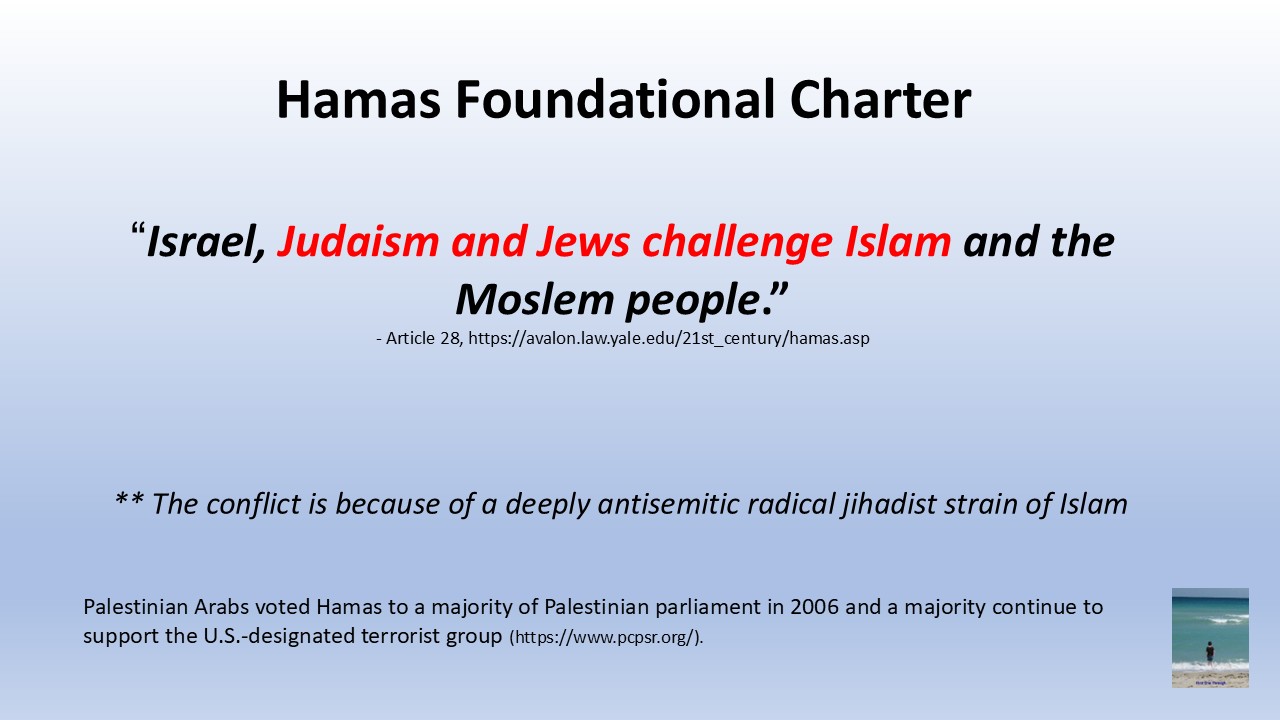
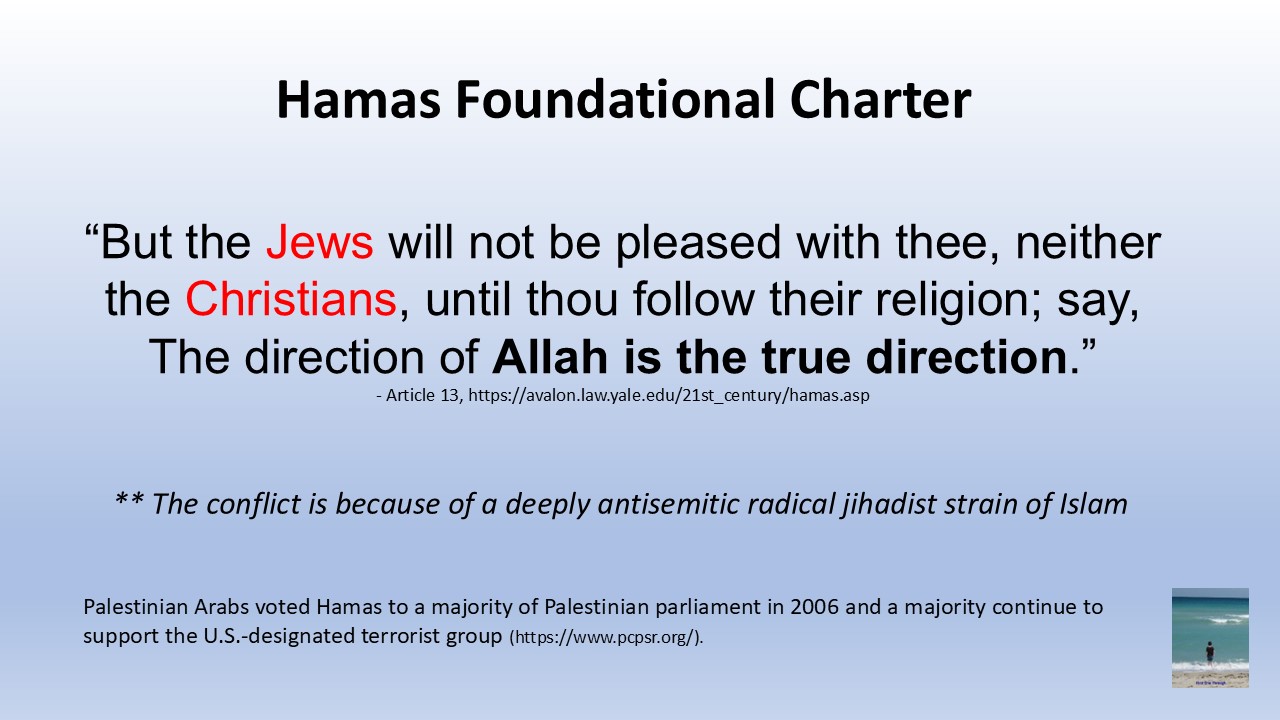
Hamas did not build tunnels because Gazans were poor. Hamas built tunnels because its charter demands Israel’s destruction, because martyrdom is sacred, because jihad is identity. Money did not create this worldview — it merely financed its execution.
You can flood a society with aid, but if its governing ideology is annihilationist, all you finance is a more capable war machine.
Once the UN misdiagnoses ideology as economics, the next failure becomes inevitable.
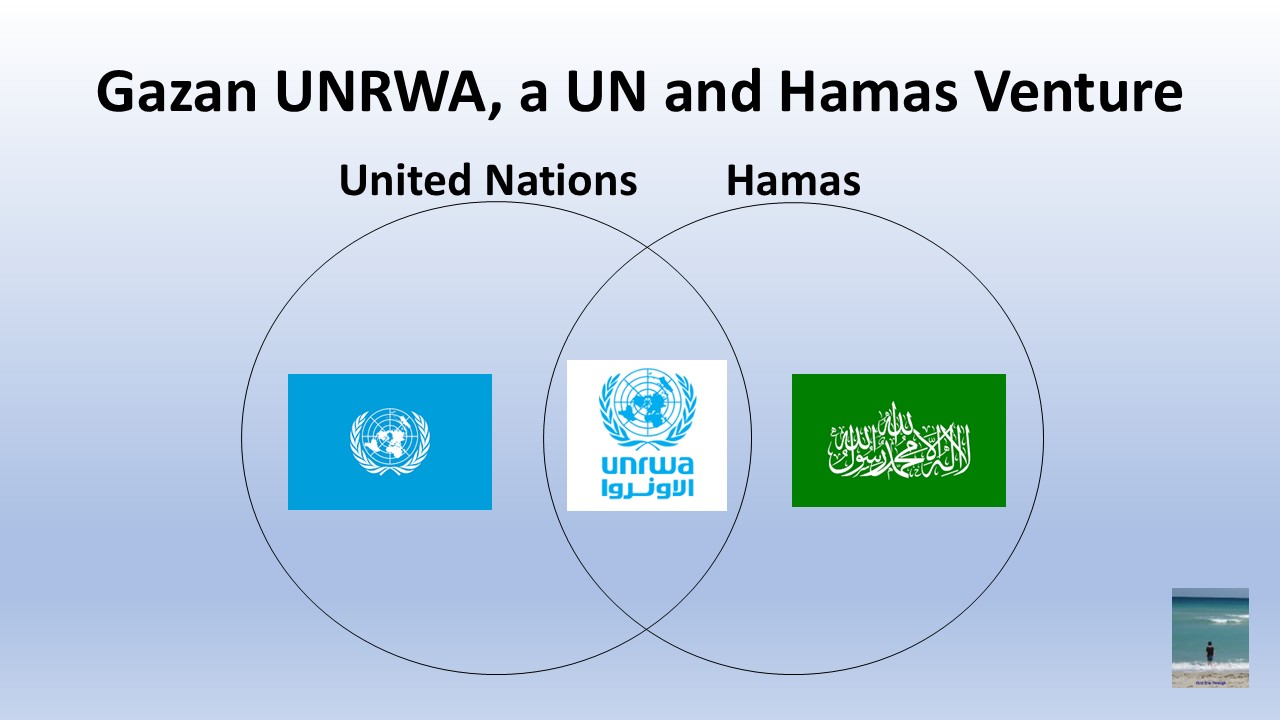
For decades, it has constructed and sustained a grievance system around the Stateless Arabs from Palestine (SAPs) that functions symbiotically with jihadist aims. Through its agencies and resolutions, it has promised millions of SAPs who have never lived in Israel that they will one day “return” en masse into Israel — effectively proposing Israel’s demographic erasure through mass population transfer via international decree.
No state can survive if an external body claims authority over who may enter it and redefine its citizenship from the outside. Yet the UN has made this assault on sovereignty a central plank of its Palestine policy — while calling it “humanitarian.”
Through UNRWA’s unique multigenerational refugee status, displacement becomes inherited identity rather than a temporary humanitarian condition. Grievance becomes doctrine. Statelessness becomes culture. A territorial dispute becomes a perpetual weapon.
And then the UN asks for more money to sustain it.
Why does the UN persist in this inversion?
Because it refuses to judge belief systems.
It will not confront jihad as an ideology. It will not describe Islamic terrorism as such. It will not wade into cultural or civilizational dynamics because it sees itself as a neutral global body.
But neutrality toward ideology does not produce peace. It produces permission.
And because the UN will not fight belief systems, it substitutes economics.
It reframes terror as inequality. It reframes jihad as deprivation. It reframes mass murder as misallocated capital.
In doing so, it becomes part of a broader machinery seeking to shift wealth and power from the Global North to the Global South — not merely for development, but as moral rebalancing, regardless of whether this addresses the real drivers of violence.
Redistribution becomes its ritual response whenever violence erupts.
Which means: more authority, more money, more relevance for the UN.
This is not accidental. It is institutional self-preservation dressed as virtue.
So the world is invited to believe the problem is billionaires rather than beheaders. That terror is born from inequality rather than indoctrination. That peace will come from redistribution rather than defeating enemies.
Evil is not a pocketbook problem. It is an ideology.
And no amount of redistribution will make a death cult lay down its weapons.
Modern conflict is collapsing into a single, repeatable failure mode: when armed power replaces legitimacy, civilian life becomes expendable—and the international system normalizes the outcome rather than correcting it.
From Syria to Yemen, from the Gaza Strip to Somalia and Sudan, different wars follow the same script. Flags and slogans change; outcomes do not. Cities empty, economies collapse, millions flee, and societies become permanent humanitarian wards while armed elites persist.
The mechanics of collapse
Across all five regions, the structure repeats with grim consistency. Power flows from weapons rather than consent, with ideology serving as authority instead of constraining it. Civilians become leverage—through hunger, displacement, and terror—while the outside world manages suffering rather than ending the conditions that cause it.
These dynamics differ in context and scale. They converge in result.
Different conflicts, identical results
Syria survives by sacrificing its cities and people. Yemen turns famine into strategy in a proxy war. Gaza shows armed rule embedded among civilians, shifting the cost of war onto the population. Somalia normalizes permanent instability under jihadist entrenchment. Sudan mirrors the same logic through rival armed elites hollowing out cities and driving mass displacement.
The human outcome is uniform.
A shared demographic reality
Each of these societies is overwhelmingly Muslim-majority— above 90 percent. This matters for clarity. These disasters do not arise from religious diversity or minority rule. They unfold in largely homogeneous societies where armed authority crowds out the chance for peaceful legitimate governance. Shared faith does not restrain violence. Only accountable institutions do—and they are absent across all five.
Two warnings for 2026
First: recognition divorced from reality. The push to recognize Palestine as a sovereign state reflects a dangerous inversion. Recognition is meant to affirm effective governance, restraint of armed actors, and protection of civilians. Gaza demonstrates the opposite. Armed rule persists, civilians absorb the cost, and failure deepens. Recognition under these conditions elevates symbolism over survival and legitimizes collapse.
Second: repression without war. In Iran, an ideological regime in power since 1979 faces economic decline and eroding legitimacy. The response has been internal violence—security forces firing on civilians, mass arrests, repression replacing consent. Iran shows the same pattern without a battlefield: when legitimacy collapses, violence becomes governance.
The United Nations: institutionalizing failure
The United Nations was founded to prevent this exact depravity. Eighty years on, it increasingly fosters it.
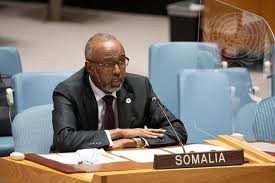
The UN grants equal procedural authority—votes, committee chairs, agenda control—to entities regardless of whether they govern responsibly or sacrifice their populations. Collapse carries no institutional penalty. In January 2026, the UN Security Council, the highest body at the UN, handed the gavel to Somalia, a state unable to protect its citizens or control its territory. Committee chairs shape agendas, manage debate, and mute scrutiny. The signal was unmistakable: mass failure has no consequence.
Somalia assumes head of UN Security Council in January 2026
This structure protects actors who weaponize civilians, including groups like Hamas, while rewarding states that export instability. Humanitarian agencies attempt to save lives on the ground, but UN governance shields the forces that endanger them. Through regional rotation, states implicated in mass civilian harm routinely gain seats, votes, and leadership roles across UN committees—including those charged with protecting human rights—without meeting any threshold of civilian protection.
Entities that systematically sacrifice civilians should lose voting rights and committee authority until they demonstrate basic standards of governance and restraint. Without consequences, international law becomes theater and failure becomes permanent.
The verdict
Syria, Yemen, Gaza, Somalia, Sudan—and the trajectory now visible in Iran—show what follows when sovereignty outweighs civilian life and armed power is indulged as politics. By preserving authority for collapsing entities, the United Nations has become part of the problem it was created to solve.
Civilian survival and protection must be the minimum requirement for legitimacy. If the UN cannot reform to enforce that standard INTERNALLY, then eighty years after its founding, it stands as a faint shadow of its founding principles at best, and an enabler of mass atrocities at worst.
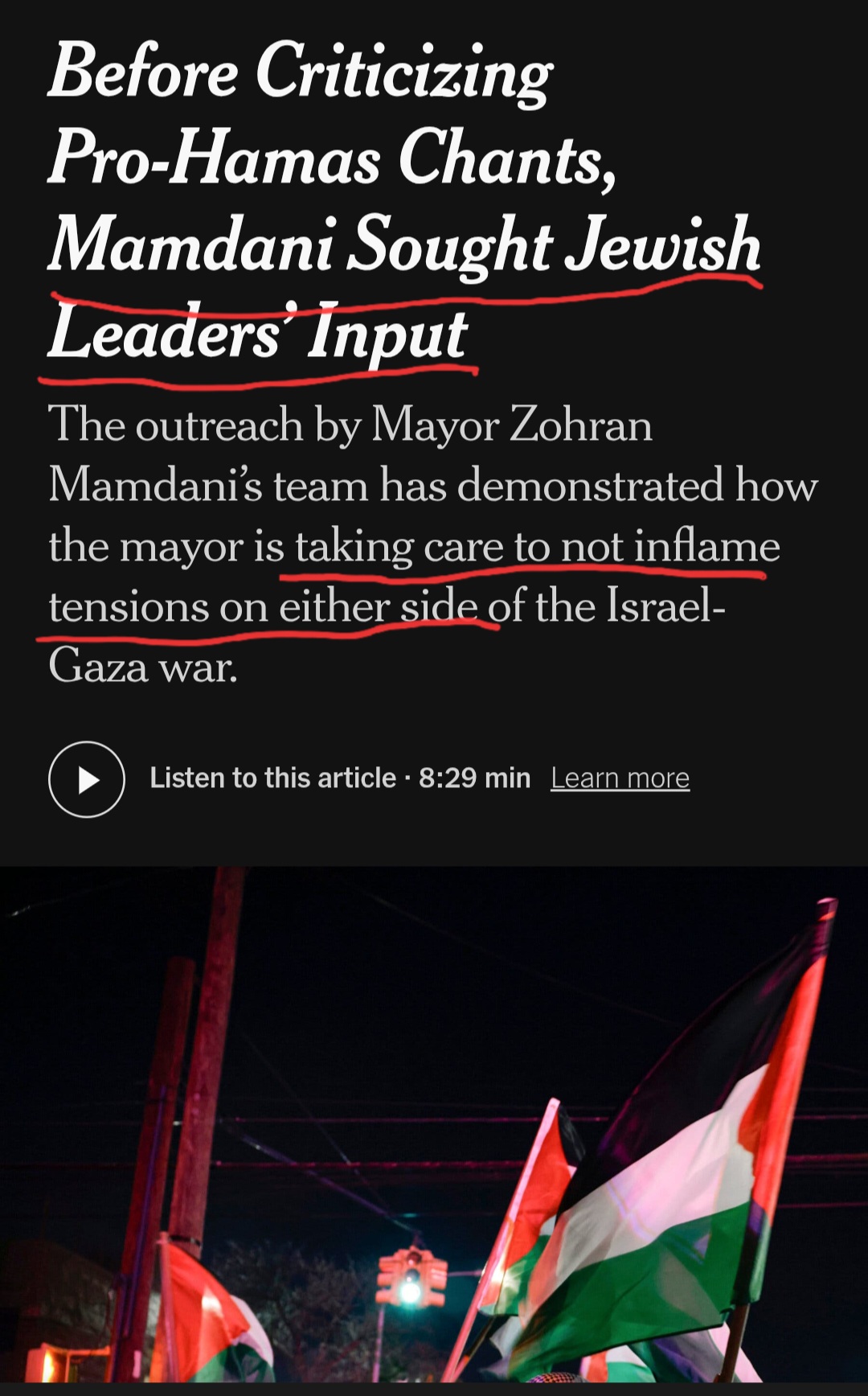
The most consequential move in the New York Times coverage was quiet. It described Mayor Zohran Mamdani’s response to pro-Hamas chants as an effort to avoid inflaming “tensions on either side of the Israel–Gaza war.” The language sounded responsible. It also erased the central reality.
The New York Times is attempting to allay fears of Jewish New Yorkers but softening image of extremist mayor Zohran Mamdani on January 17, 2026
There were no equivalent sides involved. One group openly chanted support for Hamas, a U.S.-designated terrorist organization responsible for mass murder, rape, kidnapping, and calls for genocide. The other side was a Jewish community standing outside its own synagogue, defending it from terrorist sympathizers.
That location matters. This did not unfold at City Hall or on a random street corner. It took place in front of a synagogue. For Jews, synagogues are communal sanctuaries, not neutral backdrops for geopolitical theater. Geography conveys intent. Bringing terror slogans to a Jewish house of worship transforms speech into targeting.
The New York Times chose to smooth this away. By framing the episode as “tension on either side,” it recast explicit support for Hamas as a legitimate pole of community expression. The chant was softened. The targeting dissolved into abstraction. Readers were reassured that calm was being preserved with statements such as “Mr. Mamdani’s team repeatedly debated the wording and fairness of the language,” as if a group chanting for the genocide of Jews required “fairness.”
This is how extremism gets normalized. When terror advocacy demands careful calibration rather than moral clarity, the boundary quietly shifts. Such framing would collapse instantly if crowds praised ISIS outside a mosque or neo-Nazis gathered at a Black church.
Protesters understand what editors seem determined to whitewash: location is the message. No amount of “Palestine-washing” can absolve the antisemitism in the Times coverage.
Reassurance purchased at the cost of truth carries consequences. It teaches extremists that intimidation can be reframed as passion and that targeted terror speech will be treated as just another civic grievance. That does not cool tensions. It redraws the line of what is acceptable.
Pharaoh stood unmoved as the Nile turned to blood. Life-giving water became useless overnight, and the system held. That moment captured the moral reality of the Exodus.
The plagues were not revenge. They were not emotional retaliation for suffering already endured. And they were not even, in the narrow sense, punishment for evil deeds. They were something far more deliberate: the dismantling of a system that could not be allowed to continue.
That distinction matters—then and now.
Revenge, Punishment, and Dismantlement
Revenge is backward-looking. It seeks emotional satisfaction for injury. Punishment is judicial. It assigns guilt and imposes consequences. Dismantlement is future-oriented. It exists to make continued evil impossible.
The plagues fit only the third category.
They were announced in advance. They escalated slowly. It wasn’t rage. It didn’t aim at humiliation. The Torah goes out of its way to show a paced methodology.
Even “punishment” does not fully explain what happens. Punishment targets perpetrators. The plagues targeted foundations: economy, theology, nature, and political myth. The Nile, the body, the sky—everything Egypt relied on to project permanence was stripped away piece by piece.
Why? Because slavery was not a policy failure within Egypt. It was Egypt.
You cannot reform a system built on domination. You cannot shame it. You cannot negotiate it out of existence. You have to break the assumptions that make it feel eternal.
That is what the plagues did. They delivered a message: “You are not absolute—and the time for evil has ended.”
The Same Moral Error Reappears Today
That same confusion appears again in the way Israel’s war in Gaza is discussed.
Since October 7, critics have insisted that Israel is acting out of revenge, wounded pride, or collective punishment. That reading repeats the same error people make about the plagues: it projects human emotion onto a campaign that is structural in nature.
If Israel were seeking revenge, Gaza would already be erased. If this were punishment, the war would end with confessions and symbolic justice.
Neither is happening.
Israel is trying to end a war by dismantling the system that made it inevitable.
Hamas is not a fringe militia. It is the elected majority of the Palestinian parliament and ruling authority in Gaza. It is immensely popular. Over years, it constructed a comprehensive war society: tunnels beneath homes, schools, and mosques; civilian infrastructure fused with military command; education and media organized around eradication; international aid converted into weapons. Violence was not a breakdown. It was the operating principle.
As in Egypt, brutality was not an abuse within the system. It was the system.
You cannot coexist with that indefinitely. You cannot contain it forever. You cannot pause it and hope it reforms while leaving its foundations intact.
Why Ending the System Is Not Cruelty
Calls for ceasefire without dismantlement may sound compassionate but mirror Pharaoh’s promises: temporary relief with permanent structures preserved. The Torah teaches us to distrust that move. Pauses without transformation merely reset the cycle.
Israel’s campaign is not about humiliation. It is about limits. No governing authority may embed genocide into its ideology. No regime gains immunity by hiding behind civilians. No society organized around death gets an unlimited future.
Ending such a system is not revenge. It is moral necessity.
The near-term ramifications of Hamas’s war against Israel are being crystalized. Hamas’s leadership is decimated and Gaza is in ruins. The political-terrorist group’s allies in Lebanon, Syria, Iran and Yemen have been dealt severe blows, perhaps fatal for some. Hamas’s cheerleaders in the Global North are the only ones to have gathered momentum, particularly in Australia and the United States where hunting season for Jews has a seemingly open permit.
To gain insight for the next tactical steps, world leaders are looking at the current situation and polls since October 7, 2023 and have drafted proposals and taken initial actions: The United Kingdom and Canada recognized a Palestinian State. The U.S.’s Trump administration put forward a plan for Gaza which would include a new governing entity. The West hopes that the targeted assaults and murder of Jews will peter out along with the end of war. And the United Nations keeps playing the same tune about supporting UNRWA.
These are bad decisions and conclusions, made on faulty assumptions.
There is an organization that has been polling Palestinian Arabs for decades, called the Palestinian Center for POLICY and SURVEY RESEARCH (PCPSR). It conducted a poll of Arabs in Gaza and the West Bank, just before the Hamas-led war, from September 28 to October 8, 2023. Because of the war, the results did not get published until June 26, 2024, and the world was too focused on the war to pay it any attention. It is deeply unfortunate, and it is required reading to help chart a better future for the region.
To start with the poll’s conclusions:
A large percentage of Palestinian Arabs have wanted to leave Gaza and the West Bank for years, not from the current destruction
Arabs are fed up with their own government – Hamas and the Palestinian Authority – much more than Israeli “occupation”
Canada is viewed much like Qatar for Gazans, a sympathetic haven
Palestinian Arabs Wanted to Emigrate Before the War
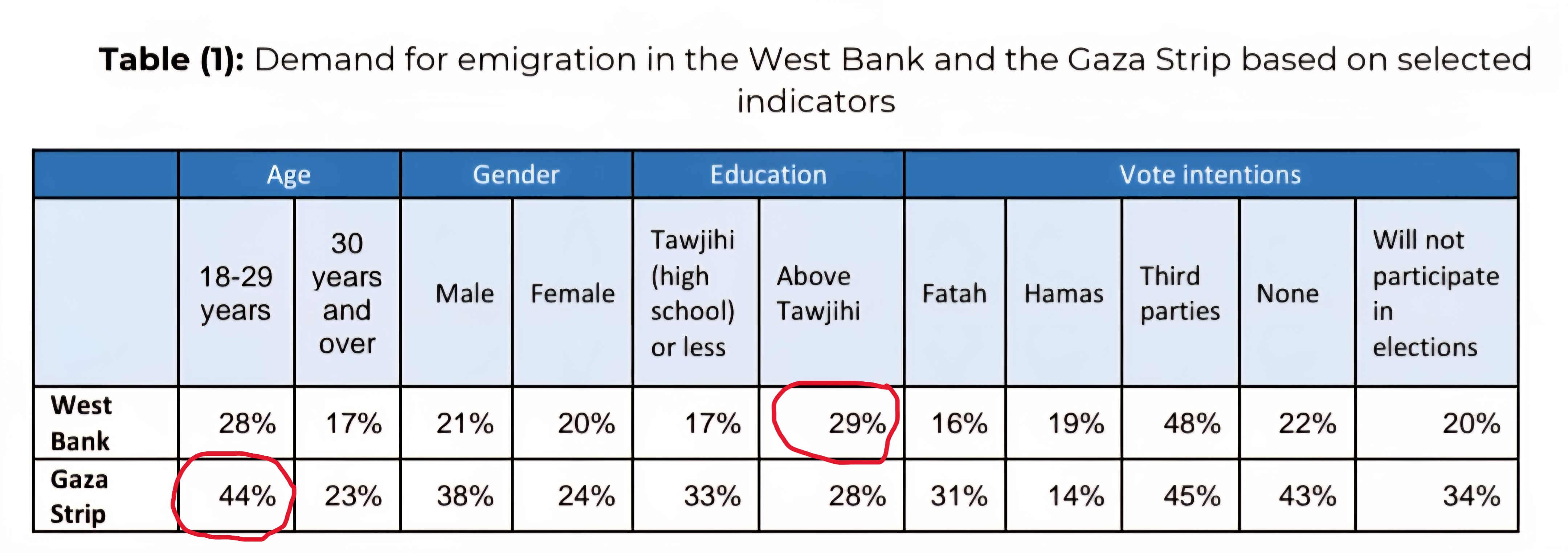
According to PCPSR, whether in October 2023 or November 2021, roughly 33% of Gazans and 20% of West Bank Arabs wanted to leave the region.
Men below age 30 make up the vast majority of those seeking to emigrate. As opposed to Gaza where both educated and uneducated people want to leave, it is the educated West Bank population that wants to move away. Among those wishing to leave, many would not vote in Palestinian elections, or if they would, they would sooner vote for third parties over Fatah or Hamas.
Palestinian Leadership is the Curse, More than Israel
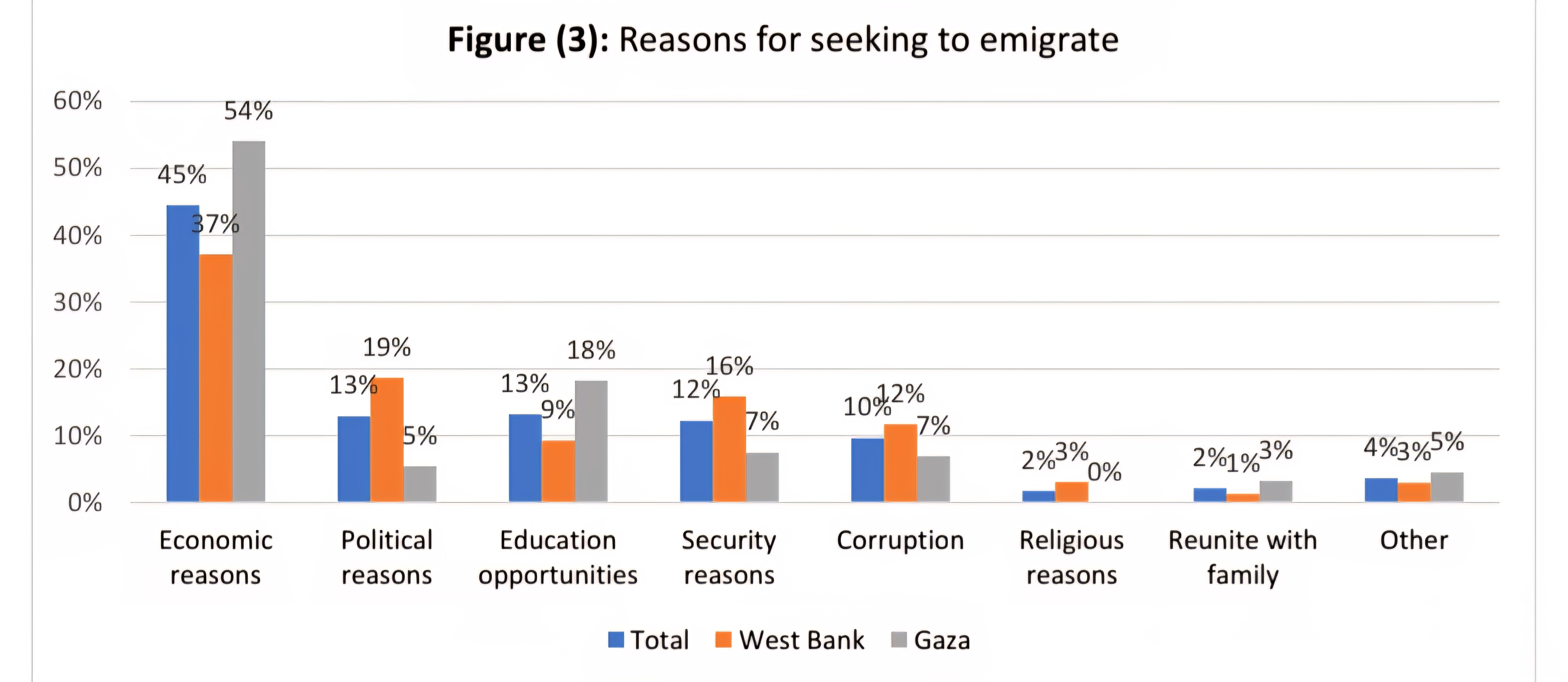
The number one reason for wanting to leave was economic conditions by a far margin. Reasons two and three were political reasons and educational opportunities. “Security reasons” came in fourth, with only 7% of Gazans focused on security; 12% overall. Corruption, religious reasons and to reunite with family rounded out the poll.
Canada as a Beacon
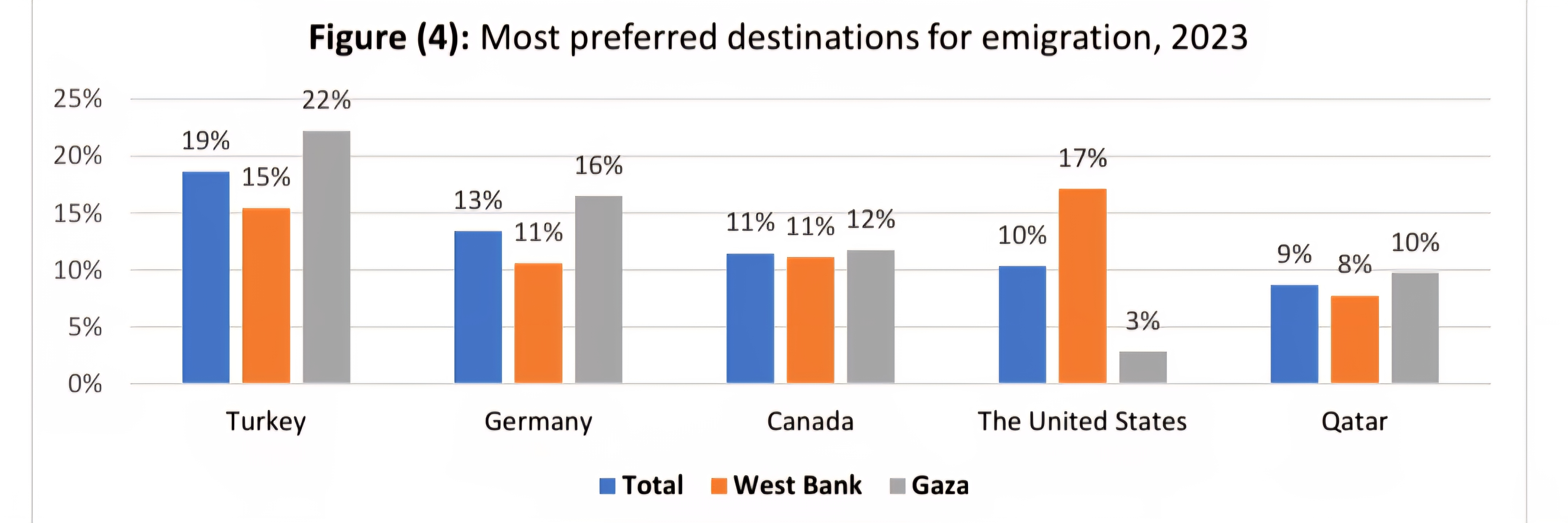
Turkey and Germany were the two most favorite destinations, especially for Gazans. Very few Gazans (3%) considered the United States, while West Bank Arabs put it as the number one choice (17%), likely seeking advanced degrees at left-wing universities. What is remarkable, is more of the Stateless Arabs (SAPs) would prefer going to Canada (11%) than Qatar (9%), the wealthy Muslim Arab nation that is a main sponsor of Hamas.
Honest Takeaways
These pre-war results leads to some basic and critical conclusions.
Complete Overhaul of Palestinian leadership, not just in Gaza
The desire of Arabs to leave was evident across both Gaza and the West Bank for many years. This was not a reaction to bombing or siege; it was a verdict on governance.
Hamas in Gaza rules through repression, diversion of aid, and religious militarism. The Palestinian Authority in the West Bank offers corruption, authoritarianism, and political stagnation. Together they have produced a society with no credible economic horizon, no accountable leadership, and no peaceful mechanism for change.
While a new entity is needed to administer Gaza, that role should be akin to a Chief Operating Officer overseeing construction. The Palestinian Authority itself needs to be gutted and rebuilt as it is a corrupt, unpopular and ineffective entity.
The United Nations Must Withdraw from Gaza and the West Bank
In its desire to create a Palestinian state, the U.N. has stripped the titular heads of Palestine of any responsibility. The UN protects Hamas despite its savagery. It props up the Palestinian Authority despite its rampant corruption. Palestinian leadership is a bed of paper scorpions.
The UN must withdraw from Gaza and the West Bank and allow local authorities to build a functioning leadership team.
The West Should Rescind Recognition of Palestine
There is no functioning Palestinian government and therefore no basic standard to recognize a Palestinian State. The United Kingdom, Australia and others should withdraw their recognition and make it conditional on building governing institutions that can lead and make peace with the Jewish State next door.
Reeducation in the West
The massacre did not arise from a sudden spike in pressure. It emerged from long-standing internal failure. Hamas chose atrocity because it couldn’t commit a complete genocide of Jews so exploited its own population to be fodder for Israel.
Western audiences were then handed a familiar script, complete with pictures. But the data taken just before the massacre tells a different story—one far more consequential. What is being taught in western public schools is divorced from reality and feeds global and local antisemitism.
Oh No, Canada
While the fears of antisemitism are focused on the United States and Australia because of recent attacks on Jews, Canada is in the hearts and minds of Palestinian Arabs seeking a warm diaspora community. Perhaps it started a decade ago under Justin Trudeau who followed U.S.’s President Barack Obama to embrace the Palestinian cause and Iranian regime over Israel. Perhaps it is because of the welcome mat for extremists groups like Samidoun. Or perhaps it is the perception that the heckler’s veto is fair game, and can run Jewish families off Canadian streets.
Whatever the inspiration, Canada is widely perceived as permissive, ideologically indulgent, and administratively porous—an attractive environment for “political activism” untethered from civic responsibility. It is a ticking time bomb.
The poll of Palestinian Arabs on the eve of the October 7 war reveals deeper truths than surface shots of leveled homes. The PCPSR findings point to a single truth: the Palestinian problem is fundamentally internal.
Ending Israeli control over territory without dismantling corrupt and extremist institutions will not deliver prosperity or peace. Statehood layered on top of dysfunction will harden it. And exporting populations shaped by jihadist rule into permissive Western societies without serious screening and integration, risks importing instability rather than relieving it.
The headlines are the same. Another plot uncovered. Another attacker radicalized online. Another manifesto stitched together from familiar phrases about vengeance, purity, and divine obligation.
Was it ISIS-inspired? Was it Hamas-aligned?
In practice, the distinction is collapsing.
From Manchester to Sydney and across Europe and North America, security services increasingly encounter the same ideological core animating different actors. Antisemitism framed as righteousness. Violence framed as duty. Death framed as meaning. The slogans vary, the flags change, but the belief system underneath remains remarkably consistent.
ISIS flag on the car of murderers in Sydney, Australia
These movements are not converging by accident. They are aligned by doctrine. They are the banners of jihad.
When stripped of geography, branding, and media strategy, Hamas and the Islamic State reveal the same worldview: a sanctified war against Jews, against pluralism, and against life itself.
They are branches of the same antisemitic death cult.
God Alone Rules
Both movements begin with a totalizing claim: sovereignty belongs exclusively to God. Political authority, democratic choice, civil law—all are illegitimate intrusions into divine rule. Religion is not guidance; it is command.
This theology leaves no room for coexistence. Difference becomes defiance. Dissent becomes apostasy. Submission is the only acceptable outcome.
Violence as Obedience
Violence is not an unfortunate consequence of struggle. It is the struggle. Jihad is framed as obligation, killing as faithfulness, death as fulfillment.
This is why attacks around the world feel interchangeable. Civilian targets are central because civilians matter symbolically. Children are drawn into the story because innocence amplifies impact. Suicide becomes virtue because it collapses the distance between belief and action.
When ideology outranks life, mass killing is not excess. It is alignment.
Jews as a Theological Obstacle
The conflict is often described in political or territorial terms, but the animating hostility is theological. Jews are cast as an enduring enemy embedded in sacred narrative, not as a community with whom disagreement might be resolved.
That framing explains the permanence of the war. Agreements become pauses. Ceasefires mere tactics. The goal is not compromise but eradication.
Scripture, once weaponized, does not negotiate.
Death as Currency
In societies shaped by this ideology, death is elevated and life is instrumentalized. Martyrdom replaces mourning. Sacrifice replaces survival. Civilian neighborhoods are folded deliberately into military design.
Homes, schools, mosques, hospitals become launchpads and shields. Suffering is curated for export. Images of devastation are not collateral damage; they are strategic output.
What the outside world experiences as tragedy, the ideology treats as leverage.
Power Without Freedom
The end state is always the same. Total control enforced by fear and sanctified by religion. No speech outside doctrine. No faith outside orthodoxy. No dignity outside obedience.
ISIS ruled this way openly. Hamas learned to cloak the same destination in the language of resistance and grievance. The structure beneath remains unchanged.
The Lesson Already Learned
When ISIS surged across Iraq and Syria, the West recognized the threat clearly. It did not argue for partial containment. It did not imagine ideological evolution. It organized, committed resources, and dismantled the movement.
And it succeeded. For a while.
Israel has carried that same burden. By Israel’s own assessments, roughly 95 percent of Hamas’s fighting capacity—its leadership, battalions, tunnels, and command infrastructure—has been destroyed.
Stopping here would not stabilize anything. Allowing the group to maintain its weapons – the way the majority of the Stateless Arabs from Palestine (SAPs) want – would preserve the conditions for revival. Ideologies built on sanctified violence do not soften when wounded. They metastasize.
The remaining fragments are not a political movement in transition. They are an ideology waiting to rearm, re-export, and re-infect—far beyond Gaza.
Yet the world is rearming and financing ISIS and Hamas. It is allowing the jihadi groups to gain strength.
The world once understood this when ISIS was the name on the banner. The jihadist doctrine of Hamas is the same and has not changed. Only the branding has.
Hamas leadership promises to continue war against Israel forever
ISIS in Africa in Somalia, recruiting from around the world













 First One Through