US Ambassador to Israel Mike Huckabee interviewed by Tucker Carlson
He cannot redraw borders. He has no authority to even set U.S. policy, let alone Israel’s.
Yet the reaction was immediate: he was condemned and vilified through the Muslim world.
At the same time, doctrines that openly reject Israel’s existence are treated as mere rhetoric.
Israel’s record makes the contrast unavoidable. After military victory, it returned the Sinai Peninsula to Egypt. It withdrew from Gaza, dismantling settlements and military presence. Few states concede territory after defeating enemies committed to their destruction.
The popular political-terrorist group Hamas begins from the opposite premise. Its doctrine frames the land as “waqf,” a permanent religious trust, and within the logic of Dar al-Islam, territory that can never be relinquished because it was once ruled by Muslims. This is not metaphor but structure. The conflict is defined as unfinished until sovereignty changes.
And this doctrine is not isolated to a particular politician.
Qatar and Turkey – on a sanctioned national level as a matter of policy – host and politically enable Hamas leadership. They provide access, legitimacy, and endurance for a movement whose framework rejects Israel’s permanence as a foundational principle.
The asymmetry is stark.
A Western figure referencing ancient Jewish kingdoms triggers global outrage. A movement invoking waqf and Dar al-Islam to destroy the Jewish State draws no scrutiny.
This is dangerous narrative selection.
Speculative Jewish expansion is treated as imminent risk, while explicit ideological rejection of Jewish sovereignty is normalized.
In this world view, Jewish history is reframed as provocation and therefore the basic fabric of Jewish peoplehood is positioned as dangerous to be erased. At the same time, maximalist jihadi philosophy is normalized into diplomatic background.
And the press keeps feeding you this antisemitic bile, and no one pauses to call it out.
The core issue in the Middle East is the attempted obliteration of Jewish history and the presence of Jews in the name of Islamic supremacy. We are seeing it daily but failing to identify it plainly.
The Jewish state is offered acceptance on two terms: 1) become less Jewish, and 2) take in those who want to end the Jewish State permanently.
The first demand asks the Jewish state to thin the very idea that created it. The national home is treated as temporary, acceptable only if its defining character softens and disappears.
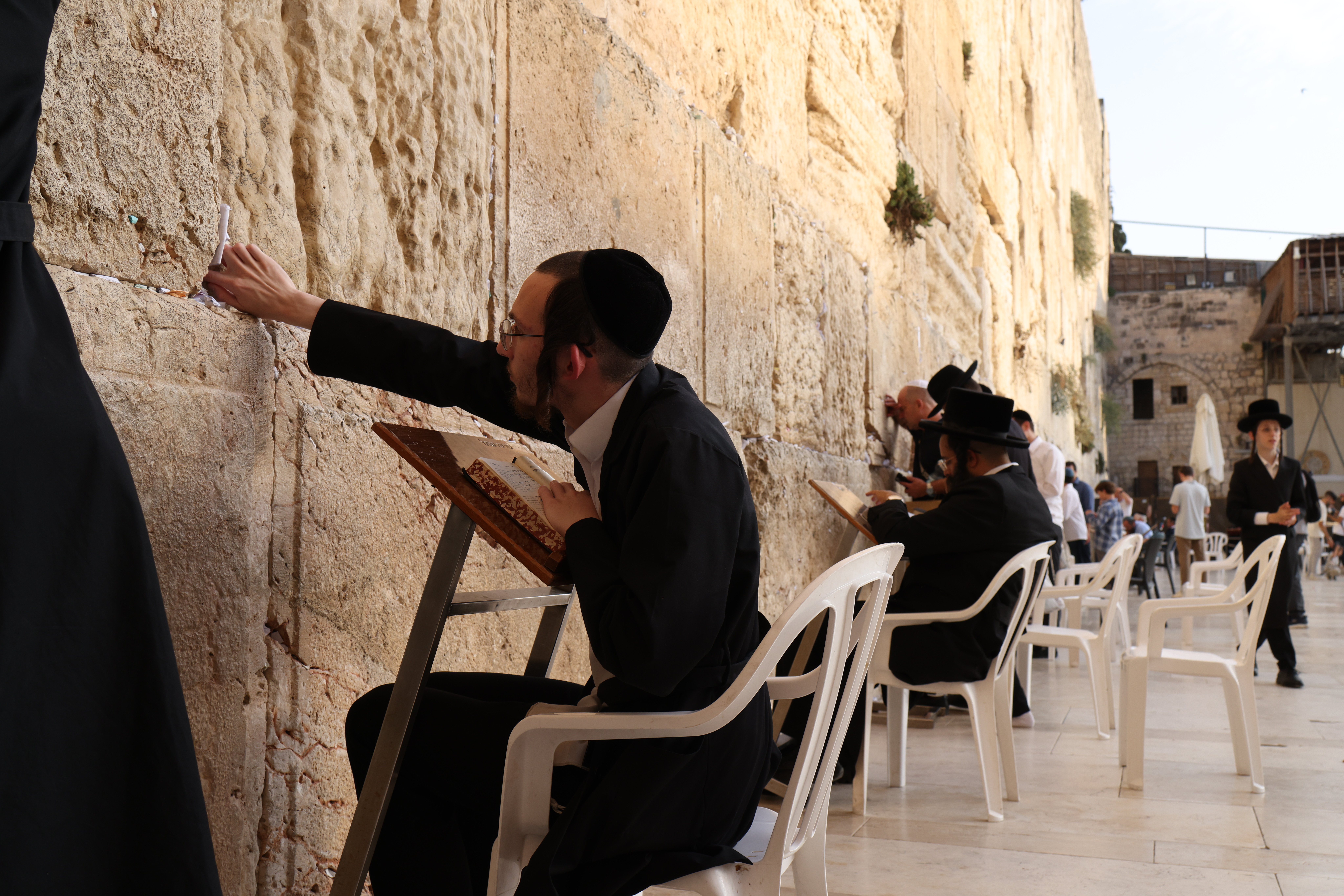
People learning and praying at the Western Wall (Photo: First One Through)
The second demand asks the state to normalize existential risk. The perpetual state of war and support for killing Jewish civilians is ignored is rationalized under the rubric of Arab “frustration.”
Each demand strains reality. Together they form a toxic contradiction.
A country cannot weaken the basis of its existence while expanding exposure to those who challenge that existence, and still promise a degree of safety to its citizens. The condition for global approval erodes the basic condition for survival.
This is the impossible conditional embedded in international language, highlighted in UN resolutions. Acceptance in the Middle East and the community of nations is framed as the reward for steps that make recognition unnecessary because the conflict’s central object -the Jewish state – is expected to disappear into a new secular bi-national entity at best, and from the face of the Earth at worst.
Unsurprisingly, Israel cannot accept such terms. So the UN blesses the violence against it.
Remarkably, the world cannot understand why Israelis will not embrace the offer of acceptance coupled with the demand for self-immolation.
The Olympics are a unique time when the national anthems of many countries get played in succession. It is a time to consider how unique Israel’s anthem is.
Hope versus Superiority and Sacrifice
Most of the national anthems in the world were written to rally a nation. They evoke war themes and superiority over a nation’s foes. Consider the United States anthem about “the rockets red glare, the bombs bursting in air,” or Germany’s original “Germany, Germany over all. Over everything in the world!”
In the Muslim Middle East, most countries have anthems that describe sacrifice:
But the State of Israel’s national anthem “Hatikvah” is about hope. Not superiority. Not vendetta, sacrifice or struggle. HOPE.
Its Capital City
While most countries’ anthems surround themes of victory and struggle, Israel uniquely focuses its anthem on its capital city, Jerusalem. In fact, no other country even mentions its capital, while Israel does so in an anthem just a few lines long.
One of the Oldest in the Middle East
The world changed dramatically after the end of World War I, with the collapse of the Austria-Hungarian and Ottoman empires, the end of the USSR, and end of decolonization. The number of countries multiplied over the last century, to nearly 200 today.
Israel’s national anthem is the oldest of the new nations, especially in the Middle East.
Israel written in 1878
Turkey 1921
Syria 1938
Jordan 1946
Libya 1951
Oman 1970
Kuwait 1978
Tunisia 1987
Iran 1990
Yemen 1990
Palestinian Authority 1996
Iraq 2004
While Jews are falsely accused of being recent interlopers and invaders, with no right to live in Jerusalem, and the Jewish State is smeared as a racist country built on superiority and imperialism, its national anthem is the oldest in the region, only speaks of hope and freedom, and is uniquely about its capital city of Jerusalem.
Israel national anthem:
As long as in the heart within, The Jewish soul yearns, And toward the eastern edges, onward, An eye gazes toward Zion.
Our hope is not yet lost, The hope that is two-thousand years old, To be a free nation in our land, The Land of Zion, Jerusalem.
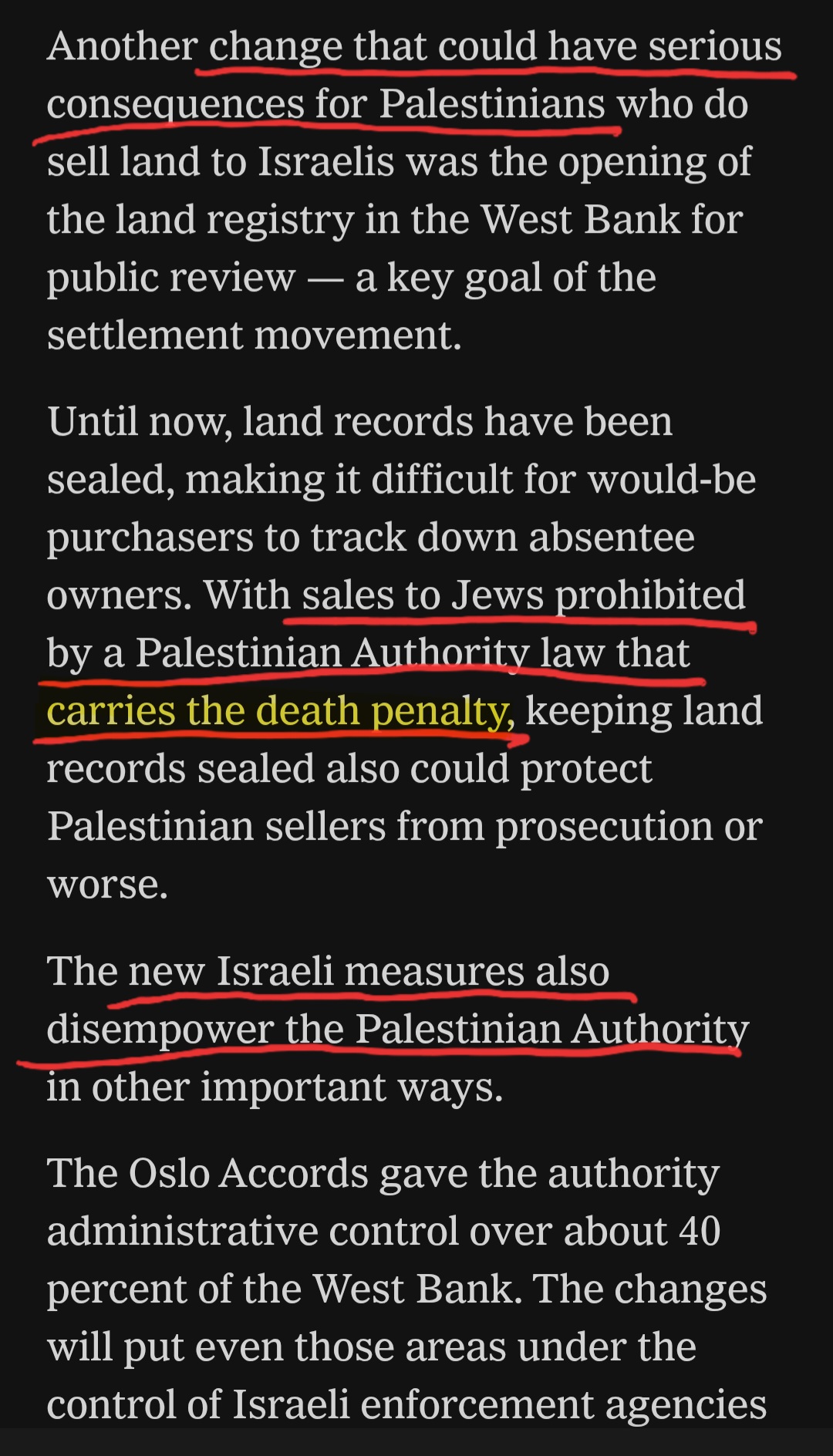
One fact should dominate any serious discussion of land and power in the West Bank: under Palestinian Authority law, a Palestinian who sells land to a Jew can face the death penalty.
That is not rumor or polemic. It is statute.
In areas governed by the Palestinian Authority in the West Bank and by Hamas in Gaza, selling land to Israeli Jews is prosecuted as treason. The charge is brought under Jordanian Penal Code No. 16 of 1960 — particularly Articles 113–118 and Article 114 on aiding the enemy — still in force in the West Bank, along with the PLO Revolutionary Penal Code of 1979. A 2014 decree by Mahmoud Abbas reaffirmed that such land sales constitute “collaboration with the enemy.” Courts have issued death sentences under these provisions.
The defining element is the identity of the buyer. A private real-estate transaction becomes a capital crime because the purchaser is Jewish and therefore legally framed as part of the “enemy.” Most countries reserve treason for espionage, armed rebellion, or wartime assistance to a hostile state. The Palestinian framework instead applies classic treason law to a civilian property sale — explicitly treating Jews, as a national collective, as the enemy for purposes of capital punishment.
Yet when the New York Times recently acknowledged this, it did so quietly, almost apologetically, inside an article whose primary concern was Israeli policy. The focus was not the law itself, but the risk that Israeli transparency might expose Palestinian Arabs to danger because the law exists.
That framing reverses cause and effect.
Israel was portrayed as aggressive and ideological, while the Palestinian Authority’s capital punishment for a racially defined transaction was treated as background context. Israeli officials were labeled “right-wing” and scrutinized by name. The PA, which enforces a law rooted in religious antisemitism, was spared comparable description. Its ideology went largely uninterrogated.
The article even suggested that sealed land records once served as a form of protection for Palestinians. That sentence alone concedes the nature of the regime. A governing authority from which citizens must be shielded because it may kill them for selling property to Jews is not a peace partner. It is a theocratic system enforcing ethnic taboos with lethal force.
If a Jewish state executed Jews for selling land to Arabs, that law would dominate media coverage. Instead, when Jews are the forbidden buyers, the death penalty becomes an inconvenience and the exposure of it becomes the problem.
UN Secretary-General Antonio Guterres “warns that the current trajectory on the ground, including this decision [to unseal the names of the owners of land making private real estate transactions easier], is eroding the prospect for the two-State solution. He reiterates that all Israeli settlements [the physical presence of Jews east of the 1949 Armistice Lines between Israel and the Kingdom of Transjordan, which specifically stated were not to be considered borders] in the occupied West Bank, including East Jerusalem, and their associated regime and infrastructure, have no legal validity and are in flagrant violation of international law, including relevant United Nations resolutions.”
This is how extremist antisemitism is normalized: by treating it as an immutable local condition, while directing moral outrage at those who reveal it. When selling land to a Jew carries a death sentence, that fact is not incidental. It is the moral center of the conflict.
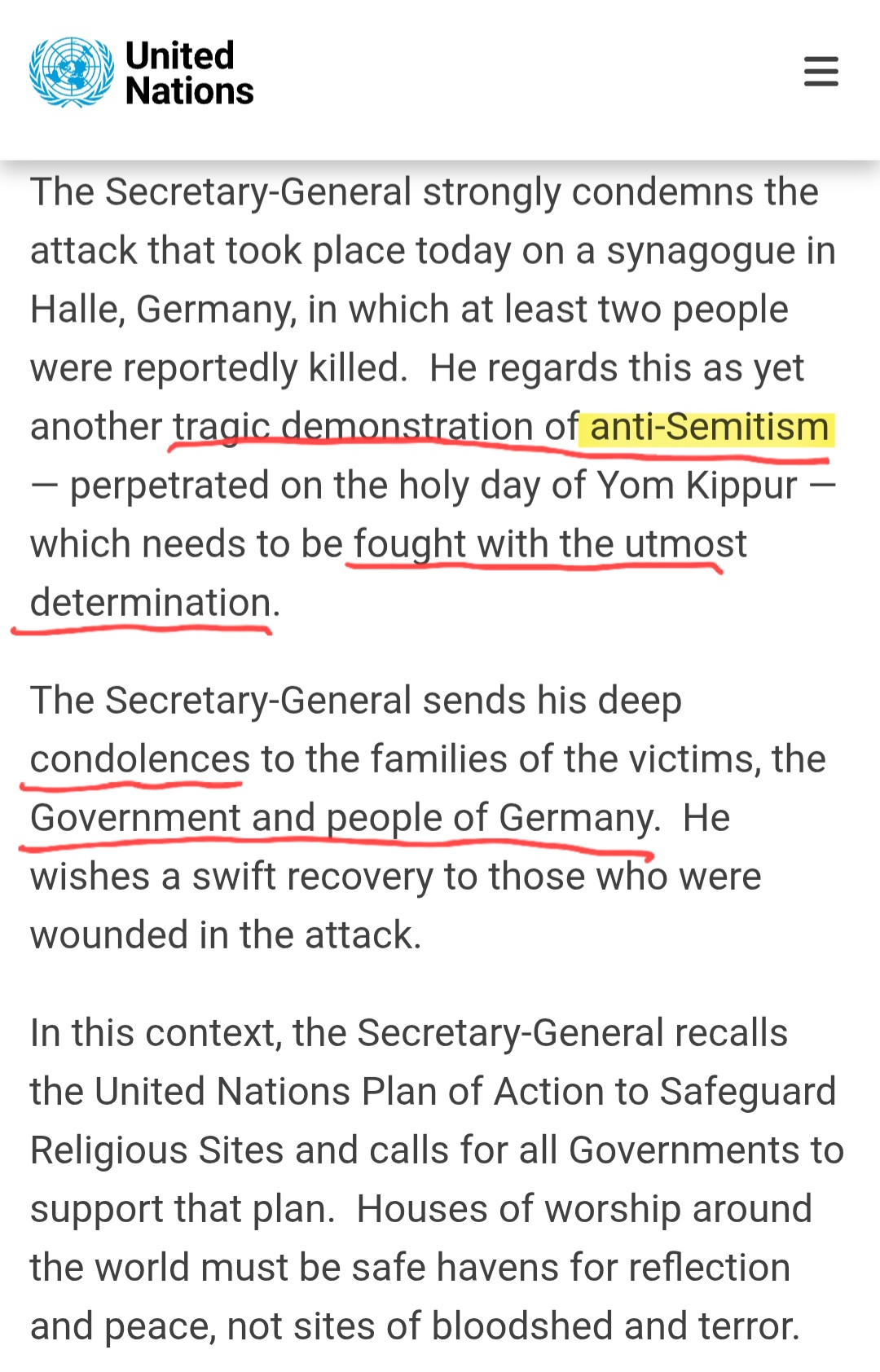
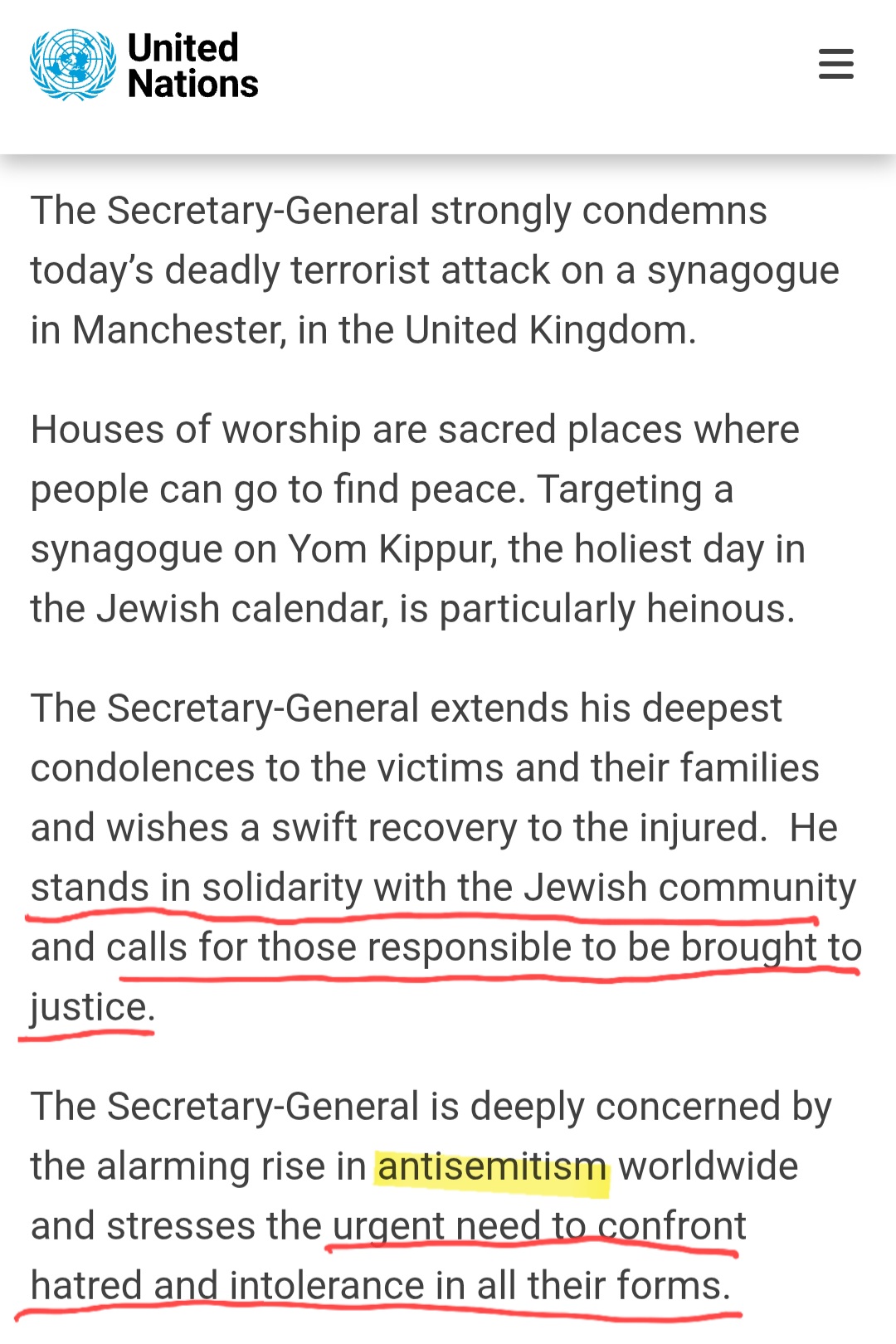
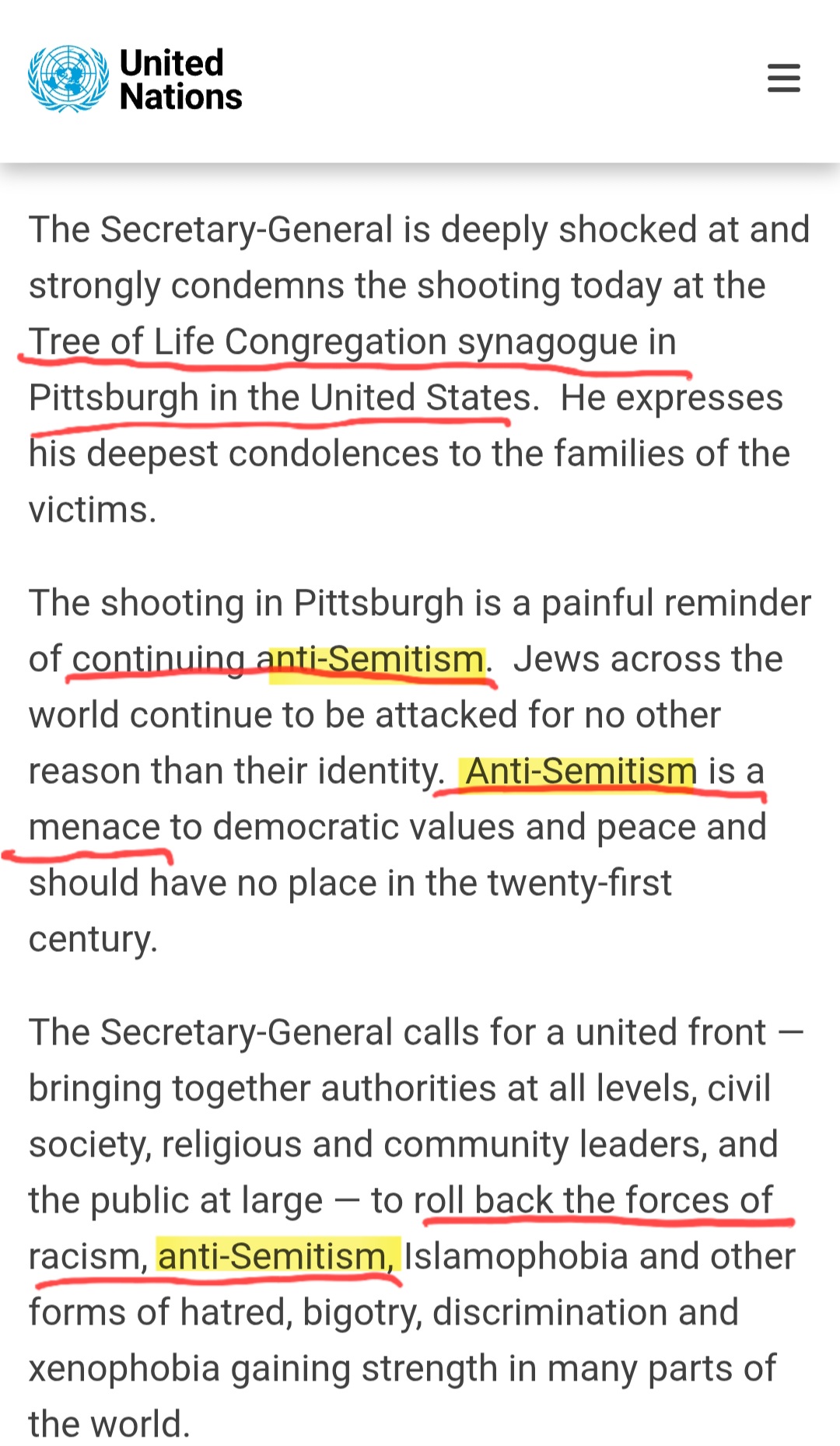
When Jews are murdered in synagogues in Europe, the United Nations speaks plainly. The attacks are labeled antisemitic. The violence is called terrorism. Solidarity with the Jewish community is explicit, and justice is demanded.
When Jews are murdered in synagogues in Jerusalem, that clarity vanishes.
The same act—killing Jews at prayer—suddenly requires “context.” Terrorism is softened into “violence.” Antisemitism dissolves into “tensions.” Victims are anonymized, motives left unexplored, ideology carefully avoided. Language that flows easily in Europe locks up entirely in Israel’s capital.
UN Secretary-General never calls killing of Jews in Jerusalem rooted in “antisemitism.”
This is not rhetorical drift. It is doctrine.
The UN has formally adopted the Palestinian demand that Jews should not live in Jerusalem. Through measures such as UN Security Council Resolution 2334, it asserts that Jews may not alter the city’s “demographic composition.” That position freezes Jerusalem at a moment immediately following the Jordanian army’s ethnic cleansing of all Jews from the eastern half of the city between 1948 and 1967. Jewish expulsion is accepted as a legitimate baseline. Jewish return is treated as a violation of international law.
This is not neutrality. It is the institutionalization of an antisemitic premise: that Jews, uniquely among peoples, have no right to live in their holiest city.
Once that premise is accepted, Jewish life in Jerusalem becomes conditional. Jewish neighborhoods are labeled illegal. Jewish prayer is framed as provocation. Jewish presence itself is cast as destabilizing. Violence against Jews no longer reads as antisemitism but as political reaction to an allegedly illegitimate reality.
Under those conditions, motive cannot be named. Calling synagogue murders in Jerusalem “antisemitic terrorism” would require acknowledging that Jews are being targeted for who they are, in a city where the UN has already ruled they should not be. It would expose the connection between UN doctrine and the moral evasions that follow.
So the motive is omitted.
Aftermath of Jews slaughtered in synagogue
The UN does not merely tolerate the idea of Jews being removed from Jerusalem; it has encoded it. The language is bureaucratic—demographics, international law, peace—but the result is stark: a city where Jewish existence is treated as unlawful, and Jewish murder as a political complication.
The contrast with the rest of the world makes the pattern undeniable. The UN knows exactly how to speak about antisemitism. That moral vocabulary disappears only in Judaism’s holiest city, in the Jewish State’s capital, because the United Nations has endorsed the antisemitic wishes of radical jihadists.
By any ordinary moral standard, the murder of worshippers in a house of prayer should provoke the clearest possible response: name the crime, demand justice, stand with the people and the government under attack. No hedging. No balancing. No political caveats.
The United Nations does that, except when Israeli Jews are the victims.
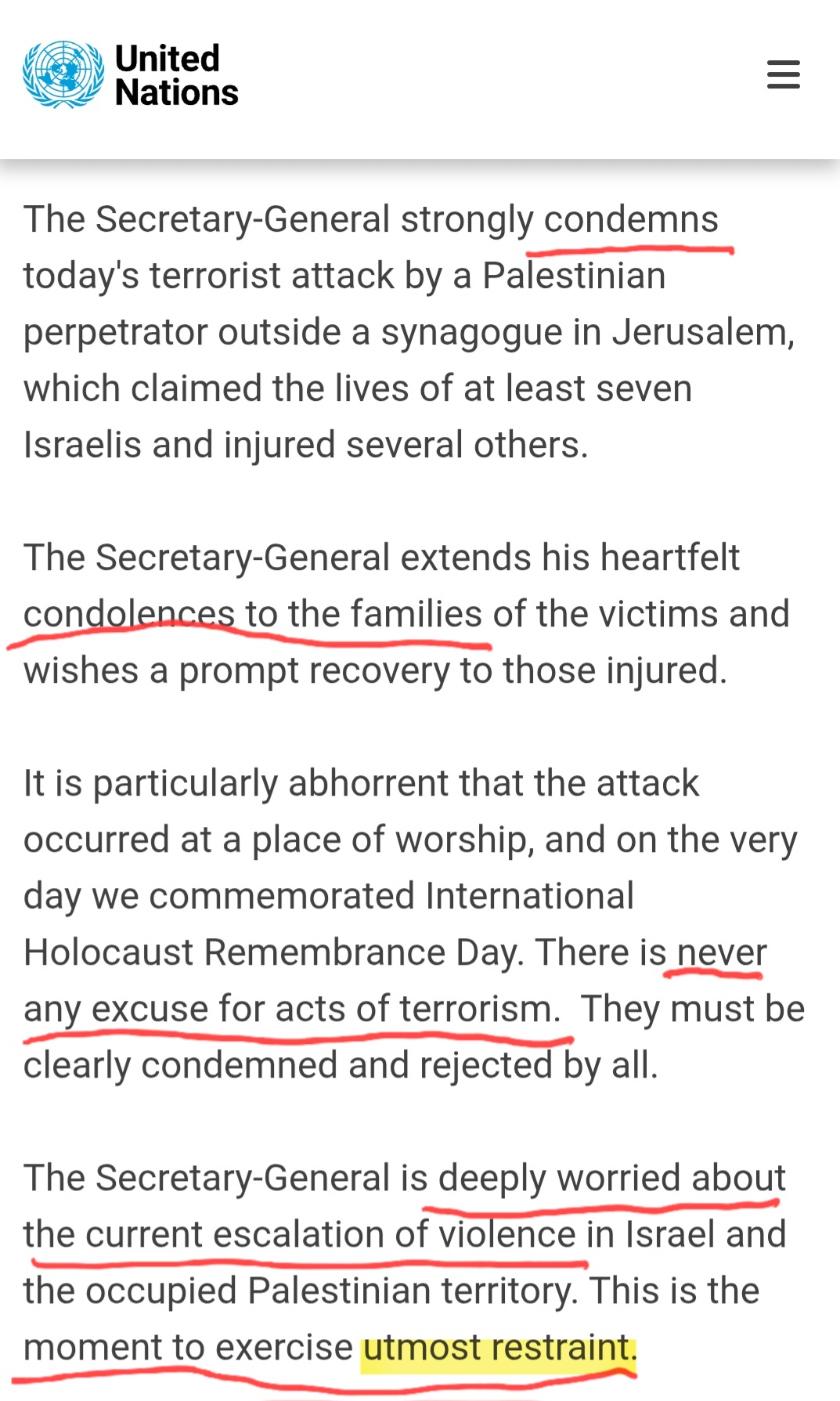
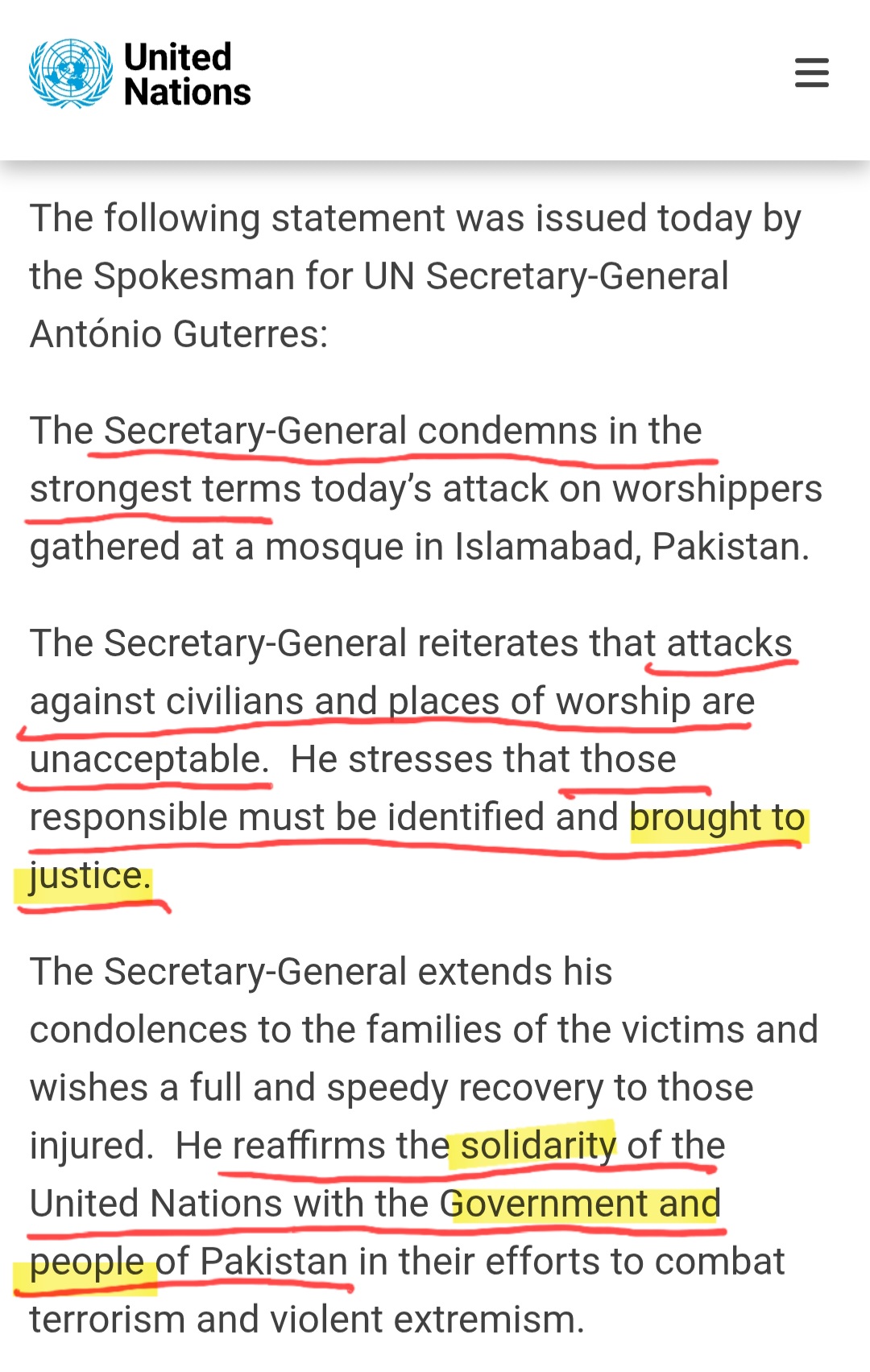
Read the paired statements issued by António Guterres after two attacks on places of worship: one at a mosque in Pakistan, the other at a synagogue in Jerusalem. The contrast reveals a complete moral collapse at the heart of the global body.
This matters even more because the Jerusalem statement was issued before Israel responded to October 7, 2023. Before Gaza. Before counteroffensives. Before a single Israeli military action the UN would later cite as justification for its posture.
Restraint was not urged because of Israeli action. It was urged instead of justice itself.
In Pakistan, the Secretary-General “condemns in the strongest terms” the attack on worshippers. He demands that the perpetrators be “identified and brought to justice.” He affirms the “solidarity of the United Nations with the Government and people of Pakistan” and situates the crime squarely within the global fight against terrorism and violent extremism.
That is what moral clarity looks like.
Yet in Jerusalem, when Jews are murdered outside a synagogue in 2023—on International Holocaust Remembrance Day- a whisper. The Secretary-General “strongly condemns” the attack. He offers condolences. He notes that it is abhorrent to attack a place of worship. And then he pivots—not to justice, not to accountability, not to solidarity with the state charged with protecting its citizens.
The synagogue becomes a geographic detail. The murders are folded into “the current escalation in Israel and the occupied Palestinian territory.” There is no demand that the killers be found. No insistence on prosecution. No solidarity with the Government of Israel. No recognition that deterrence requires consequence.
This is not diplomatic caution. It is moral abdication.
This did not begin with Guterres
If this were merely the idiosyncrasy of one Secretary-General nearing the end of his ten year tenure, it might be dismissed as tone or temperament. It is not.
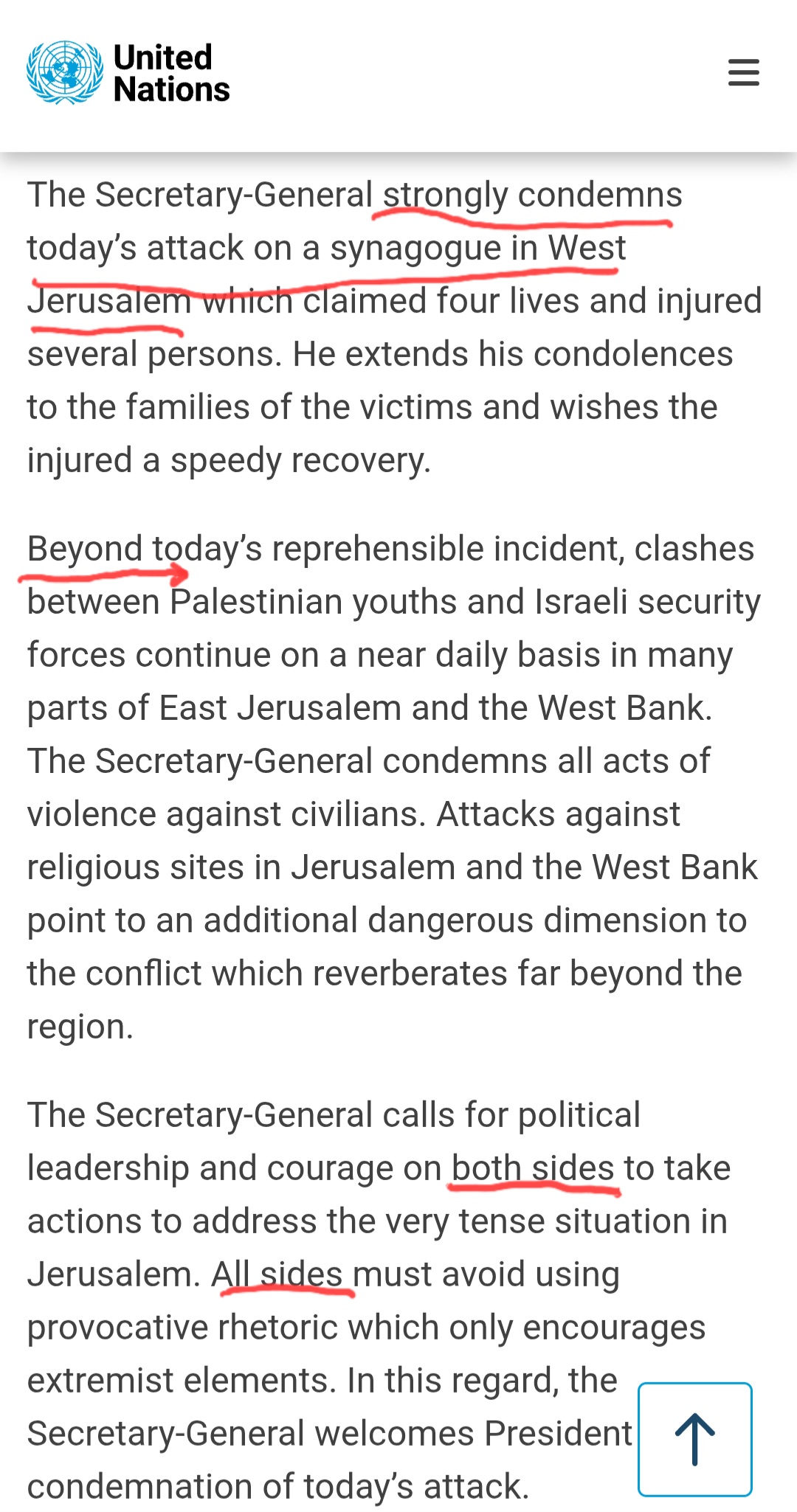
In 2014, after Arab terrorists entered a synagogue in Jerusalem wielding meat cleavers and hacked Jewish worshippers to death, Ban Ki-moon issued a statement that follows the exact same structure.
He “strongly condemns” the attack. He offers condolences. And then—almost immediately—he moves “beyond today’s reprehensible incident” to discuss “clashes between Palestinian youths and Israeli security forces.” The massacre is submerged into “the situation.” The killers disappear into context.
There is no call to bring the perpetrators to justice. No solidarity with the Israeli government. No affirmation of Israel’s duty to eradicate the threat.
Instead, Ban Ki-moon calls for leadership on “both sides”, urges all parties to avoid “provocative rhetoric,” and frames the slaughter of Jews in a synagogue as a destabilizing dimension of the conflict—not as terrorism demanding elimination.
Different Secretary-General. Same choreography.
The explanation is not mysterious because the United Nations does not conceptualize Palestinian violence as extremism.
Extremism, in UN doctrine, is something that happens elsewhere—to states battling jihadists, insurgents, or transnational terror networks. Palestinian murder, by contrast, is treated as political expression: contextualized by grievance, softened by narrative, absorbed into a permanent dispute. It is violence to be managed, not defeated.
That is why justice is demanded in Pakistan and restraint is demanded in Jerusalem. One fits the UN’s extremism framework. The other does not.
“Restraint” here is not a plea for peace. It is a veto on justice.
When Jews are murdered, the UN permits mourning but denies agency. Condolences are extended to families, while the legitimacy of Jewish self-defense and Jewish sovereignty is quietly withheld. Sympathy is offered—but solidarity with the state is conspicuously absent.
The global body created in the shadow of the Holocaust cannot bring itself to say, plainly, that Jews murdered in synagogues deserve the same moral response as anyone else. It cannot say that Jewish sovereignty is legitimate. It cannot say that justice must follow Jewish bloodshed.
And the Stateless Arabs from Palestine (SAPs), its perennial wards, must be granted absolution.
Israel should draw the only conclusion that matters: the United Nations is not a moral compass or humanitarian organization. It is purely a political instrument.
The modern left claims to speak in absolutes. Borders are immoral. Enforcement is cruelty. Language itself must be purified so that no human is illegal. That creed is recited with missionary confidence—until the subject becomes Jews in the Middle East. Then the absolutes vanish. The language hardens. Expulsion becomes justice.
When Alexandria Ocasio-Cortez says “no human being is illegal,” she isn’t hedging. When Ilhan Omar insists “undocumented does not mean illegal,” the point is categorical. When Julián Castro calls the word illegal dehumanizing, the doctrine is clear: presence confers legitimacy.
“This bill prohibits any executive agency from using the term alien to refer to an individual who is not a U.S. citizen or national, or illegal alien to refer to such an individual who is unlawfully present in the United States or lacks lawful immigration status. This prohibition does not apply when quoting certain texts.” – H.R.457 — 117th Congress (2021-2022) submitted by Joaquin Castro (D-TX) with 13 Democratic co-sponsors
And then Jews cross the only line that matters.
Beyond the 1949 armistice lines—lines drawn to stop a war, never to define a state—the same mouths reverse themselves. Jews become “illegal settlers.” Homes become “violations.” Removal becomes moral necessity. The word that supposedly dehumanizes migrants is suddenly deployed eagerly against Jews. The same politicians who recoil at deportation rhetoric now demand the dismantling of Jewish communities that have existed for decades.
The contrast is not accidental. Rashida Tlaib brands Jewish towns “illegal” and calls for their removal. Bernie Sanders repeats the charge as if the label itself settles every moral question. Even Omar—who rejects illegality as a concept at home—embraces it fully when applied to Jews. Same actors. Same vocabulary. Opposite rules.
This is where anti-Zionism sheds its disguise. A politics that claims to defend Black and Brown people from delegitimization turns around and singles out Jews—alone—for collective criminalization. When a political doctrine singles out Jews—alone—for criminalization and expulsion, it stops being anti-Zionism and becomes antisemitism, full stop. If a principle applies to everyone except Jews, it isn’t principle. It’s prejudice.
The United Nations provides the laundering. Resolutions passed by automatic anti-Israel majorities are treated as moral verdicts rather than political artifacts. When the Barack Obama administration chose not to veto Security Council Resolution 2334, it handed activists a legal-sounding alibi. The appeal is obvious: demand expulsions while pretending your hands are clean. Outsource conscience. Invoke “international law.” Move on.
“any decisions and actions which purport to have altered the character, status or demographic composition [added Jews] of the Holy City of Jerusalem have no legal effect, are null and void and must be rescinded in compliance with relevant resolutions of the Security Council” – UN General Assembly
The hypocrisy spills into the street. Protestors harass synagogues and Jewish institutions, targeting Jews for contemplating life in Israel. That behavior would be condemned instantly if aimed at any other minority. Instead, it’s excused as activism—supposed to make people uncomfortable, as Cori Bush once put it. When the discomfort belongs to Jews, the moral bar drops through the floor.
Strip away the slogans and the pattern is unmistakable: hierarchy. Some groups are granted innocence without agency. Jews exercising sovereignty are denied legitimacy regardless of history, law, or fact. The left that insists words can wound has no trouble criminalizing Jewish existence.
If no human is illegal, Jews aren’t illegal. If deportation is immoral, ethnic cleansing is immoral. If harassment is violence, it applies outside synagogues too.
Yet the antisemitic anti-Israel crowd miss the entire point and attempt to reframe the story. Palestine Chronicle wrote that “Israel has come home to roost in Minnesota. The people of Minneapolis and St. Paul have become the Palestinians of Minnesota,” misdirecting people that Arabs are targeted by Israel, when in fact it is Jews being targeted for being “illegal” by the UN and the Muslim world.
The rules change only for Jews. That isn’t progressivism. It’s selective morality—rigged, tribal, and exposed.
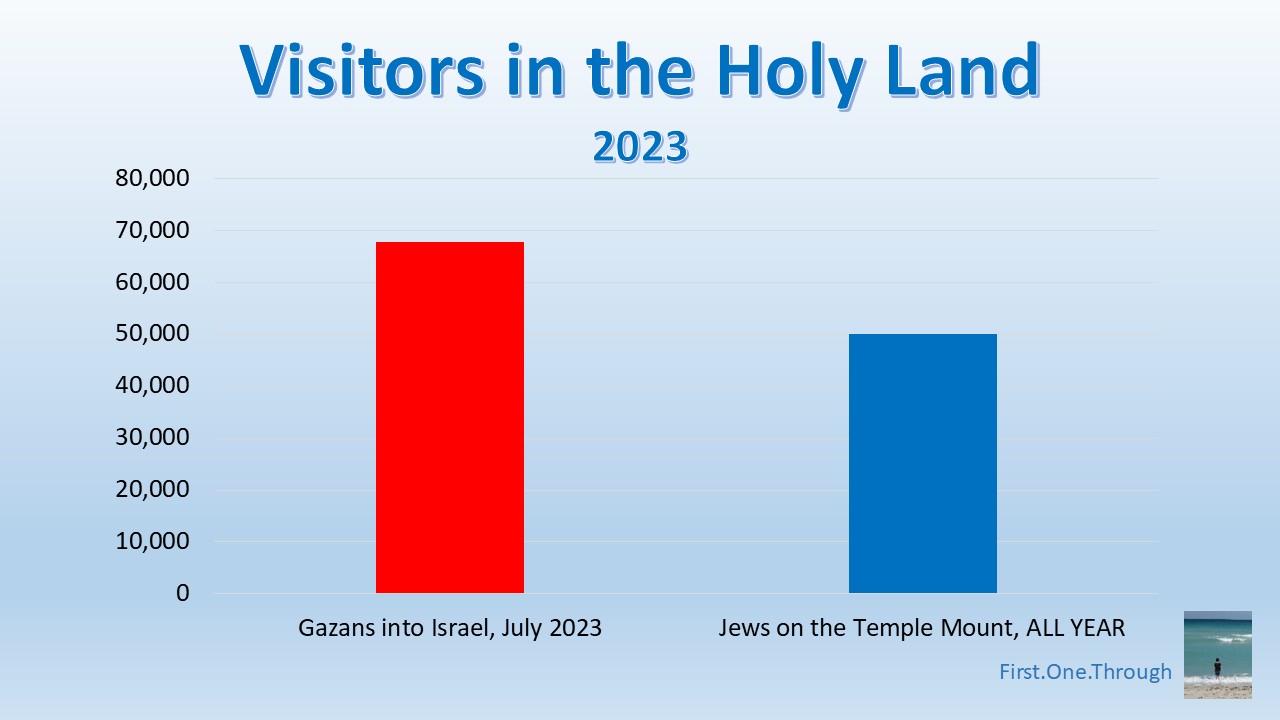
In July 2023 alone, 67,769 Gazans were allowed to exit Gaza through Israeli crossings according to the United Nations. In the entire year of 2023, only 50,098 Jews were allowed onto the Temple Mount — Judaism’s holiest site — in Jerusalem, the capital of the Jewish state according to Beyadenu a Jewish rights advocacy group.
One month versus one year. A border crossing versus a holy site in a nation’s capital. The comparison is damning.
The Jewish state allowed more Gazans to cross its border in one month before the Gaza leadership launched a war, than it allowed Jews to step foot on their holiest site over an entire year.
That is not security policy. That is civilizational self-sabotage.
Every country controls its borders. That is normal. What is not normal is a nation blocking its own people from their central religious site in their own capital city.
Jews face time windows, group limits, police escorts, and de-facto prayer bans to walk on ground their ancestors sanctified 3,000 years ago. The result is obvious: Jewish presence is suppressed by design.
Fifty thousand Jews in a year is not demand. It is managed scarcity.
Thousands of Jews congregate in the Kotel plaza on Passover, unable to ascend onto the Jewish Temple Mount
The Western Wall Plaza is sold as Jewish religious freedom. It isn’t. It is a containment zone — a consolation prize engineered to keep Jews away from the mountain that actually matters.
This is why the Gaza comparison cuts so deep.
Israeli policy makers allowed in more Gazans into Israel, during a blockade, knowing that the area is led by an antisemitic genocidal jihadist group sworn to destroy the Jewish State, than for Jews just seeking a basic human right of prayer.
A sovereign nation that polices Jewish prayer more aggressively than cross-border traffic has lost the plot. A capital that cages its own sacred history is not free.
Until Jews can walk onto the Temple Mount without escorts, quotas, and humiliation, the Kotel Plaza remains exactly what it is: an open-air prison with good lighting and a propaganda budget.
António Guterres wants the world to believe that peace can be engineered with a spreadsheet — that inequality is the disease, redistribution the cure, and justice a matter of financial rearrangement. In his January 15 address, he warned that concentrated wealth corrupts institutions and that most low-development countries are in conflict. The implication is unmistakable: balance the books and peace will follow.
“The top 1 per cent holds 43 per cent of global financial assets. And last year alone, the richest 500 individuals added $2.2 trillion to their fortunes.
Increasingly, we see a world where the ultra-wealthiest and the companies they control are calling the shots like never before — wielding outsized influence over economies, information, and even the rules that govern us all.
When a handful of individuals can bend global narratives, sway elections, or dictate the terms of public debate, we are not just facing inequality — we are facing the corruption of institutions and our shared values.” – UNSG Antonio Guterres
But choosing the wrong enemy guarantees the wrong war.
Because evil is not an accounting problem.
The UN’s failure begins in its diagnosis. It treats terrorism as a social pathology when it is, in fact, an ideological one.
Terrorism is not born in empty wallets. It is born in minds captured by belief.
Two decades of research have demolished the claim that poverty causes terror. Terrorists are rarely the poorest of the poor. They are often educated, middle-class, and technically trained — the engineers of jihad, the lawyers of holy war. The suicide bomber is seldom starving. He is convinced.
If poverty produced terrorism, the poorest societies would be its factories. They are not. Many desperately poor states remain largely untouched by global jihad, while terror movements arise from politically radicalized societies with functioning middle classes and ideological incubators.
What correlates with terrorism is not poverty, but ideas combined with power: religious absolutism, revolutionary nationalism, grievance cultures, and failed identity — not failed GDP.
This is not an academic distinction. It is the fault line between clarity and catastrophe.
If money could defeat jihad, Gaza would be the proof. It is not — it is the refutation.
Gaza has received billions in international aid. What emerged was not prosperity, but the most elaborate terrorist war machine ever embedded in a civilian population: tunnels beneath hospitals, command bunkers under schools, rockets from playgrounds, children trained for martyrdom.
This was not a failure of funding. It was the success of ideology. And the UN instigates that very ideology claiming that Israel should have no sovereign control of who enters its country, and specifically that almost every Arab living in Gaza will move into Israel with UN support.
“We are totally committed in the cause of peace in Gaza, Ukraine, Sudan and far beyond.” – UNSG Antonio Guterres
Hamas did not build tunnels because Gazans were poor. Hamas built tunnels because its charter demands Israel’s destruction, because martyrdom is sacred, because jihad is identity. Money did not create this worldview — it merely financed its execution.
You can flood a society with aid, but if its governing ideology is annihilationist, all you finance is a more capable war machine.
Once the UN misdiagnoses ideology as economics, the next failure becomes inevitable.
For decades, it has constructed and sustained a grievance system around the Stateless Arabs from Palestine (SAPs) that functions symbiotically with jihadist aims. Through its agencies and resolutions, it has promised millions of SAPs who have never lived in Israel that they will one day “return” en masse into Israel — effectively proposing Israel’s demographic erasure through mass population transfer via international decree.
No state can survive if an external body claims authority over who may enter it and redefine its citizenship from the outside. Yet the UN has made this assault on sovereignty a central plank of its Palestine policy — while calling it “humanitarian.”
Through UNRWA’s unique multigenerational refugee status, displacement becomes inherited identity rather than a temporary humanitarian condition. Grievance becomes doctrine. Statelessness becomes culture. A territorial dispute becomes a perpetual weapon.
And then the UN asks for more money to sustain it.
Why does the UN persist in this inversion?
Because it refuses to judge belief systems.
It will not confront jihad as an ideology. It will not describe Islamic terrorism as such. It will not wade into cultural or civilizational dynamics because it sees itself as a neutral global body.
But neutrality toward ideology does not produce peace. It produces permission.
And because the UN will not fight belief systems, it substitutes economics.
It reframes terror as inequality. It reframes jihad as deprivation. It reframes mass murder as misallocated capital.
In doing so, it becomes part of a broader machinery seeking to shift wealth and power from the Global North to the Global South — not merely for development, but as moral rebalancing, regardless of whether this addresses the real drivers of violence.
Redistribution becomes its ritual response whenever violence erupts.
Which means: more authority, more money, more relevance for the UN.
This is not accidental. It is institutional self-preservation dressed as virtue.
So the world is invited to believe the problem is billionaires rather than beheaders. That terror is born from inequality rather than indoctrination. That peace will come from redistribution rather than defeating enemies.
Evil is not a pocketbook problem. It is an ideology.
And no amount of redistribution will make a death cult lay down its weapons.
Every UN humanitarian agency coordinates with the authority that governs where it operates—except in Jerusalem. That exception is not a footnote. It is the story. And it exposes a mandate failure driven by politics, not humanitarian necessity.
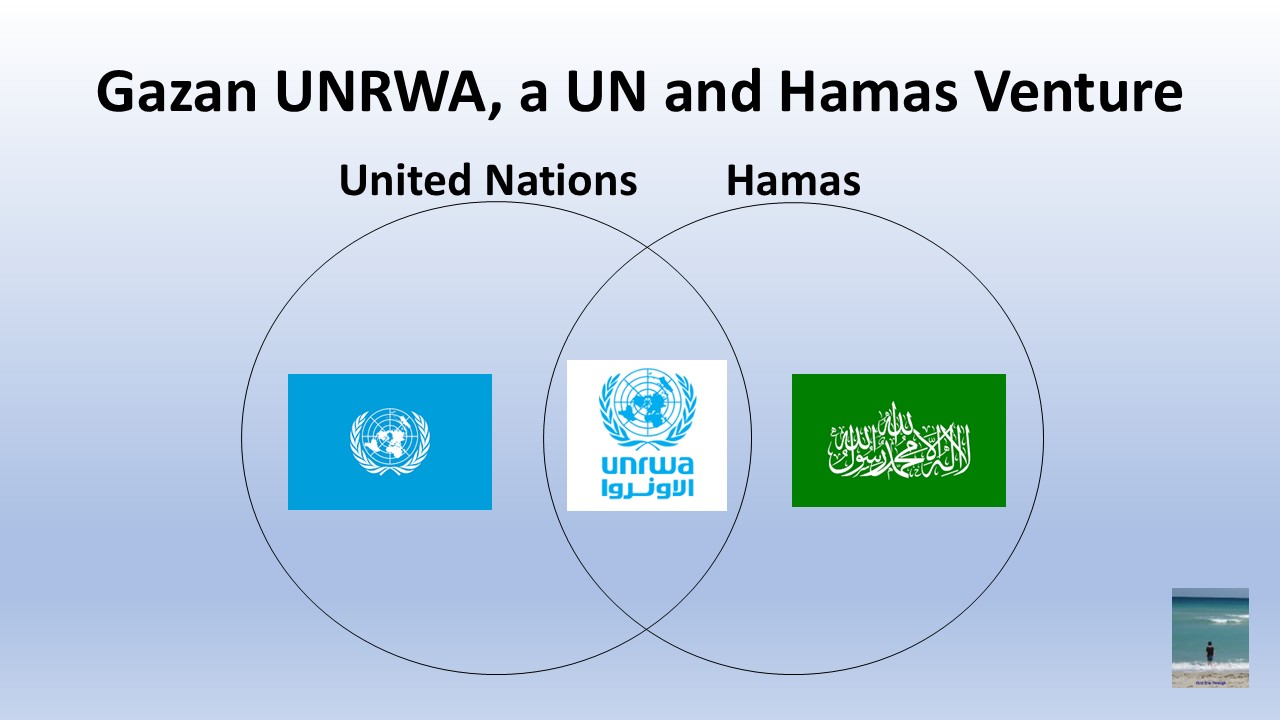
UNRWA holds that humanitarian work requires coordination with governing authorities. In practice, it does so almost everywhere: with Jordan, Lebanon, Syria, the Palestinian Authority—and even with Hamas in Gaza, despite Hamas’s terrorist designation by the United States, the EU, the UK, and others.
In Jerusalem alone, UNRWA refuses to coordinate with Israel, the authority exercising full municipal, policing, and regulatory control over the city.
Call it “coordination for access” if you like. It is still coordination. And municipal coordination is not a sovereignty concession (if one believes that Israel does not have sovereignty over eastern Jerusalem despite annexing it in 1980); it is a humanitarian necessity.
How the Facilities Came to Exist
UNRWA’s Jerusalem facilities were established between 1949 and 1967, when Jordan seized and annexed the eastern half of the city in a move not recognized by the UN or the international community. UNRWA nonetheless coordinated with the Hashemite authorities to build schools, clinics, and service centers—because humanitarian work requires coordination with whoever governs in fact.
That history matters. UNRWA’s Jerusalem footprint exists specifically because it once coordinated with an unrecognized occupier.
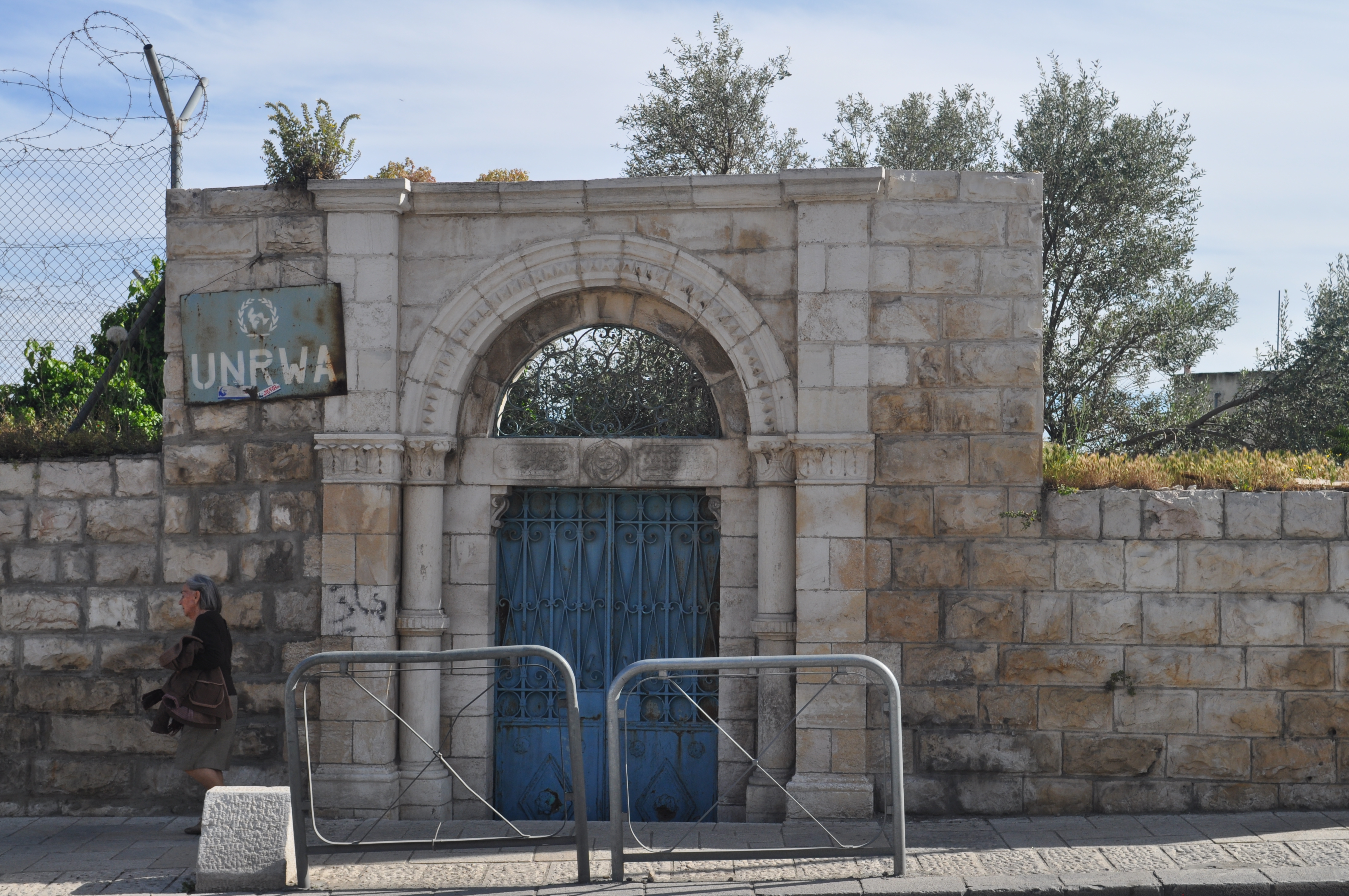
UNRWA offices in Jerusalem (photo: First One Through)
The Reversal
In 1967, Jordan entered the war, violated the armistice, and lost control of Jerusalem. Israel assumed governance and unified the city. Palestinian Arab residents became permanent residents with access to Israeli courts, healthcare, municipal services, and the right to apply for citizenship.
At that point, UNRWA reversed its logic. Where it coordinated with Jordan despite non-recognition, it now refuses to coordinate with Israel—by labeling eastern Jerusalem “occupied Palestinian territory,” theoretically negating its obligation to work with Israel.
That label sits uneasily with the UN’s own history. The 1947 Partition Plan never intended Jerusalem—east or west—to belong to an Arab state. The city was designated a corpus separatum, an internationally administered entity. Jerusalem was never meant to be Arab sovereign territory.
The contours of “Corpus Separatum” (in pink) in the United Nations 1947 Partition Plan stretched over Greater Bethlehem and Greater Jerusalem, marking the region as an international Holy Basin to be administered by the UN
An Outlier by Design
UNRWA’s mandate emphasizes cooperation with local authorities to ensure access, security, and civilian protection. That cooperation exists everywhere except Jerusalem. UNRWA coordinates with armed groups and unrecognized authorities elsewhere, yet refuses coordination with the governing authority in the city where coordination is most essential.
Refusing to coordinate with the authority responsible for public safety is not neutrality. It is an affirmative political act—one that inverts humanitarian logic by privileging narrative over civilian protection. UN immunity exists to facilitate coordination, not to replace it.
Continuity of Care—and the Standoff
Israel has enacted laws to shutter UNRWA offices in Jerusalem. UNRWA refuses to comply, invoking immunity and operating facilities largely outside municipal oversight. The confrontation exists because UNRWA chose inconsistency in the one city where consistency matters most.
“The UNRWA Jerusalem Health Centre, which serves hundreds of Palestine refugee patients every day is, for most of them, their only possibility of having access to primary healthcare…. These [Israeli] measures are a violation of the inviolability of United Nations premises and an obstacle to the implementation of the clear mandate of the General Assembly for UNRWA’s continued operations in the Occupied Palestinian Territory, including East Jerusalem.” – UN Secretary General Antonio Guterres January 15, 2026
The closure of UNRWA offices in Jerusalem would not create a humanitarian vacuum. Education, healthcare, and social services are already provided through municipal systems, national institutions, other UN bodies, and a dense NGO network operating in the city. What would end is not care delivery, but UNRWA’sparallel governance model.
Palestinian Arabs in Jerusalem rely daily on municipal emergency services, hospitals, and courts. UNRWA’s non-coordination removes the safety mechanisms coordination is meant to provide—for civilians, staff, students, and patients alike.
The Reckoning
UNRWA coordinated with Jordan when Jordan’s rule was unrecognized. It coordinates with Hamas despite terrorist designations. Yet it refuses to coordinate with Israel while Israel governs the city, extends legal status to its Arab residents, and has a network of service providers which can easily replace UNRWA in Jerusalem.
That is not humanitarian principle. It is selective politics.
Consistency is the minimum requirement of a mandate. A mandate that works everywhere but Jerusalem is not a mandate—it is a message, and it is that UNRWA is not a humanitarian organization.
UNRWA remains a rusty tool of the 1947 Partition Plan which insists that holy sites in Jerusalem never fall under Jewish rule.
















 First One Through