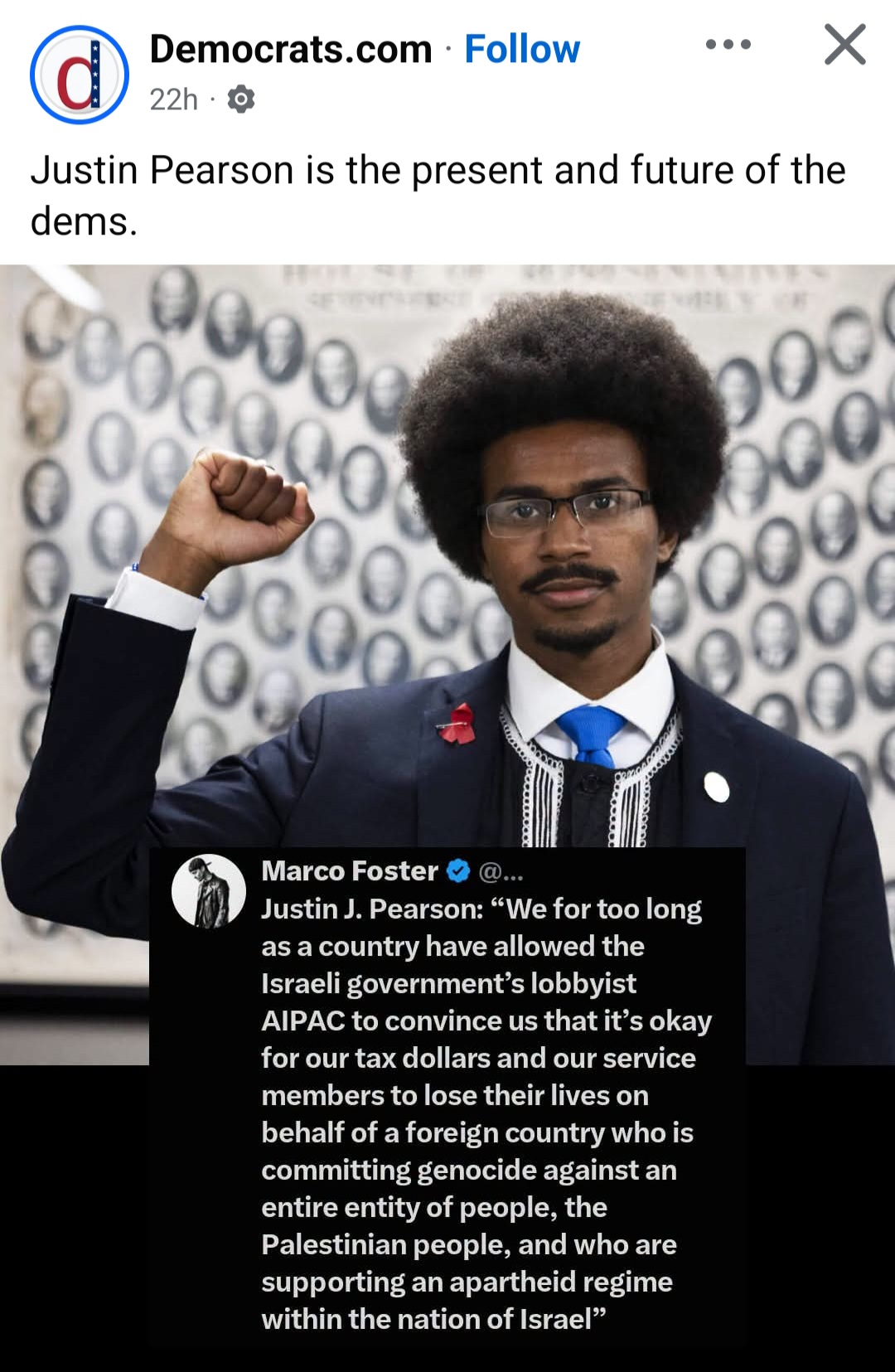
AIPAC isn’t run by Israel. It is run by Americans who support Israel, just as Planned Parenthood is backed by pro abortion people, not aborted fetuses.
Israel isn’t committing genocide. It is preventing one by trying to eliminate Hamas, the genocidal jihadi group that invaded Israel, massacred civilians and seeks Israel’s destruction.
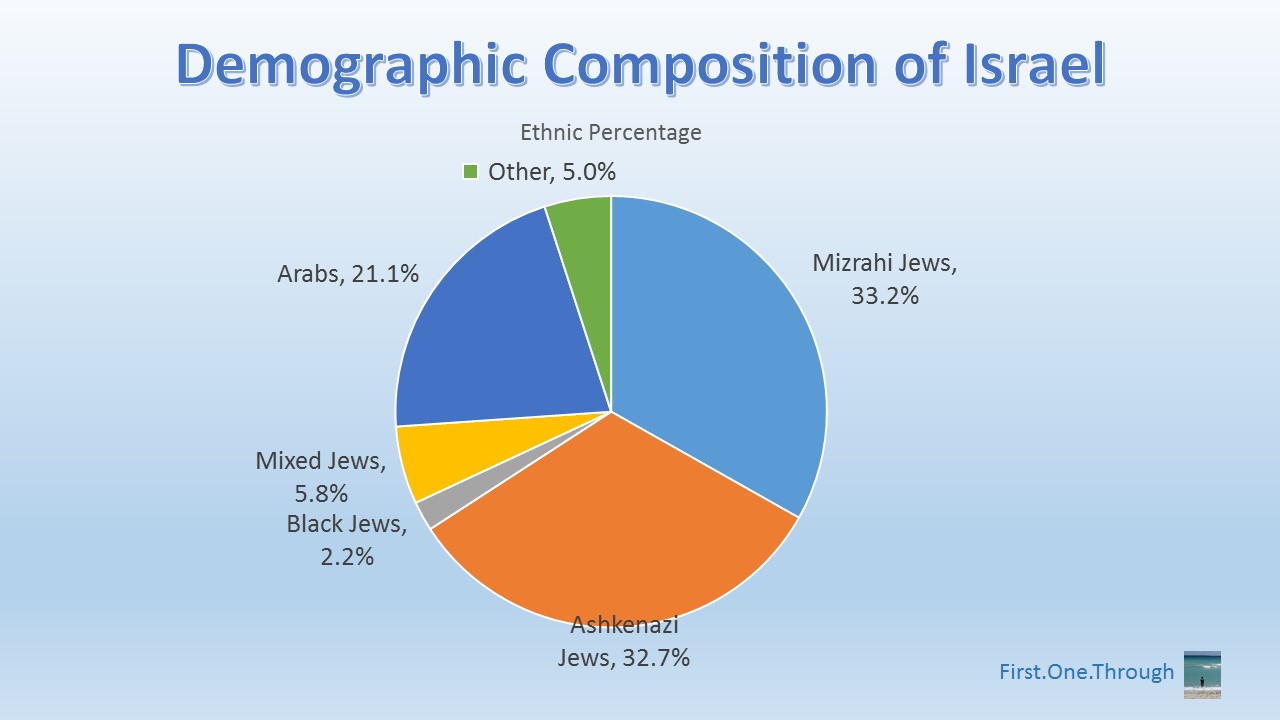
Israel isn’t an apartheid state. It is a multi-ethnic society in which Arabs are citizens, vote and serve throughout society. Meanwhile, Palestinian Arab leaders continue to demand a future Palestinian state devoid of Jews.
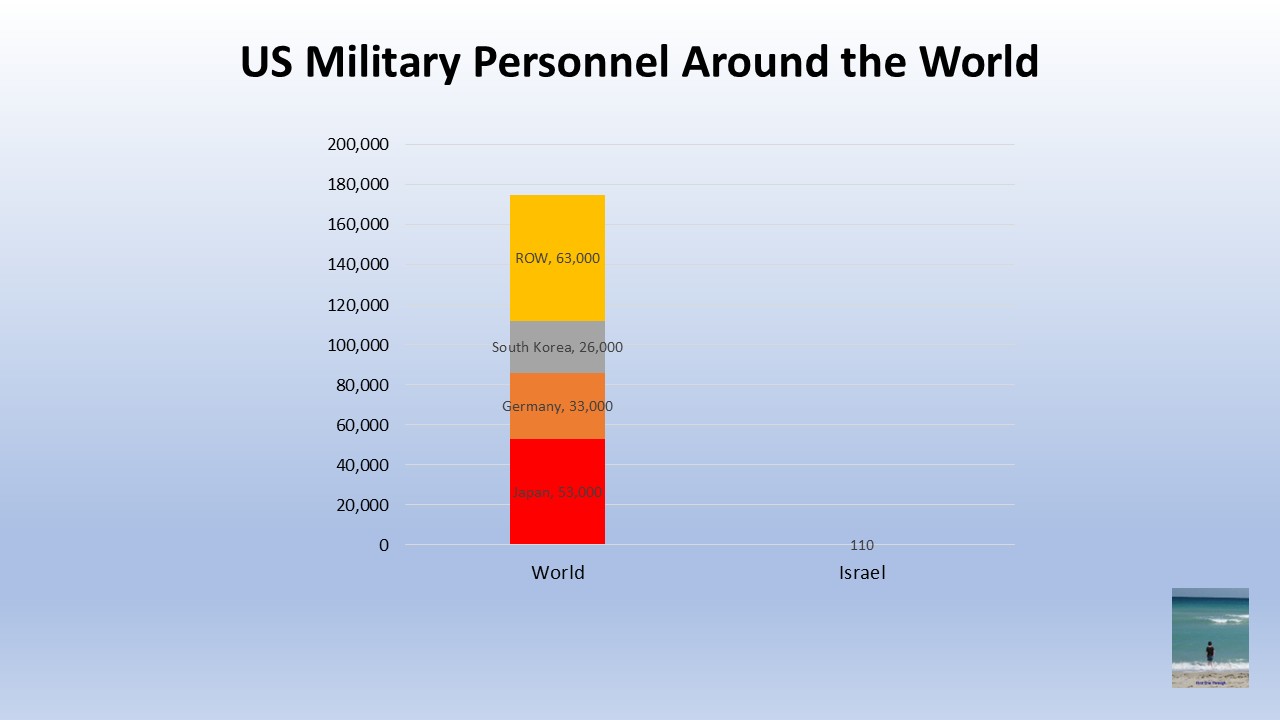
And then there is the claim about Americans losing their lives for Israel. Israel has overwhelmingly fought its own wars with its own soldiers. The American military presence inside Israel has historically been tiny compared with the enormous U.S. deployments around the world – about 110 people versus 175,000 around the world.
The money tells a similar story. The United States has spent roughly eight times as much supporting Ukraine in its war against Russia as Israel itself has spent fighting its eight-front war. Yet somehow Israel—not Ukraine, Europe or the dozens of countries where America stations troops—is presented as the foreign country consuming American lives and resources.
But there is something even more revealing about the Democrats.com post.
The entire thrust of the post was Pearson’s attack on Israel. Nothing about jobs. Nothing about housing, education, crime, taxes or the cost of living. Democrats.com chose his obsession with a foreign country as the reason Americans should see him as the future of their party.
And Democrats.com is not an obscure Facebook account.
Its founder and president, Bob Fertik, has spent more than two decades building a massive progressive Democratic communications network. Democrats.com says its network reaches more than 10 million supporters and boasts that “nearly every Democratic state party has rented our emails for nearly every competitive candidate since 2008.” It sells Democratic candidates access to its activists to raise money, recruit volunteers, mobilize supporters and turn out voters.
Fertik’s network has become part of the Democrats’ election-mobilization apparatus. So it matters what Fertik’s Democrats.com chooses to promote as the party’s future.
Pearson accused an American organization of being “the Israeli government’s lobbyist,” accused Israel of genocide and apartheid, and claimed Americans are losing their lives on behalf of Israel. Democrats.com took that anti-Israel statement, put it beneath his photograph and announced that this is the present and future of the Democratic Party.
So who exactly are the foreign-country fanatics?
Pearson is supposedly warning Americans that they are too consumed with the interests of a foreign country. Yet his showcased political message isn’t about Americans at all. It is about Israel. And Democrats.com apparently found that message so important that it used it to define both Pearson and the future of the party.
If Justin Pearson really is the “present and future” of the Democratic Party, the problem is much bigger than Justin Pearson.
Israel is discussed with hyperbole and adjectives: massive settlements, enormous American aid, rampant settler violence, Jewish encroachment, disproportionate war.
Between 700,000 and 750,000 Palestinian Arabs became refugees when they fled the battlefield as they awaited fellow Muslim Arab armies to destroy the nascent Jewish State during the 1948-9 war. In the same era, roughly 850,000 Jews left or were expelled from Arab countries with many more leaving non-Arab Muslim countries like Iran and Afghanistan.
Even though the Jewish refugee population was larger, we never speak of it today.
Today, UNRWA registers 5.9 million Palestinian Arab refugees, predominantly consisting of descendants of the original refugees, and those who married or were adopted by refugees. The comparable number of registered Jewish refugees from Arab and Muslim countries and their descendants is zero.
The Jews were absorbed as citizens of Israel and other countries. Their children, grandchildren and great-grandchildren were not perpetuated as refugees, they way Palestinian Arabs have been forced by those same “brotherly” Arab countries which went to war with Israel in 1948-9, in order to perpetuate the war they initiated and lost.
650 Times — Arab League Territory to Israel
Israel covers roughly 22,000 square kilometers and the 22 members of the Arab League collectively cover roughly 13–14 million square kilometers.
The territory of the Arab League is approximately 650 times the size of Israel.
127 Times — Muslims to Jews
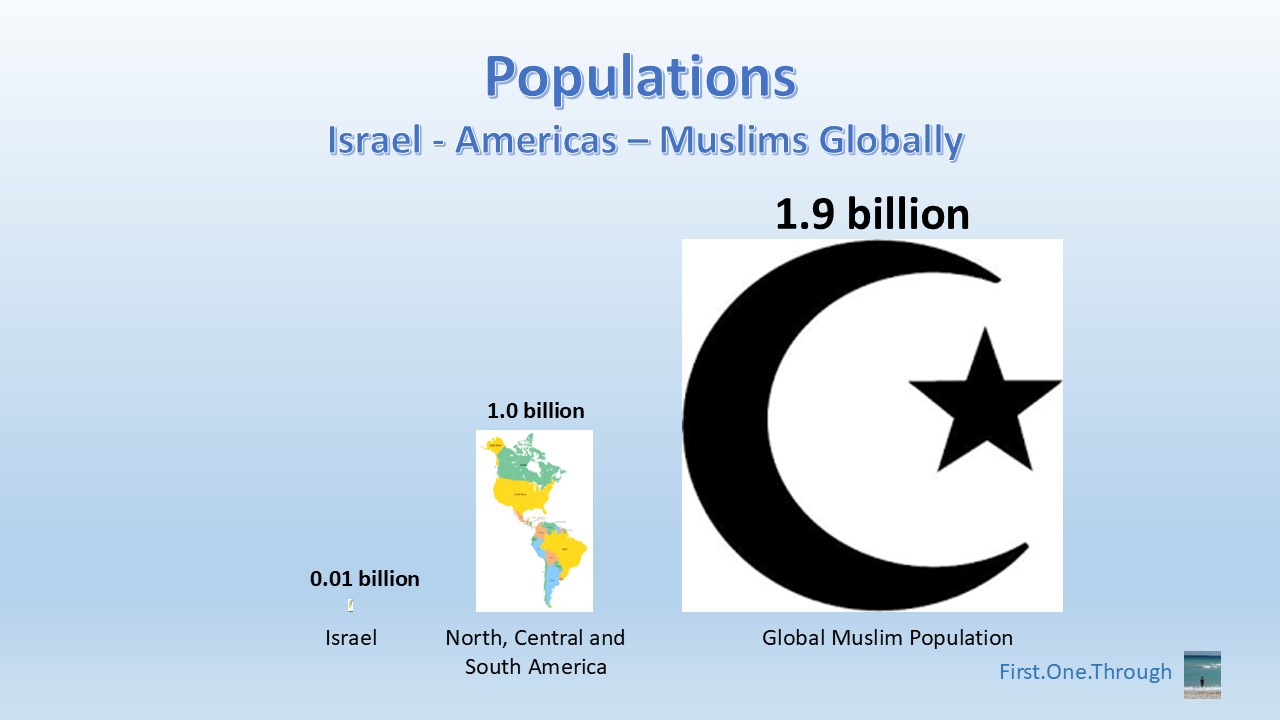
There are roughly 2 billion Muslims in the world, twice the size of the entire populations of North, Central and South America.
There are roughly 15.8 million Jews.
That is approximately 127 Muslims for every Jew.
Muslims account for roughly one-quarter of humanity. Jews account for about 0.2%.
Yet people in the West refer to Muslims as a “minority.”
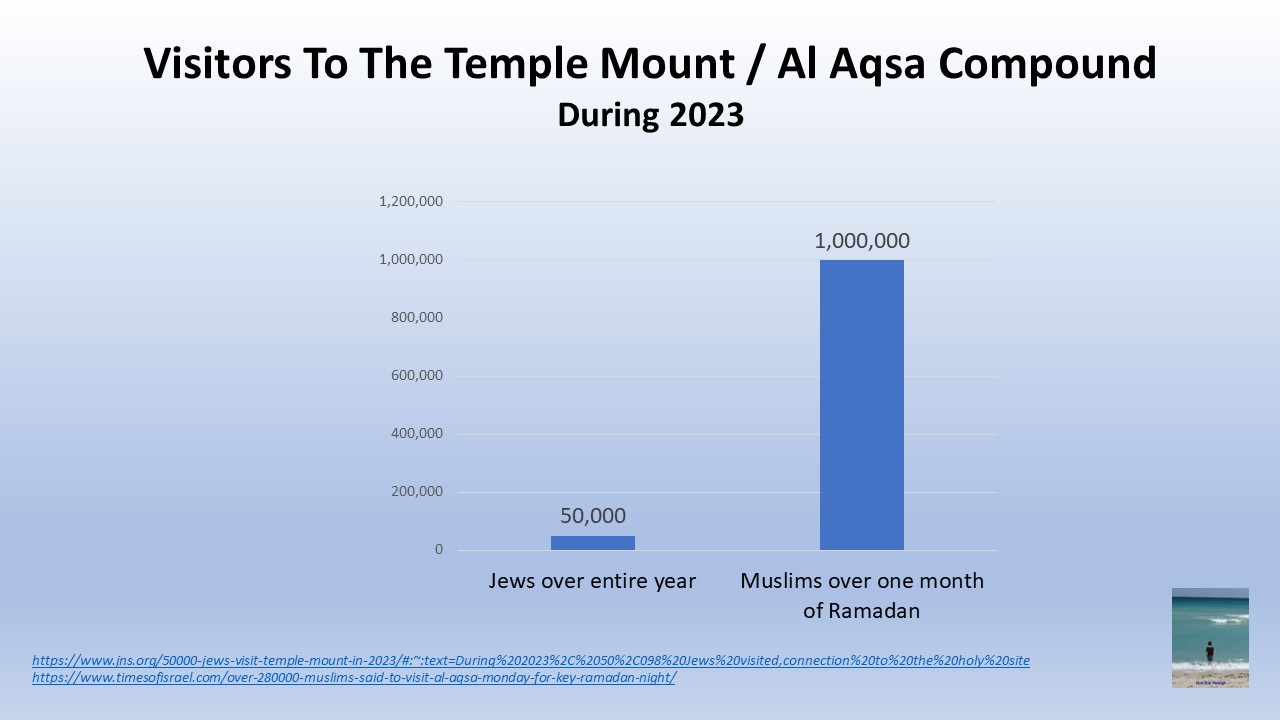
60 to 1 — Muslims to Jews Ascending the Temple Mount
Before COVID, roughly 1.8 million to 2 million Muslims visited the Temple Mount annually, compared with approximately 30,000 Jewish visits in 2019. That is roughly 60 Muslim visits for every Jewish visit.
The more recent figures of 2025 after the October 7 massacre launched by Gazans has roughly halved the visits by Muslims and doubled those by Jews, lowering the figure to about 15 times at Judaism’s holiest site.
57 to 1 — OIC States to the Jewish State
There are 57 countries in the Organisation of Islamic Cooperation that perpetually lambasts Israel. There is one Jewish state.
The Jewish state exists alongside a Muslim world dozens of times larger in countries, population and territory.
25 to 1 — American Defense Spending Outside Israel
Israel receives about $3.8 billion annually under the U.S.-Israel security assistance agreement. For every dollar America spends annually on Israel’s defense, roughly $25 is spent on defense elsewhere—defending the United States, maintaining forces abroad, supporting allies and providing security assistance around the world.
Even more striking, there are over 220,000 military personnel stationed around the world, of which slightly over 100 are in Israel. The baseline ratio is over 1,500-to-1, rising to 2,200-to-1 when reserve personnel are included.
The anti-Israel discussion focuses solely on Israel while ignoring the enormous American monies and personnel in Japan, Qatar, Germany and elsewhere.
14 Times — The Growth of Israel’s Arab Population
Approximately 156,000 Arabs lived in Israel in 1948 when the modern Jewish State was reestablished. Today, approximately 2.16 million Arabs live in Israel.
Israel’s Arab population has grown almost 14-fold since the establishment of the Jewish state. Meanwhile, the number of Jews inside Israel hasn’t even grown 12-times in that same time.
And people accuse Israel of “ethnic-cleansing.”
12 Times — Israeli Arabs Killed by Israeli Arabs Versus West Bank Arabs Killed by West Bank Jews
Thus far in 2026, Arab Israelis are murdered by other Arab Israelis at roughly 12 times the number of Palestinian Arabs killed by West Bank Jewish civilians in Judea and Samaria.
Hundreds of Arab Israelis have been murdered amid the organized-crime epidemic inside Israel over the last few years. Yet the international narrative solely focuses on settler violence.
10 to 1 — Muslim Gates to the Jewish Entrance
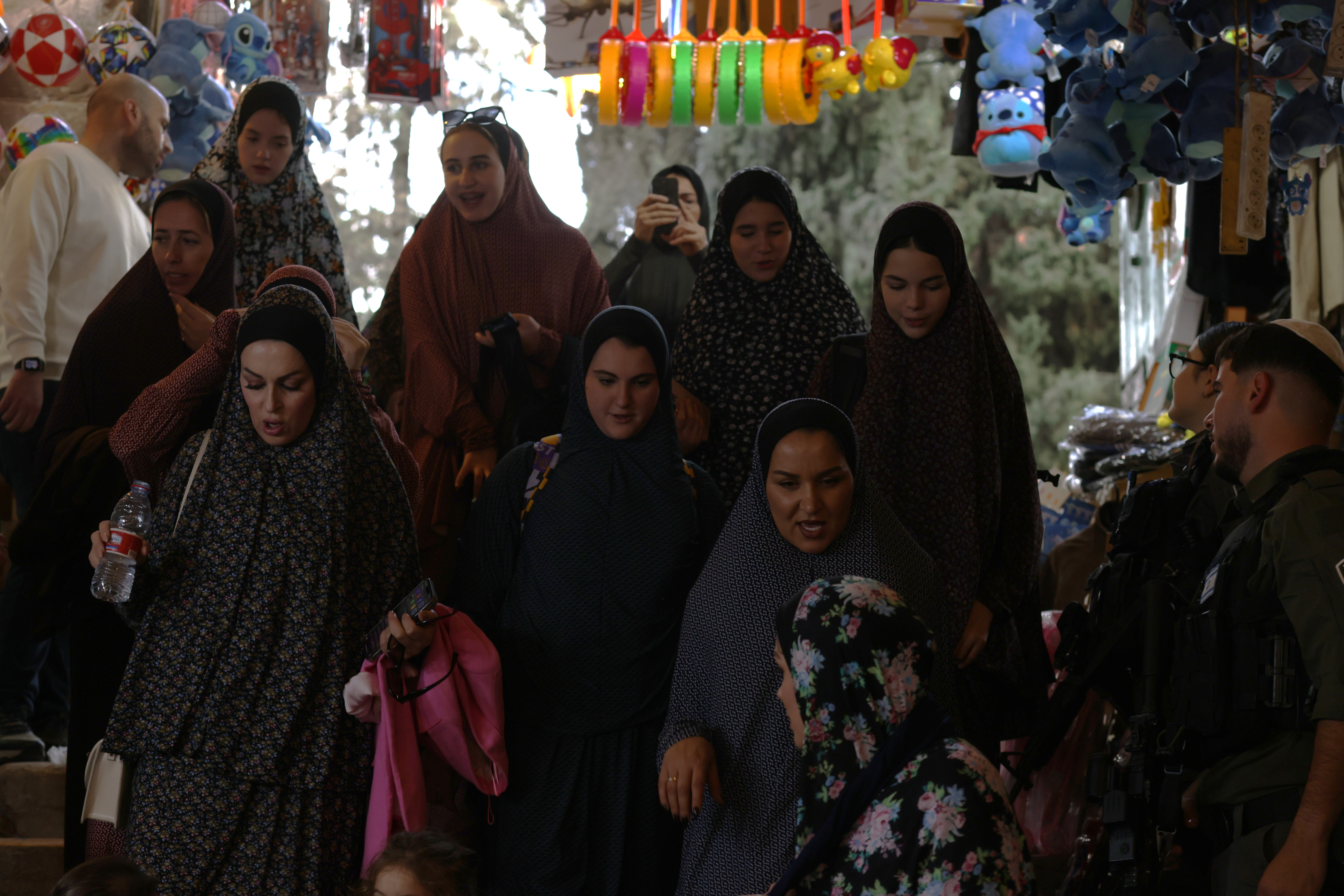
Muslims have access to the Jewish Temple Mount in the Old City of Jerusalem through ten gates. Jews and other non-Muslims enter through one: the Mughrabi Gate. There, Jews must pass through metal detectors and security clearance at only specified times of the day, even as Muslims ascend and descend at will through every other portal.
Muslim women descending from the Temple Mount through one of the many gates exclusively available for Muslims (photo: First One Through)
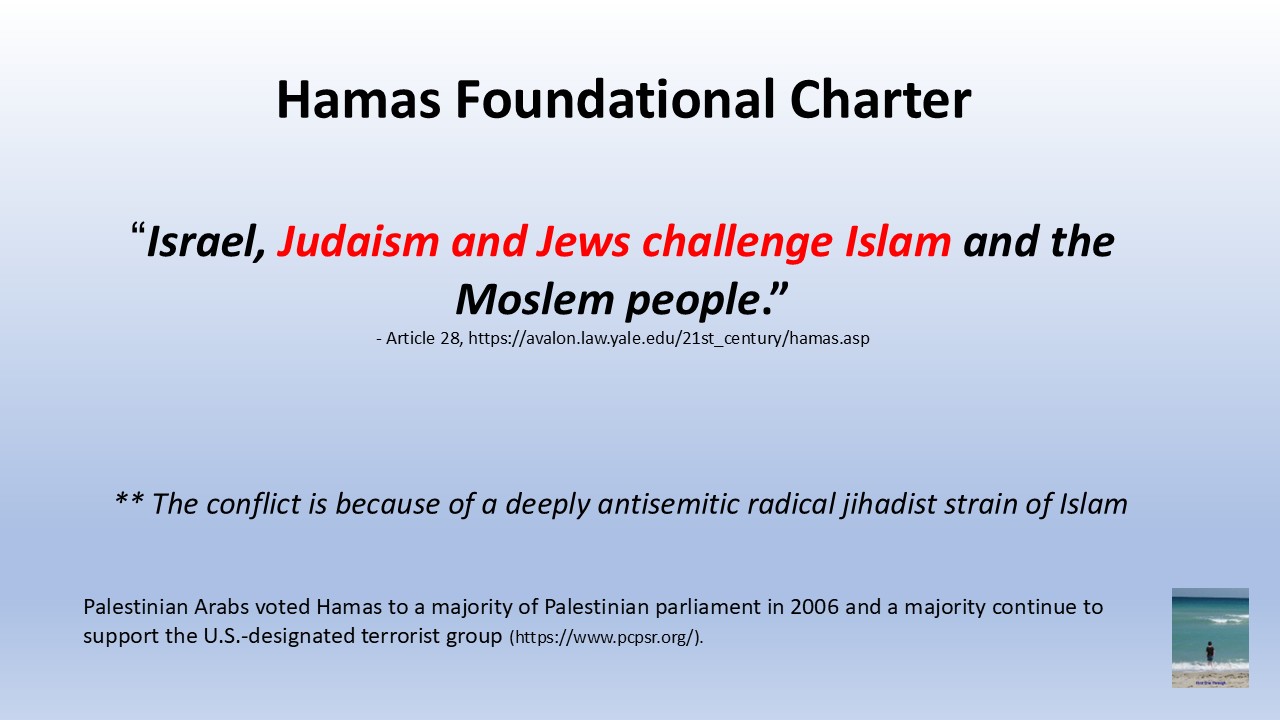
9 — Number of Times Hamas Charter Refers to Jews and Judaism
Hamas’s 1988 foundational charter is replete with antisemitic rhetoric. The opening lines begin with “Our struggle against the Jews…” and continues throughout its genocidal jihadist call to wipe out the Jewish people and Jewish State.
While the anti-Israel crowd pretends that the conflict is merely over land which can easily be compromised and carved up, they ignore the deep antisemitic ideology embedded in the Palestinian Arab culture.
8 Times — U.S.’s Ukraine War Spending Versus Gaza War Spending
The United States has spent roughly eight times more in connection with the Ukraine war with Russia than the Gaza war against Israel.
America has made roughly $195 billion available for Ukraine since Russia’s 2022 invasion. American expenditures associated with Israel and the Gaza war are a fraction of that amount.
Yet it is spending associated with Israel that is routinely presented as uniquely extraordinary.
6 to 0 — UN Bodies for Palestinians Versus Israelis
The United Nations maintains six standing bodies, offices or mechanisms focused specifically on Palestinian Arabs and Israel’s treatment of said Arabs: UNRWA; the Committee on the Exercise of the Inalienable Rights of the Palestinian People; the Division for Palestinian Rights; the Special Committee to Investigate Israeli Practices; the Special Rapporteur on the Palestinian territories; and the Human Rights Council’s permanent Agenda Item 7.
There is no comparable UN agency, committee or permanent agenda item devoted to protecting Israelis from the conflict, nor is there any group in the entire world (think the Kurds) so over-represented at the global organization.
5 — Gaza Wars Since Hamas Took Control
Israel withdrew every Jewish civilian and military asset from Gaza in 2005. Hamas subsequently took control of Gaza in 2007. Since then, it has launched five major rounds of war with Israel: in2008–09, 2012, 2014, 2021, 2023-.
Five wars in sixteen years.
2.5 to 1 — Israel Versus the Rest of the World at the UN
In 2024, the UN General Assembly adopted 18 resolutions focused on Israel. It adopted seven country-specific resolutions concerning the rest of the world combined.
That is roughly 2.5 to 1. One country received more than twice as many resolutions as every other country combined.
1 to 1 — An Equivalency of 15 Kilometers Which Matters for One But Not the Other
At its narrowest along the pre-1967 lines, Israel is roughly 15 kilometers wide. It is a stretch that continues along its major population centers.
After Ma’ale Adumim to Jerusalem’s east, the remaining West Bank corridor is also roughly 15 kilometers wide at a single narrow point where virtually no West Bank Arabs live.
15 kilometers versus 15 kilometers. Over a million Jews in the narrow stretch versus a few thousand Arabs.
Israel’s narrow waist is never described as dangerously vulnerable, while the West Bank neck is cast as making a two-state solution “impossible.”
1 — The Jewish State Whose Capital the World Challenges
There is only one country in the world whose national anthem is all about its capital.
Israel’s national anthem, Hatikvah, expresses the Jewish people’s ancient longing for Zion and Jerusalem.
The Knesset is there. The president is there. The prime minister is there. The Supreme Court is there. The government ministries are there.
Yet most countries still refuse to locate their embassies in Jerusalem or fully accept Israel’s designation of Jerusalem as its capital.
The numbers are there. Before accepting the narrative which is infused with anti-Israel bias, look at them.
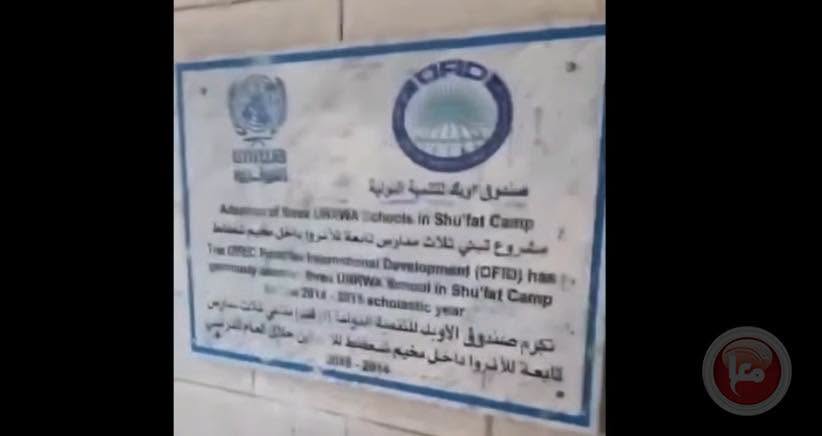
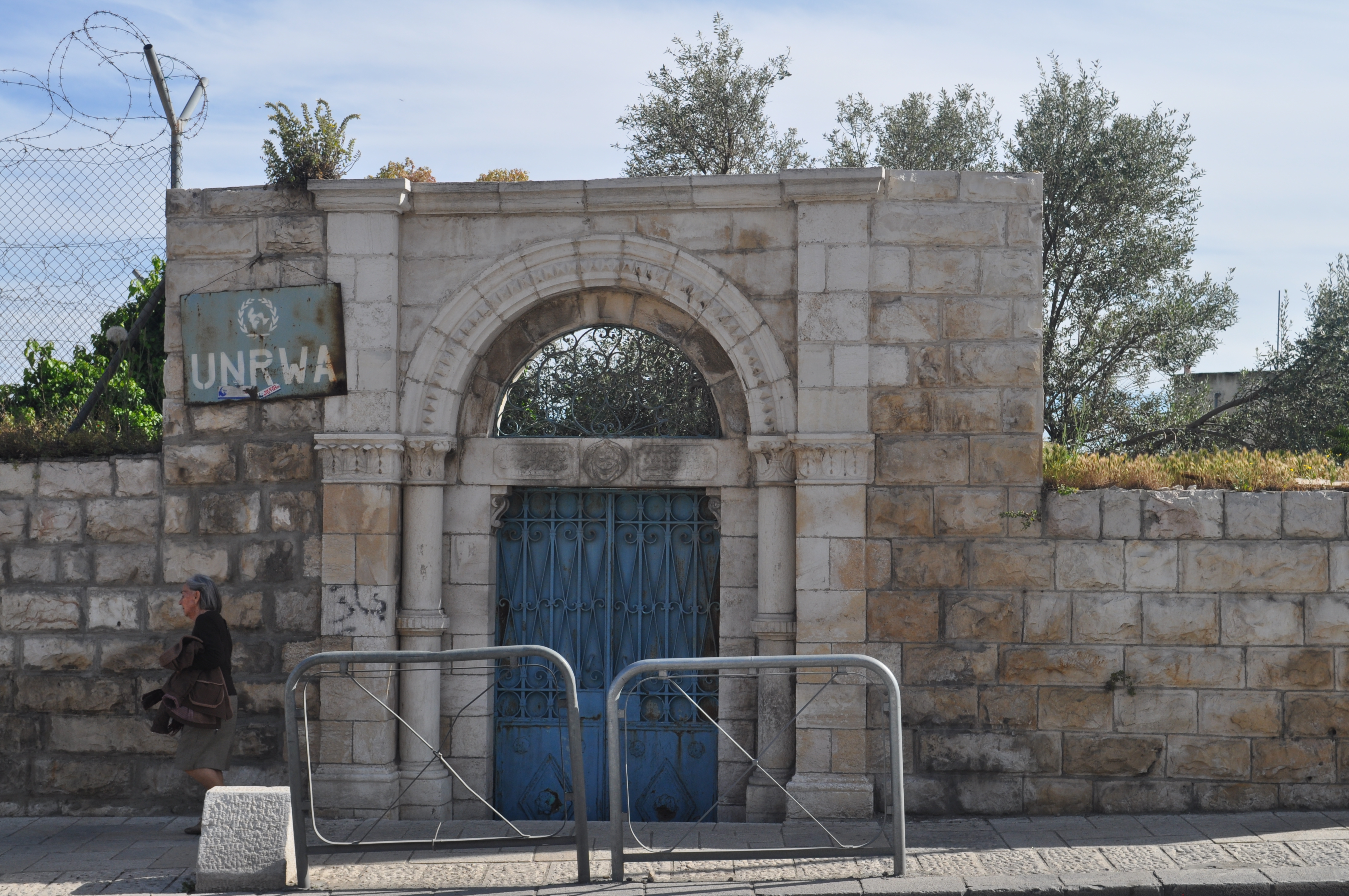
A school in Jerusalem’s Shuafat refugee camp is reopening. The building is the same but UNRWA is no longer running it.
The school is now affiliated with Israel’s Ministry of Education and the Jerusalem Municipality. Jerusalem Deputy Mayor Aryeh King posted video of UNRWA signs being removed as the school prepared to open.
Sign of UNRWA run school in Shu’afat, Jerusalem
The change ends an educational arrangement dating back more than sixty years.
UNRWA established the Shuafat refugee camp in 1965, when Jordan controlled “East Jerusalem.” UNRWA’s educational policy, dating to 1952, has been to use the curriculum of the “host countries,” allowing refugee children to take local examinations and continue into local schools and universities.
So UNRWA worked with Jordan at that time.
There was nothing internationally settled about Jordan’s sovereignty over Jerusalem. Jordan seized eastern Jerusalem in 1948 and annexed the West Bank – including East Jerusalem in 1950. Even Britain, one of only two countries (along with Pakistan) which recognized Jordan’s illegal annexation of the West Bank, specifically withheld recognition of Jordanian sovereignty over Jerusalem. It only recognized Jordan’s de facto authority there.
Yet Jordan administered East Jerusalem, so UNRWA worked with Jordan there.
Then came 1967.
Israel captured East Jerusalem and became the government actually administering Shuafat, much like Jordan had previously. But UNRWA did not treat Israel the same way as the de facto administrating authority.
The Jordanian curriculum continued for years. After the Palestinian Authority was established, UNRWA increasingly coordinated its West Bank education program with it and ultimately used the Palestinian Authority curriculum.
That is difficult to square with the simple explanation that UNRWA follows the curriculum of its host country. The Palestinian Authority did not govern Jerusalem; Israel did. Yet UNRWA chose the PA curriculum for schools there.
The contrast is particularly striking today. Israel has nine foreign embassies located in Jerusalem, with Nauru announced as the tenth. Jordan never enjoyed anything approaching that level of international recognition of its rule over Jerusalem. Yet UNRWA had been willing to work with the authority actually administering the city when that authority was Jordan.
UNRWA offices in Jerusalem (photo: First One Through)
But the problem at Shuafat went beyond which government UNRWA chose to recognize educationally. It was what children at this particular school were saying they learned.
UNRWA says its curriculum framework must reflect UN principles of neutrality, human rights, tolerance, equality and non-discrimination.
Footage recorded at an UNRWA school in Shuafat in 2022 and published by Ynet in 2024 showed something very different.
Students said that stabbing and running over Jews brought Palestinians honor. One said he was prepared to carry out a suicide attack. Another said they were taught that Jews were terrorists. Another said they were taught that Jews were deceitful and evil and that he would stab and run them over.
The videos offer a horrifying vision of what is taught at UN schools.
Israel eventually acted.
In May 2025, Israeli authorities closed six UNRWA schools in eastern Jerusalem, including three in Shuafat. UNRWA protested that hundreds of Palestinian children were being deprived of education. Israel said alternative schooling would be provided through the Jerusalem education system.
Now that alternative is becoming tangible.
A former UNRWA school in Shuafat is reopening under the Israeli Ministry of Education and Jerusalem Municipality.
The choice was never between UNRWA and no education. What can change is the system educating them and the content of that education.
The UNRWA sign coming down in the Shuafat school is symbolic. What the children learn when they walk back through those doors will determine whether the real change happened inside.
Two decades ago, Israel had a Jewish mafia problem.
Crime families including the Abergils, Rosensteins, Abutbuls and Alperons fought over drugs, gambling and territory. Their wars spilled into public spaces. In 2003, an attempt to assassinate mob boss Zeev Rosenstein with a bomb in Tel Aviv killed three innocent bystanders and wounded about 50.
Israel responded aggressively. Police investigations, prosecutions and financial enforcement eventually broke much of the power of the major Jewish crime organizations.
But something unexpected followed.
An analysis by Israel’s Institute for National Security Studies (INSS) cites a comprehensive government report that “suggests that the collapse of Jewish crime organizations in the early 2000s transferred criminal activity to Arab towns, where police presence is lacking and enforcement is ineffective.”
Arab communities offered criminal organizations opportunities to flourish: illegal weapons, black-market lending, protection rackets, socioeconomic problems and deep distrust of police.
The enforcement gap was enormous. The State Comptroller found approximately 9,200 shooting incidents in 2019 alone, while indictments were filed in only 3% to 5% of investigated shooting cases between 2017 and 2019. Government gun-collection campaigns recovered just 15 weapons in 2017 and 19 in 2019.
Criminal organizations grew from gangs into economic powers.
In 2021, Public Security Minister Omer Barlev told the Knesset that crime families were infiltrating government spending intended for Arab communities by threatening bidders and extracting protection payments.
MANY ILLEGAL weapons in the Arab community are stolen from Israeli army bases, while others are smuggled from the borders with Jordan and Egypt. Here, illegal weapons are displayed after a police operation against illegal gun dealers, in Nazareth in 2021. (photo: MICHAEL GILADI/FLASH90)
Four years later, Tira Mayor Mamoun Abd al-Hay told a Knesset committee: “The city is run today by the organized crime groups, not by the police.” He called organized crime “an economic enterprise for all intents and purposes.”
The Abraham Initiatives found that 71.7% of the Arab homicides it could classify in 2023 involved conflicts between criminal organizations or family and clan disputes. Some victims were innocent relatives murdered in revenge attacks.
Israel briefly showed that the trajectory could be reversed.
The Bennett-Lapid government launched Safe Track and Government Resolution 549, a five-year, roughly NIS 2.4 billion campaign against crime and violence in Arab society. Police worked with tax and financial authorities to attack the organizations rather than simply arrest individual shooters.
Arab crime deaths fell in 2022.
But the campaign did not dismantle the organizations. The death toll reached 244 in 2023 and remained above 200 in each of the next two years.
Now WAFA reports that 151 Arabs have already been killed in crime and violence inside Israel in 2026.
That number provides a striking update to the FirstOneThrough article Which Arab Murders Count? published in May. At the time, roughly six Arab Israelis were being murdered in internal violence for every West Bank Arab killed by a West Bank Jew.
The disparity has grown substantially. Using the UN’s broader count of 18 West Bank Arab deaths linked to settler attacks this year—including deaths attributed to Jewish civilians, Israeli forces or disputed responsibility—the comparison is now more than eight to one. Using only the 12 deaths the UN attributes directly to civilians, it exceeds twelve to one.
The Israeli government knows the dimensions of the problem. The State Comptroller launched another audit this year into organized crime and its penetration of municipal tenders after previously finding that nearly 90% of contractors were required to pay protection money. The Knesset National Security Committee has repeatedly examined organized crime, illegal weapons and the low rate at which Arab murders are solved.
Arab organizations blame inadequate policing, discrimination and underinvestment. Police point to illegal weapons, entrenched criminal organizations and witnesses afraid to cooperate.
All may be true. The question that remains is whether anyone will do anything about the runaway Arab Israeli violence that kills hundreds of people each year.
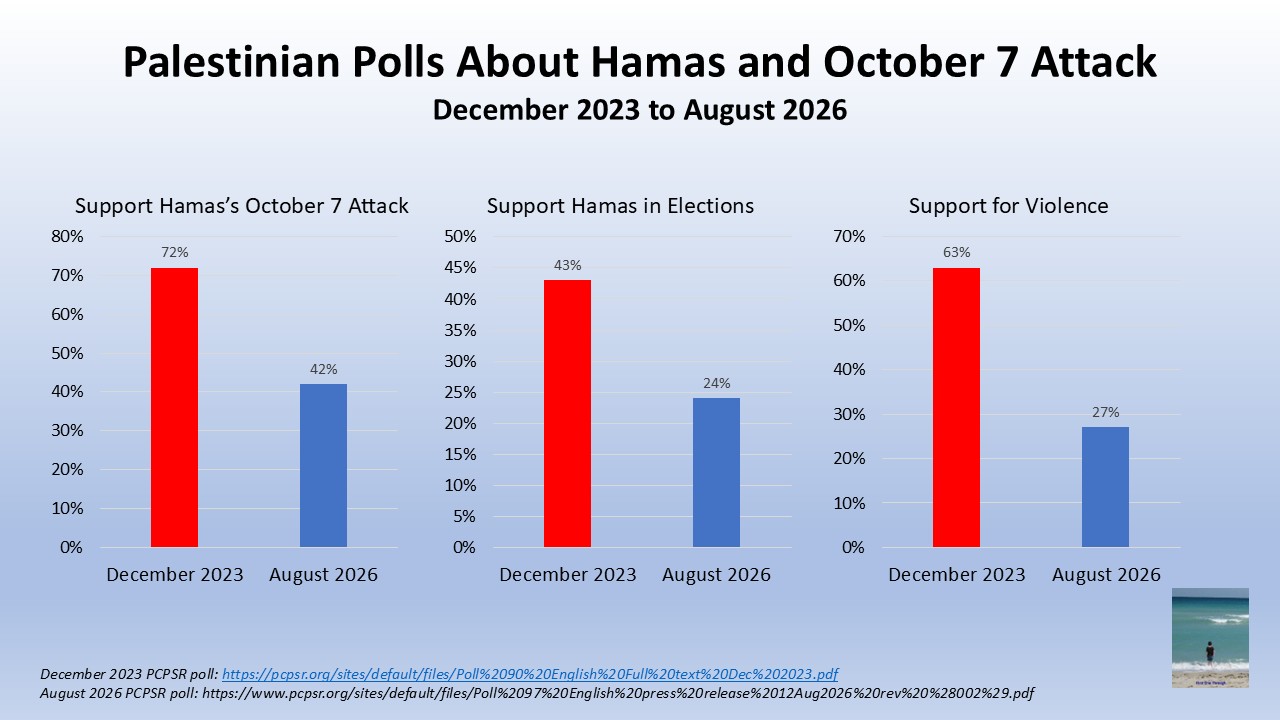
Three years ago, Palestinian Arabs thought October 7 might change their future by changing Israel. Polls show how much that ambition has changed.
In December 2023, 72% of Palestinian Arabs said Hamas was correct to launch the October 7 attack.70% believed Hamas would emerge victorious.63% preferred armed struggle as the best way to achieve Palestinian goals.
Nearly three years of war produced something very different.
According to PCPSR’s August 2026 poll, only 20% now believe Hamas won the Gaza war. Hamas political support has fallen to 24%. Half of Palestinian Arabs say “armed resistance” (aka massacring Jewish civilians) failed to protect them or end the “Israeli occupation” and instead brought destruction. Among Gazans, 65% say so.
Support for armed struggle has fallen from 63% to 27%. 44% now choose negotiations as the most effective strategy.
Their priorities have shifted with it.
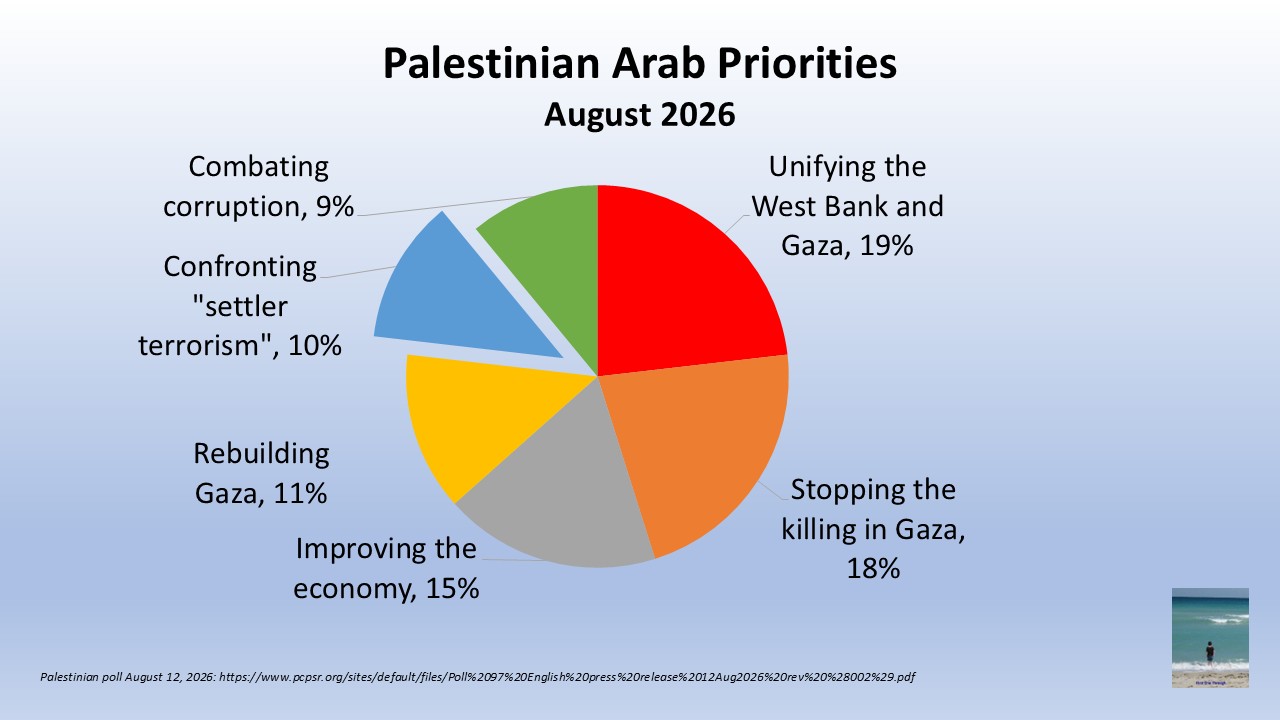
Asked in the August 2026 poll what the next Palestinian legislature should address, Palestinian Arabs answered:
19% — Unifying the West Bank and Gaza
18% — Stopping the killing in Gaza
15% — Improving the economy
11% — Rebuilding Gaza
10% — Confronting “settler terrorism”
9% — Combating corruption
Settler violence ranks fifth.
That is a very different Palestinian Arab story from the one dominating international headlines. Palestinian Arabs put reunification, ending the Gaza fighting, economic recovery and rebuilding Gaza ahead of attacks from West Bank Jews.
While the ambitions of October 2023 were directed outward, towards ending the Jewish State, the priorities of August 2026 are directed inward, to unification, rebuilding and recovering.
And Hamas remains part of that project.
The Palestinian Authority wants candidates in the coming elections to accept the commitments of the Palestine Liberation Organization, including its agreements with Israel. 66% of Palestinian Arabs oppose that requirement. Only 27% support it.
Because Palestinian Arabs envision Hamas remaining part of their future.
Asked what Hamas would become if it gave up its weapons, 53% said it would remain both an armed resistance and political movement. Another 36% said it would become solely a political movement. That means 89% see Hamas continuing as a political movement in some form.
There is a historical lesson in what happens after a genocidal society launches a disastrous war and loses.
Postwar Germany did not rebuild by simply disarming the Nazi Party and inviting it to contest elections. The Nazi Party was abolished and banned. Its political structures were dismantled. Germany’s reconstruction required a break with the movement that had led it into catastrophe.
Palestinian Arabs are not making that equivalent break. While they increasingly recognize that Hamas’s war failed, they want Hamas to be part of the Palestinian future.
As the western media and United Nations narrows a focus on violence committed by Israeli Jews against Palestinian Arabs, those same Arabs are no longer focused on those Jews. Instead, the Arabs prioritize rebuilding after the disaster while maintaining the eliminationist ideology in their society for a future war.
Eight Muslim countries issued a joint statement Sunday condemning Israel’s rejection of the latest roadmap for implementing President Donald Trump’s Gaza peace plan. They are: Saudi Arabia, Egypt, Jordan, Qatar, the United Arab Emirates, Turkey, Pakistan and Indonesia.
They have no formal collective name. So call them the Muslim Eight — the M8.
Together, the M8 countries have roughly 817 million people and contain forty percent of the world’s Muslims. Indonesia and Pakistan alone are two of the world’s largest Muslim-majority countries.
The M8 was assembled by U.S. President Donald Trump with a specific purpose.
On September 23, 2025, on the sidelines of the United Nations General Assembly, Trump convened the leaders and senior officials of these eight Arab and Muslim countries. The goal was to end the Gaza War and build a day-after framework. Trump needed Muslim and Arab countries with street-cred in Gaza to make that happen, as well as a history of operating functioning governments.
Egypt controlled the critical border with Gaza and, together with Qatar, was central to negotiations with Hamas. Jordan brought its relationship with Israel, the Palestinian Authority and sensitive holy sites in Jerusalem. Saudi Arabia brought money, Arab leadership and the enormous prize of possible normalization with Israel. The UAE brought capital, administrative expertise and an existing relationship with Israel. Turkey brought regional power and channels to Hamas. Pakistan and Indonesia brought two enormous Muslim populations and legitimacy extending well beyond the Arab world.
Trump assembled M8 to be directed at the problem in Gaza. Help end the war. Get the hostages released. Stabilize the ceasefire. Keep Hamas from returning to power. Reconstruct Gaza. Support a new Palestinian administration. Reform the Palestinian Authority. Create a workable security structure.
Six days after Trump’s meeting, the M8 jointly welcomed his Gaza peace proposal and committed themselves to working with the United States and the parties to implement it.
When Hamas responded to Trump’s proposal in October, the M8 responded together. When disputes developed over Rafah, the M8 responded together. When Trump established his Board of Peace to oversee Gaza’s transition, all eight announced together that they would join.
Trump had created a Muslim steering committee for Gaza. But soon, the M8 discovered it could steer other things.
By December, it was collectively defending UNRWA, even as Trump’s postwar architecture was establishing new institutions to govern, finance and rebuild Gaza.
In March 2026, the M8 jointly condemned Israeli restrictions at Al-Aqsa Mosque/ the Jewish Temple Mount. Later that month, it issued another statement about Muslim and Christian access to Jerusalem’s holy sites.
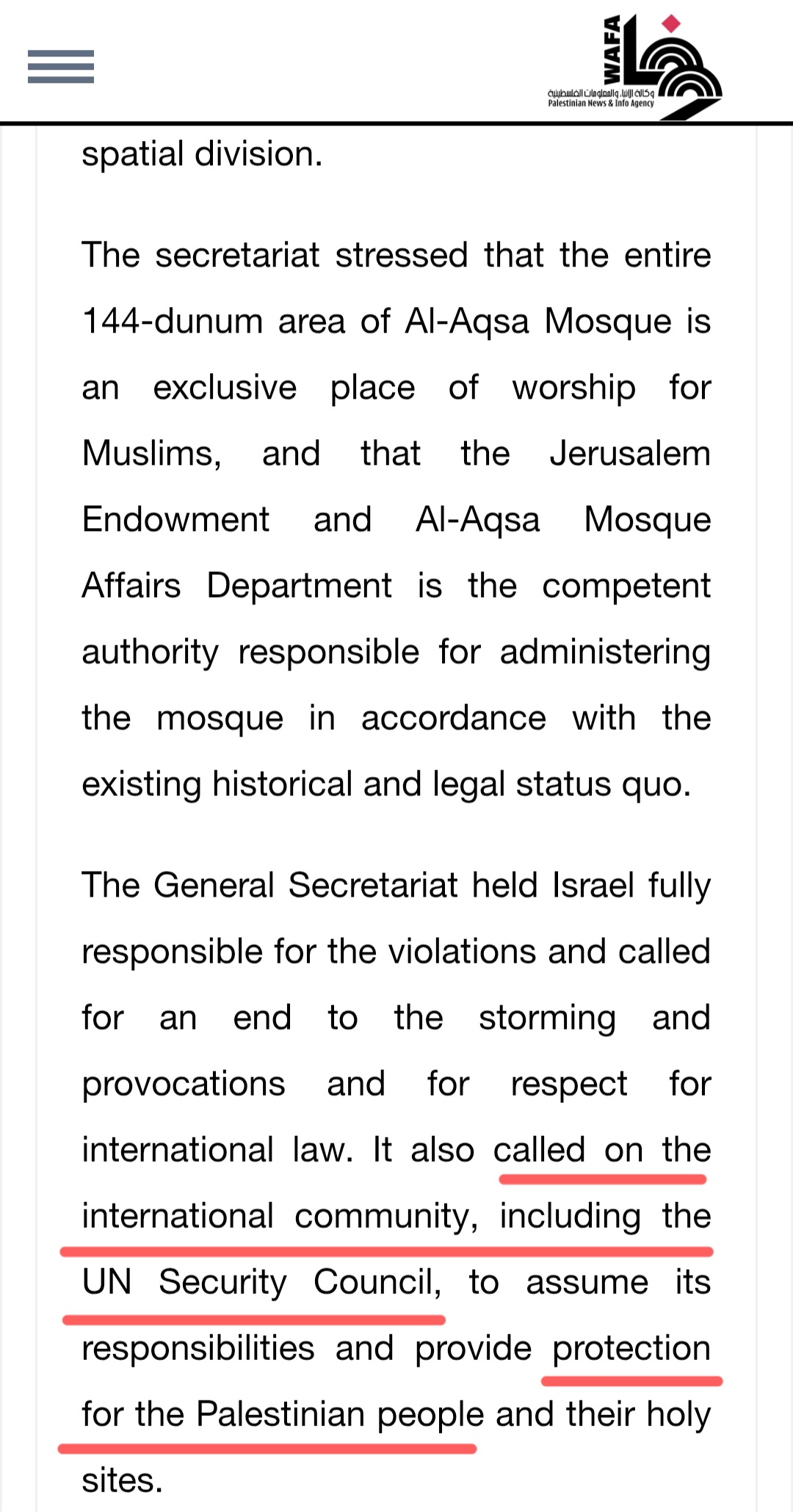
In April, it jointly declared that the entire 144-dunam Temple Mount/Haram al-Sharif compound was exclusively a Muslim place of worship and backed the Jordanian Waqf’s authority there.
The M8 began issuing collective positions on Israeli settlements, Israeli sovereignty measures, “settler violence” in Judea and Samaria.
None of that was why Trump assembled the M8.
The Board of Peace was created around a specific Gaza program: maintain the ceasefire, demilitarize Gaza, establish transitional Palestinian governance, rebuild the territory, reform Palestinian institutions and create conditions for a different future.
Yet the M8 now speaks on subjects well outside of Gaza with the institutional weight it acquired by becoming Trump’s chosen Arab-Muslim partner. A coalition created to solve Gaza has become a platform to pressure Israel over Jerusalem, Judea and Samaria, UNRWA and Palestinian statehood.
Trump gave the M8 a mandate to help fix Gaza. The M8 is turning it into a mandate to lecture Israel.
Charts regularly circulate showing the countries with the most “unicorns” — private companies that achieve valuations of at least $1 billion. Divide the totals by population and tiny Israel suddenly jumps toward the top of the world.
But the headline number obscures a three more interesting stories.
Israel did not spend 75 years steadily accumulating unicorns. Most of its unicorn phenomenon is remarkably recent. And many of the companies created by Israelis aren’t headquartered in Israel at all.
Then there is what these companies actually do.
Put those three pieces together — when they emerged, where they are headquartered and what they sell — and Israel’s unicorn story looks like a specialized company-production machine for today’s world.
The Unicorn Explosion
In 2011, only 16 new unicorns were created in the entire world. Israel was hardly overflowing with them either. TechAviv data show Israel produced just four new unicorns in 2015 and nine in 2019.
Then the curve turned sharply upward.
Israel produced 19 new unicorns in 2020 and 42 in 2021. By December 2021, TechAviv counted 79 Israeli-founded unicorns. By December 2022, there were 98.
That means the Israeli unicorn story people now take for granted is largely a phenomenon of the last several years.
“Israel ranked first globally in terms of its number of technology unicorns per capita. As of 2025, the country’s startup scene contained 90 active tech unicorns, and raised billions of dollars in investments annually. These are indicators of an exceptionally well performing startup ecosystem, which forms the basis of the country’s robust technology industry.” – Statista.com
The cheap-money technology boom certainly helped. Valuations soared everywhere in 2020 and 2021. But Israel’s performance was exceptional even within that global frenzy.
Israeli Unicorn Doesn’t Necessarily Mean in Israel
Of the 79 Israeli-founded unicorns counted at the end of 2021, only 33 — 42% — were headquartered in Israel.
The rest were spread around the world:
19 in New York.
15 in Silicon Valley.
5 in Boston.
3 in London.
2 in Los Angeles.
1 in Singapore.
1 in Chicago.
A year later, the ratio was almost identical. Of 98 Israeli-founded unicorns in December 2022, 40 were headquartered in Israel and 58 abroad. Silicon Valley had 24 and New York had 19.
So roughly three out of every five Israeli-founded unicorns were headquartered outside Israel.
That matters when looking at those viral country rankings. A ranking based strictly on corporate headquarters can count an Israeli-founded company as American. A ranking based upon where the entrepreneurs came from can count the same company as Israeli.
Israel is creating companies for a market vastly larger than Israel.
What Israel Is Creating
Israeli unicorns aren’t distributed evenly across the economy. The country’s technology ecosystem has become increasingly concentrated around enterprise software, fintech and cybersecurity.
The Israel Innovation Authority found that these three categories represented 29.4% of companies founded in 2013 but 42% by 2021. By 2022 they were attracting 53.4% of all investment in Israeli startups.
Cybersecurity is particularly extraordinary.
Dealroom currently counts 26 cybersecurity unicorns headquartered in Israel. It calculates that Israel is 9.15 times more represented in cybersecurity unicorns than its overall share of the world’s unicorn population would predict. Tel Aviv alone ranks behind only the Bay Area in Dealroom’s global cyber-unicorn count.
And that is based on headquarters. It therefore doesn’t fully capture Israeli-founded cyber companies headquartered in places such as New York and Boston.
Israel also over-indexes in semiconductors, health technology and medtech, although nowhere close to its extraordinary concentration in cyber.
Meanwhile, the composition of Israeli technology has been changing.
Communications — historically one of Israel’s great technology strengths, including hardware infrastructure and chips — represented about 8% of newly established Israeli technology companies in 2013. By 2022 it was just 1.7%.
” In H1 2025, High-Tech accounted for 57% of all Israeli exports, the highest share ever recorded. The export mix points to a clear trend: 72% software services versus 28% High-Tech industry. This means Israel is increasingly reliant on software services exports, while the High-Tech industry, including the defense industry, has been relatively stagnant. Israel increasingly went from building the pipes to building the software running through them.” – Israel Innovation Authority
Israel Invents. America Scales.
That industry mix helps explain the geography.
A cybersecurity company potential customers are banks, governments and Fortune 500 corporations around the planet. An enterprise-software company can develop its technology in Tel Aviv while putting executives and salespeople close to customers in New York. A fintech company can maintain Israeli engineering operations while establishing its corporate headquarters in the world’s largest financial market.
And those American headquarters aren’t simply mailing addresses.
In 2023, the United States–Israel Business Alliance identified 88 Israeli-founded unicorns with global or regional headquarters in the United States. Together, those companies employed nearly 62,000 people worldwide.
The available data do not establish how many of those employees were specifically in America, so the 62,000 should not be described as American jobs. But broader state studies show that Israeli-founded companies have become meaningful American employers. In California alone, Israeli-founded companies directly employed more than 14,000 people, with their broader economic activity supporting more than 22,000 jobs.
That economic relationship runs in both directions.
American venture-capital and private-equity firms finance Israeli entrepreneurs. Israeli founders establish U.S. headquarters and hire American salespeople, executives and other employees. American corporations then acquire some of the most successful companies, bringing Israeli-developed technology inside American businesses.
Google’s acquisition of Israeli-founded Wiz for $32 billion provides an extraordinary recent example. Cisco agreed to buy Israeli-founded CyberArk for approximately $25 billion in 2025. Intel’s earlier $15.3 billion acquisition of Mobileye demonstrated the same model on a massive scale. Three Israeli technology companies. More than $70 billion of announced acquisition value. Three American buyers.
The relationship is particularly important because Israel’s strongest sectors overlap with technologies the United States increasingly considers strategic: cybersecurity, artificial intelligence, semiconductors and advanced computing.
The Israeli and American ecosystems therefore aren’t competing with one another for unicorns. They are often parts of the same machine.
Israel supplies entrepreneurs, engineers, military-trained cyber expertise and dense technical networks. The United States supplies enormous customers, deep pools of capital, experienced executives and the world’s largest technology exit market.
The result is a peculiar multinational organism: Israeli-created, frequently American-headquartered, American-financed and globally sold.
A Very Young Herd
Israel’s unicorn phenomenon is not simply impressive because a country of roughly ten million people has produced so many billion-dollar technology companies. It is impressive because the herd appeared so quickly.
It is unusual because most of the herd established headquarters outside the country that produced its founders.
And it is revealing because the herd increasingly congregated in a few industries where Israel developed extraordinary comparative advantages — particularly cybersecurity, enterprise software and fintech.
For Americans, there is another reason to care.
Israel’s technology success isn’t occurring on the other side of the world in isolation from the American economy. Some of the value Israel creates lands in New York, California, Massachusetts and elsewhere in the United States — as headquarters, jobs, investment opportunities, technology and acquisitions.
The familiar unicorn-per-capita chart therefore captures only the surface. The deeper story isn’t that Israel has a lot of unicorns.
Over the last decade, Israel became very good at manufacturing global technology companies — together with American capital and talent.
WAFA, the Palestinian Authority’s official media, has spent years describing Jews who enter the Temple Mount as “storming Al-Aqsa.” I have written about that linguistic sleight of hand before.
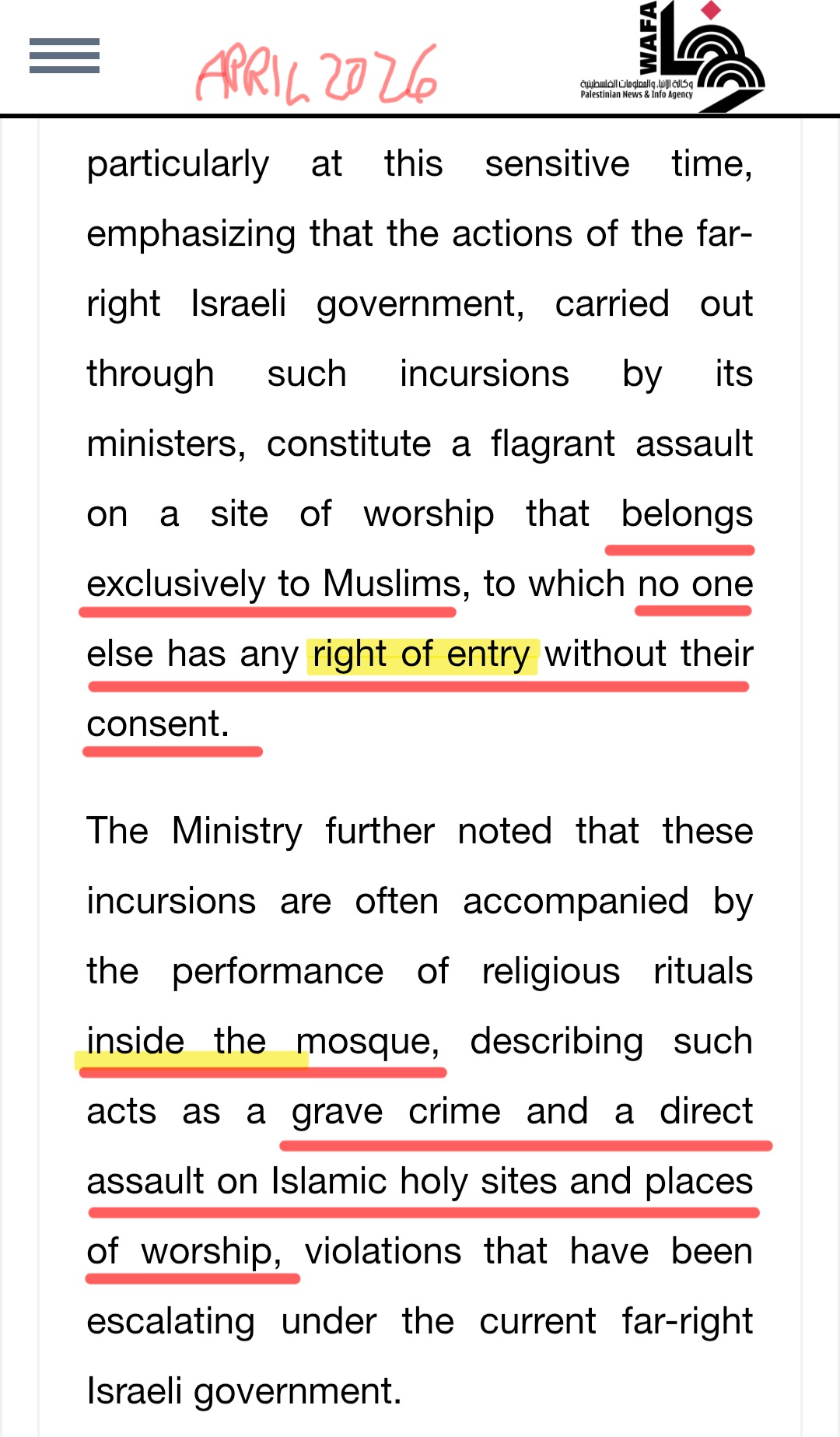
Now WAFA is promoting something more dangerous: that Jews have no right to enter Judaism’s holiest site without Muslim permission, and that Jewish worship there is an assault on Islamic sanctity.
In April 2026, WAFA reported a Palestinian statement declaring the site one that “belongs exclusively to Muslims, to which no one else has any right of entry without their consent.”
On August 13, WAFA carried an Arab League statement condemning Jews entering the site and performing religious rituals as a “blatant violation of the sanctity of the mosque.”
WAFA promoted several lies:
Muslims do not control entry. Israel controls security and access to the Temple Mount. The Jordanian-backed Waqf administers Muslim religious affairs there. Presenting Muslim consent as a prerequisite for Jewish entry is totally false.
The compound does not “belong exclusively to Muslims.” That is a religious and political claim masquerading as settled fact about the Temple Mount—the holiest site in Judaism.
Jewish presence does not inherently violate Islamic sanctity. Islam does not have a general rule that a Jew entering Muslim sacred space desecrates it. Restrictions on Jewish prayer under the status quo are one issue; declaring Jewish worship itself an assault on Islam is another.
Then comes another sleight of hand.
Having defined Jewish presence as an offense against Islam, these organizations pivot to demanding action by the international community on behalf of Palestinians.
But those categories – Muslims and Palestinian Arabs – are not interchangeable.
Some 1.85 million Muslims live in Israel, nearly one-fifth of the country’s population. And the Muslim religious administration of the Temple Mount is handled by the Jordanian-backed Waqf. Palestinian Arabs do not exercise control over entry to the site, nor do they represent all Muslims in the region.
So why transform an asserted Muslim religious grievance into a Palestinian national claim demanding international intervention?
Because the lies are the tell.
The argument is no longer about protecting Muslim worship. It takes an assertion of Muslim religious exclusivity, converts it into a Palestinian territorial right, and then asks the world to enforce that right against Israel and Jews.
The implications become darker when the same logic is applied beyond the Temple Mount. Hamas’s 1988 charter declared all of Palestine an Islamic waqf. Combine that doctrine with the claim being promoted around Al-Aqsa—that Jewish physical presence and worship offend Islamic sanctity—and expelling Jews can be transformed into protecting Muslim holy land.
“the land of Palestine is an Islamic Waqf consecrated for future Moslem generations until Judgement Day. It, or any part of it, should not be squandered: it, or any part of it, should not be given up.” – Hamas Foundational Charter, Article 11
That is why the Arab League and WAFA’s language matters. By repeatedly publishing these false assertions, it helps turn a Palestinian territorial claim into a purported Islamic prohibition against Jewish presence.
And it begins at the most perverse possible location: Judaism’s holiest site.
The progression is stark:
Declare the Jewish holy site exclusively Muslim.
Deny Jews the right to enter without Muslim permission.
Call Jewish presence and worship a desecration of Islam.
Turn that religious claim into a Palestinian territorial right.
Ask the world to enforce it.
The Arab League and Palestinian Authority are building a religious and political case for removing Jews from their own holy land.
Is there a more gay-friendly capital than Reykjavík?
Walk through Iceland’s capital and Pride is everywhere. Rainbow flags fly from storefronts. Streets are painted in LGBTQ colors. Businesses and government buildings proudly proclaim their support for gay rights, queer rights and equality.
Then look a little closer.
On those same Reykjavík streets are Zionists Not Welcome stickers and other expressions of hostility toward the one country in the Middle East where LGBTQ people openly flourish: Israel.
Anti-Israel sticker on parking pay station in Reykjavik, Iceland (photo: First One Through)
The contradiction is hard to miss.
In Israel, gay people serve openly in government and the military. Tel Aviv Pride is one of the world’s best-known LGBTQ celebrations. Gay couples live openly. LGBTQ organizations operate publicly.
Across the Palestinian Arab territories and much of the surrounding Muslim Middle East, the reality is radically different. Hamas governs Gaza according to an Islamist ideology hostile to homosexuality. Iran criminalizes same-sex relations and has imposed the death penalty for homosexual conduct.
Yet in Reykjavík, the political sympathy often seems to run precisely backward.
The rainbow flag is supposed to say that gay rights are human rights. That should apply in Iceland, Israel, Gaza, Iran and everywhere else.
Reykjavík proudly covers itself in rainbows but should follow those colors all the way to the Middle East and ask where gay people can actually live beneath them.
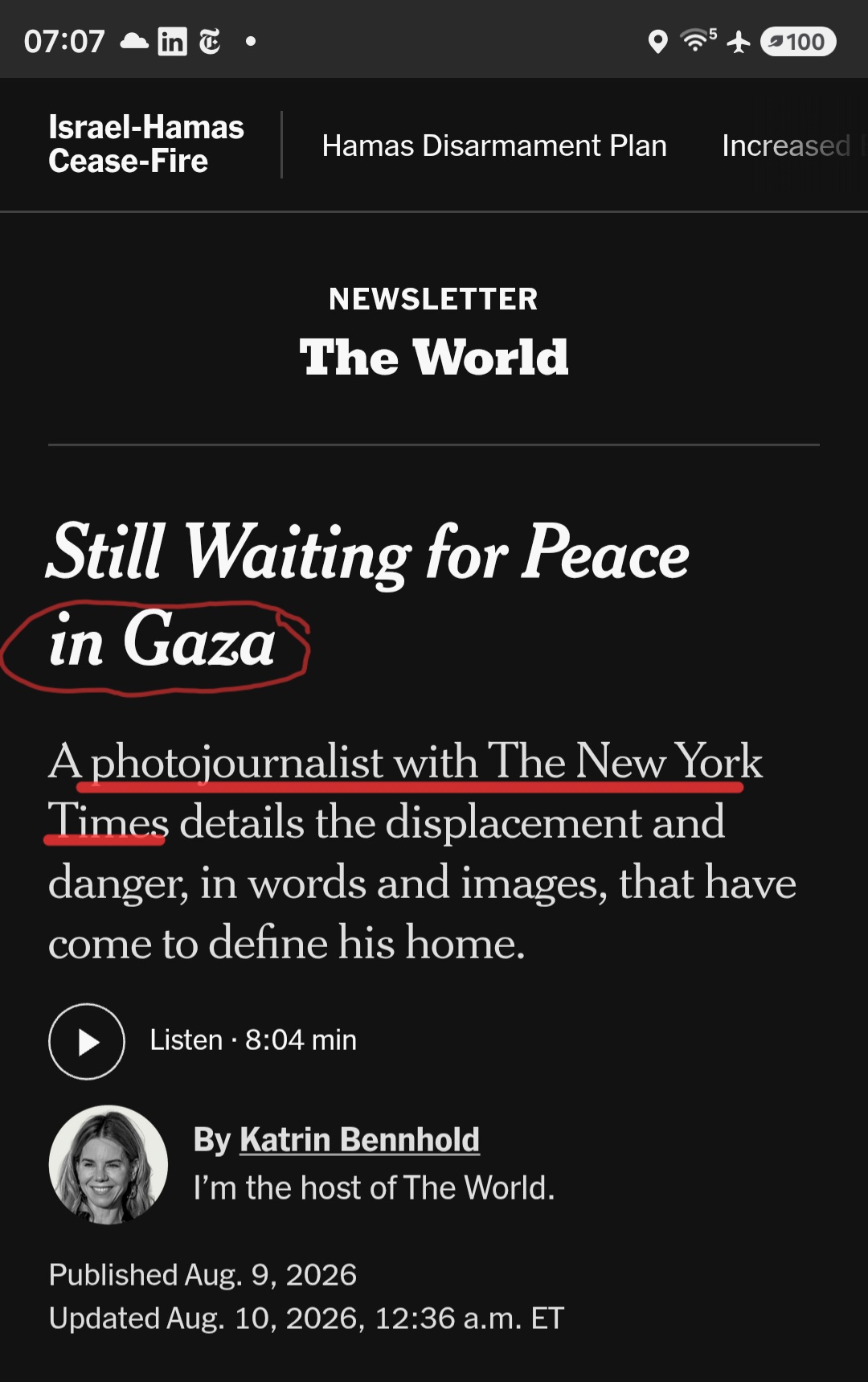
The New York Times published a photo essay under the headline “Still Waiting for Peace in Gaza.” Its Palestinian Arab photojournalist documents the world around him: shattered buildings, displaced families, rubble and danger. The photographs powerfully show what war looks like from inside Gaza.
But what does peace look like?
For Israelis living a few miles away, peace means sleeping without rockets overhead. It means children not watching their parents gunned down before them. It means young adults attending a music festival without being hunted, families living on kibbutzim without gunmen entering their homes, and civilians never again being murdered or dragged across the border as hostages.
Those images are outside the Times’ frame. And their absence raises the central question: Are Gazans waiting for peace with Israel, or peace from Israel?
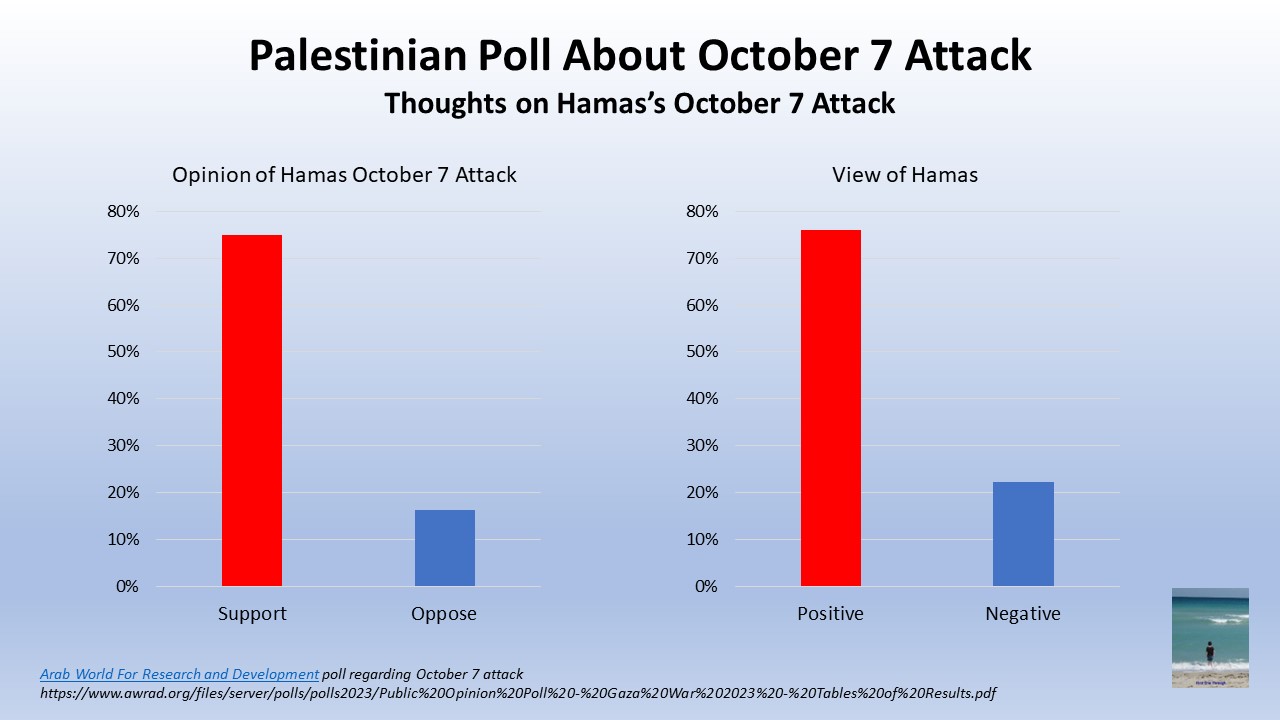
Palestinian Arab polling makes the distinction important. After October 7, the Palestinian Center for Policy and Survey Research repeatedly asked whether Hamas had been correct to launch its attack. In March 2024, 71 percent of Gazans said yes. Three months later, after enormous destruction inside Gaza, 57 percent still considered the decision correct. Support showed a desire to live with violence inside Gaza if it led to the destruction of Israel.
The pattern predates October 7. Palestinian polling over decades has repeatedly recorded substantial support for attacks against Israelis, including civilians. The question of peace therefore cannot be answered simply by photographing people who desperately want the war around them to end.
Peace is reciprocal. It requires imagining security for the people across the border as well as for oneself.
A revealing photo essay would turn its lens outward. Ask Gazans whether Jewish families should live safely in Sderot and Kfar Aza. Whether Israelis should be able to dance near Gaza without fear of armed Palestinian Arabs crossing the border. Whether rockets should stop permanently. Whether Hamas should disarm. Whether the future they envision includes Jews living securely beside them.
Those answers would tell us whether Gazans are waiting for an end to war or waiting for peace.
And this is where the New York Times itself enters the frame. This is the newspaper’s own photojournalist, presented under the Times’ own headline and editorial framing. By calling the desire for calm inside Gaza “waiting for peace,” the newspaper takes one side’s desire for relief from war and gives it the language of reconciliation between two parties. It portrays the Palestinian Arabs as desirous of coexistence when it is plainly not so.
That framing is particularly consequential when the war began with Hamas crossing into Israel on October 7 to murder and abduct civilians. When thousands of Arab civilians invaded Israel to rape women and abduct children and spit on their corpses as they arrived in Gaza. Removing Israel from a story about “peace” reduces peace to what happens to Gaza after the attack, rather than what Gazans want to happen to Israelis in the future.
The Times reinforces a distorted understanding of the conflict: Palestinian peace becomes the absence of Israeli violence against Palestinians, while the Palestinian attitude toward violence against Israelis disappears beyond the edge of the photograph.
A camera pointed only into Gaza can show us what Gazans want to stop seeing. Peace begins with asking what they want Israelis to stop seeing too.