The Long Shadow of 1492

In a sharp escalation of transatlantic tensions, U.S. President Donald Trump announced that the United States will “cut off all trade with Spain, publicly castigating the Spanish government for refusing to allow U.S. military bases on its soil to be used in operations linked to strikes against the Islamic Republic of Iran and for what he termed Spain’s failure to contribute sufficiently to NATO defense spending. Trump declared that he “doesn’t want anything to do with Spain,” framing the dispute as a response to Madrid’s resistance to what he described as confronting evil in the Middle East and paying its fair share for collective defense. 

What follows is not about this immediate crisis. It’s about deeper historical currents that help explain some of the underlying dynamics in Spanish public life that stretch back to the fifteenth century and still matter today.


In Western Europe outside Scandinavia and the United Kingdom, the two countries with the smallest Jewish presence relative to population are Spain and Portugal (about 0.02% of each countries’ overall populations).

That is not a statistical curiosity. It is a civilizational fact.

Five centuries ago, the Iberian Peninsula expelled its Jews. What had been one of the great centers of Jewish life vanished over a five and a half year short window. The Alhambra Decree in 1492 ordered practicing Jews out of Spain. Portugal followed with forced conversions and the Inquisition. Open Jewish life disappeared. What had been woven into the intellectual, commercial, and spiritual fabric of the peninsula was purged.

And it stayed removed.

Unlike other parts of Western Europe where Jewish communities, even after catastrophe, remained visible and rebuilt, Iberia entered the modern era with almost no Jews at all. Medieval synagogues became churches, then museums. Sephardic music became heritage. Jewish quarters became tourist sites. The living community remained tiny.

Fast forward to the present.

In Spain, large protests erupt over the Israeli-Stateless Arabs from Palestine (SAPs) conflict. Municipal councils pass symbolic measures aligned with boycotts. Parliament debates recognition of Palestine. Streets fill with Palestinian flags while graffiti targets Israel.

Anti-Israel graffiti on Barcelona street in March 2026 (photo: First One Through)

In Portugal, while public demonstrations are generally smaller, political and diplomatic critiques of Israeli policy align with broader European debates.

And yet.

There are no comparable national protest cultures around Sudan. No sustained marches over Somalia. No municipal votes over Afghanistan. Iran’s repression and mass slaughter of its citizens cannot find a sympathetic voice in Iberian plazas, and the Rohingya tragedy never became a regular mobilizing cause.

The difference is not just geopolitical proximity or media cycles. It is structural.

Germany, by contrast, carries the Holocaust in living memory. Its leaders speak of Israel’s security as part of state responsibility. Jewish life is visible, rebuilt, acknowledged. The past is recent enough to shape policy language. The moral vocabulary is immediate.

Spain does not carry that twentieth-century reckoning. Its rupture with Jewish life occurred in 1492, so there is no generational memory of deportation trains. The story of Jews is medieval, not modern.

When a society has lived five hundred years without Jews, when Jewish presence is primarily historical exhibit rather than daily reality, does Israel become easier to turn into abstraction? Does outrage attach more easily to a distant Jewish state when there is little lived Jewish experience at home?

Or is it even worse than detachment?

A peninsula that removed its Jews in the fifteenth century now hosts some of the smallest Jewish communities in Western Europe, public squares with the most intensely anti-Israel protests, and a government unwilling to mobilize in the slightest manner to defang the leading state sponsor of terror, especially against Jews.

Five centuries is not only long enough for history to fade; it is long enough for it to harden into culture.

The Distant Hum at Mobile World Congress

At Mobile World Congress in Barcelona, the dominant sound is usually ambition. Deals over espresso. AI demos on loop. Spectrum, towers, IoT, eSIM. The future negotiated in glass rooms.

This year there was noise at the gates.

Protesters in keffiyehs waved Palestinian flags and tried to slow the river of attendees entering Fira Gran Via. They demanded the conference bar “genocide supporters.” They blocked traffic briefly. They filmed themselves and shouted.

The doors stayed open. The show went on.

Inside, the tone was very different.

Because of the escalating confrontation between the United States and Israel, and the Islamic State of Iran, many executives from the Middle East never made it to Barcelona due to flight cancelations. The Israeli Pavilion, usually one of the most kinetic and crowded zones on the floor, felt restrained. A few local Jews stood behind booths helping scan QR codes and explain products for companies whose teams were grounded thousands of miles away.

There was no dramatic security ring. No spectacle. Just visible absence.

Attendees still came by. Investors still asked questions and carriers still wanted meetings. The international community, in practice, wants to do business with Israel. It wants the cybersecurity, the silicon, the network optimization, the AI driven infrastructure. The appetite for innovation did not vanish because activists shouted outside.

As in past years, there was no Iranian Pavilion, because there was no demand for that country’s technology despite the billions of dollars poured into nuclear weapons programs and ballistic missiles. There were also no street protests outside the hall condemning Tehran, even as reports attribute tens of thousands of civilian murders at the hands of Iranian police.

Barcelona offered no blockades over ballistic missile programs nor chants about enrichment levels.

The inversion was hard to miss. Accusations of genocide delivered by activists wrapped in the imagery of the very movements whose leaders openly call for the destruction of a state. Silence about a regime long designated by the United States as the leading state sponsor of terrorism.

Anti-Israel graffiti on Barcelona streets, March 2026 (photo: First One Through)

The true backdrop to this year’s MWC was not the shouting. It was the distant hum of war shaping travel and corporate decision making. It thinned a pavilion and changed calendars.

The protesters created friction. The war created gravity.

And Barcelona, for all its global brand and history of hosting the world’s premier telecom gathering, showed something troubling. Instead of projecting confidence as a neutral convening ground for global commerce, it allowed a small group of activists to frame the city’s welcome with hostility toward one delegation in particular, as more of the city streets became unsafe for visitors.

Neighborhoods in Barcelona have become havens for dozens of Muslim men, looking for pickpocketing opportunities

The international industry kept meeting. Deals kept forming. Business cards were still exchanged as the angry chants didn’t cross the convention hall doors.

But the hum of geopolitics settled inside, and the world, watching closely, saw which noise mattered and which one merely embarrassed the host.

Passport Hyperbole

The outrage over the U.S. offering passport services in Efrat, in Area C east of the 1949 Armistice Lines (E49AL) as “normalizing annexation” is manufactured.

For many decades, the United States operated a consular office in the western part of Jerusalem on 18 Agron Street, providing passport and visa services to Palestinian Arabs. It was situated in the area that Israel assumed control of in 1949, not 1967 when the “West Bank”/E49AL came under Israeli authority in the country’s defensive war against Transjordan. Still, some countries considered western Jerusalem “disputed” and subject to future negotiations.

Yet when the U.S. ran consular services there, it was treated as routine diplomacy.

Former U.S. office for Palestinian Arabs located in “Western Jerusalem” which has been part of Israel since the end of the 1948-9 War

Now the U.S. offers passport services in Efrat and suddenly it’s a diplomatic crisis.

Why? Because the issue is not passports. It is Jews living beyond the 1967 lines.

The U.S. action is “a dangerous precedent and a blatant alignment with the enemy’s Judaization plans… a practical recognition of the legitimacy of settlements and the enemy’s control over the West Bank.” – HAMAS, a U.S. designated foreign terrorist organization regarding the passport office in Efrat

Disputed means disputed. It cannot mean “routine” when Palestinians receive services in western Jerusalem but “provocation” when Jews receive services in Area C.

Efrat sits in Area C under the Oslo Accords, territory left for final-status negotiations. It was not designated sovereign Palestinian land, and was a Jewish community before the regional Arabs launched a war to destroy Israel at its founding in 1948. In multiple Israeli peace offers, the Gush Etzion bloc – including Efrat – was to be incorporated fully into Israel through land swaps.

Passport services mean nothing about recognizing sovereignty. The hysteria reveals a double standard: Jewish civilian life in contested areas must remain politically radioactive, even when identical administrative acts for Arabs elsewhere pass without comment.

The U.S. decision is “a clear violation of international law” and “participation in the crime of silent annexation.” – Palestinian Islamic Jihad, a U.S. designated foreign terrorist organization

The controversy is not about diplomacy. It is about delegitimizing the presence of Jews.

And demanding that Jews be barred from living somewhere – anywhere, let alone in their holy land – is plainly antisemitic.

The Third Type of Israeli For Diaspora Jewry

Since October 7, diaspora Jews have met three types of Israelis: traumatized, empowered and lonely.

The traumatized arrive as witnesses.
The empowered arrive as proof of resilience.
The third variety is one of performance – asked to explain a country while still trying to understand their own experience.


In Jewish communities, the first narrative is familiar. Israelis describe rupture.

October 7.
The hostages.
Reserve duty.
Funerals.
The knowledge that Iran sits behind the horizon.

This is testimony. The Israeli leaves seen as wounded.


A second narrative follows.

Israel adapted.
The army responded.
The economy continues.
Restaurants are full.
Startups are built.

This story stabilizes the room. The Israeli leaves seen as resilient.


Between these narratives lives daily life.

Relief and dread coexist.
Normal life returns without feeling normal.
Laughter sits beside background tension.

Public conversation prefers clarity. Experience offers contradiction.

So Israelis adapt to the room.

They speak trauma when trauma is needed.
They speak strength when reassurance is needed.
They translate Israel in real time.

The performance is neither optimism nor trauma.
But it is performance, a derivative removed from feelings.


Psychology defines loneliness as the gap between experience and recognition, not the number of relationships. This is emotional loneliness – social connection without feeling fully known.

A related idea is self-discrepancy, the distance between lived reality and presented identity. When that distance persists, people function well while feeling internally unseen.

Connection forms around the role while the person remains partially hidden.


Diaspora encounters intensify this.

Israelis become representatives of war, resilience, survival. Conversation pulls toward clarity. Ambiguity has little space.

So ambiguity moves inward.

This produces what researchers describe as invisible loneliness: being embedded in strong relationships yet recognized mainly through narrative.


Outwardly, this looks normal.

Travel resumes.
Humor returns.
Good news is shared.
Life is described as continuing.

Much of this is regulation.

Many Israelis instinctively manage diaspora anxiety: softening uncertainty, emphasizing stability, offering reassurance before they fully feel it.

People compress their own ambiguity to protect others. Emotional labor strengthens connection while quietly increasing distance.


The loneliness that follows is subtle.

These Israelis are seen as strong and seen as wounded, but rarely seen as both at once. Explanation is recognized faster than contradiction.

Fluency becomes the demanded role.

But that fluency creates distance.


The most adaptive Israelis can tell every story correctly. They sense what the room needs and provide it. They move between testimony and reassurance without hesitation.

This is competence. And compression.

At home, without an audience, the unperformed experience lives: pride and exhaustion, relief and uncertainty, normal life alongside persistent tension.

Psychology frames this as the cost of sustained self-discrepancy: the larger the gap between experienced reality and presented reality, the greater the risk of loneliness inside connection.


Diaspora Jews are not doing something wrong and Israelis are not being inauthentic. This is what prolonged uncertainty does when communities need clarity.

Narratives travel easily. Complexity moves slowly.

The role of the Israeli has become easier to understand than the experience of being Israeli. Can diaspora Jewry enable them to feel truly connected simply by listening, or does the off-ramp from loneliness require sharing the barrage of antisemitism in their own daily lives.

The Impossible Conditionals

The Jewish state is offered acceptance on two terms: 1) become less Jewish, and 2) take in those who want to end the Jewish State permanently.

The first demand asks the Jewish state to thin the very idea that created it. The national home is treated as temporary, acceptable only if its defining character softens and disappears.

People learning and praying at the Western Wall (Photo: First One Through)

The second demand asks the state to normalize existential risk. The perpetual state of war and support for killing Jewish civilians is ignored is rationalized under the rubric of Arab “frustration.”

Each demand strains reality. Together they form a toxic contradiction.

A country cannot weaken the basis of its existence while expanding exposure to those who challenge that existence, and still promise a degree of safety to its citizens. The condition for global approval erodes the basic condition for survival.

This is the impossible conditional embedded in international language, highlighted in UN resolutions. Acceptance in the Middle East and the community of nations is framed as the reward for steps that make recognition unnecessary because the conflict’s central object -the Jewish state – is expected to disappear into a new secular bi-national entity at best, and from the face of the Earth at worst.

Unsurprisingly, Israel cannot accept such terms. So the UN blesses the violence against it.

Remarkably, the world cannot understand why Israelis will not embrace the offer of acceptance coupled with the demand for self-immolation.

From Mishkan to Mikdash

Parshat Terumah introduces the Mishkan, a sanctuary built in the wilderness, precise in measurements and portable by design. It moved as the people moved. God’s presence rested among a nation without a permanent home.

For nearly two thousand years, Jewish life functioned in Mishkan mode.

Without sovereignty and without a Temple, Jewish law became the architecture that traveled. Halacha, Jewish law, created sacred space wherever Jews settled. The synagogue stood in place of the courtyard and the Shabbat table carried echoes of the altar. Study sustained covenant across continents.

Judaism survived in the diaspora because it was built to move.

But the Mishkan was never meant to be the final form. It pointed toward the Mikdash, the Temple that was ultimately built 3,000 years ago in Jerusalem, enduring and anchored in sovereignty. The Mishkan belongs to wandering. The Mikdash assumes a people settled in its land.

Exile required portability. The State of Israel reintroduces permanence.

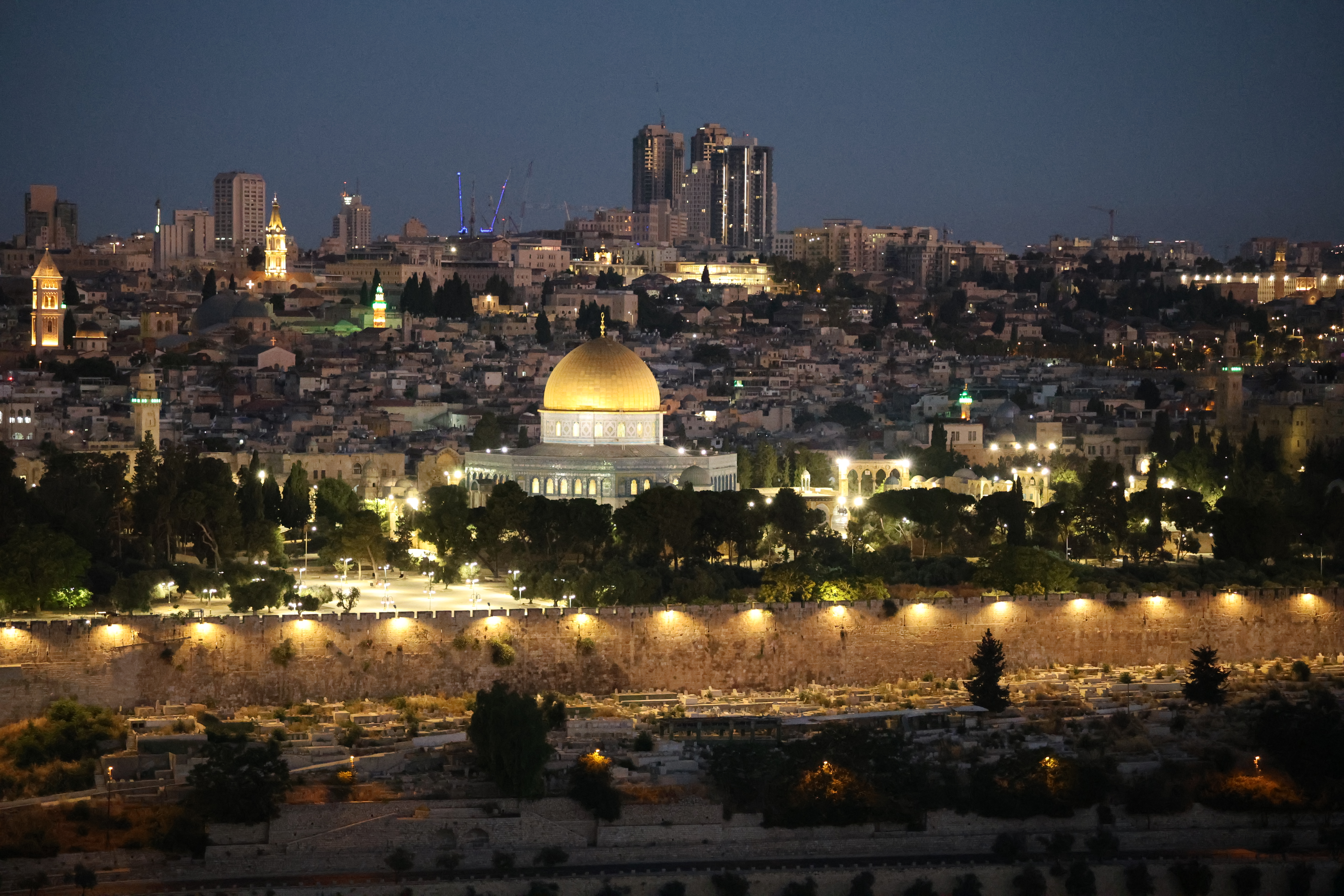
The Old City of Jerusalem including the Jewish Temple Mount/ Al Aqsa Compound

That shift changes the demands of Jewish life. Law still shapes the individual and the community, but it now encounters public power. Covenant enters the arena of governance.

The wilderness sanctuary rose from voluntary gifts. The Temple required national structure and responsibility. Now, sovereignty requires the same. While a portable faith sustains survival, a rooted nation must translate that faith into courts, policy, defense, and public ethics.

Jewish history has moved from dispersion to statehood. Yet the deeper challenge is spiritual: whether a tradition perfected in exile can shape a society in power without losing its moral clarity.

Terumah begins with a traveling sanctuary. It gestures toward something fixed and enduring.

The journey from Mishkan to Mikdash continues in our own time.

The Exception That Keeps a War Alive

Australia has drawn a line.

Citizens who left to fight for the Islamic State are not automatically welcomed home. Sovereignty allows a country to weigh allegiance, ideology, and risk. No global institution calls that immoral. No emergency sessions demand reversal.

“These are people who went overseas supporting Islamic State and went there to provide support for people who basically want a caliphate.” – Australian Prime Minister Anthony Albanese

That is how states function.

Family members of suspected Islamic State militants who are Australian nationals walk toward a van bound for the airport in Damascus during the first repatriation operation of the year at Roj Camp in eastern Syria, Monday, Feb. 16, 2026. Thirty-four Australian citizens from 11 families departed the camp. (AP Photo/Baderkhan Ahmad)

Then the rule changes.

The United Nations insists Israel must accept the DESCENDANTS of people who were NEVER ISRAELI CITIZENS, who NEVER LIVED IN ISRAEL, and whose political movement LAUNCHED A WAR TO DESTROY ISRAEL. Entry is framed as a permanent right. Citizenship becomes an instrument of conflict.

This is not mere hypocrisy. It is a flawed and fatal doctrine.

The standard for Australia preserves states. The other pressures a single state to absorb a demographic outcome tied directly to a war against its existence.

“They are terrible situations. But they have been brought on entirely by horrific decisions that their parents made.” – Australia Home Affairs Minister Tony Burke, about banning the children of Australian “ISIS brides” from being allowed into Australia

The refugee framework applied to Palestinians is unique in modern history. It has its own bloated organization in which “refugee” (not even “internally displaced” for Arabs in Gaza and the “West Bank”) passes through generations indefinitely. International institutions reinforce it. Political leadership is incentivized to promise return rather than build final compromise.

That incentive has consequences.

If millions are told the conflict ends inside Israel rather than beside it, negotiations stall. If international bodies validate that expectation, maximalism becomes rational. If maximalism is rational, violence remains politically useful. Understood. Blessed.

This mindset has cost tens of thousands of lives because it keeps the central dispute unresolved. Each cycle of violence is fueled by the belief that time, pressure, and international legitimacy will deliver what negotiation has not.

States everywhere are allowed to defend sovereignty and security. Israel is told sovereignty and security is a matter for international bodies to determine.

The Vilifiers of Raped and Kidnapped Jewish Women Get Political Power

New York City Mayor Zohran Mamdani just appointed Ana Maria Archila of the Working Families Party to lead the Mayor’s Office of International Affairs. She will serve as the city’s chief liaison to the United Nations and the State Department.

She doesn’t care much for Israeli Jews.

In 2018, Archila became a national symbol of “believe survivors” during the confirmation fight over Brett Kavanaugh. She demanded that allegations of sexual violence be treated with complete moral seriousness.

Yet in June 2024, she had no issue championing Rep. Jamaal Bowman who had taken to the streets of his district after the heinous October 7, 2023 Arab massacre of Israelis to yell to a crowd that the story of Hamas raping Jewish women was a lie.

To add toxic fuel to the fire, while dozens of Jewish Israeli women remained captive in the terror tunnels of Gaza by the Palestinian leadership, Archila yelled at the Bowman rally (4:47) that “we end foreign policy that keeps Palestinian people in shambles and Palestine in shackles.” That is not an exaggeration: she came out to a rally to support a rape denier and yelled that the victims of kidnapping were actually the perpetrators.

Now Mayor Zohran Mamdani is elevating Archila into an international-facing role for New York City, the city with the largest Jewish population outside Israel.

In the alt-left political establishment in New York City today, raped Jewish women are not to be believed, their kidnapping is to be mocked, and their tormentors are to be canonized before cheering crowds.

Three Interesting and Unique Things About Israel’s National Anthem

The Olympics are a unique time when the national anthems of many countries get played in succession. It is a time to consider how unique Israel’s anthem is.

Hope versus Superiority and Sacrifice

Most of the national anthems in the world were written to rally a nation. They evoke war themes and superiority over a nation’s foes. Consider the United States anthem about “the rockets red glare, the bombs bursting in air,” or Germany’s original “Germany, Germany over all. Over everything in the world!”

In the Muslim Middle East, most countries have anthems that describe sacrifice:

But the State of Israel’s national anthem “Hatikvah” is about hope. Not superiority. Not vendetta, sacrifice or struggle. HOPE.

Its Capital City

While most countries’ anthems surround themes of victory and struggle, Israel uniquely focuses its anthem on its capital city, Jerusalem. In fact, no other country even mentions its capital, while Israel does so in an anthem just a few lines long.

One of the Oldest in the Middle East

The world changed dramatically after the end of World War I, with the collapse of the Austria-Hungarian and Ottoman empires, the end of the USSR, and end of decolonization. The number of countries multiplied over the last century, to nearly 200 today.

Israel’s national anthem is the oldest of the new nations, especially in the Middle East.

  • Israel written in 1878
  • Turkey 1921
  • Syria 1938
  • Jordan 1946
  • Libya 1951
  • Oman 1970
  • Kuwait 1978
  • Tunisia 1987
  • Iran 1990
  • Yemen 1990
  • Palestinian Authority 1996
  • Iraq 2004

While Jews are falsely accused of being recent interlopers and invaders, with no right to live in Jerusalem, and the Jewish State is smeared as a racist country built on superiority and imperialism, its national anthem is the oldest in the region, only speaks of hope and freedom, and is uniquely about its capital city of Jerusalem.

Israel national anthem:

As long as in the heart within,
The Jewish soul yearns,
And toward the eastern edges, onward,
An eye gazes toward Zion.

Our hope is not yet lost,
The hope that is two-thousand years old,
To be a free nation in our land,
The Land of Zion, Jerusalem.

Over-Policed: From Black Neighborhoods to the Jewish State

Black Americans have long used a phrase that captures a structural grievance: over-policed and under-protected.

The complaint is that disproportionate scrutiny produces disproportionate outcomes. If people in one neighborhood are stopped more often, searched more often, cited more often, it will generate more arrests. Those arrests are then cited as proof that the scrutiny was justified. The cycle validates itself.

Pew Research on distrust of criminal justice systems, June 2024

Israel occupies a similar structural position in international institutions.

At the United Nations Human Rights Council, Israel is the only country assigned a permanent, standalone agenda item — Item 7: “Human rights situation in Palestine and other occupied Arab territories.” Every regular session includes debate under this item. No other state – not China, not Iran, not North Korea – is subject to a standing country-specific agenda item.

The numbers reinforce the asymmetry. Since its creation in 2006, the Council has adopted more condemnatory resolutions against Israel than against any other country. In multiple sessions, Israel alone has faced more resolutions than the rest of the world combined.

Volume creates narrative.

Layer onto that the density of global media in Jerusalem – more permanent foreign correspondents than in most active war zones – and the scrutiny becomes constant. Every military action is instantly internationalized. Allegations become juridical language before investigations conclude. Terms like “war crimes” and “genocide” enter discourse early and stick.

The latest war began with an attack Israel did not initiate and repeatedly stated it did not seek. It conditioned an end to fighting simply on the return of hostages and disarmament, to which Gazans repeatedly refused. While urban combat against embedded fighters produces tragic civilian loss, the reported civilian-to-combatant ratios in this conflict fell well below ranges seen in other recent urban wars. That context rarely leads headlines.

Black Americans understand how presumption operates. When systems assume danger, data accumulates accordingly. When institutions assume guilt, findings follow.

“It’s the broader narrative of who belongs and who doesn’t, which allows certain groups to tap in the police department, to use the police department or weaponized the police department in ways that are conducive to violence against Black people” – Lallen T. Johnson, Department of Justice, Law and Criminology at American University

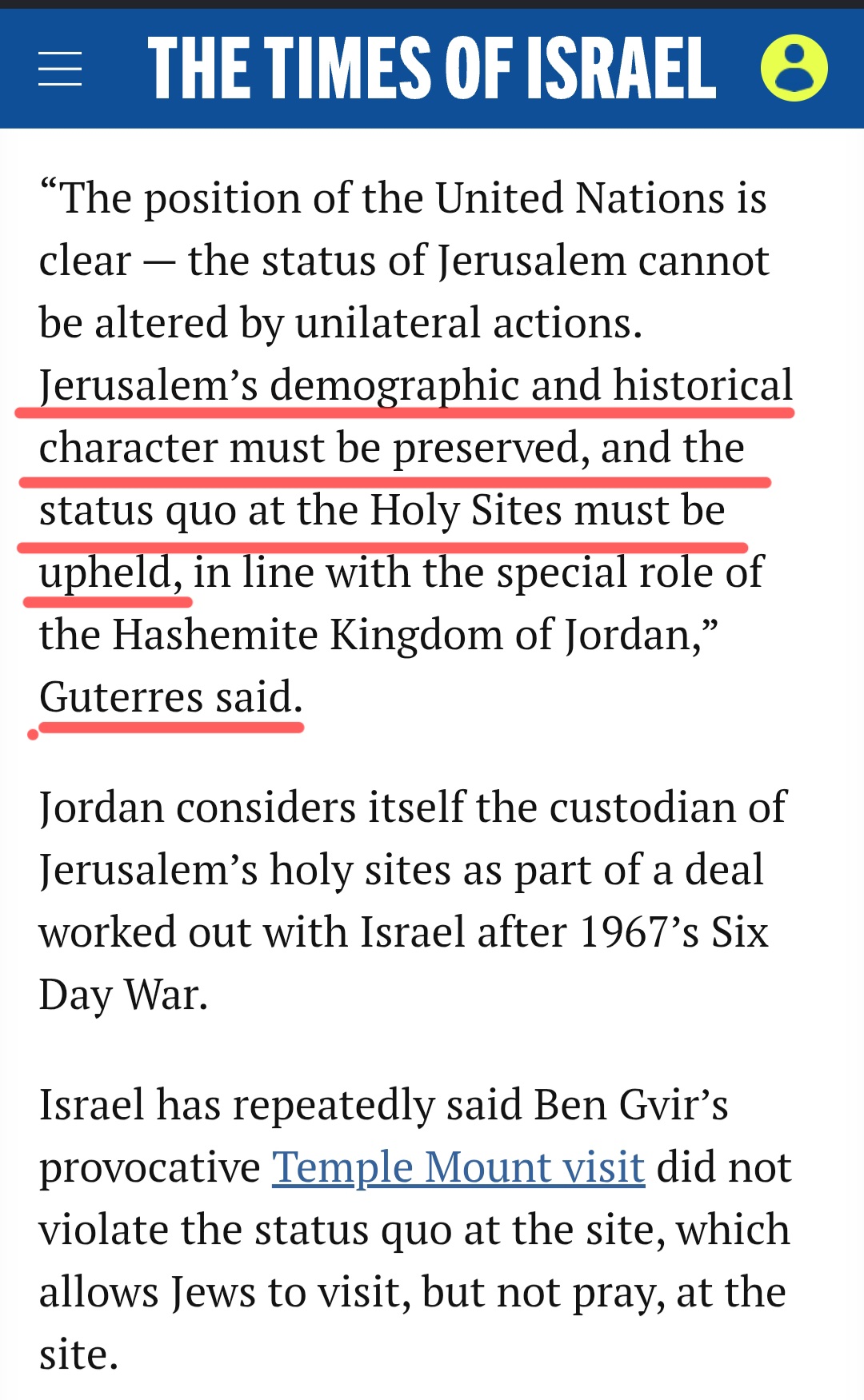
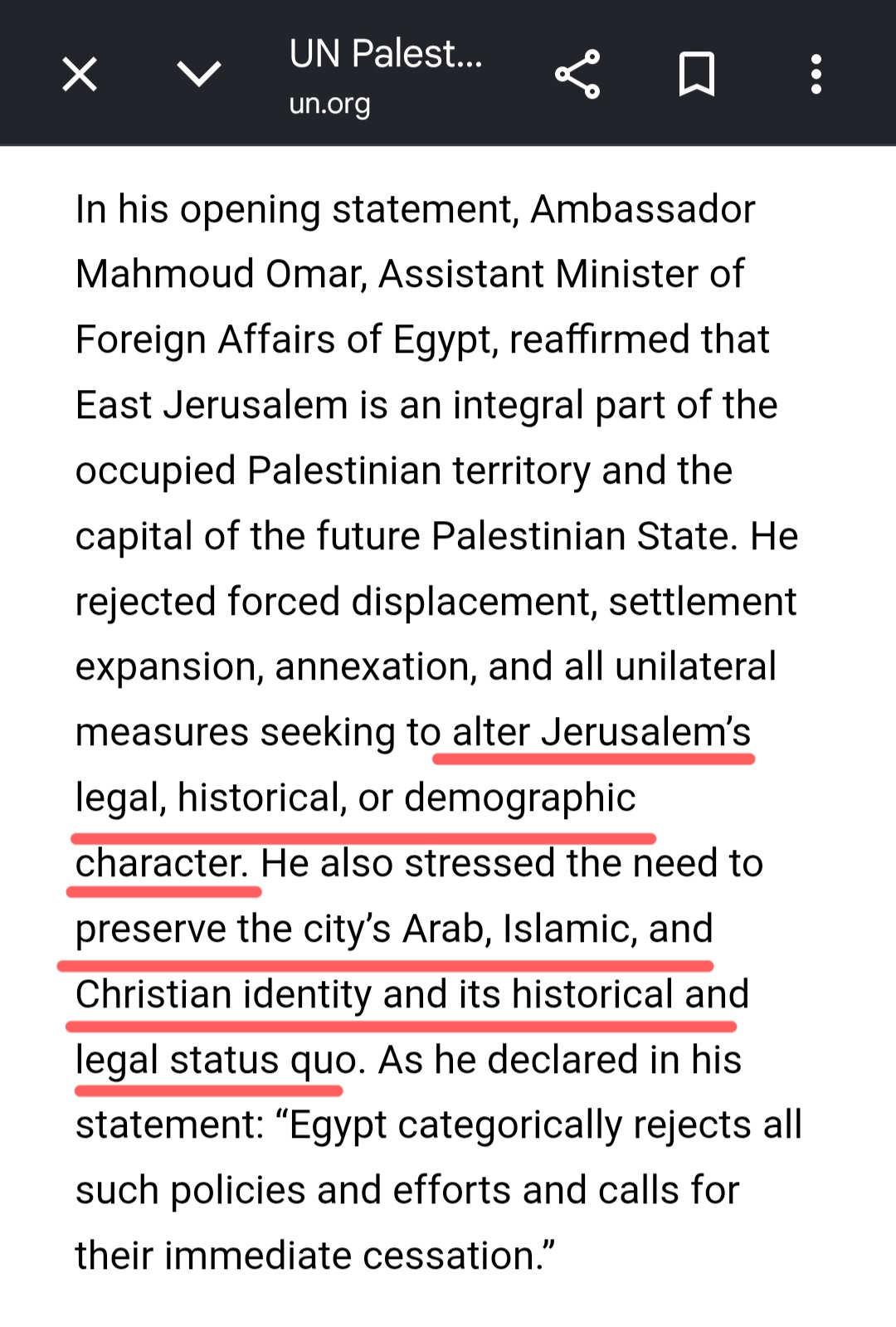
Similarly, the United Nations decided that Jews do not belong in Jerusalem – the holiest city in Judaism – or east of the 1949 Armistice Lines / the “West Bank”, so have developed a criminal system that specifically and persistently targets Jews. The mere presence of Jews is labelled “illegal” and an affront to international law.

“Condemning all measures aimed at altering the demographic composition, [presence of Jews] character and status of the Palestinian Territory occupied since 1967, including East Jerusalem,” – UN Security Council Resolution 2334

The United Nations made a law declaring Jewish presence at their holiest location to be illegal

When one minority community, whether it be racial or national, lives under permanent investigation, outcomes will look like confirmation of wrongdoing, even when standards are warped and unevenly applied.

Over-policing corrodes trust at home. Over-condemnation corrodes credibility abroad.

Justice requires symmetry. Blacks and Jews know it all too well.