In June 2015, the United Nations issued a report highly critical of Israel’s handling of its war against Palestinian attacks. Throughout the report, the committee suggested that the Israeli blockade of Gaza was a major cause for suffering of Palestinians, rather than a result of Palestinian actions, and helped precipitate the war.
Member of the Commission of Inquiry on the 2014 Gaza conflict Doudou Diene (L) gestures next to Chairperson of the Commission Mary McGowan Davis during a press conference to present their report on June 22, 2015 at the United Nations Office in Geneva. AFP PHOTO / FABRICE COFFRINI
2015 UN Assertion that
Blockade was Cause for Conflict
In the section of the report that reviewed the background to the 2014 conflict, the report stated that “In the preceding months, there were few, if any, political prospects for reaching a solution to the conflict that would achieve peace and security for Palestinians and Israelis and realize the right to self-determination of the Palestinian people. The blockade of Gaza by Israel, fully implemented since 2007 and described by the Secretary-General as “a continuing collective penalty against the population in Gaza” (A/HRC/28/45, para. 70), was strangling the economy in Gaza and imposed severe restrictions on the rights of the Palestinians.” By way of correction and education to the reader, the naval blockade of Gaza only began in January 2009 (not 2007). The land blockade of Gaza began in 2007 after Hamas routed Fatah from Gaza and took complete control of the region.
It is important and significant to point out that this 2015 report suggested that there were “few POLITICAL PROSPECTS for reaching a solution” and that the “blockade of Gaza.. was strangling the economy” and “imposed severe restrictions” on Palestinians. This directly implied that the Palestinians were seeking a political solution and rightfully frustrated with a blockade that was imposed on them (presumably for no reason). Therefore, since a political solution was not available, they were forced to pursue a military response.
That is outrageous on many levels.
Hamas has stated clearly in its charter and in addresses by its leaders that it seeks the complete destruction of Israel and that it will never enter peace negotiations. (A fact that was never mentioned in the UN report)
Hamas clearly stated that it would not pursue any “peaceful solutions and international conferences” as seen in its charter, below.
Hamas’s takeover of Gaza in 2007 is never mentioned in the UN report.
Hamas Charter Article 13: “Initiatives, and so-called peaceful solutions and international conferences, are in contradiction to the principles of the Islamic Resistance Movement…. These conferences are only ways of setting the infidels in the land of the Moslems as arbitraters… There is no solution for the Palestinian question except through Jihad. Initiatives, proposals and international conferences are all a waste of time and vain endeavors.”
The UN report inverted reality and ignored that the blockade of Gaza was in response to Hamas’s taking over of Gaza and firing thousands of missiles at Israeli civilians.
2015 UN Report
Call to Remove the Blockade
The UN report concluded with several suggestions which clearly placed the blame for the conflict on Israel’s actions: “The commission calls upon the Government of Israel… to address structural issues that fuel the conflict and have a negative impact on a wide range of human rights, including the right to self-determination; in particular, to lift, immediately and unconditionally, the blockade on Gaza.”
This conclusion and suggestion are in stark contrast to the September 2011 UN “Palmer Commission Report” which clearly spoke of the legal nature of Israel’s blockade of Gaza and spoke to the harm and evil intent of Hamas which necessitated the blockade.
2011 UN Report on LEGAL NATURE of Blockade of Gaza
To start, the Palmer Report correctly identified the different blockades of Gaza and the reason for them: “the tightening of border controls between Gaza and Israel came about after the take-over of Hamas in Gaza in June 2007. On the other hand, the naval blockade was imposed more than a year later, in January 2009.”
The report continued that “the naval blockade as a distinct legal measure was imposed primarily to enable a legally sound basis for Israel to exert control over ships attempting to reach Gaza with weapons and related goods. This was in reaction to certain incidents when vessels had reached Gaza via sea.”
The report then continued in greater detail on the “structural issues that fuel the conflict” with specific history (as opposed to simply echoing the Palestinian narrative as it did in the 2015 report): “Israel has faced and continues to face a real threat to its security from militant groups in Gaza. Rockets, missiles and mortar bombs have been launched from Gaza towards Israel since 2001. More than 5,000 were fired between 2005 and January 2009, when the naval blockade was imposed. Hundreds of thousands of Israeli civilians live in the range of these attacks. As their effectiveness has increased some rockets are now capable of reaching Tel Aviv. Since 2001 such attacks have caused more than 25 deaths and hundreds of injuries. The enormity of the psychological toll on the affected population cannot be underestimated. In addition, there have been substantial material losses. The purpose of these acts of violence, which have been repeatedly condemned by the international community, has been to do damage to the population of Israel. It seems obvious enough that stopping these violent acts was a necessary step for Israel to take in order to protect its people and to defend itself.”
In regard for using a naval blockade to prevent the assault from Gaza on Israel, the report stated “The Israeli report to the Panel makes it clear that the naval blockade as a measure of the use of force was adopted for the purpose of defending its territoryand population, and the Panel accepts that was the case. It was designed as one way to prevent weapons reaching Gaza by sea and to prevent such attacks to be launched from the sea. Indeed there have been various incidents in which ships carrying weapons were intercepted by the Israeli authorities on their way to Gaza.”
In sharp contrast to the 2015 report which cited the UN Secretary General’s comment that the blockade was a “collective penalty against the population in Gaza“, the 2011 Palmer Report concluded that “Although a blockade by definition imposes a restriction on all maritime traffic, given the relatively small size of the blockade zone and the practical difficulties associated with other methods of monitoring vessels (such as by search and visit), the Panel is not persuaded that the naval blockade was a disproportionate measure for Israel to have taken in response to the threat it faced.”
The report concluded with clarity: “Israel was entitled to take reasonable steps to prevent the influx of weapons into Gaza. With that objective, Israel established a series of restrictions on vessels entering the waters of Gaza. These measures culminated in the declaration of the naval blockade on 3 January 2009… There is nothing before the Panel that would suggest that Israel did not maintain an effective and impartial blockade…. it is evident that Israel had a military objective. The stated primary objective of the naval blockade was for security. It was to prevent weapons, ammunition, military supplies and people from entering Gaza and to stop Hamas operatives sailing away from Gaza with vessels filled with explosives… It is also noteworthy that the earliest maritime interception operations to prevent weapons smuggling to Gaza predated the 2007 take-over of Hamas in Gaza. The actual naval blockade was imposed more than one year after that event. These factors alone indicate it was not imposed to punish its citizens for the election of Hamas…. As this report has already indicated, we are satisfied that the naval blockade was based on the need to preserve Israel’s security. Stopping the importation of rockets and other weapons to Gaza by sea helps alleviate Israel’s situation as it finds itself the target of countless attacks, which at the time of writing have once again become more extensive and intensive… We have reached the view that the naval blockade was proportionate in the circumstances… The Panel therefore concludes that Israel’s naval blockade was legal… Israel faces a real threat to its security from militant groups in Gaza. The naval blockade was imposed as a legitimate security measure in order to prevent weapons from entering Gaza by sea and its implementation complied with the requirements of international law.”
Quite a different narrative and conclusion than the UN wrote up in 2015.
This analysis does not directly review “disproportionate force” but disproportionate defense employed by the two sides.
Obligation to Defend
The foremost responsibility of any governmental leadership is to protect its population. Such defense can be implemented in a variety of ways: a police force or army to maintain order; infrastructure to ensure safety; and intelligence which can guide the appropriate use of manpower and equipment. The United Nations has been developing a framework for “The Responsibility to Protect” over the past several years.
In the conflict between Israel and the Palestinian Authority, only one side proactively protects its citizens, while the other side uses reactive defenses. One side assumes responsibility via using its own resources and capabilities, while the other side relies completely on outside agents.
ISRAEL – ACTIVE DEFENSE
Protecting Against Incoming Missiles and Armaments
Bunkers and Bomb Shelters: Israel is unique in the Middle East in establishing a policy of bomb shelters throughout the country. In response to being surrounded to hostile neighbors that have attacked and shelled its people and lands since its inception, houses, schools, hotels, hospitals and even playgrounds are built with bomb shelters.
The Palestinians have not built shelters. Instead, they used their cement to build tunnels with which to attack Israel.
Playground shelter in Israel (photo: Kate Simmons) Iron Dome. Israel developed a new missile defense system called the Iron Dome, and continues to build new air defense systems to protect the country from incoming missiles.
The Palestinians have neither developed nor imported defensive systems. They have only imported offensive weaponry.
Israeli developed “Iron Dome” Defense System Blockade of Gaza. Israel imposed a naval blockade around Gaza after the terrorist group Hamas, which is sworn to the destruction of Israel, seized the land. The blockade has successfully kept out many missiles and other arms from reaching Hamas and ultimately causing death and destruction in Israel.
Protection Against Killers
Security Barrier. In September 2000, the Palestinians began multi-year riots which killed over a thousand Israelis through hundreds of attacks. In response, the Israeli government began to construct a security barrier in 2002 to keep out terrorists who mostly emanated from cities in Judea and Samaria/ east of the Green Line (EGL).
The Palestinians have not built any security barriers from the Israelis. There have been no suicide bombers going from Israel into Gaza or EGL blowing up civilians.
Stretch of Security Barrier along highway (photo: FirstOneThrough)
Airport Security. Well before the world became attuned to airport security after the attacks on the United States on 9/11/01, Israel established an extensive airport security system. The screening of passengers, x-rays of baggage and other methods were in response to a series of airplane hijackings in the 1970s (a method of terrorism created by the Palestinian Arabs).
The Palestinians do not have an airport and therefore no such security concerns.
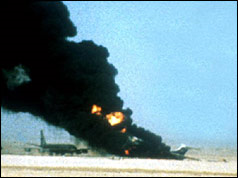
Palestinians blow up plane, 1970
Protection Against Lethal Plans
Intelligence. Israelis utilize a wide variety of information sources to uncover plans to attack its country. Whether through a network of Israeli spies, Palestinian informants, money tracking, wiretapping and other means, the Israelis gather information and make assessments on potential Palestinian Arab attacks. It is then able to take preventative action before such attacks occur.
PALESTINIAN AUTHORITY AND HAMAS – REACTIVE DEFENSE
Relying on Israeli Sensitivities and Sensibilities
Civilians. As detailed above, the Palestinian Authority and Hamas have not instituted proactive tangible means of defending its people. One of the ways it attempts to defend the population is by making it nearly impossible to distinguish between fighters and civilians.
The fighters do not typically wear uniforms and can therefore not be distinguished from civilians
Militants fire at Israel from mosques, schools and civilian neighborhoods
Palestinian Arabs hope that Israel will not indiscriminately fire upon everyone. By forcing Israel to take time and extra precautions to target the right attackers, it slows down Israeli defenses during battles.
Destroying its Own Infrastructure. Hamas built an extensive offensive network of tunnels into Israel which originated in many private homes. By relying on Israelis sensitivities to minimize destruction in civilian neighborhoods, Hamas was able to protect many tunnel openings.
Further, Hamas and other Palestinian Arab groups often booby-trapped homes from which they attacked Israel. While the Palestinian Arabs destroyed their own infrastructure, they slowed down and killed many Israelis who looked to root out the attackers.
Relying on Global Bodies like the United Nations
United Nations. One of the principal methods that the Palestinian Authority uses to defend its population is through global bodies AFTER a war. The United Nations includes 57 Islamic countries (in the OIC) and 22 Arab countries (in the Arab League) which align themselves with the Palestinian Arab cause. Many of those countries do not even recognize the State of Israel. They were instrumental in passing the “Zionism is Racism” resolution in 1975 and creating several committees devoted only to Palestinian causes.
The Palestinians turn to the UN to highlight the damage that Israel inflicts on its intentionally defenseless population. It uses deliberate attacks on Israel to provoke premeditated casualties to show the world.
The latest forum that the Palestinian Authority has pursued is the International Criminal Court, the ICC. While it is evident that the Palestinians Arabs definitely committed war crimes in the 2014 War against Israel, it would still sue Israel in the hopes that such action will hurt Israel, further its cause and protect the Palestinian Arabs.
As detailed above the two sides in the Israel-Palestinian Authority conflict have disproportionate defenses.
The Israelis use several proactive approaches; the Palestinians use reactive methods
The Israelis rely upon ingenuity and preparedness; the Palestinians rely on Israeli sensitivities and global sympathy
The Israelis principally depend on themselves; the Palestinians depend on the world
A discussion of “disproportionate force” cannot be made in a vacuum without discussing “disproportionate defenses”. The global community cannot continue to reward the acts of a leadership that deliberately deals in its own premeditated casualties.
The Palestinian Arabs and Israelis last managed to negotiate an agreement in September 1995. That agreement, Oslo II, was intended to be an interim agreement after which a permanent resolution was to be reached in five years. However, five years later in September 2000, Palestinian leader Yasser Arafat walked away from the Israeli peace proposal and launched multi-year riots which claimed thousands of lives.
The terms of Oslo II still live on, decades later.
Rabin and Arafat sign maps prior to the Oslo II signing ceremony at the White House, as US president Bill Clinton, Egypt’s Hosni Mubarak and Jordan’s King Hussein look on, September 28, 1995 (photo credit: GPO)
Goals of Oslo II
Oslo II was meant to set in place an interim Palestinian Authority which would become the basis of a Palestinian political structure. Oslo II had NO calls for an independent Palestinian state, but stated the goal of the negotiations was to lead “to a permanent settlement based on Security Council Resolutions 242 and 338.”
Security Council Resolution 338 was declared after Egypt attacked Israel in the Yom Kippur War. The goal was to stop hostilities and commence peace negotiations. The thrust of SC 338 was to implement SC 242 to establish “a just and durable peace”
Security Council 242 was drafted after the Six Day War in 1967. In that war, Israel preemptively attacked Egypt and Syria that were readying an attack on Israel, and Israel defended itself from an attack from Jordan.
Without delving into the nuances of SC 242 here, the thrust of the resolution was to have Israeli armed forces pull back from some territories which it won in the 1967 War and that all states respect “the sovereignty, territorial integrity and political independence of every State in the area… free from threats or acts of force.” It also proposed “a just settlement of the refugee problem.”
Oslo II built on these UN Security Council goals with an interim roadmap. It began with Israel’s handing over certain territories to the Palestinian Authority (Gaza and Jericho) as well as other major Palestinian cities.
Status of Jerusalem in Oslo II
Jerusalem is mentioned eight times in the Oslo II Accords. In every instance, the entire city is referenced, not just the eastern half that Israel acquired from the Jordanians and Palestinian Arabs in 1967.
The first six times “Jerusalem” appeared in the Oslo II agreement relate to future Palestinian elections in which Palestinian Arabs located in Jerusalem would be able to participate. The remaining two times specifically state that Jerusalem is a point for final status negotiations:
ARTICLE XVIIJurisdiction 1. In accordance with the DOP, the jurisdiction of the Council will cover West Bank and Gaza Strip territory as a single territorial unit, except for:
2. issues that will be negotiated in the permanent status negotiations: Jerusalem, settlements, specified military locations, Palestinian refugees, borders, foreign relations and Israelis;
ARTICLE XXXIFinal Clauses 5. Permanent status negotiations will commence as soon as possible, but not later than May 4, 1996, between the Parties. It is understood that these negotiations shall cover remaining issues, including: Jerusalem, refugees, settlements, security arrangements, borders, relations and cooperation with other neighbors, and other issues of common interest.
According to the agreements executed by the Palestinians and Israelis:
Jerusalem is not part of the West Bank, as it is broken out separately
Jerusalem is not a “settlement”, as the agreement stated later that “settlements” are entities in the West Bank and Gaza – “For the purpose of this Agreement, “the Settlements” means, in the West Bank the settlements in Area C; and in the Gaza Strip – the Gush Katif and Erez settlement areas, as well as the other settlements in the Gaza Strip, as shown on attached map No. 2“
Israel controls Jerusalem – “Israel shall continue to exercise powers and responsibilities not so transferred”
There is therefore no basis for any of the United Nations, the EU or the Unites States to claim that Jerusalem is a settlement and that Jews should have any restrictions from living anywhere in the city. Should there be any modifications to the Israeli rule of the city, it will be made by mutual consent in permanent status negotiations.
Yet, the world ignores the Oslo II foundation document of a peace agreement.
On Jerusalem’s Jewish “settlements”: “All settlement activity in the West Bank and East Jerusalem must cease. Measures that prejudge final status issues are not to be recognized.”
“Announcements of thousands of new housing units cannot be reconciled with the goal of a two-state solution and risk the collapse of negotiations”
These statements ignore Oslo II in many respects: it broke apart “East Jerusalem” as a distinct entity; it claimed that Jews living in “East Jerusalem” were in “settlements”; it called for a two-state solution (while not in Oslo II, both the Israelis and Palestinians later agreed to such plan); it suggested that Jews living in “East Jerusalem” hurt a two-state solution.
On Palestinian homes in “East Jerusalem”: “Of particular concern are developments in East Jerusalem, where this year alone, some 100 [Arab] structures have been demolished, displacing 300 people. Hundreds more Palestinians are at risk because their homes were built without Israeli-issued building permits”
The UN leader voiced concern with more Jews moving into eastern Jerusalem and not enough Arabs being accommodated there.
On the Permanent Status Negotiations of Jerusalem:“Jerusalem is to emerge from negotiations as the capital of two States, with arrangements for the holy sites acceptable to all”
Ban Ki-Moon voiced a conclusion not made in Oslo II and “prejudged” an outcome that Jerusalem must be divided, even though Israel already divided the UN’s “Holy Basin” when it gave Bethlehem to the Palestinian Authority 20 years earlier. Amazing commentary from someone who is concerned with “prejudging final status issues.”
European Union Ignores Oslo II on Jerusalem
The EU has taken positions adopted by the Palestinian Authority which are outside of the agreements reached by Israel and the PA in Oslo II:
On Jerusalem’s Jewish “settlements”: “EU considers that settlement building anywhere in the occupied Palestinian Territory, including East Jerusalem, is illegal under international law, constitutes an obstacle to peace and threatens to make a two-state solution impossible.”
On Palestinians in “East Jerusalem”: “The EU supports [Arab] institution building work in East Jerusalem, notably in the areas of health, education and the judiciary.”
On the Permanent Status Negotiations of Jerusalem: “the EU has repeatedly confirmed its deep concern about accelerated settlement expansion in the West Bank including East Jerusalem. This expansion prejudges the outcome of final status negotiations and threatens the viability of an agreed two-state solution” “The EU considers that the peace negotiations should include the resolution of all issues surrounding the status of Jerusalem as the future capital of two states. The EU will not recognise any changes to the pre-1967 borders including with regard to Jerusalem, other than those agreed by the parties.”
Like the United Nations, the EU ignored the mutual recognition of both Palestinians Arabs and Israel that only Israel administers all of Jerusalem, and any modification to such arrangement must be made by mutual agreement. Oslo II made no suggestion that the holy city be divided.
The United States Ignores Oslo II on Jerusalem
On Jerusalem’s Jewish “settlements”: Jen Psaki, Spokesperson for the US Department of State said on October 27, 2014: “we continue to make our position absolutely clear that we view settlement activity as illegitimate and unequivocally oppose unilateral steps that prejudge the future of Jerusalem. Israel’s leaders have said they would support a pathway to a two-state solution, but moving forward with this type of action would be incompatible with the pursuit of peace”
On the Palestinian Authority in Jerusalem: While the US does not recognize Jerusalem as the capital of Israel or any country (and therefor does not maintain on embassy in Jerusalem), it has nevertheless decided to establish an office for Palestinians in Jerusalem. The United States Security Coordinator for Israel and the Palestinian Authority (USSC) sounds like it services both Israel and the PA, but its mission is to serve and assist the PA in meeting its security needs. “The USSC directs all facets of U.S. security sector assistance to the Palestinian Authority and synchronizes international supporting efforts…The USSC assists the Palestinian Authority to transform and professionalize its security sector.”
The US decided to place such office to assist the PA in Jerusalem, rather than Bethlehem or Jericho. The address is home of the Consul General of the US in Jerusalem which serves US citizens from Jerusalem, the West Bank and Gaza.
On the Permanent Status Negotiations of Jerusalem: Back in 2009, White House Press Secretary Robert Gibbs made a point that recognized that Jerusalem is a matter for final status negotiations, but said he was opposed to construction in “East Jerusalem”. “The United States opposes new Israeli construction in East Jerusalem. The status of Jerusalem is a permanent status issue that must be resolved by the parties through negotiations and supported by the international community. Neither party should engage in efforts or take actions that could unilaterally pre-empt, or appear to pre-empt, negotiations. Rather, both parties should return to negotiations without preconditions as soon as possible. The United States recognizes that Jerusalem is a deeply important issue for Israelis and Palestinians, and for Jews, Muslims, and Christians. We believe that through good faith negotiations the parties can mutually agree on an outcome that realizes the aspirations of both parties for Jerusalem, and safeguards its status for people around the world.”
There have been very few agreements between the Palestinian Arabs and Israelis throughout history. When the parties last mutually agreed to move forward with a peace process, they agreed that all of Jerusalem was controlled by Israel. The agreement had no caveats about what Israel could or could not do anywhere in the city. It made no suggestion that the city was or would be divided.
Despite that reality, a new perception has taken hold in world bodies that Israel should prohibit Jews from living in parts of their capital and holiest city. It is being repeated more frequently and with greater force: at one point, world bodies opposed Israel building new neighborhoods in the eastern part of Jerusalem; now they decry Jews moving into existing homes that they legally purchased privately.
How can Israel expect to negotiate a final status agreement if the world rejects the agreements Israel makes with Palestinian Arabs as it did with Oslo II? How can Israel enter negotiations when the world advances a prejudged outcome to such negotiations to which Israel never agreed?
The obsession of the United Nations with Israel is well documented.
Israeli Ambassador to the UN, Ron Prosor
Various UN bodies sanction Israel in every session over any real or perceived issue. Meanwhile, the organization ignores mass slaughters and human rights abuses that occur daily throughout the world. When well-meaning people point out the singular focus on Israel, the Israel-bashers contend that such complaint is not a defense- it is just “whataboutary”.
Really?
If black people in Missouri were pulled over by police at 70 times the rate of white people, the police department would come under attack for abusive and discriminatory behavior.
If a particular person with financials similar to other people, was audited by the IRS every year, the agency and government would be investigated.
Just a few examples of UN uniquely targeting Israel:
The UN created a unique organization, UNRWA, to handle refugees from Palestine/Israel while every other global refugee is managed in an under-funded, under-staffed separate agency. The UN compounds the abuse by only allowing descendants of UNRWA to receive aid, while denying descendants of the rest of the world’s refugees any support.
The UN censured Israel when the Israeli Prime Ministervisited the holiest spot for Jews during regular visiting hours, but didn’t say a word while some countries were slaughtering thousands of people.
A First One Through video about the many actions and sanctions against Israel, “I hate Israel – the UN told me so”
The United Nations is inconsistent regarding its position on the “character”, “access” and “rights” of holy sites in the Holy Land across the Green Line.
In 2010, UNESCO published a paper highly critical of Israel regarding its treatment of two holy places in Judea and Samaria/the West Bank: the Tomb of the Patriarchs in Hebron and the Tomb of Rachel in Bethlehem. The statements were a complete inversion of the truth:
“Since Israel’s occupation, the Israeli Government has attempted to highlight the Jewish character of archaeological and heritage sites in the occupied Palestinian territory, while erasingor neglecting the universal character of these heritage sites and denying access to all people of faith.”
“As part of the illegal settlement enterprise, the Israeli authorities also exploit Palestinian heritage sites for financial and political gains. Under the Netanyahu administration, Israel has publicly begun to use these sacred and universal sites to provoke unnecessary religious conflict by promoting control and access on the exclusive basis of one faith while denying the rights and views of other faiths.” UNESCO PARIS, 19 March 2010
TOMB OF THE PATRIARCHS (HEBRON)
As a point of reference (as detailed in the FirstOneThrough article) almost all of the Jewish forefathers and foremothers are buried at the tomb. As such, it is the second holiest site in Judaism (after the Temple Mount in Jerusalem). Biblical characters Ishmael and Esav (forefathers of the Arabs) are not attributed to this burial site.
The tomb was a destination for Jewish pilgrims since its purchase by Abraham 3700 years ago, and for the following 2900 years. Roughly 800 years ago, Muslims took over Hebron and converted the tomb into a mosque. The Muslims forbade Jews from entering the area, and even approaching beyond the seventh step of the platform. That changed when the Israelis took over the site after the Jordanians and Palestinians attacked Israel and lost the West Bank in 1967.
It was the Muslims that “erased and neglected the universal character” of the site
It was the Muslims that ”denied access to all people of faith”
And It was the Jews that opened the Tomb for both Muslim and Jewish prayer
THE TOMB OF RACHEL (BETHLEHEM)
As the burial site of one of Judaism’s foremothers, the tomb of Rachel is considered the third holiest site in Judaism (similar to Al Aqsa Mosque in Jerusalem for Muslims).
The Crusaders built a small covering for the gravesite in the 1200s and around 1517, the Ottomans denied non-Muslim prayer when they took over control of Bethlehem. In 1615, Mohammed, Pasha of Jerusalem transferred exclusive use of the tomb to Jews, but the site fell into disrepair. In 1841, Jewish philanthropist and traveler, Sir Moses Montefiore was given the keys to the tomb and permission to build a larger structure for pilgrims.
Over the years, the area around the tomb became more densely populated. As Bethlehem was only 5 kilometers south of Jerusalem, the growth of both cities created a greater metropolitan area. The United Nations 1947 partition plan recommended that this Greater Jerusalem / Greater Bethlehem area become a single “Holy Basin” under international control, being neither Israeli nor Palestinian. While accepted by the Israelis, the Palestinians rejected the proposal.
In 1948, five Arab armies attacked Israel and Jordan illegally annexed Judea and Samaria, including Bethlehem. In 1954, the Jordanians gave Palestinian Arabs citizenship but specifically excluded citizenship for any Jews. After 333 years, the third holiest site of Judaism became off-limits to all Israelis.
Israelis took control of the area after the defeat of the Jordanians (and Palestinians) in 1967, and opened the tomb to Jewish worship once again.
In 1995, as part of the Oslo Agreements, Israel handed over control of half of the “Holy Basin” – Bethlehem – to the Palestinian Authority, under the condition that Jews be able to freely access and pray at the tomb. With that handover, the Tomb of Rachel fell under Palestinian Authority.
During the Second Intifada in 2002, with almost daily killings of Jews by Arabs, the Israeli government built a security barrier through parts of the West Bank. In 2005, a wall was built around the Tomb of Rachel to protect it from Arab assault.
The site is not even considered sacred to Islam, yet for almost 100 years, Muslims denied the rights of Jews to pray at the tomb
It was Ottomans of centuries ago who gave the Tomb of Rachel back to Jews
Modern Jordanians and Palestinians denied citizenship and access to the tomb for Jews
It was Israel that reopened access and rights for Jews at the tomb
It was Israel that agreed to give control of the “Holy Basin” to the U.N. in 1947
It was Israel that agreed to compromise and divided half of the “Holy Basin”, handing control of the city to the Palestinians in 1995
There are other examples of the United Nations condemning Israel for opening up access to holy sites, while ignoring the denial of access and destruction that Arabs caused to holy places.
JOSEPH’S TOMB (NABLUS/SHECHEM)
The Tomb of Joseph, the biblical son of Jacob and Rachel, is found in Nablus (Shechem). After the 1967 war, Israel gained access to the site once more and built a small seminary nearby in the 1980s.
Israel handed control of Nablus to the Palestinians in 1995, but retained control of Joseph’s Tomb. However, during the Intifada in October 2000, Palestinians ransacked the tomb and killed an Israeli soldier and Rabbi Hillel Lieberman who came to protect the site. His body was found in a ditch riddled with bullets.
Israel agreed to give temporary control of the tomb to the Palestinians to quiet the situation and to allow the Palestinians to repair the tomb. However, the site was set on fire and further ransacked. Later, the Associated Press reported that “the dome of the tomb was painted green and bulldozers were seen clearing the surrounding area,” as the Palestinian Arabs sought to transform the biblical Joseph’s resting place into a Moslem holy site.
Israeli president Shimon Peres remarked that the “Palestinians made a terrible mistake in Joseph’s Tomb. They pulled the rug out from under their feet regarding their demand for control of the holy places, by showing that they don’t know how to preserve and respect them.”
It was Arabs that vandalized a Jewish site
It was Palestinians that sought to change the character of Joseph’s tomb
It was Israel that handed temporary control of the site to Palestinians to try to quell violence
What was the United Nations response to ransacking of a Jewish holy place? Of attempting to “change the character” of the Jewish site? Silence. No comment nor condemnation.
What was the UN response to a visit to the Temple Mount by Israeli Prime Minister Ariel Sharon two weeks earlier? Condemnation.
“Deplores the provocation carried out at Al-Haram Al-Sharif in Jerusalem on 28 September 2000”
The UN Secretary General condemned the Israeli prime minister for exercising his “right” for “accessing” Judaism’s holiest site during normal visiting hours.
THE HURVA SYNAGOGUE (JERUSALEM)
Jews began construction of a significant synagogue in the Old City of Jerusalem in 1694 called the Hurva Synagogue which was destroyed by Muslims in 1721. Groundbreaking for rebuilding the shul happened in 1855, and it was rededicated on completion in 1864.
In 1949, the Jordanian army attacked the Jews in Jerusalem and blew up the Hurva Synagogue and 57 other synagogues in the Old City. They expelled the 2000 Jewish residents and forbade them from returning.
After the Jordanians (and Palestinians) attacked Israel again in 1967, Jews retook the Old City but did not seek to rebuild the Hurva right away. In 2010, Israel finally rebuilt and reopened the synagogue before the Passover holiday. There was condemnation from around the world.
Fatah official Khatem Abd al-Khader called the reopening a “provocation” and warned that Israel “was playing with fire”. Khaled Meshaal of Hamas said the opening was a “declaration of war” and “a falsification of history and Jerusalem’s religious and historic monuments.” The Jordanian government (that intentionally blew up the synagogue) “categorically rejects the rededication of Hurva Synagogue.”
These reactions were about a synagogue that had absolutely no connection to Islam.
Arabs destroyed the synagogue
The Jordanian and Palestinian Arabs denied access to the Old City and site
Palestinians threatened violence over rebuilding a synagogue they destroyed
Palestinian leadership incited a riot by falsely stating that Jews were attempting to destroy the Al Aqsa mosque
How did the United Nations respond to the reopening of the Hurva Synagogue?
Ban Ki Moon March 2010: “I have spoken out and have been diplomatically active whenever other provocations have taken place – including the decisions on holy sites in Hebron and Bethlehem, actions in places like Silwan and Sheikh Jarrah and tensions surrounding the Al-Aqsa Mosque.”
THE TEMPLE MOUNT (JERUSALEM)
The first Jewish Temple was built by King Solomon around the year 954BCE. At that time, there was no large platform that we know of today. That Temple was destroyed around the year 586BCE. A second Temple was built around 515BCE and destroyed in 70CE.
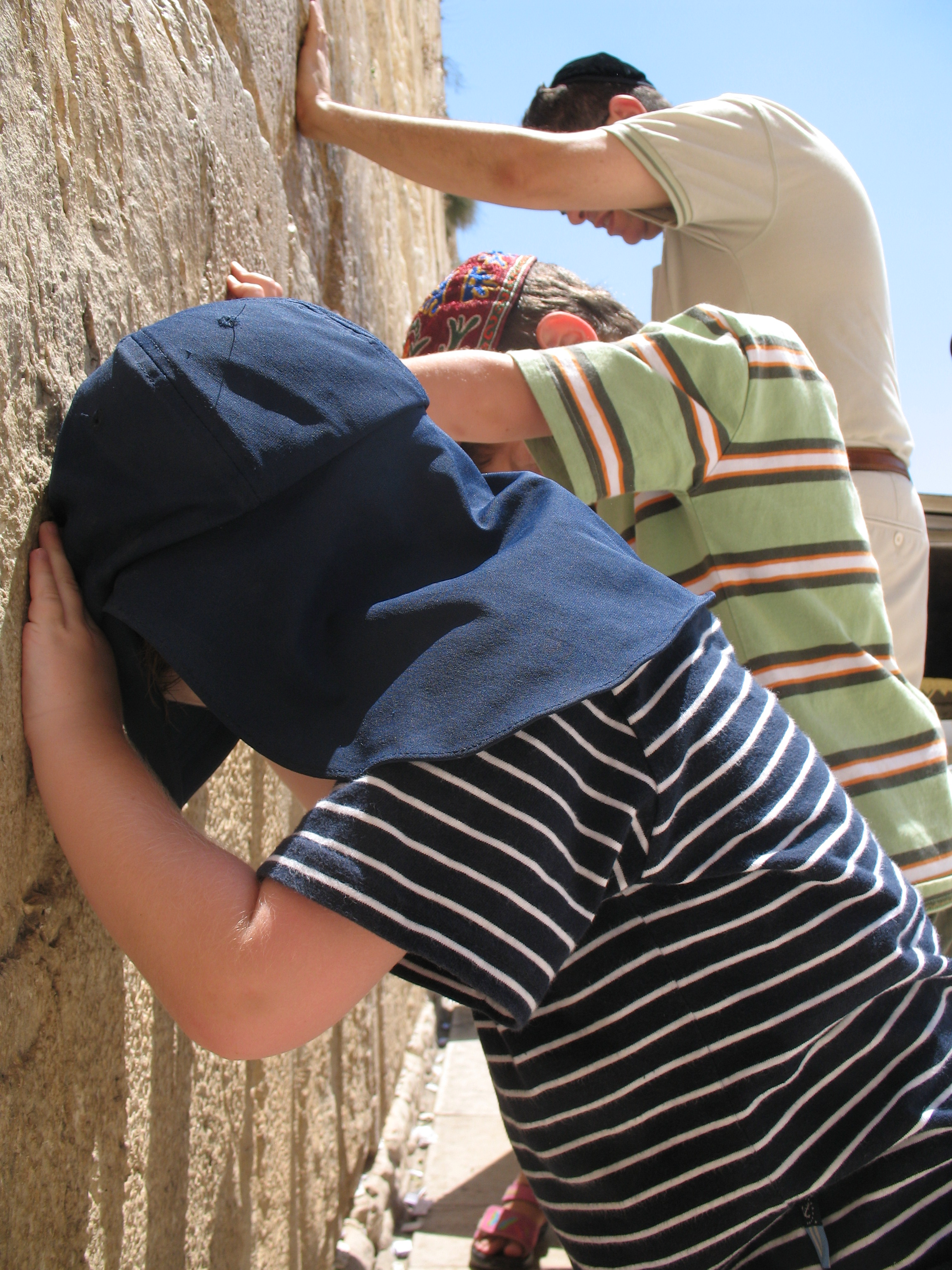
Before the Second Temple was destroyed, King Herod did major renovations in Jerusalem, including extending and building a large platform on which the Second Temple sat (from 19BCE until 63CE). Today’s “Western Wall” or “Wailing Wall” is the western retaining wall of that platform extension. It is also the area where Muslims built the Al Aqsa mosque in 705CE. That original mosque was destroyed several times, and the silver domed mosque of Al Aqsa that sits on the southern-most edge of the Temple Mount that we see today, was completed in 1033CE.
Christian crusaders came to Jerusalem in 1099, slaughtered the Jewish and Muslim inhabitants and took over the Temple Mount. Crusaders and Muslims fought over control of Jerusalem on-and-off through the year 1260, with the Muslims ultimately prevailing.
With the Muslim victory, Jews began to move back to Jerusalem, and the first new permanent synagogue in Jerusalem was set up by Nachmanides (the Ramban) in 1267. Over the next centuries, several noted rabbis stated that it was the custom of Jews in Jerusalem to ascend the Temple Mount and pray there, including Rabbi Menachem Meiri (1249-1316) and Rabbi David ben Shlomo Ibn Zimra, (known as the Radbaz, 1479–1573), the Chief Rabbi of Jerusalem.
However, in 1550, Ottoman leader Suleiman I set aside the Western Wall area as a designated area for the Jews to pray. It would appear that from this date until 1949, non-Muslims could have access but were effectively barred from praying on the Temple Mount.
After the defeat of the Ottoman Empire in 1918, the local Arab population became very anxious about future control of the land, especially in light of the 1920 San Remo Conference and the 1922 British Mandate which specifically described ensuring a Jewish homeland in Palestine. Every “normal” action of prayer at the Western Wall was viewed by the Arabs as a change to the status quo, and as such, a “provocation” in which “Zionists” were taking over.
In 1925, a new prohibition against bringing chairs or benches to the Western Wall (in response to bringing chairs for the elderly and infirm)
In 1928, a new prohibition of erecting a screen (mechitza) between men and women for prayer (in response to putting one up on Yom Kippur) at the Western Wall
In 1929, Arabs rioted at the Western Wall, first burning prayer books and later calling for Jihad as they rampaged through the city killing dozens of Jews. They felt that Islamic authority at the Western Wall was being called into question as an initial step to the takeover of the Temple Mount.
In 1948, the Arab armies of Egypt, Lebanon, Syria, Jordan, and Iraq attacked Israel. At war’s end the following year, the city of Jerusalem became divided with the Jordanians occupying the Old City including the Temple Mount. After the Jordanians evicted all of the Jewish inhabitants, they banned any Jew from coming into the Old City and visiting the Western Wall and the Temple Mount.
During that war, in December 1948, the United Nations Resolution 194 again called for the “Holy Basin” to be under international jurisdiction and that all holy sites should be given free access, with a carve-out for historical practices of discrimination:
“Resolves that the Holy Places – including Nazareth – religious buildings and sites in Palestine should be protected and free access to them assured, in accordance with existing rights and historical practice”
Resolves that, in view of its association with three world religions, the Jerusalem area, including the present municipality of Jerusalem plus the surrounding villages and towns, the most eastern of which shall be Abu Dis; the most southern, Bethlehem; the most western, Ein Karim (including also the built-up area of Motsa); and the most northern, Shu’fat, should be accorded special and separate treatment from the rest of Palestine and should be placed under effective United Nations control”
In 1967, in response to a preemptive Israeli attack on Egypt and Syria, Jordanian (and Palestinian) forces attacked Israel. The Israelis took the Old City of Jerusalem including the Temple Mount, but handed administrative control of the Mount to the Jordanian Waqf. The plaza in front of the Western Wall was expanded to enable thousands of Jews to pray at the site. Israel enshrined the protections of Holy Places in its Basic Laws in June 1967:
“The Holy Places shall be protected from desecration and any other violation and from anything likely to violate the freedom of access of the members of the different religions to the places sacred to them or their feelings with regard to those places.”
“Whosoever does anything likely to violate the freedom of access of the members of the different religions to the places sacred to them or their feelings with regard to those places shall be liable to imprisonment for a term of five years.”
Israel opened up the Temple Mount for non-Muslim visitors during specified visiting hours. However, non-Muslims were still prohibited from praying on the Mount according to the wishes of the Jordanian Waqf.
Many Israelis were not happy with maintaining the discriminatory policy and lobbied the Israeli government to make changes. One such activist, Yehuda Glick, was shot repeatedly by two Palestinians for those efforts in October 2014.
In response to the shooting of Glick and the killing of the two Palestinian Arabs who shot him, the United Nations Secretary General Ban Ki Moon discussed his displeasure with Israelis on the Temple Mount:
“As you mentioned this holy site in Jerusalem and as I also said this morning, I am deeply concerned by repeated provocations at the holy sites in Jerusalem. These only inflame tensions and must stop.”
On November 24, 2014: “Incitement and provocative acts related to the holy sites are fanning the flames of conflict far beyond the holy city.”
While the United Nations claims to care about keeping the universal access and rights to people of all faiths, it condemns the only party – Israel – which practices those values and even enshrines those values into the Basic Laws of the country. Further, the U.N. ignores the actions of the Arabs which deliberately have erased the Jewish character and rights of Jews to pray at their holiest sites.
For 800 years, from the Arab conquest of Jerusalem and the introduction of Islam to the Holy Land until 1550, Islamic and Jewish prayer both occurred on the Temple Mount.
It is not only time for there to be open access and rights for Jews, but it is time for the United Nations to acknowledge the party that provides access and rights, and the parties that do not.
Jordanian Nationality Law barring citizenship to Jews (Article 3): “The following shall be deemed to be Jordanian nationals:… Any person who, not being Jewish,…” http://www.refworld.org/docid/3ae6b4ea13.html
On October 13 2014, the UN Secretary General parroted Palestinian propaganda perfectly with “provocations”.
Using the term “provocation” does many things: it puts all of the blame completely on the person doing the provocation, and it implies that everything would be peaceful if the initiating party were not being belligerent.
The Palestinians deliberately voted for war when they elected Hamas to 58% of the government in 2006. They have made their preference for war and Hamas clear in poll after poll since that time, the latest being August 2014 which showed Hamas winning 61% of the vote. Just because the world prevents new Palestinian elections from occurring and leaves a straw-man in Abbas to act as president for six years after his term ran out, does not change that fundamental reality. The Palestinian war is eight years running with Israel responding three times (Cast Lead; Pillar of Defense; Protective Edge).
UN Secretary Ban Ki-Moon described the Israeli “provocation” of Jews moving into homes in the eastern part of Jerusalem. As detailed in the FirstOneThrough article below, the idea that there should be Jew-free zones is: blatantly anti-Semitic; was only instituted by the Palestinians and Jordanians from 1949-1967; and is against international law (including from the prior incarnation of the UN itself, the League of Nations), in the Palestine Mandate which forbade barring anyone from living in Palestine solely due to their religion.
Palestinians (and Jordanians) have used the term “provocations” often regarding Israeli action in Jerusalem. Some of those “provocations” have included actions such as:
Rebuilding a synagogue that the Jordanians destroyed
Building an exit for tourists at an archaeological site
Visiting the holiest site for Jews during regular visiting hours (and not going near Muslim sites)
Acting Palestinian President Mahmoud Abbas took the stage at the United Nations in September 2014. When he took the podium in 2011, 2012 and 2013, he distorted history out of all bounds as seen in the music video below.
In 2014, Abbas opted to move past simply lying about history. He chose the Jewish New Year of 5775 to repeatedly described Israel as a racist colonial occupier which was waging genocide on the Palestinian people. Hamas could not have written the speech any differently.
Abbas concluded by essentially calling for an end to negotiations with Israel.
The United States had the only immediate reaction, saying the speech “included offensive characterizations” and was “counterproductive”. Little reaction could be heard from the rest of the world.
If governments applaud complete distortions of fact and history, it abets war and undermines prospects for peace. Will the world finally call out Abbas or will it also refuse to engage with Israel?
There is a mass migration occurring in the MENA region (Middle East and North Africa). People are fleeing their home countries due to turmoil and are crossing land and sea to escape to more stable societies.
Fleeing Syria: Over 3 million people have poured into Lebanon, Jordan, Turkey and Egypt;
Fleeing Libya: 100,000 have crossed the Mediterranean towards Italy and southern Europe;
Fleeing Iraq: Iraq is now hosting people fleeing Syria, while simultaneously, watching thousands of its own citizens flee from ISIS
The new host countries are attempting to find solutions for the flood of new people, many which do not speak the language and lack professional skills. The United Nations is working to assist these countries handle the millions of new people who need shelter, food, clothing and education for an indeterminate amount of time.
The UNHCR, the United Nations High Commissioner for Refugees, is currently staffed with 8600 people handling 34 million refugees from 125 countries. The number of refugees continues to swell each day and hundreds of others die before they even reach safety. In 2014 alone, an estimated 2900 refugees died in transit. In 2014, UNHCR estimates that it will assist over 41 million people. Its biennial budget is $5.3 billion.
The Swell and Permanence of UNRWA
Meanwhile, the UNRWA, the United Nations Relief and Works Agency, has continued to stretch its “temporary” existence for 66 years. This distinct refugee agency for Palestinians manages virtually no refugees anymore, but instead handles services for 5.4 million children, grandchildren and great grandchildren of people who left Palestine in 1948.
The UNRWA staff stands at 30,000, or 3.5 times the staff that the rest of the world gets for actual refugees. It services only 13% of the people that UNHCR assists.
Unlike the refugees serviced by UNHCR, the Palestinians speak the language and have skills. The UNRWA infrastructure and systems have been established for decades. Yet, the UNRWA biennial budget is over $2 billion, or $370 per person serviced compared to $130 for each UNHCR refugee who needs real and immediate services and infrastructure such as shelters, medical facilities and schools.
Almost every UNRWA worker is a Palestinian. The few Europeans that occupy the senior positions and act as the face of the organization mask the reality that the organization is simply an employment agency for Palestinians that runs schools and medical facilities in Gaza, West Bank, Lebanon, Syria and Jordan. As UNRWA writes: “Staff costs constitute the bulk of UNRWA’s budget. This is because the day to day direct delivery of services requires a large number of staff (some 29,000). Efforts to maintain parity with host authorities’ public sector salaries render the Agency’s financial sustainability susceptible to economic volatility”. (In other words, when Jordan gives its public sector unions a 5% raise, the entire world gives the Palestinian UNRWA workers a raise too.)
UNRWA continues to extend its life and grow its mission. Per the UNRWA documents, the agency “has evolved over time in response to developments in the operational context, extends at present to providing education; health; relief and social services; microfinance and emergency assistance to refugees; infrastructure and camp improvement within refugee camps; and protection.”
The mission of the agency, in short, is no longer to have temporary workers in temporary hospitals assist a defined number of people for a temporary period of time. It has become a conduit for the global community to pay generations of Palestinians to care for themselves. As Queen Rania of Jordan put it elegantly “UNRWA is a way of living.”
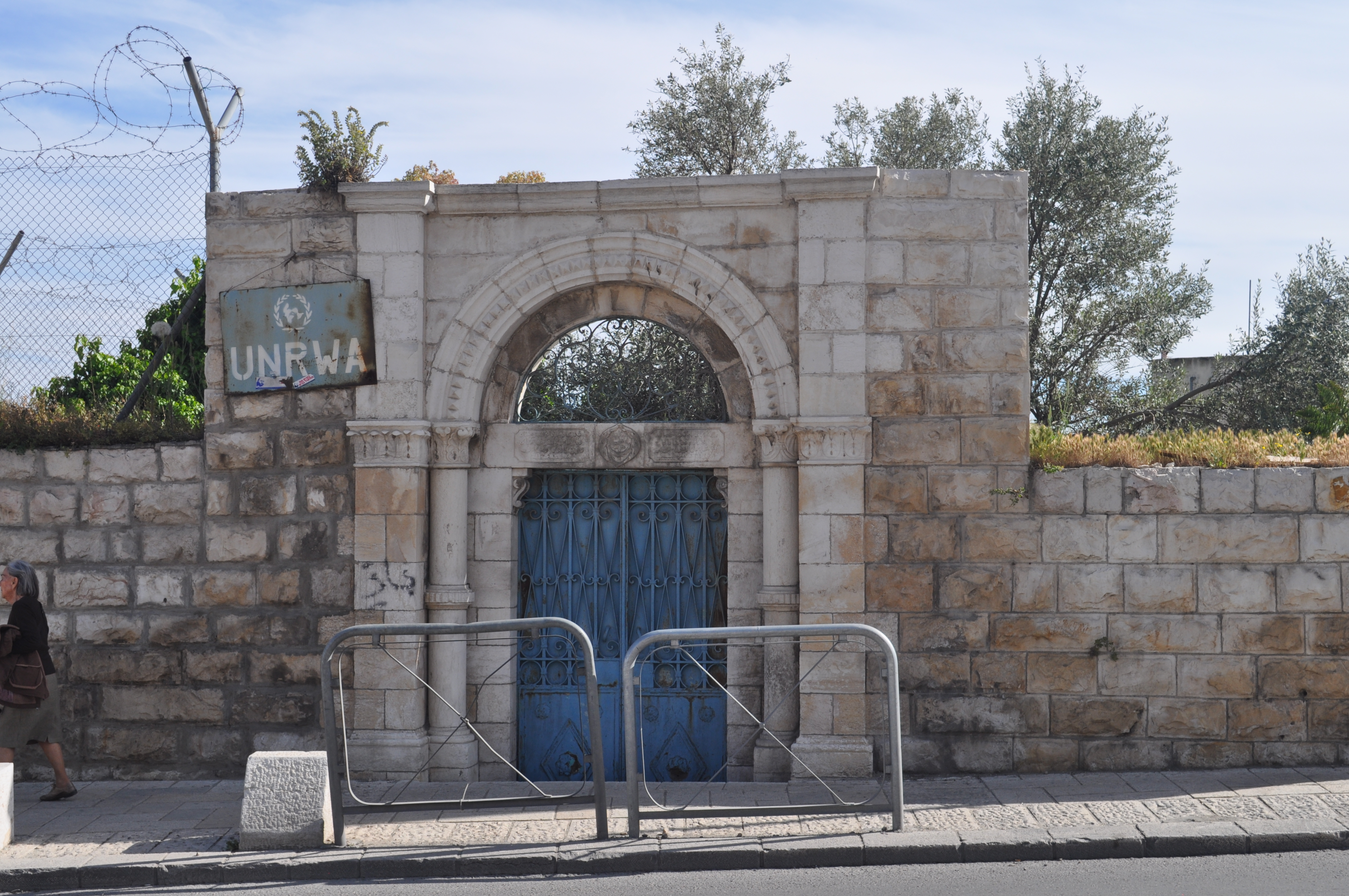
UNRWA Office just south of the Temple Mount
The Abuse of UNRWA
UNRWA’s evolving mission has distanced itself from core relief operations (as offered by the UNHCR) and the tone and tenor of the organization has come to mimic Palestinian society at large. For example, UNRWA has come under repeated fire for its actions related to Jews and Israel.
It handed those missiles to Hamas while it was in active combat;
It watched as Hamas fired rockets into Israeli civilian areas from its courtyards.
Long ago, UNRWA stopped being an independent relief agency, but has morphed into a Palestinian agency with its own agenda, courtesy of funding by the global community.
Ending UNRWA
The Palestinians and the global community have been co-conspirators in a permanent welfare situation for over six decades. Meanwhile, there is a true humanitarian crisis around the MENA region which is underfunded and understaffed. It is time to transition to a new paradigm for each area in which UNRWA operates.
Lebanon and Jordan: Each country has been over-run with actual refugees from Syria and Iraq. These refugees sit in squalor and receive a fraction of the aid that the Palestinian permanent residents receive. It is unfair and outrageous. The UNRWA should hand over all of its operations to the host countries of Lebanon and Jordan. The incremental cost of carrying these facilities should be carried by each country, with a UN contribution made at the country-level which declines over time. At the same time, additional monies should go towards infrastructure for the new actual refugees.
Syria: As the country is still engaged in a civil war, the UN should still maintain operations until hostilities end.
West Bank and Gaza: If the UN truly considers Palestine a country, by definition there can be no Palestinian refugees or SAPs (Stateless Arabs from Palestine) in Palestine. And whether it is or isn’t, all UNRWA facilities should be handed over to the government. The UN will likely give monies to the government as part of establishing and stabilizing the country, which would help cover the cost of the former UNRWA facilities.
The world’s focus on the descendants of Palestinians who left their homes 66 years ago has hurt millions of refugees from around the world. In today’s particularly violent and unstable situation in dozens of countries, the United Nations must transition from spending billions of dollars in welfare checks to capable young SAPs, and direct funds to the millions who are fleeing their home countries due to war and violence.
The United States Court of Appeals for the Second Circuit released a long-secret memo in which the Obama administration laid out its legal reasoning for launching a drone attack on an American citizen overseas. The legal arguments for a targeted killing of an American citizen are greater than for a non-American, since the US citizen is entitled to due process in the court system, whereas a non-American is afforded fewer protections under the law.
The main justification presented in the memo revolved around the targeted person’s “continued and imminent threat of violence or death” to US persons. This justification received little debate in the press, congress or world opinion. All of the debates only revolved around the rights of due process for a US citizen.
The lack of debate would lead one to naturally conclude that everyone agrees with the rationale: that a government is responsible for protecting citizens that are threatened.
However, world opinion does not believe that such rationale is a universal responsibility. World bodies selectively believe that one government has neither the right nor the responsibility to protect its citizens. That government is Israel.
Consider the world reaction to the targeted killing of leading terrorists. The world celebrated the 2011 US assassination of Osama bin Laden, but almost uniformly (Australia was an exception) condemned Israel for the 2004 killing of Sheik Ahmed Yassin, the founder of Hamas.
Sheik Yassin had committed 100 attacks which killed hundreds of people in Israel. He had just completed a terrorist attack in Ashdod and was actively planning new attacks when he was killed. Osama bin Laden had committed a few attacks which killed thousands, and had not committed any recent attacks when he was killed by US special forces.
Below is a sampling of contrasting reactions from world leaders to the two events.
Now consider why Israel often ignores world opinion.
United Nations:
UN Secretary-General Kofi Annan: “I condemn the targeted assassination of Ahmed Yassin. Such actions are not only contrary to international law but they do not help the search for a peaceful solution.”
UN Secretary-General Ban Ki-moon hailed Osama bin Laden’s death as a key turning point in the struggle against terrorism.
EU:
EU foreign policy chief Javier Solana, described the assassination as “very, very bad news. The policy of the European Union has been consistently condemnation of extra-judicial killing.”
EU foreign policy chief Catherine Ashton said: “I would like to congratulate the U.S., pay tribute to its determination and efficiency in reducing the threat posed by terrorists and underline the close cooperation between the EU and U.S. in the fight against terrorism.”
Vatican:
“The Holy See unites with the international community in deploring this act of violence that cannot be justified in any state of law. Lasting peace cannot come from a show of force.”
Vatican spokesman Fr. Federico Lombardi said that while Christians “do not rejoice” over a death, bin Laden’s death serves to remind them of “each person’s responsibility before God and men” and “bin Laden must answer to God for having killed an innumerable number of people and exploiting religion”.
UK:
British Foreign Secretary Jack Straw said: “Israel is not entitled to go in for this kind of unlawful killing and we condemn it. It is unacceptable, it is unjustified and it is very unlikely to achieve its objectives.”
Prime Minister David Cameron said that bin Laden’s death would “bring great relief” around the world. “I congratulate President Obama and those responsible for carrying out this operation.”
France:
French President Jacques Chirac “unreservedly condemned” Israel’s assassination of Hamas terror leader Yassin. French Foreign Ministry spokesman Herve Ladsous also said: “France condemns the action taken against Sheikh Yassin, just as it has always condemned the principle of any extra-judicial execution as contrary to international law.”
French Foreign Minister Alain Juppé said on that bin Laden’s death is a “victory for all democracies fighting the abominable scourge of terrorism. France, the United States and European states work closely together to fight terrorism, so I’m overjoyed at the news.”
French President Nicolas Sarkozy said bin Laden’s death was a result of a “remarkable U.S. commando” operation. “For his victims, justice has been done. Today, in France, we think of them and their families.”
Germany:
German Foreign Minister Joschka Fischer: “The German government is deeply concerned about the development [killing of Sheik Yassin].”
German Chancellor Angela Merkel: “Last night, the forces of peace were able to report a success [killing of bin Laden].”
Norway:
Norwegian Foreign Minister Jan Petersen: “This act will contribute to increased tensions in the area and will make it more difficult to implement an Israeli withdrawal from Gaza.”
Norwegian Foreign Minister Jonas Gahr Støre called the death of bin Laden “a break-through in the fight against terror”.
Denmark:
Foreign Minister Per Stig Moeller said “Terror and violence is not the way ahead.”
Danish Prime MinisterLars Løkke Rasmussen said, “I congratulate President Obama and the American people with the success in finishing the era of bin Laden’s unscrupulous and inhumane violence and destruction”
Japan:
Japan’s Chief Cabinet Secretary Yasuo Fukuda said Israel’s actions were “thoughtless and reckless, and cannot be justified.”
Japan’s Foreign Minister Takeaki Matsumoto said today that the country welcomed the death of Osama bin Laden as “significant progress of counter-terrorism measures. I pay respect to the US officials concerned.”
Secretary of State Hillary Clinton said “There is no better rebuke to al Qaeda and its heinous ideology. The fight continues and we will never waiver.”
Brazil:
The Brazilian government said it “deplored the murder of Sheik Ahmed Yassin.”
Brazilian Foreign Minister Antonio Patriota said the death of Al Qaeda’s leader Osama bin Laden is “important and positive”.
Malaysia:
Malaysia strongly condemned the assassination of Sheikh Ahmed Yassin: saying the action was a manifestation of terrorism.
Malaysian Home Minister Hishammuddin Hussein said he hopes that the death of bin Laden would help bring universal peace and harmony.
Mexico:
LUIS ALFONSO DE ALBA GÓNGORA said his country regretted the actions taken by the Israeli army which had resulted in the loss of Sheikh Yassin. Mexico believed these actions broke down the necessary political conditions needed to put an end to escalating violence and to ensure peace in the region. It recognized the right to the self-determination of the Palestinian people, urged the international community to apply the Road Map, and urged the parties not to take unilateral decisions that placed obstacles in front of the road to peace. Societies had the right to live in peace. The protection of the rule of law and respect for human rights was essential to eradicate these acts. The Security Council must take a stance against international terrorism and the international community must continue together to endow the United Nations to guarantee that human rights and fundamental freedoms must be recognized fully
Mexico Ministry of Foreign Relation: The Government of Mexico reiterates its deep conviction that terrorism is a criminal activity that must be fought decisively by the international community because it represents a serious threat to global peace and stability and causes many innocent lives to be lost. That’s why the Government of Mexico recognizes the efforts carried out by the Government of the United States to fight against and capture Osama Bin Laden, the leader of the Al Qaeda terrorist organization. These efforts have resulted in his defeat and death during an operation by U.S. armed forces in Pakistan. This is an act of great significance in the efforts to rid the world of the scourge of terrorism which threatens peace and international security, in particular the one practiced by one of the most cruel and bloody terrorist organizations which has acted against the civilian population and which has caused the loss of many innocent lives, including Mexican citizens in the attacks of September 11th, 2001.
India:
HARDEEP SING. PURI said the killing of Sheikh Yassin had further inflamed passions in the Middle East, and there was concern that it would fuel the cycle of violence and counter-violence in the region, causing a set-back to the efforts to resume the peace process. There could be no military solution to the Middle East problem. States of course had the right to defend themselves, but they also had the responsibility to uphold international law. The people of Palestine deserved the full support of the international community to enable them to realize their national aspirations. There could, of course, be no justification whatsoever for any acts of terror. The international community had to be relentless in fighting the war to eradicate this scourge; no ends could be justified by use of the means of terrorism.
Indian prime minister Manmohan Singh: “I welcome it as a significant step forward and hope that it will deal a decisive blow to Al Qaeda and other terrorist groups. The international community and Pakistan in particular must work comprehensively to end the activities of all such groups who threaten civilized behavior and kill innocent men, women and children.”
Australia:
CAROLINE MILLER said Australia had consistently supported Israel’s right to defend itself from terrorism. Hamas was a terrorist organization proscribed under the Australian law. It had used suicide bombers to target and murder many innocent Israelis. Australia urged calm and called on both sides to exercise maximum restraint. Violence would not settle the Middle East dispute.
Australian Prime Minister Julia Gillard congratulated the United States on the operation and said she acknowledges the role of Pakistan in the fight against terror. “Our fight against terrorism does not end with bin Laden’s death. We must remain vigilant against the threat posed by al Qaeda and the groups it has inspired,” she said.
New Zealand:
JILLIAN DEMPSTER said the use of extra-judicial killings by a State was particularly abhorrent. Assassinations such as the extra-judicial killing of Hamas spiritual leader Sheikh Yassin clearly violated the norms of international human rights law. Not only that, but they did not achieve their stated goal, were counter-productive to peace efforts in the Middle East, and would likely only produce further violence.
New Zealand Prime MinisterJohn Key stated that “the world is a safer place without Osama bin Laden”, but “bin Laden’s death may not mean an end to terrorism“
South Africa:
DUDU KHOSA said that her country condemned the assassination of Sheikh Ahmad Yassin, founder and spiritual leader of Hamas. Such extra-judicial killings constituted a contravention of international law and relevant United Nations conventions, and only strengthened those not committed to achieving peace in the Middle East. Such acts could only lead to retaliation and counter-retaliation, further eroding any progress being made in the implementation of the Road Map.
South Africa Department of International Relations and Cooperation reaffirmed South Africa’s support for stemming “the demon of terrorism in all its manifestations”
Russia:
VLADIMIR PARSHIKOV said the Russian Federation supported the proposal to hold the special sitting since it was concerned about the worsening situation in the Middle East in general. The recent acts committed by Israel were a serious threat to the Road Map to peace and these acts of violence would nullify every effort taken by the Quartet. Both parties must show restraint and a high level of responsibility to commit themselves to peace. The Russian Federation would also vote in favour of the proposed draft resolution of the Security Council condemning all acts of terrorism including those committed recently by Israel.
Russia’s Foreign Ministry published a statement on its website calling bin Laden’s death a “landmark point… The elimination of Osama bin Laden, a notorious figure and the number one terrorist, is a landmark point in fighting international terrorism. This is an extraordinary event for the entire anti-terror coalition which will have a lasting practical meaning in terms of decapitation of the criminal organization,” the statement said. “It will become an important symbol since it took place on the eve of the 10th anniversary of the September 11, 2001 terror attacks in the U.S. As part of the anti-terror coalition, we sympathize with the Americans, and appreciate the fact that the Russian authorities were informed about the news (of bin Laden’s elimination) ahead of the official announcement of U.S.President Barack Obama.”
China:
SHA ZUKANG said the act of assassination by Israel was strongly condemned in the belief that the practice of targeted liquidation was not conducive to the settlement of the Middle East issue, rather, it would trigger more conflicts and bloodshed and further destabilize the region.
Chinese spokesman: We have noted the announcement and believe this is a major event and a positive development in the international struggle against terrorism.
Sri Lanka:
SARALA M. FERNADO said extra judicial killings were in contravention to international law and should be condemned in no uncertain terms by peace-loving countries. Terrorism brought immense pain to innocent civilians, broke social systems, generated hatred and darkened the future of the generations to be born. For a peaceful resolution to the Middle East conflict, all parties should exercise restraint and refrain from any form of violence, as these only contributed to diminish hopes for a lasting peace.
External Affairs Minister G.L. Peiris congratulated the US and said: “the killing of the terrorist leader [bin Laden] by US forces sends a warning to other terror groups as well.” Cabinet Minister de Silva added: the assassination “sheds a lot of light on how a ruthless terrorist group should be crushed.”
Turkey:
Prime Minister Recep Erdogan called the killing of Yassin “a terrorist act” and said that “the assassination was not humane.”
President Abdualla Gul declared that the killing of bin Laden was a message for terrorst organizations all around the world.
Saudi Arabia:
ABDULWAHAB ABDULSALAM ATTAR said that Israel had no use for the resolutions adopted by this august Commission, nor for the Geneva Conventions. The assassination of Sheikh Yassin was a crime. Israel also tortured detainees and prisoners in contravention of international law. The international community was urged to put an end to such crimes, including that committed against Sheikh Yassin. This criminal act must be deplored in this forum. Otherwise, the Commission risked losing its credibility. Full solidarity with the sufferings of the Palestinian people must also be expressed.
Statement on Saudi Press Agency: “An official source has expressed the hope of the Kingdom of Saudi Arabia that the extermination of the terrorist head of Al Qaeda is a step towards the reinforcing of the international efforts to combat terror and breaking up its cells. And the extinguishing of the misleading school of thought it rests on. ”
Yemen:
MANAF AL-SALAHI said his country condemned the escalating Israeli policies which had taken a dangerous turn with the assassination of last week which was a clear violation of international norms and laws. This act may bring the region into spiralling violence. The peace process as a whole had reached a stalemate and it would be difficult for the peace process to be revived unless the international community pursued the road to peace in a strict way.
Embassy of Yemen in the U.S. released a statement welcoming “the elimination of Usama Bin Ladin, the founding father of the Al-Qaeda’s terrorist network. The successful operation, spearheaded by U.S. forces, marks a monumental milestone in the ongoing global war against terrorism.”
Iran:
MOHAMMAD REZA ALBORZI said the international community had once again been witness to yet another act of brutality and barbarism and extra-judicial targeted assassination by Israel. The relentless massacre of Palestinians and targeted assassinations were strongly condemned, as these acts were clear instances of State terrorism, which further revealed the violent face of the Israeli Government before the international community. That these atrocities were perpetrated at the very time when the Commission was in session clearly manifested Israeli continued defiance of this body and was an appalling affront to the Commission’s credibility. It was high time that the Commission considered some sort of preventative mechanism to bring an end once and for all to the continued Israeli aggression against the Palestinian people.
Iran Foreign Ministry: The Islamic Republic of Iran hopes that the death of Osama bin Laden will put an end to war and the killing of innocent people and restore peace to their region, according to the Islamic Republic News Agency. The IRNA website reports Foreign Ministry spokesman Ramin Mehmanparast said, “The Islamic Republic of Iran believes that foreign countries now have no excuse for military buildup in the region to fight terrorism.”
Jordan:
SHEHAB A. MADI said the assassination of Sheikh Yassin was a crime that would only lead to further escalation, violence and instability in the region. It was another crime against the Palestinian people and a clear violation of all norms and international conventions. The policy of assassination which led only to more escalation and violence was totally rejected.
Jordan said the killing of al-Qaeda leader Osama bin Laden is likely to end unjust campaigns in the West against Islam.
Morocco:
OMAR HILALE said his country strongly condemned the assassination of Sheikh Ahmad Yasssin and other civilians by Israel. This would have dangerous consequences that would destabilize further the region. Morocco rejected violence and everyone should return to the negotiating table. It was the responsibility of the international community to condemn Israeli acts.
Communications Minister Khalid Naciri said that “the entire world suffered from bin Laden and the organization he created“.
In total, 31 countries voted in favor of a UN Commission on Human Rights resolution “Which Condemns Continuing Grave Violations Of Human Rights in Territory, Including Tragic Assassination of Sheikh Yassin”: Argentina, Armenia, Bahrain, Bhutan, Brazil, Burkina Faso, Chile, China, Congo, Cuba, Egypt, Eritrea, Ethiopia, India, Indonesia, Mauritania, Mexico, Nepal, Nigeria, Pakistan, Paraguay, Qatar, Russian Federation, Saudi Arabia, South Africa, Sri Lanka, Sudan, Swaziland, Togo, Uganda, and Zimbabwe.
Despite condemning Israel for killing an active terrorist, these countries extolled the US doing the same thing:
Argentina President Cristina Fernández de Kirchner said “Bin Laden’s activities are repudiated by all people and nations who truly believe in the dignity of the human condition, and we stand in support of all his victims.”
Chile President Sebastián Piñera said he was “glad that the whole world learned that, though late, justice arrives, and that crimes committed against innocent people around the world will not go unpunished.”
Ansyaad Mbai, the head of Indonesia’s counter-terrorist agency, said that bin Laden’s death “would bring positive impact” and that “it would reduce movements organized by radical groups since their main figure had died.”
Ethiopian Communication Department said “The Ethiopian Government salutes all parties involved in this operation, particularly the US anti-terrorist operatives, for hunting and destroying this unrepentant leader of an international terrorist organization.”