Failing Negotiation 101: The United States

One Party that can deliver

US Secretary of State John Kerry invested heavily in Israel-Palestinian Authority peace talks from July 2013 to March 2014. In the wake of the failure, many people looked to blame one of the two parties for the talks’ failure. A recent New York Times article quoted Israeli left-wing politician Tzipi Livni as blaming the Palestinians for the collapsed negotiations (a surprising statement, as in Israeli election season she only criticizes her political opponent Benjamin Netanyahu.)

In reality, it was the US that was to blame.

The US did not fail for lack of effort. It did not fail in trying to find creative solutions. It failed because the entire basis of having negotiations in the current format was a fool’s errand.

The process was doomed from the outset because Secretary Kerry deliberately ignored Negotiation Rule 101: negotiations between parties that can deliver. A negotiation between parties without authority is meaningless. A person without authority or control could theoretically promise anything – but deliver nothing. That was precisely what Secretary Kerry insisted upon when he pushed Israeli Prime Minister Benjamin Netanyahu to negotiate with a straw man named Mahmoud Abbas.

Abbas has no mandate. Mahmoud Abbas was elected to a four year term as president of the Palestinian Authority in January 2005. After his term expired in January 2009, no new elections were held. He no longer has a mandate.

Abbas has no backing. The reason that no new elections for the PA have been held is that everyone knows that Abbas and his Fatah party would lose. One year after Abbas won the presidency, his Fatah party was trounced in legislative elections. Hamas won 58% of the parliament. Every poll taken since then has shown that Abbas would lose in a presidential election.

Abbas has no control. Gaza, with its population of 1.7 million people, is under complete control of Hamas. Hamas routed all PA forces in 2007 and Abbas has no ability to control any activities from the region. Hamas controls thousands of missiles which it fires at Israeli population centers with or without Abbas approval. Therefore, what “peace” can Abbas deliver?

Despite these enormous glaring flaws, the US pushed forward a peace process that was doomed from the start because of the very essence of one of the negotiating parties. Netanyahu was forced to sit across from a counter-party who could not deliver any compromise that he may have offered. As Netanyahu’s authority was clear, any negotiating point that he made was secure; Abbas could “bank” every concession. However, any compromise that Abbas would theoretically offer, could be negated by the Palestinians. Just as the Palestinians complained that they were never asked about the British Mandate in 1922, they could once again complain that the public was never consulted about the peace process, as a mothballed politician without backing negotiated the agreement.

Further, Abbas’ lack of control meant that he had no means of enforcing the agreement. Israel would be left (at best) with making peace with those parties that accepted the peace agreement, but still be at war with those that rejected the agreement. With Abbas unable to enforce the compromises and the peace, it would continue to fall on Israel to confront those Palestinians that were still at war with the country. Noting how the world reacted to Israel’s defensive operation against Gaza in 2014, could Israel have any sense of security that it could effectively counter-act Palestinian aggression post a mock peace deal?

Secretary Kerry compounded the mistake of the bogus negotiation by building up expectations. His earnest and persistent involvement aggravated the talk’s failure. By investing so heavily in the process, Kerry made the failure that much more pronounced. While there was no direct line linking the talk’s collapse to the July-August battles with Hamas, the environment was poisoned.


Abbas gets no R-E-S-P-E-C-T music video (music by Aretha Franklin): https://www.youtube.com/watch?v=LipAKFsUNq8


Sources:

NY Times on Tzipi Livni impression on talks failure: http://www.nytimes.com/2014/12/24/opinion/roger-cohen-why-israeli-palestinian-peace-failed.html?_r=0

Related First One Through articles:

Abbas 10-year anniversary for a 4 year term: https://firstonethrough.wordpress.com/2014/09/30/the-disappointing-46-anniversary/


The New York Times Picture of the Year, 2014

15yearold

The year 2014 was notable for the global escalation in terror and death compared to prior years.

  • Islamic State/ ISIS created killing fields in Iraq, executing and beheading hundreds of people which it recorded and aired on the Internet. The group massacred and destroyed entire villages that existed for centuries.
  • Boko Haram in Nigeria killed hundreds of Christians and abducted hundreds of girls.
  • The ongoing war in Syria had a death toll approaching 200,000 people including over 10,000 children.
  • Israel responded to attacks from Gaza for the third time in eight years as Hamas continued rocket fire into Israeli towns. An advanced Hamas terror tunnel network extending into Israel forced a ground invasion into Gaza which claimed over 2000 lives.
  • Russia invaded and annexed Crimea, as Ukraine turned to the world for support but received virtually nothing.
  • Wars in Sudan, Yemen, Afghanistan and other countries continued to claim thousands of lives.

The year also included near break-out race riots in the United States as several unarmed black men were killed by white police officers. In Africa, the deadly disease Ebola killed thousands.

Various news agencies highlighted the most significant news events which ranged from Ebola to Russia’s invasion of Ukraine. They selected new events that impacted thousands of people in 2014 which had potentially long-term consequences.

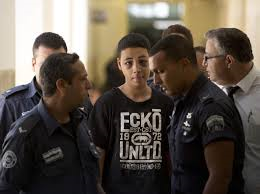
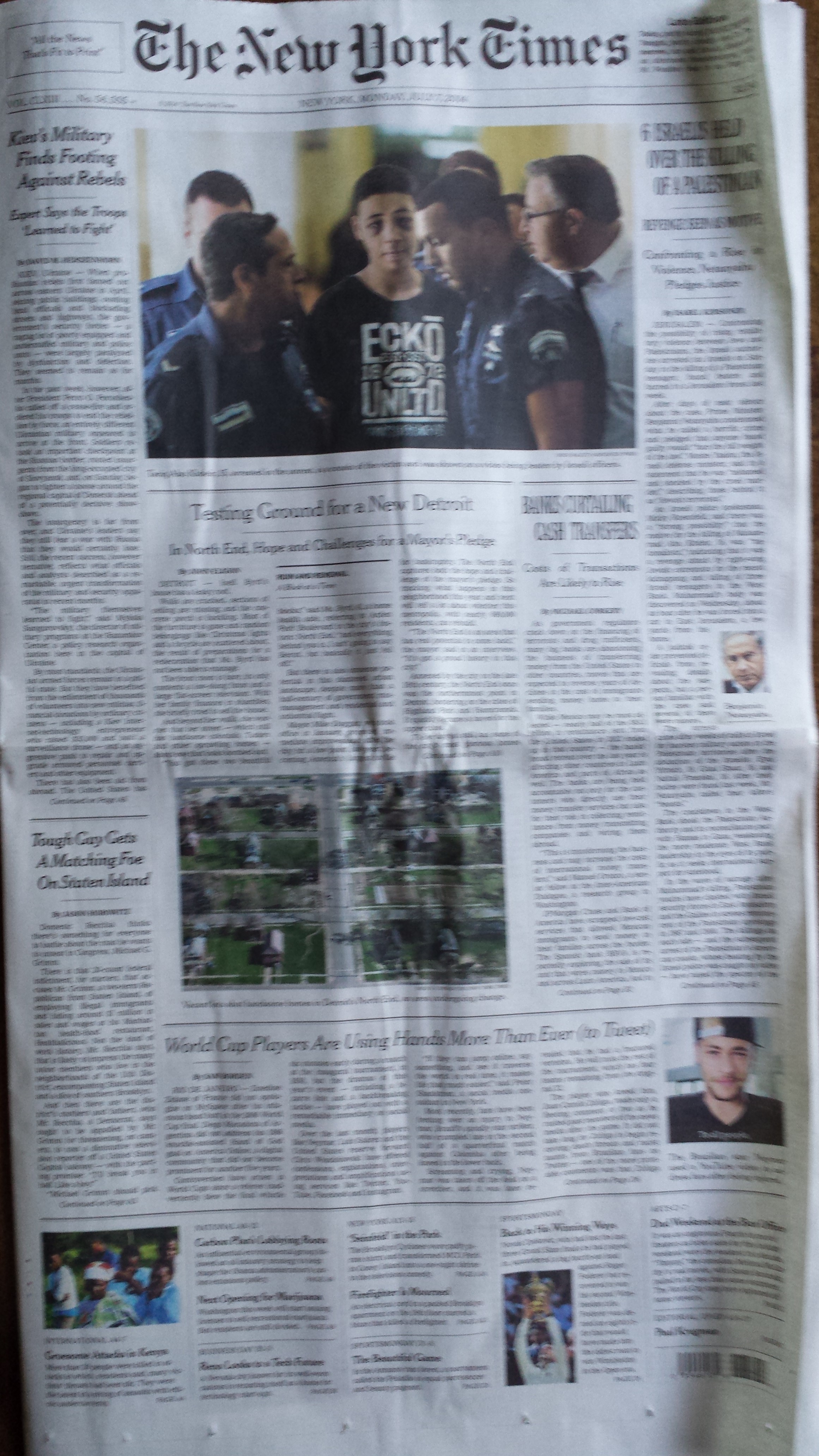
The New York Times year-end review posted dozens of pictures of conflicts around the world to encapsulate 2014.  In my opinion, the NYT picture that  summed up a dominant theme in its reporting for 2014 was the picture above, of a 15-year old Arab surrounded by Israeli policemen. For the New York Times, the stories on its cover pages in 2014 repeatedly told the story: that Israel attacks Arab youths.

The large color picture was displayed on its cover page on July 7, 2014. The bruised 15-year old Arab boy was being escorted out of a police station where he had been detained after throwing stones in a riot. There are several things that make the front-page treatment of the teenager note-worthy:

  • On that same day, over 100 people were killed in attacks in Kenya, Uganda and Yemen. Small stories appeared on the inside pages of the Times to discuss the scores murdered.
  • When Boko Haram killed hundreds, it also did not make the front page.
  • ISIS beheadings of journalists did not make the front page.

The beating of an Arab youth by Israeli forces was given more prominence and therefore deemed more important than those other world events.

This New York Times news story came shortly after three Israeli teenagers were abducted and murdered by Palestinians. The New York Times never placed even a small black-and-white photo of any of the three Jewish teenagers on the front page. Their plight was also not viewed as important by the Times.

Over the course of the next several weeks as Operation Protective Edge unfolded, the New York Times continued to put pictures of Palestinian children on the front page of the paper. Throughout July (July 11, 14, 17, 21, 22, 24 and 29th) the paper had pictures of Palestinians suffering on the front page. It took until July 29 – buried on page A6 – for the Times to write about and post a single picture of the Hamas terror tunnel network that was a main factor in launching the Israeli ground invasion of Gaza.

Further, Palestinian leadership, whether Hamas leaders such as Khaled Mashal or acting Palestinian Authority president Mahmoud Abbas, never were pictured on the pages of the Times during Operation Protective Edge (the only leader to be pictured was Ismail Haniya on September 4 page A10, well after the fighting had stopped). The paper only showed pictures of Arab civilians. However, Israeli Prime Minister Benjamin Netanyahu’s picture was shown often (July 7 twice; July 22; July 27; July 29; August 7), as were Israeli police and soldiers. The overall message of the New York Times was clear: the Israeli government was attacking Palestinian youths and civilians; it was not a war between opposing government authorities.

The Times news stories and editorials built additional narratives onto this theme, regardless of inaccuracies. In attempts to make the Israeli government seem callous to the conditions of Arab youth, an article and editorial on July 7 and July 8 stated that “days of near silence” passed before Israel Prime Minister spoke about the killing of an Arab teenager by Israeli radicals. This was completely untrue and it took days for the NYTimes to print a correction (below).

The NYT editorial board led with a piece on July 19 entitled “Israel’s War in Gaza”.  It was not called “Hamas’ War against Israel”, nor was it called the “War Between Hamas and Israel”.  The Times continued to paint the battle as an aggressive Israeli action against a populace.

In case there was any confusion in the New York Times message to its readership, it included another small picture of Netanyahu near its large picture of the year. (By way of comparison, did you ever see the NYT post a picture of US President Obama near an article about drone strikes or deaths in Afghanistan that he specifically ordered and oversaw?)


The New York Times tried to defend its coverage of the Gaza conflict by printing an editorial on November 23, 2014 entitled “The Conflict and the Coverage”.  Not surprisingly, it attempted to defend its poor media coverage and that it tried too hard to offer “symmetry” in the conflict. It claimed that the paper has “baseline beliefs that Israel has a right to exist and that the Palestinians deserve a state of their own.” The charitable Times board believing that “Israel has a right to exist,” clearly doesn’t extend to: believing that Israel has a right to defend itself; that it was reluctantly pulled into a battle in Gaza; that it sought to minimize Arab casualties; that Hamas is rabidly anti-Semitic; that Hamas leaders are intent on destroying Israel and killing Jews; and that Arab leadership was responsible for the war and deaths of both Israelis and Palestinians.


Sources:

http://www.huffingtonpost.com/2014/07/07/jodi-rudoren-new-york-times-_n_5564067.html

Times moved picture down in online of story: http://www.nytimes.com/2014/07/07/world/middleeast/israel-palestinians-muhammad-abu-khdeir.html

Every Picture Tells a story: https://firstonethrough.wordpress.com/2014/07/04/every-picture-tells-a-story-dont-it/

Bibi as a killing monster: https://firstonethrough.wordpress.com/2014/07/08/every-picture-tells-a-story-part-ii/

The NYT buried pictures: https://firstonethrough.wordpress.com/2014/07/29/the-new-york-times-buried-pictures/


NY Times Correction: July 9, 2014

An article on Monday about the arrest of six Israelis in the killing of a Palestinian teenager referred incorrectly to Prime Minister Benjamin Netanyahu’s response to the killing of Muhammad Abu Khdeir. On the day of the killing, Mr. Netanyahu’s office issued a statement saying he had told his minister for internal security to quickly investigate the crime; it is not the case that “days of near silence” passed before he spoke about it. The error was repeated in an editorial on Tuesday.”


The Legal Israeli Settlements

Many people have argued that it is illegal for Israelis to live beyond the 1949 Armistice Lines (east of the Green Line, EGL/Judea and Samaria/West Bank).  The question of “legitimacy” (not legality) has been repeated often by the USA’s Obama Administration.  Those comments are more harsh towards Israel than prior American administrations that simply viewed new settlements as “unhelpful” to a peace agreement between Israel and the Arab states.  Jimmy Carter was the only US president that actually called the settlements “illegal”.  Below is a review of the international laws that apply towards the settlements.

IMG_2002
Street sign in Judea and Samaria

Fourth Geneva Convention

Article 49 of the Fourth Geneva Convention deals with the treatment of “occupied territory“.  It is unclear whether it applies to territory obtained in both offensive and defensive wars, but this review will assume that the law stands in either case.

The majority of Article 49 is about the treatment of the inhabitants of the occupied territory and not about the “Occupying Power” transferring in its own population.  The opening paragraph:

“Individual or mass forcible transfers, as well as deportations of protected persons
from occupied territory to the territory of the Occupying Power or to that of any other country, occupied or not, are prohibited, regardless of their motive.”

This paragraph does not relate to Israelis living in EGL for several reasons:

  • The language is about people from the occupied territory, not to the occupied territory.  It underscores the flagrant illegal eviction of Jews from Judea and Samaria by the Jordanians in 1949.
  • As the Arabs living in EGL were not forcibly transferred to any country, Israel did nothing counter to this law.

The next paragraphs deal with exceptions to the main directive stated above for military reasons:

“Nevertheless, the Occupying Power may undertake total or partial evacuation of a given area if the security of the population or imperative military reasons so demand. Such evacuations may not involve the displacement of protected persons outside the bounds of the occupied territory except when for material reasons it is impossible to avoid such displacement. Persons thus evacuated shall be transferred back to their homes as soon as hostilities in the area in question have ceased.”

  • The law permits operations involving security.  This clause allows the building of the security barrier inside the West Bank that Israel erected in reaction to the Second Intifada, and relocation of people impacted to construct such barrier.

 “The Occupying Power undertaking such transfers or evacuations shall ensure, to the greatest practicable extent, that proper accommodation is provided to receive the protected persons, that the removals are effected in satisfactory conditions of hygiene, health, safety and nutrition, and that members of the same family are not separated. The Protecting Power shall be informed of any transfers and evacuations
as soon as they have taken place. The Occupying Power shall not detain protected persons in an area particularly exposed to the dangers of war unless the security of the population or imperative military reasons so demand.”

  • These paragraphs seek to protect people, even in the case of a necessary evacuation.  The only Arabs that Israel moved out of the West Bank were people who were arrested and therefore not relevant to this clause.

As seen above, almost the entirety of Article 49 of the Geneva Convention has to do with the local population- in this case, a theoretical transfer of Arabs out of EGL/Judea and Samaria/West Bank.  Only the last paragraph addresses the civilians of an “Occupying Power”.

 “The Occupying Power shall not deport or transfer parts of its own
civilian population
into the territory it occupies.”

  • Israelis moving and living in EGL/J&S do so of their own free will.  The government does not “deport or transfer its own civilians” to EGL.
  • The “territory” in question, Judea and Samaria, was settled by Jews long before the Jordanians occupied the area and evicted the Jews. As such, Jews were part of the indigenous population before being illegally evicted in 1949. Returning to the region is in keeping with Article 49’s goal above stating “Persons thus evacuated shall be transferred back to their homes as soon as hostilities in the area in question have ceased.“
  • Additionally, this territory was never a distinct country, but part and parcel of the Mandate of Palestine which specifically called for “establishment in Palestine of a national home for the Jewish people.”  As such, Jews moving to Judea and Samaria is part of the ongoing provision established internationally in 1922.

The Hague Regulations

Another law that people contend relates to Israel’s administration of EGL/West Bank is Article 55 of the Hague Regulations:

 “Art. 55. The occupying State shall be regarded only as administrator and usufructuary of public buildings, real estate, forests, and agricultural estates belonging to the hostile State, and situated in the occupied country. It must safeguard the capital of these properties, and administer them in accordance with the rules of usufruct.”

This rule clearly affirms Israel’s role as administrator for public lands.  The Hague regulations – and this provision in particular – deal with situations that are temporary in nature, and are impractical for those that last for decades.  To wit, the Arab population in the West Bank has grown four times since 1967, in one of the largest population increases on the planet. New infrastructure was established to accommodate the growth in the region, and Israel authorized these new homes, roads and other infrastructure, thereby necessitating a change to public lands.

In terms of minimizing the changes to public lands, it is unclear whether the role of Israel is to maintain a status quo according to the laws of Jordan, which illegally seized and annexed the area, or to administer the region according to British laws which had an international mandate before the Jordanians took control.

  • The Jordanians took this area in an offensive war against Israel in 1948-9
  • The Jordanian annexation in 1950 was never recognized by the United Nations
  • The area in question was part of the internationally approved British Mandate of Palestine (from 1922-1948).

Therefore, to comply with Article 55 above, which rules were appropriate for Israel to maintain: the illegal occupying Jordanian laws of 1949-1967 or those accorded in international law in the British Mandate 1922-1948?

If the British laws regarding property were to be maintained, then those laws state that no person should be forbidden to live in any part of the entirety of the Mandate (including Gaza, Israel and the West Bank) on the basis of religion, per Article 15 of that 1922 Mandate:

“The Mandatory shall see that complete freedom of conscience and the free exercise of all forms of worship, subject only to the maintenance of public order and morals, are ensured to all. No discrimination of any kind shall be made between the inhabitants of Palestine on the ground of race, religion or language. No person shall be excluded from Palestine on the sole ground of his religious belief.”

As it relates to the use of public lands (which is the focus of Article 55 of the Hague Regulations), the British Mandate clearly states that public land is to be used for Jewish settlement:

“The Administration of Palestine, while ensuring that the rights and position of other sections of the population are not prejudiced, shall facilitate Jewish immigration under suitable conditions and shall encourage, in co-operation with the Jewish agency referred to in Article 4, close settlement by Jews on the land, including State lands and waste lands not required for public purposes.”

Administration under British law encouraged Jews to live throughout Judea and Samaria, including state lands, and it can therefore not be illegal for any Jew to live there.

The only possibility that Jews moving to and living in the West Bank could be considered illegal, was if Jordanian law was to be maintained in the area.  However, even if one were to assume that despite the Jordanian’s forcible seizure and illegal annexation of the area, that their laws should still be maintained, could any law possibly suggest that it be a requirement to maintain particular laws that were flagrant violations of the Geneva Convention such as the racist Jordanian laws that evicted and barred Jews from living in the land?

Even further, if Israeli actions of Jews moving to EGL/West Bank were somehow considered illegal (which is not the case), Article 3 of the Hague Resolution states that a “belligerent party which violates the provisions of the said Regulations shall, if the case demands, be liable to pay compensation,” so remedy would be a fine, not eviction of the Jews.

(Also note that Hague Regulation Article 40, specifically gave Israel the right to attack Jordan after Jordan broke the 1949 armistice agreement in 1967.)

United Nations Reinterpretation for Israel

Since 1967, the United Nations crafted various resolutions condemning Israel for a wide variety of perceived “sins” such as the infamous “Zionism is Racism” resolution in 1975.  Many resolutions have inverted the meaning of the Geneva Convention such as a UN Security Council Resolution in 1980 which “Deplor[es] the decision of the Government of Israel to officially support Israeli settlement in the Palestinian and other Arab territories occupied since 1967.”  It continued further:

“[A]ll measures taken by Israel to change the physical character, demographic composition, institutional structure or status of the Palestinian and other Arab territories occupied since 1967, including Jerusalem, or any part thereof, have
no legal validity and that Israel’s policy and practices of settling parts of its population and new immigrants in those territories constitute a flagrant violation of the
Fourth Geneva Convention relative to the Protection of Civilian Persons in Time of War and also constitute a serious obstruction to achieving a comprehensive,
just and lasting peace in the Middle East;”

Arguing that “new immigrants” (many of whom were actually returning residents from 1949) are a threat to the security of the existing population is xenophobia at its most extreme.  Arguing that is a “flagrant violation of the Fourth Geneva Convention” is disproved above.

Status of Jerusalem

The inclusion of Jerusalem in the United Nations attacks on Israel is telling.  Greater Jerusalem and Greater Bethlehem were planned to be an international “Holy Basin” according to the UN 1947 Partition Plan – neither Arab nor Israeli.  After Jordan attacked Israel and seized the eastern half of Jerusalem and annexed it, the United Nations remained silent.  The UN issued no declaration against the Jordanian invasion and land grab for the entire period it held the territory through 1967.  However, when Israel took control of Jerusalem and later annexed it in 1980, the United Nations went on tirades about the illegal nature of Israel’s authority. The UN’s motions are absurd and duplicitous in granting tacit approval to the Jordanian Arab illegal annexation of Jerusalem and condemning Israel for its annexation. If Jordan’s offensive war to take a planned international city was viewed as permissible, how can Israel’s defensive war be viewed any less so?

The ongoing dynamic in Jerusalem is also different than the rest of EGL/West Bank since the eastern part of the city was annexed by Israel and all of the residents were offered citizenship (almost all of the Arabs declined and took residency papers instead). As such, clauses in international law about offering citizenship to people are not applicable to the eastern half of Jerusalem (while still relevant in the remainder of EGL/West Bank).

As reviewed above, Israel abides by the global rules of international law relating to Jews living in EGL.  However, the United Nations reinterpretation of law solely as it relates to Israel – whether for national movements like Zionism, or for allowing Jews to move and live freely like other peoples in lands they lived in for thousands of years – is not law, but anti-Semitism.


Source:

Fourth Geneva Convention: https://www.icrc.org/applic/ihl/ihl.nsf/c525816bde96b7fd41256739003e636a/77068f12b8857c4dc12563cd0051bdb0?OpenDocument

Hague Resolution: https://www.icrc.org/applic/ihl/ihl.nsf/WebART/195-200065?OpenDocument

Hague Resolution Article 3: https://www.icrc.org/applic/ihl/ihl.nsf/ART/195-200004?OpenDocument

Hague Resolution Article 40: “Any serious violation of the armistice by one of the parties gives the other party the right of denouncing it, and even, in cases of urgency, of recommencing hostilities immediately.“

British Mandate of Palestine: http://avalon.law.yale.edu/20th_century/palmanda.asp

Israel-Jordan Armistice agreement: http://avalon.law.yale.edu/20th_century/arm03.asp

UN Security Council Resolution 465 (1980): http://unispal.un.org/UNISPAL.NSF/0/5AA254A1C8F8B1CB852560E50075D7D5

UN Security Council Resolution 476 (1980) attacking Israel on Jerusalem: http://unispal.un.org/UNISPAL.NSF/0/6DE6DA8A650B4C3B852560DF00663826

UN call that Zionism is racism (1975): http://unispal.un.org/UNISPAL.NSF/0/761C1063530766A7052566A2005B74D1

FirstOneThrough article on the Green Line: https://firstonethrough.wordpress.com/2014/12/09/the-green-line/

FirstOneThrough article on Judea and Samaria/ West Bank terminology: https://firstonethrough.wordpress.com/2014/12/08/names-and-narrative-the-green-line-west-bank-judea-and-samaria/

Summary of US administrations attitudes towards Israeli settlements: http://www.cmep.org/content/us-statements-israeli-settlements_short#Obama

The Green Line

Much of the ongoing debate about the Israeli-Arab conflict surrounds Israel’s borders. The Arabs seek the creation of  a new state of Palestine, up to the “1967 borders.”  That term has also been used by US President Obama as a basis for a peace formula.  However, the term and plan are flawed at its core, as the “1967 borders” were deliberately and specifically never declared borders by the warring parties in 1948-9, for different reasons.

In 1922, the predecessor to the United Nations declared in the British Mandate the “establishment in Palestine of a national home for the Jewish people“.  Because of the 1936-9 Arab riots, the British back-tracked from the original international plan and began to devise a solution that created only small enclaves for Jews within an Arab state.  By 1947, their actions set in motion a compromise plan by the United Nations that would have created distinct Jewish and Arab states.  That plan was rejected by the Arabs. When the British withdrew from Palestine in May 1948, the Jews declared an independent state and five Arab countries went to war against Israel to destroy the nascent Jewish state.

The end of the war in 1949 did not fix borders, but established armistice lines where the fighting concluded. No peace deals were signed between the warring parties as each sought ultimately different borders: the Arabs still sought the complete destruction of the Jewish state; the Israelis wanted borders that were more defensible.

The 1949 Egyptian Armistice Agreement stated clearly that: “The Armistice Demarcation Line is not to be construed in any sense as a political or territorial boundary,…The basic purpose of the Armistice Demarcation Line is to delineate the line beyond which the armed forces of the respective Parties shall not move.”  The Jordanian Agreement had similar language.

From Israel’s perspective, as it was subject to constant attacks, riots, wars and blockades to destroy the country, it viewed the 1949 Armistice lines as insufficient to provide it effective security.  The sentiment was best summarized by Israeli Foreign Minister Abba Eben to the UN Security Council in 1967, after the Arab armies once again set out to destroy Israel.

Why does accuracy matter?  How would a Palestinian call for the establishment of a new state of Palestine along the “1949 Armistice Lines” or the “Green Line” be any different than calling for such action along fictitious “1967 Borders”? Because the 1949 Armistice Lines underscores fundamental truths:

  • that Palestine never existed as a distinct country
  • that Palestine was not ruled by Arabs, but by the British and Ottomans before 1948
  • that five Arab armies from Egypt, Jordan, Syria, Lebanon and Iraq attacked Israel in 1948 in an attempt to destroy it
  • the “West Bank” is a newly defined term on newly conquered territory
  • highlights that the “Palestine Question” has always been a civil war- about the allocation of land between Jews and Arabs in an area that was once part of the Ottoman Empire
  • the “armistice lines” were never a border and never intended to be a border

The deliberate use of the term “1967 borders” gives a false impression that those lines were at any time approved and permanent. Further, using the term “West Bank” for the area east of the Green Line, makes that area appear to have been an actual Palestinian Arab entity, and as such, implies that the “occupied territory” is occupied Palestinian Arab land. Those conclusions are all false, and all fall away by using the proper Green Line/Armistice Lines terminology.


Sources:

Palestinian call for 1967 borders: http://palestinianmissionuk.com/news/president-abbas-calls-on-quartet-to-recognize-1967-borders/

Obama call for 1967 borders: http://www.nytimes.com/2011/05/20/world/middleeast/20speech.html?pagewanted=all&_r=0

1922 UN British Mandate: http://unispal.un.org/UNISPAL.NSF/0/2FCA2C68106F11AB05256BCF007BF3CB

1939 British White Paper: http://avalon.law.yale.edu/20th_century/brwh1939.asp

1947 UN partition plan: http://unispal.un.org/unispal.nsf/0/7F0AF2BD897689B785256C330061D253

1949 Egypt-Israel Armistice agreement: http://avalon.law.yale.edu/20th_century/arm01.asp

1949 Jordan-Israel Armistice Agreement: http://avalon.law.yale.edu/20th_century/arm03.asp

1967 Abba Eben to UN Security Council on constant threat of Arab states: http://www.mfa.gov.il/mfa/foreignpolicy/mfadocuments/yearbook1/pages/19%20statement%20to%20the%20security%20council%20by%20foreign%20mi.aspx

1969 Abba Eben Auschwitz borders: http://www.mefacts.com/outgoing.asp?x_id=10191

2002 Arab peace initiative does not use the term “1967 borders”: http://www.al-bab.com/arab/docs/league/peace02.htm

FirstOneThrough article on “West Bank” and “Judea and Samaria”: https://firstonethrough.wordpress.com/2014/12/08/names-and-narrative-the-green-line-west-bank-judea-and-samaria/

Names and Narrative: The West Bank / Judea and Samaria

The New York Times has taken more concerted efforts to balance the narrative between Muslims and Jews regarding the holy city and sites in Jerusalem. It has not taken such efforts elsewhere where it only uses an Arab narrative.

JERUSALEM

The holiest site in Judaism is “The Temple Mount” in Jerusalem, due to the fact that it was the location of Judaism’s two temples which existed from roughly 954BCE to 70CE. The Jewish King Herod built the Temple Mount platform specifically for Jewish use to ease access and flow to the Second Temple. To this day, it continues to be the direction of all Jewish prayer.

In Islam, that holy site is called the “Noble Sanctuary”, or “Bayt al-Maqdes” or “Al-Haram al-Sharif”. It is Islam’s third holiest site after Mecca and Medina, both located in Saudi Arabia. The Noble Sanctuary holds the Al Aqsa Mosque and the shrine known as the Dome of the Rock.

Historically, the New York Times would reference the names that both religions ascribed to the holy site, typically with the Jewish name first (the Temple Mount), and later in the article, it would use the Islamic name (Noble Sanctuary). More recently, the Times would use both names in the same sentence, and occasionally use the Islamic name first, followed by the Jewish name.

JUDEA AND SAMARIA

However, when it comes to other sites in the region with different names from the two peoples, the Times excludes the Israeli terminology: specifically, “Judea and Samaria”. For such region, the Times will only use the term “West Bank”, except if an Israeli is quoted using the name Judea and Samaria.

Interestingly, the West Bank never existed as an entity until 1949, and was never even referred to by the United Nations Security Council until 1953. In comparison, Judea and Samaria, which cover more area than just the West Bank, have existed for thousands of years.

The “West Bank” came into existence after five Arab armies attacked Israel in 1948. The armistice lines established in 1949 at the end of the war with Jordan became known as the “Green Line” as the line was drawn in green on the maps. The haphazard demarcation did not follow any historic, political or geographic contours, but was simply where the warring parties stopped fighting. The area east of the green line eventually became known as the West Bank.

In the years following the 1948 Arab attack on Israel, every United Nations Security Council (UNSC) Resolution regarding the “Palestine Question”, never mentioned Palestinians as a discrete people or the “West Bank” and Gaza as entities. Each resolution referred to the various parties in the conflict being Israel, Syria, Jordan and Egypt. The term “west bank (in lower case) of the Jordan” only showed up for the first time in 1953.

The term “West Bank” is an Arab artifice and highlights the short, violent and illegal Arab rule of the area:

  • It was achieved in an offensive war to destroy Israel
  • The duration of Arab rule only lasted for 18 years 1949-1967
  • Arab rule of the West Bank was never internationally approved (the UNSC never voted on the April 1950 Jordanian annexation of the area)
  • Was administered counter to the Fourth Geneva Convention (the Jordanians and Palestinians deported all of the Jews out of the territory)

The exclusive use of the term “West Bank” gives a false impression that the territory has a long history of Palestinian Arab rule. Further, in never using the term “Judea and Samaria” for the region, the UN, the New York Times and others, distance Jews and Israelis from lands that they lived in for thousands of years.

As the New York Times and other publications now give equal weight to “the Temple Mount” and “Noble Sanctuary”, they should do the same for “West Bank” and “Judea and Samaria”. Alternatively, it could use neutral nomenclature such as EGL- East of the Green Line.

judeasamaria


Source:

2014 NYTimes Noble Sanctuary first, then Temple Mount (11/19/14): http://www.nytimes.com/2014/11/19/opinion/horror-in-israel.html

2014 NY Times mentioning Temple Mount and Noble Sanctuary at the same time (10/31/14): http://www.nytimes.com/2014/10/31/world/middleeast/israel-palestinians-jerusalem-temple-mount-al-aksa.html

(11/7/14): http://www.nytimes.com/2014/11/07/world/middleeast/israel-jordan-jerusalem-al-aqsa-temple-mount.html

(11/23/14): http://www.nytimes.com/2014/11/23/world/middleeast/mistrust-threatens-delicate-balance-at-a-sacred-site-in-jerusalem-.html

Only calling it the “Al Aqsa compound” and not the “Temple Mount” (9/17/14): http://www.nytimes.com/2014/09/18/world/middleeast/unrest-by-palestinians-surges-in-a-jerusalem-neighborhood.html?_r=0

2013 NYTimes mentions Temple Mount and only later Noble Sanctuary (10/15/13): http://www.nytimes.com/2013/10/15/world/middleeast/ten-jewish-men-arrested-at-temple-mount.html

(9/22/13): http://www.nytimes.com/2013/09/22/world/middleeast/jews-challenge-rules-to-claim-heart-of-jerusalem.html?pagewanted=all

2009 NY Times only mentions Temple Mount (10/26/09): http://www.nytimes.com/2009/10/26/world/middleeast/26mideast.html

UN mentioning “west bank of Jordan” for the first time in 1953: http://www.un.org/en/ga/search/view_doc.asp?symbol=S/RES/101%281953%29


Related FirstOneThrough articles:

The Green Line

The EU’s Choice of Labels: “Made in West Bank” and “Anti-Semite”

Nicholas Kristof’s “Arab Land”

Changing the Israeli Knesset

The Israeli government is heading for another change. Prime Minister Benjamin Netanyahu announced the firing of two cabinet members and lawmakers voted for the effective dissolution of the current legislature.

The last Israeli elections held in January 2013 brought several changes to Israeli politics:

  • Likud combined with the Yisrael Beitenu party to win a collective 31 seats (21 for Likud and 11 for Israel Bietenu)
  • A new party, Yesh Atid, headed by Yair Lapid won 19 seats
  • Bayit Yehudi, headed by Naftali Bennett, continued to grow in strength, up to 12 seats
  • The Shas party was excluded from the government for the first time since 2006
  • The ruling coalition deliberately excluded the ultra-orthodox (Haredi) parties as they attempted to force changes in their participation in community service or military draft

The main factors that motivated the Israeli public was the economy, which was viewed as leaving too many people behind. As such, it was the first election in Israeli history that did not focus on security or a peace process. The Arab Spring enveloping the Middle East, and the inability of acting-President of the Palestinian Authority Mahmoud Abbas to reign in Hamas and manage Gaza, made the possibility of a resolution with Palestinian Arabs seem remote.


The new elections are called for March 17, 2015. Current polls suggest that Likud would win 22 seats (up from 20), Yesh Atid winning 9 seats (down from 19), Jewish Home would win 17 seats (up from 12), making for a more-right leaning coalition.

Enjoy the FirstOneThrough music video with music by David Bowie: The Changed Israeli Knesset.

https://www.youtube.com/watch?v=RMPQqkR_D04


Sources:

Netanyahu poll: http://www.bloomberg.com/news/2014-12-02/netanyahu-to-call-early-israel-vote-fire-ministers.html


The United Nations Audit of Israel

The obsession of the United Nations with Israel is well documented.prosor

Israeli Ambassador to the UN, Ron Prosor

Various UN bodies sanction Israel in every session over any real or perceived issue. Meanwhile, the organization ignores mass slaughters and human rights abuses that occur daily throughout the world. When well-meaning people point out the singular focus on Israel, the Israel-bashers contend that such complaint is not a defense- it is just “whataboutary”.

Really?

If black people in Missouri were pulled over by police at 70 times the rate of white people, the police department would come under attack for abusive and discriminatory behavior.

If a particular person with financials similar to other people, was audited by the IRS every year, the agency and government would be investigated.

Just a few examples of UN uniquely targeting Israel:

A First One Through video about the many actions and sanctions against Israel, “I hate Israel – the UN told me so”

https://www.youtube.com/watch?v=jMb4oofyVgo


Source:

UN Human Rights Council: 56 out of 103 resolutions against Israel. http://time.com/3060203/united-nations-human-rights-council-israel/

http://www.unwatch.org/site/c.bdKKISNqEmG/b.3820041/

UN interpreter surprised by number of anti-Israel resolutions: http://www.haaretz.com/blogs/diplomania/.premium-1.558302

Pope Francis in Turkey

The news agencies reported on Pope Francis’ visit to Turkey in November 2014. Remarkably, the major media outlets such as CNN, BBC, and The New York Times did not report on the extreme hardened Islamic moves that have taken place in Turkey over the past several years, nor other abuses:

  • No mention of the Turkish persecution of the Kurdish minorities
  • No mention of Turkey’s illegal invasion and ongoing occupation of northern Cyprus
  • No mention of the Turkish genocide of the Armenians
  • No mention of rightward shift of Turkish government:
    • Banning kissing in public
    • Banning Youtube
    • Banning Twitter
    • Jailing the most journalists in the world in 2012 and 2013
    • Banning drinking at night

The closest any major news organization came to criticizing Turkey was the Guardian, which quickly backed off with a quote ““Things are good now, better than before certainly,” Atmaca said. “I think the Islamist rhetoric [of the government] is mostly show.””

By way of comparison, when the Pope visited Israel in May 2014, the New York Times did nothing to describe the positive environment of Christians in Israel, and constantly sought to portray every move of Pope Francis as critical of Israel in the Arab-Israel conflict (as described in the FirstOneThrough articles below.)  Absent from their narrative, was that Israel is a thriving country with more freedoms of press and worship than any country in the Middle East.  The country is much more than the conflict with the Palestinians, just as Turkey is more than its conflict in Cyprus or with the Kurds.

Here is a FirstOneThrough video analysis of an interview of Recep Erdogan from September 11, 2011, then the Prime Minister and now the President of Turkey. Like the liberal media outlets, the attacks on Israel are persistent, and the hypocrisy is without limits.

FirstOneThrough video “Turkish hypocrisy: Erdogan threatens Neighbors”:


Sources:

CNN coverage: http://www.cnn.com/2014/11/28/world/europe/turkey-pope-visit/

BBC coverage: http://www.bbc.com/news/world-europe-30239233

New York Times coverage: http://www.nytimes.com/2014/11/30/world/europe/pope-brings-message-of-interreligious-peace-to-istanbul.html?_r=0

FirstOneThrough comparing NY Times coverage of Turkish and Israeli elections: https://firstonethrough.wordpress.com/2014/08/11/new-york-times-talking-turkey/

FirstOneThrough on Pope in Israel: https://firstonethrough.wordpress.com/2014/05/28/nytimes-shows-its-preference-in-dueling-narratives-in-the-middle-east/

FirstOneThrough on NY Times Pope’s “Peace prayer” invitation: https://firstonethrough.wordpress.com/2014/05/30/ny-times-skewed-view-on-pope-prayer-invitation-and-mideast-peace/

erdogan

Silwan Circulars, Christmas 2014

A Sad and Sick Satire

Ahmed and Mohammed were very excited to open the newspaper one cold day in late 2014. The brothers knew that the paper was packed with colorful circulars for Christmas 2014. While they were devout Muslims, they appreciated toys as much as the next kid, and this year’s circular promised to be one of the best ever.

The boys ripped open the paper and let the various pages fall into the middle of the room. They grabbed handfuls of inserts that colored the hard floor. Each claimed a stack to himself and started to review the pictures and text.

The brothers learned quickly that each insert was sponsored by a different organization. The younger Mohammed yelled out “this one is from Hamas!” It had a giant picture of Khaled Mashaal pointing his finger in the air with a quote: “Who says you can no longer afford it?” Mohammed began to read off the promotions for the Hamas circular:

  • A model train set modeled after the Jerusalem light rail line, complete with switches to blow up the stations and rail cars
  • A kit called “Terror Tunnel for Tots,” complete with 160 small shovels named for each of the children who died digging in Gaza
  • “Dera” T-shirts with targets on them, (dera means “shield” in Arabic)
  • A hand grip exerciser which claimed to strengthen hands and empower stone throwing
  • An assortment of emojis including ones with a green bandana, a keffiyeh, and black ski mask
  • An adaption of the Majesco Entertainment game “Zumba” called “Boomba” which gets suicide bombers into shape
  • An advertisement for summer camp where children as young as three can learn to shoot guns and sport suicide vests
  • The back page included a note that any order comes with a copy of the Hamas Charter, animated with pictures of Jews as apes and pigs killing prophets

The older brother Ahmed got the circular promotion from Fatah. The large picture at the top of the front page was of acting PA President Mahmoud Abbas speaking at the United Nations with the teaser “Free Palestine”. The circular included:

  • Two large pictures of a shirtless Abbas with the quote “Let us stand before them with chests bared”. The ad offered a waxing service and showed Abbas with a hairy chest and the other smooth as a baby’s bottom.
  • A new release of “Martyr Cards”, updated with the newest inductees including Abd Al-Rahman Al-Shaloudi (killed a three-month old with his car), and Mu’taz Ibrahim Khalil Hijazi (shooter of Temple Mount activist Yehuda Glick)
  • A “Hanging Kit” including ropes of different sizes, “ideal for hanging land brokers who sell land to Jews”
  • A GoPro Car hood ornament, perfect for videoing running over Israelis
  • A map of the Jerusalem light rail with markings to show which ones have roadblocks
  • The back page had a picture of a scene with baby Jesus in a kheffiyeh with a sign that read “Bethlehem, Palestine”. Underneath the picture was a coupon for five “Apartheid Wall Paint” spray cans for graffiti, with any order of $200

The Islamic Jihad circular was relatively small:

  • A collection of small model cars with spikes on the front grill, some painted “Jew red” according to the outer box.
  • A couple of bumper stickers which read “We Don’t Break for Jews” and ”Islamic Jihad – Supplying Suicide Bombers for your Community”
  • Boxes of “Killing Candies” to be handed out to the community upon the murder of any American or Israeli

The Popular Front for the Liberation of Palestine used the full page for a single ad on each side:

  • A knife collection in various sizes, ideal for Papa Terrorist, Mama Terrorist and Baby Terrorist. Buying two or more sets entitles the purchaser to the newly branded “Jerusalem Cleaver” like the one used to butcher four rabbis in November 2014
  • A vintage model airplane with various toy terrorists that can be placed inside to fly the plane to a destination of your choice

The Democratic Front for the Liberation of Palestine printed their circular in the format of a poster, only printing on one side:

  • The top of the page had pictures of ancient pottery. The website and phone number sat above a description for making “Ancient Pottery for Profit” for sale to tourists
  • The bottom of the page was full of skeleton keys, to represent homes of Palestinian Arabs lost in the 1948 “Nakba.” All items were labeled as being made locally in Syria.

The United States included a circular for the first time, likely as part of Obama’s outreach to the Muslim world. The advertisement included a big picture of Obama with a quote “A New Beginning” near his face. At the bottom of the page was a large picture of former US President Jimmy Carter holding up his book “Palestine: Peace Not Apartheid”. The Obama administration was offering a discount code and the ability to buy the book on the whitehouse.gov website.

The most exciting offers were high-end electronic gear from a joint marketing effort between New York University – the King Abdullah University of Science and Technology in Saudi Arabia and Brookstone. The offerings were beyond the boys expectations:

  • A rock pulling cart, complete with LED lights for night time stonings
  • A hand massager for relaxing the hands after a full day of rock throwing
  • A hand sized electric lighter, ideal for igniting Molotov cocktails on the go
  • Earplugs connected to mosque loudspeakers, in case 120 decibels wasn’t enough to wake you up for morning prayers

The boys thought that they were done going through all of the advertisements when the older Ahmed found a small ad printed on thick cardboard stock. This insert was sponsored by the Qatari government. They offered $1,000 for anyone who died killing a Jew.

“That stinks,” said Ahmed. “Saudi Arabia and Iraq used to give us a heck of a lot more!”

“Well,” answered Mohammed, “they gave that money after the fact, when they knew how much it would cost them. At this point, Qatar isn’t sure how many people will sign up.”

Ahmed laughed and patted his younger brother on the shoulder. “You make an excellent point!”  Mohammed beamed.

“So what do you think of this year’s offerings?” Ahmed continued.

“I like the model train set which you can blow up,” he replied. “But I think it’s too expensive for Abi (father).”

“Oh, no, he can afford it,” answered Ahmed. “He just won’t go to such an expense without actually killing any Jews.”

Mohammed let out a huge laugh as he thought, this is going to be the best season ever.

20141128_090554


Sources:

Khaled Meshaal affordability: https://www.middleeastmonitor.com/news/middle-east/12684-meshaal-blames-netanyahu-for-current-escalation

The dead children of Hamas terror tunnels: http://tabletmag.com/scroll/180400/hamas-killed-160-palestinian-children-to-build-terror-tunnels

Abbas bare: http://www.palwatch.org/main.aspx?fi=157&doc_id=12915

Abbas “martyr inductees: http://www.algemeiner.com/2014/10/23/abbas-fatah-praises-slayer-of-israeli-infant-as-holy-martyr-as-new-attack-footage-emerges-video/

http://www.timesofisrael.com/abbas-says-glick-shooter-will-go-to-heaven-as-martyr/

http://palwatch.org/main.aspx?fi=709&fld_id=709&doc_id=9297

Fatah on hanging people on poles: http://www.theblaze.com/stories/2014/11/16/video-plo-official-wants-horrific-punishments-for-palestinians-who-sell-land-to-jews/

Fatah run over Jews: http://www.palwatch.org/main.aspx?fi=157&doc_id=12979

Palestinian Jesus: http://www.haaretz.com/news/middle-east/1.564989

Islamic Jihad candies: http://www.israelnewsagency.com/bostonmarathonterrorattackpalestiniansdancingcandygazaobamahamasislamicjihadhezbollahiran48041513.html

Reducing noise levels of call to prayer: http://www.israelnationalnews.com/News/News.aspx/178063#.VHi9I5stCUk

Hamas Themes song for kids “Teach Your Children Well (CSNY)”: https://www.youtube.com/watch?v=kF2fcaSPB6M

The United Nations and Holy Sites in the Holy Land

A Review of Five Sacred Sites

The United Nations is inconsistent regarding its position on the “character”, “access” and “rights” of holy sites in the Holy Land across the Green Line.

In 2010, UNESCO published a paper highly critical of Israel regarding its treatment of two holy places in Judea and Samaria/the West Bank: the Tomb of the Patriarchs in Hebron and the Tomb of Rachel in Bethlehem. The statements were a complete inversion of the truth:

  • “Since Israel’s occupation, the Israeli Government has attempted to highlight the Jewish character of archaeological and heritage sites in the occupied Palestinian territory, while erasing or neglecting the universal character of these heritage sites and denying access to all people of faith.”
  • “As part of the illegal settlement enterprise, the Israeli authorities also exploit Palestinian heritage sites for financial and political gains. Under the Netanyahu administration, Israel has publicly begun to use these sacred and universal sites to provoke unnecessary religious conflict by promoting control and access on the exclusive basis of one faith while denying the rights and views of other faiths.”          UNESCO PARIS, 19 March 2010

TOMB OF THE PATRIARCHS (HEBRON)

As a point of reference (as detailed in the FirstOneThrough article) almost all of the Jewish forefathers and foremothers are buried at the tomb. As such, it is the second holiest site in Judaism (after the Temple Mount in Jerusalem). Biblical characters Ishmael and Esav (forefathers of the Arabs) are not attributed to this burial site.

The tomb was a destination for Jewish pilgrims since its purchase by Abraham 3700 years ago, and for the following 2900 years. Roughly 800 years ago, Muslims took over Hebron and converted the tomb into a mosque. The Muslims forbade Jews from entering the area, and even approaching beyond the seventh step of the platform. That changed when the Israelis took over the site after the Jordanians and Palestinians attacked Israel and lost the West Bank in 1967.

  • It was the Muslims that “erased and neglected the universal character” of the site
  • It was the Muslims that ”denied access to all people of faith”
  • And It was the Jews that opened the Tomb for both Muslim and Jewish prayer

THE TOMB OF RACHEL (BETHLEHEM)

As the burial site of one of Judaism’s foremothers, the tomb of Rachel is considered the third holiest site in Judaism (similar to Al Aqsa Mosque in Jerusalem for Muslims).

The Crusaders built a small covering for the gravesite in the 1200s and around 1517, the Ottomans denied non-Muslim prayer when they took over control of Bethlehem. In 1615, Mohammed, Pasha of Jerusalem transferred exclusive use of the tomb to Jews, but the site fell into disrepair. In 1841, Jewish philanthropist and traveler, Sir Moses Montefiore was given the keys to the tomb and permission to build a larger structure for pilgrims.

Over the years, the area around the tomb became more densely populated. As Bethlehem was only 5 kilometers south of Jerusalem, the growth of both cities created a greater metropolitan area. The United Nations 1947 partition plan recommended that this Greater Jerusalem / Greater Bethlehem area become a single “Holy Basin” under international control, being neither Israeli nor Palestinian. While accepted by the Israelis, the Palestinians rejected the proposal.

In 1948, five Arab armies attacked Israel and Jordan illegally annexed Judea and Samaria, including Bethlehem. In 1954, the Jordanians gave Palestinian Arabs citizenship but specifically excluded citizenship for any Jews. After 333 years, the third holiest site of Judaism became off-limits to all Israelis.

Israelis took control of the area after the defeat of the Jordanians (and Palestinians) in 1967, and opened the tomb to Jewish worship once again.

In 1995, as part of the Oslo Agreements, Israel handed over control of half of the “Holy Basin” – Bethlehem – to the Palestinian Authority, under the condition that Jews be able to freely access and pray at the tomb. With that handover, the Tomb of Rachel fell under Palestinian Authority.

During the Second Intifada in 2002, with almost daily killings of Jews by Arabs, the Israeli government built a security barrier through parts of the West Bank. In 2005, a wall was built around the Tomb of Rachel to protect it from Arab assault.

  • The site is not even considered sacred to Islam, yet for almost 100 years, Muslims denied the rights of Jews to pray at the tomb
  • It was Ottomans of centuries ago who gave the Tomb of Rachel back to Jews
  • Modern Jordanians and Palestinians denied citizenship and access to the tomb for Jews
  • It was Israel that reopened access and rights for Jews at the tomb
  • It was Israel that agreed to give control of the “Holy Basin” to the U.N. in 1947
  • It was Israel that agreed to compromise and divided half of the “Holy Basin”, handing control of the city to the Palestinians in 1995

There are other examples of the United Nations condemning Israel for opening up access to holy sites, while ignoring the denial of access and destruction that Arabs caused to holy places.

JOSEPH’S TOMB (NABLUS/SHECHEM)

The Tomb of Joseph, the biblical son of Jacob and Rachel, is found in Nablus (Shechem). After the 1967 war, Israel gained access to the site once more and built a small seminary nearby in the 1980s.

Israel handed control of Nablus to the Palestinians in 1995, but retained control of Joseph’s Tomb. However, during the Intifada in October 2000, Palestinians ransacked the tomb and killed an Israeli soldier and Rabbi Hillel Lieberman who came to protect the site. His body was found in a ditch riddled with bullets.

Israel agreed to give temporary control of the tomb to the Palestinians to quiet the situation and to allow the Palestinians to repair the tomb. However, the site was set on fire and further ransacked. Later, the Associated Press reported that “the dome of the tomb was painted green and bulldozers were seen clearing the surrounding area,” as the Palestinian Arabs sought to transform the biblical Joseph’s resting place into a Moslem holy site.

Israeli president Shimon Peres remarked that the “Palestinians made a terrible mistake in Joseph’s Tomb. They pulled the rug out from under their feet regarding their demand for control of the holy places, by showing that they don’t know how to preserve and respect them.”

  • It was Arabs that vandalized a Jewish site
  • It was Palestinians that sought to change the character of Joseph’s tomb
  • It was Israel that handed temporary control of the site to Palestinians to try to quell violence

What was the United Nations response to ransacking of a Jewish holy place? Of attempting to “change the character” of the Jewish site? Silence. No comment nor condemnation.

What was the UN response to a visit to the Temple Mount by Israeli Prime Minister Ariel Sharon two weeks earlier? Condemnation.

  • “Deplores the provocation carried out at Al-Haram Al-Sharif in Jerusalem on 28 September 2000”

The UN Secretary General condemned the Israeli prime minister for exercising his “right” for “accessing” Judaism’s holiest site during normal visiting hours.

THE HURVA SYNAGOGUE (JERUSALEM)

Jews began construction of a significant synagogue in the Old City of Jerusalem in 1694 called the Hurva Synagogue which was destroyed by Muslims in 1721. Groundbreaking for rebuilding the shul happened in 1855, and it was rededicated on completion in 1864.

In 1949, the Jordanian army attacked the Jews in Jerusalem and blew up the Hurva Synagogue and 57 other synagogues in the Old City. They expelled the 2000 Jewish residents and forbade them from returning.

After the Jordanians (and Palestinians) attacked Israel again in 1967, Jews retook the Old City but did not seek to rebuild the Hurva right away. In 2010, Israel finally rebuilt and reopened the synagogue before the Passover holiday. There was condemnation from around the world.

Fatah official Khatem Abd al-Khader called the reopening a “provocation” and warned that Israel “was playing with fire”. Khaled Meshaal of Hamas said the opening was a “declaration of war” and “a falsification of history and Jerusalem’s religious and historic monuments.” The Jordanian government (that intentionally blew up the synagogue) “categorically rejects the rededication of Hurva Synagogue.”

These reactions were about a synagogue that had absolutely no connection to Islam.

  • Arabs destroyed the synagogue
  • The Jordanian and Palestinian Arabs denied access to the Old City and site
  • Palestinians threatened violence over rebuilding a synagogue they destroyed
  • Palestinian leadership incited a riot by falsely stating that Jews were attempting to destroy the Al Aqsa mosque

How did the United Nations respond to the reopening of the Hurva Synagogue?

  • Ban Ki Moon March 2010: “I have spoken out and have been diplomatically active whenever other provocations have taken place – including the decisions on holy sites in Hebron and Bethlehem, actions in places like Silwan and Sheikh Jarrah and tensions surrounding the Al-Aqsa Mosque.”

THE TEMPLE MOUNT (JERUSALEM)

The first Jewish Temple was built by King Solomon around the year 954BCE. At that time, there was no large platform that we know of today. That Temple was destroyed around the year 586BCE. A second Temple was built around 515BCE and destroyed in 70CE.

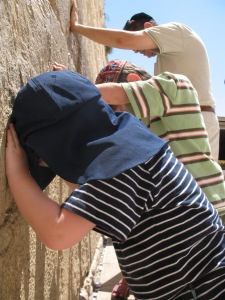
Before the Second Temple was destroyed, King Herod did major renovations in Jerusalem, including extending and building a large platform on which the Second Temple sat (from 19BCE until 63CE). Today’s “Western Wall” or “Wailing Wall” is the western retaining wall of that platform extension. It is also the area where Muslims built the Al Aqsa mosque in 705CE. That original mosque was destroyed several times, and the silver domed mosque of Al Aqsa that sits on the southern-most edge of the Temple Mount that we see today, was completed in 1033CE.

Christian crusaders came to Jerusalem in 1099, slaughtered the Jewish and Muslim inhabitants and took over the Temple Mount. Crusaders and Muslims fought over control of Jerusalem on-and-off through the year 1260, with the Muslims ultimately prevailing.

With the Muslim victory, Jews began to move back to Jerusalem, and the first new permanent synagogue in Jerusalem was set up by Nachmanides (the Ramban) in 1267. Over the next centuries, several noted rabbis stated that it was the custom of Jews in Jerusalem to ascend the Temple Mount and pray there, including Rabbi Menachem Meiri (1249-1316) and Rabbi David ben Shlomo Ibn Zimra, (known as the Radbaz, 1479–1573), the Chief Rabbi of Jerusalem.

However, in 1550, Ottoman leader Suleiman I set aside the Western Wall area as a designated area for the Jews to pray. It would appear that from this date until 1949, non-Muslims could have access but were effectively barred from praying on the Temple Mount.

After the defeat of the Ottoman Empire in 1918, the local Arab population became very anxious about future control of the land, especially in light of the 1920 San Remo Conference and the 1922 British Mandate which specifically described ensuring a Jewish homeland in Palestine. Every “normal” action of prayer at the Western Wall was viewed by the Arabs as a change to the status quo, and as such, a “provocation” in which “Zionists” were taking over.

  • In 1925, a new prohibition against bringing chairs or benches to the Western Wall (in response to bringing chairs for the elderly and infirm)
  • In 1928, a new prohibition of erecting a screen (mechitza) between men and women for prayer (in response to putting one up on Yom Kippur) at the Western Wall

In 1929, Arabs rioted at the Western Wall, first burning prayer books and later calling for Jihad as they rampaged through the city killing dozens of Jews. They felt that Islamic authority at the Western Wall was being called into question as an initial step to the takeover of the Temple Mount.

In 1948, the Arab armies of Egypt, Lebanon, Syria, Jordan, and Iraq attacked Israel. At war’s end the following year, the city of Jerusalem became divided with the Jordanians occupying the Old City including the Temple Mount. After the Jordanians evicted all of the Jewish inhabitants, they banned any Jew from coming into the Old City and visiting the Western Wall and the Temple Mount.

During that war, in December 1948, the United Nations Resolution 194 again called for the “Holy Basin” to be under international jurisdiction and that all holy sites should be given free access, with a carve-out for historical practices of discrimination:

  • “Resolves that the Holy Places – including Nazareth – religious buildings and sites in Palestine should be protected and free access to them assured, in accordance with existing rights and historical practice”
  • Resolves that, in view of its association with three world religions, the Jerusalem area, including the present municipality of Jerusalem plus the surrounding villages and towns, the most eastern of which shall be Abu Dis; the most southern, Bethlehem; the most western, Ein Karim (including also the built-up area of Motsa); and the most northern, Shu’fat, should be accorded special and separate treatment from the rest of Palestine and should be placed under effective United Nations control”

In 1967, in response to a preemptive Israeli attack on Egypt and Syria, Jordanian (and Palestinian) forces attacked Israel. The Israelis took the Old City of Jerusalem including the Temple Mount, but handed administrative control of the Mount to the Jordanian Waqf. The plaza in front of the Western Wall was expanded to enable thousands of Jews to pray at the site. Israel enshrined the protections of Holy Places in its Basic Laws in June 1967:

  • “The Holy Places shall be protected from desecration and any other violation and from anything likely to violate the freedom of access of the members of the different religions to the places sacred to them or their feelings with regard to those places.”
  • “Whosoever does anything likely to violate the freedom of access of the members of the different religions to the places sacred to them or their feelings with regard to those places shall be liable to imprisonment for a term of five years.”

Israel opened up the Temple Mount for non-Muslim visitors during specified visiting hours. However, non-Muslims were still prohibited from praying on the Mount according to the wishes of the Jordanian Waqf.

Many Israelis were not happy with maintaining the discriminatory policy and lobbied the Israeli government to make changes. One such activist, Yehuda Glick, was shot repeatedly by two Palestinians for those efforts in October 2014.

In response to the shooting of Glick and the killing of the two Palestinian Arabs who shot him, the United Nations Secretary General Ban Ki Moon discussed his displeasure with Israelis on the Temple Mount:

  • “As you mentioned this holy site in Jerusalem and as I also said this morning, I am deeply concerned by repeated provocations at the holy sites in Jerusalem. These only inflame tensions and must stop.”
  • On November 24, 2014: “Incitement and provocative acts related to the holy sites are fanning the flames of conflict far beyond the holy city.”

While the United Nations claims to care about keeping the universal access and rights to people of all faiths, it condemns the only party – Israel – which practices those values and even enshrines those values into the Basic Laws of the country.  Further, the U.N. ignores the actions of the Arabs which deliberately have erased the Jewish character and rights of Jews to pray at their holiest sites.

For 800 years, from the Arab conquest of Jerusalem and the introduction of Islam to the Holy Land until 1550, Islamic and Jewish prayer both occurred on the Temple Mount.

It is not only time for there to be open access and rights for Jews, but it is time for the United Nations to acknowledge the party that provides access and rights, and the parties that do not.


Sources:

UNESCO claim that Israel is Judaizing the Cave of the Patriarchs and The Tomb of Rachel (2010). http://unispal.un.org/UNISPAL.NSF/0/8F8CBDCA74D7D20385257721007157CF

FirstOneThrough article on Tomb of Patriarchs: https://firstonethrough.wordpress.com/2014/11/17/joint-prayer-the-cave-of-the-patriarchs-and-the-temple-mount/

History of Rachel’s Tomb: http://www.rachelstomb.org/capsulehistory.html

Bethlehem changing hands: http://www.jpost.com/Features/In-Thespotlight/This-Week-In-History-Bethlehem-changes-hands

Bethlehem history: http://www.zionism-israel.com/dic/Rachels_Tomb.htm

Article on Tomb of Rachel: http://www.timesofisrael.com/on-obamas-path-to-bethlehem-a-harshly-fortified-shrine/

Jordanian Nationality Law barring citizenship to Jews (Article 3): “The following shall be deemed to be Jordanian nationals:… Any person who, not being Jewish,…” http://www.refworld.org/docid/3ae6b4ea13.html

Jordan (and Palestinians attack Israel in 1967):

Tomb of Joseph: http://www.jewishvirtuallibrary.org/jsource/Judaism/joetomb.html

Hillel Lieberman: http://www.shechem.org/elon-moreh/enghillel.html

Ascending to the Temple Mount: http://www.google.com/url?sa=t&rct=j&q=&esrc=s&source=web&cd=3&ved=0CC4QFjAC&url=http%3A%2F%2Fwww.hakirah.org%2FVol%252016%2520Loewenberg.pdf&ei=Ldd1VO_lIO_HsQSxxILoAg&usg=AFQjCNFI6ujLjX2fEw6kPd6QNgTqQoN57A&sig2=JhXKJuu8BPvY_Oint80UKA

1929 riots: http://www.google.com/url?sa=t&rct=j&q=&esrc=s&source=web&cd=8&ved=0CFMQFjAH&url=http%3A%2F%2Fisites.harvard.edu%2Ffs%2Fdocs%2Ficb.topic1232564.files%2FSela_1929.pdf&ei=ud11VL2XLKaMsQS34ILIBw&usg=AFQjCNFrq28tbKf1Uns0HD-GAFYPBo7vQg&sig2=aUGriieF5AxIpKxwTtbApQ

UN Resolution 194: http://unispal.un.org/UNISPAL.NSF/0/C758572B78D1CD0085256BCF0077E51A

Israel Law on Protection of Holy Places (1967): http://www.bu.edu/mzank/Jerusalem/tx/lawofholyplaces1967.htm

Yehuda Glick shooting: http://www.jpost.com/Arab-Israeli-Conflict/Report-Suspect-in-right-wing-activist-Yehuda-Glicks-shooting-killed-by-police-380238

UN Security Council Resolution 1322 condemning Sharon visit to the Temple Mount: http://unispal.un.org/UNISPAL.NSF/0/22F8A95E5C0579AF052569720007921E

UNESCO 2013: http://www.haaretz.com/blogs/diplomania/israel-thwarts-unesco-resolution-condemning-its-temple-mount-activities.premium-1.470609

Ban Ki Moon on Temple Mount: http://www.theguardian.com/world/2014/oct/13/un-general-secretary-ban-ki-moon-criticises-israel-settlement-building

http://www.un.org/apps/news/infocus/sgspeeches/statments_full.asp?statID=2444#.VHR3U_8tCUk

http://www.un.org/apps/news/infocus/sgspeeches/statments_full.asp?statID=767#.VHR4X_8tCUk
IMG_2052