The Jewish state is offered acceptance on two terms: 1) become less Jewish, and 2) take in those who want to end the Jewish State permanently.
The first demand asks the Jewish state to thin the very idea that created it. The national home is treated as temporary, acceptable only if its defining character softens and disappears.
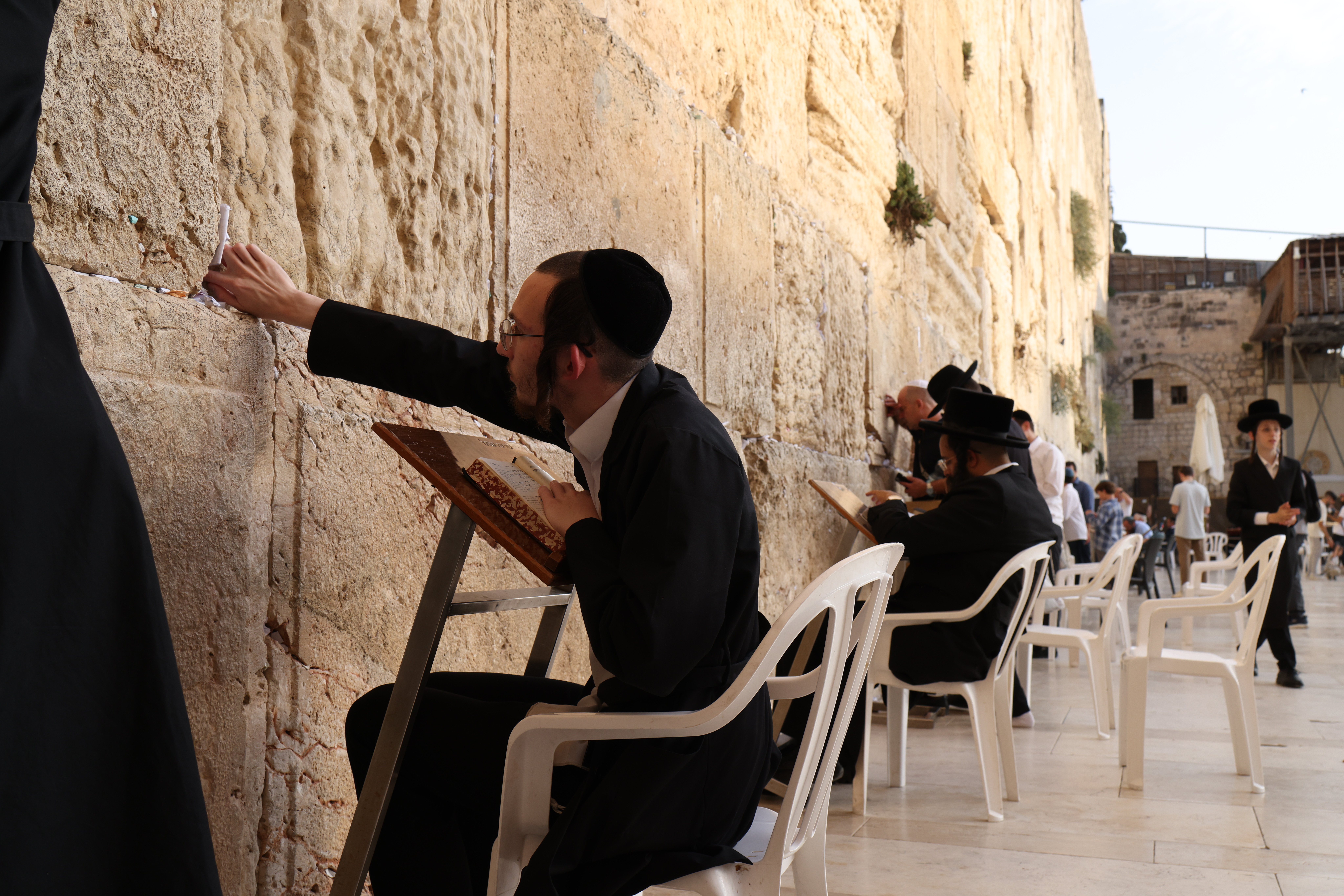
People learning and praying at the Western Wall (Photo: First One Through)
The second demand asks the state to normalize existential risk. The perpetual state of war and support for killing Jewish civilians is ignored is rationalized under the rubric of Arab “frustration.”
Each demand strains reality. Together they form a toxic contradiction.
A country cannot weaken the basis of its existence while expanding exposure to those who challenge that existence, and still promise a degree of safety to its citizens. The condition for global approval erodes the basic condition for survival.
This is the impossible conditional embedded in international language, highlighted in UN resolutions. Acceptance in the Middle East and the community of nations is framed as the reward for steps that make recognition unnecessary because the conflict’s central object -the Jewish state – is expected to disappear into a new secular bi-national entity at best, and from the face of the Earth at worst.
Unsurprisingly, Israel cannot accept such terms. So the UN blesses the violence against it.
Remarkably, the world cannot understand why Israelis will not embrace the offer of acceptance coupled with the demand for self-immolation.
Parshat Terumah introduces the Mishkan, a sanctuary built in the wilderness, precise in measurements and portable by design. It moved as the people moved. God’s presence rested among a nation without a permanent home.
For nearly two thousand years, Jewish life functioned in Mishkan mode.
Without sovereignty and without a Temple, Jewish law became the architecture that traveled. Halacha, Jewish law, created sacred space wherever Jews settled. The synagogue stood in place of the courtyard and the Shabbat table carried echoes of the altar. Study sustained covenant across continents.
Judaism survived in the diaspora because it was built to move.
But the Mishkan was never meant to be the final form. It pointed toward the Mikdash, the Temple that was ultimately built 3,000 years ago in Jerusalem, enduring and anchored in sovereignty. The Mishkan belongs to wandering. The Mikdash assumes a people settled in its land.
Exile required portability. The State of Israel reintroduces permanence.
The Old City of Jerusalem including the Jewish Temple Mount/ Al Aqsa Compound
That shift changes the demands of Jewish life. Law still shapes the individual and the community, but it now encounters public power. Covenant enters the arena of governance.
The wilderness sanctuary rose from voluntary gifts. The Temple required national structure and responsibility. Now, sovereignty requires the same. While a portable faith sustains survival, a rooted nation must translate that faith into courts, policy, defense, and public ethics.
Jewish history has moved from dispersion to statehood. Yet the deeper challenge is spiritual: whether a tradition perfected in exile can shape a society in power without losing its moral clarity.
Terumah begins with a traveling sanctuary. It gestures toward something fixed and enduring.
The journey from Mishkan to Mikdash continues in our own time.
“These are people who went overseas supporting Islamic State and went there to provide support for people who basically want a caliphate.” – Australian Prime Minister Anthony Albanese
That is how states function.
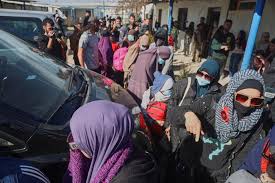
Family members of suspected Islamic State militants who are Australian nationals walk toward a van bound for the airport in Damascus during the first repatriation operation of the year at Roj Camp in eastern Syria, Monday, Feb. 16, 2026. Thirty-four Australian citizens from 11 families departed the camp. (AP Photo/Baderkhan Ahmad)
Then the rule changes.
The United Nations insists Israel must accept the DESCENDANTS of people who were NEVER ISRAELI CITIZENS, who NEVER LIVED IN ISRAEL, and whose political movement LAUNCHED A WAR TO DESTROY ISRAEL. Entry is framed as a permanent right. Citizenship becomes an instrument of conflict.
This is not mere hypocrisy. It is a flawed and fatal doctrine.
The standard for Australia preserves states. The other pressures a single state to absorb a demographic outcome tied directly to a war against its existence.
“They are terrible situations. But they have been brought on entirely by horrific decisions that their parents made.” – Australia Home Affairs Minister Tony Burke, about banning the children of Australian “ISIS brides” from being allowed into Australia
The refugee framework applied to Palestinians is unique in modern history. It has its own bloated organization in which “refugee” (not even “internally displaced” for Arabs in Gaza and the “West Bank”) passes through generations indefinitely. International institutions reinforce it. Political leadership is incentivized to promise return rather than build final compromise.
That incentive has consequences.
If millions are told the conflict ends inside Israel rather than beside it, negotiations stall. If international bodies validate that expectation, maximalism becomes rational. If maximalism is rational, violence remains politically useful. Understood. Blessed.
This mindset has cost tens of thousands of lives because it keeps the central dispute unresolved. Each cycle of violence is fueled by the belief that time, pressure, and international legitimacy will deliver what negotiation has not.
States everywhere are allowed to defend sovereignty and security. Israel is told sovereignty and security is a matter for international bodies to determine.
New York City Mayor Zohran Mamdani just appointed Ana Maria Archila of the Working Families Party to lead the Mayor’s Office of International Affairs. She will serve as the city’s chief liaison to the United Nations and the State Department.
She doesn’t care much for Israeli Jews.
In 2018, Archila became a national symbol of “believe survivors” during the confirmation fight over Brett Kavanaugh. She demanded that allegations of sexual violence be treated with complete moral seriousness.
Yet in June 2024, she had no issue championing Rep. Jamaal Bowman who had taken to the streets of his district after the heinous October 7, 2023 Arab massacre of Israelis to yell to a crowd that the story of Hamas raping Jewish women was a lie.
To add toxic fuel to the fire, while dozens of Jewish Israeli women remained captive in the terror tunnels of Gaza by the Palestinian leadership, Archila yelled at the Bowman rally (4:47) that “we end foreign policy that keeps Palestinian people in shambles and Palestine in shackles.” That is not an exaggeration: she came out to a rally to support a rape denier and yelled that the victims of kidnapping were actually the perpetrators.
Now Mayor Zohran Mamdani is elevating Archila into an international-facing role for New York City, the city with the largest Jewish population outside Israel.
In the alt-left political establishment in New York City today, raped Jewish women are not to be believed, their kidnapping is to be mocked, and their tormentors are to be canonized before cheering crowds.
The Olympics are a unique time when the national anthems of many countries get played in succession. It is a time to consider how unique Israel’s anthem is.
Hope versus Superiority and Sacrifice
Most of the national anthems in the world were written to rally a nation. They evoke war themes and superiority over a nation’s foes. Consider the United States anthem about “the rockets red glare, the bombs bursting in air,” or Germany’s original “Germany, Germany over all. Over everything in the world!”
In the Muslim Middle East, most countries have anthems that describe sacrifice:
But the State of Israel’s national anthem “Hatikvah” is about hope. Not superiority. Not vendetta, sacrifice or struggle. HOPE.
Its Capital City
While most countries’ anthems surround themes of victory and struggle, Israel uniquely focuses its anthem on its capital city, Jerusalem. In fact, no other country even mentions its capital, while Israel does so in an anthem just a few lines long.
One of the Oldest in the Middle East
The world changed dramatically after the end of World War I, with the collapse of the Austria-Hungarian and Ottoman empires, the end of the USSR, and end of decolonization. The number of countries multiplied over the last century, to nearly 200 today.
Israel’s national anthem is the oldest of the new nations, especially in the Middle East.
Israel written in 1878
Turkey 1921
Syria 1938
Jordan 1946
Libya 1951
Oman 1970
Kuwait 1978
Tunisia 1987
Iran 1990
Yemen 1990
Palestinian Authority 1996
Iraq 2004
While Jews are falsely accused of being recent interlopers and invaders, with no right to live in Jerusalem, and the Jewish State is smeared as a racist country built on superiority and imperialism, its national anthem is the oldest in the region, only speaks of hope and freedom, and is uniquely about its capital city of Jerusalem.
Israel national anthem:
As long as in the heart within, The Jewish soul yearns, And toward the eastern edges, onward, An eye gazes toward Zion.
Our hope is not yet lost, The hope that is two-thousand years old, To be a free nation in our land, The Land of Zion, Jerusalem.
The modern Paralympic Games began far from the grandeur of an Olympic stadium. Their origin lies on the grounds of a British hospital, shaped by the vision of Ludwig Guttmann, a Jewish refugee physician who transformed both medicine and sport.
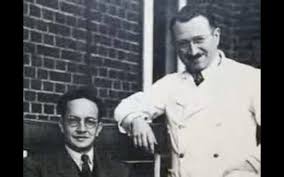
Ludwig Gutmann (1899-1980)
Guttmann was born in 1899 in Breslau, then part of Germany. He rose to prominence as a neurologist specializing in spinal cord injuries. With the rise of Nazism, Jewish professionals were pushed from academic and medical institutions, and Guttmann lost his post as antisemitic laws narrowed the space for Jewish life. During the “Kristallnacht” violence of 1938, he reportedly used his hospital authority to admit Jewish patients and shield them from arrest. Soon after, he fled Germany with his family and rebuilt his career in Britain.
In 1944, the British government asked him to lead a new spinal injuries unit at Stoke Mandeville Hospital. At that time, severe spinal cord injury often led to early death. Patients were confined to beds, vulnerable to infection, and frequently treated as beyond recovery. Guttmann rejected that assumption. He believed survival required more than medical stabilization. It required discipline, ambition, and restored self-respect.
He introduced sport as a core part of rehabilitation. Archery, wheelchair polo, and organized competition became structured therapy. Training cultivated strength and focus. Competition rebuilt identity. Patients who had been defined by injury began to see themselves as athletes preparing for events.
On July 29, 1948, the same day the 1948 Summer Olympics opened, Guttmann organized a small archery competition for sixteen wheelchair athletes on the hospital grounds. He called it the Stoke Mandeville Games. The symbolism was intentional. As Olympians competed in London, injured veterans competed at Stoke Mandeville. Each demonstrated excellence within their arena.
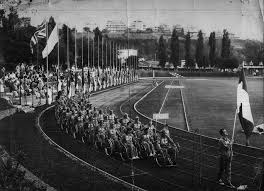
The event became annual and soon attracted international participants. In 1960, following the 1960 Summer Olympics, Rome hosted what is widely recognized as the first official Paralympic Games. A hospital initiative had grown into a global movement.
1960 Rome Paralympics
Guttmann’s work carried deeper resonance because of the era he had survived. Nazi racial ideology had targeted Jews and people with disabilities as unworthy of life. The regime’s euthanasia program murdered tens of thousands of disabled individuals before the broader genocide unfolded. As a Jewish physician forced into exile, Guttmann understood the danger of systems that ranked human worth by race or physical capacity.
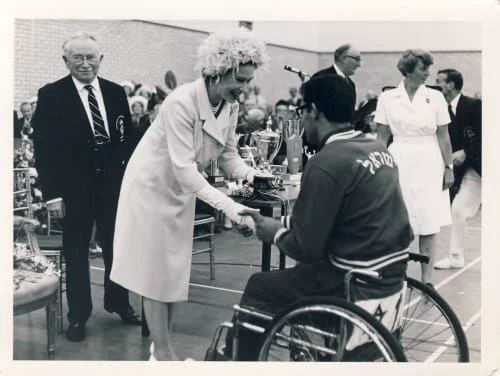
The opening of Stoke Mandeville Stadium by Her Majesty the Queen in 1969
His response was constructive and public. He placed disabled athletes on fields of competition and invited the world to witness their performance. Strength, in his framework, was measured by discipline and achievement rather than conformity to an imposed ideal.
Britain recognized his contributions. He became a citizen in 1945, was appointed an Officer of the Order of the British Empire in 1950, and was knighted in 1966 as Sir Ludwig Guttmann. Within medicine, he is regarded as the founder of modern spinal injury treatment. Within sport, he is honored as the father of the Paralympic movement. During major Games, particularly the 2012 Summer Paralympics, his story has been prominently commemorated.
Today the Paralympics stand as one of the world’s largest sporting events, watched by millions. Their origin traces back to a Jewish refugee doctor who believed that dignity could be restored through competition. From the trauma of exile emerged an institution that reshaped how the world understands disability, excellence, and human worth.
The story of the 1936 Summer Olympics is usually told as a duel between tyranny and talent.
Adolf Hitler builds a showcase for Aryan supremacy.
Jesse Owens wins four gold medals.
The German hateful ideology collapses.
But Berlin was more complicated. The Games revealed two prejudices at once: Nazi racial doctrine and American racism and antisemitism. While very different in scale and intensity, both were present on both sides of the Atlantic.
Two Jewish-American sprinters – Marty Glickman and Sam Stoller – were expected to run the 4×100 relay. Yet hours before the race, they were removed from the lineup and replaced by Owens and Ralph Metcalfe.
The official explanation was tactical: field the fastest possible team. The United States won gold in world-record time.
Yet the context was unavoidable. Glickman and Stoller were the only two Jewish runners on the U.S. track squad. Nazi Germany had already stripped Jewish athletes of meaningful participation. Their removal ensured that no Jewish athlete would stand on the Berlin track podium.
Glickman later said:
“I’ve always believed that we were taken off the relay team because we were Jews.”
Stoller observed:
“The only two Jews on the team were replaced.”
No archival proof confirms American coordination with Nazi officials. But antisemitism did not need a written agreement to operate. In the 1930s, American universities maintained Jewish quotas. Elite institutions limited Jewish membership. Prejudice was structural, even if unofficial.
Berlin exposed it.
Owens and Segregated America
Owens’ victories shattered Nazi racial mythology in the stadium but did not dissolve racial barriers in America.
The popular tale claims Hitler snubbed Owens. Owens himself redirected the accusation:
“Hitler didn’t snub me—it was our president [Franklin D. Roosevelt] who snubbed me. The president didn’t even send me a telegram.”
Owens continued:
“I wasn’t invited to shake hands with Hitler, but I wasn’t invited to the White House to shake hands with the President either.”
And when he returned home:
“After those stories about Hitler snubbing me, I had to live under segregation.”
In Berlin, Owens stayed in the same hotel as white teammates. In parts of the United States, he entered through separate doors.
Two Systems, One Lesson
Nazi Germany codified antisemitism and racism into law and would soon escalate that hatred into genocide. While the United States did not operate extermination camps, it did operate segregated schools, restricted neighborhoods, Jewish quotas, and closed clubs.
The differences in scale and brutality were enormous. The presence of prejudice in both societies was real.
One of those hatreds remains embedded in American history, while the other has been buried.
The common narrative that Owens and Team America gave a big middle finger to Hitler’s Germany in the 1936 Olympics by showcasing Black talent is incomplete. In many ways, the real lasting insult and pain was to Jews, not Nazis.
In Parshat Mishpatim, the Torah builds a society of responsibility: protect the widow, guard the orphan, lend to the poor, restrain the creditor, pay damages, return what you hold as collateral before nightfall.
This is structural compassion.
And then comes the line that seemingly defines the entire architecture:
“You shall not favor the poor in his dispute.” (Exodus 23:3)
Care for the vulnerable, but do not tilt the scale for them.
The Torah draws a boundary that modern culture struggles to maintain: the difference between moral obligation and legal judgment.
Society should be generous, while the legal system must be neutral.
In the current climate, that distinction feels almost alien. Sympathy gathers momentum as institutions rush to align themselves with the seemingly weaker side in an “oppressor/oppressed” narrative. The presumption of righteousness often follows the presumption of disadvantage. It becomes an empathy swamp that drowns moral and legal clarity.
Mishpatim resists that impulse.
The courtroom is not a venue for moral correction. It is a place for weighing evidence. A judge may not rule by instinct, pressure, or empathy. Justice must be blind because fairness depends on restraint.
The Torah has forms of structural redistribution via charity and debt release, but it refuses to let generosity rewrite verdicts. Liability flows from action. If you damage, you pay. If you steal, you repay. Identity and circumstance do not determine guilt.
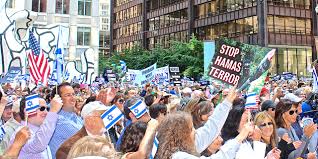
Call for Justice for Hamas has been counter-cultural
The Torah denies the emotional satisfaction of siding automatically with the weaker party. It insists that compassion operate through obligation, not through distorted judgment.
Mishpatim protects the vulnerable by strengthening society, while protecting justice by disciplining the court. Because when justice refuses to bend, society can remain both compassionate and fair.
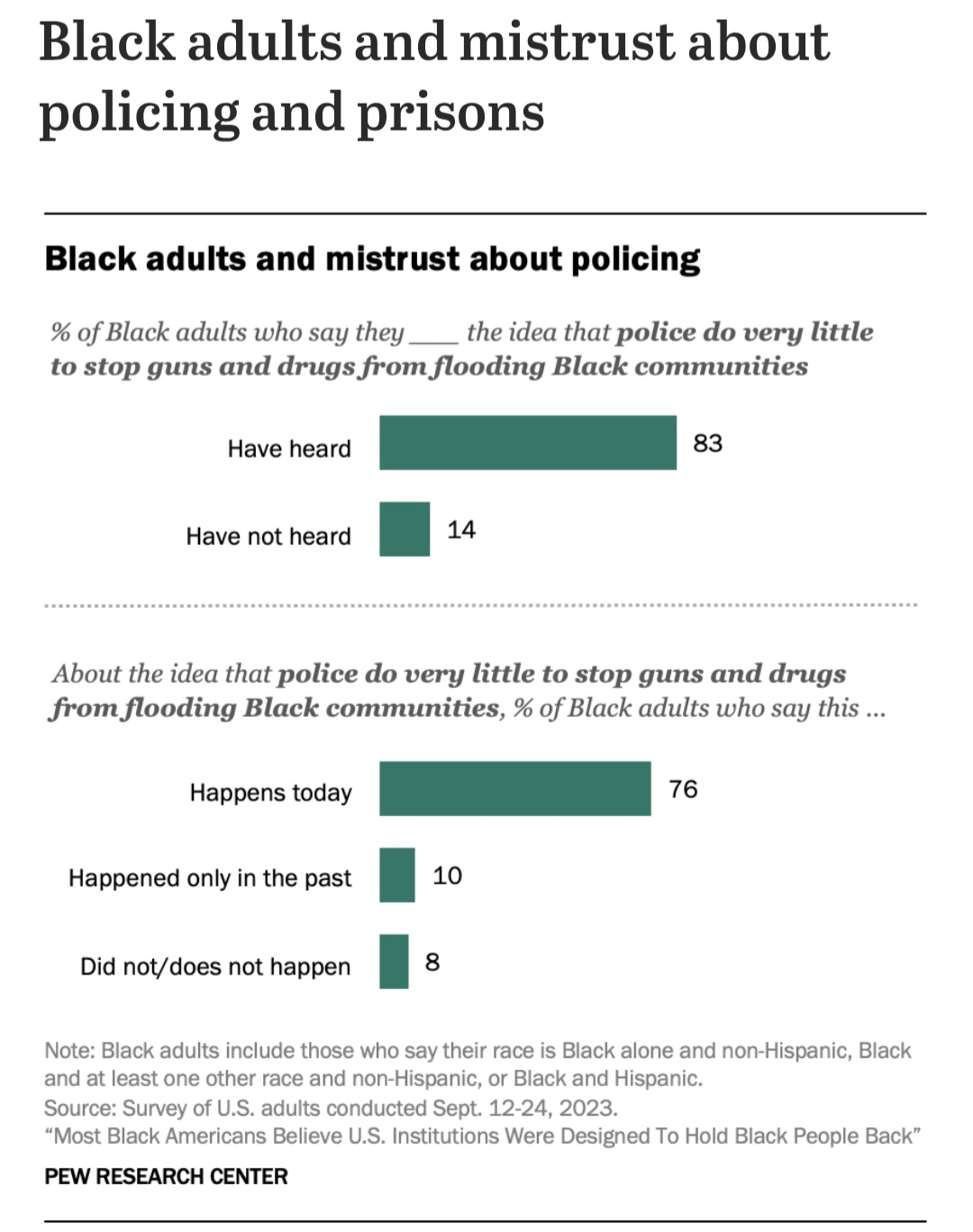
Black Americans have long used a phrase that captures a structural grievance: over-policed and under-protected.
The complaint is that disproportionate scrutiny produces disproportionate outcomes. If people in one neighborhood are stopped more often, searched more often, cited more often, it will generate more arrests. Those arrests are then cited as proof that the scrutiny was justified. The cycle validates itself.
Israel occupies a similar structural position in international institutions.
At the United Nations Human Rights Council, Israel is the only country assigned a permanent, standalone agenda item — Item 7: “Human rights situation in Palestine and other occupied Arab territories.” Every regular session includes debate under this item. No other state – not China, not Iran, not North Korea – is subject to a standing country-specific agenda item.
The numbers reinforce the asymmetry. Since its creation in 2006, the Council has adopted more condemnatory resolutions against Israel than against any other country. In multiple sessions, Israel alone has faced more resolutions than the rest of the world combined.
Volume creates narrative.
Layer onto that the density of global media in Jerusalem – more permanent foreign correspondents than in most active war zones – and the scrutiny becomes constant. Every military action is instantly internationalized. Allegations become juridical language before investigations conclude. Terms like “war crimes” and “genocide” enter discourse early and stick.
The latest war began with an attack Israel did not initiate and repeatedly stated it did not seek. It conditioned an end to fighting simply on the return of hostages and disarmament, to which Gazans repeatedly refused. While urban combat against embedded fighters produces tragic civilian loss, the reported civilian-to-combatant ratios in this conflict fell well below ranges seen in other recent urban wars. That context rarely leads headlines.
Black Americans understand how presumption operates. When systems assume danger, data accumulates accordingly. When institutions assume guilt, findings follow.
“It’s the broader narrative of who belongs and who doesn’t, which allows certain groups to tap in the police department, to use the police department or weaponized the police department in ways that are conducive to violence against Black people” – Lallen T. Johnson, Department of Justice, Law and Criminology at American University
Similarly, the United Nations decided that Jews do not belong in Jerusalem – the holiest city in Judaism – or east of the 1949 Armistice Lines / the “West Bank”, so have developed a criminal system that specifically and persistently targets Jews. The mere presence of Jews is labelled “illegal” and an affront to international law.
“Condemning all measures aimed at altering the demographic composition, [presence of Jews] character and status of the Palestinian Territory occupied since 1967, including East Jerusalem,” – UN Security Council Resolution 2334
The United Nations made a law declaring Jewish presence at their holiest location to be illegal
When one minority community, whether it be racial or national, lives under permanent investigation, outcomes will look like confirmation of wrongdoing, even when standards are warped and unevenly applied.
Over-policing corrodes trust at home. Over-condemnation corrodes credibility abroad.
Justice requires symmetry. Blacks and Jews know it all too well.
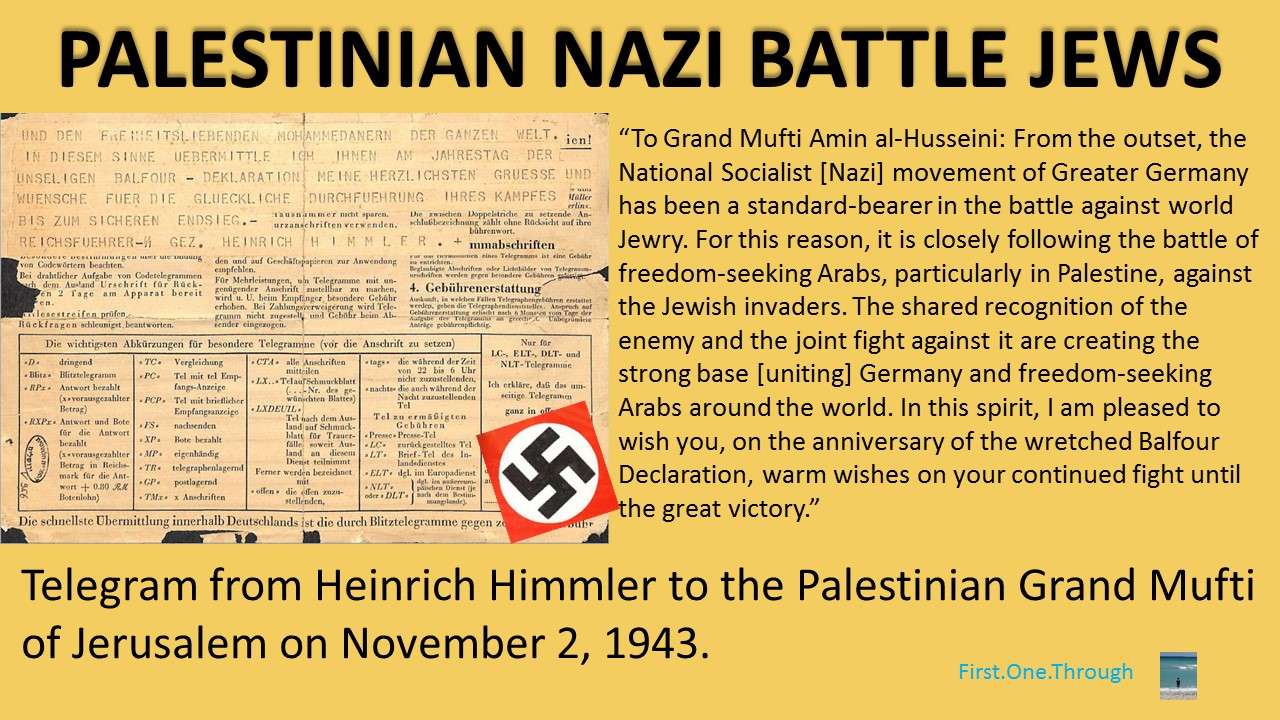
In November 1943, Heinrich Himmler sent a telegram to Haj Amin al-Husseini on the anniversary of the Balfour Declaration.
He wrote of a “shared recognition of the enemy” and “the joint fight against it.”
“The enemy” meant world Jewry.
That phrasing did real work. It turned a people into a threat. Once Jews were cast as a civilizational danger – “Jewish invaders” – their removal became a duty. Vocabulary cleared the ground and policy followed. Then came the machinery.
This is how collective persecution begins: define a group as the problem.
Eighty years later, the same grammar keeps resurfacing.
In Doha, Francesca Albanese, the United Nations Special Rapporteur on the occupied Palestinian territories, used the phrase “common enemy” to describe Israel. The target was the world’s only Jewish state. The effect was to cast Jewish sovereignty itself as something humanity must oppose.
That language strips legitimacy and treats existence as offense. It moves from argument to exclusion with the implied goal of eradication.
The pattern appears in American activism as well. Speaking at a conference hosted by American Muslims for Palestine, Zahra Billoo of the Council on American-Islamic Relations urged audiences to “oppose the polite Zionists too,” grouping mainstream Jewish institutions — synagogues, federations, Hillel chapters, civil-rights groups — into the camp of adversaries, “they are your enemies.”
The construction never changes.
Nazi Himmler: Jews are the common enemy. CAIR Billoo: Zionists are the enemy. UN Albanese: Israel is the common enemy.
Different decades. Different accents. Identical structure.
Demonization targets identity. Once identity becomes the indictment, anything feels justified and the line between debate and dehumanization disappears.
After World War II, the human-rights system was built to prevent precisely this logic — the idea that an entire people could be pushed outside the moral community. Yet the vocabulary has returned, polished and respectable, spoken from podiums that claim the language of justice.
When the Nazis called Jews “the enemy,” the world should have drawn the line right there. No conferences. No nuance. No excuses. Anyone who speaks that way disqualifies themselves.
That same rule applies now.
Human-rights officials who talk like antisemitic propagandists should lose their mandates. Activists who label Jews the enemy lose the claim to civil-rights leadership positions. Institutions that tolerate this language lose credibility.
The mob put a yellow Jewish Star on Jews 80 years ago and told everyone that they are the enemy. The mob is labelling Jews as Zionists today and doing the same. We shouldn’t pause to take action, if “never again” means anything.