New York City Mayor Zohran Mamdani just appointed Ana Maria Archila of the Working Families Party to lead the Mayor’s Office of International Affairs. She will serve as the city’s chief liaison to the United Nations and the State Department.
She doesn’t care much for Israeli Jews.
In 2018, Archila became a national symbol of “believe survivors” during the confirmation fight over Brett Kavanaugh. She demanded that allegations of sexual violence be treated with complete moral seriousness.
Yet in June 2024, she had no issue championing Rep. Jamaal Bowman who had taken to the streets of his district after the heinous October 7, 2023 Arab massacre of Israelis to yell to a crowd that the story of Hamas raping Jewish women was a lie.
To add toxic fuel to the fire, while dozens of Jewish Israeli women remained captive in the terror tunnels of Gaza by the Palestinian leadership, Archila yelled at the Bowman rally (4:47) that “we end foreign policy that keeps Palestinian people in shambles and Palestine in shackles.” That is not an exaggeration: she came out to a rally to support a rape denier and yelled that the victims of kidnapping were actually the perpetrators.
Now Mayor Zohran Mamdani is elevating Archila into an international-facing role for New York City, the city with the largest Jewish population outside Israel.
In the alt-left political establishment in New York City today, raped Jewish women are not to be believed, their kidnapping is to be mocked, and their tormentors are to be canonized before cheering crowds.
The Olympics are a unique time when the national anthems of many countries get played in succession. It is a time to consider how unique Israel’s anthem is.
Hope versus Superiority and Sacrifice
Most of the national anthems in the world were written to rally a nation. They evoke war themes and superiority over a nation’s foes. Consider the United States anthem about “the rockets red glare, the bombs bursting in air,” or Germany’s original “Germany, Germany over all. Over everything in the world!”
In the Muslim Middle East, most countries have anthems that describe sacrifice:
But the State of Israel’s national anthem “Hatikvah” is about hope. Not superiority. Not vendetta, sacrifice or struggle. HOPE.
Its Capital City
While most countries’ anthems surround themes of victory and struggle, Israel uniquely focuses its anthem on its capital city, Jerusalem. In fact, no other country even mentions its capital, while Israel does so in an anthem just a few lines long.
One of the Oldest in the Middle East
The world changed dramatically after the end of World War I, with the collapse of the Austria-Hungarian and Ottoman empires, the end of the USSR, and end of decolonization. The number of countries multiplied over the last century, to nearly 200 today.
Israel’s national anthem is the oldest of the new nations, especially in the Middle East.
Israel written in 1878
Turkey 1921
Syria 1938
Jordan 1946
Libya 1951
Oman 1970
Kuwait 1978
Tunisia 1987
Iran 1990
Yemen 1990
Palestinian Authority 1996
Iraq 2004
While Jews are falsely accused of being recent interlopers and invaders, with no right to live in Jerusalem, and the Jewish State is smeared as a racist country built on superiority and imperialism, its national anthem is the oldest in the region, only speaks of hope and freedom, and is uniquely about its capital city of Jerusalem.
Israel national anthem:
As long as in the heart within, The Jewish soul yearns, And toward the eastern edges, onward, An eye gazes toward Zion.
Our hope is not yet lost, The hope that is two-thousand years old, To be a free nation in our land, The Land of Zion, Jerusalem.
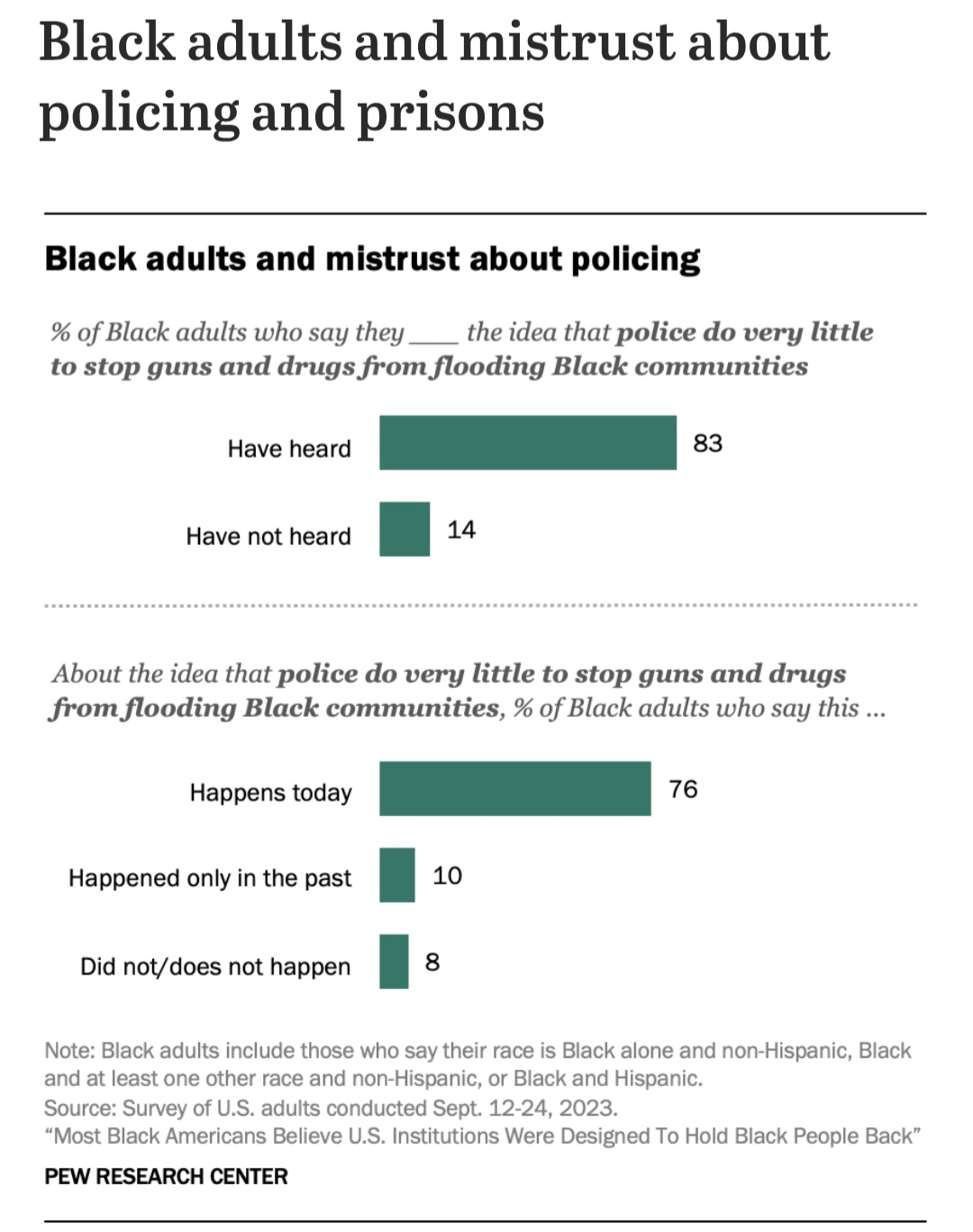
Black Americans have long used a phrase that captures a structural grievance: over-policed and under-protected.
The complaint is that disproportionate scrutiny produces disproportionate outcomes. If people in one neighborhood are stopped more often, searched more often, cited more often, it will generate more arrests. Those arrests are then cited as proof that the scrutiny was justified. The cycle validates itself.
Israel occupies a similar structural position in international institutions.
At the United Nations Human Rights Council, Israel is the only country assigned a permanent, standalone agenda item — Item 7: “Human rights situation in Palestine and other occupied Arab territories.” Every regular session includes debate under this item. No other state – not China, not Iran, not North Korea – is subject to a standing country-specific agenda item.
The numbers reinforce the asymmetry. Since its creation in 2006, the Council has adopted more condemnatory resolutions against Israel than against any other country. In multiple sessions, Israel alone has faced more resolutions than the rest of the world combined.
Volume creates narrative.
Layer onto that the density of global media in Jerusalem – more permanent foreign correspondents than in most active war zones – and the scrutiny becomes constant. Every military action is instantly internationalized. Allegations become juridical language before investigations conclude. Terms like “war crimes” and “genocide” enter discourse early and stick.
The latest war began with an attack Israel did not initiate and repeatedly stated it did not seek. It conditioned an end to fighting simply on the return of hostages and disarmament, to which Gazans repeatedly refused. While urban combat against embedded fighters produces tragic civilian loss, the reported civilian-to-combatant ratios in this conflict fell well below ranges seen in other recent urban wars. That context rarely leads headlines.
Black Americans understand how presumption operates. When systems assume danger, data accumulates accordingly. When institutions assume guilt, findings follow.
“It’s the broader narrative of who belongs and who doesn’t, which allows certain groups to tap in the police department, to use the police department or weaponized the police department in ways that are conducive to violence against Black people” – Lallen T. Johnson, Department of Justice, Law and Criminology at American University
Similarly, the United Nations decided that Jews do not belong in Jerusalem – the holiest city in Judaism – or east of the 1949 Armistice Lines / the “West Bank”, so have developed a criminal system that specifically and persistently targets Jews. The mere presence of Jews is labelled “illegal” and an affront to international law.
“Condemning all measures aimed at altering the demographic composition, [presence of Jews] character and status of the Palestinian Territory occupied since 1967, including East Jerusalem,” – UN Security Council Resolution 2334
The United Nations made a law declaring Jewish presence at their holiest location to be illegal
When one minority community, whether it be racial or national, lives under permanent investigation, outcomes will look like confirmation of wrongdoing, even when standards are warped and unevenly applied.
Over-policing corrodes trust at home. Over-condemnation corrodes credibility abroad.
Justice requires symmetry. Blacks and Jews know it all too well.
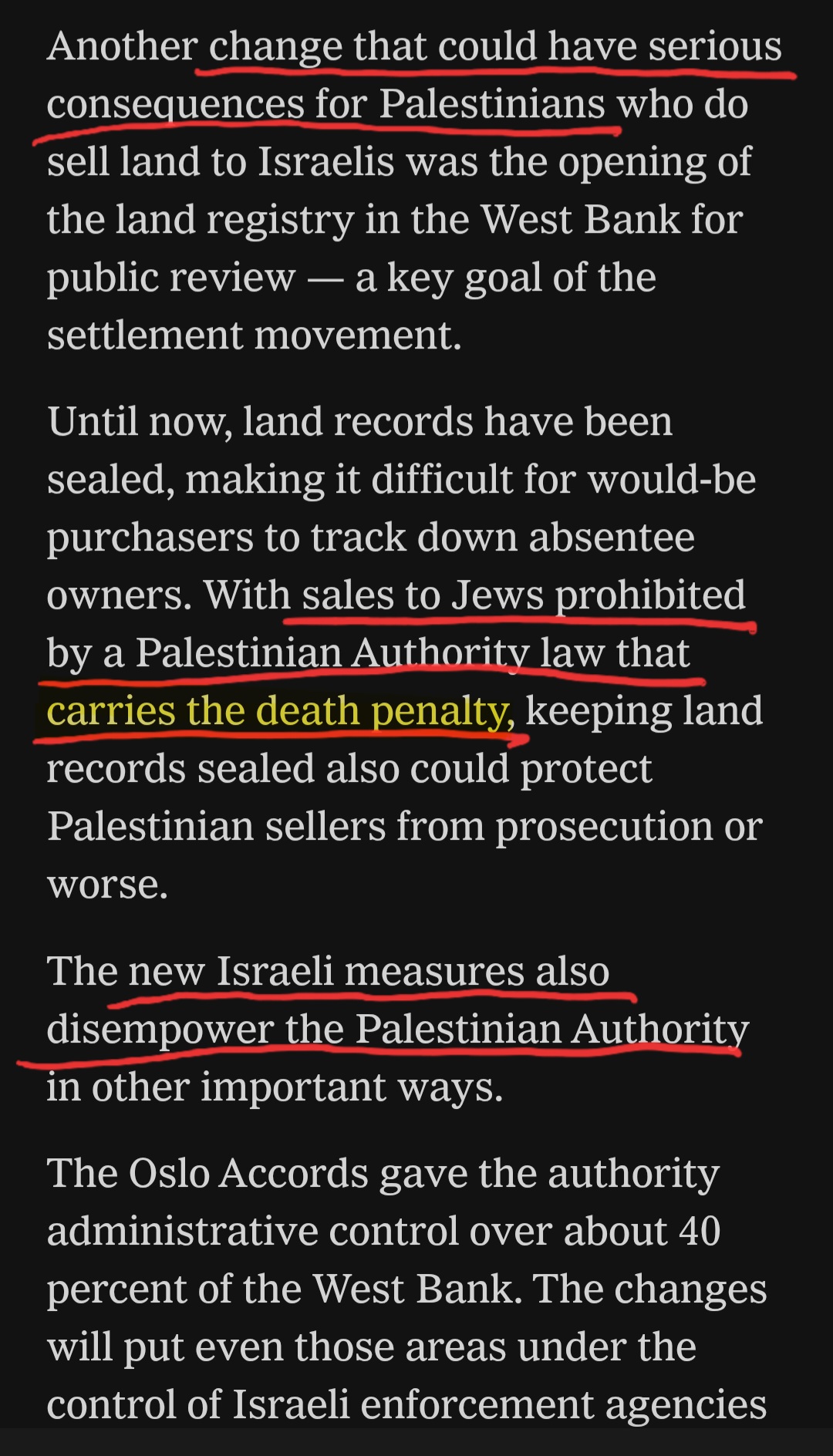
One fact should dominate any serious discussion of land and power in the West Bank: under Palestinian Authority law, a Palestinian who sells land to a Jew can face the death penalty.
That is not rumor or polemic. It is statute.
In areas governed by the Palestinian Authority in the West Bank and by Hamas in Gaza, selling land to Israeli Jews is prosecuted as treason. The charge is brought under Jordanian Penal Code No. 16 of 1960 — particularly Articles 113–118 and Article 114 on aiding the enemy — still in force in the West Bank, along with the PLO Revolutionary Penal Code of 1979. A 2014 decree by Mahmoud Abbas reaffirmed that such land sales constitute “collaboration with the enemy.” Courts have issued death sentences under these provisions.
The defining element is the identity of the buyer. A private real-estate transaction becomes a capital crime because the purchaser is Jewish and therefore legally framed as part of the “enemy.” Most countries reserve treason for espionage, armed rebellion, or wartime assistance to a hostile state. The Palestinian framework instead applies classic treason law to a civilian property sale — explicitly treating Jews, as a national collective, as the enemy for purposes of capital punishment.
Yet when the New York Times recently acknowledged this, it did so quietly, almost apologetically, inside an article whose primary concern was Israeli policy. The focus was not the law itself, but the risk that Israeli transparency might expose Palestinian Arabs to danger because the law exists.
That framing reverses cause and effect.
Israel was portrayed as aggressive and ideological, while the Palestinian Authority’s capital punishment for a racially defined transaction was treated as background context. Israeli officials were labeled “right-wing” and scrutinized by name. The PA, which enforces a law rooted in religious antisemitism, was spared comparable description. Its ideology went largely uninterrogated.
The article even suggested that sealed land records once served as a form of protection for Palestinians. That sentence alone concedes the nature of the regime. A governing authority from which citizens must be shielded because it may kill them for selling property to Jews is not a peace partner. It is a theocratic system enforcing ethnic taboos with lethal force.
If a Jewish state executed Jews for selling land to Arabs, that law would dominate media coverage. Instead, when Jews are the forbidden buyers, the death penalty becomes an inconvenience and the exposure of it becomes the problem.
UN Secretary-General Antonio Guterres “warns that the current trajectory on the ground, including this decision [to unseal the names of the owners of land making private real estate transactions easier], is eroding the prospect for the two-State solution. He reiterates that all Israeli settlements [the physical presence of Jews east of the 1949 Armistice Lines between Israel and the Kingdom of Transjordan, which specifically stated were not to be considered borders] in the occupied West Bank, including East Jerusalem, and their associated regime and infrastructure, have no legal validity and are in flagrant violation of international law, including relevant United Nations resolutions.”
This is how extremist antisemitism is normalized: by treating it as an immutable local condition, while directing moral outrage at those who reveal it. When selling land to a Jew carries a death sentence, that fact is not incidental. It is the moral center of the conflict.
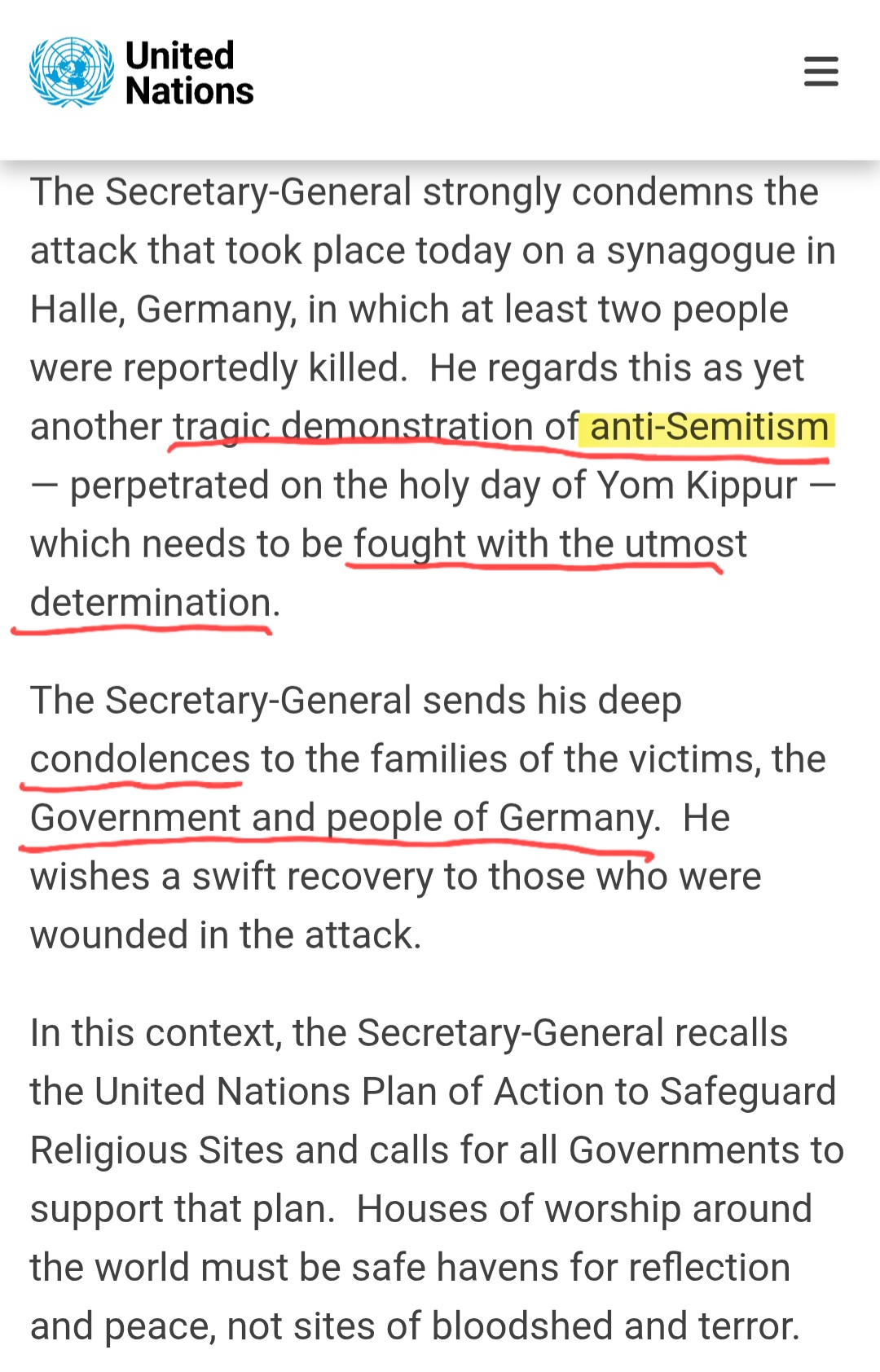
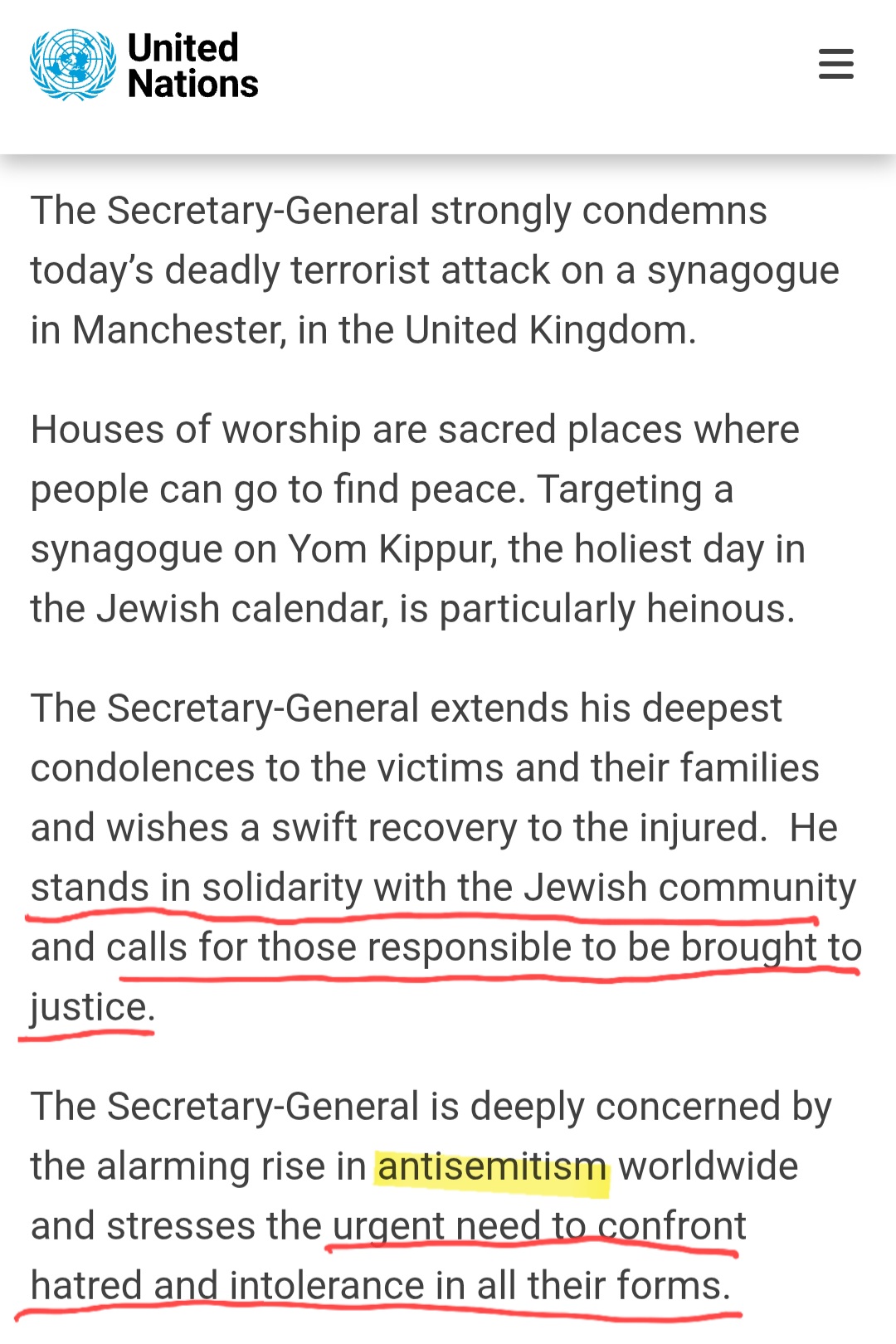
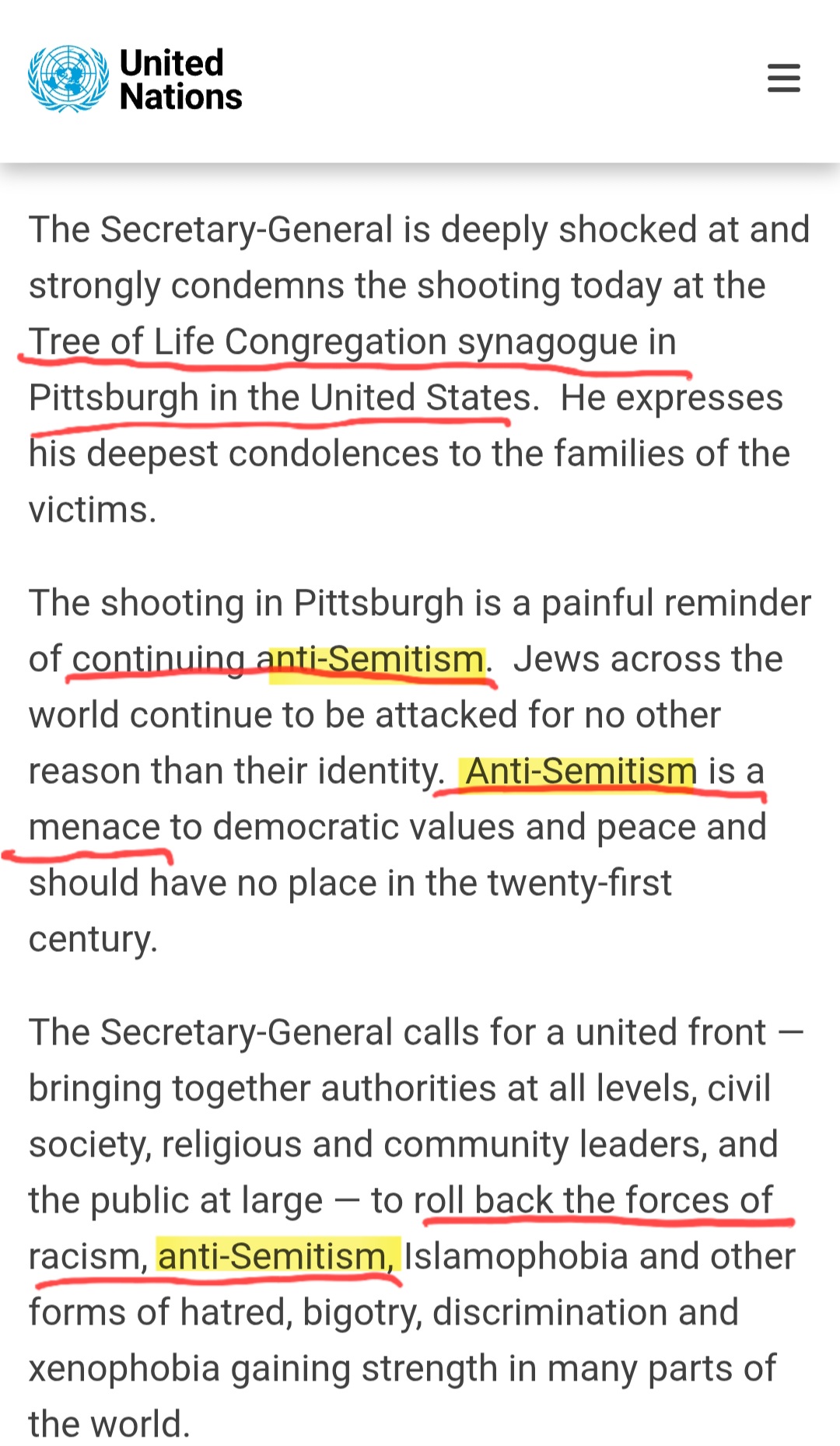
When Jews are murdered in synagogues in Europe, the United Nations speaks plainly. The attacks are labeled antisemitic. The violence is called terrorism. Solidarity with the Jewish community is explicit, and justice is demanded.
When Jews are murdered in synagogues in Jerusalem, that clarity vanishes.
The same act—killing Jews at prayer—suddenly requires “context.” Terrorism is softened into “violence.” Antisemitism dissolves into “tensions.” Victims are anonymized, motives left unexplored, ideology carefully avoided. Language that flows easily in Europe locks up entirely in Israel’s capital.
UN Secretary-General never calls killing of Jews in Jerusalem rooted in “antisemitism.”
This is not rhetorical drift. It is doctrine.
The UN has formally adopted the Palestinian demand that Jews should not live in Jerusalem. Through measures such as UN Security Council Resolution 2334, it asserts that Jews may not alter the city’s “demographic composition.” That position freezes Jerusalem at a moment immediately following the Jordanian army’s ethnic cleansing of all Jews from the eastern half of the city between 1948 and 1967. Jewish expulsion is accepted as a legitimate baseline. Jewish return is treated as a violation of international law.
This is not neutrality. It is the institutionalization of an antisemitic premise: that Jews, uniquely among peoples, have no right to live in their holiest city.
Once that premise is accepted, Jewish life in Jerusalem becomes conditional. Jewish neighborhoods are labeled illegal. Jewish prayer is framed as provocation. Jewish presence itself is cast as destabilizing. Violence against Jews no longer reads as antisemitism but as political reaction to an allegedly illegitimate reality.
Under those conditions, motive cannot be named. Calling synagogue murders in Jerusalem “antisemitic terrorism” would require acknowledging that Jews are being targeted for who they are, in a city where the UN has already ruled they should not be. It would expose the connection between UN doctrine and the moral evasions that follow.
So the motive is omitted.
Aftermath of Jews slaughtered in synagogue
The UN does not merely tolerate the idea of Jews being removed from Jerusalem; it has encoded it. The language is bureaucratic—demographics, international law, peace—but the result is stark: a city where Jewish existence is treated as unlawful, and Jewish murder as a political complication.
The contrast with the rest of the world makes the pattern undeniable. The UN knows exactly how to speak about antisemitism. That moral vocabulary disappears only in Judaism’s holiest city, in the Jewish State’s capital, because the United Nations has endorsed the antisemitic wishes of radical jihadists.
By any ordinary moral standard, the murder of worshippers in a house of prayer should provoke the clearest possible response: name the crime, demand justice, stand with the people and the government under attack. No hedging. No balancing. No political caveats.
The United Nations does that, except when Israeli Jews are the victims.
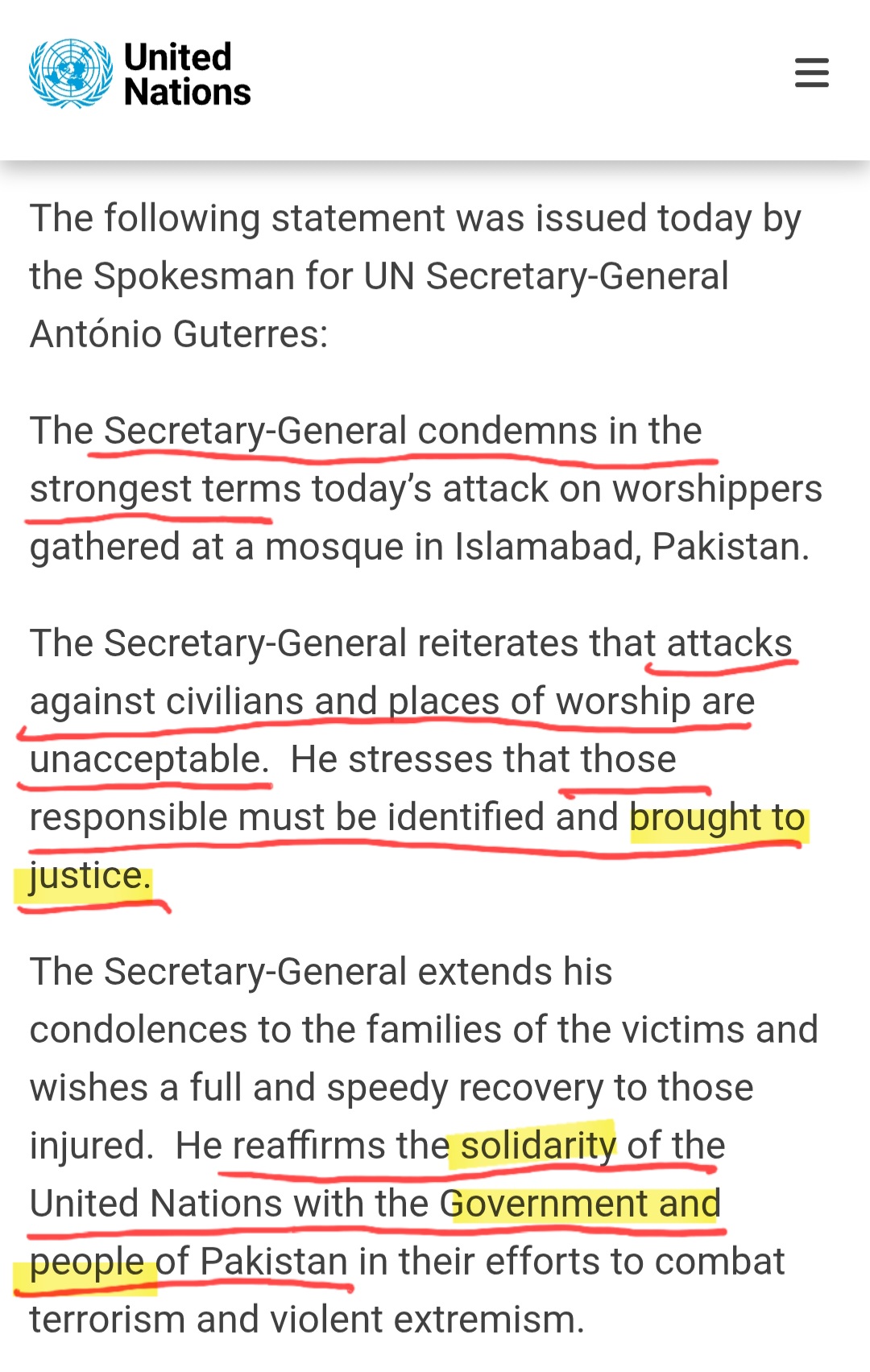
Read the paired statements issued by António Guterres after two attacks on places of worship: one at a mosque in Pakistan, the other at a synagogue in Jerusalem. The contrast reveals a complete moral collapse at the heart of the global body.
This matters even more because the Jerusalem statement was issued before Israel responded to October 7, 2023. Before Gaza. Before counteroffensives. Before a single Israeli military action the UN would later cite as justification for its posture.
Restraint was not urged because of Israeli action. It was urged instead of justice itself.
In Pakistan, the Secretary-General “condemns in the strongest terms” the attack on worshippers. He demands that the perpetrators be “identified and brought to justice.” He affirms the “solidarity of the United Nations with the Government and people of Pakistan” and situates the crime squarely within the global fight against terrorism and violent extremism.
That is what moral clarity looks like.
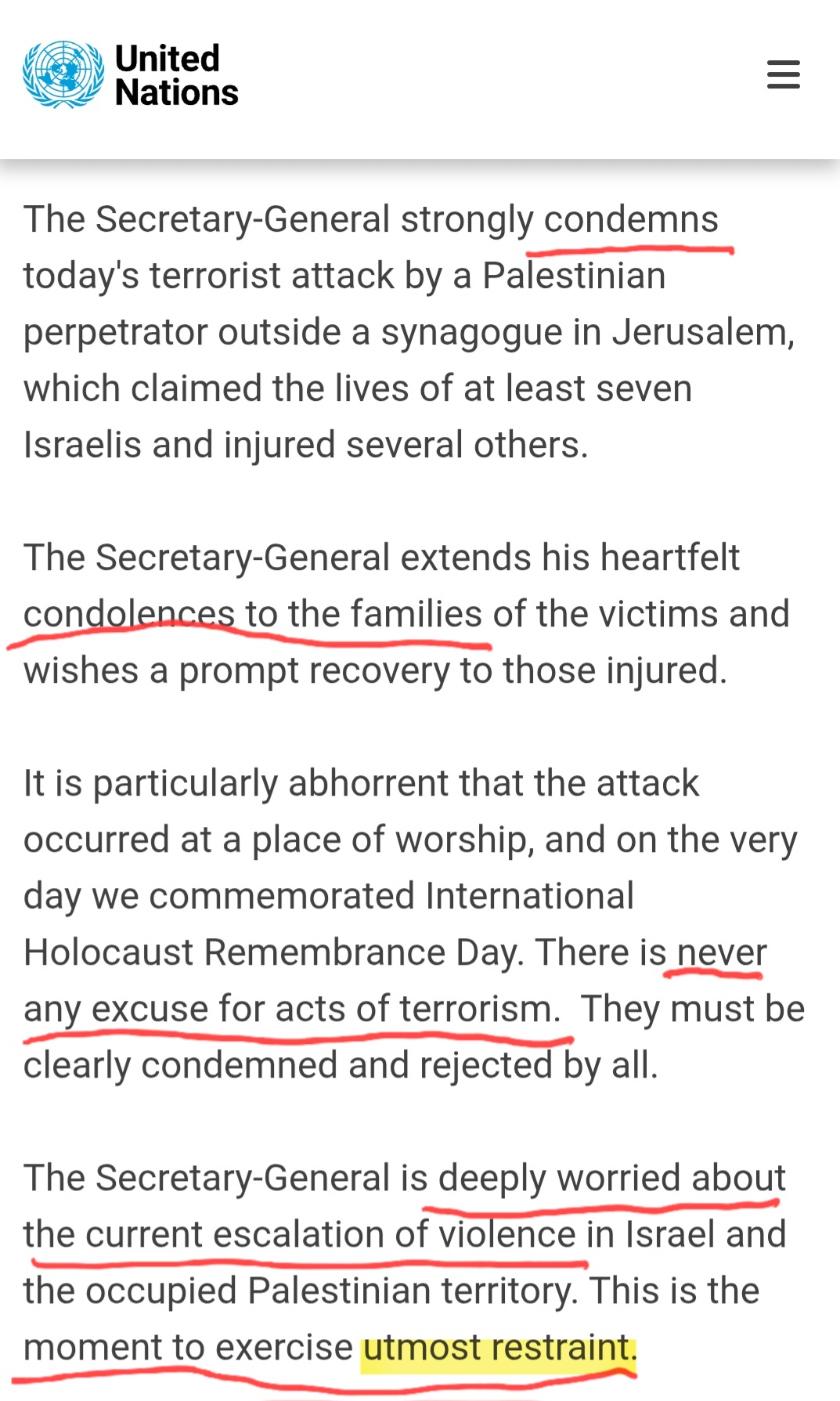
Yet in Jerusalem, when Jews are murdered outside a synagogue in 2023—on International Holocaust Remembrance Day- a whisper. The Secretary-General “strongly condemns” the attack. He offers condolences. He notes that it is abhorrent to attack a place of worship. And then he pivots—not to justice, not to accountability, not to solidarity with the state charged with protecting its citizens.
The synagogue becomes a geographic detail. The murders are folded into “the current escalation in Israel and the occupied Palestinian territory.” There is no demand that the killers be found. No insistence on prosecution. No solidarity with the Government of Israel. No recognition that deterrence requires consequence.
This is not diplomatic caution. It is moral abdication.
This did not begin with Guterres
If this were merely the idiosyncrasy of one Secretary-General nearing the end of his ten year tenure, it might be dismissed as tone or temperament. It is not.
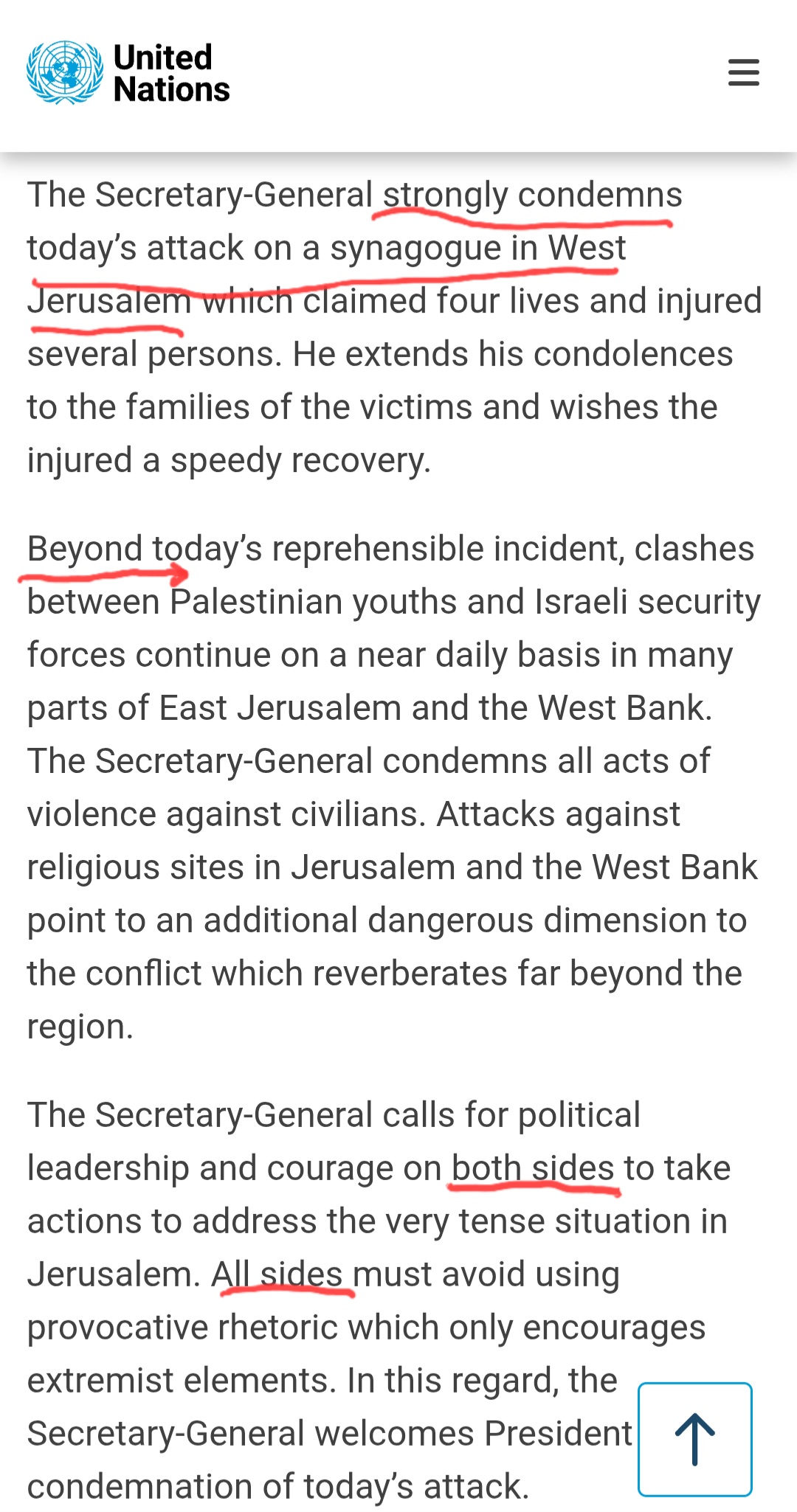
In 2014, after Arab terrorists entered a synagogue in Jerusalem wielding meat cleavers and hacked Jewish worshippers to death, Ban Ki-moon issued a statement that follows the exact same structure.
He “strongly condemns” the attack. He offers condolences. And then—almost immediately—he moves “beyond today’s reprehensible incident” to discuss “clashes between Palestinian youths and Israeli security forces.” The massacre is submerged into “the situation.” The killers disappear into context.
There is no call to bring the perpetrators to justice. No solidarity with the Israeli government. No affirmation of Israel’s duty to eradicate the threat.
Instead, Ban Ki-moon calls for leadership on “both sides”, urges all parties to avoid “provocative rhetoric,” and frames the slaughter of Jews in a synagogue as a destabilizing dimension of the conflict—not as terrorism demanding elimination.
Different Secretary-General. Same choreography.
The explanation is not mysterious because the United Nations does not conceptualize Palestinian violence as extremism.
Extremism, in UN doctrine, is something that happens elsewhere—to states battling jihadists, insurgents, or transnational terror networks. Palestinian murder, by contrast, is treated as political expression: contextualized by grievance, softened by narrative, absorbed into a permanent dispute. It is violence to be managed, not defeated.
That is why justice is demanded in Pakistan and restraint is demanded in Jerusalem. One fits the UN’s extremism framework. The other does not.
“Restraint” here is not a plea for peace. It is a veto on justice.
When Jews are murdered, the UN permits mourning but denies agency. Condolences are extended to families, while the legitimacy of Jewish self-defense and Jewish sovereignty is quietly withheld. Sympathy is offered—but solidarity with the state is conspicuously absent.
The global body created in the shadow of the Holocaust cannot bring itself to say, plainly, that Jews murdered in synagogues deserve the same moral response as anyone else. It cannot say that Jewish sovereignty is legitimate. It cannot say that justice must follow Jewish bloodshed.
And the Stateless Arabs from Palestine (SAPs), its perennial wards, must be granted absolution.
Israel should draw the only conclusion that matters: the United Nations is not a moral compass or humanitarian organization. It is purely a political instrument.
The final season of Game of Thrones disappointed many viewers.
For years the show carried two storylines: an existential threat to humanity and a political struggle for the throne. When the ending came, the cosmic danger faded first and the camera returned to palace intrigue. Technically both plots resolved but emotionally, it felt like the story had mistaken the setup for the destination.
That structural tension comes to mind every year at Parshat Yitro.
The most dramatic moment in Jewish history — Sinai, revelation to the entire people, the Ten Commandments — arrives astonishingly early in the Torah. If receiving the law is the climax, why does it appear so soon in the Bible?
Because it isn’t the ending; it’s the beginning.
Sinai gives the people a constitution. It shapes their character, their obligations, their relationship with God and each other. But from the very first promise to Abraham, the Torah’s narrative is moving somewhere concrete — toward a land.
Walk the text and it reads like a map: journeys, wells, borders, inheritances. The story is geographic as much as spiritual. It is about building a nation in a place.
Torah and land were always meant to live together.
Torah without a homeland leaves Jewish life suspended in theory. A homeland without Torah loses its moral compass. Sinai forms the people; the land is where that formation is meant to be lived.
Over a thousand years of exile forced a different emphasis. When Jews lost soil, they carried scrolls. When borders disappeared, mitzvot became portable homeland and identity. That devotion was critical for survival.
Now history has shifted again.
For the first time since antiquity, a plurality of Jews lives in the Land of Israel, and soon it will likely be a majority. The part of the Torah that once felt distant and theoretical — sovereignty, agriculture, public responsibility, national life — is no longer abstract. It is daily reality.
Which reframes Parshat Yitro.
Sinai is not the finale of the Jewish story. It is the preparation. The training. The moment a people receives the tools it will need to build something lasting in its own land.
The Torah itself tells us this by where it ends: at the edge of the land, looking forward.
After centuries of mastering how to live as guests in other people’s history, Jews are being invited back to the main storyline: living in the land, with the Torah in hand.
The Travels of Benjamin of Tudela was an eight year travelog from circa 1165 to 1173, chronicling the pilgrimage of a Jew from Spain to the Jewish holy land.
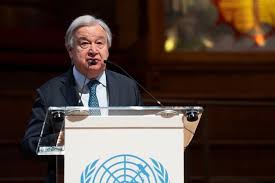
António Guterres keeps saying the United Nations is no longer the institution it was 80 years ago. Power must be rebalanced he claims. The Security Council must reflect today’s world he urges. Post–World War II structures must evolve.
Fine. But if that claim is serious, the UN’s most glaring failure to modernize is Gaza.
The system built never to end
One UN body remains frozen in 1948: UNRWA. One vision for a state is lost to contours proposed in 1947: Palestine.
UNRWA administers a refugee regime found nowhere else:
Refugee status is inherited indefinitely
It never expires through citizenship or resettlement
It is tied to a “right of return” not to Gaza or a future Palestinian state, but to Israel itself
No other refugee population is treated this way. Bosnians were not. Syrians are not. Ukrainians are not.
Every other refugee crisis is handled by UNHCR, where refugee status is temporary and meant to end. Only Palestinians are placed in a system designed to remain permanent.
Ending inherited refugee status would not end humanitarian aid. It would end the political weaponization of refugeehood.
Why Bosnia exposes the category error
After the Balkan wars, the Dayton Accords included a right of return—but it was finite, individual, and intra-state. It applied to homes lost in the same war for the same people, and aimed to undo ethnic cleansing, not undo borders.
Gaza’s claimed “right of return” is fundamentally different: intergenerational, extra-territorial, and demographic—designed to reopen 1948 and negate another UN member state.
Guterres’ contradiction
Guterres calls for reform everywhere except where reform would actually make peace possible.
As long as the UN maintains an inherited right of return into Israel and the proposed borders which have long since past their expiry:
Maximalism is rewarded
Compromise is delegitimized
Negotiations become theater
Gaza remains permanently “temporary”
This is not neutrality; it is an institutional choice to preserve claims that prevent settlement.
Reform that applies everywhere except where it matters most is not reform. It is avoidance.
The unavoidable conclusion
Until the UN ends the one system designed never to end, Gaza will not be governed toward peace—but toward the permanence of conflict.
And no amount of rhetoric about modernization can disguise that refusal.
On Holocaust Remembrance Day, António Guterres reached for the safest symbol available: Nuremberg. He spoke of universal lessons, multilateralism, and the dangers of unchecked hatred. It sounded solemn, but it was evasive. By invoking Nuremberg instead of Eichmann, the UN spun a story in which institutions matter more than victims, and legality matters more than justice.
That choice is not accidental. It is institutional self-protection.
Why the UN Prefers Nuremberg
The International Military Tribunal flatters multilateral ideals. It universalizes guilt, diffuses responsibility, and allows the UN to present itself as the heir to postwar justice. It avoids a harder truth: the world did not finish the job. Genocide went unnamed. Jewish extermination was evidence, not the charge. Many perpetrators melted back into ordinary life.
The Nuremberg trials were necessary but insufficient. And on Holocaust Remembrance Day, sufficiency is the point.
“I have always understood the clear link between the horrors of the Holocaust and the spirit of multilateralism, justice and rights that founded our organization. Just over 80 years ago, the Nuremberg trials began. These trials represented the beginning of a new era in international criminal law; an era 78 which individuals, including the most powerful, are held accountable. Today, more than ever, we need to reclaim that spirit.” – UN Secretary General Antonio Guterres on Holocaust Remembrance Day
Eichmann Is the Missing Sentence—And the Turning Hinge
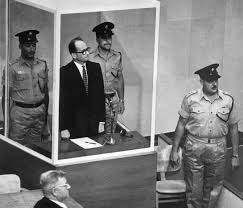
The trial of Adolf Eichmann in Jerusalem did what Nuremberg did not. It named genocide as genocide. It put survivor testimony at the center. It replaced bureaucratic fog with individual culpability. Eichmann was not tried as a generic war criminal; he was judged as an architect of the annihilation of Jews.
Adolf Eichmann on trial in Jerusalem, many years after the Nuremberg trials
As Hannah Arendt observed, the case exposed how extermination was operationalized by ordinary men. And it exposed a global failure: Eichmann lived freely for years after the war. Many like him were never tried at all.
That is why Eichmann is not an “example” to be mentioned in passing. He is the pivot of postwar justice—the moment when the Holocaust was finally understood, named, and judged as what it was.
Universalism That Erases the Crime
Guterres’s language collapses the Holocaust into a general warning about hatred. of course hatred matters. But flattening the crime turns extermination into general prejudice and genocide into an abstraction. The Holocaust was not simply bigotry run amok; it was a state-organized project to destroy a people everywhere it could reach them.
Universalism should follow truth—not replace it. When remembrance avoids naming genocide plainly, “Never Again” becomes a slogan that comforts institutions rather than indicts them.
The Uncomfortable Lesson the UN Avoids
The defining act of Holocaust justice did not come from the UN system. It came from a Jewish state acting unilaterally. Without Israel, Eichmann would have died untried, his crimes dissolved into postwar amnesia. That is not a political claim; it is a historical conclusion.
The UN prefers Nuremberg because Eichmann exposes its limits. Nuremberg affirms process; Eichmann exposes failure. One reviews general war crimes while the other points the finger squarely at demonic antisemitism. One is safe to cite as the other forces accountability.
Holocaust Remembrance Day is not a seminar on international law. It is a reckoning with a singular crime and a singular abandonment. The Jewish state does not exist to teach the world lessons, but we see plainly that the world failed to protect Jews—and then failed to prosecute their murderers. And it fails to recognize the clear difference to this day – on the very day designated to remember.
The Line That Cannot Be Dodged
Remembrance without judgment is theater. On Holocaust Remembrance Day, the honest citation is not Nuremberg’s promise but Eichmann’s dock. One symbolizes aspiration. The other delivered judgment.
If the UN wants this day to mean more than ritual, it must say the truth it avoids: the Holocaust was finally understood, named, and judged because Jews had a state willing to act when the world would not. That is not a complication of remembrance. It is its core.
The modern left claims to speak in absolutes. Borders are immoral. Enforcement is cruelty. Language itself must be purified so that no human is illegal. That creed is recited with missionary confidence—until the subject becomes Jews in the Middle East. Then the absolutes vanish. The language hardens. Expulsion becomes justice.
When Alexandria Ocasio-Cortez says “no human being is illegal,” she isn’t hedging. When Ilhan Omar insists “undocumented does not mean illegal,” the point is categorical. When Julián Castro calls the word illegal dehumanizing, the doctrine is clear: presence confers legitimacy.
“This bill prohibits any executive agency from using the term alien to refer to an individual who is not a U.S. citizen or national, or illegal alien to refer to such an individual who is unlawfully present in the United States or lacks lawful immigration status. This prohibition does not apply when quoting certain texts.” – H.R.457 — 117th Congress (2021-2022) submitted by Joaquin Castro (D-TX) with 13 Democratic co-sponsors
And then Jews cross the only line that matters.
Beyond the 1949 armistice lines—lines drawn to stop a war, never to define a state—the same mouths reverse themselves. Jews become “illegal settlers.” Homes become “violations.” Removal becomes moral necessity. The word that supposedly dehumanizes migrants is suddenly deployed eagerly against Jews. The same politicians who recoil at deportation rhetoric now demand the dismantling of Jewish communities that have existed for decades.
The contrast is not accidental. Rashida Tlaib brands Jewish towns “illegal” and calls for their removal. Bernie Sanders repeats the charge as if the label itself settles every moral question. Even Omar—who rejects illegality as a concept at home—embraces it fully when applied to Jews. Same actors. Same vocabulary. Opposite rules.
This is where anti-Zionism sheds its disguise. A politics that claims to defend Black and Brown people from delegitimization turns around and singles out Jews—alone—for collective criminalization. When a political doctrine singles out Jews—alone—for criminalization and expulsion, it stops being anti-Zionism and becomes antisemitism, full stop. If a principle applies to everyone except Jews, it isn’t principle. It’s prejudice.
The United Nations provides the laundering. Resolutions passed by automatic anti-Israel majorities are treated as moral verdicts rather than political artifacts. When the Barack Obama administration chose not to veto Security Council Resolution 2334, it handed activists a legal-sounding alibi. The appeal is obvious: demand expulsions while pretending your hands are clean. Outsource conscience. Invoke “international law.” Move on.
“any decisions and actions which purport to have altered the character, status or demographic composition [added Jews] of the Holy City of Jerusalem have no legal effect, are null and void and must be rescinded in compliance with relevant resolutions of the Security Council” – UN General Assembly
The hypocrisy spills into the street. Protestors harass synagogues and Jewish institutions, targeting Jews for contemplating life in Israel. That behavior would be condemned instantly if aimed at any other minority. Instead, it’s excused as activism—supposed to make people uncomfortable, as Cori Bush once put it. When the discomfort belongs to Jews, the moral bar drops through the floor.
Strip away the slogans and the pattern is unmistakable: hierarchy. Some groups are granted innocence without agency. Jews exercising sovereignty are denied legitimacy regardless of history, law, or fact. The left that insists words can wound has no trouble criminalizing Jewish existence.
If no human is illegal, Jews aren’t illegal. If deportation is immoral, ethnic cleansing is immoral. If harassment is violence, it applies outside synagogues too.
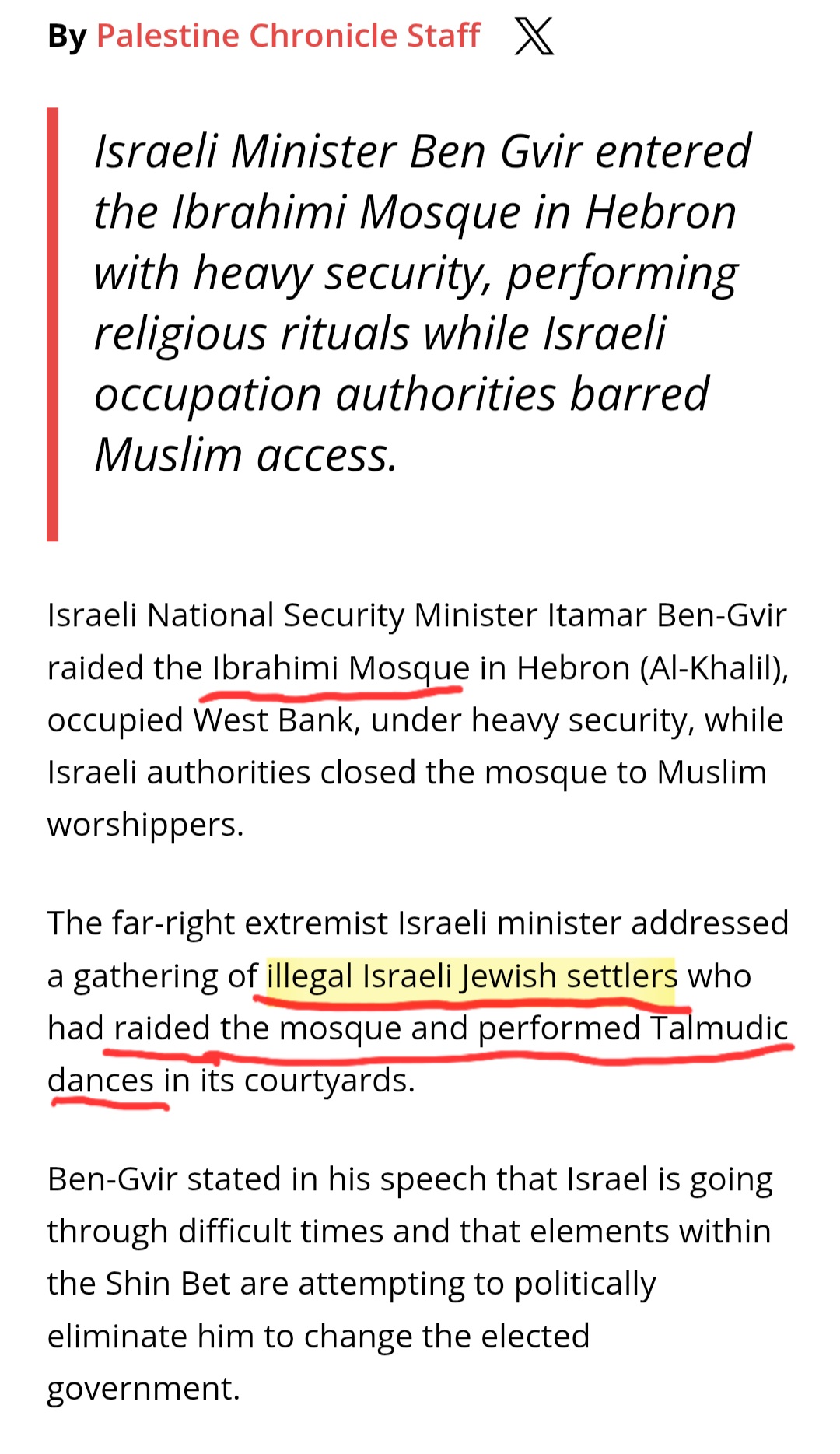
Yet the antisemitic anti-Israel crowd miss the entire point and attempt to reframe the story. Palestine Chronicle wrote that “Israel has come home to roost in Minnesota. The people of Minneapolis and St. Paul have become the Palestinians of Minnesota,” misdirecting people that Arabs are targeted by Israel, when in fact it is Jews being targeted for being “illegal” by the UN and the Muslim world.
The rules change only for Jews. That isn’t progressivism. It’s selective morality—rigged, tribal, and exposed.
















 First One Through