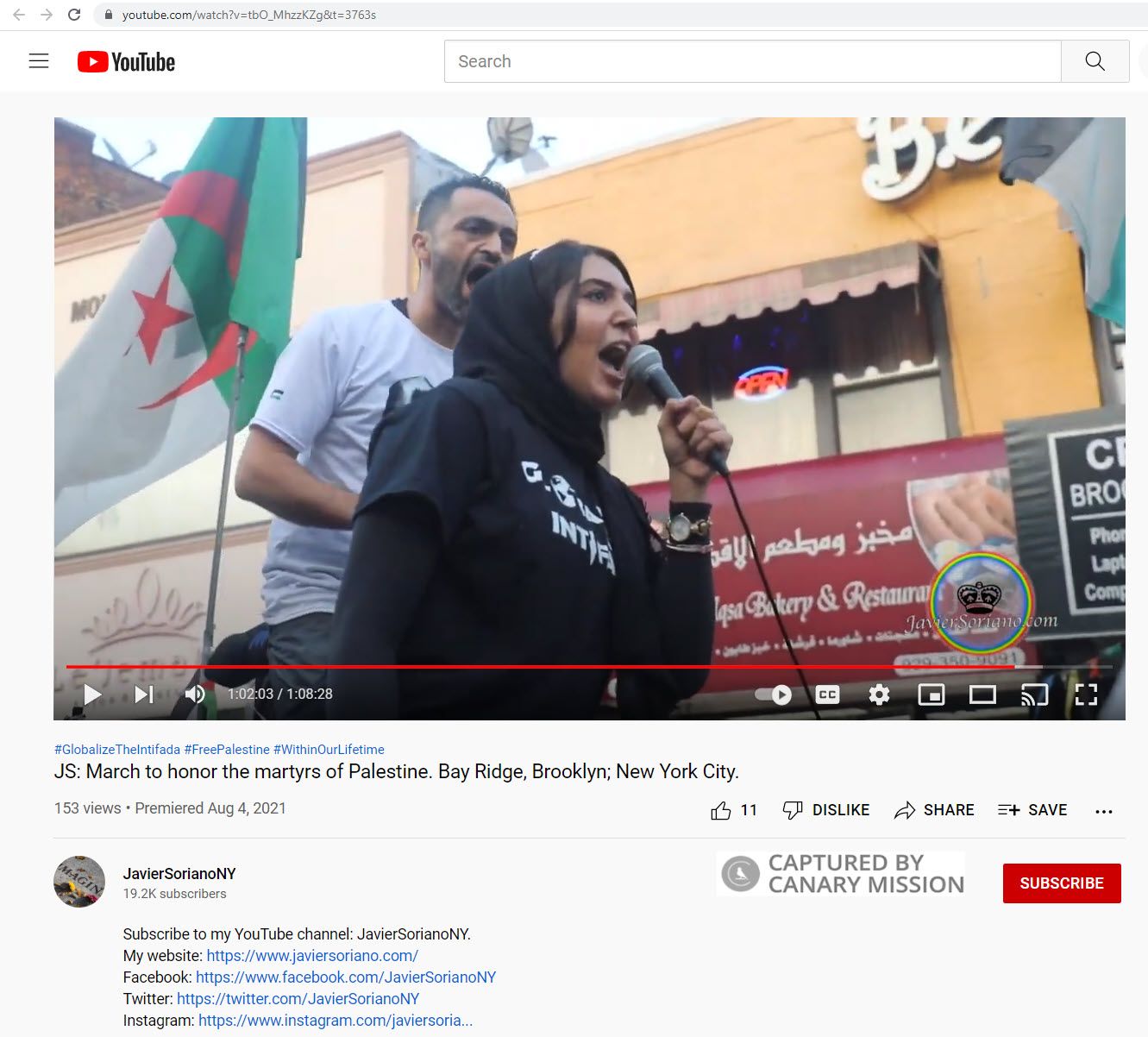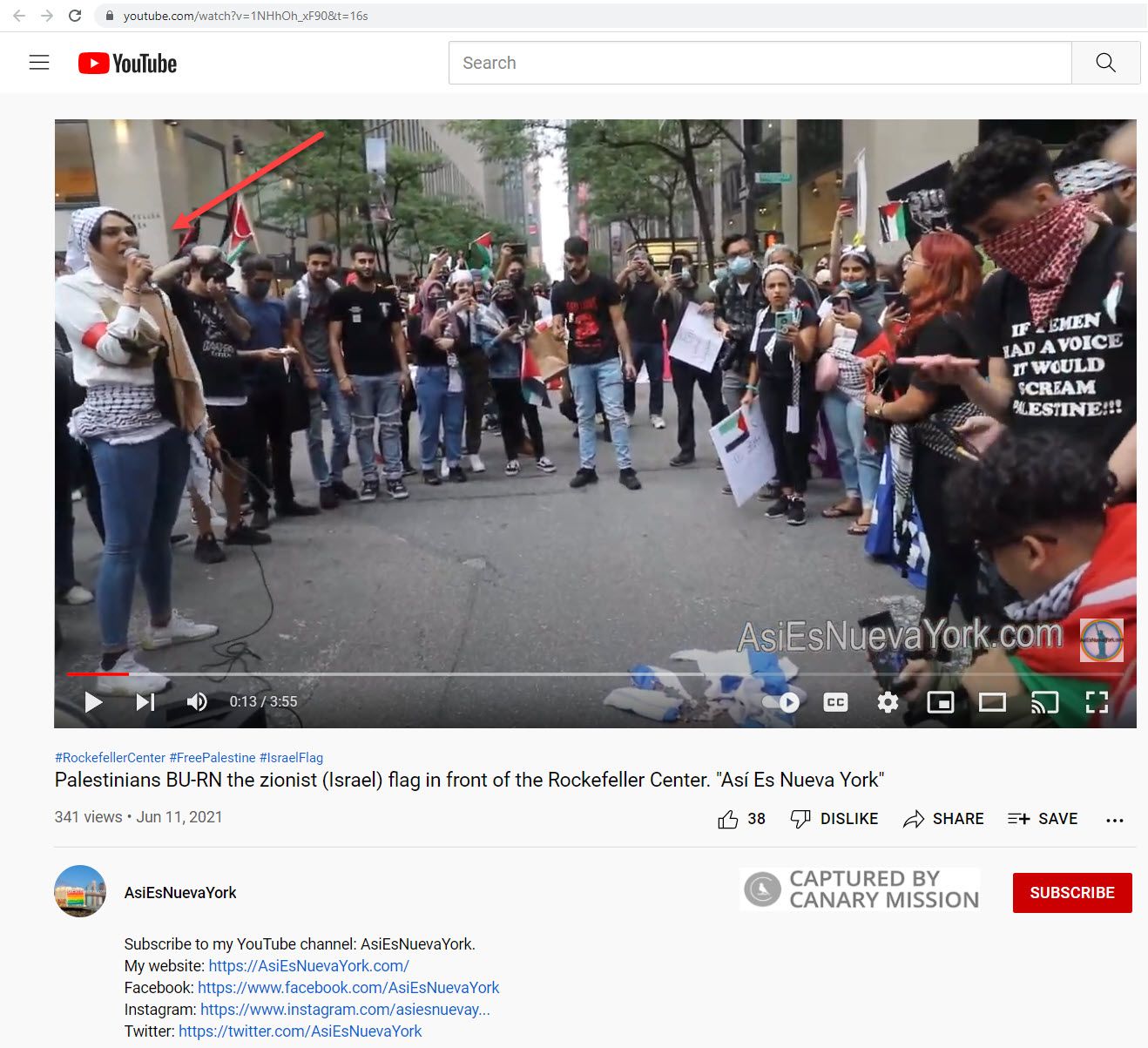
Hey NY Times, Nerdeen Kiswani Wants Zionists Killed and Israel Destroyed

Nerdeen Kiswani is not quiet about her views. She wants the Jewish State obliterated and Zionists killed. She says it openly and proudly in front of loud cheering crowds.

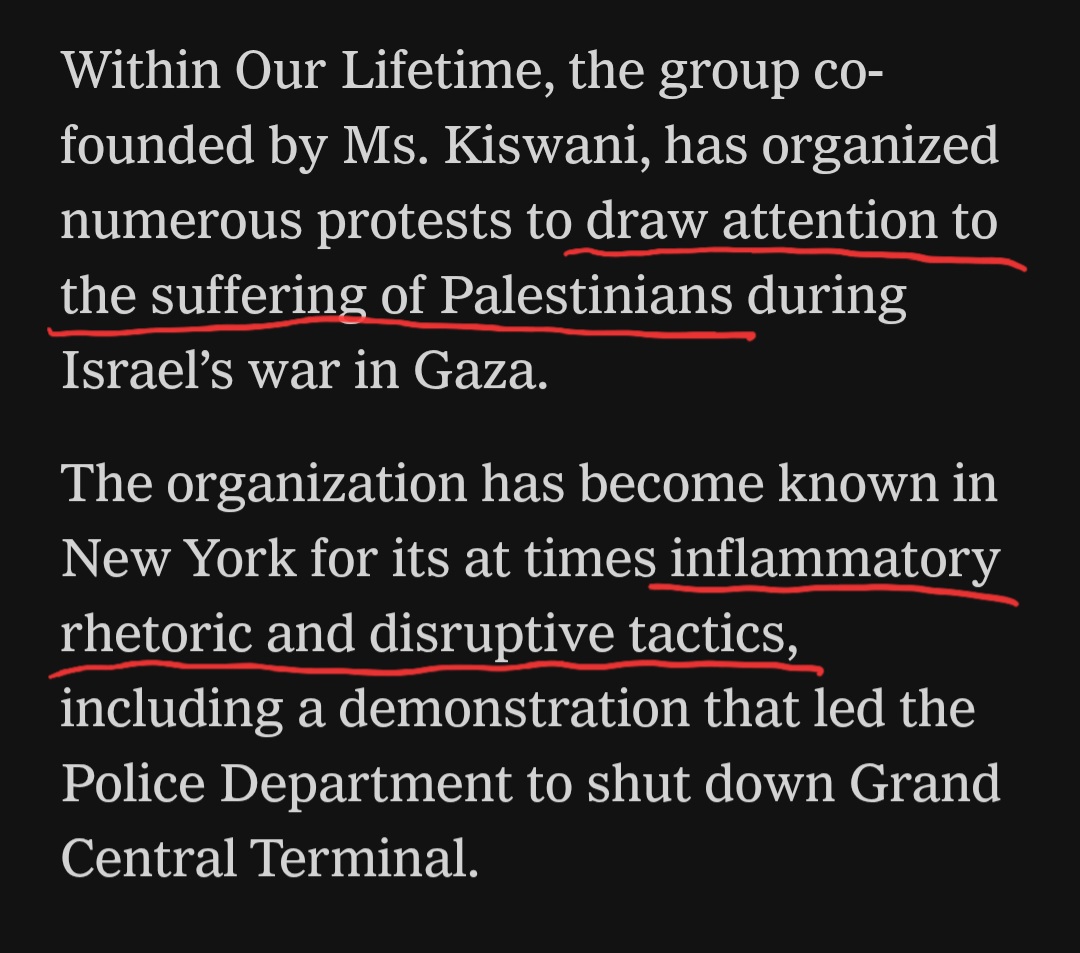
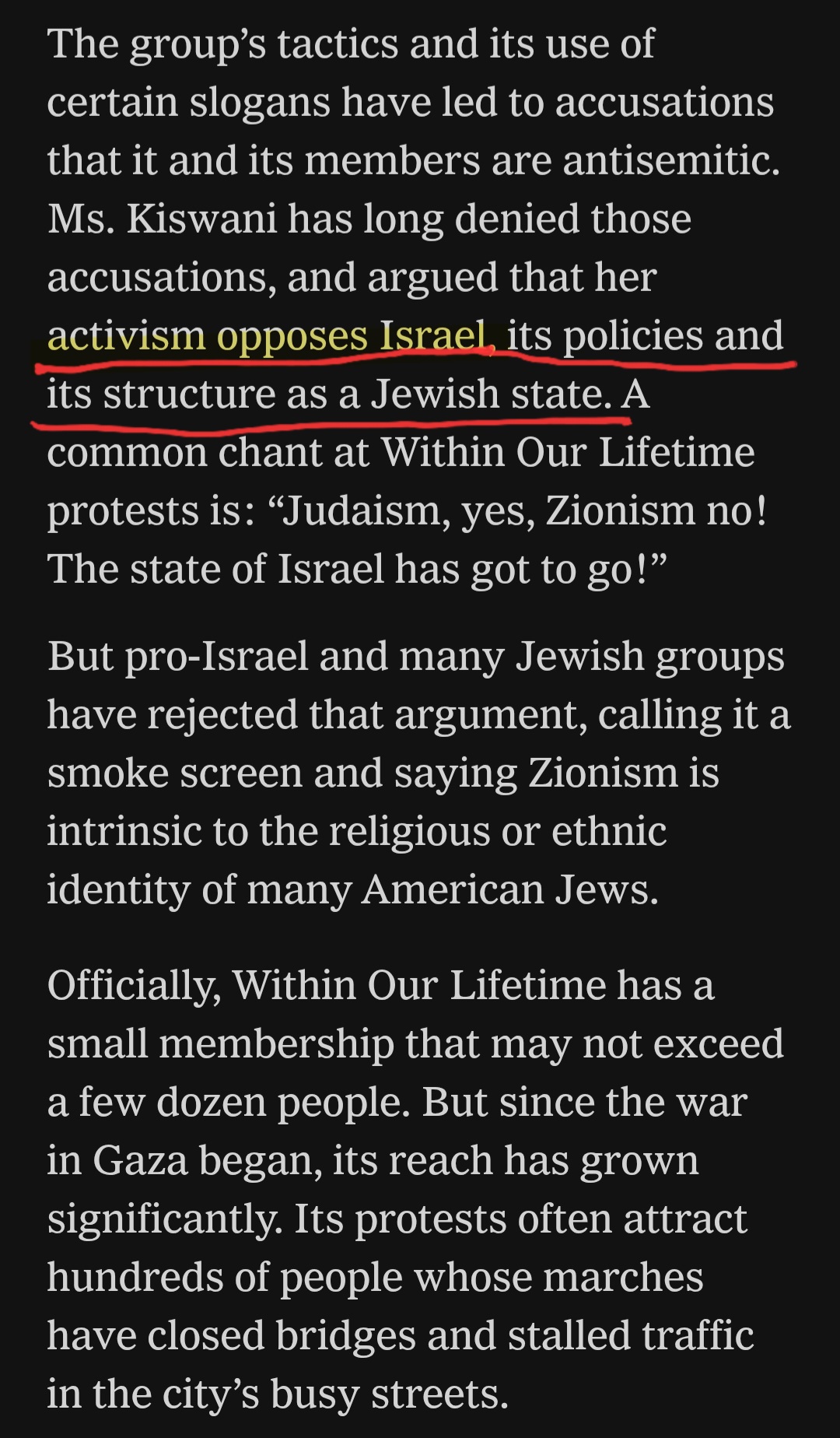
So why did The New York Times soften her stance? Why did it say that she was simply assembling “protests to draw attention to the suffering of Palestinians,” when her entire movement is about the destruction of Israel?
“I hope that pop-pop is the last noise that some Zionists hear in their lifetime!” – Nerdeen Kiswani, Youtube, Aug 4 2021

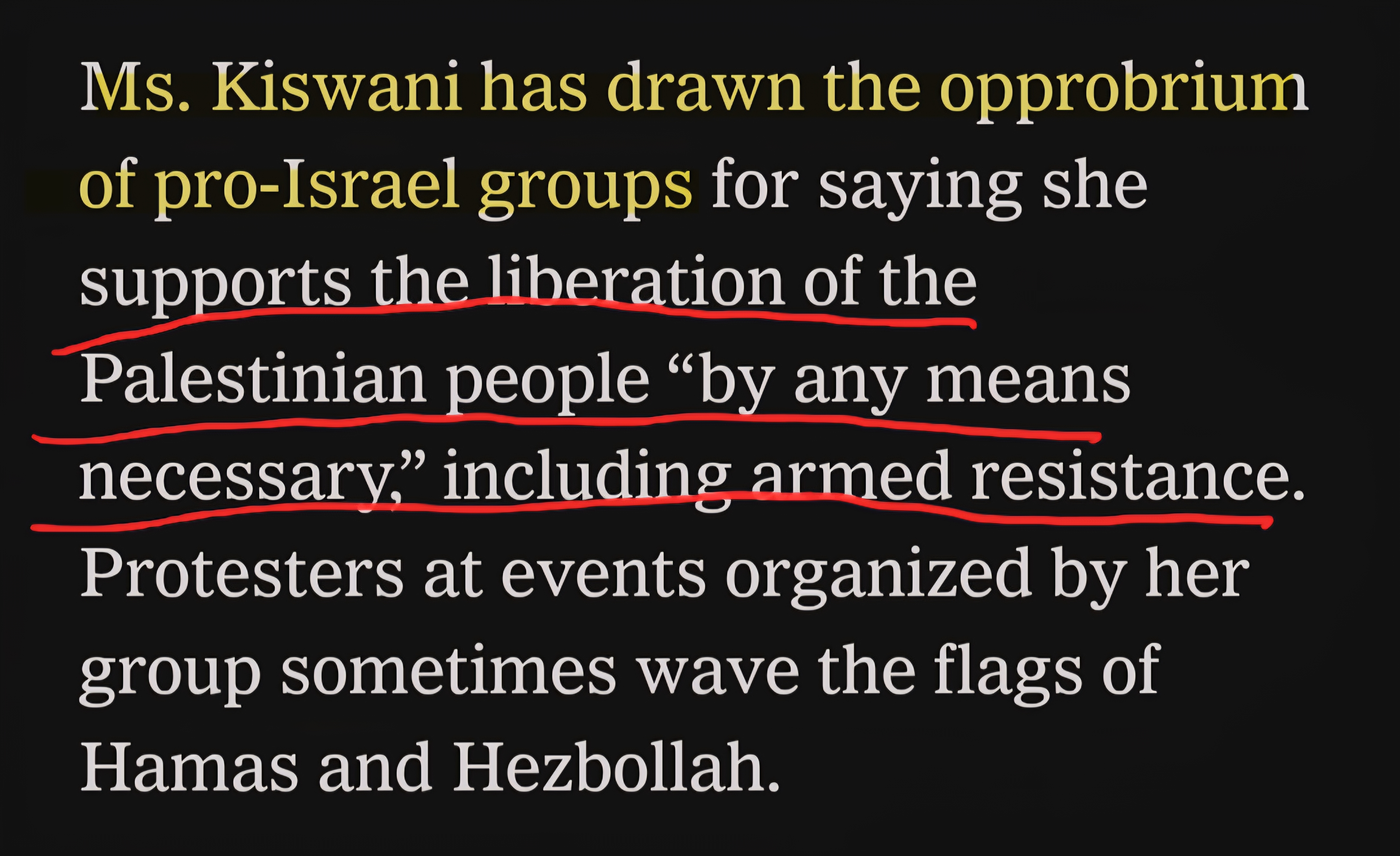
Why did the Times make it sound like pro-Israel groups were uniquely offended that “she supports the liberation of the Palestinian people “by any means necessary,” including armed resistance.”?
“Israel must be annihilated.” – Nerdeen Kiswani, Instagram, Mar 3 2017

Why did the Times use so much energy and so many words to say “that her activism opposes Israel, its policies and its structure as a Jewish State,” without saying that she supports targeting Jewish organizations and the annihilation of the only Jewish State?
“We marched today, we took over the streets and we visited multiple Zionist settler foundations. Multiple. We let them know we know where they’re at. We know where they work. We’re gonna find out more about where they’re at too. And we’re gonna go after them.” – Nerdeen Kiswani, YouTube, Jun 11 2021

Why didn’t the Times explicitly state that Kiswani endorses US designated terrorist groups and individuals?
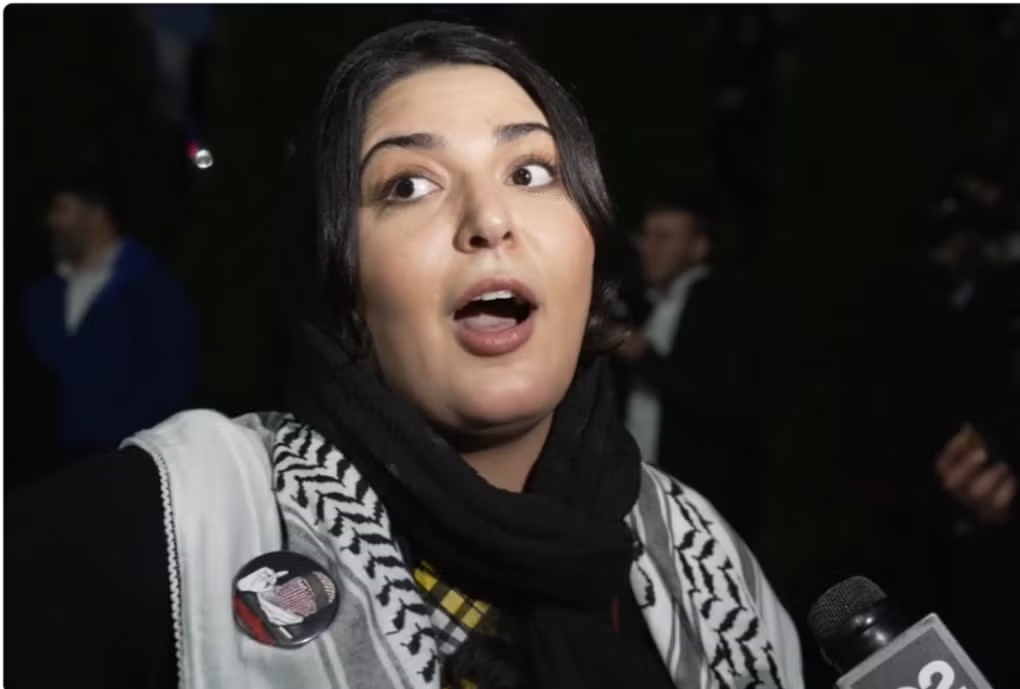
Picture on left is Kiswani with pin of Abu Obaida, a spokesman for Hamas, while protesting in front of a synagogue in Teaneck, NJ on April 1, 2024 (from ADL website)

On June 10, 2024, Kiswani led a protest outside a memorial exhibit in downtown New York City about the Nova Music Festival where she said that young partygoers enjoying music was “like having a rave right next to the gas chambers during the Holocaust,” mocking not only the hundreds of murdered youth but millions of Jews slaughtered in the Holocaust.

Kiswani doesn’t hide her love of the genocidal antisemitic group Hamas. She posts her fondness to the public.
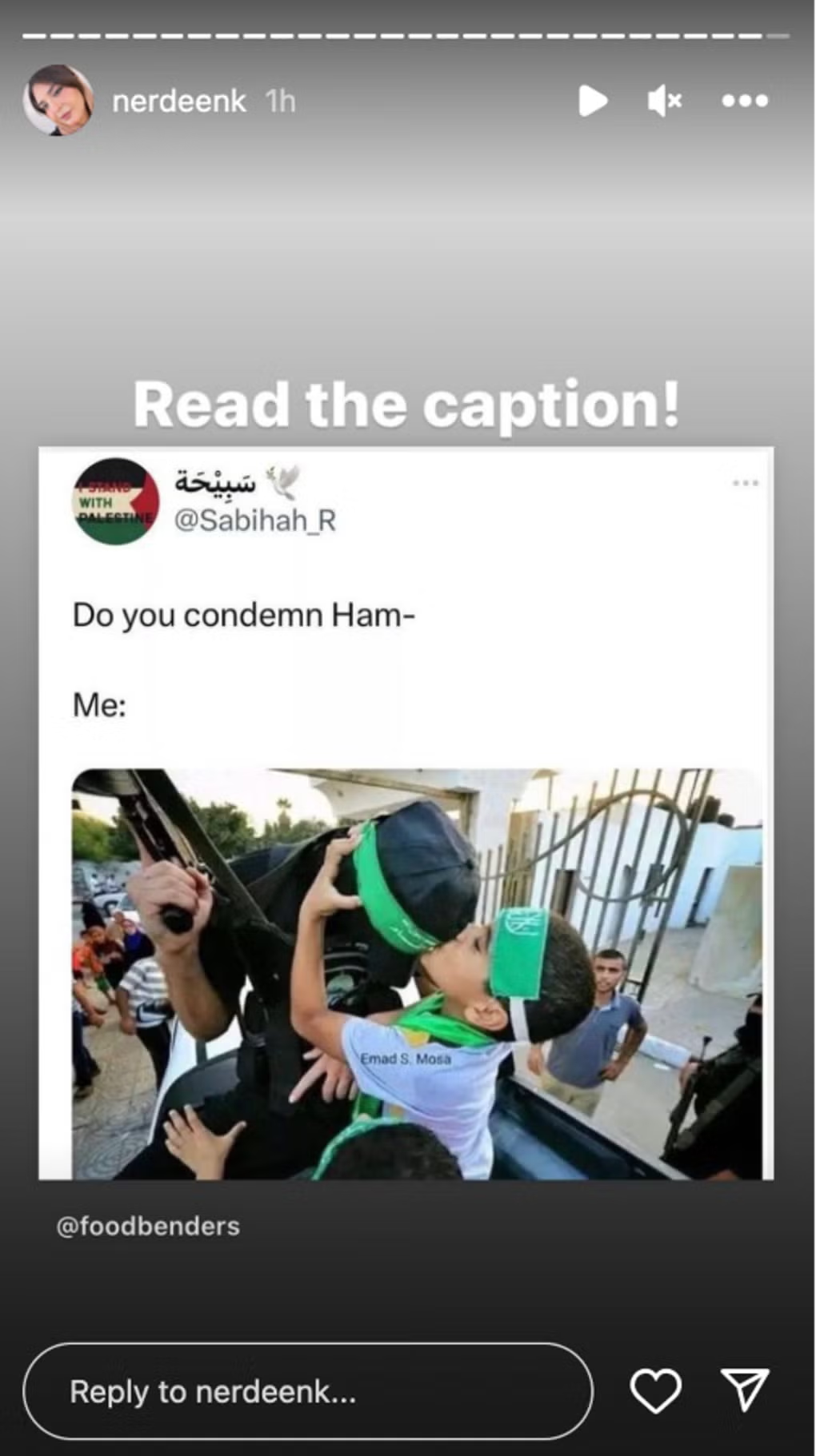
Kiswani post of a child kissing an armed Hamas terrorist, like those that burned Jewish families alive

In short, Kiswani is a proud supporter of terrorism against Jews and American allies. Yet The New York Times made it appear that her stances were simply pro-Palestinian, which some members of the pro-Israel community found offensive.

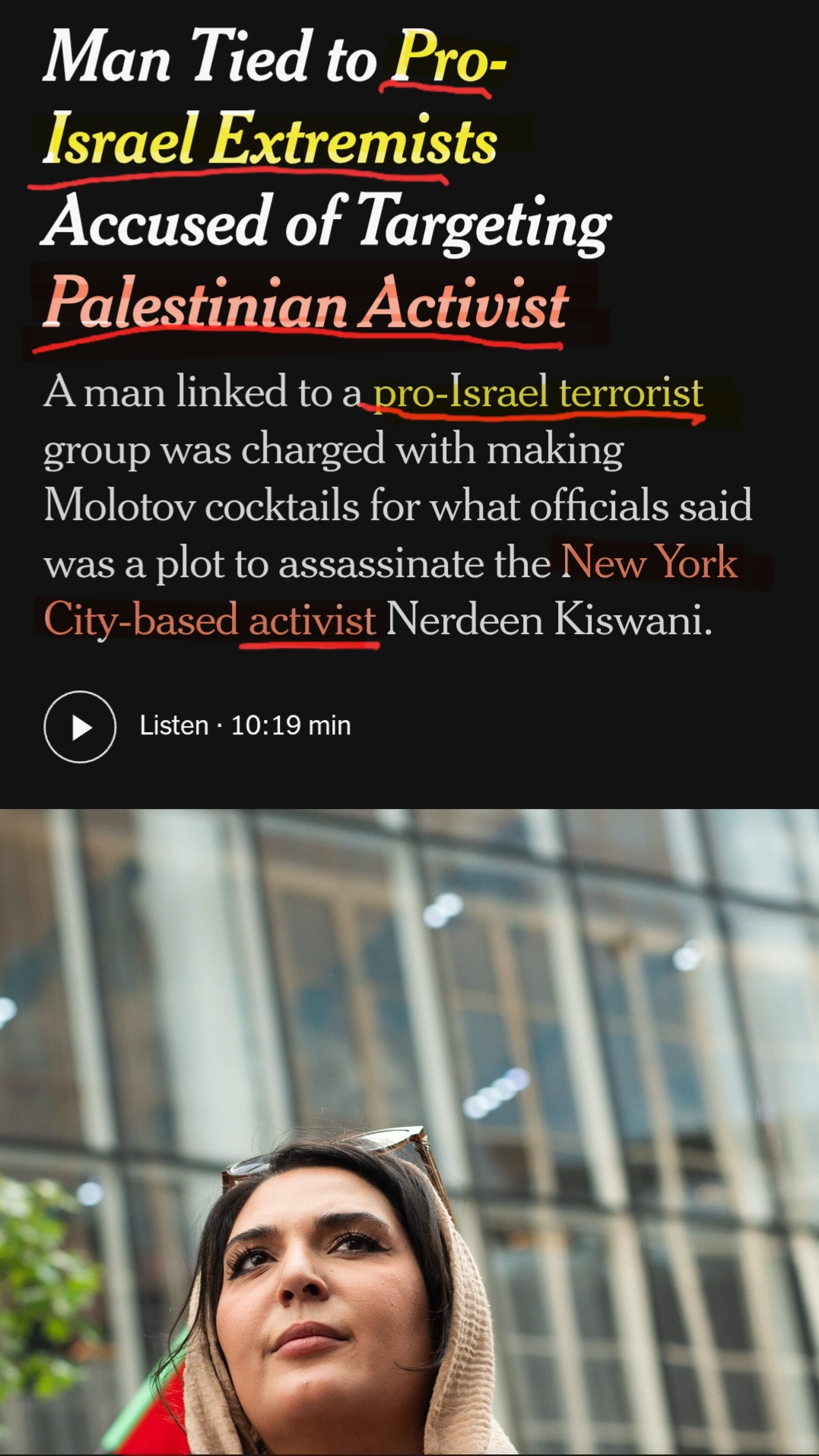
The reality is that a pro-Israel “extremist” allegedly planned an attack on a pro-Palestinian “extremist.” But the Times editorialized by showing the smiling face of an “activist” worried about the “suffering” of her people. Such is the alt-left embrace of the toxic “deformity in Palestinian culture.”
Savannah Guthrie Times 250

Savannah Guthrie tried to describe the indescribable.

Her 84 year old mother was taken from her home, with signs of violence left behind, a masked man on camera. And then nothing. A void where a mother used to be. She spoke about sleepless nights, about imagining fear she cannot reach, about a word she kept returning to: unbearable.

That word should end the conversation. It should strip away everything else.

Because everyone understands what it means when someone you love is taken.


Now Multiply That by 250

What Guthrie is living through is devastating.

In Israel, it happened at scale.

Over 250 people were abducted violently—children, parents, grandparents—dragged from homes, shoved into vehicles, disappeared into tunnels by jihadi terrorists. The same questions Guthrie now asks became a national condition: Are they alive? Are they suffering? What are they thinking?

The same agony. Multiplied. Multiplied. Multiplied.


Where the World Breaks

Here is the dividing line.

When Guthrie speaks, there is no debate. No one justifies it. No one says her mother deserved it. No one rallies in defense of the abductor.

The reaction is immediate and human: bring her home.

But when Israeli families faced the same horror, the reaction in too many places—especially on college campuses—was not sympathy.

It was celebration.

Not confusion. Not distance. Celebration of the very act Guthrie calls unbearable.


The Only Question That Matters

Her interview removes every excuse. No politics, no slogans—just a daughter describing what it feels like to have a mother taken.

If you can feel that—and then justify or cheer when it happens to someone else—you are not misinformed. You are choosing evil.

And that is the part that is unbearable to civilized people.

The New Ground Zeros

We tend to think of “ground zero” as a place, a site of destruction. Where you can point to and say: it happened here.

The new ground zeros are not simply where attacks occur. They are where the vulgar idea stops sounding outrageous.

They form in environments where the rules quietly change, where violence against Jews is never explicitly endorsed, but is no longer cleanly condemned. It is where it is explained. Contextualized. Where the language shifts just enough that the victim is converted into the villain.

You can see it in parts of political culture that elect figures like Rashida Tlaib and Zohran Mamdani without seriously confronting the ideological space around them.

Rep. Rashida Tlaib called Jews conspirators who operate “behind the curtain” to “make money off of racism” at the Democratic Socialist of America convention

Ayman Mohamad Ghazali, the man who came to murder hundreds of children at a Jewish day school in Michigan, lived in Rashida Tlaib’s Michigan district, home to thousand of people who believe Tlaib’s rhetoric, who support – or least excuse – her vile antisemitism.

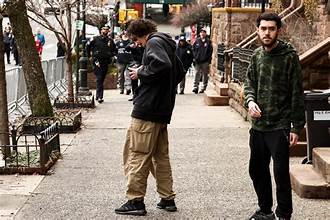
The same motion can be seen in New York City where Emir Balat, 18, and Ibrahim Kayumi, 19, pledged allegiance to the Islamic State and came to the city that elected a jihadist mayor to rain violence on perceived enemies.

Emir Balat, 18, and Ibrahim Kayumi, 19, readying a bomb to throw at police and civilians in New York City

Ideas shape environments. And environments shape what becomes possible.

It happens quickly: it took barely a decade for NYC to go from a capitalist moderate Jewish mayor in Michael Bloomberg, to an anti-capitalist jihadist in Zohran Mamdani.

When enough people participate in erasing the moral line, the boundary that once made violence unthinkable begins to weaken. And when that boundary weakens, the outliers don’t need instructions.

They need atmosphere.

The new ground zero is not the place where it happens. It is where it no longer feels impossible.

All Muslims Are Not Jihadists

There is a temptation in moments of fear and anger to reach for the bluntest possible instrument: collective blame.

We are seeing it again now, in calls from some politicians and commentators to treat Muslim Americans not as individuals, but “as a class.” It is offensive. It is wrong. And it is profoundly un-American.

We have been here before.

American history offers a warning that should never be forgotten: General Ulysses S. Grant’s order expelling Jews “as a class” from parts of the South during the Civil War. It was born of frustration, prejudice, and expedience. It is remembered today as a stain.

That is what collective guilt produces. Not security. Not clarity. Just injustice.

And it obscures the truth.

Because the truth is more important: not all Muslims are jihadists. The overwhelming majority are not. But there exists, within every society, a subset animated by radical, supremacist ideology. In this case, that subset is jihadists and they are a very real problem.

We have seen synagogues attacked, Jewish schools targeted, and civilians murdered around the world – from New York to Paris, from Sydney to Jerusalem. These acts are not isolated. They are the violent edge of a broader ideological ecosystem that glorifies terror, sanctifies hatred, and seeks legitimacy in the West.

That ecosystem is not confined to foreign battlefields. It has nodes here.

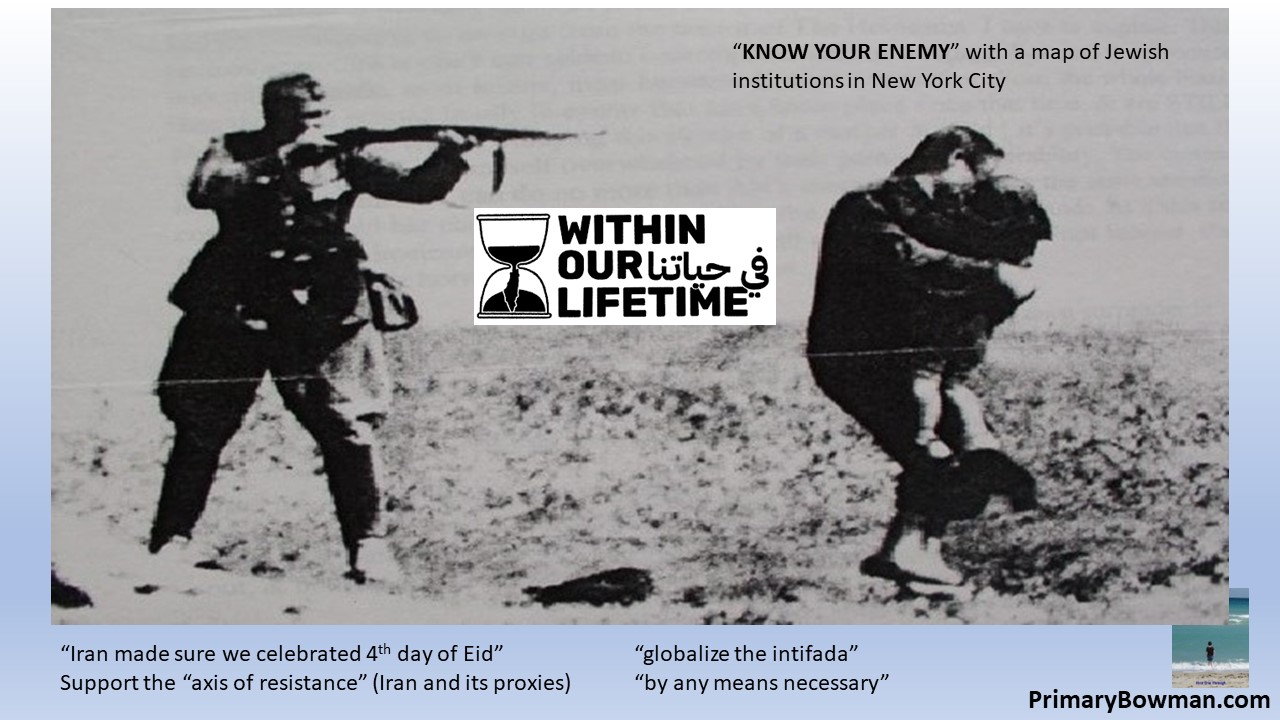
Organizations like Students for Justice in Palestine (SJP) and Within Our Lifetime do not operate as neutral advocacy groups. Their rhetoric, tactics, and alliances echo the narratives of jihadist movements – erasing terrorism, justifying atrocities, and turning mass violence against Jews into something to be rationalized and celebrated.

This is where scrutiny belongs.

Not on millions of Muslim Americans living ordinary lives who are part of the American fabric. But on the networks, organizations, and ideologies that radicalize, that excuse violence, and that deliberately blur the moral line between protest and terror.

Failing to make that distinction is not only unjust but dangerous.

When everything is labeled the problem, nothing is. When all Muslims are treated as suspects, actual jihadists disappear into the noise. They benefit from that confusion. They rely on it.

And worse, it hands them a propaganda victory: proof, in their telling, that the West is inherently hostile, that coexistence is impossible, that radicalism is justified.

That is why calls to expel Muslims from the United States are not just racist; they are strategically self-defeating. They punish the innocent, betray American principles, and distract from the real threat.

A serious society does not fight ideologies with hysteria. It fights them with precision.

It identifies the threat clearly: jihadist ideology, its enablers, and the institutions that normalize or legitimize it. It protects the innocent. And it refuses, no matter how charged the moment, to abandon the principles that distinguish a free society from the movements that seek to destroy it.

Jihadi-washing and the Ideology the Times Won’t Name

A bombing attempt near Gracie Mansion followed a pattern Americans have seen before: young men radicalized online, pledging allegiance to the Islamic State of Iraq and Syria, and attempting violence in the name of jihad.

But if you read the The New York Times, you might never notice the pattern at all.

Two men were charged after attempting the ISIS-inspired bombing near Gracie Mansion. Prosecutors say the suspects pledged allegiance to ISIS and threw improvised explosive devices toward a protest crowd and police. The bombs failed to detonate, but the casualties could have been catastrophic. The bombing suspects were 18-year-old Emir Balat, a high school student, and Ibrahim Kayumi, 19.

The plot followed a model ISIS has promoted for years: radicalize individuals already living in Western societies and encourage them to strike where they live. No training camps. No command structure. Just ideology delivered through propaganda, social media and Muslim countries money in American schools.

America has already seen the results.

In 2015, a radicalized couple carried out the San Bernardino attack. Syed Rizwan Farook was 28 and Tashfeen Malik was 29.

In 2016, Omar Mateen29, murdered forty nine people in the Pulse nightclub shooting in Orlando while declaring loyalty to ISIS.

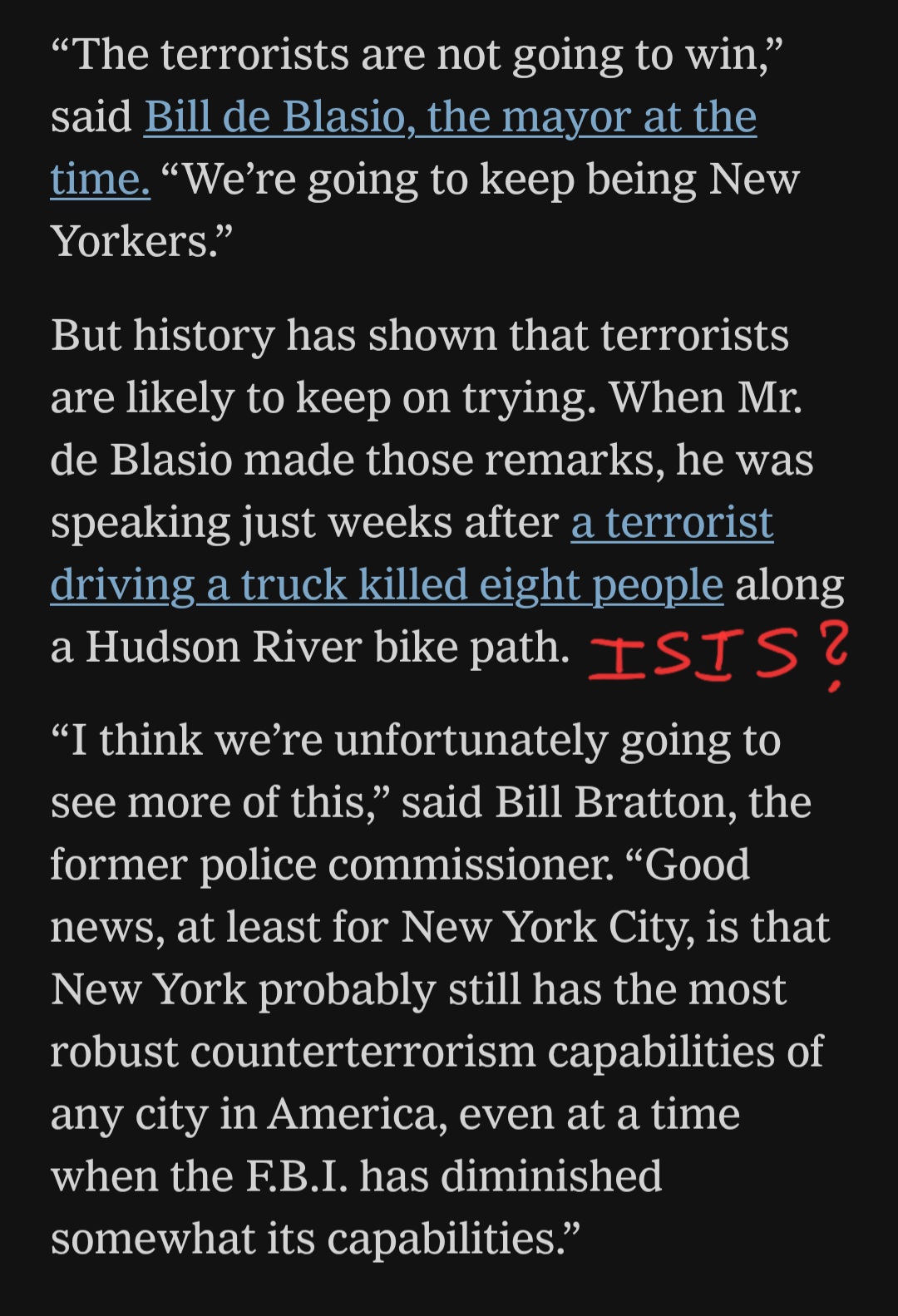
In 2017, Sayfullo Saipov, also 29, drove a rented truck onto the Hudson River bike path in Manhattan in the 2017 New York City truck attack, killing eight people and leaving a note pledging allegiance to ISIS.

This pattern is not accidental. ISIS propaganda deliberately targets young Muslims in their late teens and twenties, the age when identity and grievance can be shaped by ideology. The strategy is not to import terrorists into the West. It is to cultivate them here.

Yet when the New York Times recently referenced the Hudson River attack, it described it simply as “a terrorist driving a truck killed eight people.”

The ideology behind the attack vanished from the story.

When the ideology behind violence disappears, the violence itself begins to look random. But it is not random. It is ideological.

The same pattern of New York Times’ language appears elsewhere.

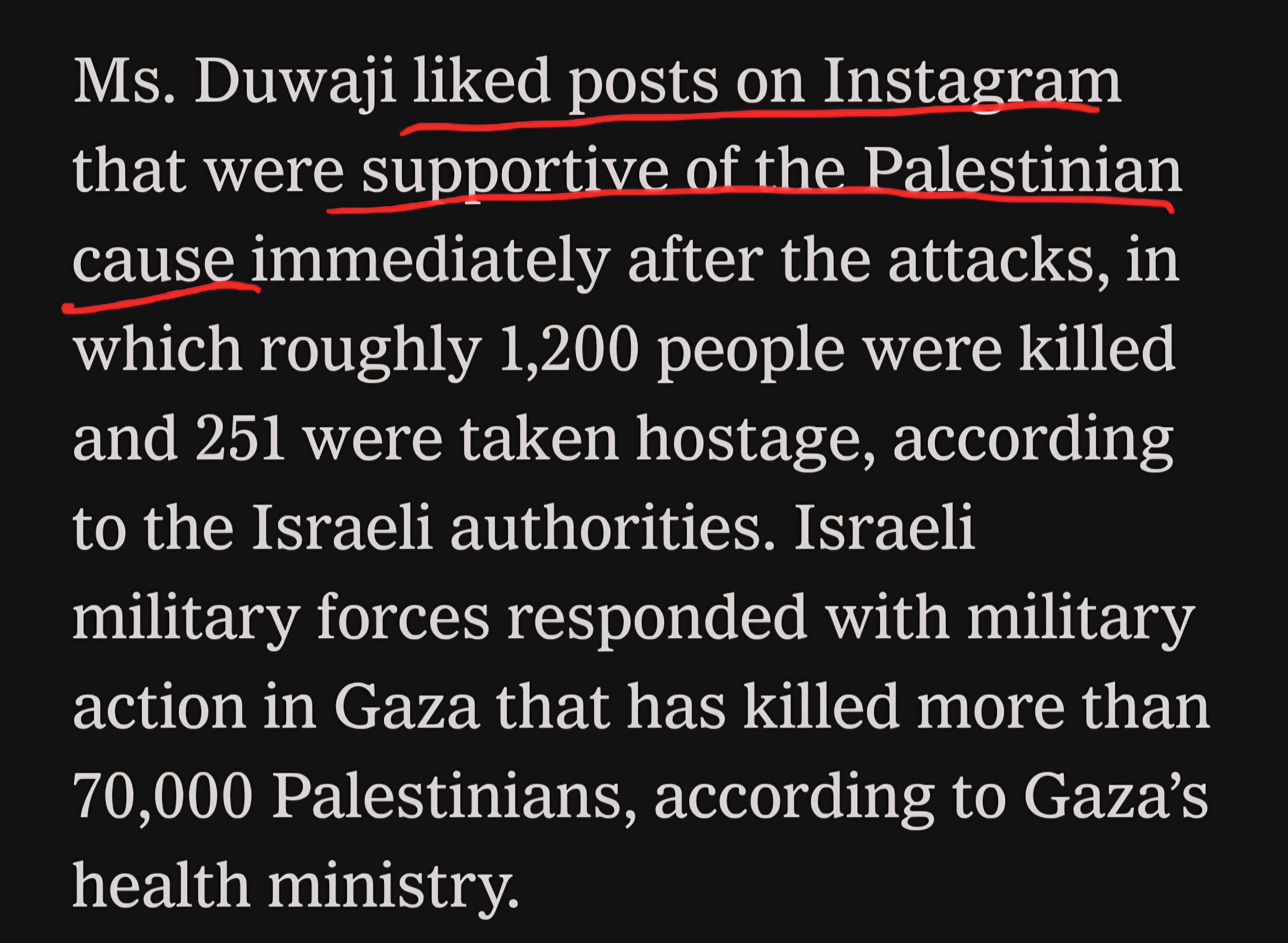
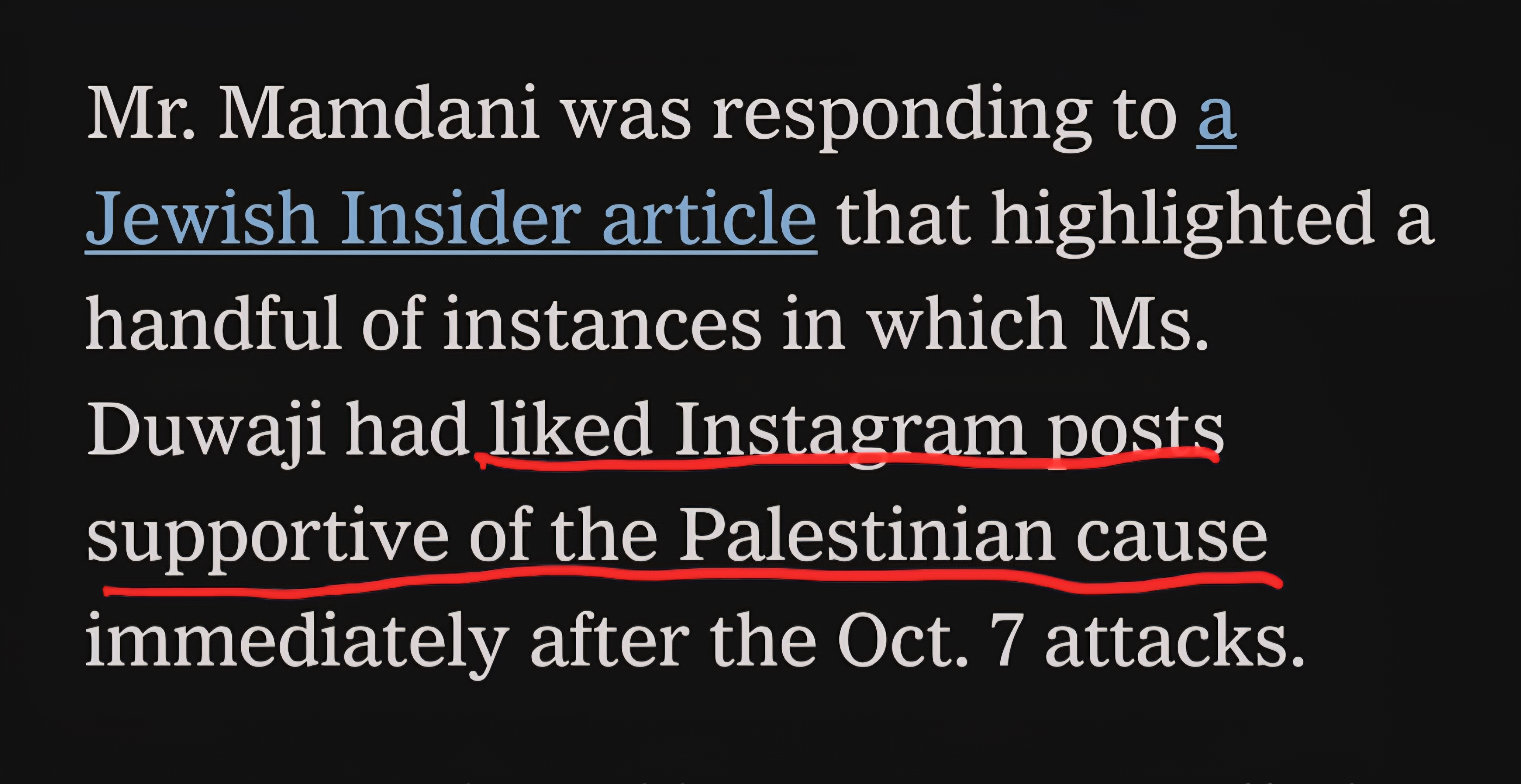
After the October 7 massacre carried out by Hamas, the New York Times described social media posts celebrating the attack as being “supportive of the Palestinian cause.” One of the examples involved Rama Duwaji, the wife of New York mayor Zohran Mamdani, who had liked posts praising the attack shortly after it occurred. At the time, Duwaji was 26 years old.

October 7 was a terrorist assault in which more than a thousand Israelis were murdered and civilians were kidnapped. Describing celebration of that massacre as support for a “cause” transforms the event itself, and radical jihadi terrorism disappears.

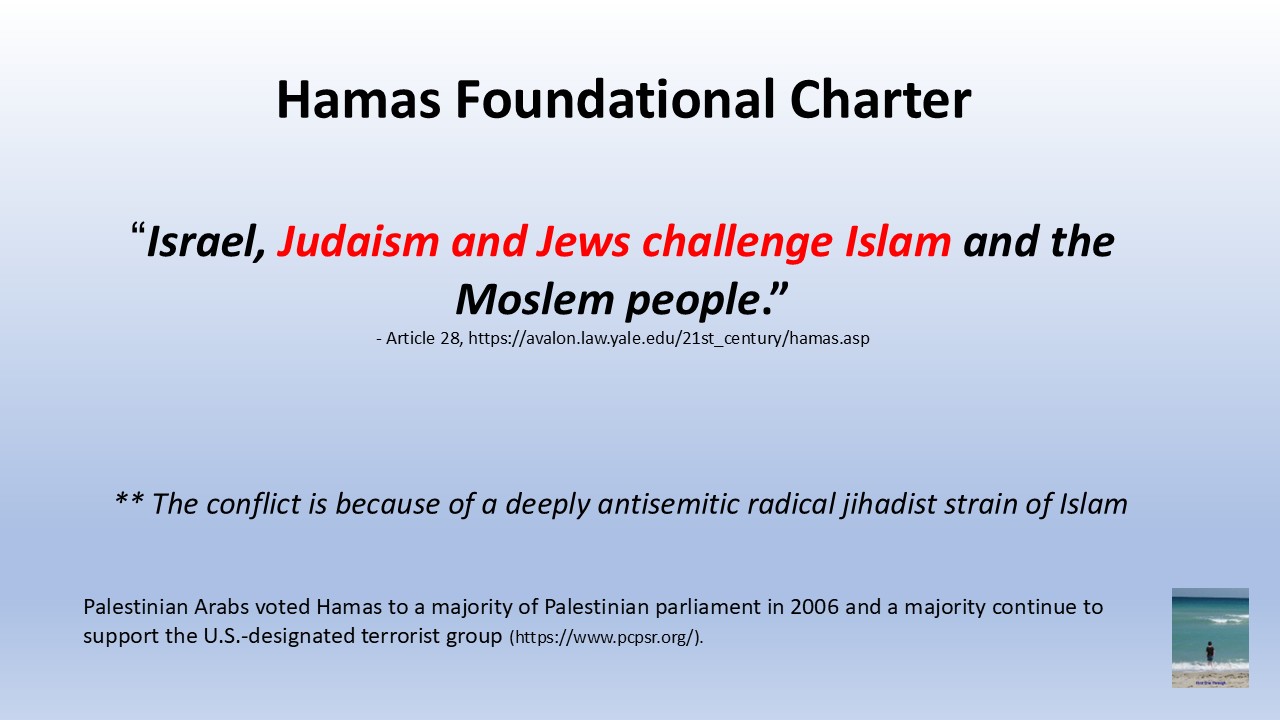
ISIS and Hamas operate in different places and pursue different strategies, but they draw from the same radical Islamist narrative that frames Jews as enemies and violence as religious duty.

Online, that narrative increasingly reaches the same audience: young people in Western societies, including young Muslims searching for identity and purpose.

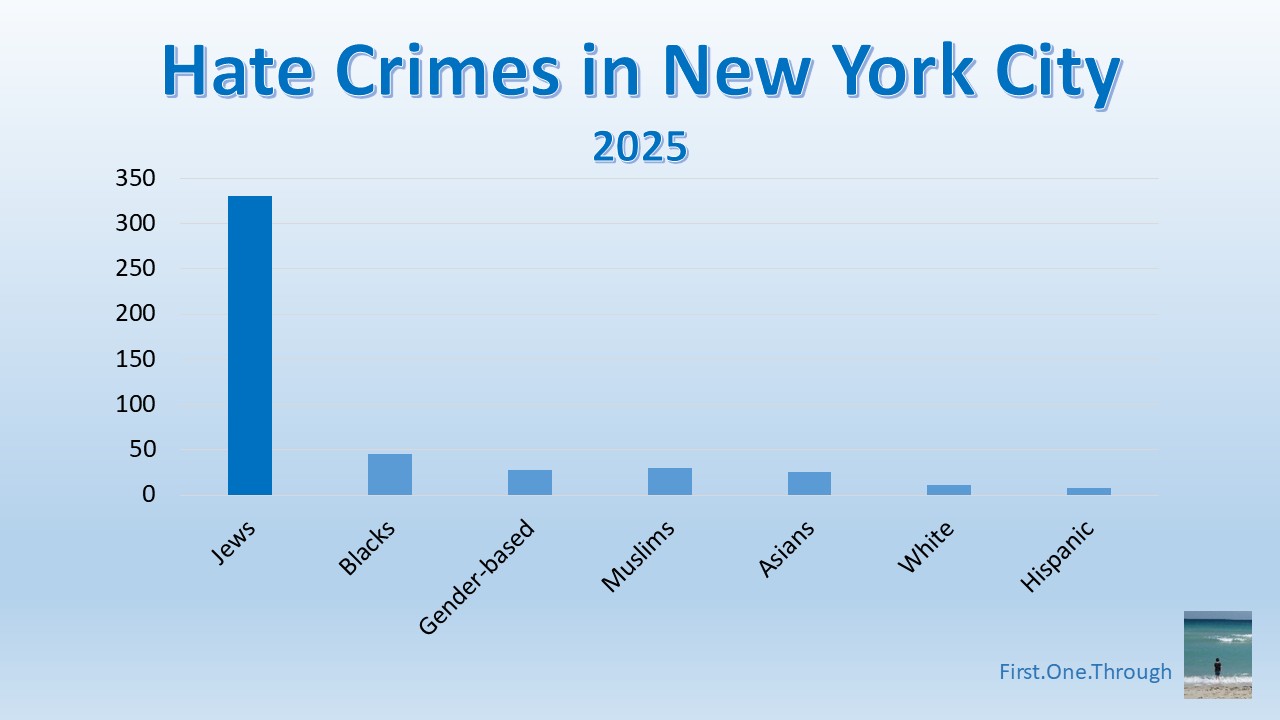
In New York the consequences are already visible. According to the New York City Police Department, Jews consistently account for the largest share of hate crime victims in the city, far out of proportion to their share of the population.

We now face two related problems.

First, there is an ideology problem. Radical Islamist movements openly encourage violence against Western societies and portray Jews as enemies in a religious struggle.

Second, there is a sanitization problem. When that ideology is softened, blurred, or renamed as a “cause,” the public cannot see the pattern.

San Bernardino.
Orlando.
The Hudson River bike path.
Bombing attempt near Gracie Mansion.
Young people celebrating Muslim massacres of Jews.

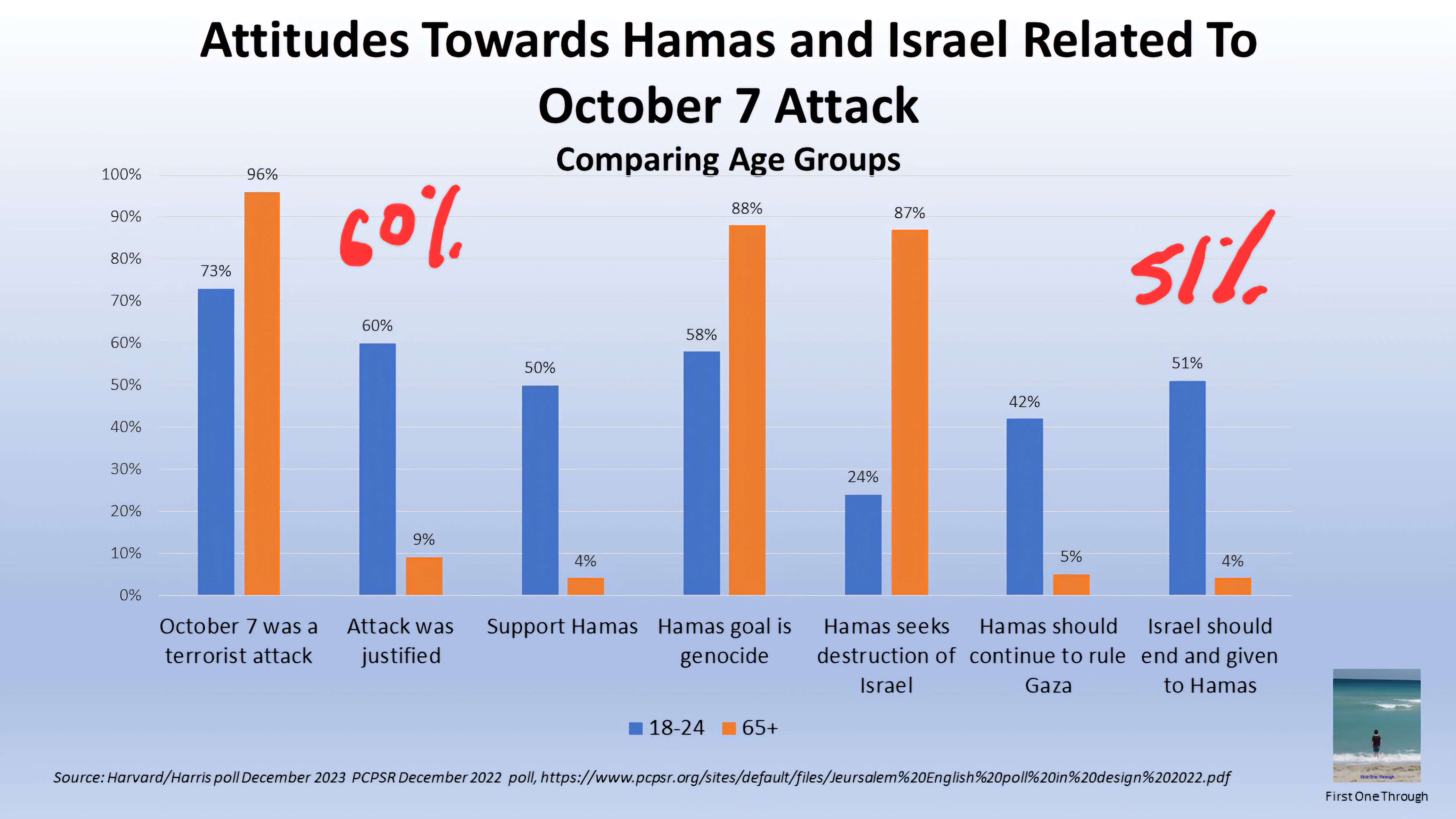
A sick 60% of Americans aged 18-24 polled said the October 7 massacre was “justified,” 50% support Hamas, and 51% said Israel should end and be handed to Hamas

Different attacks with the same ideological current reaching the same young audience, and pointing toward the same enemies.

The violence makes headlines yet the ideology poisoning western youth is being whitewashed. That is jihadi-washing, and it endangers us all.

The New York Times Calls the Massacre of Jews a “Cause”

Words matter. Especially when a newspaper chooses them carefully.

In a recent article, The New York Times wrote that New York City Mayor Zohran Mamdani’s wife, Ms. Duwaji had “liked Instagram posts supportive of the Palestinian cause immediately after the attacks,” referring to October 7.

Read that sentence again.

October 7 was the largest massacre of Jews since the Holocaust. Hamas terrorists murdered about 1,200 people, raped women, burned families alive, and kidnapped 251 civilians.

Yet approval of posts celebrating that moment is described by the Times as support for a cause.

A cause sounds political. Principled. Even noble.

But immediately after October 7 the images circulating online were not debates about borders or statehood. They were videos of murdered Israelis, kidnapped civilians, and triumphant Hamas fighters.

Calling appreciation of those posts “support for the Palestinian cause” launders the meaning of the act. The language turns approval of atrocities into activism. And it did the spin repeatedly.

Then the article pivots.

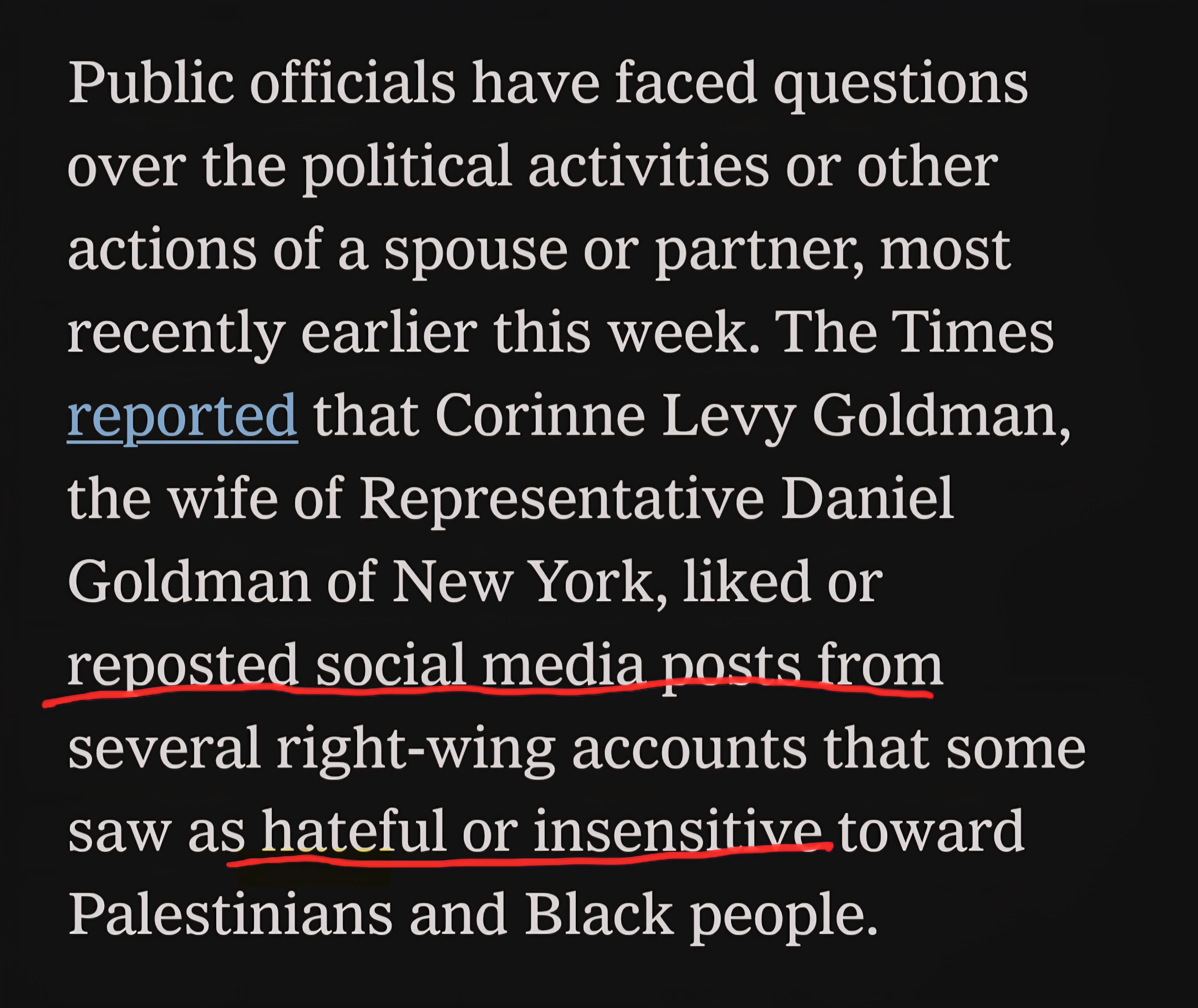
The Times raises concerns about a Jewish congressman from New York because his wife had “liked or reposted” posts from right wing accounts that some people considered hateful or insensitive.

So approval of posts DIRECTLY ABOUT a terrorist massacre is softened, while a Jewish public official becomes controversial through a chain of ASSOCIATIONS.

One situation involves praise for the moment Jews were slaughtered. The other involves subjective offense. Yet the newspaper treats them as comparable.

And this pattern did not begin here.

For years the Times has regularly described Israel’s elected government as “the most right wing in its history,” a political judgment embedded in news reporting. At the same time, the paper often avoids stating a simple fact: Hamas is a U.S.-designated terrorist organization.

So the judgmental language is applied freely to Israel and the factual label is avoided for Hamas.

Frighteningly, the framing has sunk even lower. The New York Times has moved from absolving terrorists to sanctifying the antisemitic genocidal terror itself as a “cause.”

It is a moral inversion that reflects a deeper rot in how the story is being told.

And it arrives at a moment when hostility toward Jews is rising once again across the world, seemingly with the endorsement of The New York Times.

Two Condemnations, One Moral Collapse

By any ordinary moral standard, the murder of worshippers in a house of prayer should provoke the clearest possible response: name the crime, demand justice, stand with the people and the government under attack. No hedging. No balancing. No political caveats.

The United Nations does that, except when Israeli Jews are the victims.

Read the paired statements issued by António Guterres after two attacks on places of worship: one at a mosque in Pakistan, the other at a synagogue in Jerusalem. The contrast reveals a complete moral collapse at the heart of the global body.

This matters even more because the Jerusalem statement was issued before Israel responded to October 7, 2023. Before Gaza. Before counteroffensives. Before a single Israeli military action the UN would later cite as justification for its posture.

Restraint was not urged because of Israeli action. It was urged instead of justice itself.

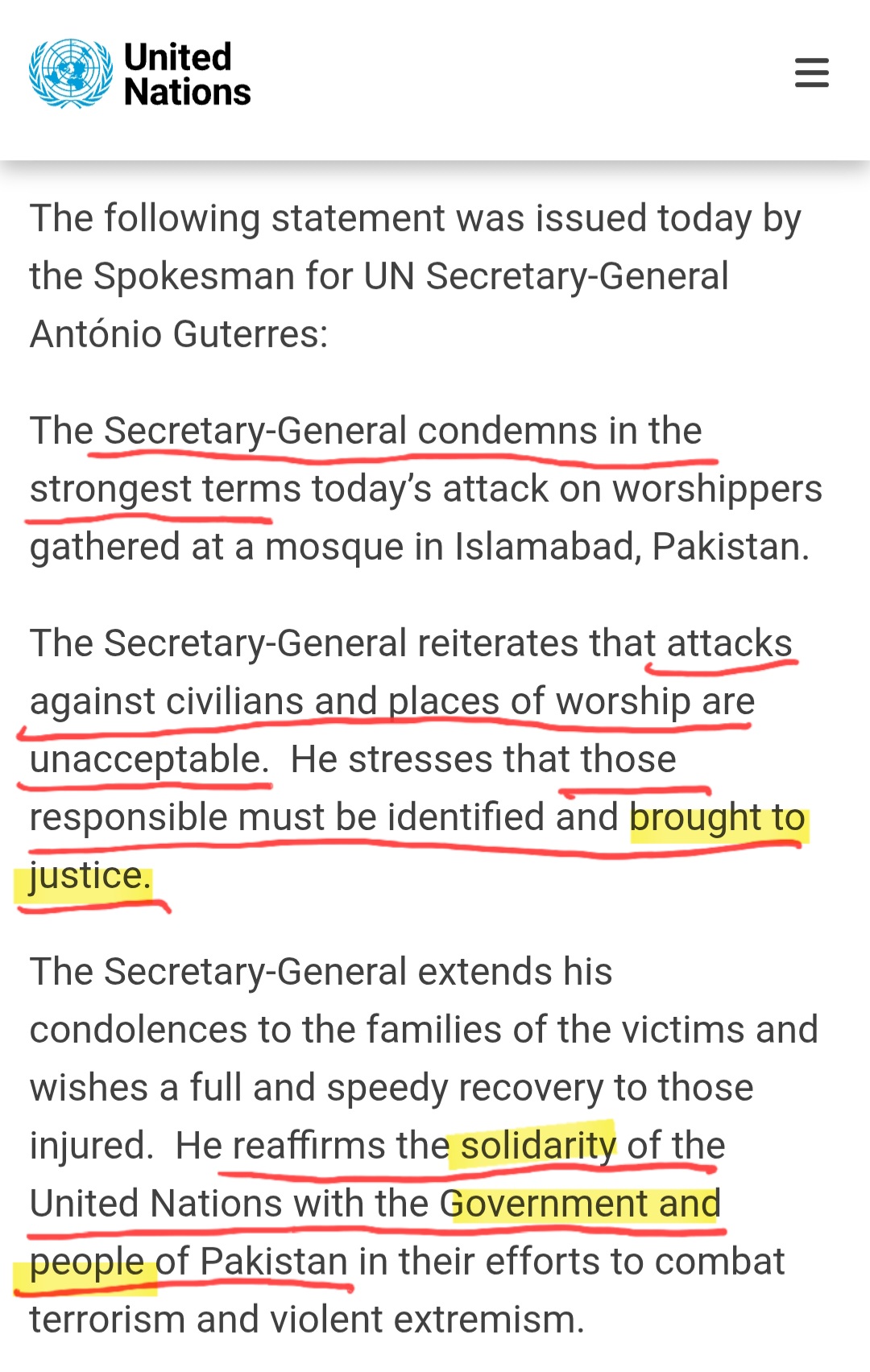
Statement by UN Secretary-General Antonio Guterres in February 2026 about the bombing of a mosque in Pakistan

In Pakistan, the Secretary-General “condemns in the strongest terms” the attack on worshippers. He demands that the perpetrators be “identified and brought to justice.” He affirms the “solidarity of the United Nations with the Government and people of Pakistan” and situates the crime squarely within the global fight against terrorism and violent extremism.

That is what moral clarity looks like.

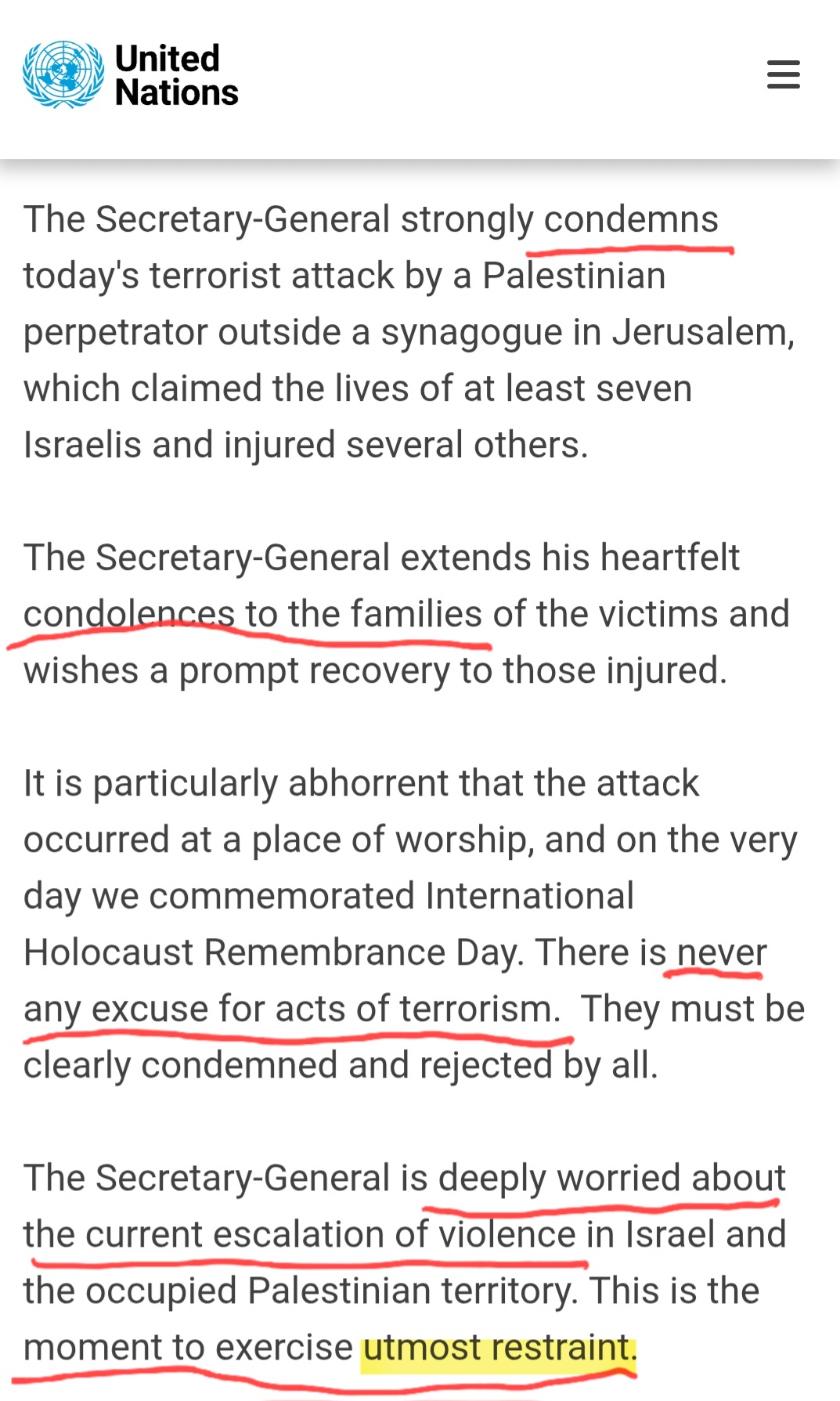
Yet in Jerusalem, when Jews are murdered outside a synagogue in 2023—on International Holocaust Remembrance Day- a whisper. The Secretary-General “strongly condemns” the attack. He offers condolences. He notes that it is abhorrent to attack a place of worship. And then he pivots—not to justice, not to accountability, not to solidarity with the state charged with protecting its citizens.

He pivots to restraint.

Statement by UN Secretary-General Antonio Guterres in January 2023 about murder of Jews outside Jerusalem synagogue

The synagogue becomes a geographic detail. The murders are folded into “the current escalation in Israel and the occupied Palestinian territory.” There is no demand that the killers be found. No insistence on prosecution. No solidarity with the Government of Israel. No recognition that deterrence requires consequence.

This is not diplomatic caution. It is moral abdication.

This did not begin with Guterres

If this were merely the idiosyncrasy of one Secretary-General nearing the end of his ten year tenure, it might be dismissed as tone or temperament. It is not.

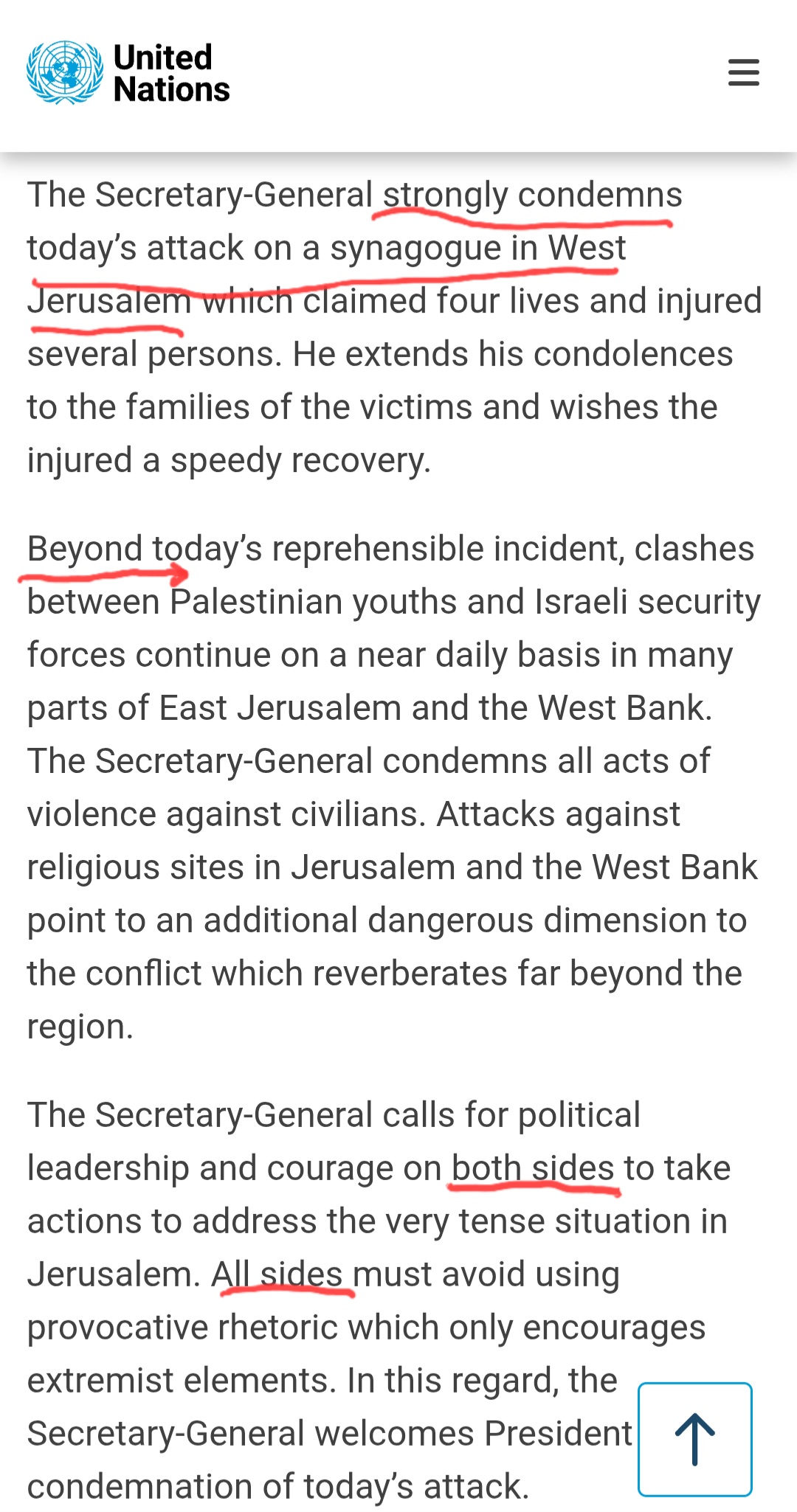
In 2014, after Arab terrorists entered a synagogue in Jerusalem wielding meat cleavers and hacked Jewish worshippers to death, Ban Ki-moon issued a statement that follows the exact same structure.

Statement by UN Secretary-General Ban Ki Moon in January 2014 about murder of Jews inside Jerusalem synagogue

He “strongly condemns” the attack. He offers condolences. And then—almost immediately—he moves “beyond today’s reprehensible incident” to discuss “clashes between Palestinian youths and Israeli security forces.” The massacre is submerged into “the situation.” The killers disappear into context.

There is no call to bring the perpetrators to justice.
No solidarity with the Israeli government.
No affirmation of Israel’s duty to eradicate the threat.

Instead, Ban Ki-moon calls for leadership on “both sides”, urges all parties to avoid “provocative rhetoric,” and frames the slaughter of Jews in a synagogue as a destabilizing dimension of the conflict—not as terrorism demanding elimination.

Different Secretary-General. Same choreography.

The explanation is not mysterious because the United Nations does not conceptualize Palestinian violence as extremism.

Extremism, in UN doctrine, is something that happens elsewhere—to states battling jihadists, insurgents, or transnational terror networks. Palestinian murder, by contrast, is treated as political expression: contextualized by grievance, softened by narrative, absorbed into a permanent dispute. It is violence to be managed, not defeated.

That is why justice is demanded in Pakistan and restraint is demanded in Jerusalem. One fits the UN’s extremism framework. The other does not.

“Restraint” here is not a plea for peace. It is a veto on justice.

When Jews are murdered, the UN permits mourning but denies agency. Condolences are extended to families, while the legitimacy of Jewish self-defense and Jewish sovereignty is quietly withheld. Sympathy is offered—but solidarity with the state is conspicuously absent.

The global body created in the shadow of the Holocaust cannot bring itself to say, plainly, that Jews murdered in synagogues deserve the same moral response as anyone else. It cannot say that Jewish sovereignty is legitimate. It cannot say that justice must follow Jewish bloodshed.

And the Stateless Arabs from Palestine (SAPs), its perennial wards, must be granted absolution.

Israel should draw the only conclusion that matters: the United Nations is not a moral compass or humanitarian organization. It is purely a political instrument.

#terrorismnotterrorism

Radical Arab “Settlers”

Palestinian terrorism has names when it is organized. Hamas. Palestinian Islamic Jihad. There is a long list of U.S.-designated foreign terrorist groups under the Palestinian banner. Yet the most persistent form of Palestinian terrorism over the last two decades carries no collective name at all.

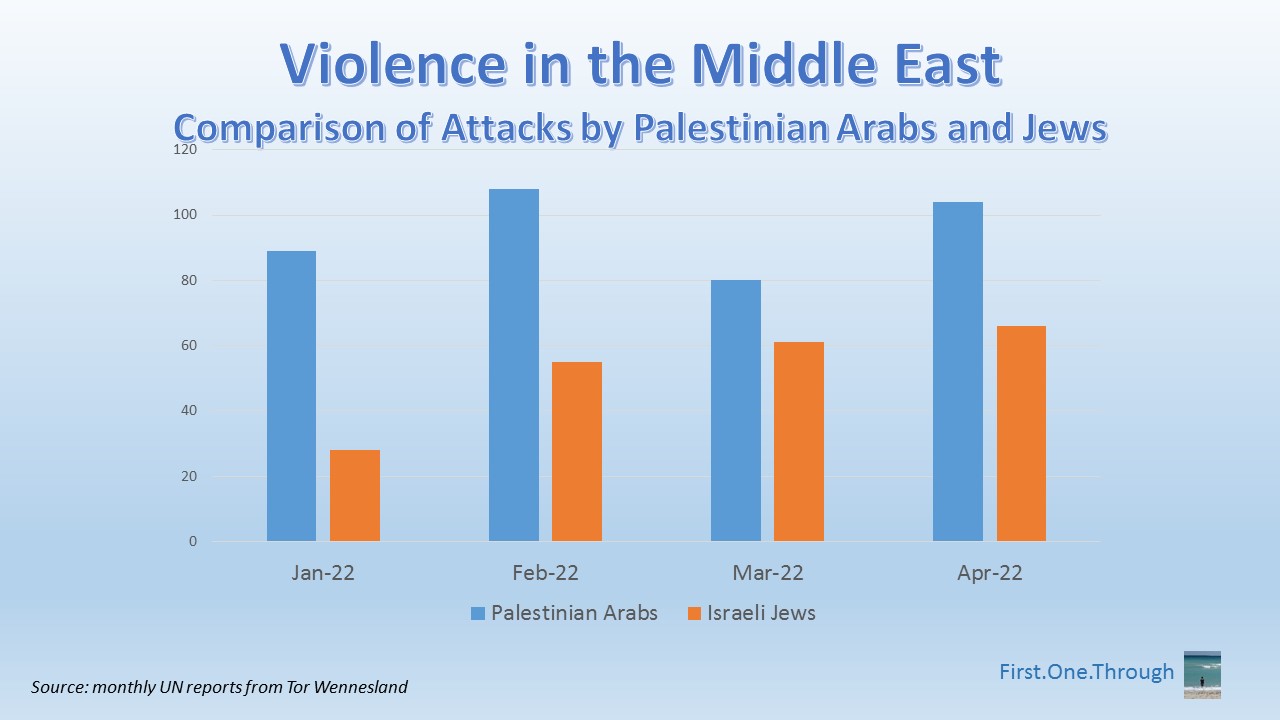
More than a thousand Stateless Arabs from Palestine (SAPs) have carried out individual fatal terrorist attacks—stabbings, shootings, vehicle rammings, ambushes at bus stops and junctions. The numbers recur year after year. The pattern holds. The vast majority originate in the land east of the 1949 Armistice Lines (E49AL) / “West Bank”.

Monthly tally of attacks by SAPs and Jews in the first four months of 2022, according to the biased United Nations

Calling these attackers “Palestinian lone wolves” obscures reality. Calling them Palestinian residents either creates a country of Palestine or integrates them into a historic landscape. The term “lone wolves” suggests isolation, desperation, a last act. The record shows the opposite. These young attackers are recognized, rewarded, and revered. Their names and faces appear on posters. Schools and streets carry their memory. Their families receive honor and money. The murderers are beatified as “martyrs.”

Civil societies do not ritualize acts they consider shameful or marginal.

Now consider how language works in parallel. Jewish civilians beyond the Green Line are routinely grouped under a single brand: “settlers.” The word does not describe residence; it passes judgment. It frames their presence as inherently illegitimate before any act occurs. When they are attacked, their civilian identity is eclipsed by a political label.

Branding does the moral work in advance.

The empirical comparison is stark. Jewish extremist violence exists and must be prosecuted. Its character is overwhelmingly vandalism and property damage—graffiti, burned fields, slashed tires. Criminal acts that generate repairs, arrests, and charges.

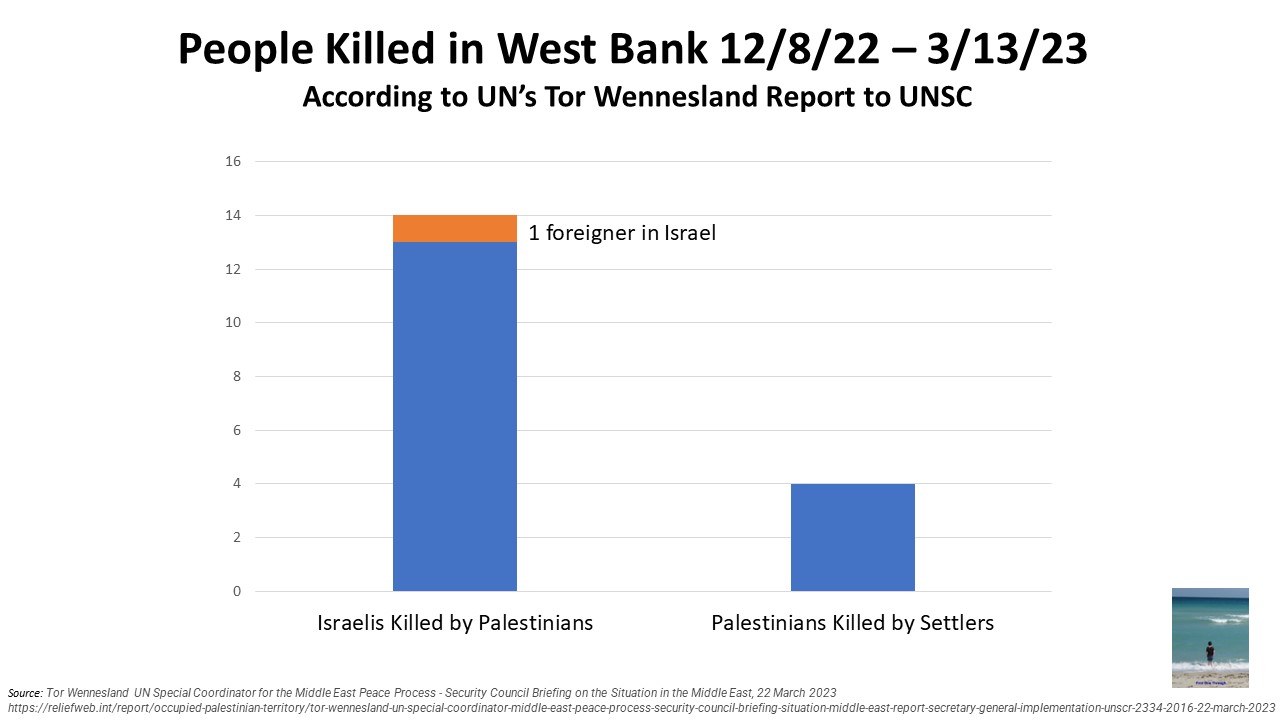
By contrast, the murders committed by individual SAPs, dwarf Jewish extremist killings by orders of magnitude. Funerals versus invoices. Deaths versus damage. Yet language reverses scale: property crimes are collectivized and politicized, while a long ledger of killings is broken into nameless “incidents.”

People killed in West Bank according to United Nations report, over end of 2022 and start of 2023 in which Tor Wennesland vilified Israel and the “settlements”

The cultural backdrop makes this impossible to dismiss as fringe behavior. Polling by Palestinian Center for Policy and Survey Research (PCPSR) consistently shows that SAPs in the West Bank express higher levels of support for violent attacks—including October 7—than Arabs in Gaza.

Polls by PCPSR show West Bank Arabs more in favor than Gazans of killing Jews, the October 7 massacre, and destroying the Jewish State

Repetition is evidence.
Veneration is evidence.
Polling is evidence.
Together they point to a culture of violent jihad in the West Bank, sustained socially even when it is executed individually.

Terror does not require a logo to qualify. It requires intent, repetition, and outcome. What persists in the West Bank is a durable campaign of individual terrorism, encouraged by culture and rewarded by society, while its victims are linguistically transformed into abstractions called “settlers,” not innocent Jewish civilians.

This is absolution via euphemism. Turning Jewish civilians into perpetrators for existing, while shielding Arab murderers under a cloak of topography.

It is plainly wrong. It is evil. It persists.

Chabad Caught In a Thicket

There are Jews who keep their heads down. And then there is Chabad.

From Bondi Beach to Mumbai, from Barcelona to American college campuses, Chabad does the opposite of what fear would counsel. It does not retreat inward. It goes outward—publicly, cheerfully, stubbornly—lighting candles, setting tables, opening doors.

And for that, it bleeds.

In Australia, Chabad helped organize a large public Chanukah gathering near Bondi Beach—sun, music, children, light. A Jewish holiday celebrated exactly as it was meant to be: openly, without apology. Antisemites came – because, as they say of bank robbers robbing banks – that’s where the Jews are. Violence came to eradicate the joy.

In India, Chabad paid an even heavier price. During the 2008 Mumbai attacks, terrorists deliberately sought out the Chabad House. This was not collateral damage in a geopolitical struggle between India and Pakistan. It was targeted slaughter. The rabbi and his wife were tortured and murdered because they were Jews—and because they were visible Jews, serving other Jews. The attackers bypassed many targets to reach them. They knew exactly who they were looking for.

This pattern repeats itself with chilling consistency. Chabad emissaries—shluchim—are not anonymous. They live openly as Jews in places where Jews are few, where governments barely register their presence, let alone prioritize their safety. Some countries have only dozens of Jews. Some have none at all, except for Chabad.

And still Chabad goes.

On Friday nights in Barcelona, Jewish life gathers around Chabad tables. Tourists, locals, students—many unaffiliated, many unsure—find Judaism not as a political identity or an abstract cause, but as food, song, wine, warmth. As Shabbat.

On university campuses across North America, Chabad events now regularly outshine Hillel. This is not accidental. Where Hillel has often drifted toward “wokeness,” flattening Judaism into a vague social-justice aesthetic, Chabad offers something older and sturdier: tradition without embarrassment. Commandments without footnotes. Jewish joy without ideological permission slips.

That, too, draws attention. And danger.

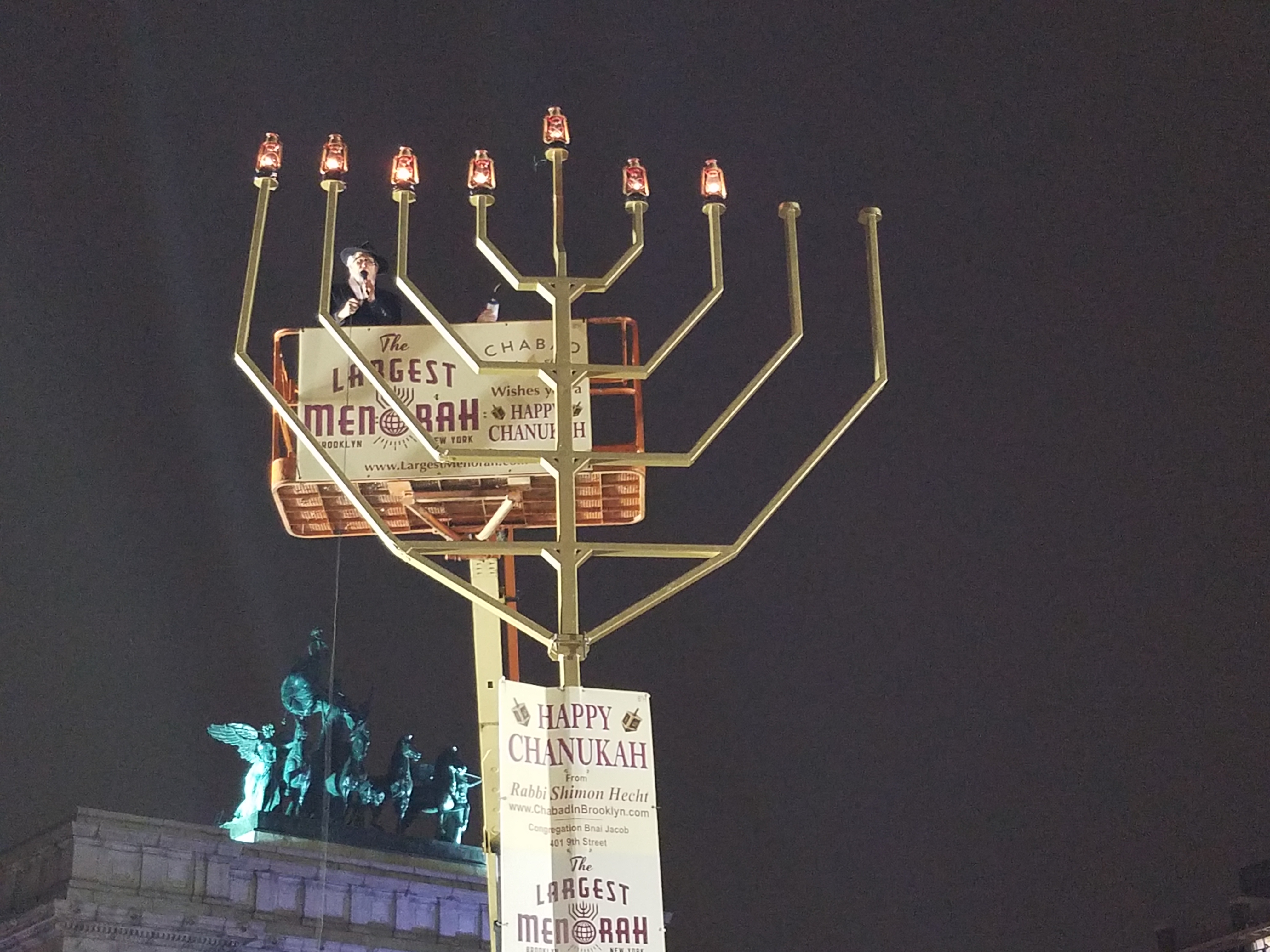
Chabad rabbis and their families know they wear a mark, and not metaphorically. They live without anonymity. They publish their addresses. They welcome strangers. They light menorahs in public squares at a moment in history when public Jewishness has been recast as a provocation.

Chabad lighting “the largest menorah” on the sixth night of Chanukah in Brooklyn’s Grand Army Plaza in 2017 (photo: First One Through)

Chanukah, of all holidays, insists on this. It is not meant to be hidden. The lights are placed in windows, at doorways, facing the street. Pirsumei nisa—publicizing the miracle—is the law. Chabad takes it seriously, even when the risk feels immediate.

In a world where Jew-hatred has resurged with startling comfort, Chabad has become something else as well: exposed in the spotlight.

There is an old biblical image for this.

When Abraham is told to sacrifice Isaac, the knife is raised but the sacrifice is halted. Instead, a ram appears, caught in a thicket by its horns. The ram is offered in Isaac’s place.

Chabad, today, feels like that ram.

Silhouette of two Chabad men at a Chankah lighting ceremony on the Upper East Side of Manhattan, shortly after the massacre of Jews in Bondi Beach, Australia in December 2025. Just a few hundred feet away sits Gracie Mansion, soon-to-be home of New York City’s new mayor, Zohran Mamdani, who refuses to repudiate the phrase “Globalize the Intifada,” a call to kill diaspora Jews. (photo: First One Through)

Not because Chabad seeks martyrdom—it emphatically does not. It absorbs the blows meant for Jewish visibility itself. It becomes the target because it brings together Jews to celebrate Judaism with gladness – the ultimate point of inflammation for antisemites.

The world often says it wants Jews to be “normal.” Chabad refuses that bargain. It insists on being Jewish instead—fully, visibly, joyfully—even when the cost is high.

Chabad is not actually caught in a thicket; it takes its position openly. But antisemites hear a calling that is not divine but grotesque when they see joyful Jews, and are willing to sacrifice themselves and their sons – like the murderers of Bondi Beach – to feed the poisoned passion.

The Little Drummer Boys of Terror

President Obama once derided those who warned of Iran’s nuclear ambitions as promoting a “drumbeat of war.” It was a curious charge, especially as his negotiated JCPOA deal paved Iran’s legal pathway to nuclear weapons within a decade—despite Tehran’s unabashed calls to utterly destroy an American ally, and referred to the United States as “Satan.”

The phrase “drumbeat of war” is worth pausing over, because its imagery is meant to point a damning finger at generals and war profiteers, when in fact it refers to a beating passion that comes from a variety of sources.

Music itself teaches us the power of the drumbeat. Maurice Ravel’s “Bolero” begins as a whisper—a single snare tapping a faint rhythm—but its relentless pattern swells, layer by layer, into a rapturous explosion. Nothing changes except the intensity. It is a master class in how a simple beat, repeated without interruption, can inflame emotion, tighten resolve, and propel an entire orchestra toward an inevitable climax. Passion grows not from complexity but from persistence.

Cinema took that lesson to the battlefield. Ennio Morricone’s “L’Arena,” born from spaghetti-western duels and later carried into modern war films, shows how percussion can elevate tension into confrontation. Its pounding drums accompanied by trumpets push characters toward conflict; the beat does not merely accompany battle—it summons it. Morricone understood that rhythm can be a weapon, a psychological drumroll that makes violence feel fated long before the first shot is fired.

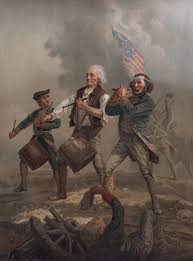
In American history, drummers were not symbolic ornaments—they were battlefield communicators. The famous “Spirit of ’76” painting captures a young boy and an old man beating time through the fog of revolution. In both the Revolutionary War and the Civil War, the drummer corps relayed commands, kept formation, and lifted morale. Soldiers needed to be adults to enlist, but drummer boys could be barely in their teens. They were not the policymakers of war; they were the ones whose youthful energy pushed men forward into battle.

“The Spirit of ’76” (1875) by Archibald Willard (1836-1918)

It is an uncomfortable truth: the drumbeat of war is often carried not by governments or generals but by the young.

We like to imagine youth as the innocent bystanders of conflict—swept up, exploited, or victimized by forces beyond their control. That is often tragically correct. But not always. In the Middle East, teenage Palestinian Arabs have repeatedly been at the center of anti-Jewish violence. During the knife intifada of 2015–2016, most of the attackers were adolescents. Arabic media even gave them a romanticized nickname: Ashbāl al-Quds—the lion cubs of Jerusalem.

On October 12, 2015, two Palestinian boys, 15-year-old Hassan Khalid Manasra and his cousin 13-year-old Ahmad Manasra, stabbed two Israeli civilians in Jerusalem

They were not pawns in someone else’s narrative. They were active participants in it.

While they were stabbing Israelis in the streets, new legions of drummer boys was forming. The Lions’ Den was inaugurated in the West Bank to unleash dozens of attacks. The United Arab Emirates named a school for children for these young murderers. In the United States, a group calling itself the Palestinian Youth Movement openly glorifies the murderers of October 7 and calls for an intifada on American soil. They harass Jews at universities, shut down bridges, disrupt traffic, and chant for “uprisings”—all under the pretext of activism, and often shielded by tax-exempt organizations like WESPAC.

In the immediate aftermath of the October 7, 2023 massacre by Gazans of Israelis, Cornel West marches with PYM calling for an “Intifada revolution”. West has taught at Princeton, Harvard and Yale, indoctrinating the next generation of American leaders on intifada.

The drumbeat is steady. It is disciplined. And it is aimed squarely at Jews.

Where does this beat begin? It is not in the Israeli cabinet rooms the media delights in blaming. It begins at UNRWA schools, where generations of children are taught that Jews are colonial invaders with no history in their homeland. It echoes through activist teacher unions in the United States, where “decolonization” rhetoric is repackaged into lesson plans that erase Jewish indigeneity. It thunders at the United Nations, where Muslim-majority blocs and their allies advance resolutions asserting that Jews must be removed from Judea, Samaria, and even parts of Jerusalem “by any means necessary.” The young Palestinian Arab terrorist are then shielded from blame and prosecution by the poorly named “UN Coordinator for Middle East Peace.” Laughable if not such a tragedy.

The young listen. And they march.

At Christmastime, the world hears “The Little Drummer Boy”—a melody of humility. A child with nothing to give but a simple rhythm of devotion for a newborn Jewish baby in Bethlehem. A beat based on innocence and purity.

But the modern Middle East and its Western echo chambers have perverted that image.

Today’s little drummer boys are not offering gentle hymns. They are being raised, trained, and celebrated for a beat of hatred—an indoctrinated cadence that valorizes “martyrs,” delegitimizes Jews, romanticizes violence, and promises glory for those who shed blood.

The world should hear the drumbeat. And it should finally ask: Who handed these children the drums? Who taught them that murder is heroism, that Jews are prey, that violence is virtue?

These teenagers did not invent the rhythm—they are marching to a score composed by UN agencies, radicalized teachers, political opportunists, and ideological arsonists who hide behind the language of “justice” while grooming minors for war.

UN Watch’s Hillel Neuer presents new report, “Schools in the Grip of Terror: How UNRWA Allowed Hamas Chiefs to Control its Education System,” to the Italian Senate in September 2025

At Christmas, we think of a young drummer offering a humble gift to a Jewish child in Bethlehem. Alas, today too many young drummers are taught to offer not devotion, but destruction—and the world nods along as if the rhythm were unavoidable. It isn’t.

The beat continues only because we refuse to silence the conductors who train the next generation of drummers to hate.