The New York Times Participates in Antisemitism as It Attempts to Whitewash It to Protect El-Sayed and the Democratic Party

Democratic Congresswoman Haley Stevens did something extraordinary on November 1, 2026. Two days before the election, she endorsed Republican Mike Rogers over her own party’s Senate nominee, Abdul El-Sayed, who had defeated her in Michigan’s Democratic primary.

She explained why.

“We have to stand with country. We can’t stand with hate. We can’t stand with Hasan Piker.”

Stevens specifically condemned Piker, warning about his influence on college campuses and the hatred being spread to young people.

Piker is no obscure activist. The internationally followed livestreamer reaches millions online, appears at universities and campaigns alongside prominent Democrats, including El-Sayed at an April rally at the University of Michigan.

Days before Stevens’ endorsement, Piker had compared West Bloomfield, a heavily Jewish Detroit suburb, to a Ku Klux Klan neighborhood. “It’s racial supremacy. It’s Jewish supremacy,” he declared.

This was the same community where a synagogue and preschool had been targeted in an attempted terrorist attack earlier in the year.

Piker has a long history of stoking Jew hatred and had previously described Israeli and Orthodox Jews as “inbred” and “psychopaths,” compared Jews in Judea and Samaria to the KKK and repeatedly invoked Jewish supremacy. His rhetoric had traveled well beyond Michigan, gaining enormous audiences and legitimacy through appearances alongside political candidates.

El-Sayed had proudly campaigned with Piker before distancing himself from some of his statements. Another controversy involved Cenk Uygur, whose advertisement linked rising grocery prices to American assistance to Israel, even though annual military spending to it is less than 5% of what America spends on its military abroad, and has sent six times as much money to Ukraine for its defensive war against Russia as the US sent to Israel for its defensive war against genocidal Palestinian Arabs. Stevens condemned the advertisement as antisemitic. El-Sayed only disavowed its message.
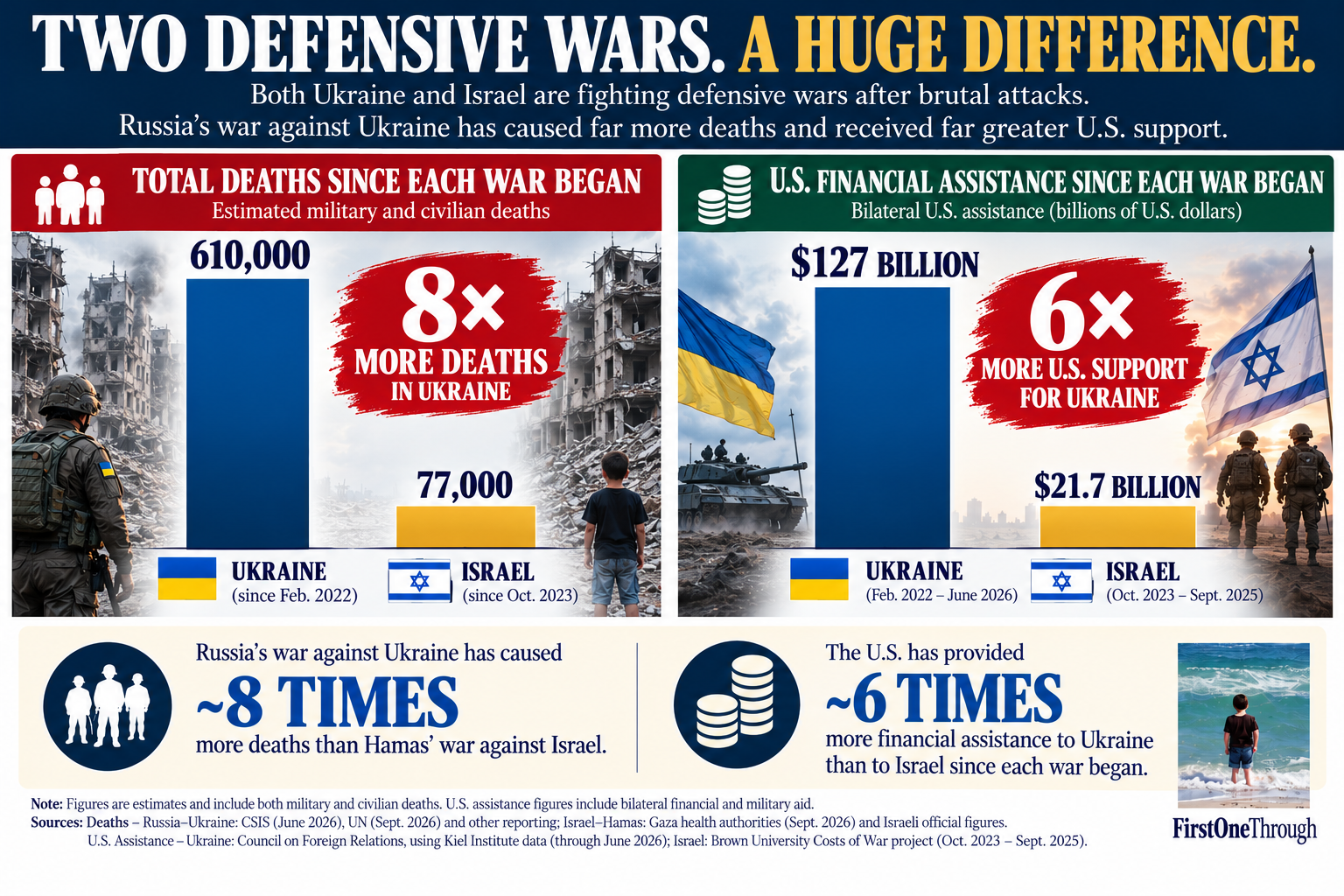
Stevens nevertheless concluded that she could not support him.

Then came The New York Times.

Its article, “Inside the Abdul El-Sayed-Haley Stevens Meltdown in Michigan,” explained in the subheading that the relationship had shattered partly because of Israel, “but also because of their sensitive egos and hurt feelings.”
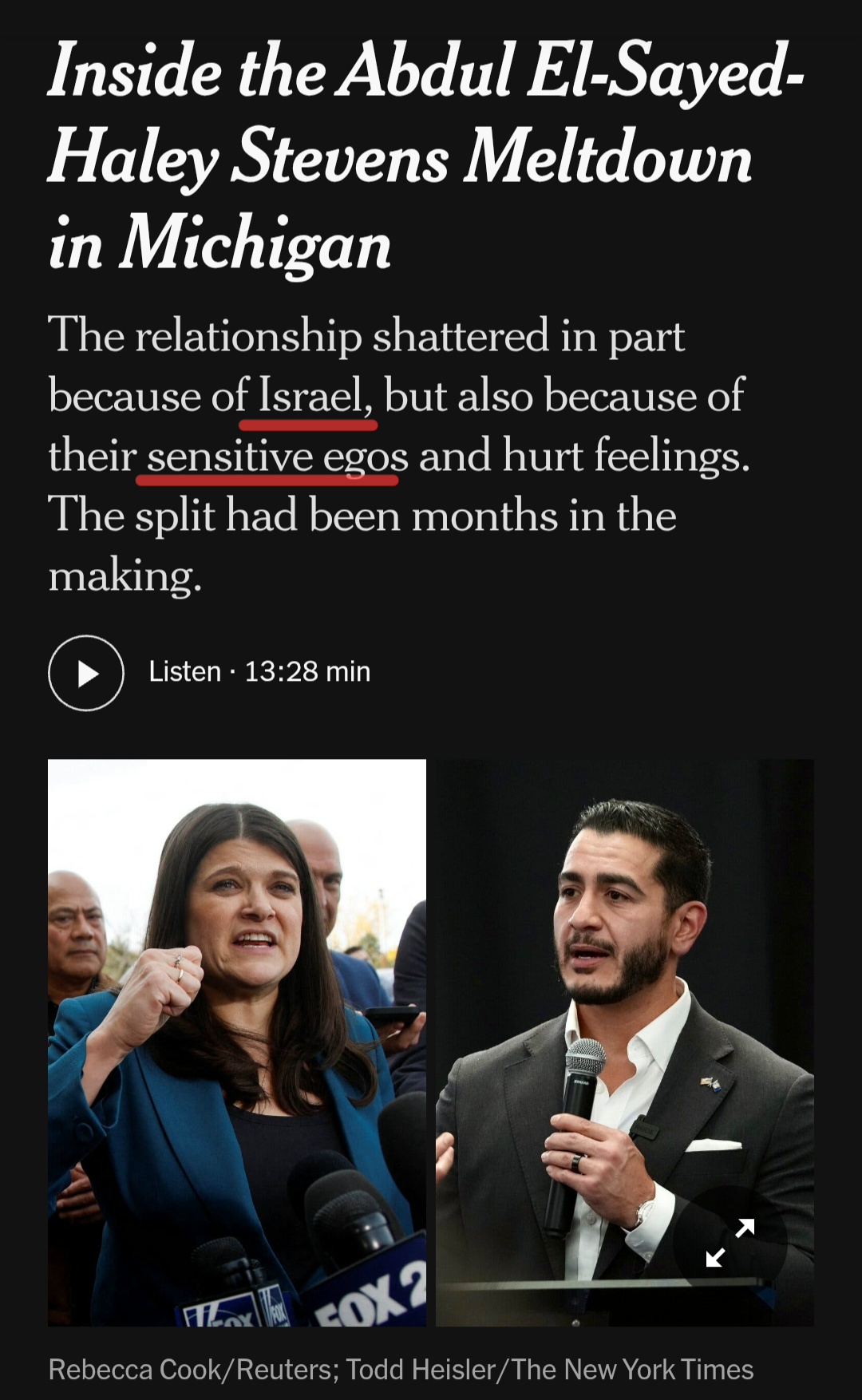
Sensitive egos? Hurt feelings?

The newspaper described Stevens as “still absorbing her primary loss” and feeling “scorned” by El-Sayed’s failure to include her in campaign events. It quoted a Democratic operative blaming the spectacle on “one person”—Stevens.
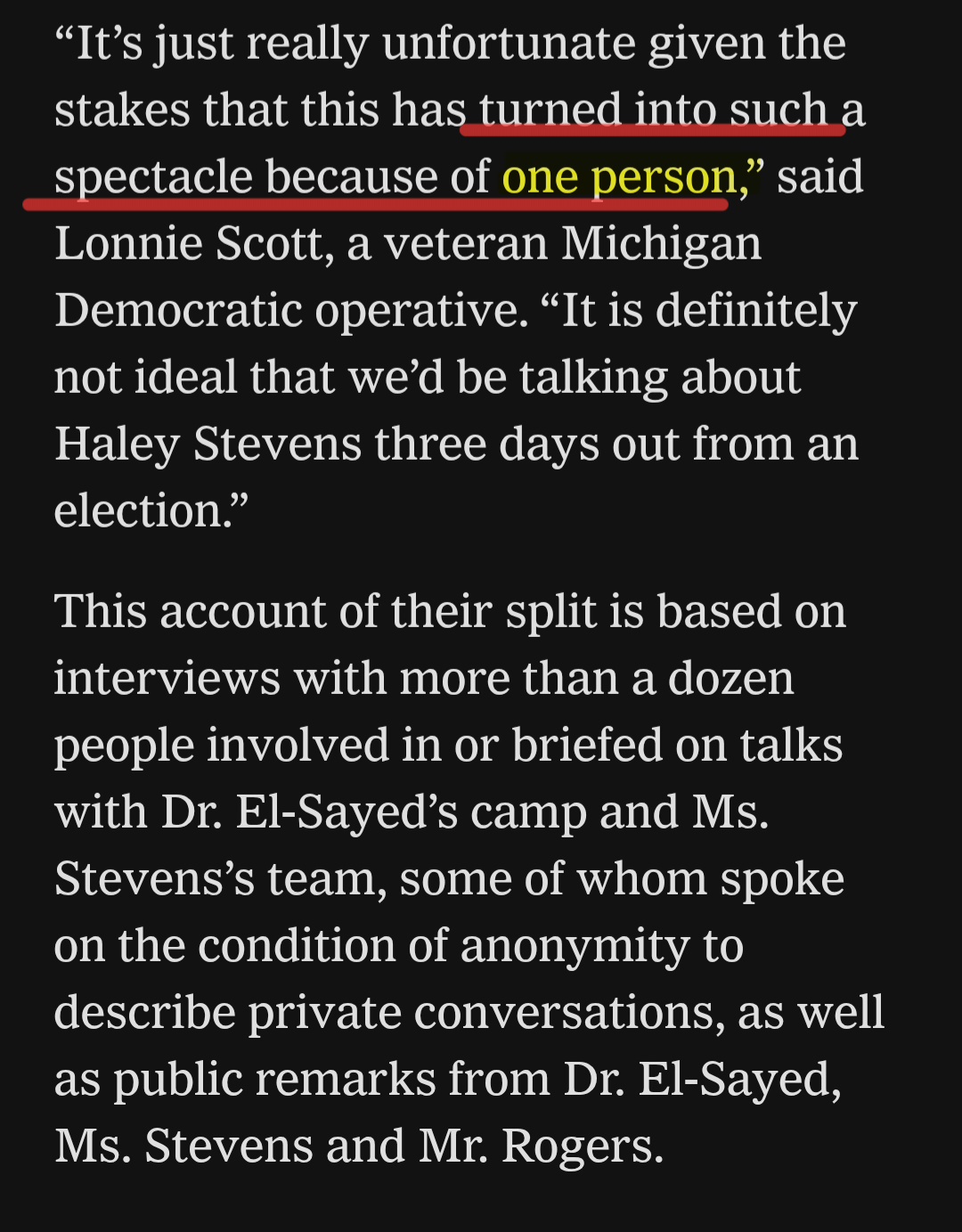
One person? What about the Jews who were being attacked?

The Times declared that “at the root of the disagreement” was American policy toward Israel. It detailed AIPAC’s spending against El-Sayed, Stevens’ attachment to Israel, her Jewish fiancé, his donations to AIPAC and her consideration of converting to Judaism.

Yet it never named Hasan Piker, whom Stevens repeatedly condemned, or Cenk Uygur, whose advertisement had sparked another confrontation. Uygur became merely “an ally.”

Most remarkably, the only time the word “antisemitism” or “antisemitic” appeared was when this so-tarred overly sensitive person said that “she viewed” the ad as antisemitic when in fact it was widely viewed as antisemitic, even among Democratic politicians.
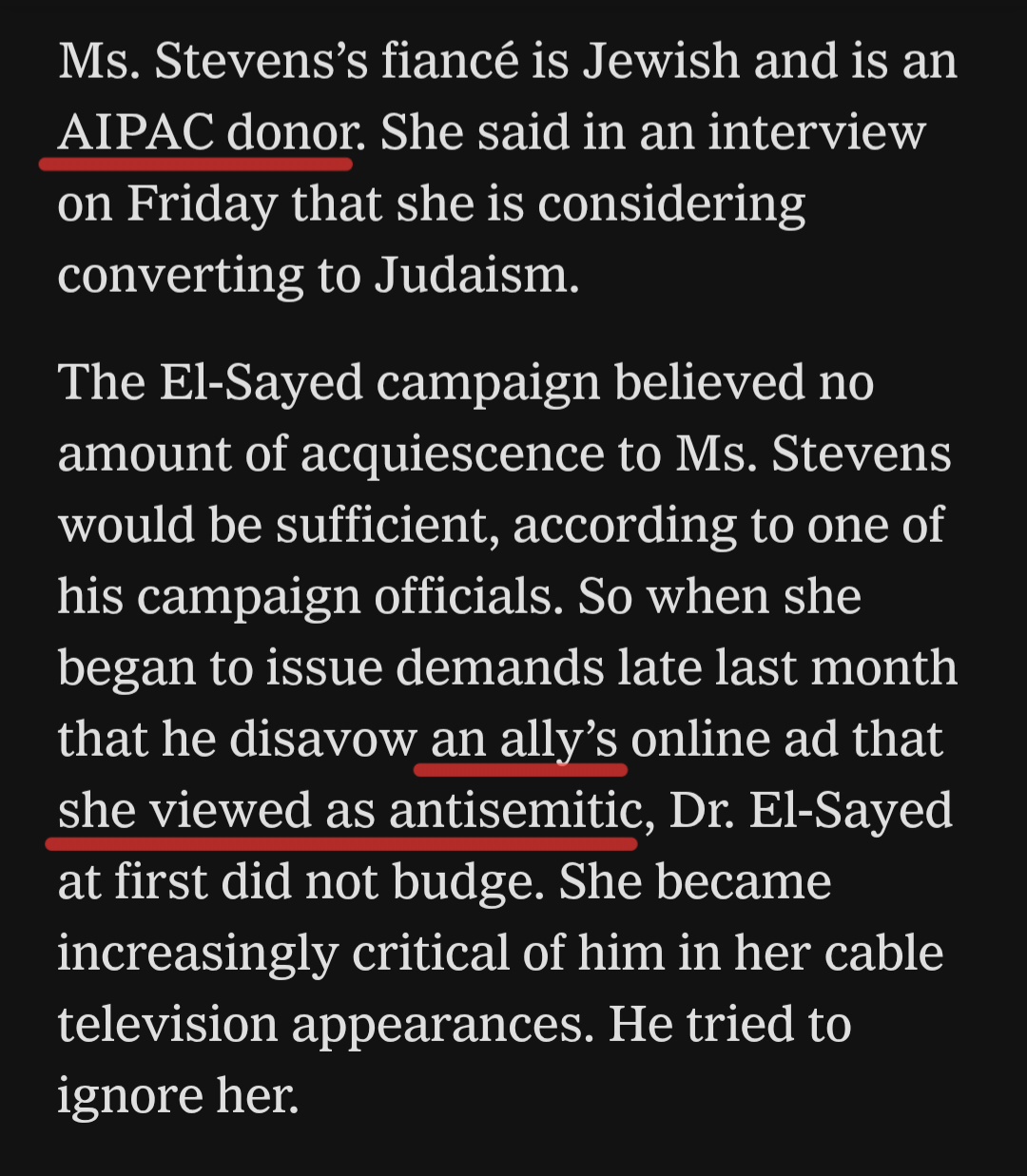
The newspaper had plenty to say about Stevens’ feelings, Israel, AIPAC and Jewish connections. It could not bring itself to name the hatred at the center of her objections.
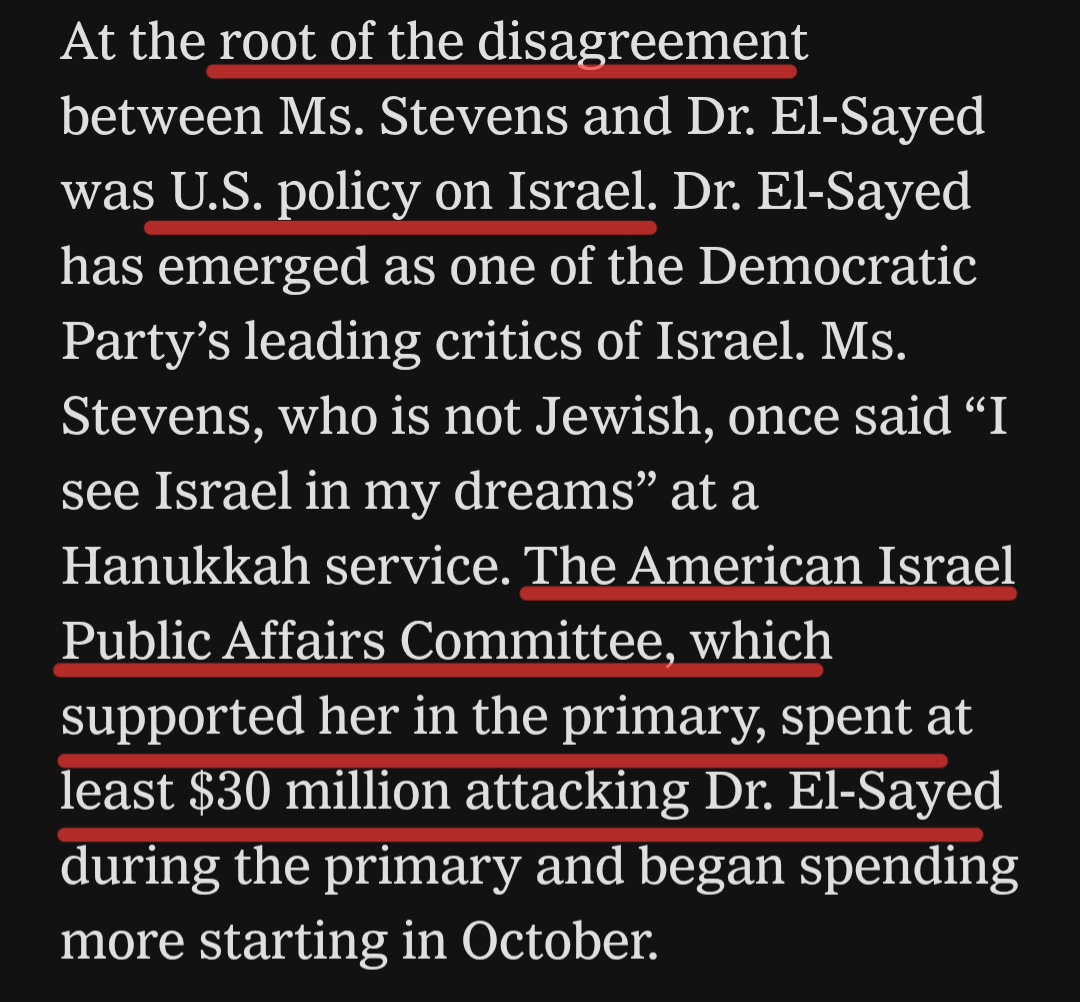
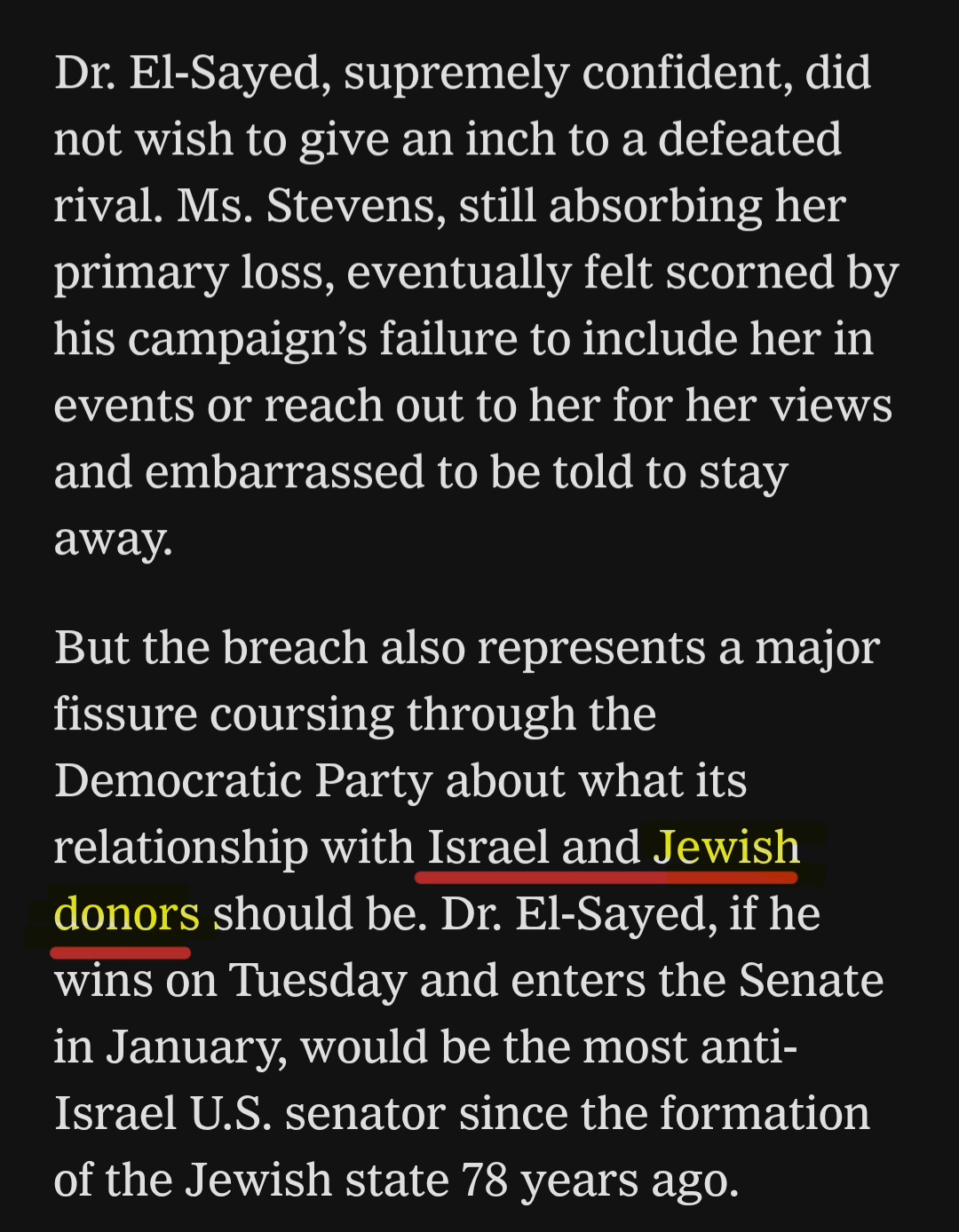
Instead, the Times described the rupture as reflecting “a major fissure coursing through the Democratic Party about what its relationship with Israel and Jewish donors should be.”

Jewish donors.

Not Jews being attacked. Not the normalization of antisemitic rhetoric. Jewish donors.
Piker himself had accused Stevens of being “weirdly obsessed with Israel” and having been “paid handsomely for this strange obsession.” The Times did not repeat his accusation, but its framing likewise directed attention toward Jewish money and influence rather than the hatred Stevens condemned.

This is how antisemitism becomes mainstream. The New York Times did not need to endorse Piker’s hatred to reinforce its underlying prejudices. By reducing objections to antisemitism to hurt feelings and Jewish concerns about safety to money and influence, the newspaper helped normalize the very hostility Stevens was protesting.

The Times was no longer simply reporting on attacks against Jews. It had become a participant in perpetuating them.

J Street Asks Politicians To “Disavow” AIPAC

Israel’s biggest critics in Congress came out to support Rep. Andy Levin (D-MI) in his Democratic primary against Rep. Haley Stevens (D-MI). They included Rep. Rashida Tlaib (D-MI), Sen. Bernie Sanders (I-VT) and J Street.

Far-left Rep. Rashida Tlaib,, Sen. Bernie Sanders (I-VT) and Rep. Andy Levin (D-MI) in a rally to support Levin’s primary race, August 2022.

Tlaib often falsely slanders Israel as an “apartheid government” committing “ethnic cleansing” of Palestinian Arabs. She calls the founding of the Jewish State a “Nakba” (catastrophe) and opposes countries normalizing relations with Israel.

Those sentiments make her a favorite of the extremist fringes of the left and right.

Members of anti-Israel IfNotNow together with Rep. Tlaib and Rep. Levin

J Street, a far-left pro-Palestinian group marketed as “pro-Israel”, poured over $700,000 into Rep. Levin’s progressive campaign against moderate pro-Israel Rep. Haley Stevens, who was backed by the bipartisan group AIPAC. Stevens won 59.5% of the Democratic primary vote on August 2nd, which brought out roughly 110,000 voters.

When Stevens prevailed over Levin, J Street issued a press release claiming that AIPAC’s involvement in the race was a “sad moment for diplomacy and democracy.” J Street was appalled that AIPAC spent $5 million on the race and had labeled Levin as “fringe”. Therefore, the progressive fringe group asked Democratic politicians to stay far away from AIPAC in the future.

“Candidates in future primaries should disavow and decline the support of AIPAC and its SuperPAC”

J STreet, august 2, 2022

J Street is peddling its extremist socialist policies as “mainstream” as it tries to become the sole voice regarding Israel in the Democratic Party. It is aggressively attempting to defeat any politician with moderate and pro-Israel views and replace them with alt-left voices who adhere to their socialist principles.

It’s completely within their right to lobby and say what they want, but they are both hypocrites and liars. The group lies when it says it is pro-Israel when in fact it is pro-Palestinian first and foremost, and when it claims its policies are mainstream. They are hypocrites when they state a desire for a “political space for open and healthy debate over US foreign policy” and then attempt to shut down AIPAC.

A long-time liberal Democrat, Gary Ackerman (D-NY) once said that J Street is “so open-minded about what constitutes support for Israel that its brains have fallen out.” He concluded that “America really does need a smart, credible, politically active organization that is as aggressively pro-peace as it is pro-Israel. Unfortunately, J-Street ain’t it.”

J Street, Rashida Tlaib and Bernie Sanders worked their hardest to defeat a moderate pro-Israel Democrat, and they are continuing to publicly push Americans to “disavow” bipartisanship and moderate solutions to today’s problems.


Some of Rep. Haley Stevens comments about Israel and anti-Semitism which seemingly offended pro-Israel progressives:

  • “I am deeply concerned by the persistent and growing effort to demonize Israel, the world’s only Jewish state and a close American ally, on the international stage. Whether through the chronic bias displayed by the United Nations Human Rights Council (UNHRC) or accusations put out by groups like Amnesty International, I stand opposed to efforts to unjustifiably brand Israel as an “apartheid state,” and I will always work to mitigate the threat of delegitimization against our closest friends in the Middle East.” – February 2, 2022
  • “Make no mistake about it: a strong and enduring partnership between the United States and the State of Israel is paramount to our interests at home and abroad. Bipartisan support for Israel and a two-state solution promotes lasting peace and democracy in the Middle East. I’m eager to reaffirm my support for Israel, condemn anti-semitism in all its forms, and make clear that my beliefs on Israel and any other policy topic for that matter will never be bought and paid for.” – February 11, 2019

Quite a contrast from Levin saying “Unless Palestinian human rights are respected, we cannot fight antisemitism.” Levin’s appalling statement was rebuked by Liora Rez, director of Stop Antisemitism.org, saying “Neo nazis and radical Islamists quite frequently hold Jews in America responsible for the Israel/Palestinian conflict. For a sitting U.S. Congressman to mirror this horrific rhetoric does nothing but feed the Jew hating machine. Andy Levin should be ashamed of himself!”

And in even sharper contract to Levin-supporter Rashida Tlaib:


Related articles:

Rashida Tlaib’s Modern ‘Mein Kampf’

J Street’s Ben Ami Smears Moderate Jews As Racists

Snapshot Of J Street’s Friends and Foes

Students For Justice in Palestine Says J Street Is The Gateway For Jewish Anti-Zionists