A Seder in Jerusalem with Liberal Friends

I am “right-of-center” when it comes to politics about Israel. I firmly believe that Israel has unquestioned legal, moral and historic right to live as a free, independent, democratic Jewish state, and that the borders of such state should include the holiest city for Jews, the united city of Jerusalem as its capital for the previous reasons, as well as based on fundamental security needs.

This year, I had the fortune of celebrating my Peach seder in Jerusalem. My hosts were liberal friends that believe that the eastern part of the city – a few hundred feet from where we ate the festive dinner – should become the capital of a new state of Palestine. I was not sure how this fact would impact the seder: how would the meal remain a celebration and educational for the dozen children, while not ignoring the momentous 50-year jubilee of the united city without a contentious debate?

The Community Obligation

I tried to stay on safe ground.

Before Pesach each year, I purchase a new Haggadah to share some new thoughts at the seder. Knowing of the attendees at this year’s meal, I decided to buy Erica Brown’s “Seder Talk,” as I considered that her essays would appeal to the more progressive crowd (compared to past year selections of R. Soloveitchik, R. Lamm, Lord Sachs, Sfas Emes among others).

One of Brown’s essays discussed the basis for the seder’s “Four Sons.” She considered that the bible wrote in four different places the need to educate one’s children about the exodus from Egypt, and each mention correlated to a different type of child:

  • Exodus 12:26-27: And when your children ask you “What is this service to you?” you will say, “It is a Pesach offering for the Lord, for He passed over the houses of the Children of Israel in Egypt while He struck the Egyptians, but saved those in our homes.”
  • Exodus 13:8: And you shall explain to your son on that day, “Because of this the Lord acted for me when I came out of Egypt.”
  • Exodus 13:14: And when, in time to come, your son asks you saying, “What is this?” you shall say to him, “With a string hand the Lord brought us out of Egypt, from the grip of slavery.”
  • Deuteronomy 6:20-21: When in time your children ask you, “What re the testimonies, the statutes and laws, that the Lord our God commanded you?” you shall say to your children, “We were slaves to Pharaoh in Egypt and the Lord our God brought us out of there with a strong hand.”

The four different types of children in the Haggadah are the hacham (wise son), the rasha (evil son), the tam (simple son), and the she’eino yo’dea lish’ol (the one that doesn’t know how to ask). Brown wrote that the rabbis believed that the role of the parent is to explain to each child according to that child’s abilities. There are “four different recipients, whose learning needs vary. All must be told the story. All must learn it and be able to transmit it.”

Brown continued that the mission to tell the story of the Exodus actually extends beyond parental responsibility. The Jerusalem Talmud used an alternative term for the “tam,” the simpleton, instead calling that son a “tipesh,” a stupid child.  Brown said that “the child of the Jerusalem Talmud is the child with limited mental capacity…. This child is a child of not only the family but of our entire community.” It is not only the responsibility of the parent to educate their own children, but in certain circumstances, it is also the obligation to assist others raising those kids. To make an important adjustment to the words of Hillary Clinton – it does not “take a village” to raise children – it is the responsibility of each parent to rear their own. However, there may be extraordinary circumstances in which the broader community should be involved in educating and raising a child with special needs.

I opted to end my comments there, as the reception at the seder was lukewarm. I do not think I won fans with terms for children of “stupid” and “mentally challenged,” even though the remarks were from Erica Brown herself. Had I continued with some extended thoughts of my own, it would have surely gone downhill.

The Community Declaration

Shortly after the description of the four sons, the Haggadah quotes and analyzes a different selection from the bible.

  • Deuteronomy 26: 5-8: [Then you shall declare before the Lord your God:] “My father was a wandering Aramean, and he went down into Egypt with a few people and lived there and became a great nation, powerful and numerous. But the Egyptians mistreated us and made us suffer, subjecting us to harsh labor.  Then we cried out to the Lord, the God of our ancestors, and the Lord heard our voice and saw our misery, toil and oppression. So the Lord brought us out of Egypt with a mighty hand and an outstretched arm, with great terror and with signs and wonders.

The Haggadah uses many pages to expound on these biblical verses, however, it does not give the context for the long history leading up to the exodus.

This declaration in Deuteronomy is ordered by God at the time of bikurim, the bringing of the first fruits in Jerusalem.

  • Deuteronomy 26: 1-2: When you have entered the land the Lord your God is giving you as an inheritance and have taken possession of it and settled in it,  take some of the firstfruits of all that you produce from the soil of the land the Lord your God is giving you and put them in a basket. Then go to the place the Lord your God will choose as a dwelling for his Name

God demanded that the story of leaving Egypt be repeated in the chosen place of the chosen land for the chosen people: at the Jewish Temple in Jerusalem, in the heart of the Jewish holy land.

Nachmanides (1194-1270), also known as the Ramban considered the rationale of the bikurim commandment. Why would an offering of first fruits in the Jewish Temple be accompanied with the history leaving Egypt?

The Ramban noted that bikurim is ONLY made in public in Jerusalem; such an offering cannot be made on an individual basis. The personal declaration of thanks for the riches of the holy land is made before the entire community. The acknowledgement of the gifts of the holy land began with the exodus from Egypt, and is something that each person must publicly declare while internalizing the message: my gift of fruit is simply a portion of our collective gifts: we are a nation that was collectively brought from Egypt to Jerusalem. The offered fruit is realy the nation’s fruit, just as the freedom from slavery was a national liberation.


The bible and Haggadah are clear in the command to educate one’s own children, and Erica Brown noted the need of the community to also educate other children in the community about our freedom from slavery. We stand as part of the community helping individuals learn the lesson of God’s gifts.

But we also have a need to stand before the community to acknowledge God’s gifts. Those gifts extend beyond our freedom from slavery, to the gift of the holy land and its produce. And that declaration is to be made in Jerusalem on the Jewish Temple Mount.

As left-wing radicals like the New Israel Fund rewrite the Haggadah and eliminate “Next Year in Jerusalem” to “Next Year in Palestine and Israel,” they have rewritten the centrality of God’s gifts and the role of our community. In doing so, have they rejected God’s gift and being part of our community? Or must the community not give up, and teach this wayward son as well?


Related First.One.Thrugh articles:

Here in United Jerusalem’s Jubilee Year

Squeezing Zionism

Today’s Inverted Chanukah: The Holiday of Rights in Jerusalem and Judea and Samaria

Rick Jacobs’ Particular Reform Judaism

The Left-Wing’s Two State Solution: 1.5 States for Arabs, 0.5 for Jews

Subscribe YouTube channel: FirstOneThrough

Join Facebook group: FirstOne Through  Israel Analysis

Here in United Jerusalem’s Jubilee Year

Biblical Command to Come to Jerusalem

There are commandments in the bible that are clear and explicit, while there are others that are deduced by the rabbis. For example, “Do not kill” is easily understood, while the commandment to not eat dairy and meat together was derived by the rabbis from different parts of the bible.

The commandment for Jews to go to Jerusalem three times a year is a combination of both clear and deduced commandments.

“1Observe the month of Aviv and celebrate the Passover of the Lord your God, because in the month of Aviv he brought you out of Egypt by night. 2 Sacrifice as the Passover to the Lord your God an animal from your flock or herd at the place the Lord will choose as a dwelling for his Name. 3 Do not eat it with bread made with yeast, but for seven days eat unleavened bread, the bread of affliction, because you left Egypt in haste—so that all the days of your life you may remember the time of your departure from Egypt. 4 Let no yeast be found in your possession in all your land for seven days. Do not let any of the meat you sacrifice on the evening of the first day remain until morning.

5 You must not sacrifice the Passover in any town the Lord your God gives you 6 except in the place he will choose as a dwelling for his Name. There you must sacrifice the Passover in the evening, when the sun goes down, on the anniversary of your departure from Egypt. 7 Roast it and eat it at the place the Lord your God will choose. Then in the morning return to your tents. 8 For six days eat unleavened bread and on the seventh day hold an assembly to the Lord your God and do no work.”

Passover in Jerusalem (Deuteronomy 16:1-8)

9 Count off seven weeks from the time you begin to put the sickle to the standing grain. 10 Then celebrate the Festival of Weeks to the Lord your God by giving a freewill offering in proportion to the blessings the Lord your God has given you. 11 And rejoice before the Lord your God at the place he will choose as a dwelling for his Name—you, your sons and daughters, your male and female servants, the Levites in your towns, and the foreigners, the fatherless and the widows living among you. 12 Remember that you were slaves in Egypt, and follow carefully these decrees.

Shavuot in Jerusalem (Deuteronomy 16:9-12)

13 Celebrate the Festival of Tabernacles for seven days after you have gathered the produce of your threshing floor and your winepress. 14 Be joyful at your festival—you, your sons and daughters, your male and female servants, and the Levites, the foreigners, the fatherless and the widows who live in your towns. 15 For seven days celebrate the festival to the Lord your God at the place the Lord will choose. For the Lord your God will bless you in all your harvest and in all the work of your hands, and your joy will be complete.

Sukkot in Jerusalem (Deuteronomy 16:13-15)

16 Three times a year all your men must appear before the Lord your God at the place he will choose: at the Festival of Unleavened Bread, the Festival of Weeks and the Festival of Tabernacles. No one should appear before the Lord empty-handed: 17 Each of you must bring a gift in proportion to the way the Lord your God has blessed you.

Passover, Shavuot and Sukkot in Jerusalem (Deuteronomy 16:16-17)

There is no question that God commanded Jews to make a pilgrimage three times a year to “the place He will choose.” However, that place was not clearly specified by God and changed over time.

When Jews emerged from Egypt and came back to the holy land roughly 3300 years ago, they first set up the holy Tabernacle in the town of Shiloh in Samaria. It remained there for 369 years.

“The whole assembly of the Israelites gathered at Shiloh and set up the tent of meeting there. The country was brought under their control,”

(Joshua 18:1)

The Jews set up the “tent of meeting” in Shiloh and made their pilgrimages to Shiloh as directed in the bible. The Israelites themselves chose this location, which is not exactly what the text in the bible prescribed stating that God will choose the location. Presumably, the Jews chose Shiloh with divine inspiration and blessing.

After Shiloh was destroyed, the Tabernacle had temporary homes for fiftyseven years in Nob and Gibeon. When King David took over the leadership from King Saul around 1000BCE, he sought to unify the various tribes and establish a new capital. David seized the Jebusite city of Jerusalem which sat in the center of the kingdom. After David died, his son King Solomon built the First Jewish Temple there in 950BCE. From that time until the present day, it has been the center of Jewish worship.

The Temple Mount in Jerusalem,
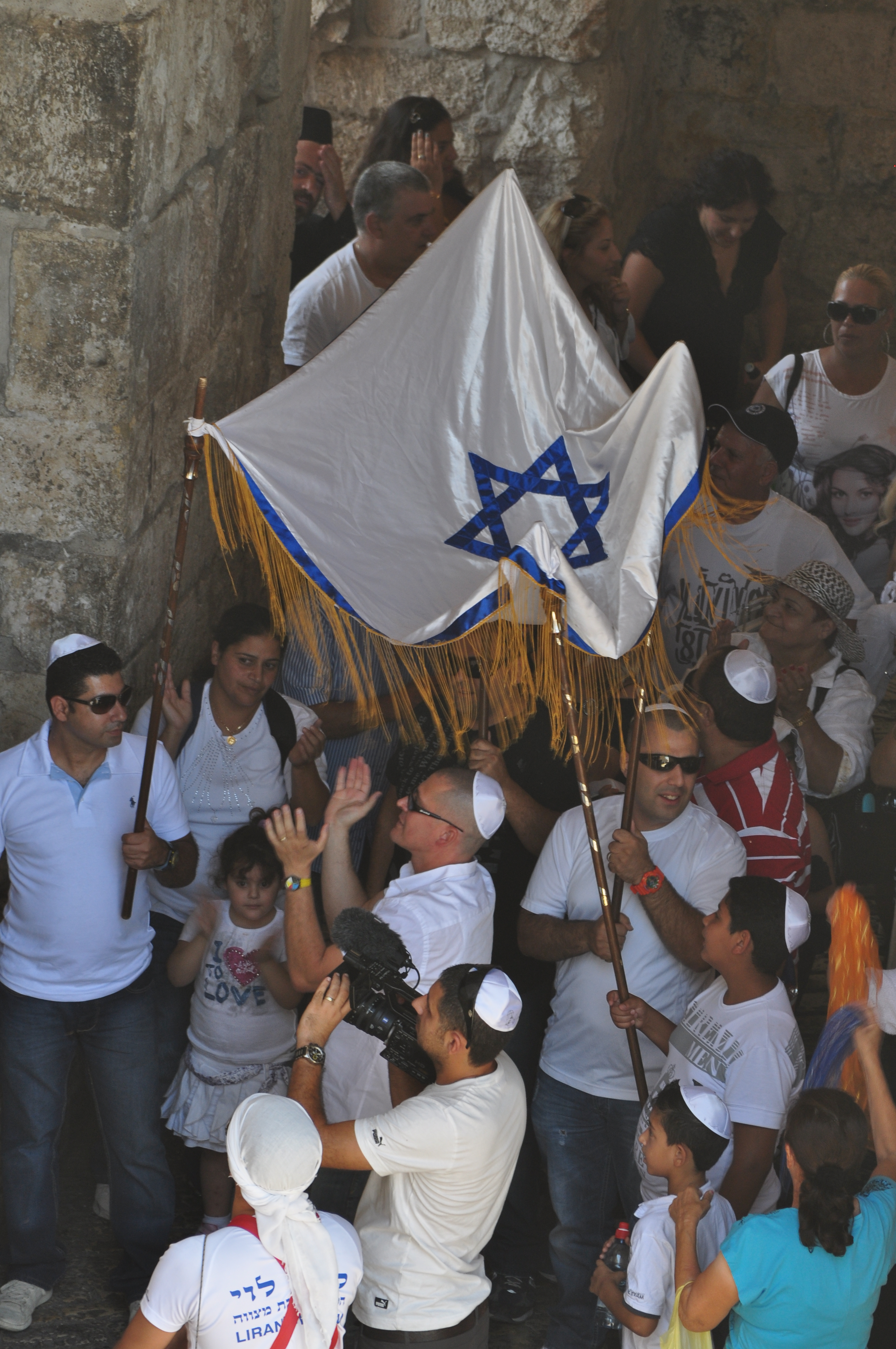
with thousands of Jews at the Kotel plaza on chol hamoed Pesach

The Incomplete Jerusalem

Whether the Jews were self-governing, or living under Assyrians, Greeks or Romans, Jerusalem and the Jewish Temple in Jerusalem was the focus of annual pilgrimages. That began to break down in 70CE.

The Romans destroyed the Second Jewish Temple in 70CE and then banned all Jews from the city in 135CE after the Bar Kochba Revolt. While Jews continued to live in the holy land, they could not visit Jerusalem.

Eventually Jews were allowed back to their holiest city, and they resumed pilgrimages even though there was no longer a Temple. But during the Christian Crusades in the 1200s, the Jews were evicted from Jerusalem again, and only able to reestablish themselves in the city in the middle of the 13th century. By the 1860s, Jews were the largest religious group in Jerusalem, exceeding both the number of Muslims and Christians, even while the city was under Ottoman rule.

That changed in 1949.

In 1948, five Arab armies invaded Israel after it declared its independence. At war’s end, the Jordanians went about an ethnic cleansing of the Jews in Jerusalem.

  • They evicted all of the Jews from the eastern half of the city, including the entire Old City
  • They destroyed over 100 synagogues in the Old City, including the Hurva Synagogue
  • They annexed the eastern half of the city in a move not recognized by most of the world
  • They established a land law which made it a capital offense for any Arab to sell land to a Jew
  • They gave Jordanian citizenship to all Arabs in the lands they annexed, and specifically excluded Jews from gaining citizenship
  • They refused to allow Jews to visit the Old City of Jerusalem, including the Kotel and Temple Mount, even on holidays

From 1949 to 1967, anti-Semites ruled in Jerusalem, and the holiest place in the world for Jews was out-of-reach.

But that changed 50 years ago.

Jubilee is for Redemption

In June 1967 the Jordanians attacked Israel after Israel pre-emptively attacked Egypt and Syria in the Six Day War. The Jordanians lost all of the land that they had illegally annexed, including Judea and Samaria and the eastern half of Jerusalem.

Jews once again moved into their holy reunited city.

The bible notes that 50 years is a jubilee, a time of redemption.

“8 Count off seven Sabbath years—seven times seven years—so that the seven Sabbath years amount to a period of forty-nine years.  Then have the trumpet sounded everywhere on the tenth day of the seventh month; on the Day of Atonement sound the trumpet throughout your land. 10 Consecrate the fiftieth year and proclaim liberty throughout the land to all its inhabitants. It shall be a jubilee for you; each of you is to return to your family property and to your own clan. 11 The fiftieth year shall be a jubilee for you; do not sow and do not reap what grows of itself or harvest the untended vines. 12 For it is a jubilee and is to be holy for you; eat only what is taken directly from the fields.

13‘In this Year of Jubilee everyone is to return to their own property.”

50 years is freedom (Leviticus 25:8-13)

Fifty years ago Jews were able to walk their streets again, to rebuild their synagogues and live in their homes. The anti-Semitic Arab laws were nullified as the Jewish State proclaimed liberty in their holiest city.

Celebrations in Jerusalem’s Old City
(photo: First.One.Through)

Just one week ago, Israeli Prime Minister Benjamin Netanyahu approved a new town in Samaria near Shiloh, the first new development in decades. The new town is adjacent to the ancient Jewish holy site. A return and redemption of sorts, thousands of years later.

Passover starts next week around the world. The seder ends with a song “HaShana HaBa B’Yerushalyim,” “Next year in Jerusalem. Next year in the rebuilt Jerusalem.” While there are still more obstacles to overcome in Jerusalem (such as the ban on Jewish prayer on the Temple Mount), the city has been revitalized and home to thousands of Jews.

Passover 2017 marks anniversaries of both the redemption of the Jews from being slaves, and the redemption of Jerusalem from being Judenrein. Celebrating Passover in Jerusalem is performing a mitzvah, a positive deed, which combines a clearly delineated action with those divinely inspired. God saved us, and blessed us when we took actions to celebrate His gifts.

Happy Passover from Jerusalem.


Related First.One.Through articles:

Shabbat Hagadol at the Third Hurva Synagogue, 2010

It is Time to Insert “Jewish” into the Names of the Holy Sites

Today’s Inverted Chanukah: The Holiday of Rights in Jerusalem and Judea and Samaria

Jordan’s Deceit and Hunger for Control of Jerusalem

The Arguments over Jerusalem

Subscribe YouTube channel: FirstOneThrough

Join Facebook group: FirstOne Through  Israel Analysis


Israel Plans to Build in Israeli Territory. It’s News

On March 30, 2017, Israeli Prime Minister Benjamin Netanyahu announced plans for a new town in Area C of Judea and Samaria for the residents of the demolished settlement of Amona. The new US Trump administration gave its tacit approval for the homes for the Israeli families.

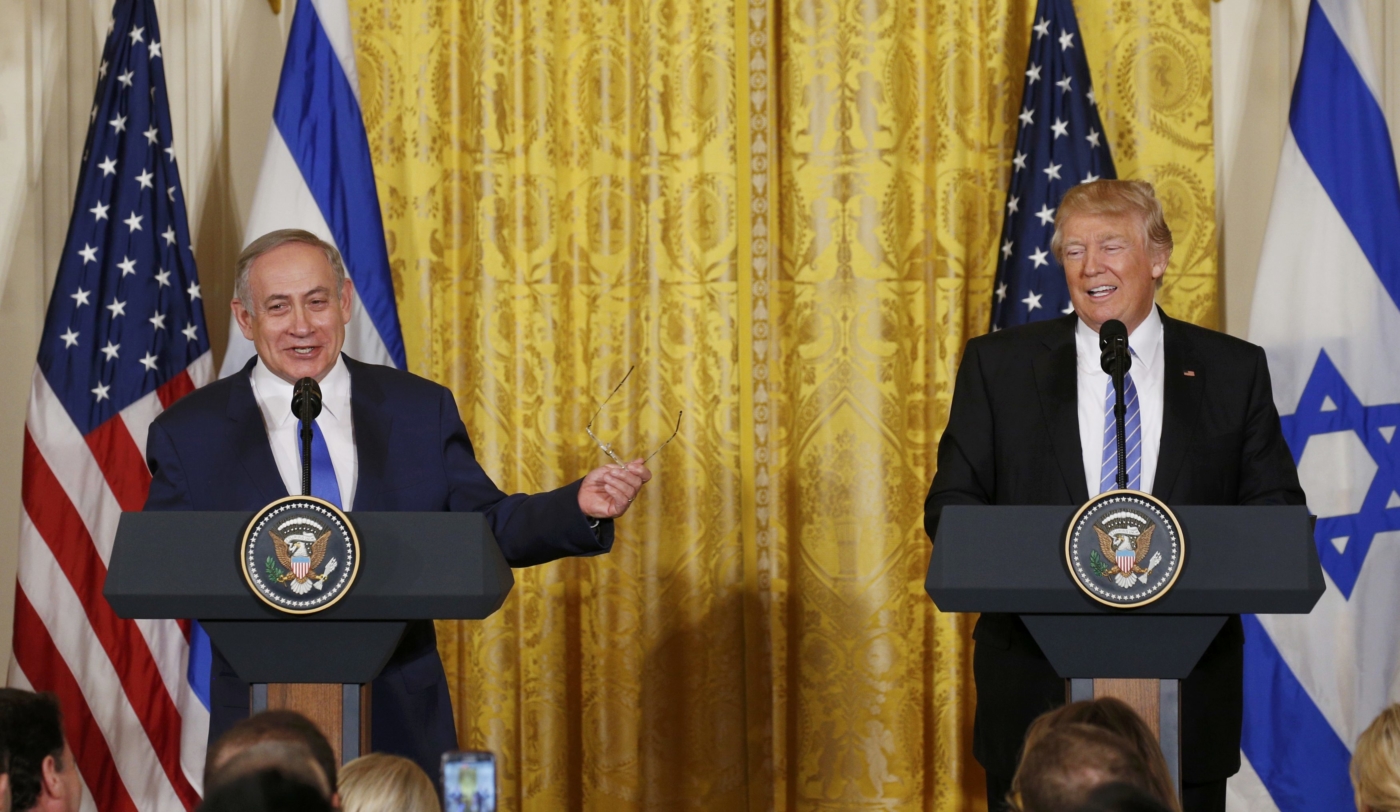
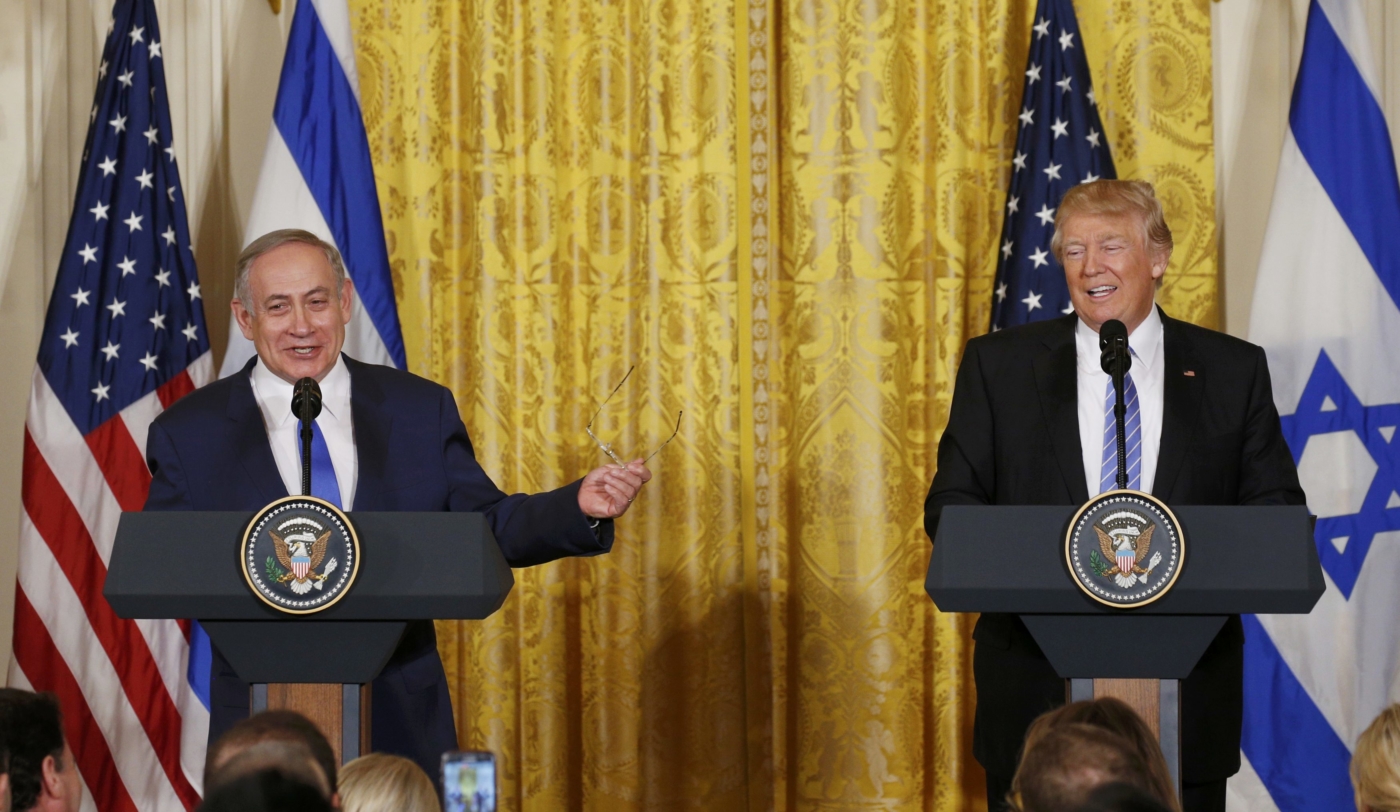
U.S. President Donald Trump (R) laughs with Israeli Prime Minister Benjamin Netanyahu at a joint news conference at the White House in Washington, U.S., February 15, 2017. REUTERS/Kevin Lamarque

The move was seen by many as very controversial, as it came just a few months after the UN Security Council passed UNSC Resolution 2334 that deemed Israeli homes east of the Green Line (EGL) as having no legal validity. The development was also the first one announced by Israel since it signed the Oslo Accords with the Palestinian Authority in 1993.

But the Oslo Accord of 1993 and the subsequent Oslo II signed in 1995 made clear that the majority of EGL – known as Area C – was under complete Israeli civilian and military control: it was Israeli Territory. So even though the Israeli government did not announce any new Israeli developments, there was no question as to the administrative authority of the Israeli government to do so.

These facts were not found in the mainstream media.

CNN’s story “Israel approves construction of first new settlement in more than 20 years,” included the following statements:

  • “Israel’s Security Cabinet on Thursday unanimously approved the construction of a new settlement in the West Bank, according to a message from the Prime Minister’s office, marking the state’s first new settlement in Palestinian territory in more than 20 years.” only calling the region “West Bank” and not including the Israeli name “Judea and Samaria” or neutral nomenclature like EGL. It further misstated that the town was in Palestinian administered land, not Israeli.
  • “The new settlement, which will be constructed north of the Palestinian city of Ramallah,” anchors the location to a “Palestinian city” and not the Israeli town of Shiloh.
  • It included this quote from a Palestinian Arab, but quoted no Israelis in the article: “”Israel’s policies remain unchanged as Prime Minister Benjamin Netanyahu and his extremist, racist coalition government continue to persist with their systematic policies of settler colonialism, apartheid and ethnic cleansing, showing a total and blatant disregard for Palestinian human rights, independence and dignity,” Ashrawi said in a statement.” Nice propaganda language to promote.
  • “The United Nations Security Council passed a resolution in December condemning Israeli settlements constructed in the West Bank and East Jerusalem as illegal. These territories, occupied by the Israeli military since 1967, are where Palestinians plan to create their future state.” No education to readers that EGL was taken from JORDAN in a DEFENSIVE WAR and that the new town is located in the Israeli Territory of Area C where Israel has civilian and military rule as agreed by the Palestinian Authority.

Reuters had a story called “Israeli cabinet approves first West Bank settlement in 20 years.” Sound familiar? The article stated:

  • “Israel’s security cabinet on Thursday approved the building of the first new settlement in the occupied West Bank in two decades, even as Prime Minister Benjamin Netanyahu negotiates with Washington on a possible curb on settlement activity.” Adding the word “occupied” gave the deliberate misrepresentation that the land was Palestinian, and not Israeli territory.
  • Like CNN, Reuters also chose to quote Hanan Ashrawi “”Today’s announcement once again proves that Israel is more committed to appeasing its illegal settler population than to abiding by the requirements for stability and a just peace,” said Hanan Ashrawi, an executive committee member of the Palestine Liberation Organization,” but it did also quoted Netanyahu: “I made a promise that we would establish a new settlement … We will keep it today.” Further, Reuters omitted the highly offensive vitriol spewed by Ashrawi.
  • Reuters also added this rationale: “Such settlements, in territory that Israel captured in the 1967 Middle East war, are deemed illegal by most of the world. Israel cites biblical, historical and political links to the land, as well as security interests, to defend its actions.” It added a few reasons why Israel has “links” to the land, but never mentioned international law of 1920 and 1922 permitting Jews to live in the area, nor political AGREEMENTS signed with the Palestinian Authority.

The Wall Street Journal’s article titled “Netanyahu Pushes New West Bank Settlement,” tied the decision to Netanyahu, not the Israeli cabinet, and did not include any time period relaying how “new” this settlement was.

  • At least until the opening sentence of the story. “Israel’s Prime Minister Benjamin Netanyahu on Thursday proposed the first new settlement in decades,” so readers got the history that this was a break from recent norms.
  • The WSJ spent the first eight paragraphs of the story giving some background on the approval process of the new town as well as the tacit approval of the White House to move forward with the project. Only at the ninth paragraph did the paper discuss the controversy around the development, before it quoted Ashrawi. This compared to CNN and Reuters which quoted Ashrawi much earlier in the fourth paragraph to set the tone of the article.

There was not a single article in any major media that mentioned the reality that the new development will be in Israeli administered territory. Of the major media, CNN was the most offensive, airing hateful Palestinian Arab propaganda and actually calling the land “Palestinian Territory.”

Is Trump wrong about CNN being #FakeNews?


Related First.One.Through articles:

Heritage, Property and Sovereignty in the Holy Land

“Settlements” Crossing the Line

CNN’s Embrace of Hamas

Names and Narrative: CNN’s Temple Mount/ Al Aqsa Complex Inversion

Stopping the Purveyors of Hateful Propaganda

A “Viable” Palestinian State

Subscribe YouTube channel: FirstOneThrough

Join Facebook group: FirstOne Through  Israel Analysis
 

Can YouTube Understand Hatred?

In March 2017, YouTube was criticized for placing advertisements next to videos that were considered disturbing expressions of hate, including racist and anti-Semitic videos. Large brands like AT&T, HSBC, Starbucks, Volkswagen and Walmart, pulled their ad campaigns from the media giant as they did not want to be associated with such ugly videos.

The Internet is rife with extremist videos, but Google has had a difficult time using algorithms to flag them.

Consider the channel FirstOneThrough, which posted over a dozen videos to COMBAT the hatred of Israel. The titles of its video series was deliberately called “I hate Israel” to counter the arguments against Israel:

The videos were headed with “I hate Israel” to CONFRONT hatred and push the videos with actual evil bias off of the front search pages. But YouTube has a hard time discerning the content of the videos and has labeled each video as “Not advertiser-friendly.”

FirstOneThrough does not seek profit from any of its videos, so the removal of advertisements is not a source of concern. However, the action underscores the difficulty of algorithms to distinguish between a simple phrase and the broader discussion in the videos.

In the meantime, supporters of Israel should continue to watch and share the videos in the series to not only become further educated about the incredible democracy, but to push anti-Israel videos off of the first page of the YouTube search screen.


FirstOneThrough’s Series “I hate Israel”


Related First.One.Through articles:

Take Names in the Propaganda War

Social Media’s “Fake News” and Mainstream Media’s Half-Truths

NY Times Discolors Hate Crimes

New York Times Finds Racism When it Wants

Your Father’s Anti-Semitism

Subscribe YouTube channel: FirstOneThrough

Join Facebook group: FirstOne Through  Israel Analysis

The Media Splits on Showing “Islamic Terrorism” and its Presence in Israel

On March 22, 2017 a terrorist attack in the heart of London left several people dead. The description of the attack from two leading media companies took very different approaches.

Islamic Terrorism

The Wall Street Journal made no bones about the terrorist and his motives. In the opening lines of the lead article “London Rampage Leaves 4 Dead,” the paper wrote “A suspected Islamist Terrorist mowed down scores of pedestrians…” The article continued to underscore the ongoing battle with Islamic terror at various points:

  • ‘the most serious act of terror in the U.K. since 2005, when coordinated bombings by Islamist extremists on buses and subway trains claimed 52 lives.”
  • Mark Rowley, the U.K.’s top counter-terror police official said… it was an act of ‘Islamist-related’ terrorism”
  • “a man fatally shot a soldier at Canada’s National War Memorial before getting inside the country’s Parliament building and being shot by security forces, in a Islamist-influenced terror attack”


Front page of Wall Street Journal March 23, 2017

The New York Times took a very different approach.

The New York Times ran an article “Deadly Attack Near U.K. Parliament; Car Plows Victims on Westminster Bridge,” which ran over 1700 words. At no time did the article mention the words Muslim or Islamic.

The Times referred to a “knife-wielding assailant” carrying out the attack and that the “assailant” had been killed. The only reference that the terrorist was even a male came from third party sources such as Prime Minister Theresa May confirming “that the attack had been carried out by a lone male assailant.” Witnesses gave corroboration that the attacker was a “middle-aged man holding a knife.”

I’m glad that the Times was avoiding male-bashing. Or maybe it was because the New York Times did not want to assume that the terrorist did not identify as a woman?

Israel

The Times did quote someone that noted that these kinds of terrorist attacks have occurred in other countries – including Israel.

“Political violence is relatively rare in Britain, where gun ownership is stringently restricted…. Jeremy Shapiro, a former State Department official now at the European Council on Foreign Relations, said that the London attack was consistent with the recent pattern of attacks in which a vehicle was used to kill people, citing assaults in France, Germany and Israel.”

That was an improvement relative to the Wall Street Journal that recalled vehicular attacks in France and Belgium, as well as Islamic terrorism in Canada. But not such terrorism in Israel.

Pretty extraordinary, since the car-ramming attacks in Israel were so prevalent in recent years.


For some time, The New York Times has avoided labeling terrorism as having anything to do with Islam. It has now seemingly made a further pivot to label terrorism as politically (not religiously) motivated, which may let it acknowledge the incessant terrorism waged against Israel by Palestinian Arabs. (The liberal editors of the Times will seemingly forever ignore the Hamas Charter which declares “Our struggle against the Jews is very great and very serious,” and “In face of the Jews’ usurpation of Palestine, it is compulsory that the banner of Jihad be raised.“)

Should the pro-Israel community claim a small victory? Maybe.


Related First.One.Through articles:

The Big, Bad Lone Wolves of Terrorism

Absolute and Relative Ideological Terrorism in the United States

The Media Finds Religion in Matters of Security. Sometimes.

New York Times’ Lost Pictures and Morality for the Year 2015

Subscribe YouTube channel: FirstOneThrough

Join Facebook group: FirstOne Through  Israel Analysis
Regime Reactions to Israel’s “Apartheid” and “Genocide”

Summary: The new leaderships at the UN and US have joined to take a forceful approach to anti-Israel rhetoric, in a sharp break from the prior regimes. Alas, the New York Times still does little to report on it and educate its remaining readership.

“Apartheid”

On March 14, 2017, a United Nations commission issued a report that called Israel’s treatment of Palestinian Arabs equivalent to “apartheid.” It’s findings came as a result of a study

“whether Israel has established an apartheid regime that oppresses and dominates the Palestinian people as a whole.”

The new Trump administration’s ambassador to the UN, Nikki Haley, pounced on the report and pressured the new UN Secretary General Antonio Guterres to have it withdrawn. Not only did he have the report removed from the UN website, one of the authors of the report resigned.

US Ambassador to the United Nations, Nikki Haley

This is in sharp contrast to the reactions of the prior regimes of US President Barack Obama and UNSG Ban Ki Moon who applied no such pressure to even worse false accusations.

“Genocide”

One of the authors of the March 2017 UN report, Richard Falk, is a notorious anti-Semite. In December 2013, he said that Israel’s “criminal intention [toward Palestinians] is genocidal.” Canada quickly called on the UN to fire Falk. The US and UN distanced themselves from Falk’s comments but would take no aggressive action for his removal.

The tolerance for anti-Semitism from the Obama and Ban regimes was neither new nor surprising. It was pervasive.

Obama was reluctant to use US pressure on the world body. He believed that everybody was entitled to a point of view and that he would rather sit at a table and listen to the anti-Semitism than take aggressive action to stop it.

Consequently, people like Mahmoud Abbas felt no compunction in taking the podium at the UN General Assembly to make absurd comments that Israel was carrying out a “genocide.”

Under-Reporting Anti-Semitism

The New York Times wrote about the latest brouhaha at the UN in an article “Tempest at U.N. Over Report Saying Israel Practices Apartheid.” In a story without any depth, the article noted that one of the authors of the UN report had been accused of being anti-Israel.

“One of the authors of the report was Richard Falk, an American law professor and former United Nations human rights investigator whom critics regard as an anti-Israel extremist. He has been refused entry to Israel for what Israeli leaders have described as his hostile point of view.”

This was the first mention of Falk in the NYT for almost a decade. As detailed in FirstOneThrough’s article “The New York Times and Richard Falk,” the paper never discussed this “human rights investigator” who touted conspiracy theories about the attacks on 9/11, and that the US deserved the Boston Marathon bombing because of its foreign policy. It also never mentioned Falk’s outrageous claim that Israel carries out a genocide against Arabs.

Further, the paper has never opted to give a basic education to its readers:

The paper’s choice of giving color and context to certain items is conspicuously selective. It would rather constantly pepper its articles that “most of the world considers the West Bank to be occupied territory,” but will never add the clause “most Palestinian Arabs harbor anti-Semitic attitudes,” when it writes about the absurd accusations of “genocide” and “apartheid” coming from Palestinian Arabs.


In 1991, New York City Mayor David Dinkins let anti-Semitic riots run rampant in the Crown Heights section of Brooklyn. His successor, Rudy Giuliani, opted to take a tough stand on crime and was able to transform New York City into the safe city that people recognize today.

The civilized world can only hope to see a similar outcome in the transition from Obama/Power to Trump/Haley and from Ban to Guterres: that the mayhem and hatred that has been tolerated for way too long will be aggressively combatted.


Related First.One.Through articles:

Nikki Haley Will Not Equivocate on the Ecosystem of Violence

The UN is Watering the Seeds of Anti-Jewish Hate Speech for Future Massacres

Arabs in Jerusalem

Palestinian Jews and a Judenrein Palestine

What do you Recognize in the Palestinians?

Subscribe YouTube channel: FirstOneThrough

Join Facebook group: FirstOne Through  Israel Analysis

Mutual Disagreement of Mediators and Judges in the Arab-Israeli Conflict

Mediators serve an important role in conflicts. They attempt to bridge the gap between parties to arrive at a mutually-agreed upon compromise to conclude the disagreement. If the mediator cannot resolve the matter, it is most likely that a judge would be tasked at making – and imposing – a final ruling.

Take divorce as an example. A mediator may be brought in by the parties to resolve issues related to child custody. If the mediator cannot get the parties to agree to terms, the case would go to court to rule on the matter.

Obama and Trump as Mediators

In February 2017, US President Donald Trump seemed to take a new stance in trying to mediate the Israeli-Arab conflict. In response to a reporter’s question about how the US will approach its role as a mediator, Trump said:

“So I’m looking at two-state and one-state, and I like the one that both parties like.  (Laughter.)  I’m very happy with the one that both parties like.  I can live with either one.  

I thought for a while the two-state looked like it may be the easier of the two.  But honestly, if Bibi and if the Palestinians — if Israel and the Palestinians are happy, I’m happy with the one they like the best.”

The media went wild. They printed headlines that Trump abandoned the two-state solution.

In actuality, Trump said that he is happy if the parties themselves are happy. The role of the mediator was not to dictate the outcome but to resolve the conflict so that the parties themselves reach a consensus. The goal was peace between the parties, not necessarily a particular formula to get there.

U.S. President Donald Trump (R) laughs with Israeli Prime Minister Benjamin Netanyahu at a joint news conference at the White House in Washington, U.S., February 15, 2017. REUTERS/Kevin Lamarque

Consider the contrast in Obama’s approach to the negotiations and the response of the media. In May 2011 Obama said:

“I said that the United States believes that negotiations should result in two states, with permanent Palestinian borders with Israel, Jordan, and Egypt, and permanent Israeli borders with Palestine.  The borders of Israel and Palestine should be based on the 1967 lines with mutually agreed swaps — (applause) — so that secure and recognized borders are established for both states. The Palestinian people must have the right to govern themselves, and reach their potential, in a sovereign and contiguous state.”

The media noted that Obama laid out a conclusion of what the final result of the compromise would look like: two states.

The Obama speech irked the Israeli government that was clear in its intention of not returning to the “Auschwitz” lines of 1967.  Obama countered that he had not laid out a conclusion that was not a matter of consensus, as he specifically included language that there would be “mutually agreed” land swaps.

From Mediator to Biased Mediator to Judge

If a mediator in a divorce announced that she was open to the father having custody or the woman having custody of the children, whichever conclusion could be worked out by the parties, her position would be considered open and balanced. However, if she stated that the mother would have custody and that the only matter to work out was whether the father would see the children on Tuesdays or Fridays, her position as mediator would be seen as clearly biased. The inclusion of a minor clause that the only point being considered was a matter of visitation, while the broad parameters were already concluded, would be seen as a jaundiced farce.

And so was the position of Obama.

He did not focus on a bringing peace agreed to by each party, but stated an outcome that he viewed as fair. Obama abandoned his position as a private unbiased mediator. Not surprisingly, the Israeli government not only questioned the content of Obama’s statement, but his role as both a mediator and important ally.

In November 2016, when Obama’s preferred presidential successor Hillary Clinton lost the Democratic election, Obama decided that ANY role for the United States as a mediator had concluded, as he did not believe that Donald Trump’s administration would be fair, competent or effective. It was therefore time to pass the Israeli-Arab Conflict to a judge: the United Nations.

In December 2016, Obama directed his UN ambassador Samantha Power to abstain from an important vote, thereby allowing United Nations Security Council Resolution 2334 to pass which declared that Israelis living east of the Green Line was illegal. Obama’s Secretary of State John Kerry then went on to berate Israel (still under the guise as a “mediator”):

“Provide for secure and recognized international borders between Israel and a viable and contiguous Palestine, negotiated based on the 1967 lines with mutually agreed equivalent land swaps.”

Team Obama again left the “mutually agreed” clause at the edges – literally. And Kerry added a new dimension that the land swaps should be “equivalent,” echoing a phrase (“comparable”) introduced by the Arab League.

President Obama moved his team from an impartial mediator to a biased one, happy to hand the situation to a judge that shared his animus for Israel. As he left office, Obama chose to belittle and undermine both the Trump administration and Israel, by enabling the UN and world to begin boycotting and suing the Jewish State.

Obama was well aware that the UN was anti-Israel at its core as it moved to sideline a negotiated solution between the Israelis and Palestinian Arabs. Samantha Power read a prepared statement right after UNSC 2334 passed:

“But in reality this vote for us was not straightforward, because of where it is taking place – at the United Nations. For the simple truth is that for as long as Israel has been a member of this institution, Israel has been treated differently from other nations at the United Nations. And not only in decades past – such as in the infamous resolution that the General Assembly adopted in 1975, with the support of the majority of Member States, officially determining that, “Zionism is a form of racism” – but also in 2016, this year. One need only look at the 18 resolutions against Israel adopted during the UN General Assembly in September; or the 12 Israel-specific resolutions adopted this year in the Human Rights Council – more than those focused on Syria, North Korea, Iran, and South Sudan put together – to see that in 2016 Israel continues to be treated differently from other Member States.”

In other words, Obama knew that the judge would eviscerate Israel, but if Team Obama could not bring peace, this was the best that could be hoped for.

Trump’s Two Fronts: A New Mediator and Sidelining the Judge

The Trump administration now has a two-pronged effort to resolve the century old conflict: as a new unbiased mediator, and as an active player in managing the judge.

As the UN officially declared (with Obama’s blessing) that Jews are illegally living in their homeland in a reversal of the League of Nations declarations of 1920 and 1922, the Trump administration is actively fighting back.

On March 18, 2017, after a UN agency released a report that Israel is an “apartheid state,” the US Ambassador to the United Nations Nikki Haley pressured the UN to withdraw the report. The diplomat that co-authored the report refused and resigned. Haley applauded the move, saying “When someone issues a false and defamatory report in the name of the U.N., it is appropriate that the person resign.”

Earlier in the week, Trump’s new envoy to the Middle East, Jason Greenblatt, met with both Israeli Prime Minister Benjamin Netanyahu and acting President of the Palestinian Authority Mahmoud Abbas in an effort to re-launch the peace process that was crippled by the Obama administration. After the meeting with Abbas, the US Consulate General said that the two men “reaffirmed the commitment of both the Palestinian Authority and the United States to advance a genuine and lasting peace between Israel and the Palestinians.”


Obama concluded his tenure regarding the Israeli conflict as a disgrace. He proved to be a terrible and biased mediator. To add an exclamation to his failure, his hubris compelled him to undermine the Trump Administration’s role of mediator, and passed the conflict into the hands of anti-Semitic judges at the United Nations.

Obama made the odds of achieving peace in the Middle East more remote. But perhaps under the watch of Nikki Haley and Jason Greenblatt, the peace process will get another chance.


Related First.One.Through articles:

How the US and UN can Restart Relations with Israel

The Illogic of Land Swaps

Obama’s “Palestinian Land”

A “Viable” Palestinian State

John Kerry: The Declaration and Observations of a Failure

Subscribe YouTube channel: FirstOneThrough

Join Facebook group: FirstOne Through  Israel Analysis

 

The New York Times Pre-Occupation with Lies

On March 9, 2017, The New York Times wrote an editorial called “Israel Says Dissenters Are Unwelcome.” The NYT editorial board did not simply disagree with Israel’s decision to bar entry to people that advocated for boycotting the Jewish State, it mischaracterized the situation completely.


New York Times editorial on March 9, 2017

In the editorial, the paper littered the article with the words “occupation” and “settlements.” It never stated that Israel does not view Jews living on the east side of the arbitrary Green Line (EGL) as an occupation, as international law in 1920 and 1922 explicitly gave Jews those exact rights. It never stated that advocates of the BDS campaign are adopting an anti-Semitic platform that was instituted by the Jordanians who expelled all of the Jews from the region in 1949, then annexed it and gave citizenship only to non-Jews. It did not give the readers the facts that the Palestinian Arabs have adopted this policy and have a law that selling any land to a Jew is punishable by death.

Further, the Times wrote that “The United States, Israel’s strongest military supporter, has consistently held that settlement building in the occupied territories is illegal.” That is a boldface lie. President Carter was the only US president to call Jews living in EGL/West Bank illegal. All others – including President Obama – used language like “unhelpful” or, as Obama said “illegitimate.”

Lastly, the editorial stated that BDS supporters are those “who support the search for a lasting peace.” The BDS campaign is all about anti-normalization of Jews and Arabs living and working together. It is either a call by anti-Semites and Israel haters, or by others that believe that a Jew-free state is the only solution for peace. If that is true, then Israel should apply the same logic and expel every Arab from the Jewish State. But the NYT labeled Israelis who advocate such approach as “far-right extremists.” Why not use the same label for BDS-supporters?


The editorial page is a place where the paper makes its opinions, and the paper has every right to state its ignorant views. However, printing outright lies and misinformation does nothing to educate readers. Other than to the fact that the Times consistently ignores facts.


Related First.One.Through articles:

The Cancer in the Arab-Israeli Conflict

The Legal Israeli Settlements

The Israeli Peace Process versus the Palestinian Divorce Proceedings

New York Times Lies about the Gentleness of Zionism

The Many Lies of Jimmy Carter

New York Times Confusion on Free Speech

Israel’s Freedom of the Press; New York Times “Nonsense”

Social Media’s “Fake News” and Mainstream Media’s Half-Truths

The New York Times wants the military to defeat terrorists (but not Hamas)

Subscribe YouTube channel: FirstOneThrough

Join Facebook group: FirstOne Through  Israel Analysis


Take Names in the Propaganda War

The International Apartheid Week began its thirteenth annual hate-fest of lying propaganda this week. It’s aim is to circle the globe with calls on college campuses to end the Jewish State.

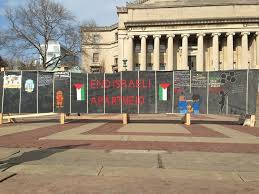
iaw-columbia
Israel Apartheid Week at Columbia University

The basic call of IAW is to mischaracterize various foundational elements about Israel and urge today’s youth to destroy the “illegal” country. As stated on its website:

“The coming year (2017) will mark 100 years of Palestinian resistance against settler colonialism, since the inception of the Balfour Declaration. IAW will be an opportunity to reflect on this resistance and further advance BDS campaigns for the continued growth and impact of the movement.”

Note that the group claims that the “settler colonialism” began in 1917, when the British recognized in the Balfour Declaration – followed by the international community in 1920 (San Remo Agreement) and 1922 (Mandate of Palestine) – the historic rights of Jews to live in their homeland. For the IAW, the “apartheid” did not happen in 1967 after the Jordanians attacked Israel and lost the land east of the Green Line (EGL)/West Bank, but when international community made the following statement:

“His Majesty’s Government view with favour the establishment in Palestine of a national home for the Jewish people, and will use their best endeavours to facilitate the achievement of this object, it being clearly understood that nothing shall be done which may prejudice the civil and religious rights of existing non-Jewish communities in Palestine, or the rights and political status enjoyed by Jews in any other country.”

A national home for the Jewish people – regardless of such borders – is an anathema to the IAW. As such, it seeks to undermine Israel and to destroy this democratic country by any means possible.

The lies and incitement to purge undesirables are not new ideas.

In Nazi Germany, Joseph Goebbels used anti-Semitic propaganda to enlist Europe to eradicate its Jewish population in World War II. In Asia today, ISIS uses online videos to recruit more jihadists to rid “non-believers” from its desired caliphate.

And on college campuses, IAW is using its propaganda to destroy the Jewish State.

Your Role

The Department of Homeland Security has trademarked a phrase “If you see something, say something.” The goal is to engage all Americans to be active in fighting terrorism. Similarly, the United Nations has a Counterterrorism Strategy which includes a goal to “prohibit by law incitement to commit a terrorist act or acts and prevent such conduct.”

As IAW comes onto college campuses with a mission of destroying a democratic member of the United Nations, it is incumbent on every person to video every person that takes part in IAW – ideally getting their names – and reporting to law enforcement any calls to destroy the Jewish State.


Related First.One.Through articles:

Stopping the Purveyors of Hateful Propaganda

The UN is Watering the Seeds of Anti-Jewish Hate Speech for Future Massacres

The UN Fails on its Own Measures to address the Conditions Conducive to the Spread of Terrorism

Elie Wiesel on Words

Martin Luther King and Zionism

The “Unclean” Jew in the Crosshairs

The Legal Israeli Settlements

Israel, the Liberal Country of the Middle East

Subscribe YouTube channel: FirstOneThrough

Join Facebook group: FirstOne Through  Israel Analysis

Heritage, Property and Sovereignty in the Holy Land

This land is my land, this land is your land. Whose land is this anyway?

 dsc_0114
Silwan in the eastern half of Jerusalem
(photo: FirstOneThrough)

Events over the past few weeks both in Israel and at the United Nations warrant a review of three distinct concepts that seem to be alternatively ignored, refuted and merged: heritage, property and sovereignty in the holy land. They are each distinct concepts.

Heritage

Jews have a connection to the holy land that not only surpasses any other people in regards to that land, it surpasses other people’s ties to their homelands, as the Jewish connection combines both history and religion.

History: While Italian-Americans may feel a connection to Italy as their ancestors came from there some generations ago, there are very few people on the planet that have a widely accepted history in a land that extends back 3700 years.

Starting with Abraham, Isaac and Jacob and extending for 1800 years, the majority of Jews on the planet lived in the holy land. During different periods they were self-governing while in others they were ruled by foreign powers that had control of the region as part of a broader kingdom. Only the Jews ruled the holy land as a distinct entity.

Religion: While some religions have holy sites like the Vatican, or a holy city like Medina, only the Jews have a holy LAND, in which the entirety of the land is viewed as a divine promise from God. For the last 2000 years, wherever Jews were in the world, they prayed facing the Temple Mount in Jerusalem.

Yet despite the glaringly obvious ties of Jews to the entirety of the holy land, various entities – including many Arab countries and the United Nations – have sought to distance Jews from the holy land. The Arabs have declared themselves as the true indigenous people in the land, even though the introduction of Arabs from the Arabian Peninsula occurred 2000 years after the Jews were in the land. Further, many of today’s “Palestinian Arabs” arrived from elsewhere in the Middle East like Iraq and Egypt during the 1920s and 1930s, after the start of the British Mandate.

The arguments that the Jews do not have a deep connection to the entirety of the holy land is an absurdity and insulting. And it does nothing to advance peace.

Property

While Jews around the world are deeply connected to the holy land, such bonds do not give them title to any property. Should someone – Jew or non-Jew – want to own land, they can go through the process of taking out a checkbook and buying a home. This is the same basic rule that applies anywhere in the world, such as an Italian-American owning property in Rome.

Despite the clear and obvious distinction between property ownership and heritage, some people in Israel have felt no compunction in seizing lands that are owned by Arabs east of the Green Line (EGL)/West Bank, on the premise that the land was promised to the Jews. That’s an absurdity.

While international law in the San Remo Agreement (1920) and the Palestine Mandate (1922) clearly recognized the Jewish heritage in the holy land, it only sought to give Jews priority to settle in STATE LANDS, not private property. That is why new communities in EGL like Maale Adumim are completely legitimate, since none of the city was built on private property. However, legalizing the theft of private property in outposts has no legal or moral basis.

Sovereignty

A third distinction is sovereignty – that is, what country rules the land. An individual Arab can own a house in Beer Sheva which is ruled by the Jewish State, and a Jew should be able to own a home in EGL, even if it becomes part of a new Palestinian State. The government that administers the land should be completely distinct from who lives in the land.

Unfortunately, in the Middle East and North Africa (MENA), that is principally only true for Israel.

Most of the countries in MENA are almost completely Muslim and/or Arab. There is little tolerance in those countries for non-Muslims and non-Arabs.

The trend of creating Arab and Muslim-only areas has continued with Israel’s acquiescence, as demonstrated by the Jewish State’s removal of all Jews from the Sinai Peninsula (1982) and the Gaza Strip (2005). This has led to a presumption that Jews would once again be removed from EGL in a future peace deal. Should such an anti-Semitic condition be part of a peace deal, the notion that there is actually peace between the parties is laughable.


Jews have a connection to the holy land that surpasses any other people, and it is a major motivation for millions of Jews moving there, including both to Israel and EGL/West Bank. The UN and Arab countries are completely wrong in challenging the Jewish ties to their holy land.

Arabs that have demonstrated property rights must be respected as neighbors. Israel is wrong to take land that is privately owned, unless it is for a clear defensive purpose.

And the ultimate sovereignty of the disputed EGL/West Bank is a matter for the two sides to work out. Neither Jewish heritage nor Arab and Jewish property rights should be the defining considerations in determing sovereignty, but a thoughtful approach designed to improve the chance of a lasting peace for the people in the holy land.


Related First.One.Through articles:

“Settlements” Crossing the Line

It is Time to Insert “Jewish” into the Names of the Holy Sites

Obama’s “Palestinian Land”

The Legal Israeli Settlements

Nicholas Kristof’s “Arab Land”

The Long History of Dictating Where Jews Can Live Continues

Obama’s Select Religious Compassion

A “Viable” Palestinian State

Subscribe YouTube channel: FirstOneThrough

Join Facebook group: FirstOne Through  Israel Analysis