In a bold step to preserve humanity’s “most fragile treasures,” UNESCO voted to add the Hamas Charter to its list of endangered cultural artifacts. The decision came during the organization’s annual heritage summit, which initially convened to safeguard vanishing African oral traditions, disappearing tribal instruments, and lost languages. But the spotlight quickly shifted after the State of Palestine—recognized as a full UNESCO member—submitted the 1988 Hamas Charter as a candidate for protection.
Delegates debated the proposal with solemn reverence, as though they were discussing ancient scrolls or fragile clay tablets. “This is not merely a document,” intoned one UNESCO official, “it is a vibrant example of humanity’s enduring talent for mixing medieval theology, paranoid conspiracy, and genocidal intent into a single cultural artifact.”
Hamas, which currently holds 58% of the Palestinian parliament and continues to govern Gaza with an iron fist wrapped in a prayer shawl, celebrated the recognition. “We thank UNESCO for finally appreciating the poetic quality of our prose,” said one Hamas spokesperson, pointing to passages citing Jews as orchestrators of every global evil, from wars to stock market crashes. “It is art. Dark, sinister art, but art nonetheless.”
The Islamic Republic of Iran, a member of UNESCO with a keen eye for heritage preservation, reportedly helped prepare the submission. Delegates noted the Persian calligraphy used in the cover page of the proposal as “an exquisite touch of cultural diplomacy.”
Critics, however, were less charitable. Human rights groups asked why UNESCO would protect a text calling for the eradication of an entire people while ignoring actual endangered communities being eradicated in real time. UNESCO officials brushed off such concerns. “Our mission is not to judge,” said one diplomat. “If we can safeguard Stonehenge, we can safeguard Stone Age thinking.”
The vote passed overwhelmingly, though with several European countries abstaining in embarrassment. The document will now be digitally preserved and inscribed on UNESCO’s Memory of the World Register, alongside such treasures as the Magna Carta, Beethoven’s Ninth Symphony, and the forgery Protocols of the Elders of Zion.
As the session closed, one delegate mused: “Perhaps one day humanity will look back on this charter the way it looks at medieval torture devices—an artifact of cruelty, once revered, now displayed in a museum of shame.”
For now, however, UNESCO has declared the Hamas Charter an endangered cultural jewel which must be preserved. Its continued existence may be a threat to peace, but, as the organization reminded the world, “heritage must be protected, even when it is heritage of hate.”
In 1975, film theorist Laura Mulvey coined the term “male gaze” to describe how women are portrayed on screen. The camera does not simply show reality — it frames women for a heterosexual male viewer. Women become visual objects, defined by how they serve the viewer’s pleasure, not by their own full humanity.
The concept applies far beyond film. A “gaze” is any dominant perspective that controls how another group is seen. The one doing the looking holds power; the one being looked at is flattened, reduced, and judged. The colonial gaze. The white gaze. The antisemitic gaze. In each, the subject is stripped of complexity and placed in a role that makes sense to the audience, not to themselves.
Israel is caught in such a gaze. Call it the “Israel Gaze.”
In the Israel Gaze, the Jewish state is the object, never the subject. It is to be observed, graded, managed — but rarely allowed to speak or act on its own terms. Its security concerns are minimized; its legitimacy treated as conditional.
Like the male gaze that zooms in on a woman’s body while ignoring the rest of her life, the Israel Gaze focuses on narrow, selective snapshots. Cameras linger on a checkpoint — but not the suicide bombings that created the need for it. They magnify airstrikes — but crop out the rockets that triggered them.
The framing serves the outside viewer, often a Western political elite, who want a morality play: powerful oppressor vs. powerless victim. Israel is assigned the role of aggressor. No matter the reality on the ground, the narrative is cast before the curtain rises.
And just as the male gaze reduces women to archetypes — seductress, mother, damsel — the Israel Gaze flattens Israel into “occupier,” “aggressor,” “settler state.” The country’s remarkable complexity — the ultimate decolonization project, a refuge for a persecuted people, a diverse democracy, a hub of innovation, a nation under constant threat — disappears from view.
This gaze is not neutral. It is a tool of power. In film, it props up patriarchy. In global politics, it reinforces the idea that Israel’s right to exist, defend itself, or define its own future depends on approval from outsiders who claim the right to judge.
Typical UN vote condemning Israel – lopsided
Mulvey noted in her analysis that “her visual presence tends to work against the development of a story line, to freeze the flow of action in moments of erotic contemplation.” So it is in global politics, with the viewer solely transfixed on Israel’s supposed evils that the actual storyline – and path to peace – is lost out of sight.
Both the male gaze and the Israel Gaze deny the subject the dignity of being whole. Both reduce identity to an image crafted for someone else’s satisfaction. And both sustain an imbalance in which the viewer’s comfort matters more than the subject’s survival.
Israel faces two battles at once: the immediate fight for security and the deeper fight to be seen truthfully. Until the gaze changes, the story will never be told honestly — and the verdict will be written before the trial even begins.
Israeli Prime Minister Benjamin Netanyahu has vowed that Israel will retake Gaza, dismantle Hamas, and free the hostages still held there. In response, the UK and France have rushed to apply diplomatic pressure — not on Hamas, but on Israel — pledging to recognize a Palestinian state in September. This move will only embolden Hamas to fight on, convinced it is winning a historic victory.
British Foreign Secretary David Lammy embraces Palestinian Prime Minister Mohammad MustafaCHARLY TRIBALLEAU
The flaw in this strategy is glaring: it’s not Israel that needs pressure — it’s Hamas, and that pressure must come from the Arab world, not just Europe. On July 30, 2025, Arab states took an overdue but welcome step, publicly calling on Hamas to disarm and hand authority over to the Palestinian Authority. This was a first in regional unity against Hamas.
Now Europe must pivot and press Arab states to go further: formally designate Hamas as a terrorist organization. This is not a radical suggestion. Egypt, Saudi Arabia, Bahrain, Jordan, Syria and the UAE already classify the Muslim Brotherhood as a terrorist group (the United States is on the cusp of doing so). Hamas is the Brotherhood’s Palestinian branch — extending the label is logical and overdue.
Such a declaration would signal to Hamas and to Stateless Arabs from Palestine (SAPs) that terrorism against Israel has no future and no backing in the Arab world, and that the region is moving towards normalization. It would also make it easier for the United States to advance pushing the United Nations Security Council to list Hamas alongside al-Qaeda and ISIS as a global pariah. To date, UN officials have described Hamas as a legitimate representative of the Palestinian people, keeping the terrorist group’s hopes alive.
Only then could Netanyahu ease military pressure, creating space for serious negotiations to dismantle Hamas and secure the return of the hostages.
United Nations Secretary-General António Guterres has once again proven himself to be a reckless ideologue, dangerously detached from reality. In his latest remarks on July 28, 2025 regarding the Israeli-Palestinian conflict, Guterres declared that Palestinians have a “right” to a state. This is not only false, but dangerously misleading at a time when thousands of lives hang in the balance.
No group of people has an entitlement to a state. International law does not guarantee statehood to any specific ethnic or religious population. What people have is the right to self-determination, which can be fulfilled through various frameworks — including autonomy, federation, or integration with existing states. The assumption that this must culminate in Palestinian sovereignty from the river to the sea is not a legal imperative; it is a political preference, and a deadly one at that.
Guterres framed the issue as a false binary: either Palestinians get a state, or they will be condemned to expulsion or second-class status. This is a silly strawman, ignoring the obvious alternatives. Palestinians could become citizens of Jordan or Egypt — both of which administered the West Bank and Gaza, respectively, before 1967. Or they could establish a state in Gaza and in Area A of the West Bank, which is already under Palestinian control under the Oslo Accords. But they have no right to demand Israeli land, nor a capital in Jerusalem.
His reference to “East Jerusalem” as if it were a legitimate, independent entity is equally misleading. “East Jerusalem” was never a recognized capital or separate city — it was a temporary result of Transjordan’s illegal occupation between 1949 and 1967. The 1947 UN Partition Plan, which Arabs rejected with violence, never designated it for an Arab state. There is no legal basis to call Israel’s presence there “occupation.”
The most disturbing part of Guterres’ statement is his call for Hamas to be included in a unity government with fantasy notions of “we must support Palestinian unity around a peaceful, democratic and inclusive vision for statehood.” Let’s be clear: these are the same Hamas terrorists who committed mass rape, torture, and murder on October 7. This is a group with the most antisemitic and genocidal foundational charter ever written. To reward their atrocities with political power is not peacebuilding — it is moral depravity. It is the very definition of appeasement, sanitizing evil and encouraging further violence.
What kind of values is Guterres promoting when he elevates genocidal psychopaths into prospective leaders of a future state? It is not peace. It is not justice. It is not coexistence.
UNSG Antonio Guterres
Time and again, Palestinian leadership — whether Fatah or Hamas — has made its goals clear: no Israel, and no Jews. From school curricula to charters to chants in the streets, the obsession is not with borders, but with obliteration. The Secretary-General’s repeated attempts to whitewash this reality reveal either staggering ignorance or something much more nefarious.
Guterres is not a neutral peacemaker. He is actively endangering Israeli lives by proposing that Israel close its eyes to reality and pretend Hamas is a peace partner. He is fueling conflict under the guise of diplomacy and exposing the rot at the heart of the UN system.
The tragic farce of modern human rights discourse reached a grotesque milestone. According to the defenders of Palestinian “human rights,” Israel should not be allowed to defend itself—even when civilians are under direct rocket fire from foes eager to destroy the Jewish State.
Francesca Albanese, the UN’s so-called “Special Rapporteur on Palestine,” brazenly declared that Israel, as an “occupying power,” has no right to self-defense. In Albanese’s warped worldview, a Jew in Israel has no right to life.
Albanese claims that Israel cannot defend itself from Hamas, the popular and dominant Palestinian political party and ruling power in Gaza.
This is policy for many. When the U.S. House of Representatives recently voted to fund Iron Dome, a purely defensive missile shield that intercepts rockets aimed at Israeli civilians, a coalition of radicals opposed it. Reps. Rashida Tlaib, Ilhan Omar, and Marjorie Taylor Greene— antisemitic-bedfellows —voted against the funding.
When Rep. Alexandria Ocasio-Cortez voted for the funding, the backlash from anti-Israel radicals was immediate. Vandals defaced her headquarters. They threatened her life. “How dare she support saving Jewish lives?” was the clear message, sprayed in graffiti.
Alexandria Ocasio-Cortez office vandalized after voting to fund Israel’s missile defense system
At Rutgers University, Noura Erakat, a Palestinian professor decried Iron Dome, essentially arguing that protecting Israeli civilians is an act of war. The Democratic Socialists of America demanded that Israel be isolated while defending itself in a multifront war. And many echoed the ridiculous claim that it is unjust for Israelis to have bomb shelters when Gazans do not—ignoring that Hamas has built hundreds of kilometers of military tunnels, used exclusively to shield terrorists and smuggle weapons, while civilians are left to die on purpose, to feed propaganda.
The global double standard is grotesque: Israel must accept rocket fire, massacres, and kidnappings—and not respond. Not defend. If it does, it is called an aggressor hell-bent on genocide. No country on Earth is asked to withhold defending its citizens.
The latest iteration of perverse Palestinian “human rights” demands that Jews die quietly, with neither fight nor protest. Palestinian “dignity” demands that Arabs stand atop Jewish graves, personal and physical manifestations mirroring the Islamic mosques sitting atop the Jewish Temples. Just as the world believes Jews should be silent at their holiest site, Jews must die quietly in their holy land.
When “human rights” for a particular group demands the sacrifice of another, basic moral math needs to be applied. When the perversion infects United Nations and U.S. government officials calling to strip and bind Jews in the Middle East, the terrifying equation yields a final solution.
The United Nations Security Council is comprised of five permanent members (P5) and ten elected members (E10) who try to pass resolutions to promote global and regional peace and cooperation. It fails repeatedly regarding the Arab-Israeli conflict as it prioritizes protecting the political-terrorist group Hamas above all else.
On June 4, 2025, E10 put forward a draft resolution which “demand[ed] an immediate, unconditional, and permanent ceasefire in Gaza; the immediate, dignified, and unconditional release of all hostages held by Hamas and other groups; and the immediate and unconditional lifting of all restrictions on the entry of humanitarian aid into the territory.”
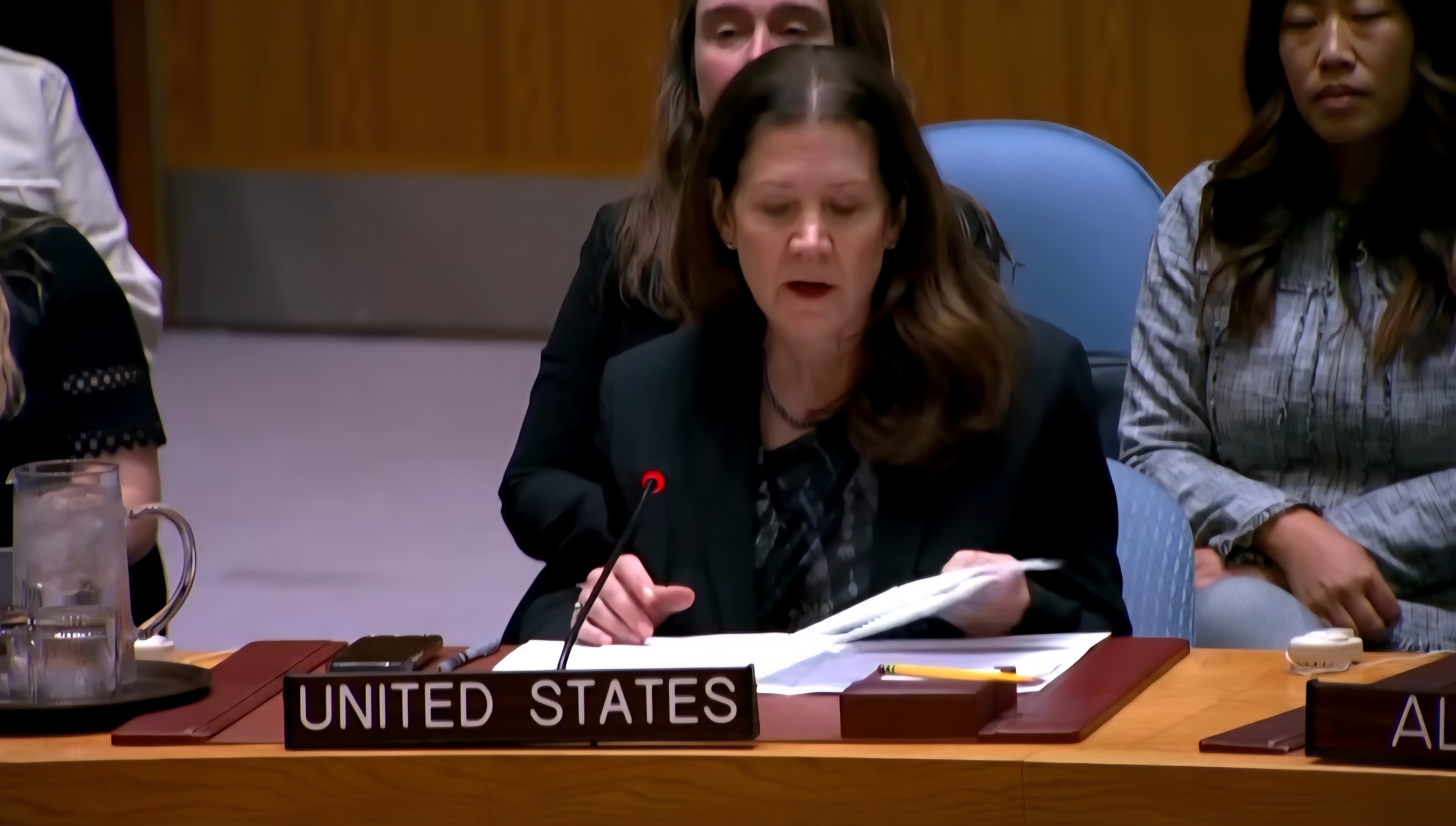
The acting US Representative Dorothy Shea vetoed the draft resolution saying “US opposition to this resolution should come as no surprise – it is unacceptable for what it does say, it is unacceptable for what it does not say, and it is unacceptable for the manner in which it has been advanced. The United States has been clear: we would not support any measure that fails to condemn Hamas and does not call for Hamas to disarm and leave Gaza.” She added “We cannot allow the Security Council to award Hamas’ intransigence. Hamas and other terrorists must have no future in Gaza. As Secretary [Marco] Rubio has said: ‘If an ember survives, it will spark again into a fire’.”
Knowing that the United States would use its veto right to reject the resolution, one is left with two conclusions: the rest of the Security Council wanted the US to veto the resolution, or they care more about protecting Hamas than civilians in Gaza.
Perhaps the fourteen UNSC countries want Israel to continue the war but want to placate their pro-Palestinian constituents, appearing to support Gazans while knowing that no relief would happen until Hamas is defeated. Maybe the countries want Israel and the United States to both look isolated – the “little Satan” and “Big Satan” as the Islamic Republic of Iran calls them – hoping to curry favor among the Global South, with 80% of the world’s population.
Either way, the world cannot really believe there is a genocide happening in Gaza, if the path to a ceasefire was simply adding two lines calling for Hamas to surrender.
United Nations Secretary General Antonio Guterres is first and foremost a politician, not a human being. What else can be the reasons behind his ignoring the slaughter of 1,200 people in Israel, burning entire towns, raping women and kidnapping 250 people, other than serving his constituents of the Global South whom he has learned are rabid antisemites?
When a radical socialist-jihadi gunned down two young Israeli diplomats outside a Jewish event in Washington, D.C. in May 2025, Guterres immediately issued a statement condemning the murders. It was something he did not do after the massacre in Israel on October 7, 2023. Or October 8. Or October 9. Or October 10.
But he rose to the occasion in May 2025 after the targeted killing of the Israeli couple by a lunatic yelling “Free, free Palestine,” as if he were surrounded by fantom college campus agitators. Perhaps anticipating blowback from the anti-Israel horde he leads (read serves), Guterres explained this statement “reiterat[ing] his consistent condemnation of attacks against diplomatic officials.”
THIS particular antisemitic murderer should be “brought to justice” because he killed diplomats, a Bozo no-no. In this circumstance, the UN “extends sympathies to the Government of Israel,” because members of the sacred circle of high brow governmental officials were gunned down, not Jews having breakfast with their kids in their kitchens.
The thousands of butchered and injured people in Israel by over 3,000 Gazans in October 2023 were just Jews and therefore deserved no sympathy from the United Nations. Guterres could not offer any words of condemnation or consolation to the Jewish State for such barbarity; he has been so trained by the Global South. His office would not demand that thousands of Gazans “be brought to justice”; they are the UN’s protected wards.
When the head of the United Nations explained to the world that he decided to quickly condemn the murder of two Israelis when he ignored the butchering of 1,200, because of unity among diplomats, he further exposed the profound inhumanity of the cancerous global institution.
How many generations should someone be called a “refugee?” Two? Ten? My parents were refugees and I consider myself the son of refugees. But not a refugee. To do so would be a mockery of millions of people fleeing homes to faraway lands where they have no family, infrastructure or knowledge of the local language.
Alas, while every year the world adds and removes refugees from the global tally, there is a permanent exception.
There are roughly 122 million displaced people worldwide (68 million internally displaced, 38 million refugees and millions of others seeking protection), and the United Nations High Commissioner for Refugees (UNHCR) is tasked with helping them. Its mission is clear: assist people fleeing conflict or persecution to either return home when it’s safe, or resettle in a new country where they can rebuild their lives and become citizens. Refugee status, according to UNHCR, is meant to be temporary. A tragic but manageable step toward normalcy.
But for one group of people, the rules were rewritten.
In 1949, the United Nations created a separate agency: the United Nations Relief and Works Agency (UNRWA). Its job was not to help all refugees, but a specific set—Arabs who left or were displaced from what became the State of Israel during the 1948 war.
Unlike the UNHCR, UNRWA never intended to help these refugees resettle or gain citizenship elsewhere. In fact, when Jordan annexed the to be named “West Bank” in 1950 and granted full Jordanian citizenship to the Arabs living there in 1954 (Jews were specifically excluded from Jordanian citizenship) —including the so-called refugees—UNRWA still kept them on its refugee rolls. Why? They were no longer stateless, no longer displaced from their community, and in most cases, were living just miles from where they or their families once resided.
No other refugee population in the world is treated this way.
The Palestinians under UNRWA are not counted based on where they live or whether they’ve rebuilt their lives. They’re counted based on ancestry—any descendant of someone who lived in Mandatory Palestine in 1946 and left during the war is considered a “refugee.” That includes people who are now citizens of Jordan who have never set foot in Israel, and those who live under Palestinian rule in the West Bank and Gaza.
This isn’t about resettlement. It isn’t about a “two-state solution.” It’s about return. Not return to a country they fled—but to homes where their grandparents once lived, in a country that has since fought multiple wars for its survival and established itself as a sovereign nation.
This has locked the Middle East into a perpetual state of conflict. UNRWA doesn’t just preserve the status of Palestinian refugees—it amplifies it, funds it, and builds an international bureaucracy around it. It has denied Israel’s right to control its own immigration, and basic principle of sovereignty.
Worse, the UN’s actions have turned a situation normally considered a humanitarian issue into a real estate dispute. By insisting that people return to a house—not a country, as outlined in international human rights law—the global political body has exceeded its own mandate. This isn’t a question of national self-determination, but one of personal property claims. UNRWA isn’t so much a champion of the creation of a state beside Israel; it champions individual return to specific homes, decades abandoned or destroyed, now occupied by others in a sovereign country.
Meanwhile, the descendants of every other refugee group in the world—from Sudan to Ukraine—are helped by the UN to find a path forward. Only the Palestinians are encouraged to walk backward, into the houses of their grandparents.
UNHCR helps refugees stop being refugees. UNRWA helps them stay that way.
Every year, new wars create new displaced people. But only one group stays on the list year after year, generation after generation.
For Palestinian Arabs, the 1948 war is still being fought. Generations of people haven’t been birthed into refugee status as much as the region is in a 100 years war. While the world may use political terminology of an UNRWA ward who has never been to Israel as a descendant of a “refugee,” Palestinians simply see a permanent property right which will never be forfeited. The UN simply provides cover under the “refugee” monicker.
The world sees Gaza through the lens of curated sympathy – smoke trails from missile strikes, wounded children, crumbled buildings – rendered by the media and United Nations. The headlines scream “siege” and “occupation,” and the images are carefully framed to elicit tears, not questions. For them, Gaza is a tragedy.
But Israelis? They see something very different.
They see a terrorist enclave. A society ruled by Hamas – not just tolerated but elected – with a charter calling for genocide against Jews. They see neighbors who have fired over 30,000 rockets at them since Israel left Gaza in 2005, and who used humanitarian aid to dig terror tunnels and stockpile weapons.
Israelis are haunted by October 7, 2023 – the day when 1,200 of their people were butchered. Burned alive. Shot in their homes. Raped in front of their families. And they remember what came next: polls showing 75% of Gazans supported the massacre. The popularity of other Palestinian Arab terrorist groups skyrocketed as well, including Islamic Jihad, al Aqsa Brigade and al Qassam. This wasn’t some fringe radical cell that commited the vile pogrom – this was public approval for mass murder. It was the fulfillment of their long-standing desire to attack Jewish civilians inside of Israel since 2000.
They also see something deeper: three-quarters of Gazans consider themselves “refugees” living in temporary homes. Not because of displacement from this war but because they believe they’re entitled to homes inside Israel. They don’t see Gaza as their future – they see Tel Aviv.
To the United Nations, Gaza is a moral play where Israel is always cast as the villain. They see Gaza not as a failure of Palestinian leadership, not as a society hijacked by jihad, but as a tragedy authored entirely by Israel. Why? Because Israel won’t allow these “refugees” to move into the homes of Israeli Jews – the very homes where grandparents fled in 1948 after five Arab armies attacked the new Jewish state.
The world has condemned Israel for responding “disproportionately” to the October 7 massacre. The UN saw Israeli counterstrikes as war crimes, not defense. They ignored the slaughter of Israeli children and focused on fuel shortages in Gaza. They accused Israel of starvation, ignoring the trucks of aid Israel itself let in, even while its soldiers were under fire. They paid scant lip service to Israeli hostages kept in tunnels by Hamas, viewing them as collateral to Israel’s ongoing “Nakba”.
The Arab and Muslim world is not fooled but is not helping. They don’t see Gazans as brothers and sisters in need of refuge. They see them as Palestinians – a distinct, useful political weapon. If Gazans were Syrians, they would’ve been taken in by now. But they’re not. They’re left to fester – a long-term tool to weaken and delegitimize the Jewish state.
Even in America, Gaza has become a kind of geopolitical Rorschach test. Leaders like Donald Trump and Jared Kushner see opportunity: beachfront real estate with the potential to be the Singapore of the Middle East. A future riviera. But that future depends on changing a mentality – one that for decades has been more obsessed with destroying Israel than building Gaza.
Because this is the reality: Gaza could have been Dubai. It had the backing of the international community, billions in aid, and a chance to chart its own path. Instead, it chose jihad. It chose hate. It chose martyrdom over medicine, tunnels over technology, indoctrination over innovation.
The world sees rubble. Death. Tragedy. Not on both sides; for Palestinians.
They can’t see the Israeli hostages through their clouded moral lenses. They don’t see the Jewish parents still waiting for their children. They don’t see the decades of restraint Israel exercised before finally saying “enough”. They are caught in an empathy swamp and have mentally baptised Gazans as martyrs instead of genocidal jihadists.
The Global South sees Gaza not just as another flashpoint – but as a pawn in a bigger game. The narrative is not just about “liberation” but “redistribution.” From peace talks to class war. Israel, to them, is just the first domino in toppling the Western-led world order.
Gaza isn’t just a local issue anymore. It’s global. It’s ideological. And for Israelis, the stakes couldn’t be higher.
In this backdrop of viewpoints, an international conference at the U.N. headquarters in New York will take place from June 17 to 20 co-chaired by France and Saudi Arabia. The Global North will join the Global South in trying to find near-term and longer-term solutions to the 100-year Arab-Israeli conflict.
In this Coliseum, the General Assembly serves as the unruly crowd seeking the torture of the Jewish State, while the Security Council acts as caesar empowered with the pen to draft international law. Will the United States protect Israel in such forum on the heels of Trump’s visit to the Gulf? Will Trump seek to trade an unwinding of U.N. Security Council Resolution 2334 to get Israel to agree to short-term and longer term movements towards a permanent divorce between local Jews and Arabs?
Israel was blind to the October 7 attack. Does it see what the world sees in Gaza now and the positions being orchestrated for the June U.N. conference? Will the modern blind Samson bring down the house if it only hears calls for its demise and cannot see a path to live in peace?
On Friday, May 14, 1948, Israel declared its independence—one day before the British ended their Palestine Mandate and left the region. The timing wasn’t accidental. Israel’s founding leaders wanted the moment to be marked with reverence, not paperwork, so the declaration was made in advance of the Jewish Sabbath, allowing the entire Jewish people to enter its rebirth with dignity and joy.
The joy wasn’t shared. Within hours, neighboring Arab armies invaded the nascent state, launching a war to crush Jews in the shadow of the European Holocaust. That contempt hasn’t faded. It echoes today in the halls of foreign governments, NGOs, and the mouths of extremist politicians thousands of miles from the region.
To “commemorate” Israel’s 77th birthday, the United Nations hosted a session dedicated not to peace or coexistence—but to “the Inalienable Rights of the Palestinian People.” One speaker after another vilified Israel, slandering its conduct in defending itself in a war it never wanted. Accusations of “racism,” “genocide” and “ethnic cleansing” flowed freely—from China, South Africa, Guyana, and others eager to hijack human rights rhetoric for anti-Israel theater.
Not to be outdone, U.S. Congresswoman Rashida Tlaib (D-MI) introduced a resolution to formally mark Israel’s independence as Nakba Day—”the catastrophe.” The language mirrored the UN’s smear campaign, ignoring context, facts, and Israel’s right to exist as a sovereign nation. The resolution outrageously called on Israel to accept seven million Arab descendants of refugees and internally displaced people—almost all of whom have never set foot in Israel—negating a fundamental right of statehood by erasing Israel’s right to control its own borders. It called for the United States to withhold all diplomatic and military support from Israel as it defends itself in the midst of a multi-front war, to facilitate a genocide of Jews.
As Israel marked its 75th year in 2023, Jewish civilians were massacred by genocidal jihadi Arab terror groups on the Sabbath and Simchat Torah, a holiday celebrating the Jewish Bible. Rockets, kidnappings, and slaughter were launched from Gaza, with terrorists using Palestinians as human shields and Jewish hostages as bargaining chips—while cheering voices thousands of miles away offered rhetorical cover.
Today’s political war against Israel is led by the unholy alliance of far-left ideologues and Islamist extremists. They’ve inherited the mantle of the Arab armies defeated in 1948—and continue their campaign, not for coexistence, but for the erasure of the Jewish homeland. This is a Global Intifada dressed in human rights language but aimed at ethnic cleansing. In 1948, the horde successfully removed all Jews from eastern Jerusalem, the “West Bank” and Gaza. They strive to finish the job.
For them, Jewish sovereignty in the ancestral Jewish homeland remains a “catastrophe,” and Israel’s Independence Day is a day for revolutionaries to perpetuate the war. Not just for the 30 countries which continue to refuse to recognize Israel—but for shrill voices in the U.S. Congress who speak as if the past 77 years never happened.
After Arab armies failed to destroy Israel in 1967, the Arab League produced its “Three No’s“: no peace with Israel; no negotiations with Israel; and no recognition of Israel. It has an underlying three principles which continue to drive Jew haters: Jews have too much; Jews enjoying fundamental human rights is a provocation; and Jewish joy is triggering.
The trifecta of Israel’s Independence Day is too rich for global antisemites to ignore.