The Torah’s first image of Moses is of a man split against himself. Born a Hebrew and raised in Pharaoh’s palace, he lives between worlds. When he kills an Egyptian beating a Hebrew slave, the act is instinctive. Yet when another Hebrew confronts him—“Who made you ruler and judge over us?” (Exodus 2:14)—Moses has no answer. He cannot say who he is or why he has the right to act.
So he runs.
The flight is explained as fear of Pharaoh because the attack was discovered. A deeper cause is identity fracture. Moses is caught between Egyptian and Jew, insider and outsider. When identity is unsettled, even a disgraceful question feels existential. Retreat becomes the reflex.
That pattern did not end in Egypt.
Today, for much of the diaspora, Jewish life has carried a similar split. Jews learned to survive by blending, qualifying, and softening. Identity became situational. Answers changed with the room. When questioned—about history, belonging, or the land of Israel—the instinct has often been Moses’ instinct: explain carefully, hedge, or leave the room. Running becomes habit when the self feels divided.
Israel changes that equation.
Israeli Jews do not experience Jewishness as a negotiation. It is civic, cultural, linguistic, and historical all at once. There is no internal argument to resolve before answering an external challenge. Questions that unsettle diaspora Jews rarely destabilize Israelis because the identity beneath them is settled.
Kotel Plaza with Israeli flag (photo: First One Through)
The philosophical approach even applies to non-Jews in Israel. Consider Quentin Tarantino, who married an Israeli, lives in Israel, and raises his children there without explanation or apology. His life models something diaspora Jews are rarely encouraged to try: resolve the split by living a whole integrated self rather than defending it. Belonging practiced instinctually requires no justification.
That clarity was shown clearly in Tarantino’s 2003 film Kill Bill: Vol. 1. In the film, O-Ren Ishii responds to an attack on her heritage immediately and violently. She recognizes the move as an attempt to diminish her and rejects the premise entirely. The table turns the instant she stops answering the charge and starts judging the judge.
For diaspora Jews—and for anyone of mixed heritage—the lesson is continuity. Identity settled internally removes the need for fleeing externally. When the self is whole, interrogation loses its force. Disgraceful questions do not deserve better answers; they deserve exposure and repudiation.
Moses ran because his identity was divided while modern Israelis do not. O-Ren stands because she knows exactly who she is and will not entertain accusers.
Diaspora Jews today should not need to relive Moses’ uncertainty of self. The work now is not to run, but firmer clarity. Better education and rootedness. Firmer responses.
Stop running. Stop defending. Condemn the question—and the room will follow.
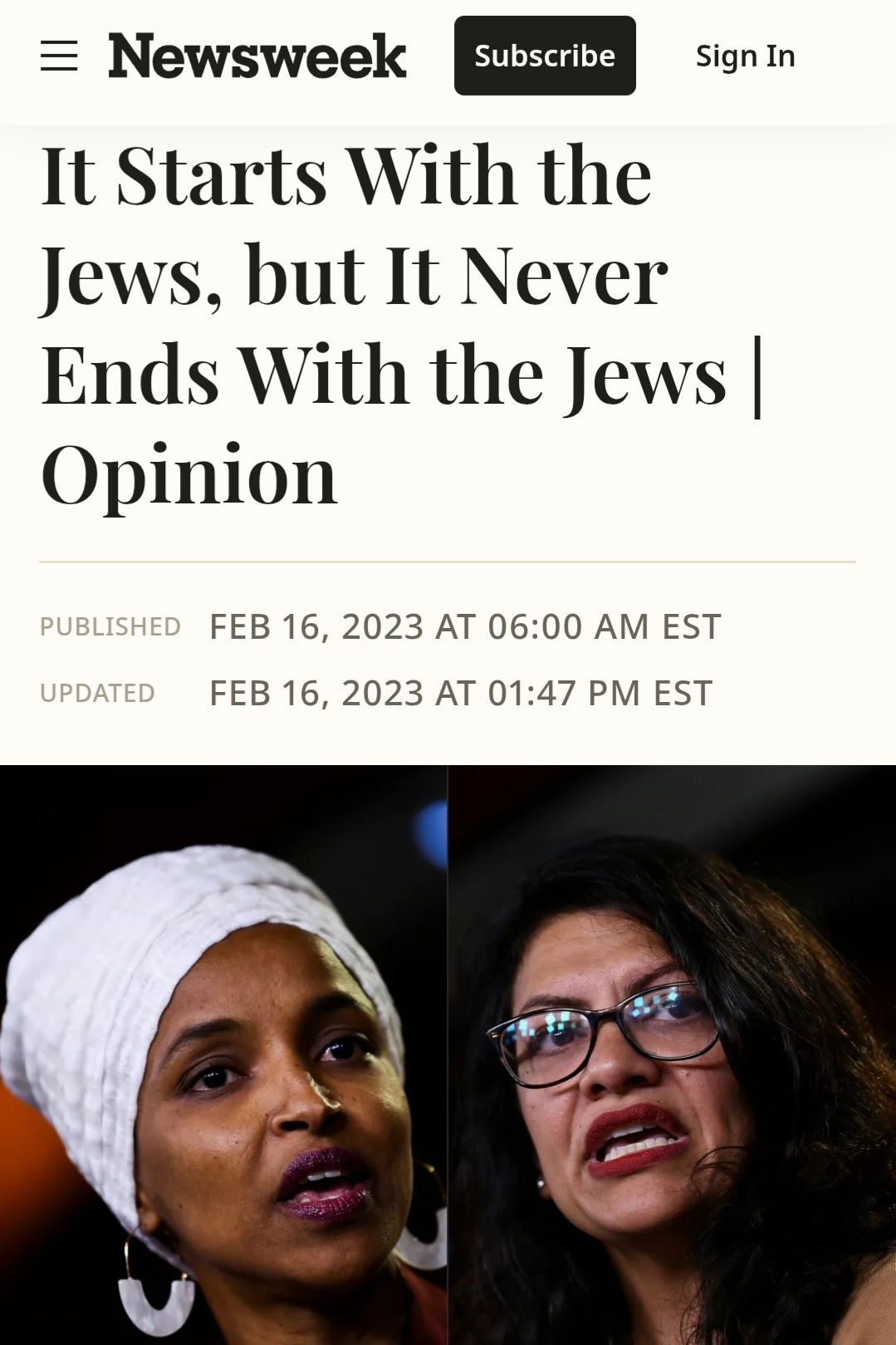
Every time antisemitism is called out on the left, the same dodge appears on cue: “It’s just free speech.”
That response is not a defense. It is a red herring.
No one is arguing that anti-Israel speech is illegal. Under American law, almost nothing is. You can shout racist slogans. You can be misogynistic. You can mock religions. You can hold a Draw Muhammad contest outside a mosque. You can call for the destruction of a country. You can deny a people’s history.
All of that is protected speech. That has never been the question.
The question is what that speech is.
And much of what now passes as “anti-Israel discourse” is not political critique at all. It is hate speech, clearly, historically, and deliberately so.
Calling for the destruction of the Jewish State is not foreign policy analysis. Denying Jewish history in the Land of Israel is not academic debate. Declaring that Jews alone have no right to national self-determination is not progressive politics. Passing a law that Jews cannot live somewhere and cannot pray at their holiest location is not a free exchange of ideas.
It is the application of a single moral standard to one people — and only one people — that says: you do not belong anywhere.
It is naked antisemitism.
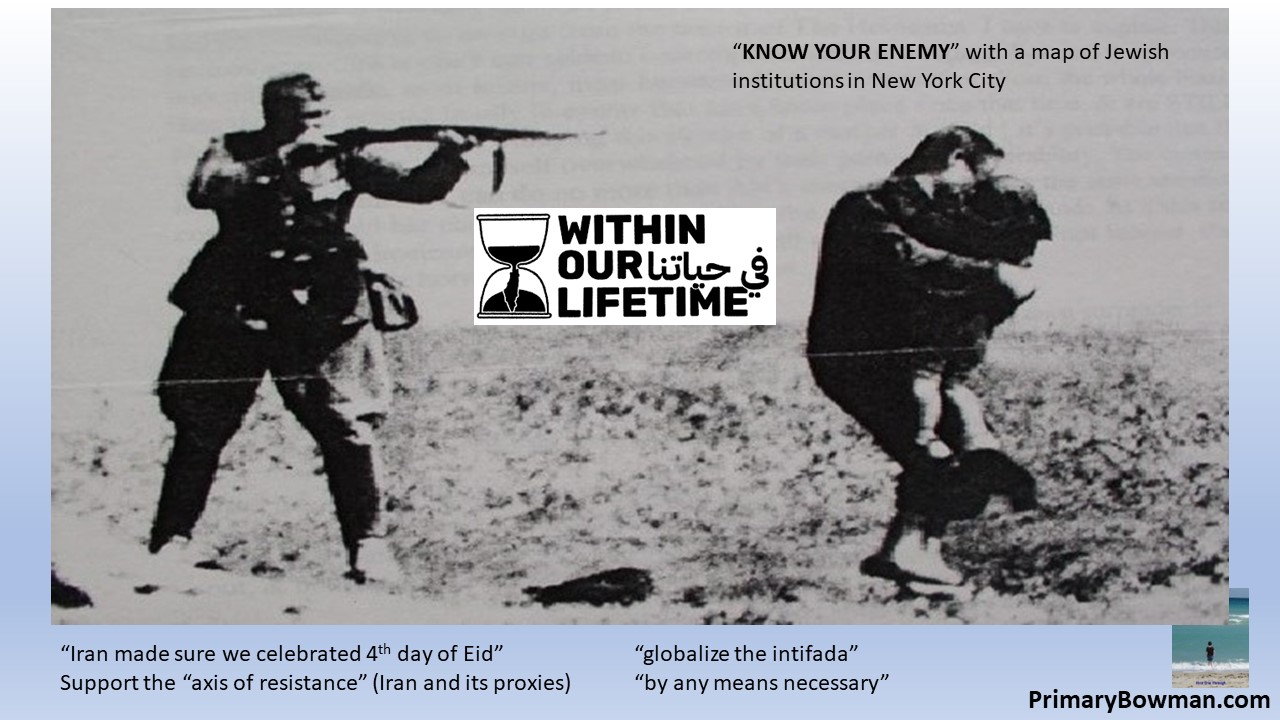
Organizations like Democratic Socialists of America, Students for Justice in Palestine, Within Our Lifetime and Palestine Youth Movement are not tolerating this rhetoric. They are chanting it,platforming it, amplifying it, and treating it as virtuous. They deny Jewish peoplehood, erase Jewish indigeneity, excuse violence against Jewish civilians, and then insist this is nothing more than robust debate.
It is not.
It is hate speech — even if the Constitution protects the right to utter it.
And then there is Zohran Mamdani, who embodies the selective blindness at the heart of this moment. No serious person believes he would tolerate a mass of protesters outside mosques depicting Muhammad as a terrorist, screaming at Muslims as they enter prayer. That would be — correctly — labeled Islamophobia, regardless of whether it was technically legal.
When Jewish institutions are targeted, when synagogues are surrounded, when Jewish national identity is declared illegitimate, the alt-left response suddenly becomes procedural: free speech.
Free speech does not launder bigotry. The First Amendment protects the right to speak; it does not cleanse the moral content of what is said. When people accuse Mamdani and the DSA of promoting Jew-hatred, they are not confused about constitutional law. They are describing the reality of ingrained Jew hatred.
“Most Americans are familiar with the classic Western flavors of anti-Semitism: the Christian, European, white-supremacist and Communist types. But little attention has been paid to the special case of Muslim anti-Semitism. That is a pity because today it is anti-Semitism’s most zealous, most potent and most underestimated form.” – Ayaan Hirsi Ali, July 2019
Invoking free speech is an evasion. A way to avoid responsibility while continuing to normalize ideas that would be instantly condemned if aimed at any other minority.
The tragedy – and fear – is that liberals understand this perfectly well in every other context. They simply refuse to apply it to Jews. Or at least, when uttered by a community of preference, Muslims.
Free speech is not on trial, do not be confused by the misdirection. Antisemitism is, and it is winning.
Political power is built when ideology is fused to daily life. Theory alone persuades few and charity alone commands none. Durable movements embed a worldview inside services people rely on, until dependence becomes loyalty.
That was the formula in Gaza. It is the same formula now visibly rising in New York.
Hamas entered Gaza with a rigid morally corrupt worldview long before it ruled. Its clinics, schools, mosques, and charities were never neutral. They delivered aid while teaching a doctrine that explained suffering, identified enemies, and promised redemption through allegiance. Service and ideology arrived together.
The Democratic Socialists of America advances along the same dual track in American cities. Mutual aid, tenant organizing, bail funds, and rent clinics function as delivery systems for a moral framework that divides society into oppressors and oppressed, treats ownership as suspect, and elevates redistribution as justice. Assistance arrives bundled with belief.
In both cases, aid becomes initiation and gratitude becomes allegiance.
The Manifesto: How Movements Legitimize Seizure
Grassroots legitimacy does not sustain power by itself. Movements require a manifesto—a moral architecture that explains why people suffer and who is to blame.
Hamas supplied that architecture in its 1988 foundational charter. The document framed politics as a total moral struggle, casting Jews collectively as illegitimate manipulators of capital and institutions, thieves of land and destiny. Jewish presence, ownership and sovereignty were criminalized. Seizure was the cure to restoration. Compromise vanished and was vilified. The charter’s function was clear: define an enemy class, strip legitimacy, and authorize permanent struggle.
The New York analogue operates through a different medium with the same effect. In the DSA ecosystem, capitalists and landlords are portrayed as extractive and illegitimate. Profit is framed as violence with ownership recast as theft. Confiscation is moralized as justice.
Jews are often implied rather than named—refigured as landlords, financiers, “Zionists,” or beneficiaries of immoral systems. Jewish capital becomes shorthand for illegitimate capital. The logic is identical: identify a moral contaminant and justify its removal.
Every mass movement needs a villain. The manifesto supplies one.
After Victory: Asset Capture as Governance
When Hamas seized Gaza in 2007, its parallel institutions fused into rule. Aid became leverage. Employment became conditional. Permits learned loyalty.
Then came Hamas’s most consequential real-estate empire: the tunnel network. A vast underground system ran beneath homes, schools, mosques, and hospitals—an invisible city binding the population into the movement’s infrastructure. Security, storage, command, and coercion converged below ground. Benefits flowed to the loyal. Dissent was isolated.
Governance became permanent: mobilization with infrastructure.
The governing theory now circulating in New York mirrors this logic. Mass governance insists movements never demobilize after elections.
Housing is the fulcrum. Advocates call for seizing or socializing rental property, transferring control to movement-aligned entities, and moralizing ownership itself. What cannot leave becomes the lever.
New York City Mayor Zohran Mamdani states openly that he will “govern expansively and audaciously” and not change course for being deemed too “radical.” What was once viewed as crazy is being normalized and soon to be implemented.
Redistribution Without Production
Hamas never built a productive economy in Gaza. It did not need to. External money—almost all of it routed through international “aid”—financed the broken economy. Governance ran on grievance and allocation. The system extracted and redistributed; it did not grow.
The same risk shadows New York’s mass-governance vision. There is no emphasis on productivity, investment, or growth. The emphasis is on free stuff and redistribution from outside: state transfers, federal dollars, and seizing capital from more wealthy citizens. When the mobile capital inevitably leaves, the focus will intensify on seizing what cannot leave: real estate. As jobs and taxpayers depart, redistribution turns inward. Assets are moralized, then absorbed.
The Bigger Warning: This Is Happening in New York
This is not unfolding in a peripheral city. It is unfolding in New York City—the capital of capitalism.
DSA-NYC backed Zohran Mamdani
A redistribution-first governing theology imposed here would not be contained. When growth is dismissed as immoral and allocation is elevated as virtue, capital leaves, talent migrates, and pressure turns inward.
The danger compounds because New York is also home to one of the largest Jewish populations in the world. History is unambiguous: when movements moralize capital and cast Jews—explicitly or implicitly—as its avatars, the outcome is rupture. Flight. Confrontation. Violence.
An antisemitic movement consolidating power beside Jewish life at this scale resulted in the deaths of tens of thousands in Israel and the terrorist enclave of Gaza. It is an impending disaster in New York.
Hamas showed the arc in Gaza: from grassroots mobilization plus ideology, to framing the enemy who causes despair, to asset confiscation and control, to an entrenched vicious philosophy financed by redistribution without production.
DSA-NYC is following the same arc, adapted to American law and language.
When the capital of capitalism abandons growth and sanctifies seizure, the city stops creating wealth and starts fighting over remnants.
Memorial plaque in Vienna, Austria. In 1420, all Austrian Jews were arrested; 270 were burned at the stake, while the others were expelled and their property confiscated. The Vienna Gesera in 1421 brought the Jewish community in the Middle Ages to a truly bloody end. The root causes were antisemitism mixed with an economic desire to cancel debts.
Jewish tradition returns again and again to the image of the tree. Sometimes it appears strong and fruit-bearing. At other moments it is reduced, cut back, or left without water. The image endures because it carries history within it—growth shaped by interruption, life that continues through constraint.
The prophets reached for this language when ordinary description failed them.
“They shall be like a tree planted in the desert, that does not sense the coming of good.” – Jeremiah 17:6
“Let not the barren one say: ‘I am a dry tree.’” – Isaiah 56:3
The statement reframes the moment. What looks final and foreboding is often incomplete. The future has not yet spoken.
That tension—between appearance and essence—finds a physical echo in the hills west of Jerusalem, where Yad Kennedy rises from the forest. The memorial marks a life interrupted mid-growth. John F. Kennedy’s presidency and life ended before its natural arc could unfold, and the monument holds that sense of unrealized promise. Surrounded by trees planted in rocky soil, it resembles a tree stump, and invites reflection on lives cut short and on continuity carried forward by those who remain.
Yad Kennedy in Jerusalem Forest
Jewish history has unfolded along similar lines. After the destruction of the Second Temple, Judaism reorganized itself without sovereignty or familiar institutions. Across centuries of dispersion, it adapted under pressure, preserving learning and community in constrained forms. Growth did not disappear; it compressed, waiting for conditions that would allow it to expand again.
This persistence appears vividly in the work of Dr. Mark Podwal (1945-2024). His drawings return repeatedly to the Jewish tree—scarred, truncated, shaped by time. The branches rise unevenly, carrying memory in their grain. Life continues without erasing what came before. Growth is real precisely because it bears the marks of history.
That image resonated deeply with Rabbi Yehuda Amital (1924-2010), founding Rosh Yeshiva of Yeshiva Gush Etzion. A survivor of the Holocaust, Rav Amital rebuilt his world through Torah that could hold rupture and responsibility together. His leadership reflected patience, moral seriousness, and a belief that renewal emerges gradually from damaged ground.
Podwal once gave Rav Amital a drawing of a truncated Jewish tree—reduced in form, yet unmistakably alive, blooming with the promise of a renewed Judaism. The rabbi transformed the image into a small sticker and placed it inside the books of his personal library. Every volume bore the same mark.
Drawing by Mark Podwal about Jewish life springing forth from Jewish texts, used as a sticker in the library of Rav Yehuda Amital (photo: First One Through)
The image spoke directly to his life’s work. Rav Amital played a central role in rebuilding the Gush Etzion community after it was destroyed in the 1948–49 War of Independence, a war in which he fought shortly after moving to the land of Israel after his family was slaughtered in Auschwitz. In the hills south of Jerusalem, homes had been razed, residents killed or expelled, and the area left barren. The return after the 1967 Six Day War was careful and deliberate, rooted in learning, faith, and responsibility. A community grew again where one had been cut down.
Each time Rav Amital opened a book, the image reinforced that lesson. Torah study itself became an act of regrowth.
Rav Amital had the original Podwal drawing framed and placed on the wall of his home. (photo: First One Through)
That insight extends far beyond one community.
In the Land of Israel, Jewish roots run beneath history itself—through exile and return, ruin and rebuilding. Torah and Jewish presence were never uprooted from this land. They were compressed, covered, narrowed to fragments. Learning continued in small circles, in whispered prayers, in constrained spaces. At times the surface appeared barren. Beneath it, roots remained alive.
This is why Jewish life and learning in Israel carry a distinctive quality of reemergence. Yeshivot rise where silence once prevailed. Communities form on ground that held ruins. Torah is studied again in places where the chain of learning was abruptly broken. To the unobservant eye, it can appear improbable—as though life has emerged from wood long dried. To those who understand the depth of Jewish connection to this land, to the Jewish texts which form the basis of Judaism, it is recognition rather than surprise.
The dry tree was never dead. It was waiting.
Jewish continuity does not require ideal conditions. Where roots reach deep enough, water is eventually found. Growth resumes in forms shaped by everything that came before.
In the legends of Prague, the Golem came into being when civic order failed Jews in predictable ways. Blood libels circulated, crowds gathered, and authorities hesitated at the decisive moment. Rabbi Judah Loew, the Maharal (c.1512-1609), recognized the pattern. He shaped a human form from the mud of the Vltava River—from the city itself—and animated it with sacred words. The choice of material mattered. The defender of Jews was made from the ground beneath their feet. Even if the city’s leaders would not protect Jews, the city itself would.
The Golem patrolled the Jewish quarter, broke the rhythm of violence, and restored deterrence. When the danger passed, it was deactivated and laid to rest in the attic of the Old New Synagogue, the Altneuschul. The legend recorded a hard truth: when the state falters, protection is improvised; when the state recovers, emergency power sleeps.
Altneuschul in Prague (photo: First One Through)
That memory traveled.
The melody of Hatikvah, the national anthem of the Jewish State of Israel, traces back through the musical world of that same Prague river Vltava, famously shaped by Bedřich Smetana (1824-1884). Exile and return share a river. The Golem embodies survival within exile; Zionism embodies the resolve to end exile. One guards a community where it stands, the other builds sovereignty so guarding becomes policy.
Yet the Golem never disappears. It waits for the moment when trust in authority thins again.
New York, Upper East Side
New York City holds one of the world’s largest and most visible Jewish populations. Jewish life here is open and proud. Synagogues, schools, and community institutions operate in public view, anchored by the assumption that their protection is a foundational duty of government.
That assumption has been tested.
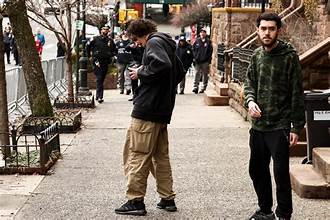
On the Upper East Side in November 2025, an anti-Israel crowd swarmed a synagogue hosting a pro–Land of Israel event. The scene echoed an old shape: shouting at the doors of a Jewish house of worship, intimidation in a public park, the expectation that Jews would need to justify gathering openly as Jews. Instead of drawing a clear perimeter around the synagogue and condemning the mob, Zohran Mamdani, the incoming mayor of New York City, scolded the shul for holding a Zionist event, shifting the burden of restraint onto the Jewish institution.
For Jews who carry history close, the signal was unmistakable. Cities fail their minorities first through language, then through hesitation, and only later through force. When the synagogue itself surrounded by an angry crowd is framed as the problem, safety has become conditional.
Conditional safety never endures.
How the Modern Golem Forms
The Golem of New York does not rise from clay. It forms from memory.
Private guards appear where confidence once lived. Volunteer patrols lengthen into the evening. Parents coordinate entrances and exits. Institutions harden quietly, without ceremony.
These are the incremental steps of adaptation. Communities organize when clarity blurs. Parallel systems take shape when weak reassurance yields to experience.
Other minority groups get municipal funding and public declarations of support while Jews are only lumped into a general “other” category, as in White Plains, the capital of Westchester County just north of New York City. Jews learn that they must fend for themselves, because their basic protection offends many. Frighteningly, even for local politicians.
On the Upper East Side, a growing and proudly Zionist congregation bears a name heavy with inheritance: Altneu Synagogue. Old–New. It is a spin-off of the Park East Synagogue where the anti-Israel mob harassed and intimidated Jews. The echo of Prague’s Altneuschul may also prove prescient. Old dangers return wearing contemporary language. Rivers change. Cities change. But the logic persists.
Natan Sharansky, a famous Russian “refusenik” who was jailed for years before being allowed to leave to Israel, knows the dangers of antisemitic regimes. He came to Washington, D.C. in November 2023 to address 300,000 people about the need to fight back: “We, together, will fight against those who try to give legitimacy to Hamas. We will fight for Israel. We will fight for every Jew. We will fight against antisemitism. We will fight for the values and against corruption of those values which are at the center of our Jewish identity and American identity.”
For the moment, things may be OK. Mamdani appointed Jessica Tisch as police commissioner, a role she has had for several years. She is Jewish and no-nonsense leader, widely supported by the city’s Jewish community. If she can do her job without anti-Zionist and antisemitic politicians limiting her mandate, Jews will be fine. Otherwise, a new golem will rise in the New World, hundreds of years after the Golem of Prague went to sleep in the attic of the Altneuschul.
The headlines are the same. Another plot uncovered. Another attacker radicalized online. Another manifesto stitched together from familiar phrases about vengeance, purity, and divine obligation.
Was it ISIS-inspired? Was it Hamas-aligned?
In practice, the distinction is collapsing.
From Manchester to Sydney and across Europe and North America, security services increasingly encounter the same ideological core animating different actors. Antisemitism framed as righteousness. Violence framed as duty. Death framed as meaning. The slogans vary, the flags change, but the belief system underneath remains remarkably consistent.
ISIS flag on the car of murderers in Sydney, Australia
These movements are not converging by accident. They are aligned by doctrine. They are the banners of jihad.
When stripped of geography, branding, and media strategy, Hamas and the Islamic State reveal the same worldview: a sanctified war against Jews, against pluralism, and against life itself.
They are branches of the same antisemitic death cult.
God Alone Rules
Both movements begin with a totalizing claim: sovereignty belongs exclusively to God. Political authority, democratic choice, civil law—all are illegitimate intrusions into divine rule. Religion is not guidance; it is command.
This theology leaves no room for coexistence. Difference becomes defiance. Dissent becomes apostasy. Submission is the only acceptable outcome.
Violence as Obedience
Violence is not an unfortunate consequence of struggle. It is the struggle. Jihad is framed as obligation, killing as faithfulness, death as fulfillment.
This is why attacks around the world feel interchangeable. Civilian targets are central because civilians matter symbolically. Children are drawn into the story because innocence amplifies impact. Suicide becomes virtue because it collapses the distance between belief and action.
When ideology outranks life, mass killing is not excess. It is alignment.
Jews as a Theological Obstacle
The conflict is often described in political or territorial terms, but the animating hostility is theological. Jews are cast as an enduring enemy embedded in sacred narrative, not as a community with whom disagreement might be resolved.
That framing explains the permanence of the war. Agreements become pauses. Ceasefires mere tactics. The goal is not compromise but eradication.
Scripture, once weaponized, does not negotiate.
Death as Currency
In societies shaped by this ideology, death is elevated and life is instrumentalized. Martyrdom replaces mourning. Sacrifice replaces survival. Civilian neighborhoods are folded deliberately into military design.
Homes, schools, mosques, hospitals become launchpads and shields. Suffering is curated for export. Images of devastation are not collateral damage; they are strategic output.
What the outside world experiences as tragedy, the ideology treats as leverage.
Power Without Freedom
The end state is always the same. Total control enforced by fear and sanctified by religion. No speech outside doctrine. No faith outside orthodoxy. No dignity outside obedience.
ISIS ruled this way openly. Hamas learned to cloak the same destination in the language of resistance and grievance. The structure beneath remains unchanged.
The Lesson Already Learned
When ISIS surged across Iraq and Syria, the West recognized the threat clearly. It did not argue for partial containment. It did not imagine ideological evolution. It organized, committed resources, and dismantled the movement.
And it succeeded. For a while.
Israel has carried that same burden. By Israel’s own assessments, roughly 95 percent of Hamas’s fighting capacity—its leadership, battalions, tunnels, and command infrastructure—has been destroyed.
Stopping here would not stabilize anything. Allowing the group to maintain its weapons – the way the majority of the Stateless Arabs from Palestine (SAPs) want – would preserve the conditions for revival. Ideologies built on sanctified violence do not soften when wounded. They metastasize.
The remaining fragments are not a political movement in transition. They are an ideology waiting to rearm, re-export, and re-infect—far beyond Gaza.
Yet the world is rearming and financing ISIS and Hamas. It is allowing the jihadi groups to gain strength.
The world once understood this when ISIS was the name on the banner. The jihadist doctrine of Hamas is the same and has not changed. Only the branding has.
Hamas leadership promises to continue war against Israel forever
ISIS in Africa in Somalia, recruiting from around the world
When famine made Canaan (the land of Israel today) unlivable, Jacob’s family went down to Egypt. What began as a temporary refuge became something else entirely. Goshen (Genesis 45:9) was fertile, welcoming, and safe. The Jews prospered there. They built families, livelihoods, and a future. And for a time, it worked.
That is what makes Goshen so instructive. Unlike earlier famine detours in Genesis, this was not a brief excursion. Goshen was a one-way trip. It felt secure enough to settle into—and that comfort lasted generations. Until it didn’t.
Jews talk about it today as they ponder antisemitism’s historic trajectory. It has moved millions of Jews around the world for thousands of years, marking them as the “wandering Jew.” In 1900, most Jews spoke Russian, German, Polish and Arabic. In 2025, they almost all speak Hebrew and English, with French and Spanish covering virtually everyone else.
The land of Israel itself was not without Jewish migration. The land flourished, kingdoms rose, institutions formed. Then came division, exile, and destruction. First the northern tribes disappeared into history. Later Judah followed. The Jews did not just lose modern incarnations of Goshen; they lost their homeland for nearly two thousand years.
Parshat Vayigash is often used as the Torah’s first meditation on long-term diaspora. It offers no illusion that comfort guarantees permanence. Goshen was pleasant until a Pharaoh arose who no longer remembered Joseph. But the Jewish homeland was also strong until it fractured from within and fell to external powers. Neither place offered permanent security.
The lesson is not that exile is doomed or that the Jewish Promised Land is automatically safe. It is that where Jews live is often situational, not absolute. Prosperity can mask vulnerability. Stability can decay quietly. The obligation is vigilance—reading the environment honestly, assessing quality of life soberly, and understanding that history turns even when life feels settled.
Israel’s Security Barrier as seen from Jerusalem, built to stop terrorism during the “Second Intifada”
Goshen teaches that success today is not a promise for tomorrow. But Israel teaches the same. Awareness, not geography, is what determines whether a place remains livable.
The conservative group Turning Point USA held its four day AmericaFest conference this week with a lineup of political commentators – and Nicki Minaj (1:13:00). Ben Shapiro of the Daily Wire sent the conference in a new direction, coming to speak early and attacking several of the speakers due to come on – including Tucker Carlson and Megyn Kelly – for trafficking in antisemitism and platforming wild conspiracy theories and theorists.
The media lit up that there is a rupture inside the conservative movement. Vice President JD Vance said at the conference, seemingly in response to Shapiro’s line of attacks, that “we have far more important work to do than cancelling each other.”
While the majority of people at Turning Point agree with Shapiro about Israel according to polls, the question of how to engage with people with whom you strongly disagree or want to persuade is an important question about tactics.
Consider the biblical figure Joseph.
When he first dreamed, Joseph placed himself at the center of the story and delivered the message directly to those who would one day bow before him. His brothers did not merely hear a vision of the future; they heard a declaration of hierarchy. The dream named winners and losers, elevation and humiliation.
Truthful or not, it was combustible.
Joseph learned—at extraordinary cost—that telling people they will submit to you does not hasten destiny. It creates enemies who delay it. Fate may be fixed, but its route is not.
Years later, standing before Pharaoh, Joseph applies that hard lesson with precision.
Joseph tells Pharaoh that his dream came in two forms because God has decided to do it—and to do it soon (Genesis 41:25-32). This is a striking claim, because Joseph himself had two dreams many years earlier, and nothing happened quickly.
Joseph is not contradicting himself. He is revealing what he has learned.
As a boy, Joseph assumed repetition meant imminence. Life taught him otherwise. His dreams were doubled, yet delayed for decades. They passed through betrayal, silence, and obscurity before fulfillment.
So why does Joseph now speak with certainty?
Because he ultimately understood something he did not then: the meaning of repetition depends on where the dream is aimed and who holds agency.
Joseph’s youthful dreams were aimed directly at people—at his brothers, at his parents, at their submission to him. They provoked resistance. Those who felt targeted fought the message, and history slowed.
Pharaoh’s dreams are different—not because they are truer, but because Joseph presents them differently.
Joseph does not tell Pharaoh that HIS reign will collapse or that HIS legacy will be erased. He does not aim the dream at Pharaoh’s ego. He does not place Pharaoh at the center of decline and does not elevate himself as the savior.
Instead, Joseph shifts the focus outward—to the land, to the people, to the coming conditions. Egypt will suffer. The famine will devastate the country. The threat is environmental and collective, not personal.
By doing so, Joseph removes both himself and Pharaoh from the line of fire.
Joseph learned an important lesson: when a dream threatens reality rather than pride, it accelerates history.
His own dreams were delayed because they challenged people directly. Pharaoh’s dreams moved quickly because they challenge circumstances instead.
Joseph’s greatness is not merely interpretive; it is strategic. He transforms a divine warning into a solvable problem.
He gives Pharaoh a way forward—storage, planning, delegation, foresight. Pharaoh is no longer defending his status; he is protecting his people.
Joseph learned the difference between telling people what will happen to them and showing them what will happen around them.
The first creates enemies. The second creates leaders.
Truth, But Approach
Joseph did not abandon truth. He learned how to deliver it. Ben Shapiro also spoke about serious matters honestly, but perhaps poorly. He imagined himself as the true shepherd of the conservative movement and sought to de-platform others.
When you aim at people, they shield themselves. When you aim at conditions, people mobilize.
If you want history to move, do not take aim at the audience. Give them the map—and let them walk into the future themselves.
In October 2002, in a case before the Supreme Court, Justice Antonin Scalia did something characteristically disarming. In the middle of a commercial case—a dispute about representations, intent, and liability—he reached for an example so blunt that no one in the courtroom could miss the point.
“let’s assume that there is a Federal statute that makes discrimination because of, or failure to hire someone, or let’s say, let’s say killing someone solely because of his race a crime, a separate crime. And someone, let’s assume he kills someone who is Jewish, and he said, well, I didn’t kill him solely because he was Jewish; I killed him because I disagree with the policies of Israel. Does that get him out of the statute?” – Supreme Court Judge Antonin Scalia on October 8, 2002
The question was not theatrical. It was instructional.
Scalia was making a narrow, lawyerly point about intent laundering—the habit of rebranding a harmful act with a more palatable explanation after the fact. In commercial law, courts reject that move every day. You cannot sell a defective product and escape responsibility by calling the defect innovation. You cannot mislead customers and then claim a higher purpose. Labels don’t change outcomes; explanations don’t erase harm.
He chose that example because everyone understood it immediately. Not because it was exotic, but because it was familiar. People do, in fact, come for Jews with reasons. They always have. The reasons change; the target does not. That is why the hypothetical worked even in a commercial case. It required no ideological scaffolding, no speech doctrine, no moral hedging. The room got it.
Scalia wasn’t talking about protest or expression. He was reminding the Court that post-hoc justification does not transform reality. A Jew selected as a Jew remains a Jew, regardless of the banner the attacker waves. You cannot launder murder through geopolitics any more than you can launder fraud through branding.
What makes the moment unsettling two decades later is not that Scalia saw this clearly in 2002. It’s that today, society now pretends not to.
Today, the very maneuver Scalia identified is routinely indulged. Violence against Jews is reframed as politics. Targeting Jews is explained as resistance. The word “Israel” is treated as a solvent capable of dissolving antisemitism on contact. The act is dissected until the victim disappears into the explanation.
Scalia understood that this maneuver was not new. In the Middle Ages, it was radical preachers who performed the laundering. On Easter, from pulpits across Europe, Jews were accused of killing Christ, poisoning wells, murdering Christian babies. The charge was always moral, never personal. The violence that followed—pogroms, expulsions, massacres—was framed not as hatred, but as righteous response. The excuse sanctified the act. The victim was still Jewish.
“The crimes you are committing in Palestine by desecrating the sanctity of the holy sites – foremost among them the blessed Al-Aqsa Mosque – you should expect reactions, not only from the Muslims, but rather from the entire world.” – Palestinian Authority Chairman Mahmoud Abbas’ Advisor on Religious Affairs and Islamic Relations Mahmoud Al-Habbash on December 15, 2025 about the massacre of Jews in Sydney, Australia
The vocabulary has changed. The mechanism has not.
Today the laundering is done in different robes—through left-wing media narratives, academic language, teacher-union resolutions, and activist slogans. The Jewish state is branded unholy, colonial, imperial. Zionism is recast as original sin. Once that premise is accepted, Jews everywhere become legitimate stand-ins—symbols of something larger, targets by proxy. “Globalize the intifada” is not poetry. It is a call that travels, and it always knows where to land.
The laundering does not stop on the left. Figures like Candace Owens have vilified Jews across time itself—casting them as architects of the slave trade two centuries ago, as hidden hands behind modern social decay, as a people uniquely responsible for nearly every ill that can be stitched into a narrative. The effect is not historical inquiry; it is moral conditioning. When Jews are blamed for everything, they become appropriate targets for anything. The excuse differs. The permission is the same.
This is why Scalia’s example mattered—and why he chose it so plainly. He knew that people come for Jews with reasons. He knew those reasons are never the point. And he assumed, reasonably at the time, that everyone else could still see the difference between explanation and absolution.
Decades later, that clarity is treated as controversial. Motives are said to cleanse acts. Ideology is said to transform targets. Murder is said to become discourse if the language is fashionable enough.
You can change the sermon. You can update the slogans. You can trade Easter blood libels for postcolonial theory.
Hamas does not rule Gaza against the will of its people. It rules because large numbers of Gazans want it to. Hamas articulates aims that many in Gaza accept: “armed struggle,” permanent war, and the eradication of Israel. This is not an imposed ideology. It is a shared one.
That reality is the reason the war has not ended.
Hamas refuses to disarm. It promises to fight again. It rejects coexistence as a moral crime. And Palestinian Arabs have not rejected Hamas. There has been no uprising, no mass refusal, no turning inward to say this has destroyed us and must stop. The tunnels remain. The rockets are rebuilt. The hostages were hidden in plain sight and with complicity.
The Arab world understands this. So does the Muslim world and international community, quietly if not publicly. No money will rebuild Gaza while Hamas governs. No state will guarantee security for a territory whose leadership is openly genocidal. Even those who chant Gaza’s cause from afar refuse to absorb the cost of dismantling its rulers. Words are cheap. Responsibility is not.
And so the world fractures.
One side insists Gaza deserves unlimited sympathy—stripped of agency, frozen as a permanent victim, absolved of all consequence. The other side sees a society that has embraced a war of annihilation and asks the world whether moral condemnation is not only justified, but necessary. This divide is not about compassion versus cruelty. It is about whether moral judgment still matters.
What cannot be sustained is the fiction that Gaza is merely trapped between Hamas and Israel. Gaza is trapped— by leaders and parents who have chosen martyrdom over future, ideology over life, and war over their own children’s survival.
That is where sympathy collapses.
Because the only people in Gaza whose moral claim is uncontested are the children—and they are being sacrificed by a society willing to place guns in schools, tunnels under bedrooms, and hostages among families. A society that teaches its children that nothing is nobler than dying for the cause of destroying the Jewish State.
Sympathy cannot be demanded for that choice. It can only be extended—narrowly, painfully—to those who never had one.
That is why the ritualized outrage of the West’s most powerful institutions now feels so hollow. Each year, The New York Times publishes its Year in Pictures, and the selection itself becomes an argument. In 2025, the year with the largest spike in antisemitism including several incidents of mass murder, there were no pictures of Jewish victims. Instead, page after page of Gaza: rubble, smoke, bloodied streets, dust-covered children. Destruction, repeated until it acquires the authority of inevitability. Israel appears only as force. Gaza appears only as suffering. Context is stripped away. Agency is erased. The camera becomes a verdict.
Two-page spread in New York Times’ 2025 year in pictures showing Gaza rubble. The only other 2-page spread was the election of Zohran Mamdani, an anti-Israel member of the DSA, as mayor of New York City
But the depravity lies not only in what is shown—it lies in what is omitted.
There are no photographs of Jewish life under siege: no police guards posted outside synagogues, no concrete barriers and metal fences erected around schools, no quiet images of fear normalized into daily routine. There are no frames of mourning for Jewish victims abroad, the couple shot in Washington, D.C., the arson at the home of the Jewish governor of Pennsylvania over Passover. No recognition of the global consequences of a war whose ideology has traveled far beyond Gaza. Violence against Jews outside Israel didn’t even make a footnote.
New security fence erected outside synagogue in 2025 (photo: First One Through)
When Israeli hostages appear in the Times, they are reduced to a single visual trope: a large military helicopter, as if their captivity were a logistical problem rather than a crime. Even Jewish victims of Gazan atrocities are set against a large Israeli military. The human cost of hostage-taking is laundered into abstraction.
New York Times only picture of a Jewish victim is a tiny speck in a large Israeli military helicopter
What does receive sympathetic attention are arrests—multiple images of pro-Palestinian demonstrators detained by police, framed as moral courage meeting state power. Advocacy for Israel’s destruction is softened into dissent. The pages preen about resistance while refusing to name what that “resistance” seeks to accomplish.
This is not journalism. It is moral choreography.
The pictures ask only one question—who suffered more?—while carefully avoiding the only one that matters: who chose this war? To launch it? To continue it? They do not show Hamas leaders refusing disarmament. They do not show weapons beneath nurseries. They do not show the ideological choice to sacrifice children for permanence of war.
In this telling, Israel becomes the aggressor by existing, and Gaza becomes sympathetic by persisting in annihilation. The refusal to surrender is recast as resilience. The willingness to sacrifice children is aestheticized as tragedy rather than condemned as crime. Sympathy is manufactured by amputating responsibility. The global anti-Israel advocates are embalmed in the moral light; Jewish victims disappear off the pages.
When the world’s most influential newspaper presents destruction without causation, suffering without choice, and death without ideology, it does not advance peace. It sanctifies perpetual war. It promotes a global blood libel. And it teaches readers that moral clarity is cruelty, while moral confusion is virtue.
The far-left media hopes that history will remember its curated selection of photographs and the modern moment will gather sympathy for the anti-Israel and anti-Jewish horde. Hopefully they are proved very wrong, and this time capsule will forever mark The New York Times for its profound antisemitism and moral depravity.