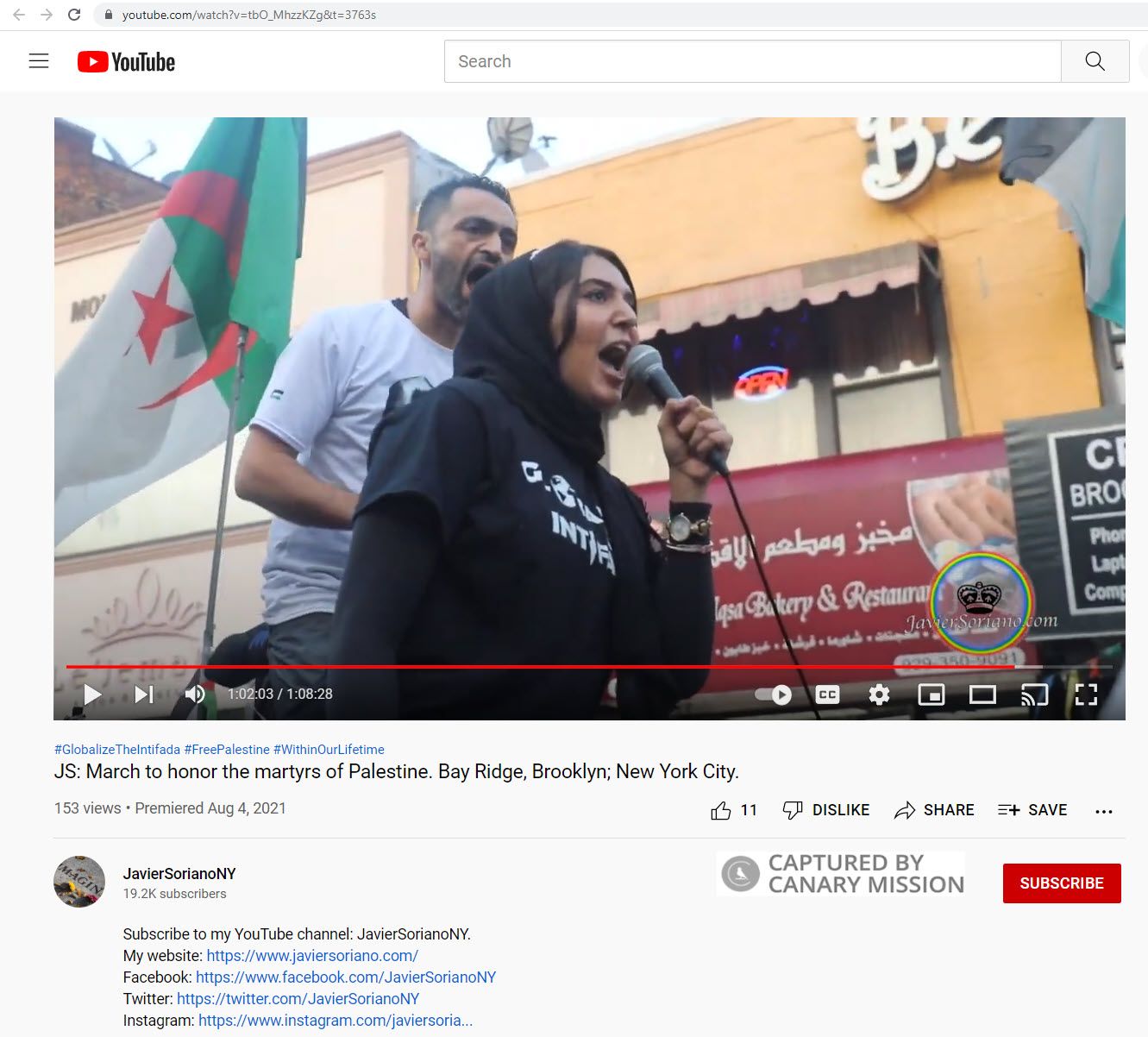
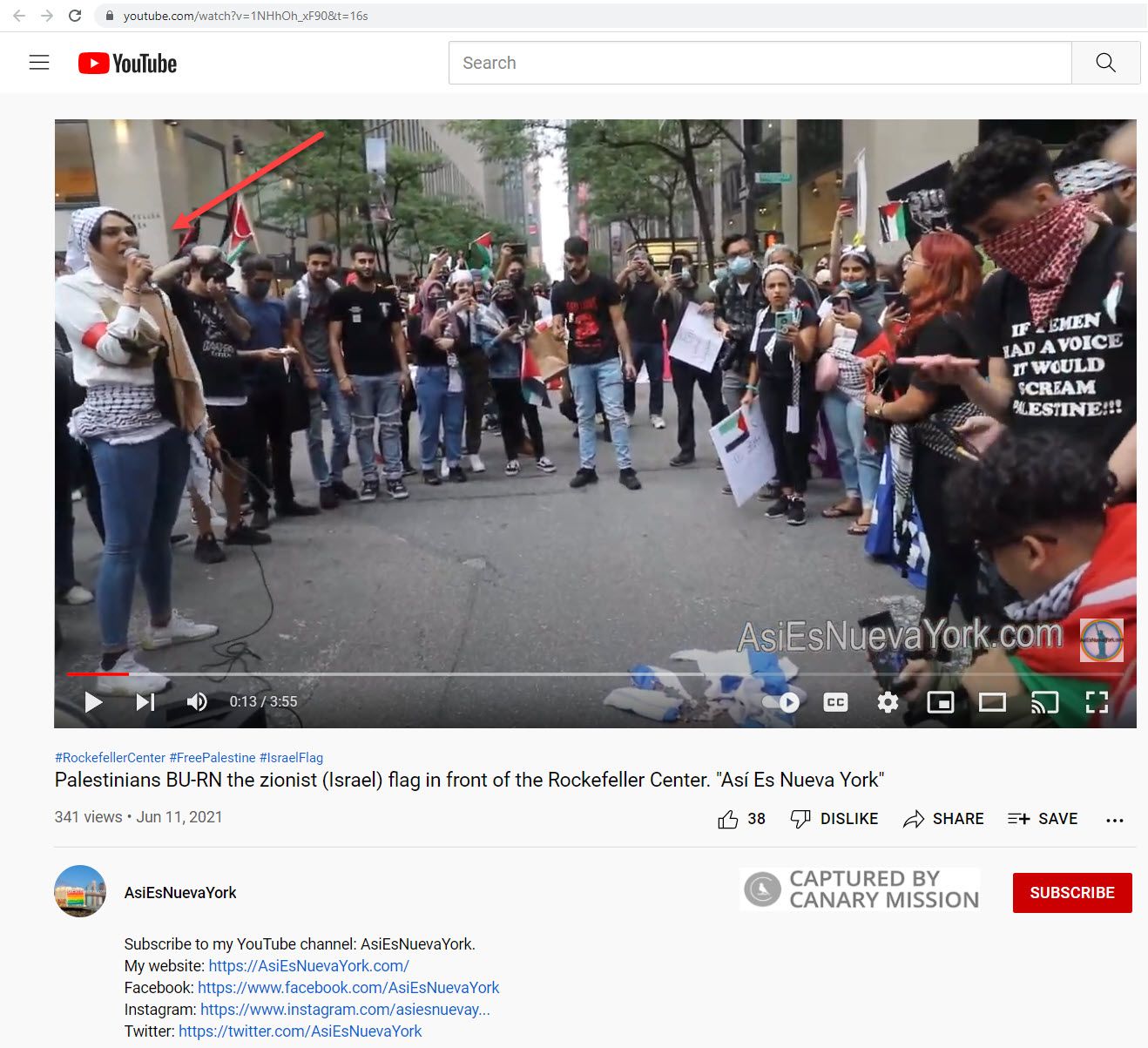
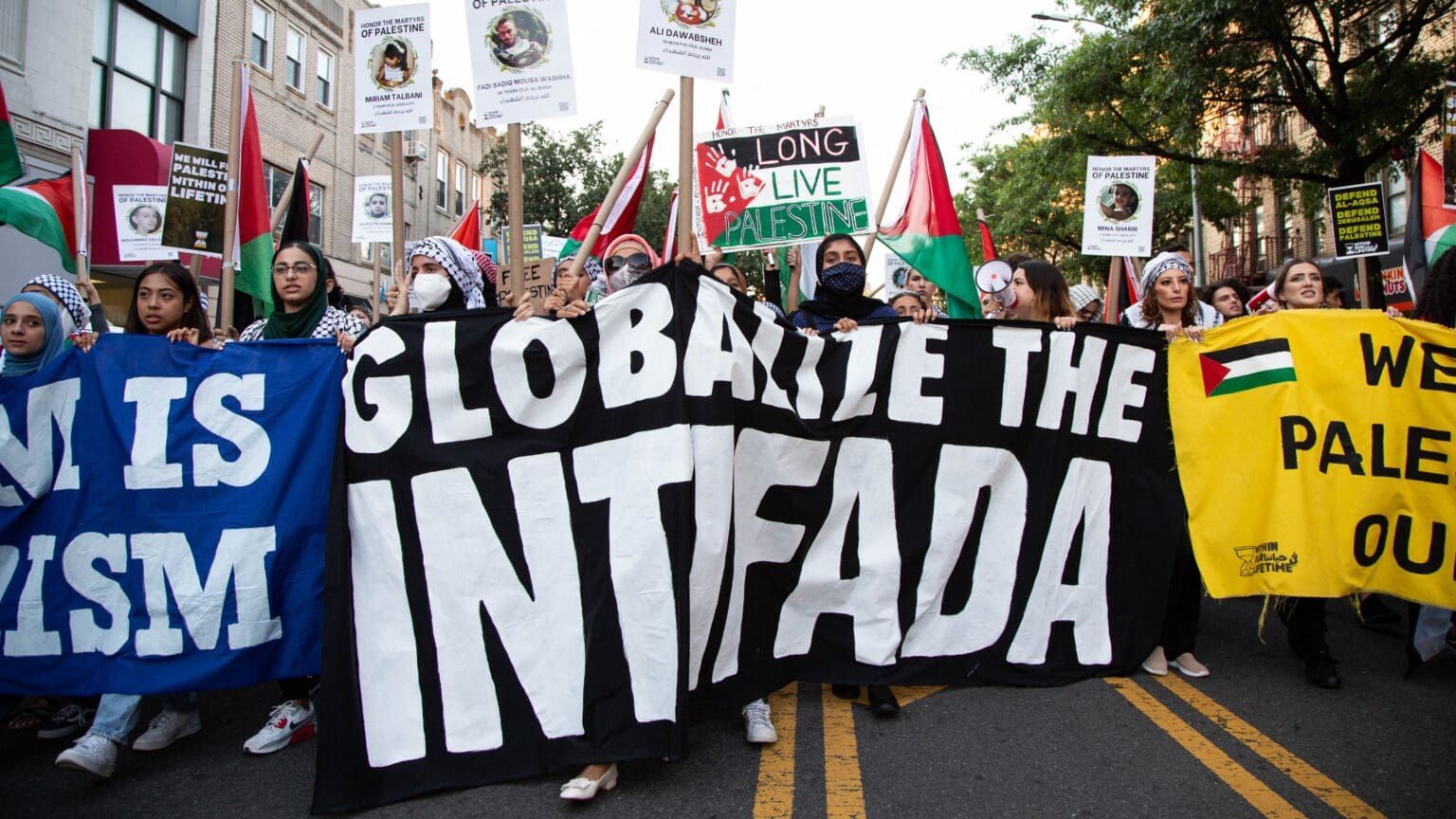
Nerdeen Kiswani is not quiet about her views. She wants the Jewish State obliterated and Zionists killed. She says it openly and proudly in front of loud cheering crowds.
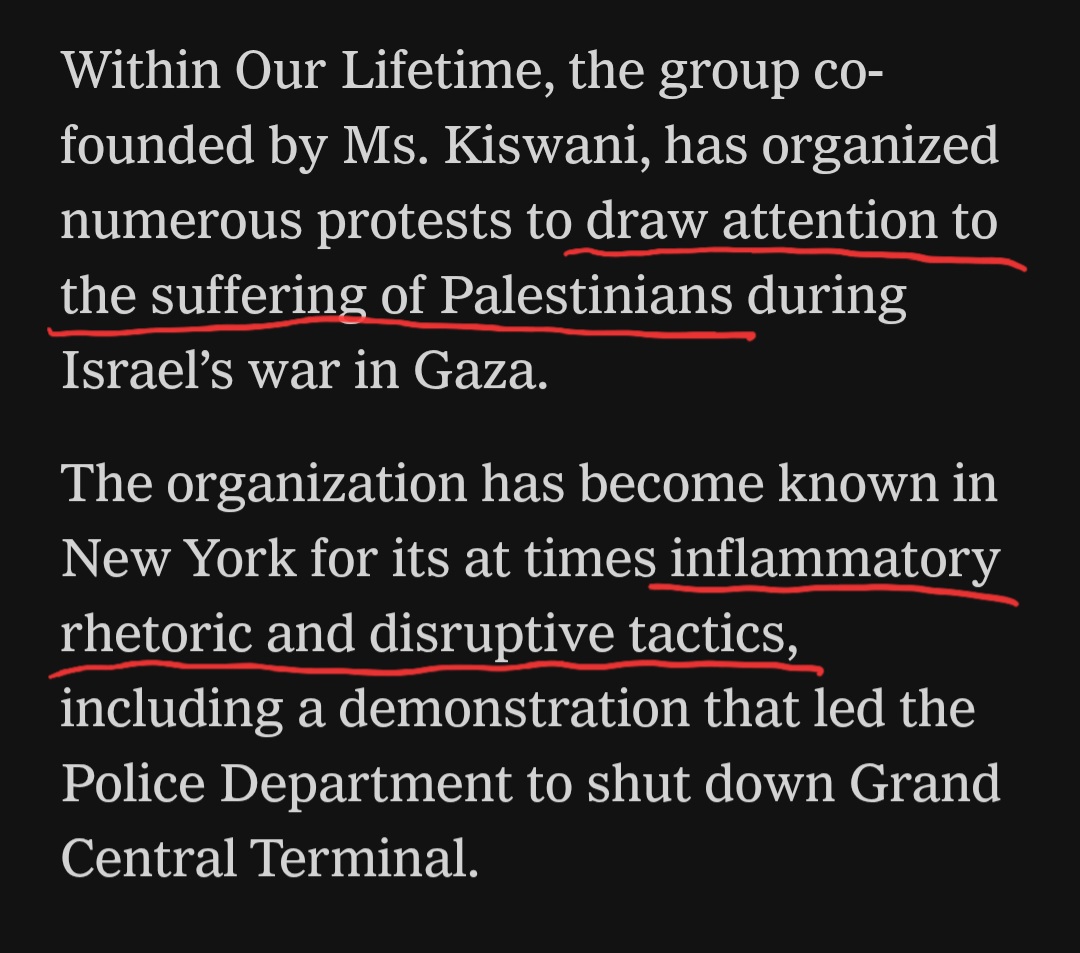
So why did The New York Times soften her stance? Why did it say that she was simply assembling “protests to draw attention to the suffering of Palestinians,” when her entire movement is about the destruction of Israel?
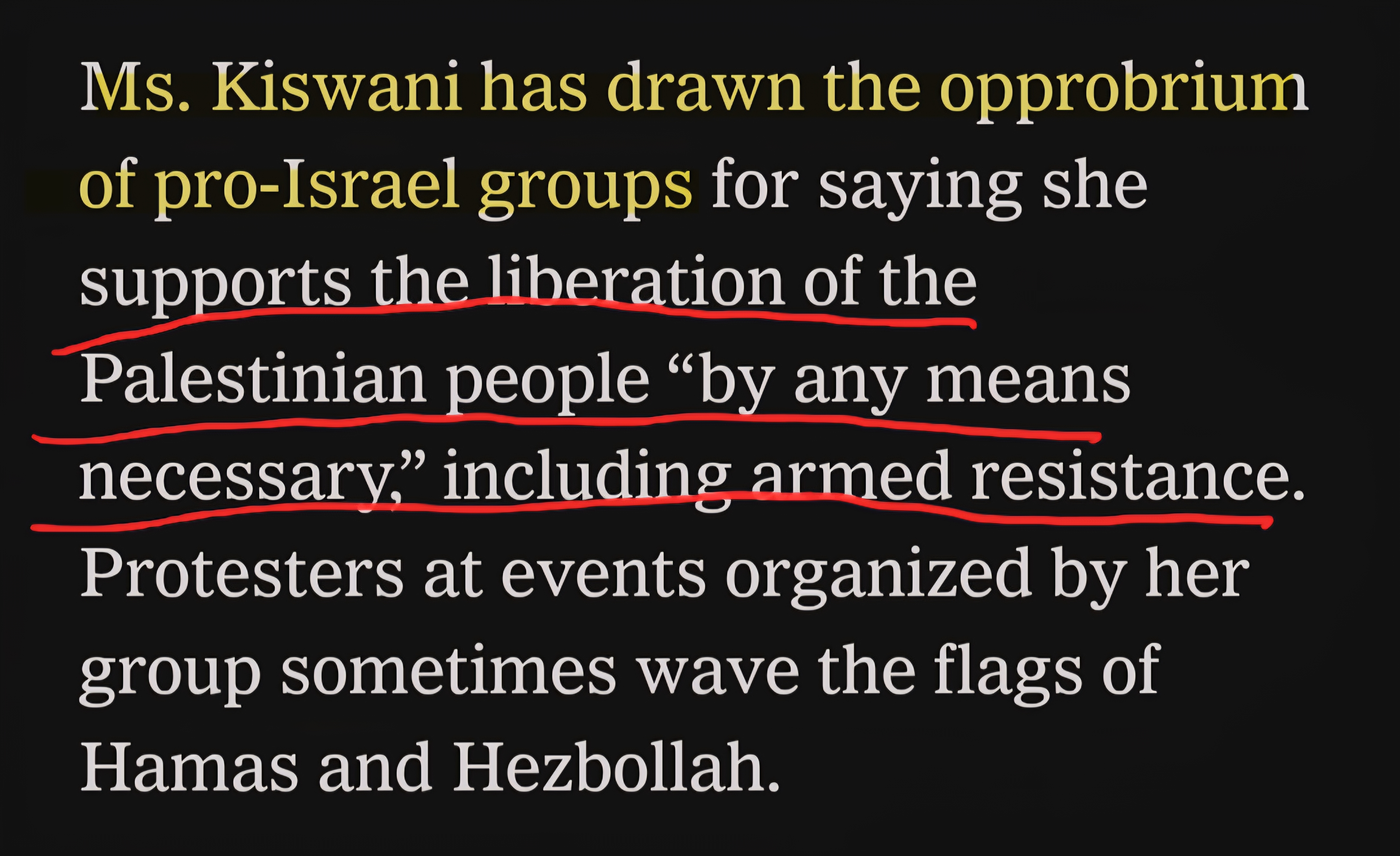
Why did the Times make it sound like pro-Israel groups were uniquely offended that “she supports the liberation of the Palestinian people “by any means necessary,” including armed resistance.”?
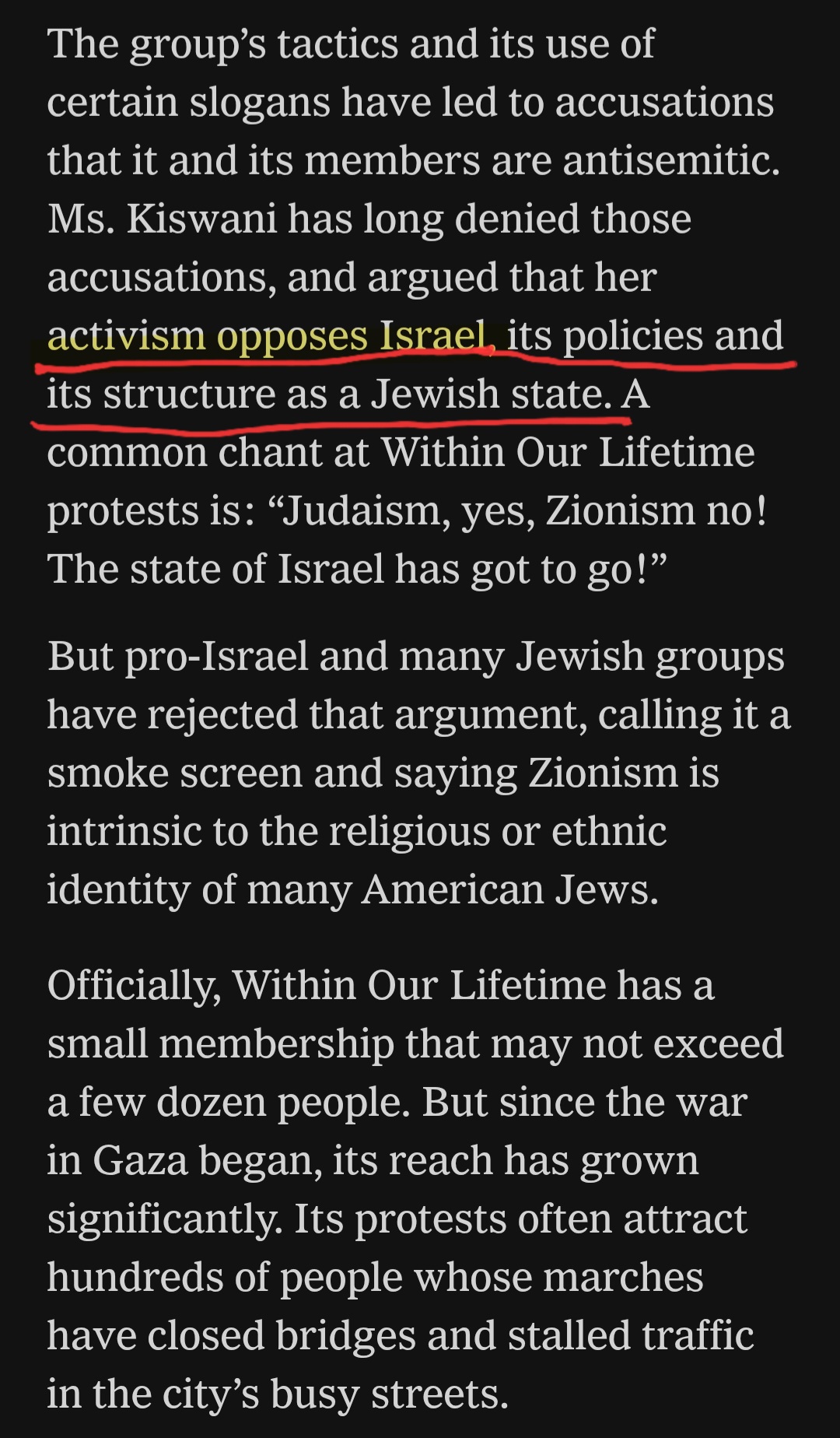
Why did the Times use so much energy and so many words to say “that her activism opposes Israel, its policies and its structure as a Jewish State,” without saying that she supports targeting Jewish organizations and the annihilation of the only Jewish State?
“We marched today, we took over the streets and we visited multiple Zionist settler foundations. Multiple. We let them know we know where they’re at. We know where they work. We’re gonna find out more about where they’re at too. And we’re gonna go after them.” – Nerdeen Kiswani, YouTube, Jun 11 2021
Why didn’t the Times explicitly state that Kiswani endorses US designated terrorist groups and individuals?
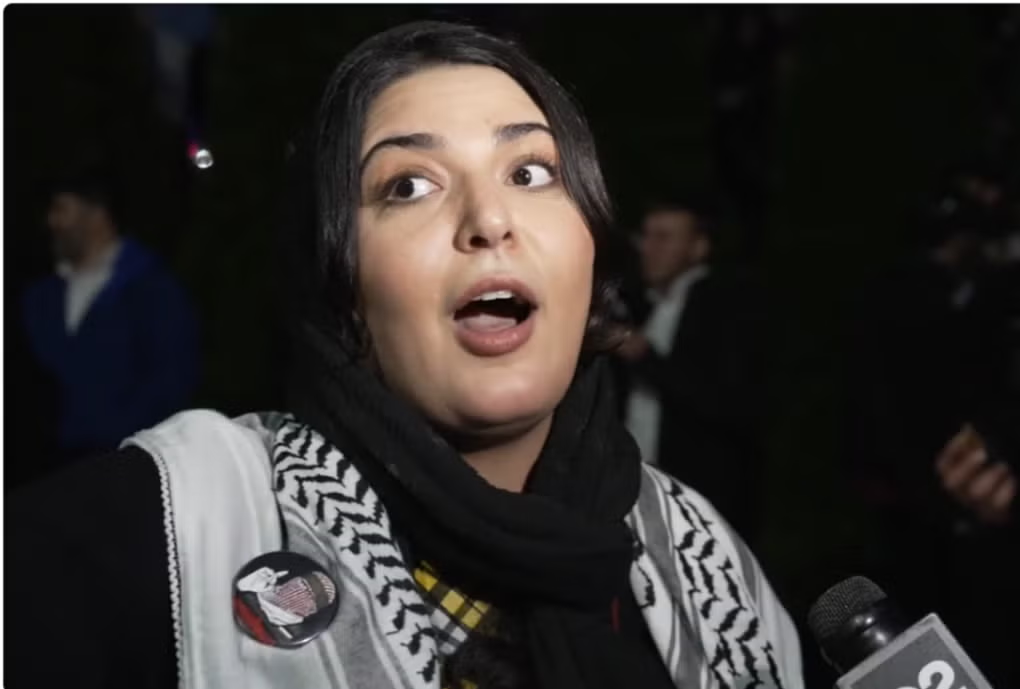
Picture on left is Kiswani with pin of Abu Obaida, a spokesman for Hamas, while protesting in front of a synagogue in Teaneck, NJ on April 1, 2024 (from ADL website)
On June 10, 2024, Kiswani led a protest outside a memorial exhibit in downtown New York City about the Nova Music Festival where she said that young partygoers enjoying music was “like having a rave right next to the gas chambers during the Holocaust,” mocking not only the hundreds of murdered youth but millions of Jews slaughtered in the Holocaust.
Kiswani post of a child kissing an armed Hamas terrorist, like those that burned Jewish families alive
In short, Kiswani is a proud supporter of terrorism against Jews and American allies. Yet The New York Times made it appear that her stances were simply pro-Palestinian, which some members of the pro-Israel community found offensive.
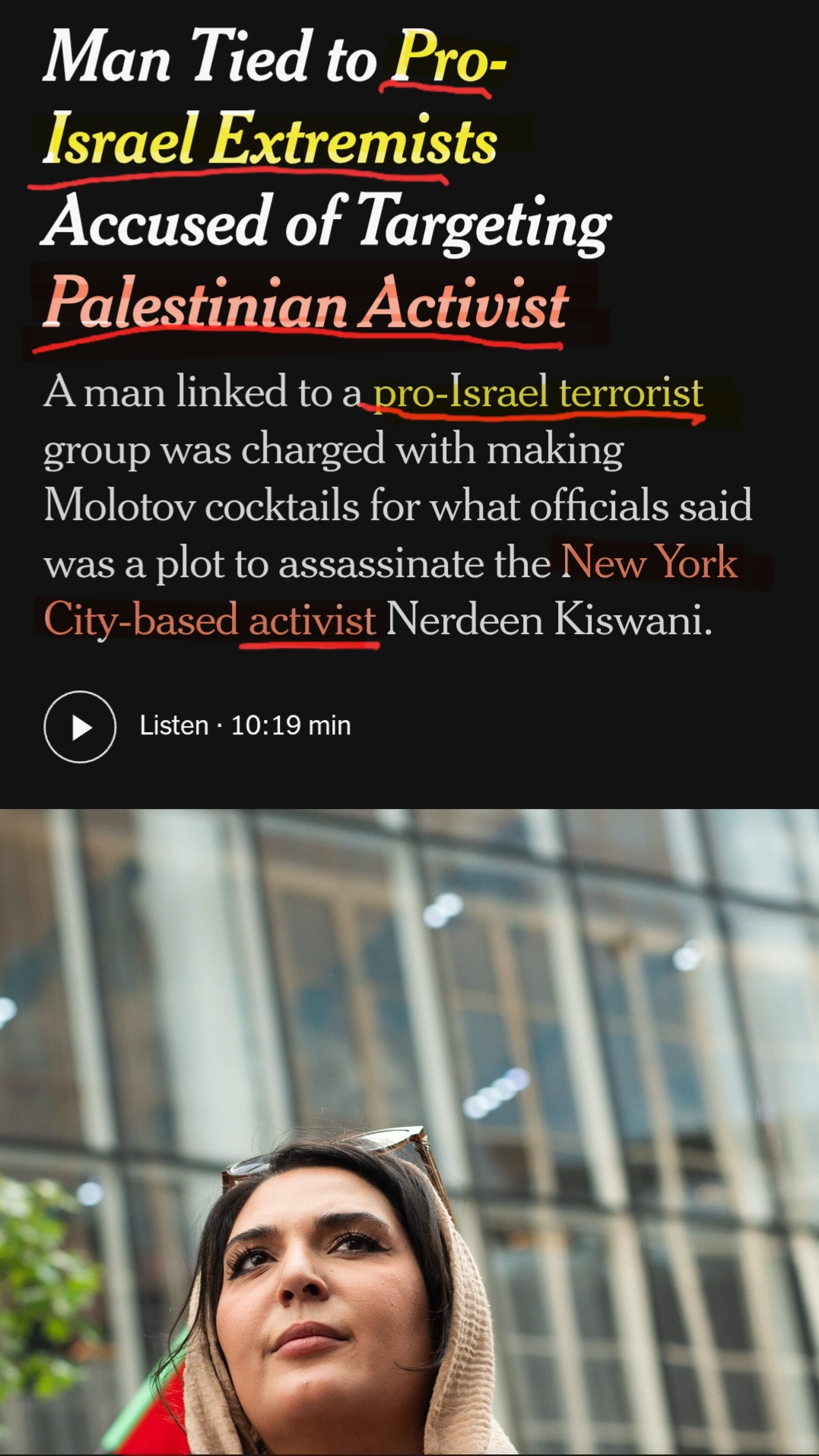
The reality is that a pro-Israel “extremist” allegedly planned an attack on a pro-Palestinian “extremist.” But the Times editorialized by showing the smiling face of an “activist” worried about the “suffering” of her people. Such is the alt-left embrace of the toxic “deformity in Palestinian culture.”
Abraham had two sons. That is not only history; it is the underlying structure of the Middle East.
From Isaac came Jacob (Israel) and the Jews. From Ishmael came peoples that would become much of the Arab world. One father. Two lines. A separation that began in a household and expanded into history.
“And the thing was very grievous in Abraham’s sight… and he sent her [Hagar and Ishamael] away” (Genesis 21:11–14)
A rupture in youth. Ishmael into the wilderness. Isaac remaining with the covenant, inheritance, and land. Two trajectories set before either became a nation.
They meet again only once.
“And his sons Isaac and Ishmael buried him in the cave of Machpelah” (Genesis 25:9)
The text records a moment that refuses to disappear: the separated sons standing together over their father.
History widened the gap.
The descendants of Ishmael became many: spread across vast geographies, largely Muslim, with enduring Christian communities. The region became overwhelmingly Arab.
The descendants of Isaac became few. Driven out, dispersed, conquered repeatedly, yet carrying something that would not yield: memory, covenant, and a fixed orientation toward their promised land.
Eventually, they returned. A small people, back in a narrow strip of that land, surrounded by a region that traced itself, at least in part, to the other son.
That imbalance defines the present.
Then something shifted.
The Abraham Accords – named for their common forefather – introduced a different possibility. Arab states choosing open relationship with Israel, shaped by economics, technology, security, and a recognition that the region was already changing beneath older narratives.
A shared pressure point sharpened that shift: Iran.
A Muslim non-Arab power, Persian in identity and imperial in ambition, projecting influence across Arab capitals and against Israel alike, forcing alignments that would have seemed implausible only years ago.
The Accords opened a door for a new future. Now widen it.
Bring the Abraham Accords to Hebron.
Bring them to the Cave of Machpelah, the burial place of Abraham, Isaac, and Jacob, and the Jewish matriarchs as well. The place where the text records Isaac and Ishmael standing together.
Let the leaders of Israel and the Arab world stand there.
Let it be an invitation – especially to Saudi Arabia – to step fully into this framework, not only as a strategic actor but as a central inheritor of the Abrahamic story.
Let it also be a reminder closer to the ground.
To Jews and Arabs living in the disputed lands east of the 1949 armistice lines (E49AL) that includes Hebron, that their conflict sits inside a much older relationship. They are not strangers placed side by side by accident. They are descendants of a shared origin, living out a divergence that began long before modernity created borders.
Ishmael did not return to neutral ground. He came back to the land understood to be Isaac’s inheritance. He stood with his brother there and buried their father.
That moment carries a clarity that history has often obscured: the land of Israel is the Jewish home.
The Arab world does not disappear in recognizing that. It becomes something stronger—anchored in reality, aligned with its own long-term interests, and reconnected to a shared origin that was never erased.
The Abraham Accords can move from alignment to acceptance.
Hebron is where that truth can be stated without abstraction.
The region has spent centuries replaying the separation.
Saudi Arabia and the Gulf States can choose, now, during their common battle against Iran, to stand again at the place where Isaac and Ishmael met thousands of years ago, and acknowledge what each brought with them when they arrived: a common bond and their own roots in the region.
Her 84 year old mother was taken from her home, with signs of violence left behind, a masked man on camera. And then nothing. A void where a mother used to be. She spoke about sleepless nights, about imagining fear she cannot reach, about a word she kept returning to: unbearable.
That word should end the conversation. It should strip away everything else.
Because everyone understands what it means when someone you love is taken.
Now Multiply That by 250
What Guthrie is living through is devastating.
In Israel, it happened at scale.
Over 250 people were abducted violently—children, parents, grandparents—dragged from homes, shoved into vehicles, disappeared into tunnels by jihadi terrorists. The same questions Guthrie now asks became a national condition: Are they alive? Are they suffering? What are they thinking?
The same agony. Multiplied. Multiplied. Multiplied.
Where the World Breaks
Here is the dividing line.
When Guthrie speaks, there is no debate. No one justifies it. No one says her mother deserved it. No one rallies in defense of the abductor.
The reaction is immediate and human: bring her home.
But when Israeli families faced the same horror, the reaction in too many places—especially on college campuses—was not sympathy.
It was celebration.
Not confusion. Not distance. Celebration of the very act Guthrie calls unbearable.
The Only Question That Matters
Her interview removes every excuse. No politics, no slogans—just a daughter describing what it feels like to have a mother taken.
If you can feel that—and then justify or cheer when it happens to someone else—you are not misinformed. You are choosing evil.
And that is the part that is unbearable to civilized people.
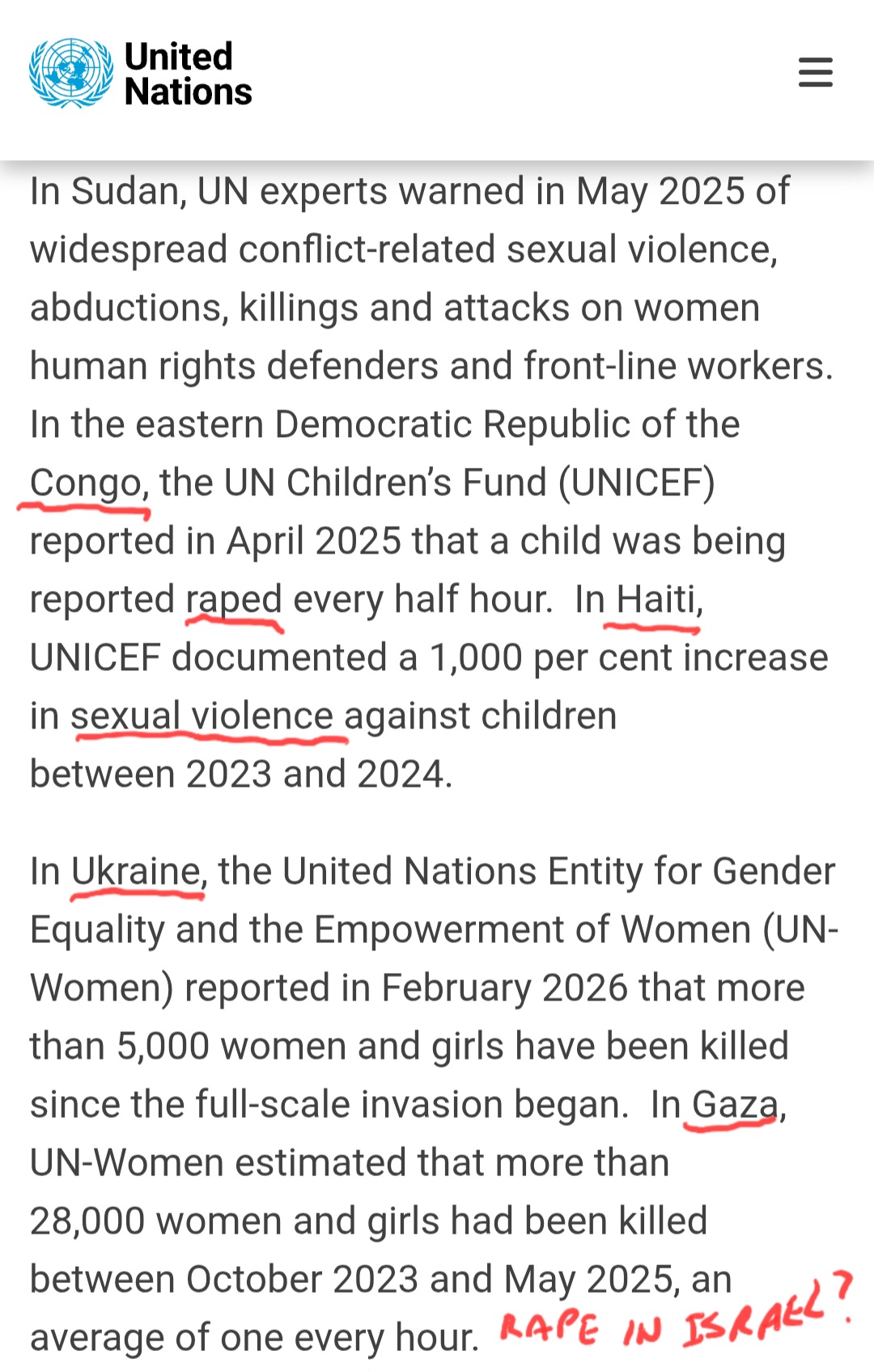
The United Nations has released yet another report on violence against women. It reads like a catalogue of human depravity – Sudan, Congo, Haiti, Ukraine, Gaza – each documented, each calibrated to shock the conscience.
And it does but not for the reason the authors intend.
Because one of the most documented episodes of mass sexual violence in recent history is missing. Not debated. Not contextualized.
Absent.
On October 7, an estimated 6,000 Gazans invaded Israel and carried out atrocities that included the systematic rape and mutilation of women. This is not a matter of competing narratives. It has been documented by eyewitnesses, first responders, forensic teams, and subsequent investigations.
And yet, in a sweeping global report about violence against women, these victims disappear.
The report finds space for a child raped every half hour in the Democratic Republic of the Congo, for the explosion of abuse in Haiti, for war deaths in Ukraine, and for casualty figures in Gaza. Horrific and worthy of attention.
But the omission is not accidental. It is instructive.
Because what the United Nations is quietly establishing is a hierarchy of victims. Some suffering is elevated. Some is ignored. And some – when it disrupts a preferred political narrative – is erased altogether.
Jewish women fall into that last category.
That is not human rights reporting. It is narrative management.
And that distortion does not stay confined to UN documents. It bleeds outward. When the international system refuses to clearly name and center atrocities committed against Jews, it creates a form of moral cover. The record itself becomes a kind of absolution.
So when figures in the West – like the wife of New York City Mayor Zohran Mamdani, Rama Duwaji – publicly express approval for the October 7 massacre, the reaction is muted, rationalized, or ignored. The most grotesque elements of that day, including the sexual violence, have already been softened, blurred, or omitted by institutions that claim to stand for universal rights.
If the crime is not fully acknowledged, then the celebration of it can be more easily excused.
That is the downstream consequence of selective memory and outrage.
The United Nations is not failing to see. It is choosing not to look and remind the world about violent antisemitism. And in doing so, it transforms a report about protecting women into something far more revealing: a document that tells us which victims matter and which ones are inconvenient.
In that calculus, the rape and murder of Jewish women is not denied. It is deemed unworthy of inclusion. Perhaps even harmful, lest it paint its forever wards, the Stateless Arabs from Palestine (SAPs) in an unfavorable light.
In a sharp escalation of transatlantic tension, Donald Trump threatened to cut off trade with Spain, accusing Madrid of refusing to support operations against Iran and failing to meet its defense obligations within NATO.
Spain rejected the criticism, citing sovereignty and international law and refusing to allow U.S. forces to use Spanish bases in operations tied to the Iran conflict.
The military campaign against Iran has been led by the United States, with Israel acting alongside it. If participation in that conflict justified downgrading diplomatic relations, the same logic would apply first to Washington, yet Spain withdrew no ambassador from the United States.
Even after Trump threatened sweeping trade retaliation, Madrid left its diplomatic posture toward Washington unchanged.
Instead, the rupture fell on Israel alone.
The reason is not difficult to see. Confronting the United States carries consequences. The American economy dwarfs Spain’s, and Washington anchors the NATO security system protecting Europe. Spain benefits from that umbrella while contributing among the lowest shares of national income to defense within the alliance.
Angering Washington carries risk. Angering Israel carries almost none.
Spain frames its decision as moral protest. But if war with Iran is the offense, the United States leads it. If regional escalation is the concern, Spain still maintains diplomatic relations with Iran itself, the leading state sponsor of terrorism.
If Spain were to look in the mirror, what would it see? A principled stand against war? That is the language Madrid uses.
But the reflection suggests something else. Spain keeps its ambassador in Washington, maintains relations with Tehran, and breaks with Jerusalem — the smallest actor in the conflict.
Spain is a nation of nearly fifty million compared to Israel, a country of ten million, a small state surrounded by hundreds of millions of Muslims where hostility toward Israel goes back to the Jewish State’s reestablishment.
That asymmetry will not go unnoticed in Washington or among Israel’s allies. Spain already faces pressure to increase its NATO defense spending. If Madrid is willing to rupture relations with Israel over the Iran war while maintaining relations with Iran itself, the contradiction may soon move from rhetoric to diplomacy.
The question could become blunt: restore normal relations with Israel, end trade with Iran, and meet NATO defense commitments — or risk losing the security umbrella Spain depends on.
A nation looking honestly in the mirror might call that geopolitics. Or antisemitism.
The blood libel begins with how the Book of Exodus is misremembered. Exodus is a story of Jewish liberation, yet antisemites preserve it as a story of punishment. That inversion is not confusion but tradition. Every generation dresses the libel in new language, while the structure never changes.
The plagues were directed at dismantling Egyptian authority with precision. The opening strike hit the Nile—Egypt’s god, economy, and source of life—and exposed a crime already committed there. Egypt had drowned Israelite infants in that river to erase a future it feared. The first plague named that bloodshed and stripped Egypt of moral order.
What followed was escalation with restraint. Egypt lost land, productivity, and cosmic claims. Darkness collapsed Pharaoh’s divine authority. What remained was the empire’s final refuge: the belief that continuity would return, that tomorrow would repair what today exposed.
The final plague took it. The death of the firstborn judged a state that had already made children expendable. It revoked Egypt’s claim on the future. Regimes that destroy children forfeit moral legitimacy. Measure followed measure.
The Israelites did not celebrate death. They marked their doors, stayed inside, and departed at dawn. Their defining act was escape from bloodlust, not indulgence in it. Freedom—not punishment—was the center of the story.
Antisemitism begins by erasing that fact.
Across centuries, Jews were remembered not as a people who fled violence but as a people who embodied it. Divine judgment on a tyrannical state was detached from context and reassigned as a permanent Jewish trait. Victims became perpetrators. Liberation became threat. From this inversion, the blood libel followed naturally, and not surprisingly, during Jewish celebrations of Passover when they left Egypt.
The charge did more than justify violence; it recoded Jews as a permanent danger. If society believes Jews possess bloodlust, then Jews must be watched, monitored, restricted, and scrutinized. They become an unwanted risk. Suspicion overwhelms citizenship. Surveillance replaces equality. In this logic, it is only a matter of time before Jews are assumed to act—and preemptive punishment becomes rationalized as self-defense.
This is how the libel works. It marks Jews forever as dangerous rather than as people who long for freedom. It recasts victims as villains and turns survival itself into evidence of guilt. The blood libel means that Jews are never trusted as equals, and never accepted as free.
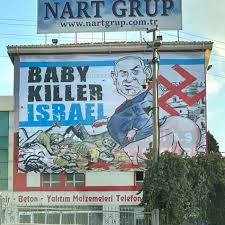
That inheritance governs today’s rhetoric. Calling Jews “baby killers” is not a factual claim; it is the inherited reflex of a culture that never accepted Jewish freedom. The accusation is identity-based, not evidence-based. It exists to keep Jews outside the circle of legitimate humanity and to deny the moral standing of Jewish self-defense before it is even asserted.
Turkey fans the blood libel in Hamas’s latest war to destroy Israel
This mindset survives because it is passed down, laundered through new vocabulary, and presented as moral concern. But it is the same lie. It refuses to see Jews as a people who escaped societies that murdered their children and insists instead on seeing Jews as the source of murder itself.
The story that antisemitism started when Pharoah forgot Joseph and became worried about the growing number and power of Jews was the fear of a monarch. Antisemitism was instilled in the masses when the Exodus story was flipped that Jews had a bloodlust and didn’t deserve equality. Every society that accepted the libel eventually convinced itself that Jewish freedom was intolerable—and acted accordingly.
Pharaoh stood unmoved as the Nile turned to blood. Life-giving water became useless overnight, and the system held. That moment captured the moral reality of the Exodus.
The plagues were not revenge. They were not emotional retaliation for suffering already endured. And they were not even, in the narrow sense, punishment for evil deeds. They were something far more deliberate: the dismantling of a system that could not be allowed to continue.
That distinction matters—then and now.
Revenge, Punishment, and Dismantlement
Revenge is backward-looking. It seeks emotional satisfaction for injury. Punishment is judicial. It assigns guilt and imposes consequences. Dismantlement is future-oriented. It exists to make continued evil impossible.
The plagues fit only the third category.
They were announced in advance. They escalated slowly. It wasn’t rage. It didn’t aim at humiliation. The Torah goes out of its way to show a paced methodology.
Even “punishment” does not fully explain what happens. Punishment targets perpetrators. The plagues targeted foundations: economy, theology, nature, and political myth. The Nile, the body, the sky—everything Egypt relied on to project permanence was stripped away piece by piece.
Why? Because slavery was not a policy failure within Egypt. It was Egypt.
You cannot reform a system built on domination. You cannot shame it. You cannot negotiate it out of existence. You have to break the assumptions that make it feel eternal.
That is what the plagues did. They delivered a message: “You are not absolute—and the time for evil has ended.”
The Same Moral Error Reappears Today
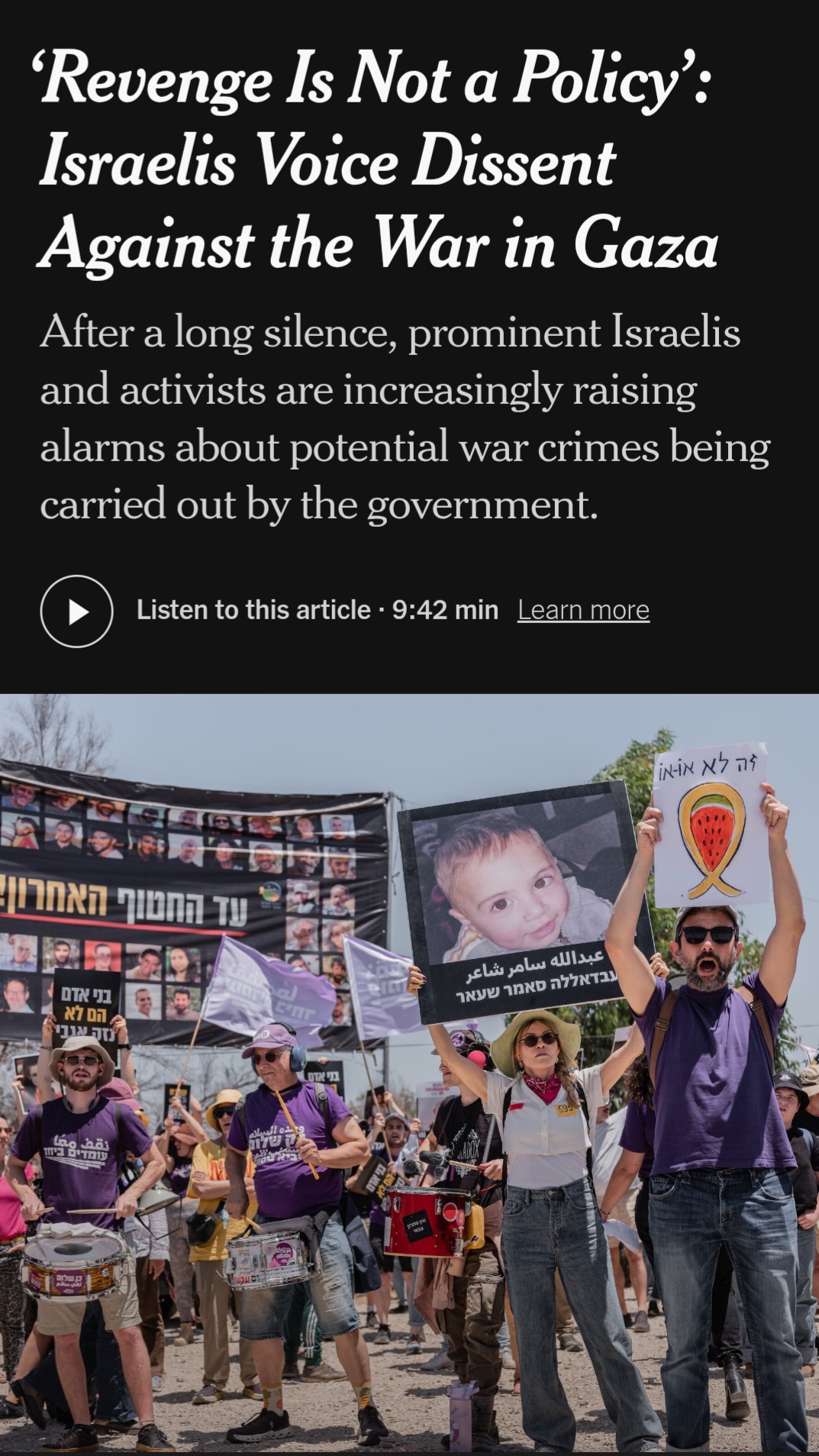
That same confusion appears again in the way Israel’s war in Gaza is discussed.
Since October 7, critics have insisted that Israel is acting out of revenge, wounded pride, or collective punishment. That reading repeats the same error people make about the plagues: it projects human emotion onto a campaign that is structural in nature.
If Israel were seeking revenge, Gaza would already be erased. If this were punishment, the war would end with confessions and symbolic justice.
Neither is happening.
Israel is trying to end a war by dismantling the system that made it inevitable.
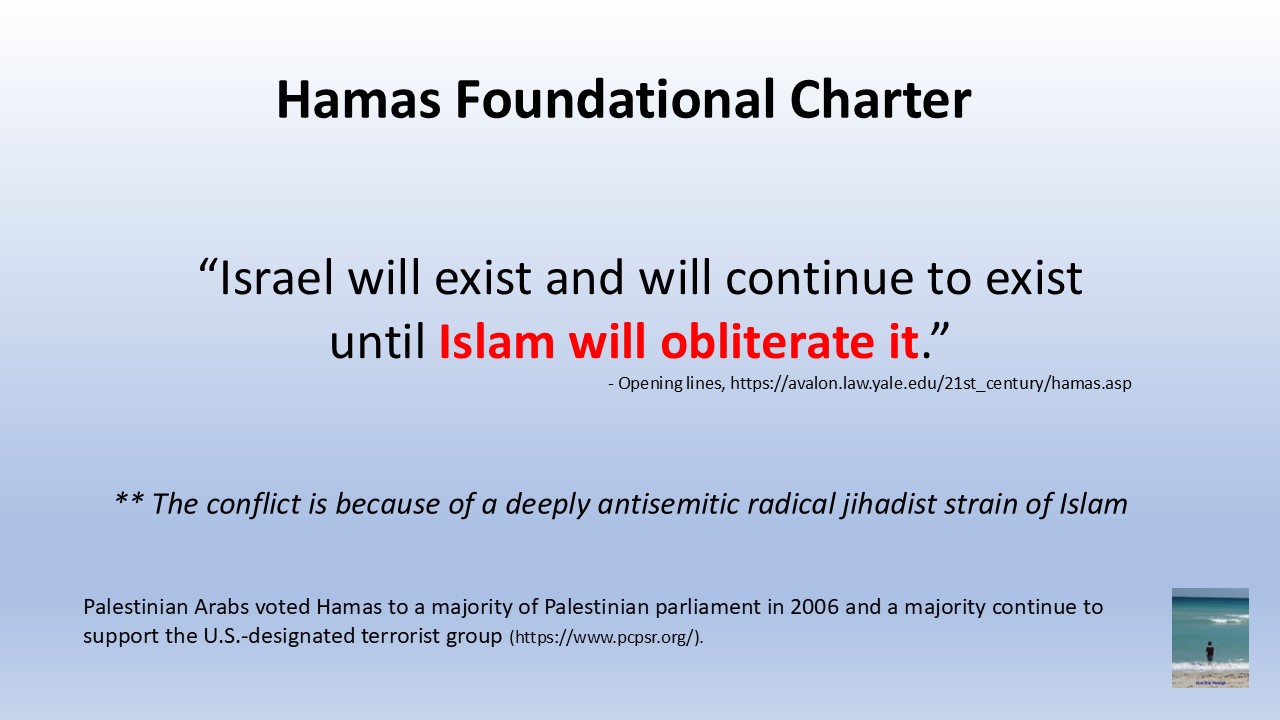
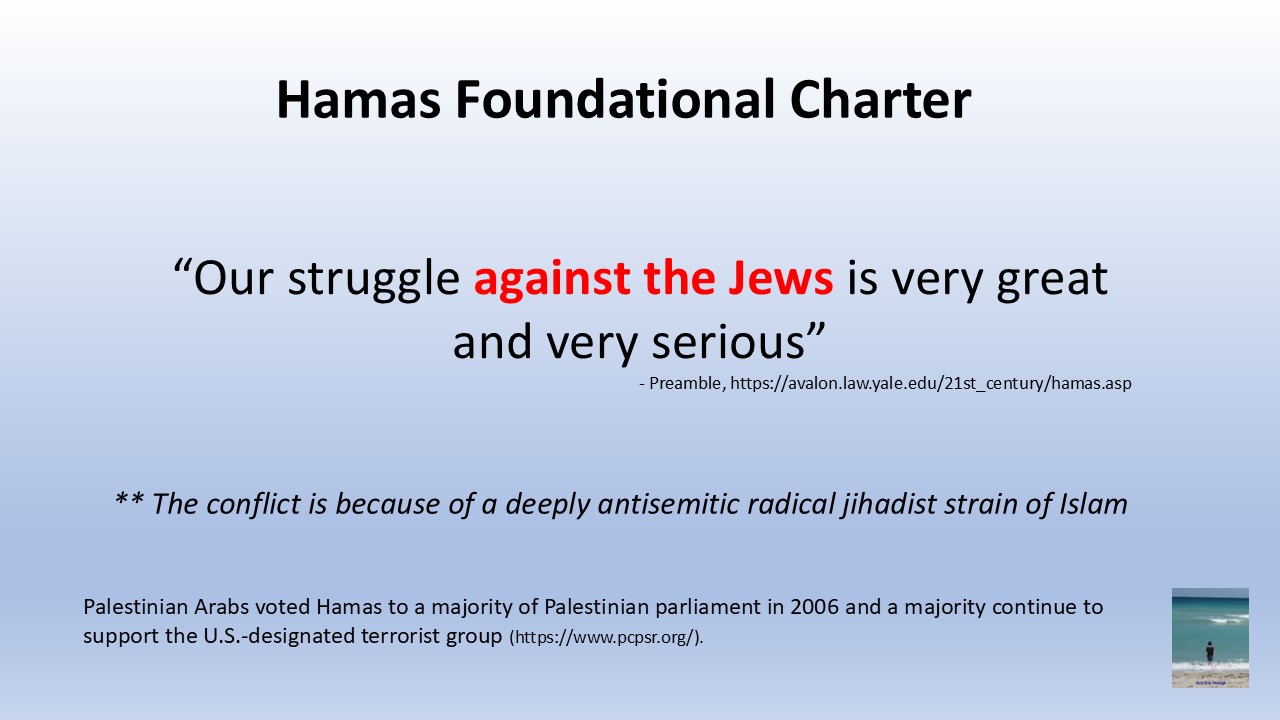
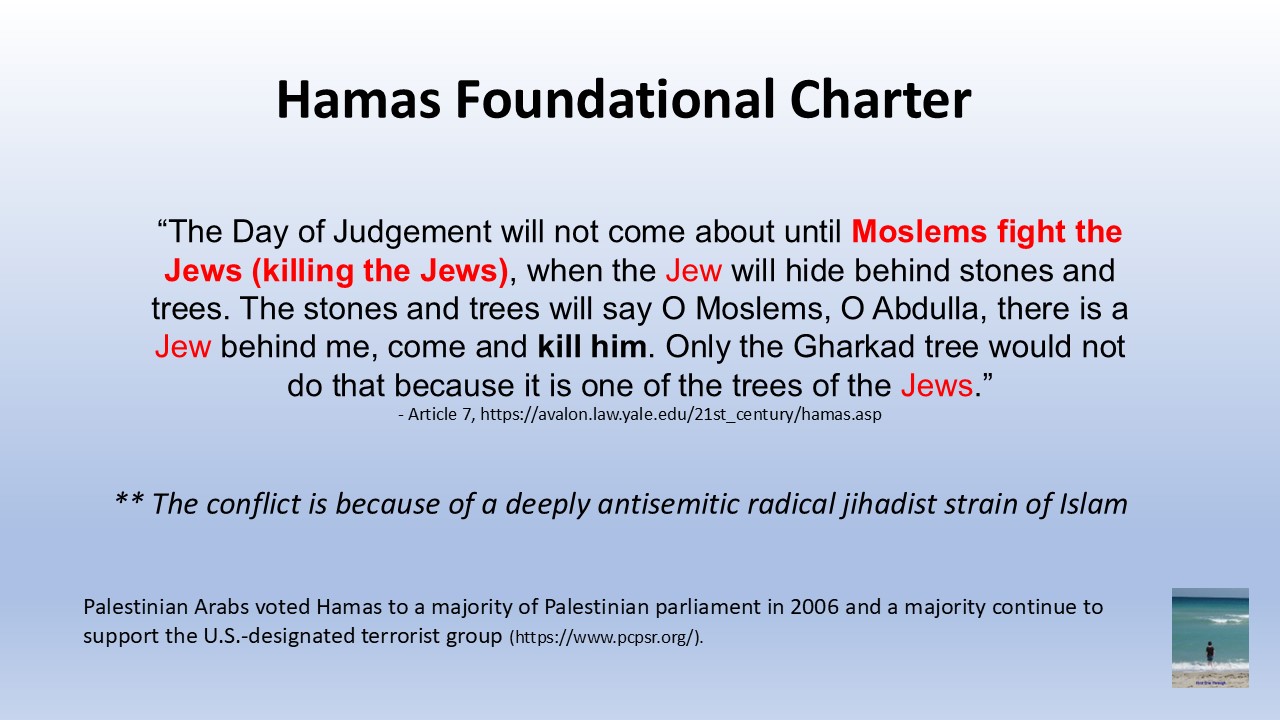
Hamas is not a fringe militia. It is the elected majority of the Palestinian parliament and ruling authority in Gaza. It is immensely popular. Over years, it constructed a comprehensive war society: tunnels beneath homes, schools, and mosques; civilian infrastructure fused with military command; education and media organized around eradication; international aid converted into weapons. Violence was not a breakdown. It was the operating principle.
As in Egypt, brutality was not an abuse within the system. It was the system.
You cannot coexist with that indefinitely. You cannot contain it forever. You cannot pause it and hope it reforms while leaving its foundations intact.
Why Ending the System Is Not Cruelty
Calls for ceasefire without dismantlement may sound compassionate but mirror Pharaoh’s promises: temporary relief with permanent structures preserved. The Torah teaches us to distrust that move. Pauses without transformation merely reset the cycle.
Israel’s campaign is not about humiliation. It is about limits. No governing authority may embed genocide into its ideology. No regime gains immunity by hiding behind civilians. No society organized around death gets an unlimited future.
Ending such a system is not revenge. It is moral necessity.
The near-term ramifications of Hamas’s war against Israel are being crystalized. Hamas’s leadership is decimated and Gaza is in ruins. The political-terrorist group’s allies in Lebanon, Syria, Iran and Yemen have been dealt severe blows, perhaps fatal for some. Hamas’s cheerleaders in the Global North are the only ones to have gathered momentum, particularly in Australia and the United States where hunting season for Jews has a seemingly open permit.
To gain insight for the next tactical steps, world leaders are looking at the current situation and polls since October 7, 2023 and have drafted proposals and taken initial actions: The United Kingdom and Canada recognized a Palestinian State. The U.S.’s Trump administration put forward a plan for Gaza which would include a new governing entity. The West hopes that the targeted assaults and murder of Jews will peter out along with the end of war. And the United Nations keeps playing the same tune about supporting UNRWA.
These are bad decisions and conclusions, made on faulty assumptions.
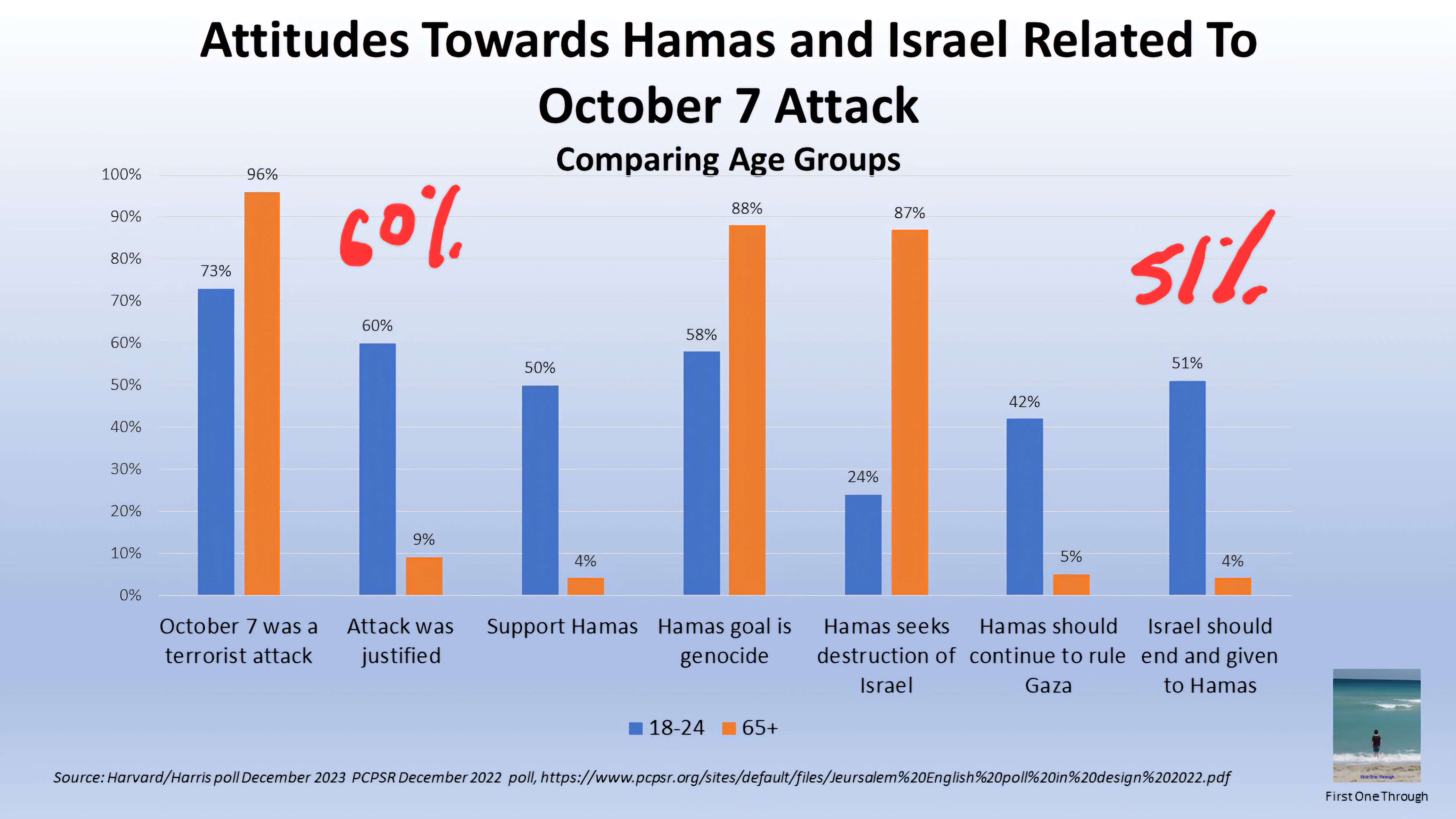
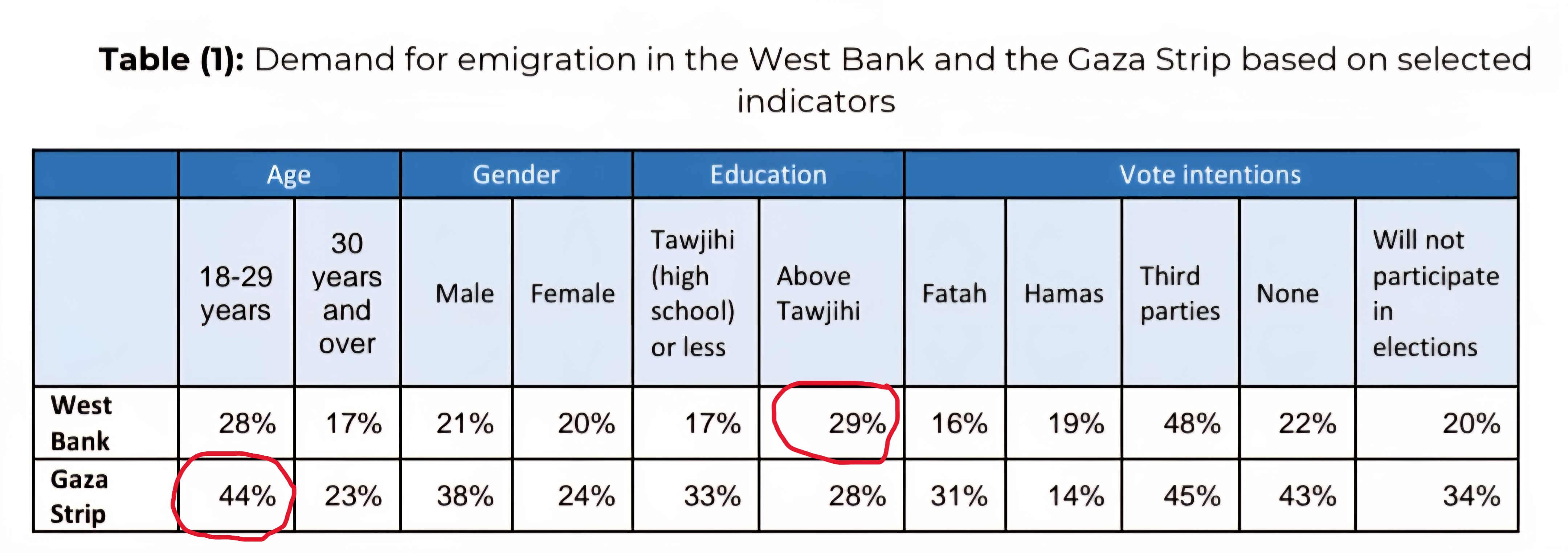
There is an organization that has been polling Palestinian Arabs for decades, called the Palestinian Center for POLICY and SURVEY RESEARCH (PCPSR). It conducted a poll of Arabs in Gaza and the West Bank, just before the Hamas-led war, from September 28 to October 8, 2023. Because of the war, the results did not get published until June 26, 2024, and the world was too focused on the war to pay it any attention. It is deeply unfortunate, and it is required reading to help chart a better future for the region.
To start with the poll’s conclusions:
A large percentage of Palestinian Arabs have wanted to leave Gaza and the West Bank for years, not from the current destruction
Arabs are fed up with their own government – Hamas and the Palestinian Authority – much more than Israeli “occupation”
Canada is viewed much like Qatar for Gazans, a sympathetic haven
Palestinian Arabs Wanted to Emigrate Before the War
According to PCPSR, whether in October 2023 or November 2021, roughly 33% of Gazans and 20% of West Bank Arabs wanted to leave the region.
Men below age 30 make up the vast majority of those seeking to emigrate. As opposed to Gaza where both educated and uneducated people want to leave, it is the educated West Bank population that wants to move away. Among those wishing to leave, many would not vote in Palestinian elections, or if they would, they would sooner vote for third parties over Fatah or Hamas.
Palestinian Leadership is the Curse, More than Israel
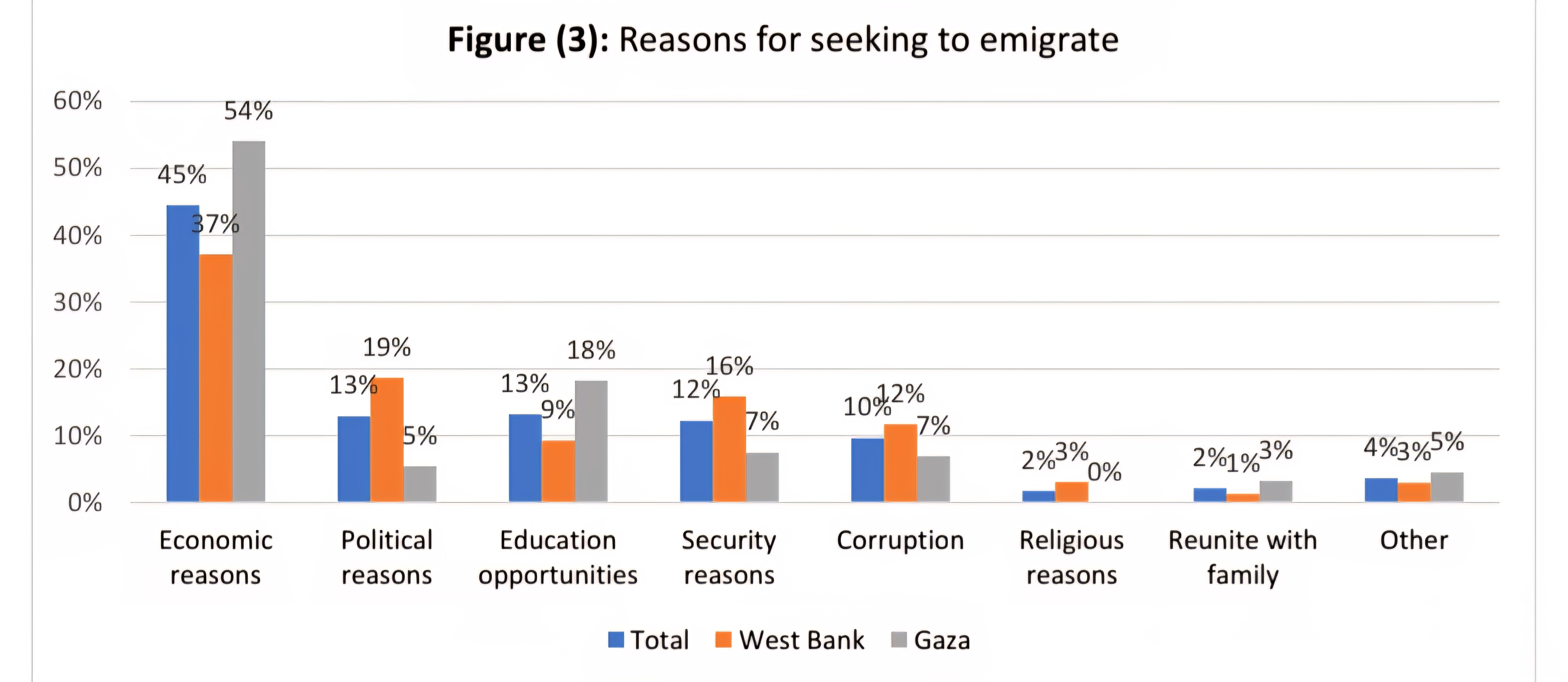
The number one reason for wanting to leave was economic conditions by a far margin. Reasons two and three were political reasons and educational opportunities. “Security reasons” came in fourth, with only 7% of Gazans focused on security; 12% overall. Corruption, religious reasons and to reunite with family rounded out the poll.
Canada as a Beacon
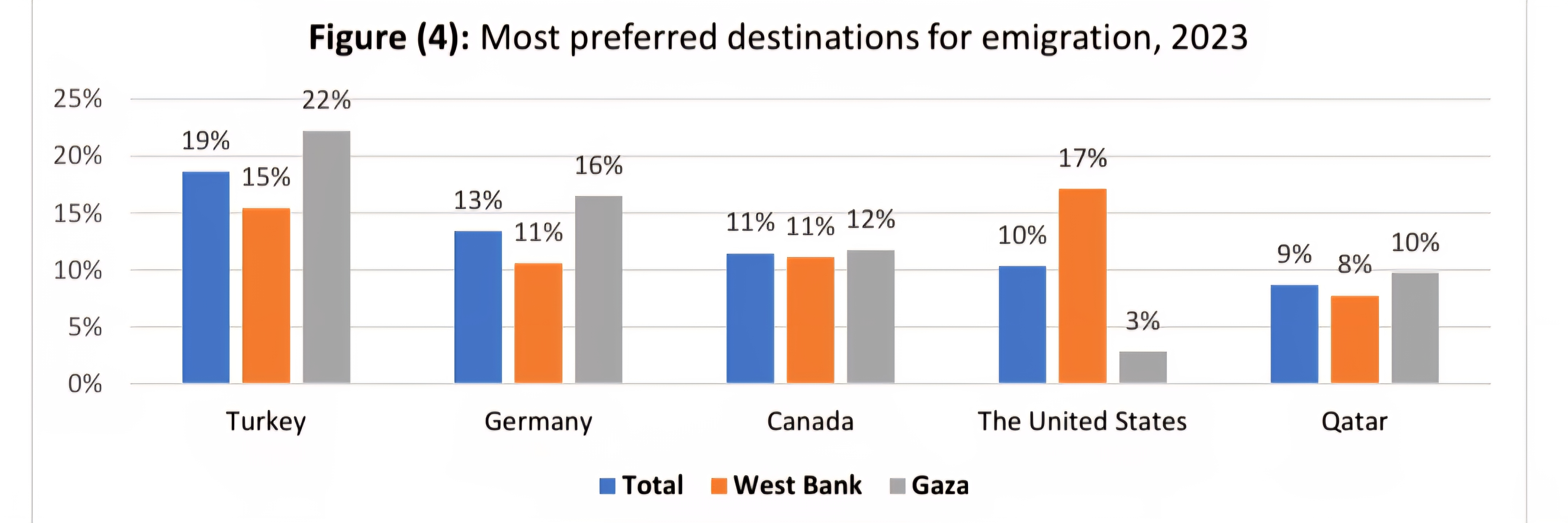
Turkey and Germany were the two most favorite destinations, especially for Gazans. Very few Gazans (3%) considered the United States, while West Bank Arabs put it as the number one choice (17%), likely seeking advanced degrees at left-wing universities. What is remarkable, is more of the Stateless Arabs (SAPs) would prefer going to Canada (11%) than Qatar (9%), the wealthy Muslim Arab nation that is a main sponsor of Hamas.
Honest Takeaways
These pre-war results leads to some basic and critical conclusions.
Complete Overhaul of Palestinian leadership, not just in Gaza
The desire of Arabs to leave was evident across both Gaza and the West Bank for many years. This was not a reaction to bombing or siege; it was a verdict on governance.
Hamas in Gaza rules through repression, diversion of aid, and religious militarism. The Palestinian Authority in the West Bank offers corruption, authoritarianism, and political stagnation. Together they have produced a society with no credible economic horizon, no accountable leadership, and no peaceful mechanism for change.
While a new entity is needed to administer Gaza, that role should be akin to a Chief Operating Officer overseeing construction. The Palestinian Authority itself needs to be gutted and rebuilt as it is a corrupt, unpopular and ineffective entity.
The United Nations Must Withdraw from Gaza and the West Bank
In its desire to create a Palestinian state, the U.N. has stripped the titular heads of Palestine of any responsibility. The UN protects Hamas despite its savagery. It props up the Palestinian Authority despite its rampant corruption. Palestinian leadership is a bed of paper scorpions.
The UN must withdraw from Gaza and the West Bank and allow local authorities to build a functioning leadership team.
The West Should Rescind Recognition of Palestine
There is no functioning Palestinian government and therefore no basic standard to recognize a Palestinian State. The United Kingdom, Australia and others should withdraw their recognition and make it conditional on building governing institutions that can lead and make peace with the Jewish State next door.
Reeducation in the West
The massacre did not arise from a sudden spike in pressure. It emerged from long-standing internal failure. Hamas chose atrocity because it couldn’t commit a complete genocide of Jews so exploited its own population to be fodder for Israel.
Western audiences were then handed a familiar script, complete with pictures. But the data taken just before the massacre tells a different story—one far more consequential. What is being taught in western public schools is divorced from reality and feeds global and local antisemitism.
Oh No, Canada
While the fears of antisemitism are focused on the United States and Australia because of recent attacks on Jews, Canada is in the hearts and minds of Palestinian Arabs seeking a warm diaspora community. Perhaps it started a decade ago under Justin Trudeau who followed U.S.’s President Barack Obama to embrace the Palestinian cause and Iranian regime over Israel. Perhaps it is because of the welcome mat for extremists groups like Samidoun. Or perhaps it is the perception that the heckler’s veto is fair game, and can run Jewish families off Canadian streets.
Whatever the inspiration, Canada is widely perceived as permissive, ideologically indulgent, and administratively porous—an attractive environment for “political activism” untethered from civic responsibility. It is a ticking time bomb.
The poll of Palestinian Arabs on the eve of the October 7 war reveals deeper truths than surface shots of leveled homes. The PCPSR findings point to a single truth: the Palestinian problem is fundamentally internal.
Ending Israeli control over territory without dismantling corrupt and extremist institutions will not deliver prosperity or peace. Statehood layered on top of dysfunction will harden it. And exporting populations shaped by jihadist rule into permissive Western societies without serious screening and integration, risks importing instability rather than relieving it.
Since 2022, the United States has funded two wars at historic scale.
~$65–70 billion in direct U.S. military aid to Ukraine
~$21–22 billion in U.S. wartime military aid to Israel since October 7, 2023
Ukraine’s funding is more than three times larger, delivered faster and sustained longer. Israel’s is smaller, largely defensive, and focused on interception and resupply.
Yet only one of these aid streams has been treated as morally illegitimate.
The Moral Divergence
Aid to Ukraine is framed as defending democracy. Aid to Israel is framed as complicity.
Both wars involve urban combat. Both involve civilian casualties. Both rely on U.S. weapons.
But only Israel’s aid is placed under moral indictment.
The Political Record
Progressive politicians aligned with the Democratic Socialists of America have been consistent in drawing this distinction.
Bernie Sanders voted for massive Ukraine aid packages while introducing resolutions to block or condition arms transfers to Israel.
Alexandria Ocasio-Cortez supported Ukraine military assistance as solidarity, while opposing emergency funding for Israel as morally disqualifying.
Ilhan Omar and Rashida Tlaib made opposition to U.S. military aid to Israel a defining cause—calling for halts and embargoes—without mounting a comparable campaign against the much larger Ukraine funding stream.
“This is not only the Israeli government’s genocide, Mr. Speaker. this is our government’s genocide.” – Rep. Rashida Tlaib
No similar moral test was applied to Ukraine.
The erosion of support in long wars
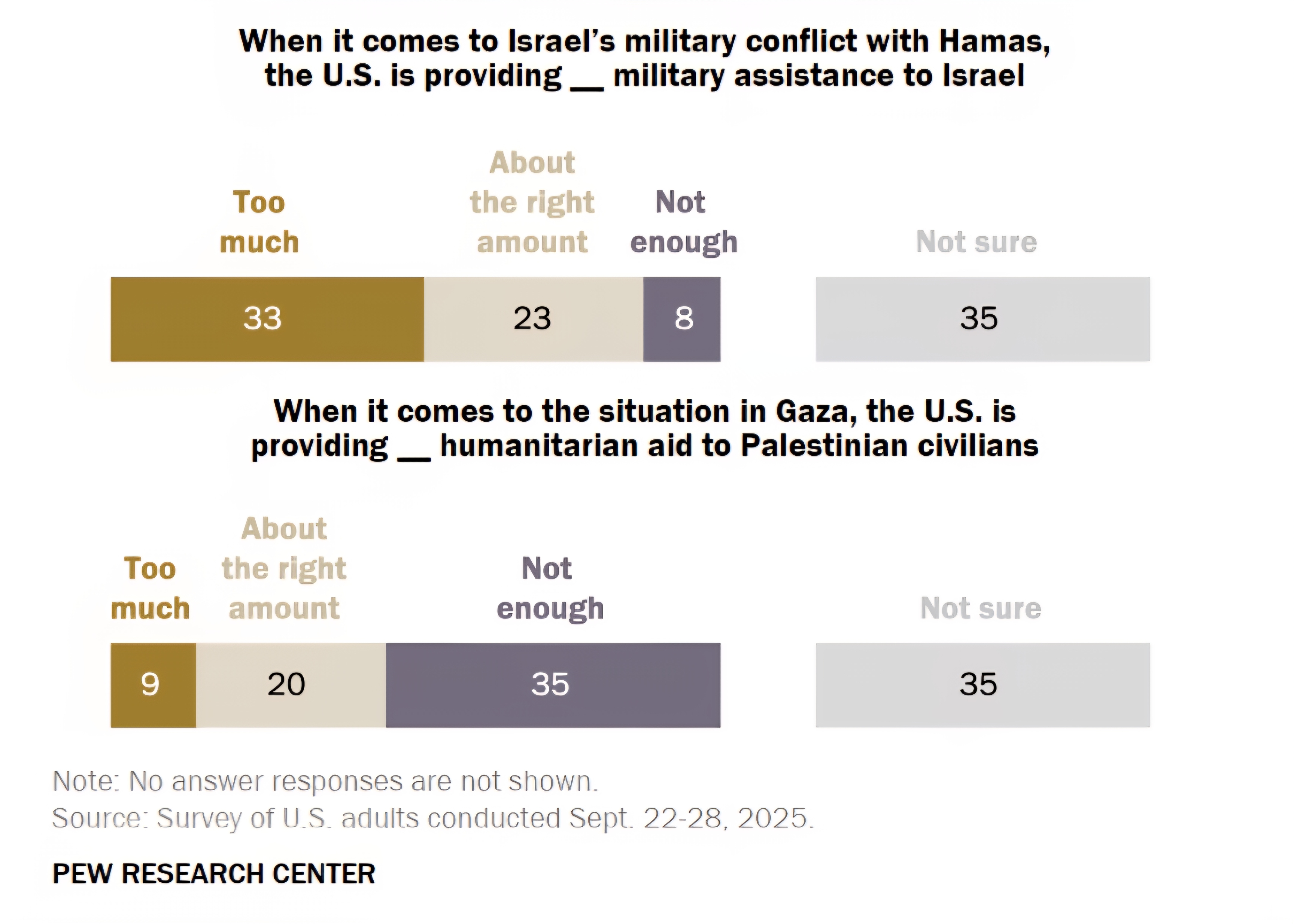
As the wars in Ukraine and Israel dragged on, Americans began to tire of spending so much money abroad in both wars. In September 2025, a Pew Research poll found that one-third of Americans thought that the US was providing too much military aid to Israel, while 23% thought the figure was about right and only 8% said it was not enough.
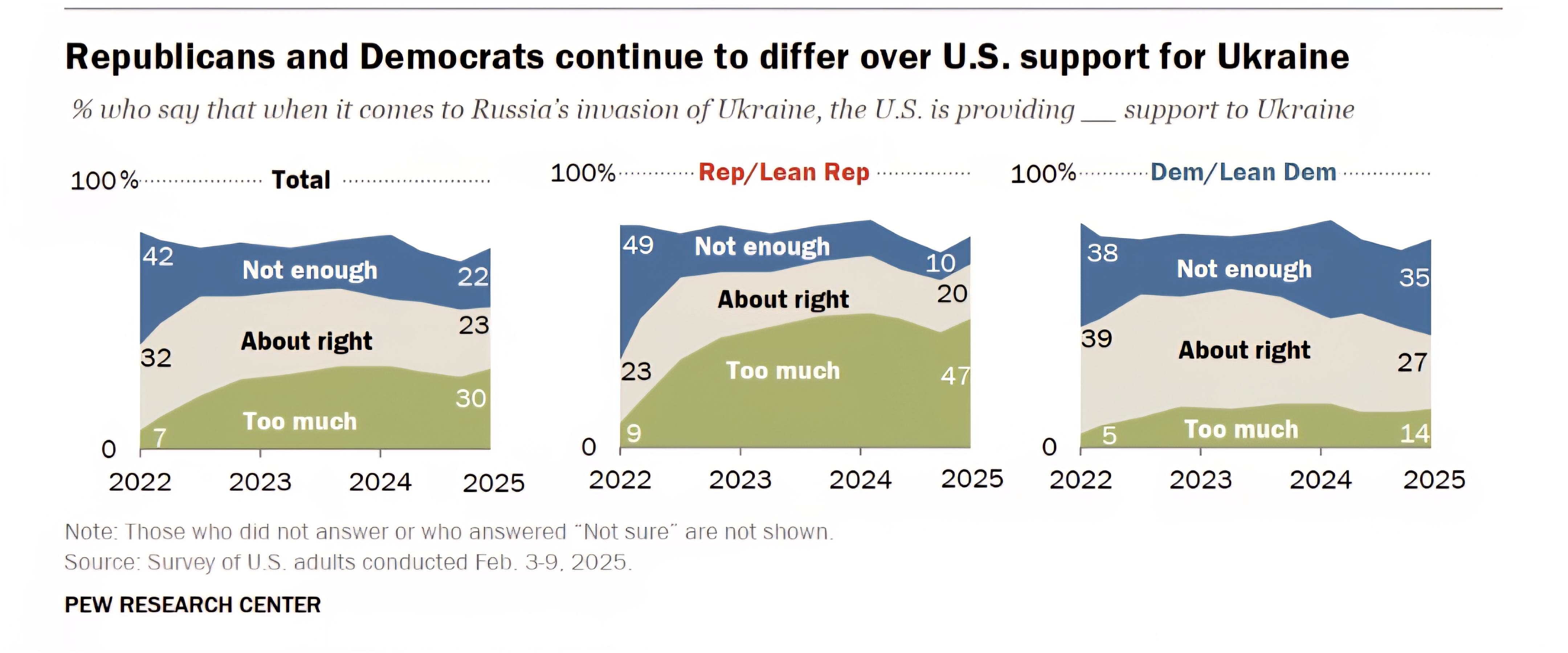
The figures were about the same for Ukraine in a February 2025 poll – 30% said too much aid, 23% about the right amount, but a significantly different figure – 22% (versus 8%) said there was not enough aid going to Ukraine. The gap is likely due to the visuals of a totally devasted Gaza and the elimination of most of the Hamas leadership.
A deeper dive shows a significant divide between Republicans and Democrats, especially over time. Republicans moved from 9% feeling there was too much aid and 49% not enough aid in 2022, to 47% feeling there was too much aid and 10% not enough aid in 2025. While Democrats did change their views over time, it was not as dramatic as the Republican shift.
At least for Ukraine.
The Ideology Behind the Distinction
This asymmetry between Ukraine and Israel is not about budgets or battlefield conduct. It is ideological.
Within DSA thinking, Israel is not merely a state that acts wrongly; it is framed as an illegal colonial project. The claim rests on a core assertion: that Jews are not indigenous to the land of Israel and therefore have no legitimate sovereign claim to it.
That assertion is historically false — and morally bankrupt.
It denies Jewish history, identity, and continuity in their ancestral homeland. It treats Jewish self-determination as uniquely illegitimate. And it transforms Israeli self-defense from a security question into a moral offense.
Ukraine, by contrast, is granted full legitimacy. Its sovereignty is assumed. Its right to fight is unquestioned.
Further, the far left is trapped in an empathy swamp, with the destroyed pictures of Gaza trumping the immorality of the Hamas death cult.
The Conclusion
A war funded at $70 billion is treated as a cause. A war funded at $22 billion is treated as a crime.
That gap has nothing to do with the weapons. It has everything to do with an ideology that denies Jewish indigeneity — and therefore Jewish legitimacy, and a perverted view of right and wrong seen through the lens of empathy rather than morality.
This is not a debate about military aid. Ukraine gets much more than Israel. As does NATO. This about the Jewish State overwinning and the depravity of antisemites who want to end the Jewish State.
The headlines are the same. Another plot uncovered. Another attacker radicalized online. Another manifesto stitched together from familiar phrases about vengeance, purity, and divine obligation.
Was it ISIS-inspired? Was it Hamas-aligned?
In practice, the distinction is collapsing.
From Manchester to Sydney and across Europe and North America, security services increasingly encounter the same ideological core animating different actors. Antisemitism framed as righteousness. Violence framed as duty. Death framed as meaning. The slogans vary, the flags change, but the belief system underneath remains remarkably consistent.
ISIS flag on the car of murderers in Sydney, Australia
These movements are not converging by accident. They are aligned by doctrine. They are the banners of jihad.
When stripped of geography, branding, and media strategy, Hamas and the Islamic State reveal the same worldview: a sanctified war against Jews, against pluralism, and against life itself.
They are branches of the same antisemitic death cult.
God Alone Rules
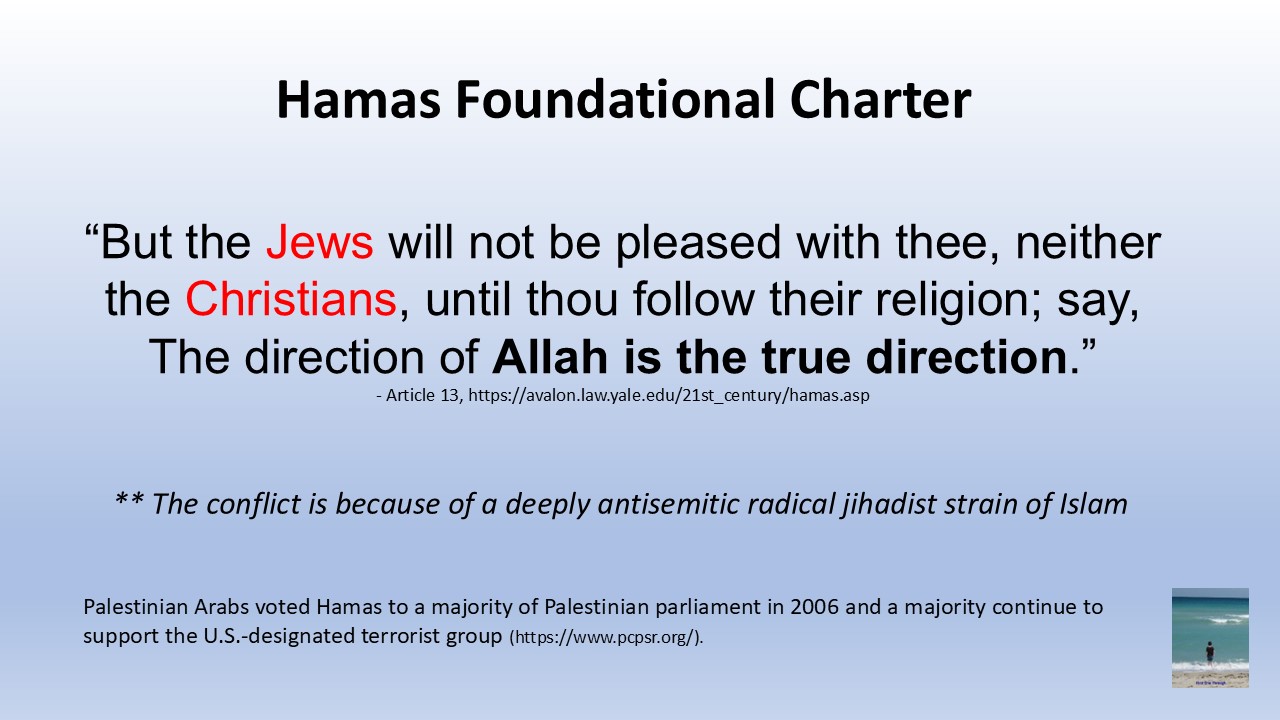
Both movements begin with a totalizing claim: sovereignty belongs exclusively to God. Political authority, democratic choice, civil law—all are illegitimate intrusions into divine rule. Religion is not guidance; it is command.
This theology leaves no room for coexistence. Difference becomes defiance. Dissent becomes apostasy. Submission is the only acceptable outcome.
Violence as Obedience
Violence is not an unfortunate consequence of struggle. It is the struggle. Jihad is framed as obligation, killing as faithfulness, death as fulfillment.
This is why attacks around the world feel interchangeable. Civilian targets are central because civilians matter symbolically. Children are drawn into the story because innocence amplifies impact. Suicide becomes virtue because it collapses the distance between belief and action.
When ideology outranks life, mass killing is not excess. It is alignment.
Jews as a Theological Obstacle
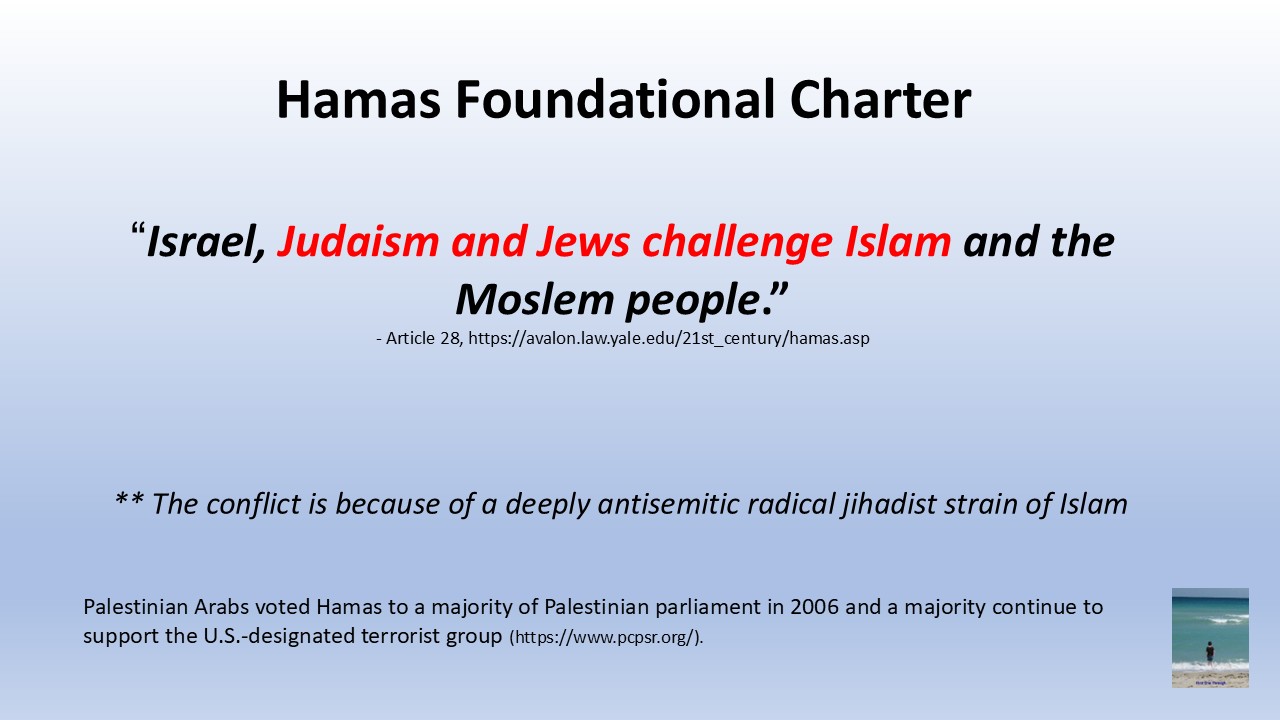
The conflict is often described in political or territorial terms, but the animating hostility is theological. Jews are cast as an enduring enemy embedded in sacred narrative, not as a community with whom disagreement might be resolved.
That framing explains the permanence of the war. Agreements become pauses. Ceasefires mere tactics. The goal is not compromise but eradication.
Scripture, once weaponized, does not negotiate.
Death as Currency
In societies shaped by this ideology, death is elevated and life is instrumentalized. Martyrdom replaces mourning. Sacrifice replaces survival. Civilian neighborhoods are folded deliberately into military design.
Homes, schools, mosques, hospitals become launchpads and shields. Suffering is curated for export. Images of devastation are not collateral damage; they are strategic output.
What the outside world experiences as tragedy, the ideology treats as leverage.
Power Without Freedom
The end state is always the same. Total control enforced by fear and sanctified by religion. No speech outside doctrine. No faith outside orthodoxy. No dignity outside obedience.
ISIS ruled this way openly. Hamas learned to cloak the same destination in the language of resistance and grievance. The structure beneath remains unchanged.
The Lesson Already Learned
When ISIS surged across Iraq and Syria, the West recognized the threat clearly. It did not argue for partial containment. It did not imagine ideological evolution. It organized, committed resources, and dismantled the movement.
And it succeeded. For a while.
Israel has carried that same burden. By Israel’s own assessments, roughly 95 percent of Hamas’s fighting capacity—its leadership, battalions, tunnels, and command infrastructure—has been destroyed.
Stopping here would not stabilize anything. Allowing the group to maintain its weapons – the way the majority of the Stateless Arabs from Palestine (SAPs) want – would preserve the conditions for revival. Ideologies built on sanctified violence do not soften when wounded. They metastasize.
The remaining fragments are not a political movement in transition. They are an ideology waiting to rearm, re-export, and re-infect—far beyond Gaza.
Yet the world is rearming and financing ISIS and Hamas. It is allowing the jihadi groups to gain strength.
The world once understood this when ISIS was the name on the banner. The jihadist doctrine of Hamas is the same and has not changed. Only the branding has.
Hamas leadership promises to continue war against Israel forever
ISIS in Africa in Somalia, recruiting from around the world














 First One Through