Hey NY Times, Nerdeen Kiswani Wants Zionists Killed and Israel Destroyed

Nerdeen Kiswani is not quiet about her views. She wants the Jewish State obliterated and Zionists killed. She says it openly and proudly in front of loud cheering crowds.

So why did The New York Times soften her stance? Why did it say that she was simply assembling “protests to draw attention to the suffering of Palestinians,” when her entire movement is about the destruction of Israel?

“I hope that pop-pop is the last noise that some Zionists hear in their lifetime!” – Nerdeen Kiswani, Youtube, Aug 4 2021

Why did the Times make it sound like pro-Israel groups were uniquely offended that “she supports the liberation of the Palestinian people “by any means necessary,” including armed resistance.”?

“Israel must be annihilated.” – Nerdeen Kiswani, Instagram, Mar 3 2017

Why did the Times use so much energy and so many words to say “that her activism opposes Israel, its policies and its structure as a Jewish State,” without saying that she supports targeting Jewish organizations and the annihilation of the only Jewish State?

“We marched today, we took over the streets and we visited multiple Zionist settler foundations. Multiple. We let them know we know where they’re at. We know where they work. We’re gonna find out more about where they’re at too. And we’re gonna go after them.” – Nerdeen Kiswani, YouTube, Jun 11 2021

Why didn’t the Times explicitly state that Kiswani endorses US designated terrorist groups and individuals?

Picture on left is Kiswani with pin of Abu Obaida, a spokesman for Hamas, while protesting in front of a synagogue in Teaneck, NJ on April 1, 2024 (from ADL website)

On June 10, 2024, Kiswani led a protest outside a memorial exhibit in downtown New York City about the Nova Music Festival where she said that young partygoers enjoying music was “like having a rave right next to the gas chambers during the Holocaust,” mocking not only the hundreds of murdered youth but millions of Jews slaughtered in the Holocaust.

Kiswani doesn’t hide her love of the genocidal antisemitic group Hamas. She posts her fondness to the public.

Kiswani post of a child kissing an armed Hamas terrorist, like those that burned Jewish families alive

In short, Kiswani is a proud supporter of terrorism against Jews and American allies. Yet The New York Times made it appear that her stances were simply pro-Palestinian, which some members of the pro-Israel community found offensive.

The reality is that a pro-Israel “extremist” allegedly planned an attack on a pro-Palestinian “extremist.” But the Times editorialized by showing the smiling face of an “activist” worried about the “suffering” of her people. Such is the alt-left embrace of the toxic “deformity in Palestinian culture.”

Mine Awareness or Narrative Warfare?

Every year, the United Nations marks the International Day for Mine Awareness and Assistance in Mine Action, a day meant to focus the world on one of war’s most enduring dangers: explosives that linger long after the fighting ends. It is supposed to be about clarity, about identifying risks so civilians can return home safely.

Instead, it has become a case study in how language can blur reality.

The Secretary-General’s message follows a familiar script. Landmines, explosive remnants of war, improvised explosive devices—all grouped into a single, undifferentiated threat facing millions. Then comes the quiet insertion: Gaza. Not explained, not distinguished, simply placed alongside countries like Colombia, Ethiopia, Lebanon, Myanmar, and Syria—places long associated with entrenched landmine contamination. With that single move, a narrative is constructed without ever being explicitly stated.

The problem begins with the collapse of categories. Landmines, IEDs, and explosive remnants are not interchangeable. Landmines are deliberately planted, often victim-activated and designed to persist. IEDs are improvised weapons, most commonly used by non-state actors. Explosive remnants of war are what’s left behind—unexploded bombs, artillery shells, rockets. In Gaza, those distinctions are not academic; they are the entire story.

Hamas and other Palestinian militant groups have relied heavily on IEDs and booby traps as a core tactic. Not Israel. There does remain unexploded ordnance buried in rubble after extensive Israeli strikes. But the UN language compresses all three categories into one phrase and drops Gaza into the middle of it, allowing implication to do what evidence does not.

Just as telling is the disappearance of agency. The United Nations Mine Action Service and related reporting have acknowledged encountering IEDs in Gaza. But in public-facing messaging, the actor behind those devices vanishes. There is no mention of Hamas, the governing authority in Gaza that initiated this war with the October 7 attacks. There is no mention of homes rigged with explosives, of tunnels wired for ambush, of civilian infrastructure turned into tactical hazards. The war did not emerge from nowhere; it was launched by Gaza’s rulers, and Israel did not seek it. Yet in the UN’s framing, explosives simply exist, detached from the decisions and strategies that put them there. When agency disappears, accountability follows.

The rhetorical effect is powerful. By placing Gaza alongside countries defined by decades of landmine contamination, the UN shifts perception. Gaza becomes, in the public mind, a classic minefield. But it is not. It is a dense urban battlefield littered with booby traps and complicated by the deliberate use of improvised explosives by militant groups embedded within civilian areas.

The reality is that Gaza is a public hazard of itself. The mines, the terror tunnels under homes and schools, the embedded terrorists throughout neighborhoods is a tragedy the UN helped foster.

Rather than take a modicum of responsibility or lay blame on its adopted wards, the UN’s language pivots the blame on the victims of October 7. It deliberately has tried to change history and public perception that Israel deliberately turned Hamas into a large minefield when Gazans did that to themselves.

The International Day for Mine Awareness was created to expose hidden dangers, to name them clearly so they can be removed. Here, the danger is not only in the ground. It is in the language. When distinctions collapse and responsibility dissolves, understanding becomes another casualty. And in a conflict already defined by competing narratives, what remains unexploded in the words can be just as damaging as what lies beneath the rubble.

The Fire That Doesn’t Go Out

Parshat Tzav centers on a single, stubborn image: a fire that must keep burning.
Day and night, without interruption, the flame is sustained. Wood is added. Ash is cleared. The rhythm continues.

No drama surrounds it. That is the point.

The Torah uses a precise word: tamid—continuous.
Rashi sharpens it further: continuous means that the fire burns through Shabbat. It burns even when conditions are imperfect. There are no pauses built into the system.

Continuity is not aspirational. It is enforced.

Continuity is fragile. It breaks in small gaps—missed days, skipped responsibilities, moments when no one shows up. Enough of those moments, and what once felt permanent disappears quietly.

Tzav eliminates the gap.


The tradition holds that the original fire descended from heaven—a moment of revelation. And then the responsibility shifts.

Ramban notes that even with that divine beginning, the command remains: keep it burning. What begins from above survives only through what is sustained below.


This is how permanence is built.

The Kohanim return each day to the same tasks. The altar is prepared again. The fire is fed again. Over time, repetition becomes structure. Structure becomes identity.

Rabbi Samson Raphael Hirsch sees in this a broader model. A people endures through daily acts that reaffirm what it stands for.

The fire becomes a signal:

Something is still here. The commitment continues. Yesterday carries into today.


In much of the worls today we have built a culture of moments. A flash of outrage. A declaration. A cause that surges and disappears as quickly as it arrived.

Tzav points in the opposite direction.

What matters is not who lights the fire. It is who keeps it burning.

Ner Tamid and lights in synagogue in Gibraltar (photo: FirstOneThrough)

The Jewish world speaks often about continuity. It invests heavily in beginnings—early education, bar mitzvah preparation, the moment a child stands before a community and reads from the Torah.

And then, too often, the system loosens its grip.

The years that follow—high school, when identity is tested, challenged, and reshaped—are treated as optional, as if the fire will somehow continue on its own.

It doesn’t.

As Adam Teitelbaum argues in Sapir, the drop-off after bar mitzvah is not a minor leak; it is the structural break. Jewish education often peaks at the moment it should begin to deepen, especially for boys.

The system celebrates ignition and neglects continuity.

The result is predictable: a generation trained for performance at thirteen, and left without reinforcement at seventeen—precisely when identity is challenged, not assumed.


Continuity cannot be front-loaded.

It requires reinforcement when the surrounding culture is strongest, when belonging becomes a choice rather than an inheritance. Those are the years when the fire must be tended most carefully.

Continuity is not sustained by intention. It is sustained by people who refuse to let the fire go out.


It Is Time To Bring The Abraham Accords To Hebron

Abraham had two sons. That is not only history; it is the underlying structure of the Middle East.

From Isaac came Jacob (Israel) and the Jews. From Ishmael came peoples that would become much of the Arab world. One father. Two lines. A separation that began in a household and expanded into history.

“And the thing was very grievous in Abraham’s sight… and he sent her [Hagar and Ishamael] away” (Genesis 21:11–14)

A rupture in youth. Ishmael into the wilderness. Isaac remaining with the covenant, inheritance, and land. Two trajectories set before either became a nation.

They meet again only once.

“And his sons Isaac and Ishmael buried him in the cave of Machpelah” (Genesis 25:9)

The text records a moment that refuses to disappear: the separated sons standing together over their father.

History widened the gap.

The descendants of Ishmael became many: spread across vast geographies, largely Muslim, with enduring Christian communities. The region became overwhelmingly Arab.

The descendants of Isaac became few. Driven out, dispersed, conquered repeatedly, yet carrying something that would not yield: memory, covenant, and a fixed orientation toward their promised land.

Eventually, they returned. A small people, back in a narrow strip of that land, surrounded by a region that traced itself, at least in part, to the other son.

That imbalance defines the present.

Then something shifted.

The Abraham Accords – named for their common forefather – introduced a different possibility. Arab states choosing open relationship with Israel, shaped by economics, technology, security, and a recognition that the region was already changing beneath older narratives.

A shared pressure point sharpened that shift: Iran.

A Muslim non-Arab power, Persian in identity and imperial in ambition, projecting influence across Arab capitals and against Israel alike, forcing alignments that would have seemed implausible only years ago.

The Accords opened a door for a new future. Now widen it.

Bring the Abraham Accords to Hebron.

Bring them to the Cave of Machpelah, the burial place of Abraham, Isaac, and Jacob, and the Jewish matriarchs as well. The place where the text records Isaac and Ishmael standing together.

Let the leaders of Israel and the Arab world stand there.

Let it be an invitation – especially to Saudi Arabia – to step fully into this framework, not only as a strategic actor but as a central inheritor of the Abrahamic story.

Let it also be a reminder closer to the ground.

To Jews and Arabs living in the disputed lands east of the 1949 armistice lines (E49AL) that includes Hebron, that their conflict sits inside a much older relationship. They are not strangers placed side by side by accident. They are descendants of a shared origin, living out a divergence that began long before modernity created borders.

Ishmael did not return to neutral ground. He came back to the land understood to be Isaac’s inheritance. He stood with his brother there and buried their father.

That moment carries a clarity that history has often obscured: the land of Israel is the Jewish home.

The Arab world does not disappear in recognizing that. It becomes something stronger—anchored in reality, aligned with its own long-term interests, and reconnected to a shared origin that was never erased.

The Abraham Accords can move from alignment to acceptance.

Hebron is where that truth can be stated without abstraction.

The region has spent centuries replaying the separation.

Saudi Arabia and the Gulf States can choose, now, during their common battle against Iran, to stand again at the place where Isaac and Ishmael met thousands of years ago, and acknowledge what each brought with them when they arrived: a common bond and their own roots in the region.

Savannah Guthrie Times 250

Savannah Guthrie tried to describe the indescribable.

Her 84 year old mother was taken from her home, with signs of violence left behind, a masked man on camera. And then nothing. A void where a mother used to be. She spoke about sleepless nights, about imagining fear she cannot reach, about a word she kept returning to: unbearable.

That word should end the conversation. It should strip away everything else.

Because everyone understands what it means when someone you love is taken.


Now Multiply That by 250

What Guthrie is living through is devastating.

In Israel, it happened at scale.

Over 250 people were abducted violently—children, parents, grandparents—dragged from homes, shoved into vehicles, disappeared into tunnels by jihadi terrorists. The same questions Guthrie now asks became a national condition: Are they alive? Are they suffering? What are they thinking?

The same agony. Multiplied. Multiplied. Multiplied.


Where the World Breaks

Here is the dividing line.

When Guthrie speaks, there is no debate. No one justifies it. No one says her mother deserved it. No one rallies in defense of the abductor.

The reaction is immediate and human: bring her home.

But when Israeli families faced the same horror, the reaction in too many places—especially on college campuses—was not sympathy.

It was celebration.

Not confusion. Not distance. Celebration of the very act Guthrie calls unbearable.


The Only Question That Matters

Her interview removes every excuse. No politics, no slogans—just a daughter describing what it feels like to have a mother taken.

If you can feel that—and then justify or cheer when it happens to someone else—you are not misinformed. You are choosing evil.

And that is the part that is unbearable to civilized people.

The UN No Longer Defends Religious Liberty

Religious liberty is not complicated. It does not require panels, frameworks, or warnings about artificial intelligence. It requires clarity.

The right to choose your faith.
The right to practice it as you see fit.
The right to pray openly, in your way, at your holy places.
The right to walk away from it—without fear, without punishment, without death.

This is not a modern reinterpretation. It is the original standard.

In 1948, in the aftermath of a world war that exposed the catastrophic consequences of state control over belief and identity, the United Nations adopted the Universal Declaration of Human Rights. At its core sat Article 18, crafted with precision that set religious freedom as a benchmark of human rights.

“Everyone has the right to freedom of thought, conscience and religion; this right includes freedom to change his religion or belief, and freedom, either alone or in community with others and in public or private, to manifest his religion or belief in teaching, practice, worship and observance.” – UN Declaration of Human Rights, Article 18

Change it. Practice it. Live it.

That was the UN at its founding: defining principles meant to bind nations, not accommodate them.

That is not the UN on display today.

When the Secretary-General recently addressed a conference on religious liberty on March 24, 2026, the words sounded familiar. Religious freedom was a “cornerstone of human dignity.” And then the center shifted—toward global pressures, social cohesion, artificial intelligence.

Artificial intelligence?

If the speech had stayed anchored to Article 18, the omissions would have been impossible to ignore: apostasy treated as a crime, in some places a capital one; the right to convert denied in law; and access to holy sites restricted where it is most visible and most contested, to Jews on the Temple Mount in Jerusalem.

These are not edge cases. They are direct contradictions of the standard set in 1948.

They went unmentioned.

The reason is not subtle. The United Nations that wrote Article 18 was asserting principle in the shadow of catastrophe. The United Nations that speaks today operates at the consent and behest of large voting blocs. Many of those blocs come from the Global South, including dozens of Muslim-majority states that reject the core of Article 18 where it matters most: the right to change religion and the expectation that religious access should be reciprocal.

Within that reality, the boundaries of acceptable language narrow.

No mention of apostasy laws.
No mention of capital punishment for conversion.
No mention of restricted prayer where it cuts closest to the principle.

So the language adapts. The sharp edges of Article 18 are rounded into generalities that everyone can endorse, including those who, in practice, deny them. The result is a version of “religious liberty” that survives as rhetoric while its substance is negotiated away.

This is not an evolution of human rights. It is a retreat from them.

The United Nations once set a standard that stood above politics. Today, it reflects the ugly politics of those who sit within it. And as the Pope will tell you, there can be no peace without religious liberty. Ergo, the UN has become one of the primary sources of discord and violence in the world today.

#IslamicSupremacy

From Dreams to Nationhood: Surrealism and the Rebirth of Israel

Surrealism did not invent the language of dreams and symbols; it applied the principles to art. For the Jewish people, that language had long been central: a civilization built on ritual, memory, and meaning encoded in objects, stories, and repeated acts of remembrance.

When Surrealism emerged from Freud’s ideas, it offered a new lens to examine what Jews had already lived: that symbols shape identity, and that dreams can carry a people across time. In the aftermath of Europe’s destruction, that lens reveals a stark contrast: while others turned to common stories to process loss, the Jewish people used their symbolic tradition to rebuild and to turn dream into reality.


Interpreting Dreams

At the turn of the twentieth century, Sigmund Freud (1856 Czechia – 1939 United Kingdom) proposed something radical: that the human mind operates on two planes at once. The conscious – ordered, rational, disciplined. And beneath it, the unconscious – restless, suppressed, filled with fears and desires that shape behavior without announcing themselves.

Dreams, Freud argued in The Interpretation of Dreams (1899), are the bridge between these worlds.

They are not noise. They are language.

A language built on symbols: recurring forms that carry meaning across individuals and cultures. A house becomes identity. Water becomes birth or transformation. Men are featured as long cylindrical objects while women are enclosed spaces. Objects are never just objects. They are carriers of something deeper, something shared.

Freud did not invent symbolic thinking. He revealed that we are already immersed in it.

And once that realization entered European culture, it transformed how artists saw their role: not as imitators of reality, but as revealers and interpreters of the unconscious.


The Dream Made Visible

Surrealism emerged from collapse.

World War I shattered Europe’s faith in reason. The same systems that promised progress delivered mechanized death. Logic, order, and scientific advancement had not restrained violence but refined it.

Into that rupture stepped André Breton (1896 France -1966 France). In 1924, his Surrealist Manifesto defined the art movement as “pure psychic automatism,” an attempt to express the true functioning of thought, unfiltered by reason or convention. It was a deliberate rejection of the structures that had failed and a search for truth in the raw, unmediated currents of the mind.

Surrealism was not escapism. It was rebellion against a reality that could no longer be trusted.

Artists like Giorgio de Chirico (1888 Greece – 1978 Italy) created haunting spaces – empty plazas, long shadows, objects placed together without explanation. These works do not resolve into meaning. They create a feeling of dislocation, of being suspended in a waking dream where logic loosens its grip.

Piazza d’Italia by Giorgi de Chirico (1913)

Jane Graverol (1905 Belgium – 1984 France) made the point plainly, saying that her canvases are “waking, conscious dreams.”

René Magritte (1898 Belgium – 1967 Belgium), strips away ambiguity and addresses the viewer directly. His 1929 painting The Treachery of Images confronted viewers with the bold statement “This is not a pipe” that what they were seeing was not an object but the symbol of an object.

The Treachery of Images by Rene Magritte (1929)

The statement is instructional.

Magritte is not playing with illusion. He is teaching a fundamental principle: that art is inherently symbolic. The painted pipe is not a pipe but a representation of a pipe. A constructed stand-in for reality. The viewer’s instinct is to collapse that distinction, to treat the symbol as the object itself. Magritte interrupts that instinct and forces recognition.

This is not just a lesson about art. It is a lesson about perception.


Before and After the Abyss

Then came World War II. And the question of perception became far more dangerous.

Before the war, Surrealism destabilized reality with intellectual daring. It exposed how fragile meaning could be, and how easily the mind imposed order where none existed. De Chirco expressed this when he said “although the dream is a very strange phenomenon and an inexplicable mystery, far more inexplicable is the mystery and aspect our minds confer on certain objects and aspects of life.”

After the war, the issue was not mystery. It was blindness.

The European Holocaust was not carried out by a primitive society. It was executed by one of the most intellectually advanced cultures in the world – Germany and Austria – lands of philosophy, music, and scientific achievement.

Civilization did not prevent barbarism. It coexisted with it.

And in that realization, Surrealism’s inquiry deepens.

Consider Magritte before and after the war.

In The False Mirror (1928), the eye is open—wide, consuming the sky. There is a sense of total perception, of a world fully visible, even overwhelming.

The False Mirror by Rene Magritte (1928)

By 1964, in The Son of Man, the face is obscured by a green apple.

The Son of Man by Rene Magritte (1964)

The shift is profound.

The apple is not arbitrary. It carries centuries of symbolic weight: knowledge, intellect, the pursuit of understanding. It evokes Eden, the awakening of consciousness, the belief that human reason elevates and refines. And simultaneously leads to destruction, despair and the loss of paradise.

Here, that very symbol blocks the face.

What if the world’s admiration for European intellect – its reverence for German philosophy, Austrian culture, scientific brilliance – functioned as a kind of blindness? What if our advances in science and knowledge was ultimately too much responsibility for our minds to handle and yielded ultimate weapons of mass destruction to end all life?

A society’s fixation on knowledge obscured the capacity for evil.

The world saw the body and the apple. It saw a society of culture, sophistication, refinement. It did not see the face – the person, the emotion, the intent – behind it. And that face? It saw nothing at all, blinded completely by knowledge.

Magritte’s post-war image reads as indictment of willful misperception. The failure was not that reality hid the truth. It was that humanity chose not to see it.


Myth as Reconstruction

In the aftermath of this rupture, some Surrealist artists turned to mythology, a common history and culture of a now divided Europe. Myth offered what history cannot: a structure to process loss.

Consider Orpheus.

He descends into the underworld to retrieve his lost wife, Eurydice, only to lose her forever when he looks back. The story is not about failure of effort; it is about the finality of loss.

Jane Graverol paints this in 1948, as a Belgian artist from a country invaded and devastated in a war it did not seek. As Europe begins to absorb the reality of the concentration camps – the industrial killing, the desecration of bodies – the imagery becomes unbearable.

The Procession of Orpheus by Jane Graverol (1948)

A woman fused into a chair – half human, half object – evokes not abstraction, but transformation of person into material. A world in which the boundary between human and furniture was grotesquely violated.

This is not simply Orpheus losing Eurydice, disappearing as they emerged from the underworld. It is Europe recognizing that what was lost cannot be restored.


Now consider Ulysses.

After the Trojan War, Ulysses (Odysseus) spends ten years trying to return home to Ithaca. His journey is long, disorienting, and filled with trials – temptation, destruction, loss of companions, divine obstacles. When he finally arrives, he is not recognized. His home has been overtaken. He must reclaim it, rebuild it, reassert his place within it.

Return is not restoration. It is confrontation.

Giorgio de Chirico captures this in The Return of Ulysses.

The Return of Ulysses by Giorgio de Chirico (1968)

The painting is divided.

On the left, a framed work from decades earlier sits beneath a heavy red chair. It anchors the past.

On the right, a frail white chair sits beneath an open window – exposed, stripped, uncertain. The solidity and comfort of the past gives way to fragility.

And in between, Ulysses. Small. Reduced. Rowing across water inside a room forcing the viewer to confront the symbolism.

Water, the symbol of birth, of transition, of beginning again.

He is not standing in triumph. He is navigating between worlds—between what was and what might be.

And then, something unexpected. An open door.

Not the past. Not the fractured present. But a third path.

Ulysses rows toward it. The hero moves toward something new.

The artist, from a country aligned with Germany during the war, was not focused on loss but a chance for a new future within his homeland, inside the familiar surroundings of his room.


The Jewish Path: Beyond Myth

And yet, there is a story that does not fit neatly within this framework of the Surrealist artists of the Allies and Axis. Because the Jewish people after World War II were neither and both.

They were the decimated. A people shattered, displaced, nearly erased – and forced to ask how to return, where to return.

There was no home to reclaim in the way of Ulysses.

No possibility of retrieving what was lost, like Orpheus.

There was only one path forward. Rebirth, in a new land.

And in a way unparalleled in history, they achieved it.

The reestablishment of the State of Israel was not simply political. It was civilizational. A people dispersed for nearly two thousand years, speaking different languages, living across continents, reconstituted sovereignty in its ancestral land.

Here, myth gives way to reality.

In 1968, Salvador Dalí – the master of dream imagery – was commissioned to create a series of 25 watercolor paintings for the Hartford Museum to mark Israel’s 20th anniversary. The timing was not incidental. It came just one year after the Six-Day War, when Israel not only survived existential threat but reunited Jerusalem, returning Jews to their holiest sites in the Old City.

If Theodor Herzl declared, “If you will it, it is no dream,” then Surrealism—an art form built on dreams—became the perfect language to express that transformation.

Aliyah, the rebirth of Israel by Salvador Dali (1968)

Dalí’s Aliyah: The Rebirth of Israel, the centerpiece of the series, captures this moment.

A figure rises, draped in the Israeli flag. And what is more symbolic than a national flag?

Two blue stripes evoking both the Mediterranean Sea and the Jordan River, the geographic bounds of the land, while simultaneously recalling the tallit, the Jewish prayer shawl. Nationhood and spirituality fused into a single image.

The figure is not merely standing. He is emerging naked and staring at the heavens.

This is not return. This is creation.


The Arc of Surrealism

Surrealism begins as an education, an attempt to translate Sigmund Freud’s insight into visual form, to show that human beings do not simply see the world, but interpret it through symbols, through dreams, through layers of meaning that sit beneath the surface. It teaches the viewer to slow down, to recognize that an image is not the thing itself, that representation is constructed, that what feels obvious may be anything but.

At its inception, it is a project of illumination, shaped by a Europe that still believed in its own intellectual coherence. From Paris to Brussels to Rome, it carries the confidence of a continent trying to understand itself through deeper, more elusive truths.

But that confidence does not survive World War II.

When Europe fractures, Surrealism fractures with it. The symbolic language remains intact, but it begins to tell different stories depending on where it is spoken.

In Belgium, through Jane Graverol, myth becomes a language of irreversible loss. The world she paints is one in which the human can be reduced to object, where dignity can be stripped away, where what has been taken cannot be restored. The symbols haunt.

In Italy, through Giorgio de Chirico, the question shifts. It is no longer about loss alone, but about return—about what it means to come home when home itself has changed. The past lingers, heavy and inescapable, while the future appears fragile, uncertain, barely formed. And yet, within that uncertainty, there is movement—a quiet insistence on choosing a path forward, even when the destination is unclear.

And then there are the Jews.

Not aligned with either side of Europe’s divide, but decimated, displaced, and exposed. They are not asking how to interpret what has been lost, or how to return to what was. Those paths are closed to them.

They are asking whether anything can be built again at all.

And it is here that Surrealism, for all its depth, turns to the Jews for answers.

Because the Jewish people did not need to be taught how symbols work. They had lived within that framework for centuries—through ritual, through memory, through stories that transformed objects into meaning and meaning into continuity. What Surrealism sought to uncover as theory had already been sustained as practice.

The Passover seder has been educating Jewish children for three thousand years about symbols, about the birth of a nation, and about the dream of Jerusalem.

Surrealism’s arc from the 1920s to 1960s was a story of Europeans wrestling with the mind and meaning before and after the war. It ends when those long familiar with symbolism left their nightmare and made their dream a reality.

The New Ground Zeros

We tend to think of “ground zero” as a place, a site of destruction. Where you can point to and say: it happened here.

The new ground zeros are not simply where attacks occur. They are where the vulgar idea stops sounding outrageous.

They form in environments where the rules quietly change, where violence against Jews is never explicitly endorsed, but is no longer cleanly condemned. It is where it is explained. Contextualized. Where the language shifts just enough that the victim is converted into the villain.

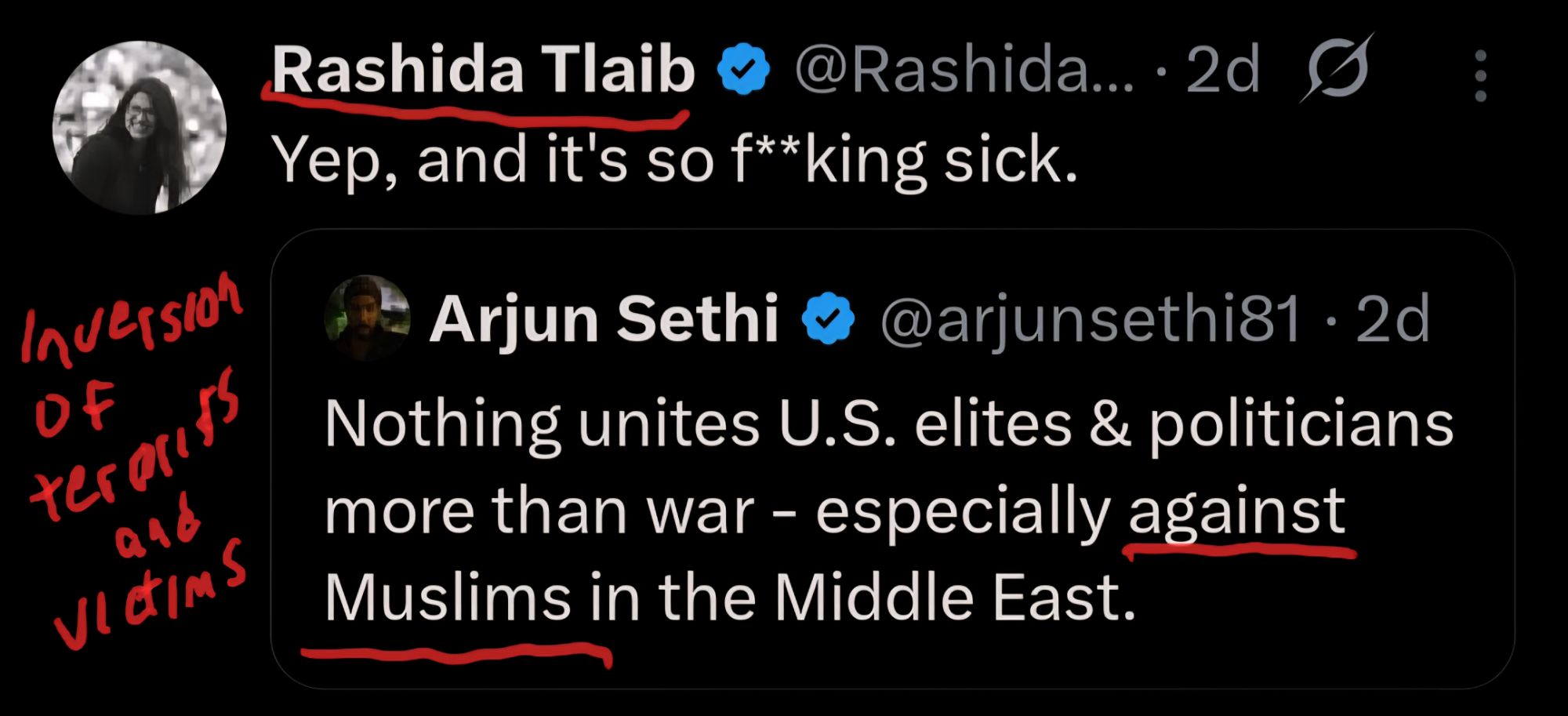
You can see it in parts of political culture that elect figures like Rashida Tlaib and Zohran Mamdani without seriously confronting the ideological space around them.

Rep. Rashida Tlaib called Jews conspirators who operate “behind the curtain” to “make money off of racism” at the Democratic Socialist of America convention

Ayman Mohamad Ghazali, the man who came to murder hundreds of children at a Jewish day school in Michigan, lived in Rashida Tlaib’s Michigan district, home to thousand of people who believe Tlaib’s rhetoric, who support – or least excuse – her vile antisemitism.

The same motion can be seen in New York City where Emir Balat, 18, and Ibrahim Kayumi, 19, pledged allegiance to the Islamic State and came to the city that elected a jihadist mayor to rain violence on perceived enemies.

Emir Balat, 18, and Ibrahim Kayumi, 19, readying a bomb to throw at police and civilians in New York City

Ideas shape environments. And environments shape what becomes possible.

It happens quickly: it took barely a decade for NYC to go from a capitalist moderate Jewish mayor in Michael Bloomberg, to an anti-capitalist jihadist in Zohran Mamdani.

When enough people participate in erasing the moral line, the boundary that once made violence unthinkable begins to weaken. And when that boundary weakens, the outliers don’t need instructions.

They need atmosphere.

The new ground zero is not the place where it happens. It is where it no longer feels impossible.

The Fight Against Antisemitism Is Being Filled With Harmful Catchphrases

The fighters of antisemitism are rushing to the front with silly catchphrases. Perhaps even toxic.

Take the line: “What starts with the Jews doesn’t end with the Jews.”

It is meant to elevate the issue. To make antisemitism feel urgent to those who might otherwise ignore it. But it carries an uncomfortable implication: that what happens to Jews matters most because it might eventually happen to someone else.

Why?

Why is the attack on Jews not sufficient on its own? Why must Jewish suffering be reframed as a warning signal for others before it earns attention?

It is already evil when Jews are targeted and that should be enough. Jews are not canaries in a coal mine for the protection of others. They are millions of innocent people living with threats, violence, and fear. That reality does not need to be universalized to be taken seriously.

Then there is the fallback line: “I condemn antisemitism, but…”

The sentence always breaks in the same place. Everything before the “but” is obligation. Everything after it is the real message.

No one says, “I condemn racism, but…” without immediately undermining themselves. Only with antisemitism does the moral clarity feel negotiable, conditional, open to context. The phrase signals that antisemitism is wrong in theory, but explainable – even understandable.

Or consider the most common defense of Israel: “Israel has a right to exist.”

It sounds firm, but it collapses under even a moment’s scrutiny.

No country has a “right to exist.” Not Singapore. Not Spain. Not South Sudan. Countries exist because history, peoplehood, and political will bring them into being and sustain them.

The real point is that the phrase is uttered because people want to destroy it. Not Montenegro or Guyana. The sole Jewish State.

This isn’t a hundred year old debate about political Zionism and the reestablishment of a Jewish state in their ancestral homeland but a discussion about the genocide of millions of Jews. Why is such phrase ever used? The defenders of Israel should condemn the premise that forced the urge to utter the words.

The more careful phrase “Criticism of Israel is not antisemitism” often lands the same way.

It is true, of course. But it is almost always deployed at the exact moment when the line is being approached, if not crossed. It functions less as clarification and more as insulation, a way to reassure the speaker that whatever comes next cannot be antisemitic, because it has already been declared not to be.

It pre-clears the argument.

All of these phrases share something in common. They take a situation that demands moral clarity and replace it with moral positioning. They allow people to sound serious and defensive while adopting the framework of the accuser.

Attacking Jews is evil. Threatening Jews is evil. Justifying targeted harm against Jews—whether through politics, ideology, or euphemism—is evil.

It is time for anti-antisemites to stop using catchphrases that feel emotionally empowering but are soaked in the lexicon of antisemitism.

Whitewashing Antisemitism at the NY Times: Cornell University

What happened at Cornell University is not complicated.

A student threatened to bomb, stab and rape Jews and was eventually convicted. A professor described the mass slaughter of Jews and the burning of families as “exhilarating.” Jewish students faced open hostility in spaces that were supposed to protect them.

That is the story.

But you would not know any of it from reading The New York Times.

There, the story is something else entirely.

It is about leverage and negotiations. About a university navigating pressure from Washington, in which “[t]he principal incentive for Cornell to settle was to restore hundreds of millions of dollars in research money.”

Antisemitism is not the subject. It is merely the backdrop.

Once Jew-hatred is relegated to the background, everything else falls neatly into place. Cornell is no longer responding to hatred; it is managing a dispute. The federal government is no longer addressing civil rights concerns; it is applying political pressure. The moral stakes dissolve into process and incentives.

This is not omission by accident. It is construction by design.

Because centering what actually happened – explicit threats against Jews, open celebration of their murder – would force a conclusion that cannot be comfortably absorbed into the paper’s worldview: that serious, virulent antisemitism has taken root inside institutions it instinctively protects.

So the frame shifts.

Facts that clarify are excluded, while context that softens is elevated, and the reader is guided, carefully, away from the obvious.

It is a familiar pattern.

When antisemitism comes from ideological adversaries – white supremacists, Christian nationalists, “your father’s antisemitism” – mainstream media names it plainly and condemns without hesitation. It is the headline, the thesis, the moral center.

But when it emerges from favored spaces – elite campuses, activist movements, intellectual circles – the noxious hatred disappears. It is reframed as protest, as speech, as tension, as politics. Anything but what it is.

Because if every instance of antisemitism were treated with the same clarity, the same urgency, the same willingness to name what is happening, then the victims of preference would face unwanted scrutiny.

So it is managed instead.

Turn a story about Jews being threatened into a story about money. The antisemitic horde combines the two naturally anyway.

The New York Times is no longer just erasing antisemitic actions by majority-minorities and woke institutions, it is participating in the targeting of Jews for future attacks.