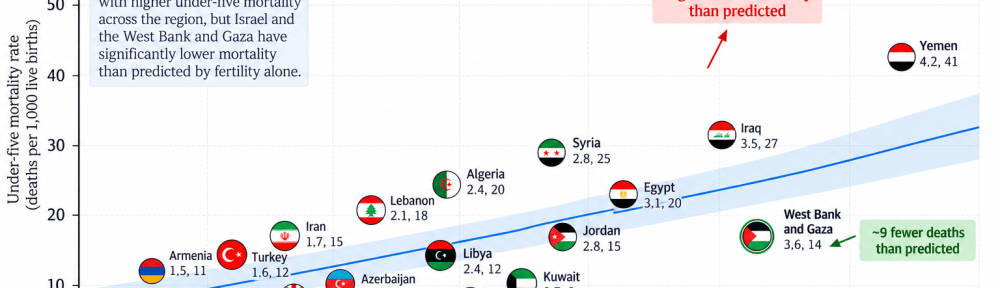
Before the October 7, 2023 Gazan massacre of Israelis and the subsequent war in Gaza, Palestinian Arabs enjoyed one of the most favorable combinations of high fertility and low childhood mortality in the surrounding Arab world.
Typically, wealthy countries like Saudi Arabia and Kuwait have few children and lower infant mortality, defined as a child dying before five years old. Poorer countries and those in conflict have more children and higher infant mortality, like Yemen, Iraq and Syria.
Yet in 2022, Palestinian women had approximately 3.6 children each, while the under-five mortality rate in the West Bank and Gaza was roughly 14 deaths per 1,000 live births.
Compare that with Syria, where approximately 21 children per 1,000 died before their fifth birthday. In Iraq, the figure was 23. In Yemen, 41. The difference was enormous. West Bank and Gaza Arabs were much closer to the exceptional high fertility and low infant mortality rates of Israel.
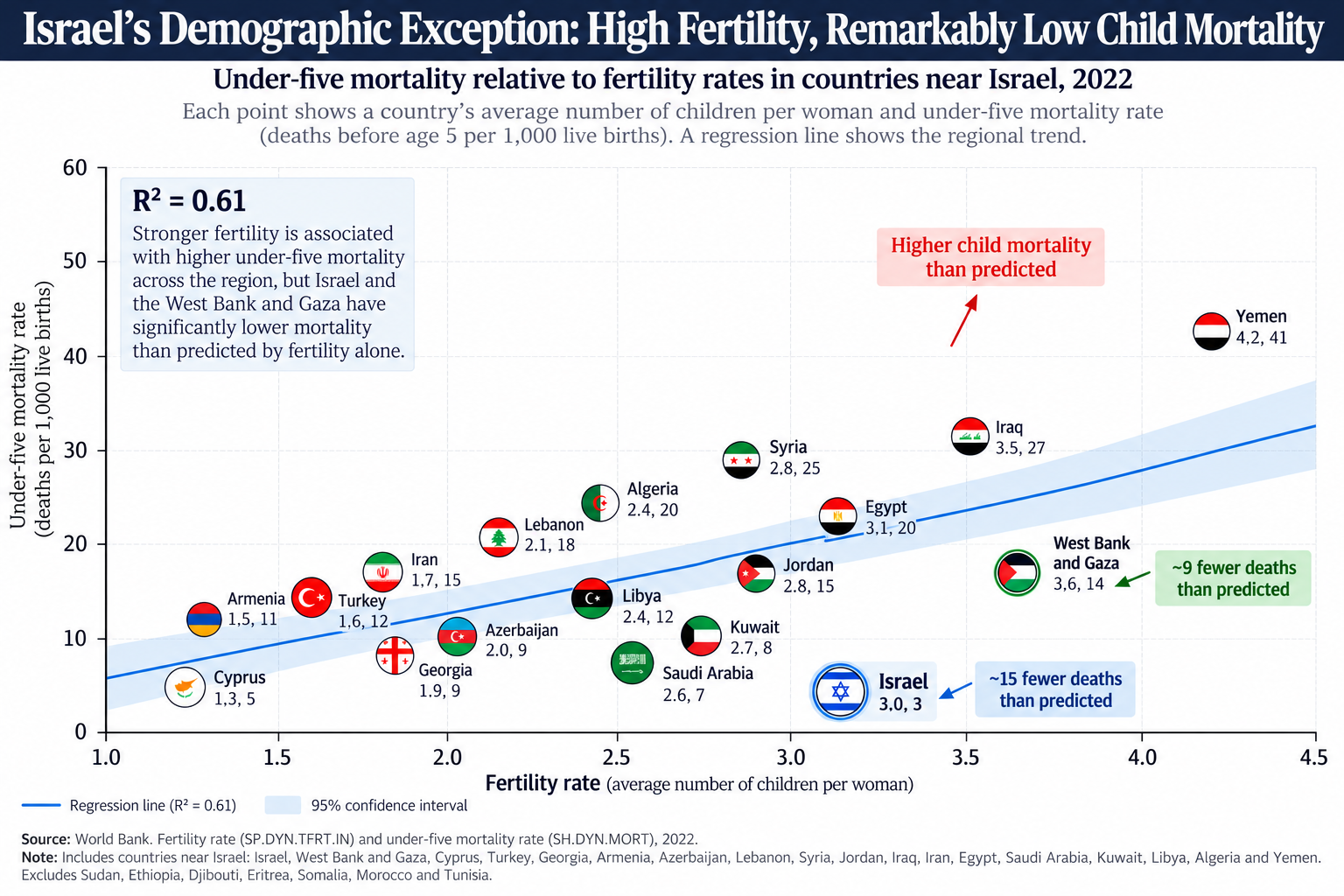
If one were to expand the regional focus to Sudan, Eritrea, Ethiopia and Djibouti, one would see an even more dramatic gap – Sudan (4.38; 51.7), Ethiopia (4.2; 46.5), Eritrea (3.79; 36.6) and Djibouti (2.7; 51.9). On the other extreme for wealthy Gulf states are UAE (1.15; 5.3) and Qatar (1.74; 6.1).
Applying Syria’s childhood mortality rate to approximately 144,000 Palestinian births in 2022 would imply roughly 950 additional deaths before age five. Iraq’s rate would imply another 1,300 deaths compared with the Palestinian rate. Yemen’s would imply nearly 3,900 additional deaths.
Extend those differences illustratively across 20 annual birth cohorts, assuming similar numbers of births and mortality differences, and the results are striking: approximately 19,000 additional Palestinian childhood survivors compared with Syria’s rate, 26,500 compared with Iraq’s, and 78,000 compared with Yemen’s. Using the same methodology for Sudan or Djibouti would result in nearly 110,000 Palestinian Arabs childhood deaths.
The Palestinian territories benefited from robust vaccination programs, maternal healthcare, hospitals, and medical services developed over decades, including services provided through United Nations and Palestinian institutions, international organizations, and cooperation with Israel.
Despite the incremental 19,000 to 110,000 young Palestinian Arabs alive today because of healthcare investment and coordination with Israel, anti-Israel organizations have been accusing Israel of pursuing a “genocide” and the destruction of the Palestinian population. These figures illustrate the precise opposite. Israel is a Palestinian Arab child MAKER.
The demographic record deserves to be confronted: Palestinian Arabs were raising large families, with child survival outcomes that compared extremely favorably with much of the neighboring Arab world.


