To watch a political novice backed by a far-left extremist group rise to the brink of becoming mayor of the largest city in America is frightening enough. To realize that he will have the full backing of a Democratic governor and a compliant state legislature to enact his radical agenda is terrifying. Zohran Mamdani, a darling of the antisemitic Democratic Socialists of America, has weaponized a friendly smile and promises of “free” everything into a populist movement ready to capture real power.
The race is effectively over. The weakness and fragmentation of his opponents make his November 4 election almost certain. But that does not mean New Yorkers are powerless. Far from it.
1. Register Democratic — and block the radicals. While national elections generate headlines, your single vote barely registers on a national scale. Local elections, however, can be swung by a few hundred ballots. In a deep-blue state like New York, the real election is the Democratic primary. That’s where the socialists gain power — because moderates stay home or remain registered as independents. If you want to stop extremists from running your city, county and state, you must register as a Democrat and vote against the zealots in the primaries.
2. Vote Republican in the general election — everywhere. Even outside New York City, every voter can help slow the DSA’s march. New York State operates under a blue-wall trifecta: a Democratic governor and supermajorities in both the State Senate and Assembly. Republicans have no effective voice. Governor Kathy Hochul’s open endorsement of Mamdani means his far-left policies will move through Albany unchecked unless the state’s Republican vote share grows.
Far-left media Jacobin advances “to govern, the Left needs many Zohrans.”
So yes — in this strange political moment — the smart play for moderates and centrists is tactical: register Democratic to stop radicals in primaries, and vote Republican to blunt their power in office.
If New Yorkers don’t act now, the most radical city government in America won’t just run New York — it will set the agenda for the entire country.
To read The New York Times or watch Saturday Night Live today is to be told that Zohran Mamdani’s critics — not Mamdani himself — are the problem. Those who dare question his rhetoric or friends are branded “Islamophobes.” The journalists and comedians who once prided themselves on “speaking truth to power” now serve as antisemitism’s defense attorneys.
The New York Times calls political criticism of Mamdani “Islamophobia”
Nowhere in The Times’ coverage will you find an honest accounting of Mamdani’s behavior: his use and defense of the slogan “globalize the intifada” — a phrase that calls for expanding anti-Israel violence worldwide. No mention that he’s proudly endorsed by, and a member of, the Democratic Socialists of America, a group whose members have declared “there are no innocent Israelis” and whose leaders celebrated “the war of liberation” even as the ceasefire was announced. No mention that Congressman Jamaal Bowman, the man who said that Israeli women’s rape claims should not be believed, stands firmly behind him — or that Bowman is now rumored for the post of Schools Chancellor, a moral disaster waiting to happen.
DSA claims that every Israeli is a legitimate target for violence
Worse than silence: spin.
The paper of record tells us that those who raise these issues are targeting a Muslim lawmaker. SNL cast members – who actively lobby for Mamdani – mock Jewish fear and turn it into a punchline. The city’s progressive (read regressive) media elite has turned the word “Islamophobia” into a political disinfectant — scrubbing away scrutiny, shielding radicals, and shaming Jews for daring to be afraid.
Even liberal rabbis like Rabbis Ammiel Hirsch and Elliot Cosgrove have said openly that Mamdani’s words instill fear in the hearts of Jews. But when Jews speak that truth, the same media that weeps for “marginalized voices” sneers at theirs. The new journalism of compassion has only contempt for Jews.
This is not journalism. It is collaboration — a moral betrayal dressed up as sensitivity. The press once prided itself on exposing extremism; now it launders it. The Times and SNL are not neutral observers. They are Hamas’ willing editors, dressing hate in hashtags and calling it progress.
A civilization that excuses incitement, whitewashes vitriol and ridicules genuine fear is not enlightened. It is suicidal.
The Torah opens in a world where inheritance belongs to the firstborn — where privilege is order, and order is destiny. Yet from its very first stories, the Bible breaks that rule.
Cain, humanity’s firstborn, murders his brother and loses everything. Abel, the second, dies without heirs. Humanity continues through Seth, the third son. The pattern is set. Abraham, father of monotheism, is not his father’s eldest. His younger son Isaac inherits the covenant, and Isaac’s younger son Jacob inherits it again.
By the time Israel becomes a nation, the inversion is complete. The Jewish people today descend from Levi and Judah — the third and fourth sons — not from Reuben, the firstborn. A book born in a culture of primogeniture systematically overturns it.
Why?
The Bible begins by showing the cost of bad choices. Adam and Eve possess everything, yet choose wrongly. The Fall from Eden inaugurates the central lesson of Scripture: that moral choice determines inheritance. Paradise is not lost by fate but forfeiture.
Michelangelo, The Fall of Man (1509-10), Sistine Chapel, Rome
Rabbi Lord Jonathan Sacks wrote that this pattern is not incidental but revolutionary.
“The Torah is not a chronicle of power. It is a critique of power.” — Covenant & Conversation: Genesis
The Bible’s rejection of firstborn privilege is a moral protest against the idea that greatness is inherited. Sacks called it “the divine displacement of power” — God’s way of declaring that leadership is not a birthright but a calling.
Each time the younger supplants the elder, it signals that the future is not fixed. The world may honor the order of birth, yet God honors the order of the heart. Greatness is not bestowed by lineage but achieved through moral courage.
This inversion gives agency to every person. The Torah’s message is that destiny is not preordained. We are not bound by family rank or societal hierarchy. Cain’s fall was not inevitable. Abraham could have ignored God’s call. Jacob could have reconciled instead of wrestled. Every figure in Genesis acts — and through action, alters the story of the world.
Sacks extends the idea to Israel itself:
“God’s chosen people are not the privileged people; they are the choosing people — those who freely choose to live by the call of holiness.”
We are all born into someone else’s order. Or disorder. The question is whether we accept it, or, like our forefathers, we choose holiness — and through that choice, earn that inheritance.
For decades, Palestinians have believed there were three paths to statehood—and they pursued them simultaneously.
1. Violence. Hamas, Islamic Jihad, Fatah’s militias and several Palestinian Arab terrorist groups waged terror wars, convinced that bloodshed brought gains: the First Intifada led to the Oslo Accords; the Second Intifada drove Israel from Gaza and parts of the West Bank; the 2021 riots were hailed for halting evictions in Sheikh Jarrah. The October 7 massacre, backed by roughly 75% of Palestinians, was the latest in that grim pattern.
2. International Pressure. Even as rockets fell, Palestinian allies abroad pressed boycotts, divestment, sanctions, and United Nations resolutions, seeking to isolate Israel diplomatically and economically until it yielded territory.
3. Negotiations. The Palestinian Authority claimed to prefer talks to gain legitimacy and foreign aid—but insisted on maximalist demands: all the West Bank, all of eastern Jerusalem, a Jew-free Palestine, and a mass “right of return.” Yasser Arafat walked away from a state in 2000 and launched the Second Intifada instead. His successor, Mahmoud Abbas, also spoke of peace while undermining it—keeping the notorious “pay-to-slay” stipends for terrorists’ families and, in a January 2018 speech, blessing those who chose violence even as he professed support for diplomacy.
Polling has consistently shown the order of Palestinian preference: violence first, global pressure second, negotiations last.
The Cost of Failed Strategies
Both violence and sanctions have brought suffering to Palestinians themselves. Suicide bombings and rocket wars prompted Israel to build the security fence, which restricted movement and economic activity. The October 7 attack provoked a massive war in which Gaza was devastated and Hamas decimated. Attempts to use international pressure backfired as well, leading Israel to withhold funds from the PA and tighten restrictions.
Israel fights like a cornered raccoon—fiercely, without backing down when attacked. Every round of violence has left Palestinians weaker and poorer.
In the recent war, Israel scored a double victory: It destroyed Hamas’s military capability, killing an estimated 25,000 fighters, and it refused to bow to global pressure, pressing on despite UN condemnations, ICC threats, and warnings of diplomatic isolation.
This shattered the long-held belief that if terror failed, the world could still coerce Israel into retreat.
A New Reality — and a Call to the Arab World
The old strategies of terror and economic warfare have failed and only deepened Palestinian misery. The third path—real negotiations—remains the only way forward.
Israel and the United States now hope the Arab world will engage Israel constructively, encouraging Palestinian leaders to abandon impossible UN demands and accept the reality of Israel’s permanence. Clinging to maximalist positions will only bring more rounds of bloodshed and despair.
And an Alternative Reality — Coming for Diaspora Jews
While Israel feels that it may have finally fought a war that could lead to long-term peace, there are those who still cling to eradicating the Jewish State. The international “Free Palestine” fighters do not want to see Israel holding onto the Old City of Jerusalem nor limiting the entry of millions of Arabs who claim UN’s mantle of “refugees.” The light at the end of the tunnel for them is not coexistence but a continued “Nakba,” a disaster.
So they are revamping the second front of international pressure, from targeting Israel to the soft targets of diaspora Jews.
They are chanting to “globalize the Intifada” to bring the war to every Jew and pro-Israel person and organization. The incineration of the kibbutzim in Israel on the Jewish holiday of Simchat Torah was echoed in the burning of the Jewish governor of Pennsylvania’s home on the holiday of Passover. Burning Jews alive in Kibbutz Be’eri was mirrored in burning Jews in Boulder, Colorado.
Burned kibbutzGov. Shapiro burned home
While Israel sees that it is in a strongest position in the region since its reestablishment which may finally enable an enduring peace, the anti-Israel horde has opened a new front on the global diaspora.
The international pressure of the BDS camp has not been defeated but inflamed. They are ratcheting up their smears of “apartheid” to “genocide,” and marking local Jews as co-conspirators.
While Israel won the Iranian proxies war, the Free Palestine camp is taking millions of new hostages – diaspora Jewry. Who will fight for them?
When the heckler’s veto becomes public policy, liberty dies by degrees.
The world rallied in Paris when jihadi radicals murdered staff at Charlie Hebdo in 2015. Leaders raised banners for free speech and spoke of defending the liberties that make liberal democracies possible. The same chorus rose after other political murders like Charlie Kirk in 2025: condemnations, eulogies, brief outrage.
Yet the Global North has a quieter, more corrosive surrender under way — a surrender not to a foreign army but to the heckler’s veto. When threats of violence can shape who is allowed to speak, to march, to play, or to pray, freedom has already been bargained away.
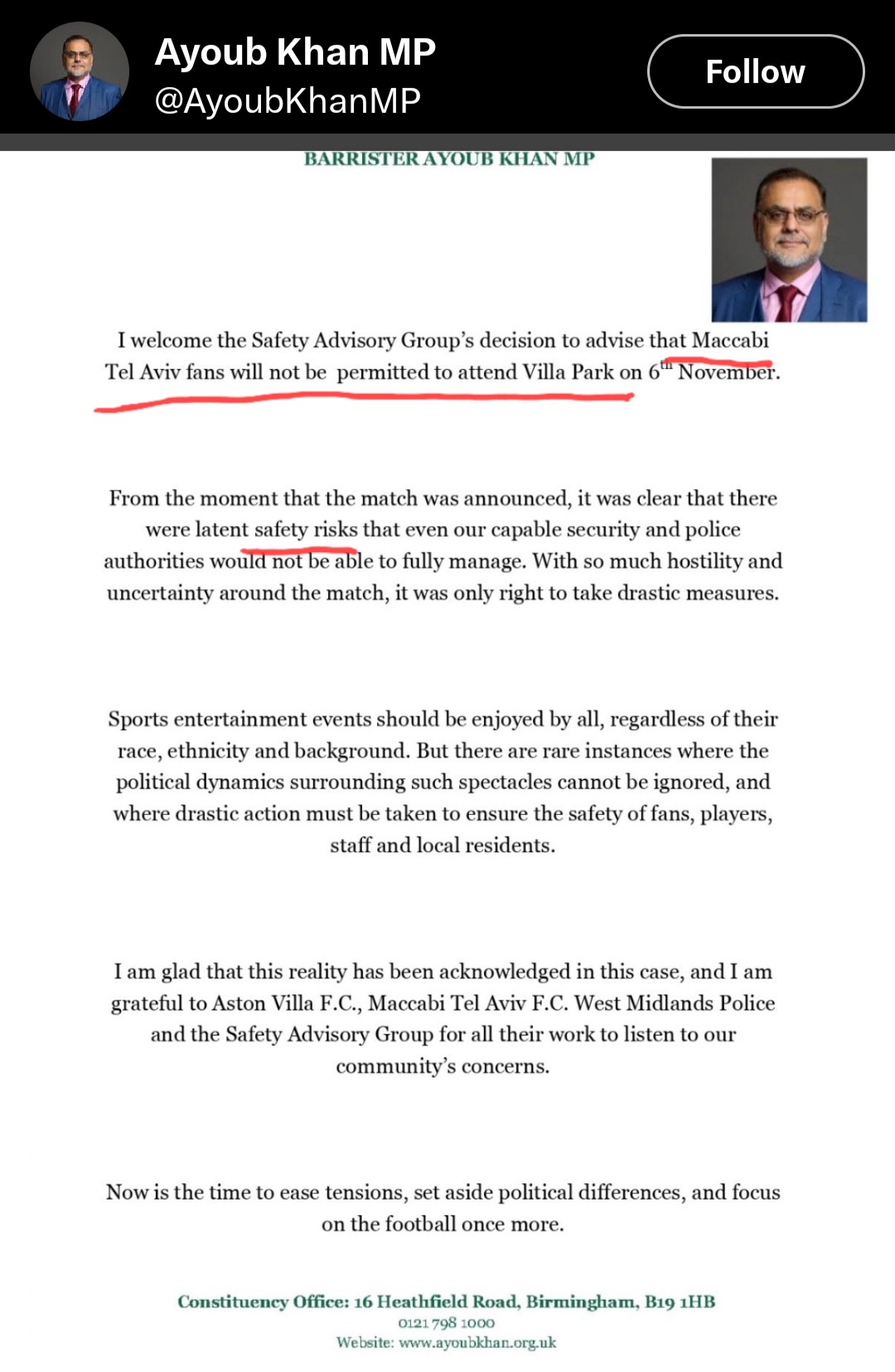
UK’s MP Ayoub Khan celebrating the banning of Tel Aviv fans from a game because their presence might bring out protestors. Other fans were welcomed to attend in October 2025.
Too often now the mere presence of Jews is treated as a provocation that must be managed by erasure. In Britain, politicians warn that protests will make events “unsafe” and ask organizers to exclude Israeli athletes and fans, Jewish speakers, or symbols rather than arrest the thugs who threaten violence. In 1929, after brutal attacks in Hebron, British authorities removed all Jews from their homes to suppress further bloodshed — an act that punished the innocent to placate the violent. That precedent echoes when modern officials choose exclusion over enforcement.
Call it what it is: when a state lets intimidation determine who may appear in public, it substitutes coercion for law. When politicians cave to the loudest violent faction to avoid a headline, they have abandoned the first duty of government — to protect the rights of every citizen, not to negotiate them away.
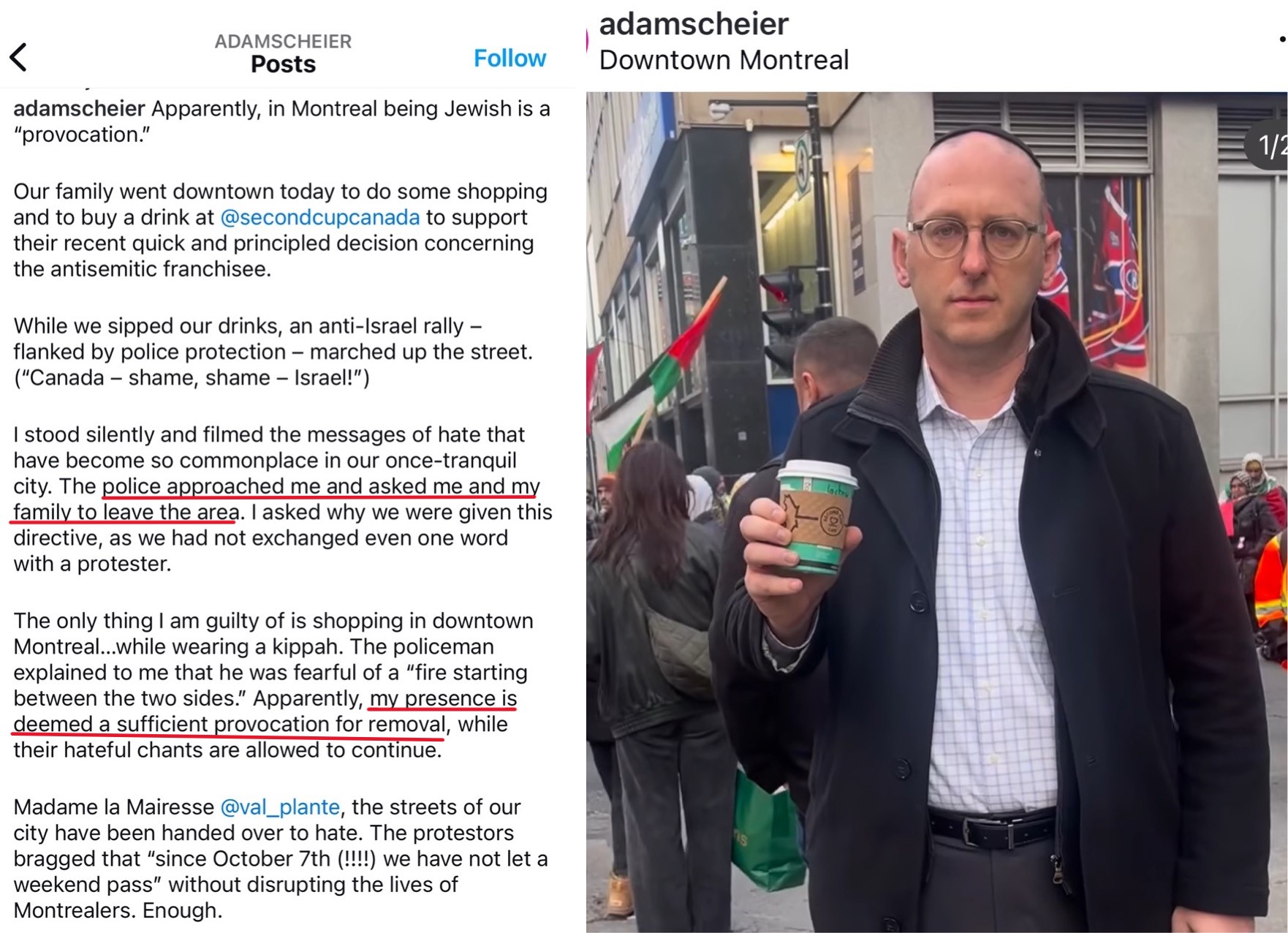
Canadian police ask Jewish family to leave the street since their “presence is deemed a sufficient provocation for removal,” in November 2024.
This is not a critique of a religion; it is an indictment of extremism and of political cowardice. The problem is not Muslim faith but those within it who preach and practice violence — and the leaders who, for fear or for votes, let those violent actors set the rules.
A democracy that permits the heckler’s veto on principle is no longer democratic; it is ruled by fear. If we are to remain free, the test is simple: do we defend rights when it is inconvenient, or only when it is safe? If the answer is the latter, then we are well on the way to living under a very different law — one written by radical mobs and enforced by silence.
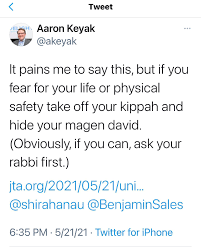
US President Obama advisor Aaron Keyak tells Jews to “take off your kippah and hide your magen david” to avoid being targeted in May 2021.
President Biden set this in motion in the U.S. in May 2021 when his own Jewish advisor, Aaron Keyak, told Jews to hide their Jewishness, presumably because they should not assume that the government would protect them showing their faith publicly. In September 2024, school officials at New York’s Baruch College said it explicitly, telling Jews that they could not “guarantee their security” if they held a celebration for Rosh Hashana.
We have set the stage for Democratic-Socialist Zohran Mamdani to become mayor of the city with the largest Jewish diaspora community in the world. Where police will not only suggest that Jews stay off the streets but may be directed by the mayor to arrest Jews because their very presence is deemed a provocation.
“Why do the nations rage, and the peoples plot in vain?”— Psalm 2:1
Saudi Arabia – the kingdom which Israel hoped would next join the Abraham Accords – sought to pressure Israel into ending its defensive war in Gaza by rallying nations of the Global North to recognize a State of Palestine. It found a partner in France, which successfully pulled the United Kingdom, Canada, and Australia into the orbit of recognition. In September 2025 at the United Nations, the group jointly declared their acknowledgment of a Palestinian state—with caveats—but the symbolism was unmistakable.
Israel did not budge. It viewed the coordinated announcement as an alarming reward for the genocidal Hamas regime that had unleashed war on October 7 two years earlier.
Enter the United States. President Donald Trump had tasked developer and confidant Steve Witkoff to lead a back-channel negotiation with Hamas for the release of Israeli hostages and an end to hostilities. Jared Kushner joined the effort more forcefully in September, unveiling a “20-point plan” aimed at ending the two-year war and reshaping the region’s political future.
To counter the Saudi-French gambit, Trump built his own coalition. The U.S. secured the backing of several Arab and Muslim nations from the Global South—including Qatar, Jordan, the United Arab Emirates, Indonesia, Pakistan, Türkiye, Saudi Arabia, and Egypt —for its peace framework. By October, the administration succeeded in gathering the leaders of 27 countries from across the North and South, including some that had just recognized Palestine, to fly to Egypt to sign what was billed as a ceasefire agreement.
A summit to support ending the more than two-year Israel-Hamas war in Gaza after a breakthrough ceasefire deal, Monday, Oct. 13, 2025, in Sharm El Sheikh, Egypt labeled “Peace 2025”
It was a mirage. Neither of the warring parties—Israel or Hamas—attended. The event was instead diplomatic theater, meant to transform a ceasefire proposal into a movement for regional peace. Trump designed the event to flip the script.
Where Saudi Arabia and France tried to impose the weight of the Global North on Israel, the United States sought to use the combined weight of both hemispheres on Hamas. The former demanded an immediate path to a two-state solution; the latter demanded the end of Hamas rule.
The Moral Gravity
The story of this moment is not only about geopolitics, but about moral gravity. The nations of the world have grown accustomed to weighing Israel’s every move while ignoring the crimes of its enemies. They call for “balance” in a war that began with mass murder, rape, and hostage-taking. They lecture the victim to compromise while the aggressor reloads. The UN Security Council could have easily passed resolutions to push for an end to the war if they had just condemned Hamas, but repeatedly refused to do so.
The weight of nations once meant the defense of justice and the pursuit of peace. Today, it is too often the ballast of perfidy—dragging down the innocent under the pretense of even-handedness.
Israel, standing increasingly alone, may yet prove that the true measure of a nation is not in the number of its allies, but in the steadiness of its conscience. It is fortunate to have President Trump in the White House as it shoulders this weight once again.
The tight bond between Israel and the United States has continued, despite Americans starting to sour on Israel since 2015.
“Well, thank you for asking that. To make sure I answer you fully, let’s first be clear on what a Zionist is. It’s someone who believes in two facts and one principle.
The first fact is that Jews are a people. The second fact is that the Jewish people originate in the Land of Israel.
The principle is that Jews should have self-determination in their homeland, the Land of Israel.
Yes, I believe in both of those facts and that principle. You can plainly see that nothing about Zionism has anything to do with any particular government, leader, or policy.”
That’s it. Calm, factual, and impossible to refute without revealing one’s true bias.
Now, it can very well be that some people simply believe Israel shouldn’t exist — and therefore call themselves anti-Zionists. But as Israel is a living, breathing reality today, to oppose its existence is not a theoretical stance about 1948; it’s a desire to dismantle a sovereign Jewish nation. That’s not political criticism — that’s eliminationism. That’s the desire of many groups including the People’s Forum, Within Our Lifetime and the Democratic Socialists of America.
In today’s world, anti-Zionism isn’t just a philosophical disagreement. It’s an active hostility toward Jewish self-determination, an echo of the same hate that fueled the October 7 massacre. It’s far more lethal and toxic than opposing the idea of creating another Arab state in the Middle East to be called “Palestine,” especially one that has opposed coexistence with the indigenous Jews for over a century.
To deny Jewish peoplehood, heritage, and rights in their homeland is not progressivism — it’s prejudice wrapped in the language of activism.
So, the next time someone smugly demands you “renounce Zionism,” repeat the verses above. Because once you strip away the slogans and hashtags, all that’s left of anti-Zionism is anti-Jewish animus.
The headline deal which everyone pretends is a simple human-rights triumph — hostages home in exchange for prisoners and a ceasefire — is, on its face, a moral imperative. Families and politicians, of course want the war to end and hostages back home. But if we treat this swap as merely a humanitarian ledger without thinking about incentives, strategy and deterrence, we invite a replay of October 7 — not because anyone wants it, but because the arithmetic of the deal makes another mass-carnage payoff seem rational to those who plan such crimes.
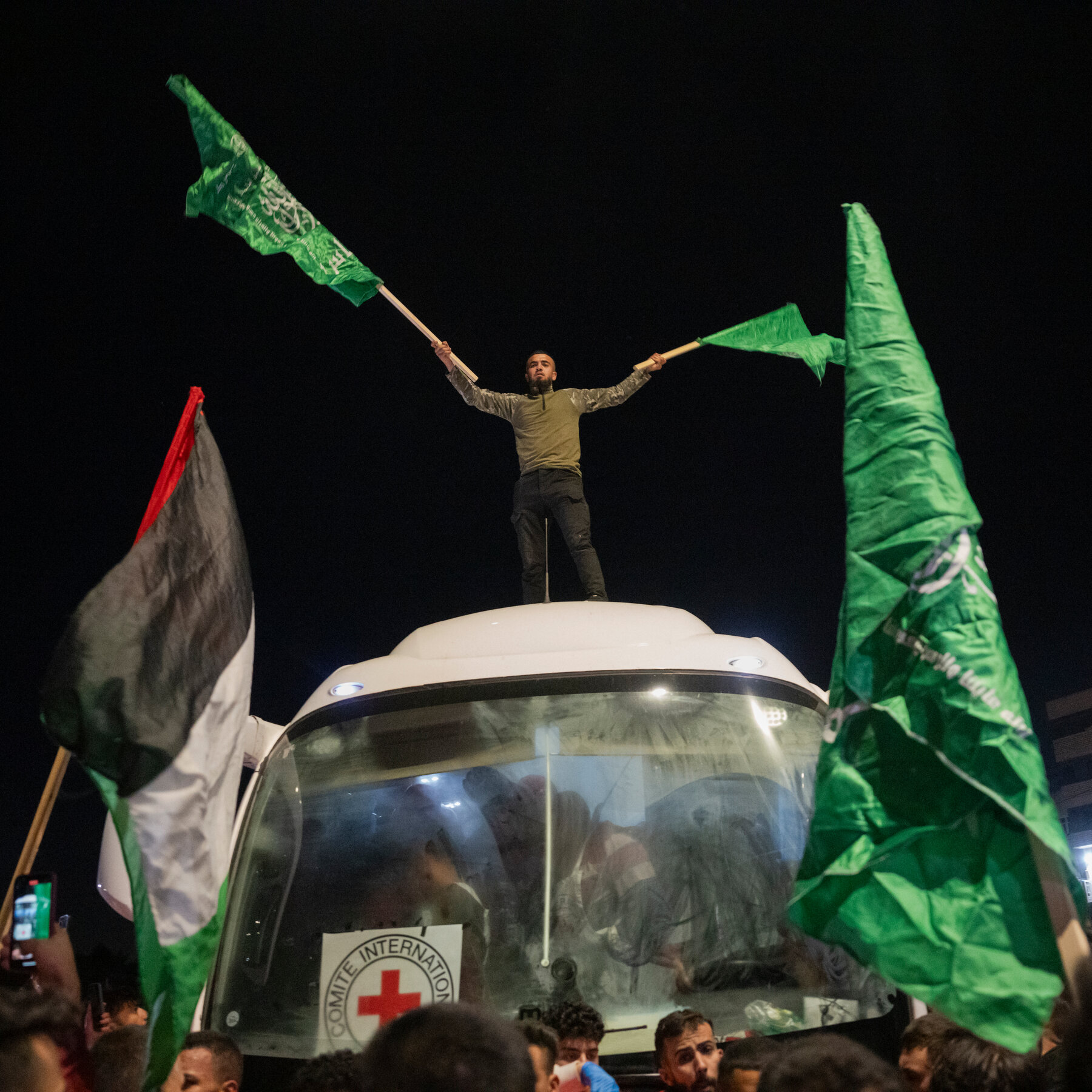
Palestinian Arabs wave Hamas flags atop the Red Cross truck bringing releases terrorists to the West Bank in November 2024
Here’s the cold calculus the bland statements miss.
Hostages for prisoners. Civilians for killers. A handful for hundreds. These trades have an immediate human relief value. The cost, however, is structural: they reset the reward function for terrorism. If a violent raid can reliably purchase the release of leadership, fighters, and political capital — and if the international response includes legal actions that delegitimize the responding state — then the net effect is to make mass atrocity an instrument of statecraft.
Celebrations for released Palestinian Arab terrorists in 2014
But the mathematics isn’t just – and must not be viewed as – the prisoner-to-hostage ratio. It includes the defensive response: the likely military, political, and territorial consequences of the assault. Hamas should be forced to accept that math too. If it contemplates another October 7-style operation as it has promised to do repeatedly, it must understand that the outcome will not be a tidy prisoner exchange and a televised victory lap. It will be the destruction of leadership and the decimation of military infrastructure, with broad international support for the defensive measures taken to prevent a repeat.
Which brings us to the international legal theater now playing out: the ICJ’s “genocide” accusations, the vociferous statements from states threatening arrest of Israeli officials, and the diplomatic embrace of Palestinian statehood in some quarters. These actions, however well intended by their proponents, have immediate strategic effects. They amplify Hamas’s narrative of global validation and, crucially, complicate the deterrent effect of defensive operations. If a state in self-defense risks being publicly criminalized or its leaders subject to arrest, the calculus of deterrence is altered – for the entire world.
So, what should sensible governments do if they insist on both protecting Palestinian rights and preventing another October 7? Two practical propositions:
If regional governments want backing for Palestinian statehood and avoid terrorism in their own countries, they should drop the ICJ case. the Arab and Muslim countries which backed the U.S. ceasefire plan should pressure South Africa and other countries which brought the case to drop the charges and let diplomacy take center stage. Law and diplomacy should be tools of stability, not absolution for terror strategies.
If the desired outcome is that populations on both sides live within range of cross-border terror and reprisals, then investing in defensive infrastructure as a bridge to a political solution is a rational step. The United Nations and donor states should be pressed to fund a replacement barrier between Gaza and Israel — walls and surveillance that reduce the risk of mass infiltrations, so that the question of where futures lie for Palestinians becomes a matter of state-building and safety inside Gaza, not a perpetual recruitment slogan for militancy.
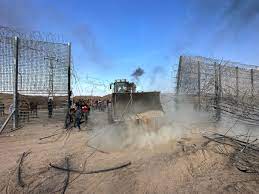
Hamas breaks through security fence between Gaza and Israel on October 7, 2023, on way for mass murder and abductions
This is not a call to abandon human rights oversight or to whitewash abuses. Accountability and adherence to international law matter. But timing and incentives matter too. Legal actions taken in the heat of war — unmoored from a strategy to prevent recurrence — can harden positions and diminish the tools of deterrence. If the objective is to keep people alive and build a durable peace that allows Stateless Arabs from Palestine (SAPs) self-determination without repeated massacres, then international actors must think like engineers of stability, not moral prosecutors on a press release timetable.
If we are serious about both ending the war and preventing future acts of mass terrorism and barbarity, we must stop evaluating deals by immediate feel-good optics alone. The right measure of a deal includes whether it reduces the incentive to perpetrate mass atrocities, strengthens deterrence against their planners, and clears a path toward political arrangements that give civilians on all sides a future. Anything less is not a solution — it is an invitation.
The final Torah reading before the festival of Sukkot, Haazinu, is a song of warning. Moses, nearing his death, calls heaven and earth as witnesses to the covenant — and then lays bare the consequences if Israel abandons its moral anchor. When the nation becomes “fat,” reveling in abundance and forgetting the source of its blessings, punishment will follow. Prosperity, once unmoored from gratitude and purpose, becomes the seed of ruin.
Just a few days later, on Shabbat Chol HaMoed Sukkot, Jews read Kohelet (Ecclesiastes). Its message mirrors Haazinu but turns inward: even the individual who possesses everything — wisdom, power, wealth, prestige, pleasure — finds himself hollow. “I made great works… I built houses and planted vineyards for myself,” writes King Solomon in Chapter 2. Yet he concludes, “It was all futile and a pursuit of wind; there was no real value under the sun.”
The parallel between Haazinu and Kohelet is striking and the proximity of their readings is seemingly deliberate. One warns the nation about collective moral decay born of excess and God’s punishment; the other exposes the personal emptiness that comes when abundance replaces meaning. Together they form a spiritual counterpoint on Sukkot — the holiday when Jews leave their sturdy homes to dwell in fragile huts, to remember that joy comes not from walls or wealth but from faith, family, and divine connection.
A life disconnected from those simple pleasures — from loving one’s spouse, nurturing one’s family, and walking humbly with God — cannot sustain happiness. Unmoored excess may glitter for a moment, but like Solomon’s “pursuit of wind,” it slips through fingers, leaving behind only the passing echo of what might have been joy.
And so, we sit beneath the s’chach of the sukkah, exposed to wind and light, reminded of the temporary nature of all possessions. The walls sway, the roof leaks, yet the heart is full. In simplicity, vulnerability, gratitude and “connectedness,” we rediscover the only abundance that truly endures — the shelter of faith and the warmth of those we love.
The Palestinian Authority (PA) has perfected the art of self-deception — and the spectacle has become an embarrassment to watch. Its leaders trade in fantasies while their people – and the entire region – suffer the consequences of their delusions.
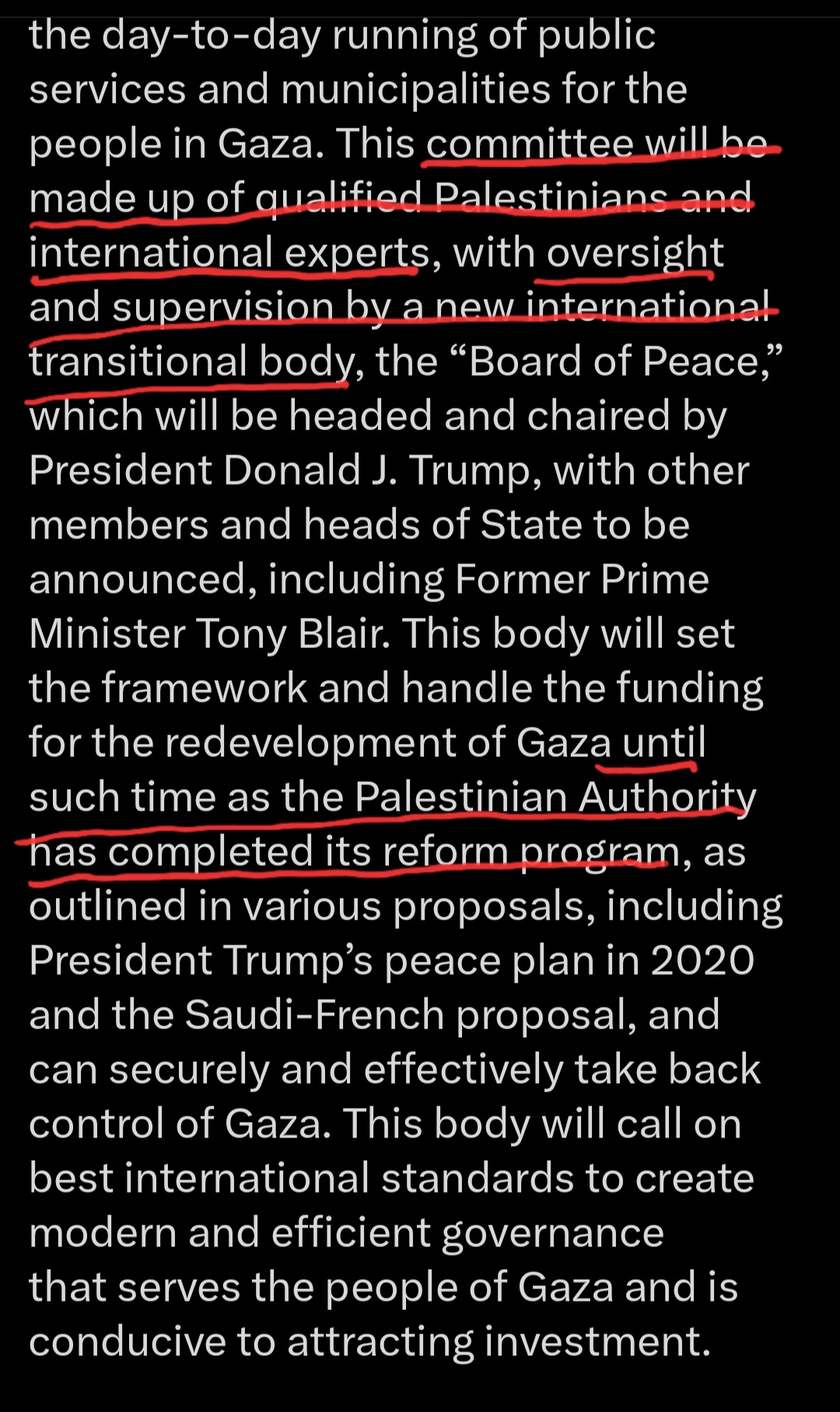
When President Donald Trump released his 20-point Comprehensive Plan to End the Gaza Conflict, it was explicit: the focus was on fixing Gaza and the PA would have no role. The document said in plain language that the PA would need to be overhauled and reformed before it could ever be trusted as a partner for peace. It deliberately withheld any credit or recognition for the current leadership, recognizing its corruption, incitement, and support for terror. “A technocratic, apolitical Palestinian committee” headed by Trump himself would be the day-after plan for Gaza. Only “qualified Palestinians” would get to sit on such committee, not the UN-lauded PA.
President Trump’s peace plan specifically did not hand control of Gaza to the PA and said the group had to “complete its reform program.”
The plan’s very structure was layered with conditionality — each potential step toward a Palestinian state contingent on verifiable reforms, renunciation of violence and demilitarization. Even then, the most it offered was that maybe one day, post-reform, there could be a pathway to a two-state solution.
The Trump plan layered conditions of “when,” “may” and “pathway” to Palestinian “statehood”
And yet, in a surreal twist, the official PA news agency WAFA ran an article in which Mahmoud Abbas claimed that Trump stood ready to endorse a Palestinian state with “East Jerusalem” as its capital. It was an astonishing fabrication — a complete lie, meant to mask Abbas’s very public humiliation and preserve his illusion of relevance.
Official PA media lied that Trump’s peace plan would establish a new Palestinian State which would follow the “June 4, 1967 borders, with East Jerusalem as its capital”
This distortion was not a misunderstanding; it was intentional misrepresentation, propaganda designed to convince Palestinian Arabs that Abbas still holds the key to their future. But everyone can see through the act. All Abbas and Hamas have delivered is destruction, division, and hatred.
The PA’s falsehoods no longer even convince its own people. Each new lie only underscores its impotence — a government in name only, ruling by inertia and deceit. The tragedy – like the lies – has layers of corruption, hatred, murder and deceit.
The Palestinian people, too, bear responsibility for their choices. They voted for Hamas, a genocidal terrorist movement to 58% of the parliamentary seats which brought death and destruction not only to Israelis but to Palestinians themselves – which the vast majority supported. They elected Mahmoud Abbas, a Holocaust denier and an ineffective president, and now watch him recycle lies and propaganda instead of leadership and reform. The Palestinians voted for failure — and the region has paid the price.
WAFA called the Israeli government an “occupation government”, clearly showing the PA was upset by being sidelined because it sorely needs reform
The Trump plan recognized that hard truth. It was not a welcome mat for Fatah or Hamas, nor a reward for decades of violence and corruption. The plan envisioned a different future entirely. The “day after” will not be another PA regime or HAMAS ruling Gaza, but the first step in a new chapter of deradicalization, where education replaces indoctrination, coexistence replaces hate, and peace is no longer a slogan but a shared reality.
Trump’s plan – as endorsed by Qatar, Jordan, the United Arab Emirates, Indonesia, Pakistan, Türkiye, Saudi Arabia, and Egypt – states clearly that a possible Palestinian State will come as a BYPRODUCT of deradicalization and peace, not in order to CREATE the forum for coexistence as offered by France and the United Kingdom. All of which may or may not happen, and most likely after Abbas is long gone.








 First One Through