Some Global Supporters of the P5+1 Iran Deal

Obama’s bright white lie on his red line.

US President Obama gave a speech about the broad support the Iranian deal enjoys: “because this is such a strong deal, every nation in the world that has commented publicly, with the exception of the Israeli government, has expressed support. The United Nations Security Council has unanimously supported it. The majority of arms control and nonproliferation experts support it. Over 100 former ambassadors who served under Republican and Democratic presidents support it.

There are others that strongly support the deal too that Obama failed to highlight:

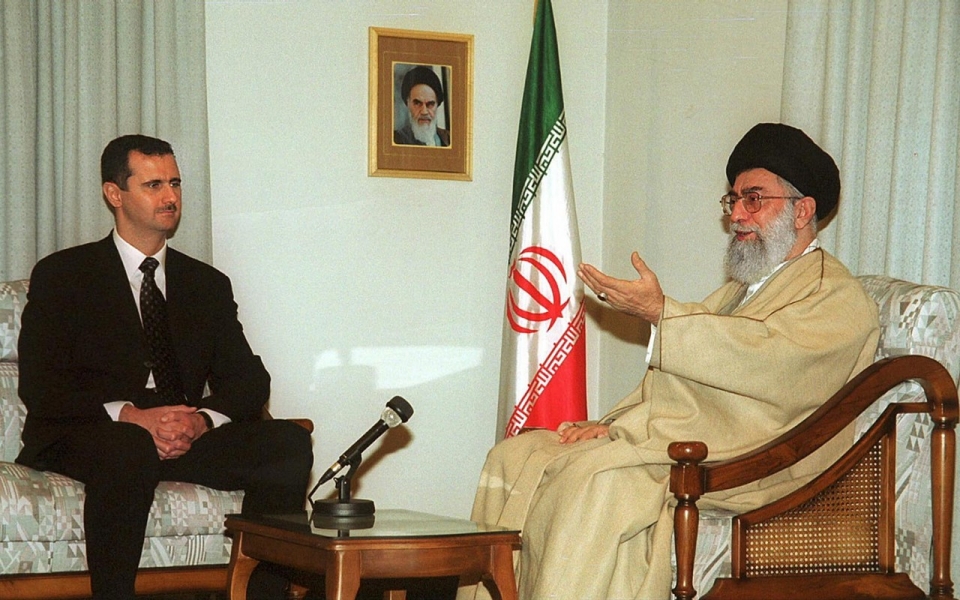
  • Syria’s president Basher al-Assad, the man who has waged a war with this own people that has killed over 220,000 people thus far told the Iranian leader: “In the name of the Syrian people, I congratulate you and the people of Iran on this historic achievement.
  • Hezbollah, the terrorist group in Lebanon was impressed that Iran now had “global recognition as a member of the nuclear club.
  • David Duke, the former member of Congress and head of the KKK was happy that the Iranian deal would likely keep Israel from attacking Iran

assad_iran_083013_1385159834190

Iran’s supreme leader Ayatollah Ali Khamenei meets Syrian President Bashar al-Assad in Tehran 25 January 2001.(photo: Atta Kenare/AFP/Getty Images)


As part of this agreement, Iran will get funds in the range between Obama’s estimate of $56 billion to as much as $150 billion.  Not surprisingly. this makes the various terrorist entities that are financed by Iran quite happy including (parenthetical is the year when placed on the US State Department list of foreign terrorist organizations):

These Iranian-backed terrorist groups are responsible for the deaths of thousands of civilians and continue to destabilize the Middle East and beyond..

In Obama’s attempt to sell the Iranian deal, he cited many allies that endorsed the deal while specifically avoiding mention of America’s enemies that also support it.  How does one account for the fact that both US allies and foes celebrate the deal? Is the deal actually beneficial to all of the parties, or do some countries simply not understand the deal’s details?

  • The Western world gets to curtail Iran’s nuclear program and avoids a war in the near-term
  • Iran gets to avoid a war, keep its nuclear infrastructure intact, global legitimacy, does not have to change its behavior regarding backing terrorism, and gets tens of billions of dollars in cash
  • Iran’s allies get access to funds and arms from Iran in the near and medium-term, and potentially a nuclear-armed Iranian-sponsor in the not-too-distant future

Obama deliberately does not discuss the many enemies of the United States that support the P5+1 deal and their long list of reasons for doing so. Instead, he makes comments that it is only the Iranian hardliners (and Republicans and Israel) who oppose the agreement. By doing so, he attempts to conceal the enormous benefits granted to Iran (and its proxies) in the agreement. It is pure marketing and a bright white lie over his old red lines.

do not enter
A bright White Lie over a Red Line
(Do Not Enter)


The party Obama highlighted as not being happy with the deal is Israel. A few reasons:

  • Iran will be allowed to continue to call for Israel’s annihilation
  • Iran will have billions of dollars that will not be constrained in any manner from funding terrorist groups that target Israel
  • Iran will get access to a range of ballistic missiles in as little of five years
  • Within 10-15 years, Iran will be a threshold nuclear state
  • The structure of the deal provides Iran opportunity to break the terms and develop nuclear weapons within ten years

In other words, there is a little something (or a lot) for everyone in the deal, with the exception of Israel.


Related FirstOneThrough articles:

The Obama Administration Lays Foundation of Blame at Israel for a Potential War with Iran

The Gap between Fairness and Safety: WMDs in Iraq and Iran

O’bama, Where Art Thou?

Netanyahu’s View of Obama: Trust and Consequences

For Obama, Israeli security is not so time-sensitive

Missing Netanyahu’s Speech: Those not Listening and Those Not Speaking

UN Comments on the Murder of Innocents: Itamar and Duma

The Middle East is unfortunately no stranger to attacks on innocent people. In July 2015, an arson attack on the home of Palestinian Arabs in the town of Duma killed an 18-month old baby. Just 15 miles away, in the town of Itamar, two Palestinian Arabs stabbed to death five members of a Jewish family in their beds in March 2011.

The taking of innocent lives is a terrible thing. It is also sad to watch completely different reactions from world bodies to the two events. Here is the UN news release of the 2011 deliberate murders of five Israeli Jews and the news release of July 2015 on the arson attack that claimed one Palestinian Arab. A short comparison:

Deliberate Murder of 5 Israeli Jews Arson Attack which Claimed Life of 1 Palestinian Arab
Words in article 220 422
Attack called “terrorism” None Three times
Blame placed Not placed on Arabs or Muslims Placed on “Jewish extremists
Other Attacks Mentioned No mention of repeated attacks by Palestinians on Israelis Discussed “repeated acts of settler violence
Comment on leadership Welcomes the strong condemnation… by President Abbas No welcome of condemnation by Netanyahu. Blamed Netanyahu for variety of items including demolishing Palestinian homes and settlement policy.
Cause for Attack Not discussed Blamed on “Israel’s illegal settlement policy

#JewishLivesMatter

The continued disproportionate attacks by the United Nations on only one party in the Israeli-Palestinian conflict will marginalize the UN as a factor in arriving at a long-term solution in the region.

Ban Ki Moon
UN Secretary-General Ban Ki-Moon
(photo: AP/Gary Cameron)


Sources:

Text of UN March 2011: “12 March 2011 – Secretary-General Ban Ki-moon and the United Nations diplomatic partners in the search for peace in the Middle East today condemned the shocking murder of an Israeli family of five, including three children, in a West Bank settlement overnight and called for the prosecution of the perpetrators of the crime.

Mr. Ban also urged all concerned to act with restraint.

The diplomatic Quartet of the UN, European Union, Russia and United States, which seeks a two-State solution to the Israeli-Palestinian conflict, condemned the killings “in the strongest possible terms.”

“The Quartet offers their condolences to the loved ones of the victims and to the Israeli people. Attacks on any civilians are completely unacceptable in any circumstance,” the Quartet said in a statement.

“The Quartet calls on those responsible to be brought to justice and welcomes the strong condemnation of this attack by [Palestinian] President [Mahmoud] Abbas and the Palestinian leadership.”

It stressed the need to expedite efforts to achieve Israeli-Palestinian and comprehensive Arab-Israeli peace.

Media reports said the killings occurred in the settlement of Itamar, near the city of near Nablus. The victims were reportedly stabbed to death by an intruder who broke into their home.

The Israeli army radio said the killer had spared two other children, and that the murder was discovered by another one when she came home.”

Text of UN July 2015: “31 July 2015 – United Nations Secretary-General Ban Ki-moon and the UN special envoy on the Middle East have strongly condemned today’s arson attack in the West Bank that killed a Palestinian child and left the child’s parents severely injured.

The Secretary-General strongly condemns today’s murder of a Palestinian child in the West Bank and calls for the perpetrators of this terrorist act to be promptly brought to justice,” reads a statement issued by his spokesperson in New York.

Continued failures to effectively address impunity for repeated acts of settler violence have led to another horrific incident involving the death of an innocent life, adds the statement. “This must end.”

The absence of a political process and Israel’s illegal settlement policy, as well as the harsh and unnecessary practice of demolishing Palestinian houses, have given rise to violent extremism on both sides, the statement continues.

“This [situation] presents a further threat to the legitimate aspirations of the Palestinian people for statehood, as well as to the security of the people of Israel. The Secretary-General urges both sides to take bold steps to return to the path of peace.”

Mr. Ban reiterates his call on all parties to ensure that tensions do not escalate further, leading to more loss of life, the statement concludes.

Earlier today, the United Nations special envoy on the Middle East today expressed his outrage over what he called a “heinous murder” and a “terrorist crime.”

“I am outraged by today’s vicious arson attack by suspected Jewish extremists in the Occupied West Bank village of Duma, near Nablus, which killed Palestinian toddler Ali, critically injured his mother and father, and injured his four-year old sibling,” the Special Coordinator for the Middle East Peace Process, Nickolay Mladenov, said.

Joining in the “strong condemnations” issued by Israeli and Palestinian Governments and political leaders, the Special Coordinator also called for a “full and prompt investigation” to bring the perpetrators to justice.

“This heinous murder was carried out for a political objective. We must not permit such acts to allow hate and violence to bring more personal tragedies and to bury any prospect of peace. This reinforces the need for an immediate resolution of the conflict and an end to the occupation.”

Later today, the Security Council issued a statement to the press, condemning “in the strongest terms” the “vicious terrorist attack,” and underlining the need to bring the perpetrators of this “deplorable act” to justice.

Council members encouraged all sides to work to lower tension, reject violence, avoid all provocations, and seek a path toward peace.”


Related FirstOneThrough articles:

The United Nations Audit of Israel

Double Standards: Assassinations

Every Picture Tells a Story: The Invisible Murdered Israelis

The Legal Israeli Settlements

The Death of Civilians; the Three Shades of Sorrow

Eyal Gilad Naftali Klinghoffer. The new Blood Libel.

Cause and Effect: Making Gaza

Subscribe YouTube channel: FirstOneThrough

Join Facebook group: FirstOne Through  Israel Analysis

The Fault in Our Tent: The Limit of Acceptable Speech

 Some passionate and eloquent liberals have bemoaned the state of inclusiveness among Jews today. Leon Wieseltier, editor of the New Republic, penned an angry piece “J Street’s Rejection Is a Scandal” about the exclusion in 2014 of J Street from the Conference of Presidents of Major American Jewish Organizations. Angry voices are again being heard about J Street due to their position in favor of the Iranian nuclear deal promoted by the Obama administration. Is Wieseltier correct in that we only seek to hear our own voices and that “the orthodoxies and the bubbles and the closed loops and the echo chambers are everywhere?” Is there a “red line” that J Street and others have crossed and therefore deserve to be excluded from the broad tent of acceptable conversation?

Individual Hate Speech

Many countries have laws that ban hate speech. Sometimes the exact language is clearly spelled out about what cannot be said publicly and sometimes it is more general in nature.

For example, several European countries, including Germany, have laws that prohibit Holocaust denial. Those countries took such steps not simply because such expressions offend Jews, but because of the continent’s failure to step in and protect Jews which led to their slaughter. Silence became complicity which must never be allowed to happen again.

For its part, the United Nations Human Rights Council adopted Resolution 16/18 whose goal is “Combating Intolerance, Negative Stereotyping and Stigmatization of, and Discrimination, Incitement to Violence and Violence Against, Persons Based on Religion or Belief.” The resolution was drafted principally at the behest of Islamic countries who were worried about the spread of “Islamophobia.”

The various laws against hate speech all seek to curtail an incitement to violence and harm. The banned speech relates to a specific group of people (ie. Muslims) and not a concept (for example, a religion like Islam).  While a person can legally say disparaging remarks about a concept (“Communism is evil”), one risks breaking the law by attacking a group of people (“All Communists should be beaten up”).

Banned Groups

Hate Speech laws are typically drafted against individuals. However, laws are also drafted against groups that incite violence.  Israel banned two political parties, Kach and Kahane Chai in 1994 as they were defined as terrorist organizations.  The groups’ ideology was based on the teachings of Rabbi Meir Kahane who called for expelling Arabs from Israel, thereby running afoul of the premise of calling for negative actions against people.  Israel has also banned some Arab parties from running in elections which supported terrorism.

BDS, Hamas and Iran

Liberals and J Street supporters feel that BDS (Boycott, Divestment and Sanctions), Hamas and the Iranian nuclear deal should be rightly within civil discourse.  However, do these topics and groups support violence against people, or are they just broad discussions about policies and ideas?

BDS: Reasonable people can arrive at different conclusions about Jewish settlements in Judea and Samaria. Some feel that all the settlements are completely legal as called for in international law in 1922, while others feel that Jews living east of the Green Line is against international law as recently stated by the UN Secretary General. Those competing viewpoints would fall within legal and acceptable conversation, both in public society and in an open-minded pro-Israel community.

However, inciting hatred against settlers is inciting violence.  Calling on the economic strangulation of Jews who legally purchased homes and businesses is akin to hate speech.  As such, new laws are being passed which specifically outlaw supporting BDS.

Hamas: Hamas is a rabidly anti-Semitic organization that calls for the complete destruction of Israel. It has fired well over 10,000 rockets into Israel, killed thousands of people in hundreds of attacks. Since completely taking over Gaza in 2007, Hamas has engaged in three wars against Israel.

Supporting Hamas in any way is supporting terror.  It should be banned completely in public society and in the pro-Israel tent.

Iranian nuclear deal: The Iranian nuclear agreement took various turns over the past several years. As Iran openly calls for the destruction of Israel, any group supporting Iran or helping Iran obtain weaponry would be supporting violence against Israel.

While the Iranian deal may arguably slow down Iran’s pathway to nuclear weapons, it certainly gives Iran tremendous financing and weaponry.  As such, 78% of Israelis oppose the Iran deal in its current format.

J Street Views

J Street has taken provocative stances on these three issues.

  • On BDS, the group technically states that it opposes the BDS movement, while it supports efforts that do call for BDS, particularly of communities east of the Green Line.
  • On Hamas, the group’s own website states that “Hamas is a political movement with an important and significant base of support within Palestinian society… and we support efforts by third parties to achieve reconciliation [between Fatah and Hamas which Israel opposes] and a unity government.”  One could similarly say that the Nazi party was a political party.
  • On Iran, the group launched a major campaign to support the deal, in direct opposition to pro-Israel groups such as AIPAC and the government of Israel itself. J Street was even against Iranian sanctions in 2009.

20150724_072448
 Full page J Street Advertisement supporting Iran Deal
New York Times July 25, 2015

On these issues which directly harm Israelis and the state of Israel, J Street has sided against the stated desires of the government of Israel.  Each time, they have taken stances which closely align with Israel’s enemies which seek to harm the country and its citizens.

Further, and most alarmingly, J Street has urged the Obama administration to vote against Israel at the United Nations Security Council, which is the sole voice of support in many instances. That action was so reprehensible, that even devout liberal politician Gary Ackerman (D-NY) said I’ve come to the conclusion that J-Street is not an organization with which I wish to be associated….America really does need a smart, credible, politically active organization that is as aggressively pro-peace as it is pro-Israel. Unfortunately, J-Street ain’t it.

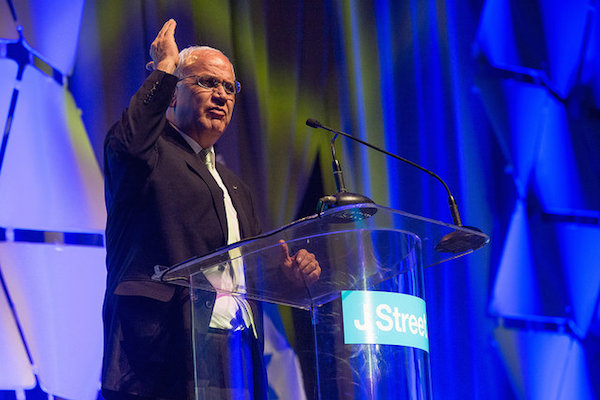
Erekat
PLO negotiator Saeb Erekat at J Street Conference
March 2015 (photo: J Street)

A Related View from Tisha b’Av

The Talmud relates a story about the reason the Second Temple in Jerusalem was destroyed:

In Gittin 56ab the Talmud tells the story of zealots who wanted to fight the Romans as they got ready to attack Jerusalem. These zealots burned decades worth of food that had been stored in Jerusalem in order to force the residents of the city to confront the Romans.

These zealots undoubtedly considered themselves pro-Jewish. They thought that by destroying all safeguards and alternative options, they could force the rest of the Jewish people to adopt their position in the battle against Rome.

J Street, like the zealots 2000 years ago, view themselves as pro-Israel. While some parts of the Arab and Muslim world (f/k/a Romans) may seek to attack and destroy Israel, J Street views their approach to the conflict as the only logical course of action.  As such, they have engaged in co-opting the US government to take positions against those sought by the government of Israel.  Like the zealots who burned all of Jerusalem’s food supplies (now known as US support), they feel that Israel stripped of all of the territories won in 1967, without a Gaza blockade, and with a nuclear pact in place with Iran will secure Israel’s future. J Street is pursuing global and US pressure to make that happen, rather than seeking to convince the Israeli government.

JStreet-Map
Bookmark designed for J Street Conference
(Photo: Lisa Goldman)

 In the minds of many, the J Street positions have made them the a modern-looking version of Neturei Karta, the anti-Zionist Chasidic sect, similar to the clean-shaven Jewish outreach people who market a more modern version of Chabad outreach.


Debating the merits of different approaches for how Israel deals with hostile neighbors is within constructive debate.  Consistently arguing in favor of Israel’s enemies that seek to destroy the country and kill its people is akin to inciting violence.

Review the statements and positions of J Street here and consider whether such voices deserve to be heard in your community.


Related First One Through articles:

New York Times Confusion on Free Speech

Selective Speech

A Disservice to Jewish Community

Subscribe YouTube channel: FirstOneThrough

Join Facebook group: FirstOne Through  Israel Analysis

Every Picture Tells a Story: The Invisible Murdered Israelis

In an Instagram and Twitter world, people expect their news in small tidbits. The major media sources have understood this and not only have taken to social media, but have their news stories include more pictures than they had previously. A review of their selection of pictures and captions provides an interesting snapshot of their views of the news.


Over a two week period in June/July 2015, seven major unprovoked attacks on Israeli Jews were committed by Palestinian Arabs. The Washington Post captured the anguish of the attacks with a picture of a grieving family which included a caption “Relatives of Malachi Moshe Rosenfeld, an Israeli settler who died in a car shooting attack on Tuesday near a Jewish settlement in the Israeli-occupied West Bank, cry during his funeral.”

The New York Times had no such pictures or description of Israelis suffering. Even while reporting on the region from many different journalists on June 24, 25, 26, 27, 28, 29, 30 and July 1 and 4

On June 27, the NYTimes made a small post without a picture in the World Briefing section in a blurb called “Man is Shot in West Bank After Opening Fire on Soldiers”. (journalist: Diaa Hadid)

On July 1, the NYTimes posted in the World Briefing section a blurb called “Man Died After West Bank Attack”. (Isabel Kershner)

These two attacks on Israeli Jews were completely invisible to a casual reader.

Another World Briefing report on June 24 without picture had a headline “Gazans Denied Access to Mosque.” (Diaa Hadid)

On June 30 Diaa Hadid had another World Briefing “Ship Halted in Blockade Protest

DSC_0101DSC_0105

On June 30, the NYTimes ran a larger article, also without a picture entitled “Worried that a Fasting Palestinian Prisoner Could Die, Israel Releases Him.” While there was no picture, the bold headline might have caught someone’s attention. The details in the article that the Palestinian prisoner was the spokesman for the terrorist group Islamic Jihad certainly would not have been recorded. (by Diaa Hadid)

Here are stories that the Times emphasized with pictures with their own terse storyline captions.

On June 29 the paper had an article which included a small map. The heading was “Israel plans Fence for part of Jordan Border.” (Diaa Hadid and Rick Gladstone)

On June 26, the Times included a small color photograph under an article called “Palestinians Deliver Accusations of Israeli War Crimes to International Criminal Court.” The picture of a group of people had a caption “Riad al-Malki, the Palestinian foreign minister, center, and delegation members on Thursday after submitting what they called evidence of Israeli war crimes to the court in The Hague.” (by Marlise Simmons)

On June 25, the Times posted two large black and white photographs as part of an article “Years after Massacre, a West Bank ‘Ghost Town’ Stirs.” The large picture was of Israeli soldiers walking past a store, while the smaller picture was of a man opening his store before four children. The single caption read “Israeli soldiers patrolling al-Sahla Street passed a reopened granary. Below, children watched as Mohammed Abu Halaweh briefly unlocked his butcher shop.” (by Jodi Roduren)

DSC_0099

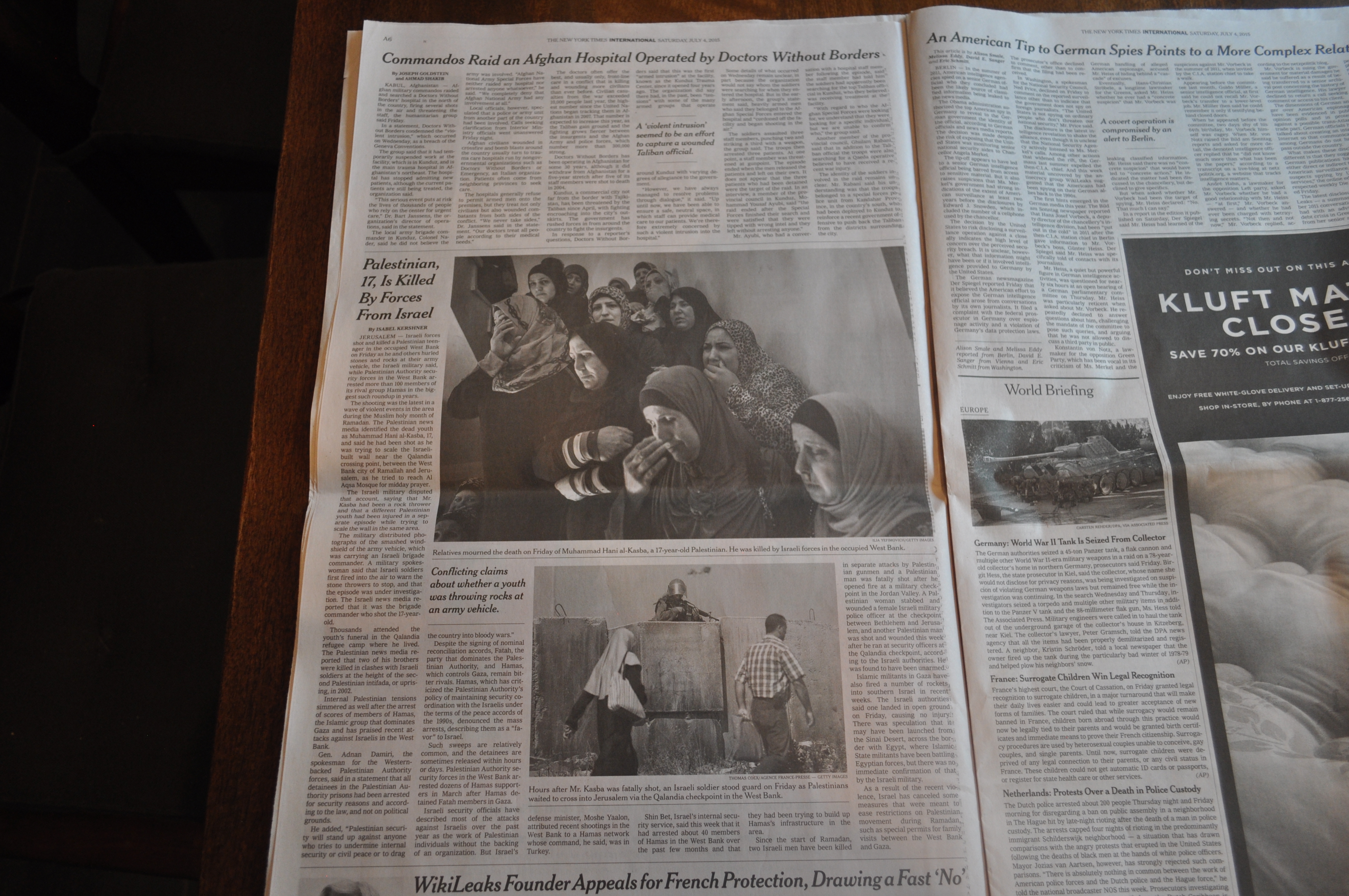
On July 4, The Times again posted two large black and white pictures alongside an article called “Palestinian, 17, is Killed by Forces from Israel.” The large photograph was of Palestinian women mourning with a caption “Relatives mourned the death on Friday of Muhammad Hani al-Kasba, a 17-year-old Palestinian. He was killed by Israeli forces in the occupied West Bank.” The smaller picture was of an Israeli soldier behind a barricade with two people walking before him. The caption read “Hours after Mr. Kasba was fatally shot, an Israeli soldier stood guard on Friday as Palestinians waited to cross to Jerusalem via the Qalandia checkpoint in the West Bank.” (Isabel Kershner)

DSC_0110

There was one news story which had two color pictures, albeit smaller than the two stories above. On June 28, the paper ran an article “Youth Chorus Unites Israelis and Palestinians, at Least for a Few Hours.” The two pictures were of a group of young men and women clapping and laughing. The caption read “Members of the Jerusalem Youth Chorus, above, took a break from rehearsing this month for their first United States tour. Micah Hendler, right, a Maryland native, founded the group.” (by Isabel Kershner)

DSC_0102

Contrast in Israeli Jews and Palestinian Arabs

The balance in the stories overall and in individual news reports was completely lacking in the New York Times.

First, consider the pictures and the stories they told: the Palestinians were dignitaries and everyday people going about life or mourning a death. They had names and professions. However, every Israeli that was pictured was a soldier and nameless. Even more, they were accused of war crimes.

Second, think of the seven attacks on Israelis Jews. They were treated as non-events and received no pictures or mention in the captions. The casual reader would not even know that such attacks occurred.

Third, review a specific story: The July 4 headline, pictures and caption would lead a reader to think that Israeli soldiers simply opened fire on a youth and that soldiers continue to patrol the intimidate the Arab population. The complete news report was that the Arab that was killed initiated an attack by hurling stones at Israeli vehicles, smashed the windows. It was in response to the Arab attack that soldiers got out of their vehicles and shot him. There were many pictures of the smashed car available that the Times could have posted as the second picture to show the complete story of the incident. Instead, it opted to convey a one-sided narrative of Palestinian Arabs as passive victims and Israelis as military oppressors.


The pictures and captions in the New York Times tell a specific narrative time after time after time: the Palestinian Arabs are passive victims under the oppression of the Israeli military. It is only these poor Arabs that suffer – unprovoked. Ordinary Israelis are not stoned, stabbed and murdered and are not subject to attacks by Palestinian Arabs. More, if there is any chance for peace in the region, it will come from Americans who will bring peace to the region.


Related First.One.Through articles

Every Picture Tells a Story, Don’t It?

Every Picture Tells a Story, the Bibi Monster

Every Picture Tells a Story- Whitewashing the World (except Israel)

The New York Times’ Buried Pictures

Flip-Flopping on the Felling of Terrorist Groups’ Founders

The New York Times reported on July 3, 2015 that “Tunisia’s most wanted jihadist” was killed in an American airstrike. The New York Times coverage stood in sharp contrast to the coverage that the paper used in covering Israel’s killing of a top jihadist in 2004.

DSC_0015
New York Times July 3, 2015 page A6

Headline: The headline from the story in 2015 was “Jihadist From Tunisia Died in Strike in Libya, U.S. Official Says” which clearly labeled the target as a “jihadist”. The way he died was framed in the passive “died” and was attributed to a “U.S. Official” speaking about the incident. This was in sharp contrast to the NYT article “Leader of Hamas killed in Airstrike by Israeli Missile” which did not suggest that the target was a militant but a “leader.” The man was “killed” in an active way, rather than simply stating that he “died”, and the method of the assassination was clearly attributed to Israeli action, rather than news reported by “US Officials.”

Opening paragraphs: A comparison of the opening paragraphs of each article shows the pattern of the Times coaxing its readers to celebrate the assassination of bad jihadists, but questioning the tactics of Israelis.

TUNIS — Tunisia’s most wanted jihadist, who masterminded a campaign of assassinations and terrorist attacks, including one against the United States Embassy in Tunis, was killed in an American airstrike in Libya in mid-June that had targeted another Al Qaeda leader, a senior United States official said on Thursday.

The jihadist, Seifallah Ben Hassine, also known as Abu Ayadh, was one of Osama bin Laden’s top lieutenants and the leader of the outlawed group Ansar al-Shariah in Tunisia. He had been based in Libya since 2013, according to reports, and ran training camps and a network of militant cells across the region.”

The article clearly spelled out that Ben Hassine was a very bad man from the very start of the article. He was the “most wanted jihadists” who led “assassination and terrorist attacks” including against American interests. If the US took out a man who launched many attacks including against Americans, it would make sense that such person got what he deserved. Heck, the article threw in two references to “Al Qaeda” and “Osama bin Laden” to convince the reader that this was a really, really bad guy.

Let’s compare the article about the targeted killing of the founder of Hamas by Israel in 2004:

JERUSALEM, Monday, March 22 Sheik Ahmed Yassin, the spiritual leader and founder of the militant Palestinian group Hamas, was killed early Monday by an Israeli missile that struck him as he left a mosque in Gaza City, his family and Hamas officials said. They said at least two bodyguards had been killed with him.

Sheik Yassin, a symbol to Palestinians of resistance to Israel and to Israelis of Palestinian terrorism, was by far the most significant Palestinian militant killed by Israel in more than three years of conflict.

The article led with the Sheik’s name. He was referred to as the “spiritual leader” who was killed while he “left a mosque.” His demise was reported by “his family.” Overall, he was regarded as much more of a religious human being than the “most wanted terrorist” in the article the attacker against the U.S.

The Times continued that the Sheik was “a symbol to Palestinians of resistance.” This phrase did many things: 1) using the term “symbol” made him appear as an uninvolved player; 2) “resistance” gave credence to a Palestinian narrative. No such equivalence was given to Tunisia’s most wanted terrorist.

While the Times stated that Yassin was the “founder of the militant Palestinian group Hamas”, it did not go on to state that the organization was considered a terrorist group by the US, EU, Israel and many other countries. Yet it did state that the Tunisian terrorist was “the leader of the outlawed group Ansar al-Shariah.”

Don’t worry. The contrasts get worse.

The NY Times then went on to praise the murder of the Tunisian terrorist:

“His death, if confirmed, would be an important victory for Tunisia in its struggle to contain a persistent insurgency in its western border region and a growing threat to its urban centers. Just last Friday, 38 people, most of them British, were massacred at a beach resort in the town of Sousse. In March, 21 people were killed when militants attacked the national museum.

The government has attributed many of the attacks to sleeper cells established by Mr. Ben Hassine when he founded Ansar al-Shariah after Tunisia’s revolution in 2011.”

The Times gave its readers the conclusion of the operation: it was “an important victory”. The people of Tunisia were struggling against a “persistent… and growing threat.” What about Israel?

“Black smoke curled over Gaza City as Palestinians began burning tires in the streets and demonstrators chanted for revenge. Mosque loudspeakers blared a message across Gaza of mourning for Sheik Yassin in the name of Hamas and another militant group, Al Aksa Martyrs Brigades.”

The Times reported that the assassination was not a step forward but a step backward. The killing of the founder of a terrorist movement in Tunisia was a step towards stability while the killing of founder of the Palestinian terrorist group was just a move to escalate a cycle of violence.

The Times emphasized the point by reporting on the recent attacks in Tunisia on tourists at a beach resort and a national museum (anyone in the world could have been one of those tourists, which elicits global sympathy). The Times failed to report on the multi-year Second Intifada which started in September 2000 in which Palestinians killed thousands of Israeli civilians. Just before the Israeli strike, Hamas took credit for two bombings at the Port of Ashdod which killed 10 people. No mention of the incident until much later in the article.


I leave the rest of the two articles for you to read. You will note that one article describes a military attack against a man with a long history of terrorist activities. The other article describes a Palestinian community in grief over the death of a “quadriplegic” without any mention of the hundreds of attacks and thousands of civilians murdered by Hamas.

It is not a coincidence that the article about Tunisia on July 3rd was next to another with a headline “Egypt fights back in Northern Sinai after Deadly Assault by Militants.”  The Times has taken to reporting that much of the world responds to militants while Israel attacks civilians and “spiritual leaders”.  The world’s responses will lead to victory and peace, while Israeli actions escalate violence.

Pretty amazing conclusions

  • from a country that has been waging wars for fourteen years, killing hundreds of thousands of people,
  • about a country that sits in the middle of region that is embroiled in civil wars and terrorist attacks that have also killed hundreds of thousands of people,
  • that is fighting against a group that has declared loudly and proudly its intentions of destroying its state

Related FirstOneThrough articles:

Double Standards: Assassinations

CNN’s Embrace of Hamas

The New York Times wants the military to defeat terrorists (but not Hamas)

Strange difference of opinion on Boko Haram and Hamas in New York Times

Differentiating Hamas

Why the Media Ignores Jihadists in Israel

Absolute and Relative Ideological Terrorism in the United States

Summary: The New York Times has sought to educate people to fear Republican terrorists more than Muslim extremists.

“Right-Wing” versus “Muslim Extremism”

In June 2015 the New York Times ran some articles and editorials claiming that domestic terrorism was more of a problem than radical Islamic terrorism.

  • A June 16 op-ed “The Growing Right-Wing Terror Threat” quoted a police officer that “said that “militias, neo-Nazis and sovereign citizens” are the biggest threat we face in regard to extremism’”. The paper quoted statistics from The Global Terrorism Database which counted 65 attacks at the hands of “right-wing ideologies and 24 by Muslim extremists since 9/11”. It added another source, “the International Security Program at the New America Foundation identifies 39 fatalities from “non-jihadist” homegrown extremists and 26 fatalities from “jihadist” extremists.
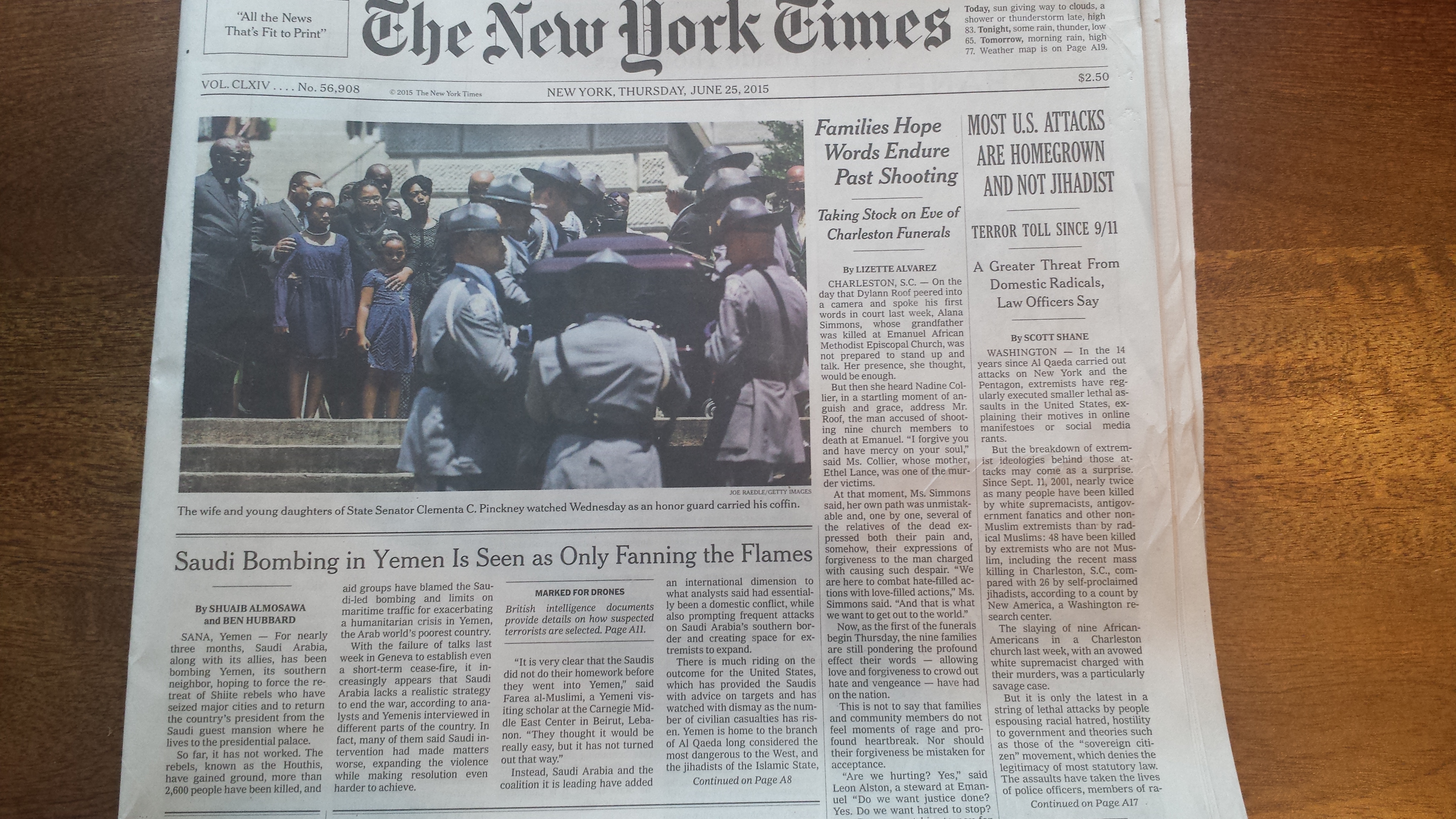
  • On June 24, the NYTimes had an article entitled “Homegrown Extremists Tied to Deadlier Toll Than Jihadists in U.S. Since 9/11”. The paper stated that “Since Sept. 11, 2001, nearly twice as many people have been killed by white supremacists, antigovernment fanatics and other non-Muslim extremists than by radical Muslims: 48 have been killed by extremists who are not Muslim, including the recent mass killing in Charleston, S.C., compared with 26 by self-proclaimed jihadists, according to a count by New America, a Washington research center.” That data looks to be the same as the International Security Program, but included the nine black church-goers who had just been gunned down. Another statistic in the article stated that “Non-Muslim extremists have carried out 19 such [ideological] attacks since Sept. 11, according to the latest count, compiled by David Sterman, a New America program associate, and overseen by Peter Bergen, a terrorism expert. By comparison, seven lethal attacks by Islamic militants.”

The Washington Examiner questioned the definition of “right-wing terrorists” to include a very broad group of people. How did neo-Nazis and racists get lumped in with the “right-wing”?  Before exploring the Times deliberate grouping of all non-Muslim extremism under a single banner, consider a brief education about relative numbers versus absolute numbers.

20150626_073343
Main cover story in the New York Times

 Absolute versus Relative

A cursory review of numbers could lead to a quick conclusion: 48 people killed is a greater total than 26 people killed. A total of 19 attacks is more than seven attacks. As such, the quotes in the article such as “Law enforcement agencies around the country have told us the threat from Muslim extremists is not as great as the threat from right-wing extremists” would appear accurate on its face as there were more than two times the number of attacks and almost twice the number of fatalities from non-Muslim attacks.

However, a review of the statistics on a relative basis would yield a very different result.

According to the Pew Research Center, Muslims accounted for 0.9% of Americans in 2014. That means that there are 99 times more non-Muslims than Muslims in the US. If one were to assume that the percentage of Muslims who are radical that would commit an act of terror is the same as the broad group of right-wing and anti-government terrorists within the non-Muslim population, one would expect the right-wing terrorists to have 99 times the number of attacks and fatalities, not two times.  This implies that an average Muslim is 49 times more likely to commit an act of ideological terror than a non-Muslim in the United States.

(By the way, the statistics deliberately exclude the jihadist terrorism of 9/11 which killed nearly 3000 people.)

 The New York Times Warning of Terrorism by Conservatives

After the Times led its readers to focus on “homegrown extremism” as the actual threat of terrorism (compared to jihadists), it lumped all of those non-Muslim fanatics into the Republican party:

 On several occasions since President Obama took office, efforts by government agencies to conduct research on right-wing extremism have run into resistance from Republicans, who suspected an attempt to smear conservatives. A 2009 report by the Department of Homeland Security, which warned that an ailing economy and the election of the first black president might prompt a violent reaction from white supremacists, was withdrawn in the face of conservative criticism.”

Even if one were to use the liberal paper’s biased assumptions that all anti-government and racist fanatics must exclusively come from the Conservative and Republican parties (which account for roughly 45% of the population according to a June 2015 Gallup poll), it would still suggest that an average Muslim is over 20 times more likely to commit an ideological attack as a “homegrown [Conservative] extremist.”

That would suggest one of the following conclusions:

  1. Non-Muslim terrorists have nothing to do with the Conservative/ Republican parties; OR
  2. An average Muslim is much more likely to commit acts of terror than an average non-Muslim

Either way -or both – these are the exact opposite conclusions that the New York Times sought to convey in its articles.


Related FirstOneThrough article:

Ramifications of Ignoring American Antisemitism


Je Suis Redux

The famous French mathematician and philosopher Rene Descartes (1596-1650) once famously said: “Je pense, donc je suis,” or in English “I think, therefore I am.” That statement as well as his other works earned him the title of the father of western philosophy.

The concept Descartes put forth of the centrality of “thinking” and “being” is profound on several levels and had a significant impact on western society.  The expression has an interesting sequel today.

thinker
French Sculptor Auguste Rodin’s The Thinker

Descartes did not call out overt action verbs like eating, running or talking to prove his existence. He argued that something as fundamental as brain activity proved that he was alive. Such an approach has led to interesting debates about brain death and the status of life today.

On a philosophical level, Descartes was plagued with doubt about everything: not just about ethereal matters such as the existence of a supreme being, but whether the world as he saw it existed at all. He considered whether it was all just his imagination, just a dream. He concluded that the actual process of considering whether anything at all existed, proved that he indeed did exist.

Je Suis 2015

The world was given a brief tutorial of French in 2015. In response to the horrible killings at the offices of Parisian magazine Charlie Hebdo and a kosher supermarket, people around the world held signs and banners that read “Je Suis Charlie,” “Je Suis Juif (Jew),” “Je Suis Policier (Police)”. A few weeks later, when another terrorist shot people in Copenhagen, the signs “Je Suis Danois (Danish)” showed support for the people of Denmark.

jesuisjuif
“Je Suis” rally in Paris,
January 2015

The expression “Je Suis…”, “I am…” in those contexts expressed people’s solidarity with the cause for which people died (freedom of press, speech or religion), essentially reaffirming that those liberties live on. While individuals may have been killed, there are others that cherish those same beliefs who remain alive. While the victims are dead, the freedoms are not vanquished.

Je Suis…” attested to the strength of people’s convictions.  While the terrorists were killed by police in both Paris and Copenhagen, people did not deceive themselves that there were many other would-be-terrorists who might commit similar acts. Yet they stood defiantly with placards held high and passions held firm.


Consider that hundreds of years ago the father of western philosophy made a statement that was born from his complete doubt in anything and everything. He imagined that nothing was real, even his own existence. Doubt Affirmed Life.

In 2015, people rallied because of the murder of people who shared a similar western philosophy. In mourning the deaths, people realized the depth of their own convictions. Death Affirmed Belief.

The sequel of Je Suis in France may be a perfect mirror image of the original. But the central theme remains the freedom and ability to question and believe.


Other First.one.Through article:

Dancing with the Asteroids: https://firstonethrough.wordpress.com/2014/11/14/dancing-with-the-asteroids/


I’m Offended, You’re Dead

The US President and the media have portrayed “radical extremists” as angry about cartoons of the Muslim prophet by western media. Such a view focuses very narrowly on the recent attacks in Paris and Copenhagen. This is because democracies consider freedom of speech a fundamental right in their societies and object strongly to such rights coming under fire. Should the media and democracies look more broadly, they would note the broader attacks on basic human rights that Islam imposes where it is in control.

The “hateful ideology” (as US President Obama calls it) is not simply an “ideology” by a few “extremists”. The basic laws of several Islamic countries trample on many fundamental human rights. Islamic laws do not only challenge what you can say, but often attack the essence of who you are, and enforce double standards regarding what you can do. To aggravate the Islamic illiberal attitudes further, the laws impose severe punishments to the offenses, often the death sentence.

 muslim protest
Muslim Protest in England

What you said

Blasphemy is clearly part of the objection of the Muslim killers. Whether Charlie Hebdo (2015), Copenhagen (2005; 2015) or Theo Van Gogh in the Netherlands (2004), the drawings of the Islamic prophet Mohammed were considered offenses deserving of murder. Those attacks made news and drew world attention because they happened in Western Europe. In the Islamic world, blasphemy is considered a crime in over a dozen countries. Pakistan recently sentenced a blasphemer to death, but the laws and actions do not often attract the world’s attention.

Asa Bibi
Asa Bibi sentenced to death in Pakistan for blasphemy,
November 2014

Who you are

Islamic countries impose the death sentence on people for simply being who they are.  Innocent civilians are viewed as criminals even though they harm no one.

  • Apostasy is the act of changing religion. In several Islamic countries, the act of converting from Islam to another religion is punishable by death. Those countries include: Afghanistan; Brunei; Mauritania; Qatar; Saudi Arabia; Sudan; United Arab Emirates; and Yemen. Many other countries also consider it a crime, punishable by a year or more in prison.
  • Being Gay is considered a crime in 76 countries in 2015. There are several Islamic countries that sentence gays to death including: Iran; Iraq; Mauritania; Nigeria; Qatar; Saudi Arabia and Yemen.
  • Islamic terrorists targeted Jews in recent attacks in Jerusalem; Paris and Copenhagen. Many Muslims feel that non-believers are doomed and should be killed according to Islamic teachings. While many Islamic countries do not sentence non-Muslims to death, they subject the non-Muslims to secondary “dhimmi” status and make them pay special taxes. There are “radical” Islamic groups like Boko Haram and ISIS that are actively killing non-Muslims throughout NigeriaIraq, and Libya.

gay hang iran
An estimated 4,000 gays have been killed in Iran since 1979

What you do

Some Islamic countries have laws that prevent persecuted segments of society from doing what other members of society (Muslims, men) can do freely.  The double standards and misogyny are simply part of the culture that the world ignores.

  • In Saudi Arabia, there are laws that prevent women from driving cars; only men can drive.
  • In Pakistan, girls are prevented from going to school to get an education; only boys can go to school.
  • In many Southeast Asian countries like Pakistan, Bangladesh and India, a girl who reject a boy’s marriage proposal may be disfigured either by having her nose and ears cut off, or acid poured on her face. Boys do not deal with such issues.
  • In Israel, the Jordanian Muslim Waqf prevents Jews from praying on the Jewish Temple Mount; only Muslims are allowed to pray on the entire 35 acre site.
  • In Gaza and Islamic countries like Pakistan and Afghanistan, people kill female family members in “honor killings” if they dress inappropriately or date unapproved men. Men do not face honor killings.

KSA women drive
Woman arrested for driving in Saudi Arabia,
December 2014

How they Respond

The punishment for many of these basic activities that people in the western world take for granted, is death.  The death sentence is often brutal and public.

“Minor” infractions also can yield a death sentence:

  • Adulterers are stoned to death in Iran; Qatar; Saudi Arabia; Somalia; Sudan; UAE; Yemen
  • Drug traffickers are killed in: Egypt; Indonesia; Iran; Iraq; Kuwait; Oman; Saudi Arabia; South Sudan; Syria and UAE
  • Prostitutes are killed in Sudan

The Danger

The view that a few “extremists” have hijacked Islam and are attacking the freedom of press is both myopic in terms of history and geography, and hazy in terms of numbers and scope. In reviewing the laws and actions of several Islamic countries, one can better understand the gross intolerance and extremism in their societies. Many Muslims are offended by a great many things, and will kill the offender.

If the West limits its review to freedom of speech in the world of social media, the conversation becomes limited as well.  Hate speech versus freedom of speech, and attitudes towards censorship of social media (such as in Turkey) are worthwhile discussions, but far too narrow.  The value of jobs and economic development for a handful of radicals is brought up by the Obama administration because he misses the larger point. Obama argues for “reasonableness and restraint” from countries because he views the attacks on them as limited to a handful of radicals.

That flawed worldview led Obama to abandon Iraq without helping secure the vacuum.  It will lead an Obama administration to enable Iran to get a nuclear weapon.

Perhaps it is time for Obama to visit Cairo again as he did on his first international trip in 2009.  This time he will meet a new leader in al-Sisi who has called for a “revamping” in Islam. Maybe al-Sisi should be on Obama’s Iran negotiating team.


Related First.One.Through articles:

Murderous governments

Blasphemy

My Terrorism

US Hypocrisy – “Reasonableness and Restraint”

Subscribe YouTube channel: FirstOneThrough

Join Facebook group: FirstOne Through  Israel Analysis

Jews in the Midst

Summary: Jews are vulnerable members of society. They are not on the fringe on the one hand, nor are they just a regular part of the broader community, on the other. As such, they must be actively protected by governments and citizens alike.

copenhagen jews
Jews in Copenhagen laying flowers where a Jewish man was gunned down,
February 2015 

No Canary in the Mine

Well-meaning people have referred to Jews as the “canary in the mine” when it comes to terrorism. They argue that various attacks on Jews in Europe, Israel and Asia by Islamic radicals over the past years should be seen in the context of an oncoming onslaught on the broader civilized world.

Canaries are treated as disposal life forms that coal miners bring into mines to detect poisonous gases. They assume that if the canary is alive, the air is breathable; however, should the canary die, they should evacuate immediately. The sole role of the canary is to detect danger and benefit the people in the mine.

Jews were not brought to Europe or Asia to serve as warning signs for non-Jews. They are not inferior life forms meant to live solely for the benefit of the broader society. They are proud citizens of their home countries.

 hyperkosher
Paris kosher supermarket where four Jews were killed,
January 2015

Not a Fringe Group

Jews are integrated into society in each country where the live. They have homes in the hearts of the country; they have jobs at corporations, in the government and military. They speak the language and have employment rates that are comparable to their fellow countrymen.

Jews are not a fringe group that fails to assimilate, that doesn’t speak the language or has high unemployment. They are not financial drains on society and do not have incarceration rates above the community averages.

Jews are a fabric of society. They are “everymen,” with particular beliefs and customs.

mumbai chabad
Chabad House in Mumbai where six people were murdered,
November 2008 

No “Random” Attack

While Jews are a basic part of the fabric of society, they are uniquely targeted by Islamic radicals. Terrorist attackers who assaulted major cities including Mumbai (2008), Paris (2015) and Copenhagen (2015), took time to specifically attack this small minority.

While US President Obama and his administration initially called the attack on a kosher supermarket in Paris a “random” attack, he back-tracked to corroborate the statement of the French government which clearly stated that the attack stemmed from antisemitism.

Even while embedded in society, Jews are picked out for attack for the simple reason that they are Jewish.

 bruseels museum
Attack on Jewish Museum in Brussels killed four,
May 2014

Jews in the Midst

There was a movie made in 1988 about a woman, Dian Fossey, who fought to protect gorillas in Uganda. These special creatures were a unique part of the Ugandan landscape that were singled out for slaughter. Dian fought both the government and locals to protect those “Gorillas in the Mist”.  It was a brave action on the part of an individual to take on so many to save the group from butchery.

It is the obligation of governments to protect their citizens.  The leaders in Germany and France have correctly stated that they will take action to ensure that their Jewish communities are safe.

It is time for all governments and citizens to speak loudly and act defiantly in protecting their vulnerable neighbors and countrymen, the Jews in their midst.

 scariest-riots-anti-semitism-men
Riots against Israel and Jews in France,
July 2014

Israel in Europe

The governments of Europe must do more than just assign police officers to synagogues and Jewish centers. They must also declare that Jews everywhere – including in Israel – cannot be targets of jihad.  As part of that effort, they should confront the biases in their governments that are uniquely against the Jewish State, such as:

  • delisting Hamas as a terrorist organization despite its calls to kill Jews and eradicate Israel
  • European Union blaming Israel for the failure of the peace talks without acknowledging the various actions the Palestinians took to sabotage the talks

The list of European actions against the Jewish State over the past year was long, and to an absurd level when compared to EU actions and comments towards murderous regimes such as Iran and Syria. The people in the streets noted, and held anti-Israel rallies which became anti-Semitic riots.

It was against that backdrop of both murders by homegrown terrorists and the anti-Israel actions of the governments that made Israeli Prime Minister Benjamin Netanyahu invite the Jews of Europe to come to Israel.

The governments of Europe must declare their strong commitment to a safe and secure Israel.  Such actions should include declaring Hamas a terrorist organization and not recognizing a Palestinian state until it prohibits the promotion of antisemitism and Holocaust denial.  The governments should not pass any BDS (boycott, divestment, sanction) actions against Israel any more than they do for other disputed territories such as Kashmir and Cyprus.

The leaders of several European countries acknowledge that there is a problem of anti-Semitism spreading in the continent.  They must be aggressive in confronting it in every manner possible.

Jews in the Midst

Summary: Jews are vulnerable members of society. They are not on the fringe on the one hand, nor are they just a regular part of the broader community, on the other. As such, they must be actively protected by governments and citizens alike.


No Canary in the Mine

Well-meaning people have referred to Jews as the “canary in the mine” when it comes to terrorism. They argue that various attacks on Jews in Europe, Israel and Asia by Islamic radicals over the past years should be seen in the context of an oncoming onslaught on the broader civilized world.

Canaries are treated as disposal life forms that coal miners bring into mines to detect poisonous gases. They assume that if the canary is alive, the air is breathable; however, should the canary die, they should evacuate immediately. The sole role of the canary is to detect danger and benefit the people in the mine.

Jews were not brought to Europe or Asia to serve as warning signs for non-Jews. They are not inferior life forms meant to live solely for the benefit of the broader society. They are proud citizens of their home countries.


Not a Fringe Group

Jews are integrated into society in each country where the live. They have homes in the hearts of the country; they have jobs at corporations, in the government and military. They speak the language and have employment rates that are comparable to their fellow countrymen.

Jews are not a fringe group that fails to assimilate, that doesn’t speak the language or has high unemployment. They are not financial drains on society and do not have incarceration rates above the community averages.

Jews are a fabric of society. They are “everymen,” with particular beliefs and customs.


No “Random” Attack

While Jews are a basic part of the fabric of society, they are uniquely targeted by Islamic radicals. Terrorist attackers who assaulted major cities including Mumbai (2008), Paris (2015) and Copenhagen (2015), took time to specifically attack this small minority.

While US President Obama and his administration initially called the attack on a kosher supermarket in Paris a “random” attack, he back-tracked to corroborate the statement of the French government which clearly stated that the attack stemmed from antisemitism.

Even while embedded in society, Jews are picked out for attack for the simple reason that they are Jewish.


Jews in the Midst

There was a movie made in 1988 about a woman, Dian Fossey, who fought to protect gorillas in Uganda. These special creatures were a unique part of the Ugandan landscape that were singled out for slaughter. Dian fought both the government and locals to protect those “Gorillas in the Mist”.  It was a brave action on the part of an individual to take on so many to save the group from butchery.

It is the obligation of governments to protect their citizens.  The leaders in Germany and France have correctly stated that they will take action to ensure that their Jewish communities are safe.

It is time for all governments and citizens to speak loudly and act defiantly in protecting their vulnerable neighbors and countrymen, the Jews in their midst.


Israel in Europe

The governments of Europe must do more than just assign police officers to synagogues and Jewish centers. They must also declare that Jews everywhere – including in Israel – cannot be targets of jihad.  As part of that effort, they should confront the biases in their governments that are uniquely against the Jewish State, such as:

  • delisting Hamas as a terrorist organization despite its calls to kill Jews and eradicate Israel
  • European Union blaming Israel for the failure of the peace talks without acknowledging the various actions the Palestinians took to sabotage the talks

The list of European actions against the Jewish State over the past year was long, and to an absurd level when compared to EU actions and comments towards murderous regimes such as Iran and Syria. The people in the streets noted, and held anti-Israel rallies which became anti-Semitic riots.

It was against that backdrop of both murders by homegrown terrorists and the anti-Israel actions of the governments that made Israeli Prime Minister Benjamin Netanyahu invite the Jews of Europe to come to Israel.

The governments of Europe must declare their strong commitment to a safe and secure Israel.  Such actions should include declaring Hamas a terrorist organization and not recognizing a Palestinian state until it prohibits the promotion of antisemitism and Holocaust denial.  The governments should not pass any BDS (boycott, divestment, sanction) actions against Israel any more than they do for other disputed territories such as Kashmir and Cyprus.

The leaders of several European countries acknowledge that there is a problem of anti-Semitism spreading in the continent.  They must be aggressive in confronting it in every manner possible.