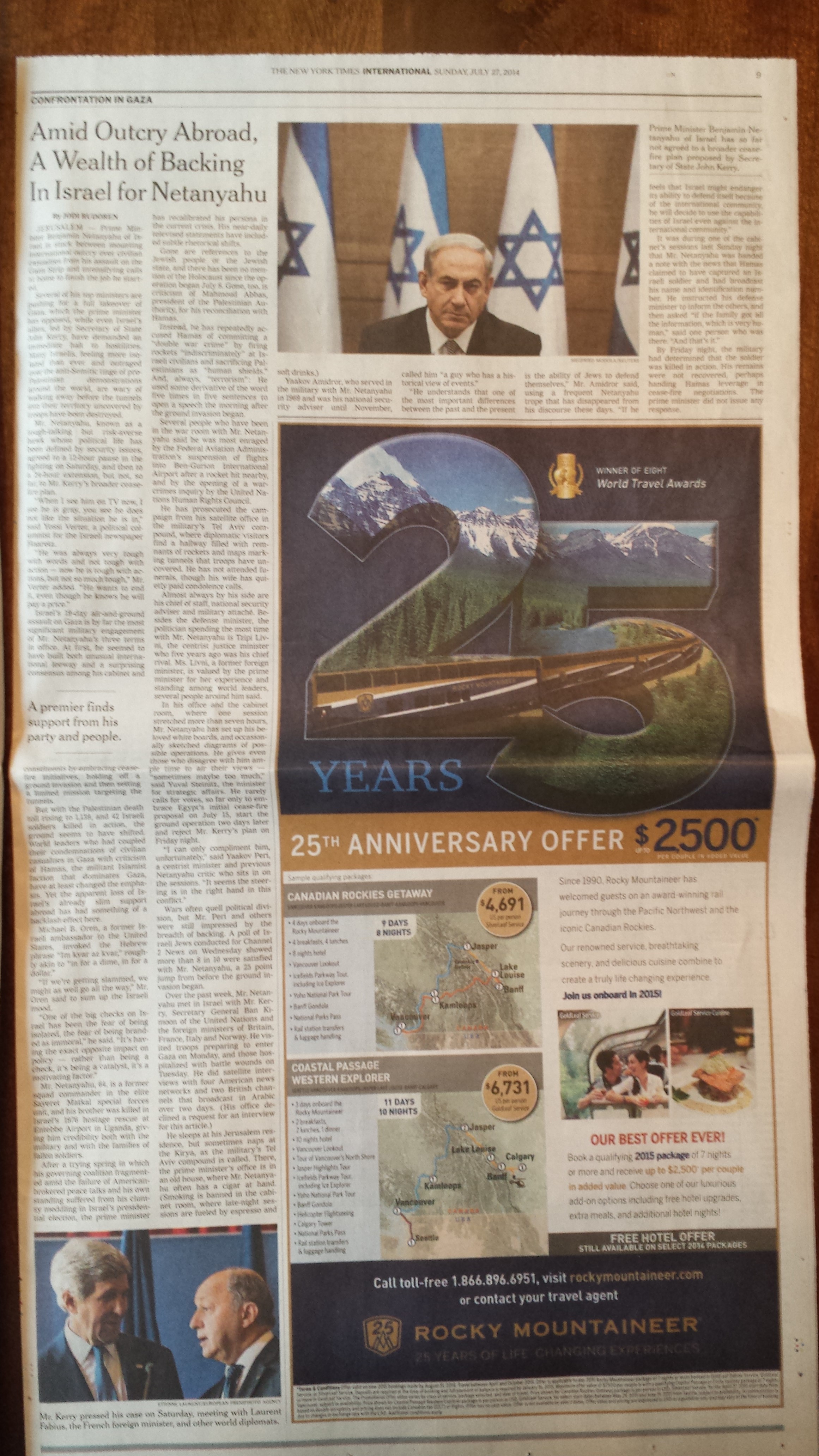
“An anti-Semitic Tinge”

Pulitzer Prize winner William Safire used to write for the New York Times “On Language.” His fascinating articles would describe the etymology of words; their usage and context. He spent years as a speechwriter for US President Nixon, followed by decades writing for the Times. He had a unique appreciation for words.

Safire would not appreciate the New York Times abuse of language today.

Some words are seldom used in daily speech. When heard or seen, we understand that there is a particular purpose and nuance for their application.  Even in comedy.

The old TV sitcom “Seinfeld” had a funny skit about George being set up on a blind date by his friend Jerry. George had a long list of questions to qualify his interest. When asking about her face he said: “Is there a pinkish hue?” The question puzzled his friend Jerry who was setting him up: “A pinkish hue?” he replied. “Yes, a rosy glow.” Jerry: “There’s a hue”. The exchange gets roars of laughter – not only because it is an absurd question to qualify a date, but the word itself is peculiar. I doubt there was ever a time in the history of television that the word “hue” was used so frequently.

We all (think we) know what the word “hue” means – heck, there was even a setting on our TV sets after “brightness” and “contrast” (but being candid, no one ever used it). The word “hue” was replaced by “color” or “tint” on many sets as those words convey a wider spectrum of color. Hue seemed too subtle.

If “hue” is subtle, the word “tinge” is meaningless. While “tinge” may be a slightly more common word, it means a great deal less.  Finding the TV’s hue setting and moving it a single notch, would be the equivalent of “tinge”. Only an expert could readily observe the slight change in color. A reasonable person could never be expected to notice a tinge without close and careful examination.

“An anti-Semitic tinge.”

It was curious (alarming?) to see the word “tinge” show up in an article about “The Confrontation in Gaza”, as the New York Times refers to current war in Gaza (avoiding using Israel’s terminology of “Operation Protective Edge” as that might make it appear that Israel was on the defensive).

On July 24, 2014, the New York Times ran an article called “As Much of the World Frowns on Israel, Americans Hold Out Support” about how angry the world is with Israel. Americans, according to the article, do not support Israel because they believe that Israel has a basic right to self defense in the face of missile attacks, but because “of the failures of the Arab Spring to spread democracy in the Middle East.” That NYT statement is beyond moronic and ignores the entire Pew report and decades of Pew Surveys which have always shown greater support for Israel than Palestinians.

The following paragraphs continued: “Pro-Palestinian demonstrations are continuing in Paris, Berlin, Vienna, Amsterdam and other European cities, some of them assuming an anti-Semitic tinge.” Quite a phrase “anti-Semitic tinge”.

So what happened in the protests the preceding weeks? On July 20 anti-Israel protestors firebombed a synagogue in the Parisian suburb of Sarcelles. Jewish shops were looted and 18 people were arrested. The French Prime Minister said: “What’s happened in Sarcelles is intolerable: attacking a synagogue or a kosher grocery, is quite simply anti-Semitism, racism.”

Just the week beforehand, a demonstration in Bastille Square in the center of Paris moved towards two synagogues which had hundreds of Jews trapped inside. The crowds chanted “death to the Jews” and “Hitler was right”. That demonstration was such a warning shock to the government that it banned further demonstrations, which took place anyway.

In Belgium, a store with a Palestinian flag and a crossed out Israeli flag in the window put up a sign in Turkish: “Dogs are allowed in this establishment but Jews are not under any circumstances.” The French text replaced “Jews” with “Zionists.”

In Berlin, Germany protestors were blocked by police in riot gear from bringing their demonstrations to the Holocaust Memorial. That week, an imam at one of Berlin’s mosques gave a sermon that Jews should be killed.

The Associated Press correspondent from Berlin wrote: “The foreign ministers of Germany, France and Italy on Tuesday condemned the rise in anti-Semitic protests and violence over the conflict in Gaza, saying they will do everything possible to combat it in their countries.”

“An anti-Semitic tinge.”

The New York Times deliberately chose to minimize the anti-Semitic motivation of the protestors as it would detract from what the Times considered an appropriate act of protesting against Israel (since the Times doesn’t believe the “confrontation” is truly about self defense). Even as riots broke out in the same cities that witnessed the Holocaust, and those governments called out against the rise in anti-Semitic protests and violence, the Times needed to bury that narrative.

For the Times, “an anti-Semitic tinge” means a few outliers; some bad seeds doing bad things. It ignores the lack of protests against: Russia in the Ukraine; Syria slaughtering its citizens; US in Iraq and Afghanistan; and other government actions in the world that have killed hundred of thousands of civilians over the past few years. Regrettably, the Times does not agree that when protestors only take to the streets when the Jewish State is in a “confrontation,” it brands the protest itself as anti-Semitic.  How does it ignore firebombings of synagogues?

Those actions are from the disgraceful anti-Semitism of the protestors. Regarding the media, it is bad enough that it is passively complicit in not identifying the anti-Semitic root cause of the protests. However, to actively trivialize riots, firebombings and death threats against Jews in the streets where millions of innocent Jews were killed, is not merely being complicit- it is an act of anti-Semitism itself.


Let me change the conclusion of the opening paragraph: William Safire would not be upset by the Times use of language.  He would be appalled by the New York Times abuse of Jews.


Sources:

http://www.jta.org/2014/07/20/news-opinion/world/anti-israel-rioters-torch-cars-throw-firebomb-at-paris-area-synagogue

http://www.algemeiner.com/2014/07/13/violent-anti-jewish-riots-rock-paris-activist-says-french-jews-are-in-serious-danger-video/

http://www.bbc.com/news/world-europe-28402882

http://abcnews.go.com/International/wireStory/berlin-bans-anti-semitic-slogan-gaza-protests-24658551

20140725_071755

The Subtle Discoloration of History: Shuafat

Reader’s often assume that the more reputable news organization do research and perform fact-checks before posting articles. However, they do not often consider the word choices or juxtapositions of those facts relayed in a story. The truths and half-truths can combine to distort reality. This becomes exacerbated when quotes from biased witnesses are included in the article.

Witness the July 6, 2014 New York Times article on page 8 describing the terrible abduction and murder of an Arab teenager as a case in point. The second paragraph of the story: “…Mohammed was at the recreation center named for his respected, expansive Palestinian family in the ancient section of the East Jerusalem neighborhood of Shuafat.” I will avoid commenting on the “respected” background of the Abu Khdeir family who “started farming [in Israel] 250 years ago” as I do not know them (and why should I doubt Jodi Rudoren?). Consider the proximity in one sentence of the words “Palestinian”, “ancient”, “East Jerusalem” and “Shuafat”. A reader could naturally conclude that Palestinian Arabs have long been living in the ancient Palestinian city of East Jerusalem. A quote from a member of the family in the article adds that “All Shuafat is in danger, all the settlers are around us. It’s like a monster – they want to eat us.” could lead a reader to conclude that Jews are recent “settlers” to the area and harass Arabs.

All of those conclusions would be false.

Shuafat is indeed thought to be an ancient site. Archeological excavations reveal Roman encampments and Jewish homes and mikvahs from 2000 years ago. However, neither Shuafat, nor the rest of Israel, have ancient Arab finds as Arabs did not come to the region en masse until the Muslim invasion in the 7th century.

Shuafat remained a small village until 1967 when Jordan (together with Palestinian Arabs who were granted Jordanian citizenship) attacked Israel in the Six Day War. Israel took control of the “West Bank” and extended the boundaries of Jerusalem to include Shuafat and other villages around the city. In 1980, Israel declared all of Jerusalem to be its united capital.

For parties that do not recognize Israel’s annexation of the eastern part of Jerusalem, it would logically extend that those same people would not recognize Israel’s extension of Jerusalem’s boundaries. Shuafat is either a neighborhood in Jerusalem, Israel (if one accepts Israel’s position) OR it is a village in the West Bank (if one doesn’t).

Regarding the comment of “[Jewish] settlers”- there are many more new Muslims that moved to Jerusalem than there are new Jewish residents. Since 1967, when Israel reunified the city, until 2012, the Jewish population grew by 2.6 times while the Arab population grew by 4.4 times. This huge difference comes despite the higher (4.3) birth rate for Jewish women in Jerusalem than for Arab women (3.6).

Lastly, Shuafat and “East Jerusalem” are integral parts of Jerusalem. Just below 40% of the eastern part of Jerusalem which was annexed in 1967 is Jewish. Arabs and Jews work and live together in the city (compared to some Israeli cities like Umm al-Fahm that are 99% Arab). Shuafat sits just south of the second largest neighborhood in Jerusalem, Pisgat Ze’ev (pop. 37,000). The new Jerusalem light rail line includes two stops in Shuafat, one of the only neighborhoods with two stops.

A fact-checked sentence should have read:

“…in the ancient Jewish section of the predominantly Arab East Jerusalem neighborhood of Shuafat in Jerusalem…”.

Just saying…

The NY Times begins its assault on Israel’s Search and Rescue

It has been several weeks since Boko Haram kidnapped over 200 teenagers from their school. Over these weeks, the New York Times has repeatedly faulted the Nigerian government for not being aggressive enough in finding the girls. But in less than one week since the kidnapping of three Jewish teenagers, the New York Times is already running articles that Israel is too aggressive in trying to bring their boys back home.

NYT on Nigeria:

5/24/14: “That the hopes of many across the globe rests on such a weak reed as the Nigerian military has left diplomats here in something of a quandary about the way forward. The Nigerian armed forces must be helped, they say, but are those forces so enfeebled… the military presence on some of the region’s most dangerous roads is light, with only a handful of checkpoints”

5/27/4: [Nigerian President Goodluck Jonathan] “responded to the kidnappings in the same way that he has responded to countless other Boko Haram atrocities (or indeed to the anti-civilian depredations of his own military): minimally, or not at all.”

NYT on Israel:

6/17/14 by Jodi Rudoren, the official NY Times reporter who covers news from a Palestinian perspective: “It was Day 3 of what Palestinians are universally calling a ‘siege’ on Hebron,” Jodi does not discuss the violent history of Hamas nor its past use of kidnapping. She quotes a “father of 10” (is this man with Hamas? A shopkeeper? Does his being a parent of 10 make him more or less reliable?): “’This is like they arrest 800,000 people in the Hebron area – look at the checkpoints.’”

Jodi continued that “many here and elsewhere in the Palestinian territories questioned whether the abductions even happened. Leaders referred to the ‘alleged kidnapping’ in their official statements… [Israel] staged the event…as a pretext to oust Hamas from the West Bank.”  Nice work getting a conspiracy theory into the public.

I wonder if the NY Times will get a reporter to cover the news from Boko Haram’s perspective. Perhaps they should send Jodi.

The New York Times wants the military to defeat terrorists (but not Hamas)

NYT 6/9/14: “Pakistan’s Latest Crisis” was a call to action for the military to defeat terrorists. What about Israel defeating Hamas? Not so much.

The Pakistan editorial led with a strong statement about the Taliban: “In its increasingly violent effort to destroy the Pakistani state”, the NYT made the Taliban’s ultimate goal clear. It continued with a call for the Pakistani government to wake up: “Will this be the crisis that finally persuades Pakistan’s government and its powerful military to acknowledge the Taliban’s pernicious threat and confront it in a comprehensive way? It should be.” The NYT editorial board clearly spelled out its desire for a military strike to defeat the terrorist entity that attacked civilians in Pakistan.

It is distressing to compare these statements with the 11/20/12 editorial about Gaza firing nearly 1000 rockets into Israel. The NYT did not describe Hamas as a terrorist entity (labeled so by the US, Canada, EU, Japan, Jordan, Egypt and Israel). It did not state that Hamas seeks the destruction of Israel – which it has made clear throughout its charter, and the statements and actions of its leadership for many years. Rather, the NYT stated that Hamas “resorted to violence” in a statement that is either evil or laughable in its ignoring the calls for death and destruction of Jews and the Jewish State.

The Times then went on to blame Israel: “Israel also has a responsibility for the current crisis,” Is the Times suggesting that if all the Jews would just leave the Middle East and dissolve Israel the way Hamas desires, they wouldn’t have to “resort to violence”?

The NYT was loath to suggest that Israel stamp out the terrorist entity bent on its destruction stating: “But military action is no long-term answer.”

The difference between the Taliban and Hamas is that Hamas is an elected government, having won 58% of the Palestinian vote in 2006. It governs a territory, Gaza, since 2007. But its desire to destroy all of Israel and kill civilians is not an iota less than the Taliban’s goals in Pakistan and the response from the government and military should similarly be supported. The links to the two editorials are below:


Pakistan-Taliban editorial:

http://www.nytimes.com/2014/06/10/opinion/pakistans-latest-crisis.html

“given recent events, one has to assume the militants will stop at nothing until the state is utterly destabilized and they have taken control. Pakistani political and military leaders need to be honest about the militant threat that they and their people are facing”


Israel-Hamas editorial

http://www.nytimes.com/2012/11/20/opinion/hamass-illegitimacy.html?_r=0

“If Prime Minister Benjamin Netanyahu of Israel had pursued serious negotiations on a two-state solution with the Palestinian president, Mahmoud Abbas, the Palestinians could have hope in a different future”

The NY Times outdoes itself Swapping News and Editorials

The New York Times has established a reputation for infusing its news stories with the editors’ biases.  However, it outdid itself when it posted an editorial about Obama’s drone strikes one day, and subsequently posted the virtually identical article as a news story on the following day.  Both had the same misstatements which: ignored the studies pointing to Obama’s killing of civilians with drones; blamed Bush for the program; and defended Obama.

The editorial:

The “news story” the next day:


Frightening New York Times 4/27/14 article on “Mahmoud Abbas Shifts on Holocaust”

  1. Abbas new statement that the Holocaust was bad does nothing to negate his various prior comments, phd paper and published book that claim: 1) that 6 million Jews were not murdered in the Holocaust; and 2) that Zionists conspired with Nazis so that more Jews would move to Palestine (so Zionists are at least partially to blame for the Holocaust).
  2. (By way of comparison, If Abbas would have reversed his prior statements and negated his research, that would have been a “shift”.  OR, if Abbas would have come out and said that the Palestinian Arabs of 1936-46 who fought successfully against the Zionists and British who then limited Jewish immigration to Palestine before and during WWII were responsible for 100,000+ Jews dying in the Holocaust, that would have been a shift).
  3. NYT claims that Abbas’s latest comment “goes further” in back-tracking from his Holocaust denial and attacks on Zionism because he claims that Palestinians understand suffering from Israeli “ethnic discrimination and racism”. Not only does the Abbas comment not negate his offensive comments, but it further insults Jews and Israelis by calling them racists, and suggests that the Holocaust is similar to the situation of stateless Arabs.
  4. Hamas is called a “militant Islamist faction” and not a terrorist organization
  5. No NYT mention of the fact that the Hamas Charter calls for the death of Jews
  6. No NYT mention that Hamas refuses to allow Holocaust education in the schools of Gaza against the wishes of the United Nations
  7. Thank you New York Times, for posting an article on Holocaust Remembrance Day about Abbas, the Holocaust denier, and his latest anti-Israel comments, and for phrasing the headline and article to try to make him look like a progressive.

http://www.nytimes.com/2014/04/27/world/middleeast/palestinian-leader-shifts-on-holocaust.html?_r=0

Biased New York Times report on recent Gaza blockade boat

NYT April 30, 2014 on explosion that sank potential blockade-busting boat from Gaza:
1. No mention that the Israeli blockade of Gaza has been deemed legal by international law

2. The boat is called “small” in keeping with the David v. Goliath imagery the NYT likes to impart in the conflict

3. No mention that the terrorist group Hamas runs Gaza. Instead we see terms of “Palestinian activists”, “Palestinian fishing boats” and “Palestinian goods” to make this terrorist haven sound like Bermuda

4. The “clashes that broke out” were not passive, they were Turks trying to kill soldiers who reacted in self-defense.

New York Times coverage of Anti-Semitism Report

NYT May 13, 2014: “26 Percent of World’s Adults Are Anti-Semitic, Survey Finds”

1. The NYT quotes the results of the poll on global anti-Semitism that the largest percentage of anti-Semites comes from the West Bank and Gaza; Iraq; Yemen; Algeria; Libya and Tunisia. It then says that “the Middle East results were not particularly surprising, the Anti-Defamation League said that the overall result — more than one in four adults are anti-Semitic — was a major finding.” – implying that the ADL did not find Middle East anti-Semitism to be surprising. In fact, what the ADL did state was “It is very evident that the Middle East conflict matters with regard to anti-Semitism. It just is not clear whether the Middle East conflict is the cause of or the excuse for anti-Semitism” – a very different statement then the ambiguous NYT posting. The NYT could lead a reader to believe that the cause-and-effect is Arabs hate Jews because of Israel, rather than because Arabs hate Jews, they hate Israel, which may be the underlying cause according to Foxman.

2. The NYT article does not mention the Hamas Charter, which is the most anti-Semitic document of a ruling party in the world today, complete with conspiracy theories and calls to kill Jews, which would clearly call out the cause-and-effect.

3. Also notable for its absence was the finding that 70% of anti-Semitic people never even met a Jew, and that Muslims are the most anti-Semitic religious group, with 49% with anti-Semitic views – points covered in other periodicals.

http://www.nytimes.com/2014/05/14/world/26-percent-of-worlds-adults-are-anti-semitic-survey-finds.html?_r=0

Strange difference of opinion on Boko Haram and Hamas in New York Times

What do Boko Haram and Hamas have in common? Not the concern of the New York Times.

Compare the NYT editorials of May 6, 2014 on Boko Haram, and of December 28, 2009 on Hamas:
1. Boko Haram is described as a “ruthless Islamist group“, while Hamas is described as “militant Palestinian group“- not ruthless; not driven by religious zeal

2. NYT describes the “horrifying abduction” of Nigerian girls; it simply states that Hamas is responsible for the “barrage of rocket attacks into Israeli territory” without any negative imagery

3. NYT is disgusted by Nigeria’s “shockingly slow and inept” response to Boko Haram, but NYT says “we fear that Israel’s response“- blaming the victim

4. NYT claims that Boko Haram’s goal “is to destabilize and ultimately overthrow the government.” (which BH does not claim even though the NYT assumes so). Meanwhile, Hamas clearly and publicly declares that its goal is the destruction of lsrael, but NYT fails to mention it

5. NYT correctly describes the violent history of BH with “It is not the first time Boko Haram has attacked“, but fails to mention the history of attacks by Hamas against Israel.

6. NYT wants Nigeria to “contain a virulent insurgency” but prefers to blame BOTH Israel and Hamas for Israel’s situation, ignoring that the terrorist group actively and constantly calls for the complete destruction of the country


Sources: