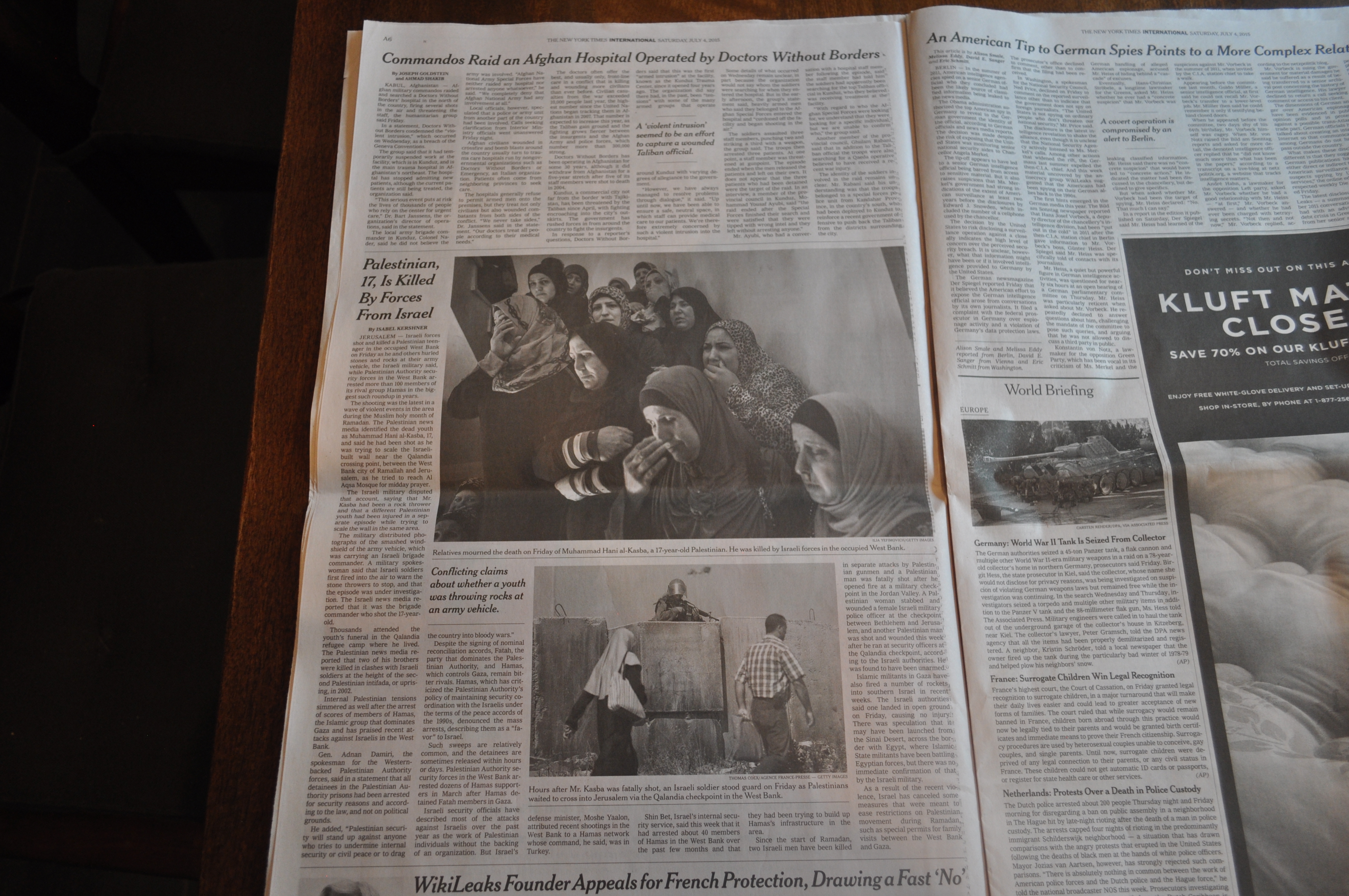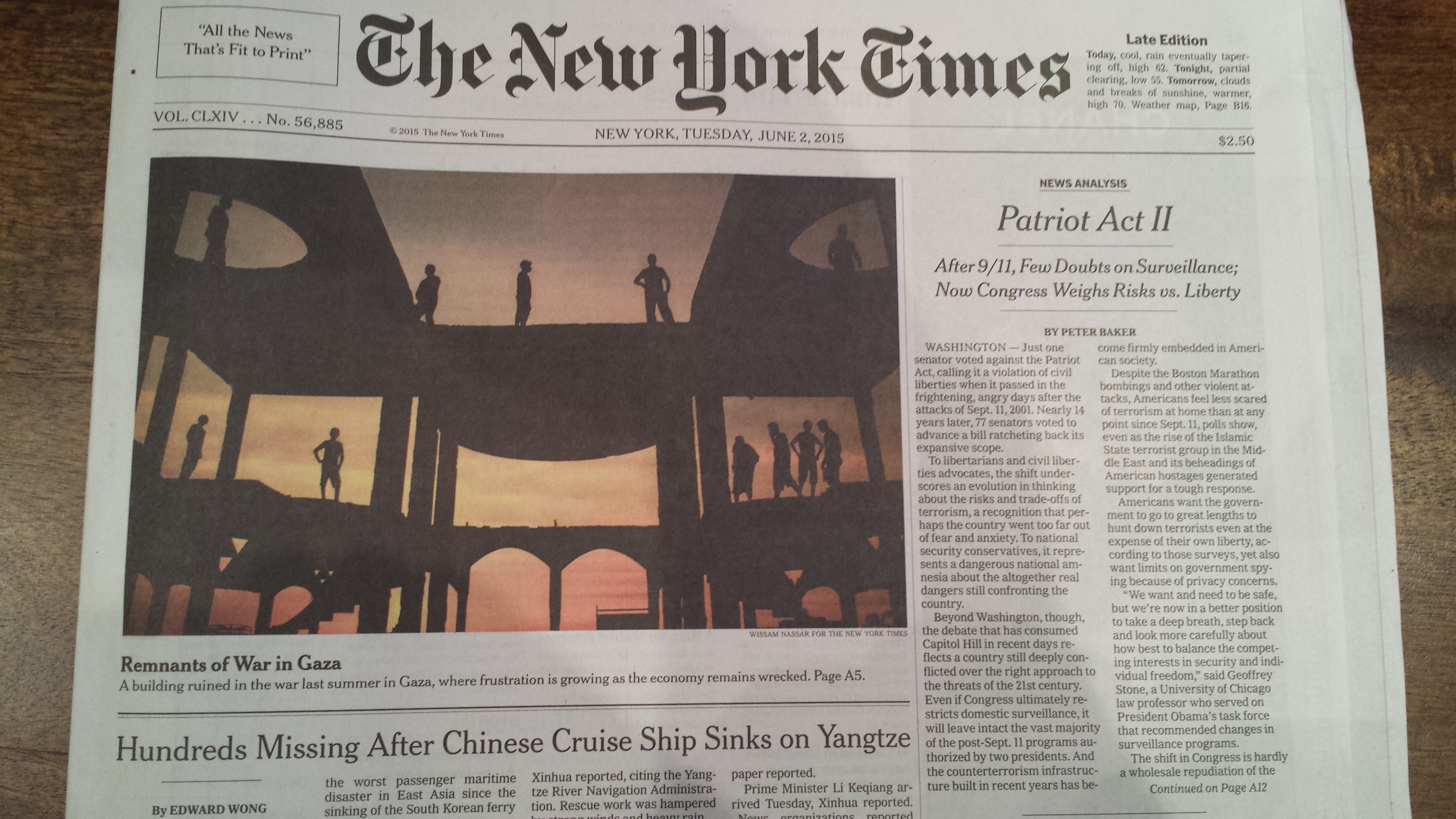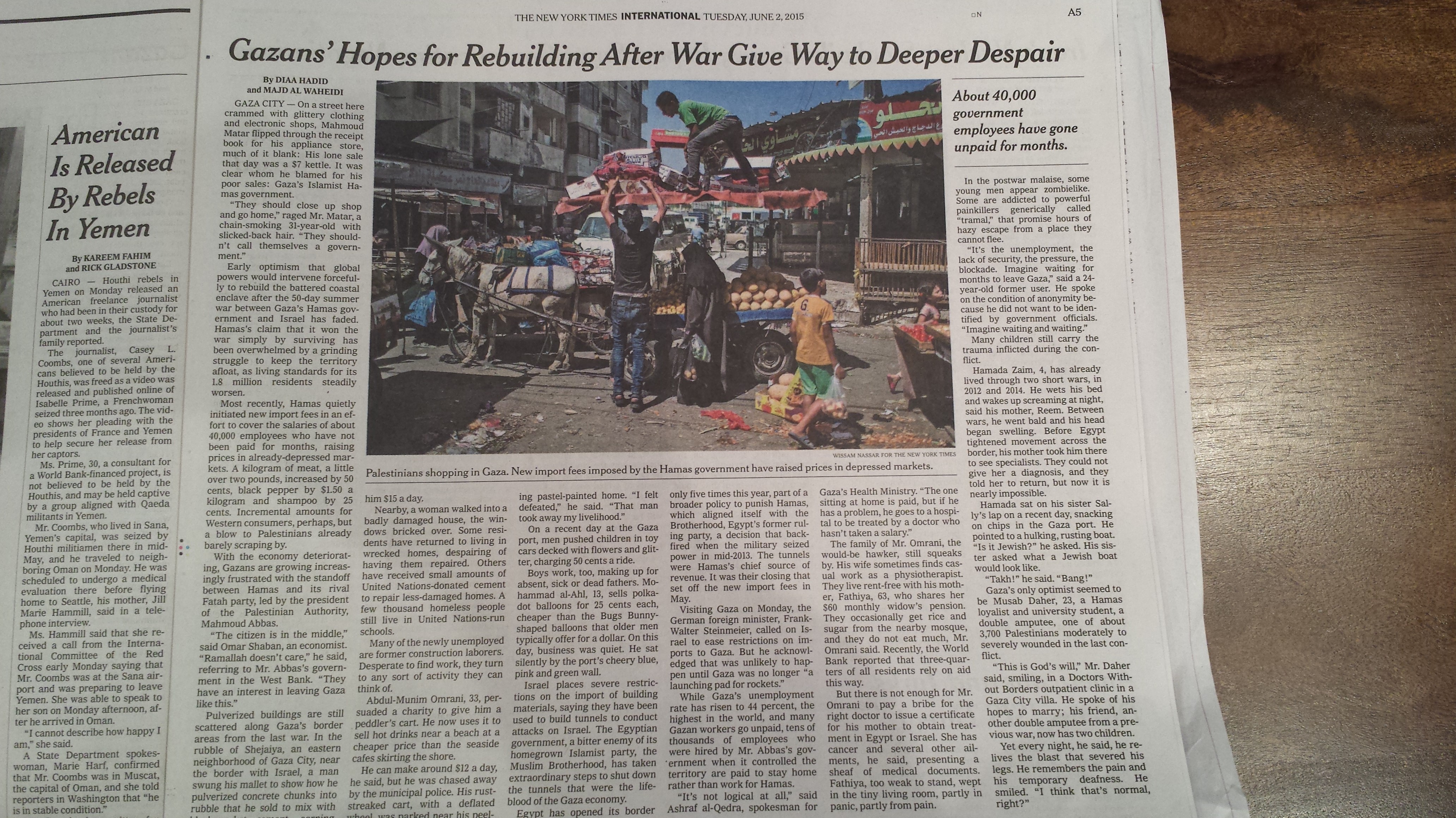
The New York Times Major anti-Netanyahu Propaganda Piece

Summary: The New York Times once again showed its bias against Jews living on the west bank of the Jordan River by painting opinion as international law. It posted a large non news-article during the week of Israeli elections in an attempt to discredit Israeli Prime Minister Netanyahu.

On March 12, 2015, the New York Times ran a cover page story called “As Israeli Settlements take Root, So do Complications” and on its online version it was titled “Netanyahu and the Settlements”. The article repeatedly referred to something called the “Geneva Initiative” as if the initiative carried any backing or legal authority. In actuality, the 2003 initiative is most akin to a present day Facebook Group.

20150313_130018
New York Times large cover story on the “Settlements”

The Times wrote “Two-thirds of new construction over the last two years, the Peace Now report shows, was on the Palestinian side of a line drawn by the Geneva Initiative, an international working group that produced a model agreement in 2003…
Efrat, with nearly 10,000 residents, is to Israelis the capital of the Etzion block. Palestinians, though, do not accept it as part of the block at all,
because it is on the eastern side of Route 60 — their side of the Geneva Initiative map. Annexing it would be far more complicated.”

By reading such statements, one would think that Israel is deliberately building homes on the “Palestinian side” of a road, contrary to existing laws and/or agreements. Palestinians are comfortable with Jews living on one side of Route 60, but not on the other.  That is specifically what the NYT intends the reader to conclude by writing such an article. It is completely untrue.

The Geneva Initiative was launched by a handful of people- both Israelis and Palestinians. The civilians met during 2003 and drafted a guideline of how a two state-solution could emerge. None of the people participating were elected or appointed by any governmental body. Their initiative was not endorsed by any government. Neither Israelis nor Palestinians consider this old private working paper at all.

“the 2003 Geneva Initiative is most akin
to a present day Facebook Group”

Meanwhile ACTUAL laws and agreements were deliberately omitted from the NYT article. They include the 1922 British Mandate of Palestine which was signed by the League of Nations, the precursor to the United Nations. The Mandate stated:

  • Article 6: The Administration of Palestine, while ensuring that the rights and position of other sections of the population are not prejudiced, shall facilitate Jewish immigration under suitable conditions and shall encourage, in co-operation with the Jewish agency referred to in Article 4, close settlement by Jews on the land, including State lands and waste lands not required for public purposes.
  • Article 15: The Mandatory shall see that complete freedom of conscience and the free exercise of all forms of worship, subject only to the maintenance of public order and morals, are ensured to all. No discrimination of any kind shall be made between the inhabitants of Palestine on the ground of race, religion or language. No person shall be excluded from Palestine on the sole ground of his religious belief.

As described above, international law enabled Jews to live everywhere in Palestine. Such freedom of movement and the ability to buy land was also the case under the Ottoman Turks. This is history and law – not the opinion of a handful of private citizens.

The west bank of the Jordan River was an integral part of the 1922 British Mandate of Palestine.  It was annexed by the Jordanians in 1950, after Jordan attacked Israel in the 1948-9 war (such Jordan annexation was with approval of the Palestinians but never considered by the United Nations). The Jordanians illegally evicted all of the Jews from the area, including the eastern part of Jerusalem, counter to the Fourth Geneva Convention.

After Jordan (and the Palestinians who were Jordanian citizens) attacked Israel again in 1967, Israel was obligated to launch a counter-attack per The Hague Regulations which state:

  • Article 40: Any serious violation of the armistice by one of the parties gives the other party the right of denouncing it, and even, in cases of urgency, of recommencing hostilities immediately.

Jordan was therefore legally attacked by Israel.  The Jordanians officially gave up all claim to the land in 1988.

None of these international laws, agreements or actions on the part of governments are mentioned in this large cover story by the New York Times. Instead, the Times chose to paint a picture that Israel is not abiding to laws to make it appear as the belligerent party. It does this with the aid of a private working paper from 12 years ago.

20150313_130046
Double page story by the NYT, continued from March 12 2015 cover 

There was nothing new in the story which begs the questions:

  • Why give the article such prominence by placing it on the cover with a large color picture, and continue with a full two-page spread in the inside pages complete with pictures, maps and drawings?
  • Why use an old private Initiative to make an argument about the location of settlements instead of history and law?
  • Why post the article now?

The New York Times posted the piece as they want to see Israeli Prime Minister Netanyahu defeated in upcoming Israeli elections.  The Israeli elections will take place later in the week, on March 17, 2015.  The New York Times, which has a long history of attacking the Israeli Prime Minister, put this non-news story on the front page the week before Israeli elections to make it appear that Israeli Prime Minister Benjamin Netanyahu was acting outside of the law.

The Times has once again shown it is not a credible source of news and chooses to air its biased opinions throughout the newspaper.  It has also shown that it seeks to influence the outcome of foreign elections with large distortions.  An interesting piece of hypocrisy, as the day before, on March 11, the NYT posted an op-ed from Thomas Freidman arguing about Sheldon Adelson’s attempts to influence elections in the United States with major contributions to Republican candidates, as well as claiming Adelson’s Israel Hayom newspaper is a biased mouthpiece for Netanyahu in Israel.

Is the Times posting the opinion of Barack Obama or George Soros?


First One Through articles:

Legal settlements: https://firstonethrough.wordpress.com/2014/12/11/the-legal-israeli-settlements/

NYT’s Nicholas Kristof’s “Arab Land”  https://firstonethrough.wordpress.com/2015/02/27/nicholas-kristofs-arab-land/

NYT ignores Jihadists in Israel: https://firstonethrough.wordpress.com/2015/01/26/radical-jihadists-in-europe-and-dislocated-and-alienated-palestinians-in-Israel/

NYT minimizing Netanyahu’s election success: https://firstonethrough.wordpress.com/2014/08/11/new-york-times-talking-turkey/

NYT only using “West Bank” instead of “Judea and Samaria” https://firstonethrough.wordpress.com/2014/12/08/names-and-narrative-the-green-line-west-bank-judea-and-samaria/

Nicholas Kristof’s “Arab Land”

On February 26, 2015, Nicholas Kristof wrote an op-ed in the New York Times called “The Human Stain” that was more than flawed- it was wrong; it was more than anti-Israel, it was anti-Semitic.

Among the many incorrect and racist statements were his claims that the “West Bank” and “East Jerusalem” were Arab. Here are some quick thoughts about his statement that “nibbling of Arab land is just plain wrong.”

IMG_2118
Judean Desert down to the Jordan Valley

Geography

The west bank of the Jordan and eastern Jerusalem are not part of the Arabian Peninsula. That landmass is located east of Israel. The borders of the region are surrounded by water on three sides (the peninsula) and the northwestern edge of Saudi Arabia is the land border.

The countries that constitute the Arab land in addition to Saudi Arabia are: Oman; Kuwait; UAE; Bahrain; Qatar; and Yemen. The Arabian Plate on which the peninsula rests includes parts of southern Jordan and southern Iraq.

Neither the Arabian Peninsula nor the Arabian plate cross the Jordan River, hence there is no geographical basis for referring to any land west of the Jordan as “Arab Land.”

Population

The “Arab Nation” spread beyond the Arabian Peninsula in the 7th and 8th centuries when Muslim invasion of neighboring lands brought Islam and Arabs to those areas. Those Muslim conquests brought Arabs to southern Spain called Andalusia. No one refers to Spain as Arab land today.

Politics

The Arab countries formed a “League of Arab States” which includes 22 countries. That group is political in nature and does not speak to the actual people and culture of the countries. For example, Syria was suspended from the League in 2011 due to its civil war. Palestine was admitted as a member in 1945 (the entire British Mandate of Palestine which includes Israel today) even though it was not an independent country.

To refer to the west bank of the Jordan as “Arab” because Palestine is a member state would also mean that Israel is an Arab state. Is that part of Kristof’s real message? Does he feel that Israel is not a valid entity and is occupying “Arab land”?

Ruby all Israel  29 (1)
Binyamin Region

Government Sovereignty

A “Land” is distinguishable from lowercase “land” in that one conveys sovereignty and ownership. The land on the west bank of the Jordan River is disputed land without independent sovereignty. Israel administers the land after Jordan attacked Israel in 1967 and subsequently lost the territory. Jordan gave up all claims to the land in 1988, including “East Jerusalem”. “Arab East Jerusalem” in capital letters makes no sense in any interpretation as sovereignty and administration belongs to Israel (albeit not recognized in much of the world) but the eastern part of the city is also not recognized, nor under sovereignty of Arabs, nor part of the Arab peninsula, and is 40% Jewish.

While many Palestinian Arabs claim the west bank of the Jordan as part of a future state and “East Jerusalem” as such state’s capital, the rule of the land is still in negotiations. As of this date, the land is much more Israeli than it is Palestinian.

Exclusivity

Liberals and progressives typically argue that no land should be the exclusive right of a single racial or religious group. No one refers to “White Selma” where only whites can live or “Black Harlem” where only blacks should be permitted to live.

While people refer to the Islamic State of Iran, Iran claims that it welcomes people of all faiths. Israel, the Jewish State, is 25% non-Jewish. Turkey, which is a secular Islamic state, is mostly non-Arab but has many Arabs living in the country.

Not only is the west bank of the Jordan not “Arab”, but the suggestion that it should be limited only to Arabs is racist and anti-Semitic. That policy was put into place under the Jordanian Arabs that attacked Israel in 1948 and expelled all of the Jews from the area including the eastern part of Jerusalem, counter the Fourth Geneva Convention.

IMG_4963
South of Bethlehem

Private Property

Land ultimately falls into two categories: private land and public land. Private land changes hands with the owner and is not considered to belong forever to a particular religion or people. One day it may be owned by an Arab, the next day by a Jew and the next by a WASP.

Public lands are administered by the government. As discussed above, the west bank of the Jordan is administered by Israel. The eastern part of Jerusalem was annexed by Israel decades ago.

Therefore neither the west bank of the Jordan River nor “East Jerusalem” can be considered “Arab land.”

History

For 400 years the Ottomans ruled Palestine and allowed Jews to live everywhere without restriction. They lived in Jericho and Jerusalem and throughout the region. The Ottomans welcomed the Yemenite Jews who founded Silwan in the eastern part of Jerusalem just outside the city walls in 1881 – in what Kristof terms “Arab East Jerusalem.”

The international community gave the British the Mandate to govern Palestine in 1922, in which it specifically stated that the entire mandate – including Kristof’s “Arab West Bank” – “shall facilitate Jewish immigration under suitable conditions and shall encourage, in co-operation with the Jewish agency referred to in Article 4, close settlement by Jews on the land, including State lands and waste lands not required for public purposes” (Article 6). The mandate further stated in Article 15 “No discrimination of any kind shall be made between the inhabitants of Palestine on the ground of race, religion or language. No person shall be excluded from Palestine on the sole ground of his religious belief”.

 DSC_1020
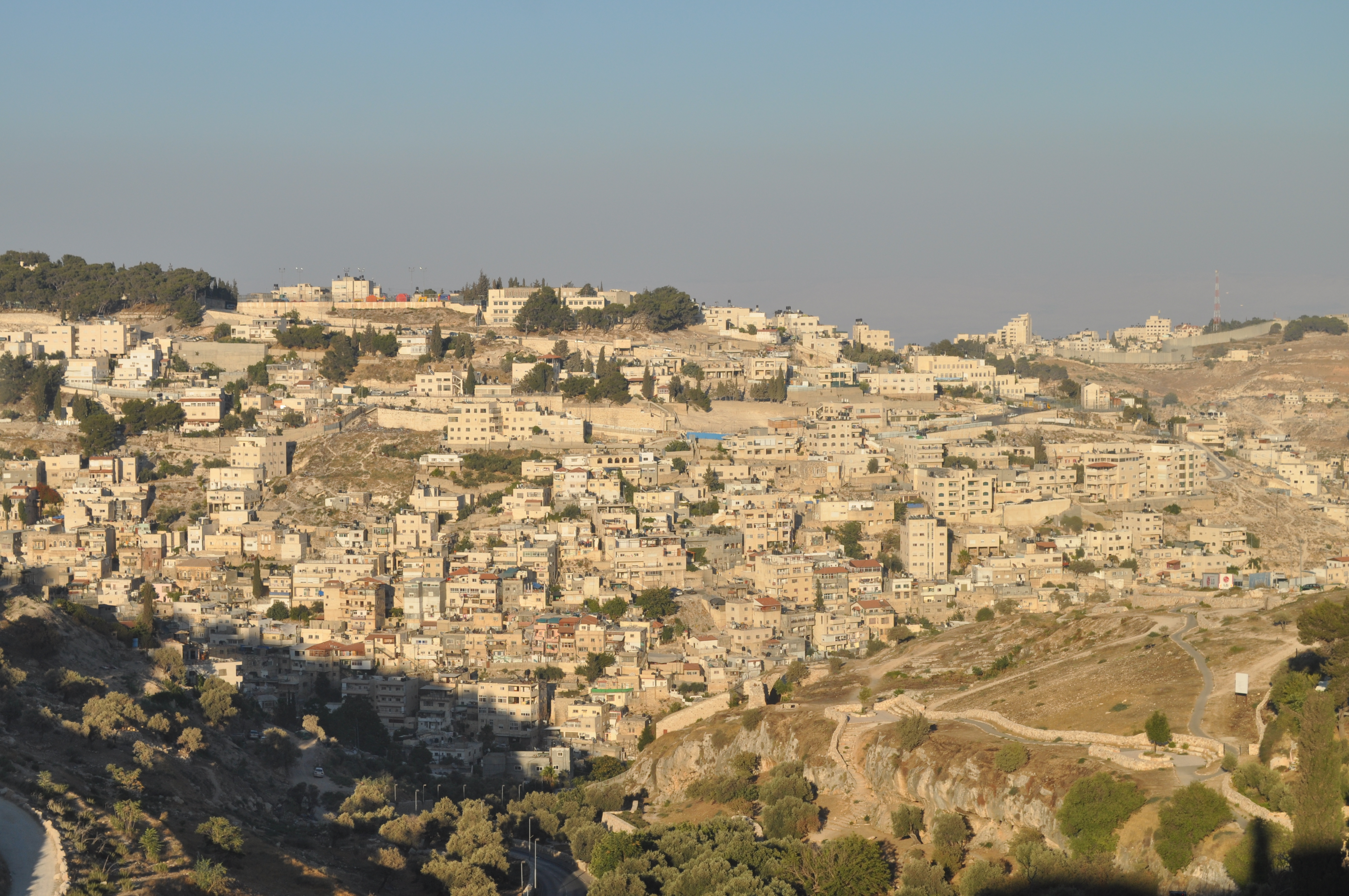
Silwan, in the eastern part of Jerusalem, founded by Yemenite Jews in 1881

Countering the Bible

As detailed above, there is no basis for naming places “Arab West Bank” or “Arab East Jerusalem”.   To claim that any land inherently belongs to a single group is a direct lift from the Old Testament in which God gives the land of Canaan to the Jews. Jews have always considered the entire land holy for that reason. Modern claims that part of that land is inherently Arab (and not Jewish) is done to specifically counter the Bible and any Jewish claim to the land.

Of course, the Jewish faith that asserts that the land is holy has nothing to do with sovereignty or private ownership. Jews have always considered the land holy, even in 1400 when they had no sovereignty, and Jews today who do not own land in Israel. The land is holy to Jews, which motivates many Jews to move there.

Kristof’s claim that this specific land (the “West Bank” which didn’t even exist as an entity or term until recently) is Arab is meant to directly confront the Jewish belief that the land was given to Jews by God. Just as the Times never uses the Jewish terminology of “Judea and Samaria” to remove Jewish connection to this land, Kristof attempts to sever the Jewish connection by stating it is inherently “Arab”. It is wrong in fact and intention.

Jews have always and will always consider Judea and Samaria/ the west Bank of the Jordan as holy regardless of its sovereignty, or the religion and ethnicity of a person living in a house on the land. Such sentiments do not preclude any type of peace deal.

Kristof wrote that “The 350,000 Israeli settlers in the West Bank — not even counting those in Arab East Jerusalem — impede any Middle East peace and stain Israel’s image,” can only be viewed as an obstacle to peace for racists that want a Jew-free state.

Attacking the Jewish faith is not a path to peace. Antisemitic calls for banning Jews from anywhere – let alone places they consider holy and lived in for thousands of years – is disgraceful.  The “Human Stain” is Kristof’s and those that share such sentiments.

New York Times Confusion on Free Speech

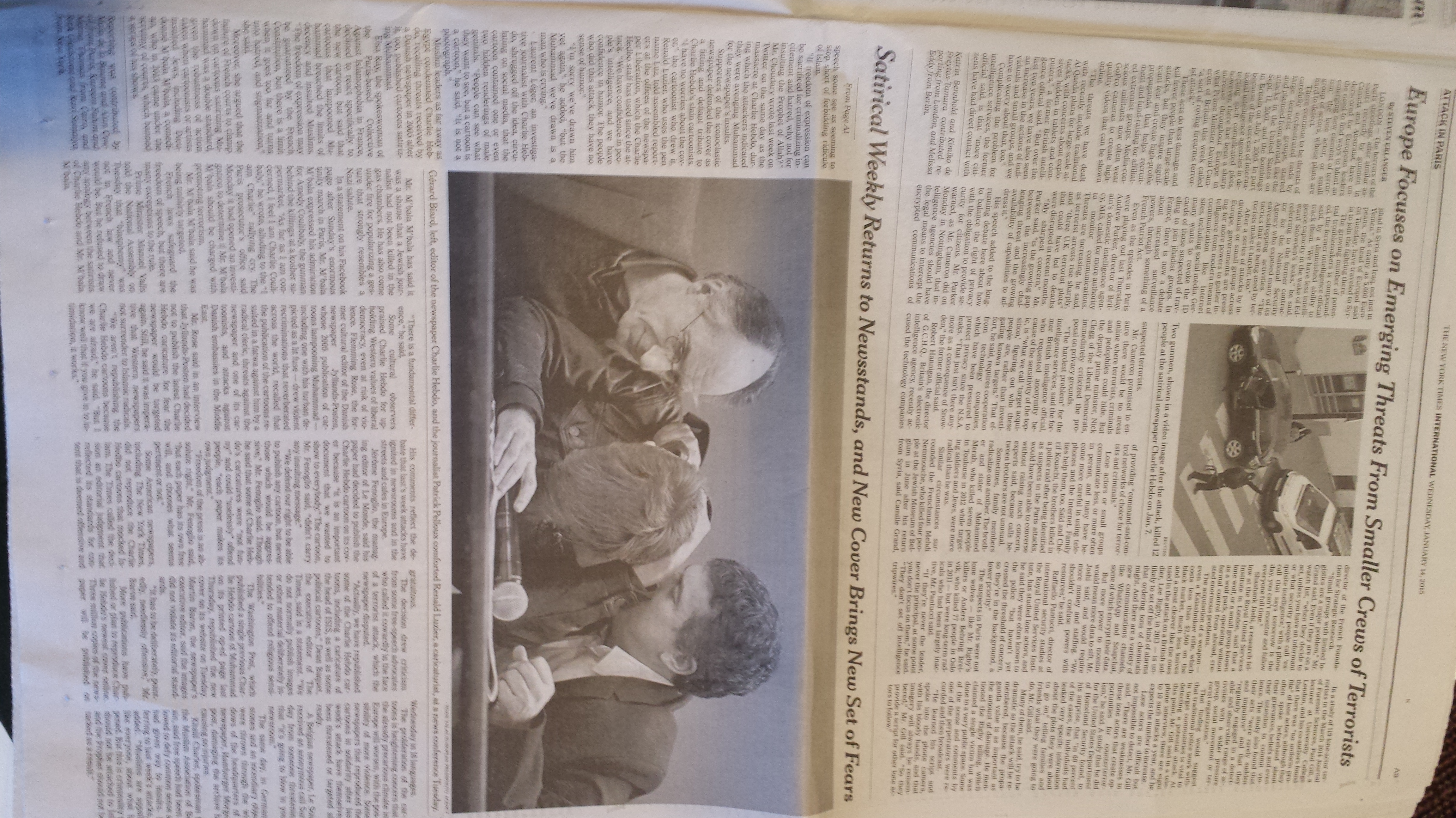
The attacks on the offices of the satirical magazine Charlie Hebdo in Paris in January 2015 sparked a plethora of articles describing the freedoms of speech and press. The New York Times, like many other media sources, fiercely defended the right of people to offer their opinions, even if such views are unpopular. Despite the clarity of its overall stance, the paper appeared confused about “double standards” in its articles which failed to clarify and distinguish between free speech and hate speech.

In the NY Times lead front page story of January 14 referring to such “double standards”, the paper contrasted the right of Charlie Hebdo to make cartoons of the Islamic prophet Mohammed, to the arrested French “comedian” M’bala M’bala who stated that a Jewish journalist should have been killed in the Nazi gas chambers and that he considers himself like the terrorist who shot and killed four Jews in the Parisian supermarket. Neither clarification nor education was given about the differences and limits of free speech.

20150115_144909

The NY Times continued to confuse the public (or itself) in a story the next day by David Carr, which included the following:

  • “Not all the French were reveling in unbridled expression of speech. Dieudonné M’bala M’bala, a comedian who has made highly provocative statements since the shooting at Charlie Hebdo’s offices, was detained as an “apologist for terrorism” for statements he made on his Facebook page that were seemingly in support of one of the attackers.
  • His arrest highlights the fact that one man’s free expression is another man’s hate speech or sedition. In Israel, the conservative Jewish newspaper HaMevaser scrubbed out the German chancellor Angela Merkel from a photograph, along with other female leaders who had participated in a solidarity march in Paris, because photos containing women are considered inappropriate in ultra-Orthodox publications.”

In an effort to educate the Times and its readership, here are three important points to distinguish between various types of speech:

  • Concept versus People
  • Active versus Reactive Incitement
  • Editing versus Censorship

 Concept versus People

A central dividing line between freedom of speech and hate speech has to do with the right to discuss concepts as opposed to the right (and limit) to discuss people. Everyone is free to say anything they want about concepts such as: capitalism, communism, Islam and Buddhism. Whether it is religion or economic theory, each topic is considered a concept worthy (perhaps?!) of discussion and debate in a positive or negative fashion. However, speech can descend into “hate speech” (or libel) which is banned by many countries, if people attack either groups or specific human beings.

For example, Louis Farrakhan, a bombastic anti-Semitic Muslim preacher referred to Judaism as a “gutter religion”. He was not brought up on any charges, despite the hateful speech. Egyptian leader Mohammed Morsi was not prosecuted for calling Jews the descendants of monkeys and pigs, which could have perhaps been classified as hate speech in some countries because he addressed people rather than a religion.

 Active versus Reactive Incitement

A key factor in the distinction of permissible versus prohibited speech revolves around “incitement”. Many countries prohibit speech that incites violence, as does the recent United Nations Resolution 16/18. The UN language:

  • “condemns any advocacy of religious hatred that constitutes incitement to discrimination, hostility or violence, whether it involves the use of print, audio-visual or electronic media or any other means”

The phrase incitement to violence is clear. For example, when an imam in Germany called for killing Jews, that fell under hate speech to incite violence, and the country is now investigating that imam.

However, it is considered completely legal to say things that may involve “reactive incitement”, that is, saying something that may annoy people to the extent that they would use violence. To ban reactive incitement would stifle free speech completely which is what the press sees as the essence of the Charlie Hebdo assassinations. Just because Muslims were insulted by the publishing of cartoons of their prophet, their reaction cannot be the basis to ban that freedom of expression.

Based on the United Nations language, the incitement to discrimination would have to be explored further. Did Charlie Hebdo promote discrimination against Muslims? Was the paper simply making pictures of Mohammed or was it attempting to foster intolerance of all Muslims? The new United Nations law makes a distinction.

The M’bala M’bala calls for a Jewish journalist to be killed in gas chambers and supporting terrorists who killed four innocent Jews are calls for direct and indirect incitement to hostility and violence.  Acting Palestinian Authority President Mamoud Abbas praise for martyrs who slaughtered innocents could also be called incitement to hostility and violence.

dalal_popular_inauguration

Fatah officials at naming of Dalal Mughrabi square,
murderer of 38 civilians including 13 children

 Editing versus Censorship

Every media outlet edits their news stories. Papers constantly select only those parts of interviews that confirm a thesis it promotes to its readers. That is (theoretically) its right. Michael Moore edited interviews about global warming and the auto industry to convey a particular narrative that he wanted to portray in his movies. The public may ultimately view the half-stories they receive as accurate, half-accurate or completely inaccurate because of the known bias of the producers of the content.

However, no one considers editing to be a form of censorship or an infringement on the freedom of speech or press. If a paper opted to not publish a sports section, that is its right. If it crops a picture to focus on a particular image to reinforce its narrative, that is also its right. It may be bad journalism, but it is not censorship (and certainly not by a governmental authority).

In its ramble on free speech above, the New York Times highlighted the Israeli “conservative” newspaper Hamevaser’s choice to edit the picture of the Paris unity march to remove the female leaders. Hamevaser is run by and serves an ultra-Orthodox Jewish community (not politically conservative) that is against showing pictures of women due to their interpretation of modesty. Such action is a form of editing that newspapers engage in to meet the tastes of its readership. To somehow suggest that it is a form of Israeli censorship is absurd. Why would the Times possibly lump this example in with examples of freedom of speech and hate speech? It is completely off topic.


People in the western world rallied behind Charlie Hebdo because they see this situation as falling completely within the framework of free speech: it poked fun at a religion (a concept), not people (Muslims); and it did not call for any violence, rather the attacks came from a reaction from incensed Muslims. The case of M’bala M’bala has to do with inciting violence against people, and the Hamevaser picture has nothing at all to do with government censorship.

So how did the Times develop this list of irrelevant examples and not try to educate its readers (and actually confuse them with calling out “double standards”)?


Sources:

NYtimes articles and picture Jan 14: http://www.nytimes.com/2015/01/14/world/europe/new-charlie-hebdo-has-muhammad-cartoon.html

NY Times article January 15: http://www.nytimes.com/2015/01/15/business/media/flocking-to-buy-charlie-hebdo-citizens-signal-their-support-of-free-speech.html?_r=0

Louis Farakhan on Judaism: https://www.youtube.com/watch?v=NbrH3eUuA3U

Egyptian leader Mohammed Morsi calling Jews names: https://www.youtube.com/watch?v=JukaOi8pKzM

UN Resolution 16/18: http://www2.ohchr.org/english/bodies/hrcouncil/docs/16session/A.HRC.RES.16.18_en.pdf

German imam calling for killing Jews: http://forward.com/articles/202751/germany-warns-against-hate-speech-after-imam-calls/

PA Abbas praise for terrorists: http://www.algemeiner.com/2013/01/10/video-of-abbas-praising-hitler-supporting-mufti-terrorists-released-video/

Naming square and centers after terrorist who killed 37 civilians: http://www.palwatch.org/pages/news_archive.aspx?doc_id=1442

Related First One Through articles:

Blasphemy or terrorism: https://firstonethrough.wordpress.com/2015/01/12/blasphemy-or-terrorism/

Klinghoffer opera: https://firstonethrough.wordpress.com/2014/06/23/eyal-gilad-naftali-klinghoffer-the-new-blood-libel/


“Extremist” or “Courageous”

Popularity versus Position, Pervasiveness and Power

The word “extremist” appears like a loaded word. That partially stems from the fact that it conveys two different meanings. The first is that it describes a person who has an extreme position. The second is that it portrays a person at the edges of society.

A person who holds a position at the far fringe of society is pretty straightforward. If someone believes that the moon is purple and 99.9% of the rest of society does not, that person could be called an extremist. The label could be viewed as appropriate simply because the opinion is not popularly held.

The pervasiveness of a position, as opposed to its popularity, is a more subjective criterion. Someone believing that the moon is purple is one thing. However, painting their entire house purple, dying their hair purple and changing their name to Professor Purple Plum, would be viewed as “eccentric” and “obsessive” at a minimum, and possibly even “extreme”.

The “extremist” label sticks best when the person’s actions impact other people. For example, an individual may believe that life starts at conception, but if that is simply a personally held viewpoint, most people would not describe that person as an extremist. However, if a person used that position to justify destroying abortion clinics and harming the people inside, the violent actions would lead people to use the “extremist” label.

Violent extremists are typically painted in two camps: “right-wing” extremists use power to protect religion and capitalism; “left-wing” extremists use violence to flatten social hierarchies, and are often viewed as anti-religion and anti-capitalism.

Religion: Popularity and Power

Popularity is a matter of simple statistics. As an example, if one looks at the distribution of world religions, one can see a few widely held beliefs and some unpopular belief systems:

  • Christians: 31.5%
  • Muslims: 23.2%
  • Unaffiliated: 16.3%
  • Hindus 15.0%
  • Buddhists 7.1%
  • Folk Religionists 5.9%
  • Jews 0.2%

By the measure of popularity, all Jews could be viewed as “extremists” because they have a belief system that is not held by 99% of the world. However, as Jews do not enforce their belief system on others, the “extremist” label would largely be considered inappropriate. Conversely, Islam is a very popular religion, but the various Muslim groups that seek to enforce sharia law and forced conversion of people are often called “extremists”, especially if people that refuse to succumb to their religious edicts are killed. Popularity is not considered the gauge; it is violent actions and/or actions that harm others that define extremists.

 Arab “Residents” and Israeli “Settlers”

Using such distinction between popularity and power, review how mainstream media uses the extreme label in regard to Israel.

On October 23, 2014, the New York Times reported on the story of an Arab that rammed his car into a crowd of Jews killing two people including an infant. Ignoring the Times’ generally terrible coverage overall, the nature of inverted reality and anti-Israel bias was typified in a particular paragraph in the story, where the non-aggressive party was labeled an extremist:

“Mr. Shaloudy was a resident of Silwan, a predominantly Palestinian neighborhood
in territory that Israel captured from Jordan in the 1967 war and later annexed,
a step that has not been recognized internationally. An influx of right-wing Jewish settlers who have acquired property in the area in recent years have made
the neighborhood a flash point in the Israeli-Palestinian conflict.”

Mr. Shaloudy, the Arab man who killed two people, is described as a “resident of Silwan, a predominantly Palestinian neighborhood”. This description made him sound like a peaceful neighbor living among his people. He is tied to the majority and therefore, by implication, not an extremist if one were to use the popularity measure.

The paragraph continued that the neighborhood is in “territory that Israel captured…that has not been recognized internationally… right wing settlers…acquired property in the area.” The New York Times painted the Jews as “right wing” extremists. On what basis? That they moved into a “predominantly Palestinian neighborhood”? That they moved into houses that “has not been recognized internationally” to be part of Israel? That just made those Jews a minority in the neighborhood, and Israel’s claim on the territory a minority-held position. However, the actions taken by this group were peaceful: they purchased apartments; and moved into them legally. They harmed no one. As such, they took no actions that warrant being called “right wing”.

However, the Arab “residents” that the Times described, sought to kill Arabs that sell homes to any Jews, in accordance with Palestinian law. This particular Arab “resident” murdered innocent Israelis.  Yet, for some reason, these Palestinians that have laws calling for murdering Jews, who do ultimately commit murder, are not labeled extremists. This is both a perversion and inversion of reality where violent actions are considered the appropriate norm and unpopular positions are considered extreme.

A few paragraphs down, the Times called Israelis extremists again:

“Many of the recent clashes have centered on visits to the compound
by hard-right Israelis who have been increasingly demanding the right to pray there.
The mosque is on the Temple Mount, revered by Jews as the location
of ancient Jewish temples and the holiest site in Judaism.”

The juxtaposition of the sentences was unfair- the Jews had no interest of praying in the mosque, but were seeking to pray nearby on the holiest spot for Judaism. Were these “hard-right Israelis” seeking to hurt anyone? Were they seeking to destroy a mosque or convert anyone? Not at all. So how can their action be considered extreme?


It is true that Jews are a minority in the world. It is true that Israel is surrounded by dozens of Arab and Muslims states that either refuse to recognize Israel or call for its outright destruction. But simply being unpopular doesn’t make Jews or Israel “extreme”.

Jews seeking to buy and live in apartments like anyone else is neither illegal nor extreme. Jews seeking to pray at their holy sites is not extreme. It is exactly the opposite: those people that seek to murder Jews for doing basic activities should be labeled “extremists”. Pinning terminology that make the Jews look like unpopular invaders and therefore extreme, ignores history, decency and honesty.

Shame on the New York Times.  If these were blacks in the 1960s moving into predominantly white neighborhoods in the US, the Times would more likely call these people “courageous”.

20141023_075354


Sources:

World religions: http://www.pewforum.org/2014/04/04/global-religious-diversity/

NY Times “right wing settlers” http://www.nytimes.com/2014/10/23/world/middleeast/2-israeli-soldiers-wounded-near-egypt.html?_r=0

First One Through articles on Silwan:

False facts on Jews in Silwan

Obama supporting Jew-free state

UN echoing Palestinian narrative

Real and Imagined Laws of Living in Silwan

The New York Times deliberately misrepresented opinion as law to disparage Israel, and omitted actual Palestinian laws to hide Arab racism. As such, the paper fully embraced anti-Semitism and the principle of segregation if it prohibits Jews from living in predominantly Arab neighborhoods.

In an article on October 16, 2014 called “A House-by-House Struggle for Control of a Jerusalem Neighborhood”, the NYT’s Isabel Kershner had an opening paragraph that could have been taken from Mein Kampf in describing secretive, cheating and stealing Jews:

“In the dark of night, under the protection of Israeli security forces, Jewish settlers took possession of some 25 housing units in six locations around the Silwan neighborhood of East Jerusalem… Many of the properties had been rented out, but they were strangely empty when the settlers arrived… Through a multimillion-dollar series of complex and shadowy transactions spanning several years,
Elad engineered the largest private settlement initiative in decades.”

[By way of comparison, here is a quote from Hitler’s Mein Kampf: “they (Jews) try to cheat the whole world with their tricks; they are lazy, but with their pretended ‘silent’ work they create the appearance of an enormous and equally laborious activity; in short, they are cheats, characters of political profiteering, who hate the honest work of others. Just as such a folkish moth always appeals to the darkness of the silence, one can bet a thousand to one that under its cover he does not produce, but only steals steals from the fruits of the labor of others”] 

The article goes on to describe and suggest that it is illegal for Jews to buy homes in the eastern part of Jerusalem. That suggestion is both untrue and racist. Here are the facts:

  • Silwan was established by Yemenite Jews in 1881. It was one of the first developments outside the city walls of Jerusalem, while the area was part of the Ottoman Empire.
  • Jews have been an established majority in Jerusalem since the 1860s.
  • The Ottomans did not impose any limits on where Jews could live.
  • When Britain took over Palestine as part of the League of Nations Palestine Mandate in 1922, the mandate specifically stated (Article 15) that no one should be barred from living in the area because of their religion.
  • The Palestinians rioted in 1936-9, killing hundreds of Jews, and effectively lobbied the British to limit Jewish immigration to Palestine. But even under those new anti-Jewish rules, there was no prohibition of Jews living in the eastern part of Jerusalem.
  • Jerusalem and Bethlehem were designated to be an international “Holy Basin” according to the 1947 United Nations Partition Plan, and was to be neither part of Israel or Palestine. Both Arab and Jew were free to live anywhere in the Basin.
  • Silwan, and much of the eastern half of Jerusalem was forcibly cleansed of Jews when the Palestinians and Jordanians initiated a war against the Jewish State in 1948, and the Jordanians illegally annexed the eastern half of the city. The Jordanians and Palestinians barred any Jews from even visiting the eastern half of the city.
  • The Jordanians granted Palestinian Arabs citizenship and denied giving any citizenship to Jews in the lands they forcibly conquered (including eastern Jerusalem), making it illegal for Jews to own land there.
  • The Jordanians and Palestinians launched another attack on Israel in 1967, only to lose the eastern half of Jerusalem in that war.

These facts were completely ignored. The only information discussed about the settling of Silwan described: “territory that Israel conquered from Jordan in the 1967 war and then annexed, in a move that was never internationally recognized. Most of the world considers the area illegally occupied by Israel”

The suggestion that Israel’s annexation (as a result of a defensive war) is considered illegal by “most of the world” and therefore means that Jews are forbidden to live there is completely misleading and untrue.

  • The Israeli territory of Judea and Samaria (West Bank) is administered by Israel. Israel approves housing for both Arabs and Jews there, and in the eastern part of Jerusalem which they annexed.
  • International law against the forcible transfer of a population has nothing to do with individual rights of buying and living in a property of their own choosing.

The NYT article successfully: 1) described Jews the way Hitler did; 2) gave no background of the long and legal history of the Jews living in the eastern part of Jerusalem; 3) implied illegal activity of Jews buying and moving into their homes when such action is legal.

What the Times article deliberately failed to describe was the actual illegal activity – according to the Palestinian Authority – for any Arab to sell land to a Jew.

Palestinian law bans the selling of land to a Jew, punishable by death. Not only was that law not mentioned in this or any NYT article, Kershner deliberately hid this racist Palestinian law in the article with a false narrative: “At a stormy meeting of about 100 [Palestinian] residents and activists in a children’s playground soon afterward, participants denounced the [real estate] brokers and called for them to be publicly named and cast out of their clans. The Palestinian Authority has no jurisdiction in Jerusalem, but there is a history of vigilante justice: In the 1990s, some local land dealers accused of selling property to Jews were kidnapped and killed.”

First, note how the article called Jews “settlers” and Arabs are called “residents”. Both parties are residents and neighbors in the same block. Is the New York Times so against coexistence that each party needs a distinct label?

Second, the article correctly points out that the Palestinian Authority has no jurisdiction in the area, but it describes the actions of “residents and activists” of “vigilante justice” making the actions appear random, unauthorized and opposed by the “moderate” Palestinian Authority. The fact is that property sales are considered a capital offense and Palestinian courts have handed out death sentences for the sale of land to Jews.


The New York Times’ illusion of Jews taking property by force in the dark of the night is outrageous. The secretive nature of the purchase was to protect the Arabs that sold the property from being killed by fellow Arabs according to Palestinian law.

The purchase of apartments by individual Jews in their holiest and capital city in a neighborhood founded by Jews is completely legal. The fact that they had to act discretely in their purchases because of racist Palestinian laws is a travesty that should anger the world – about Palestinians, not the Israelis.

20141020_211454


Sources:

NY Times article: http://www.nytimes.com/2014/10/16/world/middleeast/a-house-by-house-struggle-for-control-of-a-jerusalem-neighborhood.html?ref=todayspaper&_r=0

Yeminite Jews in Silwan: http://www.meforum.org/3281/silwan

1922 League of Nations Mandate: http://avalon.law.yale.edu/20th_century/palmanda.asp

1939 White Paper: http://avalon.law.yale.edu/20th_century/brwh1939.asp

Jordan’s nationality law (article 3) excluding Jews: http://www.refworld.org/docid/3ae6b4ea13.html

FirstOneThrough on the 800,000 Arabs moving to Palestine during the British Mandate: https://firstonethrough.wordpress.com/2014/07/03/whos-new-everybody/

Abbas on Jew-free Palestine: http://www.commentarymagazine.com/2013/07/30/abbas-arabs-in-israel-no-jews-in-palestine-peace-process/

Short history of Palestinians+Jordanians controlling Jerusalem: https://firstonethrough.wordpress.com/2014/07/07/east-jerusalem-the-0-5-molehill/

PA Land Law: http://www.jpost.com/Middle-East/PA-affirms-death-penalty-for-land-sales-to-Israelis

Jordan attacking Israel 1967 according to King Hussein: http://www.kinghussein.gov.jo/his_periods3.html

Palestinian courts handing death sentence for land sale to Jews: http://www.aljazeera.com/news/middleeast/2009/04/2009429105147715724.html

Mein Kampf: https://archive.org/stream/meinkampf035176mbp/meinkampf035176mbp_djvu.txt

The anthem of Israel is Jerusalem: https://www.youtube.com/watch?v=wulmUGVG3jA

Obama endorsing Jew-free state: https://firstonethrough.wordpress.com/2014/10/02/obama-supports-anti-semitic-palestinian-agenda-of-jew-free-state/


Israel’s Freedom of the Press; New York Times “Nonsense”

On May 1, 2014, Freedom House, a leading advocacy group on democracy and political freedom, released its annual report on freedom of the press around the world. “Global press freedom has fallen to its lowest level in over a decade” according to their report, led by declines in: Egypt; Libya; Jordan; Syria and Turkey. A notable exception was Israel, which became the only country in the entire MENA (Middle East and North Africa) to be ranked as having a free press.

Select 2013 country rankings (bold are MENA countries):

  • Israel (62)
  • Italy (64)
  • Chile (64)
  • South Korea (68)
  • South Africa (69)
  • India (78)
  • Philippines (87)
  • Brazil (90)
  • Argentina (106)
  • Lebanon (112)
  • Tunisia (112)
  • Kuwait (127)
  • Turkey (134)
  • Libya (134)
  • Morocco (147)
  • Qatar (152)
  • Jordan (155)
  • Egypt (155)
  • Iraq (157)
  • Oman (161)
  • Yemen (167)
  • UAE (167)
  • Ethiopia (176)
  • West Bank, Gaza (179)
  • Somalia (179)
  • Saudi Arabia (181)
  • Syria (189)
  • Iran (190)

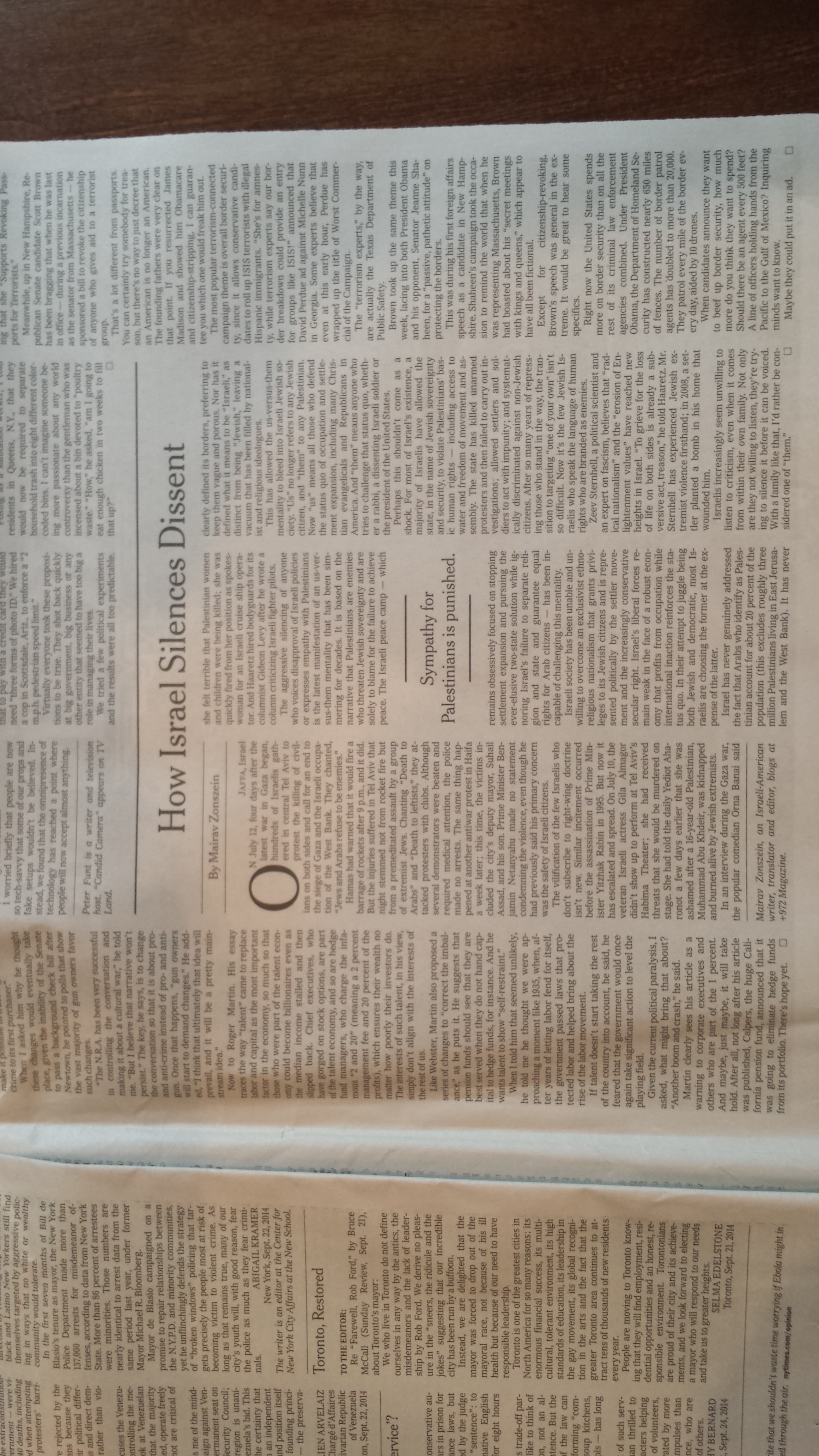
The New York Times declined to cover the story in May. However, on September 26, 2014 it ran an op-ed called “How Israel Silences Dissent”. The editorial said that the Israeli government punishes journalists that show sympathy for the Palestinians. There was no mention of the Freedom House ranking at that time either.

20140930_122042

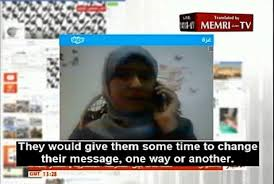
There was also no discussion of the Palestinians’ intimidation of the press.  While the NYT was printing its anti-Israel editorial, the Foreign Press Association was reporting on the intense discrimination they endured in covering Operation Protective Edge: “The FPA protests in the strongest terms the blatant, incessant, forceful and unorthodox methods employed by the Hamas authorities and their representatives against visiting international journalists in Gaza.” Even the extreme Israeli left-wing paper Haaretz reported that “some reporters received death threats. Sometimes, cameras were smashed. Reporters were prevented from filming anti-Hamas demonstrations where more than 20 Palestinians were shot dead by Hamas gunmen.”

gaza journalist

Hamas discussing changing journalist coverage, summer 2014

The New York Times did not report on any of this.  The only time the NYT opted to quote the FPA during the 2014 Palestinian war against Israel was early in the conflict on July 23 when the FPA complained about Israeli intimidation.

While ignoring the Hamas harassment, the Times was not completely silent.  Jodi Rudoren, the New York Times Middle East Bureau chief decided to make her position clear – on Twitter.  Roduren proclaimed: “Every reporter I’ve met who was in Gaza during war says this Israeli/now FPA narrative of Hamas harassment is nonsense.”

Is the FPA only worth quoting when they complain about Israel?  Is an opinion piece about possible Israeli intimidation the only op-ed that is worth printing while remaining silent about Hamas death threats?  Is the uniqueness of Israel’s record of freedom of the press too hard for the New York Times to believe and therefore to report?

“Nonsense” seems to be the New York Times sense of balanced and accurate coverage.


Sources:

Freedom House May 2014 press release: http://freedomhouse.org/article/freedom-press-2014-media-freedom-hits-decade-low#.VDnLh_8tCUl

Freedom House 2013 country ranking: http://freedomhouse.org/report/freedom-press-2014/press-freedom-rankings#.VDnNCv8tCUl

Foreign Press on Hamas intimidation: http://www.timesofisrael.com/hamas-admits-intimidating-foreign-press-who-reported-wrong-message/

New York Times on FPA discussing Israeli intimidation July 23: http://www.nytimes.com/2014/07/24/world/middleeast/foreign-correspondents-in-israel-are-targets-of-intimidation.html?_r=0

Rudoren nonsense: http://www.camera.org/index.asp?x_context=2&x_outlet=35&x_article=2814

FirstOneThrough music video for journalists in the Middle East: https://firstonethrough.wordpress.com/2014/09/04/journalists-in-the-middle-east/

FirstOneThrough on Rudoren reporting nothing of Palestinian violence and Jewish history: https://firstonethrough.wordpress.com/2014/09/21/reading-roduren-unrest-by-Palestinians/

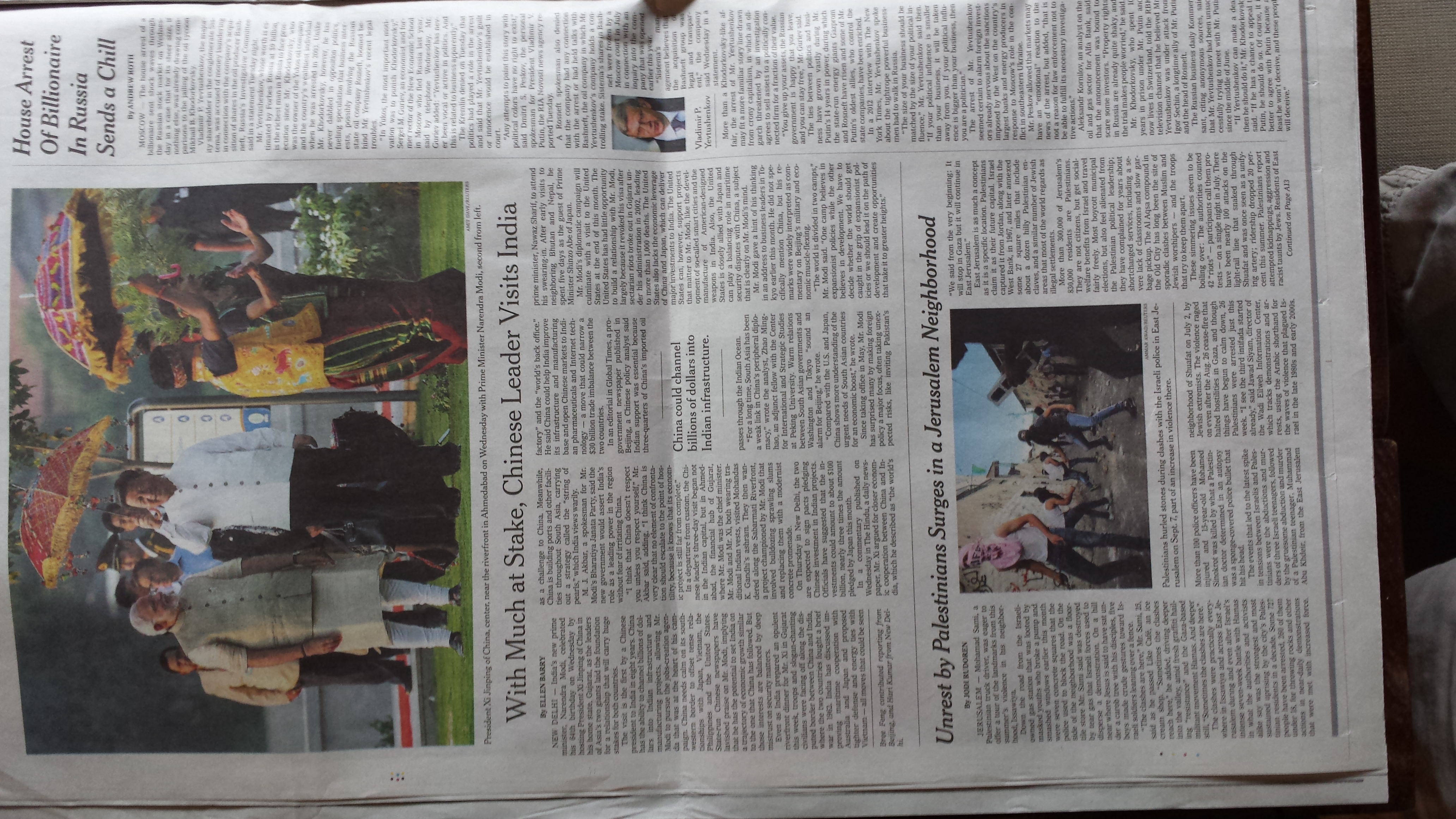
Reading Roduren: “Unrest by Palestinians”

On September 18, 2014, NY Times journalist Jodi Rudoren wrote yet another article light on history and description (regarding Palestinian violence and Jewish history) entitled “Unrest by Palestinians Surges in a Jerusalem Neighborhood“.

The article mentioned an “Israeli-owned gas station that was looted by masked youths who broke a pump and smashed windows.” What Roduren failed to mention was that the Arab riot included dozens of youths and adults who repeatedly threw firebombs at the gas pumps in an effort to ignite them and blow up the entire station.

Roduren described “a hill near where Jesus is said to have sat under a carob tree”. There was no nod to Samuel the Prophet or dozens of Jewish leaders who lived and preached in the area.

In yet another egregious example of understating Arab violence, Roduren wrote that Palestinians were arrested for “throwing rocks and other actions.” Those “other actions” included Arabs throwing Molotov cocktails at Jewish homes. An uninformed reader might think they were simply making “crude gestures toward Israeli soldiers” as Roduren wrote in the preceding paragraph.

According to the article, the start of the “tensions” arose from “the abductions and murders of three Israeli teenagers, followed by the gruesome abduction and murder of a Palestinian teenager, Muhammad Abu Khdeir, from the East Jerusalem neighborhood of Shuafat on July 2, by Jewish extremists.” Note that the Israeli teenagers were not mentioned by name whereas the Palestinian boy was. There was no adjective for the murder of the Israelis, but the Palestinian murder was described as “gruesome”. There was no blame on Palestinians for the murder of three Israelis, but the sole Palestinian boy was killed by “Jewish extremists.” (FYI, when the New York Times reported on the arrest of the murderer of the Israeli teens, the man was simply mentioned by name and was not described as an Arab, a Muslim or an extremist.)

Roduren ignores a lot of highly relevant history in describing “East Jerusalem”. She writes that “Palestinians claim it as their future capital. Israel captured it from Jordan, along with the West Bank, in 1967, and later annexed some 27 square miles.” Neglected from this quick overview was that “Palestinians” were Jordanians in 1967, as they had Jordanian citizenship since 1950. It was the Jordanians (and Palestinians) who attacked Israel first in 1967, and Israel responded in self-defense. To state that “Israel captured it from Jordan”, ignores the reality that the Palestinians, together with the Jordanians, launched the attack on Israel.  Additionally, by beginning the overview of Jerusalem in 1967, ignores that:

  1. Jerusalem has had a Jewish majority since the 1860s;
  2. Arabs initiated attacks and killed Jews throughout Jerusalem well before Israel was even created including in 1920; 1929; 1936-9
  3. Jerusalem was never intended to be a Palestinian city according to the UN plan in 1947;
  4. the Jordanians and other Arab nations attacked Israel in 1948;
  5. the Jordanians illegally seized and annexed the eastern part of Jerusalem in 1949;
  6. the Palestinians became Jordanians in 1950, and were complicit in expelling all of the Jews from the eastern part of Jerusalem and barring their entry to the city and Jewish holy sites;
  7. the Jordanians (together with the Palestinians) initiated the attack on Israel in 1967.

The fact the Jordan gave up all claim to Jerusalem in 1988, and Israel gave control to half of the Holy Basin as described by the UN – Bethlehem – 20 years ago is ignored.

When Roduren described “300,000 of Jerusalem’s 830,000 residents are Palestinians. They are not citizens,” she deliberately misrepresented that they were offered Israeli citizenship, but declined.

Regarding the Temple Mount, Roduren refers to it by its Muslim name, the “Al Aqsa compound in the Old City has long been the site of sporadic clashes between Muslim and Jewish worshipers”. Other than denying the Jewish name of the holiest site in Judaism, the “long” history of conflict dates back well before 1967 when Muslim men attacked and killed Jews. Further, it is untrue to paint it as a mutual clash between parties – it was Jews who were repeatedly attacked by Arabs, not the other way around.

In describing the “nearly 100 attacks on the light rail system”, no party is mentioned in the violence, even though all of the attackers were Arabs. Instead, Roduren wrote that “Palestinians report attempted kidnappings, aggression and racist taunts by Jews.”

Roduren repeated her long-running narrative of painting the Arabs as indigenous and Jews as recent settlers. In the article, she refers to an Arab community leader “whose family dates back 800 years,” (she presents this as fact, not something the man simply claims). The fact is that the area discussed barely had any people living there: in 1922, the census reported a grand total of 333 persons in the neighborhood (and also reported that Jews were the majority, making up 54% of all of Jerusalem). Consider that during the British Mandate, over 800,000 Arabs from the Middle East moved to Palestine – hardly making the Arabs indigenous. By ignoring Jewish ties (as in only reporting Jesus’s history and calling the Temple Mount only by a Muslim name), Roduren tries to distance Jews from being the actual indigenous people of the region.

Maybe one day, the New York Times will finally print the undisputed fact that Jews have been the majority in Jerusalem for 100 years before the Six Day War. Perhaps the paper will finally call out the Palestinians when they instigate the violence. Yeah, right.

20140921_121806 20140921_121829


Sources:

http://www.jpost.com/Israel-News/Masked-Arabs-throw-rocks-bottles-of-paint-at-Jewish-school-bus-on-Mt-of-Olives-375967

http://www.ynetnews.com/articles/0,7340,L-4571547,00.html

Murder of Israeli teenagers arrested: http://online.wsj.com/articles/israel-makes-first-arrest-in-teens-murder-case-1407315912

NY Times coverage of arrest of Palestinian who killed Israeli teenagers: http://www.nytimes.com/2014/08/06/world/middleeast/israeli-arrest-made-public-in-abduction-of-3-youths.html?_r=0

From Jordanian king’s own site about launching offensive against Israel in 1967: http://www.kinghussein.gov.jo/his_periods3.html

1922 census: http://en.wikipedia.org/wiki/Isawiya#cite_note-Census1922-7

FirstOneThrough on East Jerusalem history: https://firstonethrough.wordpress.com/2014/07/07/east-jerusalem-the-0-5-molehill/

800,000+ Arabs moved to Israel under the British Mandate: https://firstonethrough.wordpress.com/2014/07/03/whos-new-everybody/

1920 riots in Jerusalem against the Jews: http://en.wikipedia.org/wiki/1920_Nebi_Musa_riots

Palestinian Xenophobia: https://www.youtube.com/watch?v=eQS1XVQR-Xc

Demographics of Jerusalem: http://en.wikipedia.org/wiki/Demographic_history_of_Jerusalem

New York Times Creates, then Inflates Israeli Crimes

On August 28, the New York Times published an article called: “Heavy Use of Banned Cluster Bombs Reported in Syria”, which – one would imagine – was about Syria’s use of cluster bombs. A careful reader could come away with some information about Syria’s use of bombs; but any reader would be led to conclude that Israel is the worst offender on the planet.

The tone of the article (about Syria) moves quickly against Israel from the opening paragraph:

  •  Cluster bombs, outlawed munitions that kill and maim indiscriminately, have caused more casualties in the Syrian civil war than in the 2006 Lebanon conflict, when Israel’s heavy use of the weapons hastened the treaty banning them two years later, a monitoring group said Wednesday.

It is true that some countries adopted a treaty on the weapons about two years after the Israel-Lebanon war. In case Israel’s usage of bombs wasn’t clear, the article elaborated on this same point a few paragraphs later:

  • The [Human Rights] group’s statement said, “Already, casualties in Syria are higher than those attributed to the 2006 Israel-Lebanon conflict that triggered global outrage and contributed to the establishment of the ban convention.”

I guess the Times wasn’t sure if people read the point at the start of the article, so it added a line about “global outrage” to underscore the world’s opinion about Israel. The Times continued:

  • Israel’s military was widely criticized at home and abroad for its heavy cluster-bomb use in Lebanon, dropping HUNDREDS OF THOUSANDS [CAPS ADDED]of them, containing more than 1.2 million bomblets, particularly in the final days of the 34-day conflict with Hezbollah. The Israeli newspaper Haaretz quoted a commander of the Israel Defense Forces as saying, “What we did was insane and monstrous, we covered entire towns in cluster bombs.”

By this point, the Times was really rolling. It repeated the anger at Israel two more times with “widely criticized” and “we [were] monstrous”. The attribution was given not only to the general global community, but also to Israelis criticizing themselves. The negative portrayal of Israel went on:

  • Jan Egeland, a Norwegian statesman and diplomat who at the time of the Lebanon conflict was the top humanitarian aid official at the United Nations, described Israel’s use of the weapons as “completely immoral.” Mr. Egeland’s criticism was widely credited with helping to galvanize the efforts to achieve a treaty two years later known as the Convention on Cluster Munitions.

To cap off the review of Israel, a fourth phrase “completely immoral” was given to “the top humanitarian aid official at the UN”. That totaled four attacks on Israel in an article about Syria’s use of cluster bombs. And how many negative comments were there against Syria – which was the subject of the story, and had more injuries than Israel? ZERO.

Further, the article was written in a manner that made it nearly impossible for a reader to clearly see that Israel used the weapons LEGALLY BEFORE THERE WAS ANY TREATY IN EXISTENCE. It inverted this point by repeatedly saying that Israel’s actions caused the treaty to come into existence.

The singular focus on Israel and phraseology were just the beginning of the Times’ crime creation.  Crime inflation was to come.

Gross omissions from the report gave the incorrect impression that Israel was the only country that used such weapons. In fact, according to the Cluster Munitions Monitor, 22 governments used the weapons in 38 countries since World War II. Today, over 90 countries hold stockpiles of the munitions. None of those points made it into the Times’ article.

On top of the obsession, wording and lies of omission, were complete falsehoods. The “hundreds of thousands” of bombs figure attributed to Israel was over-stated by about 250 times. It took three days for the Times to post a correction noting that the correct figure “was about 1,800 bombs”.

But wait, there’s more.

  • Megan Burke, another editor of the “Cluster Munition Monitor” report, said the widely accepted data for the Israel-Lebanon conflict showed 249 cluster munition casualties between July 12, 2006, and April 12, 2007. The time period goes beyond the conflict’s end to reflect the effects of the unexploded Israeli bomblets. The United Nations has said that many of the Israeli cluster bomblets in Lebanon did not explode, essentially turning them into booby traps that required an extensive cleanup operation.

A nice usage of “Israeli bomblets” twice in a single paragraph. By this point, “bomblet” is almost synonymous with Israel in the article as no other country in the article is married to the munitions in this way.

More egregious, the casualty figure is only compared to the 264 deaths in Syria until the very end of the article. If one were to read and report on the study, one would learn that the number of casualties from “Israeli bomblets” totaled 0.5% of the total casualties inflicted by cluster bombs – or roughly 1 in 200.

The article finally mentions some other countries at the end of the article – in a passive way. It notes that the number of casualties in Laos, Vietnam and Iraq was higher than in Syria today, but it does not state who the perpetrators dropping the bombs were. Maybe bombs just happen when other countries are involved; only Israel actively drops “Israeli bomblets”.

If the Times had cared to educate a reader, or if it cared to comment on a country other than Israel, it might have noted that the only country which continues to produce, export and use cluster munitions is the United States. But the goal of the Times is clearly not to educate or report facts that disrupt its Israel-bashing narrative.


It is a sad but reliable continuation of Israeli coverage by the New York Times: it creates and inflates crimes attributed to Israel. Now, it is even featured in articles about other countries, in case you missed their point elsewhere in their “news” coverage.


Source:

An article about Syria using cluster bombs in the New York Times – August 27

http://www.nytimes.com/2014/08/28/world/middleeast/monitor-reports-heavy-cluster-bomb-use-in-syria.html?_r=0

“Cluster Munition Monitor 2014,” : http://the-monitor.org/index.php/LM/Press-Room/Cluster-Munition-Monitor-Media-Kit/CMM14/CMM-Major-Findings-2014-English


The Ties that Bind (and Those Unmentioned)

1400 girls in England raped by [Asians/Pakistanis/Muslims]

The case of the 1400 girls that were bound, beaten and raped over a period of 13 years in England horrified the civilized world. That such an event could go on at all, and then further, left unchecked by police has rightfully enraged the citizens of England and abroad.

Presumably, actions will being taken to right the wrong that was done to the girls and to prosecute those responsible. As part of the process, people are analyzing what could make people commit such atrocities on young children, and how could the police avoid taking action for so long.

Any decent analysis will examine the history of the cases and look for trends: time; place; individual; community; backgrounds; people and friends involved; etc. Common themes will certainly emerge. Some will be important and others less so.

At this point, reporting from some media outlets consider certain characteristics of the assailants important while others avoid them. Consider:

    • The Telegraph. Initial articles mentioned that the men were from “Asian gangs”. Later editorial-news clearly stated that “All but one of the perpetrators were Muslims of Pakistani heritage”.
    • The Wall Street Journal. The initial two stories mentioned the “Pakistani origin” of the attackers, but did not mention their religion. The third article did not specifically say that they were Muslim, but said that the Muslim community condemned the crimes, adding a quote from a member of the Muslim community that the attackers “are not Muslims.” In the fourth article, it declared that “the abusers were of Pakistani and Muslim origin”.
    • The Guardian. First described the attackers as “Asian”. Later articles mentioned the “perpetrators in the town mostly being Pakistani taxi drivers.”  Editorials in September reverted back to saying the rapists were “Asian”.
    • The New York Times. Has referred to the perpetrators as “men of Pakistani heritage”. To this day, none of their news accounts mention that the attackers were Muslim.


There was an evolution of the news flow in the more conservative papers: first the men are described as “Asian”, then “Pakistani” and finally “Muslim”. There are several reasons why this evolution may have occurred: more information about the perpetrators gradually became known, or the relevance of the additional information was viewed as more important as time went on.

The Telegraph and the Wall Street Journal added information that the attackers were Muslim. The Guardian held off, and only obtusely referred to their Islamic faith in an article on September 2nd where it reverted back to describing the attackers as “Asian” but the “growing influx of the far right” had expressed its anger at the “Muslim community”.  The New York Times has avoided mentioning the religion of the rapist in any manner.

By the beginning of September, the common religious background of the attackers was well reported. One must therefore conclude that the New York Times deliberately decided to not point out the attackers religious background because they felt it was not relevant to the story (but somehow their Pakistani heritage was).

Was the fact that the men were Muslim relevant to their actions? Was the fact that they were Muslim relevant to their community’s failure of reporting their actions? Was their religion a factor in the police not investigating the many reported cases? Was there an important distinction between being Pakistani and Muslim? Was this simply a gang that happened to be both Pakistani and Muslim and the religion and heritage of the people had only to do with their kinship and nothing to do with the attacks or cover-up?

Perhaps the investigations will resolve the questions. It will be interesting to see if a divide between conservative and liberal papers shields the perpetrators faith (but not heritage) at that time.


Source:

NYTimes : http://www.nytimes.com/2014/08/27/world/europe/children-in-rotherham-england-were-sexually-abused-report-says.html?_r=0

http://www.nytimes.com/2014/09/02/world/europe/reckoning-starts-in-britain-on-abuse-of-girls.html

Wall Street Journal: http://online.wsj.com/articles/u-k-report-details-widespread-child-sex-abuse-in-rotherham-england-1409095700

http://online.wsj.com/articles/calls-for-resignation-grow-after-u-k-report-on-sex-abuse-in-rotherham-1409177623

http://online.wsj.com/articles/rotherham-residents-search-for-answers-in-u-k-sex-abuse-scandal-1409272644

http://online.wsj.com/articles/brendan-oneill-when-political-correctness-took-over-in-yorkshire-1409249308


The Guardian: http://www.theguardian.com/society/2014/aug/26/rotherham-children-sexually-abused-report

http://www.theguardian.com/uk-news/2014/aug/26/rotherham-child-sex-exploitation-capital

http://www.theguardian.com/society/2014/aug/26/rotherham-sexual-abuse-children

http://www.theguardian.com/society/2014/sep/03/rotherham-you-cant-blame-all-of-us

The Telegraph: http://www.telegraph.co.uk/news/uknews/crime/11057647/Rotherham-sex-abuse-scandal-1400-children-exploited-by-Asian-gangs-while-authorities-turned-a-blind-eye.html

http://www.telegraph.co.uk/news/uknews/crime/11059138/Rotherham-In-the-face-of-such-evil-who-is-the-racist-now.html

National Review editorial: http://www.nationalreview.com/article/386648/rotherhams-and-englands-shame-john-osullivan

Forbes editorial: http://www.forbes.com/sites/rogerscruton/2014/08/30/why-did-british-police-ignore-pakistani-gangs-raping-rotherham-children-political-correctness/


“Tinge” Two. Idioms for Idiots

Do you have friends that use the same expressions over and again?

Some are cultural phenomena, such as “Oh my God!”, “Get real” or “Could you believe it?” Entire groups of friends or communities may be heard using the same sayings. You can be confident that the familiar phrase will be punctuated throughout a conversation.

Sometimes, an expression is an original. A person (or organization) develops a catch-phrase that captures their current thinking. The first time you hear it, you might think nothing of it or just consider the comment a strange choice of words. But when you hear the same bizarre expression used again by different people in the same organization, you can be sure that it reflects a conscious cultural mindset.

On July 24, Helene Cooper and Somini Sengupta wrote an article in the New York Times about what they considered the unusual support Americans give to Israel relative to the rest of the world. In describing the pro-Palestinian protests in various cities in Europe, they stated that the protests had “an anti-Semitic tinge.” As detailed in FirstOneThrough that day (link below), the phrase ignored the riots specifically against Jews. The choice of the word “tinge” was highly offensive to any civilized person who objects to racism.

Europe being Europe and the Times being the Times, the next few days saw more of the same.

  • Israeli soccer players from Maccabi Haifa were attacked in Austria.
  • In Paris, 4000 people – many with weapons – staged a protest in Place de la Republique; 70 were arrested.
  • A Facebook page was created with the faces of French Jews with an encouragement to attack them; one of the Jews was subsequently attacked by a mob.

But the New York Times continued to be unruffled and unperturbed. So much so, that the incendiary phrase “an anti-Semitic tinge” was used again in a July 27 article by Jodi Rudoren.  Not only did she repeat the phrase verbatim, but she led that only Israelis were offended by these slight expressions of hatred (ignoring the strong condemnations of political leaders throughout the continent).

Perhaps other sections of the Times (which unlike the rest of the paper, still has a few remaining fans) will notice and react: the travel editor might highlight a nice tour of Mississippi that had “a sprinkle of lynchings”; a real estate article might describe a flat in Berlin as “airy, with a nice view of the genocide”; and the food and wine critic might describe a French liquor as “smoky, with a hint of Holocaust.”

One can expect to see other offensive and idiotic idioms in the Times in the weeks ahead.


Sources:

Recent European anti-semitism:
http://www.telegraph.co.uk/news/worldnews/europe/10992886/Anti-Semitism-on-the-march-Europe-braces-for-violence.html

http://www.ynetnews.com/articles/0,7340,L-4549072,00.html

http://www.israelnationalnews.com/News/News.aspx/183377#.U9Tm66NeLi8

http://www.algemeiner.com/2014/07/25/facebook-page-publishing-identities-of-french-jews-to-encourage-attackers-15-men-reportedly-assault-1-jew-in-paris-suburb-after-confirming-photo/

“An anti-Semitic Tinge” by FirstOneThrough:
https://firstonethrough.wordpress.com/2014/07/25/an-anti-semitic-tinge/

20140727_071838