While Americans argue over Gaza, Beijing is watching Taiwan.
China wants to dominate Asia, control waterways carrying trillions of dollars in commerce, and bring Taiwan under its rule. Standing in its way is potentially the United States.
So as America commits military resources to Middle Eastern conflicts and Americans increasingly question their country’s overseas role, China is pursuing two opportunities: expanding its power abroad and exploiting political divisions inside America.
The Trillion-Dollar Prize
Taiwan produces much of the world’s most advanced semiconductors. According to the Center for Strategic and International Studies, approximately $2.45 trillion in goods passed through the Taiwan Strait in 2022, representing more than one-fifth of global maritime trade.
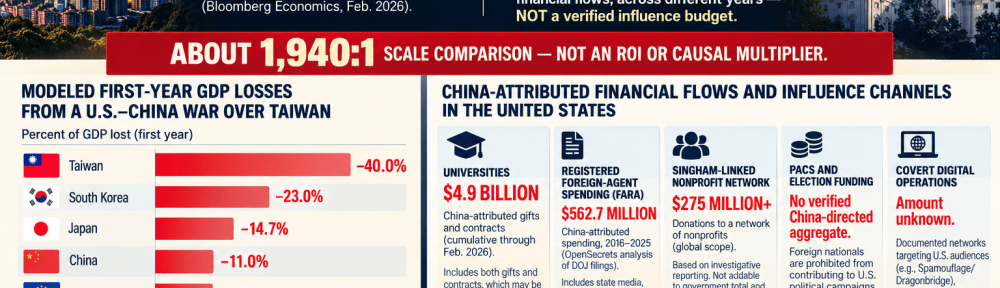
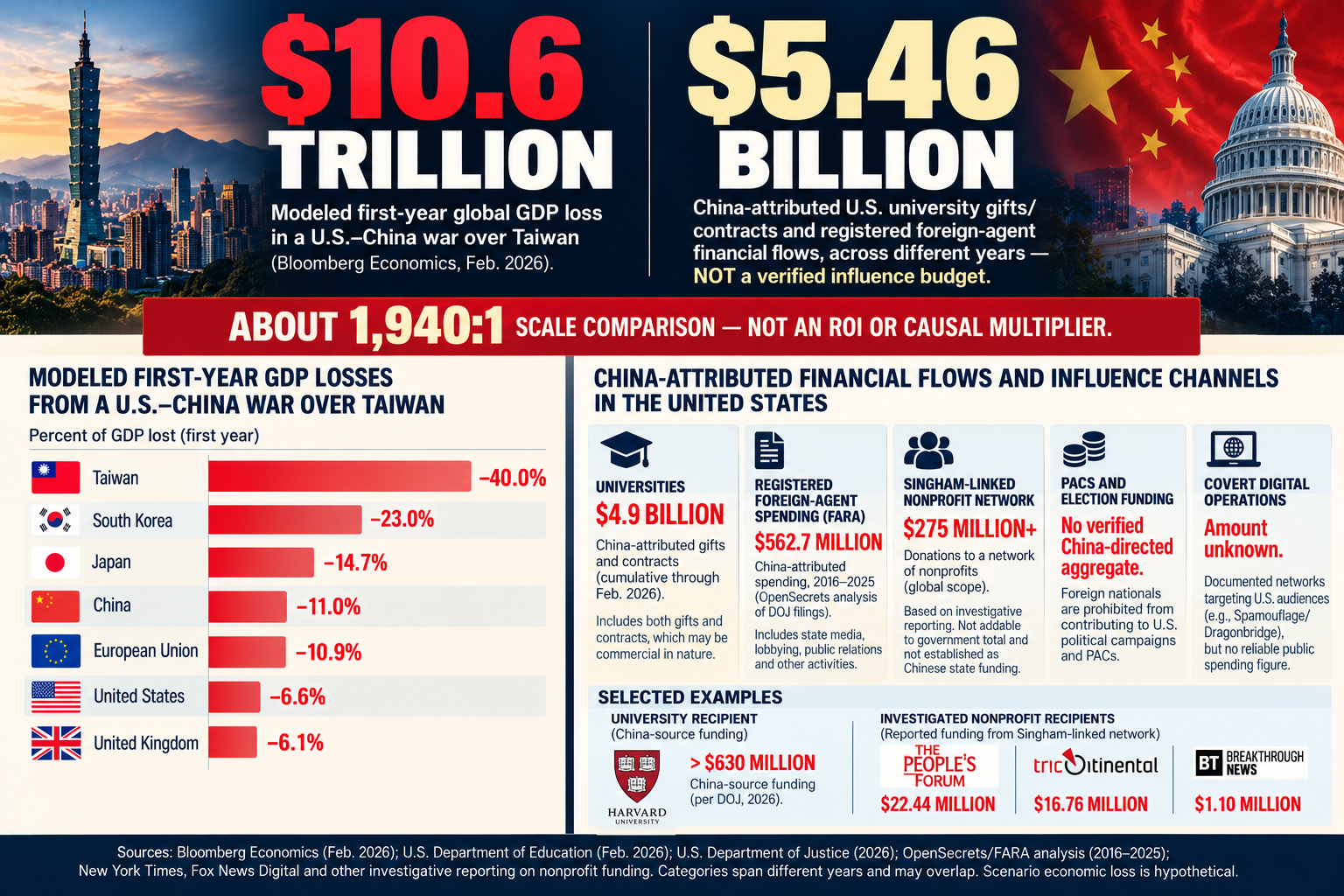
Bloomberg Economics estimated that a major war involving China and the United States could cost the global economy approximately $10.6 trillion in its first year, equivalent to 9.6% of global GDP. The modeled losses include 6.6% of American GDP and 11% of China’s. A Chinese blockade could reduce global GDP by approximately 5%. The consequences would reach American retirement accounts, employment, manufacturing, automobiles and everyday consumer prices.
Beijing has steadily increased military exercises, maritime patrols and operations around Taiwan and the South China Sea. China seeks the ability to impose its will on Taiwan while limiting American intervention.
China Sees an Opening
On October 7, 2023, Hamas invaded Israel, murdering approximately 1,200 people and taking 251 hostages. The ensuing war drew American aircraft carriers, missile-defense systems, intelligence resources and diplomatic attention into successive confrontations involving Gaza, Lebanon, Iran and the Houthis.
Within weeks, foreign-policy researchers identified the opportunity that Beijing will exploit.
On November 9, 2023, Emil Avdaliani of the Stimson Center published For China and Russia, the Gaza War May Be a Blessing in Disguise. He explained that the wars in Gaza and Ukraine interfered with America’s strategic focus on the Indo-Pacific, giving China greater freedom to maneuver and time to prepare for competition over Taiwan.
He compared the opportunity to the years following September 11, when American attention was consumed by the wars on terrorism. The Gaza conflict also threatened the proposed India–Middle East–Europe Economic Corridor, a potential competitor to China’s Belt and Road Initiative.
Two weeks after the Hamas attack, Ahmed Aboudouh of Chatham House published China’s Approach to the War in Gaza Is Not Anti-Israel. It’s Designed to Contain the US.
Aboudouh described Beijing’s posture as anti-Western neutrality. China avoided condemning Hamas’s atrocities while criticizing Israel and portraying America as a destabilizing force. Beijing was using sympathy for Palestinians to undermine American credibility, cultivate support among developing countries and strengthen its diplomatic position on Taiwan and Xinjiang.
Beijing also maintains an enormous economic relationship with Iran.
In April 2026, the U.S. Treasury Department reported that China purchased approximately 90% of Iran’s oil exports. The U.S.–China Economic and Security Review Commission estimated that Chinese purchases generated approximately $31.2 billion in Iranian oil revenue in 2025.
Those revenues support the Iranian government, whose military establishment finances and arms Hamas, Hezbollah and the Houthis. Iran’s regional activities repeatedly demand American military resources and diplomatic attention.
China receives Iranian oil while Tehran’s confrontations with America complicate Washington’s ability to concentrate on Asia.
China’s American Information Campaign
China’s efforts to exploit the conflict have also reached American audiences.
In June 2024, Google’s Threat Analysis Group documented DRAGONBRIDGE, also known as Spamouflage, a vast online influence operation linked to the People’s Republic of China.
The network distributed videos, fabricated news-style broadcasts and social-media comments attacking American democracy and exploiting domestic controversies.
One of its targets was the American campus protests over Gaza.
Beginning in May 2024, Chinese-linked accounts circulated English-language material portraying American police actions against pro-Palestinian demonstrators as evidence of Western hypocrisy. The messaging contrasted the treatment of campus protesters with American support for demonstrations in Hong Kong.
The same network criticized American involvement in Ukraine and depicted American democracy as dysfunctional.
Google disrupted more than 10,000 instances of DRAGONBRIDGE activity across its platforms in the first quarter of 2024. During the first nine months of 2024, Google also terminated more than 22,000 YouTube channels linked to Chinese coordinated influence operations.
Although investigators found limited genuine audience engagement, the volume of fabricated content demonstrated Beijing’s capacity to manufacture political messaging and distribute it across thousands of accounts.
Follow the Money
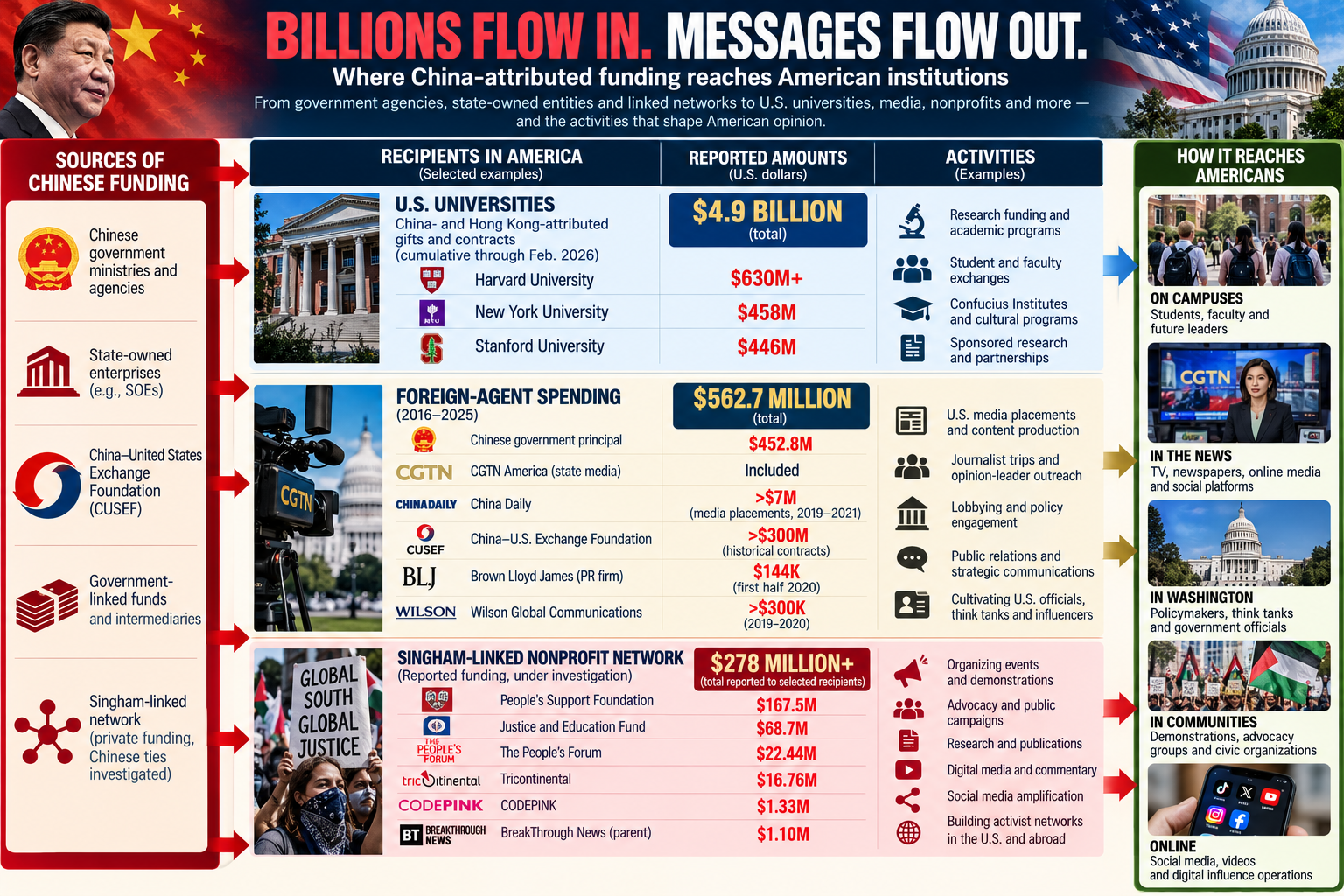
An August 2023 New York Times investigation uncovered a sprawling financial network associated with Neville Roy Singham, an American technology entrepreneur living in Shanghai, with approximately $278 million in reported financial flows attributed to his broader network. Major organizations associated with the network include the People’s Forum, ANSWER Coalition, International People’s Assembly, CODEPINK and affiliated activist and media operations. These organizations have helped organize anti-Israel demonstrations, promote political campaigns and advance positions frequently aligned with Chinese Communist Party interests. The Times also documented Singham’s financial and operational connections to Chinese propaganda organizations. A July 2025 George Washington University study examined overlapping financial relationships, organizational cooperation and ideological alignment involving Singham-linked organizations and groups associated with Shut It Down for Palestine. The $278 million represents broader network financial flows rather than verified direct funding of each organization.
The People’s Forum’s organizing activities became visible immediately after October 7. It co-organized a Times Square demonstration the following day, helped mobilize the November 4 march in Washington, and joined the nationwide Shut It Down for Palestine campaign. On April 29, 2024, more than 100 activists, including Columbia protesters, reportedly gathered at its Manhattan headquarters, where executive director Manolo De Los Santos urged them to “give Joe Biden a hot summer.” These events demonstrate the organization’s participation in street demonstrations and campus-related organizing, alongside a much broader student-led protest movement.
Beyond activist organizations, Chinese government agencies, companies and associated entities have developed financial relationships with American universities, policy institutions, media organizations and Washington lobbying firms.
U.S. Department of Education disclosures identify approximately $4.9 billion in Chinese-source gifts and contracts across roughly 8,000 transactions, making China the second-largest reported foreign funding source. These relationships reach institutions responsible for educating future American leaders and developing advanced technologies. The funding includes research, education and commercial arrangements, while its scale raises questions about academic independence, research security and foreign influence.
Chinese financial relationships have also reached American think tanks and policy institutes, where donor disclosures are less comprehensive and researchers help shape congressional testimony, national security debates and foreign-policy recommendations.
China’s presence in Washington is more directly measurable. According to OpenSecrets, Chinese government and other China-related foreign principals accounted for approximately $563 million in registered foreign-agent spending from 2016 through 2025, including approximately $453 million attributed to the Chinese government. Much of this money supported Chinese state-media operations, while other expenditures financed lobbying and public relations. U.S. Justice Department records, for example, document the Chinese Embassy’s engagement of Squire Patton Boggs to advise on congressional legislation, defense appropriations and other matters before Congress. Chinese-owned companies have separately spent millions lobbying over trade, technology restrictions and federal regulation.
From Gaza to Taiwan: The Same Organizations
CODEPINK‘s activism extends far beyond opposition to Israel. Its China Is Not Our Enemy campaign opposes American military preparations in Asia and criticizes U.S. support for Taiwan. Following Nancy Pelosi’s 2022 visit, CODEPINK characterized the trip as a dangerous escalation. Its Reject the US Militarism in the Pacific campaign challenges American military infrastructure and partnerships involving Japan, South Korea, the Philippines, Guam and Australia.
The ANSWER Coalition similarly opposes American military expansion in the Pacific, including military bases and exercises involving Okinawa and South Korea. Both organizations describe their positions as opposition to militarization and overseas intervention.
The overlap is striking. Organizations mobilizing against American support for Israel also oppose military commitments and partnerships central to American deterrence in Asia. Beijing has its own reasons for welcoming those positions: weakening America’s regional alliances would make coercion of Taiwan easier. The alignment of these policy positions is documented; whether Chinese funding or direction caused them is a separate question.
The Real Strategic Contest
American deterrence around Taiwan depends on naval forces, regional bases, military cooperation with Japan and the Philippines, defense spending and the political willingness to confront Chinese coercion.
China’s military buildup raises the cost of American intervention around Taiwan. Its influence operations exploit the political divisions that could make such intervention harder to sustain. Meanwhile, conflicts involving Iran and its proxies continue to consume American resources and attention.
A Taiwan war could destroy $10.6 trillion in global economic output in its first year. China’s disclosed financial relationships with American institutions and media operations amount to billions of dollars across multiple years, much of it spent on activities unrelated to political influence. Even a relatively small, effective influence campaign could matter enormously if it altered America’s willingness to defend Taiwan.
For a few billion dollars spent influencing Americans to be anti-Israel and pro-Iran, China is targeting several TRILLIONS of dollars in Asia.
Sources
- Stimson Center — For China and Russia, the Gaza War May Be a Blessing in Disguise, November 2023.
- Chatham House — China’s Approach to the War in Gaza Is Not Anti-Israel. It’s Designed to Contain the US, October 2023.
- U.S. Treasury Department, April 2026, reporting on China’s purchases of Iranian oil.
- U.S.–China Economic and Security Review Commission, March 2026, research on Iranian oil revenues.
- Google Threat Analysis Group, June 2024, research on DRAGONBRIDGE.
- Google congressional testimony, 2024, coordinated Chinese influence operations.
- George Washington University Program on Extremism — CCP Influence in U.S. Pro-Palestinian Activism, July 2025.
- The New York Times — A Global Web of Chinese Propaganda Leads to a U.S. Tech Mogul, August 2023.
- CODEPINK — China Is Not Our Enemy.
- CODEPINK — Reject the US Militarism in the Pacific.
- ANSWER Coalition — Islanders Unite to Resist a New Pacific War.
- Center for Strategic and International Studies — Taiwan Strait maritime trade research.
- Bloomberg Economics — The $10 Trillion Fight: Modeling a US-China War Over Taiwan, February 2026.
- Congressional Research Service — Section 117 of the Higher Education Act: Reporting of Foreign Gifts and Contracts, March 2026.
- OpenSecrets — Foreign Lobby Watch, 2016–2025.
- U.S. Department of Justice — FARA semiannual reports, including Squire Patton Boggs’ representation of the Chinese Embassy.
- Harvard/University of Connecticut Crowd Counting Consortium — U.S. protest and campus encampment data, 2023–2024.
- The People’s Forum — October 2023 statements and protest mobilization announcements.
- Reporting on the People’s Forum’s April 29, 2024 organizing meeting in Manhattan.


