Parshat Beha’alotcha opens with the lighting of the Menorah.
The Haftorah from Zechariah returns to the same image but adds a remarkable detail. The prophet sees a golden Menorah fed by two olive trees, one on each side, supplying a continuous flow of oil.
Confused by the vision, Zechariah asks what it means. The answer contains one of the most famous lines in the Bible:
“Not by might, nor by power, but by My spirit, says the Lord of Hosts.” – Zechariah 4:6
The vision came during the rebuilding of Jerusalem and the Second Temple. A small Jewish community had returned from Babylonian exile and faced the daunting task of restoring both a city and a nation.
Many readers focus on the famous verse. The prophet, however, devotes considerable attention to the two olive trees.
Rashi, following the Talmud, identifies the two olive trees with Joshua the High Priest and Zerubbabel the governor. One represented the spiritual leadership of the nation. The other represented its political and civic restoration.
The symbolism is powerful.
The Menorah stands between spiritual leadership and political leadership. Between the Temple and the city. Between faith and statecraft.
The vision’s message was not that politics would save the Jewish people. Nor was it that spiritual life alone would rebuild Jerusalem.
The Temple could not stand without a city. A city could not fulfill its purpose without the values embodied by the Temple.
That lesson echoed throughout Jewish history.
Kings and prophets, priests and governors, rabbis and communal leaders each played different roles in sustaining Jewish life. Sometimes they cooperated. Sometimes they clashed. Yet Jewish continuity depended on both the preservation of spiritual purpose and the institutions capable of carrying that purpose into the world.
Today, Israel’s state emblem places a Menorah at its center, flanked by olive branches. The design was inspired by the Menorah depicted on the Arch of Titus in Rome, commemorating the destruction of Jerusalem nearly two thousand years ago. Yet the image also echoes Zechariah’s vision of a Menorah being reestablished in Jerusalem, standing between olive trees.
A people of faith needs security, institutions, and leadership. A nation needs purpose, values, and a mission greater than itself.
Zechariah’s vision does not place the Menorah beneath a single olive tree.
It stands between two.
The light of Israel emerges from the meeting point of spiritual purpose and national life.
On November 1, 2026, Palestinians are scheduled to elect a new Palestinian National Council (PNC), the legislative body of the Palestine Liberation Organization.
Before they can choose their leaders, however, they must answer a more fundamental question: Who gets to vote?
The PNC claims to represent Palestinians everywhere, not merely those living in the West Bank and Gaza. Its members help determine the leadership and direction of the Palestinian national movement itself. The question of voter eligibility is therefore inseparable from the question of who is represented.
The new electoral framework approved by President Mahmoud Abbas reserves 200 seats for Palestinians living in the West Bank, Gaza, and Jerusalem, and 150 seats for the diaspora.
The allocation itself reveals a dilemma.
The Palestinian national movement claims to represent over fourteen million people worldwide. Yet more than nine million live outside the territories. A fully proportional system could allow voters in Jordan, Europe, North America, and elsewhere to dominate institutions that claim to represent Palestinians living in Ramallah, Hebron, Nablus, and Gaza. The 200-150 split appears to give preference to those who live with the consequences of Palestinian political decisions over the larger voices from around the world.
That raises a more difficult question.
Who qualifies as Palestinian?
Should Jordanian citizens of Palestinian origin – like Queen Rania – vote? What about Americans, Canadians, or Europeans whose grandparents left the region decades ago? How many generations removed from Palestine remain eligible?
Queen Rania of Jordan, also a Palestinian
The question may be most consequential in Jordan, where millions of people of Palestinian origin – estimated at 70% of the population – already participate in the political life of another state. Would Jordanian citizens vote in elections for a body that claims to represent Palestinians globally? If so, how many generations removed from Palestine remain eligible?
The question becomes even more complicated inside Israel.
Roughly two million Israeli Arabs vote in Israeli elections and participate in Israeli political life. Many also identify as Palestinian. Will they vote in elections for the Palestinian National Council?
Jerusalem creates an additional complication. Palestinian leaders seek participation from Arab residents of eastern Jerusalem, which they view as part of a future Palestinian state. Israel considers Jerusalem part of Israel, and many Arab residents of eastern Jerusalem hold Israeli citizenship.
If eastern Jerusalem residents vote while Arab citizens of Israel elsewhere do not, Palestinian leaders will be drawing distinctions that many people may find difficult to explain. Why should an Israeli citizen in eastern Jerusalem participate while an Israeli citizen in Haifa, Nazareth, Acre, or Jaffa cannot?
Arabs in the Old City of Jerusalem. Some are Israeli citizens while others only residents. Who will be invited to participate in Palestinian elections? (photo: First One Through)
The Jerusalem question raises another issue Palestinian leaders will eventually have to address.
If current residency in eastern Jerusalem or the West Bank is enough to qualify someone to participate in Palestinian national elections, what about the hundreds of thousands of Jews who live in those same areas?
Palestinian leaders consider eastern Jerusalem and the West Bank part of the territory of a future Palestinian state. More than 700,000 Israeli Jews live there today. Will any of them be eligible to vote for the Palestinian National Council?
The issue extends beyond contemporary residents. Before 1948, the term Palestinian was often used in a geographic sense. Jews living in Mandatory Palestine carried Palestinian passports and considered themselves Palestinian.
A descendant of an Arab family that left Jaffa, Haifa, or Jerusalem generations ago may be eligible to vote despite never having lived there. A descendant of a Jewish family that lived continuously in Jerusalem, Hebron, Safed, or Tiberias for centuries almost certainly will not be allowed to participate in PNC elections.
The distinction reveals that eligibility is not based solely on current residence, geography, or even historical presence in the land. The electorate is being defined through a more specific combination of ancestry, identity, and connection to a particular historical community.
For decades, Palestinian leaders have often left the boundaries of Palestinian identity deliberately broad. Political movements can operate with ambiguity. Elections cannot.
The voter rolls will reveal whether Palestinian nationhood is principally based on residence, citizenship, ancestry, ethnicity, geography, national affiliation, or some combination of all six. Ethnicity alone cannot fully explain the answer. Palestinians, Jordanians, Syrians, Lebanese, and many others share substantial linguistic, cultural, familial, and ethnic ties. The decisive factor appears to be a connection to a particular place and to people who lived there at a particular moment in history.
That is what makes the exercise so unusual. A Palestinian born in Chile, Canada, or the United States may qualify because a grandparent once lived in Jaffa or Jerusalem. A Jordanian or Syrian whose family never lived in Mandatory Palestine may not qualify despite sharing many of the same cultural and ethnic characteristics. A Jew – regardless of where he currently or historically lived – may be excluded.
Every eligibility rule will draw a line. Some people will be included while others will be excluded. Every decision will reveal how Palestinian leaders understand nationality, citizenship, ancestry, and belonging.
In many ways, Palestinians are attempting something few modern national movements have ever attempted: defining a political nation across multiple countries, generations, and citizenships while simultaneously deciding who belongs to it.
Imagine a movement claiming to represent all Black people whose families lived in North Carolina before 1948. Descendants living in California, London, or Johannesburg could vote even if they had never visited the state. Non-Black current residents of North Carolina could not. The electorate would be defined by ancestry tied to a place and a moment in history.
Whether one finds that model compelling or problematic, the Palestinian election will force its architects to explain where they draw those lines.
Whatever rules emerge, millions of people will discover whether they are considered part of the Palestinian political nation, observers of it, or something in between.
Most elections choose leaders. This election may do something far rarer: define the nation itself.
Before Palestinians can elect their leaders, they must first answer a more difficult question:
All three women have spent years accusing Israel of apartheid. They have described it as a state built on Jewish supremacy. They have accused it of ethnic cleansing, war crimes, and genocide. They portray Israel as uniquely dangerous for Palestinian Arabs and Muslims.
Yet all three Muslim women voluntarily sought entry.
If they truly believed their own accusations, the decisions are difficult to comprehend.
People do not voluntarily place themselves under the authority of governments they believe are genocidal. They do not seek access to countries they regard as fundamentally dangerous to people like themselves.
There is a reason almost no Syrian Jews are preparing to return to Syria despite recent invitations from the country’s new leadership. Syria was once home to a thriving Jewish community. Today, it is virtually gone. Whatever promises may be made by the new government, people who genuinely fear for their safety do not rush back. They do not voluntarily place themselves under the authority of a state they believe could harm them.
Sarsour, Tlaib, and Omar did the opposite.
Their applications revealed something their rhetoric obscures. Whatever they say about Israel, they expected to arrive safely, travel freely, and return home without incident.
Consider the many Muslim-majority countries with suffering populations that these Muslim women did not attempt to enter. Sudan and Somalia. Lebanon and Syria. Yemen and Iran. Yet these women say nothing about those regimes and do not seek to visit those nations.
It is difficult to reconcile the claims that Israel is a genocidal, apartheid, supremacist state – seemingly uniquely in the region – and that people who vilify the country are running to visit it.
No one forced them to apply for a visa. They wanted to go.
And that may be the strongest commentary on their smear and accusations campaign of all.
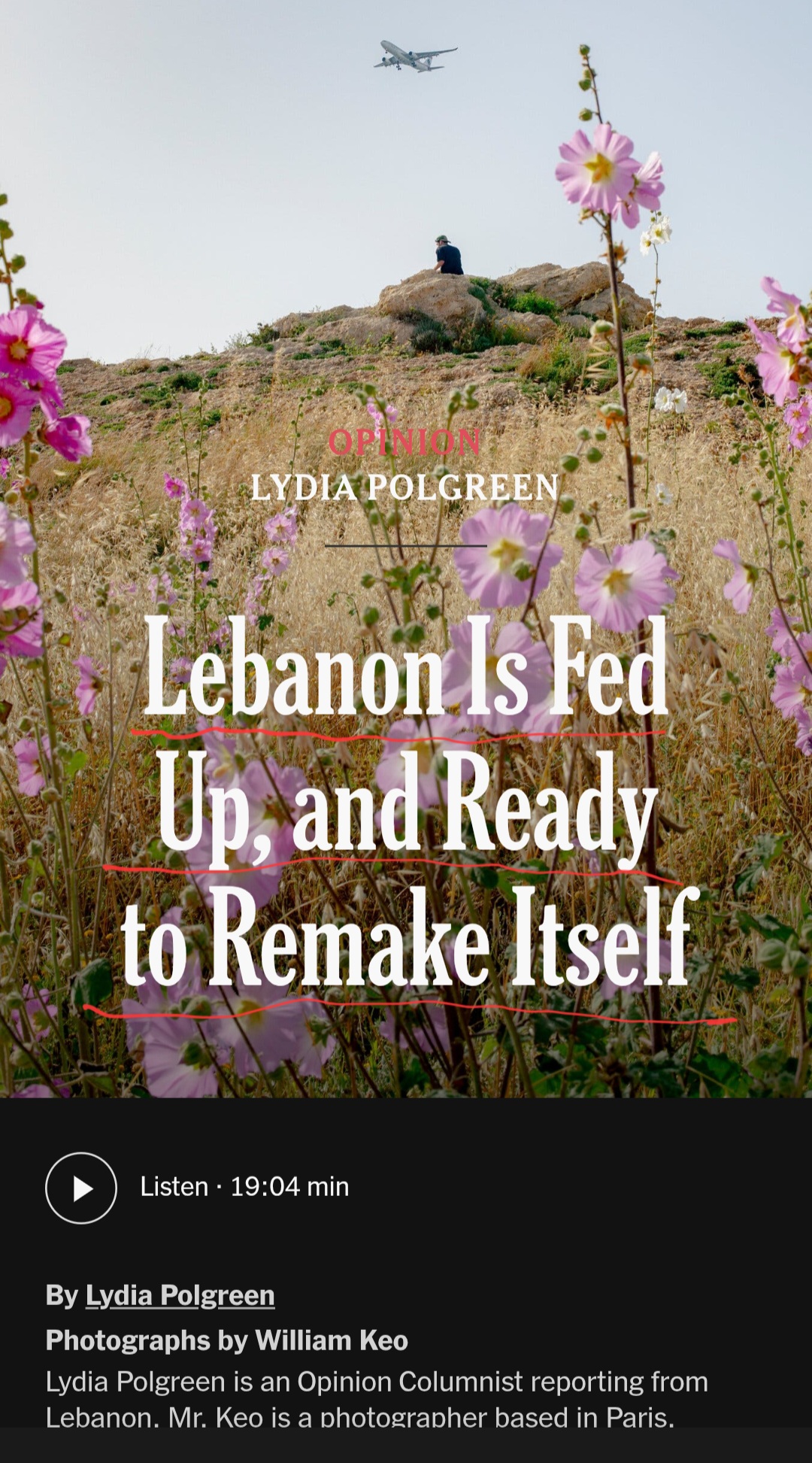
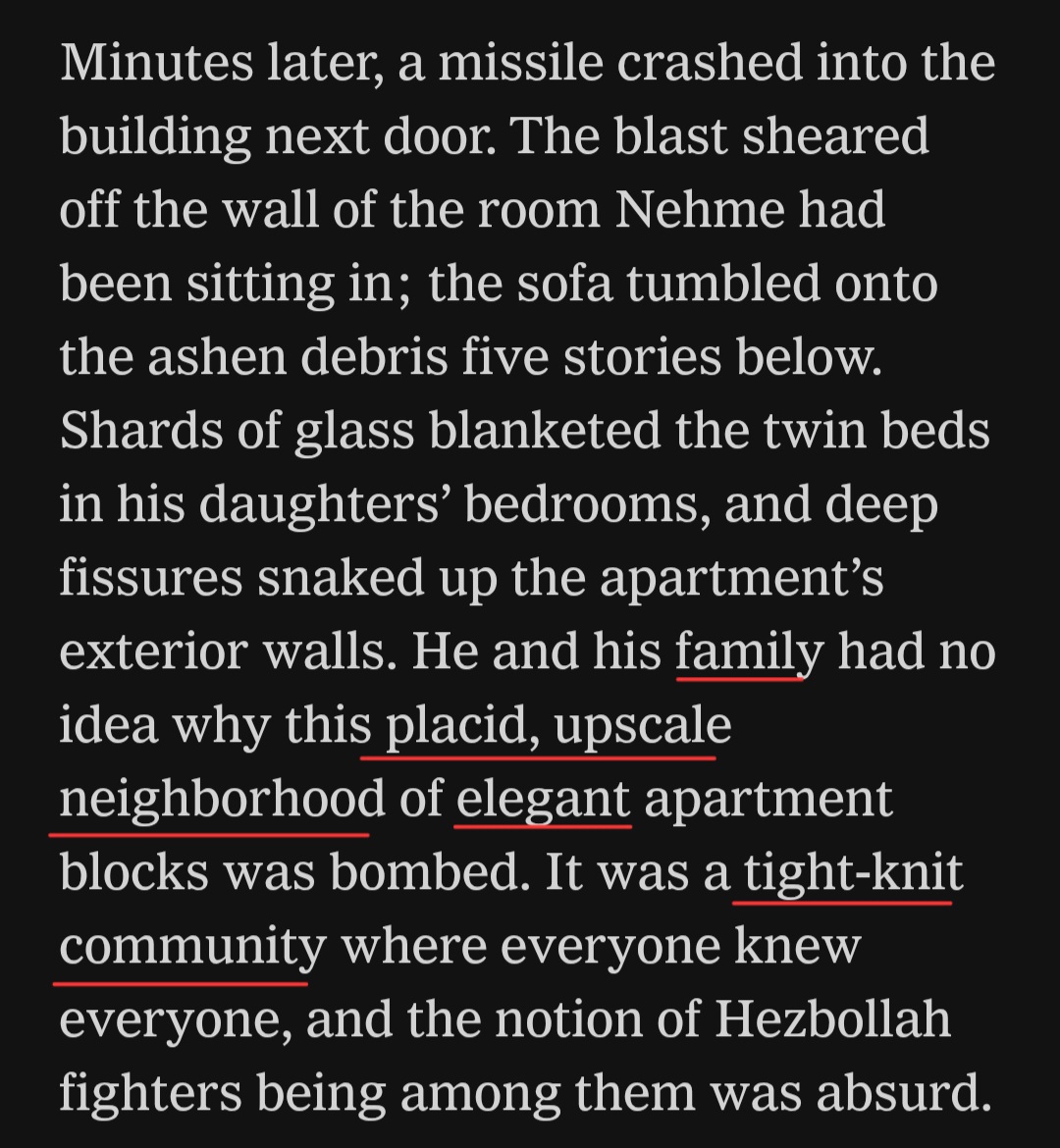
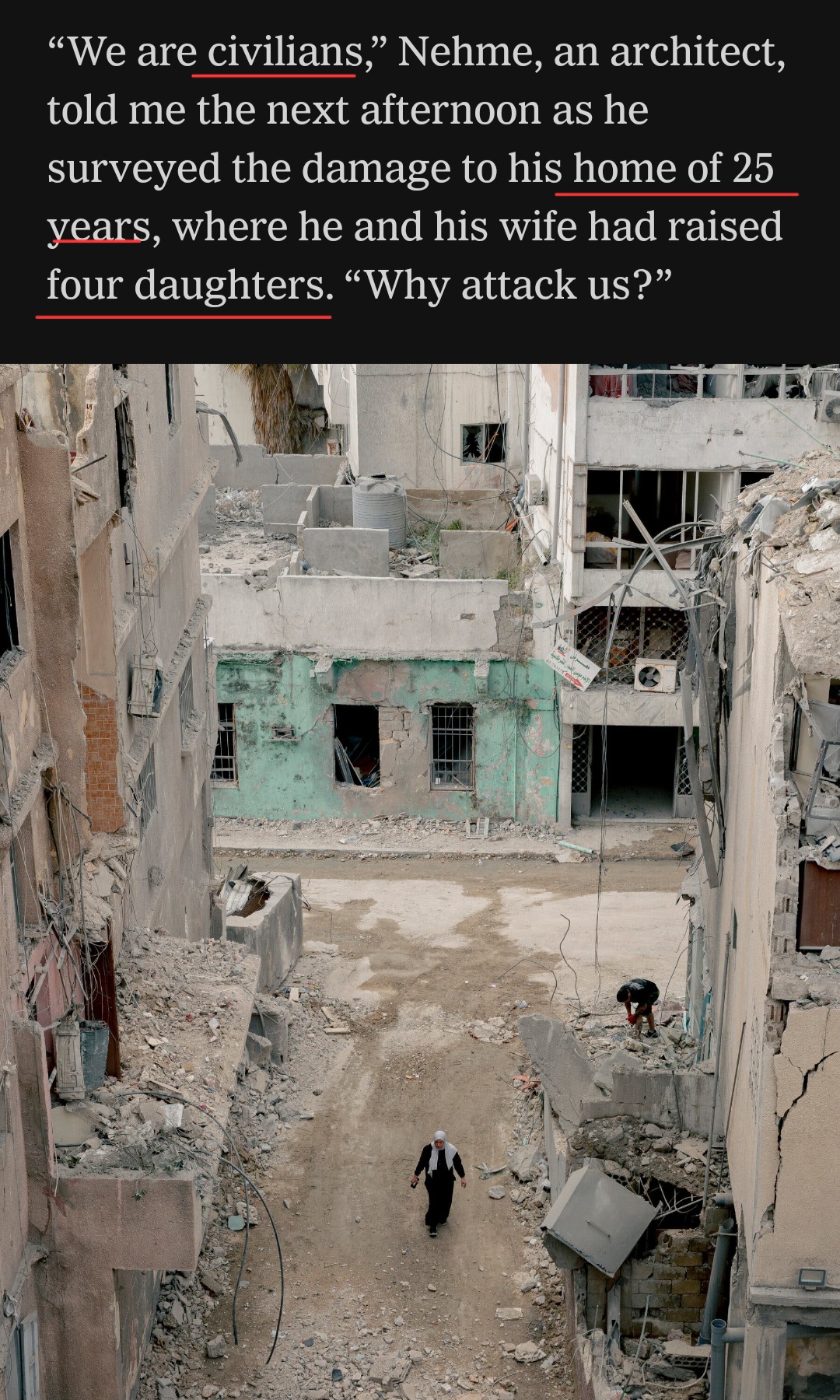
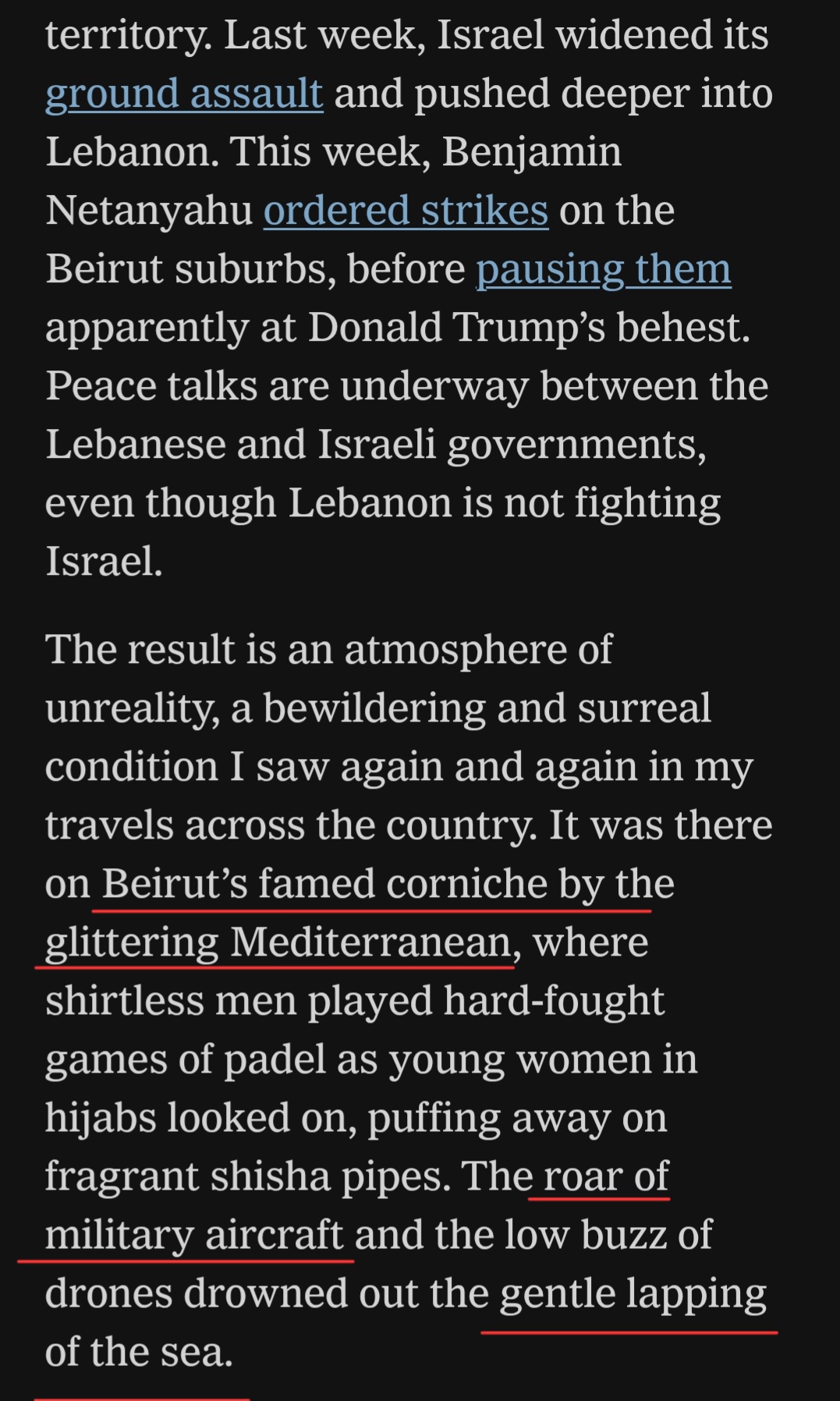
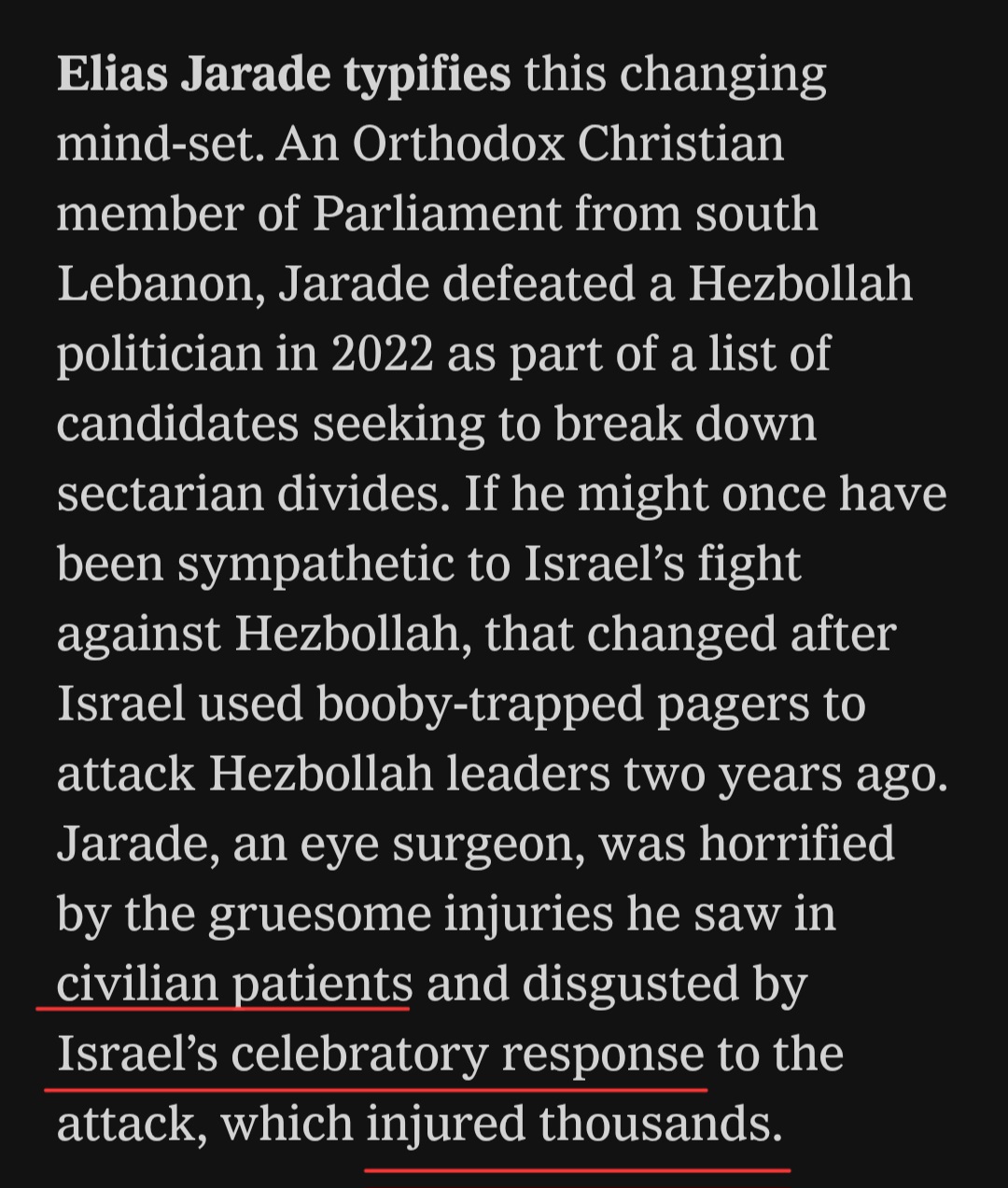
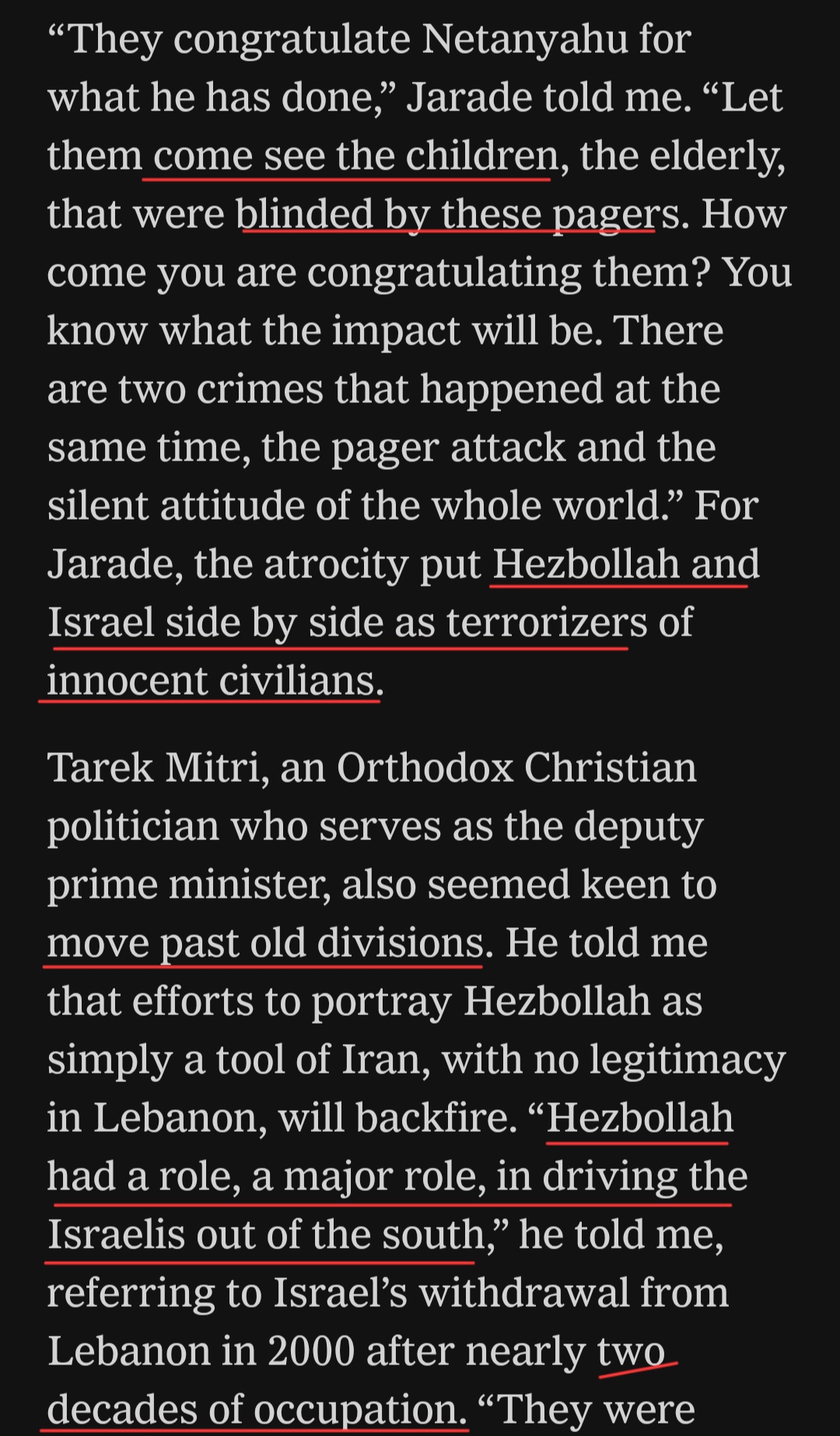
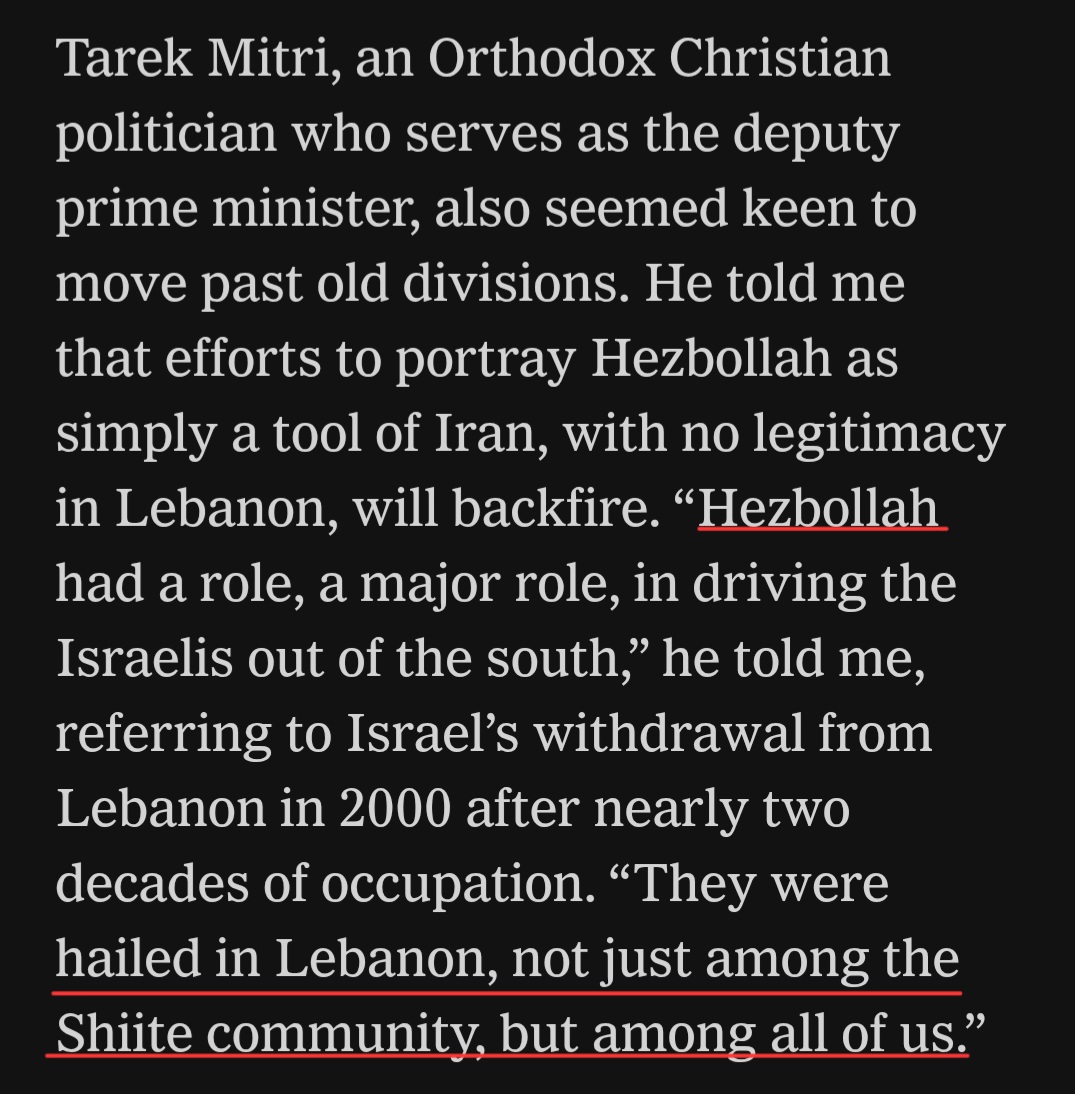
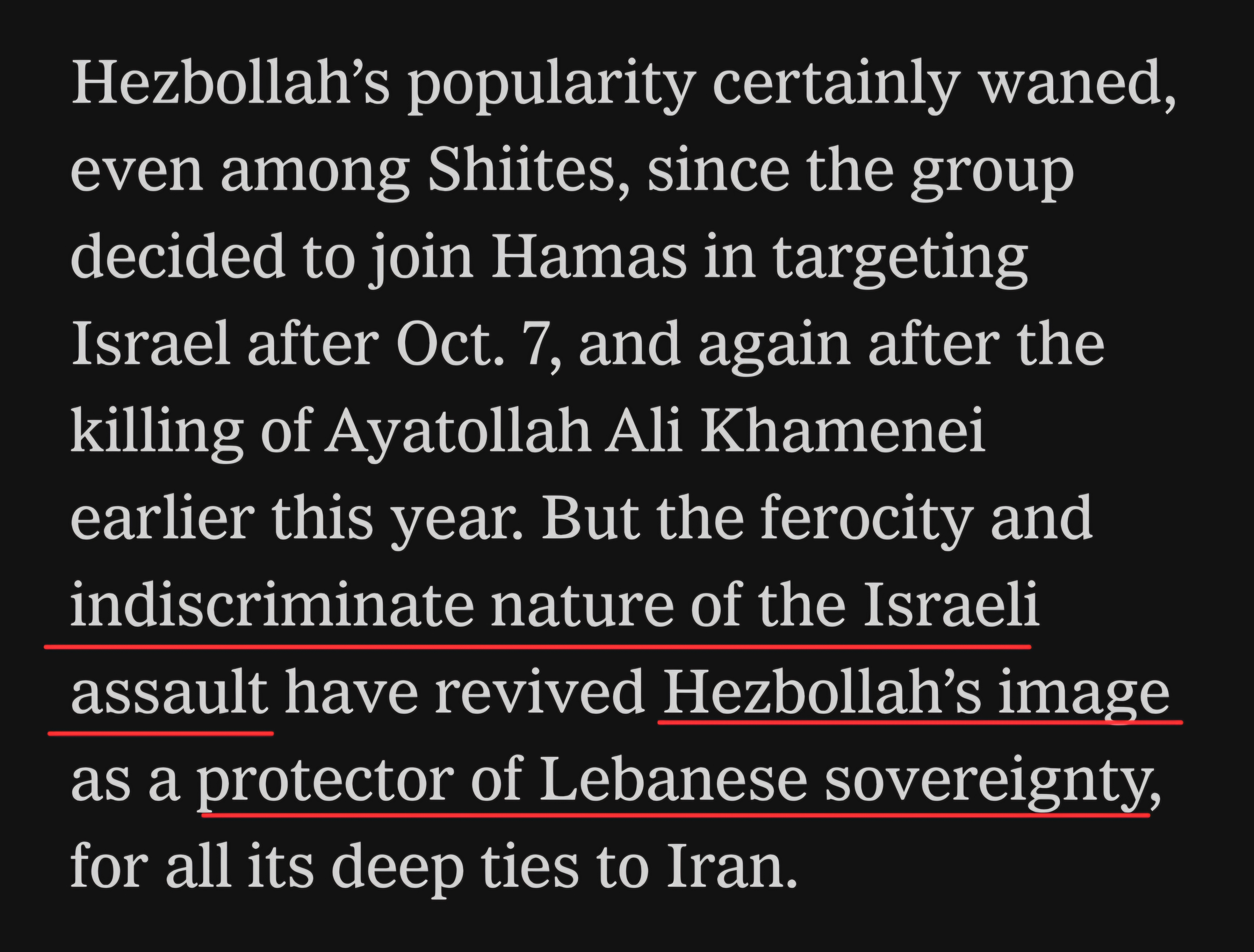
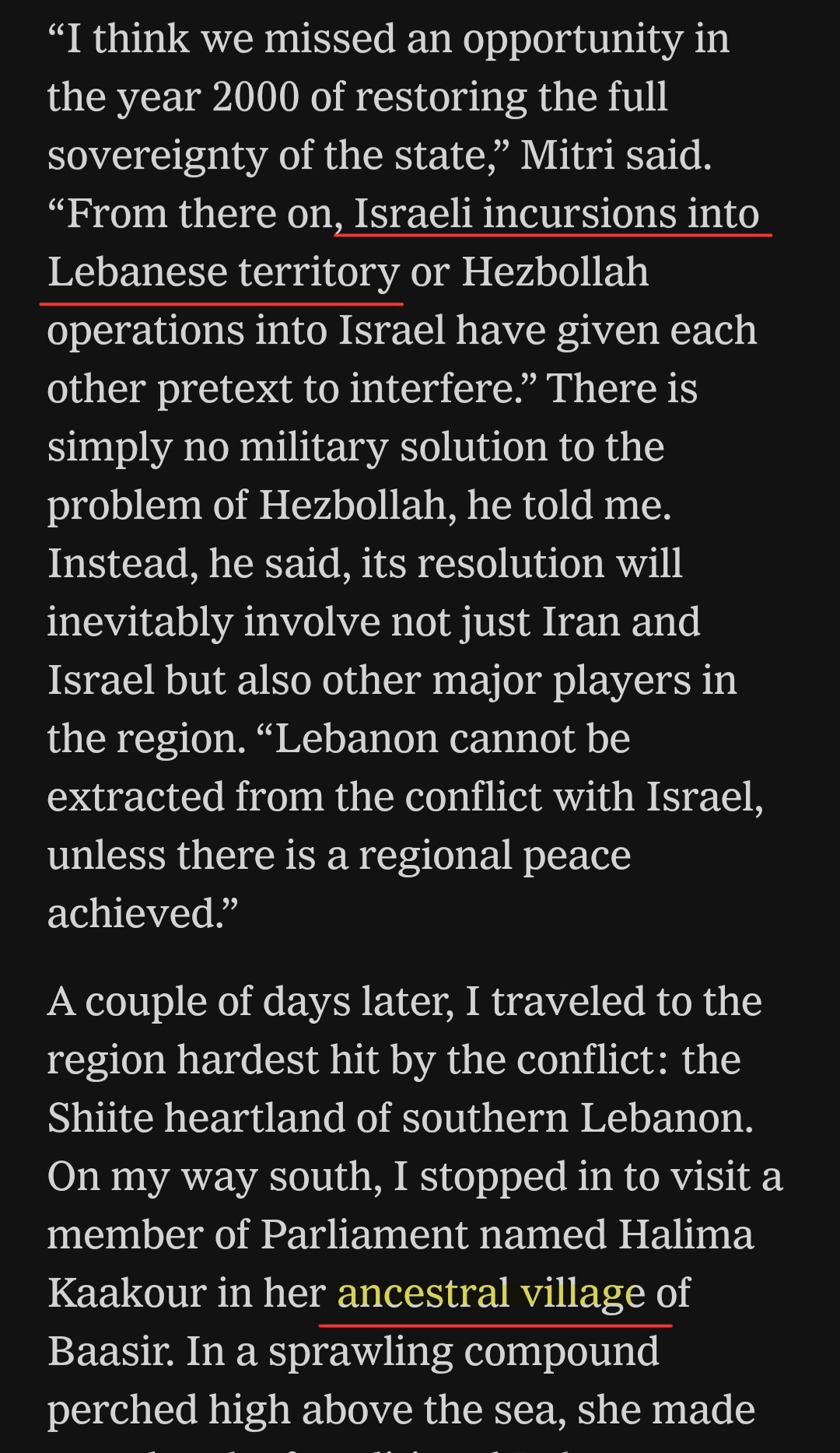
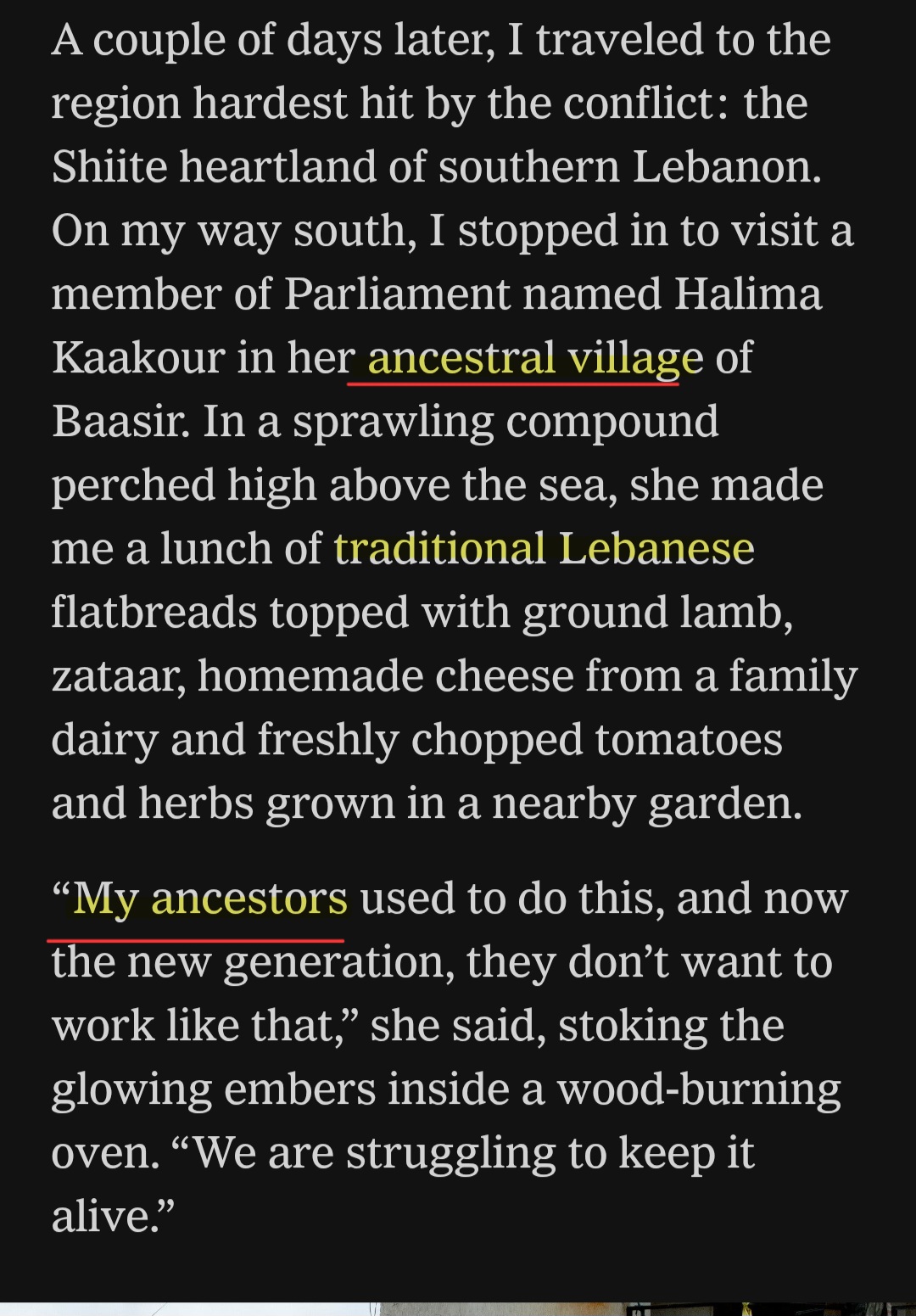
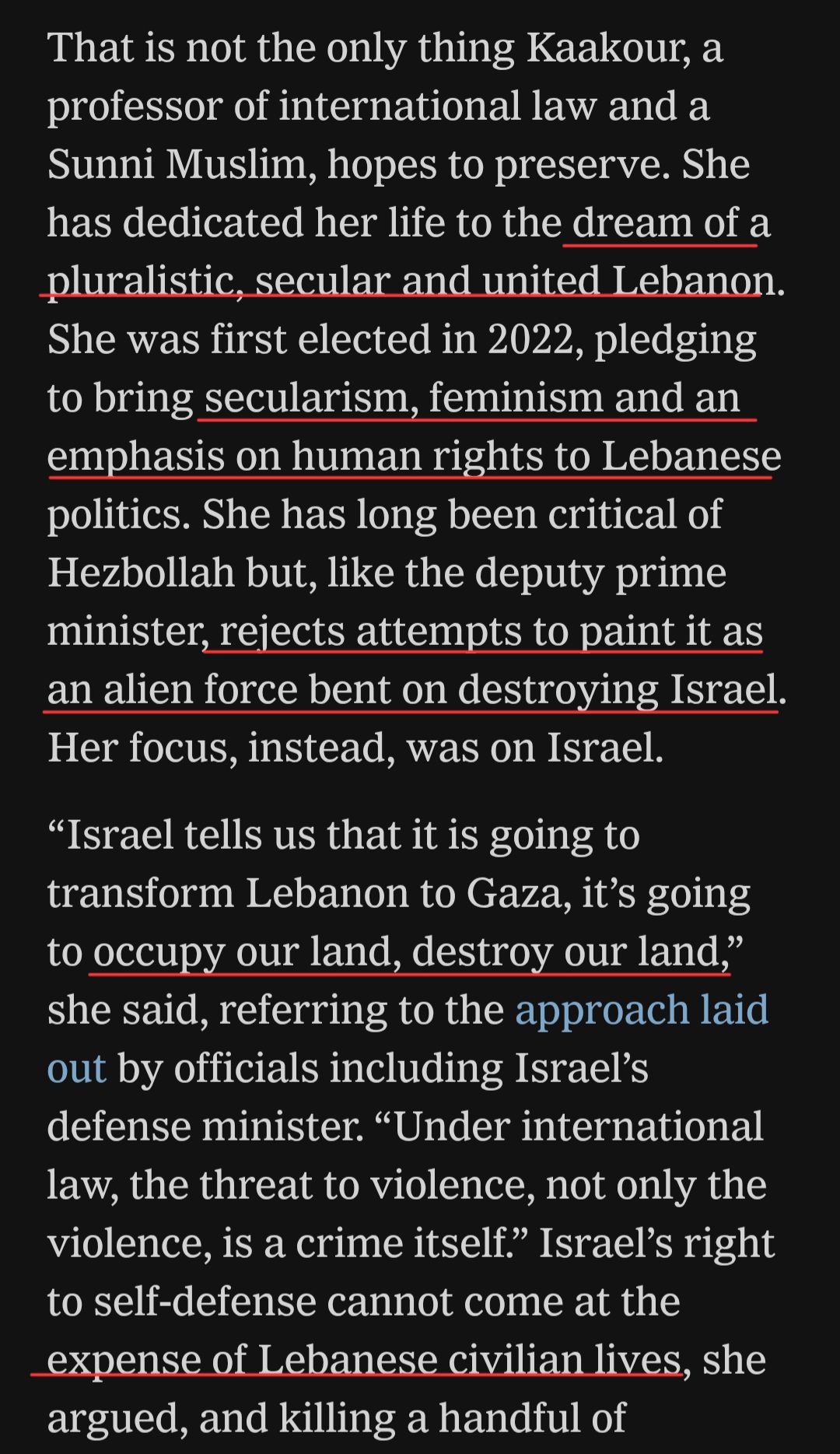
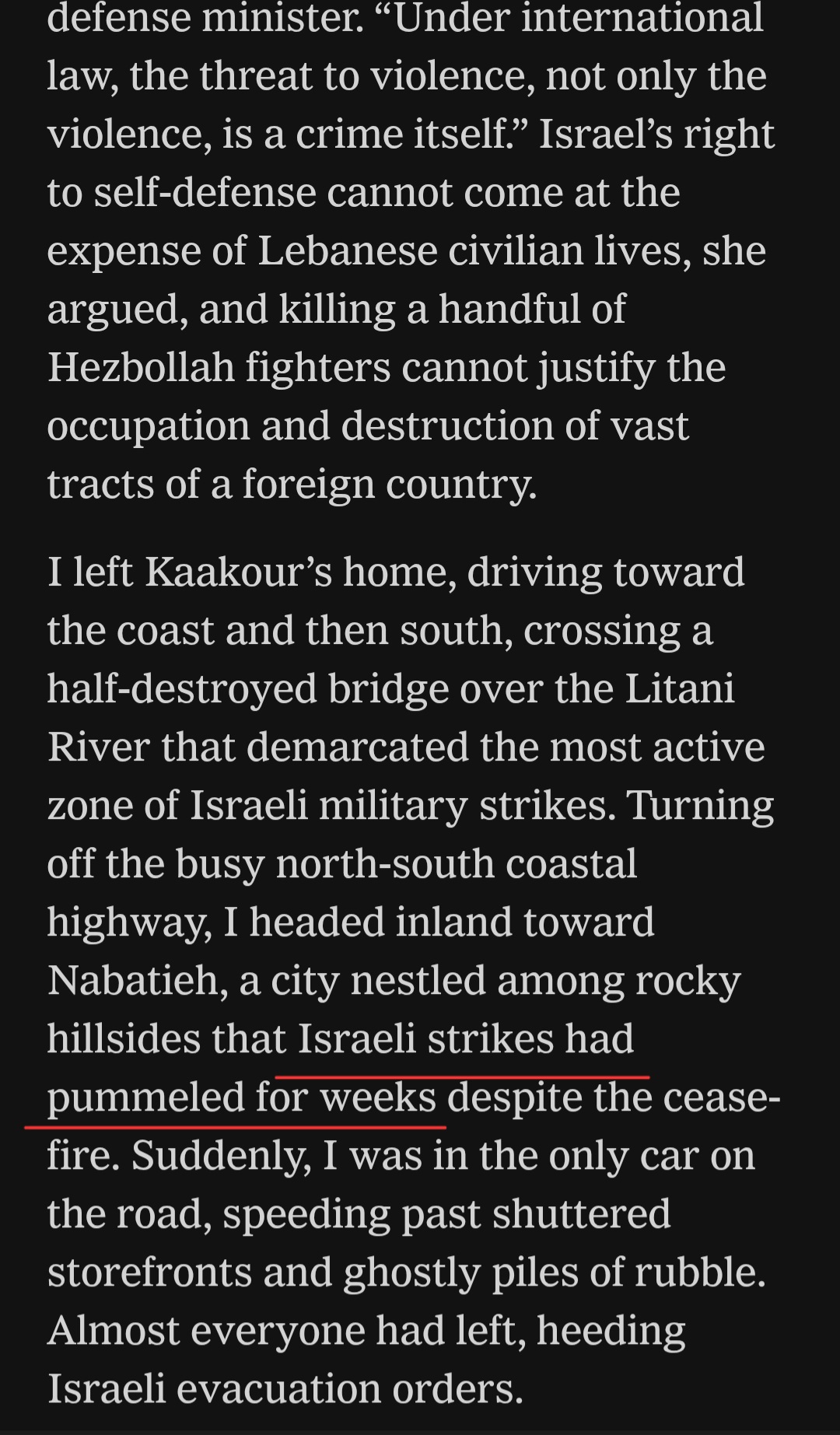
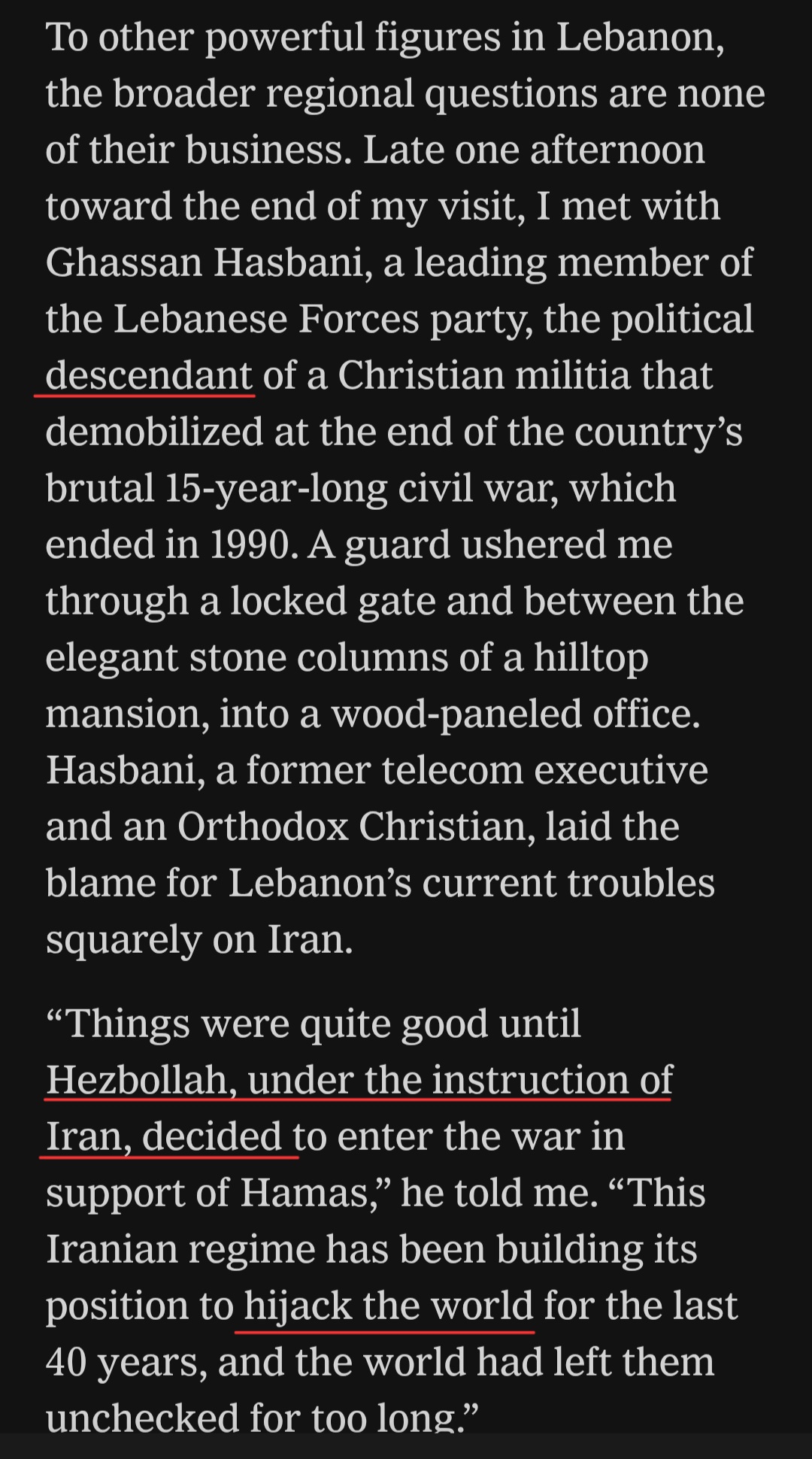
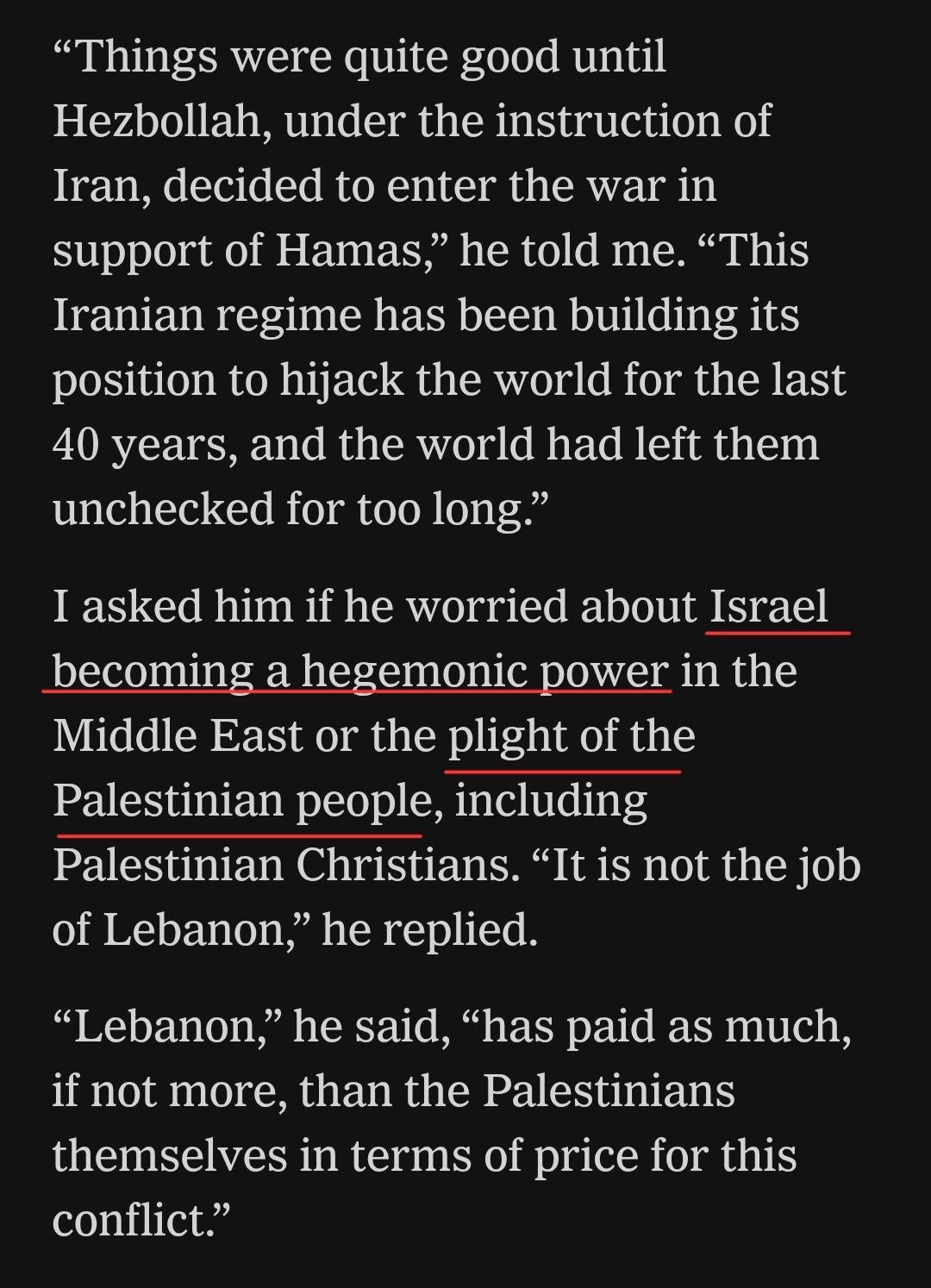
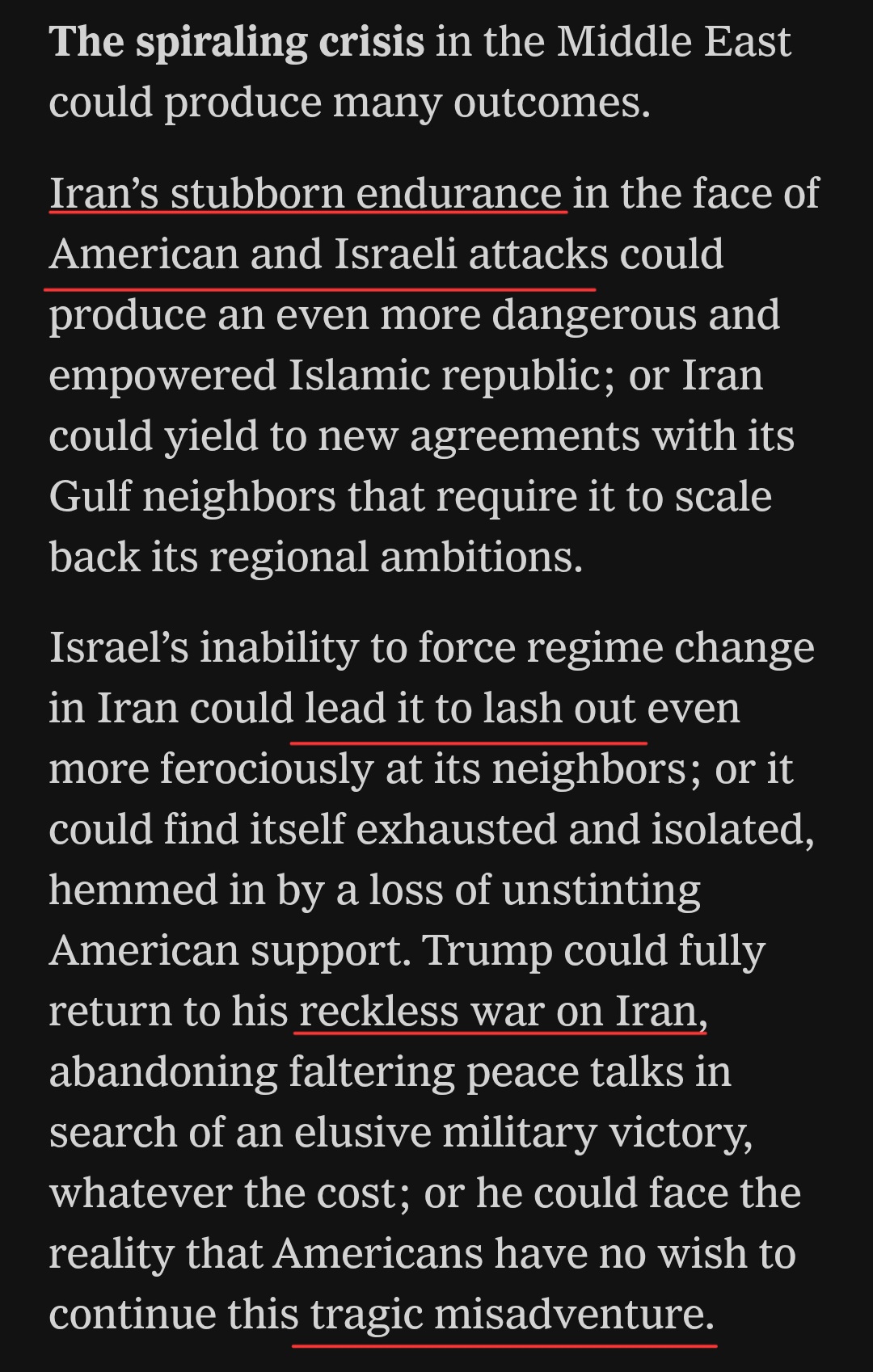
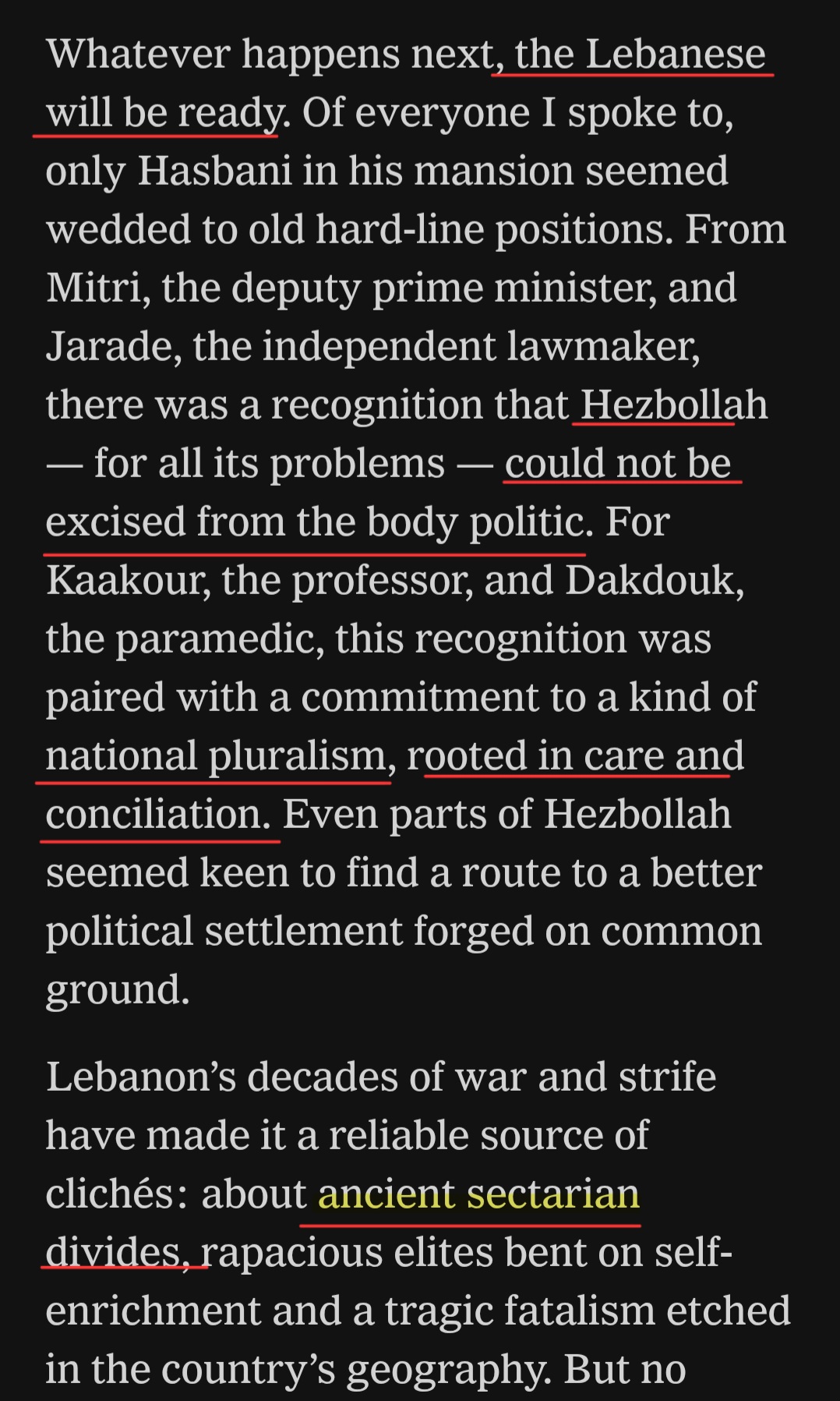
Readers are taken through a long 3,200-word editorial about an “ancient” country recovering from war. They meet civilians, politicians, intellectuals, and even Hezbollah supporters. They hear about sovereignty, reconstruction, and national renewal.
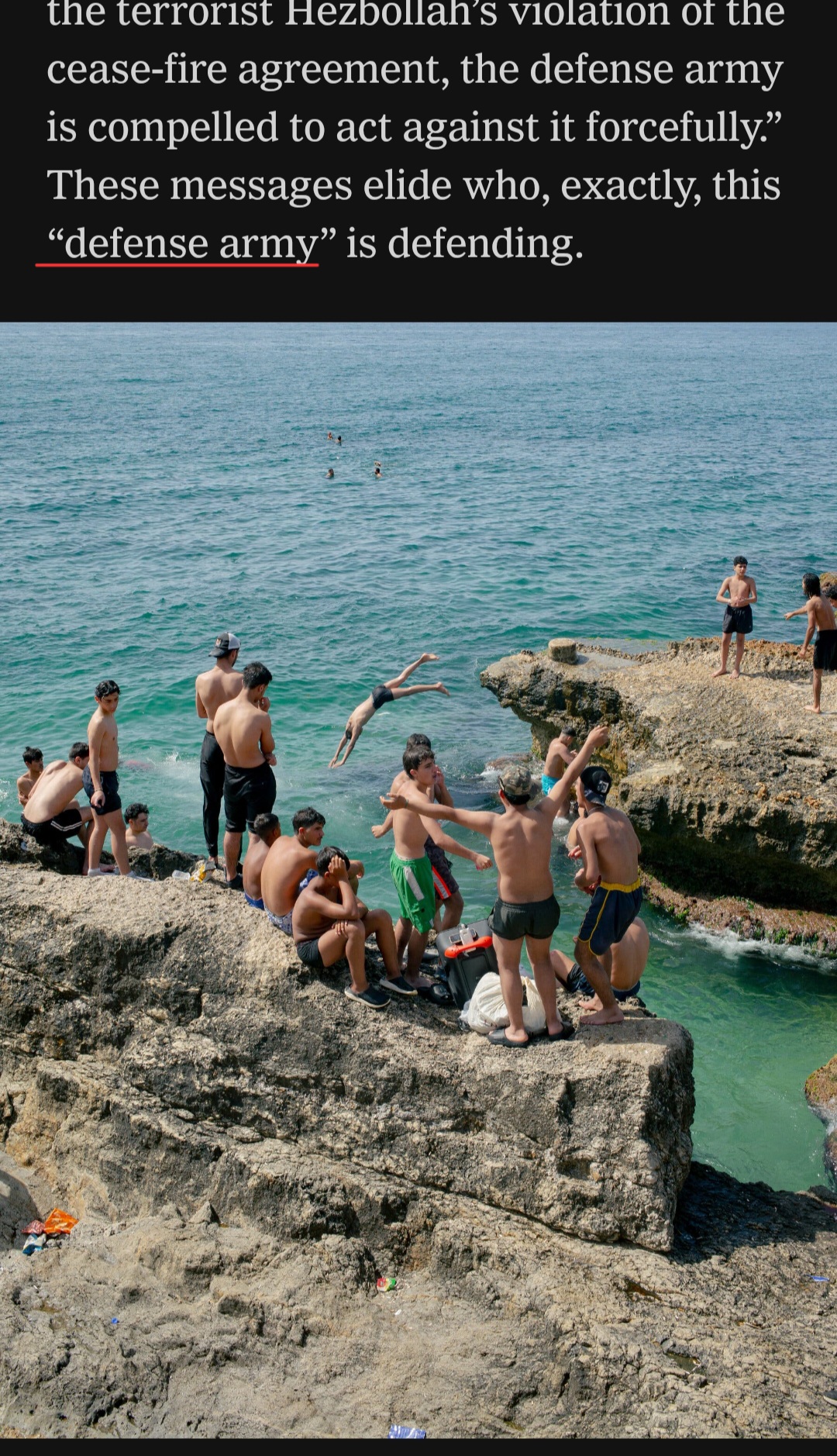
Picture accompanying 3,200-word article by Lydia Polgreen, placing a person sitting on a rock between a field of flowers and a plane overhead, a metaphor between its “ancient” beautiful land and foreign forces overhead or the temptation of leaving out of fear and disgust.
Then the focus shifts.
What begins as a reflection on Lebanon’s future gradually becomes a discussion of whether Israel should continue to exist in its present form.
That turn reveals the essay’s central assumption.
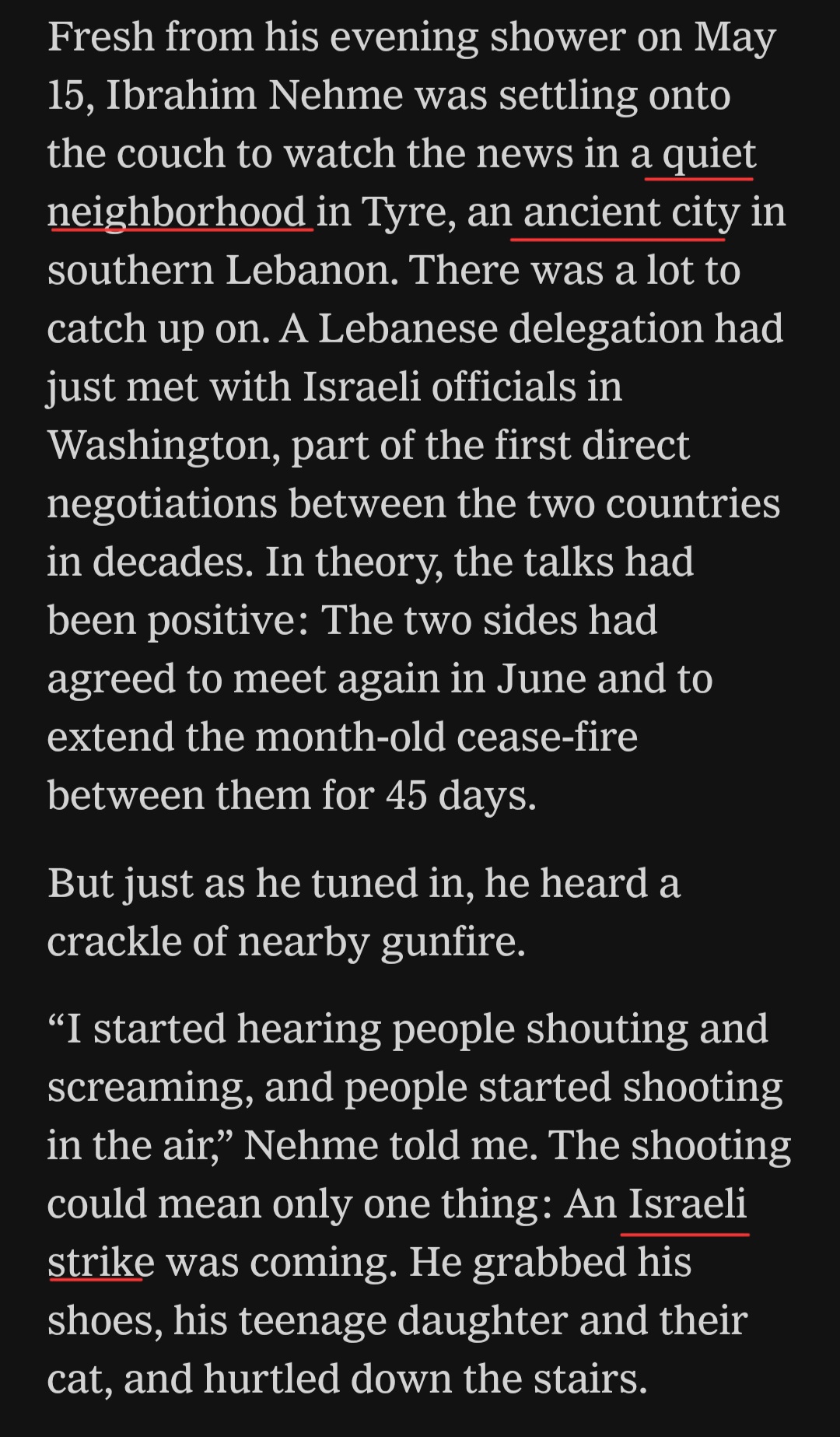
Lebanon is introduced through the language of continuity. Tyre is an “ancient city.” Villages are “ancestral.” Sectarian divisions are “ancient.” The country is presented as a society with deep roots struggling to reclaim its future.
Israel receives a different vocabulary.
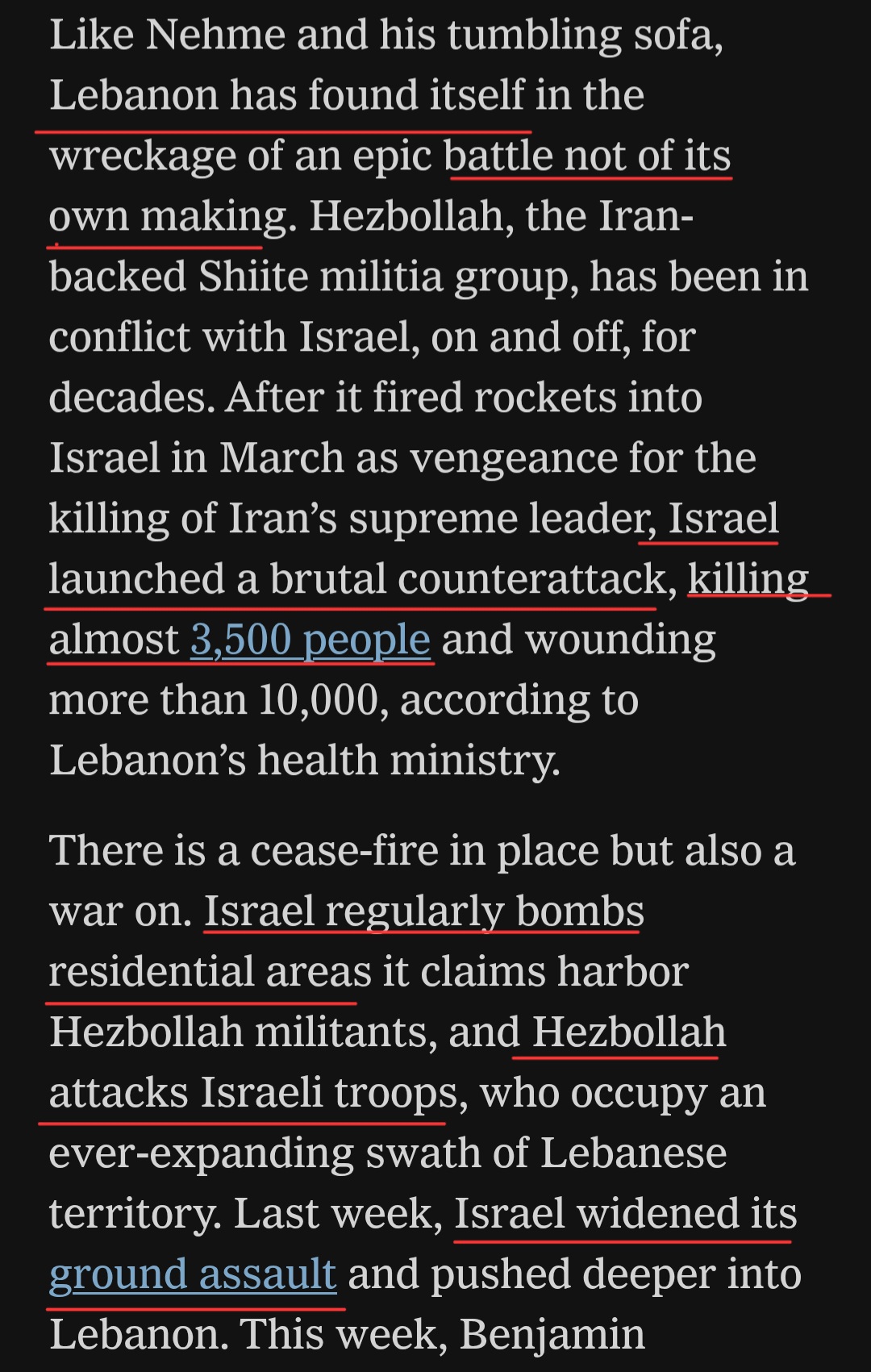
Israel occupies. Israel expands. Israel bombs. Israeli troops hold an “ever-expanding swath” of territory. The Israel is a “foreign military” operating inside another country. Israeli actions are repeatedly interpreted through ideological labels such as a “maximum-war doctrine.”
One nation is described through history and belonging. The other through power and force.
The contrast becomes more striking when the essay turns to sovereignty.
The preferred frame is Israeli intrusion into Lebanese sovereignty. Yet the defining political reality of modern Lebanon is that sovereignty itself remains unresolved.
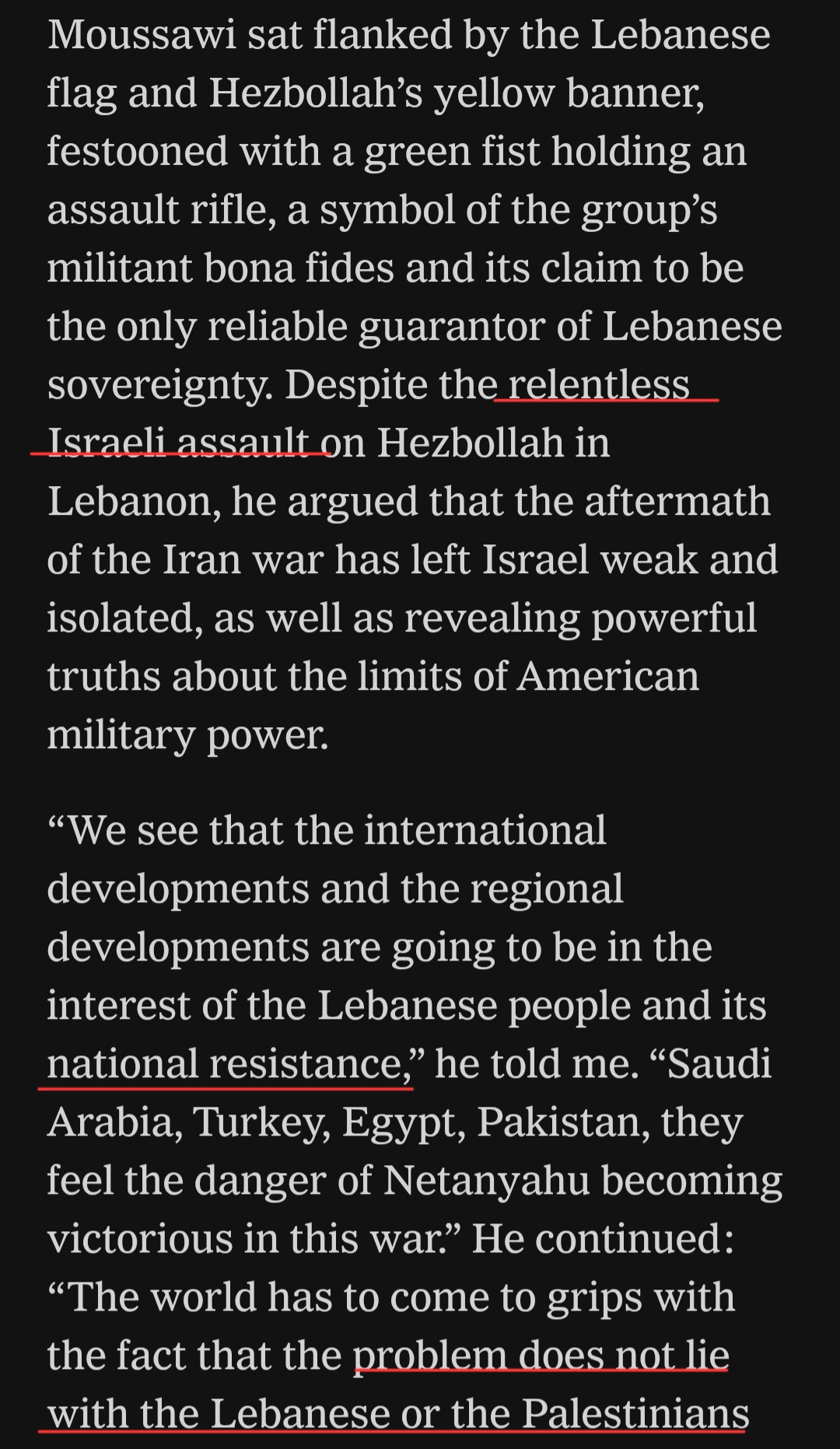
Hezbollah maintains an independent army outside the authority of Beirut. It receives funding, weapons, and strategic direction from Iran. It launched attacks on Israel after October 7 without authorization from the Lebanese government. For decades, Lebanese governments have struggled to establish a monopoly on force within their own borders.
The central question facing Lebanon is not merely reconstruction. It is sovereignty. Who governs southern Lebanon? Who decides questions of war and peace? Who controls the country’s most powerful armed force?
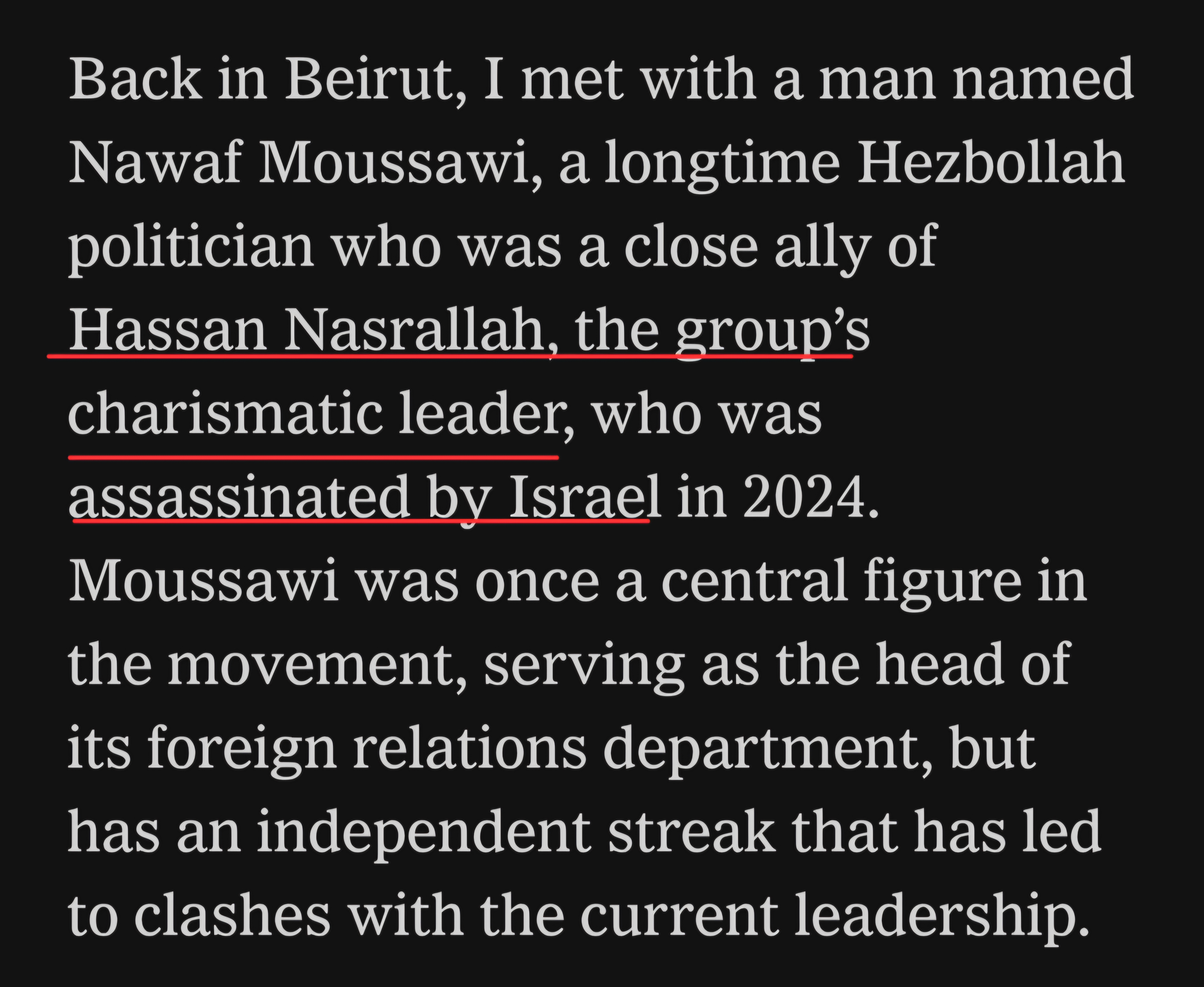
Those questions sit surprisingly close to the margins of the essay. Polgreen concludes that Hezbollah – even after the demise of its “charismatic leader” Hassan Nasrallah – will endure and be part of a “pluralistic” Lebanese society (“pluralism” and “pluralistic” show up four times in the article).
Readers learn far more about Israeli power than about Lebanese weakness.
Near the end, the essay abandons its own logic.
At one point readers are told that Hezbollah “could not be excised from the body politic.” Political reality, in other words, must be acknowledged. Hezbollah has supporters, influence, institutions, and representation. Lebanon’s future must somehow accommodate that reality.
Yet that principle vanishes when the discussion turns to Israel.
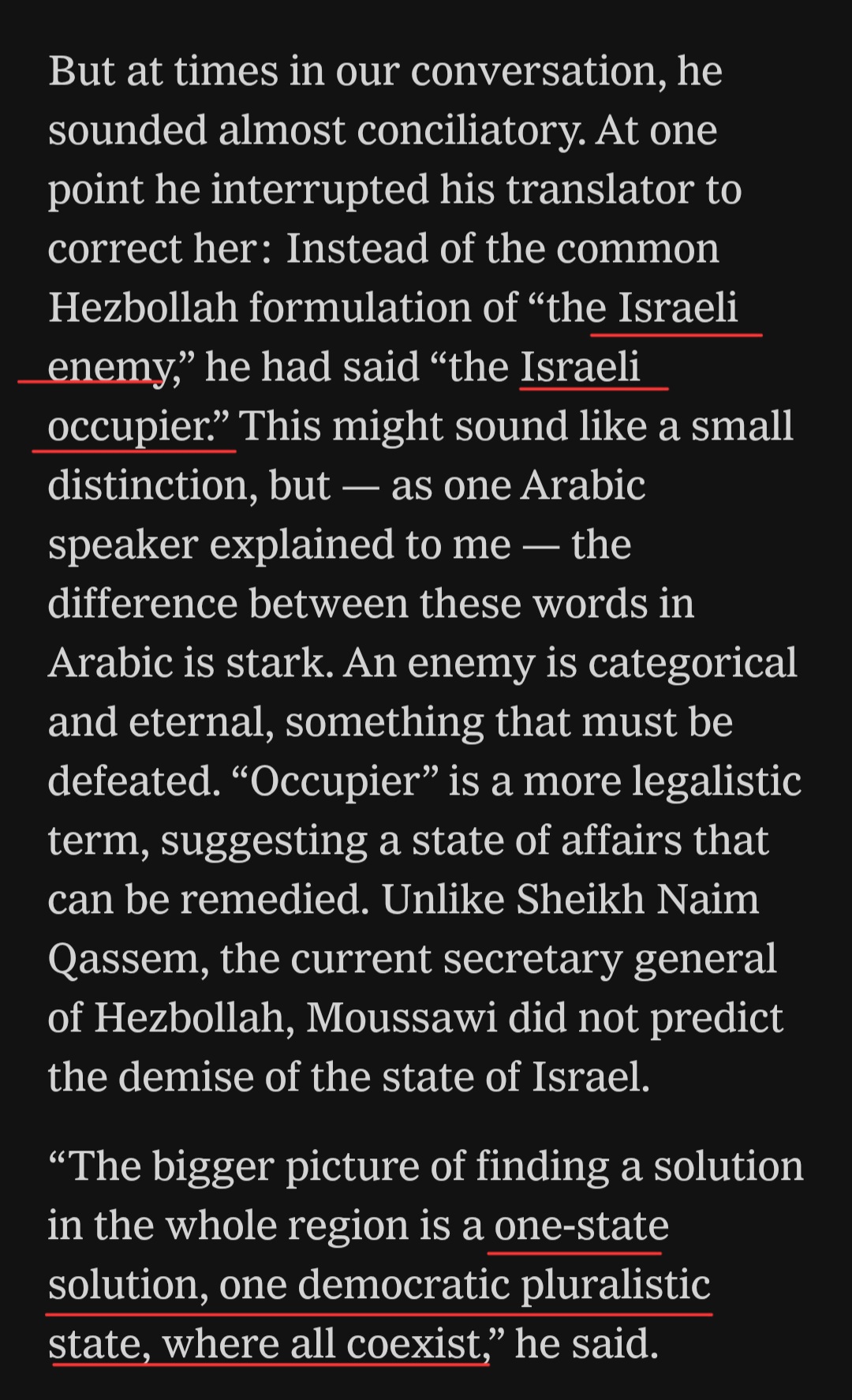
After thousands of words about Lebanon, readers are introduced to arguments for a one-state future that would effectively end Israel as the Jewish nation-state. An “emerging international consensus” suddenly becomes relevant to determining Israel’s future.
The contrast is revealing.
When discussing Lebanon, the essay asks Lebanese people what they want. Readers hear from civilians, intellectuals, politicians, and Hezbollah supporters. Their aspirations become the measure of Lebanon’s future, which we are informed will be pluralistic and peaceful, even when including Hezbollah.
When discussing Israel, Israelis are nowhere to be found. Readers have no context what the average Israeli wants. They are not told that overwhelming majorities support maintaining Israel as a Jewish state. Instead, the relevant question becomes what an international consensus believes should happen.
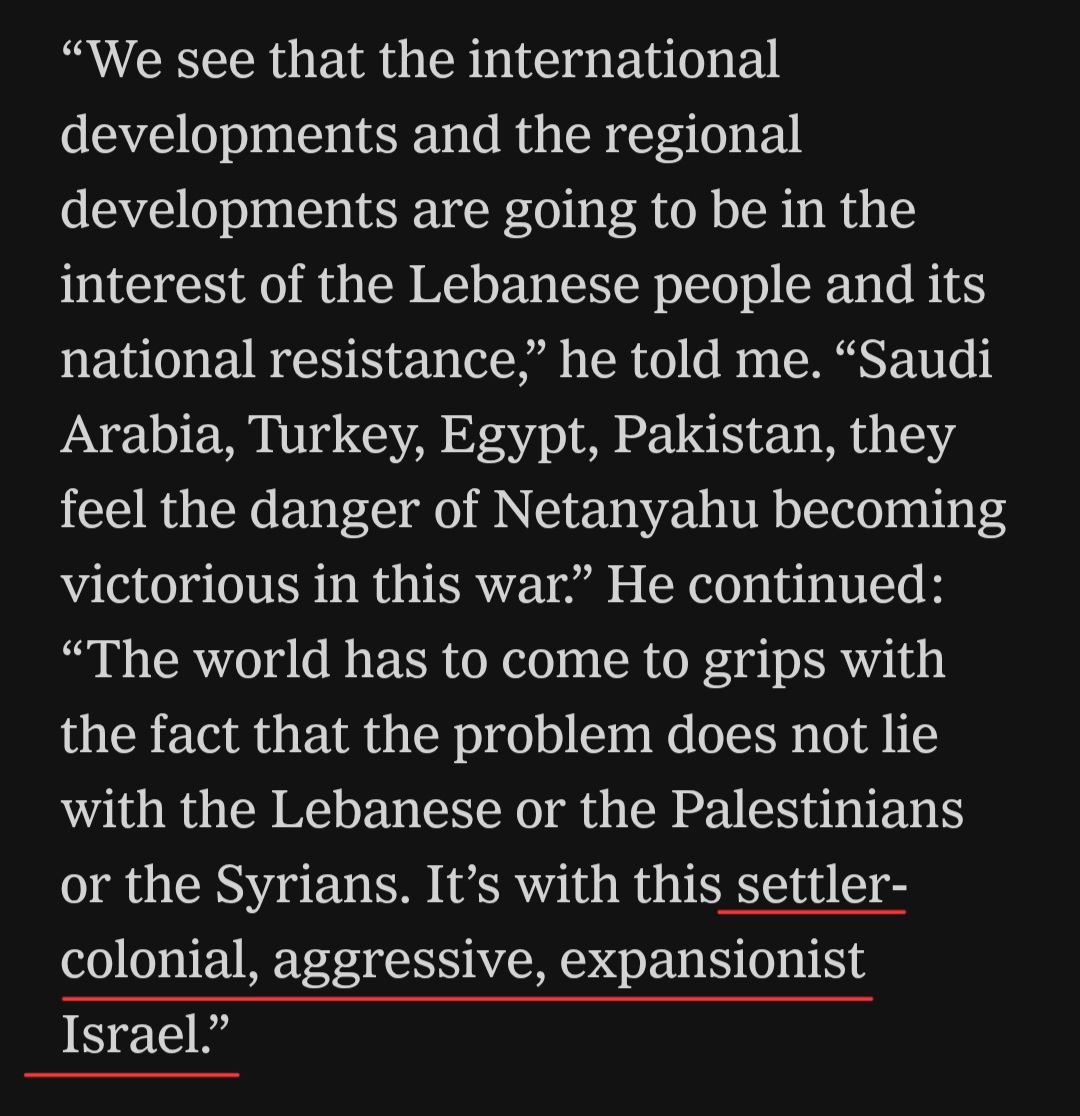
The people whose “settler-colonial, aggressive, expansionist” state is cast as being temporary are absent from the discussion. Presumably, the readers are being led to the conclusion that international pressure must be placed on Israel to let Lebanon live.
Lebanon’s future belongs to the Lebanese. Israel’s future belongs to everyone else.
By the end, readers know that Lebanon is an ancient nation whose sovereignty deserves restoration. Hezbollah is an enduring political reality that must be accommodated. Israel is a state whose identity should be reshaped by outside opinion.
Hezbollah is never properly labeled a US-designated foreign terrorist organization. Israel is never described as an American ally. Lebanon is not painted as a failed country which cannot control its failed economy or borders or manage a distinct military force outside governmental control.
A country that struggles to control its own territory is granted unquestioned legitimacy. A country with functioning institutions, competitive elections, and one of the region’s strongest economies is presented as a candidate for political reinvention.
The essay asks readers to accept permanence for Hezbollah, self-determination for Lebanon, and international supervision for Israel.
It begins by asking how Lebanon should recover from war. It ends by asking whether Israel should remain Israel.
For an essay about Lebanon, that is an oddly revealing destination.
A lecture on the archaeology of ancient Israel and Judah was supposed to take place at the British Museum this month. Instead, it was postponed after organizers learned that protesters intended to disrupt the event.
The subject was not the Gaza war nor settlements nor Israeli Prime Minister Benjamin Netanyahu.
It was archaeology.
It has happened before. In 2014, UNESCO canceled an exhibition on the Jewish people’s 3,500-year history in the Land of Israel after objections from Arab states. More recently, Palestinian Authority President Mahmoud Abbas repeatedly denied that the Jewish Temples stood in Jerusalem, at one point claiming they were actually located in Yemen.
These episodes share a common thread. The dispute is no longer simply about the modern State of Israel nor its policies or actions. It is increasingly about the history of the Jewish people themselves.
Yet the evidence is overwhelming. The kingdoms of Israel and Judah are among the best-documented societies of the ancient Near East. Their existence is attested through inscriptions, seals, coins, manuscripts, monuments, and the records of neighboring civilizations. The British Museum itself houses artifacts that tell this story.
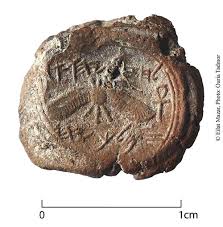
Seal of King Hezekiah found in Jerusalem, around 700 BCE
That is why archaeology poses such a problem for those who seek to portray Jews as foreign interlopers – colonizers – with no ancient connection to the land. Artifacts cannot be pressured into changing their testimony. Every discovery points in the same direction: the Jewish story in the Land of Israel stretches back thousands of years, before the births of Jesus and Mohammed.
Few people would tolerate a museum debating whether ancient Egypt existed or whether Rome stood in Italy. Yet Jewish history is increasingly treated as uniquely negotiable.
Curiously and alarmingly, the protest at the British Museum had a much more immediate backdrop than the current war. This talk was to take place during Jewish Culture Month and the protestors were assembled by an anti-Israel group called “Jewish Artists for Palestine.” The museum’s efforts to highlight Jewish history in the land of Israel during a period of focus on Jewish culture brought out Jewish anti-Israel protestors.
Institutions are backing away from Jewish history and culture with the backing of fringe extremist Jews and anti-Israel Arabs. So basic history becomes debate, and the debate has moved from the policies of the Israeli government to Jews themselves.
The Nazis physically annihilated the Jews of Europe as it sought to place their culture as historical artifacts in museums. Now, museums and institutions seek to erase Jewish history and culture as a prelude to eradicating Jews in the Middle East.
Some of Israel’s strongest supporters today are found nearly 10,000 miles from Jerusalem.
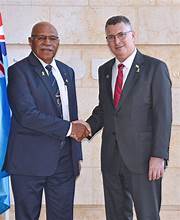
On June 2, 2026, as Israeli Foreign Minister Gideon Sa’ar opened Israel’s new embassy in Fiji, he was marking more than a diplomatic milestone. In recent years, Fiji and several Pacific nations have emerged as some of Israel’s most reliable supporters at the United Nations, often standing with the Jewish state when much of the world has turned against it.
Israeli embassy opening in Fiji, June 2, 2026
There is a certain irony in those votes. Israel was reborn in 1948, before the independence of most countries represented at the United Nations today, including many that now question its legitimacy.
At the center of this story stands Fiji’s Prime Minister, Sitiveni Rabuka.
Rabuka was born in 1948, the same year the modern State of Israel emerged from war and declared independence. Fiji itself would not become independent until 1970. Few leaders are better positioned to appreciate the journey of a small nation seeking to preserve its identity, security, and place in the world.
A former military commander and peacekeeper who served in Lebanon, Rabuka has become one of Israel’s strongest friends in the Pacific. The path that led him there reveals much about the bond between Israel and many Pacific nations.
Prime Minister of Fiji, SitiveniRabuka with Israeli Foreign Minister Gideon Sa’ar
Like generations of indigenous Fijians, Rabuka grew up in a deeply Christian society where the stories of the Bible shaped daily life. Jerusalem, Bethlehem, the Jordan River, and the Sea of Galilee were familiar long before they appeared in headlines. The history of the Jewish people, the kings of Israel, the prophets, and the life of Jesus formed part of a shared spiritual inheritance passed from one generation to the next.
For many Pacific Christians, the Holy Land is more than a place where sacred events occurred. It is the landscape where their faith began. Jerusalem is the city of David, the site of the ancient Temples, and the place where Jesus taught, died, and was resurrected.
Rabuka later encountered the region through military service. Fiji has contributed peacekeepers to the Middle East for decades, with soldiers serving in Lebanon, the Sinai, and the Golan Heights. Those missions transformed biblical geography into lived experience, creating connections between Pacific Islanders and a region they had long known through scripture.
Those experiences help explain why Rabuka has spoken so forcefully about Israel’s right to defend itself and why his government opened an embassy in Jerusalem in 2025, at the time, the seventh country to do so. His support reflects a worldview shaped by faith, military service, and an understanding that small nations must often fight to preserve their security, identity, and future.
“The people of Fiji share a very close religious and cultural connection to the Holy Land. We deeply value your great nation, which is the birthplace of Christianity. Our similarities, faith and common values continue to strengthen us together in unity and solidarity, as witnessed here this afternoon.” – Fiji PM Sitiveni Rabuka September 18, 2025
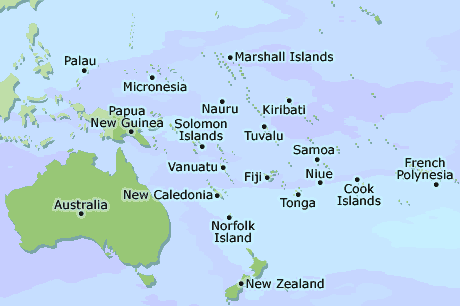
That perspective resonates across the Pacific. Countries such as Papua New Guinea, Tonga, Palau, Nauru, and the Federated States of Micronesia understand the challenge of preserving sovereignty and culture in a world dominated by larger powers. Israel’s story speaks to concerns that many of these nations know well: preserving identity, protecting sovereignty, and carrying an ancient heritage into the future.
Their support for Israel in international forums reflects more than diplomacy. They see a people who returned to their ancestral homeland, revived an ancient language, rebuilt national institutions, and defended their independence against repeated challenges. Those themes resonate deeply among nations that have worked to preserve their own cultures and sovereignty across generations.
It is a remarkable journey: a Pacific leader born in 1948, shaped by the Bible and military service in the Middle East, helping forge a friendship with the country whose modern story began the year his own life did. Across oceans and continents, the connection endures because both nations understand that a people secures its future by remaining rooted in its past.
Two years ago at New York City’s Celebrate Israel Parade, Holocaust survivors climbed down from their float and danced with the children marching beside them. This year the children climbed up onto the float and sat beside the survivors.
The change captured something unmistakable: distance in years sometimes requires an inverse relationship in physical space.
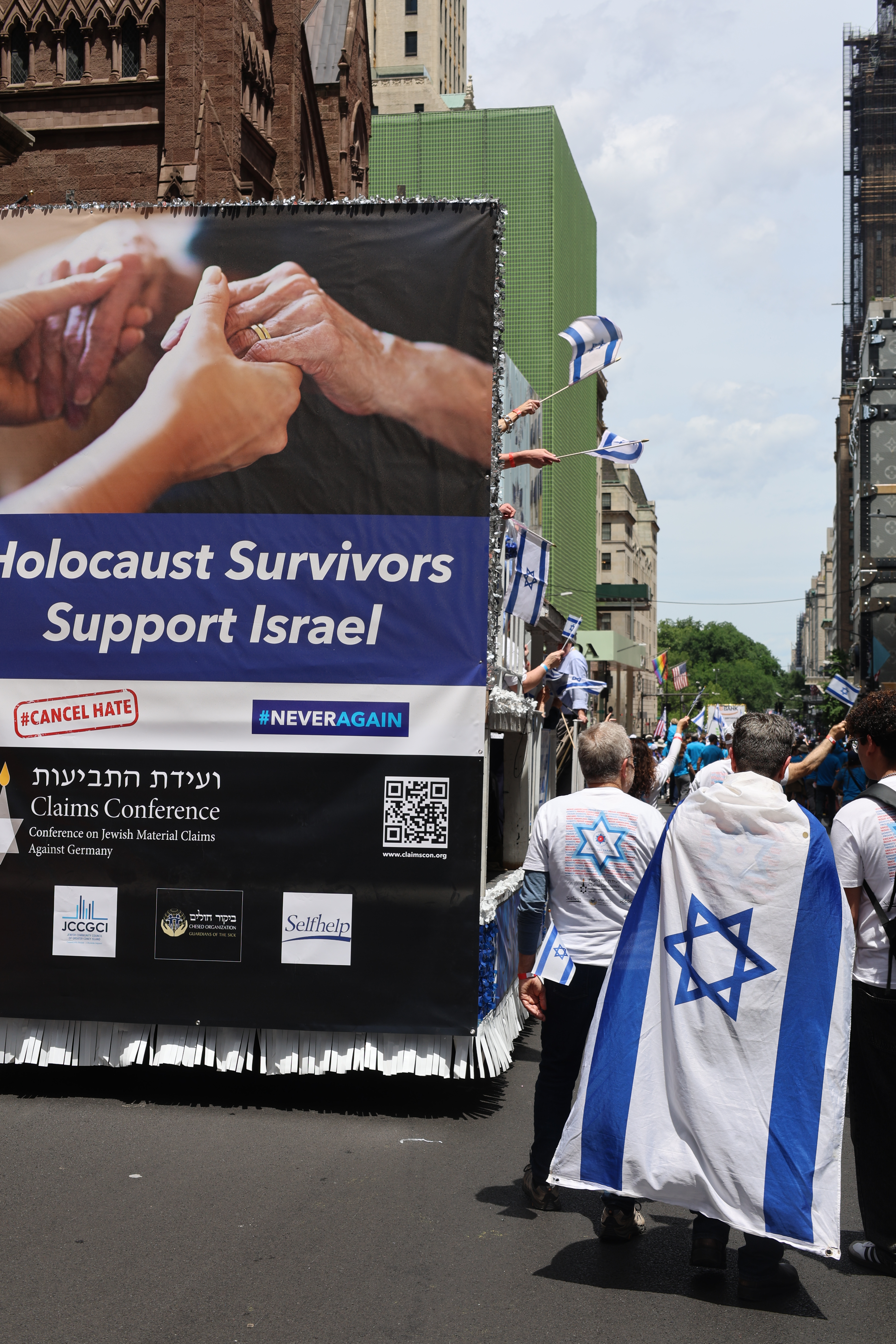
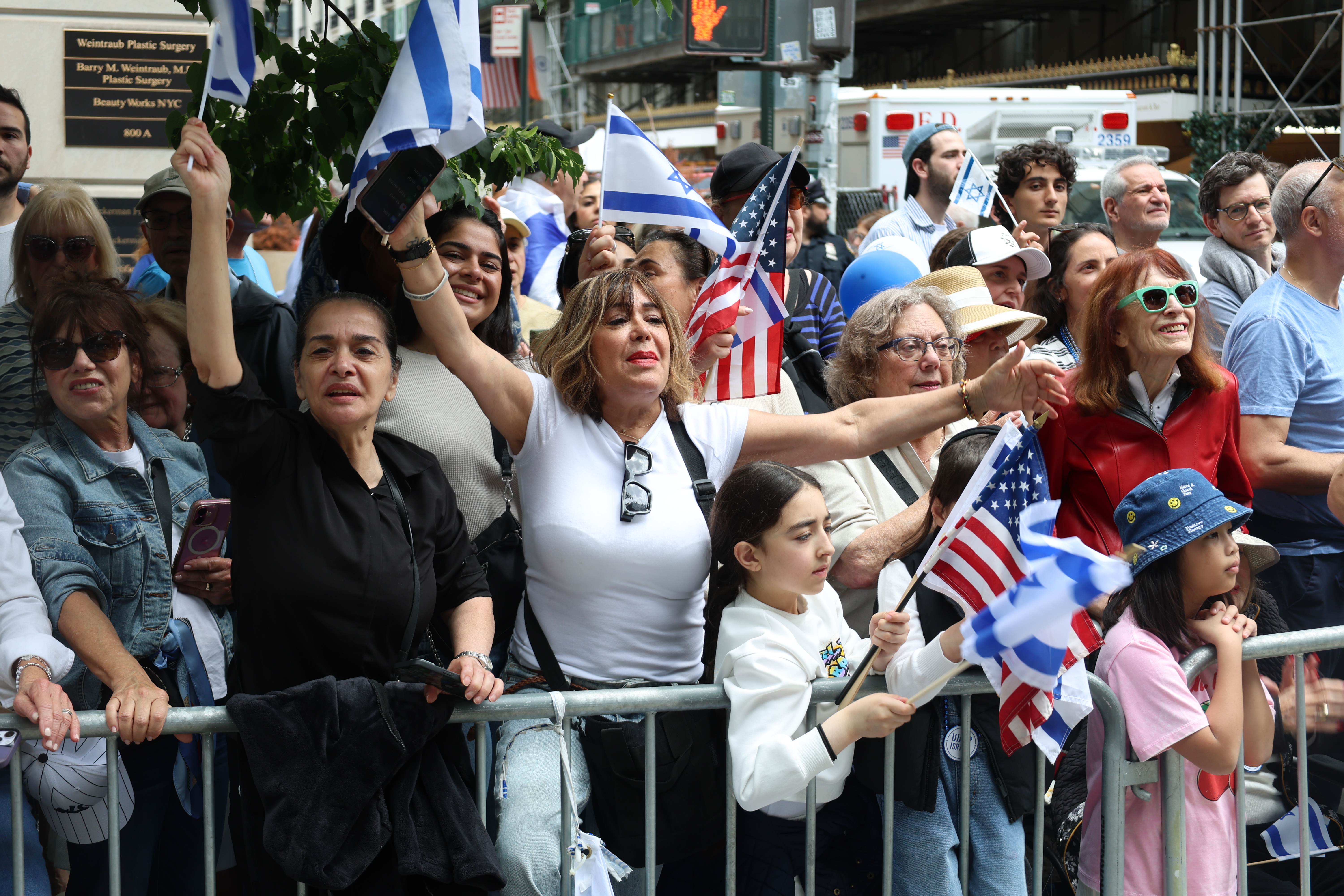
As the float moved down Fifth Avenue, Holocaust survivors waved Israeli flags toward the crowd. Around them stood students, children, grandchildren, and thousands of New Yorkers carrying American and Israeli flags. Some of those cheering were the children and grandchildren of Survivors who are no longer here.
Children of Holocaust Survivors march alongside float carrying Survivors (photo: First One Through)
They felt what we saw: how much smaller the group of survivors had become.
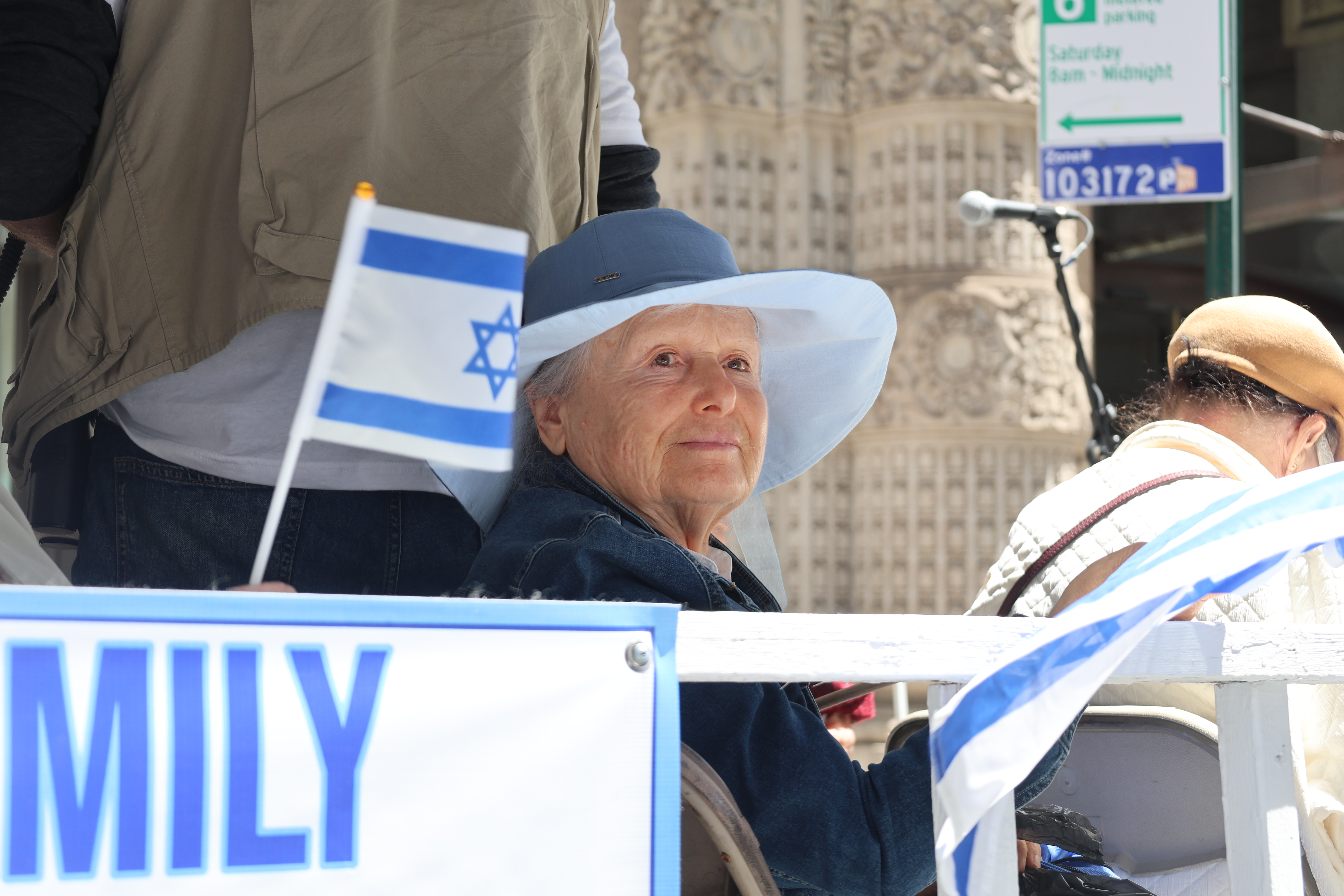
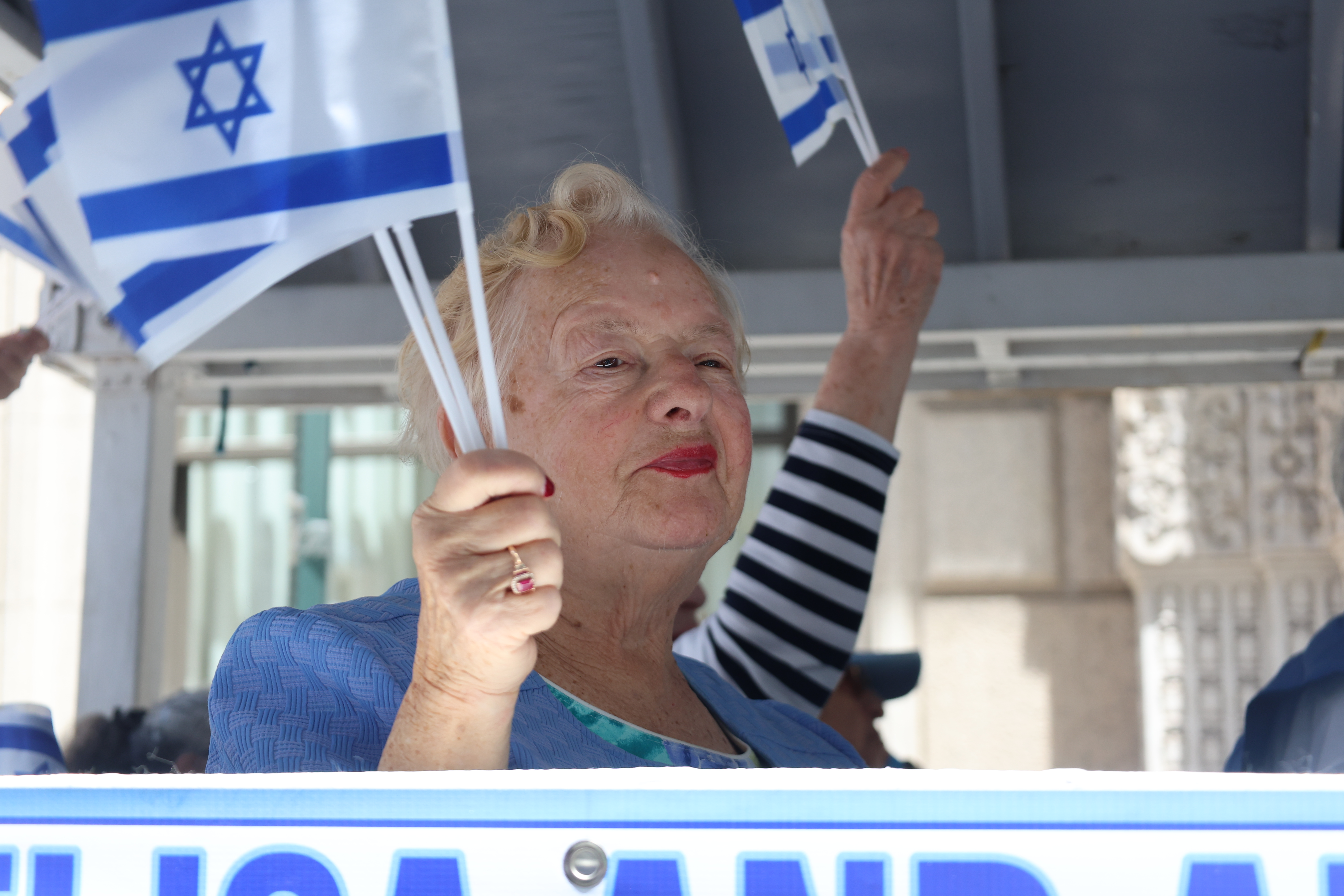
An elderly woman sat quietly beneath a blue hat, an Israeli flag resting beside her. Nearby, several other survivors smiled and waved to the crowd. Looking across the float, one could not help noticing who was missing.
Holocaust Survivor at Celebrate Israel Parade 2026 (photo: First One Through)
The men are disappearing.
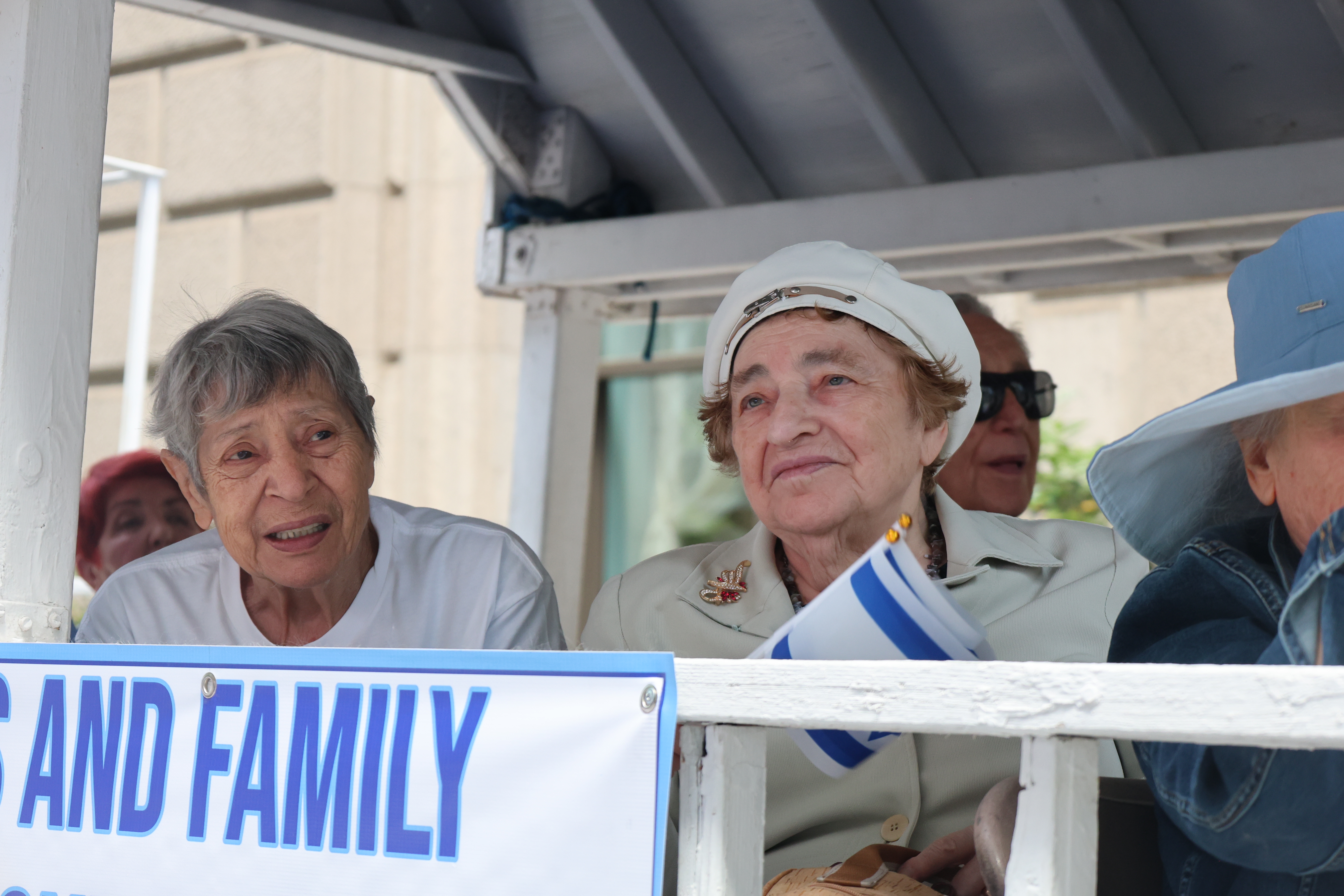
Every year there are fewer survivors able to spend a day riding through Manhattan. Husbands, brothers, and friends who once shared these memories are no longer there. Increasingly, the survivors are women carrying stories that were once held by entire families and communities.
The Holocaust is passing from lived experience into history.
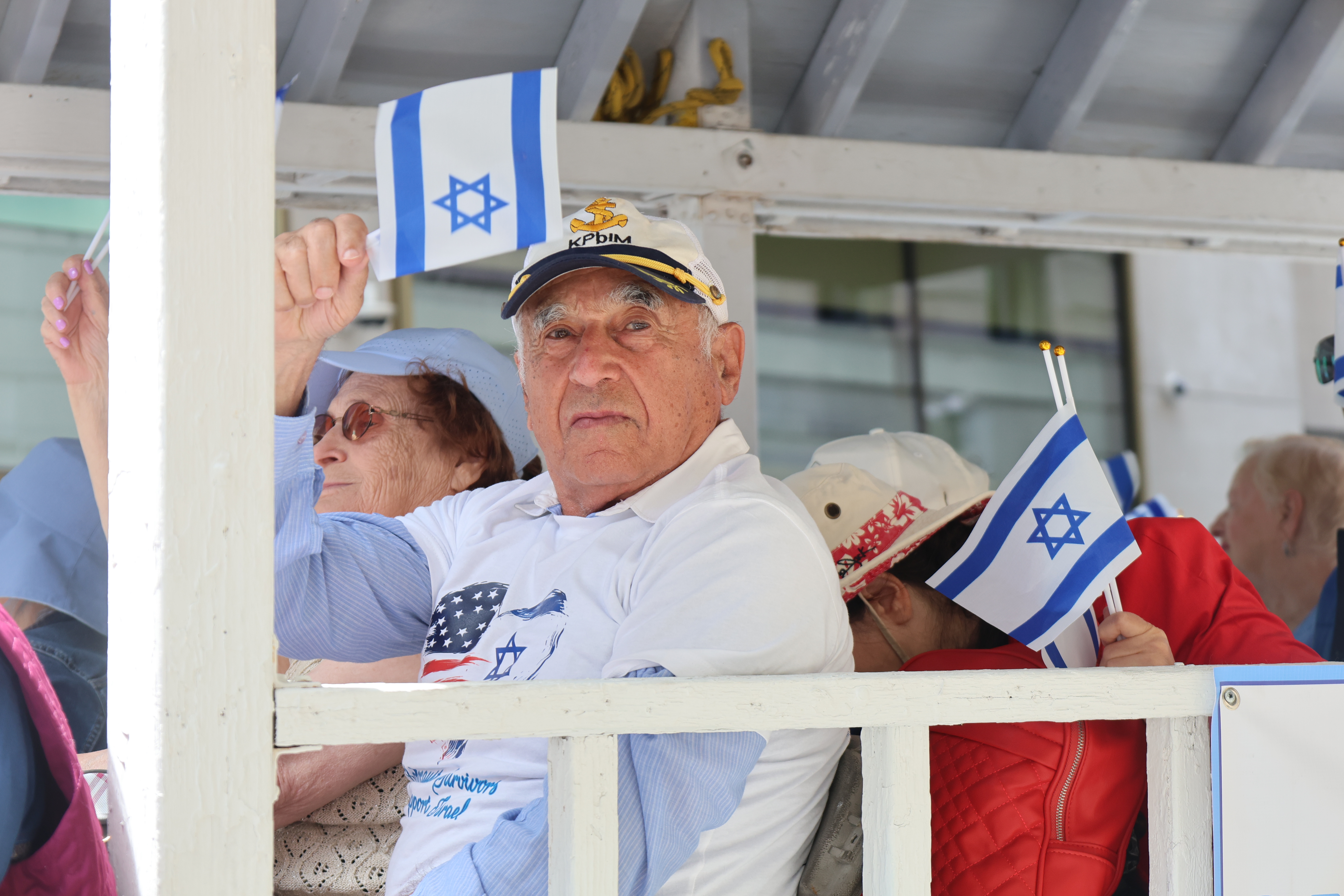
Holocaust Survivors at Celebrate Israel Parade 2026 (photo: First One Through)
The banner on the float read simply: “Holocaust Survivors Support Israel.”
For many aboard, Israel is not a political issue. They remember something most Jews today know only from books: a world in which there was no Jewish state. A world in which the doors of country after country remained closed while European Jewry was destroyed.
That reality gave the float a weight extending far beyond the parade itself.
Claims Conference float at Celebrate Israel Parade 2026 (photo: First One Through)
Yet the most moving scenes took place between the survivors and the young people gathered around them.
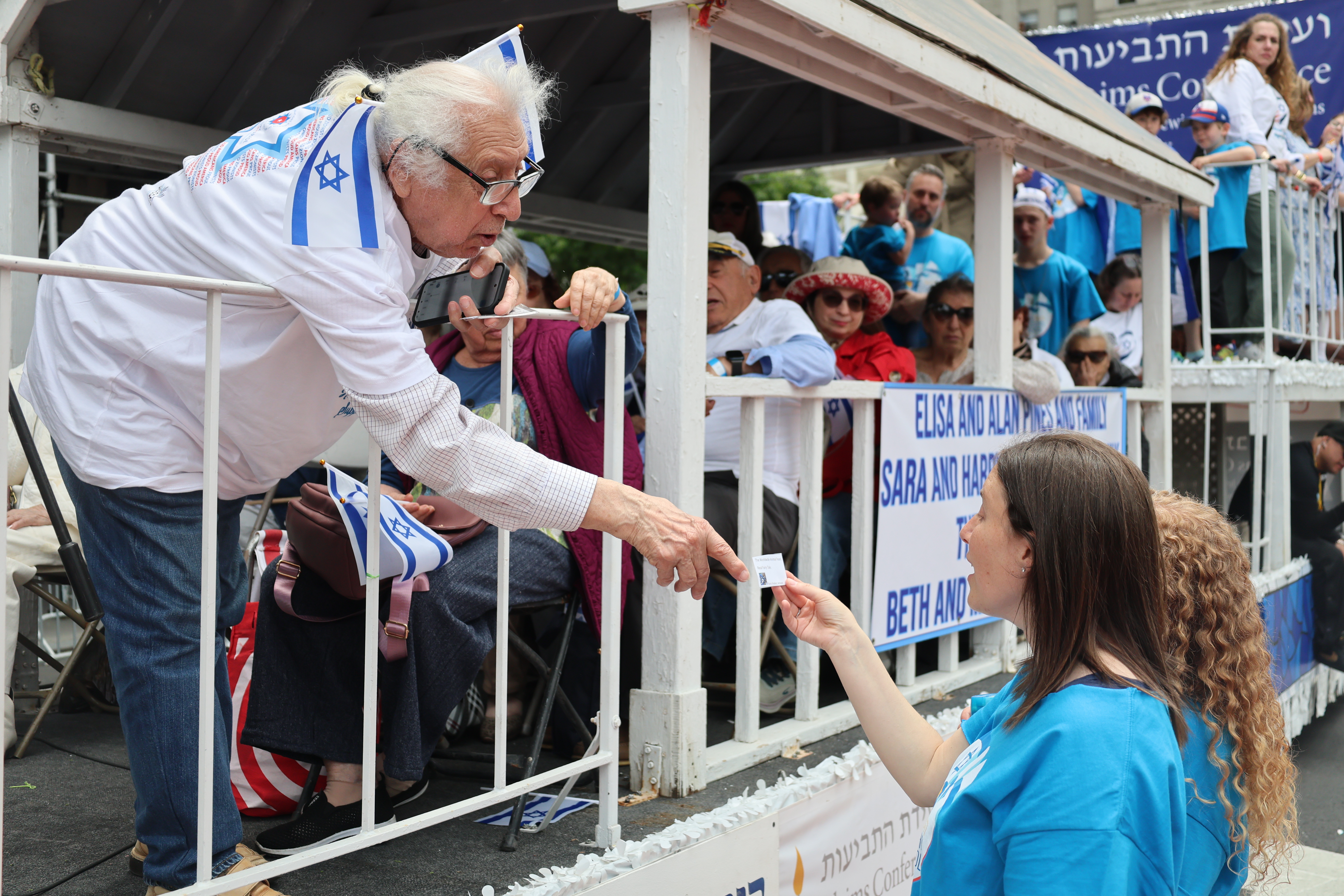
Some students and families from the Heschel School spent part of the afternoon alongside the survivors. Conversations unfolded between people separated by seventy or eighty years, yet connected by a common story. One survivor leaned over the railing to hand a parent a reference to a book he had written. Others stopped to speak with children standing beside the float.
The survivors can no longer carry these memories alone.
Holocaust Survivor at Celebrate Israel Parade 2026 talking to people from the Heschel School (photo: First One Through)
Others must carry them forward.
Perhaps that is why they continue to come.
Waving for hours on a hot day is not easy at ninety years old. Yet year after year they return because memory survives only when it enters public life and passes from one generation to the next.
Around them, the parade moved forward. Families lined the route waving American and Israeli flags. Children danced in the streets. Chabad volunteers helped Jewish men put on tefillin along the sidewalks. The crowd cheered as marchers passed.
Young men put tefillin on Jewish men at Celebrate Israel Parade 2026 (photo: First One Through)
The city itself felt different than it had a few years ago.
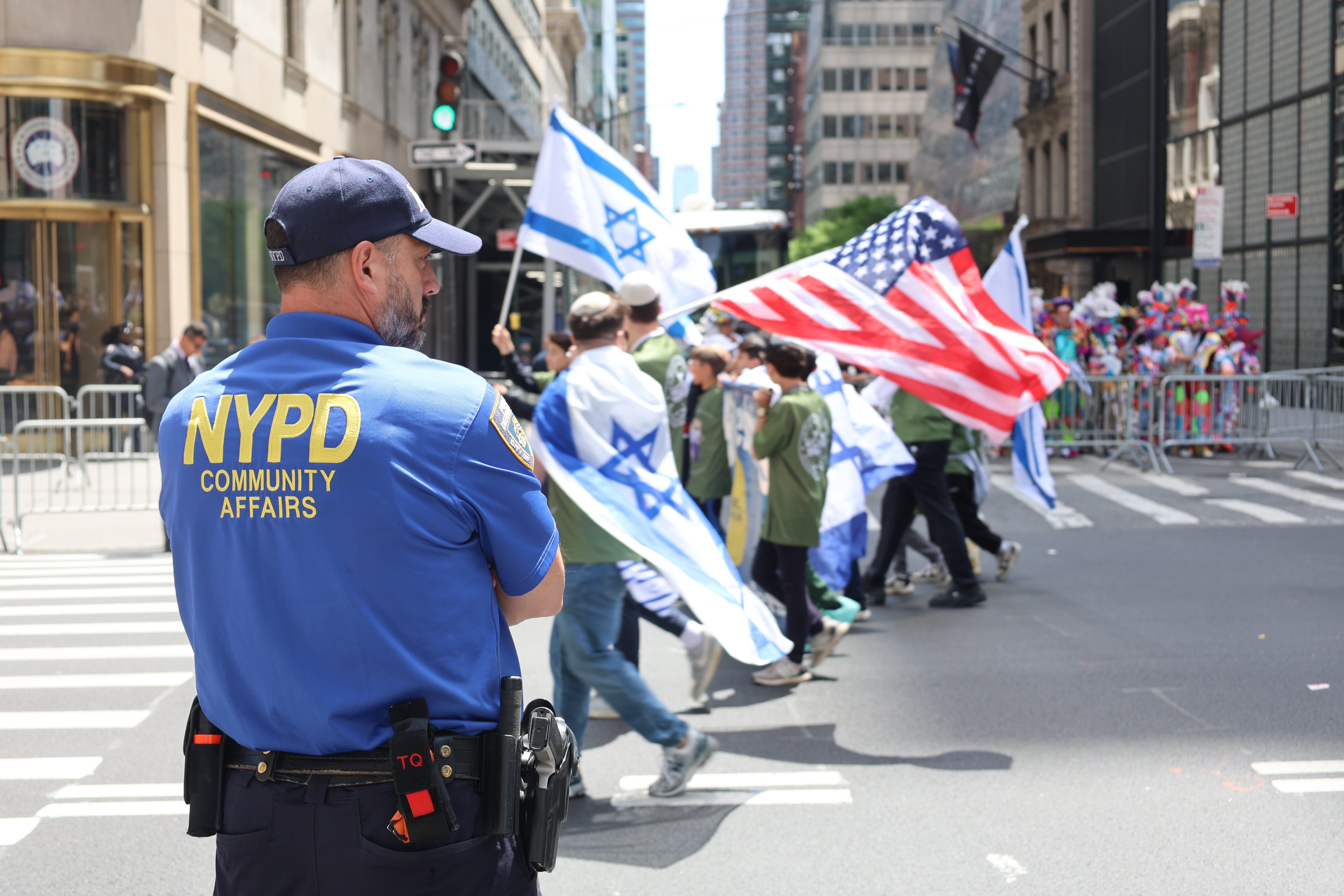
The parade was peaceful, but the precautions were impossible to miss. Police officers lined the route. Barricades stood farther from the crowd than in years past – perhaps twelve feet this year up from eight in years past.
NY Police watching over the Celebrate Israel Parade 2026 (photo: First One Through)Enormous twelve foot-plus separation along the Celebrate Israel Parade route on Fifth Avenue (photo: First One Through)
There was another difference as well.
Two years ago New York City’s mayor proudly marched in the parade. This year the mayor made a big show of not showing up because of his anti-Israel opinions. Support for Israel, once treated as an easy civic consensus, now feels more contested amid the ongoing Iranian proxy war on Israel.
The survivors understood such realities better than anyone. They have seen societies become less welcoming before.
Yet as the float rolled down Fifth Avenue, those tensions faded into the background. What remained was something older and more enduring.
Young people sat beside Holocaust survivors. They waved Israeli flags.
The scene compressed centuries of Jewish history. Survivors who remembered Europe before the Holocaust sat beside children growing up in America after the creation of Israel. The last witnesses shared space with those who will soon become witnesses for them.
Soon there will be no Holocaust survivors left to ride down Fifth Avenue.
The children waving beside them will inherit stories they never experienced themselves. They will become the custodians of memories that once belonged to the people sitting beside them.
Holocaust Survivor at Celebrate Israel Parade 2026 (photo: First One Through)
Two years ago the survivors climbed down from the float and danced with the children. This year the children climbed onto the float and sat beside the survivors.
The time distance between those moments is only two years. The physical distance between those generations has shrunk by necessity.
Holocaust Survivor at Celebrate Israel Parade 2026 (photo: First One Through)
For nearly two thousand years, Jews have ended prayers with the hope of returning to Jerusalem and rebuilding what once stood there. It is the location of the First and Second Temples. Jewish longing for Jerusalem is woven into daily prayers, holidays, weddings, and mourning rituals.
Yet major international bodies have passed resolutions referring to the site primarily through its Muslim names while minimizing or omitting its central place in Jewish history. Imagine a resolution discussing the Vatican without mentioning Christianity, or Mecca without mentioning Islam. The absurdity would be obvious.
The issue extends beyond language.
Official United Nations map labeling the Temple Mount as holy only to Muslims
The international community supports a protocol under which Muslims may pray freely on the Temple Mount while Jews are restricted from praying at Judaism’s holiest site. The result is extraordinary: the world’s only Jewish state is expected to enforce a policy under which Jews do not support a basic human right at their holiest location in favor of members of another faith.
The Temple Mount is not merely a religious site. It sits at the heart of a larger question: whether the Jewish people are entitled to the same rights afforded to every other people.
Around the world, international institutions celebrate indigenous peoples reconnecting with ancestral lands, reviving ancient languages, protecting sacred sites, and preserving cultural traditions. Yet only in the case of the Jewish people does a return to the place where their civilization, language, religion, and national identity were born become a form of “colonialism.“
International institutions routinely describe the Temple Mount and the Jewish Quarter as part of “occupied Palestinian territory.” Yet these are the very places where Jewish civilization was born, where the ancient Temples stood, and where Jewish communities lived for centuries.
Jordan’s capture of eastern Jerusalem in 1948 resulted in the expulsion of its Jewish population and the denial of Jewish access to the Western Wall, the Temple Mount, and the Jewish Quarter for nineteen years. It granted citizenship to residents as long as they weren’t Jewish. The UN seemingly liked this. International discussion of the Old City of Jerusalem begins after the expulsion of Jews, as though their absence were the natural condition and their return the disruption.
The same pattern appears in discussions of territory.
The Green Line was never intended to be a permanent border. The 1949 Armistice Agreements explicitly stated that the line was not a political boundary and would not prejudice future negotiations. It was a military ceasefire line drawn after a war.
Yet decades later, much of international law treats that armistice line as though it were a sacred border whose crossing transforms ordinary Jews into international criminals.
A Jew who moves across that line becomes a “settler.” An Arab who moves into the same building does not. The geography is identical. The identity of the resident is what changes.
International institutions frequently oppose changes to the “demographic character” of eastern Jerusalem. But demographic character relative to what date?
The answer is effectively 1949, the year after Jordan captured eastern Jerusalem and expelled every Jew from the Jewish Quarter and surrounding areas. Why should the demographic baseline for justice be the moment immediately following the ethnic cleansing of Jews?
Why not 1980? Why not 2000? Why not today?
Human beings move. Cities evolve. Neighborhoods change.
The only way to preserve a specific demographic snapshot forever is to decide that one particular population must be prevented from returning.
In Jerusalem, that population happens to be Jews.
Then there is the question of refugees.
The same international system that opposes Jews moving into neighborhoods beyond the Green Line frequently endorses claims that millions of Palestinian refugees and descendants should be allowed to settle inside Israel.
Movement in one direction is described as a right. Movement in the other direction is described as a violation of international law.
The asymmetry is impossible to miss.
Every era develops its own vocabulary for antisemitism. In medieval Europe it often spoke the language of theology. In the nineteenth century it spoke the language of race. Today it increasingly speaks the language of international law.
Around the world, international institutions celebrate indigenous peoples reclaiming ancestral lands, reviving ancient languages, protecting sacred sites, and restoring cultural traditions.
Jews have done all of those things.
They returned to the land where their civilization was born. They revived Hebrew from a language of prayer into a language of everyday life. They restored Jewish sovereignty to the city that has stood at the center of Jewish life for three millennia. They reestablished communities at many of their most ancient holy sites.
Yet only in the case of the Jewish people does this story become one of colonialism rather than return.
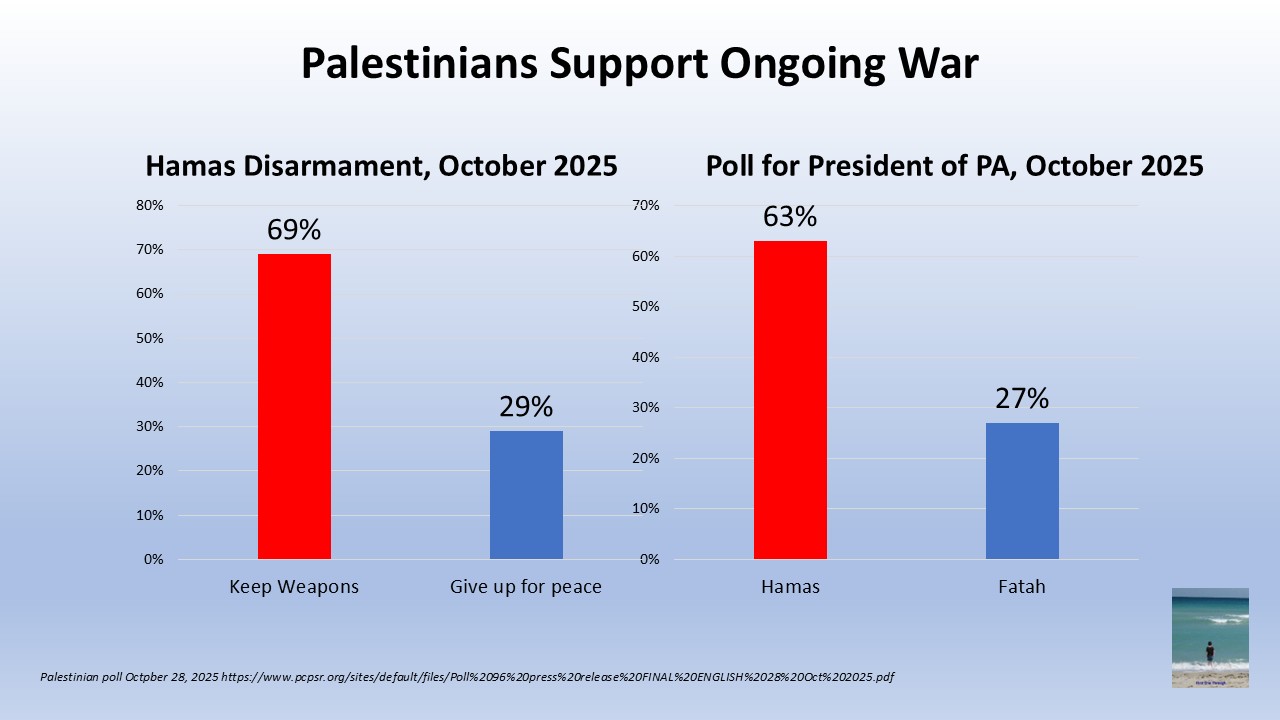
In October 2025, after two years of war and the devastation of Gaza, the Palestinian Center for Policy and Survey Research published findings that should have dominated headlines around the world:
Hamas remained the most popular Palestinian political movement.
More than half of Palestinians continued to view October 7 as the correct decision.
Nearly seven in ten opposed Hamas disarmament even if disarmament would prevent another war.
After two years of destruction, support for Hamas remained strong. Support for October 7 remained widespread. Opposition to disarmament remained overwhelming.
These findings did not come from Israeli politicians or government spokesmen. They came from Palestinians speaking to Palestinian pollsters.
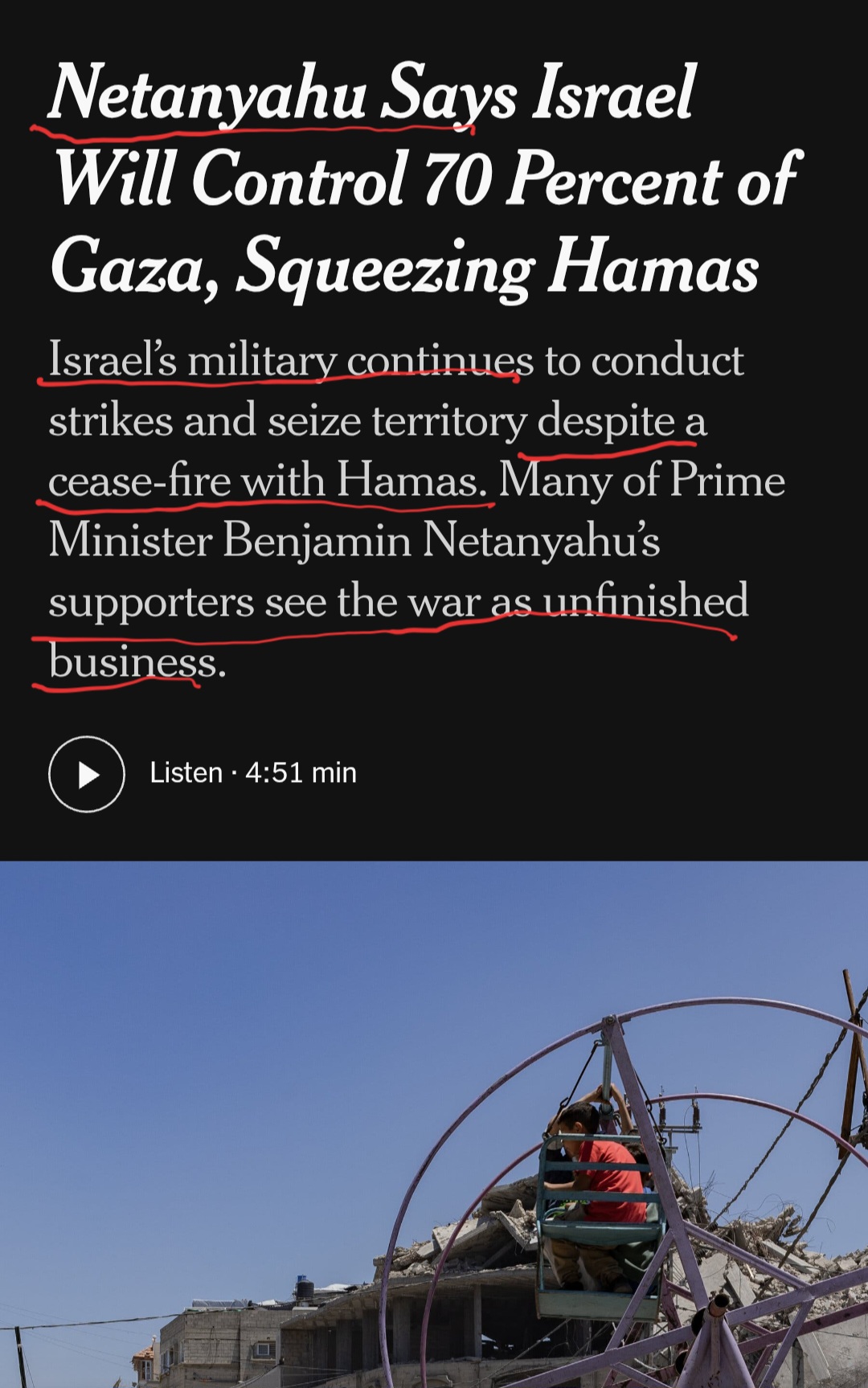
Yet still, the New York Times publishes lengthy articles that the Gaza war continues because of Israel.
Readers were taken inside Benjamin Netanyahu’s political calculations. They learned about coalition pressures, right-wing ministers, territorial ambitions, and supporters who view the war as unfinished business.
By the end, a clear narrative emerged: the war continues because Israelis want it to continue. Because of greed for land, for power.
There was no mention that Gazans want Hamas to remain armed and for the war to continue. That is the political reality that keeps a ceasefire from taking hold.
The omission matters because it changes the reader’s understanding of the conflict. It places blame solely on Israel when a majority of Palestinians continue to seek the destruction of Israel despite the devastation in Gaza.
Until journalists devote the same attention to Palestinian motivations that they devote to Israeli motivations, Americans will continue receiving a false explanation for why this war endures.
Europe spent twenty years explaining that Hamas had a “political wing.” Hezbollah too. The bomb throwers were one thing, the parliamentarians another. The rocket launchers belonged in one legal bucket, the social service offices reserved for a different one. Western diplomats performed intellectual yoga worthy of Cirque du Soleil to preserve the distinction. The “military wing” was terrorist while the “political wing” was complicated. Nuanced. An unavoidable interlocutor for peace.
Britain finally gave up the act in 2019 with Hezbollah. The distinction, it concluded, was largely fictional. Same leadership, same financing, same ideology, same organization. Europe still technically preserves some of these distinctions in various legal frameworks, but fewer people pretend anymore that the “armed wing” and “political branch” emerge from separate planets.
Which makes the growing sanctions campaign against Jewish housing rights groups so fascinating.
Because now the question flips. Suddenly Europe is no longer carefully distinguishing between ideology and violence. Advocacy for controversial positions – not for violence – can suddenly become complicity in terrorism. Entire categories of speech are treated as unlawful conduct even absent anything remotely resembling the classic terrorism that justified Hamas and Hezbollah designations in the first place.
Take Nachala. It is not Hamas. It does not have brigades. It does not launch rockets. It does not run suicide bombing cells. It is an ideological movement advocating Jewish settlement in disputed territory. One may agree with it or despise it. One may view Jews living in land the Stateless Arabs from Palestine (SAPs) want as a future Palestinian state as historic justice or catastrophic policy. But that is precisely the point. The dispute is fundamentally political and ideological.
For decades Europe insisted ideology alone was not terrorism. Supporting Palestinian “resistance” rhetorically was not enough. Calling for the destruction of Israel was grotesque but still politics. The line was violence. Actual violence. Material support for violence. Operational involvement in violence.
That was the principle.
Until suddenly the principle became inconvenient.
Now the standard appears to be evolving into something far murkier: movements may be sanctioned not necessarily for carrying out terrorism, but for contributing to environments viewed as extremist or against government foreign policy. Perhaps that standard is morally justified. Perhaps some Israeli activists have crossed legal and moral lines. But if this is the new doctrine, then the West should at least admit the doctrine changed.
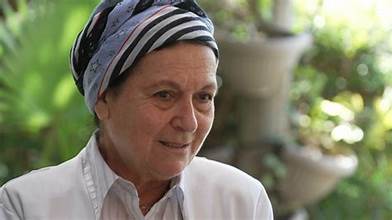
Nachala’s Daniella Weiss
If ideology itself is now sanctionable, Western governments cannot apply the principle selectively.
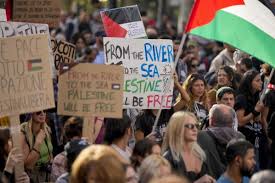
For years crowds across London, Paris, Barcelona and university campuses have openly chanted for the elimination of the Jewish state “from the river to the sea.” Activists routinely declare that Israeli Jews should “go back to Poland,” despite the fact that millions of Israeli Jews descend from families expelled from Arab countries, Ethiopia, Iran and elsewhere. Imagine any other minority in Europe being told to leave the country and “go back” to lands where many never lived, or to where their families were annihilated. Authorities would instantly recognize the ethnic character of the demand.
If Israelis arguing that Jews should again live in Gaza constitutes sanctionable extremism, then what exactly should Britain call organizations openly advocating a “right of return” designed to flood Israel demographically out of existence? If the standard is advocacy for the removal or replacement of another national group, then the principle cannot stop with some Jewish activists in the West Bank.
London protest against Israel in 2021, including rap song
If the line is now ideological support for demographic elimination, then governments must police the radicalism inside their own societies with equal vigor.
That means groups explicitly advocating the destruction of Israel should face the same scrutiny directed at Jewish expansionist movements. Organizations and individuals promoting the forced removal of Jews from the Middle East “from the river to the sea” should not receive a special exemption dressed up as mere “anti-Zionism,” as if Israel is a concept and not a reality. Calls for the end of the Jewish State are not sophisticated geopolitical critiques. They are ethnic slogans calling for violence. And if governments now believe rhetoric itself creates dangerous ecosystems, they cannot pretend those ecosystems exist only on one side of the conflict.
Anti-Israel protesters in Rome, Oct. 28, 2023, shortly after the October 7 massacre and abduction of Israelis by thousands of Gazans. (AP Photo/Andrew Medichini)
The irony is extraordinary. Europe once bent over backwards to separate terrorism from politics when the movements in question were Palestinian or Islamist. Now governments increasingly collapse politics into extremism to be sanctioned only when the movements are Jewish nationalist.
Europe spent decades insisting that ideas were not terrorism. If it now believes otherwise, it should say so openly and explain where the line will be drawn for everyone else.