While the weekend celebration of Martin Luther King, Jr. was going on in the United States of America in 2018, acting-President of the Palestinian Authority Mahmoud Abbas continued to make a fool of himself in Ramallah.
In addition to layering on multiple insults of the US President Donald Trump, its Ambassador to the United Nations Nikki Haley and its Ambassador to Israel David Friedman, Abbas went on a tirade of fake history. He claimed that “Israel is a colonial project that has nothing to do with the Jews.” But it is precisely Jewish, both according to Jews and according to the Arab countries in the region that expelled close to 1 million Jews that were living in their countries in the decades following the establishment of Israel. If Israel has nothing to do with Jews, why did the Arabs expel all of their Jews at the foundation of Israel?
Abbas’s stupidity would continue. He claimed that Palestinian Arabs have been living in the holy land for the past 6000 years – for thousands of years even before the birth of Abraham. That’s pretty impressive for a group that didn’t arrive in the land of Israel until about 1400 years ago, even by the admission of Arabs themselves.
Yes, it is the Arabs that colonized the area, not the Jews.
The Jewish people came to the land of Canaan roughly 3700 years ago. They established their kingdoms and capitals there and have always maintained a presence in the land until this day.
At the founding of Islam in Saudi Arabia in the 7th century, the early Muslims looked to spread their religion throughout the world. They embarked from the Arabian peninsula and invaded and colonized many lands, including the Jewish holy land. This colonization project was so successful, that people do not even pause to think that the term “Arab” is rooted in the Arabian peninsula.
The Palestinians fully acknowledge that they are but a part of the colonial Arab project, as stated in their own 2003 Palestinian Basic Law:
“Palestine is part of the Arab homeland. The state of Palestine abides by the Charter of the League of Arab States. The Palestinian people are part of the Arab and Islamic nations. Arab unity is a goal. The Palestinian people work on behalf of its realization.”
The Arab world views “Palestine” as simply one of the over 50 countries that comprise its Arab “homeland.” A homeland that was created thousands of years AFTER the Jews had been living in their Jewish holy land.
Abbas has denied Jewish history and presence in their native land. He has denied core elements of Judaism, including the location of the Jewish temples on the Jewish Temple Mount in Jerusalem. He has claimed that Zionists conspired to kill Jews in the Holocaust.
During Martin Luther King Day, it is a marvel to watch such “conscientious stupidity,” spew out of the mouth of someone that is venerated by the United Nations. But as MLK said many decades ago, the embrace of such venomous words are “dangerous,” and cannot simply be laughed away. This is not a debate between narratives, but the vile diatribe of a madman that must be condemned by every decent world leader.
Summary: When a country prefers to use military force over financial pressure, what does that tell you about the party’s temperament and goals?
USA’s Financial Pressure First
Over the past decades, the United States of America has made efforts to contain the nuclear ambitions of rogue states like the Islamic Republic of Iran and North Korea. The USA viewed those state sponsors of terrorism as too dangerous to be the guardians of weapons of mass destruction. But in each case, the USA used economic means of combating Iran and North Korea as a preferred course to launching into a military war.
These were not unique situations.
The US has engaged in economic warfare several times. In situations like Cuba, the US never opted to attack the country militarily. However, in other situations like Libya, the US imposed economic warfare initially in February 2011, before deciding to use its military force some weeks later.
For the United States, the preferred course of engagement was to use economic means of achieving it’s aims, whether it was for a country to reverse course on a nuclear program, or to stop a war. The USA wanted to save lives – both of its own soldiers as well as in the country it attacked – so it delayed the use of force as long as possible.
Arabs’ Attack First
The Arabs in the Middle East have used the exact opposite approach.
When Israel announced its new state in 1948, five Arab countries invaded with an enormous military. Death was not only a means to an end but a goal: the destruction of the Jewish State.
In 1973, on the holiest day of the Jewish calendar, Arab armies attacked Israel again. The Israeli army eventually repelled the invading forces of Egypt, Syria and Iraq, after incurring significant loss of life. In response to their loss, the Arab countries imposed an oil embargo on those countries that assisted Israel militarily during the battle. As summarized by the US State Department:
“During the 1973 Arab-Israeli War, Arab members of the Organization of Petroleum Exporting Countries (OPEC) imposed an embargo against the United States in retaliation for the U.S. decision to re-supply the Israeli military and to gain leverage in the post-war peace negotiations. Arab OPEC members also extended the embargo to other countries that supported Israel including the Netherlands, Portugal, and South Africa. The embargo both banned petroleum exports to the targeted nations and introduced cuts in oil production.”
The Arab countries were not concerned about the loss of life and rushed into battle to both destroy Israel having lost wars and land to Israel in 1948, 1956 and 1967. The Egyptian President Anwar Sadat said the following as it launched its attack on Israel on October 6, 1973:
“We have always felt the sympathy of the world but we would prefer the respect of the world to sympathy without respect.”
By 1973, the Arab goals’ had expanded to not only destroying Israel, but establishing a modicum of honor. As he conceded the war to the Israelis, Sadat said:
“We have been fighting Israel for the fifteenth day running. Israel fought us on its own in the first four days and its real position was exposed on the Egyptian and Syrian fronts; it [Israel] lost by its own admission, 800 tanks and more than 200 aircraft on both fronts. For the last 10 days, however, I have been fighting the United States on the Egyptian front, armed as she is with the most sophisticated weapons in her possession. I simply cannot fight the United States or bear the historical responsibility for having our armed forces destroyed once again.”
In launching the war, Egypt made clear that its honor was at stake, and in calling for a ceasefire, it opted to claim victory over Israel, but capitulation to the US. As the Arab state could not beat the United States militarily, it pivoted to an economic war, the Oil Embargo.
Palestinians’ Also Attack First
Like the other Arab countries, the Palestinian Arabs have opted to fight militarily as a first effort. However, lacking a standing army, the Palestinian Arabs have used terrorism against Israeli civilians and army alike.
After the formation of the Palestinian Authority in 1995 as a result of the Oslo Accords, Palestinians attacked Israelis throughout the 1990s. When the head of the PA, Yasser Arafat (fungus be upon him) failed to deliver a peace in September 2000, the PA launched a Second Intifada which claimed the lives of thousands of additional civilians. The end of the Intifada was brought about with the help of Israel’s establishing a security barrier which stemmed the flow of Palestinian terrorists into Israel, which propelled the Palestinians into a new war. The launch of the boycott, divestment and sanction (BDS) effort in 2005 was designed to economically strangle Israel.
A Palestinian demonstrator raises a knife, during clashes with Israeli police, in Shuafat refugee camp in Jerusalem, Friday, Oct. 9, 2015. (AP Photo/Mahmoud Illean)
The Palestinian Arabs – like the Arabs of the neighboring states – opted to use military force to try to destroy Israel. Only upon the failure of such efforts, did they switch to economic warfare.
Goals: The US took action to prevent the tremendous loss of life (rogue states with nuclear weapons), while the Arab goal was to kill and destroy.
Tactics. The US pursued economic pressure first to prevent the loss of life, whereas the Arab states immediately went to war.
The consistency of the goals and tactics of the United States and Arab world is a fabric of their world view: the US has a goal of preserving peace, so uses military force as a last resort. The Arab states have a goal of destroying Israel, so attack it first and only resort to a BDS campaign once they conclude that they cannot win militarily.
The New York Times has been advancing the notion that liberal values are popping up in the Middle East. Despite the actual murder and mayhem brought by the “Arab Spring,” the Times published articles about the advancement of women’s rights in Iran and Saudi Arabia, as well as the acceptance of the gay and lesbian communities in Lebanon.
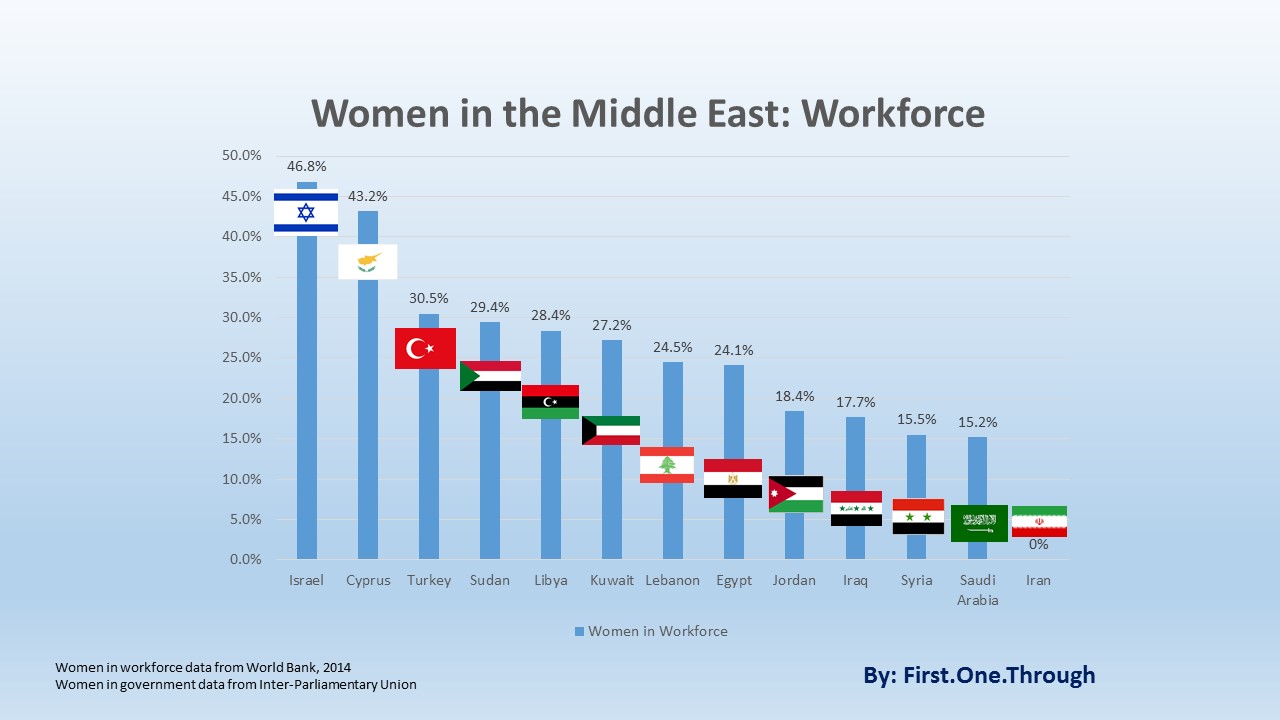
These recent phenomena may be true, but it is interesting that Israel is never mentioned in the articles – the one country that has equality for women and the LGBT community.
LGBT Rights
Consider the December 31, 2017 article “Coming Out in Lebanon, and Helping it to be More Tolerant.” The article detailed that most of the countries in the Middle East have laws punishing homosexual activity, naming several Arab countries before highlighting the unique position of Lebanon:
“Throughout the Middle East, gay, lesbian and transgender people face formidable obstacles to living a life of openness and acceptance in conservative societies.
Although Jordan decriminalized same-sex behavior in 1951, the gay community remains marginalized. Qatar, Sudan, the United Arab Emirates and Yemen all outlaw same-sex relations. In Saudi Arabia, homosexuality can be punished by flogging or death.
In Egypt, at least 76 people have been arrested in a crackdown since September, when a fan waved a rainbow flag during a concert by Masrou’ Leila, a Lebanese band with an openly gay singer.
If there is one exception, it has been Lebanon. While the law can still penalize homosexual acts, the society has slowly grown more tolerant as activists have worked for more rights and visibility.”
This is preposterous. The “one exception” of tolerance “throughout the Middle East” is Israel, not Lebanon.
The International Lesbian, Gay, Bisexual, Trans and Intersex Association (ILGA) produced detailed reports about the countries of the world that protect or criminalize LGBT relationships. In every year, Israel stands out as an island of acceptance for the LGBT community for thousands of miles.
From Morocco to Taiwan and from South Africa to Russia, there is a single country that has laws protecting the LGBT community. And it is not Lebanon, but Israel.
The New York Times December 31, 2017 article on page 10 claiming that Lebanon is the only country in the Middle East with gay rights.
Women’s Rights
On December 29, 2017, the New York Times published an article on its cover page called “Unlikely Iranian-Saudi Race: Easing Restrictions on Women.” The article advanced the notion that Iran and Saudi Arabia are both slowly easing restrictions on women in their countries in a competitive environment of liberalization. Saudi Arabia changed laws allowing women to drive, so Iran eased the law regarding women wearing a hijab.
The article quoted “Suad Abu-Dayyeh, a Palestinian who is the Middle East and North Africa (MENA) consultant for Equality Now, a global women’s advocacy group.” The article noted that “she was cautious about concluding that the changes in Iran were related to the Saudi relaxation,” but she did state that “any advancement in any country will really affect the situation in the neighboring countries.”
And still, the New York Times did not mention Israel which leads the MENA region in women’s rights.
If the Times really believed in the concept that it opted to cite, that the activity in one country could influence the actions in neighboring countries, why not mention the country that leads the entire region in human rights, especially for women and the LGBT communities? Is it too remarkable to assume that the countries in the region are trying to catch up with Israel, whether in technology, the economy or human rights? Saudi Arabia announced its Vision 2030 plans just a few months ago, as noted by the NY Times on October 25, 2017, that the country needed to move beyond oil into technology. Are all of these events regarding the economy and human rights simply coincidences with no relationship to the marvel of Israel next door?
In the closing days of 2017, the Times sought to educate its readership that the Muslim and Arab countries are in the process of liberal reformation – on their own. The paper did so while deliberately excluding the factual presence of Israel in the Middle East and its possible positive influence of reforming the Muslim nations in the region.
The New York Times has moved beyond the “pinkwashing” of Israel into new levels of #AlternativeFacts.
In the ongoing farce that is the United Nations regarding its treatment of Israel, the UN News Center published a report about the use of force that the Israeli army was using against the people of Gaza. In providing background to the story, the UN wrote:
“Since President Donald Trump’s 6 December statement concerning the status of Jerusalem, protests have been held throughout the occupied West Bank, including East Jerusalem, and in occupied Gaza. The response by the Israeli security forces has resulted in five people being killed, hundreds injured and large-scale arrests of Palestinians, noted OHCHR.
The biggest flashpoint has been in Gaza, where three people have been killed as protesters burned tires, threw stones, sang songs and waved flags along the fence. Israeli security forces have responded with firearms, including live-ammunition, to disperse the protesters.”
This is propaganda at its finest. The Israeli forces “responded with firearms” against people who “sang songs and waved flags.” Why was this put in here? Did it mention that some of the people were drinking water? Maybe someone was talking on their cellphone when the Israelis used “live ammunition to disperse the protesters.” We all know how much the Israelis hate it when people talk on their mobile phones.
The language was meant to underscore that the Gazans are peaceful people that are under siege. The story was crafted to show that the Israelis are monsters.
UN High Commissioner for Human Rights Zeid Ra’ad Al Hussein
Did the story mention the rockets that Palestinian militants launched into Israeli civilian territory a few days before? No.
Did it mention the rockets that were launched just the day before that landed in front of someone’s house? No.
Did the United Nations mention any of the 18 rockets that the Gazans fired into Israel since President Trump’s speech on December 6? Nope.
For the UN, the Palestinian Arabs are engaged in peaceful protests and the Israelis are the aggressive power using unnecessary force. The more passive the Palestinian Arabs and violent the Israelis can be portrayed, the greater the David-versus-Goliath narrative to rally people to the Palestinian cause.
The United Nations are not united in honesty, truth or fairness. Just in wild distortions to be ignored.
On December 6, 2017, on the eve of President Donald Trump recognizing that Jerusalem is the capital of Israel, the New York Times decided to give its readers a primer on #FakeHistory.
The NYT led readers to believe that Jerusalem was an Arab city and that Jews recently began to immigrate there, when IN FACT, Jews have been a majority in Jerusalem since the 1860s
The NYT led readers to conclude that Jerusalem has never been important to Jews, and that it is just a recent phenomenon of right-wing Zionists, when IN FACT, Jerusalem has been central to Judaism for 3000 years for all Jews
The NYT will talk about the “corpus separatum” of the 1947 partition plan, but only refer to Jerusalem, when IN FACT, the Holy Basin referred to Greater Bethlehem and Greater Jerusalem, and Israel gave control of Bethlehem to the Palestinians 20 years ago
Below are some details highlighting the liberal rag’s distortions.
The Myth of Colonial Fingerprints
The lead-in to the article began to orient the reader about distinct 20th century aspects to the current conflict surrounding Jerusalem. It stated:
“the current one is a distinctly 20th century story, with roots in colonialism, nationalism and antisemitism.”
The article would go on to describe the nationalism of “religious settlers,” but never touch upon the deep antisemitism pervasive in Palestinian culture and actions.
Jewish Majority in Jerusalem for 150 Years
The article repeated long-standing #FakeNews by anti-Zionists that Jews were new-comers to Jerusalem, invading an Arab city:
“The three decades of British rule that followed Allenby’s march on Jerusalem saw an influx of Jewish settlers drawn by the Zionist vision of a Jewish homeland, while the local Arab population adjusted to the reality of the collapsed Ottoman Empire, which had ruled the city since 1517…. For Arabs, he said: ‘There was something of the shock at not being in the Ottoman Empire. There was a reordering of their society. The local Palestinian aristocracy, the big families of Jerusalem, emerged as leaders of the Palestinian national movement, which was suddenly being confronted by Jewish migration. Opposition to that migration fueled several deadly riots by Palestinians…‘”
This is an outrageous lie. The Times would have readers believe that there was an Arab majority in Jerusalem for 400 years. These “local Arabs” watched helplessly as the British allowed these foreigners to take over their city.
There were various demographic studies taken of Jerusalem for the past few centuries. They all agree that Jews have been a majority in the city since at least 1870, with the percentage growing well before the British took over in 1922.
Jerusalem population statistics from the JewishVirtualLibrary, which compiled statistics from a variety of places:
Regardless of the source of information, Jews were clearly the dominant religious group in Jerusalem for as much as 30 years before the first Zionist Congress, and 50 years before the Balfour Declaration. To state that the Jews were interlopers into an Arab city is patently false and a complete inversion of history and fact.
This is part of an ongoing false narrative that the New York Times gives its readers even regarding current events. For a despicable example, read “The New York Times will Keep on Telling You: Jews are not Native to Israel,” in which every Israeli – even those whose parents and grandparents were born in Israel – was described as a foreigner, while every Arab was described as a local.
The 1947 Partition Plan Included Bethlehem
The Times continued to go over history, touching upon the 1947 UN Partition Plan.
“After the war, in 1947, the United Nations approved a partition plan that provided for two states – one Jewish, one Arab – with Jerusalem governed by a ‘special international regime’ owing to its unique status. The Arabs rejected the partition plan,… Jerusalem was divided: The western half became part of the new state of Israel (and its capital under an Israeli law passed in 1950), while the eastern half, including the Old City, was occupied by Jordan.”
The Times will forever refuse to correctly state that the Holy Basin in the partition plan was much larger than just Jerusalem, and included Greater Bethlehem.
Israel handed control of Bethlehem to the Palestinian Authority in December 1995 as part of launching the Oslo Accords with some tangible results. That concession of handing over half of the corpus separatum is never mentioned by the Times.
The Crimes of Jordan
The fact that Jordan’s annexation of the West Bank, the eastern half of Jerusalem and Bethlehem were not sanctioned by the international community is NEVER mentioned, while the world’s opinion about Israel’s taking of the West Bank and eastern Jerusalem is ALWAYS mentioned.
The fact that Jordan evicted all of the Jews from the eastern half of Jerusalem and the West Bank is NEVER mentioned.
The fact that Jordan gave citizenship to all Arabs in the newly acquired territories but specifically excluded Jews is NEVER mentioned.
Because for the Times, the problem is the Jews.
The Lie that Israel Doesn’t Care about Jerusalem
Throughout the article, the Times sought to portray Israeli Jews as ambivalent about Jerusalem as a capital city:
“It was the for the British that Jerusalem was so important – they are the ones who established Jerusalem as a capital… It was not anyone’s capital since the times of the First and Second Temple.”
“Paradoxically, Zionism recoiled from Jerusalem, particularly the Old City,.. first because Jerusalem was regarded as a symbol of the diaspora, and second because the holy sites to Christianity and Islam were seen as complications that would not enable the creation of a Jewish state with Jerusalem as its capital.”
“Jerusalem was something of a backwater, a regression to a conservative culture that they [early Zionists] were trying to move away from,”
“The early Israeli state was hesitant to focus too much on Jerusalem, given pressure from the United Nations and European powers,”
“Having accepted the idea of international control of Jerusalem, the early Israeli leadership sought alternatives for a capital, perhaps Herzliya or somewhere in the south,”
Get the message? Israel really was never focused on Jerusalem until the 1967 war, according the Times.
But how does that warped narrative fit into the following facts:
Jews moved to Jerusalem both before and after the British Mandate took effect in remarkable numbers, as detailed above
Israel made Jerusalem its capital shortly after the war of independence concluded, in 1950. It placed all of its governmental buildings there.
All of these facts about the early Zionists also doesn’t include the facts that Jews have always faced Jerusalem when they pray, regardless of where they are in the world. They pray for the return to Jerusalem and the reestablishment of the city to its former glory, several times a day.
How does the Times spew the absurd notion that Jerusalem is a novel idea to Israeli Jews?
Jerusalem is Important to All Jews, Not Jewish Extremists
The Times narrative continued that this once irrelevant city all of the sudden jumped into the minds of religious extremists after the Six Day War in 1967.
“The turning points in 1967 were two: the great victory, including the fast shift from fears of defeat before the war to euphoria and the feeling that everything was possible, and the emotional impact of occupying the Old City…. Images of Israeli soldiers praying at the Western Wall… became seared into Israel’s national consciousness.”
“Jerusalem became the center of a cultlike devotion that had not really existed previously…. This has now been fetishized to an extraordinary degree as hard-line religious nationalism,”
“The victory of the right-leaning party Likud in 1977… helped solidify this new emphasis on Jerusalem as integral to Israel’s identity. Religious settlers became more prominent in political life in Israel,”
“As part of this shift, Jerusalem’s symbolic importance intensified,”
It is unquestionably true that many religious Jews flocked to Jerusalem. They have been doing so for thousands of years because it is the most holy city in Judaism. They are not “right-leaning” or “religious settlers.” They are people who came to live in their holiest city.
As further evidence of the long-standing importance of Jerusalem to the entire country – even the “secular European socialists” that the article highlighted – was Israel’s adoption of a particular menorah as its national emblem in 1949: the one that was pictured in the Arch of Titus in Rome. That menorah symbolized the ransacking and destruction of the Second Jewish Temple in Jerusalem 2000 years earlier. The deliberate selection of that menorah as the symbol of the Jewish State of Israel was to show that the Jews had returned from the diaspora, to its sacred land and holiest city, Jerusalem.
Today, the entire Jewish people continue to be engaged about Jerusalem. The current controversy surrounding creating a pluralistic place for prayer at the Western Wall is because of the strong interest of Reform and Conservative Jews for Jerusalem. The notion that the city is only important to “cultlike… religious settlers” is absurd.
Jews Belong in Eastern Jerusalem
The Times continued its horrific background by concluding that Jews have no rights to be in the eastern part of the city:
“Palestinians say that Jewish settlers have encroached on East Jerusalem,”
“‘The entire international community has been in accord that Israeli annexation and settlement of East Jerusalem since 1967 is illegal, and refuses to recognize Jerusalem as Israel’s capital,'”
As the Times never explained to readers that all of the Jews were evicted by the Jordanians in 1949, it made their appearance in the eastern half of the city seem strange and foreign. It is not. Jews returned to parts of their holiest city where they lived for centuries.
The Times also did not give background to the international laws of 1920 (San Remo) and 1922 (Mandate of Palestine), which both clearly and explicitly stated that Jews could live throughout Palestine – including the Old City of Jerusalem – and that no person could be excluded from living anywhere in the land due to religious beliefs.
No matter. The paper chose to quote anti-Zionists. It is surprising that it did not state that Zionism is a form of Racism.
Oh, and for those keeping score that Israel limits Arabs in Jerusalem, look at the statistics above again. Under the British from 1922 to 1948, the number of Jews and Arabs BOTH went up by three times. From 1967 to 1995, the number of Arabs in Jerusalem under Israeli rule tripled again, while the number of Jews only went up by 2.5 times. How does the Times keep giving people the impression that Jews overran the Arabs during British rule (when both groups grew by the same percentage) and that Israel has been forcing out the Arabs from Jerusalem (even though the growth of Arab residents surpasses Jews!)
As the world waited for the United States to recognize the reality that Jerusalem is the capital of Israel, the New York Times fed its readers anti-Zionist red meat. It crafted an article that Jews never much cared for the Arab city of Jerusalem until 50 years ago, and that the only Jews who really care about it now are religious fanatics. The masters of #FakeNews are trying their best to instigate a jihad.
“To call these news organizations fake does tremendous damage. I believe it could amount to incitement. At an enormous rally, referring to journalists as very, very bad people — you don’t have to stretch the imagination to see then what could happen to journalists.”
Al-Hussein should similarly look at his own organization, the UN, for incitement to kill Israelis.
Zeid Ra’ad al-Hussein, the United Nations human rights chief
(photo: Denis Balibouse/Reuters)
A rallying cry to Muslim Jihadists to attack Israeli Jews is that al-Aqsa and Jerusalem are “in danger.” The three Arabs that killed Israeli policemen on the Temple Mount in July 2017 were incited by the fear that “al Aqsa was in danger.” The Mufti of Jerusalem declared that al Aqsa was “in danger” due to Jewish visitation, bringing the Al-Aqsa Martyr’s Brigade arm of Fatah to declare a “green light” on terrorism sparking a wave of stabbing and car ramming attacks in 2015.
The United Nations has long showed that it has a disproportionate concern about the Holy Land. In July 2017, the new Secretary General opted to give its blessing to Palestinian violence in that simmering dispute.
After two Israeli Arabs shot and killed two Israeli police officers on the Temple Mount prompting Israel to install security cameras and metal detectors at the site, Palestinian Arabs rioted and killed several Israelis including Jewish civilians sitting in their homes. After a few days, Israel removed the metal detectors to try to calm the calls for violence from Palestinian Authority leaders and Arab leaders from around the region. The UN Secretary General Antonio Guterres appreciated the Israeli action, but revealed his bias as he continued:
“I am particularly concerned about the potential risk of escalating violence; urge all political, religious and community leaders to refrain from provocative action and rhetoric; and call on Israel to demonstrate restraint.”
In Guterres’ call to minimize violence he asked that:
ALL PARTIES: refrain from provocative action and rhetoric
ISRAEL: demonstrate restraint
Why not simply ask all parties to show restraint as he did regarding provocative action and rhetoric? Why specifically highlight that only Israel should show restraint? Is it part-and-parcel of the UN’s determination that every country in the world should fight terrorism except for Israel? That Palestinian Arabs are naturally “resorting to violence?”
The UN has declared that Palestinians cannot and should not be restrained in their reaction to Israel’s actions and existence. It is a tacit call for war.
There are times when a Democracy recalls its seminal moments and rises to its defense. The US Ambassador to the United Nations Nikki Haley did just that in elegant fashion. Will other leaders do so as well?
Human Rights as Foundation of the USA
In 1776, the United States of America declared its independence from Great Britain. The US’s foundation principle laid out the argument that God gave people basic human rights and the primary role of government was to protect them. If the government could not do so, it no longer served its basic function and thereby lost its legitimacy and reason to exist.
“We hold these truths to be self-evident, that all men are created equal, that they are endowed by their Creator with certain unalienable Rights, that among these are Life, Liberty and the pursuit of Happiness. — That to secure these rights, Governments are instituted among Men, deriving their just powers from the consent of the governed, — That whenever any Form of Government becomes destructive of these ends, it is the Right of the People to alter or to abolish it, and to institute new Government, laying its foundation on such principles and organizing its powers in such form, as to them shall seem most likely to effect their Safety and Happiness.”
“My country has a unique beginning, founded on human rights, holding self-evident the truth that all men are created equal with rights to life, liberty, and the pursuit of happiness. Of course America did not invent these rights – God did. Simply by our birth, human beings are endowed by our Creator with certain inalienable rights. These rights belong to all of us. They are not the gift of any government. They cannot legitimately be taken away by any government.
The American idea is that government exists to serve the people, not the other way around. Government should secure our rights, not violate them.”
Haley went on to admonish the global agency for neglecting its basic purpose of defending human rights by simply politicizing human rights:
“The Human Rights Council has been given a great responsibility. It has been charged with using the moral power of universal human rights to be the world’s advocate for the most vulnerable among us. Judged by this basic standard, the Human Rights Council has failed.
In case after case, it has been a forum for politics, hypocrisy, and evasion – not the forum for conscience that its founders envisioned. It has become a place for political manipulation, rather than the promotion of universal values. Those who cannot defend themselves turn to this Council for hope but are too often disappointed by inaction.
Once again, the world’s foremost human rights body has tarnished the cause of human rights. The United Nations must now act to reclaim the legitimacy of universal human dignity….This is a cause that is bigger than any one organization. If the Human Rights Council is going to be an organization we entrust to protect and promote human rights, it must change. If it fails to change, then we must pursue the advancement of human rights outside of the Council….In the end, no speech and no structural reforms will save the members of the Human Rights Council from themselves. If they continue to put politics ahead of human rights, they will continue to damage the cause that they supposedly serve.”
Not everyone in the United States believes in God, but almost everyone still believes that people have a basic right to liberty and a pursuit of happiness. Some liberals – like former president Barack Obama – may mock fellow citizens that “cling to God and guns,” but they will still promote expanding the protection of liberties aggressively. On the other end of the political spectrum, conservative Americans may believe that ever-expanding government regulations impede personal liberties. All of these groups debate the tactics of defending human rights, but each believes in the foundation principle of the country of life, liberty and the pursuit of happiness as the ultimate goal.
Holy Land as Foundation of Israel
Judaism is a unique religion in that it has a tie to a specific piece of land.
Laid out clearly and repeatedly throughout the Old Testament, God first promises the land of Canaan to Abraham, Isaac, Jacob and their descendant in Genesis, and then to the Children of Israel on their return from Egypt in the other four books of the Bible. The later prophets add a third chapter of the promise of the land: that Jews will return home to the land of Israel from their period of exile.
International law did not focus on God’s gift of the land of Israel for the Jewish people, but it recognized Jewish history and the rights of Jews to their homeland in 1920 and 1922. It would take until 1948 for the Jewish State to be reborn, in just a portion of their homeland. Similar to the 1920 San Remo agreement and the 1922 Mandate of Palestine, Israel laid out its foundation principle in 1948 as based on history, not religion, in the Israeli declaration of independence:
“The Land of Israel was the birthplace of the Jewish people. Here their spiritual, religious and political identity was shaped. Here they first attained to statehood, created cultural values of national and universal significance and gave to the world the eternal Book of Books.
After being forcibly exiled from their land, the people kept faith with it throughout their Dispersion and never ceased to pray and hope for their return to it and for the restoration in it of their political freedom.
Impelled by this historic and traditional attachment, Jews strove in every successive generation to re-establish themselves in their ancient homeland. In recent decades they returned in their masses. Pioneers, defiant returnees, and defenders, they made deserts bloom, revived the Hebrew language, built villages and towns, and created a thriving community controlling its own economy and culture, loving peace but knowing how to defend itself, bringing the blessings of progress to all the country’s inhabitants, and aspiring towards independent nationhood.
In the year 5657 (1897), at the summons of the spiritual father of the Jewish State, Theodore Herzl, the First Zionist Congress convened and proclaimed the right of the Jewish people to national rebirth in its own country.
This right was recognized in the Balfour Declaration of the 2nd November, 1917, and re-affirmed in the Mandate of the League of Nations which, in particular, gave international sanction to the historic connection between the Jewish people and Eretz-Israel and to the right of the Jewish people to rebuild its National Home.”
These days, the United Nations has sought to undermine Israel’s foundation principle that it clearly understood a hundred years ago.
It is not too dissimilar to Haley’s complaints about the pathetic actions at the United Nations. However, a stark difference is that all Americans know and defend America’s foundation principle, but many members of the Israeli government and population do not defend Israel’s foundation principle.
Consider that the Arab Joint List is the third largest political party in Israel’s 20th Knesset. One its members, Hanin Zoabi, has stated: “we threaten the Jewishness of the state. It’s true, but it’s not my problem, this is the problem of the racist definition of the state (of Israel) as a Jewish state… I do not represent the State of Israel nor do I speak for the State of Israel, but rather in the name of a struggle that performs the exact opposite of the role of the Israeli Knesset, according to its vision.”
Another Arab MK in the Joint List, Masud Ganaim, has denied basic Jewish history, that the Jewish Temples existed on the Temple Mount in Jerusalem, stating “historically, religiously, it is a Muslim site, period. The State of Israel knows that Jews and Israel have no legitimacy to the site, except for their legitimacy as an occupier — a legitimacy (won) by force.”
Many left-wing radical Jews welcome this negation of Israel’s foundation principle and Jewish history.
Left-wing extremists then continue to advance the cause of BDS – boycotting Israel – to the cheers of other members of the Joint List like Ayman Odeh. The circle of #FakeNews and hatred reinforces itself.
Nikki Haley is fully aware of the foundation principles of the United States and is not shy about taking her passion to the global stage. She knows that she has the support of Americans of all political leanings.
However, the situation in Israel is peculiarly dysfunctional. There are many Jews and members of the Israeli government that have politicized their emotions. In their desire to assist beleaguered Palestinian Arabs, they have attacked the fundamental underpinnings of Israel, that by right of history, Jews have an inalienable right to live as independent sovereign people throughout their homeland.
When Jews and many members of the Israeli government undermine the foundation principle of the Jewish State, how can it expect fair treatment on the global stage?
The poisonous venom of denying Jewish history and rights must end, as it corrodes the foundation of the state. It must be given no air. Starting at the Israeli government itself.
It is right and commendable that Israeli Prime Minister Benjamin Netanyahu takes the floor of the United Nations to proudly review Jewish history in the Jewish homeland. It is time for him to do more in Israel itself.
On June 5, 2017, the United Nations Secretary General Antonio Guterres made a statement about the 1967 Six Day War. His opinion piece laid out a distinct narrative, or in common parlance, #AlternativeFacts. Below is a review of his actual remarks with a First.One.Through review of the same facts.
UN Secretary General Antonio Guterres
UN Secretary General, UNSG: “Today marks 50 years since the start of the 1967 Arab-Israeli war, which resulted in Israel’s occupation of the West Bank, East Jerusalem, Gaza and the Syrian Golan and the displacement of hundreds of thousands of Palestinians and Syrians.”
First.One.Through, FOT: “Today marks 50 years since a miracle thwarted Arab countries’ stated goal of annihilating the only Jewish State and millions of Jews.”
UNSG: “This occupation has imposed a heavy humanitarian and development burden on the Palestinian people. Among them are generation after generation of Palestinians who have been compelled to grow-up and live in ever more crowded refugee camps, many in abject poverty, and with little or no prospect of a better life for their children.”
FOT:“Israel has built an amazing thriving democracy among its Jewish and non-Jewish populations since its brush with annihilation in 1967. Regrettably, the UN has continued to make the Arab population in Gaza and elsewhere its wards, pretending that descendants of internally displaced people have any rights as refugees. Worse, the SAPs continue to deny the basic history and rights of Jews to live in their holy land, offering little hope for living together in peace.“
UNSG: “The occupation has shaped the lives of both Palestinians and Israelis. It has fuelled recurring cycles of violence and retribution. Its perpetuation is sending an unmistakable message to generations of Palestinians that their dream of statehood is destined to remain just that, a dream; and to Israelis that their desire for peace, security and regional recognition remains unattainable.”
FOT:“The denial of Jewish history, rights and dignity, and the Palestinian Authority leadership’s incitement to violence have continued a poisonous venom that has permeated the local Arab population since 1920. Until the Palestinian Arabs recognize the Jewish State’s rights in the land, the desire of both people for peace and security is just a dream. Recognition of the Jewish homeland is a means, not an ends to peace and security for all parties.”
UNSG: “Ending the occupation that began in 1967 and achieving a negotiated two-state outcome is the only way to lay the foundations for enduring peace that meets Israeli security needs and Palestinian aspirations for statehood and sovereignty. It is the only way to achieve the inalienable rights of the Palestinian people.”
FOT: “The path of the Palestinian Arabs’ quest for legitimacy on the world stage is disappointing. Since Israel gave the local Arabs in Gaza the first taste of sovereignty by leaving the coastal strip in 2005, the local Arab population has squandered every opportunity. They elected a terrorist group, Hamas, to a majority of parliament. They spent most of their global aid building attack tunnels into Israel rather than developing their economy. They launched three wars against Israel, in 2008, 2012 and 2014. Their actions make this global body question the basic logic of statehood and sovereignty for the local Arabs, rather than having portions of the disputed land be incorporated into Egypt, Jordan and Israel.“
UNSG: “Now is not the time to give up on this goal. Continued settlement construction and expansion; violence and incitement; and the illicit arms build-up and militant activity in Gaza risk creating a one-state reality that is incompatible with realizing the legitimate national and historic aspirations of both peoples. Now is the time to return to direct negotiations to resolve all final status issues on the basis of relevant UN resolutions, agreements and international law. Now is the time to end the conflict by establishing an independent Palestinian state, living side by side in peace and security with the State of Israel. ”
FOT: “Based on past actions, it is time to reconsider the peace process between Israel and the Palestinian Authority – which hasn’t held elections in years and cannot control its own people and territory – and to bring in Egypt and Jordan into the process now. Those two countries have made peace with Israel, and those two countries had administered the two areas in question.“
UNSG:“Resolving the Israeli-Palestinian conflict will remove a driver of violent extremism and terrorism in the Middle East and open the doors to cooperation, security, prosperity and human rights for all.”
FOT: “The turmoil in the Middle East including in: Syria; Iraq; Yemen; Sudan; and Libya have finally put an end to the argument that the Israeli-Palestinian conflict is the driver of violent extremism. It proves conclusively that radical Islamic ideology and the goal for a pure Muslim caliphate drives terrorism. Combatting radical Islamic teachings will stop terrorism in Israel and the world, and help bring peace everywhere.”
UNSG: “In 1947, on the basis of UN General Assembly Resolution 181, the world recognized the two-state solution and called for the emergence of “independent Arab and Jewish states”. On 14 May 1948, the State of Israel was born. Almost seven decades later, the world still awaits the birth of an independent Palestinian state. The Secretary-General reiterates his offer to work with all relevant stakeholders to support a genuine peace process.”
FOT: “In 1947, the Arab world flatly rejected UNGA Resolution 181 and made clear that it rejected an independent Jewish State anywhere in the region. When Israel declared statehood, the Arab countries fought a war to destroy the Jewish State completely. In 1967, the Arabs again threatened to annihilate every Jew in the land. Even today, the Arabs state that they want a Jew-free state, have laws that call for the capital punishment for any Arab selling land to a Jew and refuse to recognize Israel as the Jewish State. The Secretary-General reiterates that human rights, decency and dignity demand that Arabs recognize the Jewish State and Jewish rights, and thereby put the region on a pathway to long-term peace and prosperity.”
There is a myth that has spread into every corner of the world that Jews are foreign transplants in the holy land, even in their holiest city of Jerusalem.
The lie has become so pervasive, that even people that believe that Jews lived in Jerusalem since King David took the city as a capital in 1000BCE, still imagine that virtually no Jews lived in the city from the time Romans destroyed the Second Temple in 70CE until modern Zionism.
But Jews have had a continuous presence in Jerusalem since 1267. For 750 years.
From 70CE Until 1267
After the Romans destroyed the Second Temple, Jews became scattered throughout the holy land. Many moved to Yavne and points north of Jerusalem, while others left the land completely. But Jews continued to live in and around Jerusalem, and made three attempts to rebuild the Temple:
During the Bar Kochba Revolt (132-135), Jews believed that they would be able to evict the Romans and build a Third Temple. They failed in their attempt, and it was at that time that the Romans evicted the Jews from Jerusalem and renamed the city Aelia Capitolina.
On July 19, 362, a new Roman emperor Julian (the Apostate) had a softer approach to the Jews and announced “I shall endeavor with the utmost zeal to set up the Temple of the Most High God.” The Jews hired craftsmen and began the process of rebuilding the Temple, but the materials were destroyed in an earthquake on May 27, 363. When Julian came to the city on June 26, a Christian soldier killed him.
On May 21, 614, a Persian king named Khusrau (who was Zoroastrian) and his general Shahrbarz (the Royal Boar) came to Jerusalem to put down a Christian revolt. After he defeated them in three days, he deported 37,000 Christians to Persia and gave the city to the Jews. However, within three years, the Royal Boar concluded that the Christians were a more valuable ally and returned the city to the Christians.
The Arabs then came to the Holy Land and Jerusalem in 638, and the Muslim invasion ultimately led to battles with Christians from Europe. The Crusades ran from 1099 to 1250, with the Muslims generally allowing Jews to live in Jerusalem, while the Christians killed all non-Christians and banned them from the city while they ruled.
750 Years of Jews in Jerusalem
After the Ramban (1194-1270) won a religious disputation in Spain, he was forced to flee and went to the Holy Land. When he arrived in Jerusalem in 1267 he found only two Jews in the city out of a total of 2000 people (0.1% of the total Jerusalem population in 1267). He set up a synagogue there, which became the center of the Jewish Quarter.
Over the Mamluk period (1250 – 1517) there were reports of Jews ascending to the Temple Mount to pray, according to Rabbi Menachem Meiri (1249-1316) and Rabbi David ben Solomon Ibn Zimra, (known as the Radbaz, 1479–1573). In general, the city became more Islamic and run down. In 1405, the city had only grown to 6000 residents, of which 200 were Jewish (3% Jewish in 1405).
In 1553 Suleiman I came to Jerusalem and decided to fix up the city, including rebuilding the city walls that surround the Old City today. With his investment, the city grew to 16,000 people of which 2000 were Jews (12.5% Jewish in 1553). Not surprisingly, most were Sephardi Jews who had escaped the Spanish and Portuguese expulsions of 1492 and 1497, respectively.
Ashkenazi Jews from Europe and Russia tried to establish their presence as well. In 1694 the first Hurva synagogue was built in the Jewish Quarter, only to be burned down in 1720 when debts went unpaid.
When Napolean came to the holy land in 1799, he issued a “Proclamation to the Jews”:
“…the unique nation of Jews who have been deprived of the land of your fathers by thousands of years of lust for conquest and tyranny, Arise then with gladness, ye exiled, and take unto yourselves Israel’s patrimony. The young army has made Jerusalem my headquarters and will within a few days transfer to Damascus so you can remain there [in Jerusalem] as ruler.”
Napolean failed and the city fell into disrepair again by the 1820s.
Things changed significantly in the 1830s and 1840s, as blood libels came to Damascus, and Druze riots and earthquakes shook Tsfat and Tiberias bringing more Jews to Jerusalem. The Ottoman rulers allowed non-Muslim communities to renovate houses of worship, and four synagogues in the Jewish Quarter –Sephardic and Ashkenaz – were in service. Wealthy and influential British patrons began to focus on Jerusalem, including Moses Motefiore and Benjamin Disraeli, and tourists began to flow into the city – an estimated 10,000 per year in the 1850s – prompting the opening of the first hotels in the city. Montefiore financed the rebuilding of the Hurva Synagogue (opened 1856, only to be destroyed by the Jordanians in 1949).
At this point, the first permanent settlements outside of the Old City walls of Jerusalem popped up in the 1860s. With the opening of the Suez Canal in 1869, trade emerged in earnest throughout the region, as the British invested further to connect Britain to its colony in India. The Jaffa-Jerusalem road (to the Jaffa Gate of the Old City) was paved leading to the faster growth of neighborhoods such as Nahalat Shiva (1869) and Me’a She’arim (1874). In 1869, the estimated population of the city was 18,000, of which 9,000 were Jews (50% Jewish in 1869). Said differently, over 300 years of Muslim Ottoman rule from 1550s to 1860s, the Muslim population in Jerusalem declined from 14,000 to 9,000 (-36%) while the Jewish population of Jerusalem grew from 2,000 to 9,000 (+350%).
Jerusalem has had a Jewish majority continuously since 1869.
Modern Zionism
Theodore Herzl (1860-1904) is considered the founder of modern Zionism. He penned “The Jewish State” in 1896 and convened the First Zionist Congress in 1897. His efforts helped propel the reestablishment of the Jewish homeland in the Jewish holy land. It also helped advance the First Aliyah (1882-1903) of Jews from Russia.
But these events all came years after Jews were already an established majority in Jerusalem.
The city of Jerusalem became divided for the first time in its 4000 year history in 1948, when Arab armies invaded the nascent State of Israel. In 1950, the Jordanians annexed the western bank of the Jordan River all of the way through the Old City of Jerusalem, in a move that was not recognized by almost every country in the world (exceptions being Jordan itself, the United Kingdom and Pakistan). The Jordanian Arabs expelled all of the Jews from the lands they seized and awarded citizenship to everyone, while specifically excluding Jews. Jordan passed a land law that made it a capital offense for any Arab to sell land to a Jew (a law that the Palestinian Authority continues to keep in place).
However in June 1967, despite repeated warnings from Israel to not initiate hostilities, the Jordanians attacked Israel and lost all of the land they illegally annexed, including the eastern half of Jerusalem. Israel reunited the city and annexed it officially on July 30, 1980. The Jordanians finally gave up any claim to the “West Bank” in July 1988.
The acting-President of the Palestinian Authority, Mahmoud Abbas stated that Israel is trying to “Judaize” Jerusalem, but Jerusalem has been majority Jewish for almost 150 years, has had a continuous Jewish presence for 750 years, and been the holiest city for Jews for 3000 years – even before the creation of Christianity or Islam. The Arabs’ illegal activities and anti-Semitic laws that removed Jews from the eastern part of Jerusalem for 19 years never had any legal validity, nor the power to erase history.